Introduction
Infantile hemiplegia (IH), resulting from injury, inflammatory pathologies, or damage to the developing brain, either before or after birth, leads to paralysis of one side of the body (Panteliadis & Vassilyadi, Reference Panteliadis and Vassilyadi2018). IH is also known as congenital hemiplegia and is the second most common variant of cerebral palsy, which is distinct from juvenile-onset hemiplegia (Al-Asmari et al., Reference Al-Asmari, Al Moutaery, Akhdar and Al Jadid2006; Miller & Bachrach, Reference Miller and Bachrach2017). Apart from the functional limitations that result from motor impairments, children with IH often present with below-average intelligence while often retaining the capacity to attend regular schools (Funnell & Pitchford, Reference Funnell and Pitchford2016; Salih et al., Reference Salih, Abdel-Gader, Al-Jarallah, Kentab, Alorainy, Hassan and Al-Nasser2006).
Attention is a crucial cognitive construct and pre-requisite for learning, and attention deficits may make it difficult for these children to learn effectively and attend regular school (Maehler & Schuchardt, Reference Maehler and Schuchardt2016; Kashoo & Ahmad, Reference Kashoo and Ahmad2018). Significant attention and perception deficits are noted in children with IH and are predominantly associated with dysfunction linked to the nondominant cerebral hemisphere. In children with left-sided hemiplegia, these deficits often result in left body paresis or hemiplegia (Bishop, Reference Bishop1988; Kashoo & Ahmad, Reference Kashoo and Ahmad2019). Among the different types of attention, focused and selective visual attention (SVA) is reported to correlate with learning ability in children (Näätänen, Reference Näätänen2018).
Transcranial direct current stimulation (tDCS) is a noninvasive method of brain stimulation that uses weak electrical currents and is reported to impart polarity-dependent neuromodulatory effects on the cerebral constructs (Giordano et al., Reference Giordano, Bikson, Kappenman, Clark, Coslett, Hamblin and McKinley2017). Low-amplitude (0.5–2.0 mA) direct currents are used via scalp electrodes and have an additive or synergistic effect when combined with cognitive tasks. Furthermore, the physiological effects are different when combined with a cognitive task during stimulation (Knotkova et al., Reference Knotkova, Nitsche, Bikson and Woods2019). The left dorsolateral prefrontal cortex (Lt.DLPFC), a cortical structure with an effect on select cognitive abilities, is a common target for brain stimulation studies (Metuki et al., Reference Metuki, Sela and Lavidor2012). Improvements in working memory have been noted following anodal tDCS on the Lt.DLPFC among healthy individuals (Iyer et al., Reference Iyer, Mattu, Grafman, Lomarev, Sato and Wassermann2005). Furthermore, tDCS has been used in patients with neurological dysfunctions for non-motor rehabilitation, including that for attention (Coffman et al., Reference Coffman, Trumbo and Clark2012), learning and memory (Fregni et al., Reference Fregni, Boggio, Nitsche, Bermpohl, Antal, Feredoes and Paulus2005), and episodic memory (Fregni et al., Reference Fregni, Boggio, Nitsche, Bermpohl, Antal, Feredoes and Paulus2005), and in order to improve working memory (Papazova et al., Reference Papazova, Strube, Becker, Henning, Schwippel, Fallgatter and Plewnia2018), aphasia and apraxia (Zmigrod, Reference Zmigrod2014), cognitive fatigue (Fiene et al., Reference Fiene, Rufener, Kuehne, Matzke, Heinze and Zaehle2018), and language learning and word acquisition (Blagovechtchenski et al., Reference Blagovechtchenski, Gnedykh, Kurmakaeva, Mkrtychian, Kostromina and Shtyrov2019). The present study aimed to understand the attention-related deficits in children with IH that can impact their attendance at a regular school, as well as their access to a typical peer-group social environment. We investigated the effect of tDCS on the Lt.DLPFC for improving SVA in children with left-sided infantile hemiplegia (LSIH) using the Computerized Stroop Color-Word Test (CSCWT). We hypothesized that tDCS applied to the Lt.DLPFC for 3 weeks will improve SVA in children with LSIH compared to children in the sham stimulation group.
Methodology
Subjects
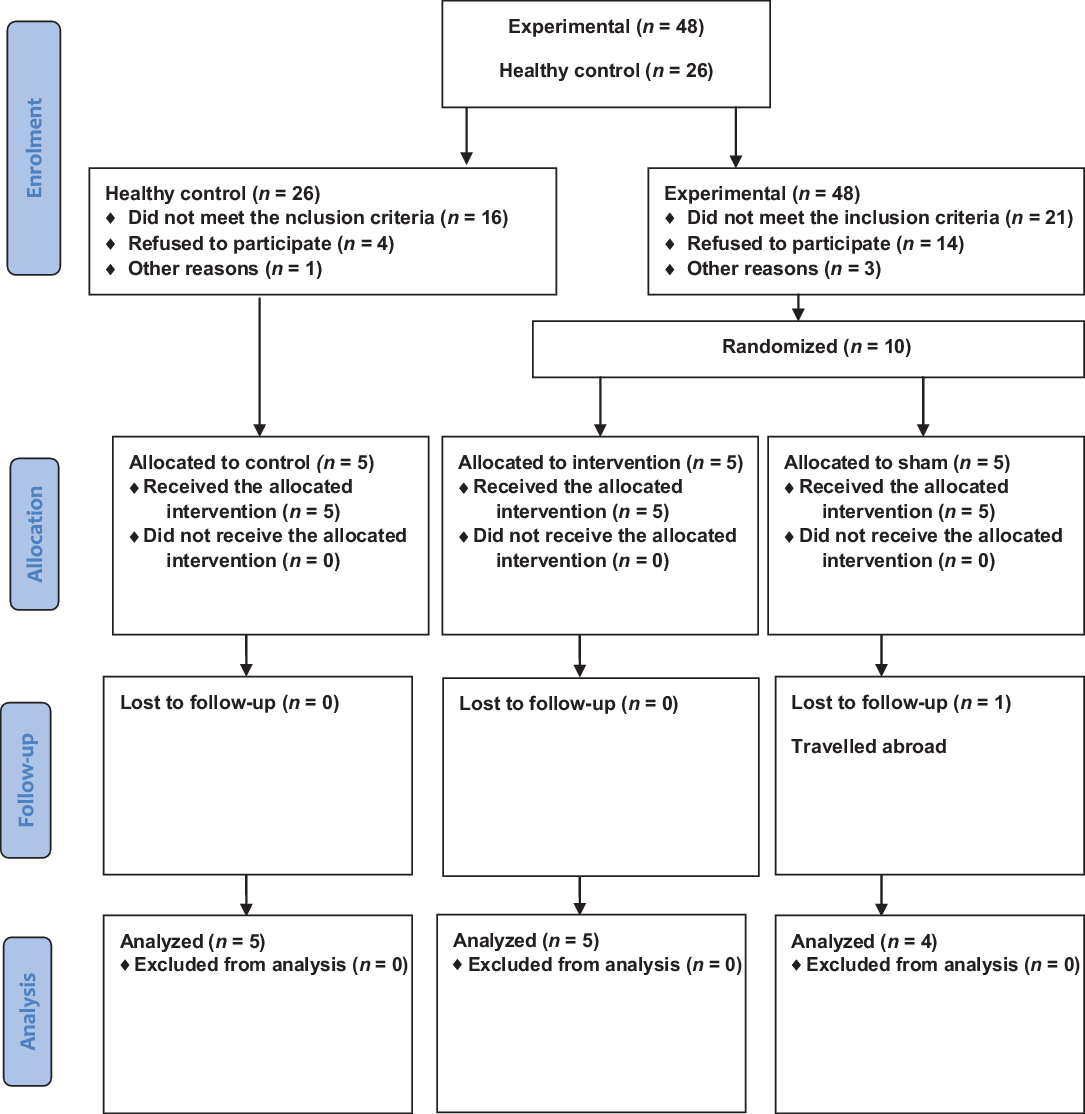
This study was a preliminary randomized controlled trial. The study population consisted of 10 children with LSIH and 5 age-matched healthy children (10 males, 5 females; average age, 12.6 ± 2.2 years). While attending regular school, children in the experimental group were recruited from the rehabilitation center they visited for regular therapeutic intervention. None of the participants had a history of epilepsy or severe cognitive deficit, as per the medical records and interviews with parents. Age-matched healthy controls were selected from the same attending school after obtaining consent and approval from the guardians/parents and the school principal. Ethical approval was obtained from the Deanship of Scientific Research (MU-2017-PHT-009753) of Majmaah University. The study commenced in January 2017 and was completed in February 2019. The study was conducted in accordance with the Declaration of Helsinki, and written informed consent was obtained from the legal guardians or parents of the children before their enrollment in the study. The CONSORT flow diagram shows the flow of participants (see Fig. 1).
Consolidated Standards of Reporting Trials flow diagram.

Only children and adolescents aged between 8 and 15 years who were diagnosed with LSIH due to damage to the nondominant cerebral hemisphere were included in the study. Children with severe intellectual and cognitive deficits (IQ < 50), a history of epilepsy, severe visual impairment not corrected by corrective glasses, or psychiatric illness, and children who were color blind or were taking any type of medication that could impact arousal and behavior were excluded from the study.
We used a simple randomization method to randomly allocate children into intervention, sham, and control groups. Children were assessed on the inclusion and exclusion criteria; 5 of the 26 pooled controls and 10 of the 48 children in the experimental group were found to be eligible to participate in the study. Potential children were sorted into two pools – the experimental pool and a healthy control pool. To create a homogenous number of participants in each group, five opaque sealed envelopes holding a unique number of children were randomly selected for each group by a faculty member at the University Hospital who was not part of the study. The caregivers and researchers responsible for evaluating the children remained blinded.
Intervention
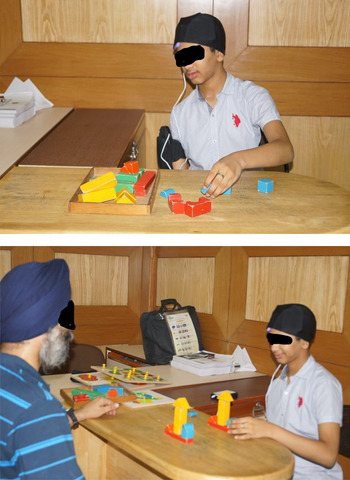
The study comprised three groups (experimental, sham, and control), and all participants performed activities that required SVA. These activities included completing the missing pieces of a picture, copying a picture, identifying an object in a picture, building a house from blocks, and many more fun and visually challenging tasks that were selected from a recent study performed on children with attention deficits (Chu, Reference Chu2003; Valvano & Rapport, Reference Valvano and Rapport2006). These activities were randomly selected by each child’s therapist (See Fig. 2). The rationale for using playful activities was to improve SVA and prevent boredom among children. Attention is a very complex and sensitive construct that may be affected by various factors including mood, emotion, stress, and sleep, and the level of attention varies throughout the day. Therefore, the intervention was scheduled in the morning for all 10 sessions to prevent diurnal variations in attention, and the children were advised to get 8 h of sleep. The mood and level of stress were evaluated using a questionnaire (Osika et al., Reference Osika, Friberg and Wahrborg2007), namely ‘Stress in Children’; this questionnaire has reported Cronbach’s coefficient of 0.856 and good psychometric properties. The emotional state of the children was assessed by psychiatrists through a face-to-face interview. Parents were advised to prevent children from consuming caffeine-rich drinks or coffee before the treatment session, and the test and SVA practice task were performed in a noise-free room without distractions.
Activities to improve selective visual attention.

The tDCS stimulator (ActivaDoseIItDCS Device; IOMED Inc., Salt Lake City, USA) is a standardized instrument that has been used and tested in children. Two tDCS electrodes, of dimensions 3 × 3”, were used for brain stimulation, and the electrodes were inserted into a wet saline sponge. The anode electrode was positioned over F3, in accordance with the international 10–20 Electroencephalogram system (F3 corresponds to the dorsolateral prefrontal cortex [DLPFC]), while the second electrode was a cathode positioned over the contralateral supraorbital region. The electrodes were secured at their respective locations by a head strap. An identical method of application was employed for the five healthy age-matched controls. The intensity of the current was ramped up and down automatically by the device for 30 s.
Experimental group
Five children with LSIH were randomly allocated to this group. All the participants received tDCS for 3 weeks on alternate days and accordingly completed 10 treatment sessions. The intensity of the current was automatically increased to 1.5 mA. A qualified physician and a team of paramedics were present at the time of treatment in case of an emergency. The total treatment duration was 20 min, and the current was slowly reduced to zero at the end of the session. During tDCS, the children were actively engaged in activities that have been shown to improve selective attention. The children were assessed at baseline, at the end of the 5th and 10th sessions, and during a follow-up that was scheduled for 4 months later.
Sham group
Five children with LSIH were randomly allocated to this group. All participants received sham tDCS for 3 weeks on alternate days and completed 10 treatment sessions. The sham tDCS followed preparatory procedures similar to that used for the experimental group, except that the intensity was ramped down to zero after the initial increase in the current. Children generally started the activity without noticing that the current was at zero, but the device stays connected. The children were assessed at baseline, at the end of the 5th and 10th sessions, and during a follow-up that was scheduled for 4 months later.
Control group
Five age-matched healthy children were included in this group. The group completed a treatment protocol similar to that of the experimental group.
Procedures
The intellectual level and the amount of motor deficit in the upper limb were assessed in participants who met the inclusion criteria. All participants were evaluated by experts in the field of psychology and physical therapy.
Intelligence test: The Wechsler intelligence scale for children was used to evaluate the intelligence quotient of the children (Minshew et al., Reference Minshew, Turner and Goldstein2005).
The CSCWT consists of two phases (dos Santos Assef et al., Reference dos Santos Assef, Capovilla and Capovilla2007). The first phase is the preparation phase, where the children were asked to identify the color of a circle on the monitor (red, blue, green, or yellow) and press the corresponding key on the keyboard using the unaffected side. Scores obtained at this stage were not included in the final results. The second phase is the actual test, which consisted of 96 colorful words, divided into 48 correctly matched colorful words and 48 incorrectly matched colorful words. The words that appeared on the computer screen were presented in a randomized sequence. Each word appeared on the computer screen for 2000 ms, with an 800-ms interval. The children were asked to identify the color of the words regardless of their meanings. All responses were recorded by the computer as either correct or incorrect, and the computer calculated the reaction time for the correctly and incorrectly matched colorful words. The test had an acceptable test–retest reliability and validity (Gualtieri & Johnson, Reference Gualtieri and Johnson2006).
Questionnaires were used to screen children with sleep disturbance, anxiety, depression, and a high level of stress (Kroenke et al., Reference Kroenke, Spitzer, Williams and Löwe2010). These evaluations were performed before the assessment and treatment to ensure compliance during the assessment and treatment.
An academic practical test was needed to evaluate the improvement in SVA among children; as such, a reading comprehension (RC) test was added to the outcome variables. All three groups performed a RC test at the baseline, during the 5th and 10th sessions, and during the follow-up period. Two different stories (unread before and of equal difficulty) were selected from their English course and presented to them at the start, and following the completion, of the 10th session. These stories comprised of between 700 and 1000 words, and 20 min were allowed for completion of the story. Ultimately, the children were asked to answer 10 multiple-choice questions related to the story, and each correct answer was assigned 1 point.
Statistical analysis
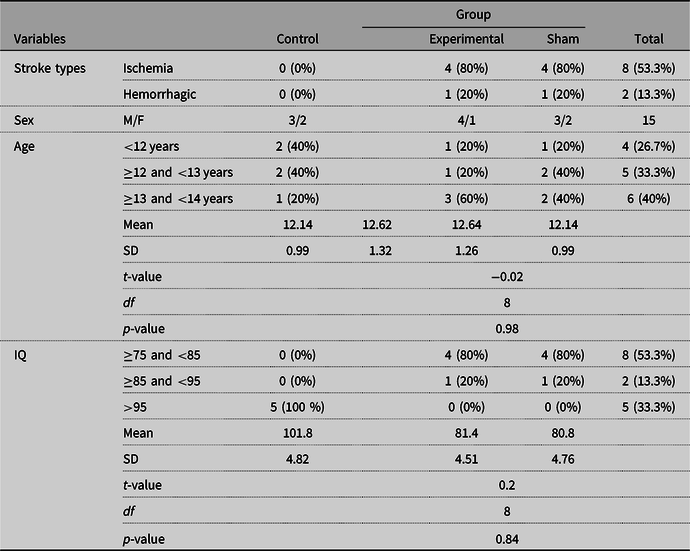
Statistical analyses were conducted using SPSS for Windows, Version 20.0 (SPSS Inc., USA). Baseline characteristics between groups were compared using analyses of variance (ANOVAs) for interval/ratio data and Chi-square test for nominal data (Table 1). A two-way repeated measures ANOVA was used to analyze the within-subject factors of time (baseline, 5th session, 10th session and follow-up) and between-subject factors of group (experimental, sham). One-way ANOVA was used for the inter-group analyses (experimental, sham and control). Paired sample t-tests were used to analyse difference between the four time points across comparable groups (experimental and sham group). Statistical significance was set at p < 0.05.
Demographic Data and Sample Characteristics

IQ, intelligence quotient; M, male; F, female; SD, standard deviation; df, degree of freedom.
Results
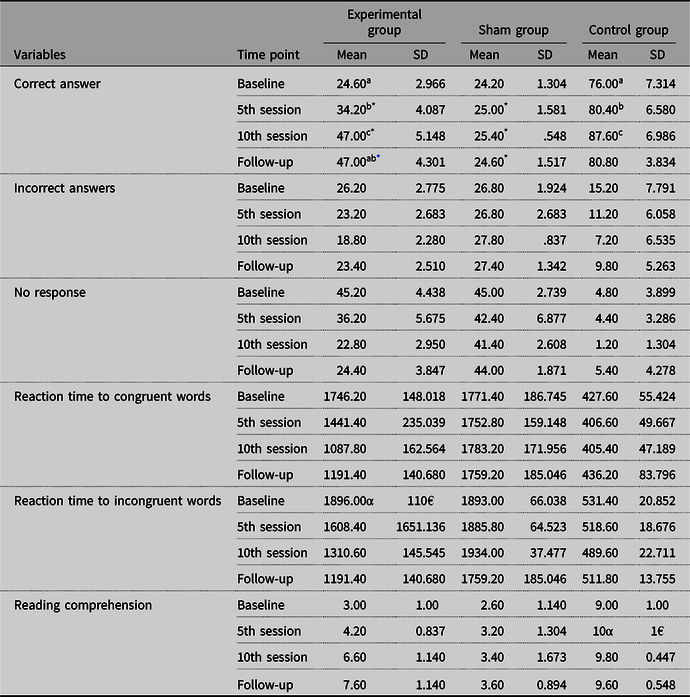
A total of 15 children were included in the final statistical analysis, as follows: experimental group (n = 5), sham group (n = 5) and control group (n = 5). The experimental group was associated with an improvement in the average SVA score compared to the sham group. A two-way repeated measures ANOVA was performed to test the hypothesis that there was a significant difference in the mean scores of correct answers (CA) between the experimental and sham groups. The other variables such as, incorrect answers (ICA), no response (NR), reaction time to congruent words, reaction time to incongruent words (RTIW), and RC were shown as mean and SD in Table 2. The baseline scores of RTIW in the experimental group and posttest (5th session) scores of RC of the control group showed non-normal distribution of data and were reported as median and interquartile range in Table 2. Other variables in the experimental and sham groups were sufficiently normal to analyze variance. Additionally, the test of homogeneity of variance was assumed via Levene’s F-test. ANOVA was conducted to analyze the within-group difference between time points (baseline, 5th session, 10th session and follow-up). We used intention-to-treat analysis and last-observation-carried-forward for one participant lost in follow-up. The data were organized and tabulated using the Statistical Package for the Social Sciences v.20.0 (SPSS, Chicago, IL, USA).
Mean Standard Deviation and Significant Difference Between and Within Groups

Different letters a, b and c in the same column indicate a statistically significant difference (repeated measure ANOVA, p < 0.5).
α Indicate scores in median and € indicates scores in interquartile range.
* Between-group statistically significant difference.
a,b,cThe statistical significant difference between ac and d but not with a and b.
For independent variable CA, two-way repeated measures ANOVA was conducted to analyze within-subject factors of time (baseline, 5th session, 10th session and follow-up) and between-subject factors of group (experimental, sham). The analysis revealed a significant main effect of group (experimental, sham), F (1, 8) = 38.324, p = 0.001, with effect size calculated as partial eta-squared (np 2 ) = 0.827 and time (baseline, 5th session, 10th session and follow-up), F (1, 8) = 198.914, p = 0.001, np 2 = 0.961. In addition, a significant interaction was found between the time points (baseline, 5th session, 10th session and follow-up) and group (experimental, sham), F (1, 8) = 160.514, p = 0.001, np 2 = 0.953.
One-way repeated measures ANOVA showed that mean CA scores differed significantly between time points (baseline, 5th session, 10th session and follow-up) in the experimental group, F(3, 12)= 127.541, p = 0.001; np 2 = 0.970 but not in the sham group, F (3, 12) = 0.941, p = 0.451, np 2 = 0.190. Post hoc analyses for multiple comparisons with Bonferroni correction for the experimental group revealed statistically significant differences between baseline vs. 5th session (p = 0.010), baseline vs. 10th session (p = 0.001), baseline vs. follow-up (p = 0.001), 5th session vs. 10thsession (p = 0.013), and 5th session vs. follow-up (p = 0.006), but not between the 10th session vs. follow-up (p = 0.98).
One-way repeated measures ANOVA showed that mean CA scores differed significantly between time points (baseline, 5th session, 10th session and follow-up) in control group, F(3, 12) = 11.661, p = 0.01, np 2 = 0.745. Post hoc analyses for multiple comparisons with Bonferroni correction revealed statistically significant differences between baseline vs. 5th session (p = 0.025), baseline vs. 10th session (p = 0.025), 5th session vs. 10thsession (p = 0.048) but not between the baseline vs. follow-up (p = 0.524), 5th session vs. follow-up (p = 0.99), and 10th session vs. follow-up (p = 0.433).
A paired sample t-test was conducted to evaluate the difference at four time points (baseline, 5th session, 10th session and follow-up) between experimental and sham group. There was nonsignificant difference at baseline (t (4) = 0.222, p = 0.836). However, the significant difference was found between 5th treatment session (t (4) = 0.4.890, p = 0.008), 10th session (t (4) = 0.8.633, p = 0.001) and on follow-up (t (4) = 0.9.675, p = 0.001).
No side effects occurred during the 10 treatment sessions of tDCS, which were performed with 1.5 mA intensity (3 × 3” Amrex sponge Electrodes), for 20 min, on alternate days among children with IH. A study reported that an intensity range of 1–2 mA is safe among children with childhood-onset schizophrenia (Mattai et al., Reference Mattai, Miller, Weisinger, Greenstein, Bakalar, Tossell and Gogtay2011). Children in the experimental and control groups tolerated the session well, only reporting a sensation of mild, tolerable tingling under the electrodes within the first minute of stimulation. None of the children reported discomfort, and no adverse events were reported during or after the stimulation. However, one child in the experimental group reported childhood absence epilepsy; a family history of seizures was found following a review of the patient’s medical records. This type of seizure is reported to run in families due to a chromosomal abnormality. Moreover, the episode of seizures occurred during the follow-up period.
Discussion
Attention is a crucial cognitive construct for learning. There are five main types of attention: focused attention, which is the ability to respond discretely to stimuli (visual, auditory or tactile); selective attention, which is the ability to focus on task-relevant information and ignore distractions; shifting attention, which is the ability to shift attention to a different aspect of the task; sustained attention, which is the ability to consistently respond to a repetitive stimulus; and divided attention, which is the ability to multi-task. Our study evaluated the effect of tDCS on one construct (SVA) of attention. Future studies will be required to evaluate the effect of tDCS on other constructs of attention. A recent review summarized the effect of brain stimulation on cognitive abilities in children with various neurological disorders (Jacobson et al., Reference Jacobson, Koslowsky and Lavidor2012). Previous studies also reported that bilateral cortical stimulation increased cortical activity to a greater extent than traditional unilateral cortical stimulation. Moreover, multiple sessions of brain stimulation yielded better results than did a single session (Utz et al., Reference Utz, Dimova, Oppenländer and Kerkhoff2010).
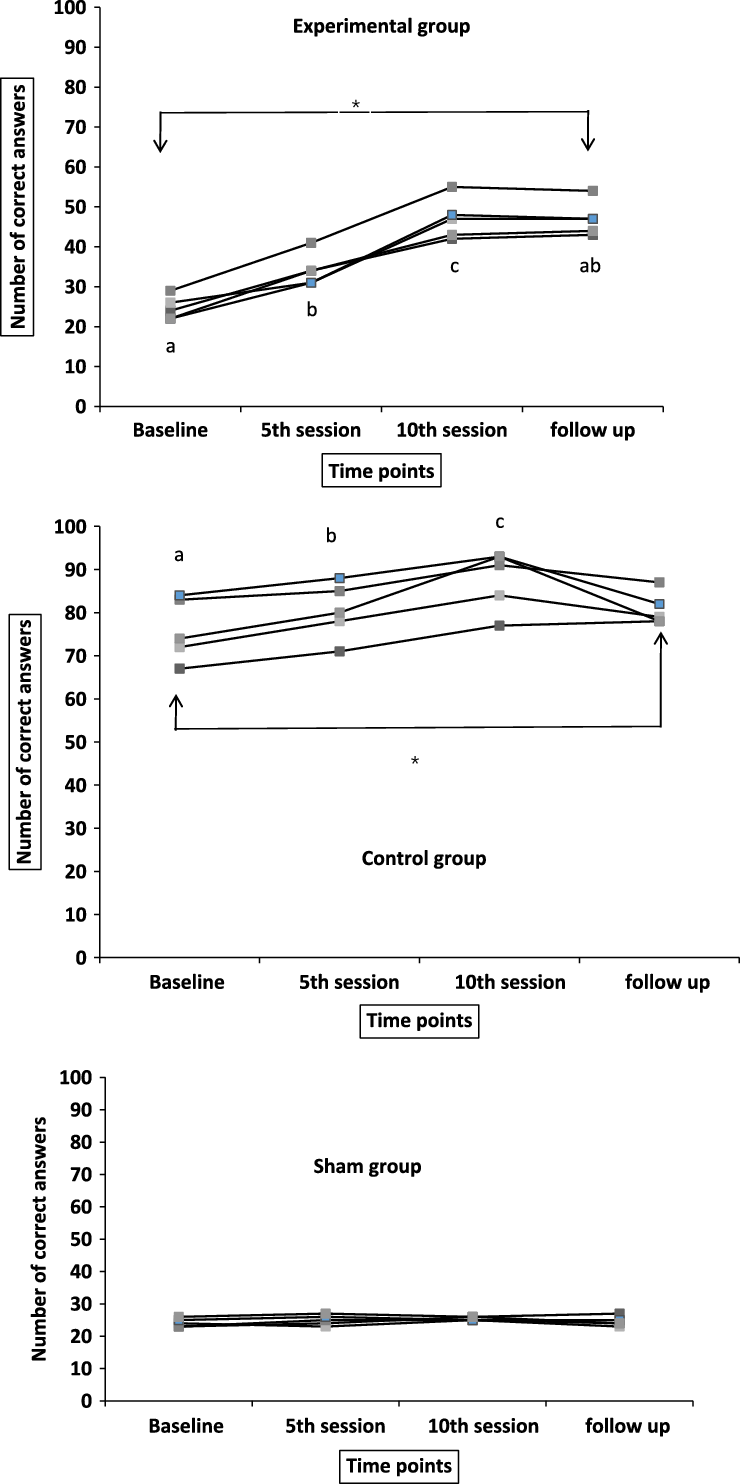
The children in our study received 10 sessions of tDCS over a 3-week period. The outcome variables were assessed at baseline, the 5th and 10th treatment sessions, and on follow-up. There was a significant change in mean scores between the baseline, 5th session and 10th session in the experimental and healthy control groups compared to the sham group. However, the improvements plateaued subsequently on follow-up (see Fig. 3). This indicates that tDCS over the DLPFC has a positive effect on SVA in normal children, as well as in those with attention deficits. The sample is too small to gain a meaningful indication of variability and thus the true effect size is not really known.
Individual participant’s values on correct answers over the time points that higher values are indicative of better selective visual attention. *indicates that there is a statistical significant difference between time points. Post hoc test between time points are indicated by different letters (a, b and c) on the time points indicate a statistically significant difference. While as (ab) indicates that there is statically significance between a and b but not with c. *indicates that there is a statistical significant difference between time points. Post hoc test between time points are indicated by different letters (a, b and c) on the time points indicate a statistically significant difference.

In the current study, we used 58.06 cm2 (3 × 3”) electrodes to deliver the therapeutic current. One study reported that a large (35 cm2) electrode produced better cortical excitation than did a smaller one (16 cm2), among healthy adults (Ho et al., Reference Ho, Taylor, Chew, Gálvez, Alonzo, Bai and Loo2016). Furthermore, they reported that an intensity of 1 mA or 2 mA did not produce significantly different cortical excitability. However, the electrodes on the skull were sufficiently distanced (at least 5 cm) from each other to avoid current shunting for larger electrodes (Hsu et al., Reference Hsu, Ku, Zanto and Gazzaley2015). The shunting of current over the surface of the brain was not measured; however, a computational current model can be utilized in future studies to calculate the resulting electric fields for dosage consideration (Kessler et al., Reference Kessler, Minhas, Woods, Rosen, Gorman and Bikson2013). Previous studies have also shown that a single session of anodal stimulation over the left DLPFC can improve working memory in healthy subjects (Saunders et al., Reference Saunders, Downham, Turman, Kropotov, Clark, Yumash and Szatmary2015). Furthermore, increased cortical activation has been observed following both tDCS and transcranial magnetic stimulation (Miniussi et al., Reference Miniussi, Cappa, Cohen, Floel, Fregni, Nitsche and Priori2008). This low-intensity current delivered through electrodes at specific areas on the skull can change neuronal membrane permeability, modulate top-down neuronal connections and induce neural plasticity, by modulating N-methyl-d-aspartate receptor-dependent long-term potentiation (Stagg & Nitsche, Reference Stagg and Nitsche2011).
Activities that require attention and concentration involve increased activation of the supraorbital area of the frontal lobe and temporal lobe, respectively. The SVA and concentration of children with IH can naturally improve through practice or rehabilitation. It is believed that anodal current increases cortical excitability, whereas cathodal current reduces it. Activities to improve SVA in our study included identifying missing pieces of a picture, copying a picture, identifying an object in a picture, building a house from blocks, and many more fun and visually challenging tasks (San Luis et al., Reference San Luis, López de la Llave and Pérez-Llantada2013). These tasks were assessed randomly between four time points. There is a great chance that the improvement in attention was due to the practice effect, as the time gap between the assessments was short. However, the significant effect on the RC variable, which requires no physical practice, indicates that the improvement was due to tDCS.
Several studies have reported the therapeutic benefits of tDCS in neurological, psychiatric and behavioral disorders (Tortella et al., Reference Tortella, Casati, Aparicio, Mantovani, Senço, D’Urso and Muszkat2015). Indeed, tDCS has been reported to be beneficial for patients suffering from anxiety, pain, depression and aphasia (Martin et al., Reference Martin, Moffa, Nikolin, Bennabi, Brunoni, Flannery and Padberg2018). However, the majority of these studies involved adults, possibly because the safety of the treatment dosage for children has not been well established and the brains of children are still developing (Davis, Reference Davis and Davis2019). However, owing to the small sample size of the study, no conclusions can be drawn until an optimally sized randomized controlled trial is carried out.
Risk mitigation
Seizures among children with IH are common, with a prevalence of approximately 4.0–8.8 per 1000 children (McKissock, Reference McKissock1953). None of the participants in the experimental and sham groups (n = 10) showed any epileptic signs or symptoms during the entire treatment session; however, one participant in the sham group experienced a seizure during the follow-up period. Thus, it may be presumed that certain physical and psychological characteristics, such as a thin cranial cavity, small head size and other psychological traits, distinguish children from adults (Gkantidis & Halazonetis, Reference Gkantidis and Halazonetis2011). The brains of children and adolescents undergo constant plastic and cognitive changes during development (Sowell et al., Reference Sowell, Peterson, Thompson, Welcome, Henkenius and Toga2003). Therefore, the tDCS protocol must account for the age of each subject. It has been reported that tDCS induces different physiological effects on the brain among children in different age groups, even when using the same protocol. In fact, a study reported that 1 mA cathodaltDCS for 10 min increased motor-evoked potentials (MEPs) in children but decreased MEPs in adults (Nitsche & Paulus, Reference Nitsche and Paulus2000). However, when the intensity of stimulation was reduced to 0.5 mA, cathodaltDCS caused a reduction in MEP amplitude in children (Moliadze et al., Reference Moliadze, Schmanke, Andreas, Lyzhko, Freitag and Siniatchkin2015).
Future studies
Future studies must contain a large sample size to increase the validity and generalizability of neurocognitive therapy.
Future studies should explore the effect of tDCS on other cognitive functions.
Limitations
There are many limitations in our study. First, the sample size was small and results of the study cannot be generalized; however, participants complied with the study design. Future research with the large sample size is needed. Second, there was no sham control group to compare with the healthy children group because many participants refused to participate and others did not meet the inclusion criteria due to the narrow age range in the inclusion criteria. We had limited access to schools. Parental apprehension about brain stimulation was the other reason for the limited recruitment of healthy children. Third, the practice effect might have occurred due to assessment within short intervals. However, the items in the assessment, as well as the order of assessment tools, were randomized.
Conclusion
These pilot results suggest that future research should be conducted with adequate samples to enable conclusions to be drawn.
Acknowledgements
We would like to thank all children who participated in our study. We would also like to thank Dr. M.A., Dean of College of Applied Medical Sciences, for the constant support and encouragement throughout the research project.
Financial support
The authors extend their appreciation to the Deputyship for Research and Innovation, Ministry of Education in Saudi Arabia for funding this research work through the project number (IFT-2020-60).
Conflicts of interest
RAA has no conflicts of interest to disclose. SAA has no conflicts of interest to disclose. FK has no conflicts of interest to disclose. MIW has no conflicts of interest to disclose. HS has no conflicts of interest to disclose. MA has no conflicts of interest to disclose.
Ethical standards
The authors assert that all procedures contributing to this work comply with the ethical standards of the relevant national and institutional committees on human experimentation and with the Helsinki Declaration of 1975, as revised in 2008.