Implications
Increasing the plane of nutrition offered to ewe replacements, lambing at 2 years, during their first winter increased lamb BW at birth. Pregnancy plane of nutrition had a greater impact on ewe performance during gestation, and on subsequent lamb performance until slaughter, than did altering the plane of nutrition at other stages of the rearing phase. Although ewe genotype (litter size varying from 1.48 to 2.45) had a major effect on the number of lambs reared and on lamb performance, there was no evidence for any significant interactions between plane of nutrition offered during the rearing phase, or during first pregnancy, and ewe genotype.
Introduction
The main factors affecting the efficiency of mid-season, grass-based systems of prime-lamb production are litter size, grassland management, feed value of forage offered during the winter housing period, shearing at housing, condition score at mating and leaving male lambs uncastrated (Keady and Hanrahan, Reference Keady and Hanrahan2006). The mean replacement rate on lowland sheep units in Ireland is 22%, based on National Farm Survey data (Keady, Reference Keady2014). Hanrahan (Reference Hanrahan2007) reported that the annual ewe replacement rate in a research flock was influenced by ewe genotype; the replacement rates for Belclare-X and Suffolk-X ewes were 23% and 21%, respectively. Keady (Reference Keady2014) also reported that the mean cost of rearing ewe replacements to the time of first joining (~18 months) equated to ~25% of the total value of lamb carcass produced during their lifetime. Two ways of reducing replacement costs are: (i) increasing litter size and, thus, the number of lambs reared and lamb carcass output per ewe joined; (ii) altering the plane of nutrition offered during the first winter and second summer in a grass-based system. Although the effects of plane of nutrition during the rearing phase on subsequent ewe performance have been evaluated in range or hill environments (Bradford et al., Reference Bradford, Weir and Torell1961; Purser and Roberts, Reference Russel, Doney and Gunn1964; Gunn, Reference Gunn1972 and Reference Gunn1977) there is a paucity of data for lowland grass-based systems.
The primary objective of the present study was to evaluate the effects of plane of nutrition offered to replacement ewes, during different stages of the rearing phase and during their first pregnancy, on the performance during that pregnancy (lambing at 2 years) and subsequent lactation, and on the performance of their progeny to slaughter. A second objective was to examine these responses for a range of ewe genotypes, differing in prolificacy potential, to determine whether there were any interactions between plane of nutrition and ewe genotype.
Material and methods
All animal procedures used in this study were conducted under experimental licence from the Irish Department of Health and Children (Dublin) in accordance with the Cruelty to Animals Act 1876 and the European Communities (Amendment of Cruelty to Animals Act 1876) Regulations 2002 and 2005.
Forages
Two grass silages, medium feed-value (MFV) and high feed-value (HFV), were produced in 3 consecutive years using herbage from the primary growth of permanent, predominantly perennial ryegrass, swards. The HFV silage was ensiled on 3, 12 and 12 May in the successive years, following a 24-h wilting period. The MFV silage was ensiled on 5, 9 and 8 June in the successive years following a 4 h wilt. In all cases the herbage was treated with a bacterial inoculant containing Lactobacillus plantarum MTD/1 (Ecosyl; Ecosyl Products Ltd, Stokesley, England) at the rate of 3 l/t, to supply 106 CFU/g fresh herbage. The herbage was mown and ensiled, and an additive was applied, as described by Keady and Hanrahan (Reference Keady and Hanrahan2015).
Animals and management
A total of 287 spring-born ewe lambs were allocated to the study over 3 consecutive years. Four genotypes were represented: Charmoise×Scottish Blackface (C×SBF), Belclare×SBF (Bel×SBF) and Belclare×SBF that were heterozygous carriers of either FecGH or FecXG mutations (BelMG×SBF) and Belclare (Bel). FecGH and FecXG are mutations (in GDF9 and BMP15 genes, respectively) that cause a large increase in ovulation rate (Hanrahan et al., Reference Hanrahan and Keady2004). The ewe lambs used in the first year comprised Bel×SBF and C×SBF; the two subsequent cohorts comprised Bel×SBF, BelMG×SBF and Bel. The lambs were assembled and managed until they were joined with rams (at ~18 months of age) as described by Keady and Hanrahan (Reference Keady, Hanrahan and Flanagan2017). Each year the ewe lambs were stratified by genotype and BW and allocated to eight groups, and these groups were randomly allocated to one of eight treatments. The eight treatments consisted of two daily allowances of deferred-grazed herbage (0.75 kg (L) or 1.75 kg (H) dry matter (DM) per head) during their first winter (winter_1) by two planes of nutrition during the subsequent summer (summer_2), achieved by set-stocking to maintain sward heights of 4 cm (L) or 6 cm (H), by two conserved forages (MFV or HFV grass-silage) from mid pregnancy until lambing (winter_2). Full details of the dates of initiation and completion, and of plane of nutrition offered during winter_1 and summer_2, are in Keady and Hanrahan (Reference Keady, Hanrahan and Flanagan2017). The oestrous cycles of the ewes were synchronised, using progestogen-impregnated sponges, and they were joined with a panel of Suffolk rams 17 days after sponge removal. Rams were joined on 19, 21 and 23 October in years 1, 2 and 3, respectively. Rams were removed after 4 days and rejoined with the flock 12 days later to mate any repeats.
The ewes were housed (mean date 1 December) during mid and late pregnancy in straw-bedded pens; grass silage was offered once daily in sufficient quantities to allow a refusal of 50 to 100 g/kg offered. Ewes were shorn within 1 week of housing and scanned for litter size in mid January. Annual booster vaccine (Heptavac-P; MSD Animal Health, Buckinghamshire, England) for pasteurella pneumonia and clostridal disease was administered 2 weeks before lambing. Ewes scanned as carrying singles, twins, triplets or quadruplets received a total supplement of 13, 20, 28 and 31 kg concentrate, respectively, during late pregnancy. The concentrate was offered to the single- and twin-bearing ewes, and to the triplet- and quadruplet-bearing ewes during the final 6 and 7 weeks of pregnancy, respectively. Concentrate allowance was stepped from 0.2 to 0.5, 0.2 to 0.8, 0.3 to 0.9 and 0.3 to 0.9 kg/day for ewes identified as carrying singles, twins, triplets and quadruplets, respectively. The concentrate consisted of (fresh weight) 350, 350, 250, 25 and 25 g/kg barley, citrus pulp, soyabean meal, molasses and minerals plus vitamins, respectively. The concentrate was offered once daily at ~1000 h.
Ewes lambed indoors and were put out to pasture, along with their lambs, within 3 days of lambing. All ewes rearing singles or twins were grazed together in a rotational grazing system and received no concentrate post lambing. Ewes rearing triplets were grazed as a separate flock and offered a daily concentrate supplement of 0.5 kg for 5 weeks post lambing. Concentrate was offered to lambs reared as triplets, up to a maximum of 300 g/lamb daily, until weaning. Ewes that gave birth to quadruplets and had four live lambs had at least one lamb removed to an artificial rearing unit. All lambs were weaned at 14 weeks and managed as one flock, without any concentrate supplementation, until drafted for slaughter. Lambs were treated for internal parasites at 5 weeks of age (levamisole hydrochloride; Chanelle, Loughrea, Co. Galway, Ireland). At 10 and 14 weeks of age, and then at intervals of 4 weeks until drafting, the lambs were treated for internal parasites using oral ivermectin (Oramec; Merial Animal Health, Harlow, Essex, England). Ewe and ram lambs were drafted when BW exceeded 41 and 42 kg, respectively, during June; these thresholds were increased to 44 and 45 kg subsequently.
Measurements
The sampling of the deferred-grazed herbage offered in winter_1 and the measurements of the swards that the ewes grazed on in summer_2 are described in Keady and Hanrahan (Reference Keady, Hanrahan and Flanagan2017). The silage offered during winter_2 was sampled once weekly for the determination of oven DM, and dried samples of offered silage were bulked weekly for the determination of ADF, NDF and ash. A composite sample of fresh silage (as offered) was taken once weekly and analysed for ethanol, propanol, CP, ammonia N, acetate, propionate, butyrate, valerate and lactate concentrations as well as for pH. A further composite sample of fresh silage, as offered, was taken once weekly and analysed for DM digestibility (DMD), digestible organic matter in the DM (DOMD) and metabolisable energy (ME) concentrations using NIRS. Silage DM was determined by oven-drying at 85°C for 24 h. Corrected silage DM was determined as described by Porter and Murray (Reference Purcell, Law, Gordon, McGettrick and Ferris2001). Chemical composition of the silage was determined as described by Purcell et al. (Reference Purser and Roberts2016).
Ewe BW and body condition score (BCS) (Russel et al. 1969) were recorded post joining (age ~20 months), at mid pregnancy (age ~22 months), at lambing (age ~2 years) and at 5 and 14 weeks post lambing. Withers height, body length, chest (heart) girth and the circumference of the cannon bone were measured, as described by Keady and Hanrahan (Reference Keady, Hanrahan and Flanagan2017), for all ewes at weaning. Litter size refers to the number of lambs born per ewe lambing; a lambing assistance score was recorded for each ewe on a three-point scale (1=unassisted, 2=minor assistance and 3=major intervention) (Keady and Hanrahan, Reference Keady and Hanrahan2009a and Reference Keady and Hanrahan2009b). All lambs were tagged and weighed within 24 h of birth; lambs that were dead at this time are referred to as dead-born (includes any that died between delivery and tagging). Lambs were weighed again at average ages of 5, 10 and 14 (weaning) weeks, and at intervals of 4 weeks between weaning and drafting for slaughter. Lamb average daily gain (ADG) was calculated for the intervals 0 to 5, 5 to 10, 10 to 14, 0 to 14 weeks and for the interval from birth to drafting. Total lamb mortality refers to lambs that were not alive at the 5-week weighing point. Ewes without a litter size record were classified as ‘failed to lamb’, which includes barrenness and pre-lambing mortality.
Lambs were slaughtered, within 18 h of drafting, at an abattoir approved by the European Union, as described by Keady and Hanrahan (Reference Keady and Hanrahan2013 and Reference Keady and Hanrahan2015). Carcass weight (cold) was recorded for each lamb at slaughter. Carcass conformation class and fat score were assigned by abattoir staff, based on visual assessment, according to the European Lamb Carcass Classification Scheme. There were five conformation classes: E (=good), U, R, O and P (=poor) – which were coded as 5, 4, 3, 2 and 1, respectively, for data analysis – and five fat scores (1=leanest to 5=fattest).
Statistical analyses
All data analyses were executed by fitting linear models using Proc GLM, Proc MIXED or Proc GENMOD of SAS (2011), as appropriate. Because not all genetic groups were represented in each annual cohort, the basic linear model used in all cases had a fixed effect that represented the combination of year of birth and genetic group. The basic linear model for traits measured in ewes had fixed effects for year-of-birth-by-genetic-group, plane of nutrition before joining and level of nutrition during pregnancy; all two-way interactions and three-way interactions among these effects were evaluated in preliminary analyses. As there was no evidence (P>0.2) that the three-way interaction was a significant source of variation for any trait this term was excluded from all models. The differences among genetic groups were primarily evaluated by calculating the contrast between Bel×SBF, which was represented in all cohorts, and each of the other genetic groups. The effects of genetic group are presented as these differences along with the least squares mean for the Bel×SBF group. The interactions between genetic group and nutrition treatments were partitioned based on the following set of orthogonal contrasts among genetic groups:
-
∙ Bel×SBF v. C×SBF;
-
∙ Bel v. mean of Bel×SBF and BelMG×SBF; and
-
∙ Bel×SBF v. BelMG×SBF.
Analogous contrasts were also used to partition components for interactions between year of birth and treatment, and all components of interactions involving treatment, year of birth and genetic group. The data on linear body measurements for ewes at weaning were analysed using the MANOVA option in Proc GLM and the set of contrasts as indicated above were evaluated. Because the incidence of ewes with an assistance score=3 (major intervention) was very low (<8%; 0 for one cohort) the data for assistance score were recoded as ‘no assistance’ or ‘assistance’ for analysis. Proc GENMOD was used for analysis of binomial traits, with a logit link function and the same linear model structure as already indicated; contrasts were used to evaluate single-degree-of-freedom components. The analysis of lamb performance traits employed mixed models with dam as the random term and fixed effects for year-of-birth-by-genetic-group, nutritional regime of dam during winter_1 and summer_2, winter_2 diet, sex, birth-by-rearing type (birth type only for BW at birth) and grazing-treatment-by-winter_2-diet interaction. Because the latter interaction failed to approach formal significance for any variable, it was dropped from the final model for lamb performance traits. Orthogonal contrasts were used to partition the effects of grazing-treatment and grazing-treatment×genetic-group interactions into single-degree-of-freedom components with the same genetic group components as described above.
Results
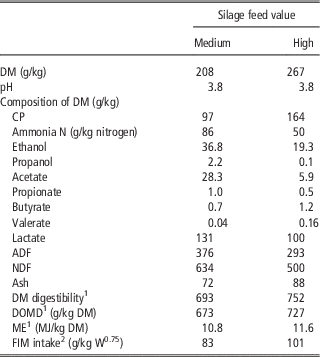
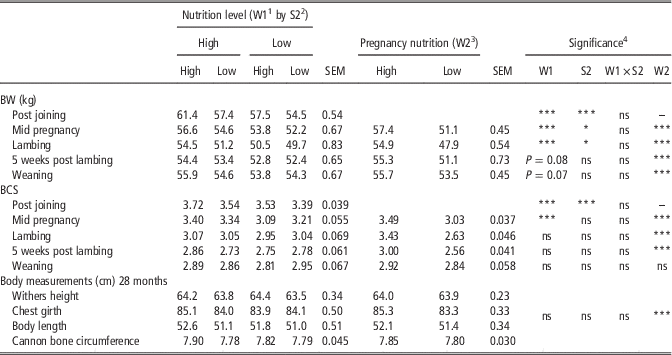
The chemical composition of the silages is presented in Table 1. The silages were well preserved, as indicated by pH and the concentrations of ammonia N and butyrate. The feed value of the silages differed as indicated by the predicted intake potential, DMD, DOMD and the concentrations of ME and CP. The effects of plane of nutrition offered during winter_1, summer_2 and winter_2 on ewe BW and BCS are presented in Table 2. Increasing the plane of nutrition during winter_1 increased (P<0.001) BW post joining, during mid pregnancy and at lambing; tended to increase BW at 5 weeks post lambing (P=0.08) and at weaning (P=0.07); and increased ewe BCS (P<0.001) post joining and at mid pregnancy. The higher plane of nutrition offered during summer_2 increased BW post joining (P<0.001), at mid pregnancy (P<0.05) and at lambing (P<0.01); and increased BCS post joining (P<0.001). Increasing the plane of nutrition during winter_2 increased ewe BW (P<0.001) at mid pregnancy, lambing, 5 weeks post lambing and weaning; and increased (P<0.001) BCS at mid pregnancy, lambing and 5 weeks post lambing. Increasing the plane of nutrition offered during winter_2 increased body size (P<0.001), as indicated by the differences in withers height, chest girth, body length and the circumference of the cannon bone at 28 months of age (weaning). Body measurements at weaning were unaffected (P>0.05) by either plane of nutrition during winter_1 or summer_2. There were no significant (P>0.05) interactions between the plane of nutrition offered during winter_1 and summer_2 for ewe BW or BCS at any time point.
Chemical composition of the silages offered to the ewes in winter_2

DM=dry matter; DOMD=digestible organic matter in the DM; ME=metabolisable energy; FIM=feed-into-milk.
1 Determined by NIRS.
2 Keady et al. (Reference McCann, Goode, Harvey, Caruolo and Mann2004).
Effect of plane of nutrition (low, high) during winter_1 (W1), summer_2 (S2) and winter_2 (W2) on ewe BW and condition score, and linear body measurements

BCS=body condition score.
1 Winter_1=late November to late March (12 months old).
2 Summer_2=late March to late August (17 months old).
3 Winter_2=early December to lambing (24 months old).
4 Results from multivariate tests in the case of body measurements.
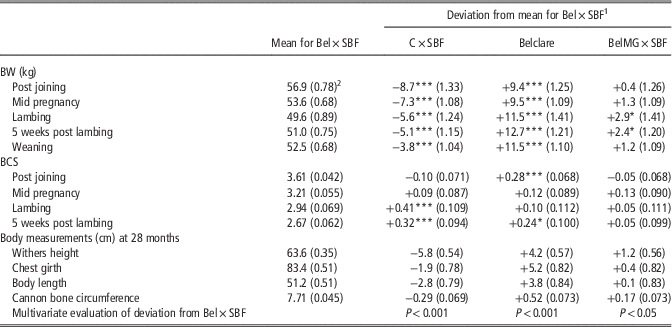
The effects of ewe genotype on BW and BCS, and on body measurements at weaning, are presented in Table 3. Relative to the Bel×SBF, C×SBF ewes were significantly lighter (P<0.001), whereas Bel ewes were significantly heavier (P<0.001) at each time point. At lambing and 5 weeks post lambing the BelMG×SBF ewes were significantly heavier (P<0.05) than the Bel×SBF ewes. The C×SBF ewes had a higher (P<0.001) BCS than the Bel×SBF ewes at lambing and at 5 weeks post lambing. The Bel ewes had a significantly higher BCS post joining (P<0.001) and at 5 weeks post lambing (P<0.05) compared with the Bel×SBF ewes. The difference in BCS between Bel×SBF and BelMG×SBF ewes was not significant (P>0.05) at any time point. Relative to the Bel×SBF ewes, C×SBF ewes had a smaller body size (P<0.001), as indicated by the differences in withers height, chest girth, body length and the circumference of the cannon bone, at weaning. The Bel ewes had a larger body size (P<0.001) than the Bel×SBF ewes as did the BelMG×SBF ewes (P<0.05).
Effect of ewe genotype on BW, body condition score and body measurements

BCS=body condition score.
1 Bel×SBF=Belclare×SBF; C×SBF=Charmoise×Scottish Blackface; BelMG×SBF=Belclare×SBF that were heterozygous carriers of either FecGH or FecXG mutations.
2 Standard error.
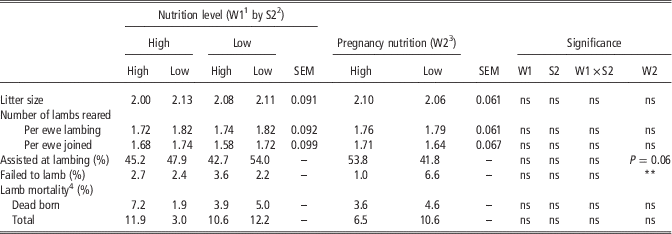
The effects of plane of nutrition on litter size and number of lambs reared per ewe are presented in Table 4. Increasing the plane of nutrition offered during winter_1, summer_2 or winter_2 had no effect (P>0.05) on litter size, or on number of lambs reared per ewe lambing or per ewe joined. The incidence of lambs classified as born-dead was significantly associated with litter size (P<0.001); the incidences were 2.4%, 4.1%, 5.7% and 14.1% for lambs born as singles, twins, triplets and quadruplets, respectively. The pairwise differences were not significant for singles v. twins (P=0.68), singles v. triplets (P=0.34) or for twins v. triplets (P=0.10); the incidence of born-dead lambs for litter size=4 was significantly higher than that for singles (P<0.01), twins (P<0.01) and triplets (P<0.05). Plane of nutrition offered during winter_1, summer_2 or winter_2 had no effect on lamb mortality at birth (Table 4) but there was a significant three-way interaction (P=0.04), between the effects of winter_1, summer_2 and winter_2 levels of nutrition, for total lamb mortality. This reflected a very low level of mortality (2.6%) for lambs born to ewes that experienced a high plane of nutrition in winter_1, a low plane of nutrition during summer_2 and a low plane of nutrition during winter_2. Although total mortality was greater for lambs born to ewes on the low level of winter_2 nutrition than for those born to ewes on the high level of nutrition during winter_2 the difference was not significant.
Effects of plane of nutrition (low, high) offered to ewes during winter_1 (W1), summer_2 (S2) and winter_2 (W2) on litter size, number of lambs reared, assistance at lambing and lamb mortality

1 Winter_1=late November to late March (12 months old).
2 Summer_2=late March to late August (17 months old).
3 Winter_2=early December to lambing (24 months old).
4 Twin-lamb basis.
Results for the effects of nutritional history on the level of assistance at lambing and the proportion of ewes joined that failed to deliver lambs are summarised in Table 4. The incidence of assistance at lambing was significantly associated with litter size (P<0.001); the incidences were 44.3%, 40.5%, 55.4% and 94% for litter sizes 1, 2, 3 and 4, respectively. The pairwise differences were not significant for singles v. twins (P=0.90) or singles v. triplets (P=0.24). However, pairwise differences were significant for singles v. quadruplets (P<0.001), twins v. quadruplets (P<0.001) and for triplets v. quadruplets (P<0.05) and approached significance for twins v. triplets (P=0.10). Plane of nutrition offered during winter_1 or summer_2 had no effect (P>0.05) on ewe mortality, the incidence of ewes that failed to lamb or on the incidence of assistance at lambing. The high plane of nutrition during winter_2 tended to increase (P=0.06) the incidence of assistance at lambing and reduced the incidence of ewes that failed to lamb (P<0.01). The latter reflected both a lower incidence of barren ewes and of ewe mortality (all ewes that proved barren were from the low plane of winter_2 nutrition treatment, whereas seven of nine ewes that died pre lambing were also from this treatment). There was no evident association between either of these components and plane of nutrition before joining but the small number of cases precluded formal analysis. Plane of nutrition offered during winter_1 or summer_2 had no effect (P>0.05) on ewe mortality.
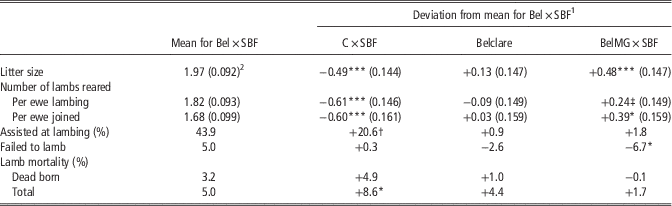
The effects of ewe genotype on litter size and number of lambs reared per ewe are presented in Table 5. Relative to the Bel×SBF ewes, C×SBF ewes had a lower litter size (P<0.001), and a lower number of lambs reared per ewe lambing (P<0.001) and per ewe joined (P<0.001). The BelMG×SBF ewes had a higher litter size (P<0.001) and number of lambs reared per ewe joined (P<0.05) than did the Bel×SBF ewes, and tended to have a greater number of lambs reared per ewe lambing (P=0.10). The Bel×SBF and Bel ewes had similar values (P>0.05) for litter size, and for the number of lambs reared per ewe lambing and per ewe joined. The effects of ewe genotype on lamb mortality, assistance at lambing and the incidence of ewes that failed to lamb are shown in Table 5. Relative to the Bel×SBF ewes, C×SBF ewes had a higher total lamb mortality (P<0.05) and tended to require a higher incidence of assistance at lambing (P=0.06). Relative to the Bel×SBF ewes, fewer BelMG×SBF ewes failed to lamb (P<0.05).
Effect of ewe genotype on litter size, number of lambs reared, assistance at lambing and lamb mortality

1 Bel×SBF=Belclare×SBF; C×SBF=Charmoise×Scottish Blackface; BelMG×SBF=Belclare×SBF that were heterozygous carriers of either FecGH or FecXG mutations.
2 Standard error.
†P=0.06, ‡P=0.01.
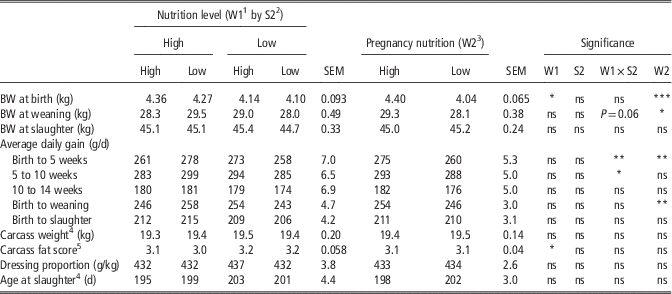
The effects of plane of nutrition offered to ewes during winter_1, summer_2 and winter_2 on lamb performance traits are summarised in Table 6. Increasing the winter_1 nutrition level increased lamb BW at birth (P<0.05) and reduced carcass fat score (P<0.05). Winter_1 and summer_2 nutrition levels offered to ewe replacements had no effect (P>0.05) on lamb BW at weaning or slaughter, carcass weight or dressing proportion. However, there were significant interactions between the levels of winter_1 and summer_2 nutrition for lamb ADG from birth to 5 weeks (P<0.01) and ADG from 5 to 10 weeks, whereas this interaction approached significance for lamb BW at weaning (P=0.06). The best performance was recorded by lambs from dams that had experienced either an increase or decrease in plane of nutrition from winter_1 to summer_2, whereas the progeny born to ewes that remained either on the low or high plane of nutrition during both winter_1 and summer_2 had lower ADG. Increasing the plane of nutrition offered to ewes during winter_2 increased lamb BW at birth (P<0.001) and weaning (P<0.05), and lamb ADG from birth to 5 weeks (P<0.01) and from birth to weaning (P<0.01). Plane of nutrition offered during winter_2 had no effect (P>0.05) on lamb carcass weight, carcass fat score or age at slaughter. Because 95% of carcasses were classified as conformation ‘R’ this variable was not subjected to statistical analysis.
Effects of plane of nutrition offered to ewes during winter_1 (W1), summer_2 (S2) and winter_2 (S2) on lamb performance

1 Winter_1=late November to late March (12 months old).
2 Summer_2=late March to late August (17 months old).
3 Winter_2=early December to lambing (24 months old).
4 At fat score=3.
5 At constant carcass weight.
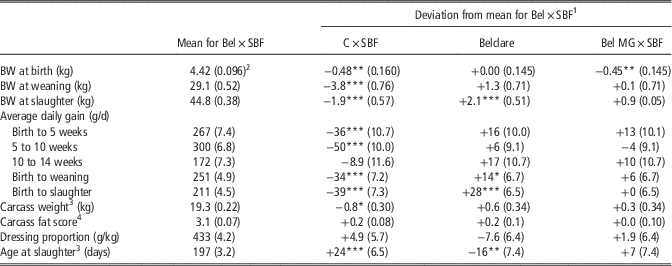
The effects of ewe genotype on lamb performance are presented in Table 7. Lambs born to C×SBF ewes were significantly lighter at birth (P<0.01), weaning (P<0.001) and slaughter (P<0.001), and had lower ADG from birth to 5 weeks (P<0.001), 5 to 10 weeks (P<0.001) and birth to weaning (P<0.001) than those born to the Bel×SBF ewes; they also had a lower carcass weight (P<0.05) and were older at slaughter (P<0.001). Relative to the Bel×SBF ewes, the Bel ewes produced lambs that had a higher ADG from birth to weaning (P<0.05), were heavier (P<0.001) and younger (P<0.01) at slaughter, and tended to be heavier at weaning (P=0.07). The BelMG×SBF ewes produced lambs that were lighter at birth (P<0.01) and tended to be heavier at slaughter (P=0.09) compared with lambs born to the Bel×SBF ewes. Otherwise, there was no difference (P>0.05) in ADG, slaughter BW, age at slaughter or carcass fat score between lambs from ewes of the BelMG×SBF and Bel×SBF genotypes.
Effect of ewe genotype on lamb performance

1 Bel×SBF=Belclare×SBF; C×SBF=Charmoise×Scottish Blackface; BelMG×SBF=Belclare×SBF that were heterozygous carriers of either FecGH or FecXG mutations.
2 Standard error.
3 At fat score=3.
4 At constant carcass weight.
Discussion
The effects of altering the plane of nutrition offered to replacement ewes on growth and development to first joining, at 19 months, are in Keady and Hanrahan (Reference Keady, Hanrahan and Flanagan2017). This paper concerns the effects of plane of nutrition during the rearing phase to first joining and that during the subsequent pregnancy (winter_2) on the performance of ewes during first pregnancy and lactation, and the growth of their progeny until slaughter. The plane of nutrition offered during winter_2 was manipulated through silage feed value. All ewes, regardless of treatment, that were identified to be carrying singles, twins, triplets or quadruplets received 13, 20, 28 and 31 kg concentrates, respectively. The MFV grass silages offered in the current study were similar to the average feed value, as indicated by DM and DMD, of silage produced in Ireland (Keady, Reference Keady2000). The expected mean litter size for the genotypes used in the current study varied from 1.5 to 2.5. The mean litter size for lowland mid-season flocks in Ireland is ~1.6 (Hanrahan, Reference Hanrahan2010). Thus, litter size of the genotypes used ranged from 1 to 1.6 times the national average.
Effects of plane of nutrition
Winter_1 nutrition
Results reported in the first paper of the current series (Keady and Hanrahan, Reference Keady, Hanrahan and Flanagan2017) showed that altering the plane of nutrition during winter_1 changed BW at the end of winter_1 and at first joining by 7.8 and 4.1 kg, respectively. In the current study, although the effect of plane of nutrition during winter_1 on ewe BW was still significant at lambing the difference in BW between the two planes of nutrition had declined to 2.8 kg; the difference had declined to 1.2 kg at 28 months (weaning). Previous authors who altered the plane of nutrition offered to ewe replacements in early life (from 0 to 12 months: Gunn, Reference Gunn1977; from 6 to 12 months: Purser and Roberts, Reference Russel, Doney and Gunn1964; Gunn, Reference Gunn1972) and from 6 to 16 months (Bradford et al., Reference Bradford, Weir and Torell1961)) also reported that the benefit to ewe BW from increasing the plane of nutrition during the rearing phase declined as animals got older. However, Bradford et al. (Reference Bradford, Weir and Torell1961), Purser and Roberts (Reference Russel, Doney and Gunn1964) and Gunn (Reference Gunn1972 and Reference Gunn1977) reported that, at ~30 months of age, ewes that had been offered a higher plane of nutrition during the rearing phase were still 2.4, 3.0, 2.3 and 1 kg heavier, respectively. These studies were undertaken in the context of hill or range conditions, whereas the ewes in the current study were grazed on intensively managed lowland pasture and, consequently, had a greater and more consistent supply of feed providing ample opportunity for compensatory growth of ewes previously on a low plane of nutrition.
The absence of an effect of plane of nutrition offered during winter_1 on litter size is consistent with the lack of an effect on ovulation rate (Keady and Hanrahan, Reference Keady, Hanrahan and Flanagan2017). As the plane of nutrition offered during winter_1 had no effect on the proportion of ewes that lambed there was no effect on the number of lambs born per ewe joined. This contrasts with the results of Purser and Roberts (Reference Russel, Doney and Gunn1964) and Gunn (Reference Gunn1977). Purser and Roberts (Reference Russel, Doney and Gunn1964) reported that increasing the plane of nutrition offered to replacement hill ewes between 6 and 12 months of age increased lambing percentage when lambing at 2 years, because of a higher proportion of twins, but there was no effect on the weight of the weaned lamb. Gunn (Reference Gunn1977) concluded that although rearing treatment had a significant effect on lifetime production, based on the number of lambs born, there was no difference in the number of lambs marked (4 to 7 weeks of age). The difference between the results from the current study and those of Purser and Roberts (Reference Russel, Doney and Gunn1964) and Gunn (Reference Gunn1977) is probably a consequence of the different nature of the environments involved (natural hill vegetation and lowland pasture) and, thus, different feed availability.
The significantly lower mortality of lambs born to ewes offered the high plane of nutrition during winter_1 is essentially a reflection of the unusually low mortality recorded for lambs born to ewes from this winter_1 treatment that were subsequently on the low plane of nutrition during summer. Hence, a significant interaction between the effects of these treatment factors is observed for total lamb mortality. Examination of traits that may possibly be related (e.g., BW and BCS of ewes, lamb BW at birth) did not indicate any likely explanation for this unusual pattern of effects, which may simply be due to chance.
There was a positive relationship between effects of winter_2 nutrition on BW of lambs at birth and weaning. Keady et al. (Reference Keady, Hanrahan, Marley and Scollan2007) and Keady and Hanrahan (Reference Keady and Hanrahan2009a and Reference Keady and Hanrahan2009b) reported that each 1 kg increase in lamb BW at birth increased subsequent BW at weaning by 3.35, 3.16 and 3.41 kg, respectively. The relationship between BW at birth and weaning, based on the effect of altering the plane of nutrition during winter_1 was a 2 kg increase in BW at weaning for each 1 kg increase in BW at birth, which is lower than the corresponding response when BW at birth was altered by plane of nutrition during winter_2. The increase in BW at birth of lambs born to ewes offered the higher plane of nutrition during the winter_1 may be associated with these dams having a larger body size (Keady and Hanrahan, Reference Keady, Hanrahan and Flanagan2017) and being heavier at joining. As the BW of ewes that had been offered the two levels of nutrition during winter_1 failed to converge during pregnancy the difference in lamb BW at birth cannot be attributed to differences in food intake during pregnancy.
Summer_2 nutrition
The absence of any evidence for an effect of plane of nutrition during summer_2 on subsequent reproductive performance or on progeny performance (apart from the interaction between this factor and plane of nutrition in winter_1 for lamb growth between birth and 10 weeks of age) indicates that for ewe replacements managed in intensive grass-based systems, regardless of plane of nutrition offered during their first winter, there is no benefit to increasing replacement ADG above ~75 g during their second summer. The significant interaction between the plane of nutrition during winter_1 and that offered during summer_2 for lamb growth rate between birth and 5 weeks may be associated with effects on udder development and, thus, milk yield. It has been shown that ewe lambs that managed to achieve accelerated weight gain during rearing subsequently had a lower milk production than contemporaries offered a lower plane of nutrition during rearing; the development of secretory tissue in the mammary gland was also impaired by the high plane of nutrition (Umberger et al., Reference Umberger, Goode, Caruolo, Harvey, Britt and Linnerud1985; McCann et al., Reference Porter and Murray1989). Similar conclusions have been reported by Johnsson and Hart (Reference Johnsson and Hart1985).
Winter_2 nutrition
Plane of nutrition offered during winter_2 was altered by offering grass silages differing in feed value. Keady et al. (Reference Keady and McCoy2013) concluded, in relation to grass silage, that digestibility is the most important factor influencing feed value and, consequently, the performance of animals offered diets based on grass silage. Plane of nutrition offered during winter_2 had a greater effect on ewe and lamb performance than did altering the plane of nutrition during the rearing phase, and the magnitude of the effects was consistent with previous results on the impact of differences in silage digestibility. Thus, the mean response of 1.26 kg in ewe BW at lambing to each 10 g/kg increase in silage digestibility is similar to the response of 1.3 kg in ewe BW to each 10 g/kg increase in silage digestibility reported by Keady et al. (Reference Keady and McCoy2013) in a review of the literature. The mean response of 66.7 g in lamb BW at birth for each 10 g/kg increase in silage digestibility is somewhat greater than the average response (52.3 g) reported by Keady et al. (Reference Keady and McCoy2013). Ewes that were offered the higher plane of nutrition during winter_2 in the current study required more assistance at lambing, which probably reflects the increased BW of their lambs at birth. Lambs that are heavier at birth are at an increased risk for incompatibility between maternal pelvic size and their dimensions. Speijers et al. (Reference Umberger, Goode, Caruolo, Harvey, Britt and Linnerud2010) concluded that lamb birth BW was the largest risk factor associated with ewe dystocia. Also, the ewes offered the high plane of nutrition during winter_2 had a higher condition score (0.8 units) at lambing and, thus, more body fat, which could have predisposed them to lambing difficulty.
The response in lamb BW at weaning for each 1 kg increase in BW at birth was 3.3 kg, and was 39% greater when birth weight was increased because of a higher plane of nutrition offered during winter_2 than was the response associated with a higher plane of nutrition during winter_1. This difference is probably associated with the higher plane of nutrition offered during winter_2 having a positive effect on milk yield. Previously, Keady and Hanrahan (Reference Keady and Hanrahan2009b) concluded that 53% of the response in BW at weaning was due to BW at birth per se, whereas the remaining 47% was attributable to higher ADG in the lambs, most likely due to a higher milk energy output of ewes between birth and weaning. Although neither milk yield nor composition were determined in the current study, it is argued that the ewes on the low plane of nutrition during winter_2 produced less milk energy output, as indicated by lower lamb ADG, and partitioned more energy to replenishing body reserves between lambing and weaning than did ewes offered the higher plane of nutrition during mid and late gestation. Keady and McCoy (Reference Keady, Hanrahan and Flanagan2001) concluded, from a review of the literature on dairy cows, that increasing BCS at calving increased milk yield and tended to increase fat concentration, consequently increasing milk energy output, during the subsequent lactation.
Although the plane of nutrition during winter_2 had no significant effect on lamb mortality, the numerically greater mortality of lambs born to ewes on the low-feed-value silage is consistent with the significantly lower BW of lambs at birth associated with this treatment, and would be of considerable economic importance if representative of a real effect. The significant effect of plane of nutrition during mid and late pregnancy on the incidence of ewes that failed to produce lambs likely reflects the major decline in BCS between mid pregnancy and lambing for ewes on the low plane of nutrition.
Ewe genotype
Relative to the Bel×SBF ewes, C×SBF ewes were lighter, as also reported by Hanrahan and Keady (Reference Hanrahan2014). The observation that the BW difference between Bel×SBF and C×SBF ewes declined by 58% between joining and weaning is likely a reflection of increased fat reserves in C×SBF ewes, as indicated by the relative changes in BCS, rather than of any alteration in relative body size. The difference in BW between the Bel×SBF and Bel ewes was consistent from joining to weaning, and is consistent with the larger body size of the Bel ewes. Although the presence of the FecGH /FecXG mutations in the BelMG×SBF ewes impacted on litter size, there was no effect on BW, BCS or body size.
Previous authors (Hanrahan, Reference Hanrahan, Gregan, Mulsant, Mullen, Davis, Powell and Galloway2001; Keady et al., Reference Keady, Mayne, Offer and Thomas2009; Annett et al., Reference Annett, Carson, Dawson, Irwin and Kilpatrick2011; Hanrahan and Keady, Reference Hanrahan2014) have reported large effects of ewe genotype on litter size. The differences in litter size and in number of lambs reared per ewe joined, between C×SBF and Bel×SBF ewes is greater by 0.13 and 0.19, respectively, than that reported by Hanrahan and Keady (Reference Hanrahan2014). Although the difference of 0.13 in litter size between the Bel×SBF and Bel genotypes is less than that which would have been predicted from previous performance data for these genotypes (Hanrahan, Reference Hanrahan, Gregan, Mulsant, Mullen, Davis, Powell and Galloway2001; Keady et al., Reference Keady, Mayne, Offer and Thomas2009) the 90% confidence interval on the present difference estimate is quite wide. The majority of the BelMG×SBF ewes in the present study were heterozygous for FecXG . Previously, Hanrahan et al. (Reference Hanrahan and Keady2004) reported that heterozygous carriers of FecGH and FecXG genes have an increased ovulation rate of the order of 0.7 and 1.1, respectively. The difference in litter size between the BelMG×SBF and Bel×SBF ewes in the current study was 0.48 lambs, which is consistent with the observed difference in ovulation rate (Keady and Hanrahan, Reference Keady, Hanrahan and Flanagan2017).
The higher mortality (by 8.6 percentage points) for lambs born to the C×SBF dams compared with those born to the Bel×SBF dams is consistent with differences between these genotypes that are implicit in the results reported by Hanrahan and Keady (Reference Hanrahan2014), and with the higher incidence of assistance at lambing despite the fact that lambs born to C×SBF ewes were the lightest at birth and that these ewes had the highest proportion of single litters. Speijers et al. (Reference Umberger, Goode, Caruolo, Harvey, Britt and Linnerud2010) reported that each unit increase in lambing difficulty score (four-point scale) more than doubled the likelihood of lamb(s) dying either at birth or within 24 h of parturition. Although the lambs from C×SBF dams were the lightest lambs at birth, lamb BW at birth was equivalent to 8.8% of the BW of their dams post lambing, similar to that for the other genotypes.
The reduced ADG of the progeny of C×SBF is probably due to a combination of factors including lower BW at birth and lighter mature ewe BW. Although lambs from the Bel and Bel×SBF genotypes had similar BW at birth, lambs from the Bel dams grew faster to weaning, which, again, is consistent with the difference between these genotypes for BW and predicted mature BW. The differences in lamb ADG associated with ewe genotype resulted in a wide range in lamb age when drafted for slaughter; ewe genotype changed age at slaughter by up to 40 days, which could have a major impact on the management of sheep systems. Increased age at slaughter not only increases feed costs but also negatively affects stock carrying capacity and, thus, farm profitability. Lambs from the Bel ewes were slaughtered 16 days earlier than those from Bel×SBF ewes, whereas those born to C×SBF dams reached slaughter weight 24 days later that the progeny of Bel×SBF dams. In the current study lambs from the Bel×SBF and BelMG×SBF genotypes were of a similar age at slaughter. A key factor affecting choice of ewe genotype is lamb output per ewe. In the current study the weight of lamb weaned per ewe joined differed by 221% among ewe genotypes. Relative to the Bel×SBF genotype, the weight of lamb weaned by the C×SBF genotype was 44% less because of a combination of a lower litter size and lamb ADG. Meanwhile, the weight of the lamb weaned by the BelMG×SBF genotype was 24% greater primarily because of an increase in the number of lambs reared per ewe joined.
It is concluded that, among the nutritional treatments examined, increasing the plane of nutrition offered to ewes during winter_2 (mid and late pregnancy) had the greatest effect on ewe performance during gestation and subsequent lamb performance until slaughter. Although increasing plane of nutrition offered during winter_1 increased lamb BW at birth, the plane of nutrition offered to ewes during summer_2 had no effect on lamb performance. Although ewe genotype had a major effect on the number of lambs reared and on lamb performance, there was no evidence for any significant interactions between plane of nutrition offered during the rearing phase, or during first pregnancy, and ewe genotype.
Acknowledgement
The authors acknowledge the technical assistance of N McNamara, T Lally and A Curley, and the farm staff at Athenry for care of the experimental animals.