1 Introduction
Targets are used in many health systems to focus managerial attention on priority areas for improvement and, by providing an explicit standard for evaluation, to promote accountability for results (Wismar et al., Reference Wismar, McKee, Ernst, Srivastava and Busse2008; Smith and Busse, Reference Smith and Busse2010). However, the top-down imposition of targets by Central Government on local organisations has attracted criticism (Carter, Reference Carter1989; Bevan and Hood, Reference Bevan and Hood2006). This form of governance by targets – what we call hierarchist governance – requires ‘dials’ (Carter, Reference Carter1989): accurate measures of performance which unambiguously represent desired policy ends (Bevan and Hood, Reference Bevan and Hood2006) and whose means of attainment are available to the organisations under scrutiny (Jacobs et al., Reference Jacobs, Martin, Goddard, Gravelle and Smith2006). For many issues in health policy, however, goals are contested and means for change are ambiguous. For such ‘wicked’ problems (Rittel and Webber, Reference Rittel and Webber1973), performance indicators are mere ‘tin openers’: measures which “do not give answers but prompt interrogation and inquiry, and by themselves provide an incomplete and inaccurate picture” (Carter, Reference Carter1989: 134).
The concept of experimentalist governance (Sabel and Zeitlin, Reference Sabel and Zeitlin2012) suggests that when the ‘correct’ targets and means for change are ambiguous, target-setting should rather be conceptualised as a learning process between central and local organisations. However, the relationship between experimentalist and hierarchist governance is still unclear (Fossum, Reference Fossum2012). The wider performance management literature has questioned the extent to which measurement for learning and improvement can be fostered alongside demands for accountability for results (Freeman, Reference Freeman2002), suggesting these logics are incompatible. This study, in contrast, examines the potential for complementarity of hierarchist and experimentalist governance, in the sense that they align and add value to each other. We investigate two research questions:
-
1. Can hierarchist and experimentalist elements co-exist and complement each other in the same health care target system?
-
2. Does the relative emphasis on experimentalist as opposed to hierarchist logics differ between policy issues depending on the degree of perceived ambiguity over ends and means?
This study contributes to knowledge as follows. First, we examine a system [the Scottish health improvement, efficiency, access and treatment appropriateness (HEAT) target system] whose socio-historical context is favourable to any potential complementarity between hierarchism and experimentalism. As McDermott et al. (Reference Mcdermott, Hamel, Steel, Flood and McKee2015) suggest, a precondition for such complementarity includes long-standing collaborative relationships between central and local organisations within a hierarchically administered health system. As we describe in Section 3.1, the Scottish HEAT target system meets these conditions.
Second, we follow-up on Sabel and Zeitlin’s (Reference Sabel and Zeitlin2012) hypothesis that experimentalism will evolve for policy issues whose ends and means are ambiguous. In turn, where ends and means are relatively clear, a more hierarchist approach may serve to foster common standards of practice. While existing research has shown between-country differences in target-based governance (Wismar et al., Reference Wismar, McKee, Ernst, Srivastava and Busse2008; Blackman et al., Reference Blackman, Elliott, Greene, Harrington, Hunter, Marks, McKee, Smith and Williams2009; Bevan, Reference Bevan2010), we find that within-country variations in governance style exist at the level of policy issues.
The next section contrasts theoretical assumptions underpinning hierarchist and experimentalist governance, reviews the rationale for exploring the scope for complementarity between them, and highlights potential barriers to complementarity. In the empirical analysis, we compare the development of targets for two policy issues in the Scottish HEAT target system. Implications for policy and research are discussed.
2 Theoretical and policy background
2.1 Setting targets: hierarchist vs experimentalist governance
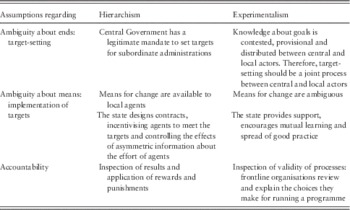
Drawing on principal-agent theory, hierarchist target-setting (Table 1) became a key policy instrument under New Public Management reforms pursued in various countries since the 1980s (Hood, Reference Hood2007). It is vividly illustrated by the model of ‘targets and terror’ (Bevan and Hood, Reference Bevan and Hood2006) adopted by the English Labour Government between 2001 and 2005 where public sector organisations were subject to strict performance targets with severe consequences for failure.
Hierarchist and experimentalist assumptions about performance targets

Source: authors’ display based on Sabel and Zeitlin (Reference Sabel and Zeitlin2012) and Pires (Reference Pires2011).
Experimentalist governance (Sabel and Zeitlin, Reference Sabel and Zeitlin2012, Table 1) has evolved as a critique of the assumptions underlying the hierarchist perspective (Table 1) in parallel to calls for more deliberation in public management (e.g. Barzelay, Reference Barzelay1992; Hood and Jackson, Reference Hood and Jackson1994). Conceived as a ‘learning process’, experimentalist governance links four elements in an iterative cycle: (i) centre and local actors agree on broad goals and metrics to ascertain their achievement; (ii) local actors pursue these goals in their own way while the centre provides support; (iii) local actors report their performance regularly, engage in peer review and share learning about ‘what works’; (iv) affected actors periodically revise goals and means following the results of the review process (Sabel and Zeitlin Reference Sabel and Zeitlin2012: 170).
Experimentalist governance was developed to understand how multilevel governance structures in uncertain and heterogeneous contexts can improve performance. This includes complex regulatory settings such as child protective services (Noonan et al., Reference Noonan, Sabel and Simon2009) and policy-making in the European Union on areas such as social protection, telecommunications, drug and food safety where the interdependency of member states, the European Commission and other stakeholders often precludes formal rule-making (Sabel and Zeitlin, Reference Sabel and Zeitlin2008; Fierlbeck, Reference Fierlbeck2014). In these contexts, the increasing use of ‘open norms’ (broad objectives and high-level regulatory principles) reflects the need to avoid clear and precise rules in order to deal with regulatory uncertainty (Hocepied and de Streel, Reference Hocepied and de Streel2005).
2.2 Why explore the scope for complementarity between hierarchist and experimentalist governance?
Complementarity implies that certain entities (here, logics of target-setting) come together in a synergistic way. As each logic retains its essential characteristics, complementarity is thought to enable a broader spectrum of policy responses (Fischer and Ferlie, Reference Fischer and Ferlie2013) and to balance the limitations of a single model only (Goddard et al., Reference Goddard, Mannion and Smith2000). Below we review key limitations of hierarchist governance with respect to target-setting, implementation and accountability. We highlight why experimentalism may offer an effective complement but not necessarily a substitute.
With regard to target-setting, where ideal ends of policy are contested, experimentalist governance scholars claim that argument offers a better basis for decision making than authority (Pires, Reference Pires2011). Because local organisations have an insight into frontline problems that national oversight bodies lack, it is argued that “global and local knowledge are mutually corrective, not hierarchically ordered” (Sabel, Reference Sabel2004: 181). However, insofar as governments have a legitimate mandate to define priorities (Mays, Reference Mays2006; Smith and Busse, Reference Smith and Busse2010), the experimentalist proposal of joint target-setting seems to contradict existing lines of accountability between Government and subordinate administrations. Thus, while the engagement of local stakeholders, as called for by experimentalist governance, may be a valuable or even an essential strategy to develop targets for ‘wicked’ problems, it may not be desirable to abandon hierarchist stewardship of the system entirely.
Where means for implementation are ambiguous, the hierarchist approach provides no process how to achieve targets. Consequently, local organisations tend to develop various coping strategies (Lawton et al., Reference Lawton, Mckevitt and Millar2000), but there is not necessarily an attempt to share learning across contexts. Experimentalist governance addresses this limitation by promoting local ‘experiments’ and mutual exchange about different approaches taken, so as to identify and scale-up good practice (Sabel and Zeitlin, Reference Sabel and Zeitlin2012). However, where effective interventions are known or become clearer over time (e.g. after a period of deliberative learning), regulatory authorities can codify and enforce common standards of practice, subject to dynamic revision. Hierarchist regulation thus retains a key role (Eberlein Reference Eberlein2010).
In terms of accountability, the hierarchist view of accountability for results implies the need to comprehensively specify goals. As most public services have multiple goals, incomplete contracts combined with divergent interests and informational asymmetries risk encouraging gaming by local organisations (Bevan and Hood, Reference Bevan and Hood2006) and misinterpretation of complex local production processes by regulators (Smith, Reference Smith1995). In search of complete contracts, reforms in England and the Netherlands have led to a multiplication of quantitative indicators so as to cover ‘every’ aspect of performance, thereby overwhelming the capacities of central and local organisations (Power, Reference Power1999; Pollitt et al., Reference Pollitt, Harrison, Dowswell, Jerak-Zuiderent and Bal2010). Experimentalism, in contrast, is seen to limit the need for a variety of indicators since it strives to understand how targets are implemented (Noonan et al. Reference Noonan, Sabel and Simon2009; Sabel and Zeitlin, Reference Sabel and Zeitlin2012). Nevertheless, within a publicly funded health system, ignoring demands for accountability for results in efforts to improve performance seems unrealistic (Ernst et al., Reference Ernst, Wismar, Busse and McKee2008).
The above review suggests that hierarchist and experimentalist governance have different potential strengths and limitations with respect to target-setting, implementation and accountability. Thus, there is a strong rationale to explore the scope for complementarity between them.
2.3 Barriers to complementarity
Is complementarity between hierarchist and experimentalist governance empirically feasible? The wider health care performance management literature has tended to argue that ‘measurement for improvement’ (which underpins experimentalist governance) ought to be kept separate from ‘measurement for accountability for results’ (which underlies hierarchist governance). While the former is thought to require a culture of openness, using data that is good enough to diagnose and remedy problems, the latter is premised on a culture of judgement against fixed objectives, with a consequent need for accurate data (Solberg et al., Reference Solberg, Mosser and Mcdonald1997; Freeman, Reference Freeman2002; Davies, Reference Davies2005).
Such incompatibility of both logics, in the sense that regulators adopt either one or the other logic, but not elements of both, seems to be supported by empirical research on health targets. An international review of health targets in seven European nations found that target-setting styles differed in terms of their focus on either hierarchist regulation and accountability, or more deliberative, learning-oriented stakeholder engagement (Ernst et al., Reference Ernst, Wismar, Busse and McKee2008). The findings showed struggles in bringing these elements together: some nations fostered stakeholder consensus, but failed to achieve accountability (e.g. Germany, Flanders) while others established strong regulatory frameworks focussed on accountability for results yet omitted local ownership (e.g. England) (Ernst et al., Reference Ernst, Wismar, Busse and McKee2008).
However, it is not known to what extent these findings reflect a general incompatibility between these approaches to target governance, or specific features of the health systems examined.
3 Methods
3.1 System context and study design
Scotland offers a suitable context to examine experimentalist governance ideas within a hierarchical system. The planning and delivery of health services is delegated to 14 territorial National Health Service (NHS) Boards who are responsible for £10.9 billion (of £11.9 billion Government spending on health in 2012/2013; Audit Scotland (2013). But while NHS Boards are major budget-holders and have considerable powers to shape patterns of service delivery, they remain directly accountable to Scottish ministers and subject to central constraints such as the requirement to break even in each financial year (Steel and Cylus, Reference Steel and Cylus2012).
The model of governance of the Scottish NHS immediately after devolution in 1999 has been described as one of trust and altruism since local organisations were trusted to deliver a high-quality service (Bevan et al., Reference Bevan, Karanikolos, Exley, Nolte, Connolly and Mays2014). Ministers have long eschewed targets or rankings that inflict reputational damage, rejecting top-down performance management in favour of a consensual approach with local managers and clinical leaders (Greer, Reference Greer2004). The relational distance between central and local organisations is low (Hood, Reference Hood2007). Senior managers from the different regions “meet regularly and have easy access to ministers and officials in the Scottish Government” (Steel and Cylus Reference Steel and Cylus2012: 26).
Targets for territorial Boards were first introduced in 2002, in the form of the Performance Assessment Framework (PAF) (Scottish Executive Health Department, 2002). The exact number of targets was perceived to be opaque as the PAF referred to multiple policy frameworks; estimates range between a hundred and over two hundred targets. An evaluation concluded that there was an “overload from the data collection (…) and the risk that PAF might become an end in itself” since it lacked incentives for Boards to improve and share good practice (Farrar et al., Reference Farrar, Harris, Scott and McKee2004).
This changed in 2006 when, as Steel and Cylus state, “[u]nfavourable cross-border comparisons (…) about performance, particularly on waiting times” (Reference Steel and Cylus2012: 113) and a change in minister led to the introduction of a “tougher and more sophisticated approach to performance management” (Steel and Cylus, Reference Steel and Cylus2012: 114); known as the HEAT target system. Within a hierarchical yet consensual context, this system offers a suitable context to investigate the potential complementarity of hierarchist and experimentalist governance (our first research question).
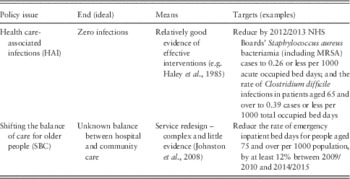
To examine the balance between hierarchist and experimentalist logics contingent on the nature of the policy issue (our second research question), we compare the development of HEAT targets for two policy issues. These policy issues were selected based on two criteria. The first criterion was to represent opposite ends on a spectrum of ambiguity over goals and means (Table 2):
-
∙ For the case of health care-associated infections (HAI), where both ideal performance and the means for change were relatively well known when targets were introduced, one would expect a more hierarchist logic.
-
∙ For the case of shifting the balance of care (SBC) for older people, where both the ideal ends and the means for change were ambiguous, one would expect a more experimentalist logic.
Case studies

Note: NHS=National Health Service.
The second criterion for selecting these two policy issues is methodological: targets were introduced in 2006 (SBC) and 2008 (HAI) and have evolved since then, thus enabling a comparison of their development over time.
3.2 Data collection and analysis
The study triangulates multiple sources of data (Table 3). Interviewees were recruited following a purposive strategy (Patton, Reference Patton2002) intended to (i) capture national and local experiences and (ii) represent diverse local contexts. We started with an initial group of national and local managers and, using ‘snowballing’, invited 33 people for interview. We included Boards from rural and remote areas (e.g. Highlands) and urban areas (e.g. Lothian); small Boards (e.g. Shetland, with a population of <20,000) and large Boards (e.g. Glasgow, with a population of over 1 million); and Boards who performed comparatively well and poorly on targets for the two policy issues, since we expected these aspects to potentially influence the perception of targets.
Data sources

In total, 31 interviews were conducted between June 2014 and February 2015 (two people declined due to time constraints), audio-recorded and transcribed. We considered data saturation to be achieved when no new themes emerged after a couple of further interviews (Guest et al., Reference Guest, Bunce and Johnson2006). Participants were informed about the aims of the study, encouraged to ask questions and assured of the anonymity of their responses. The first author’s institutional review committee granted ethics approval.
Based on the theoretical constructs from hierarchist and experimentalist governance, directed content analysis (Hsieh and Shannon, Reference Hsieh and Shannon2005) was used. This enabled theory triangulation as each case was examined through different theoretical lenses (Patton, Reference Patton2002). The first author collected and analysed the data (using NVivo). The second author supervised this process and, through regular discussions, contributed to the iterative refinement of the interpretations. To mitigate against misinterpretation, we shared the findings with the interviewees who were asked to point out any factual errors.
4 Findings
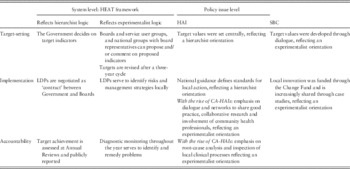
The next sections analyse the HEAT target system and special features in the governance of HAI and SBC. Specifically, we investigate how approaches to target-setting, implementation and accountability, introduced above, reflect hierarchist or experimentalist logics (for a summary, see Table 4).
Hierarchist and experimentalist governance elements in the Scottish health improvement, efficiency, access and treatment appropriateness (HEAT) target system

Note: HAI=health care-associated infections; SBC=shifting the balance of care; LDP=local delivery plan; CA-HAIs=community-acquired health care-associated infections.
4.1 The HEAT target system: commonalities across targets
4.1.1 Target-setting
Three explicit criteria exist for selecting HEAT targets: (i) alignment with Government priorities; (ii) availability of baseline data; and (iii) scope for implementation by NHS Boards. Ultimately, the Scottish Government decides on targets (reflecting the hierarchist logic). Yet, stakeholders play a key role at two vital stages of the decision-making process. First, the initial choice of HEAT targets is informed by consultations with service user groups, professional associations and NHS Boards. Second, each target runs over three years, after which feedback meetings with NHS managers, health professionals and Government officials enable the revision or abolition of targets if practical experiences with implementing targets have revealed any problems. Thus, target-setting is shaped by local stakeholders both during the initial selection of targets and during a joint revision and review process of the utility of existing targets in practice (reflecting the experimentalist logic).
4.1.2 Implementation
The HEAT target process is led by a Directorate in the Scottish Government which agrees local delivery plans (LDPs) with each Board and monitors progress against these. In LDPs, Boards explain how they plan to attain the HEAT targets and the risks they face. A head of performance noted that “LDPs are a way to sensecheck with the Scottish Government and raise concerns we see locally”. This reflects the experimentalist logic insofar as LDPs may serve as a mechanism to help uncover local problems and management strategies. Nevertheless, LDPs are drafted in relation to national guidance and signed-off by the Government. Interviewees perceived LDPs primarily as the ‘contract’ between Government and Boards, reflecting a hierarchist orientation.
4.1.3 Accountability
The HEAT target system has institutionalised two routes to assure accountability. One is a summative assessment that reflects the hierarchist logic of accountability for results. The Government examines progress against the LDPs at Annual Reviews. In addition, biennial Accountability Reviews are held by ministers where members of the public can ask questions. These reviews result in a letter from the Cabinet Secretary about issues Boards are expected to address. National progress against the HEAT targets is reported publicly on the Government’s website Scotland Performs. There are no financial sanctions or forced redundancies when targets are not met.
The other route is a formative assessment that reflects the experimentalist view of accountability as valid processes. This takes the form of mid-year reviews to gauge if Boards are ‘on track’. Pressure for corrective action can be escalated through several mechanisms. At monthly meetings of Board Chief Executives with the NHS Chief Executive, performance is routinely discussed. Regular bilateral meetings take place between performance managers from the Scottish Government and Board staff. If there are concerns about a major failure, the Scottish Government sends a performance support team to Boards to identify problems and remedial actions. However, interviewees highlighted a constant tension in the teams’ dual role of providing support and exercising Government control:
Boards don’t have a choice (…) they must develop an action plan that is heavily scrutinised by the Scottish Government (Government official).
The process is not comfortable (…) but from my experience it has been respectful and positive to diagnose problems we had (…) showing how other organisations solve them (senior manager).
Government officials and local managers pointed out that accountability for results was a response to perceived opacity of the PAF. However, because this evolved within a broader context of public sector reform which emphasised the value of partnership (see, e.g. the report of the Commission on the Future Delivery of Public Services, 2011), there was also an increasing commitment by the Government to listen to local feedback. Below, we explore these themes further with regard to HAI and SBC.
4.2 HAI: the quest for zero infections
4.2.1 Policy context
The issue of HAIs climbed the policy agenda in 2008 when an outbreak of Clostridium difficile (CDI) at the Vale of Leven hospital resulted in a major revision of infection control practices. The Scottish Government’s HAI Taskforce set out a multifaceted approach to change, funded with £56 million for three years across five areas (HAI Taskforce, 2008): standards of practice; culture (resulting, e.g. in a national hand hygiene campaign); education (e.g. on antibiotic prescribing); surveillance and audit (e.g. since 2009, the Healthcare Environment Inspectorate has carried out regular audits of compliance with national standards); and changes in the physical environment and processes (e.g. the introduction of methicillin-resistant staphylococcus aureus (MRSA) screening on admission). Action on HAI was also embedded into the Scottish Patient Safety Programme, a national collaborative aimed at improving patient safety. From the outset, there was thus a strong emphasis on national leadership.
4.2.2 Target-setting
Starting in 2008, the HAI Taskforce recommended the introduction of a national HEAT target on Staphylococcus aureus bacteraemia (SABs, including MRSA and methicillin-sensitive staphylococcus aureus (MSSA)), based on the knowledge at that time that SABs represented a dominant cause of infection. A HEAT target on CDI followed in 2009, once baseline data from mandatory surveillance was available. Targets are proposed by a subgroup of the HAI Taskforce whose membership includes key professional groups (infection control managers, medical directors and microbiologists employed by Boards). Proposals are passed to the Scottish Government for decision. While the Scottish Government thus retains the responsibility for setting targets (reflecting the hierarchist logic), proposals are initiated by the stakeholders who will implement them (reflecting the experimentalist logic).
Target values, however, were derived from technical information rather than consensus; reflecting hierarchist ideas. Initially, targets aimed at a 30% reduction of HAIs over a five-year period. This was based on a seminal study on the prevention of nosocomial infection in the United States (Haley et al., Reference Haley, Culver, White, Morgan, Emori, Munn and Hooton1985) which had found that a third of hospital infections was avoidable with a defined set of interventions including surveillance, having trained infection control staff, and a system for reporting infection rates to practising surgeons. Although this study came from a different context, it seemed “the best evidence and reference point at the time of potential for prevention” (HAI Taskforce representative).
Although an ideal rate is known for HAI (zero infections), uncertain effect sizes of interventions make it hard to ascertain what levels of quality are feasible in practice. With comparable data becoming available from standardised reporting from the United Kingdom and similar European health systems, since 2011 levels of achievement are determined by ‘best-in-class’ benchmarking. In this system, the Government seeks to infer an attainable level of quality for NHS Boards from the best performers within Scotland and abroad. However, a key challenge was the choice of threshold. As a manager from a poorer performing Board highlighted: “We argued that the lowest observed rate would not be achievable for all (…) given differences in baseline performance between Boards”. Following consultations with Boards, the HAI Taskforce thus agreed on the roughly 75th percentile of the distribution of HAI rates as the minimum target. Those performing better were expected to continue to improve to prevent regression towards this minimum target.
4.2.3 Implementation and accountability: the challenge of community-acquired infections
As Boards have integrated responsibility for acute, primary and community care, the national target includes all cases of HAI regardless of where they have been acquired. Boards’ actions have traditionally focussed on hospitals: LDPs over the past years emphasise the education of hospital staff to prevent the transmission of infections. Implementation has focussed on national standards of practice and ‘care-bundles’, which consist of a standardised set of actions health professionals are expected to follow to prevent infections. While the local implementation of these measures required, as interviewees commented, much discussion and testing with local staff (reflecting an experimentalist orientation), standards of practice were defined at the national level and provided common definitions of what constitutes ‘appropriate care’ (reflecting a hierarchist orientation).
However, while significant reductions in HAI have led to increasingly stringent targets consistent with the ‘best-in-class’ approach, Boards’ LDPs record challenges from a rising proportion of community-acquired health care-associated infections (CA-HAIs; defined as infections that develop within 48 hours after patient admission to hospital). In interviews, local managers commented that, from their experience, CA-HAIs were considerably harder to prevent than hospital-acquired HAIs because causal pathways were frequently unknown. As an infection control manager explained: “Hospitals have clear physical and managerial boundaries (…) but in the community, we often do not know where infections come from”. Mentioned by three Boards in 2007/2008, by 2013/2014, all Boards identified CA-HAIs as a key risk to meeting national targets. For instance, NHS Tayside’s LDPs record that by 2013/2014 about 50% of SABs were present on admission to hospital, an increase from about 22% of SABs in 2006/2007 (NHS Tayside, 2011).
In analysing national and local responses to this development, two major themes emerge. First, despite a changing problem frame, there appeared to be continuity. According to local LDPs, between 2009/2010 and 2013/2014, all Boards maintained their focus on hospitals in controlling HAIs. As a local manager explained: “We must keep HAIs on the agenda in hospitals, not shift all attention to the community (…) to sustain the successes we have seen”. Similarly, national guidance on infection control has been reaffirmed.
Second, however, there appeared to be an increasing emphasis on other approaches to implementation and accountability. This is reflected in the role ascribed to central-local dialogue. As an infection control manager put it: “There has always been some dialogue with Government representatives about infection rates (…) but understanding the causes has become more important with the growing proportion of community-acquired infections”. A recent and notable manifestation of this dialogue – which is not documented in the LDPs, but emerged in the interviews – was that Scottish Government leads have started to regularly attend local HAI meetings and share experiences from other Boards. As a local manager explained: “We were struggling with community-acquired infections and the Government teams said to us, ‘you might speak to Board x and y about this’ (…) this was not a panacea but it was a start” .
A related development concerns the diffusion of tools which – unlike the afore-mentioned standards of practice – do not prescribe desirable behaviour but rather offer an analytic process. A pertinent example is the use of root-cause analysis (RCA), intended to trace back infections to their initial source and, thus, understand the onset of CA-HAIs. In 2009/2010, three Boards reported using RCA in their LDPs. By 2013/2014, 11 Boards had taken up RCA. As a consequence, several Boards have started to reach out beyond hospitals towards identifed high-risk settings such as care homes and to engage general practitioners and district nurses in efforts to tackle CA-HAIs.
4.2.4 Conclusion
The perception of HAI as an issue where national standards where both feasible and desirable resulted in centrally determined targets; reflecting a hierarchist orientation. Nevertheless, Boards were consulted and their feedback was acted upon in the specification of target values. This implies the experimentalist concept of joint target-setting between central and local organisations. Implementation has focussed on the more hierarchist notion of standardised interventions. However, the reframing of the boundaries of the problem from hospitals to the wider community led to more learning-oriented approaches to implementation and accountability. This can be interpreted as a partial transformation towards experimentalism.
4.3 Care for older people: the quest for the right ‘balance’
4.3.1 Policy context
Shifting care out of hospitals into the community became a key policy focus in 2005, when the Scottish Government launched the Unscheduled Care Collaborative to reduce emergency admissions especially among older people. The Collaborative framework (Scottish Executive, 2005: 3) set out the principle that: “change will not be delivered by issuing guidance and directives (…) one size does not fit all. Solutions must meet local need and circumstance and more importantly actively engage staff”. The Scottish Government’s (2009a) strategic framework Improving Outcomes by Shifting the Balance of Care re-emphasised shifting the location of care (outside hospitals), its focus (from acute to preventive care) and responsibility for its delivery (involving non-medical professionals, patients and carers). These concepts were affirmed in successive policies. Thus, from the outset, policy discourse emphasised local diversity and stakeholder engagement.
4.3.2 Target-setting
To serve as strategic measure in support of these policies, in 2006, a HEAT target on reducing multiple re-admissions to hospital for people aged 65 and over was introduced. After the usual three-year cycle, a national stakeholder event including Government officials, clinicians, service users and Boards concluded that some admissions might be unavoidable. “Clinicians were concerned this target would create a perverse incentive to prevent even necessary admissions (…) based on that feedback, the target was reformulated” (clinical lead). In 2009, a target to reduce emergency bed days for people aged 65 (later narrowed to those aged 75) and over was introduced to clarify the underlying policy ambition: “The target is about minimising the time spent in hospital for older people (…) patient experience of care and health status often suffer as a result of long hospital stays” (medical director).
The Government agreed levels of achievement bilaterally with each Board, because imposing a single national target was perceived as “untenable due to local variations in the availability of community care, socio-demographic composition, and previous reductions in emergency bed days” (Government official).
Experimentalism would suggest that setting targets through dialogue requires a mutual interest in obtaining challenging yet feasible targets. As HEAT targets are publicly reported and frequently cited to underpin political achievements, one would expect the Scottish Government to have an interest in targets that can be met. However, emergency care puts increasing strain on the NHS budget and rising demand due to demographic changes challenges the Government’s pledge to protect universal coverage (Barbour et al., Reference Barbour, Morton and Schang2014). This has led to a perception that “the situation is unsustainable and there is a real need to reorient health services” (Government official), suggesting a commitment to move beyond merely symbolic targets. The incentive for Boards to identify a credible trajectory was, according to our respondents, both improved patient experience and financial sustainability, which is heavily scrutinised by ministers, Audit Scotland and the Scottish Parliament. The Joint Improvement Team (JIT; a partnership involving the Scottish Government, NHS Scotland, the Convention of Scottish Local Authorities, and the Third, Independent and Housing sectors) helped to build this argument: JIT provided Boards with estimates of future needs for hospital beds given demographic projections to show how reducing bed days now would mitigate the creation of new hospital beds in the future.
The national target of achieving a 12% reduction in emergency bed days between 2009/2010 and 2014/2015 was derived from the aggregation of Board-specific targets. These ranged from 0% (for Boards with a relatively low rate of bed days who felt further reductions were not feasible) to about 20% over a five-year period (in Grampian, where larger-scale service redesign was under development). Both national and local respondents perceived the process as dialogical rather than adversarial:
We cannot just set the trajectory as we like (…) we look at our historical data and suggest what we can do (…) then the Government says “we think you can do more here” or “you are too ambitious” and then we go back to the data (…) it is a dialogue really (planning manager).
Some Boards seemed very ambitious (…) but some also had an ambitious improvement programme so the trajectory was backed up (…) it was a lot about speaking to Boards (Scottish Government official).
4.3.3 Implementation and accountability
Fundamental problems in SBC – and initial differences to HAI – were the limited evidence of effective interventions, local diversity and Boards’ partial ownership of targets. These differences appeared to influence the approaches to both implementation and accountability.
Between 2008 and 2011, a national Long-Term Conditions Collaborative provided information about various tools to improve care pathways (e.g. predictive modelling, anticipatory care plans and intermediate models of care) and sought to support NHS Boards in adapting relevant tools to their own local contexts (The Scottish Government, 2009b). In 2010, the 10-year programme Reshaping Care for Older People (The Scottish Government, 2010) established a £70 million Change Fund to finance innovative projects through local partnerships involving acute, community, third and independent sectors. Some of the resulting local interventions reflect different approaches to essentially the same problem. For instance, since the capacity and quality of social care, funded by local authorities, affects Boards’ ability to reduce emergency admissions and achieve timely discharges into community care, all Boards emphasised collaborations with local authorities. However, specific local projects differ in their focus on, amongst others, joint standards for discharge management or expanded access to community and residential care. Other interventions appeared to be driven by context-specific challenges. For instance, rural and remote Boards have put particular emphasis on testing new models of telehealth and telecare.
As Audit Scotland (2014) highlights, the focus on local innovation has struggled with the challenge of ensuring national accountability, in particular with regard to the systematic evaluation of ‘good practice’ and its subsequent ‘scale-up and spread’ in a heterogeneous system. Recently, national organisations have started to address this challenge by promoting national learning events and benchmarking (see, e.g. Joint Improvement Team (JIT), 2014) and the sharing of case studies (Quality and Efficiency Support Team (QuEST), 2014). Local managers we interviewed noted that these case studies were increasingly valued as offering inspiration – rather than prescription – for local action.
4.3.4 Conclusion
Shifting the balance of care for older people was from the outset recognised as an issue of local diversity and uncertainty about effective interventions. As a result, governance focussed on Board-specific targets, innovative models of care and local partnerships, and attempts to share learning. This approach reflects core principles associated with experimentalist governance.
5 Discussion
Prompted by the limits of a hierarchist approach to setting targets for policy issues whose ‘ideal’ ends and means for change are ambiguous, we have examined whether complementary use of hierarchist and experimentalist ideas is possible.
Returning to our research questions, the findings suggest the following. First, hierarchist and experimentalist elements can be shown to exist in the same performance management regime (Table 4). Experimentalism adds distinct aspects to target-setting, implementation and accountability that are missing from a purely hierarchist approach (Table 1). In Scotland, this has led to a system where: central and local actors contribute to setting targets; central bodies support local attempts to implement change; and local actors are held accountable both for processes and for results. This suggests a complementary role of experimentalism (Fossum, Reference Fossum2012). Nevertheless, there is also some evidence of tension between the logics. This is illustrated by the ambivalent perception of Government performance support teams with their dual mandate for central control and local support.
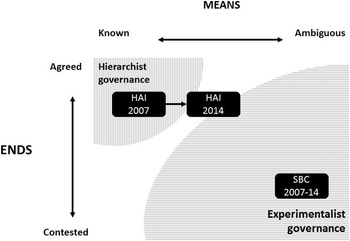
Second, while both logics co-existed at the HEAT system level, their relative emphasis differed between policy issues and also over time within a policy issue. Where targets were informed by the vision of an optimal balance between community and hospital care and means for change were ambiguous (care for older people; Table 2), governance styles reflected experimentalist ideas more strongly. Where ends and means were known initially (HAI; Table 2), targets followed a more hierarchist logic. When the rise of community-acquired infections decreased clarity about effective interventions, the ideal level of HAI (zero) and the model for target-setting remained constant. However, a more learning-oriented approach to implementation and accountability ensued (Table 4). This can be interpreted as a partial drift in governance style to the experimentalist realm (Figure 1).
Ambiguity over goals and means in relation to governance style. HAI=health care-associated infections; SBC=shifting the balance of care.

The main implication of these findings is that the distinct combination of governance logics can be adapted on a target-by-target basis. Thinking of hierarchism and experimentalism as a property of the performance management system as a whole may be analytically too coarse (from a research perspective) and neglect opportunities that arise from drawing on both logics (from a policy perspective). As this study shows, it is important to look deeper at differences between policy issues and at dynamics over time.
Our study setting, the Scottish HEAT target system, was chosen explicitly because we expected it to be receptive to complementarity between hierarchism and experimentalism. Its socio-historical and administrative context is characterised by long-standing collaboration between central and local organisations alongside a well-developed central-local accountability relationship (McDermott et al., Reference Mcdermott, Hamel, Steel, Flood and McKee2015). Our finding that it is possible to combine experimentalism and hierarchism may thus not be easily transferable to systems which do not meet these conditions. Hierarchist governance requires Governments to have a strong mandate and administrative capacity to set and enforce targets. In countries where administrative powers are dispersed between actors, hierarchist target-setting is not possible and the experimentalist governance logic may be the only feasible approach to set targets at all. Experimentalism, however, requires local actors to be willing to innovate and participate in the target-setting and review processes. Governments, in turn, must develop the infrastructure (including requisite financial and managerial support) which encourages local actors to do so and then share experiences across the system. Experimentalist governance ideas are likely to flourish only if central and local actors are prepared and capable to fulfil these roles.
Overall, our findings highlight the need for policy and research to reconsider the strict separation between ‘measurement for improvement’ and ‘measurement for accountability’ (Solberg et al., Reference Solberg, Mosser and Mcdonald1997; Freeman, Reference Freeman2002; Davies, Reference Davies2005). The experiences from Scotland lead us to conclude that both purposes can co-exist within a system. Setting targets does not have to end up in ‘targets and terror’ but may combine stakeholder engagement with accountability for results. This is an important contribution to existing research which found the hierarchist approach to target-setting, focussed on accountability for results, and the learning- and engagement-oriented approach to target-setting, which reflects experimentalist ideas, in separate countries but not in the same system (Ernst et al., Reference Ernst, Wismar, Busse and McKee2008). We have shown that the nature of policy issues and changes therein over time are important conditions for synergies between governance logics. Future research might further explore the enabling conditions for and outcomes of combining multiple logics of target governance within different institutional contexts.
Acknowledgements
The authors are grateful to all key informants from Scotland who generously shared their experiences. The authors also thank the participants of the European Health Policy Group Meeting, London 2014, and the participants of the Wennberg International Collaborative, London 2015, for their comments and in particular Jan-Kees Helderman for his constructive discussion that helped to develop the paper. The authors thank Eva Barrenberg, Gwyn Bevan, Jan-Kees Helderman, David Steel, interviewees from the research and two anonymous reviewers for their comments. The authors are responsible for the conclusions reached and for any mistakes.