1 Introduction
In recent years a vast number of studies have found fronting of the /uw/ or goose vowelFootnote 2 (Wells Reference Wells1982) in English varieties in the UK (e.g. Bauer Reference Bauer1985; Torgersen Reference Torgersen1997; Torgersen & Kerswill Reference Torgersen and Kerswill2004; Scobbie et al. Reference Scobbie, Stuart-Smith and Lawson2012;Footnote 3 Stuart-Smith Reference Stuart-Smith2013; Holmes-Elliot Reference Holmes-Elliot2015; Sóskuthy et al. Reference Sóskuthy, Foulkes, Hughes, Hay and Haddican2015) and North America (e.g. Fought Reference Fought1999; Fridland & Bartlett Reference Fridland and Bartlett2006; Labov et al. Reference Labov, Ash and Boberg2006; Baranowski Reference Baranowski2008; Fridland Reference Fridland2008; Hall-Lew Reference Hall-Lew2009; Hinrichs et al. Reference Hinrichs, Bohmann and Gorman2013; Wing-mei Wong Reference Wing-mei Wong2014) but also in New Zealand (e.g. Hay et al. Reference Hay, Maclagan and Gordon2008: 24; Maclagan et al. Reference Maclagan, Watson, Harlow, King and Keegan2009), Australia (e.g. Harrington et al. Reference Harrington, Cox and Evans1997: 178) and South Africa (Mesthrie Reference Mesthrie2010). Sociolinguistic studies conducted in the north of England confirm the strong linguistic constraints in goose-fronting which were identified in other varieties (e.g. Flynn Reference Flynn2012; Jansen Reference Jansen2012a, Reference Jansen, Calamai, Celata and Ciucci2012b; Haddican et al. Reference Haddican, Foulkes, Hughes and Richards2013; Turton & Baranowski Reference Turton and Baranowski2014).Footnote 4 In fact, goose-fronting must be seen as the most studied synchronic vowel change in varieties of English to date.
From a diachronic perspective, goose-fronting is a process which has been in progress for at least a century in England (or at least in the south of England). In the revised version of An Outline of English Phonetics, Jones (Reference Jones1932: 32) reported the fronting of /uː/ in palatal preceding environments:
The most important subsidiary long uː is an ‘advanced’ variety. It is used when j precedes, as in music ˈmjuːzik, tube ˈtjuːb, deluge ˈdeljuːdʒ. By calling it ‘advanced’ we mean that the part of the tongue which is highest is the central part – a part more forward than the ‘back’.
This statement suggests that the place of articulation of the goose vowel has moved towards the front of the oral cavity. Roach & Hartman (Reference Roach and Hartman1997) describe the fronting of goose as a radical shift in Received Pronunciation (RP), which had been ongoing for 20–30 years. However, Jones's description (Reference Jones1932) mentioned above points to an earlier initiation of this change and also to a constraint which is repeatedly confirmed in sociolinguistic studies in England – words with a preceding palatal /j/ are leading the change.
While goose-fronting has been discussed in depth in various varieties of English, a broader view which focuses on the dynamics between goose and the adjacent back vowels goat and foot is only very rarely included in sociolinguistic studies (e.g. Fridland & Bartlett Reference Fridland and Bartlett2006; Labov et al. Reference Labov, Ash and Boberg2006; Fridland Reference Fridland2008). Descriptions of these vowel dynamics are in particular missing for English varieties. This article attempts to shed more light on the vowel dynamics surrounding these back vowels in Carlisle English. In the next two sections the literature which includes the relationship between goose and goat and goose and foot is reviewed.
1.1 Relationship between goose and goat in England
While in many studies on US varieties goose is investigated in combination with goat, studies on UK varieties rarely include an expanded view of both vowels. A parallel shift seems to be ongoing in many North American varieties (e.g. Labov et al. Reference Labov, Yaeger and Steiner1972; Labov Reference Labov and Eckert1991, Reference Labov1994, Reference Labov2010; Gordon Reference Gordon2001; Boberg Reference Boberg2005),Footnote 5 while the information is sketchy for UK varieties. Besides the fronting of goose, Docherty (Reference Docherty and Kirkpatrick2010: 67) reports the fronting of goat in English varieties in the south of England, but varieties with monophthongal /oː/ for the goat lexical set (e.g. in northern England) are not influenced by this innovatory fronting process.
Watt & Tillotson (Reference Watt and Tillotson2001) point to the fronting of goat (but not goose) in Bradford, a town situated in West Yorkshire, and Finnegan (Reference Finnegan2009, Reference Finnegan and Hickey2015) presents similar findings for Sheffield in South Yorkshire, while Cooper (Reference Cooper2013) provides a historical view on goat-fronting in Yorkshire. These studies suggest that goat-fronting without preceding goose-fronting seems to be geographically restricted to Yorkshire. The long-standing fronting process of goat in this area cannot be explained by Labov's (Reference Labov1994: 116) Principle III (‘back vowels move to the front’), as the fronting of goose precedes the fronting of goat in this model. However, Watt & Tillotson (Reference Watt and Tillotson2001) show that goose-fronting is not observable. They argue that the fronting of goat ‘is facilitated by a high level of contact between inhabitants of urban areas in the region’ (Watt & Tillotson Reference Watt and Tillotson2001: 297). Hence, linguistic factors cannot explain this fronting process.
1.2 Relationship between goose and foot in England
In the early days of recognising goose-fronting in sociolinguistic studies in England, foot-fronting was also mentioned (e.g. Foulkes & Docherty Reference Foulkes and Docherty1999b; Torgersen Reference Torgersen2002; Altendorf Reference Altendorf2003; Carfoot Reference Carfoot2004). However, the foot variable never triggered as much interest and only a few systematic sociophonetic studies exist which include both the foot and the goose variable. The studies which investigated the changes in the foot vowel were conducted in the south(-east) of England, but the vowel distribution and its relationship with developments in the goose vowel have not been investigated in much detail in other varieties in England, in particular in the north of England.
In a series of experimental studies, Harrington et al. (Reference Harrington, Kleber and Reubold2011: 152) show that goose-fronting precedes foot-fronting in Standard Southern British English and that the rate of change for goose is higher than for foot. They also show that the fronting of goose and foot is mainly due to tongue movements rather than lip rounding. Overall, they propose that coarticulatory effects of coronal sounds might provide a more universal explanation for the fronting of back vowels (Harrington et al. Reference Harrington, Kleber and Reubold2011: 154).
The relationship between goose and foot was highlighted by Ferragne & Pellegrino (Reference Ferragne and Pellegrino2010) in their UK accent comparison study. The data in the study do not provide any information about the social background of the speakers but the inter-accent view is very valuable in terms of highlighting common changes which can be observed across the British Isles. They come to the conclusion that three main scenarios for goose and foot are found in the British Isles:
(i) neither goose nor foot seems to have moved from its back position . . .;
(ii) only goose, but not foot, has moved to a fronter position . . .;
(iii) both goose and foot are rather front . . . (Ferragne & Pellegrino Reference Ferragne and Pellegrino2010: 29)
Type (i) is attested for Hull, East Yorkshire. Here, goose and foot–strut have a very back position compared to the other varieties. Ferragne & Pellegrino (Reference Ferragne and Pellegrino2010: 29) state that ‘there is nothing in our data that tells us that the change [fronting] will ever apply’. A similar distribution of goose and foot is found in Newcastle English but due to the small speaker sample, statements are only tentative.
For the south of England (where the foot–strut split occurs), Ferragne & Pellegrino (Reference Ferragne and Pellegrino2010) report the co-occurrence of fronting of goose and foot, which resembles type (iii). This result confirms Torgersen's (Reference Torgersen2002) findings for the south-east of England. According to Ferragne & Pellegrino (Reference Ferragne and Pellegrino2010: 18), type (ii) is found in several locations; one of them is Burnley in Lancashire, which is (apart from Newcastle) the location closest to Carlisle, the focus of the present study.
So far, this article has discussed the distribution of goose-fronting as well as goat and foot. In the following, the research questions are introduced.
1.3 Research questions
This article aims to discuss the distribution and dynamics of goose, goat and foot in Carlisle English by investigating the following research questions:
1. Is goose-fronting found in Carlisle English?
2. What are the linguistic and social constraints of goose-fronting in this community and how do they compare to constraints found in other varieties?
3. Is fronting of goat and foot also found and if not, why not?
To address these questions, I will examine the distribution of the vowel in the goose lexical set. In addition, I will investigate the two vowels goat and foot and consider the developmental trajectory of these vowels in apparent time as well as the underlying dynamics of these vowels.
In the following, I will provide the sociolinguistic background of Carlisle, the research site for the present study, and will discuss the methodology used in this study. I will then analyse the data for goose, goat and foot and compare the results to findings in other communities, contextualising the findings.
2 Sociolinguistic background of Carlisle
Carlisle is situated in the far north-west of England. It has a population of 101,000, and is the only city in Cumbria, the most north-westerly county in England. Carlisle is also known as the Border City. The name reflects its proximity to the Scottish border only 16 kilometres away. The city's surrounding area is dominated by agriculture and the closest urban area is Tyneside, some 90 kilometres away. To the south-west of the city, about 50 kilometres from Carlisle, lies the Lake District. To the east, the Pennines, which extend down the country, are less steep than elsewhere and make the north-east relatively accessible. The Borderlands, as well as the area west of Carlisle which stretches out to the Irish Sea (West Cumbria), are sparsely populated regions. No other urban area can be found in close proximity to the city. Hence Carlisle is a regional centre where people commute to and from the surrounding areas (Coombes Reference Coombes1995).
From the end of the eighteenth century, migrants from Scotland and Ireland arrived in Carlisle (MacRaild Reference MacRaild1998: 30) and from the beginning of the nineteenth century up until around 1960, Carlisle has seen a steady increase in population. Like many other urban dialects in England, the Carlisle dialect has undergone levelling and supralocalisation over the late nineteenth and twentieth centuries (Jansen Reference Jansen2012a). Features that are spreading across the country, for example, T-glottalling, TH-fronting and R-labiodentalisation (Foulkes & Docherty Reference Foulkes and Docherty1999a; Britain Reference Britain2009), are now also attested in Carlisle English (CE) (Jansen Reference Jansen2012a).
Carlisle's geographical position in proximity to the Scottish border and the Northumbrian border but also the remaining broad Cumbrian dialects in the west of the county has led to an extreme case of levelling. People from these very different dialect areas come into contact in Carlisle on a daily basis, as Carlisle is the regional centre for people from these different dialect areas. Traditional dialect features such as [aʊ] in words like thought and centralising diphthongs [ɪə] in face were replaced by more pan-northern features quite early on in this area as they are not attested at all in oral history recordings of speakers born in Carlisle at the end of the nineteenth century (see Jansen Reference Jansen, Johannesson, Melchers and Björkman2013). This case of levelling might have led to the linguistic insecurity Montgomery (Reference Montgomery2006) found in Carlisle. Hence, the linguistic development stands in stark contrast to the developments in Newcastle, where more traditional features are still retained and commodified (see Beal Reference Beal2009; Beal et al. Reference Beal, Burbano-Elizondo and Llamas2012).
3 Methodology
The data for this study stem from sociolinguistic interviews which were recorded between 2007 and 2010 in Carlisle. The interviews were conducted by myself in the participant's home, in a quiet room in a school or in the local library. Age, sex and socioeconomic status were used to categorise speakers.
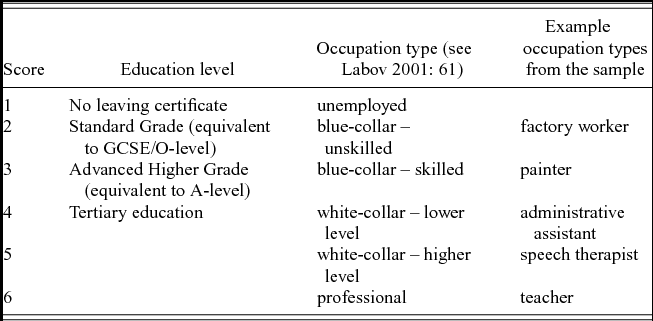
Classifying speakers according to socioeconomic status is notoriously problematic. Kerswill (Reference Kerswill, Culpeper, Katamba, Kerswill, Wodak and McEnery2009: 361) postulates that ‘there is no “natural” way of defining social class’. In order to describe the socioeconomic status of the speakers in this study, a two-component composite index modelled after Labov (Reference Labov2001: 61) and Hall (Reference Hall2008: 64ff.) was applied. Table 1 provides the scores for the education and occupation index and also provides examples of occupation types from the present sample.
Scores for the education and occupation index

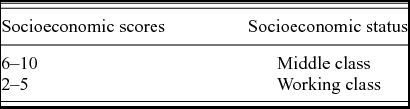
The scores of the education and the occupation indices were added up, enabling the speakers to be categorised according to socioeconomic status (table 2). Nevertheless, we need to bear in mind that this is an abstraction of real life (see Chambers Reference Chambers2003: 49).
Socioeconomic scores for this study

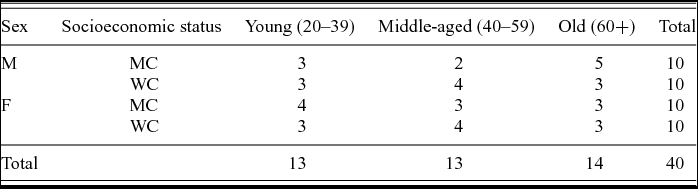
The speaker sample for this study is provided in table 3. The table provides information about the distribution of speakers according to age, sex and socioeconomic status. Overall, the data of forty participants were analysed.
Speaker sample in the present study

For the interviews, I used an Edirol R1 digital recorder with integrated stereo high-quality microphones. The sampling rate at the time of recording was 44.1 kHz but it was down-sampled to 11 kHz for analysis. Tokens were analysed in PRAAT (Boersma & Weenink Reference Boersma and Weenink2008) with a complementary script (Kendall Reference Kendall2009). The script provides measurements for F1, F2 and F3 at the midpointFootnote 6 and tokens were only measured at primary stress occasions.Footnote 7 In the present study, I focus on the diachronic development of F2 in the three vowels goose, goat and foot, which indicates the place of articulation in the front-back dimension of the oral cavity, with higher F2 values representing a higher degree of fronting. Overall, 1,238 tokens of the goose vowel were measured, which is an average of 31 tokens per speaker. The aim was to collect at least ten tokens per speaker for this vowel. Only for one speaker could fewer tokens, i.e. nine, be measured. For the goat vowel, 1,021 tokens (average: 25 tokens/speaker) and for foot 590 tokens (average: 15 tokens/speaker) were collected. The data were normalised on the NORM website (Thomas & Kendall Reference Thomas and Kendall2007) by using the modified Watt & Fabricius method (Fabricius et al. Reference Fabricius, Watt and Johnson2009). In addition to the lexical sets analysed here, at least five token measurements for the following lexical sets were collected and normalised: face, fleece, lot, nurse, price, start, strut and thought.
Under certain circumstances, tokens were omitted from the study: e.g. tokens with unclear production due to overlapping speech or background noise were rejected. The word you was excluded from the sample.Footnote 8 Tokens which belong to the foot lexical set in the standard variety but were perceived as goose in CE such as book or cook were not collected.Footnote 9 In order to reduce coarticulatory effects, several restrictions were made concerning the phonological environments in which the vowel is measured (see Di Paolo et al. Reference Di Paolo, Yaeger-Dror, Wassink, Di Paolo and Yaeger-Dror2010: 88), i.e. vowels following /w/ were omitted from this study, together with vowels preceding /ŋ/ (see Wells Reference Wells1982).
A trial run focused on the analysis of the goose vowel before /l/. This is an important environment to include in the analysis because /l/ is a retracting environment. Labov et al. (Reference Labov, Ash and Boberg2006: 150) comment on this fact:
It is clear that in any analysis of the fronting of /uw/, vowels before /l/ should be placed in a separate category. In most dialects, the vowels of tool, school, etc. occupy high back position, while all other /uw/ vowels are shifted to the center or front.
The token collection and analysis, however, showed two things: a tendency for L-vocalisation and a lack of lexical alternation. In several cases /l/ was vocalised; this is not a true liquid and therefore could influence the fronting/retraction in a way not accounted for in this study. Moreover, overall not very many tokens in this environment were collected. Almost all speakers used the token school Footnote 10 but the tokens fool, tool and pool were mentioned only once in the entire sample. There was a danger that the results would be lexically driven and thus tokens with following /l/ were not taken into account.
As structural constraints are important when analysing the fronting of the goose vowel, various preceding and following environments were considered. A broad consensus exists about the environments which favour fronting of goose in the sociolinguistics literature. Nevertheless, in the details, the studies vary. Mesthrie (Reference Mesthrie2010) distinguishes between coronal, non-coronal and /j/ preceding environments, while Baranowski (Reference Baranowski2007: 172) distinguishes between vowel-preceding coronals, vowel-preceding non-coronals and /l/ following the vowel. Hall-Lew (Reference Hall-Lew2009) follows Flemming's (Reference Flemming2003) finding that:
not all types of coronals can condition vowel fronting . . . coronals that condition fronting are produced with a front tongue body, while coronals that condition retraction are produced with a back tongue body. (Flemming Reference Flemming2003: 336)
According to Giegerich (Reference Giegerich1992: 117), the category of anterior coronal consonants is made up of /θ ð n t d s z l/ and is taken into account in the analysis of goose here.
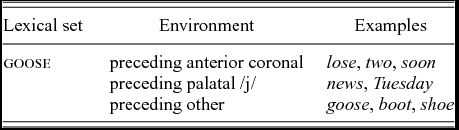
After various trial runs, I decided on anterior coronals, palatal /j/ and other environments as preceding environments which should be investigated (see table 4).
Preceding environments investigated in the present study

As with the goose analysis, for the goat and foot data sets, preceding and following environment were coded for. For goat and foot, I coded for preceding anterior coronals and preceding other environments.
For the following environment, Fridland (Reference Fridland2008), Flynn (Reference Flynn2012: 367) and Holmes-Elliot (Reference Holmes-Elliot2015: 210) describe the phonetic hierarchy of consonant > pause > vowel in the fronting process of goose. In this study, the data were coded for obstruents, sonorants and pause for both the goose and goat data sets. The following environment in foot tokens only contained consonants, which were coded for individually.
3.1 Statistical analysis
I examined linguistic and social effects on goose, goat and foot by fitting a series of linear mixed-effects regression models in Rbrul (Johnson Reference Johnson2009), with normalised F2 values of goose, goat and foot tokens as the dependent variable and random intercepts for the speaker and word. The fixed social predictors tested were speaker sex, socioeconomic status and age group.Footnote 11 Speaker sex and socioeconomic status were factors with two levels: male versus female and middle class (MC) versus working class (WC). As shown in table 3, three age groups were investigated: older speakers (age 60 and over), middle-aged speakers (40–59) and young speakers (20–39). The fixed linguistic predictors tested were the preceding environment (see table 4) and the following environment.
4 Findings
4.1 goose
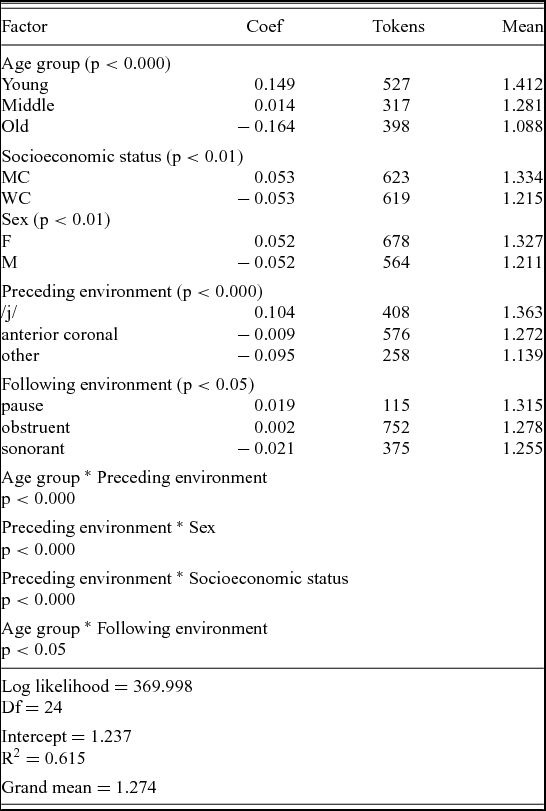
Table 5 provides the statistical results for the normalised values of goose. The language-external factors age group, socioeconomic status and sex and the language-internal factors preceding and following environment are explanatory factors in this model. Coefficients range from positive infinity to negative infinity and the larger the difference between coefficients in a constraint, the stronger is the effect size. Age group has the largest effect size in this model and is therefore the strongest constraint in the model while sex and socioeconomic status have similar effect sizes and following environment is a comparatively weaker constraint as the effect size is lower than for the other constraints. In addition, interactions exist between preceding environment and sex, preceding environment and socioeconomic status, age group and following environment, and age group and preceding environment.
Results of linear mixed-effects analysis of goose (application value: F2)

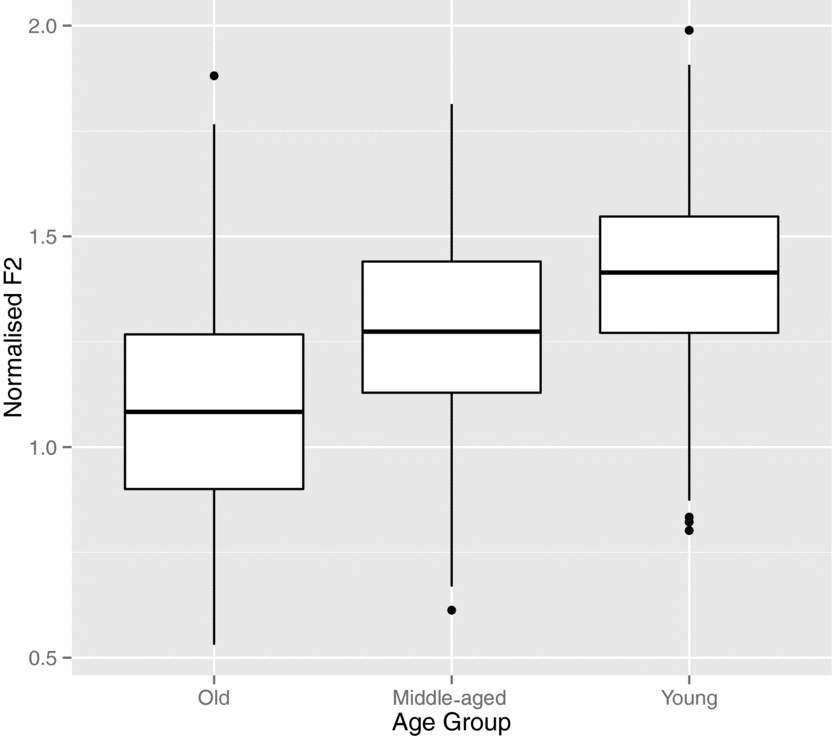
Figure 1 illustrates the aggregate F2 measures for the three age groups across apparent time, which indicate a change in progress. This finding is confirmed by the statistical results for age group (p < 0.000). Younger speakers produce higher F2 values than older speakers. Figure 1 also shows that the range of F2 slightly decreases from oldest to youngest age group. This could be an indicator that the change is slowing down.
Normalised F2 values by age group

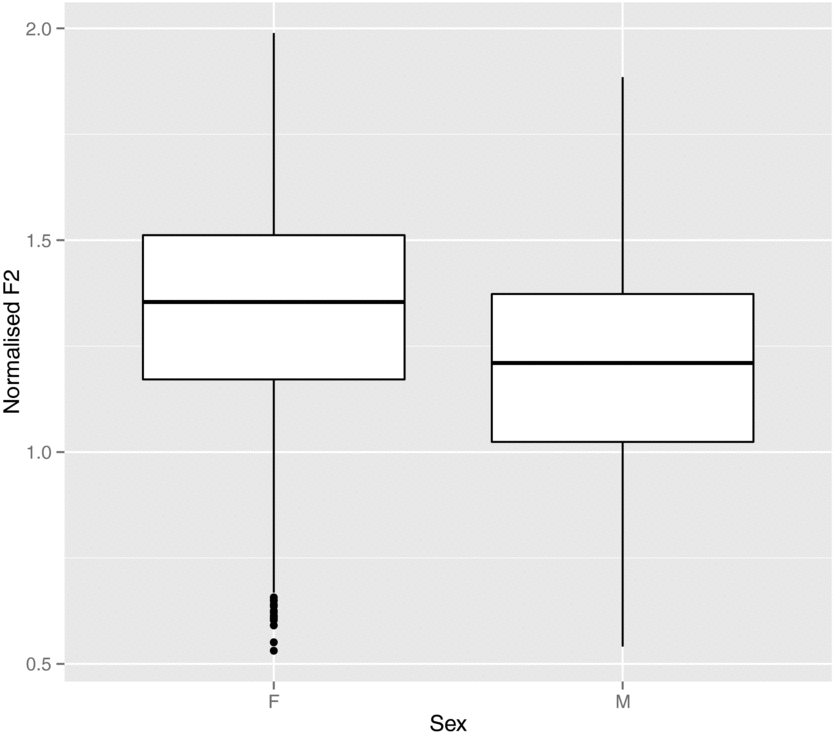
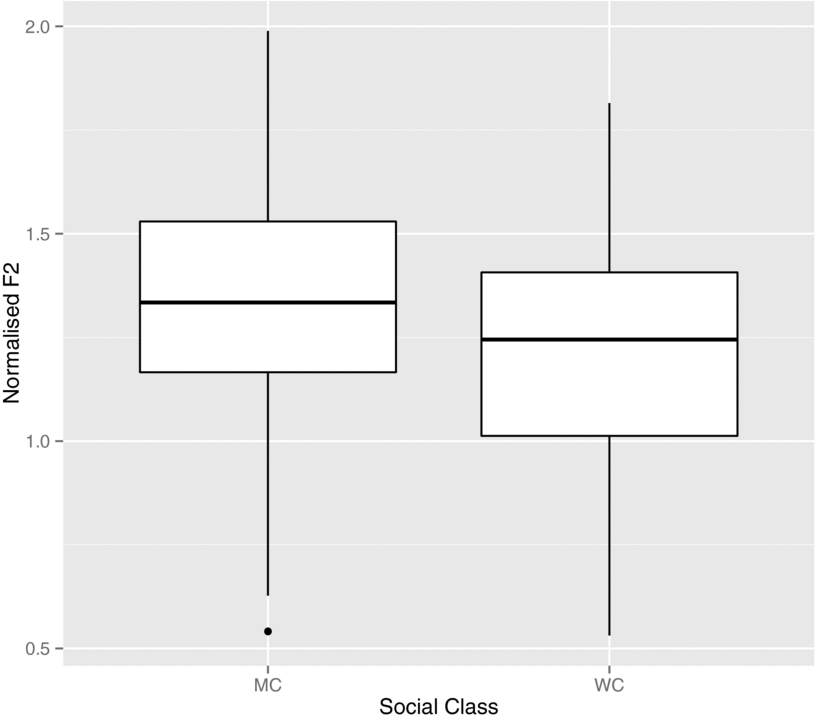
Socioeconomic status and speaker sex are both significant factors; however, unlike Flynn (Reference Flynn2012) and Holmes-Elliot (Reference Holmes-Elliot2015), who find interactions between age and speaker sex, these interactions do not exist in the present data set. Figures 2 and 3 present the boxplots for sex and socioeconomic status. Female speakers have higher F2 values than men, while MC speakers have higher F2 values compared to WC speakers.
Normalised F2 values by sex

Normalised F2 values by socioeconomic status

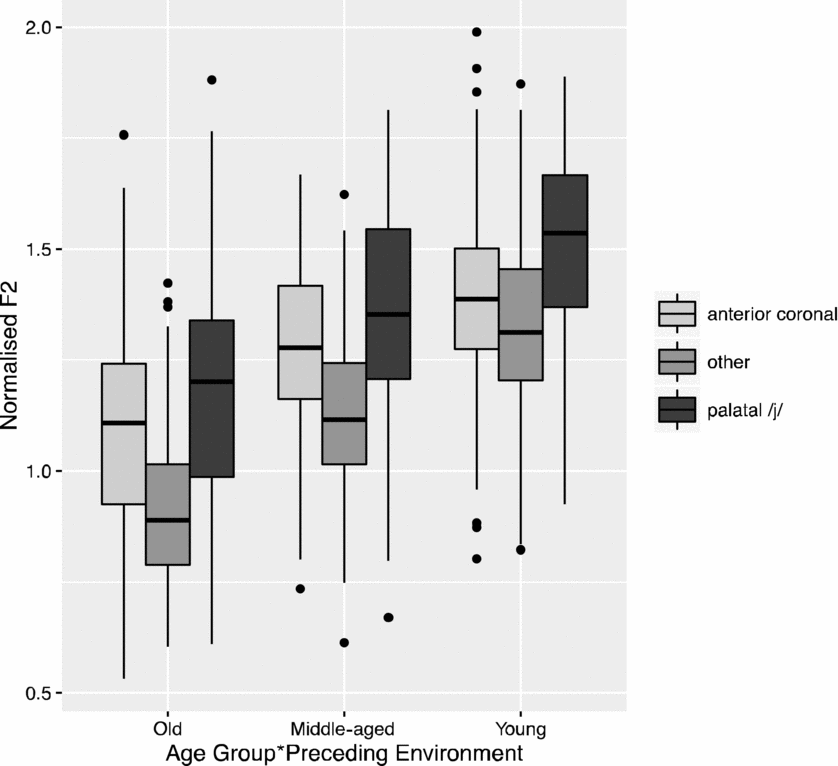
Turning now to language-internal factors, the preceding environment is a highly significant factor in the change. Figure 4 illustrates the interaction between age group and preceding environment (p < 0.000), which shows that preceding palatal /j/ has the highest aggregated F2 values in all three age groups, followed by anterior coronals and other environments, and reveals that this ranking is constant across the age groups.
Interaction between age group and preceding environment

This finding echoes the findings by others, e.g. Baranowski (Reference Baranowski2007), Hall-Lew (Reference Hall-Lew2009), Mesthrie (Reference Mesthrie2010), Flynn (Reference Flynn2012) and Holmes-Elliot (Reference Holmes-Elliot2015). The preceding environment as the strongest predictor in this change seems to be a unifying factor across varieties of English.
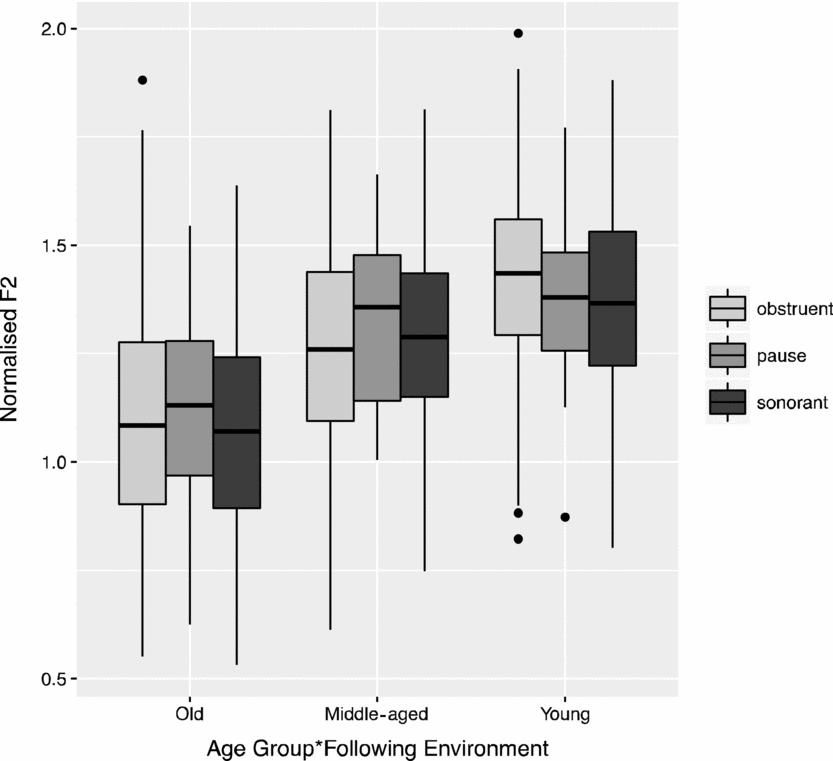
The second significant language-internal factor is the following environment (p < 0.05). Table 5 reveals that F2 is higher before obstruents than before pauses and sonorants. Again, the results are somewhat different from Flynn's (Reference Flynn2012) and Holmes-Elliot's (Reference Holmes-Elliot2015) findings. They observe that higher F2 values are found before an obstruent followed by pause and sonorant, while this data set displays a slightly different order, i.e. pause > obstruent > sonorant. Figure 5 shows that a consistent hierarchy like we find for the preceding environment does not exist. However, the number of prepausal goose tokens is considerably lower than for obstruents and sonorants, which might skew the data. As well as interacting with preceding environment, age group also interacts with the following environment.
Interaction of age group and following environment

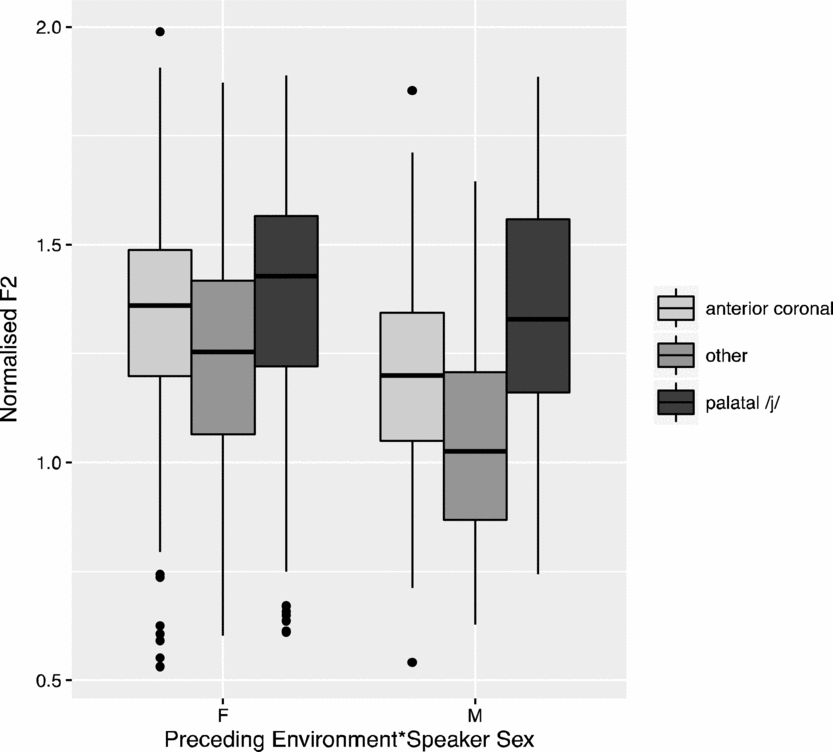
Figure 6 presents the interaction between preceding environment and speaker sex. The data reveal quite dramatic differences for anterior coronals and other environments between male and female speakers, with male speakers having lower F2 values than female speakers. However, F2 is not significantly different in the /j/ environment for speaker sex. In fact, in the group of old speakers, no social stratification is observable in this environment at all. It might be the case that male speakers have caught up with female speakers in this environment or that male and female speakers have had similar distributions all along for /j/ but women started fronting the vowel after anterior coronals and other preceding environments earlier than men. In particular, for the latter, men have much lower F2 values than women. The lack of social stratification in the preceding /j/ environment which displays the highest F2 values could indeed hint at an initial fronting due to language-internal factors.
Interaction of preceding environment and sex

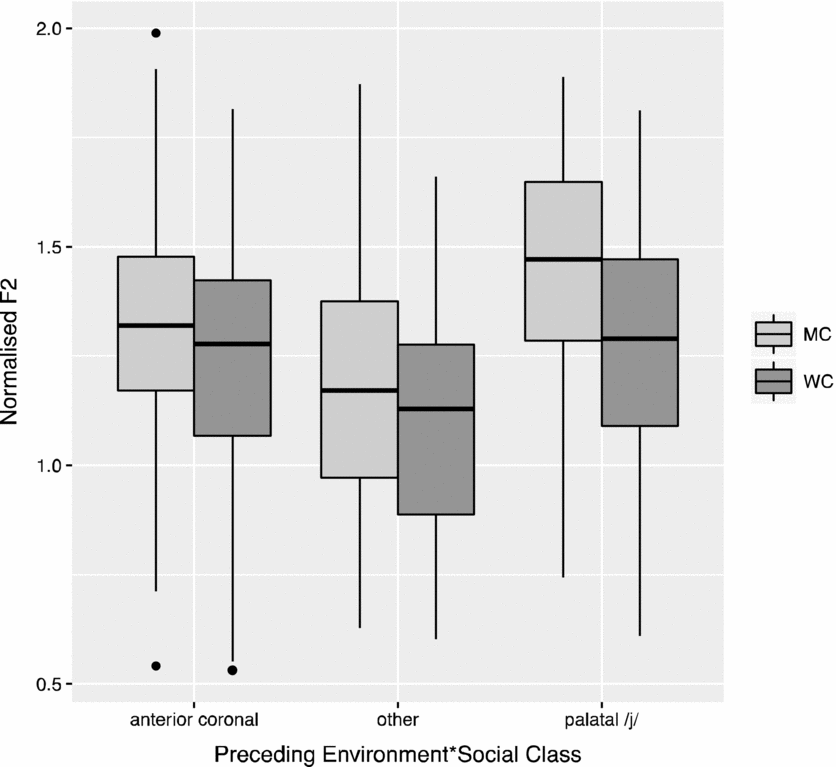
Finally, figure 7 presents the interaction between preceding environment and socioeconomic status. In all three preceding environments, MC speakers have higher F2 values than WC speakers and quite a dramatic difference exists for the palatal /j/ environment for those speaker groups. This finding deviates from Flynn's (Reference Flynn2012) and Holmes-Elliot's (Reference Holmes-Elliot2015) results, neither of whom find an interaction between socioeconomic status and preceding environment. However, both find an interaction between sex and age, which does not exist in the present study. In general, age group is a highly significant factor in this model; however, interactions with other social factors do not exist. The preceding environment appears to be a strong linguistic predictor in this change which interacts with social factors, e.g. figure 6 shows that women have higher F2 values than men. This is particularly the case for preceding anterior coronals and other environments, while for preceding /j/, the distribution is similar.
Interaction of preceding environment and socioeconomic status

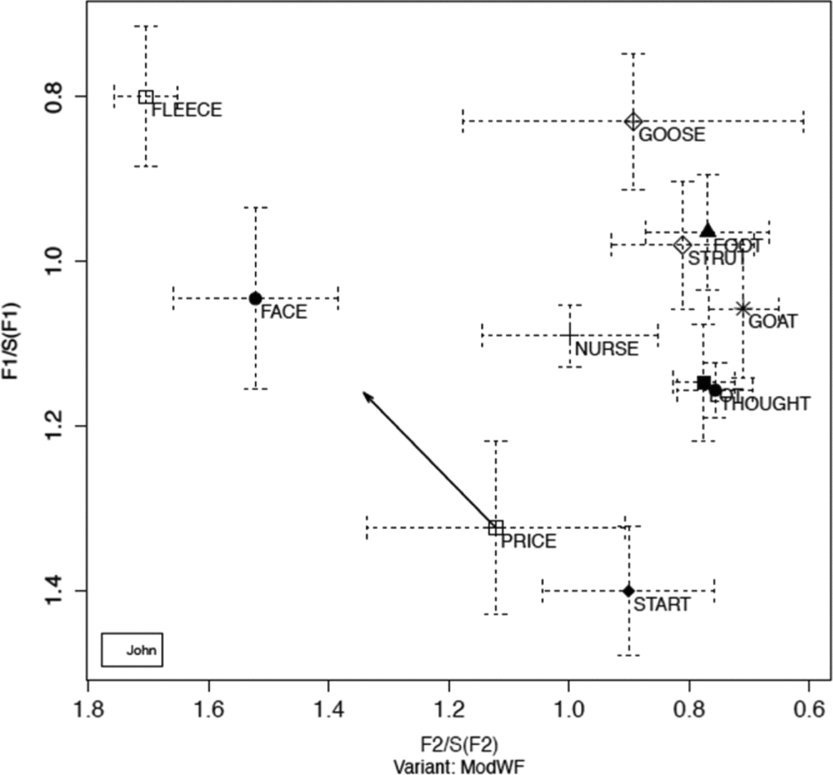
Examining the level of the individual speaker, figures 8 and 9 present vowel spaces of two speakers of CE at the extreme ends of the vowel continuum. Figure 8 represents John's vowel space. He is a 60-year-old MC male speaker from Carlisle. goose still occupies a back position for this speaker even though the standard deviation is quite high on the F2 dimension, which also means we see a lot of intraspeaker variation for John. John still has a more traditional realisation of the goose vowel even though the average of the F2 values for goose is produced in a more fronted position than the foot vowel. However, the standard deviation reveals that there are also instances where goose is produced further back than foot. The high standard deviation and variation within the speaker could be interpreted as a first step towards change, though still without obvious fronting. The speaker chooses from a wide range of realisations but the individual threshold for constant fronting has not been passed.
Vowel plot of John, a 60-year-old MC male speaker

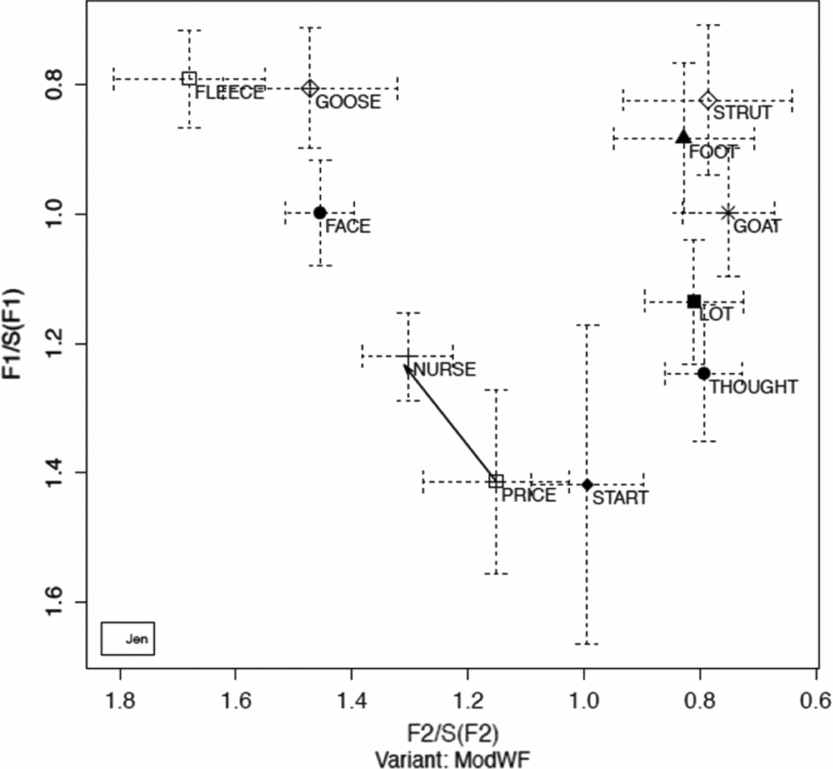
Vowel plot of Jen, a 23-year-old MC female speaker

The vowel plot in figure 9 shows part of the vowel space of Jen, a 23-year-old female MC speaker. It is apparent from this figure that Jen is participating in the vowel change as goose is found in a very front position. The deviation is much lower for her than for John. This might hint at a deceleration of the change. There is also already some overlap with the vowel space of the fleece vowel. What is also apparent from this chart is that foot and goat are found in a back position for this young person. Thus, she is taking part in the fronting of goose but for the other two vowel sets, a back quality is still found. We will now turn to the data analysis of these two vowels.
4.2 goat and foot
In this section, I focus on the distribution of the variables goat and foot in CE. As discussed above, in UK-based studies on goose, the goat and foot lexical sets are often not studied in depth. However, examining the results in relation to each other and in relation to goose provides a better picture of the dynamics of these vowels in variation and change processes, in particular in the current debate on parallel shifts where goose is seen as the main initiator. I will return to this point in the discussion section. The same statistical methods were applied and the results are presented in the following.
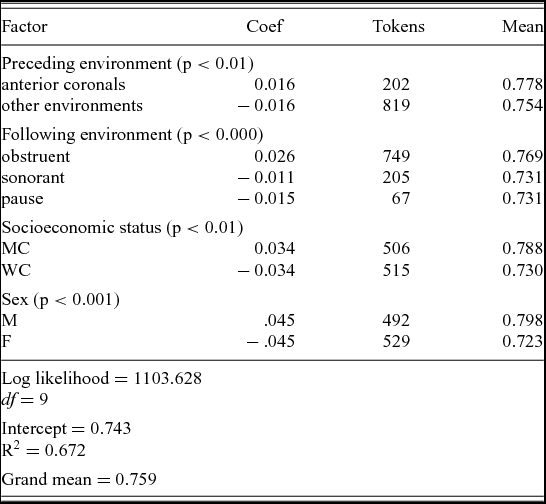
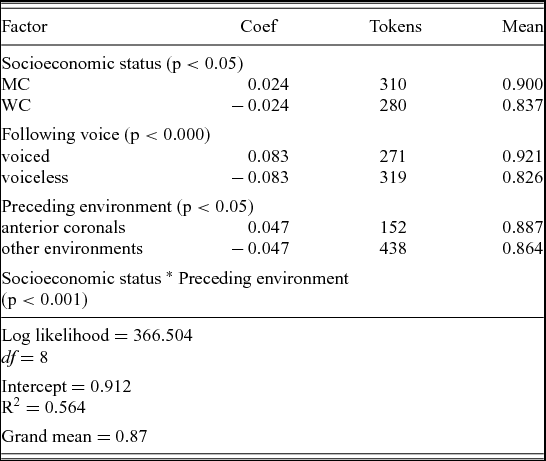
Tables 6 and 7 provide the statistical results for goat and foot. For goat, socioeconomic status (p < 0.01) and sex (p < 0.001) are statistically significant while age is not and an interaction between age and sex, or age and socioeconomic status does not exist. This leads to the conclusion that even though we can observe a social stratification of goat, there is no change in progress for F2 in the goat vowel in CE. On average, male speakers produce higher (= fronter) F2 values for goat than female speakers. The same is true for MC and WC speakers, where the former group produces higher F2 values. The following environment (p < 0.000) and the preceding environment (p < 0.01) are significant factors in the stratification of goat; however, change is not observable. In addition, the linguistic constraints are similar to the ones for goose, i.e. anterior coronals have higher F2 values than other preceding environments.
Results of linear mixed-effects analysis of goat (application value: F2)

Results of linear mixed-effects analysis of foot (application value: F2)

As in the results for goat, age group is not a significant factor for foot, which entails that we do not see a change in progress. However, socioeconomic status stratifies the realisation of foot with MC speakers showing higher F2 mean values and voiced consonants are preceded by higher F2 values. Like goose and goat, anterior coronal consonants trigger higher F2 values. The consequences of these results are reviewed in the discussion section.
5 Discussion
I have demonstrated that the goose vowel is undergoing fronting in CE in apparent time. Young speakers produce higher F2 values than older speakers. However, no change in apparent time is observable for F2 in goat and foot. I will discuss the results for goose before commenting on the lack of fronting for the other two vowels.
There are different explanatory strands for the fronting of goose, including phonological and phonetic reasons. One of the most often stated explanations is the occurrence of parallel shifts (see Labov Reference Labov1994; Durian & Joseph Reference Durian and Joseph2011; Fruehwald Reference Fruehwald2013), while Stockwell & Minkova (Reference Stockwell and Minkova1997) suggest that the crowding of the back space could be a reason for the fronting of goose (and goat). On the phonetic level, Flynn (Reference Flynn2012: 389) proposes that the high F2 of /j/ might be maintained in the transition between /j/ and /u:/, which then causes the high proportion of fronted values in this environment. Ohala (Reference Ohala, Masek, Hendrick and Miller1981) discusses how sound changes triggered by coarticulation can arise by acknowledging the role of the hearer in language change. Harrington et al. (Reference Harrington, Kleber and Reubold2011) picked up this point and suggest that coarticulation is highly likely to be the cause for vowel changes that occur across languages.
All social groups are taking part in goose-fronting but at the same time a clear social stratification exists in CE as well. Nevertheless, the linguistic conditioning is stronger than the social conditioning. The findings in this study are in line with the results of other studies, e.g. Baranowski (Reference Baranowski2008), Fridland (Reference Fridland2008), Hall-Lew (Reference Hall-Lew2009), Mesthrie (Reference Mesthrie2010), Flynn (Reference Flynn2012) and Holmes-Elliot (Reference Holmes-Elliot2015) among others, and also the linguistic stratification indicated by Jones (Reference Jones1932). Holmes-Elliot (Reference Holmes-Elliot2015: 186) comments that the language-internal nature of this shift is shown by ‘the regularity of conditioning, and the virtually universal nature of the constraint hierarchy of this change in disparate varieties of English’.
This is not a new idea. Fridland (Reference Fridland2008) discusses the extremely regular change in back vowels in the US. She suggests that while many other ongoing vowel changes in North America are socially driven,
back vowel fronting is very regular, differing mainly in the degree of advancement overall. This regularity in diffusion makes it a good candidate for an internally motivated shift, driven by instability in the American vowel system more generally, rather than any regional or social association. (Fridland Reference Fridland2008: 449)
The findings from the present study and other studies on UK varieties suggest that this regularity is not restricted to North America; in fact, strong language-internal constraints for goose-fronting are found on both sides of the Atlantic.Footnote 12 Fridland suggests that the back vowel fronting could indeed be an internally motivated change rather than a change driven by social motivations (see Milroy Reference Milroy, Cain and Russom2007).
When Fridland (Reference Fridland2008: 448) proposes that ‘this shift is one of a truly global nature’, she includes the changes in goat and foot; however, on the surface, there is no indication in the CE data so far that these two vowels are indeed participating in a shift. Yet even though fronting in goat and foot in apparent time does not seem to occur in CE, a stratification according to the preceding environment is observable for both variables. This stratification is similar to the one found by Fridland (Reference Fridland2008), i.e. the regularity in variation she observes for these two vowels is also found in the Carlisle data; however, a change in progress is not observable (yet).
A parallel shift of goose and goat, with goose-fronting always being more advanced than goat-fronting, seems to occur in US and southern English varieties.Footnote 13 However, the results for CE indicate that goat-fronting is not a necessary consequence of goose-fronting. Hence Docherty's (Reference Docherty and Kirkpatrick2010) prediction that monophthongal goat vowels are not affected by fronting is confirmed by the data for CE but the question remains as to why this is the case.
Durian & Joseph (Reference Durian and Joseph2011) argue that analogy of phonetic conditioning between vowel classes (or lexical sets) is key to parallel shifts: first an innovation diffuses on a segment-to-segment basis within a vowel class, which could be interpreted as internal analogy. As a second step the change commenced by the internal analogy is then mirrored in a second vowel class. Due to their corresponding developments, the changes in the different vowel classes can then be interpreted as parallel shifts. Durian & Joseph (Reference Durian and Joseph2011) argue that the fronting of goose and goat that we see in many varieties is due to phonetic constraints (internal class analogy) within goose before the constraints carry over (external class analogy) to goat. They comment that the internal class analogy often chronologically predates the external class analogy, which would explain why goose-fronting is in most cases preceding the fronting of goat.
In the Carlisle data for goose we see the diffusion from segment to segment (internal class analogy) quite clearly, i.e. the fronting happens in preceding palatal /j/ environments before it is observed in anterior coronal and other environments. For goat and foot an internal class analogy seems to happen as well, in which the preceding anterior coronal environments show higher F2 values than the other environments. However, there is a decisive difference between those two vowel groups: goose is fronting across apparent time while goat and foot are not.
Coming back to Docherty's (Reference Docherty and Kirkpatrick2010) comment about the fact that goat is not fronting in the north of England where we find a monophthongal variant rather than a diphthong, we could assume that the fronting is only possible if goat is a diphthong. And indeed, Haddican et al. (Reference Haddican, Foulkes, Hughes and Richards2013: 390) hypothesise that a correlation between goat diphthongisation and goat-fronting exists. There is ‘the possibility that goat fronting and goat diphthongisation may be at least partially unified processes of change’. Hence, even though Haddican et al. (Reference Haddican, Foulkes, Hughes and Richards2013: 389) state that the diphthongisation of face and goat seem to proceed slower than goose/goat-fronting, the fronting of goat would probably not be possible without the initial stages of the diphthongisation which we see in York.Footnote 14
Given these results, there seems to be a structural dimension involved in the fronting of goat (and the lack of it), which has not been discussed in the past. In both cases – goose and goat – diphthongisation seems to take place in lockstep with frontingFootnote 15 in other varieties (see Kerswill & Williams Reference Kerswill and Williams2005; Haddican et al. Reference Haddican, Foulkes, Hughes and Richards2013). Durian (Reference Durian2012) even refers to the parallel fronting of goose and goat as ‘back diphthong fronting’.
goose is often reported as increasing in diphthongal quality over time, which is most likely triggered by the high F2 of /j/ and then mimicked in the other environments (see Flynn Reference Flynn2012: 389). For the goat lexical set, there is no such trigger in CE, i.e. changing from a monophthongal to a diphthongal state starting in the onset is structurally harder to accomplish. Durian & Joseph (Reference Durian and Joseph2011) state that parallel shifts occur when two or more vowel classes are parallel to each other. The lack of parallel development in terms of diphthongisation in CE might lead to discontinuation of goat-fronting in the initial stages of the change. While the internal class analogy according to the preceding sound takes place, the next step of establishing a change in progress is prevented by the monophthongal nature of the goat vowel. For southern varieties, however, diphthongal qualities are the norm and a parallel development due to phonetic analogy between goose and goat is possible.
Turning to the results for foot in this study, they confirm Ferragne & Pellegrino's (Reference Ferragne and Pellegrino2010: 29) findings for the far north-west of England, i.e. foot remains in a back position. In the south, on the other hand, foot is fronting (see Torgersen & Kerswill Reference Torgersen and Kerswill2004; Fabricius Reference Fabricius2007). Ferragne & Pellegrino (Reference Ferragne and Pellegrino2010: 29) tentatively suggest that we observe different stages of a ‘potential partial chain shift’ in goose and foot and Harrington et al. (Reference Harrington, Kleber and Reubold2011) established that in the diachronic change of goose and foot in RP, goose is leading the change. There seem to be similarities in the structural conditioning of goose and goat and goose and foot. Parallel linguistic constraints are observable, which suggests that the dynamics between goose and goat are similar to the dynamics between goose and foot. However, diphthongisation does not appear to be a driving force for foot-fronting in the south, possibly due to the length distinction between goose and foot.
foot-fronting seems to be prevented by another structural factor. While the process of goose-fronting is found in the vast majority of varieties in England, fronting of foot is mainly described for varieties which have a foot–strut split,Footnote 16 e.g. foot is fronting in the south of England and in Scotland (varieties with the foot–strut split) but not in the north of England where the foot–strut split does not occur (see Ferragne & Pellegrino Reference Ferragne and Pellegrino2010).
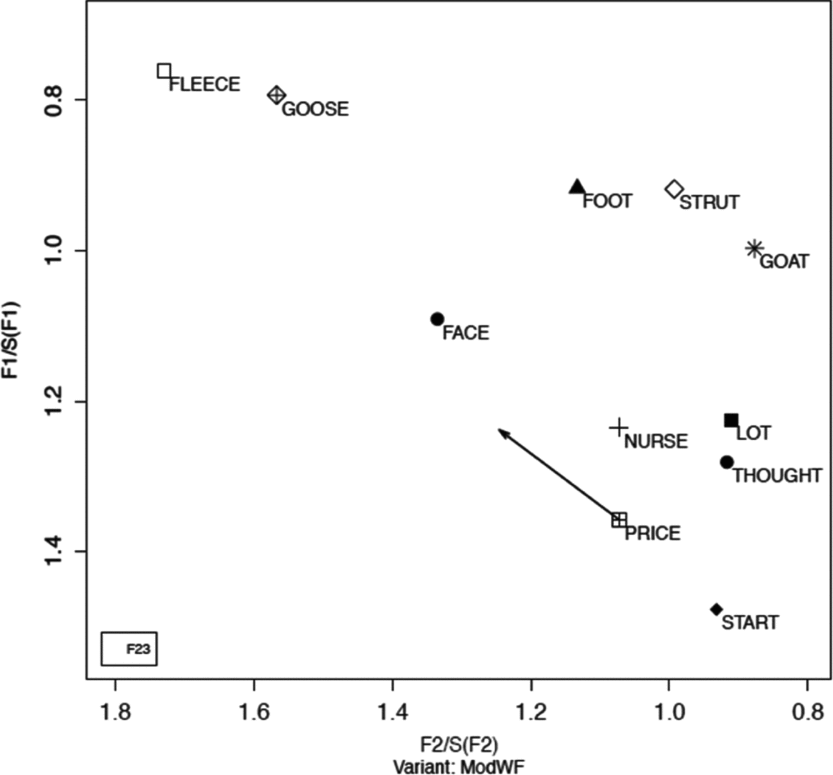
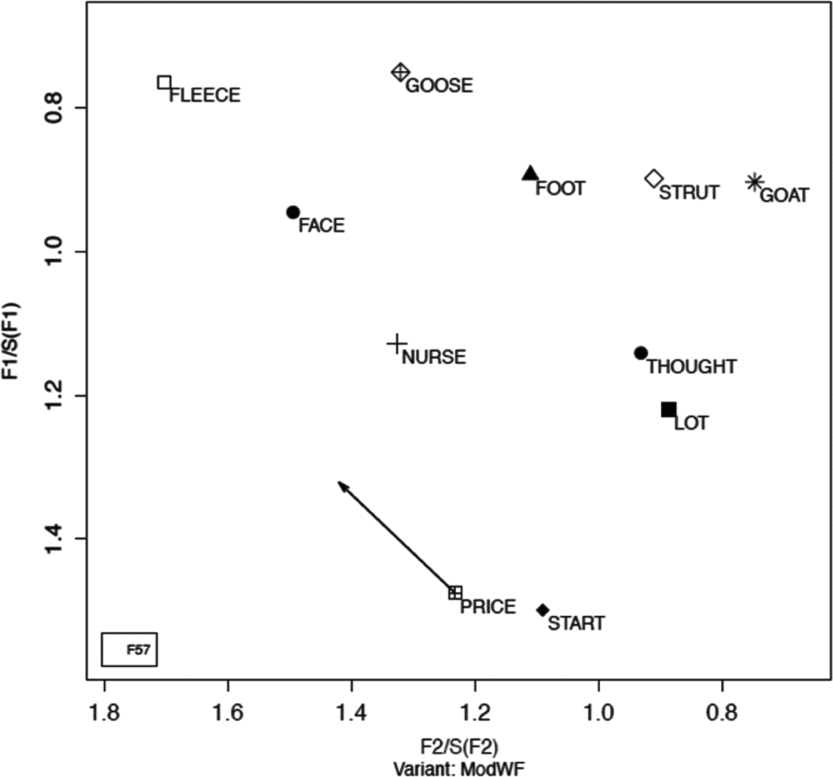
Looking at individuals in the CE data, we find different scenarios for the distribution of foot. Figure 10 shows the vowel plot of Helen, a 23-year-old speaker who spent some time in Edinburgh, and figure 11 presents the vowel plot of Silvia, a 57-year-old who lived in various places in the south of England. They are the speakers with the highest F2 values for foot in the sample. Helen's goose vowel is very fronted but we also see that foot is slightly fronted while strut seems to stay behind. Similarly, there is a slight split between foot and strut for Silvia. In both cases, strut stays in the back position while foot is fronting. However, there is only a fronting movement. In terms of height, the vowel stays very stable.
Vowel plot of Helen, a 23-year-old speaker

Vowel plot of Silvia, a 57-year-old speaker

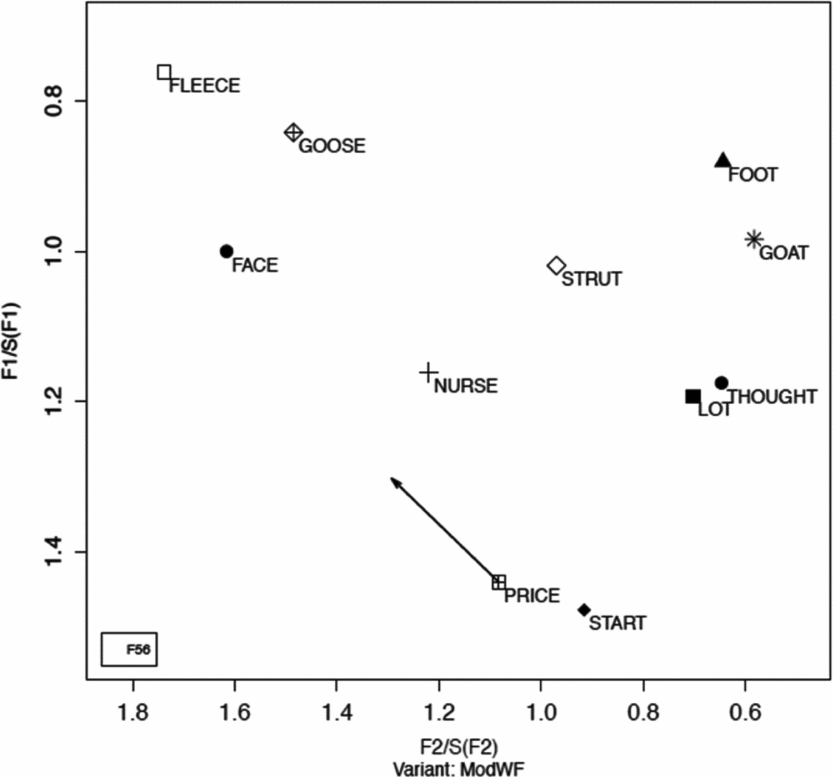
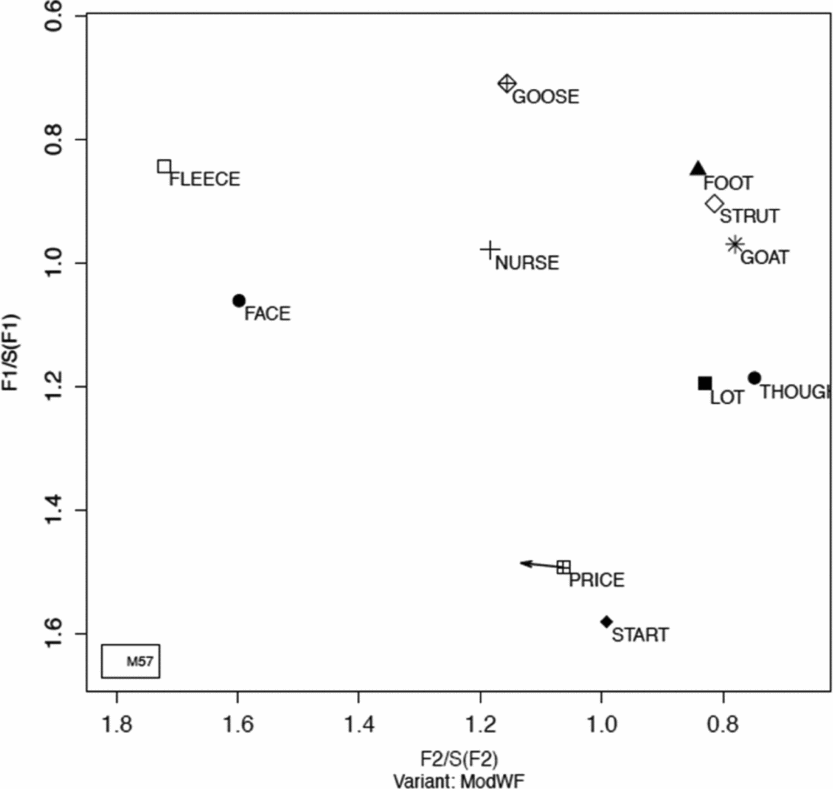
Figure 12 depicts Irene's vowel plot who somewhat has a foot–strut split which is similar to the one found in the south of England. Irene's strut vowel is further front and more open than the strut vowel produced by Irene in figure 12 and Joseph in figure 13, who does not have the split. Irene works as a receptionist and even though she does not have the bath–trap split, her face and goat vowels are variably diphthongal and her strut vowel is somewhat more central and open. Due to her occupation, she might be aiming for a ‘posh’ voice which includes southern English variants. Hence, we can assume that external motivation is responsible for the split we see for Irene.
Vowel plot of Irene, a 56-year-old speaker with a foot–strut split

Vowel plot of Josef, a 57-year-old speaker who shows a lack of the foot–strut split

Since both speakers in figure 10 and figure 11, Helen and Silvia, spent time in areas where the foot–strut split occurs, it is most likely that the high F2 values for foot are linked to external motivations. What is striking, however, is the stability of strut in the back position. Given these results, it seems that foot-fronting in Carlisle can occur in individuals due to external motivations, in this case their history of mobility. The internal motivation for foot-fronting, however, which is described for RP (and other southern varieties; see Harrington et al. Reference Harrington, Kleber and Reubold2011), cannot trigger this fronting process. The stability of foot–strut as an unsplit back vowel prevents the fronting of foot if an external motivation does not exist. This structural specification, which is only found in the north of England, would explain why we do not find foot-fronting in this geographical area. More studies of UK varieties are needed that investigate the dynamics from a sociolinguistic point of view in order to understand the distribution of the back vowels in full.
In general, we can establish that even though goose-fronting exists in CE, there is no indication of a parallel shift of goose and goat or goose and foot. On the contrary, goat and foot are fairly stable in their back position due to structural constraints which prevent the movement of these vowels. Hence, even though parallel shifts between goose and goat and goose and foot are attested in quite a number of English varieties, e.g. in US varieties and in southern English varieties, at least CE displays different vowel dynamics.
6 Conclusion
I have demonstrated that goose-fronting is found in Carlisle, a city in the north-west of England, and that language-internal constraints that are at work in this variety are similar to those in other varieties. I also showed the complexity of the dynamics between goose and the back vowels goat and foot in this community. Fronting of goat and foot is not found in CE and this lack of change in both vowels has structural reasons: even though initial conditions for fronting are observed, the monophthongal realisation of the goat vowel prevents a parallel shift with goose and the fronting of foot seems to be blocked by the lack of the foot–strut split. These results provide new insights into the distribution of the back vowels in varieties of English.
While morphosyntactic features such as quotative be like have been studied across different varieties, we need to start conducting cross-dialectal studies of phonetic changes that seem to happen on a global scale to investigate the nature of these changes in more depth. Whereas vocal fry, high-rising terminals and short front vowel lowering seem to be spreading due to dialect contact, for goose-fronting, the question of internal and external motivations seems to be much more complex. At the same time, studies focusing on goose-fronting would benefit from including a broader picture, i.e. investigating goat and foot in relation to goose and the (internal) factors that lead to goose-fronting.