1. Introduction
The past 30 years have seen international courts growing not only in numberFootnote 1 but also in power, influence and confidence. In parts of the world, the rise of international judicial power has also sparked a backlash against judges.Footnote 2 Yet there is a great degree of variation in the situation of international courts and international adjudicators do not, by any means, all wield the same authority. Some institutions – such as the European Court of Justice (CJEU) and the European Court of Human Rights (ECtHR) – have morphed into mighty judicial bodies. But others – including the courts set up by regional trade agreements in Africa – occupy a more precarious position in their respective legal regimes.Footnote 3 Yet even the most powerful international courts must reckon with the fact that there are limits to their power. These limits arise in part from the fact that international adjudicatory bodies – even the European Court of Justice or the European Court of Human Rights – do not hold the formal power to strike down domestic legislation or to overturn domestic court rulings.Footnote 4 They reflect, more generally, the fact that international legal regimes, unlike nation states, cannot rely on any extensive administrative apparatus, let alone a network of local courts to implement and enforce their decisions. Compliance with international court rulings thus appears to require that states will have enough goodwill to abide by decisions that condemn their actions.
An expanding literature, straddling the disciplines of law and political science, has begun to shed light on the compliance environment of international courts. This rich, transdisciplinary scholarship stresses the penetration of domestic legal orders;Footnote 5 political fragmentation;Footnote 6 compliance partnerships with infra-state actors;Footnote 7 and the active cultivation of public support through effective judicial rhetoric;Footnote 8 as major determinants of the authority of international adjudicators. Simply put, the broad lesson of this body of research is that international courts need the support of, at least, some state actors in order to secure domestic compliance. Courts that fail to cultivate some form of state support face the prospect of irrelevance, leaving them with an unenviable choice between permanent self-restraint and endemic disobedience. Yet even the more established international judicial bodies cannot assume that state actors will get along with just any kind of activist decision. Indeed, it is in the international adjudicators’ own institutional self-interest to take into account the possibility that normally compliant states may refuse to obey a ruling seen as overreaching or as unduly interfering with a cherished domestic policy or practice. Defiance will damage the court’s authority and, potentially, its long-term influence. Judges who care about their court’s institutional standing, therefore, have a strong incentive to choose their battles carefully and refrain from making decisions that will invite defiance.Footnote 9
These aspects of the decision-making environment of international courts have been well attended. Scholars have generally argued that international adjudicators seek to maximize compliance by avoiding decisions for which the odds of compliance are low.Footnote 10 One question, though, deserves greater attention than it has received so far in the literature. This relates to the uncertainty surrounding the judicial decision-making process. Often enough, international adjudicators must solve the compliance dilemma in a context where they do not possess perfect information over state preferences. Does the state value its commitment to the international regime to a sufficient degree to accept an adverse ruling over this or that particular issue? This question is all the more difficult to answer for the judges sitting on an international court as these judges – with the possible exception of the judge appointed by the state whose action is being reviewed – ordinarily possess limited knowledge of the domestic legal, political, and cultural context potentially affected by their decisions. To be sure, careful investigation by the judges and their clerks or other court personnel can help mitigate uncertainty. Yet, helpful as they are, such measures cannot entirely eliminate uncertainty. At the end of the day, a decision has to be reached on the basis of information that is inevitably imperfect. So, if the judges decide to rule against the state, they will only know whether they were right to bet on obedience after the state has taken cognizance of the decision.
As this article seeks to demonstrate, defiance avoidance is a complex and delicate matter. Its success is heavily contingent on information over the court’s political environment. Moreover, compliance management does not necessarily end with the court’s dictum in the case in which the spectre of state defiance initially arose but may extend over several cases. I use a simple formal theoretical framework to elucidate how uncertainty and the extent of the information available to judges affect international judicial rule-making. In the model, an International Court (IC) interacts with a State.Footnote 11 The IC must decide whether the State has violated the international regime, but without knowing for certain whether the State is supportive and thus prefers compliance over defiance or non-supportive with a preference for defiance over compliance. I show that the IC’s choice is sensitive to the judges’ ‘prior beliefs’ over state preferences. When over-optimistic, these beliefs can lead the IC to draw the wrong conclusion and to render decisions that trigger the sort of pushback its judges hoped to avoid.Footnote 12 I then use the insights derived from this simple game-theoretic setup to discuss the institutional mechanisms and doctrinal tactics employed by international adjudicators to mitigate this informational problem, and to revise their beliefs about state preferences in light of the actions and behaviour of participating states. Test-the-water dicta, for instance, can serve to assess whether there is enough goodwill to permit doctrinal innovation in a sensitive policy area. Similarly, appeal to a grand chamber within the international judicial body can operate as a safeguard to avert defiance when a state does not react as international adjudicators had initially expected. By creating informational feedback loops, these mechanisms give international adjudicators the ability to adjust their level of activism to what states will stomach. I illustrate these two mechanisms with CJEU and ECtHR cases. Variations in institutional design, I suggest, implicate that some of these tools are more easily deployed and better suited to some international legal regimes than others. In discussing these examples, my aim is not to test a theory of international adjudication but to sharpen our theoretical understanding of the compliance dilemma. Thus, the examples selected are meant to be illustrative of the problem I am pursuing rather than a representative sample of the caseload of international courts. In that sense, the contribution of this article should be understood as primarily theoretical and conceptual.
2. Modelling uncertainty in the environment of international courts
The formal modelling approach applied in the present article rests on assumptions about the behaviour of international adjudicators which I take to be uncontroversial.
First, I assume that international judges behave rationally when deciding cases, consciously weighing preferences over case outcomes and concerns of a more institutional nature such as long-term authority. To be sure, human decision-makers are not always rational and empirical research has confirmed that this holds for judicial decision-making too – judges are not Vulcans immune to emotional impulses or cognitive biases in the mould of the imperturbable Mr. Spock from the Star Trek franchise.Footnote 13 The incentive to use rationality, however, rises with the importance of the choice to be made. Assuredly, few judicial choices are more consequential than the decision to rule for or against a sovereign state. So, it is unlikely that the outcome of such cases will have much to do with when or what the judges had for breakfast or with an imaginary coin toss.Footnote 14
Second, I assume that international adjudicators think strategically and in forward-looking fashion when they seek to solve the compliance dilemma. It bears emphasis that this assumption does not commit us to a Machiavellian conception of adjudication in which judges have no concern for the law and are exclusively preoccupied with advancing their personal ideological agenda. Indubitably, the relative indeterminacy of international law and inter-state treaties entails that considerations extraneous to the law do, by necessity, play a role in international dispute resolution. Yet the model set forth in this Section is compatible with a rich and nuanced picture of the determinants of judicial conduct.Footnote 15 The judges sitting on an international court may wish to rule against a state out of a genuine conviction that it is what the law requires; or because of the conception of justice they happen to hold; or simply because they expect that the decision will enhance their own social prestige. All these goals are compatible with the model. Yet I assume that in seeking to achieve these goals, international adjudicators normally care about their court’s institutional standing and about how state responses to their rulings may affect it. Thus, I do not assume that judges strategize for the sake of strategizing but because a loss of institutional standing will diminish their capacity to influence the development of the law in subsequent cases.
Third, I model the strategic interaction as one between a judicial rule-maker and a unitary state actor. This, arguably, is a simplifying assumption. Some ICs, especially the more powerful ones, engage not just state governments but also infra-state actors, such as domestic courts and private litigants. While a more complex model may be needed to investigate compliance dynamics specific to these more advanced regimes, the framework presented here provides enough analytical leverage for the substantive point I am concerned with in this article – even for these more advanced regimes.Footnote 16
Finally, it may help the reader unfamiliar with game-theoretic analysis to know that the point of a model is not to provide a theory of everything or a thick description of reality. Instead, the objective of a model is to shed light on the question at hand by ensuring that all the assumptions of our analysis are consistent. The particular question I seek to clarify is how uncertainty over state preferences affects international judicial decision-making when international adjudicators would, in principle, prefer to rule against the state. To make it perfectly clear, I am only concerned with the situation in which ruling against the state is the best outcome for international adjudicators conditional on state compliance, as this is the configuration that I take to be characteristic of the non-compliance dilemma. I do not intend to elucidate state–court interactions that do not meet this characteristic, such as when a no violation verdict is the international court’s most preferred outcome. The choice to leave out these and other facets of international adjudication is thus a deliberate one.
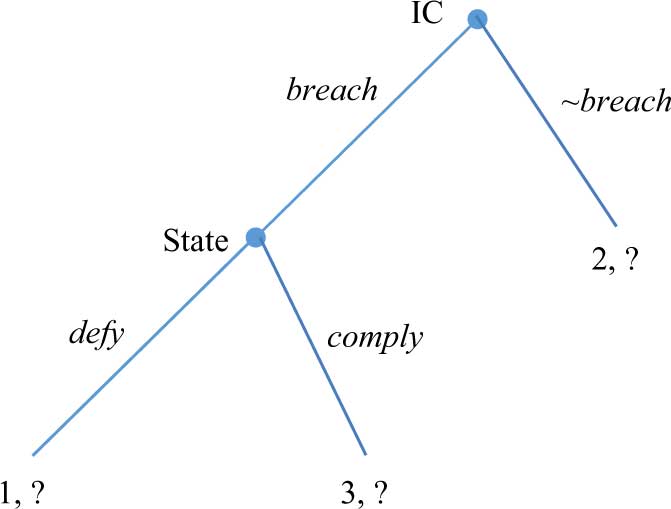
Figure 1 illustrates the situation I purport to model. The IC must decide between two legal findings: to declare the state in breach of the legal regime (breach) or not in breach (∼breach).Footnote 17 If the IC chooses ∼breach, the game stops there. But if it opts for breach, then the State must decide whether to comply with the ruling (comply) or to defy it (defy). The IC would prefer to declare a state violation rather than to defer to the State, but only if the latter complies with its ruling. If the State chooses to defy, the IC would rather defer than suffer non-compliance. The IC’s payoffs reflect this preference ordering and characterize the problem we aim to elucidate.Footnote 18 The IC receives a payoff of 3 (the highest payoff) if it declares a violation and the State complies; a payoff of 1 (the lowest payoff) if it declares a violation and the State defies; and a payoff of 2 if it defers to the State.Footnote 19 It is easy to see in this setup that for the IC the outcome of choosing breach depends on the behaviour of the State and, more specifically, on whether the State prefers defy or comply. The uncertainty surrounding the IC’s decision environment arises from the fact that it does not know with certainty which of the two actions the State prefers. This is why I put a question mark on the State’s payoffs.
International Court and Uncertainty over State Preferences.

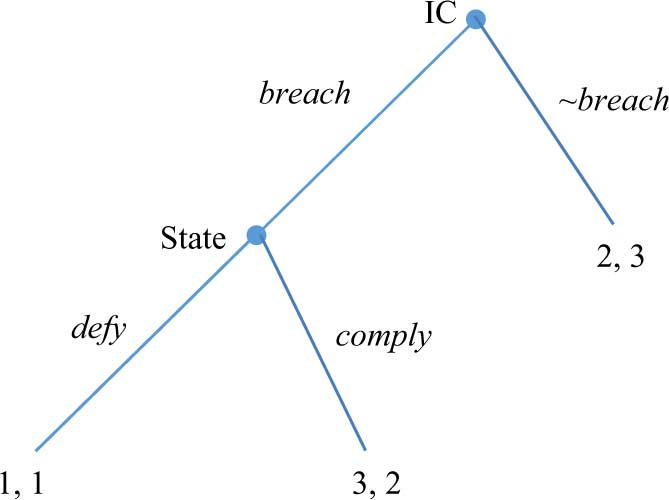
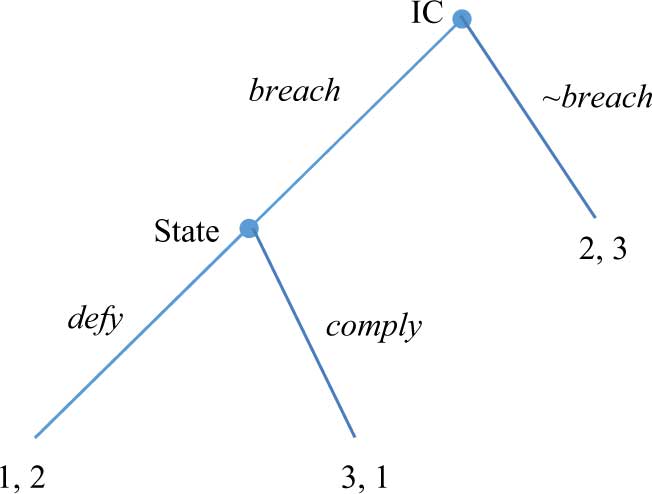
The IC can safely assume that the outcome where it defers to the State by choosing ∼breach will invariably be the State’s most preferred. But if it chooses breach, there are two possibilities. Either the State has a strong commitment to international law such that it prefers compliance over defiance, as in Figure 2.1. Or the State has a low commitment to international law such that it prefers defiance over compliance, as in Figure 2.2. For the sake of simplicity, I refer to the State in the first scenario as ‘supportive’ and to the State in the second scenario as ‘non-supportive’.Footnote 20
International Court and Supportive State.

International Court and Non-supportive State.

The payoffs in the two figures reflect the difference between the respective preference orderings of the supportive and non-supportive State. Both the supportive and the non-supportive State get their highest payoff, 3, when the IC defers (by choosing ∼breach). But the supportive State receives a higher payoff from compliance (payoff = 2) than from defiance (payoff = 1), whereas the reverse holds for the non-supportive State (payoffs for compliance and defiance are respectively 1 and 2).
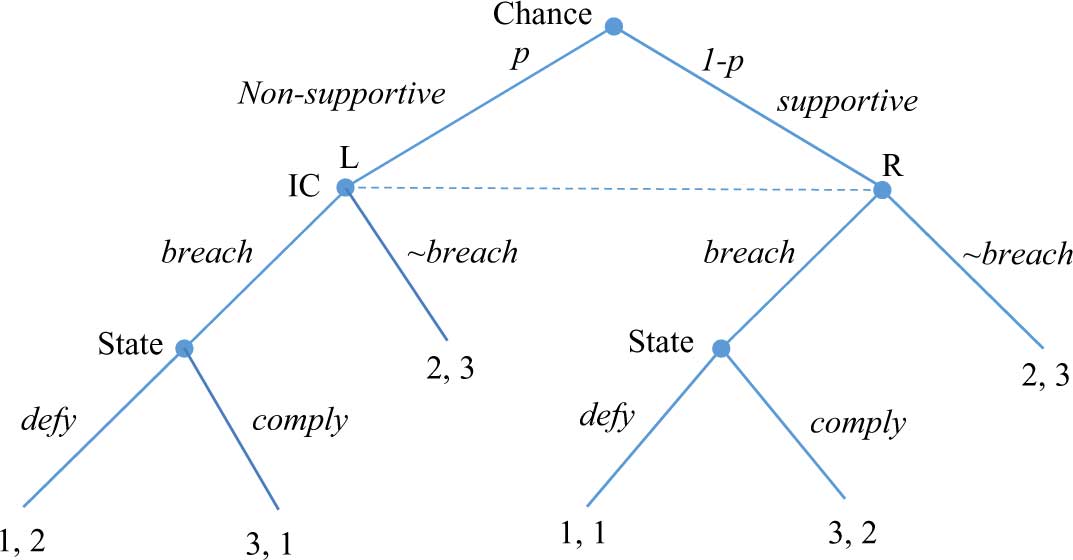
Figures 2.1 and 2.2 represent these two hypotheses (or ‘states of the world’ in game-theoretic jargon). Now, from the IC’s standpoint, the problem lies precisely in the fact that it does not know with certainty which hypothesis is true (that is, which state is the actual state of the world). The IC does not have, in other words, complete information over the State’s true preferences.Footnote 21 For that reason, it must balance the possibility of defiance against the possibility of lost justice.Footnote 22
International Court and Compliance Dilemma.

Information, to be sure, is not an all-or-nothing matter but, rather, comes in shades of grey. International judges can be more or less informed and, therefore, more or less confident about true state preferences. In our formal setup, this is equivalent to saying that they can be more or less confident about the State’s true payoffs. To model this, we merge the two trees from Figures 2.1 and 2.2 and we add a chance node to represent the two possible hypotheses. The chance node determines which payoffs are the State’s true payoffs. It can be thought of as representing history or fate, or simply the social process by which state preferences come about. What is crucial here is that the payoffs determined by the chance node are not directly observed by the IC. This is why the IC does not know with certainty the State’s true payoffs. Specifically, uncertainty means that the IC does not know with certainty whether it is making a decision at node L or at node R, as denoted by the dashed line linking the two nodes.Footnote 23 The letter p stands for the probability the IC ascribes to the State being non-supportive. 1 − p, on the other hand, indicates the probability ascribed by the IC to the State being supportive. These probabilities represent the information available to the IC and the confidence it has about the State’s true preference ordering. Suppose, for example, that p = 0.7. This means the IC believes there is 70 per cent probability that the State is non-supportive – and so a 1 − 0.7 = 0.3 = 30 per cent probability the State is supportive. Looking at the tree in Figure 3, this entails that the IC believes it is more likely to be at node L than at node R.
Equipped with these probabilities, the expected payoff respectively attached to breach and ∼breach can be readily computed and compared; ∼breach always yields a payoff of 2, irrespective of the State’s payoffs. Deferring to the State is, in that sense, a safe bet. Anticipating that the supportive State will choose comply and the non-supportive State defy, the IC’s expected payoff from choosing breach should reflect the probability attached to each scenario. If the IC believes that there is a 70 per cent chance the State is non-supportive, the expected payoff of choosing breach is:
 $$ 0.7*(1) + 0.3*(3) = 0.7 + 0.9 = 1.6 $$
In this case, the expected payoff of breach is less than the expected payoff of ∼breach (1.6 < 2). Balancing the possibility of defiance against the possibility of lost justice, deferring is thus the equilibrium outcome.Footnote 24 Contrast this with the situation where the IC believes there is only a 25 per cent chance the State is non-supportive. Correspondingly, the expected payoff of choosing breach is:
 $$ 0.25*(1) + 0.75*(3) = 0.25 + 2.25 = 2.5 $$
In which case the expected payoff of breach is larger than that of ∼breach. Predicted equilibrium behaviour, therefore, is a breach. More generally, the IC will only rule against the State if the probability that the State is supportive is greater than 50 per cent.Footnote 25
For simplicity of exposition, I assigned the payoffs 1, 2, and 3 to the outcomes. Needless to say, the equilibrium outcome may change if we vary the magnitude of these outcomes even if we keep the same preference ordering. Holding prior beliefs and other payoffs constant, ruling against the State becomes a more attractive proposition if the IC accrues a payoff of 10 rather than 3 when the State complies. In other words, when international judges regard a violation as particularly severe they will be more inclined to take risks.
Nevertheless, what I want to underline here is not the effect of varying the payoffs on the judges’ conduct or the precise probability threshold at which deference becomes an equilibrium outcome. Rather, my point is about the importance of information along with the beliefs over state preferences based on this information. The belief that states are more likely to defy than to comply with an adverse ruling is arguably what differentiates passive international courts from their more activist counterparts. At one end of the activism–restraint spectrum lie the two self-confident European judicial bodies, the CJEU and ECtHR. At the other end are the courts – some of which modelled after the CJEU – in Africa and Latin America that, owing to low state commitment, have had a considerably smaller impact on domestic law and policy.Footnote 26 Then somewhere in between are the Inter-American Court of Human Rights (IACtHR) and the Appellate Body of the WTO – which have displayed a fair amount of activism, but are not quite as solidly established and powerful as the CJEU and the ECtHR.Footnote 27 Information on state preferences thus appears essential to the conduct of international judges.
More specifically though, the model helps us pinpoint the type of scenario that international adjudicators want (or should want) to avoid. Indeed, in our model, even when the IC is confident or is at least ready to take the gamble that the State is supportive, there is still a chance that the IC gets it wrong and that the State turns out in fact to be non-supportive. A prime example of judicial overconfidenceFootnote 28 and of the high institutional price international adjudicators paid for it is the decision of the Tribunal of the Southern African Development Community (SADC) in Mike Campbell (Pvt) Ltd v. Zimbabwe.Footnote 29 The dispute related to the eviction and expropriation of white farmers by the Zimbabwean government. Evicted from his farm, Mike Campbell challenged various government actions, including the passage of a constitutional amendment transferring ownership of mostly white-owned land to the Zimbabwean state. Filed in October 2007, Campbell was the first case ever heard by the SADC Tribunal – the institution had officially been inaugurated in 2005. The judges of the Namibia-based Tribunal announced their final ruling on 28 November 2008. They held that the actions of the Zimbabwean government amounted to de facto racial discrimination against white landowners.Footnote 30 Zimbabwe’s government and judges, however, refused to obey the judgment. Zimbabwe’s justice minister informed the Tribunal of his country’s intent to withdraw from its jurisdiction, while the High Court of Zimbabwe rejected the petition to execute the SADC judgment on the ground that it was contrary to the Constitution as newly amended.Footnote 31 Worse still, at a SADC summit, heads of state and government announced a review of the ‘role and functions’ of the SADC Tribunal. Consequently, member states stopped filling vacancies on the Tribunal and it soon stopped accepting cases. Finally, after another SADC summit pledged to restrict the Tribunal’s jurisdiction to disputes between member states, the SADC was ultimately disbanded in late 2012.Footnote 32
The manner in which participating states reacted to the SADC Tribunal’s ruling seems extreme. But even in more established legal regimes, bad ‘surprises’ of this kind – where states do not respond in the way judges hoped – can damage the authority of international adjudicators. This is especially likely when the defiant state has an otherwise strong compliance recordFootnote 33 and is seen as crucial to the international regime’s support community.Footnote 34
What can international adjudicators do to minimize such a risk without, at the same time, being forced into permanent judicial restraint? The next two sections consider some of the tools and practices international courts may deploy to address this problem and limit the institutional damage potentially caused by unexpected defiance.
3. Prior beliefs and information collection
The first and most obvious manner to mitigate uncertainty is for international adjudicators to get their prior beliefs, p and 1 − p, as accurate as possible in the first place. One way to do this is to look at the state’s compliance record. Does the state have a history of defiance or is it a scrupulous rule stickler? The state’s compliance record is certainly not a perfect measure of commitment, but it may nonetheless give some indication of the state’s likelihood to defy. This applies, of course, only as long as such a record exists. An important feature of the case that led to the collapse of the SADC Tribunal is that its judges could not rely on any history of interactions with Zimbabwe – or other member states for that matter – to assess the threat of defiance. In that respect, older international courts may have an advantage over younger ones. Even when it exists, though, history may on occasion be misleading. Not only because state preferences may change over time but because it may not say much about state preferences over the particular policy question before the international court. A state may be impeccably compliant until the point where international judges start crossing what it regards as its red lines. In such circumstances, history will offer little guidance as to the state’s likely behaviour.
Where else to look for information? One can look at party and amicus curiae briefs. While party briefs are by their very nature biased statements designed to persuade judges to rule in favour of the corresponding party’s interests, they can nonetheless contain useful information on state preferences.Footnote 35 Party briefs are seen as one of the sources used by the WTO Appellate Body to gather information on state preferences.Footnote 36 Likewise, in the EU context, member state governments – whether or not they are parties to the case brought before the CJEU – commonly present ‘observations’ stating the government’s stance on the legal question at issue. A string of empirical studies has documented this practice and attempted to relate it to the outcome of the adjudication process.Footnote 37 Scholars have found some evidence that the European Court does take into account the information set forth in these documents.Footnote 38 Declarations and credible threats of defiance by government leaders and, in some instances, top court judges may also provide information cues to guesstimate state preferences.Footnote 39
Careful analysis of these sources may give adjudicators some confidence that the state will not defy an adverse ruling. Yet they may still guess wrong and discover that the state, in reality, prefers defiance over compliance. Is it too late then to avert an authority crisis? Not necessarily. As the next Section will demonstrate, international courts can create informational feedback loops and put mechanisms in place that permit them to reassess their position in light of the state’s reaction to their initial ruling.
4. Informational feedback loops and belief revision: Institutional and doctrinal mechanisms
In this Section, I dwell on two mechanisms that allow international judges to gather new information on state preferences and to reassess their decision-making strategy in light of the new information: 1) review of contentious judgments by a special panel or grand chamber within the international court, and 2) test-the-water dicta.Footnote 40 I illustrate their use by, respectively, the ECtHR and the CJEU. Picture these mechanisms as adding two additional steps to the game tree in Figure 3 after the IC has chosen breach. The State observes the adverse ruling and then decides to issue a threat to defy or not. Based on the State’s signal, the IC updates its beliefs about the State’s true preferences and decides whether to overrule or to confirm its initial ruling. Finally, if the IC confirms its initial ruling, the State chooses defy or comply.
4.1 ECtHR: Referral to the Grand Chamber
Suits filed with the ECtHR and declared admissible are normally reviewed by chambers of seven judges formed from the ECtHR’s several ‘Sections’. Chamber judgments are final three months after they have been issued unless a party to the dispute requests that the decision be referred to the Grand Chamber. The Grand Chamber is the Court’s largest and most solemn formation. It comprises 17 judges, including the Court’s president, vice-president and the five chamber presidents. Referral to the Grand Chamber, however, is not available as a matter of right. Instead, the decision to refer the case to the Grand Chamber is left to a panel of five senior judges.Footnote 41 This mechanism effectively allows the Grand Chamber to overrule a Chamber after observing the state’s reaction to its ruling. Using the terminology of our formal model, the Court can update its prior belief p that the state is non-supportive and decide, on that basis, whether to reconsider the Chamber judgment against the state.
One case illustrating this use of the Grand Chamber is Lautsi v. Italy. Though Italy regularly ends on the losing side of ECtHR rulings – mostly for excessive length of proceedingsFootnote 42 – it is habitually committed to the Convention and to the judgments of its Court. In regard to Italy, compliance has more to do with inefficient public management and less with defiance or sovereignist impulses. Hence, despite the country’s high degree of administrative and judicial inefficiency, the expectation is, and most probably was on the eve of the first Lautsi ruling, that Italy does not normally seek to defy adverse ECtHR judgments.Footnote 43 History, in other words, suggested that p was low.
The Lautsi case involved the display of crucifixes in state-run schools. Mrs. Soile Lautsi claimed that the presence of the religious symbol violated her negative freedom of religion under Article 9 of the Convention. On 3 November 2009, the chamber of the Court’s Second Section unanimously declared that the practice violated the Convention.Footnote 44 Yet the decision sparked an unprecedented uproar.Footnote 45 It drew sharp criticism from parties in the governing coalitions as well as from those in the opposition.Footnote 46 Defying the authority of the Court, the government of Silvio Berlusconi pledged that the ‘crucifixes would stay in the classrooms’.Footnote 47 In January 2010, the Italian government requested that the decision of the Second Section be referred to the Grand Chamber. Twenty-one governments expressed support for the Italian position, either via amicus curia briefsFootnote 48 or through public statements.Footnote 49 These reactions suggested that the prospect for compliance was poor, while the damage to the Court’s institutional standing was potentially large.
Italy’s request for referral was held admissible and, on 18 March 2011, the Grand Chamber announced the Court’s final decision. By 15 votes to 2, the Grand Chamber overturned the Chamber decision, holding that the display of crucifixes in Italian schools did not constitute a violation of Article 9.Footnote 50 As can be seen from Figure 4, the judgment of the Grand Chamber came nowhere near to generating the same level of attention as the ruling of the Second Section. Some academics rebuked the Grand Chamber for its failure to articulate a convincing legal rationale for the decision.Footnote 51 Yet, while the position of the Second Section may have been more coherent from a juristic standpoint, the Grand Chamber may well have spared the ECtHR a painful loss of authority.
Another illustration of the Grand Chamber’s strategic use of overruling in cases where it faced defiance is provided by Al-Khawaja and Tahery v. United Kingdom. The case pertained to the compatibility of UK hearsay evidence law with the right to a fair trial under Article 6 of the Convention. At issue was the question whether criminal conviction can be based solely or decisively on evidence from a witness who does not appear in court. The first appellant had been convicted on the basis of a statement by a woman who had subsequently committed suicide. The second, meanwhile, had been found guilty of assault on the basis of a statement made by the victim, who, however, refused to testify in court. On 20 January 2009, by a Chamber judgment of the Fourth Section the practice was unanimously found to violate Article 6.Footnote 52 In April 2009, the UK government requested that the decision be referred to the Grand Chamber: A request that the Court did not grant until March 2010. In the meantime, however, the UK Supreme Court had rendered its judgment in R. v. Horncastle.Footnote 53 As with the two applicants in the case before the ECtHR, the defendants had been convicted on the basis of statements by absent witnesses. In express (albeit polite) language, the UK Supreme Court rejected the argument of the Fourth Section. Writing for the majority, Lord Philipps underlined that the UK Supreme Court would normally apply ‘principles that are clearly established by the Strasbourg Court’, except in the ‘rare occasions’ where it ‘has concerns as to whether a decision of the Strasbourg Court sufficiently appreciates or accommodates particular aspects of [the] domestic process’.Footnote 54 After critiquing the ECtHR for its failure to appreciate the specificities of the common law tradition,Footnote 55 the UK Supreme Court went on to affirm the convictions of all four defendants in the case.
Consequently, by March 2010, when the ECtHR announced that the Grand Chamber would review the decision of the Fourth Section, it was clear that the UK would not budge on hearsay evidence. The wording of Article 6 of the Convention was not easy to reconcile with UK evidence law. Indeed, Article 6(3)(d) states that everyone charged with an offence has the minimum right ‘to examine or have examined witnesses against him and to obtain the attendance and examination of witnesses on his behalf under the same conditions as witnesses against him’.Footnote 56 From a strategic point of view, the choice the Grand Chamber was presented with was straightforward. It was a clear choice between retreat and a now very probable loss of authority. Not unreasonably, the judges of the Grand Chamber chose the first option. On 15 December 2011, they ruled that securing criminal conviction solely or decisively on the basis of statements by absent witnesses was not automatically incompatible with ECHR law.Footnote 57 Playing down textualist arguments, the Court cited previous rulings on witness evidence and emphasized the need to balance the competing interests of defendants, victims and witnesses in an overall evaluation of the fairness of trial proceedings.Footnote 58
Though lawyers and judges may prefer to speak of successful ‘judicial dialogue’,Footnote 59 both Lautsi and Al-Khawaja suggest that the Grand Chamber can serve as a defiance avoidance mechanism. When a chamber ruling is met with overt pledges of defiance by heads of government or supreme court judges, the Grand Chamber can avert a damaging loss of institutional standing by revising the position of the Court.Footnote 60 On the other hand, if reactions to the chamber reveals no new information about state preferences, the Court may let the chamber ruling stand by dismissing the referral. In sum, the subsidiary role of the Grand Chamber creates an informational feedback loop. Chambers decide in light of their prior belief 1 − p that the state will be supportive. Then if reactions to a chamber ruling indicates that this prior belief was too optimistic, the Grand Chamber can step in to defuse a looming authority crisis.
4.2 CJEU: Test-the-water dicta
The CJEU does have a grand chamber, too. But, unlike the Grand Chamber of the ECtHR, it does not have the power to overturn chamber decisions.Footnote 61 Yet a grand chamber review is not the only way international adjudicators can address the uncertainty characteristic of the compliance dilemma. An alternative tactic used by the Luxembourg Court is the test-the-water dicta. The test-the-water dicta are not merely about strategic judging à la Marbury v. Madison and Costa v. ENEL – cases in which respectively the US Supreme Court and the CJEU had good reasons to be confident that an adverse ruling would be met with defiance. Rather, they are about eliciting strategic information in the absence of certainty. The idea is nicely summarized by Trevor Hartley in his discussion of the manner in which the CJEU conducts policy-making:
A common tactic is to introduce a new doctrine gradually: in the first case that comes before it, the Court will establish the doctrine as a general principle, but suggest that it is subject to various qualifications; the Court may even find some reason why it should not be applied to the facts of the case before it. The principle, however, is now established. If there are not too many protests, it will be reaffirmed in later cases; the qualifications can then be whittled away and the full extent of the doctrine revealed.Footnote 62
Hartley points to the lines of cases concerning the treaty-making power of the European UnionFootnote 63 and the direct effect of directivesFootnote 64 as instances where this tactic was put to use. A similar argument has been made with regard to the Court’s case law on patient mobility.Footnote 65 Yet an even starker illustration is provided by the CJEU’s citizenship jurisprudence.
Just as federal law in the United States only applies, in principle, to situations that presents an interstate dimension, the prevailing assumption was that rights deriving from EU law, such as residence and family reunification rights, can only be invoked when a member state national has crossed an EU internal border. Unless an EU internal border had been crossed, a member state national or, for that matter, her third-country relative could not invoke EU law.Footnote 66 Extending the reach of EU law to internal situations where neither the plaintiff nor her relatives had crossed an internal EU-border would have impinged on policy arrangements viewed as highly sensitive. Some authors and Advocate Generals did claim that the Maastricht Treaty by establishing a ‘European Union citizenship’Footnote 67 had extended the benefits of these rights to all member state citizens, irrespective of their status as EU migrant worker.Footnote 68 But these arguments failed to gain traction.Footnote 69
As a result, the principle that residence and family reunification rights deriving from EU law legislation did not apply to ‘wholly internal’ situations remained the status quo. This was the case, at least, until the CJEU’s preliminary ruling in Ruiz Zambrano issued in March 2011. The facts of the case that gave rise to the preliminary reference involved two Colombian nationals facing a deportation order and their two Belgian children. As Belgian citizens, the children automatically enjoyed EU citizenship. Yet, because they had never left Belgium, their situation was, in principle, a purely internal one. This fact was thought to preclude their non-EU parents from challenging the deportation order as violating EU rights to family reunification. Eight member states (Belgium, Denmark, Germany, Ireland, Greece, the Netherlands, Austria and Poland) intervened in the proceedings to argue that the case had to be regarded as ‘wholly internal’, making EU law inapplicable. The CJEU, however, found that Article 20 of the Treaty on the Functioning of the European Union (TFEU):
precludes a Member State from refusing a third country national upon whom his minor children, who are European Union citizens, are dependent, a right of residence in the Member State of residence and nationality of those children, and from refusing to grant a work permit to that third country national, in so far as such decisions deprive those children of the genuine enjoyment of the substance of the rights attaching to the status of European Union citizen.Footnote 70
Clearly, the ruling entailed that border-crossing was no longer a necessary prerequisite for the application of EU law family reunification rights. Yet the phraseology used by the Luxembourg Court, ‘the substance of the rights attaching to the status of European Union citizen’, was remarkable for its vagueness. This allowed both broad and restrictive interpretations.Footnote 71 A broad reading of the dictum cast the ruling as a truly constitutional moment. It meant EU law now governed deeply controversial questions of immigration and residence rights hitherto under domestic control. Yet a narrow reading of the dictum was also possible. The latter implied that Article 20 could only be appealed to in exceptional circumstances, when denying a residence or work to non-EU parents would have particularly egregious consequences for their EU children. That Advocate General Eleanor Sharpston had pleaded for the broad construction,Footnote 72 though, suggested that it was the position adopted by the Court.
The potential implications of a broad reading caused much dismay among member state governments.Footnote 73 To the extent that they implemented the ruling, most member states did so restrictively and narrowly.Footnote 74 Moreover, they kept insisting that EU law should not apply to ‘wholly internal situations’; first in McCarthy –in which five member states intervened (Denmark, Estonia, Ireland, the Netherlands, and the UK) and then in Dereci and others – in which seven did so (Austria, Denmark, Germany, Ireland, Greece, the Netherlands, and Poland).Footnote 75 This led the Court of Justice to back away from the wider implications of the Ruiz Zambrano dictum. Less than two months after Ruiz Zambrano, the CJEU handed down its preliminary ruling in McCarthy.Footnote 76 The case concerned a woman with both British and Irish citizenship, but who had never left the UK. She claimed an EU right of residence so that her Jamaican husband could enjoy derived residence rights. The CJEU, however, rejected the claim on the grounds that Mrs McCarthy had never moved to another member state and that the application of UK law did not have the effect of obliging her to leave the territory of the EU. In December 2011 then, the Luxembourg Court rendered its preliminary ruling in Dereci and others.Footnote 77 Reiterating the reasoning set out in McCarthy, its opinion found that non-EU adult children or spouses of EU nationals could not rely on Article 20 TFEU unless domestic law left them with no choice but to leave the territory of the EU as a whole. The factual determination of whether this was true in the circumstances of the case was left to the Austrian court which had requested the preliminary ruling. In Ymeraga,Footnote 78 issued in December 2012, and O, S and L,Footnote 79 issued in May 2013, the Court of Justice confirmed that it was not pursuing the broad reading of the Ruiz Zembrano dictum. The Court made this point unequivocal by stating that the deprivation of the ‘substance of rights’ test outlined in Ruiz Zambrano would only be met ‘exceptionally’.Footnote 80
Academics have characterized the trajectory of the CJEUs citizenship case law as ‘fine-tuning’Footnote 81 or ‘experimental’Footnote 82 law-making, while members of the Court, eager to come to the defence of their institution, have described it as a ‘stone-by-stone’ approach.Footnote 83 At any rate, it is not implausible to see the initial Zambrano dictum as a tactic to test the political mood – the judicial equivalent of a test balloon. Had the reaction to Ruiz Zambrano been more favourable, the Court would probably have chosen the broad construction. The continued opposition of member state governments amid mounting public pressures to curb immigration and ‘benefit tourism’, however, revealed that the risk of defiance was real. The CJEU responded by severely restricting the scope of its new doctrine. Legal scholars have lambasted the Ruiz Zambrano reasoning for its vagueness.Footnote 84 But this very vagueness is analyzed here, instead, as calculated ambiguity designed to assess the potential for doctrinal innovation. Analogous to the Chamber-Grand Chamber arrangement at the ECtHR, the ambiguity of the initial dictum creates an informational feedback loop, enabling the judges to update their prior estimate of the odds of defiance.
5. Limitations and replicability of defiance-avoidance mechanisms
Inasmuch as all international courts are faced with the compliance dilemma at some point in their existence, we may wonder the extent to which the tactics and practices described in the previous Section are, or can be, emulated by international adjudicators beyond the two European examples.
5.1 Two-tier review system
Most conspicuous are the institutional obstacles to the implementation of a Chamber-Grand Chamber setup. The majority of international judicial bodies do not have a two-tier review system comparable to the ECtHR. The principle is that a decision on the merits is final – no matter the size of the judicial panel that issued it.
An exception is the WTO. There, trade disputes are adjudicated by panels but panel reports can be appealed to the Appellate Body (AB). In theory, it is possible for the AB to rely on state reactions to panel reports to assess the odds of compliance. A possibly not insignificant difference with the ECtHR is that appeal to the AB is a matter of right for the parties rather than left to judicial discretion. In practice, more than two-thirds of all panel reports are appealed.Footnote 85 Because panels’ decisions are not viewed as final, this could mean that states’ reactions are harder to interpret or simply less informative about state preferences. On the other hand, the win rate for appeals is sufficiently low that the appellant state should normally expect to lose.Footnote 86 So it cannot be ruled out that the AB does indeed use reactions to panel reports as a barometer of sovereignist feelings.
The IACtHR does not have a grand chamber but parties can file a request for an ‘interpretive decision’ within 90 days of the announcement of a ruling.Footnote 87 Requests for interpretation are adjudicated by the same judges that sat on the original decision. Whether or not the Court can really use this procedure as a defiance avoidance mechanism is unclear.Footnote 88 Can the Court, under the guise of interpretation, significantly alter the original ruling to avert looming defiance? Alternatively, the Court could rely on the Inter-American Commission of Human Rights, which acts both as gatekeeper to the Court and as investigatory body. The Commission reviews claims of human violations and issues recommendations to member state governments. Conceivably, the states’ responses to the statements of the Commission could serve as bellwether for state opposition to supranational interference.Footnote 89 Yet there is little indication that the IACtHR has considered making use of these mechanisms to adjust its determinations to the set of outcomes member states can realistically be expected to accept.Footnote 90 The Court has experienced several widely publicized episodes of overt defiance from Venezuela and the Dominican Republic. Some member states have withdrawn from the Convention or threatened to do so following adverse IACtHR rulings. So far, the Court, headquartered in San Jose, may have elected to act as if state support did not matter.Footnote 91 Still, in the long run, concern for the Court’s effectiveness, if not survival, may compel its judges to take state preferences more seriously and to use existing institutional mechanisms to create the sort of informational feedback necessary for that purpose.
5.2 Test-the-water dicta
The test-the-water dicta provide a more flexible and easily replicable defiance avoidance technique. Many international adjudicators probably employ the method in one form or another already. In their study of the Tribunal of the Andean Community, Karen Alter and Laurence Helfer highlight the Tribunal’s frequent reliance on abstract reasoning and reluctance to press on with more specific doctrinal pronouncements when encountering domestic resistance.Footnote 92 The Tribunal, for example, had to consider whether Colombia’s alcohol monopoly was compatible with Community law. The Community’s Junta – the equivalent of the European Commission in the Andean system – had issued a binding resolution requiring Colombia to put an end to local practices that discriminated against alcohol products imported from other member states. However, after the Colombian Constitutional Court declined to enforce the resolution, the Tribunal, sitting over a preliminary reference Footnote 93 from another Colombian court – the Consejo de Estado – refrained from giving specific instructions to the Colombian judges as to what they should do to bring national law in conformity with Andean law.Footnote 94 This particular ruling, Alter and Helfer observe, ‘is difficult to divorce from the very real concern that national judges might find they lack the legal authority or political will to heed the [Tribunal]’s request’.Footnote 95
The example of both the Andean Tribunal and the CJEU suggest that preliminary ruling systems may be well suited for the deployment of test-the-water tactics. This is, in part, because the decision on the merits of the municipal dispute is formally left to domestic judges. This permits international adjudicators to leave the determination of the more controversial aspects of their dicta in the dispute at hand to the appreciation of domestic judicial actors. Domestic judges, who are ordinarily better informed than their international counterparts about the national context, can then decide whether there is scope for the implementation of the international court’s doctrines. Yet the use of test-the-water dicta probably extends to many other settings.
6. Conclusion: Knowledge is (judicial) power
The aim of the present article was to sharpen our understanding of how international adjudicators might deal with uncertainty over state preferences. To that end, I applied a very simple formal model of court–state interactions to analyze the informational dimension of the compliance dilemma. As with every formal model, this framework is, of course, a simplification and approximation of reality. Even so, I believe I have shown that it captures an important characteristic of the decision environment of international judges. In a world of complete and perfect information, international courts would often be more activist, though also occasionally less so.Footnote 96 International adjudicators would enact their preferred legal outcome whenever states are supportive but they would make sure to defer to the states whenever the latter are not as supportive. In such a world, instances of outright institutional collapse like the SADC Tribunal or cases of defiance by high-reputation states would never actually be observed. In the world that international adjudicators inhabit, however, information is neither complete nor perfect. International judicial decision-makers must operate in a context that is, by its very nature, uncertain. Yet they also have a strong incentive to develop tactics apt to reduce this uncertainty. In that regard, the adage that knowledge is power appears to hold for international judicial power as well. A better-informed international court is a stronger court. I discussed some methods apt to reduce uncertainty and illustrated their deployment in the context of various international legal regimes. I also underlined the limitations of these methods while pointing to potential institutional obstacles to their transferability.
Obviously, the reflections presented in this article leave plenty of room for future research – as it should be. The cases used to illustrate my argument constitute only anecdotal evidence and say little about the overall prevalence of these strategies in the corresponding international regimes. Nor are the two highlighted mechanisms necessarily exhaustive of the information-eliciting techniques deployed by international adjudicators. Future research may unearth other information-gathering mechanisms or imagine new ones. Likewise, we should hope that some ambitious scholars will, one day, take up the task of systematically mapping the frequency with which these mechanisms are used across international legal regimes.
Nonetheless, as scholars begin to ponder the implications of the growing wave of criticism confronting international courts,Footnote 97 I hope that the reflections and framework presented in this article will help guide future research on international adjudication. Whether fuelled by populist sentiment or by other causes, growing hostility towards international adjudicators is likely to make the compliance dilemma more acute. Judges should have even more reasons to take information seriously. But so too should students of international law and courts.