INTRODUCTION
The task of this article is first to clarify the true nature of the local financial administration that was re-established under the system of “regional military governors” (fanzhen 藩鎮) after the disintegration of the empire in the mid-eighth century. Local financial administration consisted of tax revenue, both in cash and commodities, of two types: the portion retained by provincial governors (liushi 留使) and that retained by prefectures (liuzhou 留州). The goal is to reconsider the period of Tang–Song transition from the perspective of the history of financial administration by grasping the process through which this local financial administration became centralized.
When we survey the research on local financial administration under the fanzhen system, we find that in the fields of Tang Dynasty history and Song Dynasty history there have been different approaches to the transition period that lies between them, which have not necessarily resulted in a unified understanding. Research into the history of local financial administration in the latter half of the Tang Dynasty has thus far been led by Hino Kaisaburō 日野 開三郎, while the scholar who has advanced such research for the Song Dynasty is Saeki Tomi 佐伯 富. Hino's focus has mainly concentrated on regional financial administration in relation to proper tax (zhengshui 正税) through research into the twice-a-year (liangshui 兩稅) tax law and its stipulated distribution. It is well known that after the establishment of the twice-a-year tax law in the first year of Jianzhong (780), the peasants’ surplus in the late Tang Dynasty was first gathered by the prefecture as a twice-yearly tax in two forms: cash and commodities (qianwu 錢物) and grain (hudou 斛斗).Footnote 2 This tax revenue was then divided into three parts, each of which came to have a fixed amount. First was the revenue (both cash and commodities) that was transmitted to the central government and that constituted its finances: shanggong 上供. The regional finances comprised two categories: revenue sent to (or retained by) the provincial governor of the circuit (military commissioners, jiedushi 節度使, and surveillance commissioners, guanchashi 觀察使, etc.), which was known as songshi 送使 (or liushi); and the portion of revenue the prefecture retained for its own financial administration, known as liuzhou. Hino argued that this three-way division system changed over time, undergoing three pivotal events amid the political antagonism between the central government and local authorities. The three watershed moments he identifies to trace the process by which the finances of the circuit were constrained over time are as follows: when the reforms creating the three-part division were enacted at the end of Yuanhe 4 (809); when changes were introduced to the three-part division with the military system reforms of Yuanhe 14 (819); and when changes to the three-part division were made during the late Tang to Five Dynasties period. He showed clearly how there was a gradual transformation from the three-way division of revenue (for the central government, the provincial governor, and the prefecture; i.e., shanggong, liushi, and liuzhou) into a two-way division (for the central government and the prefecture; i.e. shanggong and liuzhou), bringing about the basis of early Song Dynasty financial administration in which the regional military governors or fanzhen had disappeared.Footnote 3
Saeki, on the other hand, taking as premise clarifying the true nature of the “money for public use” (gongshiqian 公使錢)Footnote 4 that constituted the regional finances of the Song Dynasty, investigates its origins, identifying the existence of “public office money” (gongxieqian 公廨錢) and “money for public use” (gongshiqian) from the end of the Tang Dynasty to the Five Dynasties.Footnote 5 The Tang Dynasty examples that Saeki enumerates are cases of central offices such as the National Academy (Guozijian 國子監) and the Censorate (Yushitai 御史臺); they do not therefore directly identify the origins of regional financial administration. However, Saeki's point of departure takes the establishment of “money for public use” in the Song Dynasty as one element in the centralization of financial administration under the sovereign's autocratic governance; this perspective is rich in suggestion for illuminating regional financial administration in the late Tang Dynasty.
Though it is true that Hino and Saeki take different objects for their research, the common problem that they explore is that of the centralization of financial administration during the Tang-Song transition. In order to illuminate this issue in its entirety, it is necessary to trace how the central government's right to supervise financial administration penetrated the countryside and how it became concentrated. As a premise to that, it is also necessary to ask in concrete terms what the organization of regional financial administration itself was and how it operated.
In addition, according to the recent research of Funakoshi Taiji 船越 泰次, from the first year of Yuanhe (806) onward, the ever-normal and charity granaries (chang ping yi cang 常平義倉) were rebuilt and the prefectural (zhou and fu) government assumed the task of their management.Footnote 6 In order to understand regional financial administration during the late Tang Dynasty in its entirety, it is also necessary for us to include these ever-normal and charity granaries in our consideration.
Looked at in this way, it is clear that in order to elucidate the true nature of regional financial administration in the latter half of the Tang Dynasty as well as the process by which the right to supervise financial administration became concentrated, we must examine not merely the redistributed portion of the twice-a-year tax (i.e., liushi and liuzhou—the cash and commodities transmitted to provincial governors and prefectures, respectively), but must also include the actual state of the gongxieqian public office money and the ever-normal and charity granaries as well as their reciprocal relations in order to clarify the origins, expenses, and balance of income and expenditures in regional financial administration. In what follows, I will consider these issues, focusing on prefectural financial administration, which was the mainstay of regional financial administration in the late Tang Dynasty, as well as the special case of the metropolitan prefecture, which was the capital.Footnote 7
PREFECTURAL FINANCIAL ADMINISTRATION IN THE LATER PART OF THE TANG DYNASTY
The Scale of Regional Financial Administration in the Later Part of the Tang Dynasty
As a preliminary step toward clarifying the actual circumstances of regional financial administration in the later part of the Tang Dynasty, let us first survey the scale of regional financial administration in this period. In the financial administration of the later part of the Tang Dynasty, the portion of income coming from revenue sources derived from the twice-a-year tax and monopolies was a fixed amount; in the state as a whole, it was about 36 million guanshi (30 million guan in cash and commodities, and 6 million shi in grain). Of this, one-third, about 12 million guanshi (9.5 million guan, 2 million shi), constituted the shanggong revenue sent to the central government's Ministry of Revenue (Duzhi 度支); the remaining two-thirds, about 24 million guanshi (20.5 million guan, 4 million shi), comprised the regional financial administration, retained by the circuit and prefecture, respectively, as songshi (liushi) and liuzhou cash and commodities.Footnote 8
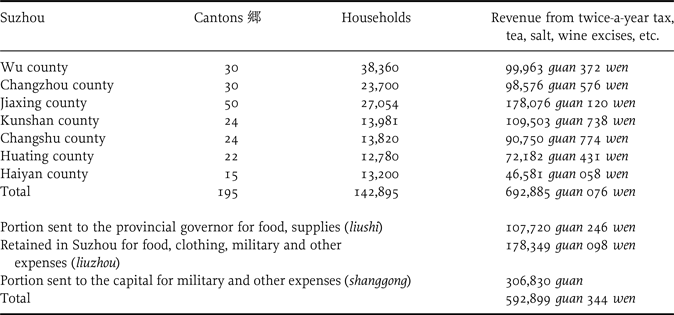
The individual circuits and prefectures were rated according to their populations and their location conditions, and the financial administration of each circuit or prefecture had its fixed amount determined in accord with this evaluation. Aside from the case of Suzhou that has been introduced by Hino (see Table 1), only the most fragmentary information is available to offer concrete examples of the scale of these financial administrations.Footnote 9 Here, I will take the Zhexi circuit (which includes Suzhou), and the Jiannan/Xichuan circuit as examples and survey the special characteristics of the scale of circuit and prefecture financial administration.
Tax revenue and distribution for Suzhou; Qianfu 3 (876); from Wu di ji 呉地記 (from Record of the Wu Region)

According to the Yuanhe junxian tuzhi 元和郡縣圖志 (Illustrated gazetteer of Yuanhe prefectures and counties), juan 25, the Zhexi (Zhejiangxi) circuit was the leading regional administrative center in Jiangnan, comprising six prefectures (the capital Runzhou, as well as Changzhou, Suzhou, Hangzhou, Huzhou, and Muzhou) and 37 counties, with 313,772 households and 57,932 qing of arable land. There are no surviving historical documents which tell us the amount of the twice-a-year tax for the whole of the Zhexi circuit and the scale of its financial administration. However, according to an imperial decree dated the renshen 壬申 day of the second month of Yuanhe 2 (March 26, 807):
Because the Zhejiangxi circuit has suffered both flooding and drought, 340,000 guan was excused from last year's payment of the twice-a-year tax.
以浙江西道、水旱相乘、蠲放去年兩稅上供三十四萬餘貫。Footnote 10
From this it is clear that with the cash portion of the twice-a-year tax alone, the circuit forwarded tax revenues to the central government in excess of 340,000 guan. Also, according to the biography of Li Deyu 李徳裕 in the Jiu Tang shu 舊唐書, the cash portion of tax revenue retained by the circuit (liushi), which formed the bulk of circuit finances, was 500,000 guan, and that when this was combined with other revenues, the total expenses of the circuit were roughly 630,000 guan.Footnote 11 It is unclear how much tax revenue was in the form of grain, but it seems likely that the money and grain combined were close to one million guanshi.
The prefectures under the jurisdiction of the Zhexi circuit include many large ones. Among them, Suzhou was a pivotal site for the financial administration of the Tang Dynasty state, as the following description indicates:
At present, the state's finances for the most part come from Jiangnan. Among the various prefectures of Jiangnan, Suzhou is the largest; its soldiers are many and the tax revenues are quite numerous.
況當今國用、多出江南。江南諸州、蘇最為大、兵數不少、稅額至多。Footnote 12
As can be seen from Table 1, which shows “Tax revenue and distribution for Suzhou,” the combined revenue in cash from the twice-a-year tax and monopolies in late-Tang Suzhou was approximately 590,000 guan, which was divided into three parts: in excess of 300,000 guan that was sent to the central government (shanggong); more than 100,000 guan that was sent to the provincial governor (songshi), and more than 170,000 guan that was retained as cash for the prefecture (liuzhou). The amount of revenue that was grain is unclear, but we can see that in Suzhou, the revenue was roughly equally divided between the portion transmitted to the central government and the portion that made up regional financial administration. There are no historical documents that survive from other prefectures, but it is known that the tax revenue in cash for Hangzhou was 500,000 guan; from this we can tell that its scale was on par with Suzhou's.Footnote 13
In the case of Jiannan Xichuan circuit, the circumstances of the circuit as a whole are comparatively well known. The Xichuan circuit comprised 26 prefectures, beginning with Chengdu-fu, and 112 counties.Footnote 14 The amount of the twice-a-year tax for the entire circuit was 2,013,645 guan and the amount of cash and rice transmitted to the central government as changfu 常賦 “regular payment” (i.e., shanggong) was in excess of 700,000 guanshi. Out of the total amount submitted to the central authorities, the cash portion of the twice-a-year tax came to more than 560,000 guan and the grain portion to 140,000 shi.Footnote 15 Speaking only of the cash portion of the twice-a-year tax, we can see that about one-fourth went toward making up the central Ministry of Revenue (duzhi) finances as shanggong, and three-fourths made up regional finances (liuzhou and liushi). This is close to the national-level distribution structure that I explained earlier, but it is certainly not the case that these portions were mechanically imposed on a national scale.
When looked at in this way, it is clear that the ratio of division of the twice-a-year tax between the regional and the central government was not uniform and seems to have been determined through the specific relations between each region and the central authorities. In the case of Zhexi circuit and Suzhou, the ratio of tax revenue forwarded to the central government as shanggong was probably high because this was an area that comprised the major revenue source for the central government's financial administration; as the above quotation notes, “at present, the state's finances for the most part come from Jiangnan.” What I have presented above gives us an overview, albeit an insufficient one, of the scale of regional financial administration for which the twice-a-year tax and monopolies served as revenue sources. This was not the full extent of regional financial administration in the later part of the Tang Dynasty, however, for it was managed with an even broader range of content. Below, I would like to take up this concrete content.
Income and Expenditures in Prefectural Financial Administration
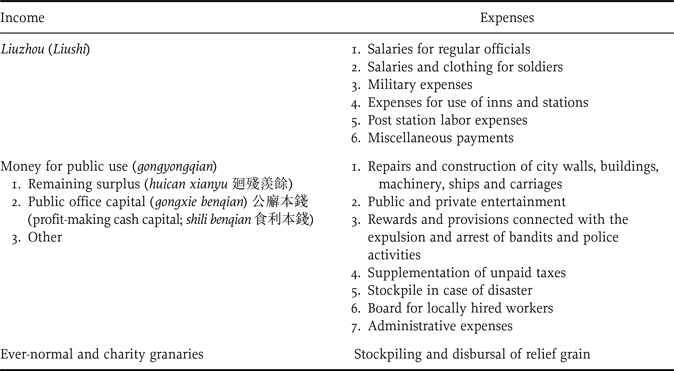
On the basis of multiple historical documents, I have compiled Table 2, which shows “A chart of regional (prefectural) financial administration in the late Tang Dynasty.” Below I would like to pursue my investigation on the basis of this chart.
A chart of regional (prefectural) financial administration in the late Tang Dynasty (from Record of the Wu Region)

The income for prefectural financial administration comprised three parts: 1) the liuzhou portion of tax revenue that remained in the prefecture; 2) the “money for public use” (gongyongqian 公用錢); and 3) the ever-normal and charity granaries. Previous research has concentrated on elucidating the nature of partitioning in the liuzhou portion. Moreover, with regard to the nature of expenditures, aside from a few brief mentions by Hino Kaisaburō, there has been virtually no consideration of this topic. When it comes to the portion made up of public moneys, it has not been elucidated at all.Footnote 16 Below, for each of these three areas, I would like to investigate its special characteristics as well as what role it played in the prefecture's financial administration.
First of all, the liuzhou portion constituted the general financial administration of the prefecture; it was a fixed amount made up of the allotment from the twice-a-year tax and liquor-monopoly money (quanjiuqian 權酒錢). This portion was in general managed under the decision-making authority of the prefect (cishi 刺史) of the prefecture. Therefore, the central government did not directly take a hand in the management of financial affairs. The following passage from “Amnesty to commemorate the presentation of an honorific title” (Shang zunhao shewen 上尊號赦文), dated the 23rd day of the 4th month of Huichang 2 (842), is a good example of this:
Each year the prefectural government collects the cash and commodities as well as the grain of its twice-a-year taxes according to a fixed amount. When the tax is collected, each province reports the amount to the central authorities. Aside from the revenue that is sent to the central authorities, the liushi and liuzhou money and commodities are to be used to cover expenses within the fixed amounts. If there is a surplus, it is permitted for this also to be retained by the prefecture or province to prepare for natural disasters.
州府兩稅物斛斗、每年各有定額、徵科之日、皆申省司、除上供之外、留後留州、任於額內方圖給用。縱有餘羨、亦許州使、留備水旱。Footnote 17
However, the twice-a-year tax that served as the local government's revenue source was, in systematic terms, unified under the authority of the central Ministry of Revenue (Duzhi 度支), and was generally speaking directed along a chain of command that ran either from the Ministry of Revenue through the Surveillance Commissioners (guanchashi) or Military Commissioners (jiedushi) to the prefecture or in some cases by imperial command to the circuit or prefecture. There were also extraordinary cases in which these funds were reclaimed as part of central expenses.Footnote 18 Although it is true that the significance of regional financial administration differed depending on the political power relations between the central government and the various regions, the liuzhou and liushi portions of tax revenue were essentially a part of the central government's financial administration. They should be thought of as its property that was consumed in the localities.
Let us examine the structure of expenses for the liuzhou portion. A historical document that provides a clear example of this is the following imperial decree dated the first month of the first year of Huichang (841):
Concerning the cash, commodity, and grain payments of fugitive households, the amount of the liushi portion owed in cash and commodities shall be calculated, and if this corresponds to three-tenths or more of the total, it shall be ordered that the difference be offset by making do with monies for miscellaneous expenses of that prefecture or provincial governor; the salaries of regular officials and expenses for post stations and so forth shall not be reduced to make up the difference.
其逃戶錢草斛斗等、計留使錢物、合十分中三分已上者、並仰於當州當使雜給用錢内、方圓權落下、不得尅正員官吏料錢、及館驛使料、遞乘作民課等錢。Footnote 19
According to this, we can see that there were categories of expenditure through the circuit and prefectural financial administration for: 1) salaries for local bureaucrats; 2) fees for use of inns and stations (communication and transportation expenses); 3) post station labor (communication expenses); and 4) miscellaneous moneys (various other expenses).Footnote 20 Though it is not seen here, with the military reforms of Yuanhe 14 (819), soldiers came to be stationed in each prefecture; henceforth, military expenses came to constitute the core of prefectural finances. A good example of this is the one I included above in Table 1: that the liuzhou section in Suzhou from the Wudi ji is labeled “Retained in Suzhou for food, clothing, military and other expenses.”Footnote 21 In this way the basic pattern was that expenses associated with military activity, including soldiers’ salaries and military expenses (equipment, city walls, repairs of moats, etc.) came to constitute the main portion of expenses for the liuzhou portion,Footnote 22 on top of which were added the salaries of the local officials, communication and transportation expenses.
Out of these expenses, salaries for soldiers and bureaucrats constituted the largest part of expenditures.Footnote 23 There were a fixed number of soldiers and bureaucrats, and with the exception of the fluidity of military action expenses, the expenditures for the liuzhou portion came in large part to have fixed amounts. A good example of this can be seen in an imperial order dated the eighteenth day of the eleventh month of Dahe 3 (829), which reads:
Among the moneys from the twice-a-year tax in the prefectures and metropolitan areas in the realm, the annual expenditures each have their fixed amounts.
天下州府兩稅占留錢、毎年支用、各有定額。Footnote 24
This demonstrates that the liuzhou portion had the same structure of expenses as the financial administration directly under the jurisdiction of the central government's Ministry of Revenue.Footnote 25 We can confirm that from the point of view of expenditures, the liuzhou section was a part of the central financial administration.
Let us turn to the “money for public use” (gongyongqian 公用錢) section. It was this section, in fact, that constituted the distinctly regional income and expenses. This section comprised the following: 1) the “remaining surplus” (huican xianyu 廻殘羨餘); 2) various kinds of capital; and 3) other. It was called “money for public use” and was clearly distinguished in terms of income and expenses from the liuzhou section that formed the general financial administration. Let us look at these components in sequence.
The “remaining surplus” (huican xianyu) is the property left over from the liuzhou tax revenue section (which had been apportioned as a fixed amount); such surplus might occur simply because the liuzhou revenue had not been completely spent, or it might come about as the result of economizing financial expedients (fangyuan 方圓). In other words, it was a reapportioned share of the twice-a-year tax that had been apportioned as liuzhou.Footnote 26 Because of this, it could be used much more flexibly in regional finances than the liuzhou section. For example, the following Bureau of Review memorial from the ninth month of Dahe 4 (830) is one example:
The Bureau of Review sent a memorial. According to the imperial order dated the tenth day of the eleventh month of Dahe 3, it is permitted for the prefectures (zhou and fu) of the entire realm to use their remaining surplus for various public expenses in accordance with recent imperial orders.
比部奏、准太和三年十一月十日赦文、天下州府迴殘羨餘、准前後赦文、許充諸色公用。Footnote 27
In this way, the “remaining surplus” turns out to have had a diverse range of characteristics; it formed one component of regional financial administration, but at the same time it could also be used for extra levies (zaquelü 雜榷率) to the twice-a-year tax or as a source of revenue for submission to the emperor. Bai Juyi turned the “remaining surplus” into the topic of a poem, criticizing it as follows:
昨日輸殘稅 Yesterday, when I went to submit my remaining taxes,
因窺官庫門 I got a peek in the government's storehouse gates.
繒帛如山積 Cloth fabrics piled high as mountains;
絲絮似雲屯 Silk strands and silk floss billow like clouds.
號為羨餘物 They call these “surplus items”
隨月獻至尊 And every month they are presented to the sovereign.
奪我身上煖 Stealing the warmth from my body;
買爾眼前恩 To buy the benevolence before your eyes.
進入瓊林庫 Though placed into the jade-grove storehouse,
歲久化為塵 In so many years, they will all be dust.Footnote 28
From this poem, it is clear that the category of “surplus items” was by no means merely the leftovers from the general financial administration proper; rather, it could also include commodities that had been forcibly and improperly seized from the peasantry.
Next, the category of “various types of cash capital” (zhuse benqian 諸色本錢) refers to the cash (capital) of both central and regional government offices that was nominally designated “profit-making cash” (shiliqian 食利錢) among other names. This cash was entrusted to money-lenders (zhuoqianhu 捉錢戶) and petty officials (guandian 官典 or xuli 胥吏) who managed it. They used this cash as principal for trade, buying and selling on the market, and to lend out to private individuals. The profits from commerce and interest (at a monthly interest rate of 4–5 percent) were recovered and applied to expenses. For example, a Census Department (Hubu 戶部) memorial from the sixth month of the first year of Huichang (841) reads as follows:
In this month, the Census Department submitted a memorial. “According to the imperial order dated the ninth day of the first month, it was ordered that the various government offices discharge their profit-making cash and that every year they separately be granted 20,000 guanwen in cash to apply to the public use of those offices. Now, according to the imperial order dated the ninth day of the twelfth month of Changqing 3 [823], the various offices were all granted 84,500 guanwen. If they collect interest every month at a rate of 4%, it will only yield 40,992 guanwen per year. … I would like to request that now, in addition to the cash that has been newly granted, the above-mentioned money be added on top. The expenses are not great while the profit is extremely large, thus it should be sufficient to sustain the various internal and external (i.e., central and regional) offices for a long time. I humbly submit this request in the hope that your sagely benevolence will permit what I have proposed.” An imperial decree was issued saying that it should be followed.
是月、戶部奏、準正月九日敕文、放免諸司食利錢、每年別賜錢二萬貫文、充諸司公用。今準長慶三年十二月九日敕、賜諸司食利本錢、共八萬四千五百貫文。四分收利、一年秖當四萬九百九十二貫文。… 臣今於新賜外、更請添賜上件錢、所費不廣、所利至多、則內外諸司、永得優足。伏望聖恩、允臣所奏。敕旨、宜依。Footnote 29
This memorial from the Census Department is a petition raised mainly among the central government officers to make an additional request concerning the newly distributed profit-making cash capital of 20,000 guanwen. Evidence that regional officials are included in this is clear from the fact that the memorial contains the phrase “thus it should be sufficient to sustain the various internal and external (i.e., central and regional) offices for a long time.” In the case of regional officials, the revenue source for this cash that would be used as capital was basically from the redistributed portion of the liushi or liuzhou cash and commodities or from “remaining surplus.”Footnote 30 From Yuanhe 10 (815) onward, however, there was also distribution from the central government's Census Bureau (hubu cao 戶部曹).Footnote 31 As I will explain later, the income from the management of these various types of cash capital can be traced back to the Han Dynasty,Footnote 32 but it is something that directly continued the system of the Sui dynasty and is the portion among the regional financial administration of the later part of the Tang with the oldest origins. However, it can be said as well that insofar as the revenue source came from commerce and profit, it was also the aspect where a parasitic quality was most intense.
As for other sources of revenue, there was income too from the commercial tax that was implemented in Yangzhou as well as from the tax-hemp (shuima 税麻) of the same prefecture. There were also circumstances in which bureaucrats spared some of their stipends and applied it to money for public use.Footnote 33
Looking at the income in the money for public use section as a whole, we can make a basic division between the redistributed portion from liuzhou and liushi tax revenue on the one hand, and an income section that was parasitic with regard to commerce and the circulation of currency on the other; the latter included commercial taxes, high-interest lending, and so forth. From these features, it is inconceivable that there was a fixed amount of income every year. The liuzhou section had as its revenue source the fixed-amount redistribution of the proper tax, that is the twice-a-year tax, and if this constituted the general financial administration, then we can understand the portion of “money for public use” as constituting a special section of the financial administration that was fluid.
Let is consider the expenses corresponding to the “money for public use” section. With regard to the “money for public use” that had its revenue source in “remaining surplus” cash and goods, a certain framework was determined as follows in accord with the proposal made in Dahe 4 (830) by the Bureau of Review:
In the ninth month of that year, the Bureau of Review issued a memorial. “According to the imperial order dated the tenth day of the eleventh month of Dahe 3 [829], it was ordered that … concerning the use of all surplus cash and goods, a clear categorized itemization shall be produced and disseminated to all of the prefectures (zhou and fu). We have respectfully written up a list of the items and submit the following request. 1. Situations in which construction and repair are necessary for city walls, public offices, buildings, machinery, ships and carriages, and other furnishings; or when establishment or replacement are required. 2. Or, in situations in which there is an official or private envoy, when a court official with official charge passes through, or when a new or old official is sent off or welcomed back; when it is customary to entertain them, have a farewell banquet, or present them with gifts. 3. Or, in situations in which an official, general, or patrolling officer (a minor official, suoyou 所由) makes tours of inspection to prosecute illegality, or to expel or apprehend thieves or bandits and it is necessary to pay a reward or travel expenses. 4. Or, in situations where the members of the peasantry are impoverished and unable to pay their taxes, they may be exempted from making these payments and then it will be necessary to offset the original tax amount. 5. Or, in situations where the harvest happens to be plentiful and it is necessary to purchase and stockpile grains in preparation for natural calamity. In all of these situations, the use is permitted. Unless the various types of remaining surplus cash and goods within the proper amount for a given prefecture are used in accordance with these itemized categories, then such conduct will be regarded as equivalent to thievery. When these monies or goods are expended, a document shall be created for evidence of inspection.” There was an imperial decree stating, “This shall be followed.” The matter was entrusted to the Censorate (yushitai) who would oversee in keeping with the above memorial.
其年九月、比部奏、准太和三年十一月十日赦文、… 其應合用羨餘錢物、並令明立條件、散下州府者。謹具起請條件如後、應有城郭及公廨屋宇器械舟車什物等、合建立修理、須創置添換者。或有公私使客、兼遇徵拜朝官、送故迎新、舊例合有供應、宴餞贈貺者。或官屬將校所由等、有巡檢非違、追捕盜賊、須行賞勸、合給程糧者。或百姓貧窮、納稅不逮、須有矜放、要添填元額者。或遇年豐穀熟、要收糴貯備、以防災敝者。並任用。當州所有諸色正額數內迴殘羨餘錢物等、如不依此色、即同贓犯、其所費用者、並須立文案、以憑勘驗。敕旨。宜依。仍委御史臺、准此句當。Footnote 34
From this it is clear that the expenses were designated as: 1) construction and repair of government offices and furnishings; 2) entertainment expenses associated with the exchange of public and private envoys and bureaucrats; 3) regional police operations; 4) supplementation of unpaid tax duties; and 5) stockpiling for use in natural disaster. Of the five items enumerated above, stockpiling for use in natural disasters was in particular encouraged as part of the fundamental expenses, and in situations where the “money for public use” was left over, it was encouraged that grain for stockpiling be purchased.Footnote 35 In Dahe 4 and earlier, it seems that there were various kinds of expenditures in addition to the five categories enumerated above, but with this year came the imposition of a certain fixed framework. With regard to this point, I would like to take up the matter again in the next section, below.
In the case of “money for public use” that had its revenue source in profit obtained from various kinds of capital cash, the expenses included the following: 1) construction and repair of government offices and supplies; 2) Entertainment expenses associated with the exchange of public and private envoys and bureaucrats; 3) meals for lingli 令吏 and other low-ranking officers (guanxieliao 官廨料 and gongxieliao 公廨料); 4) administrative operational expenses such as paper and brushes. In some circumstances, it seems that this money was also applied to compensation for officials.Footnote 36 It is unclear how money for public use that derived from other revenue sources was expended, but it is thought that it would have been similar to the above structure of expenditure.
On the whole, the two groups of expense structures outlined above were concerned with the typical official duties of the prefect. A memorial from the Director of the Bureau of Evaluations (kaogong langzhong 考功郎中) in the seventh month of Taizhong 6 (852) reads as follows:
And according to the Statute for Evaluating Officers, it states that when an officer submits an evaluative statement (kaozhuang 考狀, a report on personnel assessment), it must not exceed two or three pages of paper. For prefects and district magistrates (xianling 縣令), they should collect all duties and taxes, render court decisions without delay, ensure that there are no fugitive households and maintain the fixed amount of arable land, make the collection of corvée (fuyi 賦役) equitable, preserve government buildings, maintain inns and post stations according to regulations, and ensure that traffic on the roads runs smoothly. All of these things are their typical professional duties and shall not be figured into personnel assessments.
又准考課令、凡官人申考狀、不得過兩紙三紙。刺史縣令、至於賦稅畢集、判斷不滯、戶口無逃散、田畝守常額、差科均平、廨宇修飾、館驛如法、道路開通、如此之類、皆是尋常職分、不合計課。Footnote 37
According to this, the typical official duties of prefects can be summarized into five categories: 1) collection of levies and taxes and making the collection equitable; 2) judicial decisions; 3) maintenance and preservation of households and arable land; 4) maintenance and preservation of official buildings; 5) maintenance and preservation of communication and transportation operations. Aside from affairs concerning judicial decisions (number 2), the other official duties were fiscally supported by the expenses from the two sections of liuzhou tax revenue and money for public use. Yet, whereas the liuzhou tax revenue section was of a piece with the Ministry of Revenue's financial administration, when it came to the section of “money for public use,” the scope of the prefect's individual independent judgment was relatively broad, although this section still had a certain connection with the Secretariat-Chancellery (zhongshu menxia 中書門下) as well as the Census Department and Bureau of Review.Footnote 38 In this way, the section of “money for public use” was structured around various kinds of expenses that corresponded to administrative necessities for the prefecture in excess of the typical duties of the prefect. The expenses for which the liuzhou tax revenue section was used had become a fixed amount and permitted virtually no freedom of movement. The “money for public use” not only made it possible to provide some side support for these expenses, but it is also fair to say that this section constituted an independent regional financial administration.
Let us turn to the ever-normal and charity granaries, which constituted the third branch of prefectural financial administration. Funakoshi Taiji has researched ever-normal and charity granaries of the latter half of the Tang dynasty. According to his findings, the system of ever-normal and charity granaries was something newly established from Yuanhe 1 (806) onward. It was a system in which individual regional prefectures stored up grain in preparation for disaster and it had not only the function of providing relief but also of stabilizing commodity prices. When it was first established in Yuanhe 1, two-tenths of the grain portion of the twice-a-year tax that individual prefectures collected was spared and made the source of grain for storage. Subsequently, with a proposal from the Census Department in Kaicheng 1 (836), the source came to be an additional rice levy in the amount of one sheng of rice for each mou of land, whether public or private, but this was halted in Huichang 6 (846). The mission of the ever-normal and charity granaries to serve as sources of relief was fulfilled in the period between the Yuanhe era and Kaicheng 1. Afterward, the ever-normal and charity granaries continued to exist all the way to the end of the Tang, but they degenerated to the point of becoming a system for gathering tax grain that was only charity granary grain in name.Footnote 39 The ever-normal and charity granaries were managed at the prefectural level by the Administrative Supervisor (lushi canjun 録事參軍) and the central Census Department had general oversight. As is clear from their revenue sources as well as their administrative lineage, the ever-normal and charity granaries occupied a place connected to the Census Department and were fundamentally a form of financial administration with strong central aspects.Footnote 40 Therefore, even in cases of diversion to regional expenses, this was carried out on the basis of central directives.Footnote 41
Together with the use of “money for public use” to stockpile grain in the event of natural disaster, the ever-normal and charity granaries formed a two-part insurance expense. In order to make use of the grains that had been stored up in the ever-normal and charity granaries, the decisive authority of an imperial edict was required. This meant that although the system was able to display impressive power when it came to long-term responses, it was ineffective in response to natural disasters that necessitated urgent measures. To use the grain that had been stored away against natural disasters through the expenditure of “money for public use,” by contrast, a decision made at the prefectural level was sufficient, meaning that an ad hoc response to an emergent situation was possible.Footnote 42 Had it fulfilled its original purpose, the implementation of ever-normal and charity granaries and the use of “money for public use” to store grain away in the event of natural disasters would have amounted to an insurance expense that, it is fair to say, would have played a major role in the social reproduction of Tang dynasty peasants. However, there was a second dimension to its character; just like the charity granaries and land tax in the first half of the Tang dynasty, it became an additional tax outside of the tax proper, and often transformed into a means of exploiting the peasantry.Footnote 43
Adjusting the Equilibrium of Prefectural Financial Administration
As described above, regional financial administration in the latter half of the Tang dynasty controlled three branches: 1) the liuzhou portion of tax revenue; 2) the portion of “money for public use”; and 3) the ever-normal and charity granaries. Whereas the liuzhou portion was financial administration that was connected to the central government's Ministry of Revenue and the ever-normal and charity granaries was financial administration that was connected to the Census Department, in the case of the money for public use portion, autonomous management by the prefecture was permitted, albeit with certain restrictions.Footnote 44 Now then, in the management of the regional financial administration, what sort of mutual relations existed between these three constitutive branches? Let us focus on the equilibrium between income and expenditure.
It is unclear what sort of ratio existed in the composition of these three branches, but needless to say the mainstay of prefectural finances was the liuzhou portion of tax revenue. The liuzhou portion, both in terms of its income sources and the expenses for which it was used, was nearly of a fixed amount. From the first, it was managed on the premise that there would be an equilibrium between income and expenditure. Nevertheless, because of factors like diminished income as a result of fugitive households (taohu 逃戶) or excessive burdens of expenses for military action within areas under its jurisdiction, the prefectural financial administration often failed to maintain a balance of income and expenses. For example, the following is written in an imperial command dated the yihai day of the twelfth month of Changqing 1 (January 9, 822):
In the twice-a-year tax that is collected every year by the prefectures of the various circuits, in addition to what is sent to the capital at Chang'an, there are liuzhou and liushi cash. Because the bandits have not yet been quelled, the expenses expanded more and more.
諸道州府、每年徴納兩稅、除送上都外、留州・留使錢、縁草賊未沴、費用滋廣。Footnote 45
The costs associated with military actions were unexpected, contingent expenses, and the repeated eruption and suppression of bandit uprisings in various areas during the later part of the Tang dynasty imposed a significant burden on regional financial administration. When an imbalance in finances emerged because of these sorts of military expenses or unpaid taxes and levies, the shortfall was initially offset by internal contrivance within the liuzhou portion or through drawing on money for public use. For example, the following passage appears in the imperial decree mentioned above from the first year of Huichang (841):
Concerning the cash, commodity, and grain payments of fugitive households, the amount of the liushi portion owed in cash and commodities shall be calculated, and if this corresponds to three-tenths or more of the total, it shall be ordered that the difference be offset by making do with monies for miscellaneous expenses of that prefecture or provincial governor …
其逃戶錢草斛斗等、計留使錢物、合十分中三分已上者、並仰於當州當使雜給用錢內、方圓權落下。Footnote 46
Here, the narrative centers on the financial administration of circuits, but the fact that it also includes prefectural financial administration is clear from the reference to “miscellaneous monies of that prefecture or province.” The unpaid tax of fugitive households was made up for on the balance sheets by means of makeshift contrivances in the portion of miscellaneous expenses within the liuzhou, liushi and other regional finances. As I have explained above, the money for public use that derived its revenue from remaining surplus cash and goods was used to supplement and make good the unpaid taxes of the general peasantry. There was, in addition, also support from prefectural financial administration that came through diverting grain from the ever-normal and charity granaries. An imperial order from the seventeenth day of the first month of Dazhong 1 (847) is a good example. There, the proposal was made to encourage now-fallow paddy fields in various prefectures to be returned to cultivation and their harvest applied to military provisions needed locally and to grain storage for natural disasters. In addition, it was directed that seeds, foodstuffs, and tools for production be covered by diverting grains from the ever-normal and charity granaries.Footnote 47 In short, alongside ensuring sustainability by storing up cash and grains in case of natural disaster, one of the functions of money for public use and grains in the ever-normal and charity granaries was to provide backup for the liuzhou section of tax revenue that constituted the core of regional finance administration, thereby helping to maintain its balance.
However, there appear to have been limits to maintaining balance within regional financial administration in this way. At the time, in order to make actions related to financial affairs run smoothly in the three offices of the central government's Finance Commission (sansi 三司)—the Department of Revenue (duzhi), the Salt and Iron Monopoly Bureau (yantie), and the Census Department (hubu)—property placed on government ledgers and called “cash or goods belonging to the government” (shusheng (xisheng) qianwu 屬省(係省)錢物) was retained in the regional areas. There were occasionally times when a circuit or prefecture could borrow the cash or goods that belonged to the government.Footnote 48 For example, an imperial command from the yihai day of the first month of Kaicheng 3 (838) contains the following:
In general, with regard to the cash and grain that a defense command (fangzhen 方鎮) or prefecture borrows from the Department of Revenue, Salt and Iron Monopoly Bureau, and Census Department for its own use, in cases where five or more years have passed, these ought all to be forgiven.
應方鎮州府借使度支鹽鐵戶部錢物斛豆鬥經五年已上者並宜放免。Footnote 49
In addition, there is the following in the “Amnesty to commemorate the awarding of an honorific title” from the third day of the first month of Taizhong 2 (848):
In the prefectures of the various circuits up to the end of Kaicheng 3 (838), loans were made to peasants in the wake of poor harvests that resulted from flooding and drought, and cash and grain from the Department of Revenue, the Salt and Iron Monopoly Bureau, and the Census Department were also borrowed to make up for shortfalls in military expenses. These deficits have accumulated and many years have passed…. Though the relevant government offices have nominally tried to collect these debts, ultimately they have not been repaid and they have only been recorded in the ledgers in vain. They ought to all be forgiven.
諸道州府、應欠開成三年終已前、因水旱不熟、貸借百姓、及軍用欠闕、借便度支戶部鹽鐵錢物斛斗、積欠相承、日月既久、… 所司徒有徵索之名、終無送納之日、虛係簿書。宜並放免。Footnote 50
This is a case in which deficiencies resulting from regional military expenses were made up for by borrowing from the cash and commodities belonging to the Finance Commission's three offices; yet while such adjustments were made to maintain equilibrium, ultimately the debts became irrecoverable loans and repayment was in the end excused by means of an imperial edict.
As discussed above, regional financial administration at the prefectural and other levels was fundamentally premised on a balanced equilibrium of income and expenditures through the principle of fixed amounts. However, as a result of factors such as excessively burdensome military expenses and stagnant collection of tax payments, it was not uncommon for income and expenditures to become imbalanced. In these situations, steps were taken in order to achieve balance within the regional financial administration by a) supplementing from the miscellaneous expenses portion of the liuzhou section; b) supplementing from the money for public use portion; and c) diverting from the ever-normal and charity granaries. In cases where even these measures proved insufficient, d) balance adjustments were effected by borrowing cash or goods belonging to the government; this was property left regionally but which belonged to the three offices of the Finance Commission: the Department of Revenue, the Salt and Iron Monopoly Bureau, and the Department of Census. Going by the principle of fixed amounts in the financial administration frame, on first glance it seems that even financial administration during the latter part of the Tang dynasty had a modern budget function where plans were made to balance income and expenditures. Yet when we consider the actual circumstances at the level of regional financial administration, we see that the situation was more precarious: a constant struggle to get by from one day to the next.
THE FINANCIAL ADMINISTRATION OF THE METROPOLITAN PREFECTURE: THE CAPITAL
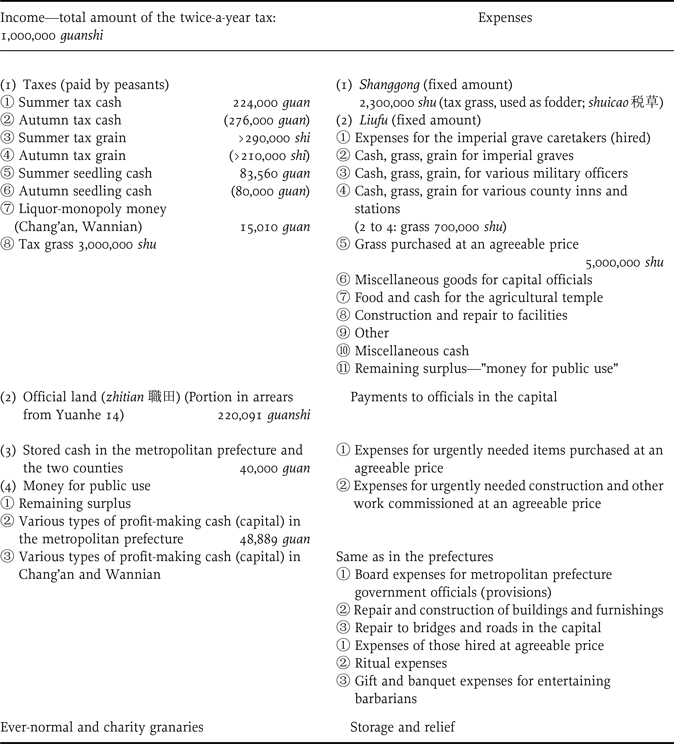
In the previous section I provided an overview of general regional financial administration with a focus on financial administration in prefectures. In this section, let us approach the actual circumstances of regional financial administration in the late Tang dynasty in more concrete detail by examining the special form that financial administration took in the metropolitan prefecture (Jingzhaofu 京兆府), which was the dynastic capital. The metropolitan prefecture (Yongzhou 雍州) was, according to Yuanhe junxian tuzhi, juan 1, an administrative structure that comprised 241,202 households in the twenty-three counties in the Chang'an region (including the two counties of Chang'an 長安 and Wannian 萬年). It was also one of the twenty-five prefectures that comprised the Guannei circuit (Guanneidao 關內道), and needless to say it was also the capital of the Tang dynasty. Therefore, in addition to being a regional administrative unit, it also markedly exhibited aspects of a central government office. Because it was the capital, the historical record that survives is comparatively plentiful and it possible to trace the general prefectural financial administration that we saw in the previous section by following the concrete example of this single fu. I have produced Table 3, “A chart of income and expenditures in metropolitan prefecture financial administration,” on the basis of information on the actual circumstances of prefectural financial administration presented in the previous section along with various historical materials concerning the metropolitan prefecture.Footnote 51 I will have occasion to make reference to this table in the account that follows below.
A chart of income and expenditures in the metropolitan prefecture financial administration

The first matter that deserves attention is the scale of financial administration in the metropolitan prefecture. With regard to the total scale of income and expenses, it is clear that the fixed amount was one million guanshi, as can be seen from the following passage in a memorial by Supervising Secretary Xu Mengrong 許孟容 dated the sixth month of Zhenyuan 19 (803):
The capital is the place where the myriad states meet. It has been the common standard since antiquity to strengthen the trunk (the central government) and weaken the branches (the local government). Its annual revenue and expenditures from tax cash and land rent come to one million guan.
京師是萬國所會、強幹弱枝、自古通規。其一年稅錢、及地租出入、一百萬貫。Footnote 52
This fact is also confirmed from the following passage in an inspection report concerning the financial administration of the Metropolitan Prefecture by Deputy Minister of Justice Xi Zhi 奚陟 in Zhenyuan 9 (793):
In a memorial it was stated: “According to the memorial from the Ministry of Revenue, the twice-a-year tax for Zhenyuan 9 and the various types of prior surplus cash in total exceeded 680,000 guan, but the Metropolitan Governor Li Chong used it profligately. Now my examination finds that of this, 1,200 guan was used by various counties to contribute to inn building and post station expenses, or else was various types of cash that was retained by various households but should have been collected. The portion that is grain came to 320,000 shi in total. At the time of payment, it was found that minor officials had lost just over 300 shi of this amount. The rest was expended at imperial command or with the approval of the Ministry of Revenue.”
奏言、據度支奏、京兆府貞元九年兩稅及已前諸色羨餘錢、共六十八萬餘貫、李充並妄破用。今所勾勘、一千二百貫已來是諸縣供館驛加破、及在諸色人戶腹內合收。其斛斗共三十二萬石、唯三百餘石諸色輸納所由欠折、其餘並是準敕及度支符牒、給用已盡。Footnote 53
A total of 1,000,000 guanshi was the financial administration of the metropolitan prefecture area for the year Zhenyuan 9 (793): 680,000 guan in cash and commodities from the twice-a-year tax, along with 320,000 shi in grain.Footnote 54 We can see that surplus cash was included in this figure and also that the surplus cash was used as a supplement to make good on the fixed amount of expenses. What is even more deserving of our attention is the fact that the disbursements of expenses for the Metropolitan Prefecture were put into effect with the approval of imperial command and the Ministry of Revenue. This is different from the financial administration situation in other localities and indicates that the Metropolitan Prefecture financial administration was linked in an even tighter connection with the financial administration of the Ministry of Revenue. This is still more clearly expressed by an imperial order dated the first day of the first month of Zhenyuan 4 (788):
The Metropolitan Prefecture from this year forward shall follow the practice of the various prefectures and retain from the amount of the twice-a-year tax the cash and commodities, grain, and fodder that should be expended in accordance with the authorized annual fixed amounts. This will enable it to be liberated from having to repeatedly petition and receive these items, and the remainder shall be submitted to the Ministry of Revenue. As for Henan Prefecture, they also ought to follow these guidelines.
其京兆府今年已後、准當府每年敕額、應合給用錢物斛斗及草者、宜便於兩稅內比諸州府例剋留、免其重疊請受、餘送納度支。其河南府亦宜准此。Footnote 55
According to this, up until 788, the financial administration of the Metropolitan Prefecture and Henan Prefecture were under the direct jurisdiction of the central government. It is clear that this was the first time that revenue was separated into a liufu portion that was retained by the Metropolitan Prefecture and a shanggong portion submitted to the Ministry of Revenue. Moreover, just as we saw in the inspection report by Xi Zhi discussed above, even after the liufu portion came into being, the disbursement of expenses still required the approval of imperial command and the authorization of the Ministry of Revenue. The Metropolitan Prefecture financial administration, unlike that of other prefectures, had only a division between liufu and shanggong. Insofar as it had a tight connection with the financial administration of the Ministry of Revenue, we can say that it also had aspects of an office of the central government's financial administration.Footnote 56
Next, let us look at the organizational structure of the financial administration in the Metropolitan Prefecture. As can be seen from Table 3, “A chart of income and expenditures in Metropolitan Prefecture financial administration,” the financial administration of the Metropolitan Prefecture, like the financial administration of other prefectures, was comprised fundamentally of the liufu section and the “money for public use” section, as well as the “ever-normal and charity granaries” section; the structure of income and expenditures for each of these was fundamentally unchanged. However, from the special circumstances of being the capital district, there were also corresponding unique expenses and revenues. Namely, these included, for example, the maintenance of imperial tombs and parks, expenses for rituals, for entertaining foreigners (barbarians, i.e., diplomatic expenses), and for miscellaneous requisitions needed by officers at the court or in the capital. In order to supply these expenses, the Metropolitan Prefecture along with the two counties of Chang'an and Wannian were supplied annually with 40,000 guan in cash for savings (zhubeiqian 貯備錢) from the Ministry of Revenue. Various types of capital were also provided.
Moreover, in the management of financial affairs in the Metropolitan Prefecture, there were special measures taken in coordination with the financial administration offices of the central government. First of all, from the time that the liufu portion of cash and commodities was established in the Metropolitan Prefecture beginning in 788, among the salaries paid to Metropolitan Prefecture county officers, a salary in cash came to be paid from the financial administration of the Department of Census in the same way as for officials serving in the capital.Footnote 57 This indicates that the Metropolitan Prefecture had the characteristics of a central government office.
Second, in regard to the operation of the ever-normal and charity granaries, a system of relief for peasants was put into practice that was structured on two levels with the imperial granary (taicang 太倉). The amount ranged between 200,000 and 700,000 shi.Footnote 58
Third, the Metropolitan Prefecture carried out its own unique financial management practices such as “harmonious purchase” (hedi 和糴) and “payment by proxy” (zhedi 折糴) in coordination with the requirements for grain in the financial administration of the Ministry of Revenue and the Census Bureau. “Payment by proxy” referred to collecting from peasants payments of the twice-a-year tax cash portion as a corresponding amount of grain rather than in cash. This “payment by proxy” system was systematized after a memorial from the Ministry of Revenue from the tenth month of Zhenyuan 2 (786). A passage in the Cefu yuangui reads as follows:
The Ministry of Revenue memorialized: “In the Metropolitan Prefecture, Henan, Hezhong, Tong, Hua, Shan, Guo, Jin, Jiang, Fu, Fang, Dan, Yan, and other prefectures (zhou and fu), it was decided that the cash and commodities of the twice-a-year tax for autumn and summer, as well as the seedlings, can be paid by proxy with millet and barley which will be used to provide military provisions in various areas. In the Metropolitan Prefecture, payments will also be made in cash and each dou is to be purchased at ten qian over market price. The grain will be deposited in the imperial granary. An imperial command approved of this memorial. Afterward, it was implemented every year in order to supplement the financial administration of the state.”
度支奏、京兆河南河中同華陜虢晉綘鄜坊丹延等州府、秋夏兩稅青苖等錢物、悉折糴粟麥、所在儲積、以僃軍食、京兆府兼給錢收糴、每斗於時價外、更加十錢、納於大倉。詔可其奏、自是每嵗行之、以贍軍國。Footnote 59
The total amount, when combined with the various prefectures (zhou and fu) listed above, came to a total of between 300,000 and 500,000 shi.
“Harmonious purchase” was a practice by which grain was purchased on the basis of an agreeable price negotiated with peasants. In order to respond to the military needs on the northwest border, the Metropolitan Prefecture in coordination with the Ministry of Revenue each year supplied as much as one million shi in harmoniously purchased grain.Footnote 60 If we combine “harmoniously purchased” and “payment by proxy” grain, there were occasions, such as in Baoli 1 (826), when the total amount reached 2,000,000 shi for the prefectures in the vicinity of the Metropolitan Prefecture. The amount of grain that was accumulated through “harmonious purchase” and “payment by proxy” was used not only for military provisions but also stored up in case of emergency.Footnote 61 As is well known, however, it was common for grain to be forcibly bought up or plundered, leading to social problems.
It seems reasonable to conclude that the Metropolitan Prefecture financial administration relied upon the same sorts of measures the various other prefectures had to balance its income and expenditures. However, as is clear from what I have presented thus far, it was common for Metropolitan Prefecture finances to be managed by receiving support and supplementation of expenses from the central government, in particular the Census Bureau.Footnote 62 Broadly speaking, the financial administration of the Metropolitan Prefecture was managed with its income coordinated with the financial administration of the Ministry of Revenue and its expenses coordinated with those of the Census Bureau. At the same time that it was a single regional financial administration, it also functioned as an organ of the central financial administration.
The previous two sections have clarified the outline of the regional financial administration in the latter half of the Tang Dynasty. Last, I would like to consider the nature of regional financial administration in this period as a whole, focusing on its connection with society. To take a comprehensive view of the totality of regional financial administration presented in Tables 2 and 3, the functions carried out by the prefectures and metropolitan areas in their financial administration activities can be roughly summarized in the following four points. First were activities such as military action and police work which helped to achieve the maintenance of the law and social order through the exercise of a certain degree of force. This range of activities included the dual functions of defense in the face of threats from other ethnic groups and the natural world, as well as social control. Second were activities that aimed to reproduce the various organs of state and the human units that occupied them; this includes repairs and construction of city walls, government offices, and furnishings as well as the salaries and provisions of bureaucrats and officials. Third was the reproduction of general conditions for production, principally the provision and maintenance of communication and transport (including roads and bridges). Fourth was the maintenance of social reproduction through storehouses for use in case of natural disasters, as seen in the ever-normal and charity granaries. Of these, the latest to be developed and the earliest to disintegrate and transform into an organ for the exploitation of the peasantry was the fourth function: for social reproduction.Footnote 63 Also, in reference to the third category, the reproduction of general conditions of production, in terms of the amount of the expenses, it was insignificant in comparison to the first and second functions. From the perspective of financial administration, for regional financial administration in the latter half of the Tang Dynasty, even in situations where normal management was practiced, the main concern was military expenses (including expenses for quartering soldiers) as well as the stipends of bureaucrats and officials. We can say that its fundamental function was in the very reproduction of the social suppressive effect, the various organs of the state, and those who bore responsibility for it, such as bureaucrats and officials (who numbered several hundred thousand) as well as the military (that numbered a million). In this way, it was in the first half of the ninth century, from the Yuanhe through the Dazhong eras, that these essential functions were able to be achieved, just as the third and fourth functions outlined above, especially the latter's social reproductive function, were nearing completion. Afterward, society became increasingly disordered over the course of the Tang–Song transition. With the beginning of the Five Dynasties, there would again be grasping toward the redevelopment of national structures and state and the unification of society through the state. Let us trace one example of this from the vantage point of financial history using a broader historical perspective.
The Centralization of Regional Financial Administration during the Tang–Song Upheaval
The previous section has provided us with a general overview of the actual circumstances of regional financial administration in the latter half of the Tang Dynasty. The problem that arises is its place in history. Speaking broadly, this means asking what historical stage the regional financial administration described above occupies in terms of Chinese history as a whole. Moreover, the time period that is at issue is known as the Tang–Song transition: one of the most prominent periods of transformation in Chinese history. This question will also lead us to inquiring into the significance of this period of transformation from the perspective of the history of financial administration. Our discussion must begin by returning to the Han Dynasty, when the framework for financial administration history in the ancient state of China took shape.
As I made clear in the first chapter of my book Chūgoku kodai no zaisei to kokka (Financial Administration and State in Ancient China),Footnote 64 during the period when the ancient state came into being, the special feature of financial administration history was that the peasants’ surplus was gathered by regional prefectures and counties in various forms such as “field tax” (tianzu 田租) and “tax in commutation” (gengfu 更賦; the three types of tax known as gengqian 更錢, suanqian 算錢, and kouqian 口錢), which were in turn accumulated in various commanderies and counties mainly in the form of “stored grain” (weiji 委積). The financial administration of the central government's Chamberlain of the National Treasury (Dasinong 大司農) was composed of redistribution from this regional accumulation. With a scale of between four and six billion in cash, the National Treasury's finances were comparable to no more than roughly 5 percent of total surplus labor in the Han dynasty. Although the Chamberlain of the National Treasury, which was the central government's office of financial administration, had established some authority over this regional accumulation through the reports on financial matters (which were called “Submitted reports” shangji 上計) that the commanderies and princedoms (jun and guo) submitted at the beginning of the year as well as the reports on current financial holdings they produced four times annually, it had still not completely achieved authority over financial administration. To state my conclusion in advance, the penetration of the central government's authority to direct this regional accumulation and have control over regional financial administration still lay in the future. In other words, the establishment of centralized authority over regional finances would continue to be groped toward gradually, a target sought for constantly through all of the transformations of ancient Chinese dynasties. In this way, it was none other than the transition from the latter half of the Tang dynasty to the beginning of the Northern Song that the process of establishing the centralization of authority over financial administration entered its final stage. In what follows, I will take the Northern Wei financial administration (which served as the original model for Tang dynasty financial administration) as a fixed data point and clarify the historical special circumstances of financial administration in the later part of the Tang dynasty.
As I explained in “The Structure of Financial Administration in the Northern Wei,”Footnote 65 the fundamental tax collection zudiao 租調 in the Northern Wei was divided into various categories: “official levies” gongdiao 公調 (or “regular levies”; changdiao 常調), which constituted the central financial administration, and “external expenses” (diaowaizhifei 調外之費), which constituted the regional financial administration, as well as “irregular levies” (zadiao 雜調), which constituted occasional expenses by the central government. In Taihe 8 (484), at the time of the imposition of the stipend system, the following record appears in the Wei shu (History of Wei).
In the eighth year of Taihe, for the first time stipends were paid to bureaucrats in keeping with the old system. In accord with status, grades were assigned respectively. Prior to this, for all of the houses of the realm, the nine grades of household wealth had been treated uniformly. Each house was made to contribute two bolts of silk, two jin of silk floss, one jin of silk thread, and twenty shi of unhulled grain. Separately, one bolt and two zhang of cloth was contributed to the prefecture storehouse as diaowaizhifei (local expenses). At this time, the amount per household was raised to three bolts of silk, two shi and nine dou of unhulled grain, and this was apportioned as the stipend of officials. Afterward, the amount of diaowai silk was increased to two bolts.
太和八年,始準古班百官之祿,以品第各有差。先是,天下戶以九品混通,戶調帛二匹、絮二斤、絲一斤、粟二十石;又入帛一匹二丈,委之州庫,以供調外之費。至是,戶增帛三匹,粟二石九斗,以為官司之祿。後增調外帛滿二匹。Footnote 66
With regard to the financial administration ratio among gongdiao and diaowai expenses and the bureaucrats’ stipends, the Tongdian quotes the “Wei ordinances” (Weiling) as follows:
The “Wei Ordinances” states: in general, ten bolts of cloth are taken as a unit. Of these, five bolts are gongdiao (contributed to the central government), and two bolts are applied to diaowai expenses (local expenses outside of what is contributed to the central government), and three bolts are applied to the stipends of the various internal and external officers. Beyond this are irregular levies.
魏令… 大率十匹中五匹爲公調、二匹爲調外費、三匹爲內外百官俸。此外雜調。Footnote 67
Excluding bureaucrats’ stipends, the ratio of central financial administration to local financial administration was five to two. In comparison to the Han dynasty, the percentage that the central government's financial administration occupies has become overwhelmingly higher. Not only that, but it is also worth bearing in mind that the very amount of regional financial administration is clearly stipulated here, which bespeaks an advance by the central government into local financial administration: an increase in its authority to direct financial administration.
In addition to the right to direct regional financial administration, what also deserves attention is the fact that, with the system of “three-grades and nine-ranks of tax” imposed during the reign of emperor Xianwen in the latter half of the fifth century, a system had already been imposed upon peasant and other households in which tax grain was directly transported to the grain storehouses of the capital, to the grain storehouses of important prefectures, and to those of the household's own prefecture. This means that all property could, at the order of the state, be transported from the region of its production directly to the region in which it was needed. In other words, this means that a network for the exchange of goods was opened across the entire national territory. This was organized in order to secure the financial administrative needs of the central government, as well as the military requirements of the borderland districts in the northwest and those southeast of the Jianghuai.
Before a nationwide system of commodity circulation was completed, the Northern Wei's fiscal distribution came to a halt due to an uprising near the end of that period that originated in the 523 Revolt of the Six Garrisons. What brought the system to completion was the fiscal management under the statues and ordinances (lüling 律令) system in the Sui and early Tang that had reunified the realm. With that, a system of commodity distribution with national scope was organized with the Ministry of Revenue's Bureau of General Accounts (Duzhisi 度支司) as the command center. All property could now be directly transported from the region of its production to the region where it was required and such transport occurred in three patterns: 1) within the same prefecture; 2) to the capital (sending to the central government); 3) external distribution (sending to other prefectures or to the borderland). The local expenses (when sent to the same prefecture) were limited to the stipends of the local officials and communication costs as well as insurance expenses (charity granary).
The framework of local financial administration and the organization of a national scale fiscal distribution system that began in the Northern Wei and was established in the Sui and early Tang were the forerunners of the late Tang period regulation of the amounts of liuzhou (tax for the prefecture) and liushi (tax for the provincial governor) and the amount of shanggong (tax forwarded to the central government). In terms of the formal ratio between the local areas and the central government, if we compare cases where the content is known, then during the Tianbao period of the Mid-Tang (742–755), the ratio was 4:5, or roughly equally split, between finances for the central government (4) vs. finances for the military and the prefecture itself (5); in the late Tang dynasty, the tax for the central government was half of the tax for local government. In comparison to the case of the Northern Wei, when the ratio of gongdiao (taxes forwarded to the central government) to diaowai (taxes for local expenses) was 5:2, these figures show that the proportion of local financial administration became gradually larger. However, we cannot regard the enlargement of the proportion of local financial administration as simply a matter of the decline of the central government's authority to direct fiscal matters.
The fundamental reason for the enlargement in the proportion of the local financial administration in the late Tang dynasty is due first of all to the establishment of a separation between military personnel and farmers during the Kaiyuan period (713–741), and secondly that the laborers who transported property switched from being peasant adult males (zhengding 正丁) to being soldiers and merchants; as a result of that, the amount of local financial administration that was taken up by expenses associated with the costs of supporting soldiers and military actions on the frontier increased dramatically.Footnote 68 What is even more important is that after the An Lushan rebellion, because of the dissolution of the empire, in various areas within the internal territory, fanzhen (areas controlled by regional military governors) grew segregated and it came to be the practice that expenses for supporting soldiers and military activity were held in reserve separately. The central government's authority to direct the fiscal matters of these areas controlled by regional military governors was restricted.
It is true that there were differences in the ratio of financial administration between the central government and localities over the course of the Northern Wei through the latter part of the Tang Dynasty. But if we compare the situation to the fiscal management of the Han dynasty where only the amount of redistribution from local areas to the central government was fixed, the fact that a fixed frame was imposed upon local financial administration indicates that the state's fiscal authority had achieved a certain advance. In this way, premised upon a new social structure in which soldiers and peasants were separated, the central government's fiscal authority again began to penetrate even into the framework of local financial administration and a more centralized form of fiscal management became established; it is this process that marked the shift from the late Tang dynasty to the early Song dynasty. Below I will explain the course of events.
In the late Tang dynasty, local financial administration was composed of three parts: 1) the tax revenue retained by the prefecture, or liuzhou portion; 2) the “money for public use” (gongyongqian) portion; 3) the ever-normal and charity granaries portion. Of these, as the research of Funakoshi Taiji has made clear, the ever-normal and charity granaries portion collapsed at the end of the Tang dynasty, and while there was a plan to revive it during the Five Dynasties, this effort ultimately did not succeed.Footnote 69 The problem remains with the liuzhou portion and the “money for public use” portion. Let us first of all examine the “money for public use” portion, which had comparatively more independence.
The establishment of “money for public use” goes back to the Kaihuang era of the Sui Dynasty. In regard to an incident from Kaihuang 8 (588), the Sui shu (History of Sui) narrates as follows:
Up until this point, the offices of the central government and the various prefectures were provided with “public office money” (gongxieqian) that they managed in order to yield interest that was then applied to the expenses of various officials. In the sixth month of Kaihuang 14 (594), the Minister of Works (and Duke of Anping prefecture) Su Xiaoci and others thought nothing could be further beyond the pale than the way that all of the officials were following the old practice and using “public office money” and cloth to lend money for interest and carry out commercial activities, single-mindedly pursuing profit and troubling the people and harming customs in this manner. They thus made a memorial stating that land would be provided and used for agriculture and that the accrual of interest through management of “public office money” would be entirely prohibited. In the eleventh month of the seventeenth year (597), an imperial command was issued stating that the “public office money” of the various offices of the central and local governments would be managed in the marketplace and commercial activities would be permitted in various areas. However, accruing profit by lending at interest alone would be prohibited.
先是京官及諸州,並給公廨錢,廻易生利,以給公用。至十四年六月,工部尚書、安平郡公蘇孝慈等,以為所在官司,因循往昔,以公廨錢物,出舉興生,唯利是求,煩擾百姓,敗損風俗,莫斯之甚。於是奏皆給地以營農,廻易取利,一皆禁止。十七年十一月,詔在京及在外諸司公廨,在市廻易,及諸處興生,並聽之。唯禁出舉收利云。Footnote 70
The lending of publicly owned property by the local government offices to private individuals to obtain profit that could be used for administrative expenses is a practice that can already be confirmed in the latter Han.Footnote 71 And in the Northern Wei, prior to the imposition of the stipend system in the eighth year of Taihe (484), there were occasions when regional expenses corresponding to stipends were raised by allowing merchants to manage publicly owned property.Footnote 72 Managing public property in order to raise funds to meet the cost of expenses is something that only rarely comes to the surface of historical records, but it had a long tradition. The practice of using the “public office money” as principal and applying the profit from trade or from high-interest-rate lending to prefectural financial administration was something that was a successor to this tradition. At the latest, it can be traced back not long before this Kaihuang period (581–600). The origins of the other revenue sources that made up the money for public use are at present unclear, but it seems that cash capital in the form of “public office money” was the original form from the early stages. Public office money and other forms of cash capital used for profit-making underwent various transformations with the arrival of the Tang Dynasty, such as becoming the revenue source for the stipends of provincial officials, but in the latter part of the period it came to be an important revenue source of the money for public use.Footnote 73
The first regulations on profit-making cash capital came in the eleventh month of Yuanhe 9 (814), when the Census Department's transaction tax of five wen was extended and applied to this profit-making cash capital.Footnote 74 An imperial command issued in the twelfth month of this year contains the following:
The interest that the various government offices currently manage and collect on profit-making cash capital and the interest that they will in future collect on profit-making cash capital that they lend out shall, in accordance with the imperial order issued this year on the fifteenth day of the eighth month, be applied to the expenses for the repair of those government offices and their furnishings as well as the expenses of the various lower-ranking officials. This shall be monitored by entrusting the task to the Censorate and at the end of each year, a comparison of documents shall be made and matters dealt with accordingly.
其諸司應見徵納、及續舉放所收利錢、並準今年八月十五日敕、充添修司廨宇什物、及令史驅使官廚料等用。仍委御史臺勾當、每常至年終、勘會處分。Footnote 75
These regulations on the management of profit-making cash capital were imposed on the various offices of the central government, but we can assume that they were also applied to the management of cash capital by the various offices of prefectures and other local government entities. This is because eventually it would lead to the regulations that were, as discussed above, imposed on money for public use that derived from the remaining surplus in Dahe 4 (830). As we have already seen, the proper composition of expenses for money for public use at this time was designated as follows: 1) the construction and repair of government offices and supplies; 2) entertainment expenses associated with the exchange of public and private envoys and bureaucrats; 3) regional police operations; 4) supplementation of unpaid tax duties; and 5) stockpiling for use in natural disaster. We can conclude that this signified an expansion of the content of regulation from 814. The regulations on “money for public use” in Dahe 4 was carried out in response to the instructions of the imperial command from the previous year of Dahe 3 (829). The imperial command gave as a reason for its imposition the fact that it was common for prefects to be brought up on charges of misappropriation of funds because there were not clear regulations to be followed.Footnote 76 Conversely, this means that up until that point, the matter had been left to the free discretion of the prefects. Since we do not encounter any historical material concerning regulations on money for public use after this point, it seems that the regulations on money for public use continued through the end of the Tang.
Let us turn to the liuzhou section. The liuzhou section was a fixed amount and the contents were almost completely standardized. However, there were occasionally inordinate expenditures by the prefect and others. So far as I have been able to determine, the earliest regulations on these came with an imperial decree dated the second year of Yuanhe (807):
In the first month of the second year of Yuanhe (807), a decree was sent to the Ministry of Revenue. If the prefect unreasonably depletes the cash and commodities within the amount of liuzhou cash and commodities, or if he makes expenditures that violate the regulations, then a surveillance commissioner (guanchashi 觀察使) shall be entrusted to carry out an inquiry and investigation. Consideration shall certainly be made and punishment meted out to serve as a warning to the other prefectures.
元和二年正月、制度支。如刺史於留州數內、妄有減削、及非理破使、委觀察使風聞按舉、必當料加量貶、以誡列城。Footnote 77
This order became even more concrete with a memorial from the Bureau of Review dated the sixth month of the first year of Changqing (821):
In the sixth month of the first year of Changqing, the Bureau of Review memorialized as follows. According to the imperial decree, for the year-end ledgers of the various circuits, they should rely upon the imperial edict precedents to date. Recently, we hear that some prefects have inappropriately reduced the amount of cash and commodities from within the liuzhou cash and commodities portion or have made inappropriate expenditures. We will entrust a surveillance commissioner to carry out an inquiry and investigation and will certainly apply severe punishment in order to warn the various prefectures that have made reductions. The various prefectures in this way each entrusted the Administrative Supervisor and made a clear account of the respective types of expenditure, contribution, and additional surplus holdings from their fixed-amount of liuzhou cash and commodities; they clearly entered this information into the ledgers and petitioned to submit the information by the stipulated date to the Bureau of Review. The Bureau of Review, in compliance with the typical deadline (the thirtieth day of the fifth month is the typical deadline), shall put together all the materials and present a memorial. Once an imperial decree is issued, the submission will be again sent to the Census Department. If it exceeds the deadline or has concealment or omission that is not reported, then the Administrative Supervisor and the relevant judges shall make notification to the Ministry of Personnel and effect the punishment of dismissal. An imperial decree stating “It should be followed” was issued.
長慶元年六月。比部奏。准制。諸道年終句帳。宜依承前敕例。如聞近日刺史留州數內。妄有減削。非理破使者。委觀察使風聞按舉。必重加科貶。以誡削減者。其諸州府。仍請各委錄事參軍。每年據留州定額錢物數。破使去處。及支使外餘剩見在錢物。各具色目。分明造帳。依格限申比部。准常限。每限五月三十日都結奏。旨下之後。更送戶部。若違限及隱漏不申。錄事參軍及本判官。並牒吏部使闕。敕旨。宜從。Footnote 78
The regulations imposed by the central government upon the liuzhou portion at this stage were a strengthening of oversight concerning prefectural financial administration by the Bureau of Review. They severely cracked down on excessive expense.
This system, upon reaching the Later Tang in the Five Dynasties period, underwent a fundamental change. It was the consolidation of the three offices of the central government's Finance Commission—the Department of Revenue (duzhi), Salt and Iron Monopoly Bureau (yantie), and Census Department (hubu)—under the tax officer (zuyongshi 租庸使) in the first month of Emperor Zhuangzong's reign period Tongguang 2 (924).Footnote 79 The tax officer was a position established after the Later Liang responsible for financial administration. It was the forerunner of the later three offices of the Finance Commission. However, around 924, the tax officer not only oversaw the financial affairs of the three offices of the central government, but also began to intervene in local financial administration in ways fundamentally different than before. The content of this transformation is recorded as follows in an entry for 924 in the Zizhi tongjian (“Comprehensive Mirror in Aid of Governance”):
In the winter, in the tenth month, on the xinwei day [10.06; November 5, 924], the Military Commissioner of Tianping Li Cunba and the Military Commissioner of Pinglu Fu Xi made a report: “The prefectures belonging to our circuits in general state that they have directly received documents from the tax officer and that they are directing official matters. We commissioners have no knowledge of this; they are disrupting the legal regulations.” The tax officer issued a memorial stating, “In recent years, as a rule, documents have been directly issued to the various prefectures.” (Hu Sanxing annotation: at the time the tax officer presented documents to the various prefectures and did not allow the Military Commissioners or the Surveillance Commissioners to have any knowledge of it. This was called zhixia or “direct issue”). The imperial decree stated, “It is the old practice of the court that imperial decrees are not issued to the prefectures, and the prefecture does not by itself issue memorials. Now, the content of what the two circuits have presented in their memorial is the old rule of our court. The content that the tax officer has reported is the recent practice of the Later Liang. From now onward, unless the prefecture is directly presenting to the emperor, then the copied memorial of the circuit in question shall be used; also, solicitations from the tax officer shall be made to the Surveillance Commissioner in writing.” Although this imperial command was issued, it was ultimately not put into practice.
冬,十月,辛未,天平節度使李存霸、平盧節度使符習言:「屬州多稱直奉租庸使貼指揮公事,使司殊不知,有紊規程。」租庸使奏,近例皆直下。【胡三省注:時租庸使帖下諸州調發、不關節度觀察使、謂之直下】敕:「朝廷故事,制敕不下支郡,牧守不專奏陳。今兩道所奏,乃本朝舊規;租庸所陳,是偽廷近事。自今支郡自非進奉,皆須本道騰奏,租庸征催亦須牒觀察使。」雖有此敕,竟不行。Footnote 80
Contradicting the practices up until that point, the tax officer went over the heads of the military commissioner and the surveillance commissioner to give direct instructions about the requisition of property from the various prefectures. In the imperial command was the phrase “What the tax officer has declared is the recent practice of the bogus court,” from which we can see that from the Later Liang, this sort of direct participation in prefectural financial administration began to spread. In the Later Tang, as the tax officers effected the unification of the financial affairs of the three offices of the central government's Finance Commission, they bypassed the military commissioners and the surveillance commissioners; by unifying under their direct control the prefectural financial administration, they attempted to achieve an even greater concentration of their authority over financial affairs. That the military commissioners and surveillance commissioners strongly resisted this move is clear from the Zizhi tongjian account.
What deserves attention is that not only was there concentration of authority to direct financial administration, but that the tax officer placed “public office money,” which constituted an independent section of prefectural financial administration, under its direct jurisdiction. An imperial command dated the fourth month of Tiancheng 1 (926) eliminated the office of tax officer; the following passage appears in the text:
In the fourth month of Tiancheng 1, an imperial decree stated: “The name and amount of the Tax Office are eliminated and in their place will be the traditional three offices of the Finance Commission: the Department of Revenue, Salt and Iron Monopoly Bureau, and Census Department. Decisions will be entrusted to a single high minister … Entrust the Military Commissioners with the task of notification and make it so the three offices of the Finance Commission cannot separately dispatch officers to take charge of “public office money.” What was previously placed in the jurisdiction of the tax officer shall be entirely returned to the authority of the prefectures.
天成元年四月、勅、停廢租庸院名額、依舊為鹽鐵户部度支三司、委宰臣一人專判。… 仍委節度使通申、三司不得更差使檢括州使公廨錢。先被租庸管係者、一切却還州府。Footnote 81
According to this, the Tax Officer clearly tried to place not only the prefecture's “public office money” but that of the Military Commissioner and the Surveillance Commissioner under his direct control. The unification of the three offices of the central government's Finance Commission under the Tax Officer, the direct participation in the financial administration of the prefecture, as well as direct management over “public office money” that was a step in that direction, were all measures undertaken by the central government financial administration offices with an eye toward establishing a more concentrated administration of the financial affairs of the entire country. However, in part because of the political circumstances of the time, this plan foundered after just over two years.Footnote 82 Nevertheless, at this time, the unification of the central government's financial administration under a single high minister in the form of the Supervisor of the Three Fiscal Agencies (pansansi 判三司) was realized, and eventually this led to the establishment of the State Finance Commissioner (sansishi 三司使) in the eighth month of Changqing 1 (930).Footnote 83 The establishment of the Supervisor of the Three Fiscal Agencies and the State Finance Commissioner was a step backward from the Tax Officer, but the establishment of unified management of financial affairs by the central government's Finance Commission came to be a bridgehead for the spread of leadership authority of the State Finance Commissioner into local financial administration.
The Later Tang plan for the tax officer to establish concentrated financial administration was achieved in two stages in the course of the unification of national territory in the Northern Song. The first thing to be seized upon was the liuzhou cash and commodities portion. That happened in the second year of Qiande (964). An account in the Xu zizhi tongjian changbian (Continued Comprehensive Mirror in Aid of Governance Long Edition) reads as follows.
In this year [Qiande 2], for the first time the various prefectures were commanded to, from this year forward, annually submit all of the cash collected from taxes and income from monopolies and send it to the capital with the exception of disbursements on prefecture expenses. In prefectures not having sufficient carts and oxen, privately owned carts and oxen were hired for use in transport. This was the proposal of Zhao Pu.
是歲始令諸州、自今每歲受民租、及筦榷之課、除支度給用外、凡緡帛之類、悉輦送京師、官乏車牛者、僦於民以充用。趙普之謀也。Footnote 84
When Zhao Pu became Prime Minister, he recommended to the emperor to eliminate this evil practice. In this month (the third month), he ordered the various prefectures that aside from the disbursements they would make for prefectural expenses, all gold and silk could not be retained and would be sent to the capital to support military expenses.
及趙普為相,勸上革去其弊。是月,申命諸州,度支經費外,凡金帛以助軍實,悉送都下,無得占留。Footnote 85
With this was planned a step toward transformation of liuzhou cash and goods into cash and goods belonging to the government (xisheng qianwu 係省錢物), for aside from regular expenses in the prefecture, all would be sent to the capital. In other words, this was a thorough narrowing of the scope of free discretion that the prefectures had enjoyed; the “remaining surplus” (huican xianyu), the portion that up until now had served as the revenue source for the “money for public use” section, would now be transferred to the central government, transformed into cash and goods belonging to the government. As a result, it came to be that only the bare necessary minimum of regular expenses whose use had already been decided, such as the salaries of bureaucrats, was retained in the local area. In this way, by means of the transformation of cash and goods for public use into cash and goods belonging to the government, in Kaibao 6 (973), prefectural financial administration was ultimately all put under the direct control of the central government's financial administration and the concentrated authority over financial administration by the State Finance Commissioner was established.
In the eighth month of the sixth year of Kaibao, on the yisi day [08.24; September 23, 973], the various prefectures were given the following order. The “money and goods for public use” that had been held in the prefectures up until this point was designated “cash and goods belonging to the government” and its reckless use was prohibited. The total transformation of liuzhou cash and goods into cash and goods belonging to the government began at this time.
開寶六年八月乙巳、令諸州、舊屬公使錢物、盡數係省、毋得妄有支費。以留州錢物、盡數係省、始於此。Footnote 86
This account is one that can easily give rise to misunderstanding. The last sentence about “liuzhou cash and goods” records an evaluation of the complete transformation of cash and goods for public use into items belonging to the government; it is not a statement that this in fact happened. It is clear on the basis of the above analysis, that the money for public use portion and the liuzhou portion constituted separate lines of prefectural financial affairs. Therefore, it is not the case that the placement of cash and goods for public use onto government ledgers meant the complete transformation of the liuzhou portion into cash and goods belonging to the government. We should observe here that as a result of the policies instituted after Qiande 2 (964), the money for public use over which the prefect held independent discretion as well as the cash and goods from “remaining surplus” of the liuzhou portion that formed its revenue source were placed onto government ledgers; as a result of that, the financial administration of the prefecture was unified under the direction of financial affairs by the central government. The leftover liuzhou portion was the bare minimum for local expenses, and was for expenses in which there was no flexibility. Thus, at this point in time, the financial administration authority of the prefect was ultimately concentrated in the hands of the central government.
Of the three sections comprising the local financial administration in the latter half of the Tang Dynasty, the ever-normal and charity granaries were re-established in the first year of the Yuanhe period (806). The liuzhou section was established along with the imposition of the twice-a-year tax law in the first year of Jianzhong (780) and its regulations began in Yuanhe 2 (807). The money for the public use section was established around the Kaihuang era of the Sui Dynasty (581–600), but along with the implementation of “profit-making cash capital” that had as its revenue source the Census Department’s transaction tax of five wen in Yuanhe 9 (814), there came to be a certain framework that was imposed upon its use. Looked at in this way, we can see that the penetration of the central government's authority over local financial administration in the late Tang Dynasty began in the Yuanhe period. In this way, the process of concentrating the central government's fiscal authority over local financial administration that began in the Yuanhe period came to a turning point with the hasty attempt of installing a tax officer in the Later Tang period of the Five Dynasties. Then, the unification of central financial administration under the State Finance Commissioner was first achieved, and ultimately in the Northern Song, the central control of the liuzhou section, i.e., its transformation to cash and goods belonging to the government was begun; this process was then completed with the transfer of money for public use to government ledgers in Kaibao 6 (973). What were the origins of this?
On what grounds can we explain the process of concentration of the central government's authority to direct financial administration? The matter concerns the state as a whole and clearly is the result of a complex mix of political and economic factors. However, what most deserves our attention here are the military factors. Among the financial administration problems that existed from the latter half of the Tang Dynasty through the Northern Song, the most significant was the need to make expenditures for the cost of the perpetual support of soldiers, who had reached a million in number after the establishment of the division of soldiers and peasants. According to “A scheme presented to the army” (Gongjuntu 供軍圖) submitted in the first month of Kaicheng 2 (837) by Deputy Minister of Revenue Serving General Accounts Wang Yanwei, out of the roughly one million soldiers, excluding the 600,000 soldiers who were compensated by liuzhou and liushi cash and goods, the expenses for supporting the remaining 400,000 was the responsibility of the central government's Department of Revenue.Footnote 87 During this time, the authority to direct military affairs across the entire country was scattered, as the following quotation shows:
There were ten Surveillance Commissioners, twenty-nine Military Commissioners, four Defense Commissioners, and three Strategic Commissioners in the realm. They followed one after another and became mutually entangled; there was no large town lacking military troops.
天下有觀察者十、節度二十有九、防禦者四、經略者三。掎角之師、犬牙相制、大都通邑、無不有兵。Footnote 88
In spite of this, 40 percent of the fees for maintaining these soldiers came from the central expenses. It is clear that if the authority to direct military matters lacks the backing of financial administration, then it is essentially weak. We can see that at least in a latent sense, from the fundamentals of financial administration, the concentration of military authority to the central government had already begun. In this way, from the Five Dynasties into the beginning of the Song, the authority to direct military affairs that had been scattered came to be unified in the form of the imperial armyFootnote 89 and the central government's control over the costs of boarding soldiers and other military expenses advanced, so that the authority to direct financial administration came to be concentrated under the central government. Or, rather we should say that the central government's assumption of authority to direct the military was in a mutually influencing relationship with its assumption of authority to direct financial administration: both proceeded as cause and effect. It is military factors that offer the most fundamental explanation of the roots of the process of centralization of the central government’ s authority over financial administration that began in the Yuanhe period.
CONCLUSION
The regional financial administration in the latter half of the Tang Dynasty was comprised of the following three divisions: 1) the liuzhou/liushi section; 2) “money for public use”; and 3) ever-normal and charity granaries portion. The liuzhou section was a portion that was a fixed-amount share of the revenue from the twice-a-year tax, which constituted the official tax. It made up the general finances and was used in the main for military and communication expenses as well as the stipends and salaries of officials and soldiers. The money for public use section constituted special finances that had their principal source in the profit obtained from management of “profit-making cash capital” (shilibenqian) and “remaining surplus” (huican xianyu) that were the redistributed portion of liuzhou. They were expenses that were applied to a variety of financial needs that could not be entirely covered with the liuzhou portion. The ever-normal and charity granaries section was for storing grain in case of natural disaster. Money for public use was also used to store grain in case of natural disasters, and along with this it constituted a two-stage structure of insurance expenses that guaranteed sustainable social reproduction. Whereas the liuzhou section was managed in relatively tight association with the central financial administration of the Ministry of Revenue and likewise the ever-normal and charity granaries section was operated in relatively tight association with the central financial administration of the Census Department, the money for public use section gave the prefect a comparatively wide range of individual discretion; it was characterized by being an independent local financial administration at this time.
From a historical perspective, the original forms of the three sections that comprise the local financial administration of the latter half of the Tang Dynasty appeared around the Kaihuang era of the Sui (581–600). The original form of the ever-normal and charity granaries was the establishment of granaries (shecang 社倉) in the fifth year of Kaihuang (585), and the roots of this can be traced back to the Northern Wei.Footnote 90 The original form of the money for public use was in the “public office capital cash” (gongxiebenqian) established around the Kaihuang period, and the liuzhou section has its roots even further back in the diaowaizhifei expenses of the Northern Wei. In other words, in macroscopic terms, the components of local financial administration in the latter half of the Tang Dynasty had their origins in the Northern Wei and were all in place around the time of the national unification under the Sui. They proceeded in step with the policies of centralization through reforms of local systems begun at this same time by Emperor Wen.Footnote 91 Although the systematic framework had been put in place, just as in the case of the civil service exam system, it would nevertheless still require a long period of trial and error lasting throughout the Tang and into the Song for this system to become more substantial and centralized. In this way, if we focus solely on local financial administration, then it was in the latter half of the Tang Dynasty, particularly around the Yuanhe era of Emperor Xianzong, that the central government's authority to direct financial administration began to penetrate and become more concentrated. It was precisely in the period of fragmentation from the end of the Tang through the Five Dynasties that saw the final consolidation of the process, begun in the Sui Dynasty's Kaihuang era, by which central authority over local financial administration was concentrated.