

Introduction
The term “migrant” refers to all persons having left their homeland due to either push factors in the country of origin (ie, humanitarian migration, wars, political persecutions, and sexual discriminations) or pull factors in the host country (ie, economic opportunities). Major definitions came from the United Nations High Commissioner for Refugees (UNHCR) Convention of Ginevra in 1951, 1 see Box 1.
Juridical Definitions According to UNHCR Convention
Juridical Definitions
-
• The primary and universal definition of a refugee that applies to States is contained in Article 1(A) (http://stra-dati.istat.it) of the 1951 UNHCR Convention, as amended by its 1967 protocol, defining a refugee as someone who: “owing to well-founded fear of being persecuted for reasons of race, religion, nationality, and membership of a particular social group or political opinion, is outside the country of his nationality and is unable or, owing to such fear, is unwilling to avail himself of the protection of that country; or who, not having a nationality and being outside the country of his former habitual residence, is unable or, owing to such fear, is unwilling to return to it. In the case of a person who has more than one nationality, the term “the country of his nationality” shall mean each of the countries of which he is a national, and a person shall not be deemed to be lacking the protection of the country of his nationality if, without any valid reason based on well-founded fear, he has not availed himself of the protection of one of the countries of which he is a national.”
-
• Asylum seekers: an individual who is seeking international protection. In countries with individualized procedures, an asylum seeker is someone whose claim has not yet been finally decided on by the country in which the claim is submitted. Not every asylum seeker will ultimately be recognized as a refugee, but every refugee was initially an asylum seeker.
According to the Italian National Institute of Statistics, 2 between 2014 and 2017, 976 963 non-EU people arrived in Italy, of which 30% for humanitarian reasons. Among the total number of migrants coming to Italy, about 33% cross the country to reach other EU Member States.
A glance at the Italian regulation for asylum application is summarized in Box 2.
Italian Rules About Asylum Seekers
Italian Rules About Migration
-
• The reception of an applicant in the Reception Centers for Asylum Seekers (CARA) is arranged in three cases: to verify or determine his nationality or identity if he is not in possession of travel or identity documents or has presented false results documents (no later than 20 days); if you have submitted your application after being stopped for evading or attempting to circumvent border control or immediately thereafter (for no more than 35 days); or if he has submitted the application after being arrested in conditions of irregular stay (also in this case, for no more than 35 days).
-
• The actual detention in the Identification and Expulsion Centers (CIE) is provided for in cases where the applicant is the recipient of an expulsion or rejection order; committed a crime against peace, a war crime or a crime against humanity; has committed a serious crime under common law outside of Italy; has been guilty of acts contrary to the purposes and principles of the United Nations; has been sentenced in Italy for crimes related to drugs, sexual freedom, the facilitation of illegal immigration to Italy and illegal emigration from Italy to other states, or for crimes aimed at the recruitment of people to be destined for prostitution or the exploitation of prostitution or of minors to be employed in illegal activities. Note that there are no time limits for detention in CIEs.
-
• Applicants who must not be accepted into the CARA or detained in the CIE have the right to be included in the reception circuit of Protection System for Beneficiaries of International Protection and for Unaccompanied Foreign Minors (SIPROIMI). The latter is a reception and integration system that offers applicants, within the limits of their availability, accommodation-type support and help to start an integration path on the National territory.
The Dublin III Regulation, 3 which identifies the EU country responsible for examining an asylum application by using hierarchical criteria, defines redistribution of migrants arriving in Europe. The most frequently applied criterion is the irregular entry, meaning that the Member State through which the asylum seeker first entered the EU is responsible for examining his or her asylum claim according to local and international laws. When uncertainty arises about the Member State of competence or the regularity of the asylum request, an assessment phase is opened. Here, the so-called “Dublin phase,” the asylum application is suspended, leaving subjects involved in an ambiguous social and juridical status. A proposal for change was advanced in 2017 and is summarized in Box 3.
Dublin Regulation Changes
Dublin System Proposed Changes
-
• Automated registration and monitoring system: The development of a new automated registration and monitoring system is proposed. It would consist of a central system, a national interface in each Member State, and communication infrastructure between the central system and the national interface. The automated system would record each asylum application made in the EU as well as the number of people each Member State effectively resettles. The central system would be run by a new proposed European Union Agency for Asylum.
-
• Determination of a Member State being under disproportionate asylum pressure: A reference key is proposed to show the indicative share of the total number of asylum applications made in the EU that each Member State would receive if they were allocated according to a country’s size and wealth. This reference key would be based on two criteria with equal weighting: the size of the population, and the total gross domestic product of a Member State. Comparing the reference share to the actual distribution of asylum claims would help determine when one Member State is responsible for a disproportionate amount of asylum applications compared with other Member States. Resettlements would be included under the number of asylum applications, to acknowledge the importance of efforts to implement legal and safe pathways to Europe.
-
• Fairness mechanism: It is proposed that a fairness mechanism be applied when Member States are confronted with a disproportionate number of asylum applications. If the number of asylum applications made in a Member State is above 150% of the reference share, the fairness mechanism will be automatically triggered. All new asylum applications made after the triggering of the mechanism will be relocated across the EU. If a Member State decides not to accept the allocation of asylum applicants from a Member State under pressure, a “solidarity contribution” of €250 000 per applicant would have to be made. New arrivals to Member States benefiting from the fairness mechanism will be relocated across the EU until the number of applications falls back below 150% of the country’s reference share.
Association between migration and psychopathological vulnerability has been strongly documented in the last decades. Reference Bourque, van der Ven and Malla4-Reference Veling, Hoek, Selten and Susser6 Furthermore, several epidemiological studies Reference Wamala, Bostrom and Nyqvist7-Reference Levecque, Lodewyckx and Vranken10 and a recent meta-analysisReference Swinnen and Selten 11 confirmed the association between social status and affective disorders (increased anxiety and depressive symptomatology), post-traumatic stress disorders (PTSD) Reference Cacioppo, Hawkley and Thisted12-Reference Bustamante, Cerqueira, Leclerc and Brietzke16 and suicide.Reference Puzo, Mehlum and Qin 17
Interestingly, Cantor-GraaeReference Cantor-Graae and Pedersen 18 showed an increased incidence rate ratio and cumulative incidence for psychotic spectrum disorders, in both first- and second-generation migrants (having either a single foreign parent or both foreign parents). These data have been confirmed by other studies involving different migrant populations with respect to juridical status and hosting regions. 19-Reference Lindert, von Ehrenstein, Priebe, Mielck and Brähler23 A specular psychopathological paradigm in both first-generation and second-generation migrants, may suggest that common post-migratory (social) factors in the host-country are crucial in triggering the phenomenological schema behind their vulnerability. Reference van Os, Kenis and Rutten24-Reference Bianucci, Charlier, Perciaccante, Lippi and Appenzeller27
Originally, it has been postulated that the prevalence of psychiatric disorders among migrant populations was due to a “selective process of migration,” in which mentally ill patients were more prone to leave their homeland.Reference Ödegaard 28 Currently this hypothesis has been criticized, both anthropologically and phenomenologically.Reference Cantor-Graae, Pedersen, McNeil and Mortensen 29 , Reference Selten, Cantor-Graae, Slaets and Kahn 30 More recently, Cantor-Graae proposed a new theory that could explain, at least in part, the psychopathological vulnerability of migrants: the “social defeat” hypothesis. Defined by Gilbert and Allan in 1998 as “being in a chronical subordinate position,”Reference Gilbert and Allan 31 this model has been used as a phenomenological paradigm to better define the relationship between social environment, traumatic life events and social resilience. In psychopathology, the social defeat hypothesis has been adopted in both affective Reference Taylor, Gooding, Wood and Tarrier32-Reference Gee, Spencer, Chen, Yip and Takeuchi37 and nonaffective Reference Cantor-Graae38-Reference van de Beek, van der Krieke, Schoevers and Veling42 psychiatric disorders, generating a specific interest in psychotic spectrum disorder. Reference Valmaggia, Day and Garety43-Reference Liu, Zhou and Yang46 This paradigm proposes that emotional and physiological responses to a social situation arise from the relationship between the unconscious salience attributed to this stimulus and the self-defined ability to deal with it. Physiologically, when the environmental context is perceived as threatening, a response mental schema is organized to develop a behavioral and cognitive pattern useful to overcome the obstacle. If the defensive mechanism used failed chronically—or if the context of social threat exceeded the subject’s coping capabilities—it would adversely affect the salience and significance of perceived social stimuli and, then, the organization of an appropriate cognitive and behavioral response. Reference Garety, Bebbington, Fowler, Freeman and Kuipers47-Reference Moutoussis, Williams, Dayan and Bentall52
The aim of our study is to better understand psychopathological paradigms within a population of refugees and asylum seekers subjected to migration-related trauma factors. We focused our attention primarily on post-migratory (social) risk factors, assuming that these stressful events—mainly uncertainty of legal and social status—can overwhelm the coping capacity and resilience of migrants.
In other words: we hypothesized that alienation, associated to the actual migration, could become one of the most incisive vulnerability factors in the migrant identity crisis.
Patients and Methods
Participants
Participants were recruited among migrants collected in local SIPROIMI centers and referring to the Catholic University Research Center Hera (Health Human Care and Social Intercultural Assessment) outpatient facility for refugees at Gemelli University General Hospital, in Rome, between January 2011 and January 2014.
The choice of the target of the study (refugees and asylum seekers) was determined by the presence of different objective and subjective traumatic events in their history. The transfer in application of the Dublin Regulation was considered a relevant risk factor for the development of psychopathology.
Minors, elderly people and patients unable to declare a voluntary consensus were excluded from the study. Candidates for the status of refugee or asylum seekers were included in the study.
Anonymity was guaranteed to all participants. The study protocol fully complied with guidelines of the local Ethics Committee and was approved by the Institutional Review Boards in agreement with local requirements. It was conducted in accordance with Good.
Clinical Practice guidelines and the Declaration of Helsinki (1964) and subsequent revisions. All subjects enrolled gave their written informed consent prior to their inclusion in the study and participated without receiving any form of payment.
Anamnestic variables and clinical procedures
We collected socio-demographic and clinical-anamnestic variables in a database including: age, sex, country of origin, juridical migratory status, familial status, age for first escape from home country, educational level, previous job experiences, traumatic experiences in homeland, traumatic migratory experiences, previous psychiatric history, previous psychopharmacological treatments.
We used an expanded version of the DSM-IV-TR 53 Outline for Cultural Formulation, which presents specific items investigating premigratory and perimigratory history, juridical status, social and cultural backgrounds and identities. It was already validated in Consultation.
Services in Canada by Kirmayer and colleagues.Reference Kirmayer, Thombs, Jurcik, Jarvis and Guzder 54 Additional areas explored in this expanded version of the Cultural Formulation include details on migration trajectory; cultural illness models represented as “procedural knowledge” or prototypes in addition to explicit explanatory modelsReference Groleau, Young and Kirmayer 55 mutual perceptions of hierarchy between patients and doctors, as well as the relationship between their respective cultural background expectations.Reference Kirmayer, Rousseau, Jarvis, Tasman, Maj and First 56
We used the List of Migration Experiences (LiMEs) which is a checklist mainly developed for research,Reference Aragona, Pucci, Roma, Aragona, Geraci and Mazzetti 57 used to unravel whether the event was experienced before the journey, during the trip, or after landing in the country of arrival. It presents a principal two-factor structure, which investigates traumas and living difficulties, and 11 possible subscales (ie, generic traumas, intentional traumas, war/conflicts, traumas and worries for family members, poverty, difficult cultural/social adaptation, difficult access to welfare facilities, problems with legal procedures, work problems, discrimination, and migration blues).
Diagnoses were based upon the diagnostic criteria of DSM IV-TR 53 and SCID-I Axis was applied to confirm diagnosis. Trained psychologists and psychiatrists collected other relevant mental health data. The same professional performed a re-evaluation session after 6 months of permanence in the first government hospitality center, using the Clinical Global Impression Scale.
The transfer to a country different from that wished in the migration project, in association to the traumatic experiences lived in the premigratory and perimigratory periods, determined the basis for a condition that we have called Dublin Migration Syndrome.Reference Caroppo 58
We included three criteria for clinically identifying the syndrome: (a) emerging juridical problems related to the so-called “Dublin phase,” (b) occurrence of PTSD or sub-threshold PTSD, and (c) dissociative symptoms possibly leading to a concurrent diagnosis of dissociative disorder of identity or depersonalization/derealization.Reference Caroppo, Lanzotti and Janiri 59
Statistical analysis
Descriptive statistics was used for basic information, including the percentage, mean, and standard deviation. Chi-squared and Student’s t tests were used to evaluate the distributions of categorical and continuous variables among patients. Statistical analysis was conducted using SPSS for Windows, Version 15.0 (SPSS Inc, Chicago, Illinois). The cut-off for statistical significance was considered to be P less than 0.05.
Results
Demographic characteristics
Our sample included persons who have been subjected to torture, rape or other serious forms of psychological, physical or sexual violence hosted in local SIPROIMI centers. They referred to HERA center through local medical facilities and for social and clinical (both psychological and psychiatric) assistance.
The total number of patients enrolled was 272, out of them only refugees and asylum seekers were selected. Among our sample, 92 patients were excluded from analysis because they were revealed to be economic migrants and not applicable to the asylum request.
The final number of patients eligible for statistical analysis was 180 aged 25.52 ± 5.6 years (range 18-59). The average age at the first escape from the country was 22.66 ± 3.1 years (range 12-53). Male to female ratio was 52% vs 48%. In most cases (72%), patients were in that phase above referred to as “Dublin phase” (Table 1).
Socio-Demographic Characteristics.

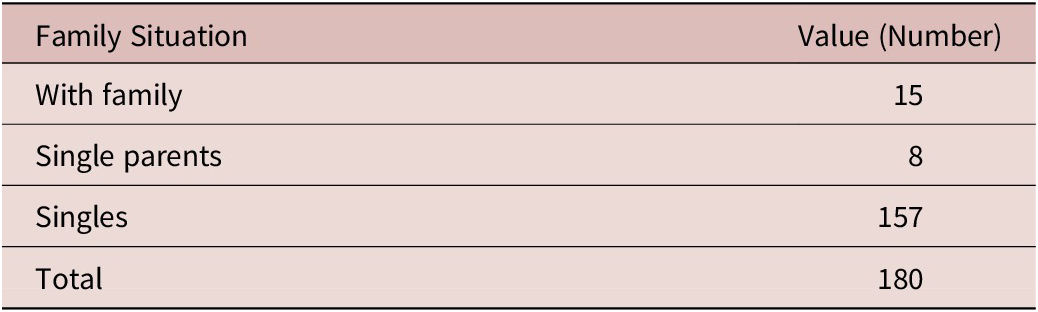
The mean of the journey length was calculated in months and was 12.3 months (SD 3.1 months). Most of our sample (87.22%) arrived in Italy alone, leaving the origin family behind in the Fatherland (Table 2).
Family Situation.

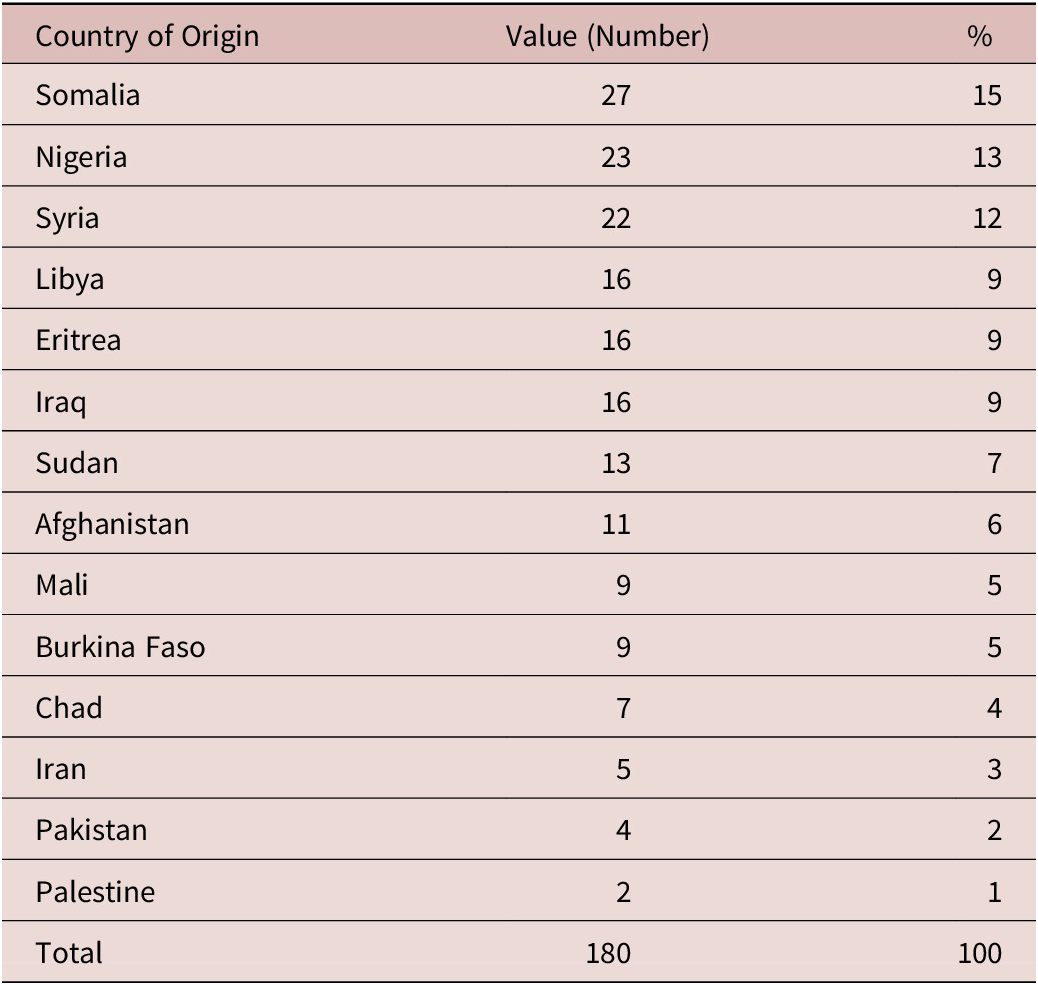
Countries of origin are summarized in Table 3.
Country of Origin.

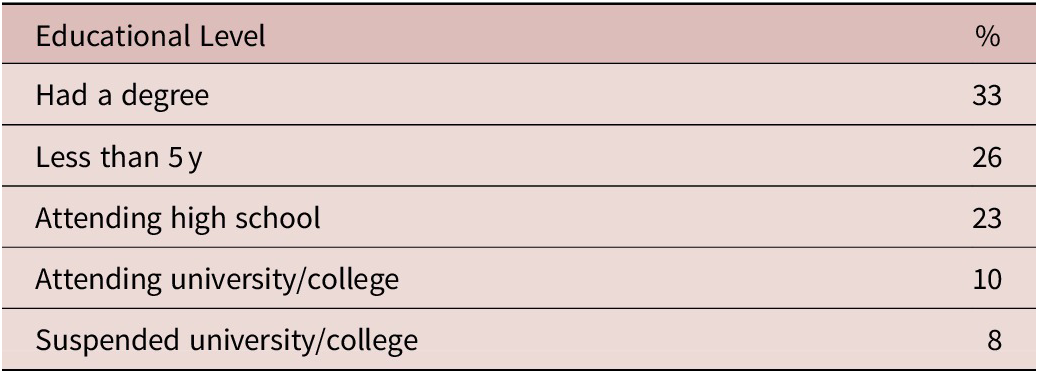
The educational level recorded was heterogeneous: 23% of the subjects were currently attending high school; 8% of them suspended college studies in their country; 33% among patients had a degree; 10% were currently attending University; 26% had less than 5 years of schooling (Table 4).
Educational Level.

In our sample, 47% of migrants had a regular employment, 34% were unemployed and 19% were employed in an illegal occupation.
Most of the sample professed a religion: in the majority, they professed Islam or Catholic religion, in a minority they were Protestants or followers of “traditional” animistic cults.
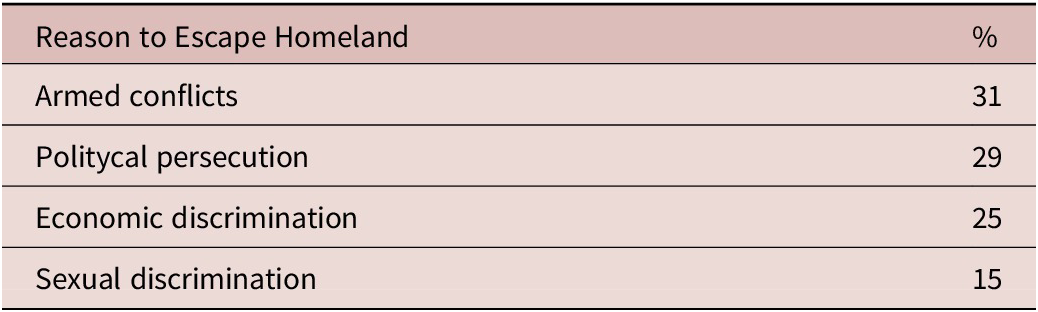
Pushing factors we found were: 31% of patients escaped from war, 29% of the sample for political reasons, 15% of patients for sexual discrimination, and 25% for economical persecution (Table 5).
Reasons to Escape from Homeland.

Psychopathological characteristics
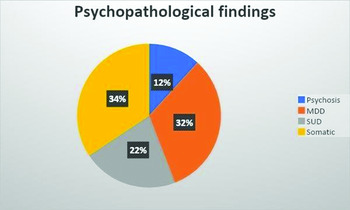
Psychopathological findings are summarized in Figure 1.
Psychopathological findings.

In the sample, victimization from torture was frequent, with 51% of the assessed individuals: only in 31% of these cases, torture was inflicted not in conditions of detention, whereas many cases were tortured while imprisoned. Torture affected the mental health in various ways: people reported fear (29%), pain (27%), and sense of dehumanization (24%).
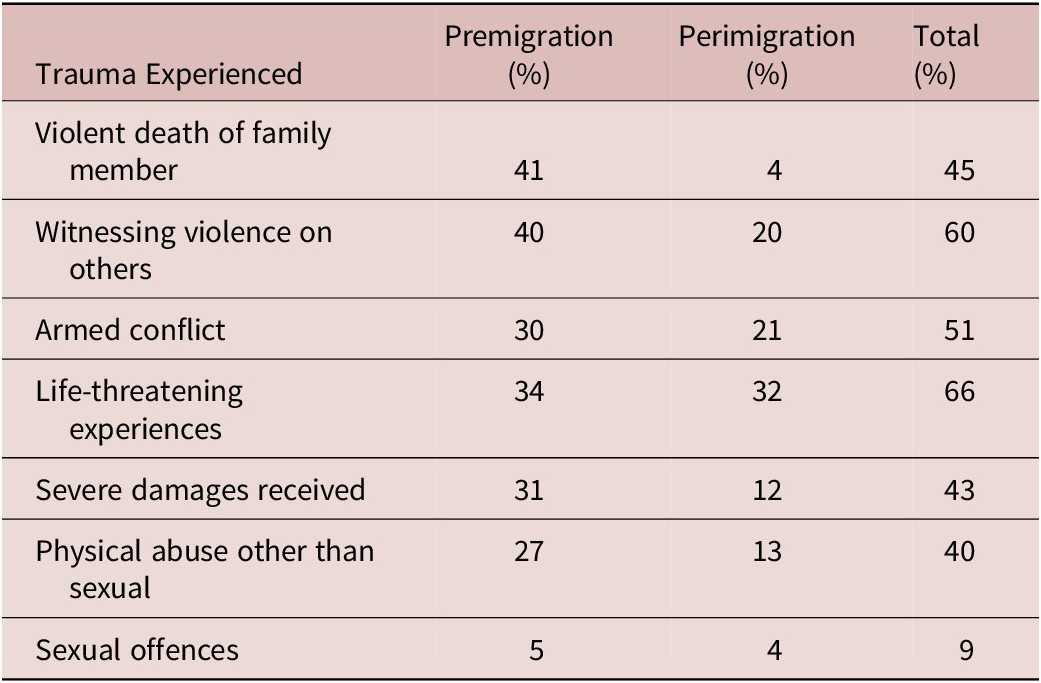
We have clustered trauma experiences, by classifying premigratory and perimigratory factors. This data is shown in Table 6 in detail. Only 20% of the hosted refugees declared no relevant loss in their personal history.
Clustering of Experienced Traumas (LiMEs).

Among the sample, 58% of patients reported suicide ideation before arrival in Italy and 4% after the transfer.
The most prevalent diagnosis was PTSD (95 patients, 53%), with prevalent dissociative symptoms (74 patients, 41%). Subthreshold PTSD symptoms were reported in 22% of subjects and in these cases, a dissociative symptomatology tended to prevail.
Diagnoses other than PTSD were grouped in four categories: not otherwise specified psychosis, major depression disorder, substance-related (addictive) disorders, and somatoform disorders. Overall, around 20% of the sample (36 subjects) suffered from a severe psychiatric disease: 12 psychosis, 12 severe major depressive disorder, and 12 severe drug/alcohol addiction. When the patients met the DSM-IV criteria of dissociative disorders (15% of cases), a separate diagnosis was not formulated because of the cooccurrence of PTSD of the dissociative type. Other patients (37% of the sample) suffered from less relevant syndromes: 35 from somatic disorders, 21 from mild depression, and 10 from drug/alcohol abuse. All patients suffering from a severe psychiatric disorder exhibited post-traumatic stress symptoms: 13% had a comorbidity with PTSD and 6.7% showed additional subthreshold symptoms.
Among our sample, 59% of subjects were suitable for diagnosis of Dublin Migration Syndrome, according to the above-defined criteria.
About 69% of the sample was available for the re-evaluation in the 6 months clinical follow-up, among them, 40% presented residual functional impairment according to the Clinical Global Impression Scale.
We found that 66% of our sample underwent psychopharmacological treatment, 53% before the transfer, and 13% after the transfer. Approximately 33% took antidepressants for Major Depressive Disorder (MDD), 33% antipsychotics (both first and second generation) when a diagnosis of psychosis was made and 33% other psychoactive drugs (mostly antiepileptic and mood stabilizers) or a combination for more severe affective disorders with loss of impulse control and suicidal thoughts.
Discussion
During the past two centuries, humans were often pushed to migrate with the aim to improving their lives and each migration was characterized by stressors of different burdens responsible for what is called “classical migratory duel.”Reference Selye 60 Namely, a condition that encompasses both the fatigue of the journey and the effort to adapt to the new country.
Indeed, migrants who leave their home country for humanitarian reasons, have already experienced enormous alteration in their physical and psychological homeostasis, mainly linked to war traumas, both political and economic persecutions and sexual discriminations in their fatherland. Some of them neither reach the borders of their own country. Who survives is forced to elaborate an adaptation paradigm to pass the journey, which represents an enormous stressor in itself. These environmental stimuli force the natural resilience of the migrant and they go far beyond the usual adaptation stressors. A trivial fight for survival, where life is reduced to the bone of primordial instincts, threatens the integrity of the subject determining the development of the so-called “extreme migration duel.” This represents a permanent crisis, in which a person cannot elaborate the duel when the basis of his/her life are constantly threatened.
The persistence of several peri-migration stressors create a psychological burden that can evolve in a picture described as a specific form of General Adaptation Syndrome associated with migraine, tension headache, insomnia, tiredness, loss of appetite, and generalized ill-defined discomfort. The natural history of the disease may evolve into a severe psychosomatic disorder leading to profound depression.
Not surprisingly, our data show that, in the studied sample of refugees and asylum seekers, the most prevalent clinical picture was PTSD (53%), while subthreshold PTSD symptoms were detectable in another 22% of subjects, so that the total number of 117 subjects out of 180 suffered from post-traumatic stress. Even though we formulated the diagnosis through the DSM-IV-TR criteria, we found an elevated prevalence of PTSD of the dissociative subtype according to DSM-5, Reference Selye60 with maladaptive patterns of reaction to traumatic experiences.
Overall, 59% of subjects met criteria for Dublin Migration Syndrome. These people seem to exhibit altered mechanisms of coping, due to problems in the self-consciousness, social synchronization and personal identity areas. In detail, we found a common clinical pattern characterized by significant impulsivity and aggressive behaviors within a twilight state of consciousness and fragmentary aspects of identity, up to shape a psychotic picture.
From a descriptive point of view, subjects seemed to experience an oneiric dimension. Hypervigilance, depersonalization, derealization, dissociative flashbacks and feelings of detachment were frequent. Depressive symptomatology, anhedonia and social defeat equivalents were also recorded. Anhedonia and failure to elaborate a first-person perspective were frequently associated with depersonalization and derealization.
We have supposed a continuum state, in which patients started from an asymptomatic phase with modifications of physiological defences taking place in response to the “classical migration duel.” When a condition of loss of personal identity and decreased self-awareness occurs, the Dublin Migration Syndrome may clinically emerge, varying in the phenomenological appearance from the dissociative PTSD up to psychotic dissociation.
Our hypothesis is that this gap can be fulfilled by the conflict between social defeat paradigm and social resilience factors. Among other risk factors, urban upbringing (namely higher levels of competition in urban areas), childhood trauma, low educational level, a positive anamnesis for psychiatric disorders, substance abuse, peri-migratory risk factors, social exclusion and socio-economic status cooperate to the definition of the chronic minority status defining the social defeated subject. Here, social support, ethnic diversity and higher educational level could work to minimize the effect of the social status, increasing the coping capabilities and the social resilience of migrants. Nevertheless, van de Beek and colleagues have demonstrated that these factors influence positively on the natural course of integration process—namely protecting subject from the melancholic and paranoid experience—but they do not reduce the pathological effect of defeat factors.
We can assume that long-term minority status and discrimination, in the context of a social environment perceived as threatening, may be the gateway to the genesis of a psychotic experience, characterized by paranoid cognitive and emotional schema that the subject puts in place unconsciously to defend himself. 61-Reference Veling, Selten, Susser, Laan, Mackenbach and Hoek65
What emerges from our sample differs from the canonical clinical picture of the already known Extreme Migratory duel described. Indeed, we found a greater alteration in the state of consciousness dimension and a higher incidence of ego experience and consciousness disturbances.
From a narrative-interpretive point of view, these migrants must cope with the main postmigration traumatic factor: the loss of the object of their migratory project. They will find themselves suspended, deprived of their cultural and social meanings and links, strengthening premigratory and perimigration traumatic experiences through dissociation.
Social defeat takes over the individual experience. Solitude, seen as an existential feeling of nonbelonging and alienation from the surrounding world, becomes a relevant stressful factor, exposing the migrant to an absence of a defining context. This psychopathological context may elicit emerging paranoid ideations with errors of logic inference, failure in reality test and decreased mentalization capacity.
Conclusions
Our sample of refugees and asylum seekers showed severe psychopathological conditions in a relevant percentage of cases: the most represented diagnosis was PTSD. Half of them were victims of torture, more than half of them described violent and life-threatening traumatic experiences such as those listed in Table 6. Yet, more than half of them underwent psychopharmacological treatment and nearly half showed still symptoms of mental disorders after 6 months of clinical follow-up.
Among subjects in our sample, 59% of migrants were identified as Dublin Migration Syndrome, according to the above-mentioned criteria, and they could be described as persons unable to cope with the negative emotional context of social exclusion and solitude.
The absence of a safe and clear legal status, the threat to the survival instincts, the loss of the migratory project and the alienation mediated by a chronic social defeat paradigm may trigger the psychopathological condition, which could be defined Dublin Migration Syndrome.
Waiting for a change of the Dublin Regulation, currently under revision within the EU Commission, a common and integrated treatment project is needed, with the aim of reintegrating the migrant’s personal and narrative identity. This may allow them to cope with and elaborate traumas lived before and during the migration, and may prevent them from the limbo of uncertainty, in which their desires and ambitions are frustrated.
Acknowledgments
Authors are responsible for the scientific contents of the paper.
Disclosures
Emanuele Caroppo, Pierluigi Lanzotti, and Luigi Janiri do not have anything to disclose.