Introduction
Throughout the history of psychiatry, autism and psychosis have been considered related disorders (Nylander, Lugnegård, & Unenge Hallerbäck, Reference Nylander, Lugnegård and Unenge Hallerbäck2008). Although autism was described as one of the four primary symptoms of schizophrenia by Bleuler more than one century ago (Hommer & Swedo, Reference Hommer and Swedo2015; Peralta & Cuesta, Reference Peralta and Cuesta2011), its conceptualization changed over subsequent decades. Considered as a combination of psychotic and neurodevelopmental symptoms at the beginning of the 1930s, and sometimes described as childhood psychosis, by the time that DSM-III had been published in the late 1970s, it had acquired the status of a separate diagnostic entity (Raja & Azzoni, Reference Raja and Azzoni2010; Sugranyes, Kyriakopoulos, Corrigall, Taylor, & Frangou, Reference Sugranyes, Kyriakopoulos, Corrigall, Taylor and Frangou2011). Today, autism spectrum disorder (ASD) is defined in terms of difficulties in social interaction and communication, coupled with repetitive behavior and restricted interests with an onset in early childhood (American Psychiatric Association, 2013; Nylander et al., Reference Nylander, Lugnegård and Unenge Hallerbäck2008; Raja & Azzoni, Reference Raja and Azzoni2010). By contrast, psychotic disorders such as schizophrenia spectrum disorder are characterized by the presence of positive (e.g. hallucinations and delusions), negative (e.g. blunted affect), and cognitive symptoms with an onset in early adulthood (American Psychiatric Association, 2013).
Overlap between ASD and psychotic symptoms
Despite the apparent differences between the two conditions, and their different developmental antecedents and course, some studies have pointed to symptom overlap between autism and psychosis. For example, a systematic review of seven studies (Kincaid, Doris, Shannon, & Mulholland, Reference Kincaid, Doris, Shannon and Mulholland2017) reported higher rates of ASD diagnoses, and autistic traits, in people diagnosed with psychosis compared to the general population. Another systematic review revealed that people diagnosed with ASD experience higher levels of paranoia in comparison to non-clinical participants but lower levels of paranoia than patients with a diagnosis of schizophrenia (Spain, Sin, & Freeman, Reference Spain, Sin and Freeman2016). Autistic people have also been reported to experience high levels of anomalous perceptions which are similar to those reported by psychotic patients (Milne, Dickinson, & Smith, Reference Milne, Dickinson and Smith2017).
Overlap between autistic and psychotic-like traits in non-clinical population
There is evidence that both autistic traits and psychotic experiences are not confined to clinical populations (Freeman, Reference Freeman2007; Skuse et al., Reference Skuse, Mandy, Steer, Miller, Goodman, Lawrence and Golding2009; van Os, Hanssen, Bijl, & Vollebergh, Reference van Os, Hanssen, Bijl and Vollebergh2001), and that both psychosis and autistic traits are continuously distributed in the general population (Constantino & Todd, Reference Constantino and Todd2003; Palmer, Paton, Enticott, & Hohwy, Reference Palmer, Paton, Enticott and Hohwy2015; van Os, Linscott, Myin-Germeys, Delespaul, & Krabbendam, Reference van Os, Linscott, Myin-Germeys, Delespaul and Krabbendam2009). Studies that have addressed whether or not autistic and schizotypal traits overlap in non-clinical populations have typically used self-report measures such as the Autism-Spectrum Quotient (AQ) and the Schizotypal Personality Questionnaire (SPQ). For example, by using college student samples, studies have reported modest and weak associations between positive schizotypal traits (e.g. unusual perceptions, magical thinking, ideas of reference) and specific autistic features (e.g. attention to detail, communication difficulties, attention switching; Horder, Wilson, Mendez, & Murphy, Reference Horder, Wilson, Mendez and Murphy2014; Hurst, Nelson-Gray, Mitchell, & Kwapil, Reference Hurst, Nelson-Gray, Mitchell and Kwapil2007; Mealey, Abbott, Byrne, & McGillivray, Reference Mealey, Abbott, Byrne and McGillivray2014). However, although the cognitive-perceptual factor of the SPQ is considered a proxy measure of positive-like symptoms, it does not map onto specific positive experiences such as auditory hallucinations, paranoid delusions, or thought insertion. Moreover, the use of college student samples in the above-mentioned studies limits the generalizability of previous findings, since they are less likely to be representative of the general population (Hanel & Vione, Reference Hanel and Vione2016).
Other studies have used semi-structured interviews to assess autistic and schizotypal features. For example, in a longitudinal study, it was found that autistic traits in adolescents predicted schizotypal traits although not transition to psychosis over a 3-year follow-up period (Esterberg, Trotman, Brasfield, Compton, & Walker, Reference Esterberg, Trotman, Brasfield, Compton and Walker2008). Another longitudinal study with the Avon Longitudinal Study of Parents and Children (ALSPAC) birth cohort found an association between autistic traits (e.g. speech problems, ritual behaviors) reported by parents at 7 years and psychotic experiences manifested at 12 years (Bevan Jones, Thapar, Lewis, & Zammit, Reference Bevan Jones, Thapar, Lewis and Zammit2012). Although these studies have employed larger samples and different instruments to assess autistic and schizotypal traits, they have focused on child and adolescent samples and the relationship between autism and psychosis in the adult general population remains unexamined.
On balance, evidence therefore suggests that autism and psychosis are two spectrum conditions that present overlapping traits and symptoms. Since autism and schizotypal personality traits are two lifelong conditions (Hurst et al., Reference Hurst, Nelson-Gray, Mitchell and Kwapil2007), exploring if they are related in adult epidemiological samples and if that relationship is with specific psychotic experiences should facilitate the identification of common causal factors and pathological processes which, in turn, could lead to improved interventions for both conditions.
Aims of the current study
In this paper, we address this relationship for the first time by evaluating the association between autistic traits and psychotic-like experiences in two large epidemiological surveys which included clinically-validated measures of both: the 2007 and 2014 waves of the Adult Psychiatric Morbidity Survey (APMS). The datasets are considered separately in order to determine the extent to which we could replicate in the 2014 dataset the findings from the 2007 dataset. In both datasets, we first test the strength of association between autistic traits and probable psychosis, and secondly – given previous reports of specific associations between autism and paranoid beliefs (Spain et al., Reference Spain, Sin and Freeman2016) and unusual experiences (Esterberg et al., Reference Esterberg, Trotman, Brasfield, Compton and Walker2008; Milne et al., Reference Milne, Dickinson and Smith2017) – we conduct exploratory analyses to test the strength of association between autistic traits and specific psychotic-like experiences: auditory hallucinations; paranoia; strange experiences; thought insertion and mania, tentatively predicting associations with paranoia and strange experiences, but not between autistic traits and hallucinations, thought insertion, or mania.
Study 1
Methods
Sample
The APMS 2007 was carried out between October 2006 and December 2007 by the National Centre for Social Research and the University of Leicester. The survey was commissioned by the NHS Information Centre for Health and Social Care and employed a multistage stratified probability sampling design. Individuals aged 16+ years living in private households were identified for an interview in England using postcodes. From 13 171 eligible households, 7353 individuals completed phase 1 of the survey (McManus, Meltzer, Brugha, Bebbington, & Jenkins, Reference McManus, Meltzer, Brugha, Bebbington and Jenkins2009). Researchers administered computer-assisted interviews and self-completion questionnaires using laptops to obtain data on topics including physical health, mental health, service use, religion, social capital, discrimination, and childhood adversity. The survey was implemented in two phases, and in the second phase, a subsample was assessed face-to-face by a mental health professional. In this report, we use only data for the whole sample obtained during the first screening phase. Written informed consent was obtained from all subjects. The authors assert that all procedures contributing to this work comply with the ethical standards of the relevant national and institutional committees on human experimentation and with the Helsinki Declaration of 1975, as revised in 2008. All procedures involving human subjects/patients were approved by the Royal Free Hospital and Medical School of Research Ethics Committee no. 06/Q0501/71 (for more information, see McManus et al., Reference McManus, Meltzer, Brugha, Bebbington and Jenkins2009).
Instruments
Psychotic-like experiences. The APMS 2007 screened for psychotic-like experiences using the Psychosis Screening Questionnaire (Bebbington & Nayani, Reference Bebbington and Nayani1995) (PSQ) which is a clinically-validated instrument developed to detect psychotic conditions in the general population (Bebbington & Nayani, Reference Bebbington and Nayani1995). In a proportion of those classified with probable psychosis, a more detailed phase 2 interview was conducted by clinically-trained research assistants using the Schedule for Clinical Assessment in Neuropsychiatry (SCAN) version 2.1
The PSQ has five sections to identify psychotic-like experiences that may have occurred within the past year: auditory hallucinations, paranoia, thought insertion, strange experiences, and mania. Each section has an initial question answered in a yes/no format followed by 1 or 2 follow-up questions to determine severity. Consistent with our previous research with this survey (Wickham, Taylor, Shevlin, & Bentall, Reference Wickham, Taylor, Shevlin and Bentall2014), each of the psychotic experiences was coded as a binary variable, where 1 indicated the highest level of severity and 0 the absence of it.
Probable psychosis. Probable psychosis is a variable produced by the APMS with the purpose of reducing missing data accounted for by non-respondents (e.g. due to refusal or non-contact) in phase 2. A positive classification of probable psychosis was based on responses to two or more of the psychosis screening criteria at phase 1 (McManus et al., Reference McManus, Meltzer, Brugha, Bebbington and Jenkins2009). These criteria included currently taking antipsychotic medication, history of admission to a mental health hospital or ward, self-reported or given diagnosis (or symptoms) suggestive of psychotic disorder in the past year, and a positive response to question 5a in the PSQ that refers to auditory hallucinations. The psychosis screening criteria are based on the World Health Organization International Classification of Diseases chapter on Mental and Behavioral Disorders Diagnostic Criteria for Research (ICD-10). Probable psychosis was coded in this study as a binary variable where 1 indicates the probability of experiencing psychosis and 0 the absence of it. In a previous analysis of the data from both phases of the survey, it was reported that 0.5% of the sample met the criteria for probable psychosis (McManus et al., Reference McManus, Meltzer, Brugha, Bebbington and Jenkins2009).
Autism traits. The APMS2007 used a 20-item version of the AQ (Baron-Cohen, Wheelwright, Skinner, Martin, & Clubley, Reference Baron-Cohen, Wheelwright, Skinner, Martin and Clubley2001) to identify autistic traits in phase 1. This shorter version, rather than the original 50-item version, was used in order to minimize respondent burden (Brugha, McManus, & Meltzer, Reference Brugha, McManus and Meltzer2009). Of the 20 items, six assessed social functioning; four, communication; four, attention to detail; three, attention switching and three imagination. For each answer indicative of an autistic trait, one point was given, so a general score was generated between 0 and 20. A proportion of the sample, weighted according to ASQ scores, was also interviewed with Autism Diagnostic Observation Schedule (ADOS) in phase 2. In a report based on an analysis of data from both phases of the survey, it was estimated that 1% of the sample met the criteria for ASD (Brugha et al., Reference Brugha, McManus and Meltzer2009).
Demographic covariates. Sex, age, ethnicity, and index of multiple deprivation (IMD) were considered as covariates in order to control for possible confounds. Sex was coded as a categorical variable and age as a continuous variable. As in previous studies which have used the APMS 2007 (Wickham et al., Reference Wickham, Taylor, Shevlin and Bentall2014), ethnicity was considered as a categorical variable where 0 equated to white British and 1 indicated other ethnicity. The IMD measures social and economic deprivation and the APMS 2007 reported this measure on a five-point scale, where 1 represents the least deprived (0.57–8.35) and 5 (34.21–86.36) the most deprived areas.
Statistical analyses
In this cross-sectional dataset, we chose to regress psychosis variables onto autistic traits because the former were binary and the latter was a continuous variable and for ease of handling covariates. However, it is important to note that this does not imply a direction of causality and it would also be possible, although less elegant, to treat psychotic symptoms and probable psychosis as independent variables and autistic traits as the dependent variable.
All analyses were carried out in R 1.1.463 using the MASS package glm function for binomial logistic regression and using the odds ratio (OR) package or_glm function for calculating ORs and 95% confidence intervals (CIs). For the first analysis, probable psychosis was regressed on autism traits as the independent variable and on the potentially confounding variables. For the remaining analyses, the specific psychotic experiences (paranoia, auditory hallucinations, mania, thought insertion, and strange experiences) were entered as dependent variables, which were regressed on autistic traits and the potentially confounding variables in the initial models. Subsequently, the models were recalculated with the remaining psychotic experiences added as additional possible confounding variables.
Results
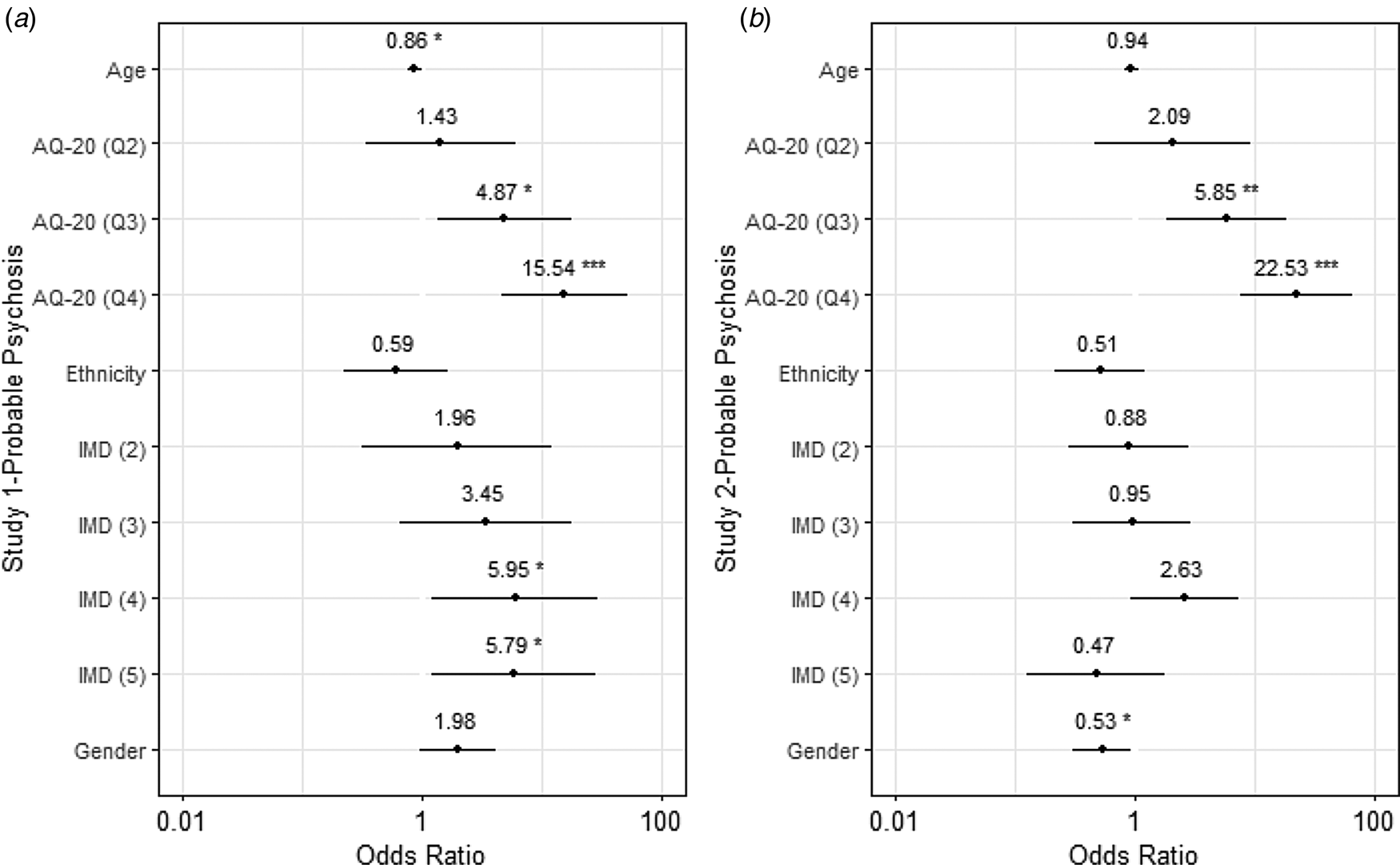
Detailed statistical results including the effects of covariates are available in the supplementary materials (online Supplementary Tables S1–S7). A significant association was found between autism traits and probable psychosis, b = 0.35, p < 0. 001, OR = 1.42 (95% CI 1.29–1.56). This OR represents the increased probability of probable psychosis for each incremental point on the AQ. To assist in the interpretation of this finding, AQ scores were recoded as quartiles and this variable was used in a further analysis as a categorical variable with the lowest quartile used as a reference category and an indicator contrast was used to estimate the ORs for the remaining three quartiles. Results of this latter analysis show a non-linear increase of the OR from the second (OR = 1.43, 95% CI 0.33–5.97) to the third (OR = 4.87, 95% CI 1.33–17.6) and fourth quartile (OR = 15.5, 95% CI 4.57–52.6; see Fig. 1).
Error plot bars showing odds ratio for the association between probable psychosis, AQ-20 quartiles and covariates for Study 1 (panel A) and Study 2 (panel B). Significance levels *p < 0.05, **p < 0.01, ***p < 0.001.

When we considered specific psychotic experiences, significant associations were found between autism traits and paranoia, thought insertion, and strange experiences in our initial models and Table 1 shows that these effects remained when the rest of the psychotic experiences were included as covariates in the case of paranoia, b = 0.18, p < 0. 001, OR = 1.20 (95% CI 1.11–1.30), thought insertion, b = 0.10, p < 0.05, OR = 1.11 (95% CI 1.01–1.23), and strange experiences, b = 0.22, p < 0.001, OR = 1.25 (95% CI 1.18–1.33). A significant association was also found between autism traits and auditory hallucinations in our initial model, b = 0.22, p < 0.001, OR = 1.25 (95% CI 1.13–1.37) but this effect was no longer significant once we controlled for the remaining psychotic experiences, b = 0.08, p = 0.27, OR = 1.08 (95% CI 0.93–1.27). In our initial models, no significant association was found between autistic traits and mania b = −0.01 p = 0.19, OR = 0.98 (95% CI 0.96–1.01).
Odds ratio for the associations between autistic traits and psychotic-like experiences (controlling for other psychotic experiences)

Note. 95% CI for OR are reported in parenthesis. Significance level *p < 0.05; **p < 0.01; ***p < 0.001.
Study 2: replication
Methods
Sample, instruments, and analysis
For the analysis of Study 2, we used the APMS 2014, which was the fourth wave of the survey. This sample and dataset do not overlap with the APMS 2007 analyzed in Study 1. APMS 2014 retains the same core questionnaire content and methodological approach as the 1993, 2000, and 2007 surveys, allowing the examination of trends (McManus et al., Reference McManus, Bebbington, Jenkins, Brugha, Appleby, Asherson and Wessely2016). Therefore, for this analysis, we employed the same statistical models and used the same variables employed in Study 1. Only the autism variable was slightly modified since, based on statistical modeling, the APMS 2014 retained the 17 most predictive items of the AQ-20 used in the APMS 2007, whereas three items that had a poor performance were replaced with items that improved the prediction.Footnote 1 For phase 1 of the survey used in this analysis, 7500 participants were recruited. Based on data from both phases of the survey, it has been reported that 0.7% met the criteria for ASD and 0.7% met the criteria for psychotic disorder (McManus et al., Reference McManus, Bebbington, Jenkins, Brugha, Appleby, Asherson and Wessely2016). Written informed consent was obtained from all subjects. The authors assert that all procedures contributing to this work comply with the ethical standards of the relevant national and institutional committees on human experimentation and with the Helsinki Declaration of 1975, as revised in 2008. All procedures involving human subjects/patients were approved by the West London National Research Ethics Committee no. 14/LO/0411.
Based on our initial hypotheses at the outset of this study, and also the results from Study 1, we predicted that we would replicate the findings of the APMS 2007 analysis, so that autistic traits would be strongly associated with probable psychosis, paranoia, and strange experiences but not with mania, thought insertion, and auditory hallucinations. Prior to our obtaining access to the APMS2014 data, the hypotheses and analyses of this second study were pre-registered with the Open Science Framework project in line with the Transparency and Openness Promotion Guidelines (doi: 10.31219/osf.io/vj54c).Footnote 2
Results
As in Study 1, detailed statistical results including the effects of covariates are available in the supplementary materials (online Supplementary Tables S1–S7). A significant association was found between autism traits and probable psychosis, b = 0.41, p < 0.001, OR = 1.52 (95% CI 1.40–1.64). Results of this analysis recoding our independent variable as quartiles show a non-linear increase of the OR from the second (OR = 2.09, 95% CI 0.46–9.37) to the third (OR = 5.85, 95% CI 1.85–18.3) and fourth quartile (OR = 22.5, 95% CI 7.64–66.3) as in Study 1 (see Fig. 1).
Regarding specific psychotic experiences, significant associations were found in our initial models and remained even when including the rest of the psychotic experiences as covariates for the associations between autism traits and paranoia (b = 0.20, p < 0.001, OR = 1.23, 95% CI 1.12–1.34), autism traits and auditory hallucinations (b = 0.23, p < 0.001, OR = 1.25, 95% CI 1.13–1.38), autism traits and thought insertion (b = 0.23, p < 0.05, OR = 1.26, 95% CI 1.05–1.51), and autism traits and strange experiences (b = 0.19, p < 0.001, OR = 1.22, 95% CI 1.14–1.30; see Table 1). As in Study 1, in our initial models, no significant association was found between autistic traits and mania (b = −0.009, p = 0. 20, OR = 0.99, 95% CI 0.95–1.02).
Discussion
To the best of our knowledge, this is the first study to examine associations between autistic traits and psychotic-like experiences in large epidemiological samples representative of the adult general population. Although probable psychosis was rare, both autistic traits and psychotic-like experiences were present in both samples in a way that is consistent with continuum models of these conditions, which propose that relevant traits and experiences are widely distributed in the general population. In our first study, we found that autistic traits were strongly associated with probable psychosis and this finding was replicated in the second dataset. There was some indication that this association was non-linear, with the greatest risk associated with the highest quartile of AQ scores. Using the APMS2007, we also found associations between autistic traits and specific psychotic-like experiences, particularly paranoia, thought insertion, and strange experiences, although the latter is one of the least satisfactory PSQ items in terms of the overall factor structure of the scale. However, in the APMS2014, we found a significant association between autism traits and all the psychosis variables with the exception of mania. Thus, these findings suggest that the associations between autism traits and psychotic experiences in the domains of delusions, and disturbances of thought possession and perception are more consistent than the association with auditory hallucinations. Although these results do not fully support a symptoms-specific association between autism and psychotic experiences, they provided evidence of a strong relationship between autistic traits and psychotic-like experiences in the adult general population, and the absence of such an association with the one symptom representative of bipolar disorder, mania.
Strength and limitations
An important limitation of the present study is that the datasets we employed were cross-sectional, limiting our ability to infer causality. Furthermore, the absence of longitudinal data prevented us from directly testing whether autistic traits preceded the onset of psychotic experiences, although typical developmental trajectories for these conditions suggest that this is likely to be the case. Additionally, we acknowledge that the variable probable psychosis does not reflect a definitive diagnosis of psychotic disorder and thus there is the possibility of reporting false positives. In a similar way, the PSQ is not a diagnostic tool but rather a screening self-report instrument and hence it does not assess pure psychotic symptoms but psychotic-like experiences. Hence, neither of these constructs should be taken as implying a specific attribution of schizophrenia, bipolar disorder, or any similar diagnosis. The main strength of the studies was that the associations observed were large and for the most part replicated across two independent datasets, suggesting that we can be confident that, in the adult general population, autistic traits and psychotic-like experiences are related in the way that we have described.
Future directions
Chisholm, Lin, Abu-Akel, and Wood (Reference Chisholm, Lin, Abu-Akel and Wood2015) suggest eight possible ways in which autism and psychosis might be related: multiformity (autism and psychosis are two manifestations of the same underlying process); increased vulnerability (autism increases the risk of psychosis); chance model (autism and psychosis co-occur by chance due to external variables); stage model (the two conditions are different stages of the same disorder); associated liabilities model (the conditions are related by shared risk factors but are still distinct); independence model (comorbid disorder is regarded as an independent diagnostic entity); diametrical model (the conditions are a result of reciprocal processes resulting from common risk factors); and multiple overlapping etiologies model (the disorders reveal high clinical heterogeneity as a result of multiple etiological pathways). Bevan Jones et al. (Reference Bevan Jones, Thapar, Lewis and Zammit2012) found that autistic traits recorded in childhood increased the chances of psychotic experiences in adolescence, and suggested that this finding was consistent with the increased vulnerability model. However, Cederlöf et al. (Reference Cederlöf, Pettersson, Sariaslan, Larsson, Östberg, Kelleher and Gumpert2015) reported that, in an adolescent general population sample, a strong association between auditory hallucinations and autistic traits that was initially detected was no longer significant when general neuropsychiatric problems were controlled for, suggesting that shared genetic factors and/or neurodevelopmental processes could explain that association observed here, which would be consistent with the multiple overlapping etiologies model. Various psychological functions have been highlighted as candidate overlapping etiological mechanisms. Studies have revealed that patients with paranoid delusions do not differ from ASD patients on Theory of Mind (ToM) performance and that ASD patients score higher than healthy controls on measures of paranoia, but still lower than patients with diagnoses of paranoid schizophrenia (Craig, Hatton, Craig, & Bentall, Reference Craig, Hatton, Craig and Bentall2004; Spain et al., Reference Spain, Sin and Freeman2016). Additionally, people with autism and psychosis both score high on measures of abnormal perceptual experiences (Bell, Halligan, & Ellis, Reference Bell, Halligan and Ellis2006; Milne et al., Reference Milne, Dickinson and Smith2017) and it has been suggested that reduced NMDA-receptor function at a biological level and early traumatic experience (e.g. bullying) at a psychological level might explain this similarity (Bentall, Wickham, Shevlin, & Varese, Reference Bentall, Wickham, Shevlin and Varese2012; Milne et al., Reference Milne, Dickinson and Smith2017). The present findings suggest that all of these hypotheses are worthy of further research and that addressing might yield important insights into both conditions.
Given that the cross-sectional nature of our design does not allow us to infer the superiority of any of the above-mentioned models, future research should disentangle these possibilities by exploring associations between autistic traits and clinical precursors of psychosis. For example, it might be particularly fruitful to examine whether there is overlap in the kinds of autistic traits recorded in this study and ‘basic symptoms’ (e.g. subjectively experienced subclinical disturbances in affect, perception, and thinking; Schultze-Lutter, Reference Schultze-Lutter2009) that precede the onset of psychotic disorders; this might require a detailed phenomenological inquiry of the kind that is not possible within an epidemiological study. It would also be helpful examining candidate shared mechanisms that might account for the association between autism and psychosis-related phenomena in both clinical and non-clinical populations.
Implications
The major clinical implication of the present findings is that services should be alert to the risk that autistic traits may be a complication in the treatment of psychosis and the risk that psychotic symptoms are experienced by patients diagnosed with autism. Clinical services might benefit from applying tailored psychotherapeutic interventions for patients with comorbidity in line with the more general recommendation that treatment packages for people experiencing early psychosis should be individually tailored to their specific needs (Haddock & Lewis, Reference Haddock and Lewis2005).
Supplementary material
The supplementary material for this article can be found at https://doi.org/10.1017/S0033291720001373.
Data
The Adult Psychiatric Morbidity Survey (APMS) 2007 was accessed via UK data archive, whereas APMS 2014 was accessed via DARS (Data Access Request Service) – NHS Digital.
Acknowledgements
None
Author contributions
All authors met all four ICMJE criteria for authorship. All authors were involved in the development of the research question, design, and writing. First and second authors were involved in data analysis but supervised by the three remaining authors.
Financial support
This research received no specific grant from any funding agency, commercial or not-for-profit sectors.
Conflict of interest
None.