Introduction
Sheep husbandry is the backbone of the rural economy in India’s arid and semi-arid regions. Marwari sheep are an important sheep breed in the hot arid zone of north-western Rajasthan, as people’s livelihoods depends on the Marwari sheep. Due to its high growth rate, it produces medium to coarse-quality carpet wool, and people prefer it for mutton production. Marwari is the largest sheep breed in the north-western region of the country, and it is well recognized for its drought resistance and capacity to travel greater distances in search for pasture (Central Sheep and Wool Research Institute, 2021; National Bureau of Animal Genetic Resources, 2021). Growth is the most important trait in sheep rearing due to its direct association with market age for slaughter, early reproduction and positive association with survival. Flock productivity is highly dependent on the higher growth rate of the flock and the economics associated with it. Therefore, measuring the live weight of sheep at different intervals, such as at birth, 3 months (weaning), 6 months and 12 months, is important to assess the growth trajectory and health status of the flock (Mehta et al., Reference Mehta, Vij and Nivsarkar1995; Narula et al., Reference Narula, Yadav, Sharma and Vimal2009; Chopra et al., Reference Chopra, Prince, Gowane and Arora2010).
Pre-weaning weight has a significant maternal influence and is also related to the overall lifetime performance and health status of sheep. Optimum birth weight decides the fate of a lamb with respect to its further growth, competition with other lambs and health status. Weaning weight (3 months) is also influenced by maternal effects and affects the economic returns from commercial sheep flocks (Mousa et al., Reference Mousa, Monzaly, Shaat and Ashmawy2013; Shiotsuki et al., Reference Shiotsuki, de Oliveira, Lôbo and Facó2014). The economics of the sheep flock are directly affected by post-weaning body weights, especially the weight at market age (6 months in Marwari sheep), as most surplus males are sold for mutton at this stage (Gowane et al., Reference Gowane, Prakash, Chopra and Prince2013; Reddy et al., Reference Reddy, Punya Kumari, Gowri Manokari and Venkataramanan2018; Khan et al., Reference Khan, Ganai, Alam, Shanaz, Hamadani, Rather, Bukhari, Shah, Jalal and Wani2020).
Increased average daily gain (ADG) leads to the quick achievement of market weight (Prakash et al., Reference Prakash, Prince, Gowane and Arora2012) and therefore needs huge emphasis in a sheep flock. The Kleiber ratio (KR) is a useful determinant of feed conversion and may be chosen as a crucial selection criterion for growth efficiency. To accomplish greater growth, the reliability of feed conversion seems to be a more appropriate selection prerequisite than live weight alone (Mahala et al., Reference Mahala, Saini, Kumar, Prince and Gowane2019). Kleiber ratio (KR) is illustrated as a change in growth/metabolic body weight (body weight 0.75), as recommended for determining growth performance (Kleiber, Reference Kleiber1947).
Inbreeding tends to be a useful strategy for genetic improvement by increasing the abundance of beneficial genes. However, due to selection and the closed structure of flocks, intensive use of limited numbers of sires and dams can result in an increase in inbreeding and a decrease in genetic diversity among livestock populations. In addition, many researchers have observed decreased performance in traits related to productivity, reproduction, and health in sheep due to inbreeding. (Gowane et al., Reference Gowane, Prince and Arora2010; Ceyhan et al., 2011; Venkataramanan et al., Reference Venkataramanan, Subramanian, Sivaselvam, Sivakumar, Sreekumar and Iyue2016).
The inbreeding depression is the main consequence of inbreeding. Inbreeding depression causes a lowering in phenotypic values of production traits in inbred animals. Despite certain beneficial inbreeding results in selection schemes, breeders are conscious of its detrimental impacts and work to prevent it.
Apart from the animal’s own genotype, there are several covariates that affect the growth performance of lambs and need critical evaluation. Earlier studies on Marwari sheep tried to address the effect of covariates on growth; however, the data size used was low. In the current study, we used 40 years of data with the objective of assessing the effect of sire, major fixed covariates and levels of inbreeding on growth performance in a closed flock of Marwari sheep.
Materials and methods
Data and management practices
The information utilized in the study was collected from the database of 11,126 animals maintained at ICAR-Central Sheep & Wool Research Institute, Arid Region Campus (CSWRI-ARC), Beechwal, Bikaner, during the period from 1981 to 2020. The research project was started in August 1981 under the All India Coordinated Research project (AICRP). This project was converted into Network Project in 1990 as a breeding project. The Marwari sheep have been improved through selection since the project’s inception. Currently, there are 300 breeding ewes in the flock, along with their followers.
The feeding management of Marwari sheep has been described earlier (Gohil, Reference Gohil2010; Singh, Reference Singh2012). Up to weaning (90 days), ad libitum concentrate feeding was offered. After weaning, 300 g of concentrate was provided. Lambing occurred only in the spring (February–March) and autumn (August–September) seasons. Newborn lambs and dams were weighed at lambing, and each lamb’s lambing date, sex, and type of birth were recorded.
The various economic traits that were included in the study were birth weight (BWT), 3-month or weaning weight (3MWT), 6-month weight (6MWT), 9-month weight (9MWT), and 12-month weight (12MWT). ADG1 is the average daily gain (in grams) from birth to 3 months, ADG2 and ADG3 are the average daily gain (in grams) from 3 to 6 months and from 6 to 12 months, respectively (Brody and Lardy, Reference Brody and Lardy1946). Absolute growth rate or ADG (g/day) was estimated as = (W2 − W1)/(t2 − t1) ×1000, where: W2 = body weight at the end (kg), W1 = body weight at the start (kg); t2 = animal’s age at the end of the period (days); t1 = animal’s age at the start of the period (days).
Arthur et al. (Reference Arthur, Renand and Krauss2001) explained KR as a fraction of ADG and live weight (LWT)0.75 as both observations were under a similar unit (kg). Kleiber ratio from birth to 3 months (KR1), Kleiber ratio from 3 months to 6 months (KR2) and 6 months to 12 months (KR3) were calculated using the following formulae: KR1 = ADG1/(3MWT)0.75, KR2 = ADG2/(6MWT)0.75, KR3 = ADG3/(12MWT)0.75
The inbreeding coefficient (F) was computed following Meuwissen and Luo (Reference Meuwissen and Luo1992) using the PEDIGREE VIEWER V6.5b computer package (Kinghorn, Reference Kinghorn1994). Data were classified based on the inbreeding coefficient and arranged in the following classes: F = 0, i.e. non-inbred animals; F ≤ 1.25%; F > 1.25% to ≤ 5%; F > 5.0%.
Statistical analysis
The data were assigned to linear mixed model equation (LMME) analysis using IBM SPSS (2019) version 25.0. The LMME included the random effect of sire, and fixed covariates were the year of birth, sex of the lamb, inbreeding levels, dam’s age at lambing and dam’s weight at lambing as covariable. In addition, Duncan’s Multiple Range Test (Kramer, Reference Kramer1957) was used for analyzing subclass differences.
The statistical model used to investigate the effect of several factors, including inbreeding, on various body weight traits was as follows:
 $$\eqalign{{\rm Y_{ijklmn}}=\,& amp; {\rm \mu + \rm a_i+B_j+C_k+D_l+G_m+b\,(DW_{ijklm}-\overline{ DW})}\cr& amp; {\rm +\, e_{ijklmn}}}$$
where Yijklmn = Production performance of the nth progeny of ith sire born in jth year of kth age of dam belonging to lth sex, having mth inbreeding level
µ = Mean of the whole population, ai = Random effect of ith sire, Bj = Fixed effect of jth year/period of birth (j = 1–10), Ck = Fixed effect of kth age of dam (k = 1–5), Dl = Fixed effect of lth sex (l = 1 and 2), Gm = Fixed effect of mth inbreeding (m = 1 to 4),
 $\rm b\,(DW_{ijklm}-\overline{ DW})$
= The corresponding trait’s regression on dam’s weight at lambing, eijklmn= Random error associated with each observation, NID (0, σ2
e).
Results and Discussion
Growth traits of Marwari sheep improved over the selection period
Live weights
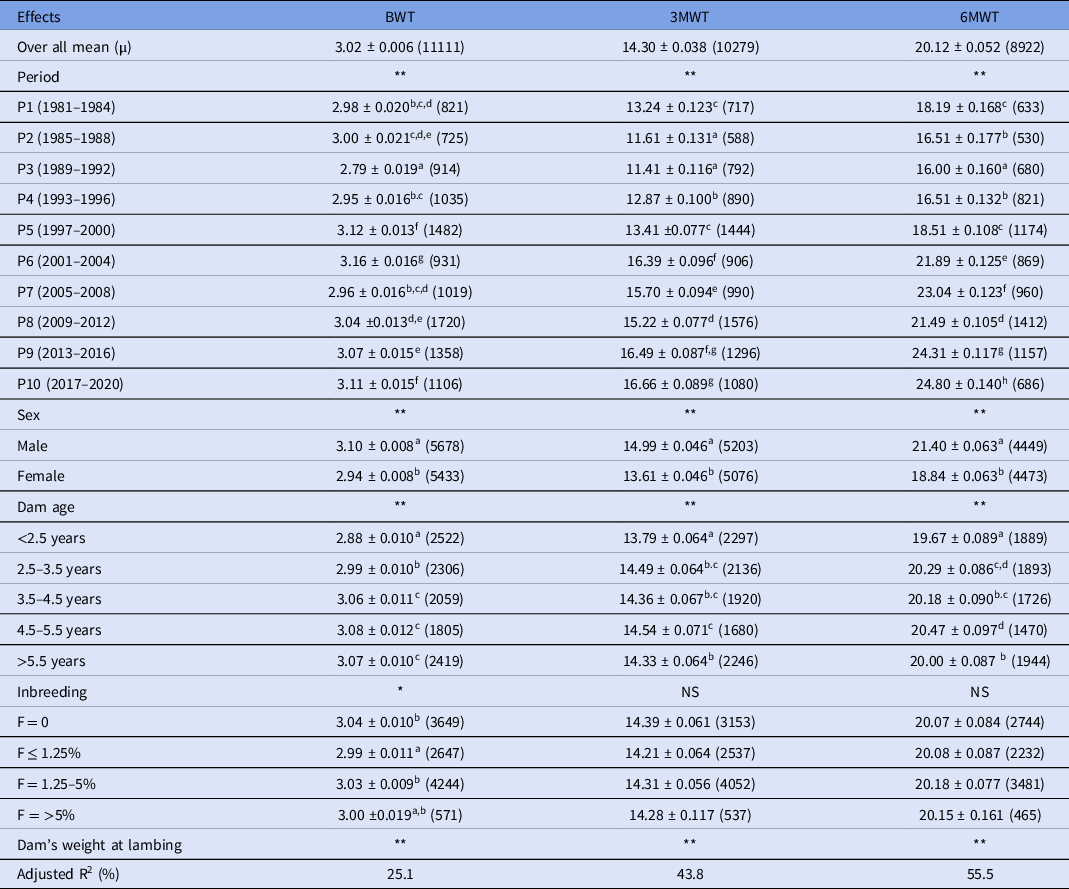
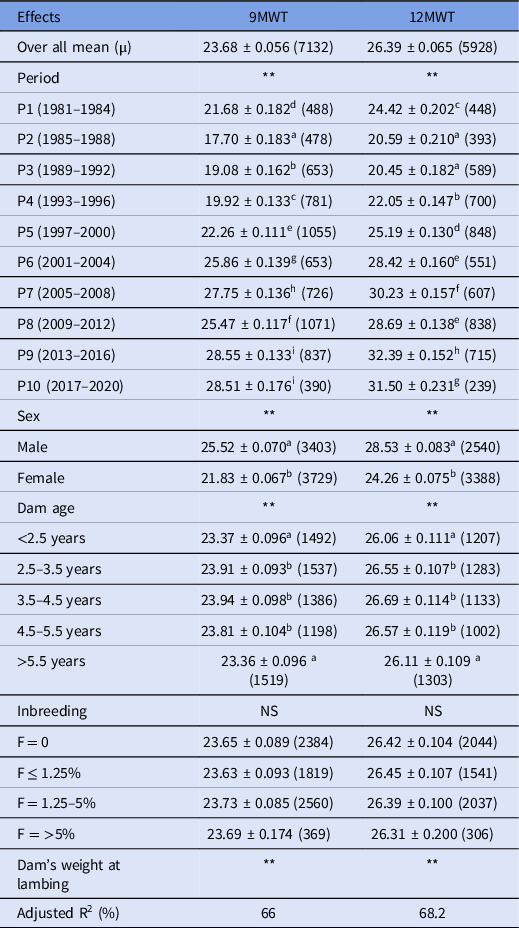
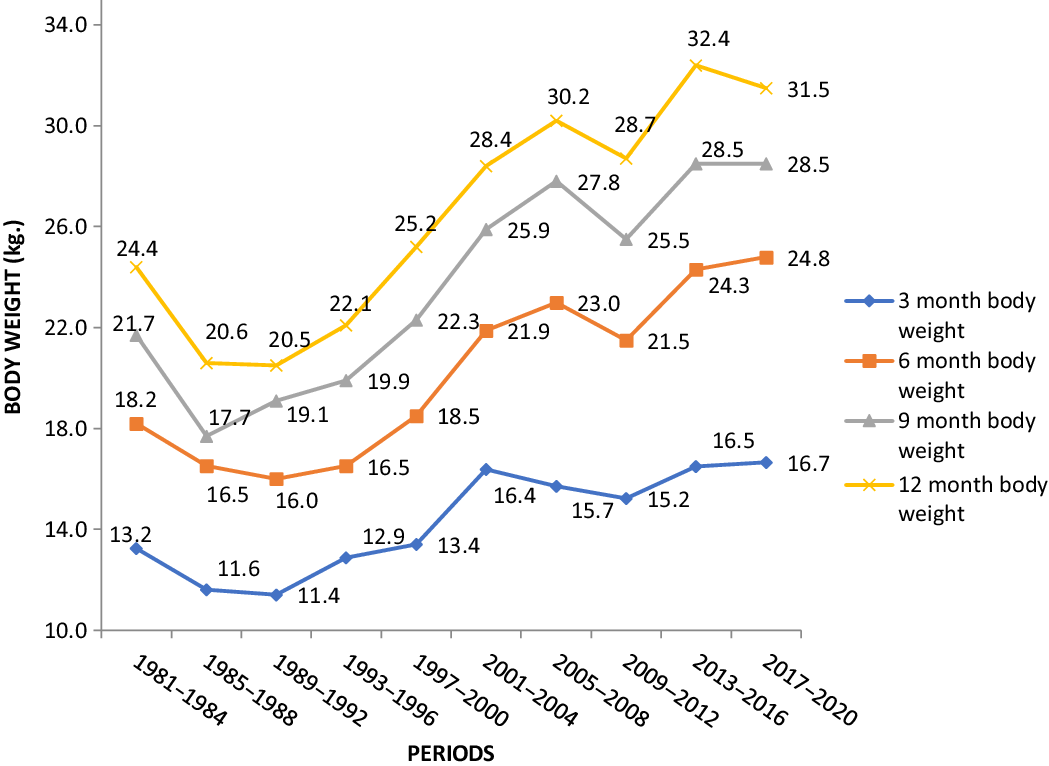
The overall least-squares means (LSM) of BWT, 3MWT, 6MWT, 9MWT and 12MWT were 3.02 ± 0.01, 14.30 ± 0.04, 20.12 ± 0.05, 23.68 ± 0.06 and 26.39 ± 0.07 kg, respectively (Table 1 and 2). Live weight at the start of the programme were 2.98 ± 0.02, 13.24 ± 0.12, 18.19 ± 0.16, 21.68 ± 0.18 and 24.42 ± 0.06 kg, respectively. Results revealed a 4.36, 25.83, 36.33, 31.50 and 28.99% improvement in the live weights since the inception of the improvement programme. The increase in body weight at a younger age was found to be higher compared with later ages. In this current research, an increase in live weights reveals the effect of better nutrition and management practices along with the selection. This has resulted in higher live weights at 6 months and 9 months of age. The overall performance of Marwari sheep was in agreement with many researchers and their respective sheep breeds (Prince et al., Reference Prince, Sushil, Mishra and Arora2010; Gowane et al., Reference Gowane, Prakash, Chopra and Prince2013; Singh et al., Reference Singh, Pannu, Narula, Chopra and Murdia2013; Nirban et al., Reference Nirban, Joshi, Narula, Singh and Bhakar2015; Kumari et al., Reference Kumari, Pannu, Chopra, Buri and Prince2017; Mahala et al., Reference Mahala, Saini, Kumar, Prince and Gowane2019).
Effect of covariates and inbreeding levels on growth traits (BWT, 3MWT and 6MWT) of Marwari sheep

BWT = birth weight, 3MWT = weaning or 3 months weight, 6MWT = 6 months weight.
Number of observations are given in parenthesis.
Means within subclasses with different superscripts (a to h) are significantly (P ≤ 0.05) different from each other.
** Highly significant (P ≤ 0.01);
* Significant (P ≤ 0.05); NS- Non-significant.
Covariates appearing in the model are evaluated at the Dam’s weight at lambing = 31.70 kg for birth weight, 31.87 kg for 3MWT weight, 31.94 kg for 6MWT.
Effect of covariates and inbreeding levels on growth traits (9MWT and 12MWT) of Marwari sheep

9MWT = 9 months weight 12MWT = 12 months weight.
Number of observations are given in parenthesis.
Means within subclasses with different superscripts (a to i) are significantly (P ≤ 0.05) different from each other.
** Highly significant (P ≤ 0.01);
* Significant (P ≤ 0.05); NS- Non-significant.
Covariates appearing in the model are evaluated at the dam’s weight at lambing = 31.69 kg for 9MWT and 31.64 kg for 12MWT.
Average daily gain
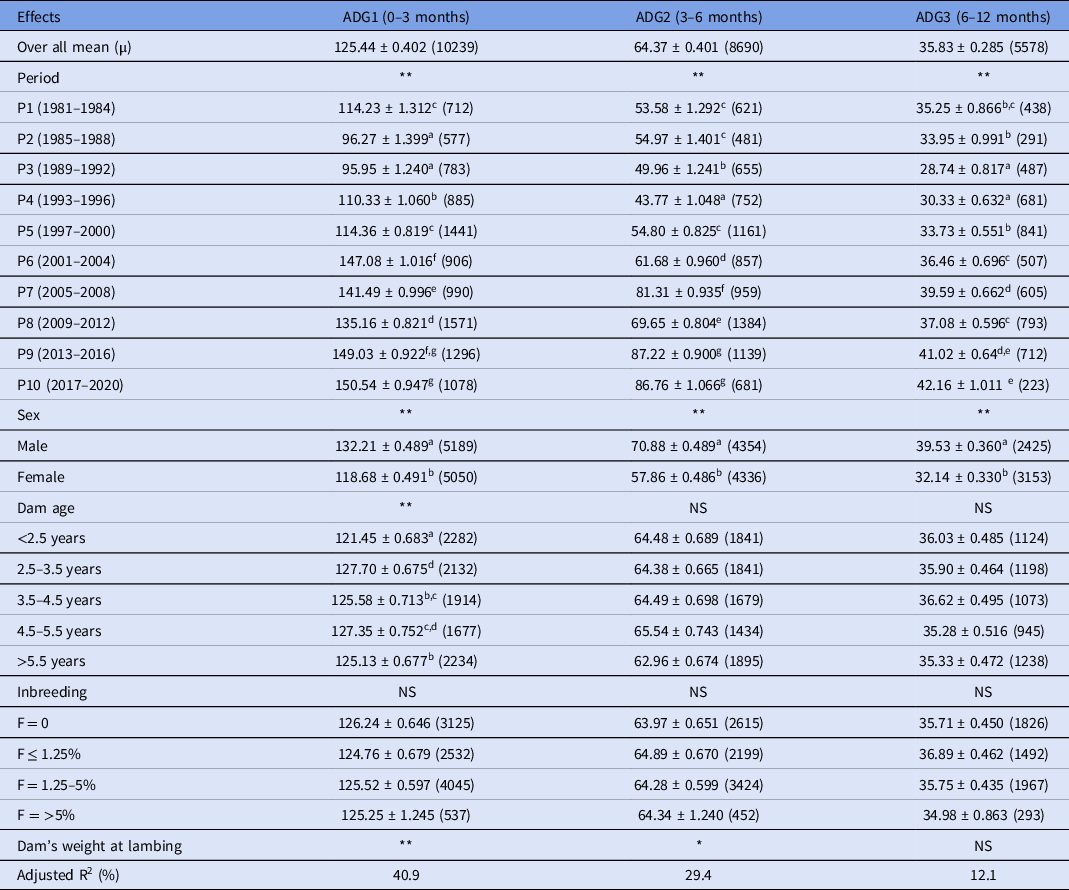
The overall LSM of average daily gain during 0–3 (ADG1), 3–6 (ADG2) and 6–12 (ADG3) months were 125.44 ± 0.402, 67.37 ± 0.401 and 35.83 ± 0.285 g/day, respectively (Table 3). At the start of the programme ADG were 114.23 ± 1.31, 53.58 ± 1.29 and 35.25 ± 0.86 g/day, respectively, and increased up to 150.54 ± 0.94, 86.76 ± 1.06 and 42.16 ± 1.01 g/day, respectively. The estimate of LSM for average daily gain indicated that the highest advancement in ADG occurred from birth to 3 months of age and then declined in subsequent periods. This is directly related to the consistent feeding of dam’s milk to newborns along with the inherent nature of the growth rate, where a sharp rise in growth occurs up to weaning. After weaning, gain in body weight relies mostly on the competition effect and grazing availability. Therefore, the decrease in ADG may also be due to competitive behaviour experienced between the individuals of the same flock for sharing resources, along with the burden of grazing in the area and progressing maturity. Mahala et al. (Reference Mahala, Saini, Kumar, Prince and Gowane2019) found similar findings for ADG1 and ADG3 in Avikalin sheep. Prince et al. (Reference Prince, Sushil, Mishra and Arora2010) found lower ADG1 estimates in Avikalin sheep and Kumari et al. (Reference Kumari, Pannu, Chopra, Buri and Prince2017) observed lower estimates for ADG2 and ADG3 in Chokla sheep. Higher observations were reported for ADG1 and ADG2 by Gowane et al. (Reference Gowane, Prakash, Chopra and Prince2013) in Bharat Merino sheep.
Effect of covariates and inbreeding levels on average daily gains in Marwari sheep

ADG1= average daily gain from birth to 3 months, ADG2 = average daily gain from 3 to 6 months, ADG3 = average daily gain from 6 to twelve months.
Number of observations are given in parenthesis.
Means within subclasses with different superscripts (a to g) are significantly (P ≤ 0.05) different from each other.
** Highly significant (P ≤ 0.01).
* Significant (P ≤ 0.05); NS- Non-significant.
Covariates appearing in the model are evaluated at the Dam’s weight at lambing = 31.89 kg for ADG1, 31.99 kg for ADG2 and 31.79 kg for ADG3.
Kleiber ratio
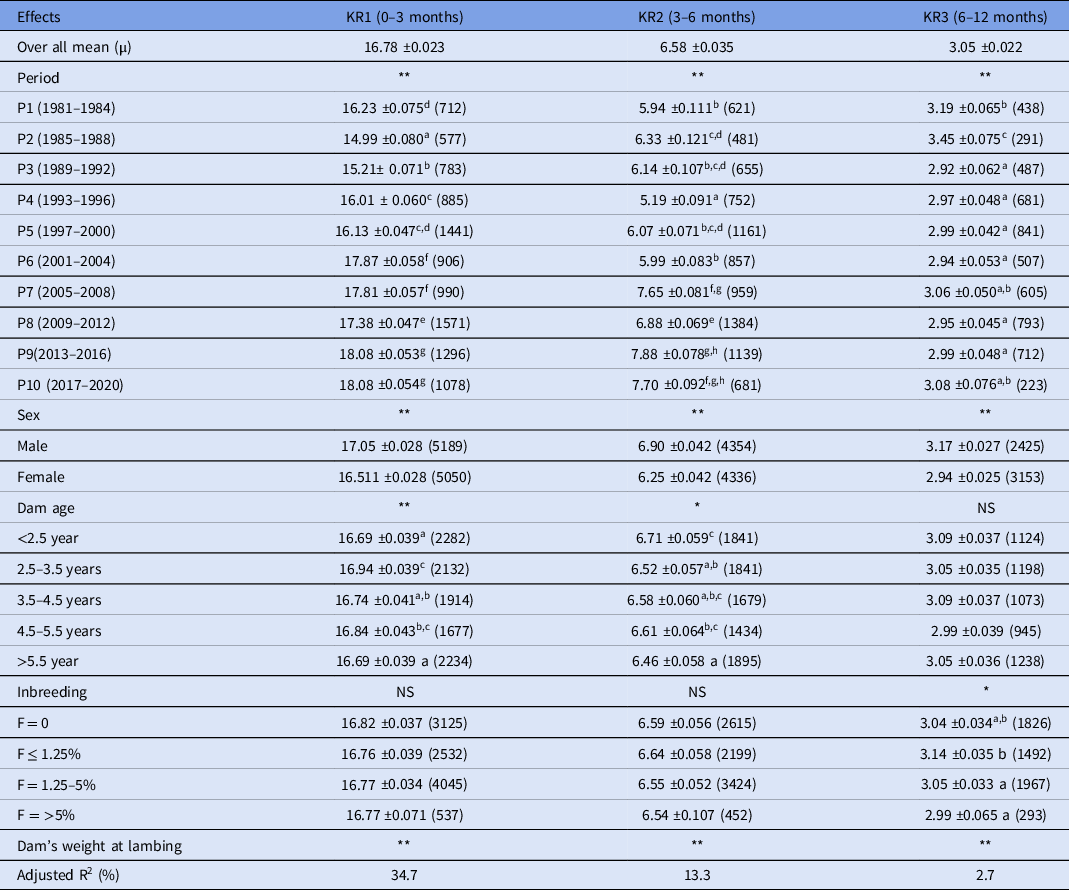
The KR measures the metabolic weight gain in animals, highlights the importance of feed transformation and is an important characteristic to be incorporated in selection programmes. The overall LSM of KR1, KR2 and KR3 were observed to be 16.78 ± 0.023, 6.58 ± 0.035 and 3.05 ± 0.022, respectively (Table 4). This proves that animals are more capable of converting food at a younger age. KR reduced as the animal became older, indicating that as animals grow older, their feed conversion efficiency weakens. Gowane et al. (Reference Gowane, Prakash, Chopra and Prince2013) and Mahala et al. (Reference Mahala, Saini, Kumar, Prince and Gowane2019) found similar findings for KR1 and KR 2 in Bharat Merino and Avikalin sheep, respectively.
Effect of covariates and inbreeding levels on Kleiber ratios in Marwari sheep

KR1 = Kleiber ratio from birth to weaning, KR2 = Kleiber ratio from weaning to 6 months, KR3 = Kleiber ratio from 6 to 12 months.
Number of observations are given in parenthesis.
Means within subclasses with different superscripts (a to h) are significantly (P≤ 0.05) different from each other.
** Highly significant (P ≤ 0.01).
* Significant (P ≤ 0.05); NS- Non-significant.
Covariates appearing in the model are evaluated at the Dam’s weight at lambing = 31.89 kg for KR1, 31.99 kg for KR2 and 31.79 kg for KR3.
Mixed model revealed a significant influence of sires and fixed covariates on growth traits
Effect of sire
The highly significant (P ≤ 0.01) effect of sires on all the pre and post-weaning traits was observed (Tables 1–4). This is true as selection for higher weight was already in practice in this nucleus and therefore the observance of this result was obvious. Superior sires can be further used efficiently for continuous increase in growth rate in the future. The major influence of sire suggests that these traits have additive genetic variation and can be utilized for selection and improvement. Similar findings were observed by Mandal et al. (Reference Mandal, Pant, Nandy, Rout and Roy2003) in Muzaffarnagari sheep, Nirban et al. (Reference Nirban, Joshi, Narula, Singh and Bhakar2015) in Marwari sheep and Khan et al. (Reference Khan, Ganai, Alam, Shanaz, Hamadani, Rather, Bukhari, Shah, Jalal and Wani2020) in Corriedale sheep.
Effect of the year of birth
The effect of the year/period of birth was highly significant (P ≤ 0.01) on all growth traits (Tables 1–4). The variation in pre-weaning body weight over the periods was due to the variation in the accessibility of nutrition directly to the lambs and indirectly to the dams. Better nourishment to the dam provided more milk to the lambs. Adequate rain in the preceding year might have provided better environmental conditions for the growth in the post-weaning period, which perhaps got better pasture/grazing. The year-wise variations indicate the abundance of pasture, better farm management strategies and other non-specific environmental conditions (Figure 1). Post-weaning growth performance continuously increased in 6MWT, 9MWT and 12MWT at 36.33, 31.50 and 29%, respectively, from the previous year, which depicts that selection and management were in the right direction. However, there was an instantaneous decrease in live weight between 1989 and 1992 due to low rain and famine in that period. The closed flock of Marwari sheep is part of the Network Project, and work is done for genetic improvement in the flock as well as to bring improvement in field flocks by providing farmers with superior germplasm. The flock was under constant selection pressure where males were strictly selected based on selection index including 6MWT and first greasy fleece yield. This programme resulted in constant improvement in performance over the period. The increasing trend of KR in Marwari lambs shows the performance of productive animals to transform feed. A highly significant effect of the period of birth was reported by Gowane et al. (Reference Gowane, Prakash, Chopra and Prince2013) in Bharat Merino sheep and Kumari et al. (Reference Kumari, Pannu, Chopra, Buri and Prince2017) in Chokla sheep for live body weight and ADG and Mahala et al. (Reference Mahala, Saini, Kumar, Prince and Gowane2019) in Avikalin sheep.
Live weight (kg) of lambs at different stages of growth during studied periods.

Effect of sex of lamb
A highly significant (P ≤ 0.01) effect of sex of lamb on all growth traits was observed (Tables 1–4). On average, the males at BWT, 3MWT, 6MWT, 9MWT and 12MWT were 0.16, 1.38, 2.56, 3.69 and 4.27 kg heavier, respectively, than female lambs (Tables 1 and 2). Males exhibit a greater growth rate and are often more effective in feed conversion than females at all phases of growth. The sex difference may be related to the anabolic action of hormones that allow them to gain weight. It showed that males grew at a faster rate and acquired more body weight at all stages of growth. Many researchers (Chopra et al., Reference Chopra, Prince, Gowane and Arora2010; Gowane et al., Reference Gowane, Prakash, Chopra and Prince2013; in Bharat Merino sheep, Kumari et al., Reference Kumari, Pannu, Chopra, Buri and Prince2017 in Chokla sheep, Mahala et al., Reference Mahala, Saini, Kumar, Prince and Gowane2019 in Avikalin sheep, Illa et al., Reference Illa, Gollamoori and Nath2020 in Nellore sheep) observed a significant effect of sex on growth traits.
Effect of dam’s age at lambing
A highly significant (P ≤ 0.01) effect of the dam’s age at lambing was seen on birth weight (Table 1), probably due to a correlation of age with uterine capacity. In the dam’s age groups, no significant increase after 4.5 years of age was observed. There was no noticeable difference in birth weight at later ages of the dam due to the cessation of growth of dams at later ages. Dam’s age at lambing was observed to be highly significant (P ≤ 0.01) for weaning weight, which can be attributed to more milk availability with experienced dams along with a strong mothering capability. It was observed that more than 4.5 year age dams gave good nourishment to their offspring and their lambs attained higher live weight at weaning age. Traits expressed in later stages (6, 9 and 12 months of age) were affected by the age of dam at lambing, indicating the carryover effect of maternal influence (Tables 1 and 2). It was observed that dams with age above 5.5 years produced comparatively weaker lambs for all growth traits under study. Similar results were observed by Kumari et al. (Reference Kumari, Pannu, Chopra, Buri and Prince2017) in Chokla sheep and Mallick et al. (Reference Mallick, Pourouchottamane, Rajapandi, Thirumaran, Venkataraman, Nagarajan, Murali and Rajendiran2017) in Bharat Merino sheep. Dam’s age at lambing was observed to be highly significant (P ≤ 0.01) on ADG1 while non-significant on ADG2 and ADG3, suggesting the maternal effect, which declines as the animal gets older (Table 3). Dam’s age at lambing was observed to be highly significant (P ≤ 0.01) for KR1, significant (P ≤ 0.05) for KR2 but non-significant for KR3 (Table 4). A significant effect of the dam’s age at early ages was observed by Gowane et al. (Reference Gowane, Prakash, Chopra and Prince2013) in Bharat Merino sheep and Gowane et al. (Reference Gowane, Chopra, Misra and Prince2014) in Malpura sheep.
Effect of dam’s weight at lambing
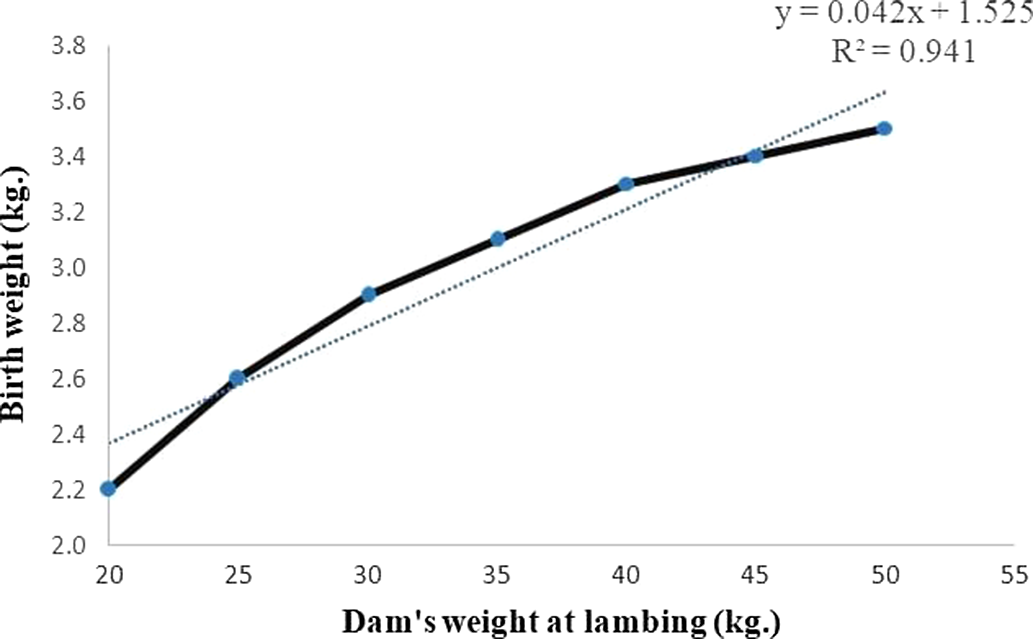
Regression of the weight of the dam at lambing was significant on birth weight (P ≤ 0.01) (Table 1). Heavier lambs were born to heavier dams, as heavier dams offered more nutrition and more uterine space for developing fetuses resulting in heavier lambs at birth. There was a rise of 4.2 g in birth weight per unit (1 kg) increase in the dam’s weight at lambing (Figure 2). The weight of the dam at lambing had a highly significant (P ≤ 0.01) influence on 3MWT, 6MWT, 9MWT and 12MWT (Tables 1 and 2). This shows that, at successive ages, the lambs delivered by heavier dams kept heavier live weights and therefore had an intrinsic propensity to grow at a higher rate. For ADG1, KR1 and KR2, the regression in weight of the dam at lambing was found to be highly significant (P ≤ 0.01) and for ADG2 it was significant (P ≤ 0.05). This implies that up to 6 months of age, the higher body weight of dams contributed to higher daily gain in lambs due to the sufficiency of the milk in the pre-weaning stage. The weight of the dam at lambing was observed to have a non-significant effect on ADG3 while highly significant (P≤ 0.01) on KR3 (Table 3 and 4). This result shows similarity with early reports across breeds (Ganesan et al., Reference Ganesan, Dhanavanthan, Balasubramanyam and Kumarasamy2013; Singh et al., Reference Singh, Pannu, Narula, Chopra, Naharwara and Bhakar2014; Lalit et al., Reference Lalit, Malik, Dalal, Dahiya, Patil and Dahiya2016; Kumari et al., Reference Kumari, Pannu, Chopra, Buri and Prince2017).
Effect of dam’s weight at lambing on birth weight of lamb.

Effect of inbreeding
In the study, non-inbred individuals, ≤1.25% Fi, 1.25–5% Fi and >5% Fi were 32.84, 23.82, 38.19 and 5.13%, respectively. The number of individuals with 1.25–5% Fi was maximum (38.19%), revealing the optimum fitness and survivability of the lambs having inbreeding of <5%. The study revealed the non-significant effect of inbreeding level on all growth traits except BWT and KR3. For BWT, inbreeding classes had variation; however a negative effect was not seen. For KR3, however, we observed that the inbreeding class (>5% Fi) reduced the KR3 by 0.06 units as against its preceding class. The adverse effect of inbreeding was not seen on live weights because scientific management and a careful mating plan were conducted using a limited number of genetically efficient sires. This is a good outcome for a breed with a long history at the Institute. The non-significant effect of inbreeding on growth performance was observed in Malpura sheep by Arora et al. (Reference Arora, Mishra, Gowane and Prince2009) and Gowane et al. (Reference Gowane, Chopra, Misra and Prince2014), in Bharat Merino by Gowane et al. (Reference Gowane, Prakash, Chopra and Prince2013) and in Nellore sheep by Illa et al. (Reference Illa, Gollamoori and Nath2020). However, Mandal et al. (Reference Mandal, Pant, Rout, Singh and Roy2002) in Muzaffarnagari sheep, Mackinnon (Reference Mackinnon2003) in Crossbred Sheep, Pedrosa et al. (Reference Pedrosa, Santana, Oliveira, Eler and Ferraz2010) in Santa Inês sheep, Jafari (Reference Jafari2014) in Makooei sheep observed a significant effect of inbreeding on growth performance.
In conclusion, Marwari sheep have been preferred for improved growth and fleece production in the north-western arid region of Rajasthan, India. It is a proliferative breed and can be uplifted for higher productivity before it reaches the commercial age. Until the third month of age, the Marwari lambs have an increased growth performance and, therefore, the market age can be reduced further. Post-weaning growth performance is continuously increased over previous years due to selection. The long history of Marwari sheep at this farm shows better flock management, good selection policies, and no adverse effect of inbreeding on growth traits. Selecting effective feed converters at a young age is important for greater economic benefit. Environmental and management factors had a profound effect on Marwari sheep growth; as a consequence, it is paramount to thoroughly comprehend them to minimize their negative effect on lamb growth.
Acknowledgements
Authors duly acknowledge the College of Veterinary and Animal Science, Bikaner (CVAS, Bikaner) for administrative and research support and the project coordinator cell, NWPSI cum Director, ICAR-CSWRI, Avikanagar for providing facilities for carrying out the research work. In addition, we acknowledge the contributions of previous project leaders and staff of the Marwari sheep unit of ICAR-CSWRI, ARC, Bikaner for data collection, database management and recording of animals.
Disclosure statement
The authors have no conflicts of interest to declare that are relevant to the content of this article.