Certain sequences that adopt non-B DNA conformations (i.e. DNA that is not in orthodox, right-handed double helix form) are more likely to mutate leading to rare mutations; these mutations are also called as rare structural variants (RSV) Reference Wells(1). One example of such sequences with non-B DNA conformation is the long homopurine • homopyrimidine sequences; these sequences can adopt a triplex DNA structure Reference Wells(1). Interestingly, these long homopurine • homopyrimidine sequences are often found in the genes expressed in brain Reference Bacolla, Collins and Gold(2).
In a recent report in Science journal, it was observed that RSV resulted in disruption of genes in neurodevelopmental pathways and these aberrations could lead to schizophrenia Reference Walsh, McClellan and McCarthy(3). As triplex DNA has been shown to be prone for rare mutations (or RSV) Reference Wells(1), one can hypothesise that the genes disrupted by these mutations in schizophrenia Reference Walsh, McClellan and McCarthy(3) might show triplex DNA. However, this hypothesis is yet to be explored. In this letter, I present further analyses that examined the gene location map of triplex DNA sequences Reference Bacolla, Collins and Gold(2) to look for its potential association with the RSV-disrupted genes in schizophrenia Reference Walsh, McClellan and McCarthy(3).
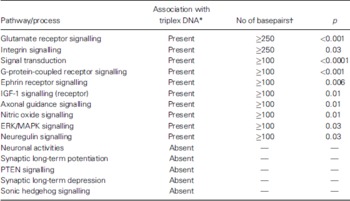
In their recent study, Walsh et al. Reference Walsh, McClellan and McCarthy(3) reported 24 genes to be disrupted by rare structural variants in schizophrenia. Of these 24 genes, 11 genes were found to be components of 15 signalling pathways/processes that are critical for neuronal cell growth, migration, proliferation, differentiation, apoptosis and synapse formation Reference Walsh, McClellan and McCarthy(3). Interestingly, in the present analyses, 10 of those 15 signalling pathways/processes [glutamate receptor signalling, integrin signalling, signal transduction, G-protein-coupled receptor signalling, ephrin receptor signalling, insulin-like growth factor-1 (IGF-1) signalling (receptor), axonal guidance signalling, nitric oxide signalling, extracellular signal-regulated kinase (ERK)/mitogen-activated protein kinase (MAPK) signalling and neuregulin signalling] are found to be associated with triplex DNA sequences Reference Bacolla, Collins and Gold(2) (Table 1). Also, 5 (ERBB4, DLG2, CAV1, GRM7 and PTK2) of the 11 RSV-disrupted schizophrenia genes that are components of signalling pathways Reference Walsh, McClellan and McCarthy(3) are also associated with triplex DNA sequences; on the contrary, none of 13 RSV-disrupted schizophrenia genes that are not components in signalling pathways show this relationship (χ2= 7.5; p= 0.006). Moreover, in the study by Walsh et al. Reference Walsh, McClellan and McCarthy(3), healthy controls also showed RSV in 12 genes. However, it is important to note that none of these 12 RSV-disrupted genes in healthy controls Reference Walsh, McClellan and McCarthy(3) is found to be associated with long homopurine • homopyrimidine sequences as examined by further analyses of the gene location map of triplex DNA sequences.
Association between the triplex DNA and the signalling pathways/processes disrupted in schizophrenia

* Association of the pathway/process with triplex DNA (long homopurine • homopyrimidine sequences) was inferred from the gene location map of triplex DNA sequences supplementary data Reference Bacolla, Collins and Gold(2)
† Number of basepairs of homopurine • homopyrimidine sequences.
To summarise, the analyses presented here show significant association of RSV-disrupted genes in schizophrenia patients with triplex DNA sequences as well as lack of such association of RSV-disrupted genes in healthy controls. This suggests a potential pathogenetic role for non-B DNA in schizophrenia. It is plausible that the high rate of mutations involving the non-B DNA sequences Reference Wells(1) might mediate this pathogenetic role. Such mutations have been described to be associated with the benefits of accelerated adaptive evolution as well as the risks secondary to acquiring deleterious mutations Reference Bacolla, Collins and Gold(2).
Interestingly, schizophrenia has been hypothesised as a ‘costly by-product’ of the evolution of human brain Reference Burns(4). Contextually, it is important to note that triplex DNA sequences are longer in humans than chimpanzees Reference Bacolla, Collins and Gold(2). As the triplex DNA is often found in the genes expressed in brain Reference Bacolla, Collins and Gold(2), it is possible that this evolutionary selection for these long sequences in humans might have contributed to the rapid evolution of human brain; and the ‘downside’ of this selection might be the heightened risk for schizophrenia in human population. Further studies need to elucidate this potential interaction between RSV and triplex DNA sequences to clarify the evolutionary basis of schizophrenia.