Introduction
Subjective cognitive impairment (SCI) is defined as a perceived deficit in cognition despite the absence of objective cognitive deficits (Montejo et al., Reference Montejo, Montenegro, Fernandez and Maestu2011; Jessen et al., Reference Jessen2014) and is frequently operationalized as self-reported memory complaints (Montejo et al., Reference Montejo, Montenegro, Fernandez and Maestu2011), perceived forgetfulness (Mol et al., Reference Mol, van Boxtel, Willems, Verhey and Jolles2009), or difficulty concentrating (i.e. attention-related complaints; Scholtissen-In de Braek et al., Reference Scholtissen-In de Braek, Hurks, van Boxtel, Dijkstra and Jolles2011). An estimated 20% to 50% of older adults report experiencing SCI, a phenomenon that becomes more prevalent as individuals age (Jonker et al., Reference Jonker, Geerlings and Schmand2000; Montejo et al., Reference Montejo, Montenegro, Fernandez and Maestu2011). SCI is of growing interest due to an aging population as well as evidence indicating that SCI precedes non-normative cognitive decline and progressive dementia for some older adults (Mitchell et al., Reference Mitchell, Kemp, Benito-León and Reuber2014). For example, Mitchell et al. (Reference Mitchell, Kemp, Benito-León and Reuber2014) found that older adults with SCI are twice as likely to develop dementia compared to individuals without SCI. SCI can negatively impact older adults’ well-being through worry about memory and forgetfulness (Mol et al., Reference Mol, van Boxtel, Willems and Jolles2006) as well as feelings of loss of control or meaning in one's life (Sims et al., Reference Sims, Whitfield, Ayotte, Gamaldo, Edwards and Allaire2011; Steinberg et al., Reference Steinberg2013), reduced activity engagement (Trouton et al., Reference Trouton, Stewart and Prince2006), increased affective symptoms (Hill et al., Reference Hill2016), and health or functional problems (Comijs et al., Reference Comijs, Deeg, Dik, Twisk and Jonker2002; Ogata et al., Reference Ogata, Hayashi, Sugiura and Hayakawa2015). This potentially extensive impact on the daily lives of older adults suggests that SCI may be detrimental to overall quality of life (QoL) for this group. Furthermore, lower QoL among older adults is associated with many adverse outcomes of great personal and societal significance including higher fall risk, emergency department admissions, nursing home placement, and mortality (Bilotta et al., Reference Bilotta2011).
QoL is a multidimensional concept that considers an individual's perception of their position in life relative to beliefs, goals, concerns, and expectations (The WHOQOL Group, 1998). Due to the broad nature of the conceptualization of QoL, multiple factors are considered in its measurement. These include life satisfaction (Diener and Suh, Reference Diener, Suh, Schaie and Lawton1998), well-being (Mount and Cohen, Reference Mount and Cohen1995), and the specific impact of physical health on other areas of life (i.e. health-related QoL; National Research Council, 2001). Life satisfaction captures an individual's attitudes toward and evaluation of their life and can be influenced by societal norms and lived experiences (National Research Council, 2001). Well-being encompasses positive emotions and the absence of physical limitations (Centers for Disease Control and Prevention, 2016). Health-related quality of life (HRQoL) similarly captures the impact of one's health on a wide array of physical, mental, emotional, and social factors (Office of Disease Prevention and Health Promotion, 2010).
Among older adults, the measurement and consideration of QoL can be more complex. The presence of chronic illness and comorbidity that often accompany aging, for example, may negatively impact HRQoL while other aspects of QoL such as life satisfaction are maintained (Baernholdt et al., Reference Baernholdt, Hinton, Yan, Rose and Mattos2012). In high-income, English-speaking countries, older adults overall tend to report higher well-being than middle-aged adults; however, those with chronic illnesses have increased affective symptoms and decreased well-being (Steptoe et al., Reference Steptoe, Deaton and Stone2015). Multiple studies examining the concept of QoL among older adults specifically have identified certain aspects of QoL beyond physical functioning that are important in this population: psychological well-being, leisure activities, social relationships, independence, autonomy, and mental functioning (e.g. Bowling et al., Reference Bowling, Seetai, Morris and Ebrahim2007; Gobbens and van Assen, Reference Gobbens and van Assen2014).
A long-standing challenge when generating a systematic review of the literature on the concept of QoL is the inconsistent conceptualization and operationalization of this construct (cf. Zhan, Reference Zhan1992; Fayers and Machin, Reference Fayers and Machin2013). QoL is frequently conceptualized with a certain definition, yet operationalized using measures that are only loosely linked to the proposed conceptualization. For instance, researchers purporting to measure well-being may only use an instrument that measures life satisfaction (e.g. Requena et al., Reference Requena, Lopez and Ortiz2009). Relatedly, a conceptualization may not be completely operationalized. An example of this would be when well-being is used as a construct but only includes instruments that measure the psychological and social aspects of well-being, leaving out the physical aspects (e.g. Seidel et al., Reference Seidel, Andrews, Owen, Miller and Buccino2017). A final challenge is lack of consensus on the critical factors underlying QoL. For instance, HRQoL can be defined as relating to physical, mental, and emotional factors without the inclusion of social factors (e.g. Kim et al., Reference Kim, Im and Choi2016). To create the most comprehensive review of the QoL literature, we chose to examine both the conceptual definitions and operationalization of QoL in the SCI literature.
Current evidence regarding the association of SCI on QoL has not been systematically examined, evaluated, and synthesized. In their decade-old qualitative review, Mol et al. (Reference Mol, Carpay, Ramakers, Rozendaal, Verhey and Jolles2007) identified a relationship between the presence of SCI and lower QoL among older adults; however, the literature at the time was limited to only five studies. Therefore, the purpose of the current review is to advance understanding of the SCI–QoL relationship based on all currently available evidence, a comprehensive conceptualization of QoL, as well as utilization of rigorous search, evaluative, and synthesis methods to determine the current state of the science.
Methods
This systematic literature review was guided by The Preferred Reporting Items for Systematic Reviews and Meta-Analyses (Moher et al., Reference Moher, Liberati, Tetzlaff and Altman2009) to aid in creating a narrative synthesis of the study findings.
Search strategy and selection criteria
A systematic literature search was conducted in CINAHL, PsycINFO, and PubMed in December 2016. Reference lists were also searched to identify any additional relevant articles. The following search terms were utilized and entered individually into each database: subjective cognitive, subjective memory, cognitive complaints, memory complaints, cognitive concerns, memory concerns, cognitive difficulties, memory difficulties, cognitive failures, memory failures, and perceived forgetfulness. To capture all potentially applicable articles, no publication date limits were included in the literature search. Articles had to meet the following inclusion criteria for this review: (1) a measure of SCI; (2) a measure of QoL, life satisfaction, or well-being; (3) available in English; and(4) sample or subsample aged 50 years or older. Only peer-reviewed reports of primary research were included in this review. Samples could include cognitively impaired subgroups; however, a subgroup analysis for individuals with SCI only was required to be deemed eligible. Studies were excluded that examined SCI among individuals with a specific condition (e.g. schizophrenia) or receiving a specific treatment (e.g. chemotherapy). In addition, experimental or quasi-experimental studies were not included in this review.
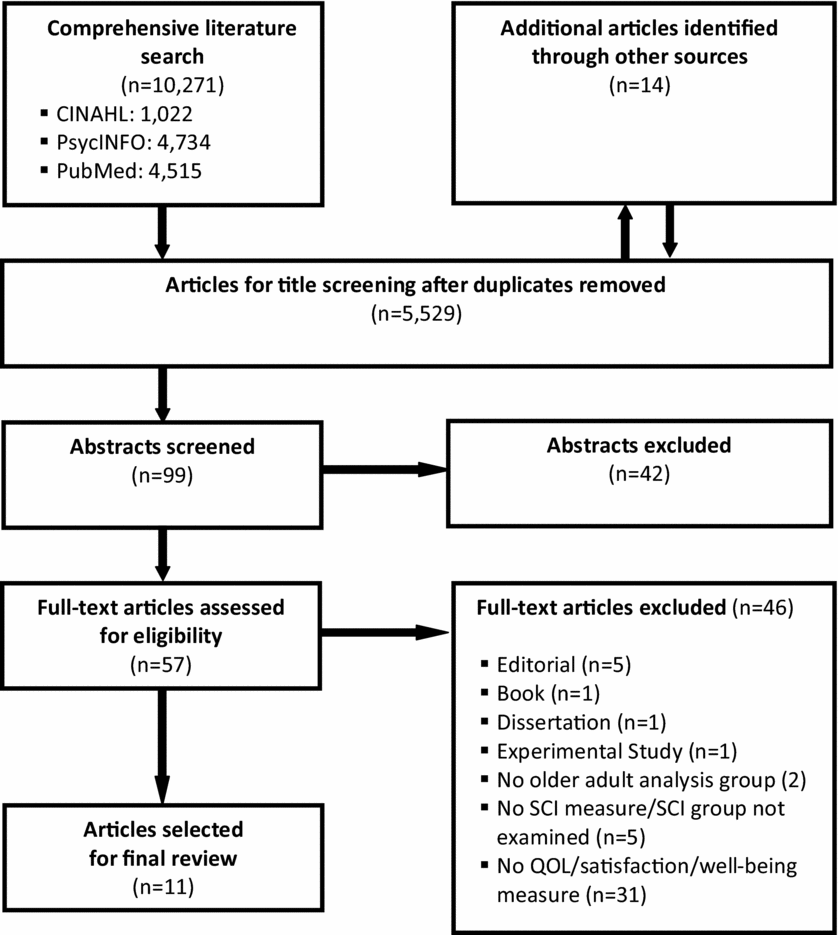
All authors worked independently to assess titles, abstracts, and full-text articles at each review stage to determine eligibility; each article was reviewed by two authors at each stage of the process. Any disagreement was discussed and if a consensus could not be reached, a third reviewer was consulted. After duplicates were removed, 5,529 articles were screened for selection criteria. Article abstracts were then evaluated, resulting in the review of 57 full-text articles. Ultimately, 11 studies were considered appropriate for this review based on inclusion and exclusion criteria. Figure 1 identifies rationales for article exclusion. Information extracted from each article included study purpose, design, sample, measures, results, study limitations, and conclusions.
PRISMA Flowchart.

Appraisal of evidence
The weight of evidence (WoE) framework was used to appraise the quality and relevance of each eligible article (Gough, Reference Gough2007). The WoE framework is useful because it provides appraisal criteria that researchers can tailor to meet the goal of their literature review whereas typical quality appraisal guidelines assess the quality of the evidence without accommodation for the aim of a particular review. For the purposes of this review, the WoE framework was used to evaluate methodological quality (WoE A), methodological relevance (WoE B), and topic relevance (WoE C). For each category, the potential ratings (low, medium, or high) were assigned in accordance with the WoE framework criteria (Table 1). Two authors (NH and CM) independently evaluated the quality of all articles meeting eligibility criteria with an interrater agreement of 90% (agreement on 30/33 WoE ratings). Any inconsistencies or disagreements were resolved through discussion, with a third reviewer (JM) bringing the group to consensus, as needed.
Weight of evidence framework

Notes: Weight of Evidence Framework outlines the criteria used to evaluate the eligible literature (Gough, Reference Gough2007). QoL = quality of life; SCI = subjective cognitive impairment; WoE = Weight of Evidence.
Results
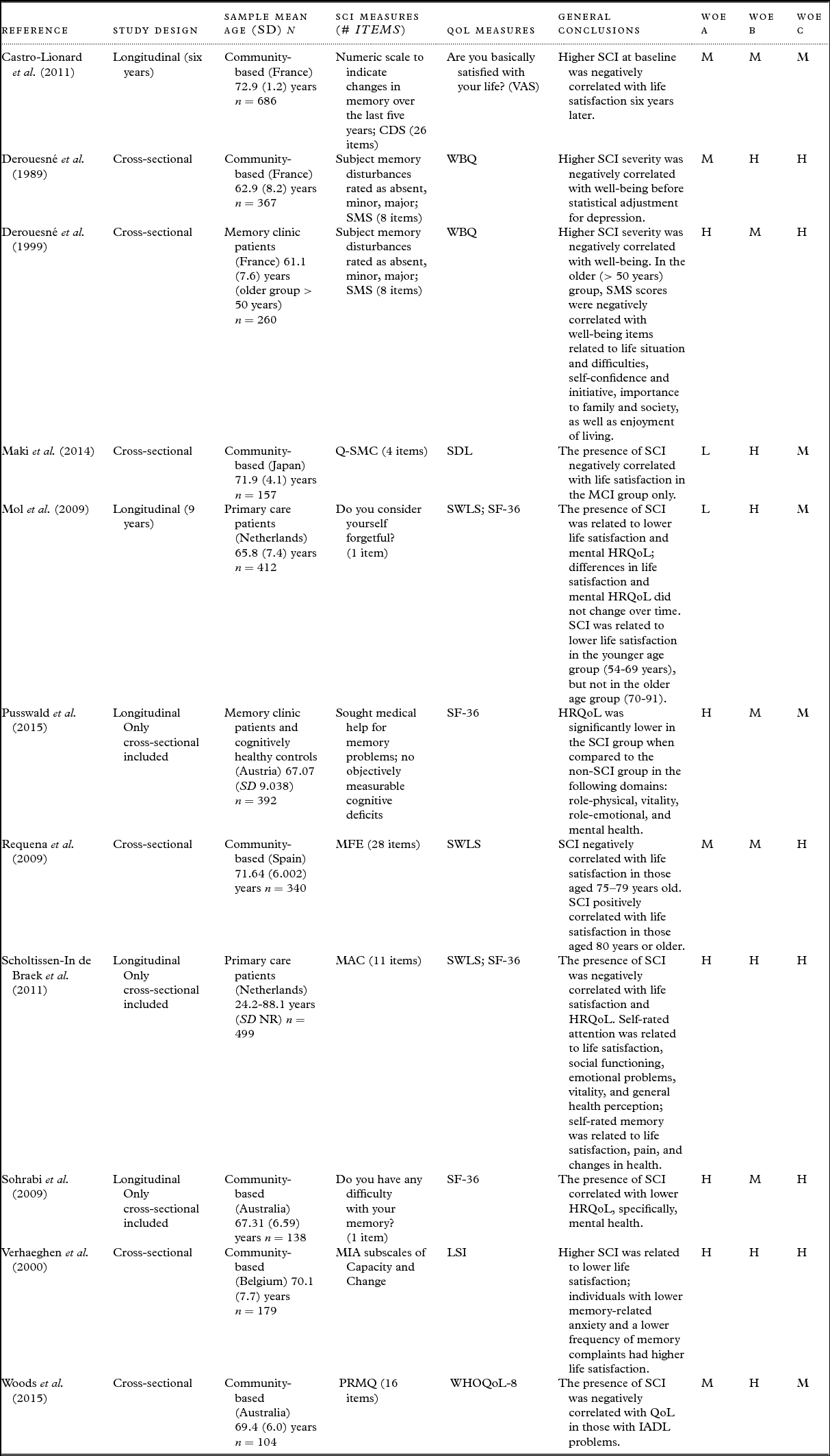
Given the variety of conceptualizations of QoL across the 11 articles, synthesis of results was conducted based on conceptual definitions (i.e. life satisfaction, overall well-being, HRQoL/QoL measure). When a study examined multiple QoL-related outcomes, results were synthesized for each relevant category. Details regarding each study are described in Table 2. Overall, WoE A ratings (reflecting Methodological Quality) ranged from low to high and WoE B (reflecting Methodological Relevance to the current review) as well as WoE C (reflecting Topic Relevance to the current review) ratings were either medium or high. Sample sizes ranged from 104 to 686, participants were recruited from community settings (seven studies), memory clinics (two studies), or primary care settings (two studies), and were from seven different countries (Australia, Austria, Belgium, France, Japan, the Netherlands, and Spain).
Summary of articles included in review

Notes: This table summarizes data synthesis of eligible articles. CDS = Cognitive Difficulties Scale; HRQoL = health-related quality of life; IADL = instrumental activities of daily living; LSI = Life Satisfaction Index; MAC = Maastricht Attention and Memory Checklist; MCI = mild cognitive impairment; MFE = Memory Failures Everyday; MIA = Metamemory in Adulthood Questionnaire; PRMQ = Prospective and Retrospective Memory Questionnaire; QoL = quality of life; Q-SMC = Questionnaire for Subjective Memory Complaint; SCI = subjective cognitive impairment; SDL = Satisfaction in Daily Life Questionnaire; SF-36 = Short-Form Health Survey; SMS = Subjective Memory Scale; SWLS = Satisfaction with Life Scale; VAS = Visual Analogue Scale; WBQ = Well-Being Questionnaire; WHOQoL-8 = World Health Organization Quality of Life Scale; WoE = weight of evidence.
SCI measures
The reviewed studies employed a variety of methods for operationalizing SCI. About half of the reviewed studies (55%, n = 6) included a measure assessing frequency of current memory problems. The next most common procedure was assessing the presence of memory problems (n = 4). Two of these studies used single items about difficulty with memory or forgetfulness (Mol et al., Reference Mol, van Boxtel, Willems, Verhey and Jolles2009; Sohrabi et al., Reference Sohrabi2009), one used help-seeking for memory problems (Pusswald et al., Reference Pusswald2015), and the last used a scale that includes a series of yes/no items about possible memory problems (Requena et al., Reference Requena, Lopez and Ortiz2009). Next, three studies operationalized SCI by severity of memory problems (Derouesné et al., Reference Derouesné1989, Reference Derouesné, Lacomblez, Thibault and Leponcin1999; Scholtissen-In de Braek et al., Reference Scholtissen-In de Braek, Hurks, van Boxtel, Dijkstra and Jolles2011). Finally, two studies operationalized SCI with questions about change in memory functioning. Specifically, Castro-Lionard and colleagues (Reference Castro-Lionard2011) used a single item measure of change over the past five years while Verhaeghan et al. (Reference Verhaeghen, Geraerts and Marcoen2000) included a subscale from a standard questionnaire on memory.
Life satisfaction
Six studies examined the relationship between SCI and life satisfaction. Methodological quality (WoE A) reflected the full range from low to high scores, and samples included either community-based or primary care patients (no memory clinic samples were represented). Four studies used the Satisfaction with Life Scale (Diener et al., Reference Diener, Emmons, Larsen and Griffin1985), one used the Life Satisfaction Index (Neugarten et al., Reference Neugarten, Havighurst and Tobin1961), and one used a single item [i.e. “Are you basically satisfied with your life?;” Castro-Lionhard et al., Reference Castro-Lionard2011].
With two exceptions (Mol et al., Reference Mol, van Boxtel, Willems, Verhey and Jolles2009; Requena et al., Reference Requena, Lopez and Ortiz2009), SCI was consistently associated with lower life satisfaction when measured cross-sectionally (Verhaeghen et al., Reference Verhaeghen, Geraerts and Marcoen2000; Mol et al., Reference Mol, van Boxtel, Willems, Verhey and Jolles2009; Castro-Lionhard et al., Reference Castro-Lionard2011; Scholtissen-In de Braek et al., Reference Scholtissen-In de Braek, Hurks, van Boxtel, Dijkstra and Jolles2011; Maki et al., Reference Maki2014). Requena et al. (Reference Requena, Lopez and Ortiz2009) found that the presence of SCI was associated with lower life satisfaction in those aged 75–79 years old, but with higher life satisfaction in individuals aged 80 years or older. Similarly, Mol et al. (Reference Mol, van Boxtel, Willems, Verhey and Jolles2009) found that the presence of SCI was related to lower life satisfaction in individuals aged 54–69 years, but not in those aged 70–91 years. Longitudinal evidence regarding the influence of SCI on life satisfaction was limited. Castro-Lionard et al. (Reference Castro-Lionard2011) found that higher SCI was associated with lower life satisfaction at baseline, and these higher SCI scores predicted lower life satisfaction six years later even though memory complaints did not increase over that time period. Mol et al. examined SCI and life satisfaction at baseline, and at three, six, and nine year intervals. Individuals with SCI had lower life satisfaction at baseline, and the differences between SCI and non-SCI groups did not change over time. That is, compared to individuals without SCI, individuals with SCI did not experience greater decreases in life satisfaction over time.
Two studies in this group were rated high across all WoE framework components (Verhaegan et al., Reference Verhaeghen, Geraerts and Marcoen2000; Scholtissen-In de Braek et al., Reference Scholtissen-In de Braek, Hurks, van Boxtel, Dijkstra and Jolles2011). In addition to providing the highest quality of evidence relevant to this review, both studies had findings that reflect a nuanced relationship between SCI and life satisfaction. Scholtissen-In de Braek et al. (Reference Scholtissen-In de Braek, Hurks, van Boxtel, Dijkstra and Jolles2011) examined SCI in the form of attention as well as memory complaints. Although attention-related complaints were significantly associated with lower life satisfaction, memory complaints were significantly associated with both lower life satisfaction and poorer HRQoL. Verhaeghen et al. (Reference Verhaeghen, Geraerts and Marcoen2000) found that higher levels of SCI were related to lower life satisfaction, and furthermore, people with lower memory-related anxiety as well as lower frequency of memory complaints scored higher in life satisfaction.
Well-being
Two studies examined the relationship between SCI and well-being (Derouesné et al., Reference Derouesné1989, Reference Derouesné, Lacomblez, Thibault and Leponcin1999). Both were cross-sectional; one of high (Derouesné et al., Reference Derouesné, Lacomblez, Thibault and Leponcin1999) and one of medium (Derouesné et al., Reference Derouesné1989) methodological quality (WoE A). In both studies, the Well-Being Questionnaire (Derouesné et al., Reference Derouesné1989) was used and the severity of SCI was assessed rather than its presence or absence only. The earlier study (Derouesné et al., Reference Derouesné1989) found that higher SCI severity was related to lower well-being in a community-based sample. However, depression was the factor most strongly associated with the severity of SCI, and after statistical adjustment for depression, well-being was no longer significantly related to SCI severity. Using the same measures but in a memory clinic sample, Derouesné et al. (Reference Derouesné, Lacomblez, Thibault and Leponcin1999) found that higher severity of SCI was associated with lower well-being in both younger (< 50 years) and older (> 50 years) age groups. However, correlations among SCI questionnaire items and well-being differed in the two age groups: in younger adults, an item related to importance to friends; and in older adults, items related to difficulties of living, ambition, importance to family, and importance to society. SCI items associated with well-being in both age groups included those related to current state of living, self-confidence, and enjoyment in life.
HRQoL/QoL
Five studies examined the relationship between SCI and HRQoL (n = 4) or QoL (n = 1). Methodological quality (WoE A) reflected the full range from low to high scores and samples included community-based, primary care, and memory clinic patients. Four studies used the Short-Form Health Survey (SF-36; Ware and Sherbourne, Reference Ware and Sherbourne1992) and one used the World Health Organization Quality of Life Scale (Schmidt et al., Reference Schmidt, Mühlan and Power2006).
Across four studies using the same measure (SF-36), HRQoL was significantly lower in individuals with SCI in the following domains: physical functioning (Pusswald et al., Reference Pusswald2015), social functioning (Scholtissen-In de Braek et al., Reference Scholtissen-In de Braek, Hurks, van Boxtel, Dijkstra and Jolles2011), vitality (Scholtissen-In de Braek et al., Reference Scholtissen-In de Braek, Hurks, van Boxtel, Dijkstra and Jolles2011; Pusswald et al., Reference Pusswald2015), and mental health (Mol et al., Reference Mol, van Boxtel, Willems, Verhey and Jolles2009; Sohrabi et al., Reference Sohrabi2009; Scholtissen-In de Braek et al., Reference Scholtissen-In de Braek, Hurks, van Boxtel, Dijkstra and Jolles2011; Pusswald et al., Reference Pusswald2015). Scholtissen-In de Braek et al. (Reference Scholtissen-In de Braek, Hurks, van Boxtel, Dijkstra and Jolles2011) considered attention-related versus memory-related complaints: attention-related SCI was associated with greater problems in social functioning, emotional problems, mental health, vitality, and health perceptions but memory-related SCI was associated with greater pain and general declines in health. Findings from Woods et al. (Reference Woods, Weinborn, Li, Hodgson, Ng and Bucks2015) were similar in that the presence of SCI was associated with lower QoL (measured with the World Health Organization QoL Scale), but this was only true among individuals with at least one limitation in instrumental activities of daily living.
Discussion
This review examined SCI and QoL in older adults. The majority of studies found that the presence, greater frequency, or greater severity of SCI is associated with lower QoL (including life satisfaction, well-being, and HRQoL); these findings were generally consistent across studies regardless of methodological quality rating, sample characteristics (e.g. geographic location, clinical vs. community settings), study design (e.g. cross-sectional vs. longitudinal), and different measures of SCI or QoL domains. However, this review also identified key aspects of the current literature that should be considered in more detail. Specifically, (1) current measurement of QoL in examinations of cognitive perceptions as well as the implications of SCI assessment itself, (2) SCI-related concepts that may be important contributors to QoL, and (3) potential differences in the impact of SCI on QoL depending on age warrant further consideration. Each of these are discussed in more detail below.
Our review examined QoL based on different categories of operational definitions of the construct (i.e. life satisfaction, well-being, HRQoL/QoL) in order to support synthesis of results across studies. However, we found that there was often a mismatch between conceptual and operational definitions. For example, Castro-Lionard (Reference Castro-Lionard2011) aimed to examine successful aging and included well-being as one relevant measure, but well-being was operationalized with a life satisfaction item: “Are you basically satisfied with your life?” Similarly, Maki et al. (Reference Maki2014) sought to evaluate the impact of memory complaints on overall QoL, but included only a life satisfaction measure. Consistent conceptual and operational definitions are needed to best understand the negative correlations found between SCI and aspects of QoL. The QoL measure used most frequently across studies, the SF-36, was considered a measure of HRQoL in our review, regardless of the conceptual definitions provided by the authors. The SF-36 is best described as a patient-reported survey of health that assesses limitations or disability in a variety of categories (Ware and Sherbourne, Reference Ware and Sherbourne1992), but is also commonly used as a QoL measure more broadly. Considering the potential overlap among SCI and affective symptoms such as anxiety about possible memory loss (c.f. Hill et al., Reference Hill2016), and the consistent findings in our review regarding the associations between SCI and the SF-36 domain of mental health or emotional problems, certain aspects of QoL may be driving the associations identified in the current evidence. However, the disconnect between conceptualization and operationalization of this construct hinders the ability to make claims about which aspect is most at risk.
Like QoL, an important facet that contributes to the evaluation of studies in this review is the way in which SCI is measured. There is a lack of consistency spanning SCI assessment which makes it particularly difficult to compare study findings (Jessen et al., Reference Jessen2014). Conceptualizations of SCI include changes in memory functioning within a certain time frame (e.g. Castro-Lionard et al., Reference Castro-Lionard2011), frequency of current problems (without reference to previous functioning; e.g. Mol et al., Reference Mol, van Boxtel, Willems, Verhey and Jolles2009), or simple presence or absence of problems (e.g. Maki et al., Reference Maki2014). Operationalization of the SCI construct then also lacks coherence. Questionnaires used in studies of SCI range from single binary response items (e.g. Do you have any difficulty with your memory?) to ratings of ability or concern using standardized scales (e.g. Metamemory in Adulthood). Rabin and colleagues (2015) reviewed the literature on SCI measurement and identified over 500 different items that had been used in previous work. As described for QoL above, the variability in conceptualization and operationalization of SCI presented a challenge to the current literature review and we chose to use a broad range of terms for SCI in order to capture more literature relating SCI to QoL. Although most of the measures focused on perceptions of memory performance, there were two additional components that were evaluated alongside memory: attention complaints (e.g. difficulty concentrating; Scholtissen-In de Braek et al., Reference Scholtissen-In de Braek, Hurks, van Boxtel, Dijkstra and Jolles2011) and memory-related anxiety (e.g. getting flustered when put on the spot to remember; Verhaeghen et al., Reference Verhaeghen, Geraerts and Marcoen2000). Attention complaints were related to vitality, emotions, and social function, compared to memory complaints which were related to pain and changes in health (Scholtissen-In de Braek et al., Reference Scholtissen-In de Braek, Hurks, van Boxtel, Dijkstra and Jolles2011). Additionally, older adults with lower memory-related anxiety reported greater life satisfaction (Verhaeghen et al., Reference Verhaeghen, Geraerts and Marcoen2000).
Taken together, the findings in this review imply that unique aspects of the SCI experience, including those outside of the subjective memory realm, are important considerations for QoL. Sohrabi et al. (Reference Sohrabi2009) suggest the SCI–QoL relationship may be mediated by depression, anxiety, and personality such that adaptation to perceived cognitive problems lead to behavioral, cognitive, or affective changes which prompt self-evaluation and ultimately negatively impact QoL. Intriguingly, Woods et al. (Reference Woods, Weinborn, Li, Hodgson, Ng and Bucks2015) found that SCI was associated with lower QoL only among older adults with one or more problems with activities of daily living. This could be, in part, due to the dependency of QoL on intermediary factors in one's life and the presence of functional problems that make issues with SCI more apparent, thus influencing QoL (Wilson and Cleary, Reference Wilson and Cleary1995). Although much remains to be examined regarding the pathways by which SCI negatively impacts QoL in older adults, our review identifies several important areas worthy of future investigation.
This review did identify a few instances of differences in the impact of SCI based on the age range of older adult participants. Requena et al. (Reference Requena, Lopez and Ortiz2009) found an association between SCI and lower life satisfaction in those 75 to 79 years old, but this trend reversed in the older group (> 80 years). Similarly, Mol et al. (Reference Mol, van Boxtel, Willems, Verhey and Jolles2009) reported that among individuals aged 54 to 69 the presence of SCI was related to lower life satisfaction; however, there was no correlation in individuals aged 70 to 91. These findings may be due to older individuals’ tendency to overestimate cognitive abilities or to accept SCI as a part of the aging process, and thus not perceive a significant impact of SCI their daily life (Mograbi et al., Reference Mograbi, Brown and Morris2009). Another explanation for this could be selective survival effects in the older age groups (Zajacova and Burgard, Reference Zajacova and Burgard2013). Those adults most able to participate in a study over the age of 70 may be healthier and more functional compared with those under the age of 70. Additionally, given these selective survival effects, QoL may be more closely tied to loss of functional ability due to health conditions rather than perceptions of cognitive functioning in older age groups.
A common theme underlying the disparate conceptualizations of QoL is adequate levels of functioning across a variety of domains. This becomes increasingly important as older adults experience health-related issues as well as age-normative societal transitions (e.g. retirement). Identifying the variables that contribute to QoL in older adults is necessary to define successful aging, of which preserved life satisfaction and maintenance of physical and psychological functioning are key elements (Schulz and Heckhausen, Reference Schulz and Heckhausen1996). If concerns about memory and perceptions of memory problems are contributing to decrements in QoL, professionals could implement interventions that support memory functioning and create downstream effects such as improving QoL more generally. Additionally, development of age-friendly environments can include support for memory and cognitive functioning to preserve QoL (Wahl et al., Reference Wahl, Iwarsson and Oswald2012). The relationships highlighted in this review demonstrate the need for supporting cognition in older adults.
Although SCI and QoL are important concepts in aging, the literature bringing them together is relatively sparse and focuses primarily on cross-sectional relationships. Only two studies in the current review examined longitudinal change and change-based associations among SCI and QoL. Future research is needed to understand how and when perceptions of cognitive difficulties impact QoL. It is possible that as older adults adapt to newly perceived cognitive problems, QoL is restored. However, this remains an open question.
Another limitation that continues to plague the SCI literature is the overlap of SCI with other important constructs such as depression, anxiety, and functional limitations. The development of consistent and comprehensive measures that reduce bias in SCI assessment is greatly needed (Hill et al., Reference Hill2016). The assessments in this review represent a variety of measurement strategies and as such, could be a potential factor in understanding the impact of SCI on QoL. For example, although frequency of cognitive problems provides a more nuanced rating compared with presence/absence measures, change in functioning over a short period of time may have the greatest impact on QoL. Future research should focus on capturing the multifaceted nature of SCI to bring coherence to the current literature and an understanding of the impact of SCI and its widespread implications for practice and research.
A final limitation of this review is the variety of samples included. Samples drawn from clinical settings may limit the generalizability of the results depending on the observed complaint, and memory clinic samples will likely have memory complaints as well as affective symptoms associated with those complaints. Future work should aim to include community-based samples to enhance the generalizability of results and account for differences due to bias in clinic-only samples.
Conclusion
QoL is an important indicator of preserved functioning in older adults. Identifying those factors that most contribute to decrements in QoL would provide avenues for researchers and clinicians to develop interventions that better support adults as they age. The current review highlights the role of perceived problems with cognition as one of these factors. The consistent negative relationship between SCI and QoL suggests a need for further work addressing the mechanisms underlying this association.
Conflict of interest
None.
Description of authors’ roles
N. Hill conceptualized the paper, led team efforts in the literature review and evaluation, and assisted in writing and editing the final product. C. McDermott provided critical review and evaluation of the literature and assisted in writing and editing the manuscript. J. Mogle conceptualized the paper with N. Hill, reviewed and evaluated the literature, and provided essential editing to the manuscript. E. Munoz, N. DePasquale, and R. Wion assisted in writing and editing the manuscript and provided essential review and evaluation of the literature. E. Whitaker assisted in manuscript editing, literature review, and organization of data.