INTRODUCTION
One of the central issues in the evolution of life histories in insects is the mechanism behind variation in voltinism (Taylor and Spalding, Reference Taylor and Spalding1988). Abiotic and biological factors, like food or natural enemies, are known to influence the number of generations of insects per year (voltinism) (Masaki, Reference Masaki1980; Tauber et al. Reference Tauber, Tauber and Masaki1986). These animals have evolved to use developmental mechanisms, particularly diapause, to synchronize their life cycles with seasonal changes in resource availability and climatic conditions suitable for their development, growth and reproduction. Diapause is a form of dormancy influenced both by genetic and environmental factors. It enables insects to survive unfavourable conditions, to synchronize their active stages with resource availability and to disperse and colonize new habitats efficiently (Tauber et al. Reference Tauber, Tauber and Masaki1986; Danks, Reference Danks1987, Reference Danks1992; Soula and Menu, Reference Soula and Menu2003; Kostal, Reference Kostal2006). In insects, diapause is governed by reliable environmental signs preceding seasonal changes (Tauber et al. Reference Tauber, Tauber and Masaki1986). Duration of the seasons influences the diapause period, which may range between days and months, or even years. Therefore, the number of generations per year varies. In habitats with long favourable periods and high resource availability, some species can shorten the cycle, develop fast with short diapauses, and give rise to a generation within days (Campbell and Mackauer, Reference Campbell and Mackauer1975; Tillman and Powell, Reference Tillman and Powell1991; Sabelis and Janssen, Reference Sabelis, Janssen and Houck1994). These are multivoltine species. In regions with short seasons and where the resources are not always available, multiple generations do not occur and many species are strictly univoltine (Danks and Foottit, Reference Danks and Foottit1989; Danks, Reference Danks2002).
In many parasitic insect species, life-cycle duration varies within the population (Tauber and Tauber, Reference Tauber and Tauber1981; Danks, Reference Danks1987, Reference Danks1992; Menu et al. Reference Menu, Roebuck and Viala2000). In animals with facultative diapause, dynamic temporal risk spreading and adaptive developmental plasticity (Stearns, Reference Stearns1976) appear to have evolved to regulate diapause frequency and duration in response to uncertain environments (Bradford and Roff, Reference Bradford and Roff1993; Soula and Menu, Reference Soula and Menu2003). Thus, a single genotype may produce multiple phenotypes, some of which enter diapause whereas others continue to develop and produce offspring (Hopper, Reference Hopper1999; He et al. 2010). Whereas the variation of voltinism over a geographical range as a result of local adaptation has been widely described in insects (Tauber et al. Reference Tauber, Tauber and Masaki1986; Danks, Reference Danks1987), the phenotypic plasticity of voltinism in a local population has been seldom reported and is poorly understood (He et al. 2010).
Carnus hemapterus Nitzsch (1818) is a generalist parasite whose entire cycle, including diapause, takes place in its host's nest. It parasitizes a wide range of bird species whose phenology varies considerably (Grimaldi, Reference Grimaldi1997). A degree of synchronicity has been recorded between the appearance of the host and its parasite's emergence (Liker et al. Reference Liker, Markus, Vozár, Zemankovics and Rózsa2001; Valera et al. Reference Valera, Casas-Crivillé and Hoi2003). It has therefore been assumed that some environmental signs must exist to regulate such synchronicity. Still poorly-known, the plasticity of Carnus diapause seems to be remarkable: (i) 3 different types of diapause have been described, namely a short diapause (Guiguen et al. Reference Guiguen, Launay and Beaucournu1983), a winter diapause to resist the adverse environmental conditions and food shortage (Guiguen et al. Reference Guiguen, Launay and Beaucournu1983; Grimaldi, Reference Grimaldi1997), and a long diapause that may prolong itself for years (Valera et al. Reference Valera, Casas-Crivillé and Calero-Torralbo2006); (ii) experiments have proved that temperature changes at the end of the diapause influence the emergence phenology of the parasite, which ultimately means some plasticity in diapause termination in Carnus (Calero-Torralbo and Valera, Reference Calero-Torralbo and Valera2008).
This paper examines variation in voltinism in a local population of Carnus hemapterus in southern Spain. Resident bird species at temperate latitudes like ours start breeding early in the season and usually produce several clutches. These species usually co-exist with migrant bird species, which start breeding later and, therefore, produce a single brood. The starting hypothesis is that the length of the breeding season of bird species (i.e. Carnus' hosts) influences diapause duration and that the co-occurrence of various host species with different breeding phenology foster the co-existence of various life-cycle strategies (multi- vs univoltinism). Flies which parasitize early breeding, multi-brooded bird species are expected to undergo short diapause and to be multivoltine, while flies which parasitize late breeding, single-brooded bird species, like trans-Saharan migrants, are expected to undergo long diapause and to be univoltine. To this end, we studied the emergence phenology of adult flies in nests of a bird species with an early reproductive cycle as a model of a multi-brooded species, the Spotless starling (Sturnus unicolor), and also in nests of a bird species with a late reproductive cycle as a model of a single-brooded species, the European roller (Coracias garrulus).
MATERIALS AND METHODS
Study area and species
The main study area (∼50 km2) lies in the Desert of Tabernas (Almería, SE Spain, 37°05′ N, 2°21′ W). The climate in this area is semi-arid with high annual and seasonal rainfall variability (mean annual rainfall ca. 218 mm), and strong thermal oscillations with inter-annual differences. Summers are long and hot and winters are usually mild.
Carnus hemapterus (Nitzsch 1818, Phylum Arthropoda, Class Insecta, Order Diptera, Family Carnidae) (hereafter Carnus) is a 2 mm long, highly mobile ectoparasitic fly that colonizes nestling birds (Grimaldi, Reference Grimaldi1997). It has a wide geographical distribution and parasitizes a variety of host species, although it shows some preference for birds nesting in holes (troglodytic species) (Dawson and Bortolotti, Reference Dawson and Bortolotti1997; Grimaldi, Reference Grimaldi1997). Adult flies have a winged and wingless phase. After their emergence, adults are initially winged, but lose their wings as soon as they locate a suitable host (Roulin, Reference Roulin1998). Carnid flies do not need a host for transmission because they actively colonize hosts’ nests during the winged phase of their life cycle (Grimaldi, Reference Grimaldi1997). Once emerged, the imagines can survive for slightly less than 3 days without feeding. Carnid flies complete their cycle in their hosts’ nests. Adults mate in the nest, lay eggs which hatch approximately 5 days later, and the larvae live on the organic matter in the nest (Capelle and Whitworth, Reference Capelle and Whitworth1973; Papp, Reference Papp1998). The 3 larval stages last 21 days (Guiguen et al. Reference Guiguen, Launay and Beaucournu1983) and pupation takes place in the nest. During the pupal stage, Carnus undergoes a diapause that usually lasts for months. Carnus emergence is usually synchronized with the occurrence of the host (i.e. hatching) and persists continuously throughout the whole nestling period (Roulin, Reference Roulin1998; Liker et al. Reference Liker, Markus, Vozár, Zemankovics and Rózsa2001; Valera et al. Reference Valera, Casas-Crivillé and Hoi2003; Calero-Torralbo and Valera, Reference Calero-Torralbo and Valera2008). Guiguen et al. (Reference Guiguen, Launay and Beaucournu1983) described a short, 8-day diapause in spring in laboratory conditions, and Valera et al. (Reference Valera, Casas-Crivillé and Calero-Torralbo2006) recorded a prolonged diapause that may last for years.
In southern Spain, the Spotless starling Sturnus unicolor and the European roller Coracias garrulus are common avian breeders. These species readily use nest boxes and are commonly parasitized by Carnus (Liker et al. Reference Liker, Markus, Vozár, Zemankovics and Rózsa2001; Václav et al. Reference Václav, Valera and Martínez2010). The Spotless starling is a resident species in the Iberian Peninsula. The breeding period begins in early March and some pairs in our study area have a second clutch at the end of May. Incubation lasts for approximately 10 or 15 days, from the last laid egg until the first hatched egg (Peris, Reference Peris1984). European rollers are migratory birds that arrive at breeding grounds when resident and secondary cavity-nesting birds are already settled. Rollers rear a single brood per year (Cramp, Reference Cramp1998). In our population incubation lasts for approximately 21 days and nestling rollers fledge about 20–22 days after hatching (R. Václav, unpublished data). European rollers are the latest breeders in our study area, with the tardiest nestlings remaining in the nest until as late as the third week of July.
Experimental approach
The number of generations per year and the existence of a short diapause in C. hemapterus can only be established based on the emergence of flies in newly occupied nests. The emergence of flies after year-long diapauses can thus be discarded. Alternatively, the emergence of Carnus can be studied in used nests after due disinsecting. Our approach is based on the study of the emergence of carnid flies from diapausing pupae collected from first and second Starling broods and single Roller broods performed in previously disinsected nest boxes.
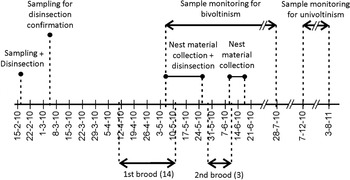
Twenty-four out of 55 nest boxes deployed in our study area as a result of several projects were selected in 2010. Some of them had been used by European rollers. The nest boxes were disinsected with a 10 ml/L solution of Arpon® (cipermetrine) on 17 and 18 February 2010. The solution was sprayed on the nest's inner surface to cover the material and walls and to soak the sand at the bottom of the nest. To test the efficacy of the insecticide, a sample of nest material (sand, feces and vegetal matter) was collected before spraying, from the 12 nest boxes that had been occupied the previous breeding season. The same nest boxes were sampled on 3 and 4 March, i.e. after disinfection (Fig. 1). The samples collected before and after disinfection were kept in plastic bags in the dark in a well-aerated room at the Estación Experimental de Zonas Áridas (EEZA-CSIC, Almería). The samples were checked every 3–4 days prior to collection and until fly emergence ceased (13 April 2010).
Experimental approach for determination of Carnus hemapterus life history in the multi-brooded Spotless starling. Treatment, sampling and monitoring are shown above the line and bird breeding phenology (nestling period) is depicted below the line (number of infected nests in parentheses).

The disinsected nest boxes were then made available for nesting. Fourteen out of 24 nest boxes were used by Spotless starlings and were monitored to record the occurrence of Carnus based on the appearance of fecal spots on the eggs (López-Rull et al. Reference López-Rull, Gil and Gil2007), or on insects on the chicks and in the nest. The occurrence of Carnus in these nests means that flies emerged in other nests colonized the experiment's nests. The controls showed that 10 out of these 14 nests were parasitized by Carnus. The remaining 4 nests were infected purposely with 7–20 newly emerged adult Carnus obtained from pupae from European roller nests of the previous year. These Carnus adults were added when the nestlings were still featherless, i.e. 4–7 days after the first egg hatched.
Once breeding had finished, the material of the nest boxes was collected in plastic bags i.e. between 5 and 25 May, and kept at the EEZA in replicated natural conditions (i.e. ambient temperature moderated by partial enclosure and semi-darkness). Nest boxes were disinsected again and their floors covered with fresh sand (Fig. 1). Only 3 out of the 14 nest boxes used originally were occupied again, this time in late May. Second broods in these nests were monitored and Carnus was recorded in 2 nest boxes. The nestlings of the third brood showed Carnus wounds. Again, the material of the 3 nest boxes was collected after breeding, i.e. between 9 and 17 June (Fig. 1), and then kept as described above.
All the samples were monitored every 3–4 days from collection until 28 July 2010 for any possible cases of bivoltinism. A subsample of approximately one third of the nest material was selected and controls conducted from 7 December 2010 until 3 August 2011 for fly emergence (univoltinism) (Fig. 1). The emerged insects were preserved in 70% alcohol and were later identified.
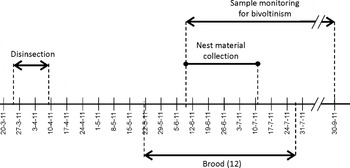
Twelve European roller clutches in previously emptied, cleaned and disinsected nest boxes (from 25 March 2011 until 6 April 2011) were monitored for bivoltinism in a late brood species during the 2011 breeding season. Sixteen to 19 days after the first egg hatched, i.e. between 9 June and 11 July, the nest material, containing both Carnus pupae and larvae in different stages of development, was sampled (Fig. 2). The material collected was kept in plastic bags as described above and monitored every 3–4 days since then until 30 September 2011. Data about the breeding phenology of rollers were obtained from 31 clutches laid in nest boxes in 2011.
Experimental approach for determination of Carnus hemapterus life history in the single-brooded European roller. Treatment, sampling and monitoring are shown above the line and bird breeding phenology (nestling period) is depicted below the line (number of infected nests in parentheses).

The samples of Spotless starling nests were sieved in November 2010 and the samples of European roller nests were sieved in October 2011 for any viable Carnus pupae. The material was sieved through 8 mm, 4 mm, 1 mm and 0·4 mm sieves, and the remains of all the sieves were rejected except those retained by the 0·4 mm sieve, where the Carnus pupae remained. Two 1 g subsamples were selected randomly from every sample, and the Carnus pupae contained in the subsamples were counted for 2 min. A distinction was made between closed and apparently intact, i.e. viable pupae, and open, i.e. emerged pupae, or broken, i.e. unviable pupae.
Statistics
Prevalence (percentage of samples where emergence is recorded with respect to the total number of samples) and abundance (the number of emerged flies per sample) of Carnus was calculated. An exact unconditional test for the comparison of 2 prevalences was used following Reiczigel et al. (Reference Reiczigel, Abonyi-Tóth and Singer2008). Statistical tests were done with the program Quantitative Parasitology 3·0 (Reiczigel and Rozsa, Reference Reiczigel and Rozsa2005). Means and standard errors are shown and tests are 2-tailed unless otherwise stated.
RESULTS
Confirmation of treatment
Disinsection resulted in 0% prevalence of Carnus in the treated subsamples compared to 33% in the untreated subsamples (4 out of 12 subsamples) (exact unconditional test, P=0·038). The untreated subsamples also contained other insects (moths, hymenoptera, coleoptera) that were not found in the treated subsamples.
The Carnus hemapterus life cycle in a multi-brooded species: the Spotless starling
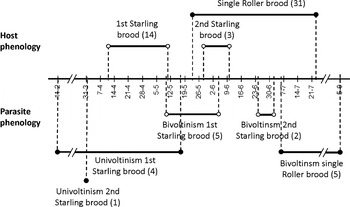
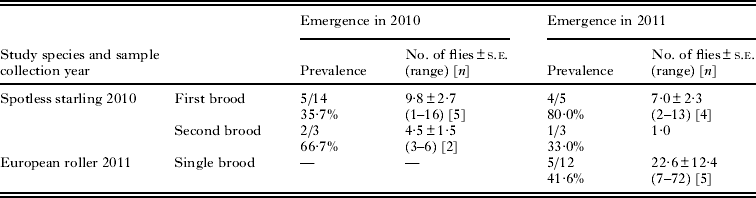
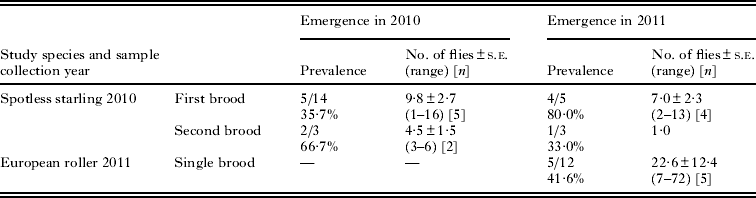
Carnus hemapterus emergence was recorded in 5 (35·7%) out of the 14 previously fumigated nest boxes where carnid flies were recorded in the first brood (Table 1). Two of these 5 samples come from the nests which had been infected purposely. The total number of flies was 49, averaging 9·8±2·7 (s.e.) flies per nest (Table 1). In these nests, emergence occurred between 10 May and 5 June, partially overlapping with hatching of the second clutches (Fig. 3). The subsequent analysis of nest material revealed open pupae in 3 more nests, some with partially emerged, dead flies. Fly emergence in these nests may therefore have occurred before sampling. In that case, the percentage of nests with bivoltine Carnus emergence would rise from 35·7% to 57·1% (8 out of 14).
Host availability (range of nestling period) in first and second starling broods and in roller broods and emergence period (range) of bivoltine and univoltine flies from starling and roller nests. White dots refer to data obtained in 2010 and black dots to data obtained in 2011. Sample size (nests) in parentheses.

Emergence of Carnus in first and second clutches of Spotless starlings during 2010 and 2011 and in European roller clutches during 2011
| Study species and sample collection year | Emergence in 2010 | Emergence in 2011 | ||||
| Prevalence | No. of flies±s.e. (range) [n] | Prevalence | No. of flies±s.e. (range) [n] | |||
| Spotless starling 2010 | First brood | 5/14 | 9·8±2·7 | 4/5 | 7·0±2·3 | |
| 35·7% | (1–16) [5] | 80·0% | (2–13) [4] | |||
| Second brood | 2/3 | 4·5±1·5 | 1/3 | 1·0 | ||
| 66·7% | (3–6) [2] | 33·0% | ||||
| European roller 2011 | Single brood | — | — | 5/12 | 22·6±12·4 | |
| 41·6% | (7–72) [5] | |||||
Three of the abovementioned 14 nests were occupied with a second clutch. In 2 nests (66·7%) carnid flies emerged in the following days (Table 1) and open pupae were also found in the third nest during sieving. The emergence period occurred between 25 June and 2 July (Fig. 3).
Material from nests sieved in the autumn of 2010 revealed closed, apparently viable pupae in 8 out of 14 samples of the first broods (including 4 of the 5 nests where emergence was recorded in spring 2010) and in the 3 samples of the second broods. Further monitoring of the samples in spring 2011 detected Carnus emergence in 5 out of the 17 samples. Specifically, 4 (80%) out of the 5 nests where emergence was recorded after the first brood yielded flies in spring 2011 (Table 1). In these nests, emergence occurred between 11 February and 17 May 2011 (the earliest starling hatch of 2010 occurring on 11 April) (Fig. 3). Fly emergence was recorded only once in the samples of the second brood, specifically on 1 April 2011. These results confirm that one and the same nest may contain both uni- and bivoltine pupae and this holds both for flies parasitizing first and second starling clutches.
The Carnus hemapterus life cycle in a single brooded species: the European roller
Carnus hemapterus emergence was recorded in 5 (41·6%) out of the 12 studied nests, averaging 22·6±12·4 flies per nest (s.e.) (Table 1). Emergence occurred between 6 July and 5 September, partially overlapping with active roller nests (9 of 31nests - 29% - had suitable nestlings for Carnus at this period) (Fig. 3). Further examination of the sieved material for pupae revealed open pupae in 6 out of the 12 sampled nests, including the 5 nests where bivoltinism was recorded. Thus, the percentage of nests with bivoltine Carnus emergence would rise to 50%. Closed, apparently viable pupae were also found in these 6 nests. Thus, rollers’ nests can contain bivoltine and non-bivoltine pupae.
Interspecific comparisons
The percentage of nests with bivoltine flies was similar for first starling broods and roller broods, both if we consider only those nests where emergence was recorded (exact unconditional test, P=1·0) and the nests where open pupae were found (P=1·0). Overall, the prevalence of bivoltine flies in starlings (first and second clutches) was similar to that registered in rollers (only nests with emerged flies: P=1·0).
DISCUSSION
Highlighting the variation in voltinism in insects and the underlying mechanisms is basic for a better understanding of the evolution of their life histories (Taylor and Spalding, Reference Taylor and Spalding1988). This paper studies voltinism in a haematophagous diptera parasitizing 2 sympatric hosts with very different breeding phenologies: an early, resident, multi-brooded species, and a migrant single-brooded species. Our results show the co-ocurrence of uni- and bivoltinism in a local population of the ectoparasitic fly Carnus hemapterus. We found evidence of bivoltinism in first and second clutches of starlings. The pupae in these nests underwent a short cycle and emerged within few days. Opportunistic observations of clutches of Hoopoes (Upupa epops) and of starling in new nest boxes also provided evidence of bivoltinism in 1 out of 3 hoopoe samples and in a Spotless starling sample (unpublished data). Evidence of bivoltinism in flies parasitizing a late breeder was also obtained; specifically bivoltine flies were found in at least 40% of European roller clutches.
Most of the specialized literature (Papp, Reference Papp1998; Grimaldi, Reference Grimaldi1997; Roulin, Reference Roulin1998) describes a winter diapause in Carnus that may prolong itself over months. However, Guiguen et al. (Reference Guiguen, Launay and Beaucournu1983) recorded a short cycle (34 days) with an 8-day diapause in laboratory conditions (22°C and 95% relative humidity throughout the insect's cycle). Our experiment was not intended as a detailed study of the duration of short diapause in Carnus. Nevertheless, our data show that the life cycle may be even shorter than that described by Guiguen et al. (Reference Guiguen, Launay and Beaucournu1983). The emergence of bivoltine adult flies in 6 out of the 7 starling samples collected in 2010 occurred between 20 and 27 days after carnid flies were first detected in the parasitized nests (mean±s.e.; 25·9±3·5, range 20–46, n=7 nests). Only in 1 nest did emergence occur after as long as 46 days. The contrast with the data of Guiguen et al. (Reference Guiguen, Launay and Beaucournu1983) may be due to the different environmental conditions that the larvae and the pupae were subject to in each case.
To our knowledge, before this study, voltinism variation in a local population has only been reported for parasitic wasps (Parrish and Davis, Reference Parrish and Davis1978; Gag and Haynes, Reference Gag and Haynes1975; He et al. 2010). We could unambiguously show that some starling nests held univoltine and bivoltine flies, both in the first and the second clutches. Moreover, the occurrence of apparent viable pupae that did not emerge after 1 year suggests that some of them could also experience prolonged diapause, which has also been reported for this species (Valera et al. Reference Valera, Casas-Crivillé and Calero-Torralbo2006). Thus, pupae with short diapause, with 1-year diapause and with prolonged diapause may co-exist in one and the same nest.
Co-occurrence of various life-cycle strategies in a local population may be a response to selective pressures associated with variation in abiotic and biotic factors and their interactions (Price et al. Reference Price, Qvarnstrom and Irwin2003; Winterhalter and Mousseau, Reference Winterhalter and Mousseau2007). In many insect species the number of produced generations increases with the length of the favourable season (Valimaki et al. Reference Valimaki, Kivela and Jaaskelainen2008; Kivelä et al. Reference Kivelä, Välimäki., Oksanen, Kaitala and Kaitala2009). Therefore, the occurrence of bivoltinism in an early, multi-brooded species like Spotless starling is not surprising. This strategy also results in remarkable host-parasite synchronization at the population level. Data from starling nests show that a fraction of the bivoltine flies from first clutches emerged at the time when nestlings had already hatched in second clutches, so flies could parasitize starlings again. Bivoltine flies from second clutches emerged too late to find starling nestlings, but they could still parasitize late breeders e.g. European rollers.
We expected a lower frequency of bivoltinism in rollers, because they are the last breeders in the study area and mistiming may have severe consequences for flies. Nonetheless, bivoltinism was common and a considerable fraction of the bivoltine flies (69·9%) emerged before 22 July when there were still roller nests with unfeathered nestlings. The remaining individuals emerged in August and September, i.e. when hosts were no longer available. Extemporaneous emergence of Carnus (i.e. out of the hosts’ breeding season) has been both reported elsewhere (Matyukhin and Krivosheina, Reference Matyukhin and Krivosheina2008) and observed by us (unpublished data), but this emergence is marginal.
Concerning univoltine flies, we also found a remarkable synchronization with the hosts’ cycle. The emergence of univoltine starling flies in 2011 occurred within the hatching period observed for starlings in 2010.
Overall, which factors regulate the length of the C. hemapterus life cycle? The period during which environmental stimuli may induce diapause is known often to be limited to specific stages of the life cycle of insects (Tauber and Tauber, Reference Tauber and Tauber1970). Rapid larval development may allow some individuals to surpass the critical diapause induction age before the key abiotic conditions reach the levels that induce long diapause. For example, the determining factor for a long or a short diapause in the butterfly Manduca sexta is the photoperiod to which the larvae are subject (Denlinger and Bradfield, Reference Denlinger and Bradfield1981). Temperature is a primary abiotic factor for the insect seasonal cycle (Hilbert et al. Reference Hilbert, Logan and Swift1985; Roff, Reference Roff1980, Reference Roff1983). It is also known to influence termination of diapause in Carnus (Calero-Torralbo and Valera, Reference Calero-Torralbo and Valera2008). Thus, temperature is likely to participate in the regulation of diapause initiation in Carnus. Although this paper does not disclose any of the conditions that may induce short diapause, such conditions appear to occur between May and July in our study species.
Cases of partial bivoltine cycles in otherwise univoltine populations that cannot be related to climatic conditions have also been reported (Sota, Reference Sota1988). Studies of such populations suggest that food limitation affects the population dynamics and that the seasonal change in food availability is a limiting factor for the bivoltine cycle (Sota, Reference Sota1988 and references therein). The wide range of Carnus hosts, with varying breeding phenologies, entails a long period of resource availability for the parasite, actually over 5 months in the study area described here. The multivoltine cycle of Carnus can therefore be made possible by prolonged host availability (e.g. Kurota and Shimada, Reference Kurota and Shimada2001) so that Carnus would produce long diapausing and short diapausing individuals according to the food prospects. A similar process has been described by He et al. (2010) for the parasitic wasp Platygaster demades: it seemingly regulates its population by entering aestivation in a proportion of individuals concordant with the expected scale of food shortage to avoid massive mortality when the future food source is expected to be short in different scales. This is more like the case of carnid flies infecting rollers than starlings, even though the percentage of bivoltinism is similar in both species.
Polymorphism in seasonal cycles is a common adaptation that can reduce the probability of extinction in unpredictable habitats and that allows populations to exploit seasonally variable habitats (Tauber and Tauber, Reference Tauber, Tauber and Masaki1986). Schlichting and Pigliucci (Reference Schlichting and Pigliucci1998) pointed out that there are 3 evolutionary mechanisms to produce phenotypic variation within populations in differing environments: phenotypic plasticity, genetic variation (polymorphism with regard to diapause characteristics), and risk-spreading strategy. The phenotypic plasticity of voltinism in local populations is still poorly understood and has been reported rarely (He et al. 2010). In contrast, some genetic polymorphism and/or a risk-spreading strategy are considered as a reason for over-wintering stage variation within populations in insects (Takafuji and Morimoto, Reference Takafuji and Morimoto1983; Tyshchenko and Kind, Reference Tyshchenko and Kind1983; Gerber, Reference Gerber1984). These strategies are very common in inactive stages of insects and give them the possibility to survive, diversify and adapt to stochastic conditions (Menu and Debouzie, Reference Menu and Debouzie1993; Menu, Reference Menu1993; Danforth, Reference Danforth1999; Menu and Desouhant, Reference Menu and Desouhant2002).
In this study we did not control the origin of flies and, therefore, we cannot highlight the mechanisms producing intrapopulational variation in life cycles (nor was that our aim). The evidence of multiple immigrants colonizing single nests suggests that parasite genotypes within nests are mixed, so that flies genetically predisposed to be univoltine could co-exist with multivoltine-coded flies. In any case, the polymorphic life cycle of Carnus may have major effects both on the parasite and its host. Bivoltinism would allow Carnus to exploit successfully the time frame of resource availability during the breeding season by granting access to early breeders (e.g. resident species like starlings or hoopoes), resident species with a somewhat later phenology (Common kestrels Falco tinnuculus, Little owls Athene noctua) and late breeding trans-Saharan migrants (European rollers, Bee-eaters Merops apiaster). As to the host, the emergence of several generations of Carnus means a higher risk of parasitization (e.g. multi-brood species may be parasitized by Carnus throughout the breeding season). In turn, this may influence the host's strategies to avoid this pressure, e.g. by nest site selection, nest cleaning behaviour or development of strategies to increase the asynchrony between the parasite's cycle and the host's cycle. Our results also have implications at a practical level: the co-occurrence of univoltinism, bivoltinism and delayed voltinism in this species will make it difficult to distinguish individual generations, so population studies may become difficult. Thus, the length of the life cycle and emergence cannot be predicted easily and population control is probably ineffective in the absence of detailed information on the insects’ stage and/or favourable conditions for the development of a short or long cycle.
This paper does not identify the conditions that may favour the induction of short diapause. Prolonged host availability and a range of nests where the parasite may thrive offer a wide range of environmental conditions that may favour a plastic response (Via, Reference Via1992; Scheiner, Reference Scheiner1993). Thus, experimental research based on precise knowledge of the natural conditions that Carnus larvae and pupae are subject to in spring, may disclose the factors governing diapause onset and termination in this species.
ACKNOWLEDGEMENTS
We thank M.A. Calero-Torralbo for his assistance during fieldwork and for constructive comments, and Manuel Martín-Vivaldi for sharing unpublished information with us. During the elaboration of this paper the authors received financial support from the SAS-CSIC bilateral program (Ref. 2007SK0006), and the Programa de Incentivos de Carácter Científico y Técnico de la Junta de Andalucía (2/2008). F.V. also received financial support from the Spanish Ministry of Science and Innovation (CGL2008-00562) and the European Regional Development Fund. M.A-V. was funded by the program JAE-Predoc run by the CSIC and co-financed by the European Social Fund.