Introduction
Cognitive deficits are a core feature of schizophrenia and an important predictor of functional outcome (Bowie et al., Reference Bowie, Reichenberg, Patterson, Heaton and Harvey2006; Strassnig et al., Reference Strassnig, Raykov, O'Gorman, Bowie, Sabbag, Durand, Patterson, Pinkham, Penn and Harvey2015). It has even been suggested that schizophrenia is primarily a cognitive disorder rather than a psychotic illness (Insel, Reference Insel2010; Kahn and Keefe, Reference Kahn and Keefe2013). Already in the early stages of schizophrenia, cognitive deficits are present. These deficits are global and may be particularly prominent in processing speed, attention, and memory (for a review, see: Mesholam-Gately et al., Reference Mesholam-Gately, Giuliano, Goff, Faraone and Seidman2009). Deficits in encoding information for later processing may underlie the cognitive deficits in memory and attention (Hartman et al., Reference Hartman, Steketee, Silva, Lanning and McCann2003; Dickinson et al., Reference Dickinson, Ramsey and Gold2007; Andersen et al., Reference Andersen, Fagerlund, Rasmussen, Ebdrup, Aggernaes, Gade, Oranje and Glenthoj2013). While little is known about the underlying mechanisms that are associated with cognitive impairments, event-related potentials (ERPs) may offer this insight because of their associations with cognition, whereas in addition their neural basis is extensively studied.
One of the most investigated ERPs in relation to schizophrenia is the P300 amplitude (for a review, see: Jeon and Polich, Reference Jeon and Polich2003; Bramon et al., Reference Bramon, Rabe-Hesketh, Sham, Murray and Frangou2004; Turetsky et al., Reference Turetsky, Calkins, Light, Olincy, Radant and Swerdlow2007). While other ERPs (Mismatch Negativity, N1 and N400) are also widely studied in schizophrenia, only P300 amplitude has shown to be most consistently reduced in the early course of schizophrenia (Duncan et al., Reference Duncan, Barry, Connolly, Fischer, Michie, Näätänen, Polich, Reinvang and van Petten2009). The P300 amplitude reflects processes of attention, and is usually subdivided into an early component, the P3a amplitude, reflecting an involuntary shift in attention toward a deviant stimulus, and a later component, the P3b amplitude, reflecting the amount of attention that is directed toward a stimulus; both components are associated with memory operations (Polich, Reference Polich2007). More specifically, Jeon and Polich (Reference Jeon and Polich2003) stated that the P3 amplitudes can be viewed as brain activity stemming from tasks that require working memory (WM; see also Donchin, Reference Donchin1981) proportional to the amount of attentional resources allocated to a task (see also Kramer and Strayer, Reference Kramer and Strayer1988). It is therefore believed that P3a and P3b amplitudes underlie the processes of attention and WM (Donchin, Reference Donchin1981; Polich, Reference Polich2007).
In chronic stages of schizophrenia, lower P3a and P3b amplitudes have been found compared with healthy subjects (Jeon and Polich, Reference Jeon and Polich2003). Only limited research has been conducted on P3a and P3b amplitudes in first-episode schizophrenia (FES). Nevertheless, the limited available data consistently show a reduction of P3b amplitude in FES (Salisbury et al., Reference Salisbury, Shenton, Sherwood, Fischer, Yurgelun-Todd, Tohen and McCarley1998; Devrim-Üҫok et al., Reference Devrim-Üҫok, Keskin-Ergen and Üҫok2006; Oranje et al., Reference Oranje, Aggernaes, Rasmussen, Ebdrup and Glenthøj2017). In contrast, it is still debated if the P3a amplitude is also reduced in FES compared with healthy controls (HC): Some studies report a reduction in its amplitude (Valkonen-Korhonen et al., Reference Valkonen-Korhonen, Purhonen, Tarkka, Sipilä, Partanen, Karhu and Lehtonen2003; Mondragón-Maya et al., Reference Mondragón-Maya, Solís-Vivanco, León-Ortiz, Rodríquez-Agudelo, Yánez-Téllez, Bernal-Hernández, Cadenhead and de la Fuente-Sandoval2013), whereas other studies report P3a amplitudes similar to those of HC (Devrim-Üҫok et al., Reference Devrim-Üҫok, Keskin-Ergen and Üҫok2006; Atkinson et al., Reference Atkinson, Michie and Schall2012). Only a few studies to date have investigated P3a and P3b amplitudes in the same FES subjects, showing reductions in both P3a and P3b amplitudes (del Re et al., Reference del Re, Spencer, Oribe, Mesholam-Gately, Goldstein, Shenton, Petryshen, Seidman, McCarley and Niznikiewicz2015; Morales-Muñoz et al., Reference Morales-Muñoz, Jurado-Barba, Fernández-Guinea, Álvarez-Alonso, Rodríquez-Jiménez, Jiménez-Arriero and Rubio2017). The results of most of these FES studies might have been influenced by antipsychotic medication: A meta-regression analysis from Bramon et al. (Reference Bramon, Rabe-Hesketh, Sham, Murray and Frangou2004) showed that P3b amplitude was significantly more reduced in medicated compared with non-medicated patients with schizophrenia.
While several studies report a positive association between P3b amplitude and WM and attentional capacity in healthy subjects (Johnson, Reference Johnson1995; Portin et al., Reference Portin, Kovola, Polo-Kantola, Revonsuo, Müller and Matikainen2000; see also: Kok, Reference Kok2001), there is only limited information about this relationship in schizophrenia (Dichter et al., Reference Dichter, van der Stelt, Laube Boch and Belger2006; Young et al., Reference Young, Bismark, Sun, Zhang, McIlwain, Grootendorst and Light2017). Dichter et al. (Reference Dichter, van der Stelt, Laube Boch and Belger2006), for example, have found a positive correlation between executive functioning and P3 amplitudes. To our knowledge, there is only one study that focused on the relationship between cognitive deficits and P3a and P3b amplitude deficits in FES patients (Morales-Muñoz et al., Reference Morales-Muñoz, Jurado-Barba, Fernández-Guinea, Álvarez-Alonso, Rodríquez-Jiménez, Jiménez-Arriero and Rubio2017). That study reported a small but significant negative correlation between P3a and P3b amplitudes and a vigilance task. However, they only included medicated patients, which may have influenced their results.
In the current study, psychophysiological and cognitive measures from a large sample of antipsychotic-naïve FES patients (AN-FES) were examined and compared with age- and gender-matched HC. Based on the above described literature, we expected that both P3a and P3b amplitudes would be significantly reduced in AN-FES patients compared with controls. Similarly, we expected that AN-FES subjects would score lower in our cognitive battery compared with the HC. Furthermore, we expected to find associations between P3a and tasks that require more simple processing such as reaction time, whereas we expected associations between P3b and tasks that require more advanced processing such as WM and/or executive functioning and that these patterns are more visible in AN-FES than in HC.
Methods
Subjects
This study was conducted combining data from two larger longitudinal multimodal studies on initially AN-FES patients. A large array of study variables including electroencephalography (EEG) and cognition were assessed in both projects. Part of the current data has already been published in separate papers of these two projects (Andersen et al., Reference Andersen, Fagerlund, Rasmussen, Ebdrup, Aggernaes, Gade, Oranje and Glenthoj2013; Düring et al., Reference Düring, Glenthøj, Andersen and Oranje2014; Bak et al., Reference Bak, Ebdrup, Oranje, Fagerlund, Jensen, Düring, Nielsen, Glenthøj and Hansen2017; Oranje et al., Reference Oranje, Aggernaes, Rasmussen, Ebdrup and Glenthøj2017); in the current study, we combined the psychophysiological and neuropsychological data from the baseline assessments of both projects. Only patients and HC with both available psychophysiological and cognitive datasets were included in the present analyses: 73 AN-FES patients and 95 HC matched on age, gender, and parental socioeconomic status (SES; see Table 1). The projects were approved by the ethical committee of the capital region Copenhagen (Registration: HD-2008-088 and H-KF-01-78/97) according to the ethical principles and guidelines for medical research as stated in the Declaration of Helsinki (amendment of Washington 2002). Written and oral information was provided to each participant, after which written informed consent was obtained. Psychophysiology measures and cognitive measures were both assessed on separate test days, with no more than 5 days between both measurements.
Demographical and clinical characteristics of the included antipsychotic-naïve first-episode patients and healthy controls

* Significant at p < 0.05.
a 1 = high SES, 2 = medium SES, 3 = low SES.
b Years of education information was only available for one or the cohorts: N = 45 for AN = FES; N = 51 for HC.
c N = 72.
The patients were referred from psychiatric facilities in the capital region of Copenhagen, and completed the Schedule of Clinical Assessment (SCAN; Wing et al., Reference Wing, Babor, Brugha, Burke, Cooper, Giel, Jablenski, Regier and Sartorius1990) version 2.1 to confirm their schizophrenia diagnosis; all included patients met both the International Classification of Diseases, 10th Edition (ICD-10) as well as Diagnostic and Statistical Manual of Mental Disorders, Fourth Edition (DSM-IV) criteria for schizophrenia. The PANSS interview (positive and negative syndrome scale; Kay et al., Reference Kay, Opler and Lindenmayer1988) was assessed in order to determine the severity of psychopathological symptoms. Exclusion criteria were previous impact-related unconsciousness, organic brain damage or disease, intellectual disability (IQ < 70) diseases or processes contraindicated with amisulpride or quetiapine treatment (e.g. allergy, prolactin producing tumor), and coercive measures. Substance use and abuse were not exclusion criteria, but their extent and type were registered.
The HC subjects were recruited through the online platform of http://www.forsoegsperson.dk. They could only participate when they met the criteria of no previous or current mental health issues or serious somatic illnesses (confirmed by the SCAN, version 2.1 interview), had a history of alcohol- and/or drug abuse, and if they had no history of first-degree relatives with mental health disorders.
Psychophysiology
Selective attention paradigm
The selective attention paradigm is part of the Copenhagen Psychophysiological Test Battery (CPTB; described in more detail in Oranje et al., Reference Oranje, Jensen, Wienberg and Glenthoj2008); it is always assessed last, since other tests may be influenced by the attention that should be allocated to its stimuli. The CPTB battery took approximately 75 min to complete. The exact procedure has been described previously (Oranje et al., Reference Oranje, Aggernaes, Rasmussen, Ebdrup and Glenthøj2017). In short, our selective attention paradigm consisted of 400 stimuli that were presented binaurally in a semi-random fashion (equally distributed over the ears) to the subject. Stimuli were presented by a computer running Presentation® (Neurobehavioral Systems Inc., Albany, CA, USA). Two types of stimuli were presented: standard tones (1000 Hz) which appeared 80% of the time and deviant tones (1200 Hz) which appeared 20% of the time. Duration and intensity of both stimuli were 50 ms and 75 dB, respectively, while the inter-stimulus intervals were randomized between 700 and 900 ms. Subjects were instructed to push a button as quickly as possible if the deviant tone was perceived in the previously designated ear. Next, the paradigm was repeated, with the request to monitor the other ear for deviant stimuli. The total duration of the selective attention paradigm was 14 min.
Smoking was not allowed 1 h prior to testing to avoid acute and/or withdrawal effects of nicotine. In addition, all subjects were requested not to drink any caffeinated beverages on the test day until all tests were completed. Use of benzodiazepines was allowed until 11 pm on the day preceding a test day.
Signal recording
EEG recordings were performed with BioSemi hardware (Amsterdam, The Netherlands) using a cap with 64 active electrodes. Only data from the electrodes relevant for the present study were analyzed, i.e. where the maximum amplitude for the ERPs was found: midline electrodes Cz (P3a) and Pz (P3b), see below. For data on other sites, see online Supplementary material.
BESA software (version 5.2.4, MEGIS Software GmbH, Gräfelfing, Germany) was used for further processing of the data. First, data were resampled from the originally recorded 4–250 Hz, to allow easier file handling. Second, the data were corrected for eye artifacts using the adaptive method of BESA. Third, the data were epoched (from 100 ms pre-stimulus to 900 ms post-stimulus) and corrected for movement (or other unrelated paradigm) artifacts, by removing those epochs from the database that contained amplitude differences exceeding 75 µV between maximum and minimum in a time window between 0 and 700 ms of these epochs (this window was chosen because of its relevance for scoring, see below). The data were band-pass filtered (0.5–40 Hz), collapsed over both ears, and averaged. Averaging was done separately for the four different trial types [attended standards, attended deviants (=targets), non-attended standards, and non-attended deviants]. P3a and P3b amplitudes were scored in the therefore relevant trial types, i.e. the non-attended deviant trials for P3a and the attended deviant trials (targets) for P3b amplitude. The grand averages showed that maximum P3a amplitude was reached at electrode Cz, within a time window of 130–275 ms post-stimulus, whereas maximum P3b amplitude was reached at electrode Pz within a time window of 250-600 ms post-stimulus.
Cognition
A comprehensive cognitive test battery was administered in a fixed order by an experienced neuropsychologist. In total, the cognitive tests took approximately 2.5 h to complete. The cognitive tests have been described previously (Andersen et al., Reference Andersen, Fagerlund, Rasmussen, Ebdrup, Aggernaes, Gade, Oranje and Glenthoj2013; Bak et al., Reference Bak, Ebdrup, Oranje, Fagerlund, Jensen, Düring, Nielsen, Glenthøj and Hansen2017). In short, WM, attention, and executive functions were assessed using tests from the computerized Cambridge Neuropsychological Test Automated Battery (CANTAB, Lowe and Rabbitt, Reference Lowe and Rabbitt1998; Sahakian and Owen, Reference Sahakian and Owen1992):
Spatial span (SSP) measures the visuospatial WM span. The outcome measure was the longest sequence successfully recalled by the participant.
Spatial working memory (SWM) measures the ability to retain spatial information and to manipulate this in WM. The outcome measure was a strategy score that was obtained by counting the number of times the participant began a new search. A higher number represents poorer use of strategy.
Stockings of Cambridge (SOC) measures the spatial planning and WM. The outcome measure was the number of problems solved with the minimal number of moves.
Intra–extra-dimensional set shifting (IED) measures the visual discrimination, attentional set formation, maintenance, shifting, and flexibility of attention. Outcome measures were the number of stages completed, total errors made (adjusted for stages not completed), and errors made in the extra-dimensional stage (all participants reached this level of the task).
Reaction time (RTI) measures the subjects’ speed of response to a visual target where the response may be predictable (simple reaction time) or unpredictable (choice reaction). Outcome measures were simple reaction time, simple movement time, five-choice reaction time, and five-choice movement time.
Rapid visual information processing (RVP) is a measure of sustained attention and processing speed. The outcome measure was the signal detection measure A’ (detecting and responding to the target while not responding to non-targets) for both the simple version (3-5-7) and the more complex version (3-5-7; 2-4-6).
Statistics
All statistical analyses were performed with SPSS version 22 (Statistical Package for Social Sciences; IBM, USA). Differences in demographical characteristics of the patient and control groups were examined with independent sample t tests and Pearson's χ2 tests. Kolmogorov–Smirnov tests were used to test the distribution of the data and appropriate tests were used accordingly. Substance use was included as a covariate, however, when not statistically significant substance use was removed from the analyses.
Group differences in P3a and P3b amplitudes and latency were analyzed with independent sample t tests. Pearson correlations were performed to assess association between PANSS scores and P3a and P3b amplitudes. Furthermore, Mann–Whitney U tests were performed to assess group differences in cognitive measures. Last, Spearman correlation tests were performed to explore the associations between P3a and P3b amplitudes and the cognitive tests for both groups (HC and AN-FES patients) combined as well as for the groups separately. Effect sizes are reported in Cohen's d.
Results
Demographics
The statistical tests showed that matching for age, gender, and parental SES was successful: neither significant differences in age (p = 0.793), gender (χ2 = 0.06, p = 0.803), or parental SES (χ2 = 1.58, p = 0.453) were found (see also Table 1). Similarly, substance use did not reach statistical significance in any of our analyses. Two HC were excluded due to a P3b amplitude >3 s.d. above average P3b amplitude. Patients and HC did differ in years of education [F (1,94) = 24.70, p < 0.001], where patients had fewer years of education (x̄ = 12.21, s.d. = 2.42) compared with the HC (x̄ = 14.80, s.d. = 2.67).
Psychophysiology
Figures 1 and 2 show the grand average waveform of P3a and P3b amplitudes, respectively. A significant difference in P3a amplitude between the two groups was found [t (163.41) = −2.02, p = 0.045, d = 0.31], indicating a higher amplitude in the control group (x̄ = 5.07, s.e.m. = 0.287) than in the patient group (x̄ = 4.32, s.e.m. = 0.24).
Grand average waveform of P3a amplitude for patients (gray) and healthy controls (black), showing a significantly reduced P3a amplitude for patients, compared with controls (p = 0.045).

Grand average waveform P3b amplitude for patients (grey) and healthy controls (black), showing a significantly reduced P3b amplitude for patients, compared with controls (p = 0.034).

Similarly, a significant group difference was found in P3b amplitude, [t (164) = −2.14, p = 0.034, d = 0.33], indicating a higher P3b amplitude in the control group (x̄ = 8.09, s.e.m. = 0.34) than in the patient group (x̄ = 7.00, s.e.m. = 0.38). For information on the other leads, we refer to the online Supplementary material.
A significant P3a latency difference was found [t (164) = −3.73, p < 0.001] indicating a longer latency for the control group (x̄ = 215.05, s.e.m. = 3.03) compared with the patient group (x̄ = 197.86, s.e.m. = 3.48). P3b latency was not significantly different between the two groups [t (132.04) = 0.61, p = 0.527; AN-FES: x̄ = 372.38, s.e.m. = 7.05; HC: x̄ = 367.14, s.e.m. = 4.80].
Furthermore, there were no significant correlations between PANSS scores and P3a and P3b amplitudes (p > 0.17).
Cognition
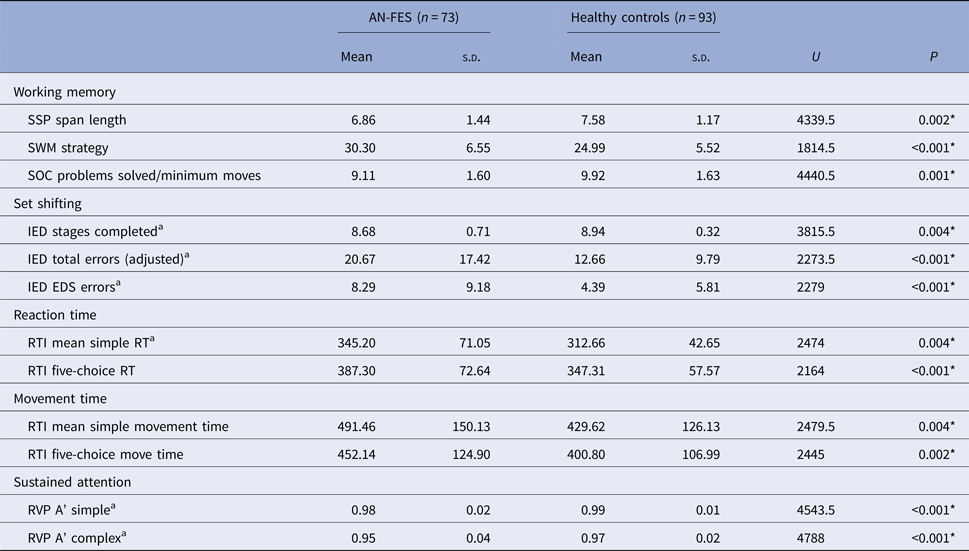
Similar to the amplitudes recorded in the electrophysiological paradigm, also the results of the Mann–Whitney U tests showed significant group differences on all cognitive tests (see Table 2).
Cognitive performance of AN-FES and HC on the individual cognitive tests

SSP, spatial span; SWM, spatial working memory; SOC, stockings of Cambridge; IED, intra–extra-dimensional set shifting; EDS, extra-dimensional stage; RTI, reaction time; RVP, rapid visual information processing.
* Significant at p < 0.05.
a AN-FES n = 72.
Correlations
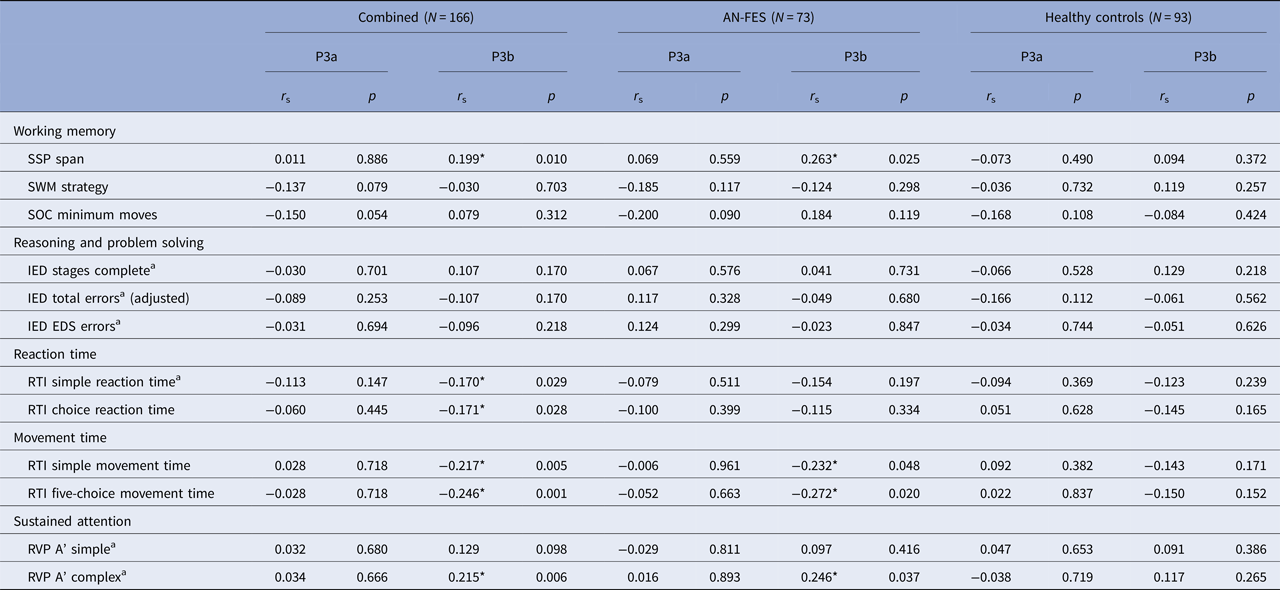
Given the non-normal distribution of the cognition data, Spearman correlation tests were used to explore the relationship between the electrophysiological and cognitive data (see Table 3 for an overview). Significant whole group positive correlations were found between P3b amplitude and WM and the complex version of the sustained attention task. Furthermore, P3b amplitude correlated significantly negative with all measures of reaction time. These associations appeared to be largely driven by the patient group. No significant associations were found between P3a amplitude and our cognitive measures in either of our groups, nor when combined. Furthermore, we found no associations between P3a and P3b latency and cognition. See online Supplementary Figs 5 and 6 for associations between the other leads and cognition. There was no significant association between P3a or P3b amplitudes and years of education (p = 0.77 and p = 29, respectively).
Spearman correlations between P3a and P3b amplitudes and AN-FES patients and HC

*Significant at p < 0.05.
a AN-FES n = 72.
Discussion
The present study is the first to explore the underlying mechanisms of cognitive deficits in a group of schizophrenia patients, who not only experienced their first psychotic episode but were in addition antipsychotic naive. Our results are therefore largely free of possible confounding factors such as progress of the disease or antipsychotic medication. We found lower P3a and P3b amplitudes in the patients, while P3a latency was significantly shorter for the patients compared with the HC. Furthermore, AN-FES patients scored lower on all cognitive tests compared with HC. Several significant correlations were found between P3b amplitude and cognitive measures in the group as a whole which appeared to be mainly driven by our AN-FES patients given that we found none in our HC. When split on group, patients showed positive associations between P3b amplitude and WM and the complex version of the sustained attention task on one hand and negative associations with movement time on the other. Surprisingly, no significant associations were found between any of our cognitive measures and the P3a amplitude in either group, nor when combined.
The results regarding lower P3a and P3b amplitudes in our AN-FES patients compared with HC are in line with our previous studies based on parts of the current population of subjects (Oranje et al., Reference Oranje, Aggernaes, Rasmussen, Ebdrup and Glenthøj2017) and other studies reporting P3a and P3b amplitude deficits in FES (Salisbury et al., Reference Salisbury, Shenton, Sherwood, Fischer, Yurgelun-Todd, Tohen and McCarley1998; Valkonen-Korhonen et al., Reference Valkonen-Korhonen, Purhonen, Tarkka, Sipilä, Partanen, Karhu and Lehtonen2003; Devrim-Üҫok et al., Reference Devrim-Üҫok, Keskin-Ergen and Üҫok2006; Mondragón-Maya et al., Reference Mondragón-Maya, Solís-Vivanco, León-Ortiz, Rodríquez-Agudelo, Yánez-Téllez, Bernal-Hernández, Cadenhead and de la Fuente-Sandoval2013; del Re et al., Reference del Re, Spencer, Oribe, Mesholam-Gately, Goldstein, Shenton, Petryshen, Seidman, McCarley and Niznikiewicz2015; Morales-Muñoz et al., Reference Morales-Muñoz, Jurado-Barba, Fernández-Guinea, Álvarez-Alonso, Rodríquez-Jiménez, Jiménez-Arriero and Rubio2017). Reduced P3a amplitude is associated with increased distractibility and theorized to represent a failure in the automatic (involuntary) attentional shift (Cortiñas et al., Reference Cortiñas, Corral, Garrido, Garolera, Pajares and Escera2008). The differences with studies that did not find a reduction in P3a amplitude in FES (Devrim-Üҫok et al., Reference Devrim-Üҫok, Keskin-Ergen and Üҫok2006; Atkinson et al., Reference Atkinson, Michie and Schall2012) may either have been caused by the patients being treated with antipsychotics or, alternatively, by differences in the electrophysiology paradigms used: Devrim-Üҫok et al. (Reference Devrim-Üҫok, Keskin-Ergen and Üҫok2006), for example, used a novel, environmental salient distractor in an oddball paradigm, while the P3a amplitude reported in the study of Atkinson et al. (Reference Atkinson, Michie and Schall2012) was assessed in a mismatch negativity paradigm. Our results regarding the diminished P3b amplitude add to the theory that P3b deficits are biological trait markers for, although not specific to, schizophrenia (Mathalon et al., Reference Mathalon, Ford and Pfefferbaum2000). P3a latency was significantly shorter in the AN-FES group, which might indicate a fast classification speed (see Polich, Reference Polich2007) of the deviant stimulus which could result in an altered processing of the stimulus.
Similar to our psychophysiological data, patients scored significantly lower than HC on every cognitive test assessed. This is in line with the previous research of comprehensive cognitive deficits present in schizophrenia in the first episode (Mesholam-Gately et al., Reference Mesholam-Gately, Giuliano, Goff, Faraone and Seidman2009) and before any impact of illness chronicity or medication.
In contrast to what we expected, P3a amplitude did not correlate to any of our cognitive measures in either the combined group or split in the AN-FES and HC groups. We hypothesized that P3a amplitude would be associated with tasks that require simple processing such as simple reaction time. However, even the simplest of our tasks required some level of conscious processing. These results therefore suggest that P3a amplitude is a truly automated response and that deficits in its amplitude do not cause deficits in (even simple) processing tasks.
Our combined group correlations revealed that P3b amplitude is not only associated with WM, but also with reaction time and (complex) sustained attention. All of these associations were in a direction that would be logically expected, i.e. a higher P3b amplitude reflects better task performance (and vice versa) and therefore agree with the theory suggested by Polich (Reference Polich2007) that P3b amplitude reflects allocation of attention and subsequent memory operations that are required for higher cognitive processing. These associations appeared mainly driven by our AN-FES patients, given that they were only found in that group, and not in the HC.
Similar to the study of Morales-Muñoz et al. (Reference Morales-Muñoz, Jurado-Barba, Fernández-Guinea, Álvarez-Alonso, Rodríquez-Jiménez, Jiménez-Arriero and Rubio2017), we found a positive association between sustained attention and P3b amplitude in our patients, showing that this relationship also holds when patients are first-episode and still anti-psychotic naïve. Given that our combined group correlations were mainly driven by our patient sample, it suggests that for cognitive processing, AN-FES patients, in contrast to HC, are more dependent on proper working P3b networks; these networks are widely distributed in the brain (Kiehl et al., Reference Kiehl, Laurens, Duty, Forster and Liddle2001). In healthy adults, most cognitive processes will largely deactivate the Default Mode Network (DMN) in favor of task-related networks, i.e. the frontoparietal network in case of P3b activity (Tam et al., Reference Tam, Luedke, Walsh, Fernandez-Ruiz and Garcia2015). Interestingly, activity in both the DMN as well as the frontoparietal network is known to be affected in FES (Guerrero-Pedraza et al., Reference Guerrero-Pedraza, McKenna, Gomar, Sarró, Salvador, Amann, Carrión, Landin-Romero, Blanch and Pomarol-Clotet2012; Guo et al., Reference Guo, Liu, Xiao, Liu, Yu, Zhang, Zhang and Zhao2015).
It should be kept in mind, however, that the correlations we found were weak, with the P3b amplitude accounting for <10% of the variance in cognitive scores, while no correlations at all were found for the P3a amplitude. This implies that deficits in P3a and P3b networks do not lead to explicit cognitive deficits, at least not in the paradigms we currently assessed, but likely serve as mediators to attain healthy levels of cognitive functioning (Thomas et al., Reference Thomas, Green, Hellemann, Sugar, Tarasenko, Calkins, Greenwood, Gur, Gur, Lazzeroni, Nuechterlein, Radant, Seidman, Shiluk, Siever, Silverman, Sprock, Stone, Swerdlow, Tsuang, Tsuang, Turetsky, Braff and Light2017). It is therefore unlikely that future treatment strategies targeted to normalize P3a and P3b amplitudes will result in major improvements of cognition in schizophrenia. Thus, in order to understand the underlying mechanisms of cognitive dysfunction, other brain networks should be examined.
The major strength of this study is the large group of AN-FES patients that we managed to include. A further strength is that the HC were not only matched to patients on age and gender but also on parental SES. The last is important, because it has been proposed as an (indirect) index of the potential level that patients could have reached had they not become ill (Keefe et al., Reference Keefe, Eesley and Poe2005). Last to point out is that the PANSS scores indicated a moderate-to-severe symptomatology (Leucht et al., Reference Leucht, Kane, Kissling, Hamann, Etschel and Engel2005), higher than seen in many other medication trials. A limitation of this study is that the long test days may have induced fatigue in our subjects which may have influenced their performance; we tried to attenuate this influence by testing early in the day (Lorist et al., Reference Lorist, Klein, Nieuwenhuis, de Jong, Mulder and Meijman2000) and by assessing electrophysiology and cognition on separate days. Another limitation is that we did not screen our HC for drug use, which might have been a confounding factor. However, given that drug use in the patient sample was not significant in our analyses, we do not assume that this would have been different for our HC. Due to unforeseen issues, we only had data on years of education for cohort 1 but not 2 and therefore we could not control for this measure. However, we analyzed the influence of years of education in cohort 1 and found that it correlated with cognition but not with the P3 amplitudes, which makes it unlikely that it would have had a major impact on our main outcome measures (correlations between the P3 amplitudes and cognition). Furthermore, because this is the first study examining associations between P3a and P3b amplitudes and cognition in AN-FES patients, we regard this study as explorative in nature, and therefore did not correct our results for multiple testing. Our results need therefore to be confirmed in other populations of AN-FES patients.
Conclusion
Similar to our previous studies, our current data demonstrate neurophysiological (reduced P3a and P3b amplitudes) and cognitive deficits in AN-FES patients. No associations were found between P3a amplitude and the scores on our cognitive tasks in either patients or controls, while P3b amplitude was mostly associated with tasks that require more cognitive processing. Although most of these associations were driven by our AN-FES patients, the observed associations were weak, therefore making it difficult to draw firm conclusions about deficient P3b amplitude as a direct underlying factor of cognitive deficits in schizophrenia.
Supplementary material
The supplementary material for this article can be found at https://doi.org/10.1017/S0033291718001575.
Acknowledgements
The authors would like to recognize the valuable work of the research nurses Gitte Saltoft Andersen and Katharina Alfsen as well as research assistant Mikkel Erlang Sørensen for assisting in the recruitment and assessment of participants.
Financial support
This study was sponsored by the grants of: the Danish Medical Research Council; the Copenhagen Hospital Cooperation Research Council; Copenhagen University Hospital Bispebjerg; the Faculty of Health Sciences of the University of Copenhagen; the Copenhagen Council Research Foundation (grant number: 1123); The Lundbeck Foundation (grant numbers: 192/05; 192/04; R25-A2701).
Conflict of interest
Dr Ebdrup has received lecture fees from and/or is part of Advisory Boards of Bristol-Myers Squibb, Eli Lilly and Company, Janssen-Cilag, Otsuka Pharma Scandinavia and Takeda Pharmaceutical Company. All other authors have no conflicts of interests.
Ethical standards
The authors assert that all procedures contributing to this work comply with the ethical standards of the relevant national and institutional committees on human experimentation and with the Helsinki Declaration of 1975, as revised in 2008.