Implications
This study shows that the digestibility of sorghum (S) is lower in piglets than in growing pigs. The difference is greater for protein than for independent amino acids (AA) thus accuracy in dietary formulation and estimation of AA requirements for pigs at weaning is in need of critical improvement if the appropriate digestibility figures are to be used. The lower digestibility of S in piglets is possibly due to an exacerbated response of the gut of the piglets to the deleterious effect of tannins. For this reason S is not recommended in diets for starter pigs, particularly if it is rich in tannins.
Introduction
Sorghum (S) ranks fifth among the cereals produced worldwide (Bansal et al., Reference Bansal, Mishra, Tomar, Sharma, Khanna and Garg2008). A characteristic of S is its huge variability in chemical composition and consequently in its nutritive value (Mossé et al., Reference Mossé, Huet and Baudet1988). Ramírez et al. (Reference Ramírez, Anaya and Mariscal2005) analyzed 216 samples of S and obtained a wide range for the CP content (5.2% to 11.0%), NDF (6.3% to 22.9%) and tannins (0.02% to 5.06%). Tannins affect in a negative way the digestibility of nutrients in S (Brand et al., Reference Brand, Badenhorst and Siebrits1990; Jondreville et al., Reference Jondreville, van den Broecke, Gatel, Grosjean, van Cauwenberghe and Sève2001; Mariscal-Landín et al., Reference Mariscal-Landín, Avellaneda, Reis de Souza, Aguilera, Borbolla and Mar2004) and the efficiency with which pigs use its nutrients for growth (Kondos and Foale, Reference Kondos and Foale1983; Bell and Keith, Reference Bell and Keith1989). However, all the experiments cited above were conducted in growing pigs; for that reason it is unknown whether the coefficients of ileal apparent digestibility (CIAD) of protein and amino acids (AA) that have been determined in growing pigs are appropriate to pigs at weaning. Consequently, the aim of this study was to determine the CIAD of CP and AA in S, both for piglets at weaning and for growing pigs to test the hypothesis that CP and AA digestibility of S is lower in weaned piglets than in growing pigs.
Material and methods
Two experiments using weaned piglets and growing pigs of the same herd were conducted according to the guidelines of the International Guiding Principles for Biomedical Research Involving Animals, and the ‘Mexican Official Standard for the Production, Protection and Use of Lab Animals’ (Diario Oficial de la Federación, 2001).
Experiment 1: weaned piglets
A total of 20 piglets, Duroc × Landrace, from four litters, weaned at 17 ± 0.5 days of age and weighing 5.5 ± 0.7 kg, were assigned to one of five different treatment groups based on litter of origin and body weight (four piglets per treatment). Piglets were placed individually in metabolism cages provided with a self-feeder and a nipple watering device, in a room with a controlled temperature of 26 ± 3°C. To have the piglets eating solid feed, but to alter as little as possible the enzymatic profile of suckling animals, from day 17 to day 20 of age all piglets were fed with a dry mash mixture composed of dry whole milk (80%) and maize starch (20%), three times daily, at 0800, 1300 and 1800 h. When the piglets were 21 days of age, a ‘T’ cannula was fitted in the terminal ileum (Reis de Souza et al., Reference Reis de Souza, Mar and Mariscal2000). After surgery, piglets from each treatment group received one of five treatments: a reference diet containing 200 g of CP/kg using casein (C) as the sole protein source, or one of four casein–sorghum (C–S) diets (Tables 1 and 2). The amount of S used in the C–S diets was 135, 307, 460 and 614 g/kg. To ensure isoproteic diets the appropriate amounts of C and maize starch were adjusted. In addition to the variable amounts of starch, the five diets contained the same amount of lactose, maize oil, calcium carbonate, dicalcium phosphate, salt and a mixture of vitamins and minerals. Calcium carbonate and dicalcium phosphate were used to adjust the Ca and P levels, and premixes of vitamins and trace elements were added to satisfy or exceed the recommended daily allowances (NRC, 1998). Chromic oxide was added at a rate of 3 g/kg as an indigestible marker.
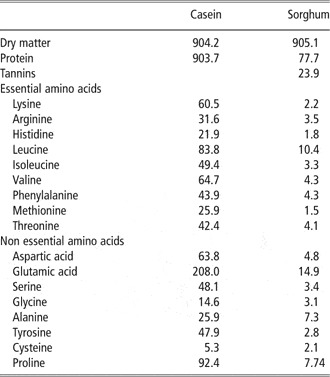
Chemical composition of casein and sorghum as fedFootnote *

* In g/kg of raw material. The values reported are measured.
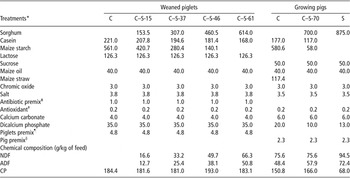
Composition of experimental diets in g/kg of feed

*Weaning piglets: C = casein diet; C–S-15 = casein–sorghum at 15%; C–S-37 = casein–sorghum at 37%; C–S-46 = casein–sorghum at 46%; C–S-61 = casein–sorghum at 61%. Growing pigs: C = casein diet; C–S-70 = casein–sorghum at 70%; S = sorghum.
‡Antibiotic premix that provided per kilogram of PREMIX: Chlortetracycline 44 g/kg, Sodium sulfadimethylpyrimidine 44 g/kg and Penicillin G procaine 22 g/kg.
†ANTI-OX-HP, Compagnie Chimique d’Aquitaine.
¶Premix that provided per kilogram of piglet diet: vitamin A 10 200 IU, vitamin D 1980 IU, vitamin E 60 IU, vitamin K 1.20 mg, Choline 967 mg, Niacin 36 mg, Pantothenic Acid 17 mg, Riboflavin 7.2 mg, vitamin B12 40 μg, Thiamine 0.30 mg, Pyridoxine 0.31 mg, Biotin 0.08 mg, Folic Acid 0.75 mg, Cu 14.4 mg, I 0.96 mg, Fe 120 mg, Mn 36 mg, Se 0.3 mg, Zn 144 mg.
§Premix that provided per kilogram of growing pigs diet: vitamin A 6400 IU, vitamin D 1280 IU, vitamin E 30 IU, vitamin K 0.8 mg, Choline 375 mg, Niacin 24 mg, Pantothenic Acid 11.0 mg, Riboflavin 4.8 mg, vitamin B12 30 μg, Cu 8.4 mg, I 0.56 mg, Fe 70.0 mg, Mn 21.0 mg, Se 0.18 mg, Zn 84.0 mg.
Piglets were fed during 14 days with the same experimental diet, starting on day 22 according to the previously described schedule. The experimental period lasted 7 days each: 5 days for adaptation and the remaining 2 days for collection of ileal digesta. Piglets were given 150 g feed/day during the 1st week and 300 g/day during the 2nd week; the piglets had free access to water at all times.
Ileal digesta were collected using plastic bags (5 × 3 cm) containing 2 ml of 0.2 M HCl solution to block any bacterial activity. The bags were attached to the cannula using a rubber band and ileal digesta were collected six times per day, from 0800 to 2100 h on day 1, and from 0900 to 2200 h on day 2. During the first 2 hours of collection (0800 to 1000 on day 1 and 0900 to 1100 on day 2) the cannulae remained open. The cannulae were then alternately opened and closed for periods of 60 min, and one bagful of digesta was collected every 2nd hour. As the collecting bags were withdrawn, the samples of ileal digesta were transferred to a container for immediate freezing at −20°C until lyophilization.
Experiment 2: growing pigs
Fifteen castrated, Duroc × Landrace, pigs weighing 57.8 ± 2.8 kg were used for this experiment (five pigs by treatment). A ‘T’ cannula was fitted in the terminal ileum when the pigs weighed 45 kg. After surgery, the pigs were placed individually in metabolism cages provided with a self-feeder and a nipple watering device. Room temperature was maintained at 19 ± 2°C. The post-surgery period lasted 14 days, during which the pigs received a growth diet that provided 160 g of CP/kg of feed twice daily (0800 and 1700 h). The amount fed was increased every day until the pigs reached the intake level observed before surgery. Pigs were randomly allotted to one of three treatments (Table 2), a reference C–maize starch diet containing C as the sole protein source, a C–S diet (both at about 160 g of CP/kg), and a fortified S diet containing 68 g of CP/kg. These diets contained fixed amounts of maize oil, sucrose, salt and a mixture of vitamins and minerals. Calcium carbonate and dicalcium phosphate were used to adjust the Ca and P levels, while a premix of vitamins and trace elements was added to satisfy or exceed the recommended daily allowances (NRC, 1998). Chromic oxide was included at 3 g/kg as an indigestible marker. During the experimental period, the castrated pigs were fed 2.5 times their maintenance requirement of digestible energy (DE; 460 kJ of DE per kg of W0.75) (INRA, 1984), and had free access to water.
The experimental period was as described for experiment 1, except for the following modifications. Ileal digesta were collected in plastic bags (11 × 5 cm) containing 10 ml of 0.2 M HCl. On day 1 the bags were attached to the cannulae using a rubber band at 0800 h and the ileal contents were collected from 0800 to 1000 h, and the cannulae remained open every other hour until 0900 h on day 2. On day 2, the cannulae remained open from 0900 to 1100 h, and every other hour until the end of the collection period (i.e, 0800 h on day 3).
At the end of both experiments, narcosis was induced in piglets and growing pigs with CO2 inhalation, followed by euthanasia by exsanguination. A post-mortem examination was performed to verify the integrity of their small intestines.
Preparation of samples and chemical analysis
The samples of ileal digesta from experiments 1 and 2 were lyophilized and ground in a laboratory mill using a 0.5-mm mesh sieve (Arthur H. Thomas Co. Philadelphia, PA, USA). The following analyses were performed on the experimental diets and the samples of ileal digesta: dry matter (DM) and CP according to AOAC (2000) methods 934.01 and 976.05, respectively, and chromic oxide according to the method of Fenton and Fenton (Reference Fenton and Fenton1979). Samples were prepared for determination of AA according to method 994.12 of the AOAC (2000). Samples were hydrolyzed at 110°C for 24 h in 6 M HCl. For assay of methionine and cysteine, oxidation with performic acid was carried out before the AA analysis, using reverse phase HPLC (1100 HPLC Hewlett Packard), according to the method described by Henderson et al. (Reference Henderson, Ricker, Bidlingmeyer and Woodward2000). In addition, the level of tannins in S grain was determined according to the method of Price et al. (Reference Price, Steve and Butler1978).
Data analysis
Estimation of the ileal apparent digestibility of protein and AA
The IAD coefficients for DM, CP and AA in the experimental diets were estimated using the following equation:

in which IADD is the coefficient of the ileal apparent digestibility (CIAD) of a nutrient in the diet; ID is the concentration of the marker in the diet (mg/kg of DM); AF is the concentration of the nutrient in the ileal digesta (mg/kg of DM); AD is the concentration of the nutrient in the diet (mg/kg of DM); and IF is the concentration of the marker in the ileal digesta (mg/kg of DM).
Estimation of the ileal apparent digestibility of S by the difference method
Using C as the basal feed ingredient, the ileal apparent digestibility values for CP and AA in S were calculated by the difference method proposed by Fan and Sauer (Reference Fan and Sauer1995):

in which IADA is the coefficient of ileal apparent digestibility of a component in the assayed ingredient under the assumption of the additivity of digestible or indigestible components; IADD is the CIAD of protein or AA in the assayed diet; DB is the coefficient of apparent digestibility of a component in the reference feed ingredient; SB is the contribution of a nutrient in the reference ingredient to the assayed diet; and SA is the contribution of a nutrient in the assayed ingredient to the assayed diet.
Estimation of the ileal apparent digestibility of S by the regression method
As defined by Mosenthin et al. (Reference Mosenthin, Sauer, Blank, Huisman and Fan2000), in this method the basal and the assay feed ingredient are evaluated simultaneously. The basal and the assay feed ingredient provide the sole assay nutrients in the diet. The ingredients (C and S) were mixed at various graded levels. To perform the regression analyses the amount (g/kg) of nutrient furnished by C was utilized as the regressor using the REG procedure of SAS (Statistical analysis system, v 9.1, 2002):

where y is the predicted digestibility of a nutrient in the assay diet; the intercept a represents the digestibility of S nutrient (0 g/kg of C); b is the slope and represents the increase in digestibility due to an increase in the amount (g/kg) of the nutrient assay furnished by C; and X represents the amount (g/kg) of C in the assay diet.
Statistical analysis
The homogeneity of variance for all data was tested by the test of Levene using hovtest of SAS (version 9.1).
Data for the CIAD for CP or AA in experiment 1 (weaned piglets) were analyzed using the GLM procedure of SAS (version 9.1, 2002) for a split plot design, according to the following model:

where Yijkl = dependent variable, μ = general mean, Ti = treatments 1, 2, 3, 4 and 5; Ak = animal as the whole plot unit (1, 2, 3, … and 20), which was used as the error term to test the significance of treatment, Pj = collection period for the subplot 1, 2, and eijk = experimental error. Treatment means were compared using the Tukey method and the linear effect was tested using orthogonal contrast (Steel and Torrie, Reference Steel and Torrie1980).
The data for the CIAD for CP and AA in experiment 2 (growing pigs) were analyzed using the GLM procedure of SAS (version, v 9.1, 2002), for a randomized complete block (the block was a group of three animals, one per treatment used at the same time) design under the general model:

where Yij = is the dependent variable; μ = general mean; Ti = treatments 1, 2 and 3; Bj = blockj 1, 2, 3, 4 and 5, and eij = experimental error. Treatment means were compared using the Tukey method.
Because both experiments were done at the same time under the same conditions with animals belonging to the same herd and with the same protein sources, the CIAD determined by the difference method in each experiment (treatment C–S-70 in growing pigs and treatment C–S-61 in weaned piglets) were combined and analyzed as a Completely Random Design (Steel and Torrie, Reference Steel and Torrie1980) using the GLM procedure of SAS (version 9.1, 2002). Treatment means were compared using the Tukey method.
Results
All the variables had a homogenous variance (P > 0.05), excepting valine, methionine and proline in weaned piglets and protein and alanine in growing pigs, Therefore, the digestibility values for these AA were subjected to angular transformation (Steel and Torrie, Reference Steel and Torrie1980), followed by statistical analysis as described above. Data are presented as back-transformed in Tables 5 and 6.
Experiment 1: weaned piglets
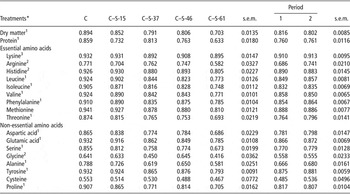
The CIAD are shown in Tables 3 and 4. The CIAD for CP and AA decreased linearly (P < 0.05) as the amount of S in the diet increased. The average ileal digestibility of AA from C was 0.858 ± 0.111, and this decreased to 0.663 ± 0.191 when the percentage of S in the diet was 61. The greater decrease was observed in CP (from 0.859 to 0.633) and the smaller in lysine (from 0.932 to 0.895). The ileal digestibilities during the 1st and 2nd weeks after weaning were not different.
Coefficients of ileal apparent digestibility of experimental diets in weaned piglets

*C = casein diet; C–S-15 = casein–sorghum at 15%; C–S-37 = casein–sorghum at 37%; C–S-46 = casein–sorghum at 46%; C–S-61 = casein–sorghum at 61%.
1Linear effect (P < 0.001).
2Linear effect (P < 0.01).
3Linear effect (P < 0.05).
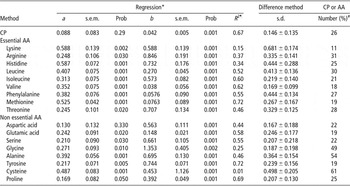
Coefficients of ileal apparent digestibility of CP and AA in sorghum determined in weaned piglets using the regression or difference method

AA = amino acid; Prob = probability.
*Lineal regression according to equation: Y = a + bX, where the intercept a represent the digestibility of sorghum nutrient (0 g of casein); b is the slope and represents the increase in digestibility due to an increase in the nutrient assay furnished by casein; X represent the g/kg of casein in the assay diet.
¶R 2 = Coefficient of determination for the linear regression line.
Percentage of nutrient furnished by sorghum.
The CIAD estimated by the regression or difference methods were similar for leucine, cysteine, glutamic acid, serine, alanine and tyrosine and different for the other AA (Table 4). The lower digestibility obtained by the regression method were for protein, aspartic acid and proline (0.088, 0.130 and 0.169, respectively), and the higher were for lysine, histidine and methionine (0.588, 0.587 and 0.525, respectively). The capacity of the piglets to digest CP and AA from S was low.
Experiment 2: growing pigs
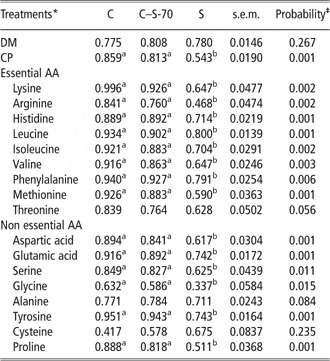
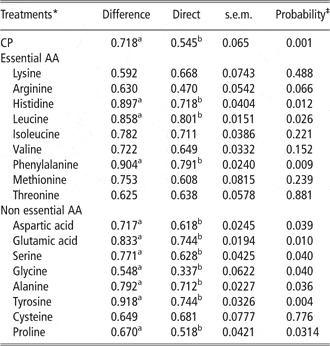
The results are shown in Tables 5 and 6. In general, the CIAD of protein and AA (except alanine and cysteine) were similar (P > 0.05) in the C and the C–S diets, and were higher (P < 0.05) than those of the S diet. The CIAD for S obtained by the difference method were higher (P < 0.05) than those obtained using the direct method, except for lysine, isoleucine, valine, methionine, threonine and cysteine. Using the direct method the AA with lower digestibility were glycine, arginine and proline (0.337, 0.470 and 0.518, respectively).
Coefficients of ileal apparent digestibility of experimental diets in growing pigs

DM = dry matter; AA = amino acid.
*C = casein diet; C–S-70 = casein–sorghum at 70%; S = sorghum.
‡Means with different superscript (a,b) differ at probability level shown in the sixth column.
Coefficients of ileal apparent digestibility of CP and AA in sorghum determined in growing pigs using the difference or direct method

AA = amino acid.
‡Means with different superscript (a,b) differ at probability level shown in the fifth column.
Comparison between weaned piglets v. growing pigs
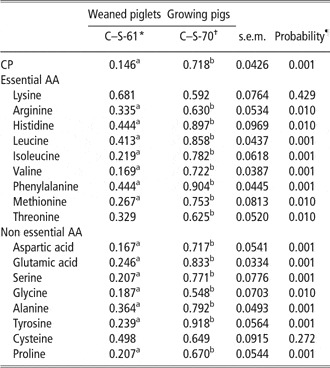
The results are shown in Table 7. Excepting lysine and cysteine growing pigs digest better (P < 0.01) all the AA and protein than weaned piglets.
Comparison of Ileal digestibility coefficients between weaned piglets and growing pigs

AA = amino acid.
*C–S-61 = casein–sorghum at 61%.
†C–S-70 = casein–sorghum at 70%.
¶Means with different superscript (a,b) differ at probability level shown in the fifth column.
Discussion
The digestibility of S is affected by tannins, and by the presence of α-kaffirin, a S storage protein, which is resistant to pepsin (Oria et al., Reference Oria, Hamaker and Smith1995). The low digestibility of proline and glycine could be attributable to the capacity of tannins to stimulate the synthesis of a proline-rich protein (Jansman, Reference Jansman1993; Haslam, Reference Haslam1998); this protein may be acidic, basic or glycosylated (Bennic, Reference Bennic1982), and may contain 40% proline and 20% glycine. It acts as the first line of defense against dietary tannins (Mehansho et al., Reference Mehansho, Clements, Sheares, Smith and Carlson1985). Its secretion responds to the ability of tannins to precipitate proteins, and it shows a particular preference for combination with proline (Hagerman and Butler, Reference Hagerman and Butler1981; Mitaru et al., Reference Mitaru, Reichert and Blair1984; Kim et al., Reference Kim, House and Miller2004). In the case of arginine, Charlton et al. (Reference Charlton, Baxter, Khan, Moir, Haslam, Davies and Williamson2002) reported that this AA strengthens the interaction between proteins and tannins forming an additional site of interaction.
The CIAD of protein and AA from S in growing pigs are in the range of values reported previously (Lin et al., Reference Lin, Knabe and Tanksley1987; Mariscal-Landín, Reference Mariscal-Landín1992; Mariscal-Landín et al., Reference Mariscal-Landín, Avellaneda, Reis de Souza, Aguilera, Borbolla and Mar2004).
The lower CIAD values obtained with the direct method than with the difference method has been reported and criticized in pigs by Fan and Sauer (Reference Fan and Sauer1995). This is the reason why values for standardized ileal digestibility are now commonly used in diet formulation.
The ileal digestibility coefficient of protein from S obtained in piglets by either the regression or the difference method was low (0.088 and 0.146, respectively). The low protein digestibility could be caused by the negative effect of tannins or the presence of α-kaffirin; and be aggravated by the lower capacity of weaned piglets to digest vegetable protein when compared with growing pigs (Mariscal-Landín et al., Reference Mariscal-Landín, Reis de Souza, Parra, Aguilera and Mar2008). For this reason the use of highly digestible proteins is recommended in starter feeds (Makkink et al., Reference Makkink, Berntsen, op den Kamp, Kemp and Verstegen1994; Shon et al., Reference Shon, Maxwell, Southern and Buchanam1994).
Even if the average digestibility of AA from S was low (0.339 or 0.319 by the regression or difference method, respectively), however, all the AA had a higher digestibility than protein. The lower protein digestibility could be due to a high non-amino nitrogen content in the digesta, probably provided by the amino sugars (50% to 80% of the molecular weight) of mucin, a glycoprotein with a high content of N-acetyl glucosamine and N-acetyl galactosamine (Deplancke and Gaskins, Reference Deplancke and Gaskins2001). Mucin is the principal component of the mucus layer in the gastrointestinal tract (Corfield and Shukla, Reference Corfield and Shukla2003; Montagne et al., Reference Montagne, Piel and Lallès2004). The mucus layer functions as an interface between the external environment (the intestinal lumen) and epithelial cells (enterocytes); its principal task is the protection of the epithelium. An increase in the loss of endogenous protein (enzymes and mucins) has been reported in pigs that are fed S (Jondreville et al., Reference Jondreville, van den Broecke, Gatel, Grosjean, van Cauwenberghe and Sève2001), as well an increase of mucin in the feces of mice fed S containing high levels of tannins (Sell et al., Reference Sell, Reed, Chrisman and Rogler1985).
Ileal digestibility coefficients are lower in piglets than in growing pigs, as shown by our results. The greater difference was observed for protein because the CIAD in the piglets was only 27% of that observed in the growing pigs. Lysine was the AA that was most digestible in piglets, independent of method utilized for analysis; this could be because this was the AA with the lowest proportion furnished by S (11% of dietary lysine); consequently the impact of the lysine furnished by S was negligible. In fact, this is a limitation of the used methods (regression and difference), because the proportion of AA (11% of lysine to 61% of cysteine) and protein (26%) furnished by S was low. Due to the low digestive capacity of piglets that limits the use of one plant ingredient as a sole protein source these are the best methods available to measure the ileal digestibility of raw materials in weaned piglets.
Conclusions
The protein and AA of S are less digestible in piglets than in growing pigs. In piglets the ileal digestibility of protein is lower than the average ileal digestibility of AA. The coefficients estimated in growing pigs using the direct method were lower than those estimated by the difference method.
Acknowledgements
The authors acknowledge Benito Mar-Botello, MSc, for surgical procedures; Mariela Camacho, MSc for amino acid analysis and chemistry and Ericka Ramirez for general laboratory analyses. And also to the National Council for Science and Technology of Mexico (CONACYT) for the financial support given to Research Project G13972