In the Netherlands, as in most countries of the world, children are taught a foreign language through classroom instruction at school. One focus in such instruction is to continuously enhance the students’ vocabulary, a feat that second language (L2) learners master with varying speed and success. One much addressed issue in research on second language learning has been how learners integrate novel words in the L2 into their mental lexicon and particularly whether lexical access to these words follows a route via the first language, L1 (Kroll & Stewart, Reference Kroll and Stewart1994; Talamas, Kroll & Dufour, Reference Talamas, Kroll and Dufour1999) or whether the conceptual system can be directly accessed (Altarriba & Mathis, Reference Altarriba and Mathis1997; Finkbeiner & Nicol, Reference Finkbeiner and Nicol2003).
How then are associative links laid between the first and second language in speakers learning a second language and how is meaning linked to words in a second language? Previous work in this research domain has focused mainly on adult L2 learners and bilinguals (for recent reviews and debate, see Brysbaert & Duyck, Reference Brysbaert and Duyck2010; Kroll, Van Hell, Tokowicz & Green, Reference Kroll, Van Hell, Tokowicz and Green2010; Van Hell & Kroll, Reference Van Hell, Kroll, Altarriba and Isurin2013). The present study examined children in the early stages of L2 learning. More specifically, we studied L2 word form to concept mappings in child classroom L2 learners in two paradigms previously used in research with adult L2 learners and bilinguals: translation recognition (Experiment 1) and translation production (Experiment 2).
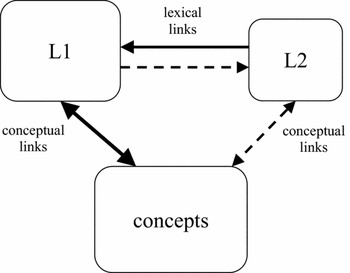
Combining two models of word-to-concept mapping, the word association model and the concept mediation model originally proposed by Potter, So, Von Eckhardt, and Feldman (Reference Potter, So, Von Eckhardt and Feldman1984), Kroll and Stewart (Reference Kroll and Stewart1994) developed the Revised Hierarchical Model (RHM) to account for the developmental changes evident during the early stages of L2 acquisition (see Figure 1). The RHM described how L2 words are linked to L1 words and concepts and proposed that initially during L2 processing the L1 translation equivalent is exploited to mediate access to meaning, whereas at later stages of L2 development direct conceptual access from the L2 word form becomes possible (for reviews, see, e.g., Kroll & Tokowicz, Reference Kroll, Tokowicz, Kroll and De Groot2005; Kroll et al., Reference Kroll, Van Hell, Tokowicz and Green2010).
The Revised Hierarchical Model (adapted from Kroll & Stewart, 1994)

Two tasks commonly used to test the predictions by the RHM are the translation recognition and translation production tasks. To explore the developmental changes in L2 word-to-concept mappings, Talamas et al. (Reference Talamas, Kroll and Dufour1999) compared beginning and more advanced adult L2 learners on a translation recognition task. Two words were presented to the learners, who had to decide whether the second word was the first word's translation or not. The critical stimuli were incorrect translation pairs of which the second word was either related to the correct translation in lexical form (e.g., GARLIC-OJO ´eye´, instead of GARLIC-AJO as in the correct translation), or in meaning (GARLIC-CEBOLLA ´onion´). The results showed that beginning L2 learners were influenced more by word form and less by its meaning. The more advanced L2 learners, however, demonstrated a larger semantic interference effect, suggesting that they were more sensitive to a word's meaning. This pattern was taken as support for the RHM in that beginning L2 learners used the lexical mediation route in contrast to advanced L2 learners who used the conceptual mediation route, making the form of words irrelevant and rendering no influence on the translation task. Ferré, Sánchez-Casas and Guasch (Reference Ferré, Sánchez-Casas and Guasch2006) used orthographically related and semantically related conditions in a translation recognition task with early and late L2 learners of low and high proficiencies. The highly-proficient speakers were above all influenced by closely semantically related stimuli, while the low-proficiency speakers were more sensitive to orthographically related stimuli. These results, again, were in line with the RHM. Recent ERP evidence by Guo, Misra, Tam and Kroll (Reference Guo, Misra, Tam and Kroll2012), however, indicates that even relatively proficient bilinguals show patterns of activation in some contexts indicative of both lexical and conceptual mediation (see also review by Van Hell & Kroll, Reference Van Hell, Kroll, Altarriba and Isurin2013).
The predictions made by the RHM have not always been borne out in past research. Altarriba and Mathis (Reference Altarriba and Mathis1997) were interested in whether beginning L2 learners chiefly used the lexical link during translation without directly activating the concept. For this purpose, English learners of Spanish were taught a number of Spanish words, and were then tested in two translation recognition tasks. Their performance was compared to that of proficient English–Spanish bilinguals. Spanish–English word pairs were shown, some of which were incorrect translations. In these pairs the second word was orthographically similar to the correct translation equivalent (Experiment 1a) or the second word was semantically related to the correct translation equivalent (Experiment 1b). Both groups of participants showed longer reaction times for incorrect form-related word pairs than for unrelated stimuli, indicating lexical interference. A semantic interference effect was also found for both groups of participants, albeit more strongly in the fluent L2 speakers. Critically, the beginning L2 learners also activated semantic information when translating from L2 to L1, even though they had followed only one training session. These results were interpreted as evidence against the RHM, although Talamas and colleagues (Talamas et al., Reference Talamas, Kroll and Dufour1999) pointed out that the performance by the low-proficient group may have been influenced by a priming effect through the initial word learning. Sunderman and Kroll (Reference Sunderman and Kroll2006) later obtained similar semantic interference effects for both less and more proficient groups of speakers in a translation recognition task, the results of which suggest that the L2 word-to-concept link may be available for L2 learners at an earlier point in their L2 acquisition than previously assumed (and see Dufour & Kroll, Reference Dufour and Kroll1995, for similar evidence from a semantic categorization task).
Another task that has been used to explore the lexical and conceptual connections between a bilingual's two languages and the conceptual store is translation production. Depending on which direction the translation is performed, forward (L1 to L2) or backward (L2 to L1), the RHM makes different predictions depending on relative proficiency in the L2. While forward translation (L1 to L2) is thought to generally proceed via the conceptual store, backward translation (L2 to L1) is assumed to proceed via the direct lexical link to L1 in low-proficient L2 speakers and via the concept in high-proficient L2 speakers. Particularly the assumed strong lexical link between L2 and L1 in low-proficient L2 speakers, and the strong conceptual link between L1 word form and concept should lead to an asymmetry between the time required to translate from L2 to L1 and that from L1 to L2. This asymmetry between translating from L1 to L2 and vice versa was found in Dutch–English bilinguals by Kroll and Stewart (Reference Kroll and Stewart1994). These bilinguals, it was reasoned, accessed the meaning of L2 words indirectly via the lexical link from L2 to L1, as this was assumed to be much stronger than the L2 conceptual link. The authors assumed that more proficient L2 speakers, in contrast, would have a decreased need to rely on the L1 translation for L2 processing, as such speakers inadvertently strengthened the L2 conceptual link by becoming more fluent in the L2 (see Fig. 1). In time, as the speaker became more proficient, a gradual shift from lexical to conceptual mediation would take place; and the magnitude of the asymmetry should also decrease.
These predictions were supported by the results of a study by Kroll, Michael, Tokowicz and Dufour (Reference Kroll, Michael, Tokowicz and Dufour2002) in which translation and picture-naming tasks were performed by beginning and proficient L2 learners. In accordance with the RHM, translation from L2 to L1 was faster in both groups than vice versa, and the asymmetry between lexical and conceptual mediation was larger for the beginning L2 learners than the fluent L2 speakers. However, De Groot, Dannenburg and Van Hell (Reference De Groot, Dannenburg and Van Hell1994), in a study systematically controlling for word frequency, imageability, and concreteness, found conceptual mediation during both backward and forward translation in unbalanced but relatively proficient Dutch–English bilinguals, with semantic variables having a higher impact on forward than on backward translation. These findings led the authors to propose a weaker version of the asymmetry model by Kroll and Stewart (Reference Kroll and Stewart1994).
Furthermore, in a study by La Heij, Hooglander, Kerling and Van der Velden (Reference La Heij, Hooglander, Kerling and Van der Velden1996) using forward and backward translation combined with a picture-word interference component, concept mediation was found for both translation directions, and backward translation was slower than forward translation, results that run counter to those obtained by Kroll and Stewart (Reference Kroll and Stewart1994). As a possible underlying reason for partially non-converging results, La Heij and colleagues comment on the varying nature of stimulus materials and their relative familiarity for participants in earlier studies and those used in theirs. While the participants in the La Heij et al. study had become acquainted with the stimuli beforehand, the Kroll and Stewart participants had not. Accordingly, in interpreting these results in contrast to, for example, those obtained by Kroll and Stewart (Reference Kroll and Stewart1994), it should be noted that Kroll and Stewart tested bilinguals who were required to process very low-frequent items, while the bilinguals in La Heij et al., drawn from a similar population as the Kroll and Stewart (Reference Kroll and Stewart1994) bilinguals, were required to process more frequent items. Thus, frequency differences in stimuli may have contributed to the differential findings. Finally, the La Heij et al. study also included a picture prime that may have changed the way that production was initiated in the translation task. The semantic processing of the picture may have induced a semantic strategy that overrode the option of lexical mediation in the backward direction of translation. In a recent review, Kroll et al. (Reference Kroll, Van Hell, Tokowicz and Green2010) also point out that task contexts (e.g., comprehension vs. production) and properties of task items (such as high-frequency vs. low-frequency words) may involve differential processing loads for participants (see also Kroll & Tokowicz, Reference Kroll, Tokowicz, Kroll and De Groot2005). This in turn may have a variable impact on L2 language processing particularly when this is of a challenging nature, resulting, for example, in translation asymmetries (i.e., shorter backward than forward translation times) even in highly-proficient bilinguals (Van Hell & De Groot, Reference Van Hell and De Groot1998a).
As mentioned above, so far, the reported studies all focused on adults. Children, in contrast, represent a group of individuals who are still in the process of developing their first language and L1 word-to-concept mappings – thus the relative strength of these connections may be differently balanced and a new language may have a different impact on their mappings (cf., Brenders, Van Hell & Dijkstra, Reference Brenders, Van Hell and Dijkstra2011; Poarch & Van Hell, Reference Poarch and Van Hell2012). The learning contexts for children may also differentially impact the acquisition of L2 word-to-concept mappings, with greater reliance on concrete, perceptually salient meanings for children relative to adults. Support for this hypothesis was reported by Chen and Leung (Reference Chen and Leung1989) who found that child beginning L2 learners performed differently than adult L2 learners when L2 picture naming and translation were compared. While the adult L2 learners were faster at translating than picture naming, the child L2 learners named pictures faster than they translated. The authors attributed this finding to differential L2 learning routes in children (who use pictures more) in contrast to adults (who use words more).
More recently, differential outcomes of vocabulary acquisition based on differing word-learning methods have also been shown by Tonzar, Lotto and Job (Reference Tonzar, Lotto and Job2009), who had Italian 4th and 8th graders learn words in German and English and later tested the children on their retention of words. The results showed that the picture-based method lead to better performances than the word-based method, which the authors interpreted as suggesting a more efficient link between concept and L2 word for children than that between L1 word and L2 words. Comesaña, Perea, Piñeiro and Fraga (Reference Comesaña, Perea, Piñeiro and Fraga2009) had bilingual Spanish–Basque children perform a translation recognition task, and manipulated the semantic relationship of stimuli to the correct translation (Experiment 1). The children made more errors and were slower in the semantically related condition. In Experiment 2, monolingual Spanish children performed the same translation recognition task after being taught Basque words. Critically, half the children learned the Basque words through L2-L1 translation pairs, assumed to develop the L2-to-L1 lexical link, while the other half learned the L2 words via pictures, assumed to develop the L2-to-concept link. Only the novice L2 learners who had learned the L2 words via pictures showed a significant semantic-interference effect (similar to the fluent bilingual children in Experiment 1), on the basis of which the authors concluded that beginning L2 learners can activate concepts directly, but that this depended on the word learning method (but see Comesaña, Soares, Sánchez-Casas & Lima, Reference Comesaña, Soares, Sánchez-Casas and Lima2012, for semantic-interference effects in beginning L2 learners irrespective of learning method). It thus seems that the developmental aspect of the RHM could be explored in more detail by focusing on child L2 learners. The present study employs a combination of two experimental paradigms, translation recognition and translation production, to tap into word-to-concept mappings in children who are in the early stages of learning a second language. Given the mixed results, particularly in studies using the translation recognition task, the theoretical rationale for combining translation recognition and translation production in the present study was to explore whether or not beginning learners’ performances would be similar in these two tasks, which in turn could offer valuable insights into evidence of early word-to-concept mapping as elicited by differing tasks.
The present study
The present study aims to explore language organization in children who are beginning L2 learners in the early stages of L2 instruction. We focused on a group of primary school children aged 10–11 who had received lessons in English as a second language for around 8 months. After consultation with the school, all children in the classroom were tested, in the knowledge that probably not all children would display sufficient levels of proficiency to yield reliable data (see also Participants section and Footnote 1). First, a translation recognition task was administered, in which L2 English words were shown followed either by correct, incorrect, or incorrect but semantically related L1 Dutch word equivalents (Experiment 1). Second, the participants performed a forward (L1 to L2) and backward (L2 to L1) translation task (Experiment 2). Both tasks have been used previously to test the variability and sensitivity to semantic interference in L2 learners and bilinguals, but to our knowledge this is the first study combining both tasks in child classroom learners. Similar patterns for both tasks were expected since the same participants took part in both experiments.
Predictions
The predictions for the translation recognition task (Experiment 1) were: if beginning L2 learners are already able to exploit concept mediation, which means there is activation of a link between the L2 word form and its concept, the children would show a semantic-interference effect for the semantically related stimuli. This would cause longer reaction times and lower accuracies in semantically related foils compared to incorrect but unrelated stimuli.
In the forward and backward translation tasks (Experiment 2), the RHM predicts an asymmetry in speed and accuracy for beginning L2 learners, with backward (L2 into L1) being faster and more accurate than forward (L1 into L2) translation. According to the RHM, during backward translation, speakers rely more on lexical mediation while during forward translation they rely more on concept mediation. We predict that children should make more errors overall in the L2 to L1 direction, given that they will likely bypass activating the concept and directly access their richer and more extensive L1 lexicon via the lexical link, which in turn offers them a greater pool from which to simply guess the translation. In contrast, the children are hypothesized to show more omissions from L1 to L2, as upon reading the L1 word they will first activate the concept and then subsequently have to use the concept-to-L2 word conceptual link to access the L2 word, a link that is assumed to be weaker in the first place. Since they also have fewer words in the L2 lexicon to choose from, this should lead to more omissions. In other words, errors and omission should differ according to differential sizes of the lexicon and the different routes involved in forward and backward translation (cf., Van Hell & De Groot, Reference Van Hell and De Groot2008).
Experiment 1 – L2-L1 translation recognition
Method
Participants
The group consisted of 60 5th grade children (28 girls and 32 boys, mean age = 10.6, SD = 0.5), who had had 1 hour of weekly English lessons for approximately 8 months, using the ‘Real English – Hello World’ method (Van der Voort & Mol, Reference Van der Voort and Mol1998). None of the children were dyslexic or spoke any other language than Dutch at home.
The children were also asked whether and how frequently they played English-language computer games, watched English-language television programs, and read English-language books or comics. They indicated this on 7-point scales (ranging from 1 = never to 7 = daily), the scores of which were used to assess the extent of exposure to English outside school lessons. The results are reported in Table 1.
Means for participants’ age, length of instruction, language experience, frequency of English usage, and proficiency measure response times and accuracy rates.

Note. * Frequency ratings follow a 7-point Likert scale (1 = ‘never’ to 7 = ‘daily’) / RT = Response times / Acc = Accuracies / SD = standard deviation.
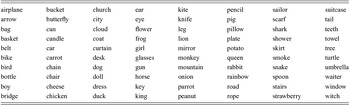
In order to measure L2 proficiency, the children performed an L2 English picture-naming task. For this task, 80 black-on-white line drawings of common objects were chosen (Székely et al., Reference Székely, Jacobsen, D’Amico, Devescovi, Andonova, Herron and Bates2004; see Appendix A). The children were asked to name the objects displayed on the screen as quickly and as accurately as possible in English. Each experimental trial began with a fixation cross being displayed for 1000 ms followed by a picture presented for 5000 ms or until the participant responded. Trial lists were created in a pseudo-random order with the restriction that no more than three items would be displayed in a row that had an identical initial phoneme. Trial lists were counterbalanced across participants. For each participant and each item, mean reaction times and mean accuracies were calculated. An accuracy threshold was set at 20%, below which participants were assumed to have insufficient L2 proficiency to perform the task at hand and were thus excluded from further analyses. This led to 47 children entering the final analysisFootnote 1 . The minimum percentage of correct answers per picture was 30%.
Trials associated with voice-key failures (e.g., mouth clicks, stutters, false starts; 3.1%) and incorrect responses were excluded from the RT analysis. Outliers with reaction times shorter than 200 ms or longer than 2.5 standard deviations above the participant's mean (1.3%) were also excluded. The resulting mean RTs and accuracy scores are presented in Table 1.
As 74 of the 80 stimuli for the picture-naming proficiency task were also used as stimuli in the translation recognition task in Experiment 1, the tasks were counterbalanced across participants to avoid priming effects of having named many of the experimental stimuli beforehand. This meant that half the children who performed the translation recognition task did so after the picture-naming task while the other half did so before the picture-naming task. To test whether the order of tasks had any effect on performance in the translation recognition task, a one-factor ANOVA on the RTs of the word types (correct and incorrect translations) used in the translation recognition task was run with group (participants named pictures before the translation recognition task or participants named pictures after the translation recognition task) as the independent measure. Critically, the analysis yielded no significant main effect of group and no interaction between word type and group, Fs (1, 33) < 1, ps > .30, indicating no difference in performance between those children who had named pictures before and those who had after the translation recognition task.
Materials
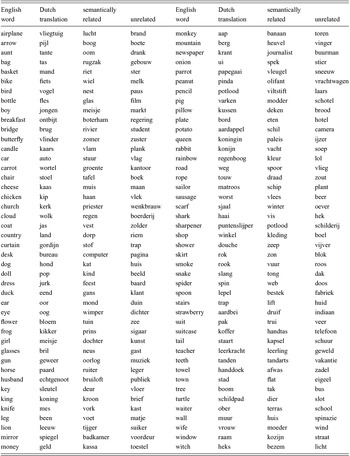
For the translation recognition task, 88 sets of four concrete nouns were created (see Appendix B). The stimuli were chosen from the textbook Real English (Van der Voort & Mol, Reference Van der Voort and Mol1998), which was used in the English language class of the participants. Each set consisted of one correct translation between English and Dutch (duck – eend), one semantically related, incorrect translation (duck – gans [goose]), and one unrelated, incorrect translation (duck – klant [customer]).
The four groups of stimuli (English prime word, Dutch correct translation, Dutch semantically related incorrect translation, Dutch unrelated incorrect translation) were controlled for word length as measured by number of syllables (prime: 1.5, SD = 0.6; translation: M = 1.5, SD = 0.7; semantically related: M = 1.5, SD = 0.6; unrelated: M = 1.6, SD = 0.7), number of letters (prime: M = 5.3, SD = 1.6; translation: M = 5.2, SD = 1.9; semantically related: M = 5.2, SD = 1.5; unrelated: M = 5.4, SD = 1.6), and word frequency (prime: M = 1.6, SD = 0.6; translation: M = 1.6, SD = 0.6; semantically related: M = 1.5, SD = 0.6; unrelated: M = 1.6, SD = 0.4; CELEX database, Baayen, Piepenbrock & Van Rijn, Reference Baayen, Piepenbrock and Van Rijn1993). A one-way ANOVA was run to ascertain that there were no significant differences between the four groups of words in number of syllables, number of letters, and frequency, all ps > .20. None of the correct translation pairs included cognates.
Apparatus and Procedure
The experiment was programmed in E-Prime (Schneider, Eschman & Zuccolotto, Reference Schneider, Eschman and Zuccolotto2002) and conducted on a Pentium computer. Stimuli were presented using black, lower-case letters on a white background. Reaction times were measured using an E-Prime serial response button box (Schneider, Reference Schneider1995).
The children were tested individually and were seated in a quiet room approximately 50cm from the monitor. They were shown 88 word pairs and had to decide as quickly and as accurately as possible whether or not the second word (Dutch) was the correct translation equivalent of the first word (English) by pressing one of two buttons on a serial response button box. The 88 two-word pairs were generated randomly from the 88 four word sets described in the Materials section. This lead to each child being shown 22 correct translations, 22 semantically related, incorrect translations, 22 unrelated, incorrect translations, and 22 correct filler pairs to equalize the number of correct and incorrect translation responses. The experiment was designed in 5 blocks, the first of which being 8 additional practice trials. These practice trials (8 word pairs not used in the 4 experimental blocks; 2 trials from each of the 4 conditions) were used to familiarize the children with the experimental procedure and, if necessary, to give them additional instructions before proceeding. There was an automatic 20-second pause between each of the four experimental blocks of 22 stimuli each.
The experimental trials were structured as follows. A fixation sign was displayed in the center of the screen for 500 ms, followed by a blank screen displayed for 200 ms, followed by a word in L2 English presented for 300 ms, again followed by a blank screen displayed for 200 ms, and finally an L1 Dutch word presented for 3000 ms or until the participant responded. Four trial lists were created in a pseudo-random order with the restriction being that no more than three items would be displayed in a row coming from the same condition. The trial lists were counterbalanced across participants.
Results and Discussion
For each participant and each item, mean reaction times (RTs) and mean percentage of accuracy were calculated for the four conditions. RTs below 250 ms and above 2500 ms as well as those exceeding 2.5 SDs above the mean were treated as outliers and were excluded from the reaction time analysis. Outliers made up 1.2% (SD = 1.5%) in the translation equivalent condition, 2.3% (SD = 2.7%) in the semantically related condition, and 2.2% (SD = 3.4%) in the unrelated condition. As participants were performing a binary choice task, there was a 50% probability of the children giving the right answer by chance. For this reason and in order to ensure that the participants included where sufficiently proficient to generate meaningful data in the task, a sufficiently high but arbitrary accuracy threshold for all conditions was set at 60%. Participants with a score below 60% would not be included in the final analysis. All 47 children entered the final analysis. The data were then analyzed as follows.
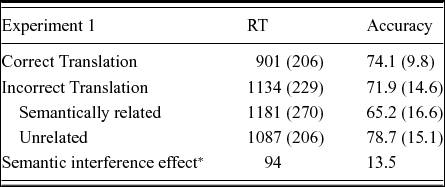
One-factor repeated-measures ANOVAs were performed by participants (F1) and by items (F2) on mean RTs and accuracy rates, with word type (correct translation or incorrect translation) serving as the independent variable. In the participant analyses, word type was treated as a within-participant variable, while in the corresponding item analyses, word type was treated as a within-items factor. To determine whether semantics influenced the children's performance, subsequent ANOVAs on mean RTs and accuracy rates, with word type (semantically related incorrect translation or unrelated incorrect translation) serving as the independent variable, were conducted. The resulting means and SDs are presented in Table 2.
Mean reaction times (in ms) and accuracy rates (in %) for Experiment 1.

Note. Standard deviations are in parentheses. RT = Reaction Times.
* Semantic interference effect calculated by subtracting the reaction times of the unrelated stimuli from those of the semantically related stimuli and the accuracies of the semantically related stimuli from those of the unrelated stimuli.
The RT analysis yielded a significant effect of word type, F1 (1, 46) = 171.60, MSE = 1281211, p < .001, ηp 2 = .79; F2 (1, 87) = 157.70, MSE = 12010, p < .001, ηp 2 = .64. A subsequent ANOVA on the two word types representing the incorrect translations (i.e., the semantically related and unrelated word types) showed that children reacted significantly slower to reject semantically related stimuli than semantically unrelated stimuli (semantic interference effect = 94 ms), F1 (1, 46) = 19.94, MSE = 211625, p < .001, ηp 2 = .30; F2 (1, 87) = 14.43, MSE = 27908, p < .001, ηp 2 = .14.
The accuracy rates analysis yielded no significant effect of word type by-participant, F1 (1, 46) < 1, p > .1, ηp 2 < .10, but did by-item, F2 (1, 87) = 3.96, MSE = 5, p = .042, ηp 2 = .03. The ANOVA including only the critical semantically related and unrelated word types, however, showed a semantic interference effect of 13.5%, both by-participant and by-item, F1 (1, 46) = 56.59, MSE = 76, p < .001, ηp 2 = .55; F2 (1, 87) = 21.50, MSE = 23, p < .001, ηp 2 = .20.
The results obtained in Experiment 1 show that Dutch beginning L2 learners of English with limited L2 instruction were influenced by the semantic manipulation, which indicates that these children at an early stage in their L2 learning are able to access concepts and semantic information directly from the L2.
To test whether differences in quantity of media consumption may have had an impact on whether children performed above or below the proficiency measure exclusion threshold (20% picture-naming accuracy), t-tests were conducted comparing self-reported English media usage (PC games, TV, books) for the 47 included and 13 excluded children. T-tests yielded no significant differences in media usage between groups (ps >.20; PC games: included group = 2.9, SD = 0.7, excluded group = 3.2, SD = 0.7; TV: included group = 3.5, SD = 0.7, excluded group = 3.4, SD = 0.5; books: included group = 1.4, SD = 0.5, excluded group = 1.3, SD = 0.5). Then, to assess whether media usage may have affected how much children access meaning during the translation recognition task, English media usage (PC games, TV, books) was correlated with performance on the semantically related word pairs. The analysis yielded no significant correlations save a marginally significant correlation between the frequency of playing English PC games and the accuracy scores for the semantically related stimuli, r = .25, p = .089.
Finally, to explore the relationship between L2 proficiency (as measured by performance on the L2 picture-naming task) and sensitivity to semantic information, indexed by the magnitude of the semantic interference effect (performance on semantically related word pairs minus that on unrelated word pairs), picture-naming times and accuracy were correlated with the magnitude of the semantic interference effect in Experiment 1. The only significant correlation was between the semantic interference effect indexed by accuracy and L2 picture-naming times, r = −.26, N = 47, p = .042 (all other ps > 1), indicating that participants who were faster at naming pictures in L2 showed a greater semantic interference effect (albeit only in the accuracies). In a subsequent correlational analysis including all 60 children (i.e., also those children excluded due to poor performance on the L2 proficiency measure), significant correlations were found between the semantic interference effect indexed by accuracy and L2 picture-naming accuracy, r = .24, N = 60, p = .035, and the semantic interference effect indexed by accuracy and L2 picture-naming times, r = −.25, N = 60, p = .028. These results hint at a relationship between growing proficiency and stronger L2 word-to-concept mappings as indexed by a greater sensitivity to the semantic interference effect for individuals with higher L2 proficiencies.
The children's performance in Experiment 1 indicated that they were already able to access meaning directly from the L2 words. If the L2 word-to-concept link in these children has already become stronger after 8 months of L2 instruction, then their performance in a translation production task could be used to test the predictions of the RHM concerning forward translation and backward translation. While forward translation was assumed to rely more on conceptual mediation, backward translation was assumed to rely more on lexical mediation. To further explore word-to-concept mapping in these beginning L2 learners, Experiment 2 was run approximately two months after Experiment 1 with the same group of children using a forward and backward translation task.
Experiment 2 – Backward and forward translation
Method
Participants
The same children who took part in Experiment 1 also participated in Experiment 2. To ensure that results from both experiments could be compared, only the 47 participants who had displayed sufficient L2 proficiency in Experiment 1 and whose data had been included in the final analyses were also included in Experiment 2.
Materials
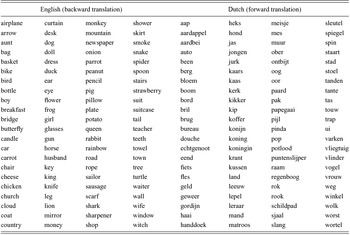
Trial lists of 88 translation pairs between English and in Dutch were created. The stimuli were identical to the stimuli used in Experiment 1 (see Appendix C).
Apparatus and Procedure
The experiment was programmed in E-Prime (Schneider et al., Reference Schneider, Eschman and Zuccolotto2002) and run on a Pentium computer. Reaction times were measured using a microphone that triggered the voice key of an E-Prime serial response button box (Schneider, Reference Schneider1995). Children were asked to translate the word presented on the screen as quickly and as accurately as possible into the target language, speaking into the microphone set before them. The experiment was designed in 5 blocks, the first of which being 8 practice trials. Then, each of the 4 experimental blocks (22 stimuli each) was initiated with the press of a button by the researcher.
Each experimental trial was structured as follows. A fixation sign was displayed for 1000 ms followed by a word for 5000 ms or until the participant responded. The experimenter used the button box to code the participant's utterances and the experiment was digitally recorded for later analysis.
Each child was shown the 88 words in either English or Dutch, which then needed to be translated into the other respective language. Half of the children received the stimuli in L2 English and were asked to translate into L1 Dutch (backward translation), while the other half received the stimuli in L1 Dutch and were asked to translate into L2 English (forward translation). T-tests verified that the two groups did not differ significantly on any of the background measures (see Table 3; all ps > .10). Trial lists were created in a pseudo-random order with the restriction being that no more than three items would be displayed in a row with an identical initial phoneme. Trial lists and language conditions were counterbalanced across participants.
English language use and proficiency measures of participants in the forward and background translation conditions and significance testing p-values for Experiment 2.

Note. Standard deviations are in parentheses. FreqPC = frequency PC games played in English / FreqTV = frequency TV watched in English / FreqBooks = frequency books read in English (7-point Likert scale, 1 = ‘never’ to 7 = ‘daily’) / Prof_RT = Proficiency Measure Reaction Times / Prof _Acc = Proficiency Measure Accuracies
Results and Discussion
For each participant and each item, mean RTs and mean error and omission percentages were calculated for the two conditions. Responses that were not possible translations according to Dutch–English/English–Dutch dictionaries (Martin & Tops, Reference Martin and Tops1984, Reference Martin and Tops1986) were considered errors. An error-omission threshold was set at 60%, above which participants were not included in the final analysis. This led to 42 of the 47 children entering the final analysis (21 participants for the backward translation and 21 participants for the forward translation task)Footnote 2 . Finally, stimuli that were translated above an error-omission threshold of 60% were also eliminated from further analyses, which left 60 of 88 stimuli for the final analyses for both forward and backward translation. Of the 28 excluded items, 23 were identical for both translation directions.
An omission was scored if the children had not responded within the 5000 ms allotted for naming after picture presentation (backward translation = 37.8%, SD = 20.2; forward translation = 24.8%, SD = 13.2). Trials associated with voice-key failures such as clicks and false starts (backward translation = 3.6%; forward translation = 0.6%) and incorrect responses were excluded from the RT analysis. Outliers with RTs shorter than 200 ms or longer than 2.5 SDs above the participant's mean (backward translation = 1.6%; forward translation = 1.7%) were also excluded from the RT analyses.
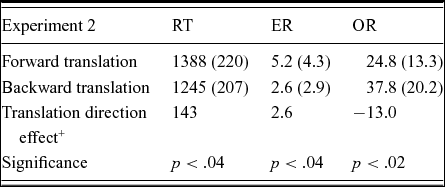
One-factor ANOVAs were performed by participants (F1) and by items (F2) on mean reaction times, on error rates, and on omission rates, with translation direction (forward or backward) serving as independent variable. In the participant analyses, translation direction was treated as a between-participants variable, while in the corresponding item analysis, translation direction was treated as a between-items factor. The resulting means and SDs are presented in Table 4.
Mean response times (in ms), error rates, omission rates (in %), and significance testing p-values for Experiment 2.

Note. RT = Response Times / ER = Error Rates / OR = Omission Rates.
+ Translation direction effect is calculated by subtracting RTs, error rates, and omission rates for backward from forward translation.
The data revealed a significant effect of translation direction for the latencies analysis, F1 (1, 40) = 4.67, MSE = 45827, p = .037, ηp 2 = .11; F2 (1, 118) = 16.26, MSE = 54448, p < .001, ηp 2 = .12, with backward translation being 143 ms faster than forward translation, and for omission rates, F1 (1, 40) = 6.04, MSE = 291, p = .018, ηp 2 = .13; F2 (1, 118) = 9.96, MSE = 504, p = .002, ηp 2 = .08, with 13.0% more omissions in backward translation than forward translation. In contrast, the comparatively low error rates yielded a significant difference in the opposite direction, with 2.6% more errors in forward translation than in backward translation, F1 (1, 40) = 5.05, MSE = 13, p = .03, ηp 2 = .11; F2 (1, 118) = 4.81, MSE = 38, p = .03, ηp 2 = .04.
The participants’ performance indicates that translation direction did have a significant effect, in that backward translation was performed significantly faster and with fewer errors than forward translation, while omission rates were significantly higher for backward than for forward translation. The translation latency results suggest that these children rely more on lexical mediation in the L2 to L1 translation direction and more on conceptual mediation in the L1 to L2 translation direction, which in line with the RHM should be evident in speakers whose L2 is relatively weak (cf. Kroll et al., Reference Kroll, Van Hell, Tokowicz and Green2010)Footnote 3 . The omission results, running counter to those obtained by Van Hell and De Groot (Reference Van Hell and De Groot2008) and to the predictions made in the Introduction, could be interpreted as resulting from the children having remained silent instead of (incorrectly) guessing when they did not know a particular word when translating from L2 to L1. In contrast, when translating from L1 to L2, assuming concept mediation, more conceptual neighbors may have become active, possibly offering more L2 word alternatives to choose from, albeit not necessarily the correct one. Alternatively, given the strong L1 word form-to-concept mapping, the correct concept may have been activated but due to a weak concept-to-L2 word form link, the incorrect L2 word form may have been retrieved. This could explain the higher error rates during translation from L1 to L2, and could be interpreted as a sign of a greater willingness in the children to guess the L2 word than to remain silent.
Finally, the Potter et al. (Reference Potter, So, Von Eckhardt and Feldman1984) predictions, that beginning L2 learners could either be faster translating from L1 to L2 than naming a picture in L2 (as predicted by the word association hypothesis) or that beginning L2 learners could be faster naming a picture in L2 than when translating from L1 to L2 (as predicted by the concept mediation hypothesis), were tested. In other words, task type (L2 picture naming vs. forward translation) was used to further explore the L2 word-concept mappings in beginning learners and whether at these early stages of learning, there is evidence for word mediation or concept mediation during L2 production. For this purpose, the picture naming times (Experiment 1; M = 1557, SD = 294) of only those children who had performed the forward translation task and their forward translation production task RTs (Experiment 2; M = 1388, SD = 220) were compared. An ANOVA on the mean naming latencies with task type (forward translation vs. picture naming) as the independent variable yielded a significant effect of task type, F(1, 20) = 5.44, MSE = 54770, p = .03, ηp 2 = .21, showing significantly faster forward translation times than picture-naming timesFootnote 4 . This outcome is in line with the ‘word mediation’ hypothesis as proposed by Potter et al. (Reference Potter, So, Von Eckhardt and Feldman1984) and corroborates the translation asymmetry in the latency data in Experiment 2. Alternatively, children may be slower in retrieving the L2 word of a concept when this concept is activated by a picture rather than by an L1 word, as we will elaborate on below.
The results we have reported are similar to those reported by Kroll and Curley (Reference Kroll, Curley, Gruneberg, Morris and Sykes1988) and Chen and Leung (Reference Chen and Leung1989) for low proficiency adult learners but run counter to the findings by Chen and Leung who had also compared L2 picture naming with the L1 to L2 translation performance of child beginning L2 learners. They showed that child L2 learners were faster at naming pictures than when translating (‘concept mediation’), while the adult L2 learners were faster when translating than at naming pictures (‘word mediation’), results that the authors assumed to be linked to L1 word decoding difficulties in the children under study and/or to differing L2 word learning methods between child and adult learners.
The results obtained with the children in the present study resemble those of the adults, and not those of the children, in the Chen and Leung (Reference Chen and Leung1989) study. The diverging results with children may have at its base the fact that, while the languages under investigation in the present study, Dutch and English, are alphabetic languages, the languages in the Chen and Leung study were Chinese and French, the former a logographic language. Chen and Leung, who remarked that their findings with children were unexpected and inconsistent with any of their hypotheses, interpreted the children's performance as driven by their need to use the concept-to-L2 word link in the early stages of learning caused by their relatively low proficiency in reading L1 words. In other words, the L2 word-to-L1 word lexical mediation route was rendered ineffective during L2 learning and unlikely to take place by the nature of the L1 in this population. Thus, the language make-up may have been the underlying cause for differing results with children.
In addition, Chen and Leung noted that the prominent learning strategy in child L2 learners in Hong Kong when learning novel L2 words is via pictures – this may have added to an early boosting of the concept-to-L2 word connections, making L2 picture naming in these children an often-repeated and relatively fast task. The Dutch child L2 learners, in contrast, while able to use concept mediation in the translation recognition task (Experiment 1), in translation production still relied more on L1 word-to-L2 word lexical mediation during forward translation (Experiment 2), possibly caused by the fact that they were less used to primarily naming pictures in L2 during L2 learning. Hence, forward translation was lexically mediated from the L1 word form straight to the L2 word form. When naming pictures, however, first the L1 word form was accessed, using the well-developed concept-to-L1 word connection, followed by access to the L2 word via the word-to-word lexical link. The less developed direct concept-to-L2 word connection was thus not exploited yet during translation production. This suggests that variations in word learning methods potentially impact the lexical-semantic routes L2 learners employ during translation tasks, a point we will elaborate upon in the General Discussion.
General Discussion
This study tested predictions made by the RHM (Kroll & Stewart, Reference Kroll and Stewart1994) on the activation of lexical-semantic links during translation recognition and translation production particularly when performed by beginning L2 learners. For this purpose, L1 Dutch 5th graders with 8 months of English instruction performed a translation recognition task and a translation production task.
According to the predictions of the RHM, beginning L2 learners are less likely to activate concepts when they have to translate from L2 to L1, and thus mostly use the lexical link via L1 to access concepts. For this reason, beginning L2 learners should be less sensitive to the meaning of a word in an L2 to L1 translation recognition task than more advanced L2 speakers. To explore this, incorrect word pairs in which the second word was semantically related to the correct translation and incorrect unrelated word pairs were used. According to the RHM, beginning L2 learners should process both types of word pairs similarly, yielding similar naming latencies and accuracies. Contrary to this prediction, the children were slower and less accurate in rejecting semantically related word pairs than unrelated word pairs. This corroborates the findings with adult L2 learners by Sunderman and Kroll (Reference Sunderman and Kroll2006), who interpreted their results by suggesting that even at early stages of learning L2 learners could exploit L2 word form-to-concept mappings.
Given these results, we conclude that Dutch beginning learners of L2 English are able to exploit the L2 conceptual link and thus activate concepts directly when translating from L2 into L1. These results also corroborate those by Comesaña and colleagues (Comesaña et al., Reference Comesaña, Perea, Piñeiro and Fraga2009, Reference Comesaña, Soares, Sánchez-Casas and Lima2012), who found semantic interference effects in child L2 learners and concluded that beginning L2 learners were able to translate similarly to more advanced L2 learners – via the conceptual link. The results of these studies qualify the predictions made by the RHM and run counter to the results obtained with adult learners by Talamas and colleagues (Talamas et al., Reference Talamas, Kroll and Dufour1999; reaction times only) as well as Ferré and colleagues (Ferré et al., Reference Ferré, Sánchez-Casas and Guasch2006), who had found that beginning L2 learners used the lexical link instead of the conceptual link during translation (but see Sunderman & Kroll, Reference Sunderman and Kroll2006). We assume that the critical differences in accounting for the present study's results are the participant groups’ ages and the conditions under which the L2 had been learned. Such effects of conditions of L2 learning on L2 processing have previously been shown in adult learners by Sunderman and Kroll (Reference Sunderman and Kroll2006).
In a second experiment, we examined forward translation (from L1 to L2) and backward translation (from L2 to L1). Whenever beginning L2 learners need to translate from L2 to L1 (backward translation), the RHM predicts that this should be faster and more accurate than when translating from L1 to L2 (forward translation). According to the RHM, this asymmetry is most prominent in beginning L2 learners, as in these individuals there is a direct link from L2 to L1, but an indirect link from L1 to L2. Translating from L1 into L2 uses the indirect link via the concept. To test this asymmetry, we used a translation production task. The children showed exactly this asymmetry in translation latencies – they were slower in forward than in backward translation.
A possible alternative explanation for the translation production results is that it was more difficult for these children learning English to produce L2 phonology. On the basis of the present findings alone, we cannot determine the contribution of relatively weaker phonology in the L2 than the L1 to the present results. On the one hand, if the slower times to translate in the forward than backward direction of translation was due to difficulty in producing the L2, then the results across the two experiments may not be as conflicting as we have presented them. On the other hand, given that the forward translation latencies were shorter than those in L2 picture naming, future research may need to focus on specific effects of retrieving L2 phonology in picture naming compared to forward translation.
The translation recognition findings indicate that the beginning L2 learners can exploit the conceptual link between L2 word form and concepts, but the results on the backward translation production task suggest that the L2 learners may also exploit lexical-level links. Which route becomes more prominent during translation is likely related to specific task demands in translation recognition and translation production. The translation recognition task is perceptual in nature and no verbal response is necessary. In the translation production tasks, in contrast, participants need to actively give a verbal response, which require the participants to access their lexicon and retrieve lexical items for production. La Heij et al. (Reference La Heij, Hooglander, Kerling and Van der Velden1996), who had found concept mediation in both translation directions in their study, assumed that word translation was made up of two processes: activation of the concept followed by word retrieval. The difficulty in backward translation, they reasoned, lay in concept activation, whereas the difficulty in forward translation lay in L2 word retrieval. These two processes may have a differential effect on an L2 learner's translation performance. In the present study, L2 word retrieval difficulties may have slowed down forward translation, whereas difficulties in accessing the conceptual store in backward translation when unknown L2 words were presented may have caused the children to remain silent. This would explain the higher omission rates in backward translation.
One important finding of the present work is that already at an early stage, Dutch beginning L2 learners of English can exploit L2 word form-to-concept mappings and access the meaning of an L2 word in a direct way without mediation of the L1 word. This finding differs from some earlier findings with adult beginning L2 learners (Talamas et al., Reference Talamas, Kroll and Dufour1999; Ferré et al., Reference Ferré, Sánchez-Casas and Guasch2006; but see Altarriba & Mathis, Reference Altarriba and Mathis1997, and Sunderman & Kroll, Reference Sunderman and Kroll2006). A possible reason for this finding is that the children in the present study were taught with an L2 learning method that fostered L2 word-to-concept mapping. The method used in the English lessons of the children in this study, Real English (Van der Voort & Mol, Reference Van der Voort and Mol1998), focuses most prominently on listening to spoken English, repeating of spoken English and repeating new words. It is, incidentally, the method most commonly used nowadays in Dutch primary schools in the Netherlands (Periodieke Peiling van het Onderwijsniveau [periodic poll on education levels], Heesters, Feddema, Van der Schoot & Hemker, Reference Heesters, Feddema, Van der Schoot and Hemker2008). In this method, much less stress is placed on translating Dutch words into English via paired associate learning, which would strengthen L2 word to L1 word form connections, but more on the integration of L2 words in a meaningful context, which fosters the development of L2 word form-to-concept connections.
Moreover, any language in a child's environment besides the native language, and particularly the soon-to-be-learned L2, may have an effect on later foreign language acquisition. Even though all children participating in the experiments spoke only Dutch at home, they grew up in a language environment in which English is ubiquitous in the media, particularly in the form of original English-language movies and series being aired with Dutch subtitles instead of dubbed versions, a practice that is common in other European countries such as Germany and Italy. Although our correlational analysis did not yield a strong relationship between media exposure and L2 proficiency or magnitude of the semantic interference effect, Koolstra and Beentjes (Reference Koolstra and Beentjes1999) – in a study aimed at exploring the exposure of Dutch children to L2 English via the media and its impact on building a basic L2 vocabulary and L2 language learning – showed that Dutch children who watched a television program with an English-language soundtrack and Dutch subtitles had a larger English vocabulary than children who watched an English-language program without subtitles. For this reason, fifth-grade Dutch children, when they start receiving English lessons at school, may actually be more advanced in their L2 learning than L2 learners who have never had any exposure prior to learning the language. This could explain the children's performance in the present study in the translation recognition task being comparable to more advanced L2 learners’ performances found in earlier studies. Future research may more systematically study the relation between prior exposure to English and the development of L2 word-to-concept mappings.
Finally, future research may also attempt to move beyond using nouns exclusively (as done by, e.g., Altarriba & Mathis, Reference Altarriba and Mathis1997; Brenders et al. Reference Brenders, Van Hell and Dijkstra2011; Chen & Leung, Reference Chen and Leung1989; Comesaña et al., Reference Comesaña, Perea, Piñeiro and Fraga2009, Reference Comesaña, Soares, Sánchez-Casas and Lima2012; De Groot et al., Reference De Groot, Dannenburg and Van Hell1994; Ferré et al., Reference Ferré, Sánchez-Casas and Guasch2006; Finkbeiner & Nicol, Reference Finkbeiner and Nicol2003; Guo et al., Reference Guo, Misra, Tam and Kroll2012; Kroll & Curley, Reference Kroll, Curley, Gruneberg, Morris and Sykes1988; Kroll et al., Reference Kroll, Michael, Tokowicz and Dufour2002; Kroll & Stewart, Reference Kroll and Stewart1994; La Heij et al., Reference La Heij, Hooglander, Kerling and Van der Velden1996; Potter et al., Reference Potter, So, Von Eckhardt and Feldman1984; Sunderman & Kroll, Reference Sunderman and Kroll2006; Talamas et al., Reference Talamas, Kroll and Dufour1999; Tonzar et al., Reference Tonzar, Lotto and Job2009; Van Hell & De Groot, Reference Van Hell and De Groot1998a, Reference Van Hell and De Groot1998b) to test the development of L2 word form-to-concept mappings and use other word categories such as, for example, verbs. Nouns and verbs are assumed to be processed differentially due to differences in their underlying syntactic and semantic information (e.g., Federmeier, Segal, Lombrozo & Kutas, Reference Federmeier, Segal, Lombrozo and Kutas2000). Recent research with highly-proficient, adult Dutch–English bilinguals by Bultena, Dijkstra and Van Hell (Reference Bultena, Dijkstra and Van Hell2013; Reference Bultena, Dijkstra and Van Hell2014; see also Van Hell & De Groot, Reference Van Hell and De Groot1998b) offers corroborating evidence that verbs and nouns are processed differently. Thus, exploring the learning of words from different word classes, which may follow different paths regarding how they are integrated into the mental lexicon, may yield more fine-grained information on the development of word form-to-concept mappings in L2 learners.
In conclusion, the findings of the present study offer new insights to the question of how child classroom L2 learners integrate novel L2 word forms into their mental lexicon, and how they connect novel L2 words to concepts and to word forms in the L1. The results from the translation recognition task, a comprehension task in which no verbal response is required, show that even beginning L2 learners activate concepts. With changed task demands in the translation production task, however, they rely more on the lexical link and less on the conceptual link particularly during backward translation. During backward translation production, after reading the L2 word, the L1 lexicon needs to be accessed and lexical items need to be retrieved before production takes place. Thus, the results obtained indicate that child beginning L2 learners are able to exploit conceptual and lexical links depending on the contextual task demands, possibly also influenced by the language learning context (cf., Van Hell & Kroll, Reference Van Hell, Kroll, Altarriba and Isurin2013).
List of stimuli used in the L2 picture-naming proficiency measure (Experiment 1)

List of stimuli used in Experiment 1

List of stimuli used in Experiment 2