Introduction
Significant depressive symptoms are common in persons with dementia (PWD), ranging from more than 20% to 50% (Snow et al., Reference Snow2005; Kessing et al., Reference Kessing, Harhoff and Andersen2007; Bergdahl et al., Reference Bergdahl, Allard and Gustafson2010; Lucas-Carrasco et al., Reference Lucas-Carrasco, Lamping, Banerjee, Rejas, Smith and Gómez-Benito2010). This wide range might reflect the result of the different screening scales used for detection of symptoms. Many of these scales were designed for use in other patient populations. PWD with depression have more chronic medical conditions (Bartels et al., Reference Bartels2003; Lee and Lyketsos, Reference Lee and Lyketsos2003; Teng et al., Reference Teng2008) and worst quality of life (QoL) (Hurt et al., Reference Hurt2008; Lucas-Carrasco et al., Reference Lucas-Carrasco, Lamping, Banerjee, Rejas, Smith and Gómez-Benito2010; 2011). Also, depression in PWD predicts long-term care placement (Gaugler et al., Reference Gaugler, Yu, Krichbaum and Wyman2009). However, comorbid depression often goes undetected and therefore untreated (Lee and Lyketsos, Reference Lee and Lyketsos2003; Kessing et al., Reference Kessing, Harhoff and Andersen2007; Teng et al., Reference Teng2008). Thus, screening for depression and the correct diagnosis of depression in PWD are important, because depression can be treated successfully in most cases with pharmacological and/or non-pharmacological therapies, improving behavioral and functional capacities (Lyketsos and Olin, Reference Lyketsos and Olin2002).
The European Alzheimer Disease Consortium (EADC) (Diaz et al., Reference Diaz2005) underlines the need for a consensus in the use of assessment tools for dementia in centers in Europe. In the UK, the National Institute for Health and Clinical Excellence (NICE) recommends including detection of depression when assessing PWD. Also, in the USA, the National Alzheimer's Coordinating Center (NACC), which coordinates information from all the Alzheimer's disease centers (ADCs), requires the assessment of depression in PWD (Beekly et al., Reference Beekly2004). The Geriatric Depression Scale 15-item version (GDS-15) (Sheikh and Yesavage, Reference Sheikh and Yesavage1986) is used to inquire about symptoms of depression from ADC participants. The GDS-15 was developed as a self-report instrument to screen for clinical depression in older adults. Compared with other depression rating scales, it excludes certain somatic symptoms which might be due to medical illness, and focuses on the psychological symptoms of depression. The GDS-15 uses a simple response format (yes/no), which facilitates easier use by individuals with impaired cognitive functions (Sheikh and Yesavage, Reference Sheikh and Yesavage1986). Validation of the GDS-15 and GDS-30 has been carried out in PWD (Müller-Thomsen et al., Reference Müller-Thomsen, Arlt, Mann, Mass and Ganzer2005; Kørner et al., Reference Kørner2006; Debruyne et al., Reference Debruyne2009). The main objective of this study was to investigate the reliability and validity of the Spanish version of the GDS-15 and its shorter version GDS-5 in PWD.
Methods
Procedure
Centers providing care for PWD (diagnostic dementia units and day hospitals) were contacted and PWD and their caregivers were invited to participate. At each participating center, a psychologist administered the questionnaire which contained information about perception of health, functional status, QoL, depressive symptoms, and sociodemographic information. The Ethics Committee of the Autonomous University of Barcelona approved the study protocol; all PWD and caregivers provided written informed consent.
Participants
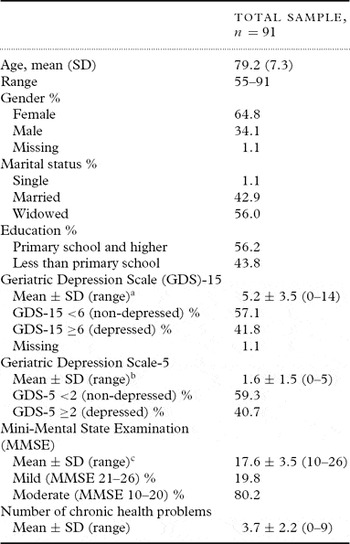
The sample consisted of 91 community dwelling PWD of whom 56 had Alzheimer's disease (AD), 14 had vascular dementia, 14 had mixed dementia, and 7 were diagnosed with dementia not otherwise specified (NOS) (Diagnostic and Statistical Manual of Mental Disorders, Axis I) (DSM-IV) (American Psychiatric Association, 1994). Based on the Mini-Mental State Examination (MMSE) (Folstein et al., Reference Folstein, Folstein and McHugh1975), 19.8% persons had mild dementia (MMSE 21–26) and 80.2% had moderate dementia (MMSE 10–20). The mean MMSE score was 17.6 (SD ± 3.5; range 10–26). Persons with severe dementia (MMSE <10), and persons with seeing, hearing, and communication problems were not invited to participate in the study. The mean age was 79.2 years (SD ± 7.3); 64.8% were female (see Table 1). Sample size was calculated according to the recommended minimum of a 4:1 ratio of number of subjects to number of test items (Kline, Reference Kline and Kenny1998).
Participant characteristics: socio-demographic and health status information

SD = Standard Deviation; aGeriatric Depression Scale-15: range 0–15; bGeriatric Depression Scale-5: range 0–5; cMini-Mental State Examination: range 0–30.
Measures
Geriatric Depression Scale (GDS)-15 (Sheikh and Yesavage, Reference Sheikh and Yesavage1986) is a 15-item scale that measures depressive symptoms. Answers are reported on a yes/no scale; total score ranges from 0 to 15 where high scores indicate more severe depression. A cut-off score of 6 was used to divide the sample into non-depressed (GDS-15 <6) and depressed (GDS-15 ≥6) participants. The GDS-15 and GDS-5 validated in Spanish in persons from primary care were used (Martínez de la Iglesia et al., Reference Martínez de la Iglesia, Onís Vilches, Dueñas Herrero, Aguado Taberné, Albert Colomer and Arias Blanco2005). The Spanish version of the GDS-5 includes items 3, 4, 5, 8, and 13; a cut-off score of 2 was used to divide the sample into non-depressed (GDS-5 <2) and depressed (GDS-5 ≥2) participants (Martínez de la Iglesia et al., Reference Martínez de la Iglesia, Onís Vilches, Dueñas Herrero, Aguado Taberné, Albert Colomer and Arias Blanco2005).
Cornell Scale for Depression in Dementia (CSDD) (Alexopoulos et al., Reference Alexopoulos, Abrams, Young and Shamoian1988) is a 19-item scale that measures depression in PWD after a joint interview with the patient and caregiver. Items are reported on a 3-point scale and are grouped into “mood and related signs,” “behavioral disturbance,” “cyclic function and ideational disturbance,” and “physical signs.” Nine or more points indicate a depressive disorder.
World Health Organization Quality of Life (WHOQOL-BREF) is a 26-item generic QoL questionnaire comprising 24 items assessing four domains (physical health, psychological health, social relationships, and environment) plus two unscored questions about overall QoL and health. Each item is answered on a 5-point scale; domain scores ranged from 4 to 20, with high scores representing higher QoL (Lucas-Carrasco, Reference Lucas-Carrasco1998). The Spanish version shows good psychometric properties in PWD (Lucas-Carrasco et al., Reference Lucas-Carrasco, Skevington, Gómez-Benito, Rejas and March2011).
Barthel Index (BI) (Mahoney and Barthel, Reference Mahoney and Barthel1965) is a 10-item measure of disability based on daily activities (bathing, transfer, dressing, feeding, mobility, stairs, toilet use, and grooming). Scores range from 0 to 100. Lower scores are associated with worse functional status.
Mini-Mental State Examination (MMSE) (Folstein et al., Reference Folstein, Folstein and McHugh1975) is a measure of dementia severity; the lower the MMSE scores, the more severe the dementia. It is the most common measure of severity used to assess PWD in Spain. Following the hypothesis that cognitive impairment could influence the validity of depression scales used, the sample was divided into mild (MMSE 21–26) and moderate (MMSE 10–20) dementia.
In addition, sociodemographic information (i.e. gender, age, marital status, and education), and subjective perception of health (in general, do you consider yourself to be currently healthy/in good health or unhealthy/ill?) was gathered from the participants.
The diagnosis of dementia, assessed by a neurologist, was obtained by chart review. Assessment of the MMSE was done one to five days prior to participation in the study.
Analysis
Test for reliability
Internal consistency reliability was assessed using Cronbach's α coefficient. An α value of ≥0.70 was specified as the criterion for acceptable internal consistency (Cohen, Reference Cohen1988).
Tests for validity
To evaluate convergent validity the relationship between the GDS-15/GDS-5 and CSDD, WHOQOL-BREF domains and questions related to frequency of negative symptoms (“How often do you have negative feelings such as blue mood, despair, anxiety, depression?” (Never, seldom, quite often, very often, always), Barthel Index, and the number of chronic medical conditions were examined. As the GDS-15 does not include functioning items, it was expected that no significant association between the GDS-15/GDS-5 and Barthel Index would be found. Low correlation coefficients between the GDS-15/GDS-5 and the total number of chronic medical conditions, and high correlations between the GDS-15/GDS-5 and CSDD, the question related to frequency of negative symptoms, and the WHOQOL-BREF psychological domain were anticipated. It was hypothesized that a higher level of depression would correlate with lower QoL. Spearman correlation analyses were performed to explore related factors. A p-value < 0.05 was regarded as statistically significant.
To assess contrasting group differences, we compared mean GDS-15 and GDS-5 scores for subgroups of participants defined on the basis of dementia severity (mild vs. moderate), self-reported depression on the comorbid condition list (yes vs. no), and groups of dementia. We also examined changes of the GDS-15/GDS-5 scores in item 26 of the WHOQOL-BREF, “How often do you have negative feelings such as blue mood, despair, anxiety, depression?” (Never, seldom, quite often, very often, always). We expected an increase of symptoms with increasing reported frequency of negative feelings. Independent t-tests were performed to examine group differences. ANOVA and post hoc Scheffé test were used to distinguish differences among diagnostic groups. A p-value of <0.05 was regarded as statistically significant.
Finally, factor analysis was used to determine the factorial structure of the GDS-15 and GDS-5. The Kaiser–Meyer–Olkin statistic (KMO) and the Bartlett test of sphericity were used to test if there was underlying structure to the data; it required a KMO >0.5 and a significant Bartlett test. We used principal components as extraction method and used factor loadings ≥40 as a criterion to define a “salient” factor loading with Varimax rotation. All statistical calculations were performed with SPSS for Windows v15.0 (SPSS v15.0 for Windows; SPSS, Inc., Chicago, IL).
Results
Sample characteristics
Forty-two percent of participants had significant depressive symptoms as measured by the GDS-15 (≥6), with scores ranging from 0 to 14 (mean = 5.2; SD: 3.5). We did not find significant differences on the GDS-15 scores between males (5.2 ± 3.4) and females (5.4 ± 3.6) (t(87) = –0.297, p = 0.767) or on the GDS-5 where the score for males was 1.5 ± 1.5 and 1.6 ± 1.5 for females (t(88) = –0.463, p = 0.644). Similarly, we did not find significant differences between married (5.2 ± 3.5) and widowed (5.2 ± 3.5) on the GDS-15 scores (t(87) = –0.046, p = 0.963) or on the GDS-5 (t(89) = –0.368, p = 0.714). In addition, no differences were found on the rate of depression between persons with mild and moderate dementia, or on GDS-15 (χ 2 (1 df) 1.924, p = 0.165) nor on the GDS-5 (χ 2 (1) = 3.161, p = 0.075) (data not shown).
Two-thirds of PWD reported themselves as healthy or in good health, though 92.6% reported having one or more additional chronic health conditions: hypertension (n = 42), heart problems (n = 26), lung problems (n = 22), stomach/intestinal problems (n = 11), neurological problems (n = 24), arthritis (n = 53), diabetes (n = 25), thyroid problems (n = 9), kidney problems (n = 10), depression (n = 37), cancer (n = 4), hearing problems (n = 26), eye problems (n = 36), and other (n = 9). Sociodemographic and health status information are shown in Table 1.
Internal consistency reliability
On the GDS-15, internal consistency reliability as measured by Cronbach's α was 0.81, indicating good internal reliability. Item-total correlations ranged from 0.13 to 0.65 (mean 0.35). To examine the impact of cognitive impairment on internal consistency, the sample was divided into mild and moderate dementia. Cronbach's α were 0.75 and 0.82 in the mild and moderate groups, respectively. On the GDS-5, Cronbach's α for the total sample was 0.72, and 0.63 and 0.73 in the mild and moderate group, respectively.
As reliability of criteria affects the validity coefficient, the reliability of the CSDD used as criteria for validation was previously calculated. The Cronbach's α coefficient of the CSDD total scale was 0.84.
Validation
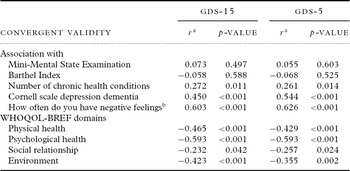
No significant associations were found between GDS-15 total score and Barthel Index (r = –0.058, p = 0.588), and MMSE (r = 0.073, p = 0.497). GDS-15 was significantly correlated with increasing number of chronic health conditions (r = 0.272, p = 0.011), CSDD (r = 0.450, p < 0.001), and the question about “How often do you have negative feelings” (r = 0.603, p < 0.001). The GDS-15 showed significant negative correlations with all WHOQOL-BREF domains; the highest correlation was found with the psychological domain. Similar results were found for the GDS-5 (Table 2). In persons with moderate dementia, correlations between GDS-15/GDS-5 and CSDD scores were moderate-high (r = 0.495, p < 0.001; and r = 0.587, p < 0.001, respectively).
Evidence of validity of the GDS-15 and GDS-5

aRho Spearman correlation; bHow often do you have negative feelings such as blue mood, despair, anxiety, depression?
Contrasting groups
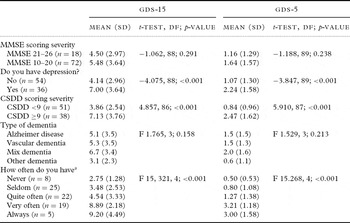
GDS-15 scores showed the predicted pattern among a priori defined groups. There were no significant differences on GDS-15 scores between participants with mild (MMSE 21–26) and moderate dementia (MMSE 10–20) (t = –1.062, 88 df; p = 0.291). PWD reporting not having depression (“No”) on the list of chronic health conditions had statistically significant lower depressive symptoms than those reporting having depression (“Yes”) (t(88) = –4.075, p < 0.001). As anticipated, as the frequency of negative feelings increased, GDS-15 scores also increased. Similar results were found for the GDS-5 (Table 3). We did not find significant differences on GDS-15/GDS-5 scores between diagnostic groups (Table 3).
Evidence of validity of the GDS-15 and GDS-5: contrasting group differences

a How often do you have negative feelings such as blue mood, despair, anxiety, depression?
MMSE = Mini-Mental State Examination; CSDD = Cornell Scale for Depression in Dementia
Dimensionality
The KMO statistic was greater than 0.5 and the Bartlett test of sphericity was significant (p < 0.05) indicating an underlying structure in the GDS-15. A first analysis, following the “eigenvalue greater than 1” rule, showed a four-factor structure accounting for 57.7% of the variance, but there was one factor containing only two relevant loadings. A three-factor solution accounted for 50.5% of the variance, but five items loaded ≥0.40 on two factors. Finally, we tested a two-factor solution which accounted for 41.6% of the variability. A first factor was defined by primary and salient loadings from negative and positive affect items (items 1, 3–11, and 14), and a second factor by primary and salient “mixed” items (items 2, 12, 13, and 15). All items loaded more than 0.40, with exception of item 9. Do you prefer to stay at home, rather than going out and doing new things? and 10. Do you feel you have more problems with memory than most? which loaded <0.40 (0.34 and 0.22, respectively). For the GDS-5 a unique factor solution was found which accounted for 48.1% of the variability. All items loaded more than 0.40.
Discussion
This study examined the reliability and validity of self-reported depression in Spanish persons with mild and moderate dementia. Both versions, GDS-15 and GDS-5 showed good reliability and evidence of validity. The internal consistency was acceptable, except for the lower value found on the GDS-5 in persons with mild dementia.
The prevalence of depression (GDS-15 ≥6) was 40.6%, similar to the range of 30%–40% reported in previous studies (Garre-Olmo et al., Reference Garre-Olmo2003; Lee and Lyketsos, Reference Lee and Lyketsos2003; Teng et al., Reference Teng2008). Previous studies reported different rates of depression, with higher rates in persons with mild dementia (Müller-Thomsen et al., Reference Müller-Thomsen, Arlt, Mann, Mass and Ganzer2005). However, this study found no significant differences between persons with mild and moderate dementia on depression rates, nor on the GDS-15 or on the GDS-5. Given that depressive symptoms/depression are more prevalent among females, we examined gender differences; however, no significant differences were found.
The present results do not support findings from previous studies that showed a decrease of internal consistency in persons with moderate dementia compared to persons with mild dementia (Müller-Thomsen et al., Reference Müller-Thomsen, Arlt, Mann, Mass and Ganzer2005; Debruyne et al., Reference Debruyne2009). In contrast, our results show a higher internal consistency in persons with moderate dementia. However, the number of persons with mild dementia compared to moderate dementia was smaller. Debruyne et al. (Reference Debruyne2009) using the CSDD as “gold standard” found weak correlations between GDS-30 and CSDD scores in AD patients and reported that the GDS-30 was not a reliable screening tool for depressive symptoms in patients with AD. Furthermore, higher validity for the CSDD compared to the GDS-15 has been reported in PWD (Lam et al., Reference Lam, Lim, Low, Ng, Chiam and Sahadevan2004; Kørner et al., Reference Kørner2006). However, we found moderate to high correlations between GDS-15/GDS-5 and CSDD scores for the total sample, as well as in persons with moderate dementia (r = 0.587 between GDS-5 and CSDD and r = 0.495 between GDS-15 and CSDD). Low but statistically significant correlations were found between the GDS-15/GDS-5 and the total number of chronic medical conditions; as expected, these correlations were lower than those found between GDS and similar constructs (e.g. CSDD and WHOQOL-BREF Psychological health). An association between depressive symptoms/depression and physical comorbidities has been reported in adult and elderly persons without dementia (Bech et al., Reference Bech2003; Lacruz et al., Reference Lacruz2012).
Thus, our results support the finding that the Spanish versions of GDS-15 and GDS-5 are reliable instruments in persons with mild and moderate dementia. This is of interest to professionals working in primary care as well as in specific health and social centers providing care for PWD because short depression screening facilitates its use more frequently. In addition, compared to the CSDD, GDS-15 and GDS-5 are self-administered scales and do not require an informant to complete it. For this reason, the GDS-15 and GDS-5 might be useful as an alternative to measure depressive symptoms in PWD when no informant is available.
An interesting finding not previously reported in PWD which shows that PWD are able to provide reliable assessments of their own subjective states (Weintraub et al., Reference Weintraub, Xie, Karlawish and Siderowf2007; Lucas-Carrasco et al., Reference Lucas-Carrasco, Lamping, Banerjee, Rejas, Smith and Gómez-Benito2010; 2011; Waldorff et al., Reference Waldorff, Nielsen and Waldemar2010) is that as PWD reported higher frequency of negative feelings on question 26 of the WHOQOL-BREF, GDS-15 scores increased. This finding might be also helpful for social and health professionals when asking PWD about their health.
The two-factor structure found on the GDS-15 appears clinically meaningful, although replication of this study in larger samples would be desirable. Weintraub et al. (Reference Weintraub, Xie, Karlawish and Siderowf2007), comparing patients with Parkinson's and AD, found a four-factor solution in patients with AD, most of whom had mild AD.
Study limitations
Participants were not administered a structured clinical interview to diagnose depression; however, we used the CSDD using a cut-off score of 9 as a CSDD total score of 8/9 or more suggests significant depressive symptoms (Burns et al., Reference Burns, Lawlor and Craig2004). Test–retest reliability of the GDS-15 was not assessed. Participants were living at home and had a known caregiver so we cannot transfer these results to other populations, for example, PWD without a known caregiver, living in institutions, or with severe dementia. Finally, the mild dementia group included a rather small number of persons compared to the number of PWD included in the moderate group.
In conclusion, these results show that the Spanish versions of the GDS-15 and GDS-5 are reliable and valid screening measures for depressive symptoms in PWD. To our knowledge, this is the first study assessing the psychometric properties of the Spanish version of the GDS-15 in PWD. Thus, these results are of clinical relevance for professionals caring for PWD; however, further studies and replication of these findings, including larger samples of persons with mild dementia, are recommended.
Conflict of interest
None.
Acknowledgments
The author is grateful to all PWD who participated in the study and their caregivers who allowed their family members to participate. Pfizer sponsored the field trial work for this study and funds were used to pay interviewers at each participating center. Special thanks to Dr. Brenda L. Den Oudsten for the editing of the paper and comments.