Introduction
Extrafloral (EF) nectar mediates defensive mutualisms in many plant populations (Koptur Reference Koptur2005). Meta-analyses support that, in general, ant visitation to plants expressing EF nectaries benefits plants by reducing herbivory (Chamberlain and Holland Reference Chamberlain and Holland2009; Rosumek et al. Reference Rosumek, Silveira, Neves, Barbosa, Diniz and Oki2009: Trager et al. Reference Trager, Smriti, Hostetler, Andrade, Rodriguez-Cabal and McKeon2010). The quantity and quality of food rewards provided by the plant can affect the strength of defensive mutualisms. For example, ant visitation was positively associated with EF nectar availability across several experimental studies (e.g., Rudgers Reference Rudgers2004; Rudgers and Strauss Reference Rudgers and Strauss2004; Kost and Heil Reference Kost and Heil2005; Chamberlain and Holland Reference Chamberlain and Holland2008), and an increase in EF nectar secretion was associated with reduced leaf damage and increased fruit set by lima bean (Phaseolus lunatus Linnaeus; Fabaceae) (Heil Reference Heil2004). Variation in the rate of EF nectar secretion occurs in response to environmental cues. Defoliation, application of jasmonic acid, and exposure to volatile organic compounds from damaged neighbours have been shown to increase the rate of EF nectar secretion across a broad range of EF nectary-bearing plant species (Heil Reference Heil2011), and drought stress has been shown to reduce EF nectar secretion rate in a smaller number of species (Yamawo et al. Reference Yamawo, Hada and Suzuki2012; Newman and Wagner Reference Newman and Wagner2013).
Quaking aspen (Populus tremuloides Michaux; Salicaceae) expresses EF nectaries on a subset of its leaves (Doak et al. Reference Doak, Wagner and Watson2007). Extrafloral nectaries appear to function as an indirect defence against herbivory for boreal aspen, as EF nectary expression by ramets is negatively related to damage by the leaf miner Phyllocnistis populiella Chambers (Lepidoptera: Gracillariidae) (Mortensen et al. Reference Mortensen, Wagner and Doak2011). EF nectar secretion by aspen plants varies in response to environmental stimuli. In a greenhouse experiment, 40% defoliation increased the EF sugar secretion rate by about 25%, whereas drought decreased the secretion rate of some aspen genotypes by a similar magnitude (Newman and Wagner Reference Newman and Wagner2013).
The goals of this study are twofold. First, we test how ants respond to variation in the availability of aspen nectar of realistic magnitude. Second we compare the attractiveness of different aspen genotypes to ants.
Materials and methods
Experimental design
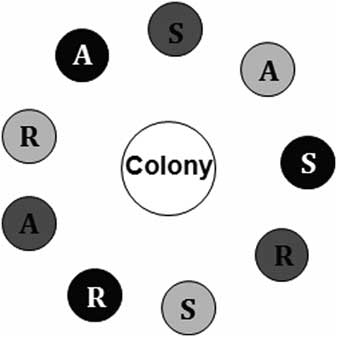
We tested the effects of variation in extrafloral nectar availability and plant genotype by monitoring visitation by free-living ants to experimentally-manipulated potted plants. The experiment took place in a naturally occurring aspen stand within a 0.14 ha plot on the University of Alaska Fairbanks campus (centre of plot: (64.857225°N, 147.859760°W). Potted aspen plants of three genotypes were used in the study (17–18 per genotype, n=52 total). Potted aspen ramets were propagated from root stock in 2010 and 2011. They occupied 2 L containers and were 0.5–1.0 m tall. Ramets were randomly assigned to one of three treatments: reduced nectar, supplemented nectar, or unmanipulated nectar (control). We measured the responses of the ant species that most commonly visited aspen at the study site, Formica fusca Linnaeus (Hymenoptera: Formicidae). Formica fusca is a widespread species with a range that overlaps that of aspen in Canada and the mountain regions of the United States of America (Francoeur Reference Francoeur1973). We located six F. fusca colonies at least 10 m apart and observed the movements of workers to identify the location of the most frequently used entrance to each colony. Around each focal ant colony, we arranged in a circle one aspen ramet from each combination of genotype and treatment (n=9 ramets). Potted ramets were arranged in a circle, each 1 m from the colony entrance (Fig. 1). Each pot was sunk into the ground with the lip of the pot at surface level. The arrangement of the genotype×treatment combination was constant across colonies, but the orientation varied randomly among colonies. During the experiment, ramets were watered as necessary, approximately every other day.
Example of an experimental array of aspen ramets around a central ant colony. R, S, and U represent reduced, unmanipulated, and supplemented nectar treatments, respectively. Shades of grey denote different aspen genotypes.

We conducted a census of each aspen ramet three times each day, at 12:00, 03:00, and 06:00 PM, to count the number and species of ants present. No counts were made during rain. During a census, each ramet was observed for ~30 seconds, while the observer moved around the plant to view it from a variety of angles.
Ramets in the supplemented nectar treatment received repeated applications of an artificial nectar solution. We applied 2 µL of the artificial nectar solution to the site of EF nectaries on the two most proximal leaf positions of the lowest six shoots (12 supplemented leaves per ramet). This selection of leaf locations for supplementation was intended to maximise the discovery of the extra sugar by foraging F. fusca workers. The solution contained 95 g/L sugar made up of equal parts fructose, glucose, and sucrose. The quantity of sugar in artificial nectar was based on the mean plus two standard deviations of daily sugar secretion by aspen leaves bearing EF nectaries, determined from a preliminary study (n=229 leaves from 35 ramets; J.R.N. and D.W., personal observation). The artificial nectar solution was re-injected onto EF nectaries every three days between 07:00 and 07:30 AM for the duration of the experiment, resulting in an average increase in sugar availability of 63 µg sugar per leaf per day, and a total increase of 760 µg sugar per ramet per day. This constitutes a 110% increase in sugar availability on leaves with supplemented nectar, and approximately a 10% increase in total sugar secretion for ramets of this size (J.R.N. and D.W., personal observation).
Ramets in the reduced nectar treatment received a drop of fabric glue (Aleene’s OK to Wash-It; Duncan Enterprises, Fresno, California, United States of America) on top of the EF nectaries at the two most proximal leaf positions bearing EF nectaries on all shoots. Based on the total number of nectary-bearing leaves on experimental ramets at the start of the experiment, this treatment corresponded to about a 50% reduction in total nectar sugar availability per ramet. We imposed a more extreme level of nectar reduction than nectar addition because previous work showed that, at least in this geographic area, ants and other arthropods were relatively insensitive to even extreme levels of aspen nectar reduction (Mortensen et al. Reference Mortensen, Wagner and Doak2013). To control for any unintended effects of glue on ant behaviour, ramets in supplemented and unmanipulated nectar treatments received a drop of glue next to the EF nectaries on the two most proximal EF nectary-bearing leaf positions on all shoots. We allowed the glue to dry for 24 hours before placing ramets at the study site.
We conducted two trials of the experiment. The first trial (hereafter the early-summer trial) lasted for 18 days beginning 18 June, for a total of 50 censuses per ramet. The second trial (hereafter the mid-summer trial) lasted for 12 days beginning 14 July, for a total of 33 censuses per ramet. Between trials, ramets were removed from the experimental plots and returned to the greenhouse garden. During the period between trials, ramets were fertilised with aqueous fertiliser and all experimental ramets were checked to ensure that glue treatments had remained intact. Before the start of the mid-summer trial, we constructed “bridges” from within 5 cm of the central colony entrance to the rim of the pot of each ramet in an attempt to facilitate ant visitation to plants. Bridges were made from naturally occurring dead twigs from the surrounding area. For the mid-summer trial, experimental ramets were replaced at the same F. fusca colonies and in the same positions around the colony as in the early summer trial.
Aphids (Hemiptera: Aphididae) were abundant on leaves and stems of experimental P. tremuloides ramets during the study. Phloem-feeders such as aphids excrete sugar-rich honeydew during feeding, which could diminish differences in available carbohydrate sources among experimental ramets. Therefore, during each census and after ants were counted on a ramet, we manually removed aphids from the ramet by gently wiping them off the leaf. To control for possible negative effects of handling, we also handled leaves on ramets with no aphids present.
Statistical analysis
We tested the effects of nectar manipulation, ramet genotype, and the interaction between the two on the number of F. fusca ants observed. We used the GENMOD procedure in SAS (SAS Institute, Cary, North Carolina, United States of America) to fit a model to repeated measures of ant counts using generalised estimating equations (SAS Institute 2008), assuming a Poisson distribution. Ant colony was included as a blocking variable, and individual ramet was included as the repeated subject. Means were compared using Tukey’s honest significant difference tests. In the case of a significant interaction between treatment and genotype, treatment means were compared within genotypes. Early-summer and mid-summer trial data were analysed separately.
Expression of EF nectaries on aspen leaves has a genetic component (Wooley et al. Reference Wooley, Donaldson, Gusse, Lindroth and Stevens2007), and differences in EF nectary expression could lead to variation in nectar secretion among aspen clones. We therefore also examined whether the total number of leaves bearing EF nectaries, counted just before the experiment, varied among genotypes. We tested whether genotypes differed in total number of EF nectary-bearing leaves per ramet using one-way analysis of variance.
Results
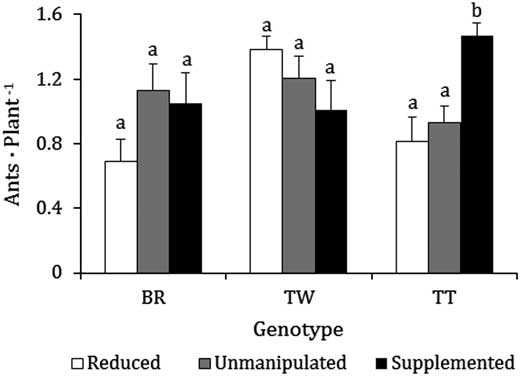
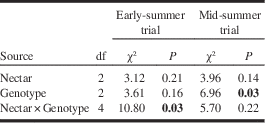
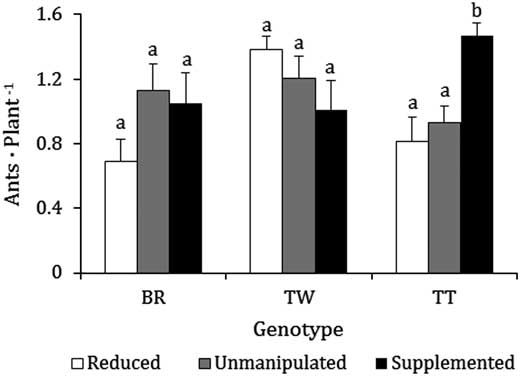
In the early-summer trial, the effect of nectar manipulation on ant visitation was dependent upon aspen genotype (Table 1). Within the TT genotype, ramets with supplemented nectar experienced significantly higher F. fusca visitation than either the ramets with unmanipulated or reduced nectar (Fig. 2). TT ramets with supplemented nectar were visited by 58% and 80% more ants per census than ramets with unmanipulated and reduced nectar, respectively. There was no significant difference between the reduced and unmanipulated nectar treatments for this genotype (Fig. 2). Within the BR genotype, somewhat fewer ants visited aspen ramets with reduced nectar than visited nectar-supplemented or control ramets, but these differences did not reach the level of statistical significance after controlling for multiple comparisons. There were also no statistically significant differences between nectar treatment groups within genotype TW (P>0.05).
Average number of ants observed on ramets of different genotypes with reduced, unmanipulated, and supplemented extrafloral nectar during the early summer trial. Values shown are least squared means±SE. Different letters denote significantly different means within genotypes (Tukey honest significant difference, α=0.05).
Analysis of the effect of nectar manipulation and aspen genotype on ant counts across two trials.

Note: Data were analysed using generalised estimating equations. P-values significant at P<0.05 appear in bold font.
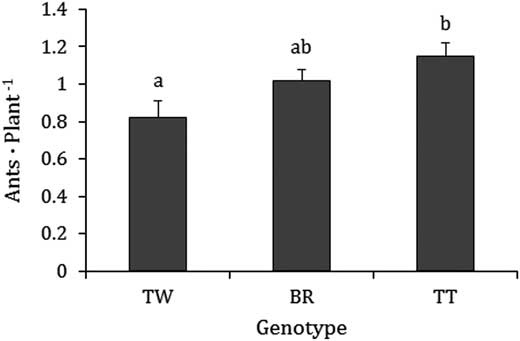
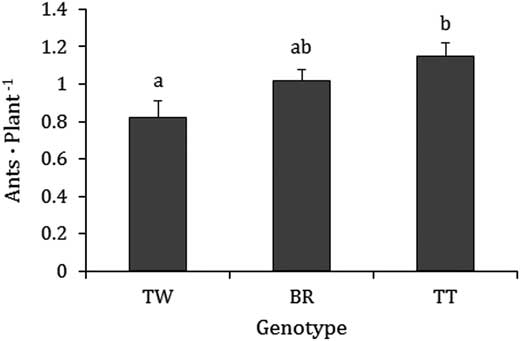
The frequency with which ants visited aspen was marginally lower (by 8%) during the mid-summer trial than during the earlier trial. During mid-summer, F. fusca workers did not respond significantly to nectar manipulation, and there was no significant interaction between genotype and nectar treatment (Table 1). However, F. fusca workers visited aspen genotypes at different frequencies (Table 1). Ramets of the TT genotype were visited by 40% more F. fusca workers per census than ramets of the TW genotype (Fig. 3), while the other between-genotype comparisons were not statistically significant.
Average number of ants on ramets of different aspen genotypes during the mid-summer trial. Values are least squared means±SE. Different letters denote significantly different means (Tukey honest significant difference, α=0.05).
Because rain may have removed supplemented nectar from experimental ramets, we repeated the above analyses after excluding data from censuses that followed a rainy period and preceded the reapplication of supplemented nectar. The results of these analyses did not differ qualitatively from those obtained from analyses of the complete datasets.
The genotypes used in this study did not differ significantly in the mean number of EF nectaries per ramet (F 2, 49=0.63, P=0.53).
Discussion
Environmental influences such as herbivory and drought can alter the secretion rate of aspen EF nectar, and the intent of this experiment was to investigate the effects of such changes on ant behaviour. In response to a reduction in nectar availability of ~50% per ramet, we found no statistically significant response by F. fusca ants in their visitation to aspen. In contrast, studies on several plant species employing more extreme reductions in nectar availability, achieved through the wholesale blockage or removal of EF nectaries, have detected a decrease in ant visitation to plants (e.g., Apple and Feener Reference Apple and Feener2001; Rudgers and Strauss Reference Rudgers and Strauss2004; Chamberlain and Holland Reference Chamberlain and Holland2008). Notably, a previous study on aspen in interior Alaska showed that a more extreme blockage of EF nectaries produced a modest decrease in visitation, though this did not result in increased herbivory (Mortensen et al. Reference Mortensen, Wagner and Doak2013). The insensitivity of ants to a 50% nectar reduction we report here suggests that an estimated 25–30% decrease in nectar secretion by drought-susceptible aspen genotypes (Newman and Wagner Reference Newman and Wagner2013) may have little effect on ant visitation, at least by F. fusca.
In contrast, F. fusca workers were more sensitive to a 10% increase in nectar sugar availability than to the much larger decrease. Supplemental nectar produced a 1.6-fold increase in ant visitation to one aspen genotype in early summer. The physical placement of sugar supplements on low branches and distal leaves along shoots may have accentuated ant response by facilitating discovery of supplemented leaves. Damage to aspen leaves induces increased EF nectar secretion by a magnitude similar to that simulated in this study: defoliation of 40% of total leaf area per ramet resulted in an increase in EF nectar sugar secretion rate of 20–25% (Newman and Wagner Reference Newman and Wagner2013). Typical natural levels of induction are likely lower because the extent and uniformity of the damage that was imposed on plants experimentally is unusual under natural conditions, except during an insect outbreak (e.g., Wagner and Doak Reference Wagner and Doak2013). Variation in the average ant response to nectar supplementation among aspen genotypes suggests that damage induction of nectar secretion may be more effective for some genotypes than others.
The many sources of sugar available in an aspen stand may dull the response of ants to variation in nectar secretion expressed by individual ramets. Aspen tends to grow in high-density stands, as was the case at our study site, which increases the availability of EF nectar to ants foraging in the area. In a setting containing abundant nectar resources, relatively subtle changes in secretion rates within or among ramets may have little impact on foraging behaviour. Additionally, the availability of honeydew from ant-tended aphids has the potential to reduce the importance of EF sugar resources to foraging ants (Katayama and Suzuki Reference Katayama and Suzuki2003).
Patterns of F. fusca visitation to aspen plants differed between early and mid-summer trials. We detected a response to nectar treatment in the early summer trial, but not in the late summer trial. Differences in ant responses between trials may reflect temporal shifts in colony foraging requirements. In early summer, ant colonies contain actively feeding larvae. By mid-July, when the mid-summer trial was conducted, F. fusca colonies typically contain pupae (D.W., personal observation), which would tend to decrease the colony-wide demand for food. Larvae consume primarily protein, while workers consume primarily carbohydrates (Blüthgen and Feldhaar Reference Blüthgen and Feldhaar2010). But the presence of larvae in the nest can increase a colony’s carbohydrate requirement (Dussutour and Simpson Reference Dussutour and Simpson2009), likely in order to fuel the additional foraging needed to sustain larvae. Moreover, Rhytidoponera Mayr workers exhibit enhanced discrimination among sucrose concentrations when larvae are present in the nest, regulating their consumption of carbohydrates to more accurately meet colony demands (Dussutour and Simpson Reference Dussutour and Simpson2008). This finding is consistent with the greater discrimination among nectar treatments we detected in the early summer trial. Differences in the responses of F. fusca to nectar manipulation across early-summer and mid-summer trials could also be related to a dilution in the treatment effect caused by the production of new EF nectary-bearing leaves throughout the summer, or an increase in honeydew available from aphid colonies.
The most important finding of this study is that the genetic identity of aspen plants affected the recruitment of ant visitors. In the early summer trial the effect of treatment was dependent on genotype, and in the mid-summer trial average ant visitation differed between aspen genotypes. The cause of genotype-related differences in discrimination among treatments by F. fusca workers is not clear. The cause of overall differences in visitation to different P. tremuloides clones could be related to EF nectar secretion rate, nectar quality, or non-nectar plant traits that affect attractiveness to ants. We found no evidence that the number of EF nectaries varied among aspen genotypes at the start of the study, but the rate at which sugar is secreted from EF nectaries is known to vary among genotypes (Newman and Wagner Reference Newman and Wagner2013). Extrafloral nectar composition may also impact ant visitation, as nectar blends with higher sucrose and amino acid concentrations are generally preferred by foraging ants (González-Teuber and Heil Reference Gonzalez-Teuber and Heil2009), but further work will be necessary to test whether nectar composition varies among aspen genotypes. Volatile organic compounds (VOCs) emitted by plants have been shown to attract predatory insects (Heil Reference Heil2008), and several VOCs have been shown to vary among genotypes in Populus hybrids (Eller et al. Reference Eller, de Gouw, Graus and Monson2012). Therefore, variation in VOC emission among P. tremuloides genotypes might also contribute to variation in ant visitation, but more work will be needed to test this hypothesis.
Differences in attractiveness to ants among aspen genets may be ecologically significant. Recent work indicates that aspen establishes from seed more commonly than was once assumed (Long and Mock Reference Long and Mock2012), especially following disturbance (Romme et al. Reference Romme, Turner, Gardner, Hargrove, Tuskan and Despain1997; Johnstone et al. Reference Johnstone, Hollingsworth, Chapin and Mack2010; Landhäusser et al. Reference Landhäusser, Deshaies and Lieffers2010), producing stands with high genetic diversity (Jelinski and Cheliak Reference Jelinski and Cheliak1992; De Woody et al. Reference De Woody, Rickman, Jones and Hipkins2009). Genotypes that are more attractive to ants or other potential mutualists may have an advantage in competition with less attractive genotypes. Further investigation of the traits responsible for differences in the attractiveness of aspen genets to ants and the ecological significance of such differences is warranted.
Acknowledgements
The authors thank Mark Wright for technical assistance in the greenhouse and Tom Green for comments on the manuscript. J.R.N. received support from the National Science Foundation GK-12 program CASE (Changing Alaska Science Education), the University of Alaska Fairbanks Institute of Arctic Biology Summer Research Fellowship, and the University of Alaska Department of Biology and Wildlife. Portions of the research were supported by National Science Foundation grant DEB 0543632 to D.W. and P.D.