INTRODUCTION
Cognitive impairment is a common non-motor symptom of Parkinson’s disease (PD). At early stages, up to a third of PD patients fulfill diagnostic criteria for mild cognitive impairment (MCI) (Aarsland et al., Reference Aarsland, Bronnick, Williams-Gray, Weintraub, Marder, Kulisevsky, Burn, Barone, Pagonabarraga, Allcock, Santangelo, Foltynie, Janvin, Larsen, Barker and Emre2010; Broeders et al., Reference Broeders, de Bie, Velseboer, Speelman, Muslimovic and Schmand2013; Litvan et al., Reference Litvan, Aarsland, Adler, Goldman, Kulisevsky, Mollenhauer, Rodriguez-Oroz, Tröster and Weintraub2011). Within 5 to 6 years, half of cognitively intact PD patients develop MCI, and all patients with MCI progress to dementia (Broeders et al., Reference Broeders, de Bie, Velseboer, Speelman, Muslimovic and Schmand2013; Pigott et al., Reference Pigott, Rick, Xie, Hurtig, Chen-Plotkin, Duda, Morley, Chahine, Dahodwala, Akhtar and Siderowf2015). Despite these stark statistics, some longitudinal studies with de novo PD show progression rates comparable to healthy controls (HC) (de la Riva, Smith, Xie, & Weintraub, Reference de la Riva, Smith, Xie and Weintraub2014). This discrepancy may be due to inclusion of PD patients with varying levels of known risk factors for cognitive impairment, including increased age, longer disease duration, male sex, more severe motor symptoms, non-motor symptoms such as neuropsychiatric disturbances, genetic factors, and comorbid Alzheimer’s disease (AD) pathology (Aarsland et al., Reference Aarsland, Bronnick, Williams-Gray, Weintraub, Marder, Kulisevsky, Burn, Barone, Pagonabarraga, Allcock, Santangelo, Foltynie, Janvin, Larsen, Barker and Emre2010; G. Liu et al., Reference Liu, Locascio, Corvol, Boot, Liao, Page, Franco, Burke, Jansen, Trisini-Lipsanopoulos, Winder-Rhodes, Tanner, Lang, Eberly, Elbaz, Brice, Mangone, Ravina, Shoulson, Cormier-Dequaire, Heutink, van Hilten, Barker, Williams-Gray, Marinus and Scherzer2017).
In healthy individuals, sex is associated with different cognitive profiles across the lifespan; women generally perform better on verbal learning and memory, and men perform better on visuospatial tasks (Brunet, Caldwell, & Miller, Reference Brunet, Caldwell and Miller2018; Munro et al., Reference Munro, Winicki, Schretlen, Gower, Turano, Muñoz, Keay, Bandeen-Roche and West2012). Similar differences have been observed in PD (Liu et al., Reference Liu, Umbach, Peddada, Xu, Tröster, Huang and Chen2015). In addition, in PD patients with over 8 years of disease, men show higher risk for dementia and faster decline once cognitively impaired (Cholerton et al., Reference Cholerton, Johnson, Fish, Quinn, Chung, Peterson-Hiller, Rosenthal, Dawson, Albert, Hu, Mata, Leverenz, Poston, Montine, Zabetian and Edwards2018). This is in contrast to AD, where women have more rapid declines once impaired (Burke et al., Reference Burke, Hu, Fava, Li, Rodriguez, Schuldiner, Burgess and Laird2018). Better understanding of sex-based differences in risk for and trajectory of cognitive decline in newly diagnosed PD patients may help shape treatment approaches or clinical management of early cognitive impairments.
In this study, we investigated changes in cognitive scores over time in men and women newly diagnosed with PD using the Parkinson’s Progression Markers Initiative (PPMI) database. We evaluated whether men would deteriorate faster than women, as male sex has been reported as a risk factor for dementia in PD patients with longer disease duration (Cholerton et al., Reference Cholerton, Johnson, Fish, Quinn, Chung, Peterson-Hiller, Rosenthal, Dawson, Albert, Hu, Mata, Leverenz, Poston, Montine, Zabetian and Edwards2018). Depression and anxiety impact cognition and brain functioning (Dotson et al., Reference Dotson, Szymkowicz, Kirton, McLaren, Green and Rohani2014), and excessive daytime sleepiness is a risk factor for cognitive decline in healthy populations (Jaussent et al., Reference Jaussent, Bouyer, Ancelin, Berr, Foubert-Samier, Ritchie, Ohayon, Besset and Dauvilliers2012). We assessed whether deterioration rate was faster and whether the cognitive scores declined more in the PD-MCI compared to cognitively intact PD independent of mood, sleepiness and motor impairment changes. Finally, as the apolipoprotein E gene ϵ4 allele (APOE-ϵ4) is a common AD risk factor and is associated with executive dysfunction in PD (Samat, Abdul Murad, Mohamad, Abdul Razak, & Mohamed Ibrahim, Reference Samat, Abdul Murad, Mohamad, Abdul Razak and Mohamed Ibrahim2017); differences in APOE-ϵ4 frequency across groups were investigated.
METHOD
Data were downloaded from the PPMI website on May 10, 2018 (http://www.ppmi-info.org/). The PPMI is a multi-site study collecting data on aspects of PD longitudinally. Design and aims have been previously published (Marek et al., Reference Marek, Jennings, Lasch, Siderowf, Tanner, Simuni, Coffey, Kieburtz, Flagg, Chowdhury and Poewe2011) and can be found on their website (http://www.ppmi-info.org/study-design). The PPMI was approved by the institutional review boards of all participating sites, and all participants provided written informed consent.
In our study, patients were separated into two groups: PD-normal cognition (PD-NC) (n = 257) and PD-MCI (n = 167). MCI was defined by standard scores of ≥1.5 SD below appropriate norms on at least two cognitive tests (Litvan et al., Reference Litvan, Goldman, Tröster, Schmand, Weintraub, Petersen, Mollenhauer, Adler, Marder, Williams-Gray, Aarsland, Kulisevsky, Rodriguez-Oroz, Burn, Barker and Emre2012). The HC (n = 140) consisted of individuals 30 years or older with no current or active clinically significant neurological disorder, and no first-degree relative with idiopathic PD; cognitively intact with a Montreal Cognitive Assessment (MoCA) score>26, and standard scores within 1.5 SD of appropriate norms on the cognitive battery.
Cognitive Battery
All available cognitive tests were included. MoCA – a screening measure assessing attention, working memory, executive function, visuospatial function, language, orientation with the total score ranging from 0 to 30 – was used to index global cognition (Nasreddine et al., Reference Nasreddine, Phillips, Bédirian, Charbonneau, Whitehead, Collin, Cummings and Chertkow2005). Phonemic fluency was assessed by the MoCA (total number of words beginning with a specific letter produced within 1 min). Hopkins Verbal Learning Test-Revised (HVLT-R) is a verbal learning/memory test consisting of a list of 12 words presented in three repeated learning trials, followed by a minimum 20-min delayed recall and recognition (Benedict, Schretlen, Groninger, & Brandt, Reference Benedict, Schretlen, Groninger and Brandt1998). Benton Judgment of Line Orientation 15-item (JLO) is a 15-item spatial perception and orientation measure requiring matching two angled lines to a set of 11 lines arranged in a semicircle (Benton, Varney, & Hamsher, Reference Benton, Varney and Hamsher1978). Symbol-Digit Modalities Test (SDMT) is a processing speed test requiring transposition of symbols for 90 s, following a key (Smith, Reference Smith and Helmuth1968). Wechsler Memory Scale-III Letter Number Sequencing (LNS) is a verbal working memory measure, including auditory presentation of letter and number sequences, requiring recitation of first the numbers in an ascending order and then the letters in an alphabetical order (Wechsler, Reference Wechsler1997). Animal naming is a semantic fluency test requiring naming as many animals as possible in 1 min (Rosen, Reference Rosen1980). Higher scores indicate better performance for all.
Other Assessments
The 15-item Geriatric Depression Scale (GDS) is a self-report scale measuring depressive symptoms (Meara, Mitchelmore, & Hobson, Reference Meara, Mitchelmore and Hobson1999). State and Trait Anxiety Inventory (STAI) consists of self-report of state and trait anxiety (Spielberger, Gorsuch, & Lushene, Reference Spielberger, Gorsuch and Lushene1970). Epworth Sleepiness Scale (ESS) is a self-report scale of sleepiness in daily activities (Johns, Reference Johns1991). Motor impairment in PD was assessed using Movement Disorders Society-Unified Parkinson’s Disease Rating Scale (MDS-UPDRS) Part III (Goetz et al., Reference Goetz, Tilley, Shaftman, Stebbins, Fahn, Martinez-Martin, Poewe, Sampaio, Stern, Dodel, Dubois, Holloway, Jankovic, Kulisevsky, Lang, Lees, Leurgans, LeWitt, Nyenhuis, Olanow, Rascol, Schrag, Teresi, van Hilten and LaPelle2008). Higher scores indicate worse symptoms for all.
Statistical Analysis
Data were analyzed using IBM SPSS version 23 (Armonk, NY) and SAS (SAS Institute Inc., Cary, NC). Cognitive and other assessment scores from baseline and annual follow-up visits (years 1, 2, 3, 4) were analyzed. Demographics and baseline scores were compared between groups using Chi-square tests, independent samples t tests and analysis of variance (ANOVA). Longitudinal changes in other assessments were evaluated using repeated measures ANOVA. Longitudinal course of cognition was evaluated with repeated measures analysis of covariance. Years of education and MDS-UPDRS Part III were not matched, thus included as covariates. Longitudinal GDS, STAI, ESS were included as covariates due to previously reported cognitive associations and significant differences between diagnostic groups and/or sexes in our sample. Sidak correction was used for multiple comparisons. p < .05 was considered statistically significant.
RESULTS
Demographics, Clinical Features, and Other Assessment Scores
Baseline comparisons
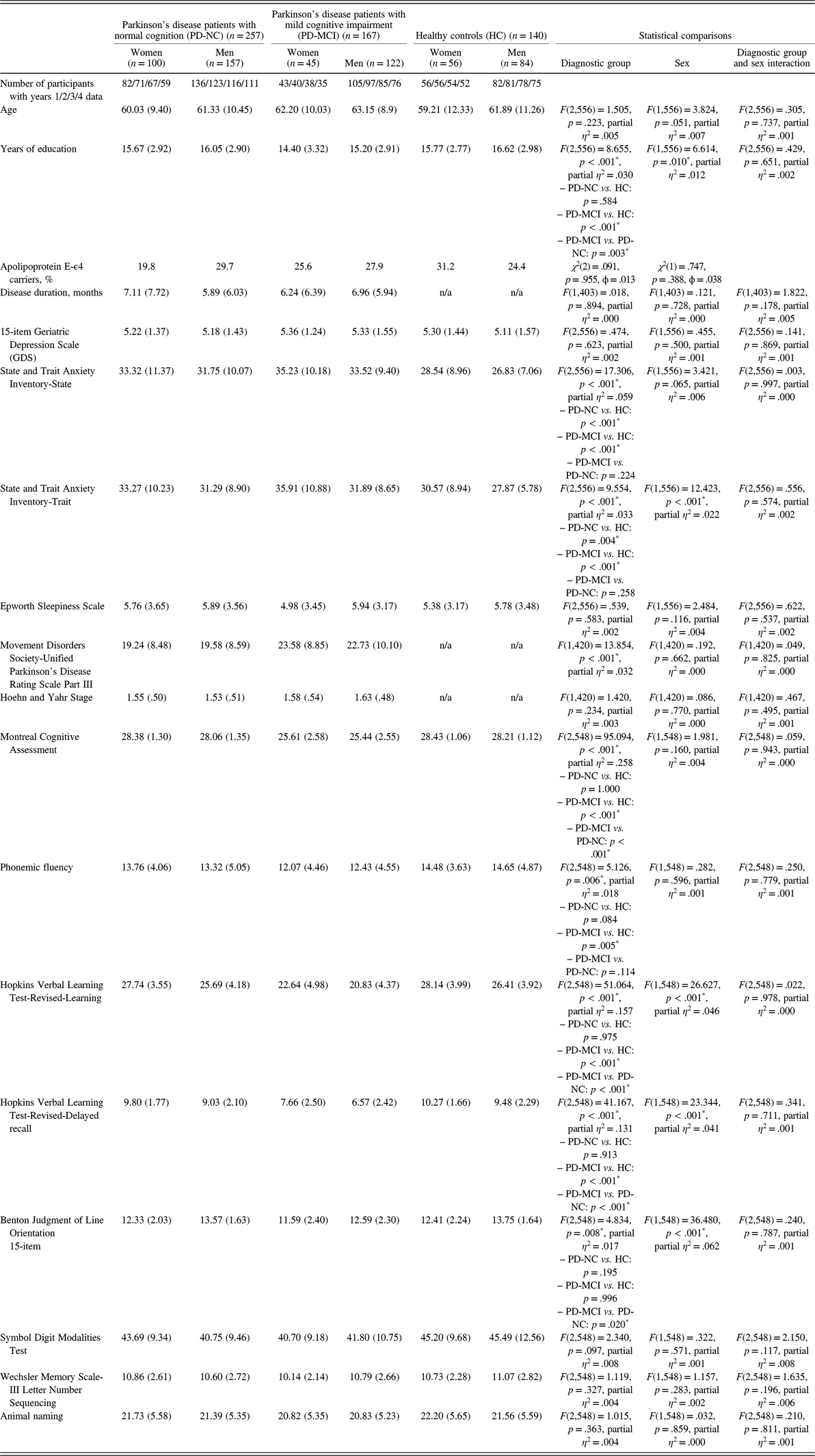
Descriptive statistics and comparisons for demographics, clinical features, other assessment scores at baseline are given in Table 1. There were no significant diagnostic groups by sex interaction effects on any of these measures. Women had less years of education, higher STAI-Trait than men, and showed a trend toward younger age. APOE-ϵ4 frequency, GDS, ESS, STAI-State, disease duration, HYS, MDS-UPDRS Part III were similar between men and women. Regarding diagnosis, PD-MCI was less educated than HC and PD-NC, though education was similar for HC and PD-NC. HC had lower STAI than both PD groups, with no STAI difference between PD groups. PD-MCI had higher MDS-UPDRS Part III than PD-NC. Age, APOE-ϵ4 frequency, GDS, ESS were similar across diagnostic groups. Disease duration and HYS did not differ between PD groups.
Means (SD) and statistical comparisons of baseline measures

Variables are reported as mean (SD) or percentage. PD-NC, Parkinson’s disease patients with normal cognition; PD-MCI, Parkinson’s disease patients with mild cognitive impairment; HC, healthy controls; n/a, not applicable.
* Statistical significance.
Longitudinal comparisons
Results are presented in Supplementary Table 1. GDS, STAI, MDS-UPDRS Part III did not change over time, while ESS increased over time. Men had higher ESS, lower STAI-Trait compared to women, though GDS and STAI-State were similar across sexes. Both PD groups had higher STAI and ESS than HC. PD-MCI showed a trend toward higher GDS compared to HC, but GDS was not different between PD-NC and HC. The only significant difference between PD-NC and PD-MCI was MDS-UPDRS Part III, with higher scores for the PD-MCI. The only diagnostic group and sex interaction effect was for MDS-UPDRS Part III, with difference between the PD-NC and PD-MCI more pronounced in women.
Cognition
Baseline comparisons
Descriptive statistics and comparisons at baseline are shown in Table 1. Women scored higher on HVLT-R learning and delayed recall,and lower on JLO. MoCA, phonemic fluency, SDMT, LNS, animal naming were similar between men and women. Regarding diagnosis, SDMT, LNS, animal naming were similar across the diagnostic groups, and all cognitive scores were similar between PD-NC and HC. PD-MCI scored lower than HC on MoCA, phonemic fluency, HVLT-R learning, and delayed recall. JLO was similar between PD-MCI and HC. PD-MCI scored lower than PD-NC on MoCA, HVLT-R learning and delayed recall, and JLO, but showed similar scores as PD-NC on phonemic fluency. There were no significant diagnostic groups by sex interactions.
Longitudinal comparisons
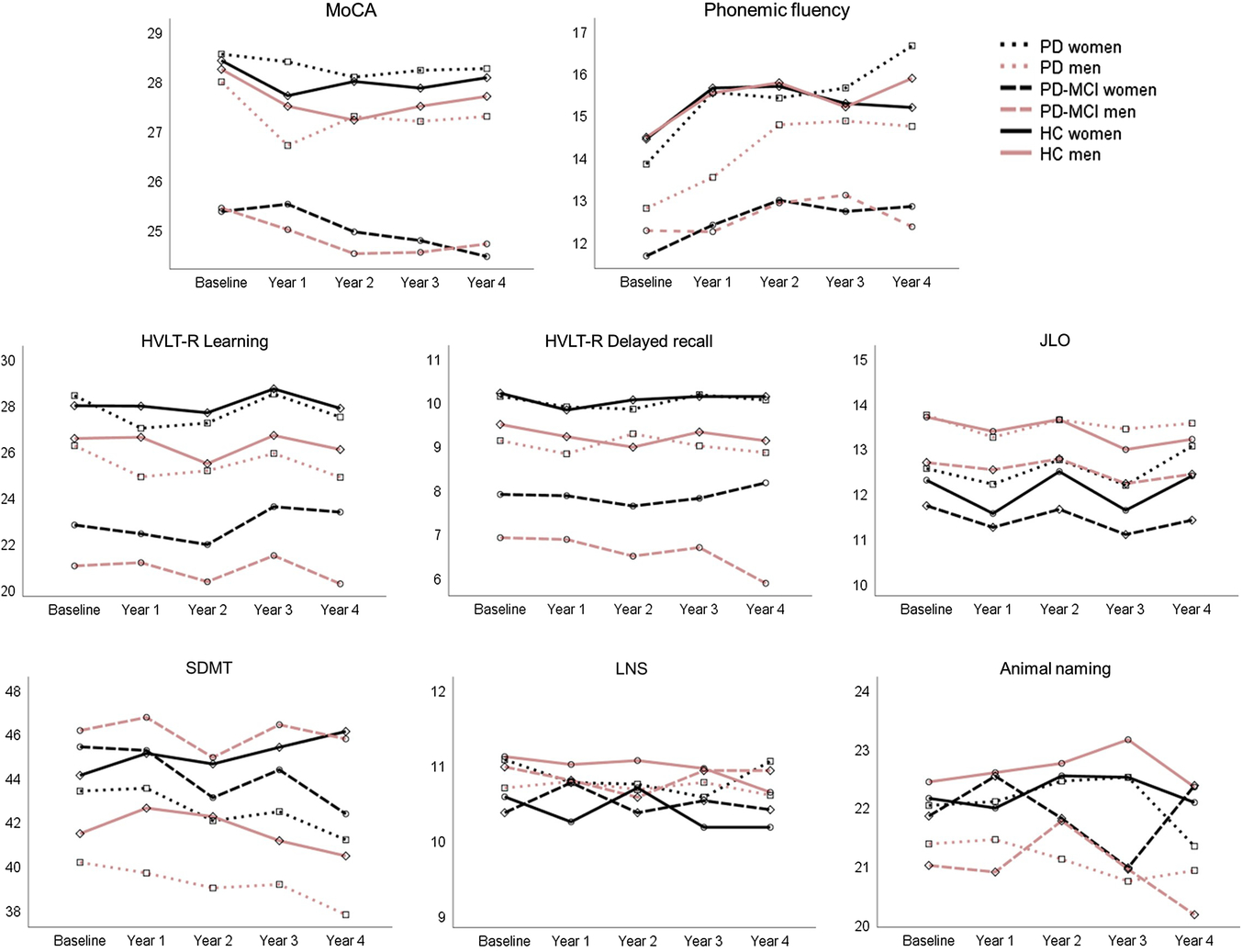
The change in cognition over time is demonstrated in Figure 1 (Supplementary Tables 2–3 for results).
Changes in cognitive scores over time.
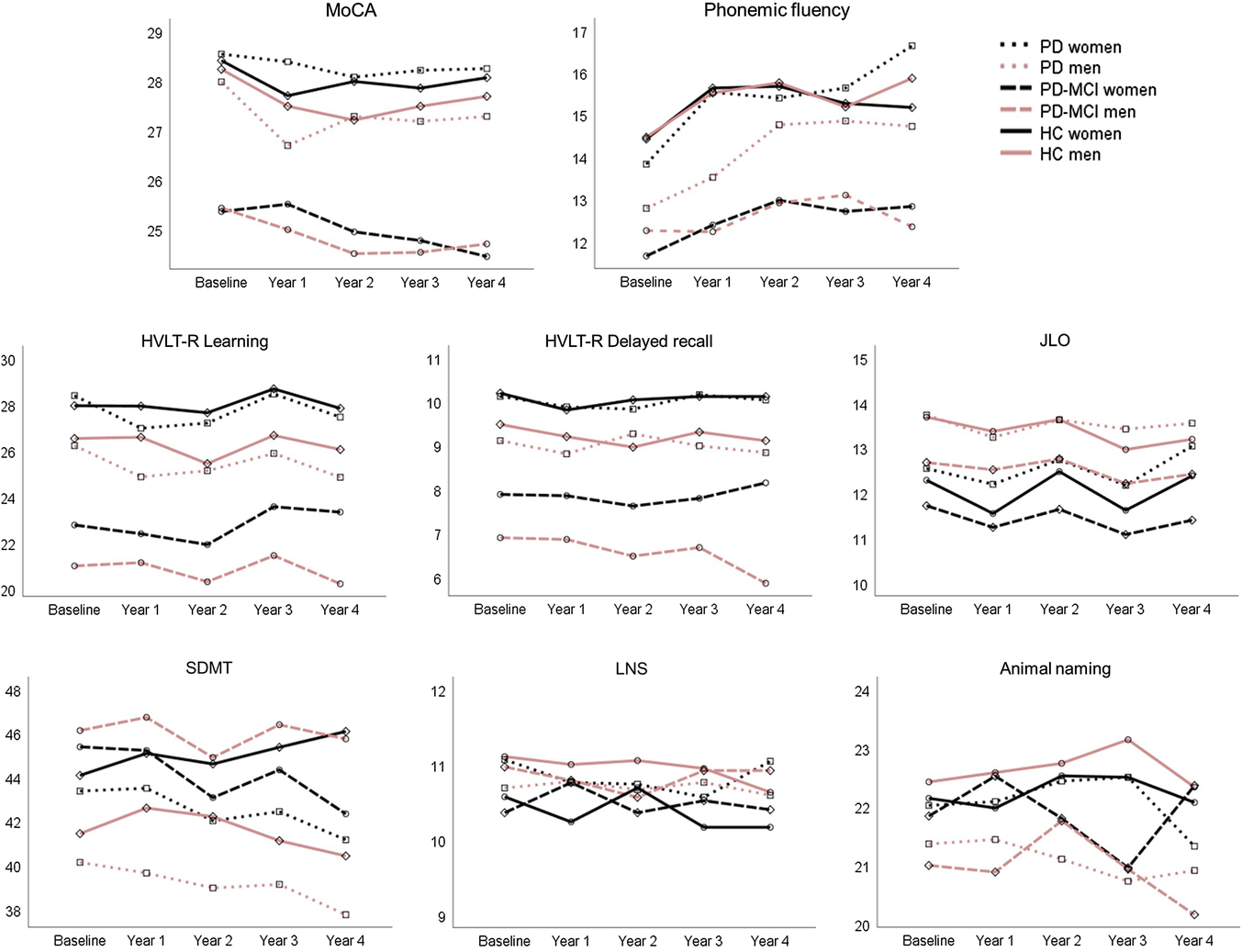
MoCA, HVLT-R learning and delayed recall, animal naming did not change over time. Phonemic fluency increased, SDMT and LNS decreased, and JLO showed a trend toward decreasing. There were no significant three- or two-way interactions of diagnostic group, sex, or time. Women scored higher on MoCA, HVLT-R learning and delayed recall and lower on JLO. Phonemic fluency, SDMT, LNS, animal naming were similar between men and women. Regarding diagnosis, LNS and animal naming were similar across diagnostic groups. PD-NC scored lower than HC on SDMT, but similarly to HC across all other measures. PD-MCI scored lower than HC on MoCA, phonemic fluency, HVLT-R learning and delayed recall, JLO, SDMT, and lower than PD-NC on MoCA, phonemic fluency, HVLT-R learning and delayed recall, JLO.
Longitudinal covariate effects
There were several significant covariate effects on cognition (Supplementary Table 3). Years of education had a positive effect on phonemic fluency, HVLT-R learning and delayed recall, JLO, but a negative effect on animal naming. Longitudinal GDS had a negative effect on SDMT. Longitudinal STAI-State had a negative effect on LNS and animal naming. Longitudinal STAI-Trait did not have a significant effect on any cognitive measures. Longitudinal ESS had a negative effect on MoCA, LNS, animal naming. Longitudinal MDS-UPDRS Part III had a negative effect on MoCA, HVLT-R learning and delayed recall, JLO, animal naming.
DISCUSSION
We investigated how cognition changes over time in men and women with de novo PD, with and without MCI. Women performed better on verbal learning and memory, whereas men had better visuospatial functioning. Controls performed better than PD-MCI on general cognitive abilities, verbal learning and memory, visuospatial functioning, and processing speed measures. The PD-NC performed better than PD-MCI on general cognitive abilities, verbal learning and memory, and visuospatial functioning, but had reduced processing speed compared to HC. Across groups, visuospatial function, processing speed, and working memory deteriorated over time. Diagnostic group, sex, and time effects on cognition were independent, and no interactions between these factors were found.
Male sex has been associated with more cognitive impairment in PD (Cholerton et al., Reference Cholerton, Johnson, Fish, Quinn, Chung, Peterson-Hiller, Rosenthal, Dawson, Albert, Hu, Mata, Leverenz, Poston, Montine, Zabetian and Edwards2018; but, c.f., Rana, Yousuf, Naz, & Qa’aty, Reference Rana, Yousuf, Naz and Qa’aty2012). Our findings revealed that over 4 years, differences between women and men were confined to verbal memory and visuospatial functioning, independent of MCI diagnosis. This cognitive pattern has been previously reported in healthy aging (Munro et al., Reference Munro, Winicki, Schretlen, Gower, Turano, Muñoz, Keay, Bandeen-Roche and West2012), and de novo PD with cross-sectional, baseline measures of the same PPMI PD patient sample (R. Liu et al., Reference Liu, Umbach, Peddada, Xu, Tröster, Huang and Chen2015). In healthy individuals, sex differences in verbal memory have been suggested to be due to different cognitive strategies employed, and to differences in brain language networks between women and men (Andreano & Cahill, Reference Andreano and Cahill2009). Our findings indicate that sex effects on cognition in de novo PD are similar to those found in healthy aging.
We did not find any sex differences in trajectory of scores over time, contrary to reports associating the male sex with a faster cognitive decline in PD (Cholerton et al., Reference Cholerton, Johnson, Fish, Quinn, Chung, Peterson-Hiller, Rosenthal, Dawson, Albert, Hu, Mata, Leverenz, Poston, Montine, Zabetian and Edwards2018). However, this faster rate was reported in patients with over 8 years of PD duration, and our sample consisted of only de novo patients followed for 4 years. As both age and disease progression are important for PD dementia development (Levy et al., Reference Levy, Schupf, Tang, Cote, Louis, Mejia, Stern and Marder2002; Rana et al., Reference Rana, Yousuf, Naz and Qa’aty2012), effects of sex on cognitive decline rate may become more meaningful later in disease. Other methods, including functional and structural neuroimaging, may help show subtler sex differences that may not yet be reflected with cognitive scores. It is also noteworthy that comorbidities and risk factors which may impact cognition in PD (Doiron, Langlois, Dupré, & Simard, Reference Doiron, Langlois, Dupré and Simard2018) were not evaluated in this study. Future studies are required to clarify whether comorbidities influence the effects of sex in PD.
In our sample, clinical course of cognition over 4 years was similar in PD-NC, PD-MCI, and HC. Previous studies have reported faster progression to dementia in PD with baseline MCI (Pigott et al., Reference Pigott, Rick, Xie, Hurtig, Chen-Plotkin, Duda, Morley, Chahine, Dahodwala, Akhtar and Siderowf2015), even in de novo PD (Broeders et al., Reference Broeders, de Bie, Velseboer, Speelman, Muslimovic and Schmand2013). Given the age effects on dementia development, the discrepancy between these findings and those of Broeders and colleagues (Broeders et al., Reference Broeders, de Bie, Velseboer, Speelman, Muslimovic and Schmand2013) may be due to our sample being younger. Although we cannot test this hypothesis, it is also possible that our PD-MCI group is less impaired at baseline, which would explain differences in longitudinal trajectory. The use of alternate HVLT-R, SDMT, and JLO forms for each year, despite mitigating practice effects, may also have contributed to our lack of finding by adding noise to the data. In addition, our measure of decline differs in important ways as we captured the decline in raw scores instead of assessing the percentage of patients with cognitive decline. Finally, the decrease in our sample size over time is significant, and our negative result may be due to a bias toward better-functioning individuals remaining in the study.
The increase in phonemic fluency scores over time is somewhat surprising given the deteriorating effects of aging on cognition (Harada, Natelson Love, & Triebel, Reference Harada, Natelson Love and Triebel2013). This enhanced performance may be due to practice effects, given the repeated use of the same MoCA form, despite use of alternate forms of other measures (i.e., HVLT-R, SDMT, and JLO). This would be consistent with a study showing that phonemic fluency was the only test of 25 measures showing increased scores due to practice effects over a period of 1 year in healthy aging (Bartels, Wegrzyn, Wiedl, Ackermann, & Ehrenreich, Reference Bartels, Wegrzyn, Wiedl, Ackermann and Ehrenreich2010).
We included longitudinal mood, sleepiness, and motor impairment scores as covariates and found group and/or sex effects in these variables. In healthy elderly, depression was associated with processing speed, working memory, and executive functions deficits, whereas anxiety was associated with better attention and working memory (Dotson et al., Reference Dotson, Szymkowicz, Kirton, McLaren, Green and Rohani2014). Our results suggest that depression is associated with reduced processing speed, while state anxiety is associated with reduced working memory and linguistic skills. The opposite relationship of anxiety with cognition in healthy adults and our sample (with the majority consisting of PD patients) can be investigated further to establish effects of anxiety on cognition in PD. Worse daytime sleepiness scores were associated with lower scores on MoCA, reduced working memory, and linguistic skills. This is in line with a previous study reporting that excessive sleepiness can predict cognitive decline determined by the Mini Mental State Examination, a brief global cognitive scale (Jaussent et al., Reference Jaussent, Bouyer, Ancelin, Berr, Foubert-Samier, Ritchie, Ohayon, Besset and Dauvilliers2012). As the motor impairment (MDS-UPDRS Part III) progressed over time, MoCA, verbal learning and memory, visuospatial functioning and language deteriorated. This is not surprising as cognitive decline increases over time as the disease progresses and worse motor impairment at baseline may predict future cognitive decline (Broeders et al., Reference Broeders, de Bie, Velseboer, Speelman, Muslimovic and Schmand2013; Pigott et al., Reference Pigott, Rick, Xie, Hurtig, Chen-Plotkin, Duda, Morley, Chahine, Dahodwala, Akhtar and Siderowf2015). However, more direct testing of these variables was beyond the scope of the article and deserves future studies. In addition, the frequency of APOE-e4 carriers was similar across the groups and the sexes, and thus the association was not evaluated further. Future studies could investigate a potential mediating effect of APOE-ϵ4 on cognitive decline in men and women with PD.
In conclusion, sex had similar cognitive effects in de novo PD as healthy individuals, and decline over 4 years did not differ between men and women with de novo PD or between PD-NC and PD-MCI. In early PD, in contrast to findings for AD, sex does not appear to affect cognition differently. We acknowledge that the PPMI includes limited cognitive assessment, and more extensive cognitive batteries may be helpful in further fleshing out sex differences. Use of such batteries would also allow classification of PD-MCI and provide more reliable results as PD-MCI is rather heterogeneous. Future investigations including longitudinal neuroimaging may further elucidate the course of pathophysiology in women and men with PD, as well as PD-NC and PD-MCI.
ACKNOWLEDGMENTS
Data used in the preparation of this article were obtained from the Parkinson’s Progression Markers Initiative (PPMI) database (http://www.ppmi-info.org/data). For up-to-date information on the study, visit http://www.ppmi-info.org.
PPMI – a public-private partnership – is funded by the Michael J. Fox Foundation for Parkinson’s Research and funding partners, including Abbvie, Allergan, Avid Radiopharmaceuticals, Biogen, BioLegend, Bristol-Myers Squibb, Celgene, Jenali, GE Healthcare, Genentech, GlaxoSmithKline, Lilly, Lundbeck, Merck, Meso Scale Discovery, Pfizer, Piramal, Prevail Therapeutics, Roche, Sanofi Genzyme, Servier, Takeda, Teva, UCB, Verily, Voyager Therapeutics, and Golub Capital.
CONFLICT OF INTEREST
The authors have nothing to disclose.
SUPPLEMENTARY MATERIAL
To view supplementary material for this article, please visit https://doi.org/10.1017/S1355617719001085