INTRODUCTION
Masting, the synchronous and intermittent production of large seed crops, is a widespread phenomenon displayed by many plant species worldwide (Lamontagne & Boutin Reference LAMONTAGNE and BOUTIN2007, Norden et al. Reference NORDEN, CHAVE, BELBENOIT, CAUBÈRE, CHÂTELET, FORGET and THÉBAUD2007, Norton & Kelly Reference NORTON and KELLY1988, Shibata et al. Reference SHIBATA, TANAKA, IIDA, ABE, MASAKI, NIIYAMA and NAKASHIZUKA2002, Sork et al. Reference SORK, BRAMBLE and SEXTON1993). In the South-East Asian humid tropics, masting at the community level, also termed ‘mast fruiting’ (MF), occurs at irregular intervals of one to several years (Appanah Reference APPANAH1985, Ashton et al. Reference ASHTON, GIVNISH and APPANAH1988, Sakai Reference SAKAI2002). Not only do the dominant dipterocarps bloom, but plants of diverse families bloom as well (Cannon et al. Reference CANNON, CURRAN, MARSHALL and LEIGHTON2007, Sakai et al. Reference SAKAI, MOMOSE, YUMOTO, NAGAMITSU, NAGAMASU, HAMID and NAKASHIZUKA1999, Reference SAKAI, HARRISON, MOMOSE, KURAJI, NAGAMASU, YASUNARI, CHONG and NAKASHIZUKA2006). After flowering, many fruits are produced and dispersed synchronously and the forest floor becomes covered with a carpet of various current-year seedlings (Curran & Leighton Reference CURRAN and LEIGHTON2000).
One of the major hypotheses explaining the evolutionary cause of MF is the predator satiation hypothesis, in which seed survival is expected to be enhanced because a high density of seeds that all share the same seed predators can reduce the destructive impact of those predators (Janzen Reference JANZEN1974, Sun et al. Reference SUN, CHEN, HUBBELL, WRIGHT and NOOR2007, Visser et al. Reference VISSER, JONGEJANS, VAN BREUGEL, ZUIDEMA, CHEN, KASSIM and DE KROON2011). The mortality of dipterocarp seedlings has been reported to be high, and a major cause of initial seedling mortality is often predation by mammals (Curran & Webb Reference CURRAN and WEBB2000, Takeuchi & Nakashizuka Reference TAKEUCHI and NAKASHIZUKA2007). Therefore, predator satiation at the seedling stage may also be important to the recruitment success of dipterocarp trees (Bagchi et al. Reference BAGCHI, PHILIPSON, SLADE, HECTOR, PHILIPS, VILLANUEVA, LEWIS, LYAL, NILUS, MADRAN, SCHOLES and PRESS2011). Conversely, a high density of conspecific seedlings may attract host-specific predators or pathogens (Connell Reference CONNELL, den Boer and Gradwell1971, Janzen Reference JANZEN1970), or may intensify intraspecific competition for resources, with a negative impact on seedling survival. A significant negative effect of conspecific seedling density on seedling survival has been reported in various tropical (Comita et al. Reference COMITA, URIARTE, THOMPSON, JONCKHEERE, CANHAM and ZIMMERMAN2009, Reference COMITA, MULLER-LANDAU, AGUILAR and HUBBELL2010, Lin et al. Reference LIN, COMITA, ZHENG and CAO2012, Queenborough et al. Reference QUEENBOROUGH, BURSLEM, GARWOOD and VALENCIA2007, Webb & Peart Reference WEBB and PEART1999) and other forests (Comita et al. Reference COMITA, QUEENBOROUGH, MURPHY, ECK, XU, KRISHNADAS, BECKMAN and ZHU2014, Johnson et al. Reference JOHNSON, BEAULIEU, BEVER and CLAY2012).
Local abiotic factors also have significant effects on seedling dynamics in tropical forests (Comita et al. Reference COMITA, URIARTE, THOMPSON, JONCKHEERE, CANHAM and ZIMMERMAN2009, Queenborough et al. Reference QUEENBOROUGH, BURSLEM, GARWOOD and VALENCIA2009). In a forest with a vertical gradient in irradiance, improved light conditions usually result in higher seedling survival (Brown & Whitmore Reference BROWN and WHITMORE1992, Kobe Reference KOBE1999). Dipterocarp seedlings growing in canopy gaps often experience higher survival than those in the shade (Itoh Reference ITOH1995, Turner Reference TURNER1990). Tree seedling survival is also influenced by the availability of water and nutrients in the soil (Comita et al. Reference COMITA, URIARTE, THOMPSON, JONCKHEERE, CANHAM and ZIMMERMAN2009, Walker et al. Reference WALKER, LODGE, GUZMÁN-GRAJALES and FETCHER2003). Previous studies found that higher dipterocarp seedling mortality has been observed during periods of severe drought (Bebber et al. Reference BEBBER, BROWN and SPEIGHT2004, Delissio & Primack Reference DELISSIO and PRIMACK2003). Furthermore, nutrient additions can enhance the growth of dipterocarp seedlings (Burslem et al. Reference BURSLEM, GRUBB and TURNER1996), and therefore higher soil resource availability should impact dipterocarp seedling survival.
The relative importance of biotic and abiotic drivers for seedling survival may differ among dipterocarp species. Because the density of current-year dipterocarp seedlings from wingless (i.e. mainly gravity-dispersed) fruits tends to be higher than that of winged (i.e. wind-dispersed) fruits under the crown of mother trees, negative density dependence of dipterocarp seedlings may be more apparent in wingless than in winged fruits (Bai et al. Reference BAI, QUEENBOROUGH, WANG, ZHANG, LI, YUAN, XING, LIN, YE and HAO2012). The morphological traits of current-year seedlings also show high variation among dipterocarp species (Ng Reference NG1991). This variation in seedling morphology could alter responses to the light environment or soil conditions. However, few studies have investigated the relative importance of both biotic and abiotic drivers of dipterocarp seedling survival following a MF, which provides an excellent but relatively rare chance to improve our understanding of dipterocarp regeneration.
In this study, we assessed the effects of biotic and abiotic factors on dipterocarp seedling survival within 1.5 y following a MF, using data from 1842 seedlings of 12 dipterocarp species in an old-growth Bornean tropical rain forest. Specifically we explored (1) the relative importance of biotic and abiotic drivers in seedling survival following a MF, and (2) interspecific differences in the relative importance of these factors, to examine our hypotheses that abiotic factors are more apparent than biotic factor (i.e. density dependence) and that dipterocarp seedlings from wingless fruits are more sensitive to biotic factors than those from winged fruits.
METHODS
Study site
This study was carried out in and around an 8-ha Canopy Biology Plot (CBP; 200 m × 400 m) and a 4-ha Crane Plot (CP; 200 m × 200 m) in Lambir Hills National Park, Sarawak, Malaysia (LHNP; 4°12′N, 114°02′E, 20–150 m asl). The average annual rainfall and mean air temperature at LHNP from 2000 to 2009 were 2600 mm and 25.8°C, respectively (Kume et al. Reference KUME, TANAKA, KURAJI, KOMATSU, YOSHIFUJI, SAITOH, SUZUKI and KUMAGAI2011). The soils of LHNP contain sandstone-derived humult ultisols and shale-derived clay-rich udult ultisols (Lee et al. Reference LEE, DAVIES, LAFRANKIE, TAN, YAMAKURA, ITOH, OHKUBO and ASHTON2002). Soil nutrients vary according to the soil type and sandy loam is less fertile than clay (Davies et al. Reference DAVIES, TAN, LAFRANKIE, POTTS, Roubik, Sakai and Hamid2005, Ishizuka et al. Reference ISHIZUKA, TANAKA, SAKURAI, HIRAI, HIROTANI, OGINO, LEE and KENDAWANG1998, Russo et al. Reference RUSSO, DAVIES, KING and TAN2005). In LHNP (about 7000 ha), which is dominated by an intact lowland dipterocarp forest, a major MF event occurred during 2009–2010 and many fruits were produced and dispersed (Nakagawa et al. Reference NAKAGAWA, MATSUSHITA, KUROKAWA, SAMEJIMA, TAKEUCHI, AIBA, KATAYAMA, TOKUMOTO, KUME, YOSHIFUJI, KURAJI, NAGAMASU, SAKAI and NAKASHIZUKA2012).
Seedling census
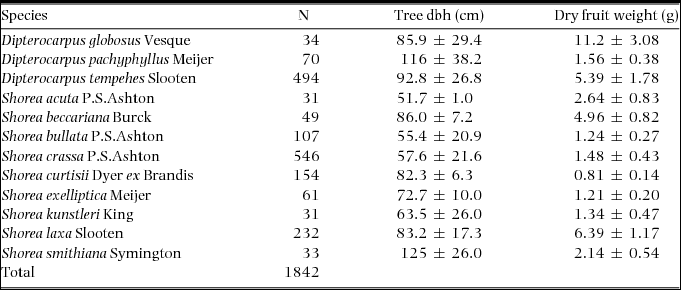
To explore dipterocarp seedling survival following the major 2009–2010 MF, we used three Dipterocarpus and nine Shorea species, which produced plentiful fruits at the study site (Table 1). In March 2010, a few weeks after mature fruits had been dispersed, three individual trees per species were selected and three seedling quadrats (1 × 1 m) were established under the crown of each individual tree (in total, 108 quadrats). Then all seedlings of the targeted dipterocarp species that recruited in the 2009–2010 MF in each quadrat were numbered and their height was measured. Seedling survival was monitored in June and September 2010 and in September 2011.
Dipterocarp species used in seedling census in Lambir Hills National Park. N is the initial number of seedlings. Diameter at breast height of selected trees (dbh, mean ± SD) is measured in 2009. Six trees selected around the plots were measured during 2001–2005. Mean dry weight (± SD) of dipterocarp fruits without wings (oven-dried at 50ºC for 120 h) was measured using mature, sound fruits collected in March 2010 under each selected tree (7–20 fruits per tree), with the exception of two S. curtisii trees.

In total, 6–12 seedlings were harvested per individual tree in March 2010, except for one tree of S. kunstleri that had no extra sound seedlings. We quantified leaf area to the nearest 0.1 mm2 using LIA software for Win32 (http://www.agr.nagoya-u.ac.jp/~shinkan/LIA32/). After oven-drying at 50ºC for 120 h, we measured the dry weights of leaves, roots and whole seedlings to the nearest 0.001 g, and calculated the root allocation (dry root weight/dry whole weight). We also calculated specific leaf area (SLA) by dividing the leaf area by the dry leaf weight.
Biotic and abiotic factors
To quantify the local biotic neighbourhood, we calculated the initial density of conspecific seedlings in each seedling quadrat. Because seedling quadrats were set under the crown of selected trees and most of the offspring recruited in seedling quadrats were of the targeted dipterocarp species, we did not include the density of heterospecific seedlings in this biotic factor. The distance of each seedling quadrat from the selected tree was also not included because most quadrats were placed within 10 m (mean ± SE, 4.9 ± 0.16 m). Although the importance of initial height for survival has been well-documented in tropical seedlings (Comita et al. Reference COMITA, URIARTE, THOMPSON, JONCKHEERE, CANHAM and ZIMMERMAN2009), we included the initial seedling height since the effect on the targeted dipterocarp species remains unclear.
We measured light conditions, soil water content and soil type as abiotic factors. To quantify the light conditions in each seedling quadrat, we measured per cent canopy openness using a digital camera with a fisheye lens (Cool Pix 950, Nikon). Images were taken at the centre of each seedling quadrat at a height of 30 cm in August 2010 and analysed using CanopOn 2 ver. 2.03c (http://takenaka-akio.org/etc/canopon2/). Soil water content was measured at five randomly selected points in each seedling quadrat using a sensor (SM200) and a Moisture Meter (Type HH2, Delta-T Devices Ltd). The sensor was placed into the soil at 10-cm depth. The measurements in all seedling quadrats were completed in a single day and conducted four times during the morning from September to October 2010, when monthly precipitation approximately averaged during the census period. We used the mean value of soil water content in each seedling quadrat. Soil samples from the centre of each seedling quadrat (5-cm in diameter and 15-cm depth) were air-dried and the per cent sand was measured using a Soil Texture Unit (LaMotte Company) in September 2010.
Statistical analyses
We modelled the probability of dipterocarp seedling surviving for 1.5 y as a function of the biotic and abiotic factors described above using generalized linear mixed models (GLMMs) with binomial errors (Bolker et al. Reference BOLKER, BROOKS, CLARK, GEANGE, POULSEN, STEVENS and WHITE2009). First, to evaluate the effect of biotic and abiotic factors on dipterocarp seedling survival as a whole, we analysed the survival of all dipterocarp seedlings from March 2010 to September 2011 in a single community-level analysis. In this analysis, all dipterocarp species were pooled and tree individuals nested within species were included as random effects. All biotic and abiotic variables, plus log-transformed initial seedling height, were standardized using means and standard deviations across all seedlings and entered into the model as fixed effects. This allowed for a direct comparison between the relative importance of explanatory variables (Gelman & Hill Reference GELMAN and HILL2006). Then the most appropriate model was determined by model selection based on Akaike's information criterion (AIC) (Anderson et al. Reference ANDERSON, BURNHAM and WHITE1998).
Second, we performed species-level (seven species with >60 initial seedlings) analyses for dipterocarp seedling survival over 1.5 y for each species. Tree individual was the only random effect included in the GLMMs of each focal species. All explanatory variables were again standardized using the mean and standard deviation of the seven dipterocarp species, which allowed us to compare the effects of factors across species. To test the effect of species on each dipterocarp seedling morphological trait (initial height, dry weight, SLA and root allocation), we used GLMMs with Gaussian distribution and tree individual as a random effect. To assess the statistical significance of species, we compared the change in deviance when a species was removed from the model with the F-distribution (Bolker et al. Reference BOLKER, BROOKS, CLARK, GEANGE, POULSEN, STEVENS and WHITE2009). In post hoc comparisons, the family-wise error was adjusted based on Tukey's method at P = 0.05. Initial height, dry weight and SLA were log-transformed and root allocation was logit-transformed before analyses. All analyses were conducted in the software R version 3.0.2 (R development Core Team, http://www.r-project.org/), using the ‘lme4’ and ‘multcomp’ packages.
RESULTS
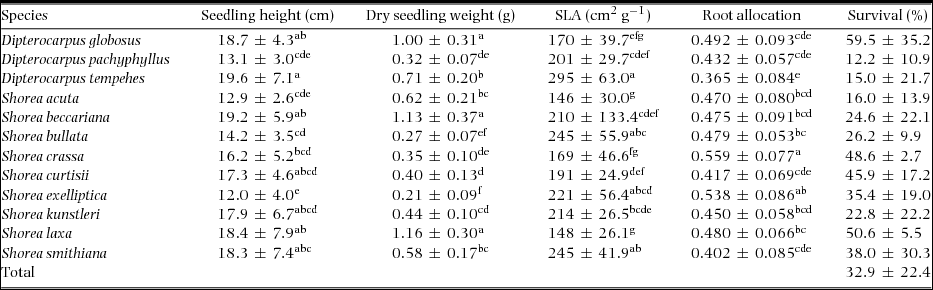
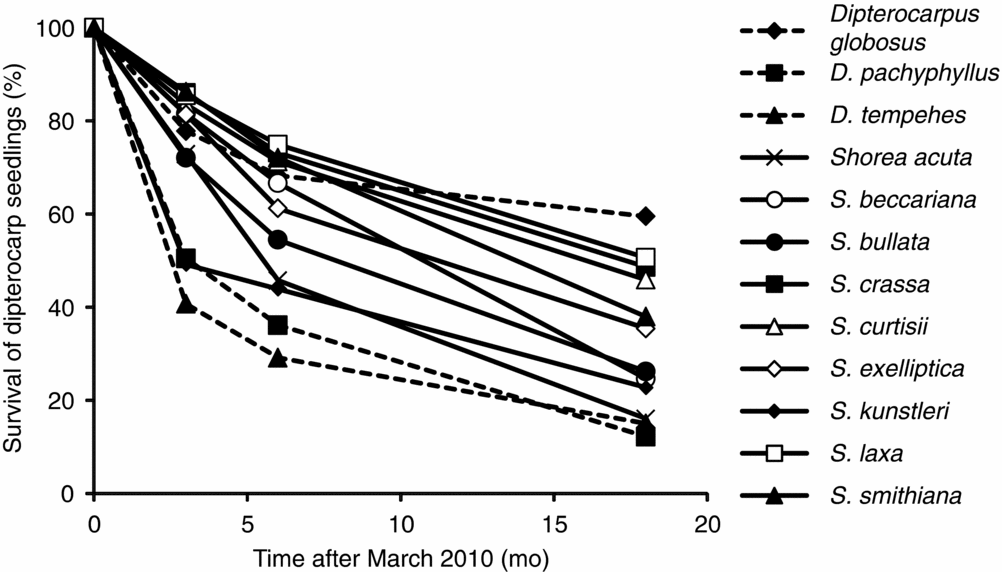
Current-year dipterocarp seedlings gradually decreased after MF (Figure 1), and overall, the mean (± SD) community-level seedling survival over 1.5 y was 32.9% ± 22.4% (Table 2). The mean survival of D. globosus and S. laxa was more than 50%, whereas that of D. pachyphyllus, D. tempehes and S. acuta was less than 20%. In the best-fit model of community-level dipterocarp seedling survival based on the AIC, one abiotic and two biotic drivers were included (Table 3). Initial height had the strongest impact on seedling survival, with larger seedlings having a higher probability of survival. Canopy openness was the second strongest factor, and dipterocarp seedlings growing under higher canopy openness had a higher probability of survival. Conspecific density had a negative impact on survival, wherein dipterocarp seedlings surrounded by higher density of conspecific seedlings showed lower survival.
Morphological traits measured in March 2010 and seedling survival from March 2010 to September 2011 of 12 dipterocarp species in Lambir Hills National Park (mean ± SD). The survival was calculated for each selected individual (three individuals per species, 36 individuals for community-level mean survival). Different letters indicate significant differences among species in the results of multiple comparisons using Tukey's method at P = 0.05.
Coefficients included in the best model for community-level and species-level analyses of dipterocarp seedling survival in Lambir Hills National Park.

Seedling survival of 12 dipterocarp species from March 2010 to September 2011 in Lambir Hills National Park.
All morphological traits of current-year seedlings significantly differed among dipterocarp species (P < 0.01). Dipterocarp species with larger fruit mass (D. globosus, D. tempehes, S. beccariana and S. laxa) had generally taller and larger-mass seedlings than those with smaller fruit mass (Table 1, 2). Mean SLA and root allocation were highest and lowest in D. tempehes seedlings, respectively. When examining dipterocarp seedling survival at the species level, biotic and abiotic factors were selected differently according to focal species. Although initial height positively affected the seedling survival of most dipterocarp species, conspecific density had negative effects on D. tempehes, S. bullata, S. crassa and S. exelliptica (Table 3). The effects of canopy openness and per cent sand were positive for D. pachyphyllus and S. curtisii seedlings, and for S. bullata and S. curtisii seedlings, respectively. The survival of S. curtisii seedlings decreased with increasing soil water content, whereas that of D. tempehes and S. laxa seedlings increased with soil water content.
DISCUSSION
Recruitment of dipterocarp seedlings after MF
Over 30% of dipterocarp seedlings survived 1.5 y after the 2009–2010 MF, in which the magnitude of fruit production was substantially larger than in other MF years at the study site (Nakagawa et al. Reference NAKAGAWA, MATSUSHITA, KUROKAWA, SAMEJIMA, TAKEUCHI, AIBA, KATAYAMA, TOKUMOTO, KUME, YOSHIFUJI, KURAJI, NAGAMASU, SAKAI and NAKASHIZUKA2012). By contrast, near-complete recruitment failure has been reported for Dipterocarpaceae in years of moderate and minor MF (Blundell & Peart Reference BLUNDELL and PEART2004, Maycock et al. Reference MAYCOCK, THEWLIS, GHAZOUL, NILUS and BURSLEM2005). Once dipterocarp seedlings are established, various dipterocarp juveniles (height < 2.0 m) tend to show high survivorship (77–100% in a 1-year census; Aiba & Nakashizuka Reference AIBA and NAKASHIZUKA2007). Therefore, the 2009–2010 MF appears to have been a relatively successful masting event in terms of seedling recruitment of dipterocarp species at the study site. On the other hand, higher seedling survival has been reported for several dipterocarp species (Brown et al. Reference BROWN, PRESS and BEBBER1999, Delissio et al. Reference DELISSIO, PRIMACK, HALL and LEE2002, Itoh et al. Reference ITOH, YAMAKURA, OGINO and LEE1995). Long-term studies on the seedling survival of various dipterocarp species following MFs are essential for better understanding the relationships between the establishment success of the dipterocarp seedling community and the magnitude of flower and fruit production in MF.
Biotic and abiotic factors affecting dipterocarp seedling survival
We found that biotic and abiotic variables affected the survival of all dipterocarp species following MF. The importance of both biotic interactions and habitat environment for seedling dynamics has been reported in tropical and temperate forests (Bagchi et al. Reference BAGCHI, PHILIPSON, SLADE, HECTOR, PHILIPS, VILLANUEVA, LEWIS, LYAL, NILUS, MADRAN, SCHOLES and PRESS2011, Bai et al. Reference BAI, QUEENBOROUGH, WANG, ZHANG, LI, YUAN, XING, LIN, YE and HAO2012, Shibata et al. Reference SHIBATA, MASAKI, TANAKA, NIIYAMA, IIDA, ABE and NAKASHIZUKA2010). With the exception of initial height, canopy openness had the strongest effect overall, increasing the survival of dipterocarp seedlings. Canopy openness has been observed to have similar positive effects on the survival of not only dipterocarp seedlings (Itoh Reference ITOH1995, Turner Reference TURNER1990), but also dipterocarp juveniles (Aiba & Nakashizuka Reference AIBA and NAKASHIZUKA2007) and seedlings in other tropical and subtropical forests (Comita et al. Reference COMITA, URIARTE, THOMPSON, JONCKHEERE, CANHAM and ZIMMERMAN2009, Everham et al. Reference EVERHAM, MYSTER and VANDEGENACHTE1996, Kobe & Vriesendorp Reference KOBE and VRIESENDORP2011). In the present study, the canopy openness of each seedling quadrat ranged from 4.0% to 8.8% (mean ± SD, 6.0 ± 1.0 %), and we investigated only seedlings growing under closed canopy in a multi-layered forest. Under these conditions, slight increase in light level will generally result in increased dipterocarp seedling survival due to the better availability of photosynthetic assimilates. However, the effect on seedling survival of much higher light availability, such as in a gap, remains unclear.
The density of conspecific seedlings also affected the survival of dipterocarp seedlings. Assuming that predator satiation is effective for seedling establishment after MF, this relationship might be expected to be positive. However, the detected effect was negative, indicating that predator satiation did not affect the seedling stage during the 2009–2010 MF. Predator satiation might be more crucial at earlier reproductive stages such as the pre- or post-dispersal seed stages or during seedling establishment (Sun et al. Reference SUN, CHEN, HUBBELL, WRIGHT and NOOR2007, Takeuchi & Nakashizuka Reference TAKEUCHI and NAKASHIZUKA2007, Tokumoto et al. Reference TOKUMOTO, MATSUSHITA, TAMAKI, SAKAI and NAKAGAWA2009). The negative conspecific density-dependent seedling survival found here is in agreement with previous studies in various tropical forests (Comita & Hubbell Reference COMITA and HUBBELL2009, Comita et al. Reference COMITA, URIARTE, THOMPSON, JONCKHEERE, CANHAM and ZIMMERMAN2009, Reference COMITA, MULLER-LANDAU, AGUILAR and HUBBELL2010; Harms et al. Reference HARMS, WRIGHT, CALDERÓN, HERNÁNDEZ and HERRE2000, Kobe & Vriesendorp Reference KOBE and VRIESENDORP2011, Lin et al. Reference LIN, COMITA, ZHENG and CAO2012, Queenborough et al. Reference QUEENBOROUGH, BURSLEM, GARWOOD and VALENCIA2007). Negative density dependence is hypothesized to result from intraspecific competition for resources (Paine et al. Reference PAINE, HARMS, SCHNITZER and CARSON2008) and contribute to the maintenance of diversity in species-rich tropical forests via host-specific natural enemies, including herbivores and pathogens, which respond in a density- or distance-dependent manner (Bagchi et al. Reference BAGCHI, GALLERY, GRIPENBERG, GURR, NARAYAN, ADDIS, FRECKLETON and LEWIS2014, Connell Reference CONNELL, den Boer and Gradwell1971, Janzen Reference JANZEN1970). Furthermore, the relative importance of biotic and abiotic factors changed over time after disturbance by a hurricane (Comita et al. Reference COMITA, URIARTE, THOMPSON, JONCKHEERE, CANHAM and ZIMMERMAN2009). As the overall density of dipterocarp seedlings dropped to about one-third of the initial density over 1.5 y after a MF, the effect of density dependence on dipterocarp seedling survival may change over time.
Variation in abiotic and biotic drivers among dipterocarp species
The results of species-level analyses showed a wider variation in responses to biotic and abiotic factors compared with the community-level analysis. Canopy openness had a significant effect on the seedling survival of only two dipterocarp species in our study. Dipterocarps are generally all late-successional species, although differences in shade tolerance and photosynthetic capacity have been suggested among species (Aiba & Nakashizuka Reference AIBA and NAKASHIZUKA2005, Reference AIBA and NAKASHIZUKA2007; Brown et al. Reference BROWN, PRESS and BEBBER1999, Cao & Booth Reference CAO and BOOTH2001). Philipson et al. (Reference PHILIPSON, SANER, MARTHEWS, NILUS, REYNOLDS, TURNBULL and HECTOR2012) reported that the response in 3-y-old seedling growth rate to experimentally controlled light conditions varied among dipterocarp species. Seedlings of D. pachyphyllus and S. curtisii, which in the present study showed positive relationships between survival and canopy openness, appear to be relatively light-demanding. However, these two dipterocarps showed not small but intermediate SLAs among studied species. Because SLA changes as seedlings develop (Ichie et al. Reference ICHIE, NINOMIYA and OGINO2001) and photosynthetic capacity is also influenced by other factors like leaf nitrogen content, further physiological measurements are needed to elucidate the relationship between seedling traits and the degree of sensitivity to light conditions.
Although a previous study at the same study site found that the survival of dipterocarp saplings with wingless fruits (D. tempehes and S. laxa) had no clear density dependence (Takeuchi et al. Reference TAKEUCHI, KENTA and NAKASHIZUKA2005), negative density dependence was observed in D. tempehes seedlings with wingless fruits as well as in seedlings of three winged-fruit Shorea species. In a temperate forest, Bai et al. (Reference BAI, QUEENBOROUGH, WANG, ZHANG, LI, YUAN, XING, LIN, YE and HAO2012) reported that negative density dependence was more apparent in gravity-dispersed seedlings than in wind- or animal-dispersed ones, but that density dependence was detected only for younger seedlings (age 1–3 y). Further accumulation of empirical studies is necessary for identifying whether dispersal mode influences the occurrence and strength of negative density dependence (Bagchi et al. Reference BAGCHI, PHILIPSON, SLADE, HECTOR, PHILIPS, VILLANUEVA, LEWIS, LYAL, NILUS, MADRAN, SCHOLES and PRESS2011).
The survival of tropical seedlings is often associated with habitat topology through species-specific habitat preferences or drought persistence (Chen et al. Reference CHEN, MI, COMITA, ZHANG, REN and MA2010, Comita & Engelbrecht Reference COMITA and ENGELBRECHT2009). Such a spatially variable effect of soil resource availability on seedling survival likely contributes to species distribution patterns and niche partitioning. Seedlings of S. curtisii had the advantage of higher survival at sites with a higher content of sand and lower soil moisture, which suggests a preference for habitats with dry, nutrient-poor soil. This is supported by previous studies, which found that S. curtisii trees are abundant on ridge crests (Whitmore Reference WHITMORE1984) and that those 30–130 cm tall can withstand water stress and nutrient shortages (Yagihashi et al. Reference YAGIHASHI, OTANI, TANI, NAKAYA, RAHMAN, MATSUI and TANOUCHI2010). However, no clear trends appear to exist in the effects of soil environmental heterogeneity on seedling survival and seedling morphological traits. During the census period, every month had rainfall more than 100 mm, except for 68.2 mm in March 2010. Differences in seedling performance according to the morphological traits might emerge under more severe conditions (e.g. severe drought). Our species-level results indicate that the major drivers of dipterocarp seedling survival vary among species, which in turn may contribute to species coexistence. Future studies should focus on identifying the traits controlling species sensitivity to biotic and abiotic drivers of seedling survival.
ACKNOWLEDGEMENTS
We thank the Forest Department Sarawak and Sarawak Forestry Corporation for permitting research activities in Lambir Hills National Park, and researchers and local people for helping with field survey. This study was financially supported by the Research Institute for Humanity and Nature Project (D-04), Grants-in-Aid from the Japanese Ministry of Education, Science, and Culture (20687002, 23255002 and 26660124), and JSPS Research Fellowship for Young Scientists to Y.T. (226034).