Introduction
The Baltic Sea has been for many centuries a considerable maritime trading crossroads and it is known as a trading region since the formation of the Hanseatic League in the 12th century. This association of merchants, mainly German, became a society of merchant towns which stimulated fast expansion of trade in northern countries of Europe thanks to naval power (Dollinger Reference Dollinger1988). Since then, maritime traffic in the Baltic Sea has grown, its trading activities have internationalised due to the invention of new technologies for shipping and maritime transportation (Guillaume Reference Guillaume2008). From 1997 to 2007, the aggregated volume of cargo handled in the Baltic Sea ports grew from approximately 580 million to 825 million tons (Saurama Reference Saurama2010).
Nowadays, despite the severe Baltic Sea ice conditions, its winter traffic represents about one quarter of the annual traffic. Indeed, sea ice can cover 10 to 100% of its surface. The ice season can last between four and seven months, and the maximum ice thickness can reach 120 cm (Jevrejeva and others Reference Jevrejeva, Drabkin, Kostjukov, Lebedev, Leppäranta, Mironov, Schmelzer and Sztobryn M.2004). Nevertheless winter navigation at the ends of the gulfs of Bothnia and Finland is relatively recent.
This article illustrates the historical evolution of winter shipping in the Baltic Sea since the 19th century. The results are based on both qualitative and quantitative approaches and depend on substantial literature, statistical data, and interviews with Finnish Maritime Administration (FMA) representatives. The history of winter navigation is explained through numerous material and shipping technical developments, the establishment of maritime regulations, and aids to navigation. The article also deals with the maritime risks incurred by vessels and the consequences of a possible future significant reduction of sea ice.
The beginnings of winter navigation
Winter navigation in the Baltic was at the heart of many rules enacted mainly to ensure maritime safety. At the time of the Hanseatic League, maritime traffic was stopped during the winter and the ports were often covered by ice. In the 14th century access to the Hanseatic ports was largely prohibited from 11 November to 22 February. (Dollinger Reference Dollinger1988). In the days when sailing ships were still dominating maritime traffic in the 19th century, winter navigation was nonexistent. It was only at the beginning of the 20th century that vessels began to sail in lightly frozen waters of the Baltic Sea. The progressive steam engine manufacture did not immediately cause any major changes in the winter traffic. Indeed, vessels’ hull was still made of wood like the one of the old sailing ships and was therefore still fragile.
However, the first winter routes between Finland and Sweden were run from the winter of 1878 by the predecessor of the icebreaker, Express, which carried passengers between Hanko and Stockholm (Finnish Institute of Marine Research 1997). In 1890, Finland acquired its first icebreaker, Murtaja. This steam ship built by a Swedish company was mainly used to provide exports to western Europe. It was operational for maritime traffic after the World War I when it met many technical problems.
In the first half of the 20th century, maritime trade and the merchant fleets in the Baltic Sea suffered from the disastrous consequences of the war. During the post-war period, maritime trade growth slowed and the reconstruction of the Finnish merchant fleet was only hesitant. Considering the economical inability of the shipbuilding sector, Finnish imports depended on few steamboats (511 in 1918) and sailing boats (nearly 640 in the same year) that were still dominating in the Baltic Sea (Kaukiainen Reference Kaukiainen1993).
From the interwar period to the end of the sixties: strengthening vessels and first regulations
In the mid-1920s, maritime trade increased progressively and the Finns bought more than 20 000 net tons of steamboats. From 1918 to 1922, more than 600 Finnish ships were built and most of them were either small steamboats with wooden hulls carrying mainly wood or sailing boats with auxiliary engines. In the 1920s, the traditional wooden vessels still dominated in shipbuilding. Moreover, some windjammers were bought to make up for war losses. In the thirties, the growth continued and the Finns began to invest more in second-hand steamboats. From 1931 to 1934, 114 steam- and diesel engine ships and half dozen sailing boats were purchased. After 1935, the shipbuilding industry grew more and seven diesel engine vessels were built. During the interwar period, a significant structural change appeared in the Finnish merchant navy with a continuous decline of the amount of sailing boats. Steam- and diesel engine ships were mostly made up of a wooden hull and sailed mainly along the coasts.
Moreover, during the same period, winter navigation expanded to southern regions of the Baltic and the Gulf of Finland. Indeed, during the mild winters of the 1920s and 1930s, there were some attempts to let the ports of the Bothnian Sea and the Gulf of Finland open. As a matter of course, the increase of construction of iron and steel hull vessels had an important role to play in the transition to winter navigation. Furthermore, the icebreaker fleet became larger with three more ships and the structures of most vessels were reinforced to face sea ice while the first winter traffic regulations were established. However, the coal consumption of steam icebreakers was too high and their field of working was consequently restricted. The ports of Hanko and Turku (Gulf of Finland) were the only ones to remain open during the all winter. Nevertheless in 1939, the diesel electric icebreaker Sisu came into service and ensured winter traffic growth (Finnish Institute of Marine Research 1997). In fact, the winter traffic represented 7 to 15% of the annual maritime transport during the interwar period.
Despite considerable technical progresses in materials for ship construction and new icebreaker operations, the strong ice growth of northern waters of the Bay of Bothnia did not permit easy access to the furthest harbours. Winter traffic was therefore almost nonexistent there.
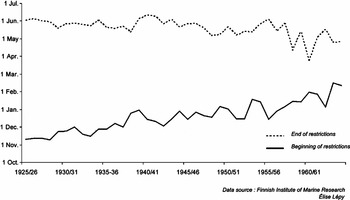
In the 1920s, it could have sometimes been the case that any vessel was able to reach the port of Oulu for more than 200 days in the year. Fig. 1 shows the date when the last vessel arrived at the port of Oulu in the autumn and when the first vessel arrived in the spring between 1925 and 1965. Until 1950, these vessels were mainly some steamers sailing more easily in sea ice than the sailing boats that dominated maritime traffic at the beginning of the century. Nevertheless, in general the period without any winter navigation tended to decrease. Indeed, the number of days when any ships came to the port of Oulu has been reduced, from 203 days in 1926–1927 to only 53 days in 1960–1961. Yet, the severity of ice conditions is not the only explanation to this trend: indeed the correlation coefficient between the number of days without navigation and the maximum ice extent in the Baltic Sea is low (r = 0,23). But the change of the shipbuilding structure and the increase of the number of icebreakers have actually played an important role. Thus, after World War II, obviously catastrophic for the Finnish fleet, there was a decline of steamboats in favour of the diesel engine ships. So the Finnish fleet still counted 312 steamboats and 37 diesel engine ships in 1945 whereas it counted respectively 53 and 447 in 1970.
Dates of the last ship arrival and the first ship departure at the port of Oulu between 1925–1926 and 1964–1965.

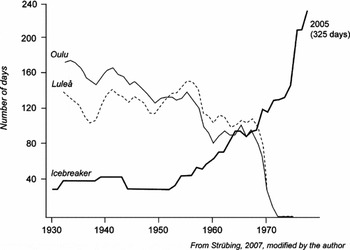
Moreover, the icebreaker fleet common to the Swedish and Finnish maritime authorities continued to increase from 7 to 9 ships in the late forties to 12 in the middle of the sixties (Strübing Reference Strübing2007). This had a significant impact on the shortening of the closure period of the ports of the Bay of Bothnia (Fig. 2). Indeed, in the fifties the Finnish icebreaker fleet was rebuilt with vessels such as Voima in 1954, Karhu in 1958 and Sampo in 1960. One by one, the winter ports became accessible and most of the ports have remained open throughout the year since the seventies (Finnish Institute of Marine Research 1997).
The closure of Luleå and Oulu ports from 1930 to 1977 and icebreaking length.

Winter navigation in sea ice since the seventies
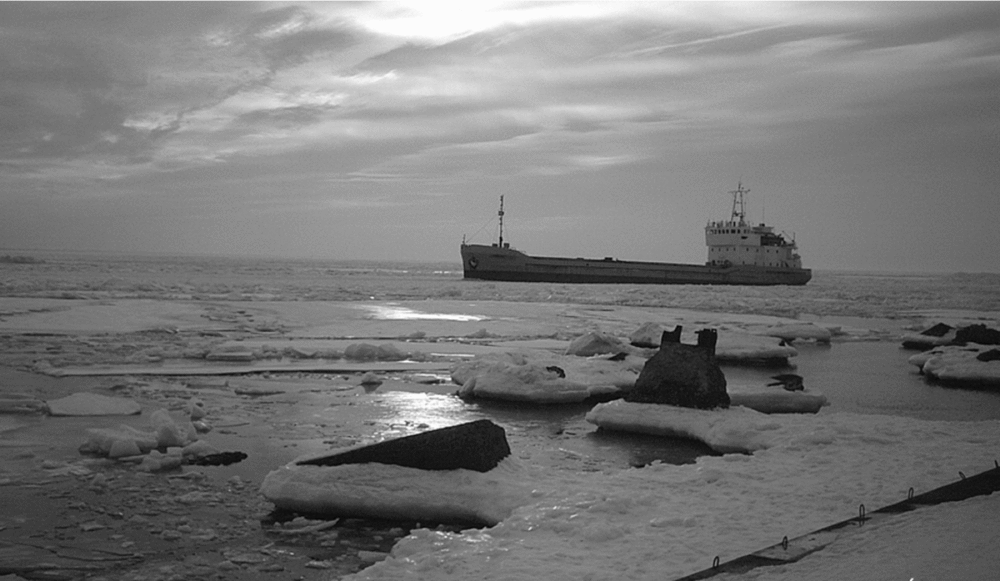
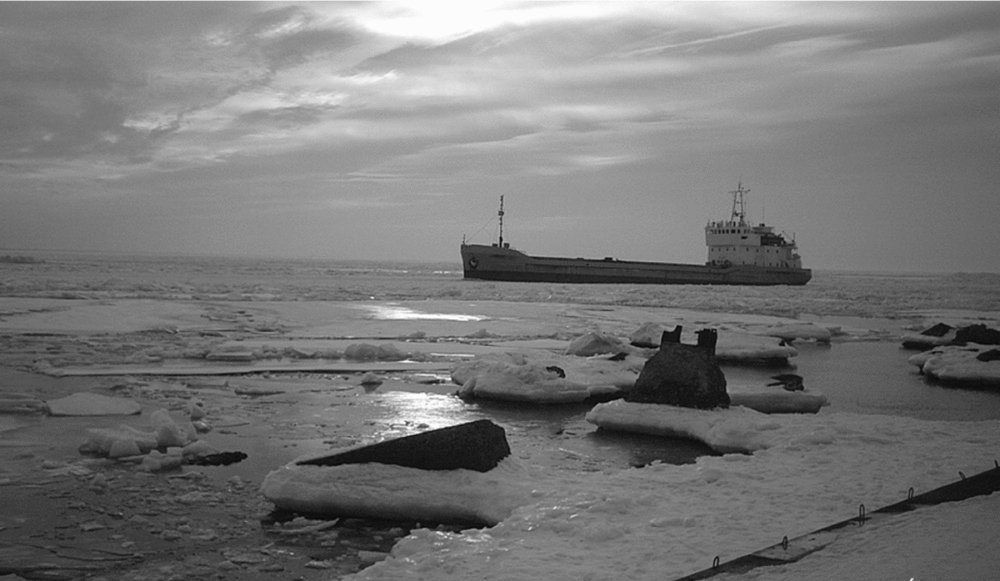
The common approach to winter navigation issue in the Baltic began to emerge between Finland and Sweden in the mid-1960's when the political and economical will was felt to let the northern Baltic ports open throughout the year (Juva et Riska Reference Juva and Riska2002). This approach aimed at regulating export and import flows and maintaining traffic safety. These two objectives were achieved with the icebreaker assistance when sea ice conditions required it. So since 1963, two generations of more powerful icebreakers were introduced to the fleet: Tarmo in 1963, Varma in 1968 (sold later to Latvia), Apu in 1970, Urho in 1975 and its sister-ship Sisu in 1976, then later, Otso in 1986, Kontio in 1987, Fennica in 1993, and Nordica in 1994. Therefore, the smooth functioning of the Finnish-Swedish cooperation allowed the northernmost ports (Luleå, Kemi, Oulu, etc.) to be opened throughout the year. The last seasonal closure of the main ports of the Gulf of Bothnia happened in the winter 1969–1970. Winter traffic has consequently increased to 40% (Kaukiainen Reference Kaukiainen1993), blurring seasonal variations of the maritime traffic. Moreover, more and more merchant ships (Fig. 3) were able to operate in sea ice conditions more or less favourably without any icebreaking assistance (Landtman Reference Landtman1983).
Cargo arriving to the Port of Riga, mouth of Daugava.
For instance, the port of Oulu remained closed for three months of the year until the end of the 1960’s. But since the winter of 1969–1970 it has been opened all year. In 1971, it acquired the icebreaker Tuura built in Sweden. Also in the 1970's the winter traffic grew progressively. In 1971 the traffic in February and March was 4,3 times less important than in July and August, and few years later only 2,5 times less important. Nowadays, seasonal variations have become blurred. From January to March 2008, the international maritime trade of Oulu port was about 25,87%, that is a little bit more than a quarter of the annual traffic (486,100 tons accumulated the first three months of the year out of 1,879,200 tons) (Terho Reference Terho1979).
At the end of the 1970’s, the tonnage transported by Finnish vessels was one of the highest in the world. During these years, maritime traffic in the Baltic greatly increased. Passenger traffic especially between Finland and Sweden participated considerably in this increase as well as the winter traffic which was developed thanks to the interest of maritime authorities and shipbuilders for strengthening hulls to face sea ice conditions. Moreover, the requirements for icebreaker building have evolved according to the maritime traffic development. Nowadays, there are more than 10 000 calls in Baltic Sea ports for each ice season and the icebreaker fleet of both countries had 19 vessels in 2005 (Strübing Reference Strübing2007).
The establishment of maritime regulations
Winter navigation is organised around three elements: the merchant ships, the icebreakers and the maritime authorities which manage maritime activities. The variability of ice condition severity does not allow all vessels to navigate in sea ice or to be assisted by an icebreaker. The number of icebreakers, even if it seems important in the Gulf of Bothnia, is however limited against the importance of increasing traffic. Thus traffic restrictions have been required to vessels according its capacity to navigate in sea ice.
The first statute concerning shipbuilding and equipment for winter shipping was adopted in 1890. Only a few passenger vessels were concerned by this new regulation requiring the strengthening of the ships from the poop to the bow and the use of a double bottom under the engine room. It took some decades before this regulation was applied to other vessels.
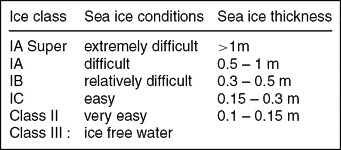
From then on, shipbuilding norms have become more and more exigent as laid down by maritime authorities and the International Association of Classification Societies (IACS). Within this regulation context, Finland is considered as one of the most active states in the establishment of regulations for shipping in sea ice issued by public authorities (Siivonen Reference Siivonen1979). Since the first regulations, the ship classifications have evolved according to security and navigation needs and ice conditions. Table 1 describes the actual classes defined in 1971 by the cooperation between Sweden and Finland.
Sea ice characteristics of different ice classes.

Progressively regulations have had recourse to stricter criteria for hull strengthening and ship power. For instance, the smallest ship of class IA is 3500 dwt (deadweight tons) with an engine power of 1100 kW. Moreover in the 1970’s, IACS proposed for the first time an universal classification of navigation regulation in sea ice standardising Finnish-Swedish norms with Canadian and Soviet norms (Siivonen Reference Siivonen1979). This project is still relevant today even if certain efforts have been undertaken within countries bordering the Baltic Sea.
In fact, according to the ice condition severity, only class I ships can be assisted by an icebreaker if necessary excepted class IA Super ships whose structure, engine and other properties are able to sail in extremely difficult ice conditions without assistance. Class II ships generally have a steel hull adequate for sailing in lightly frozen waters. The class III ships can only sail in ice free waters (Finnish Maritime Administration 2008).
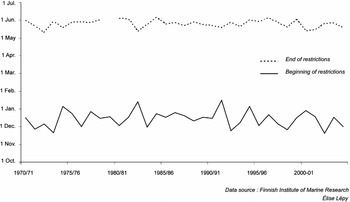
Winter traffic restrictions have evolved with modifications and improvements brought to shipbuilding. Fig. 4 shows the start and end dates of restrictions for every winter since 1970–1971 for class II ships, those which have the smallest resistance and power for sailing in sea ice. Variations reveal the harshness of the winter and the more or less precocious ice growth and melting. However, the first 15 years drawn in this document show that restrictions occur later due to a more significant capacity of vessels.
Winter restriction dates of ice class II at Oulu from 1970 to 2005.

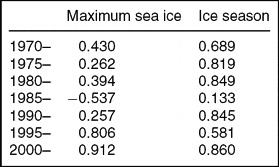
Logically, sea ice conditions have an influence on start and end dates of restrictions. But it seems appropriate to wonder if the number of days of winter restrictions is influenced by the maximum ice extent of the Baltic Sea and/or its ice season length. According to the results shown in Table 2, the ice season length would have more impact on restriction dates than the maximum ice extent, knowing that four of the time periods have a correlation coefficient higher than 0.8 for the ice season length, and only two time periods for the ice extent. Nevertheless, the number of restriction days was weakly related to the two variables for the period 1985–1990, due to the presence of the severe winters 1985, 1986, 1987 and the extremely moderate winter 1989 in the same time period.
Correlation between the number of winter restriction days and the maximum Baltic ice extent and the length of the ice season.

These results demonstrate that restrictions to navigation are not only related to the sea ice extent and ice season length, knowing that local sea ice conditions can also explain them (Strübing Reference Strübing2007).
Aids to navigation
The Baltic Sea pack ice with the exception of coastal fast ice always attached to the shore is subjected to frequent movements of its ice floes and numerous deformations of its cover. Navigation in sea ice requires aid provided by icebreaking services in order to open the maritime routes, and an information medium needed for the knowledge of maritime routes to take to reach the remote parts of the gulfs.
In order to compensate for inconvenience due to winter sea ice and to make the harbour access easier, the Finnish and Swedish maritime administrations have developed services meeting the needs of vessels during the winter. Maritime administrations have a mission to ensure maritime safety, to maintain the channels open, to assist the maritime traffic and to provide information about sea ice and weather conditions to vessels.
During recent years, the new generation of icebreakers and the Finnish-Swedish cooperation for icebreaking and assisting ships, the improvement of performance of ships to sail in sea ice, and finally the more adapted restrictions to sea ice conditions and the ship classification have all contributed to the fast growth of winter traffic especially in the northern Baltic. As winter navigation is completely dependent on icebreaking intervention and assistance, the cooperation between maritime administrations improves services provided by icebreakers through networks largely based on new satellite and information technologies.
Icebreaking assistance in figures
After the difficulties met during the winter 2002–2003, maritime authorities and icebreaking services of all countries of the Baltic decided to create in 2004 an organization named Baltic Ice-Breaking Management (BIM) the purpose of which is to promote safety at sea during the ice season. It has as its main objective ensuring the smooth functioning of maritime traffic in the Baltic Sea and strengthening cooperation between all the countries bordering the Baltic in winter time.
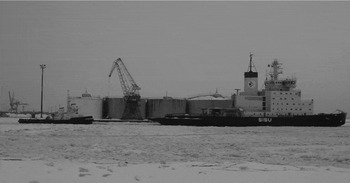
According to BIM reports, more than 6700 vessels received assistance from an icebreaker in 2005–2006, with near 27% in the Bay of Bothnia and a majority in the Gulf of Finland. In both gulfs, icebreakers worked for over five months and in the Gulf of Riga for less than four months. In fact, icebreaking and assistance interventions are controlled by maritime authorities of each country. In Finland, for instance, the Finnish maritime Administration (FMA) decides about traffic restrictions and sends icebreakers (Fig. 5) to operate at sea according to sea ice conditions and traffic flows (Jalonen and others Reference Jalonen, Riska and Hänninen2005).
The icebreakers Tuura owned by the city of Oulu and Sisu, the biggest icebreaker of the Finnish fleet.

Port infrastructures adapted to sea ice conditions
Aid to navigation does not only concern frozen maritime routes. The ports of the gulfs of the Baltic Sea also become frozen seasonally. Contrary to some regions where sea ice conditions are much more severe and boat loading and unloading can take place directly on the icepack as in Russian arctic harbours (Thorez Reference Thorez2008), the ports of the Baltic are all accessible for vessels even if sea ice may pose two major problems: the deterioration of port structures due to pressure of ice on quays, and the access to the manoeuvring areas hindered by sea ice. The solution to these problems is to reduce or make sea ice disappear from port waters and to decrease forces generated by sea ice on port structures.
The case of Oulu is exemplary for the Baltic since other ports like Helsinki have followed its example and its ice control system (Pan and Eranti Reference Pan and Eranti2009). Oulu port infrastructures are adapted to the seasonal formation of sea ice. Thus, during the planning and quay building, forces generated by sea ice on quays were considered: the use, the model, the solidity and the location of the quays must be adapted to sea ice. While maximum protection against sea ice movements is required, the access to the port must remain easy.
For this, the port has required an ice control system renewed in 2008 in Oritkari basin. This new system must fulfil the specific needs of North European Transportation and Supply System (NETSS) which links several times a week the ports of Ajos with Oulu and the ones of Lübeck with Gothenburg. The ice control techniques in the port of Oulu have two main aspects: firstly the icebreaking operations of port waters by the city icebreaker Tuura in order to allow the opening of maritime routes. And secondly, the use of thermal discharges from the industrial zone nearby, associated with the use of chemical products allow ice melting. According to Pan and Eranti (Reference Pan and Eranti2009), many Finnish ports take advantage of thermal effluents to solve problems related to sea ice hindrance of port areas. Yet during previous winters some ships had problems with mooring at the northern quay of Oritkari. A new system of air bubblers has been installed in the bottom of the tidal basin. These mechanical devices produce air bubbles which bring the deepest and warmest waters to the surface and then accelerate the ice melting process. Thus, the thermal energy from the industrial zone combined with the air bubbler system should markedly improve the ice control in the entire Oulu port area (Port of Oulu 2008).
Some subarctic ports use other complementary actions like insulating materials on stretches of water close to the quays and a floating stockade to divert sea ice blocks (Tsinker Reference Tsinker2004).
The new information technologies for winter navigation
The constant cooperation between Sweden and Finland since the 1960's has always allowed the improvement of common functioning of icebreaking and assistance operations. Thus, recently, both authorities have used new information technologies (NICT) to develop jointly a new online information system called IBNet (IceBreaking Net), in order to coordinate common icebreaking operations.
The IBNet is an information and management system used by icebreaking services. It comprises information about merchant ships (locations, speed, etc.), traffic restrictions, and weather and ice conditions. This information is essential for icebreaking and assisting operations. This system proposes a geographical interface, IBPlott developed by the technical research centre of Finland VTT, which displays all information in only one document. IBPlott gives information about the maritime traffic organisation and allows users access to weather and ice data, essential for the navigation. Users can consult a satellite image layered to an electronic map where locations and routes of icebreakers and vessels are noted as well as information about ice thickness, wind direction and speed. Recently, the images used by IBPlott are Radarsat, Envisat and Modis images. They are processed in remote sensing centres before being sent to the Finnish ice service which distributes them to maritime authorities in charge of delivering the information to icebreakers (Berglund and others Reference Berglund, Kotovirta and Seinä2006).
Maritime traffic data are diffused by the AIS (Automatic Identification System), system to which IBNet is connected. The AIS system, fitted with VHF radio, GPS and other information and communication technologies, provides data about identity, status, geographical location and ship routes to maritime authorities and other vessels fitted with this system. Since 2005, the Baltic is totally covered by the system HelCom AIS created by the Helsinki Commision (HelCom), after several sea accidents occurred. IBPlott allows then to receive combined information about maritime traffic situation provided by AIS and weather and ice conditions.
In order to improve trip length and reduce fuel consumption, avoiding ship accidents or incident in sea ice, some researchers (Kotovirta and others Reference Kotovirta, Jalonen, Axell, Riska and Berglund2009) have set up a system which would present the optimal routes in sea ice taking into consideration natural and economic parameters. This system has to integrate modelling of sea ice and ships routes.
However, despite navigation assistance in sea ice becoming more developed and efficient, and despite a modernisation of information and communication tools, vessels are still exposed to incidents not to say accidents.
The maritime risks
Icebreaker development and the ship strengthening made possible winter navigation in the northern Baltic. The risk caused in a sea ice context is normally controlled by maritime traffic regulation based on the ice cover extent and ice condition severity, by the regulation of vessel categorisation and by icebreaking assistance. Yet, there are some hazards during winter navigation, being limited to minor damages without human losses (Jalonen and others Reference Jalonen, Riska and Hänninen2005).
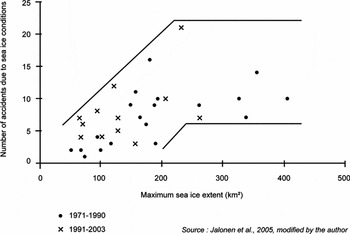
Every winter, accidents in sea ice are reported to the maritime authorities. The more severe ice conditions are, the more ship accidents occur, as shown in Fig. 6 for the period 1971–2003. It can be noticed that the link established between the two variables was stronger in the 1990's than later due to the recent and continuous improvement of control conditions.
Correlation between the number of marine accidents in ice conditions of Finnish waters and the maximum extent of ice cover from 1971 to 2003.

The Gulf of Finland where the traffic is more developed, records the biggest number of winter accidents. Despite a less important traffic, harsher sea ice conditions in the Bay of Bothnia are also at the origin of numerous accidents whereas a weaker percentage is noticed in the Gulf of Riga.
According to Riska and others (Reference Riska, Wilhelmson, Englund and Leiviskä1998), sea ice can affect navigation in two ways. On one hand, sea ice can impose a heavy weight to the hull and disturb the smooth functioning of marine propulsion system while on the other hand, sea ice can increase the resistance to the vessel movements until the vessel stops and remains blocked. It is then possible to draw a list of the most plausible type of accidents in winter navigation in the Baltic. Jalonen and others (Reference Jalonen, Riska and Hänninen2005) have underlined in their studies dealing with Finnish waters that the most frequent case is when a ship is grounded in shallow water. However, collisions are also frequent in winter navigation. Collisions are often the result of difficult steerage between an icebreaker and assisted cargo ships. Moreover, problems can also concern the hull. Compression of the hull due to the movement of ice pack or during direction change of the vessel, often explain damage. It can also happen that the propellers are damaged by the weight of the ice bending the blades. Finally, the rudder can break when the vessel goes backwards.
The example of a severe winter 2002–2003
During the winter 2002–2003, many incidents and accidents occurred in the Baltic. The maritime and port administrations counted about a hundred cases involving 111 vessels (Hänninen Reference Hänninen2003). In comparison, the winter 2005–2006 had only three major accidents and the two following winters only minor damage. Obviously, sea ice conditions were the main reason for the problems in 2002–2003. The longest restriction period concerned the ports of the Bay of Bothnia (Luleå, Tornio, Kemi, Oulu) starting from 19 November 2002 for vessels of class I and II and tonnage inferior to 1000 dwt and ending on 23 May 2003.
Yet it is known that the winter 2002–2003 was, in terms of sea ice cover, moderate (232 000 km2 in the Baltic Sea on 6 March 2003). It was however one of the most severe winter of the decade which explains the high number of incidents and accidents. Sea ice thickness reached 88cm in the Bay of Bothnia, 80cm in the Gulf of Finland and 70cm in the bay of Pärnu. Moreover, the ice season was longer than the average, from two weeks to one month according to place. Many cold spells appeared during that winter making ice conditions more severe. In March, strong winds from southwest led to the creation of ice ridges and made the navigation even more difficult in the Gulf of Bothnia.
In 2002/2003, 98 accidents were listed and rather more than 15% of them took place in the Bay of Bothnia and 10% in the Gulf of Riga. Many accidents also occurred in the Gulf of Finland where maritime traffic is more developed. Most of the vessels involved were class IA or IA Super (except three of them that were class II). At this period, shipping restrictions allowed only vessels of class IA and superior to reach the end of the gulfs. Bulk carriers and ferries were more implicated than other vessels because of their high number.
Damage
Damage is mainly caused by technical errors. Many of these arise in the case of vessels with a high propulsion power compared to size. The bow is then often damaged. Manoeuvre errors can be also causes of incidents especially during the assistance or towing of a vessel by an icebreaker. But one of the most common is collision between two ships following each other, often when ship channels are resurfaced by ice: the first ship remains jammed in the ice and the second one collides. Moreover, natural, sea ice and meteorological conditions have consequences on winter navigation. Strong winds can engender ice pack movements compressing sea ice on the ship's hull. Ice ridges in the way can also damage the ship's hull and hold. Finally, the darkness of the long winter night and abundant snowfall make the winter navigation more difficult.
Propeller deterioration is the predominant damage. The incident often occurs during port manoeuvres or during backing. The collision between a cargo ship and an icebreaker assisting is the second most common accident.
Solutions to limit the risks
According to Jalonen and others (Reference Jalonen, Riska and Hänninen2005), limiting the risks of involvement of a vessel in an incident or accident is based on three points: first of all, a more severe or even total restriction of IC and IB class ship (which register many hull problems) would reduce the number of accidents. Moreover, a more efficient icebreaking assistance would improve security at sea. The number of icebreakers of the Finnish-Swedish fleets would consequently have to increase in order to intervene faster and to reduce the waiting time for assistance. Besides, some ships of IA Super class, despite their theoretical capacity to navigate by themselves in sea ice, sometimes require an icebreaker. Finally, improvement of meteorological forecasts and ice conditions maps would be beneficial.
Conclusion: the future of the winter navigation in the context of global warming?
Most of the scenarios with regard to global warming predict an increase of temperatures which would have effects on Baltic sea ice characteristics. Thus, a decrease trend of ice pack would have considerable consequences on maritime navigation and the whole winter traffic system including navigation aids would be affected.
Icebreaking activities, the main aid to winter traffic, permits an appreciation of the actual influence of sea ice variations on maritime navigation. If we consider the time length of the functioning of the Finnish icebreaking fleet in the Baltic from winters 2000–2001 to 2008–2009 as well as the maximum ice extent, it is obvious that the correlation between duration of the icebreaking and the maximum ice extent is strong. Thus, during the winter 2002–2003, the most severe of the decade, the icebreakers worked in total almost 1200 days. On the contrary, during the winter 2007–2008 with a very small ice extent, the number of cumulated days of working for icebreakers was less than 300.
What about the future icebreaking activities? According to some representatives of the FMA the possible shortening of the ice season would be positive because it would lead inevitably to the reduction of icebreaking costs. In fact, the average annual cost for the Finnish icebreaking fleet operations is about 20 million euros paid by the FMA although some of this is offset by charges on vessels. For a mild winter equivalent to 650 days of icebreaking operations, 5 million euros must be added for various assistance and port operations, and 5 million euros for the fuel. During a more severe winter (more than 900 days of icebreaking activity), the costs increase dramatically.
Moreover, delays in winter traffic and port operations (coming alongside, etc.) would be reduced. Modifications for winter traffic restrictions would be made, because low class vessels (IC and II) would be authorised to sail in winter. Finally an icepack reduction would necessarily lead to the extension of the shipping season in ice free waters and the ship speed would increase (Kubat and others Reference Kubat, Gorman, Collins and Timco2007). However, the risk of accidents might remain or even increase in Northern Baltic Sea due to traffic growth.
The occurrence of a possible climate warming leaves some open questions as the future of the icebreaking fleet. In fact, a certain number of icebreakers are old and have reached the ‘end of life’. The question of replacement is influenced by the knowledge that the winters of the last decade were quite mild excepted for 2002–2003 and the two last ones. But non-replacement of the fleet could mean that many vessels were stopped in sea ice during more severe winters causing potential risks. New icebreakers should then be multifunctional and the icebreaking cost would considerably increase. Actually BIM members should envisage a collective solution for bordering states which would, in effect, result in the creation of a common fleet for the whole Baltic Sea.