Introduction
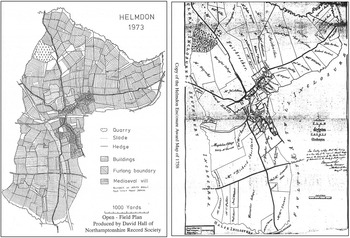
“Enclosure” has long been shorthand for describing the exchange of scattered strips of land and common rights for cohesive plots in premodern and modern England. Proprietors who farmed long strips of land throughout a village or released cattle on unused waste would receive at enclosure regular plots commensurate in value with earlier interests. The process of enclosure in a village could be gradual, as it predominantly was for much of the premodern period. Alternatively, as increasingly occurred in the modern era, the proprietors could enclose their lands in concert. Figure 1, two maps of Helmdon in Northamptonshire, depicts the vast change in holdings that could occur through enclosure.Footnote 1
Maps of Helmdon in Northamptonshire as farmed in strips and upon enclosure in 1758.

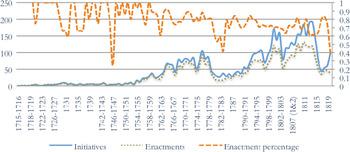
In the early eighteenth century, at least 25 percent of the land in England was held in strips or subject to common rights. Beginning in the mid-eighteenth century and lasting into the early nineteenth century, a vast wave of enclosures swept over England, washing away these prior holdings, often leaving entirely new ones in their wake.Footnote 2 Propelling this wave were thousands of individual enclosure bills, separately promoted by private individuals through Parliament. As Chart 1 illustrates, before 1750 only a mere handful of these bills were offered into Parliament each year.Footnote 3 In the 1760s, that average jumped to sixteen. By 1770, the average had more than tripled to over fifty. In the early nineteenth century, well over 100 enclosure acts were attempted in a typical session.
Enclosure petitions, enactments and enactment percentages, 1715–1820

Generations later, the effects of this proliferation of acts and enclosures remain contested. These debates focus principally on redistributive issues, primarily the impact of enclosure on the peasantry and small landowner as well as the gains to substantial landowners. These issues are fascinating, but it is not the aim of this article to delve into them.Footnote 4 Rather, this article explores the conditions that made this growth in enclosure legislation possible. Specifically, this article looks at Parliament's willingness and ability to enact enclosure legislation after the Glorious Revolution. In its approach, this article compliments the work of prior economic, social, and legal historians, who have almost uniformly looked outside of Parliament to uncover the factors that gave rise to the century's great waves of enclosure. These historians have exhaustively explored such factors as increasing agricultural innovation,Footnote 5 price changes,Footnote 6 augmentation of rental income,Footnote 7 and other productivity gains.Footnote 8 This article does not wade into debates over the relative importance of these factors in encouraging enclosure. Rather, it attempts to identify another as-yet-unstudied variable affecting the rise in enclosures: institutional changes in Parliament related to the passage of enclosure legislation. This article aims to identify changes in Parliament's rules, procedures, and fees that lowered the costs associated with enclosure and that affected the willingness of suitors to promote legislation there.
This article identifies two principal developments in Parliament's rules, procedures, and fees that had effects on the eighteenth-century wave of enclosures. The first was a decrease in the percentage of property holders necessary for an enclosure act to be passed through Parliament. Over the first half of the eighteenth century, Parliament ceased to require the unanimity of the affected commoners before passing an enclosure bill. By mid-century, it settled on a requirement that consent for an enclosure was required only by those holders of 80 percent of effected property. This allowed property holders to break down entrenched interests and realign property rights to potentially more productive uses.Footnote 9 The second development was the strategic deployment of fees and procedures in way that encouraged energetic solutions to perceived problems, especially those involving enclosure——that made legislation a viable mechanism for those seeking economic change.
In examining the part played by parliamentary institutions in the enclosure wave, this article endeavors to carve out a role for legal history in explaining its causes, not merely its putative effects. As Ron Harris has aptly noted, “Legal history in Britain is, to a degree, lawyers, or pre-Hurstian, legal history.”Footnote 10 Thus, the connections between the traditional English legal history and the economics of the enclosure movement have been, at best, attenuated. The legal history of the enclosure wave typically played out in the national Parliament, at the local public house, and before enclosure commissioners, with little interference from the common law and the law courts. As a consequence, traditional legal historians have largely neglected it.
Meanwhile, these rules and their impacts have often been lost in the work of many economic and social historians, who perceive law as evidence of social, cultural, or economic forces at work, and rarely the converse. Law, as traditionalists have understood, possessed its own logic. And whereas this logic may have varied depending upon how openly political its institutions were, this logic nonetheless generated its rules, procedures, and practices. How well these rules, procedures, and practices functioned for those who had contact with law affected whether it was readily obeyed, became the subject of challenges or was ignored through practice. Knowing how an old law yielded to a new law remains the first essential step to understanding law's history and its relation to economy, culture, and society. In the specific context of the enclosure movement, knowing how parliamentary procedure and norms changed enables us to better understand the origins and growth of this movement.
In carving out a role for legal history in exploring the causes of the enclosure movement, this article is also situated next to recent work on the effects of fees and other incentives on actors engaged in the legal process. In this regard, this article follows the disparate, but similarly informed work of Dan Klerman on the effects of judicial fees on the competing court jurisdictions and attitudes of the courts toward parties;Footnote 11 Nicholas Parrillo's forthcoming book on the history of fee effects in nineteenth-century American government;Footnote 12 and James Pfander's examination of the effects of judicial salaries on the unwillingness of early federal courts to expand their jurisdiction.Footnote 13
The argument of this article proceeds in three parts. Part I briefly describes the limits that the law placed on private enclosure efforts on the eve of the parliamentary enclosure movement as well as the changes in Parliament's substantive rules and norms pertaining to enclosure that enabled suitors to expect a net benefit from pursuing legislation. This part centers on the dilution of a legal standard of unanimous assent. This standard, earlier adopted by chancery, required the consent of all affected landholders before a bill authorizing enclosure would be enacted. Through its dilution, blocks of landowners were thereby enabled to impose enclosures on increasing numbers of dissenting landholders and to create stable coalitions in favor of enclosure. The remainder of the essay begins to address the questions that emerge once we begin to think of the enclosure movement as having a significant parliamentary component. Particularly, it centers on those parliamentary features that made it worthwhile for lords, impropriators of tithes, and landed proprietors to attempt dilution of a unanimous assent standard. In Part II, the general process by which an enclosure act was obtained is described. Part III argues that the tolerant procedures of the Commons before 1740 encouraged suitors to attempt risky legislation, such as bills departing downward from the assent standard. This section of the argument is something of a two-step, showing first that procedures in one house nurtured novel legislative efforts and second that suitors were sensitive to procedural tolerance through a comparison of business presented into each house. After 1740, when there was a change in Commons procedure, costs there decreased overall while the use of parliamentary agents further reduced costs related to uncertainty. This article concludes by describing its implications and highlighting some previously obscured questions.
Unanimity at Law, Proportionality in Parliament
Before turning to the question of why landowners turned to Parliament en masse after 1750 to authorize enclosures, it is worth considering the prior matter of why they turned to Parliament at all. Preferably, a landholder who wanted to consolidate and hedge his interest in open fields or reclaim several lands from the manor's waste would have sought to avoid negotiating legislation through Parliament. However, the common law provided few opportunities for the sole landowner to enclose. Unilaterally establishing an enclosure often meant curtailing the rights of some other person: a commoner, proprietor, or lord. The law, however, had long been protective of the potential victims of enclosure and therefore hesitant to authorize unilateral enclosure if the cognizable rights of others were at stake.Footnote 14
It was possible for groups of proprietors in open fields to enclose if they were able to come to an agreement among themselves and the manorial lord. These efforts at enclosure by agreement were, however, bedeviled by collective action problems as reticent freeholders, copyholders, and cottagers refused to relinquish known common rights for potentially more circumscribed holdings. At the very least, they had every incentive to hold out for the better deal. To the extent that the statutory record can reliably signal anything about local matters, these difficulties were overcome in the Tudor era through the persuasive power of local authority and of the threat of force behind it.Footnote 15
In the seventeenth century, proprietors were resorting to a more clever solution to the problem by leveraging the equitable powers of the chancellor. Lords, owners of tithes, and landed proprietors could agree in the present to a future enclosure award by referees or commissioners, and the Court of Chancery would enforce this agreement against those who subsequently balked at the award.Footnote 16 Even when there were no dissenters to the award, proprietors often filed fictitious bills to have the award formally enrolled. This permitted parties to put off the more difficult issues of distribution while committing them to an enclosure.Footnote 17 However, chancery would only compel performance of an enclosure award against those who had consented to an agreement in the first instance.Footnote 18 Those not parties to the agreement were not bound by the award. Chancery would permit proprietors to put off the sticky question of who got what until after agreement, but it would not corral those dissenting to participate in the division of lands.Footnote 19
Throughout the seventeenth century, Parliament presented a far less viable solution for problems of enclosure. Parliament had provided intermittent relief for a host of difficulties throughout previous centuries on those uncertain occasions when it was in session and there was sufficient time for legislation to be enacted. Bills to restore estates, to resettle lands, to favor one body of fishermen with monopoly rights, to charge duties for the rebuilding of wharfs and quays, and numerous other matters, were intermittently proffered to Parliament. They were much more rarely passed. From the sixteenth century, enclosure schemes of varying sorts had been among this private business of Parliament,Footnote 20 but enclosure by act was exceptional before the eighteenth century.
There was every reason for enclosure by agreement through chancery to have continued into the eighteenth century. Rising food prices and innovative efforts perhaps broadened the economic gains from enclosure, increasing the number of proprietors who would have sought it. With a large enough gain from enclosure, recourse to simple agreement, as opposed to Parliament, would generally have been the more rational choice; enclosure would have increased rents and incomes generally. Where this was not the case, those who stood to gain would have had a larger pot from which to compensate those who fared poorly, but enclosure through chancery ceased to be a viable option. Some of the reasons that proprietors ceased to offer bills in chancery were the ongoing calcification of chancery procedures and the increasing fees that encouraged proprietors to find a more suitable avenue. By contrast, as described later in this article, Parliament became available during the eighteenth century in a way that chancery was steadily ceasing to be. Also, however, the preconditions of obtaining an enclosure through Parliament grew less strict through the eighteenth century. Central to this easing of limits on enclosure was a shift from chancery's refusal to enforce an enclosure award against dissenters to Parliament's willingness to entertain bills with the assent of only a proportion of proprietors.
Like chancery, the early eighteenth-century Parliament would not authorize an enclosure affecting proprietors who had not been agreed to legislation. In part, no doubt, this respect for the common rights of affected parties was owed to the chancellor's influence in the House of Lords as well as a reluctance of Parliament to significantly depart from law established in chancery. It may also have been attributable to the more than passing similarity between estate and enclosure bills, both of which aimed to revise existing property rights. Estate legislation formed the overwhelming majority of Parliament's private business in the early eighteenth century. Proceedings on estate bills consequently affected the proceedings on other, similar types of legislation. For estate bills, the assent of affected interests was a touchstone of whether a petition or bill would emerge from a reference to a pair of common-law judges or the committee on the bill, or would be enacted. The only exceptions appear to have been when proprietors could not obtain consent, because of “unreasonable” refusal or when an owner could not be found.
The similarities between enclosure and estate legislation were so great, in fact, that the House of Lords briefly considered extending its estate bill procedures to them.Footnote 21 Although this effort failed to make headway, the House of Lords continued to treat them somewhat similarly. Therefore, the Lord's report on the Farmington Enclosure Bill prosecuted in 1713 reveals an interest in proof of consent. There, the consents on the bill had been earlier proven before two common-law judges, to whom the bill had been submitted because it contained an estate component.Footnote 22 Not surprisingly, then, the enclosure acts of the early eighteenth century were mainly consensual efforts at circumventing narrow legal impediments.Footnote 23 Unanimous assent was taken as a given, a matter to be formally proven on the road to rectifying some other minor, but legally significant, impediment to enclosure.
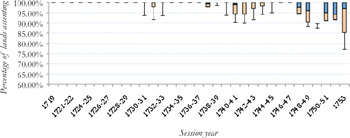
In the two decades between 1730 and 1750, however, there was a gradual, but steady dilution of Parliament's unanimous assent standard. Using the reports of petition and bill committees out of the House of Commons, it is possible to see a dramatic shift in the way that assent was treated in Parliament. In the House of Commons, committees were expected to report any lack of assent to an enclosure bill.Footnote 24 These reports and other related material open a window into the Commons' expectations of assent, revealing the gradual drift from a standard of unanimity to acceptance of proportional assent. Chart 2 is a boxplot that depicts this drift.Footnote 25 The whiskers mark the extremes of the lowest and greatest proportions of assent for reported legislation. The hinges mark out assent proportions at the 25th and 75th percentiles. The different shadings distinguish those assents above and below the median, with the point at which yellow gives way to blue marking out the median itself. The chart shows that, along the lower whiskers and later the lower hinges, the percentage of assent reported on successful enclosure legislation decreased after 1730 and that, in the 1740s, the assent percentage in the median enclosure act also began to decline. The chart does not, however, capture the full extent of the depreciation. Many of the Commons' committee reports describing dissent or neutrality that form the basis for the chart do not indicate the overall interest of proprietors in the enclosure, making it hard to discern what proportion of assent was required on those occassions. In such instances, the data have just been omitted, exaggerating the proportion of instances in which unanimity was the norm, particularly in the early 1730s.
Assents reported on enclosure legislation in parliament, 1719–1753

A thicker examination of reports in this period is illustrative. Between 1719 and 1729, all committee reports and bill preambles save one reveal a prosecution in which there was unanimous assent by the affected parties. Therefore, the Overton–Longville enclosure bill described the various articles of agreement among affected proprietors in favor of enclosure and setting aside their respective, specific proprietary interests.Footnote 26 For the Sunningwell enclosure, unanimity is revealed in a preamble of the bill reciting the consenting proprietors to be “Sir John Stonhouse (lord of the manor), and John Peniston (rector of the parish church) and all other the proprietors (excepting the said Thomas Dalby).”Footnote 27 The one committee report reveals dissent early in the decade, on the Balstonbury Commons Enclosure Bill. There, a petition opposing legislation had been presented to the House of Commons and referred to the committee considering the Bill. The committee, however, went to great lengths to show that the opposition was largely manufactured. The committee reported the testimony of a proponent of the Bill to the effect that opponents to the legislation had previously consented to the Bill when notice had been promulgated in the countryside. Moreover, it appeared, many of the persons who signed the petition actually lacked any right of common whatsoever. Those persons rather had signed the petition for the sole reason that the proposed enclosure would adversely impact the local highways.Footnote 28 The Bill was ultimately enacted.
Between 1730 and 1740, however, reports out of committees in the House of Commons reveal a lessened concern with unanimity. The bill committee on the Welsbourne Mountfort Enclosure Bill in the 1729–1730 session, for example, reported legislation despite “one person ‘who has One Three-yard Land out of Forty-seven, . . . declared, he would not sign the Bill.’” The lone dissenter, the committee noted, had provided no rationale for his decision, nor had he believed that he would be adversely affected.Footnote 29 The petition committee on the Prestbury Enclosure Bill of 1731 reported favorably when five proprietors possessing one sixteenth of the affected lands had not consented, but had merely remained neutral.Footnote 30 In the case of the failed Wakefield Enclosure Bill of the 1731–1732 session, the petition committee described the testimony offered by the suitors to prove consents. “Mr. Alexander Ready and Mr. Robert Doiley; who proved the signing of the Petition; but said, there are Three or Four Proprietors, who have not signed it, yet were consenting, that the common Fields should be enclosed: The only Reason, those Three or Four Persons gave for not signing the Petition, was, because that they apprehended, they should thereby bring an Expense upon themselves.”Footnote 31 The House of Commons granted the petitioners leave to present an enclosure bill.
The Ashendon Enclosure Bill of 1738 seems to provide the first clear instance of opposing interests being wholly disregarded. This, one of Richard Granville's several enclosure attempts during the period, was reported to have the consent of all but one person possessing one-quarter of a yard land—20 acres—with commons appurtenant. By the time the Bill was before the committee, the number of opposed proprietors and their property interests had doubled, but only to 40 acres out of the 900 with appurtenant rights of common.Footnote 32 Nonetheless, the legislation was reported and passed in both houses. The report of the Castle Dodington enclosure of the same session likewise reveals that of 119 proprietors, 11 had refused to sign the petition, of whom 7 later assented. The remaining holdouts possessed only 17 pastures out of a total of 491.Footnote 33 By 1740, the consent of 90 percent of affected lands was adequate to have a petition reported on an opposed bill. Unanimous assent, however, remained most common.
By the early 1750s, proportional assent was the norm. At a minimum, only 80 percent of affected property was needed. Reports show the Commons struggling around this threshold. For example, the committee on the Staverton enclosure in 1751 reported the bill even though proprietors consenting to the bill possessed only thirty-six and three quarters yard lands out of a total of forty-seven. Of those not consenting, three proprietors holding two and three eighths yard lands were neutral, and another fifteen proprietors, possessing a total of seven and seven eighths yard lands, were opposed. The report endeavored to play down the holdings of the opponents to the bill, describing one opponent “who is possessed of One Quartern and One Half Quarter Yard Land, for Life” as owning land in which the reversionary interest was in “Mr. Markham, who is a Petitioner for the Bill.” Another proprietor's opposition was played down because “she had given a Bond for Thirty Pounds, to oppose the Bill; otherwise she would have consented; and that the Reversion of her Half Yard Land goes to her Son, who appeared personally at the Committee, and declared Consent to the Bill. . . .”Footnote 34 The limited support for the bill doomed it, however. After the legislation had been engrossed, opponents successfully petitioned to be heard against the bill before its third reading, and once heard, they managed to have a third reading of the bill put off indefinitely.Footnote 35
The report on the Hexham Manor Enclosure Bill in 1753 reveals a committee struggling to diffuse substantial, but unspecified opposition:
Parties concerned had given their Consent to the Bill, to the Satisfaction of the Committee, except Sir Ralph Millbank, who is possessed of a Fifty-fifth part of the said Wastes and Commons, and who refused to sign the bill, and except 24 other persons, who having been applied to, said they would not oppose the same; and also except about Forty-six other Persons, who have but a small Interest in the said Wastes and Commons, and of whom about Six are Minors, and the rest either beyond the Sea, or could not be found; and that none of the said Parties appeared before the Committee to oppose the Bill. . . .Footnote 36
The maneuvering on the Quinnington Enclosure Bill reveals a similar effort to limit and diffuse the permitted proportion of dissent. There, the committee found that all parties had sufficiently consented to the bill “except William Volkins, Charles Stephens, Susannah Tombs, and John Godwin, who are possessed of Eleven Yard Lands and One-half” out of a total proposed enclosure of thirty-seven yard lands. Despite that the four proprietors were nonetheless neutral toward the bill, upon report it was noted that “some other Amendments” were proper to be made to the legislation and the bill was recommitted.Footnote 37 In the second report, the number of parties who refused consent had grown by one, but so too had the extent of the proposed enclosure: The five parties refusing their assent possessed in total 382 acres, only 20 percent of the approximately 1900 acres to be affected by the enclosure.Footnote 38
One can see among the early committee reports the themes that eventually came to govern the willingness of Parliament to proceed with enclosure legislation. When unanimous assent was required, there was little need to divide between neutral and opposed individuals, to distinguish between the number of opponents and the extent of their holdings, or to express qualms over an appearance by dissenters before the committee. At mid-century, however, all of these distinctions had emerged, and others—such as whether the land or rated value should be the touchstone by which proportional assent was to be measured—were soon to come. But, at its core, the principal inquiry remained whether the requisite proportion had been met. The remaining matters simply permitted committees to massage assent toward the minimum proportion.
For the remainder of the century, this assent proportion rested at approximately 80 percent. Homer's Essay on enclosures printed in 1766 states that for a parliamentary enclosure “a Concurence of so many of the Parties, as are possessed of four-fifths of the Property, is now looked upon as a sufficient Ground for an Applicaton to the Legislature . . . provided the Lord of the Manor and the Impropriator, who have been considered as separate and leading Interests, concur in the Application.”Footnote 39 And, as late as 1801, parliamentary agent Charles Ellis similarly remarked in his Practical Remarks and Precedents of Proceedings in Parliament that “Parliament have been understood to expect the consents of as many proprietors as have amongst them four-fifths in value of the lands to be inclosed or drained. . . .”Footnote 40
The unanimous assent standard prevented proprietors from obtaining enclosure against holdouts and where it would effectively have been redistributive. The shift to a proportionality standard allowed landowners to overcome intransigent holdouts and to the extent that enclosure was redistributive, to ignore those on the losing side. Permitting landholders to run roughshod over the interests of upwards of 20 percent of dissenting property did pose an inherent collective action problem. Under the standing orders of the House, those who signed the petition for a bill were sureties for the bill, obligated to pay its fees and costs. By refusing to sign or assent to the petition (or bill), then, an owner could ostensibly avoid those costs. Moreover, as Parliament grew increasingly willing to impose enclosures on villages despite a lack of unanimous consent, it would have made sense for interested landholders to ride for free on the prosecution efforts of others by strategically withholding assent from enclosure.
Often, particularly in the first half of the eighteenth century, this was not an issue. The lord of the manor, anticipating a substantial increase in rents from enclosure, would be willing to bear all of its costs. So, for example, Richard Granville by agreement paid the costs of enclosures in Wooten Underwood and Ashenden in Buckinghamshire.Footnote 41 But where the lord of the manor or another landowner was unable to personally bear the costs of enclosure, free rider problems would arise. In the case of the Castle Dodington enclosure, for example, suitors for enclosure bills regularly informed petition and bill committees that one or more of the dissenters were persons who were in favor of enclosure, but who did not want to pay for it.
How was the free rider problem managed? Beginning in the 1730s, enclosure bills began to contain a provision that all benefitting parties would be required to pay the costs of the enclosure, including the costs of obtaining the act. Prior to that time, no act contained a defraying clause. In the Lillington Enclosure Act, this changed, with the introduction of a clause that “as well as the Charges in Passing this Act, as for the Surveying, Allotting, Settling and Enrolling the Allotments, shall be defrayed by the Owners and Proprietors of the Lands, according to their respective Interests, the same to be calculated by an equal Pound Rate, as the Lands shall be rated at the Time of Passing this Act. . . .”Footnote 42 Through the remainder of the decade, a similar defraying clause occasionally appeared in enclosure bills, although becoming more sophisticated. The West Stafford cum Froom Bellet Act imposed the costs of enclosure on owners and proprietors based upon their respective holdings at the completion of the enclosure.Footnote 43 By the middle of the century, landholders put teeth to the defraying clause, giving commissioners of enclosure the power to levy rates and collect those rates by distress and sale.Footnote 44 Because all who benefitted would be required to pay, regardless of their approval or dissent to the enclosure, it made no sense for a self-serving beneficiary not to sign a petition or bill.
A number of factors played into the parliamentary enclosure movement, internal and external to Parliament itself. However, changes in the operation of Parliament and in acts that were passed certainly played a significant role in the dramatic increase in legislation after 1750. In the early part of the century, Parliament's availability increased through regular sessions and the better dissemination of credible information about its inner workings. As important, however, and what has gone undetected by scholars of enclosure, was the steady dilution of the unanimous assent standard out of chancery to a four-fifths property standard. This made it possible for owners to ignore the opposition of uncompromising holdouts and prevented all but the most substantial landholders from exacting steep concessions as a condition of assent. Meanwhile, to forestall interested landholders from strategically withholding assent to avoid bill costs, prosecutors began to include defraying provisions in their bills. Together, these rules and provisions operated nicely in favor of enclosure. They incentivized those proprietors interested in enclosure to assent and, especially in large villages, increased the likelihood of obtaining sufficient cooperation.
A Short Description of Enclosure Bill Procedure
Unanimous assent gave way to proportional assent as precondition of enclosure in the first half of the eighteenth century. This dilution of the assent standard not only provides new insight into the enclosure movement, it opens up some unexplored or underdeveloped questions, not least of which is why Parliament moved from unanimity to proportionality. The remainder of this article offers a partial answer to this question, centered on Parliament's procedures and the opportunities it provided suitors to challenge the existing assent standard. By implication, then, this article argues that the dilution of the assent standard was not a top-down phenomenon, the result of a specific policy of government to promote agricultural productivity. Rather, it occurred largely by happenstance, through the individual activity of hundreds of proprietors and by piecemeal erosion. This is not to say that these attempts were not encouraged by Parliament or that Parliament did not develop informal policies about the propriety of enclosure. They were and it did, as the last section shows.Footnote 45 Rather, encouragement came not in the form of an articulated policy from a department, but through a handful of minor-seeming procedural and practical mechanisms that either emerged piecemeal or for reasons entirely unrelated to the promotion of enclosure. These procedural and practical encouragements will be explored over this and the following section.
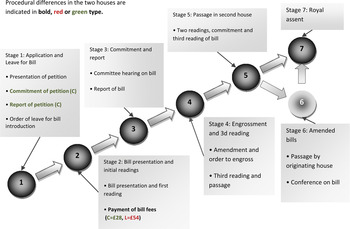
We turn now to the mechanics of bill passage in the first half of the eighteenth century. How, as a formal matter, was an enclosure bill prosecuted to enactment? For the entirety of this period, legislation could be initiated in either the House of Commons or the House of Lords. Moreover, but for a few matters, procedure for bills originated in either house was substantially identical. For convenience sake, then, we can break the stages through which a bill was enacted out of either house into seven, of which we will primarily be concerned with the first four: (1) application and leave for introduction of the bill; (2) bill presentation and initial readings; (3) commitment and report; (4) engrossment and third reading; (5) transition to and passage through the second house; (6) passage of or conference on bills amended by the second house; and (7) the royal assent. However, within these stages, there were a handful of crucial differences in procedure between the Commons and the Lords. These differences impacted both the willingness of promoters to depart from the assent standard and the choice of house in which a bill would be originated. Chart 3 generally depicts these stages of bill prosecution in each house. The remainder of this section attempts to fill in the chart. In describing these stages, primary focus will be on process in the Commons.
Stages of enclosure bill proceeding in the Commons and Lords

Stage 1: Application and Leave for Introduction of BillFootnote 46
The initial step of prosecuting a private bill, at least after 1700, was the presentation of a petition to Parliament by a member or lord praying for leave for a bill's introduction. It would invariably cite the difficulties endured by the promoters in attempting to extinguish the commons through existing means and note the gains from enclosure to the community. In the prayer, specific request for an order granting leave for a bill to enable enclosure would be made. Between 1729 and 1740, the Commons would then commit the enclosure petition for examination and report.Footnote 47 This committee was to take evidence on the allegations of the petition, including proof of assent to the proposed enclosure application. After the committee had taken evidence, it would then be summarized in a report. The report would often go into specific detail on the proportion of assent, setting forth the holdings (and occasionally names) of those who did not affirmatively consent to the proposed enclosure.Footnote 48 Surmounting the petition committee was perilous for suitors. Nearly half of the legislation lost in this period never emerged from the petition committee. Upon report, the committee chairman would next move for leave to bring in a bill. By contrast, in the Lords and in the Commons after 1741, a motion for leave to introduce a bill was summarily put to a vote upon presentation of the petition, unless the proposed bill had an estate component. As will be further discussed in the following section, the prior Commons procedure was important in that it provided proprietors the opportunity to test the waters on potentially contentious bills.
Stage 2: Bill Presentation and Initial Readings
Nearly 10 percent of promoters who received leave to introduce legislation never actually presented a bill in a session. There was no single cause for abandonment. A coalition supporting enclosure may have fallen apart or run into intractable difficulties in the face of actually writing a bill. Alternatively, in the interim, the proponents of the bill might have learned of insurmountable opposition. Or, the credible threat of enclosure may have brought previously unwilling participants to enclose through a simple agreement. In any case, this meant that a number of applications were never pursued in a session.
The vast majority of promoters did present a bill. For them, the next step in prosecuting a bill was the preparation of a fair draft on paper and the printing of a suitable number of review copies to be left in the lobby of the Commons. Both the handwritten bill and the copies would contain most of the relevant provisions of the proposed act, except that blanks would be left for rates, proportions, and names of enclosure commissioners, all to be filled by the bill committee. Accompanying the bill would be a brievate —a short description of the legislation—that would be announced by the clerk at each reading. In the morning of the day chosen by the bill's manager, he would be called upon by the speaker to present the bill. In most sessions, this was immediately followed by the first reading of the bill in the Commons and an order for a second reading of the bill.
The order for the second reading did not set the time of the second reading. Practice required that three full days pass before the second reading occur, but otherwise procedure allowed the second reading to take place at any time. The timing of the second reading was determined, rather, by the promoters' payment of their bill fees. These fees, established in the orders of each house, formed the first substantial outlay of money in the formal process of obtaining the bill. Prior to this point, the fees incurred in promoting legislation were slight; simply fees for presentation of the petition, committee fees, and bill receipt fees. For the purposes of this article, this point also marks an important division between proceedings in the Commons and those in the Lords. In the Commons, the fees owed on an enclosure bill before the second reading were £28. Although somewhat costly, this amount in no way matched the fees owed at the second reading in the Lords. There, to obtain a second reading, promoters were obliged to pay officers and clerks a hefty £68. For the cost-sensitive body of proprietors, the amount and timing of this outlay had the potential to affect where a bill would be originated.
Once fees were paid, the second reading would take place. On the date of the second reading, there would be initial debate on the bill. The question would then be put for a second reading and the question of commitment would be put. If agreed to, then interested members and additional members from the originating county would be named to the committee on the bill. Although it was possible to lose a bill at a second reading, this occurred only rarely: once in the Lords and three times in the Commons prior to 1774.
Stage 3: Commitment and Report
Approximately one percent of all enclosure bills went unreported. From this perspective, one might reasonably assume that the point of bill commitment and report was relatively unimportant in its prosecution. However, it was at this stage that members fully tested the assent given to a bill, heard opposition, and marked up the proposed legislation. As earlier described, the investigation into assent was in many cases the hinge of the enclosure attempt. Determining whether assent to enclosure was adequate was not a matter of pure formality. According to the Liverpool Tractate, a mid-eighteenth-century guide to parliamentary business, “If any Party or Parties refuse to consent to a Bill it must be specially reported to the House, and the reason of their Dissent specified if any was given[,] together with the nature and value of their Interests in the Premises affected by the Bill.”Footnote 49 The Journals of the House of Commons reveal that this procedural expectation was in place as early as 1720.Footnote 50 Until promoters of legislation were able to obtain an adequate number of witnessed signatures to their bill, there would have been little point in proceeding with the legislation in committee.Footnote 51 The failure of promoters to have their assents in order, then, could lead to significant delay.
This was also the moment at which opposition to legislation would be seriously heard and substantial amendments, if any, would be offered. Of the seven petitions presented in opposition to enclosure legislation in the Commons before 1750, six were heard on counsel in the committee on the bill. Half of the bills against which petitions were directed were lost in the session in which they were introduced. Typically, however, as both Sheila Lambert and Paul Langford have ably demonstrated, committees used the markup process as an opportunity to bring about reconciliation among the various factions supporting and opposed to a bill.Footnote 52
Stage 4: Engrossment and Third Reading
After a bill had been amended and the blanks filled, the clerk would prepare the report and the committee would vote to approve it. At the next available opportunity, the chair of the bill committee would present the report to be read. Contemporaneous with the reading of the report, the Commons would vote on whether to adopt the amendments made by the committee as part of the bill. At this point, members would propose their own changes to the legislation, sometimes attempting alterations unobtainable before the bill committee. Once amendments had been proposed and adopted, the House would vote to engross the bill. Engrossment was the transcription of the amended bill onto parchment in a fair hand. After the bill was engrossed by a clerk, it would be brought into the House for a third reading. Here again was an opportunity for debate and amendment, after which the bill was read a third time and the question of passage put. Only once between 1714 and 1774 did the Commons or Lords vote against an enclosure bill at this stage. Upon passage, the manager of the bill in the Commons would be ordered to carry it to the Lords; in the Lords, either two masters in chancery or members present would be instructed to transmit the bill into the Commons.
Stage 5: Transition to and Passage in the Second House
From this point, procedure in the two houses is for all purposes an identical, truncated version of procedure in the originating house. A message would be read in the second house that the first house had passed an enclosure bill, seeking the former's concurrence. Either the same or the following day, the bill would be read a first time. Bill fees in the second house would come due, then the bill would be read again and committed. The committee would examine consents, look over the bill's preamble and perhaps offer amendments, but it tended to be more cautious in its treatment of legislation than the corresponding committee into initiating house. After report, the bill would be read a third time and passed. Very rarely did bills passed out of the originating house fail to pass in the second house; only on a couple of occasions were bills passed in the Lords lost in the Commons and only a single time did the Lords refuse to support a bill successfully prosecuted through the Commons.
Stages 6 and 7: Passage or Conference on Amendment and Royal Assent
If no amendments were offered to the bill in the second house, the legislation would be provided to the king for the royal assent. If the second house had made amendments, the bill would be returned to the originating house for its agreement to the same. Greater complications were possible, but amendments were always adopted by the originating house and the bill passed (or was dropped and started over). Likewise, all bills received the royal assent. The last queen not to assent to legislation passed out of Parliament was Anne, and she was well in her grave by the time that enclosure bills were a regular feature of the parliamentary session.
Encouraging Enclosure
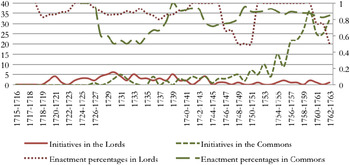
In the early eighteenth century, suitors for enclosure bills could choose whether to introduce legislation into the Commons or Lords. As Chart 4 illustrates, for the first 30 years of the eighteenth century, Parliament's enclosure business was almost entirely initiated in the House of Lords. These bills were premised on the same facts as an enclosure decree in chancery—namely, the consent of all parties affected by the legislation—and were typically aimed at overcoming traditional legal impediments to conveyance: the minority status of a landowner, the inability of the improprietor of tithes to grant them for more than three lives, or the constraint of a settled estate. In this regard, early enclosure legislation bore a striking resemblance to estate legislation, which had been almost entirely the province of the Lords since 1710. Estate legislation was regularly used to permit the sale of lands under settlement, to make a jointure, to enable a minor to settle lands, or to remedy defects in a will. The certainty provided by this similarity likely encouraged early suitors to attempt legislation there, despite the higher initial cost of bringing legislation into the Lords. This situation persevered until promoters began to prosecute what might have been seen as riskier enclosure schemes.
Enclosure initiatives in the Commons and enactment percentages, 1715–1765

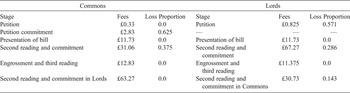
When, in the 1730s, promoters did begin to introduce riskier enclosure schemes, such as those seeking enclosure over the heads of a handful of dissenting landowners, they did so by originating legislation in the Commons. This article is neutral on the issue of whether, or the extent to which, enclosure acts were redistributive, and whether the 1730s saw a rise in demand for enclosure. Whatever the external factors incentivizing enclosure, however, the fees and procedures of the Commons were extremely tolerant of those challenges to the status quo that made enclosure easier. Table 1 summarizes these fees at various stages, as well as the relative proportions of those stages at which bills failed.Footnote 53 The procedure in the Commons permitted the first formal examination of adequate assent in the petition committee, at a nominal fee of £2.5. Moreover, only five committee members were needed for a quorum at the petition stage, whereas eight were needed for a bill committee. Because it was often difficult to corral members to a committee hearing, fewer required numbers could mean the difference between housing witnesses in London for a day and housing them for a week. If we can infer from practice to probability, not only was it relatively inexpensive for promoters to have a petition presented to a committee, if they were going to lose the application, they had a 50 percent chance of losing it then.Footnote 54 Even if the promoters lost the bill later, before the Commons bill committee, they would lose only £46 or thereabouts in fees. By contrast, in the Lords, there was no formal opportunity to contest assents or other novel features of enclosure legislation until one reached the bill committee. Even though the overall fees and costs of successfully prosecuting legislation out of that chamber was less expensive than proceeding out of the Commons, the costs of losing a bill in the Lords before the committee was steep, with fees amounting to nearly £70, much more than in the Commons. If a promoter stood a fair chance of losing a bill, it was better to lose it in the Commons in the years before 1740. It only made sense for promoters to proceed in the Lords when they were confident about their chances of success; that is, when prosecuting a traditional bill. Promoters who brought bills into the Commons would likely have done so out of a concern that the chances of obtaining an act were not high. Consequently, during this period there was a steady mixture of business originating in both houses, as each was welcoming to some prosecutions to which the other was not so amenable.
The Fees and Proportion of Enclosure Bills Lost at Key Stages of the Legislative Process, 1714–1740.

Overall data on enactment percentages for enclosure bills confirms what the analysis of costs indicates. At 68 percent, the enactment percentage for bills originated into the Commons fell well below the breakpoint at which it became more costly to pursue legislation. In other words, promoters with chancier legislation—such as those seeking to deviate from norms regarding assent—were opting to bring their enclosure projects before the lower house. In addition, at 89 percent, the enactment percentage for legislation being brought into the Lords fell comfortably near or above the break at which a suitor would have opted to bring legislation into that house. We can also say something about the proportion of suitors who thought their position to have been better or worse about legislation, based upon these figures. Most promoters, bringing traditional bills, must have felt quite confident of their chances. More than 72 percent of them were willing to proceed into the Lords to avoid the additional costs of initiating legislation in the other house. In less than 28 percent of cases, was it likely that a promoter would have concluded that the chances of success were sufficiently slim to make proceeding to legislation in the House of Commons worthwhile. Those who required tolerance of novelty were plainly in the minority.
In the 1741–1742 session, the Commons ceased committing petitions for enclosure bills and instead adopted the Lords' practice of allowing a motion for leave to introduce a bill to be made immediately following the petition's reading.Footnote 55 With the cessation of the practice of committing petitions for enclosure bills, so too went the attendant costs, although some of those costs would have been shifted to the bill committee, in the form of increased fees and costs for additional days spent examining consents. The decline in fees alone was nearly £3—not much, but if we also consider the costs attendant to proving assent before the committee, this would probably increase substantially. One interesting point to note is the heightened importance of the initial stage in weeding out legislative failures. In nearly all of the cases in which legislation was lost at this stage, it was because no bill was presented after leave was obtained. This indicates that proprietors were increasingly able to evaluate whether they had obtained adequate consent for legislation (among other things) without needing to test bills before the petition committee. One possible reason for this, explored subsequently, was the rise of the parliamentary agent.
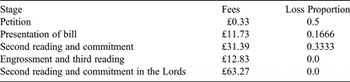
This change shifted enclosure business entirely into the Commons. Doing away with the petition committee dropped the overall costs of originating business in the Commons to less than that of proceeding in the Lords. Because most losses occurred at or before committal of the bill in each house, the comparative costs of getting to the committee also explain why the Commons came to dominate enclosure business. After 1741, failure in the Commons at the bill committee stage meant losing approximately £42; a loss at the same point in the Lords stayed at approximately £80. Table 2 illustrates these changes. Therefore, prosecutions of enclosure bills in the Lords disappeared, as suitors became increasingly aware of the savings to be had for promoting business in the Commons, even when the matter was traditional or the expectations of success high. Further, as time passed and bills were only sporadically introduced into the Lords, reliable information regarding the overall and relative chances of success decreased. This raised the likely costs of proceeding in the upper house still further. It additionally reduced the number of attempts ventured there in a vicious cycle. Eventually, the enclosure business of the House of Lords was a footnote to the regular process, one which was deleted in 1774. Then, the Commons decided to put a procedural imprimatur on actual practice, requiring an enclosure bill introduced into the Lords to be reinitiated in the Commons. By that time, the practice of the past 30 years weighed against their being brought anywhere else.
The Fees and Proportion of Enclosure Bills Lost at Key Stages of the Legislative Process in the Commons, 1741–1776.

Prior to 1741, then, the procedural hurdle of the Common's petition committee was a factor in encouraging challenges to the uniform assent standard in that house. The committee rendered the process of obtaining enclosure legislation tolerant of novel attempts at a time when reliable information about parliamentary norms was otherwise hard to obtain. At least at the margins, suitors were given the choice between a certain payoff to holdouts and a small additional payout for the chance to avoid accommodating those holdouts. Many opted for the latter alternative. After 1741, however, the Commons ceased to refer petitions for enclosure bills to a committee. The formal opportunity to challenge the existing assent standard prior to incurring significant legislative costs was lost. Meanwhile, however, suitors continued to push against assent standards, driving them down by nearly 10 percent over the decade. The demand for enclosure may simply have been so high that attempts to challenge the assent standard would have continued apace despite procedural developments. But even if we think of external features as primarily driving the growth of enclosures, or assume that enclosure was an efficient alternative to the status quo, the issue of whether it would be cheaper to buy off holdouts or attempt a legislative solution must have affected the calculus of proprietors. And whether enclosure was redistributive, or it was simply the case that opposing commoners were wary of the ability of enclosure commissioners to appropriately value their holdings, changes in the expected costs of overcoming dissent would drive the enclosure process.
What factors might have kept the expected costs of seeking novel solutions to problems of enclosure low after 1741? One factor, we can speculate, was simple inertia. Committees in Parliament were visibly open to reporting bills with ever-lower numbers of assenting signatures in the name of “innovation.” Repeat and well-attuned players would know this and therefore had reason to suspect that the downward trend in assent percentages would generally continue. These lords and owners would have revised upwards their subjective probabilities of success accordingly. But a known factor in continued suitor challenges to the assent standard was the increased use of professional parliamentary agents to oversee the progress of bills. One agent, Robert Harper, expanded his parliamentary business from estate matters to enclosure bills in the late 1730s and 1740s. For two decades, Harper advised clients on anywhere from one third to over half of the enclosure bills prosecuted in a session. By the time Harper began to reduce his practice in the 1750s, other parliamentary agents were beginning to fill the breach.Footnote 56
The employment of professional agents to oversee business before Parliament meant that each aspect of the bill process could be attended to with increased diligence. The agent would have experience in drawing up the petition to be given to a member of Parliament for presentation, based either upon the promoters' express wishes or upon an already drafted bill. More so than a solicitor, whose information on the operation of Parliament might be second hand, coming more from copies of the Votes or information gleaned while looking after business in the law courts, an agent would have advanced knowledge of when Parliament would sit and adjourn, be aware of which members were regular attendees at committees, and have a good rapport with the clerks who would draw orders and sit at committees. Therefore, an agent could better ensure that each reading of the bill would occur on time, drawing up the breviate of a bill and making certain it was in the hands of the member who would present a bill. He would also be better placed to coordinate a committee meeting, not through mere reliance on attendance by members, but by, for example, sending letters on gilt stationary to members of the committee imploring them to appear on the scheduled day.Footnote 57 Retention of experienced agents, therefore, increased the chances of a private measure's passage. Their employment also enabled suitors to learn early in the process if bills were doomed to failure.
The parliamentary agent, therefore, lessened the costs of prosecuting enclosure legislation and enabled challenges to the assent standard in three ways. First, the agent increased the enactment chances of bills through his detailed knowledge of the process and the legislators who formally prosecuted legislation. Also, he served a vital coordination function as the process became more complex. Second, the parliamentary agent allowed suitors early insight into deficiencies in a prosecution or opposition to an enclosure. The former was a function of his knowledge of members' opinions about the prevailing rules and norms governing parliamentary enclosures. Regarding the latter, by exercising his informal legislative contacts among both members and clerks, an agent would be able to obtain early knowledge of any potential opposition. After 1741, nearly 70 percent of all failed enclosure prosecutions were lost before any bill was presented. Particularly in legislation attempted in later sessions, one can see the hand of parliamentary agents who possessed the ability to ferret out information about members who had irresolvable problems with bills. Finally, parliamentary agents, through their practice, were able to transform the general mass of parliamentary opinion into a set of established norms of prosecution. Like any legal practitioner, this permitted the parliamentary agent to act as a screen to prosecutions. Agents could, based upon their experience in this aspect of the lex parliamentia, tell their clients whether a prosecution was likely to succeed. They could also inform them how to remedy defects in a prosecution for a subsequent year. It is likely that the settling of the assent standard took place among agents, as they informed their clients not to attempt legislation if they could not reach an 80 percent margin.Footnote 58
In summary, then, to some extent, the shift to the proportional assent standard that enabled the parliamentary enclosure movement was owing to the Commons' fee structures; procedures and practices that were tolerant of challenges to the previous standard. In the 1730s, the Commons took the lead on applications proffered with less than the full assent of proprietors because these were risky measures for which the possibility of initial failure was high. Commons procedure, with its impressive mechanisms for testing these measures, practically invited contests to existing norms. Meanwhile, enclosure measures in the House of Lords continued to be the sort of low-risk traditional business with which it had been concerned since the initial decades of the century. After 1740, a change in Commons procedure—the elimination of the petition committee—lowered the overall costs of promoting legislation so that it made sense to originate any enclosure application there. Contemporaneously, the parliamentary agent stepped into the shoes of the petition committee as a credible, although informal, source of information regarding the appropriate level of assent needed for an enclosure application to succeed. This is not to say that these features of the parliamentary process were determinative of the willingness of suitors to promote risky legislation, but they certainly affected the expected costs of making a challenge, particularly in the 1730s and 1740s when the chances of success were largely uncertain. These early, cheap opportunities to attempt avoidance of holdouts would have made an approach to Parliament rational, even without large shifts in demand.
Conclusion
We have seen that law helped enable agreements to enclose in the modern era by empowering landholders to enclose fields and wastes over the objections of those smallholders who refused to agree. The rules and norms of Parliament contributed to the enclosure movement of the late eighteenth and early nineteenth century. As this article has shown, the House of Commons' procedures during first half of the eighteenth century and the rise of the parliamentary agent lowered the expected costs of challenges to existing parliamentary standards. These procedures and institutions determined the viability of challenges to existing standards early in the parliamentary process, before substantial fees were incurred. In this way, Parliament was extremely tolerant of novel legislative claims during the eighteenth century.
The remainder of this conclusion takes up some tantalizing questions raised by this account of the parliamentary enclosure movement. The first of these is why Parliament aided promoters in diluting the unanimous assent standard at all. Whereas the issue of parliamentary policy making has been raised in a number of contexts, it has not been broached in the specific context of enclosure. Presently, my working hypothesis is that in part, this has something to do with that old standby, “innovation.” Even if landholders were not innovating on their lands in the aftermath of enclosure, belief in innovation may have prompted members of Parliament to support enclosure. The notion of property as sole dominion may also have factored into this, leading members and lords to see dissenting smallholders and common right holders as irritants standing across the bulwark of strong, multiple property holdings. In other words, proprietors broke property to build property. It may also be time to revisit William Tate's determination that members and lords were not self regarding in granting enclosures.Footnote 59 Even if members and lords were not directly involved in promoting their own bills, a willingness to ease the enclosure of other members and lords indirectly through a lowering of assent requirements might have been in place. These are all open avenues for exploration.
Another intriguing question, related to the last, is why the assent standard did not continue to be diluted, but instead bottomed at approximately four fifths during the second half of the eighteenth century. Here, my thoughts are purely speculative, ranging over a handful of possibilities. First, the assent standard did wend its way down farther, beginning perhaps as early as the 1790s and reaching two thirds by the time of the Enclosure (Lord Worsley's) Act of 1836.Footnote 60 Landholders therefore may not have insisted upon (and members and lords therefore did not grant) enclosure legislation through the latter half of the eighteenth century because it was unnecessary. Four-fifths assent was adequate to permit enclosure in all but the most inflexible of villages. Alternatively, medium-sized and large landholders themselves may have been concerned over further depression of the assent standard, perceiving their interests would be at risk if it was lowered much more. Lastly, as Paul Langford has argued generally about Parliament's attitudes toward private business, Parliament may have been reluctant to proceed farther down the path to reduced assent requirements simply because it threatened the legitimacy of the institution.Footnote 61 This legitimacy was bound up with the protection of property. Even common rights, troublesome as they were, were long recognized real property interests. There may have been a point at which Parliament's willingness to abrogate those rights ran up against its interest in protecting landholders from involuntary dispossession.
Supplementary materials and methods
The Supplementary material referred to in this article can be found online at journals.cambridge.org/mbi.