Introduction
Pharyngeal pouches or Zenker's diverticula are the commonest form of diverticulum of the upper aerodigestive tract. Over the years, there have been several techniques advocated for the treatment of these lesions. The techniques vary from external approaches to endoscopic techniques. The endoscopic techniques may be broadly divided into those using staplers and those where the cricopharyngeal muscle is divided using diathermy, laser or harmonic scalpel.
This paper describes an audit of the experience of one surgeon using a broad range of the available techniques.
Materials and methods
The study comprised a retrospective analysis of a case series. All records for a consecutive series of patients who underwent pharyngeal pouch procedures between 2000 and 2011 were analysed. The variables analysed were: patient age, co-morbidities, pouch size, technique used, recurrence, leak and length of hospital stay.
The size of the pouch was considered small if less than 2.5 cm, and medium if greater than 2.4 cm but less than 5 cm. Recurrence was defined as symptom recurrence that led to repeat barium swallow test findings indicating a pouch.
The surgical technique chosen depended on the age of the patient, co-morbidities, the size of the pouch and, to an extent, the preference of the patient. Early in the series, stapling was preferred for elderly patients with co-morbidities (because of a perceived low risk of leak). In the later years, stapling was preferred for patients with a pouch that was at least of medium size. Laser surgery was not used for large pouches; these were treated by stapling or, in the earlier years, an external procedure.
For the laser technique, a Hollinger-Benjamin diverticuloscope (model 12068A; Karl Storz, Tuttlingen, Germany) was used to define the cricopharyngeal bar. A carbon dioxide laser was used to divide the mucosa and muscle. It was set on a spot size of 200 µm and power setting of 4 W. For stapling, an ATW45 stapler (Ethicon Endopath ETS™) was used after the cricopharyngeal bar had been defined using the Weerda distending diverticuloscope (model 12067B; Karl Storz). External cricopharyngeal myotomies were performed over a bougie and for a distance of 4 cm. When the pouch was excised, once again an ATW45 stapler was used followed by oversewing. Drains were placed and nasogastric tubes inserted in order to nourish the patient. A contrast swallow study was performed between days 5 and 7. If a leak was diagnosed, the patient was managed by continuation of enteral feeding until clinical and radiological evidence of leak cessation.
The categorical variable data were analysed using the chi-square and Fischer's exact tests. With regard to the continuous variables, a one-way analysis of variance was conducted to compare the mean ages of the patients in the groups, and the Kruskal–Wallis test was performed to examine differences between the groups in terms of the length of hospital stay. Statistical significance was set at a p-value of 0.05.
Results
During the period 2000 to 2011, 121 patients underwent 135 procedures for pharyngeal pouch. There were 18 recurrences. Fourteen of the procedures were for recurrences in 13 patients. Seventy-seven of the patients were male and 44 were female. The mean age of the cohort was 72.3 years (standard deviation, 12.5 years).
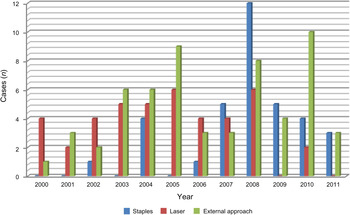
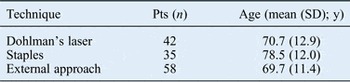
Table I shows the distribution of patients according to the technique used and the mean age of the patients undergoing each technique. There were significant differences between patients treated by each technique in terms of age and pouch size. This was partly because, in the early years of the series, stapling was preferentially used in the elderly, particularly in those individuals with co-morbidities. The preferences of techniques employed changed over time, as shown in Figure 1.
Distribution of cases according to the technique used to treat pharyngeal pouch, from 2000 to 2011.

Number and mean age of patients who underwent each technique

One-way analysis of variance; p = 0.002. Pts = patients; SD = standard deviation; y = years
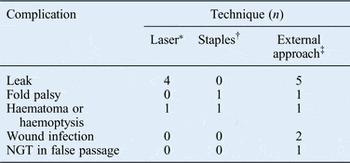
An analysis of the complications revealed that Dohlman's laser procedure and external procedures had a 9.5 per cent and 8.6 per cent leak rate respectively. Other complications in the series are tabulated in Table II. Both patients with vocal fold palsies recovered spontaneously. A patient who had a nasogastric tube inserted into a false passage was given total parenteral nutrition for one week; thereafter, normal contrast swallow study findings led to the resumption of oral alimentation. Leak rate was not significantly related to pouch size.
Complications of each technique

Fisher's exact test; p=0.28. *n = 42; †n = 35; ‡n = 58. NGT = nasogastric tube
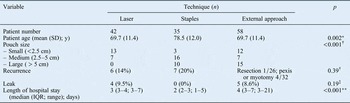
Analysis of the length of hospital stay after the surgery revealed a significant difference between the groups, with the patients having a stapled procedure staying in hospital for a shorter period (Table III). Recurrences occurred in all groups, although the lowest rate was in the external procedures group (Table III). Further breakdown of the results showed that the rate of recurrence for resected lesions was 1 out of 26. The other four recurrences in the external procedures group occurred in patients who underwent cricopharyngeal myotomy or pouch pexis. The rate of recurrence was not significantly related to the size of the pouch.
Variables analysed for each technique

*One-way analysis of variance; †chi-square test; ‡Fisher's exact test; **Kruskal–Wallis test. SD = standard deviation; y = years; IQR = interquartile range
There were 18 recurrences in 16 patients in this series. Three of these patients (two in the stapled group and one in the laser group) had no further surgery. Of the 14 operative cases, 10 underwent revision surgery by an external approach and 4 by an endoscopic approach. In this series, there were also 10 recurrences in patients who had undergone surgery conducted elsewhere (5 had previously received laser surgery and 5 had undergone external procedures); hence, there were a total of 24 patients who underwent revision surgery. Seven of these latter 10 patients underwent revision surgery using external procedures. The rate of complications in the 24 patients was higher than that for the primary cases (33 vs 10 per cent).
Discussion
Pharyngeal pouch or Zenker's diverticulum was first described in 1769,Reference Ludlow1 and the commonly accepted pathophysiology was elucidated by Zenker in 1878.Reference Zenker and von Ziemssen2 Early attempts at external correction were associated with significant operative mortality. Mosher, in 1917, described endoscopic approaches, with a similar high operative mortality.Reference Mosher3 Dohlman and Mattsson published on a series of cases treated using endoscopic procedures in 1960.Reference Dohlman and Mattsson4
Currently, many authors feel that endoscopic approaches are the best first-line treatment for pharyngeal pouches.Reference Yeo and Mackenzie5–Reference Mortensen, Schaberg, Genden and Woo7 It is also recognised that the endoscopic stapled approach has limitations for pouches smaller than about 2.5 to 3 cm, and other methods are chosen.
The modern surgeon has a variety of treatment choices. Several studies have compared various techniques: laser endoscopic versus stapled procedures,Reference Weerda, Sommer and Weerda8, Reference Verhaegen, Feuth, van den Hoogen, Marres and Takes9 endoscopic versus external proceduresReference Keck, Rozsasi and Grun10–Reference Gutschow, Hamoir, Rombaux, Otte, Goncette and Collard12 and, more recently, stapled versus harmonic procedures.Reference Sharp, Newman and Magnuson6
Complications
Leak
A leak from the mucosa to the surrounding tissues is responsible for many of the complications associated with pharyngeal pouch surgery. Verhaegen et al. compared endoscopic laser with endoscopic stapling techniques, and found that surgical emphysema was much more common following laser surgery.Reference Verhaegen, Feuth, van den Hoogen, Marres and Takes9 In the initial part of their series, lateral X-ray of the neck was used to determine whether a leak had occurred. The results consistently revealed that there were no air leaks with the stapled technique; routine X-ray comparison therefore ceased. The laser group had a 33 per cent chance of having free air on X-ray and a 21 per cent chance of fever greater than 38°C. Weerda et al. reported a post-operative fever rate of 53 per cent, and mediastinitis in one case.Reference Weerda, Sommer and Weerda8 Koch et al. reported a leak rate of 6 per cent.Reference Koch, Mantsopoulos, Velegrakis, Iro and Zenk11 After stapling, the leak rates tend to be much lower, and are reported at between 0 and 8 per cent.Reference Weerda, Sommer and Weerda8, Reference Verhaegen, Feuth, van den Hoogen, Marres and Takes9, Reference Gutschow, Hamoir, Rombaux, Otte, Goncette and Collard12–Reference Visosky, Parke and Donovan14 Roth et al. made the interesting observation that none of the cases in which a single firing was used had a leak, whereas when a double firing was performed the leak rate was 36 per cent.Reference Roth, Sigston and Vallance15 For external surgery, the leak rate varies from 8 to 11 per cent.Reference Koch, Mantsopoulos, Velegrakis, Iro and Zenk11, Reference Gutschow, Hamoir, Rombaux, Otte, Goncette and Collard12 The current series had leak rates of 0, 9.5 and 8.6 per cent for stapled, laser and external procedures respectively, which fall in line with the reported series findings.
Vocal fold palsy
This is an important complication of pharyngeal pouch surgery. Koch et al. reported a 10 per cent rate with external procedures; all affected patients recovered within three months.Reference Koch, Mantsopoulos, Velegrakis, Iro and Zenk11 There were also two cases of vocal fold palsy following endoscopic treatment. In the current series, there was one case of vocal fold palsy each for external and for laser treatment. It is important to recognise that vocal fold palsy can occur even after endoscopic treatment.
Inability to proceed
While it is not, strictly speaking, a complication, the inability to proceed with endoscopic treatment needs to be recognised as a significant problem in a number of cases. In Koch et al.'s study, the intention was to treat 90 per cent of the presenting cases with endoscopic laser surgery, but this was successful in only 70 per cent of cases, because of anatomical and access problems.Reference Koch, Mantsopoulos, Velegrakis, Iro and Zenk11 Other series have reported between 6 and 13 per cent of cases affected by an inability to perform the endoscopic procedure. One explanation for this problem is the size of the distending laryngoscope often used in stapling procedures. Other techniques (laser, harmonic scalpel or needle knife diathermy with flexible endoscopy) are sometimes advocated specifically to overcome these anatomical and technical difficulties.
Recurrence
One issue in the assessment of recurrence is the definition. Some authors have found that while a pouch may be present, the symptoms have reduced substantially.Reference Aly, Devitt, Watson, Jamieson, Bessell and Chew13, Reference Harris, Weller and Porter16 Patients will often report improvement (such that food no longer sticks) and satisfaction with the procedure, but some difficulties with swallowing (e.g. regurgitation and gurgling) may persist. In the opinion of Koch et al., ‘long term relief of all symptoms can only be achieved by resection of the pouch “food trap mechanism”’.Reference Koch, Mantsopoulos, Velegrakis, Iro and Zenk11
Reported recurrence rates for external, stapled and laser procedures are 2–9 per cent, 11–26 per cent and 5–18 per cent respectively.Reference Weerda, Sommer and Weerda8, Reference Koch, Mantsopoulos, Velegrakis, Iro and Zenk11–Reference Roth, Sigston and Vallance15 Amongst the external procedure cases, there is probably also a difference in recurrence rates between the cases where the pouch was resected and those where a pexis or simple myotomy was performed. In this series, only 1 of 26 patients (4 per cent) experienced recurrence after the pouch was excised.
Length of stay
Many studies have found that the length of stay in hospital is shortened with endoscopic procedures, particularly the stapled procedures.Reference Verhaegen, Feuth, van den Hoogen, Marres and Takes9, Reference Keck, Rozsasi and Grun10 In particular, there will be a shorter hospital stay if there is no leak. In this series, there was a significantly shorter hospital stay in those who underwent stapled procedures.
New techniques
The harmonic scalpel has been reported to be useful for endoscopic division of the cricopharyngeal bar.Reference Sharp, Newman and Magnuson6, Reference Fama, Moore and Kasperbauer17, Reference Allen and Belafsky18 It is useful for small pouches. In the reported series (which has small case numbers), there was still the risk of a leak (4–5 per cent).Reference Sharp, Newman and Magnuson6, Reference Fama, Moore and Kasperbauer17
Needle knife diathermy provided via a flexible endoscope is another technique reported.Reference Al Kadi, Maghrabi, Thomson, Gillman and Dhalla19, Reference Case and Baron20 In the series of Case and Baron, there was a 27 per cent rate of surgical emphysema, and while the intention was to perform the procedure as day-case surgery, there was a 38 per cent readmission rate.Reference Case and Baron20
• There are several ways of treating pharyngeal pouches
• All techniques have a risk of complications, including leak, infection, vocal fold palsy and recurrence
• Stapling techniques have low leak rates
• External approaches are associated with a longer hospital stay, but pouch excision gives a lower recurrence rate
In order to overcome the problem of a small pouch not being suitable for stapling, and to effect closure when using methods such as laser surgery to divide the cricopharyngeal bar, Mortensen et al. used a technique wherein small pouches were resected endoscopically, followed by mucosal closure after division of the cricopharyngeus.Reference Mortensen, Schaberg, Genden and Woo7 The numbers in that study were small, but the procedure results are encouraging.
Conclusion
Stapled diverticulectomy provides satisfactory symptom relief in patients whose pouches are larger than 2.5 cm, with a low complication rate. The problems with the technique include exposure, persistent symptoms and, in larger pouches, leaking. External procedures probably remain the definitive technique in terms of symptom reduction, but these are more prone to complications. For smaller pouches, laser and harmonic scalpel procedures have a role, and new techniques of endoscopic closure may improve the complication rate.