Introduction
The genus Coffea belongs to the family Rubiaceae and comprises more than 100 species (Davis et al., Reference Davis, Govaerts, Bridson and Stoffelen2006). It is the most widely consumed beverage in the world with known health benefits (Fredholm et al., Reference Fredholm, Battig, Holmen, Nehlig and Zvartau1999). Besides caffeine (0.5–1.0% of green coffee beans) (Santos, Reference Santos2010) a well-known CNS stimulant, coffee contains a very complex mixture of organic compounds, such as chlorogenic acids, caffeic acid, kahweol, trigonelline and minerals. In India, the area under coffee is around 4, 70, 000 ha of which Arabica accounts for 2, 42,000 ha and Robusta accounts for the rest (2, 28,000 ha). The annual average production is around 3, 42,000 MT and 75 per cent of this is exported. Coffee has contributed nearly Rs. 7699 crores of foreign exchange to the national exchange annually (Anon., 2022).
Genetic variability in crop species is important for successful conservation of genetic resources and plant breeding with proper detection and quantification (Allard, Reference Allard1960 and Falconer and Mackay, Reference Falconer and Mackay1996). Further, genetic parameters such as genotypic coefficient of variation (GCV) and phenotypic coefficient of variation (PCV) are useful in detecting the amount of variability present in the germplasm. Heritability indicates the effectiveness with which selection of accessions can be based on phenotypic performance. However, heritability alone provides no indication of the amount of genetic improvement that would result from selection of individual genotypes. Hence, heritability coupled with high genetic advance (GA) would be more useful tool in predicting the resultant effect in selection of the best genotypes for yield and its attributing traits. According to De Vienne et al. (Reference De Vienne, Santoni, Falque and Vienne2003) morphological characters are a classical method to distinguish variation based on the observation of the external morphological differences. By using morphological traits viz., growth, productive, yield and quality parameters, Kumar et al. (Reference Kumar, Ganesh and Awati2008), Gichimu and Omondi (Reference Gichimu and Omondi2010), Mishra et al. (Reference Mishra, Padmajyothi, Surya Prakash, Sreenivasan, Srinivasan and Jayarama2011), Olika et al. (Reference Olika, Alamerew, Kufa and Garedew2011), Oliveira et al. (Reference Oliveira, Pereira, Silva, Rezende, Botelho and Carvalho2011), Kitila et al. (Reference Kitila, Alamerew, Kufa and Garedew2011), Beksisa and Ayano (Reference Beksisa and Ayano2016), Atinafu and Mohammed (Reference Atinafu and Mohammed2017), Atinafu et al. (Reference Atinafu, Mohammed and Kufa2017), Bikila and Sakiyama (Reference Bikila and Sakiyama2017), Weldemichael et al. (Reference Weldemichael, Alamerew and Kufa2017), Rodrigues et al. (Reference Rodrigues, Brinate, Martins, Colodetti and Tomaz2017), Muvunyi et al. (Reference Muvunyi, Sallah, Dusengemungu and Zhang2017), Kusolwa et al. (Reference Kusolwa, Makwinja, Nashon, Marianna and Kibola2019), Donkor et al. (Reference Donkor, Asare and Adjei2020) and Cheserek et al. (Reference Cheserek, Ngugi, Muthomi and Omondi2020) characterised Arabica coffee collections and have indicated the presence of high genetic diversity in coffee.
Despite the appropriate environmental conditions, the productivity and production of Arabica coffee per unit area in the Southern Ghats of India remain very low (470 kg clean coffee per ha) as compared to top coffee producing country like Brazil (2443 kg/ha) reported by Campanha et al. (Reference Campanha, Santos, Freitas, Martinez, Garcia and Finger2004). Hence, in-depth utilisation of available coffee genetic resources, characterisation and evaluation of germplasm is the crucial step in the improvement process following different methods. Nevertheless, apart from very few observations no data has been recorded scientifically to enable the systematic characterisation of coffee germplasm in India. Keeping all the views, an experiment was conducted to assess the genetic variability in Arabica coffee genotypes for productivity and quality traits.
Materials and methods
The present investigation was undertaken to study the genetic variability, heritability and GA of different genotypes of Arabica coffee at Central Coffee Research Institute (CCRI), Balehonnur, Karnataka, India during the year 2020–2021 and 2021–2022.
Geographical location of the experimental site
CCRI is situated in Southern hill zone of Karnataka state at 130 22″ North latitude and 750 28″ East longitudes and at an altitude of 885 m above the mean sea level. The soil of the experimental plot was medium sandy loam to lateritic in nature. The pH of the experimental plot was slightly acidic (5.63) and low in electrical conductivity (0.17 dS/m), while the organic carbon content was 2.48%. Similarly, nutrient status of the soil was medium in available phosphorus (26.21 kg/ha) and high in available potassium content (277.48 kg/ha). The soil analysis data is furnished in online Supplementary Table S1.
Environmental conditions
During 2020–2021 and 2021–2022, the experimental area had, the average monthly maximum (27.01 and 26.97°C) and minimum (18.58 and 18.45°C) mean temperatures, the average mean monthly maximum (94.92 and 93.67%) and minimum (64.75 and 69.58%) relative humidity. The total rain fall received was 2755 (2020–2021) and 2433 mm (2021–2022) and the same is presented in online Supplementary Table S2.
Experimental material and layout of the study
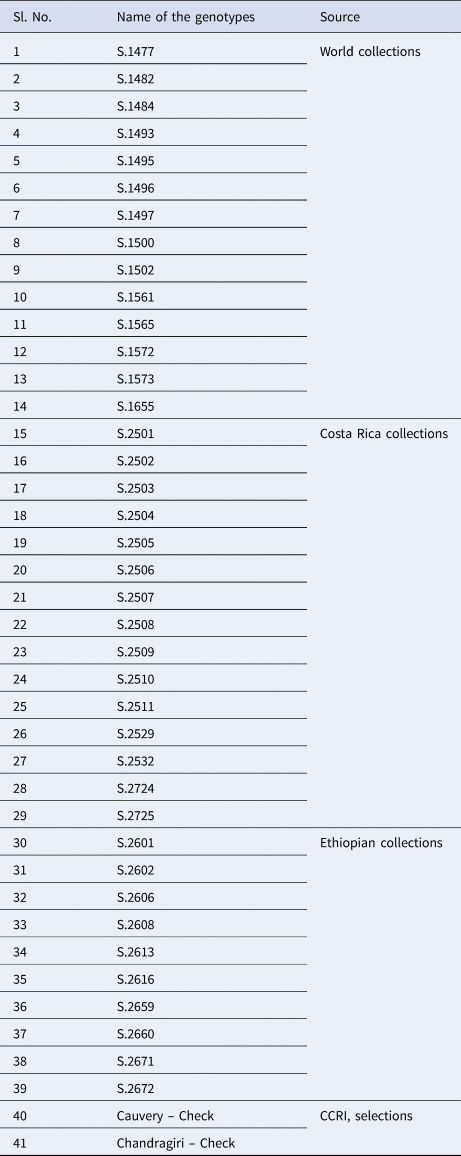
The 41 Arabica coffee genotypes (Table 1) comprising exotic collections such as World collections (14), Costa Rica collections (15), Ethiopian collections (10) and check varieties of CCRI (2) maintained at CCRI germplasm of uniform age groups (16 years old) were selected for assessment of genetic diversity. The experiment was conducted in randomised complete block design with two replications. Four randomly selected plants from each replication were tagged for recording observations on various characters such as growth, yield and yield attributes and quality parameters. Further, the regular calendar of operations like weeding, fertiliser application, plant protections measures, harvesting and processing were carried out during the course of investigation. The schematic representation of the design is depicted in the online Supplementary Fig. S1.
Details of the Arabica coffee genotypes used for present study

Observations on growth, yield attributes and yield
The observations on various morphological characters such as growth (number of primaries per plant, number of secondaries per primary, length of primary branch (cm), length of secondary branch (cm), stem diameter (cm) and average canopy diameter (cm), yield attributing (number of nodes per primary, number of bearing nodes per primary, number of flower buds per primary, number of fruits per primary, number of flower buds per node, number of fruits per node, fruit set percentage (%), fruit length (mm), fruit diameter (mm) and fresh fruit weight (g) and yield (clean coffee yield (kg) parameters were recorded from the sample plants using the following procedure. Four randomly selected plants from each replication were tagged for recording observations on different characters as described below and the mean values were calculated.
Observation on quality parameters
The clean coffee beans were subjected for analysis of various quality parameters such as 100 bean weight (g) reported by Anon. (2014) (Randomly selected 100 green beans at 11 per cent moisture from each sample were weighed using sensitive balance and expressed in gram) and per cent ‘A’ grade bean (grading was carried out based on the size of the coffee beans using 6.7 mm sieve) (Anon., 2014).
Estimation of caffeine content (%)
a. Caffeine estimation: The procedure used for estimation of caffeine content in Arabica coffee genotypes was developed by Shrestha et al. (Reference Shrestha, Rijal, Pokhre and Rai2016). A total of 41 green coffee samples weighing 150 gm each were collected from experimental plot for estimation of caffeine content in Arabica coffee genotypes. The coffee samples were kept at room temperature throughout the analysis. All the glassware were properly cleaned, then rinsed with HPLC water before use. The chemicals and reagents used in this study were HPLC grade methanol, ultra-pure water and MgO (Magnesium oxide).
b. Determination of caffeine content (%): Coffee samples were first grounded to powder and about 1 g of grounded coffee samples were taken into 250 ml conical flasks. Then 200 ml of distilled water was added along with 5 gm of MgO (Magnesium oxide) into the conical flask and placed over hot water bath (90°C) for 20 min, proper mixing was done with occasional shaking. Then the solution was cooled, volume maintained to 250 ml water in a 250 ml volumetric flask and allowed solid particles to settle. The supernatant solution was taken and filtered through 0.45 micron filter. First few ml of supernatant solution was discarded and later used for HPLC analysis. Caffeine content was calculated in per cent on dry basis.
Statistical and biometrical analysis
The data recorded for various characters were subjected to statistical analysis for Analysis of variance, mean, range, standard deviation, components of variance like genotypic variance, phenotypic variance, genotypic coefficient variation and PCV studies using statistical package ‘Windostat Version 9.2 from Indostat services, Hyderabad’ available at Department of Crop Improvement and Biotechnology (CIB), Kittur Rani Channamma College of Horticulture, Arabhavi. The detailed information on the statistical and biometrical analysis is given in the online Supplementary material.
Results
Analysis of variance
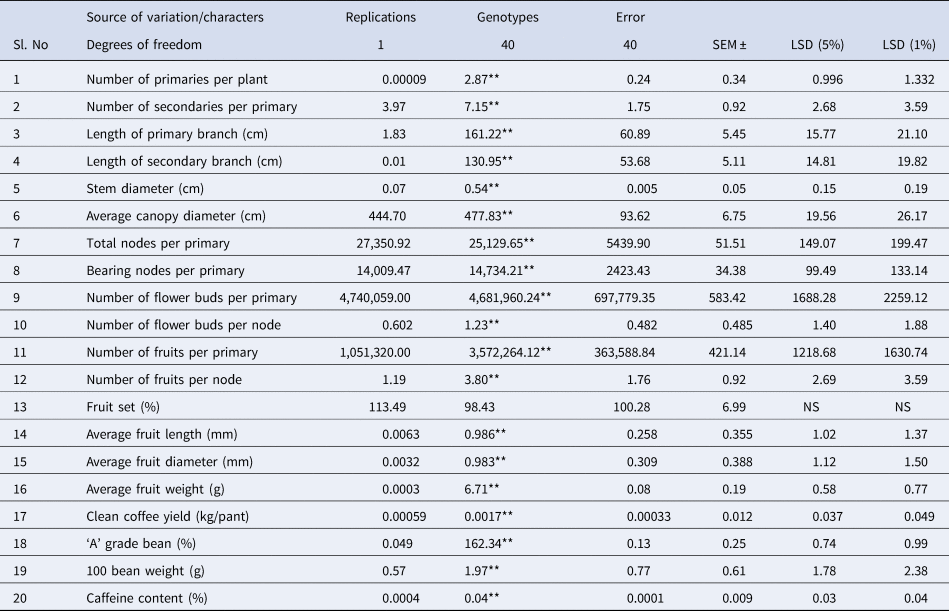
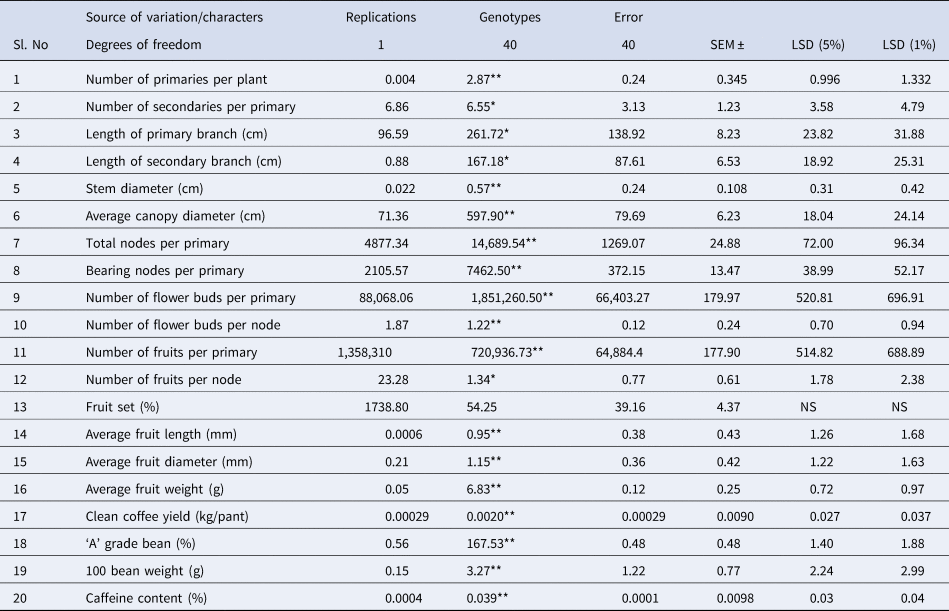
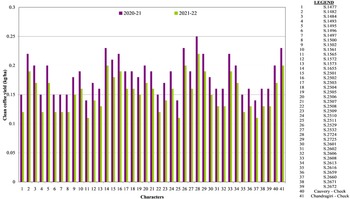
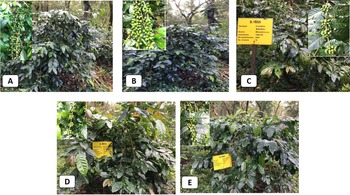
The study of genetic variability was carried out by analysis of variance for 20 characters during 2020–2021 and 2021–2022 and the data are presented in Tables 2 and 3, respectively. Data revealed significant difference among the genotypes for all the characters studied except fruit set percentage during 2020–2021 and 2021–2022. The per se or mean performance of the genotypes for various characters is presented in Fig. 1 and Plate 1 represents the best-performing genotypes for growth and yield.
Mean sum of square of ANOVA for growth, yield and yield attributing parameters in Arabica coffee genotypes during 2020–21

NS, Non significant.
**Significant at 1%, *Significant at 5%.
Mean sum of square of ANOVA for growth, yield and yield attributing parameters in Arabica coffee genotypes during 2021–2022

NS, Non significant.
**Significant at 1%, *Significant at 5%.
Performance of Arabica coffee genotypes for clean coffee yield in Arabica coffee genotypes during 2020–2021 & 2021–2022.

Top Performing genotype with respect to growth yield: (a)S.2724 (b)2725 (c) S.1655 (d) S.2613 and (e) 1495.

Genetic variability, heritability and GA as per cent mean
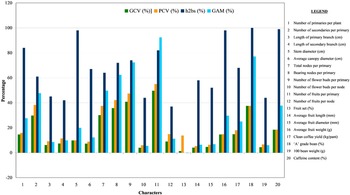
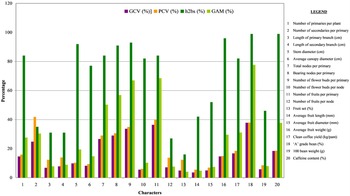
To understand the extent to which the variations observed due to genetic factors viz., the range, mean, GCV, PCV, heritability (h 2), GA, GA as per cent of mean of different characters were worked out during 2020–2021 and 2021–2022 and the data are presented in Figs 2 and 3, respectively.
Genetic parameters of different morphological and yield-related traits in Arabica coffee genotypes during 2020–2021.

Genetic parameters of different morphological and yield-related traits in Arabica coffee genotypes during 2021–2022.

Range of variation
The data from Fig. 1 found that range was highest in case of number of flower buds per primary (1619.69 to 8564.96 and 1386.35 to 5557.79) which was followed by number of fruits per primary (1082.09 to 7113.49 and 751.41 to 3441.23), total nodes per primary (156.69 to 656.07 and 156.69 to 506.07) and bearing nodes per primary (108.57 to 488.51 and 101.63 to 363.50) during the year 2020–2021 and 2021–2022, respectively. The lowest range was observed in clean coffee yield (0.14 to 0.25 and 0.12 to 0.25 kg/plant), caffeine content (0.56 to 1.05%) and stem diameter (4.47 to 6.83 and 4.40 to 6.68 cm) during both the years of study, respectively. With respect to the grand mean results indicated wide variation ranging from 0.18 kg/plant for average clean coffee yield to 3460.12 and 2804.99 for number of flower buds per primary during the year 2020–2021 and 2021–2022, respectively (Fig. 1).
Coefficient of variation
The estimates of phenotypic coefficients of variation (PCV) and genotypic coefficients of variation (GCV) are presented in Figs 2 and 3. The PCV values ranged between 5.32 and 5.50% for average fruit length to 54.98 and 39.83% for number of fruits per primary in 2020–2021 and 2021–2022, respectively. In 2020–2021 (Fig. 2), the characters such as length of secondary branch (11.44%), fruit set percentage (13.77%), average fruit length (14.74%), number of fruits per node (14.84%), number of primary branches per plant (15.88%), clean coffee yield kg plant−1 (17.94%) and caffeine content (18.50%) were recorded relatively moderate PCV values (10–20%). While, higher PCV values (>20%) were observed for six other characters viz., total nodes per primary (37.46%), per cent ‘A’ grade bean (37.50%), number of secondary branches per primary (38.27%), bearing nodes per primary (42.17%), number of flower buds per primary (47.40%) and number of fruits per primary (54.98) (Fig. 2). Similarly during 2021–2022, PCV was found moderate for nine characters like stem diameter (10.24%), fruit set percentage (12.30%), length of the primary branch (12.31%), number of fruits per node (13.70%), length of secondary branch (13.90%), average fruit weight (14.89%), number of primaries per plant (15.88%), clean coffee yield kg plant−1 (18.47%) and caffeine content (18.50%) (Fig. 3). While rest of the characters were recorded higher PCV (>20%) values. Further, GCV values were ranged from 1.33 (2020–2021) and 3.58 (2021–2022) in case of fruit set percentage and average fruit length, respectively to 49.64% (number of fruits per primary) and 37.83% (per cent ‘A’ grade bean) during 2020–2021 and 2021–2022, respectively. The narrow gap between GCV and PCV values were observed across the two season (2020–2021 and 2021–2022) Figs 2 and 3) for stem diameter (9.77–9.86 and 9.82–10.24%, respectively), average fruit length (14.56–14.74 and 14.61–14.89%, respectively), per cent ‘A’ grade bean (37.47–37.50 and 37.83–37.94%, respectively) and caffeine content (18.41–18.50%, respectively).
Heritability
The estimates of broad sense heritability (h 2) for 20 quantitative traits are presented in Figs 2 and 3. The heritability estimates for 20 characters ranged from −1 and 16% in case of fruit set percentage to 100 and 99% for per cent ‘A’ grade bean during 2020–2021 and 2021–2022, respectively. In 2020–2021, relatively higher magnitude of heritability (>80%) was observed for number of fruits per primary (82%), number of primary branches (84%), average fruit length and stem diameter (98%), caffeine content (99%) and per cent ‘A’ grade bean (100%). Similarly the characters like average fruit diameter (52%), average fruit length (58%), number of secondaries per primary (61), total nodes per primary (64%), average canopy diameter (67%), bearing nodes per primary (72%) and number of flower buds per primary (74%) recorded above 50% heritability. While, length of primary branch (45%), 100 bean weight (44%), length of secondary branch (42%) and fruit set percentage (−1%) showed low heritability (<50%) (Fig. 2).
The extent of magnitude of heritability had shown high (>80%) for total nodes per primary, number of fruits per node and number of primary branches (84%), bearing nodes per primary (91%), stem diameter (92%), number of flower buds per primary (93%), average fruit weight (96%), caffeine content and per cent ‘A’ grade bean (100%). In the same way, the traits such as average fruit diameter (52%) and average canopy diameter (77%) recorded heritability of above 50% but less than 80%. The low heritability (<50%) was found in case of 100 bean weight (46%), average fruit length (42), number of secondary branches (35%), length of primary branch and length of secondary branch (31%), number of fruits per node (27%) and fruit set percentage (16%) during the year 2021–2022 (Fig. 3).
GA as per cent over mean (GAM)
Results of GAM establish that the GAM was ranged from −0.26 to 92.33 per cent in 2020–2021 (Fig. 2) and 4.09 to 68.50 per cent in 2021–2022 (Fig. 3) in respect of fruit set per cent to number of fruits per primary. GAM was recorded high (>20) for 10 characters like number of primaries per plant (27.58%), number of secondaries per primary (47.72 and 30.40%), total nodes per primary (49.71 and 50.30%), bearing nodes per primary (62.33 and 56.89%), number of flower buds per primary (72.31 and 66.93%), number of fruits per primary (92.33 and 68.50%), average fruit weight (29.63 and 29.54%), clean coffee yield (24.96 and 31.09%), ‘A’ grade bean percentage (77.12 and 77.70%) and caffeine content (37.73%) during 2020–2021 and 2021–2022, respectively (Figs 2 and 3). While, moderate GAM (10–20) was observed for three traits such as stem diameter (19.93%), average canopy diameter (12.24%) and number of fruits per node (11.18%) during 2020–2021 (Fig. 2) and stem diameter (19.38%), average canopy diameter (14.75%) number of flower buds per primary (10.27%) during 2021–2022 (Fig. 3). Similarly (Fig. 2), the characters viz., length of primary branch (8.52%), length of secondary branch (9.86%), number of flower buds per node (5.40%), fruit set per cent (0.26%), average fruit length (6.41%), average fruit diameter (6.83%) and 100 bean weight (5.94%) registered low GAM (<10) during 2020–2021 and length of primary branch (7.78%), length of secondary branch (8.94%), number of flower buds per node (7.63%), fruit set per cent (4.09%), average fruit length (4.80%), average fruit diameter (7.41%) and 100 bean weight (8.01%) during 2021–2022 (Fig. 3).
Discussion
The progress in breeding programme depending upon availability of genetic variability and which provides many avenues for genetic improvement of crop without which neither the improvement in existing lines nor development of new lines is feasible. In the present study, the analysis of variance indicated highly significant differences among the genotypes for the characters studied. This indicates the existence of large amount of variations among the genotypes. So, there is scope for considerable improvement in this crop through the characters studied and which shows the possibility to select best and exploit through selection. The significant difference observed for measured quantitative traits in this study are in agreement with the finding of earlier authors like Olika et al. (Reference Olika, Alamerew, Kufa and Garedew2011), Anon. (2014)and Atinafu and Mohammed (Reference Atinafu and Mohammed2017) who reported the existence of genetic diversity in beverage quality (Caffeine) and bean physical characteristics (weight of 100 dry seeds) Gichimu and Omondi (Reference Gichimu and Omondi2010) and suggested the exploitation of these traits in coffee breeding. Muvunyi et al. (Reference Muvunyi, Sallah, Dusengemungu and Zhang2017) indicated highly significant (P < 0.01) differences among the accessions for number of primary branches, number of cherries per internode and per cent coffee leaf rust disease rating and significant (P < 0.05) for yield. Substantial variation was observed by Tran et al. (Reference Tran, Vargas and Slade Lee2017), Kusolwa et al. (Reference Kusolwa, Makwinja, Nashon, Marianna and Kibola2019) and Donkor et al. (Reference Donkor, Asare and Adjei2020) for reproductive traits (bean size, berry size and shape) and biochemical (caffeine) attributes (WeldeMichael et al., Reference Weldemichael, Alamerew, Tulu and Berecha2020).
Genetic variability
From the present study, it is clearly observed that there exists a wide range of phenotypic as well as GCV for majority of the 20 quantitative and qualitative characters in Arabica coffee. The PCV values were comparatively higher than GCV values for all the traits studied (Beksisa and Ashenafi, Reference Beksisa and Ayano2016). Further, the maximum difference in magnitude of GCV and PCV was found in number of primaries per plant, number of secondaries per primary, length of primary branch, length of secondary branch, average canopy diameter, total nodes per primary, bearing nodes per primary, number of flower buds per primary, number of flower buds per node, number of flower buds per primary, number of flower buds per node, number of fruits per primary, number of fruits per node, fruit set percentage, average fruit length, average fruit diameter, clean coffee yield and 100 bean weight which indicates the importance of environment in influencing the traits. These results are in agreement with the findings of Kumar et al. (Reference Kumar, Ganesh and Awati2008), Kitila et al. (Reference Kitila, Alamerew, Kufa and Garedew2011), Olika et al. (Reference Olika, Alamerew, Kufa and Garedew2011), Beksisa and Ayano (Reference Beksisa and Ayano2016), Weldemichael et al. (Reference Weldemichael, Alamerew and Kufa2017), Donkor et al. (Reference Donkor, Asare and Adjei2020) and Cheserek et al. (Reference Cheserek, Ngugi, Muthomi and Omondi2020) who reported the larger differences between PCV and GCV for yield and length of first primary branch. This large difference i.e. higher values for PCV than that of GCV reflects the high environmental influence on expression of the studied traits. However, the narrow gap between GCV and PCV values were observed during both the years of study for stem diameter, average fruit length, per cent ‘A’ grade bean and caffeine content. This data suggests that the influence of environment in phenotypic performance is minimal as GCV values were very close to that of corresponding PCV values for these characters (Atinafu et al., Reference Atinafu, Mohammed and Kufa2017) suggesting the greater role of the genotype in the expression of these traits Hence, simple selection followed on the phenotypic variation is worth while improving the traits of interest. On the other hand, as most of the traits like Length of secondary branch, number of flower buds per node, fruit set per cent, average fruit length, average fruit diameter and 100 bean weight exhibited low GCV during both the years study (Beksisa and Ayano, Reference Beksisa and Ayano2016). Hence, there is no opportunity to improve these traits using simple selection. Therefore, heterosis breeding should be applied to improve these traits (Weldemichael et al., Reference Weldemichael, Alamerew and Kufa2017).
Heritability
High magnitude of heritability was noticed (>80%) for total nodes per primary, number of fruits per node and number of primary branches, bearing nodes per primary, stem diameter, number of flower buds per primary, average fruit weight, caffeine content and per cent ‘A’ grade bean (100%). Present study results are in line with the findings of Weldemichael et al. (Reference Weldemichael, Alamerew and Kufa2017), Olika et al. (Reference Olika, Alamerew, Kufa and Garedew2011), Bikila and Sakiyama (Reference Bikila and Sakiyama2017), Cheserek et al. (Reference Cheserek, Ngugi, Muthomi and Omondi2020), Yonas and Tarekegn (Reference Yonas and Tarekegn2015) and Yigzaw (Reference Yigzaw2005) who reported high broad sense heritability for main stem girth, number of primary branches and internodes length while canopy diameter, length of first primary branch, height up to first primary branch, total plant height and yield showed medium (20 to 50%) broad sense heritability. These results suggesting most likely the effective selection can be done by the studied traits for Arabica coffee improvement since GCV showed from medium to high for all traits.
Genetic advance
Though the studies of heritability estimates are important, their scope is limited since they are estimated in broad sense and are prone to change with changes in environment and the testing material. Further, the heritability estimate by itself may not be a useful index of genetic potentiality of a character. According to Eswro et al. (Reference Eswro, Sentz and Meyer1963), GA indicates the potentiality of selection at particular level of selection intensity. Thus, heritability estimates along with GA are more valuable than heritability alone in predicting the response of selection (Johnson et al., Reference Johnson, Robinson and Comstock1955 and Robinson, Reference Robinson1963). High heritability does not necessarily mean that the character will show high GA, but when such compatible association exists (high heritability and high GA) additive genes come into prominence because no GA is due to non-additive genes.
Higher estimates of heritability combined with a strong GA as per cent of mean (>20%) was recorded for number of primaries per plant, number of secondaries per primary, total nodes per primary, bearing nodes per primary, number of flower buds per primary, number of fruits per primary, average fruit weight, clean coffee yield per plant, per cent ‘A’ grade bean and caffeine content (2020–2021 and 2021–2022). The high heritability with high GA as per cent of mean observed for the character is due to the lesser influence of environment in expression of the characters and additive gene effects and hence selection could be effective. The results are comparable with Oliveira et al. (Reference Oliveira, Pereira, Silva, Rezende, Botelho and Carvalho2011), Beksisa and Ayano (Reference Beksisa and Ayano2016) for stem diameter and Weldemichael et al. (Reference Weldemichael, Alamerew and Kufa2017) for 100 bean weight. According to Atinafu et al. (Reference Atinafu, Mohammed and Kufa2017) high broad sense heritability coupled with high GA as per cent of the mean was observed for coffee berry disease, average green bean yield, stem diameter, number of primary branches and average length of primary branches confirming that genotypic variance has contributed substantially to the total phenotypic variance (Rodrigues et al., Reference Rodrigues, Brinate, Martins, Colodetti and Tomaz2017). This makes plant girth, 100 dry bean weight, and fruit width important traits to consider for the improvement of coffee reported by Donkor et al. (Reference Donkor, Asare and Adjei2020) and Cheserek et al. (Reference Cheserek, Ngugi, Muthomi and Omondi2020). However, operation of both additive and non-additive gene action was indicated for stem diameter, average canopy diameter and number of fruits per node through moderate GA. Further improvement of this character would be easier through mass selection, progeny selection or any modified selection procedure aiming to exploit the additive gene effect rather than simple selection.
Conclusions
Present study reveals the significant differences among the 41 genotypes for the characters studied indicating the presence of variability in the studied material. Hence, the existence of genetic diversity is potential resource for improvement of coffee through selection and hybridisation. The PCV was higher than the corresponding GCV for all the traits. On the other hand, higher estimates of heritability combined with a strong GA as per cent of mean recorded during both the years of study most of the growth, yield and yield attributing traits. Hence, direct selection could be effective for improvement of these traits as these characters were highly influenced by additive gene action. The phenotypic diversity observed in this study should be further studied using the molecular characterisation (DNA markers).
Supplementary material
The supplementary material for this article can be found at https://doi.org/10.1017/S1479262123000680
Acknowledgement
The authors are grateful to Dr N. S. Prakash, Former Director of Research and entire staffs of Central Coffee Research Institute (CCRI), Balehonnur for providing the facilities to carry out the experiment.
Authors’ contributions
This work was carried out in collaboration among all authors. Authors P. M. Gangadharappa, S. Koulagi and J. S. Hiremath guided in characterising the genotypes. Author D. Satish guided in breeding aspects and analysing data and interpretation of results. Author S. Nishani guided in Biotechnology aspects and guiding in molecular characterisation. All authors read and approved the final manuscript.
Competing interest
None.