Introduction
Advances in technology have led to the development of even more sophisticated instruments in the rehabilitation of audition in patients with hearing loss. Cochlear implants are classically indicated for severe sensorineural hearing loss and are based on the electric stimulation of the cochlea. In recent years, surgery for cochlear implants has increased around the world, with a larger spectrum of indications. Continuous research is being conducted to improve surgical techniques, and refinements are needed to preserve residual audition and improve implant efficiency.
Numerous bone conduction implants have been developed for patients with conductive or mixed hearing loss. These employ bone conduction stimulation for the treatment and rehabilitation of hearing loss.Reference Zernotti and Sarasty1,Reference Zernotti, Di Gregorio, Galeazzi and Tabernero2 Candidates for this type of implant normally cannot use conventional hearing aids because of medical or anatomical conditions such as recurrent otitis externa, aural atresia, chronic otitis media and single-sided deafness.Reference Zernotti and Sarasty1
Several types of bone conduction implant exist; these are classified according to the modality of conduction. They can be broadly categorised as cutaneous and direct implants.Reference Carnevale, Til-Pérez, Arancibia-Tagle, Tomás-Barberán and Sarría-Echegaray3 In cutaneous implants, vibration is transmitted through the skin. They include passive transcutaneous bone conduction implant systems such as the Sophono device (Sophono, Boulder, Colorado, USA) and the bone-anchored hearing aid Attract system (Cochlear, Sydney, Australia). In direct implants, vibration is transmitted directly to the bone. They are classified into percutaneous devices (e.g. bone-anchored hearing aid and the Ponto system (Oticon Medical, Askim, Sweden)) and active transcutaneous systems (e.g. Bonebridge; Med-El, Innsbruck, Austria).
Cochlear and bone conduction implants present similar complications. Although major complications requiring revision surgery or hospitalisation are extremely rare, in 5 per cent of cases a minor complication may be reported.Reference Zernotti and Sarasty1 Skin flap necrosis, infection, dehiscence and device extrusionReference Geraghty, Fagan and Moisidis4 are the most common complications observed. The presence of a previous canal wall down mastoidectomy for cholesteatoma or chronic otitis media has been well documented in the literature as a risk factor for device extrusion, and a variety of surgical techniques have been described to reduce its incidence.Reference Kojima, Sakurai, Rikitake, Tanaka, Kawano and Moriyama5–Reference Carnevale, Til-Pérez, Arancibia-Tagle, Tomás-Barberán and Sarría-Echegaray11
Other non-otological surgical procedures can also be related to post-operative complications observed with these implantable hearing devices.Reference Sarría-Echegaray, Til-Pérez, Arancibia-Tagle, Carnevale and Tomás-Barberán12 Several head and neck surgical procedures may affect vascularisation of the post-auricular region, where the device is usually implanted. In recent decades, there has been an increase in cosmetic surgical procedures for face and neck rejuvenation, which are commonly performed by otolaryngologists and facial plastic surgeons. The pre- and retro-auricular approaches used in these procedures, such as parotidectomy and rhytidectomy, may affect the vascularisation of the soft tissues covering the implant.
We report four cases of skin necrosis, infection and device exposure in implantation patients who previously underwent a cervicofacial procedure, and describe the technique used to solve the complication. Finally, we propose an algorithm that can be useful for the management of these difficult cases.
Materials and methods
We reviewed a retrospectively acquired database of all surgical procedures for cochlear and bone conduction implants performed at Son Espases University Hospital between January 2011 and December 2019. A total of 326 surgical procedures were performed. Five cases of implant exposure because of skin necrosis were observed. Only patients with device extrusion related to a cervicofacial procedure were included in the study. A case of cochlear implant extrusion related to previous otological surgery (canal wall down mastoidectomy for cholesteatoma prior to the cochlear implant) was excluded from the study.
The characteristics of the patients, type of implant, and type of previous face and neck surgery were analysed, as well as the medical and surgical management of the patients. In all patients, microbiological examination was performed, and oral and/or intravenous antibiotic treatment administered, prior to the wound debridement and closure of the defect. Follow up ranged between 24 and 52 months. Finally, an algorithm for management of these challenging cases was proposed.
Results
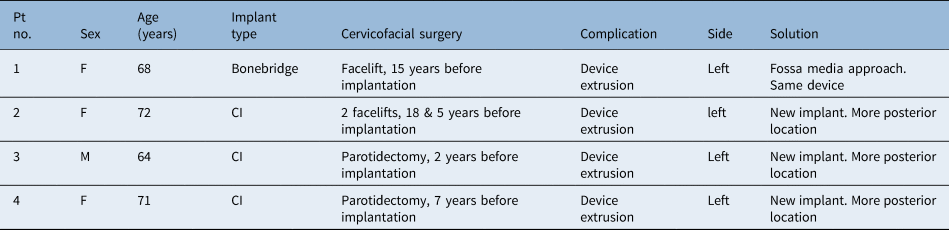
Four patients were included in the study. The patients’ characteristics are shown in Table 1. Patients’ median age was 67.25 years (64–72 years). Three patients were female and one was male. One patient was implanted with a Bonebridge system and the other three patients received a cochlear implant. One and two facelifts had been performed for patients one and two, respectively. In the other two patients, a superficial parotidectomy for excision of a benign tumour had been performed several years before. All patients presented a device extrusion with necrosis and dehiscence of the soft tissue covering the implant.
Patients’ characteristics

Pt. no. = patient number; F = female; CI = cochlear implant; M = male
The management was based on antibiotic treatment for at least two weeks and wound debridement in all cases. In general, infections were primarily treated with an oral beta-lactam antibiotic containing a beta-lactamase inhibitor (875 mg amoxicillin-clavulanic acid every 8 hours). Then, the treatment was adjusted according to the clinical evolution and bacterial sensitivity. In the case of severe infection and no response to oral antibiotics after 5–7 days, intravenous ceftazidime in combination with metronidazole or clindamycin was employed and later adjusted according to bacterial sensitivity. Surgical revision was performed in all cases to remove infection from the wound as an attempt to preserve the implant. In all cases, any visible biofilm was mechanically removed, and gentamicin-impregnated collagen sheets were used to obtain a higher antibiotic concentration directly in the tissue surrounding the implant.Reference Buijs, Theunisse, Mulder, van den Hoogen, Offeciers and Zarowski13,Reference Benito-González, Benito, Sánchez, Estevez Alonso, Muñoz Herrera and Batuecas-Caletrio14
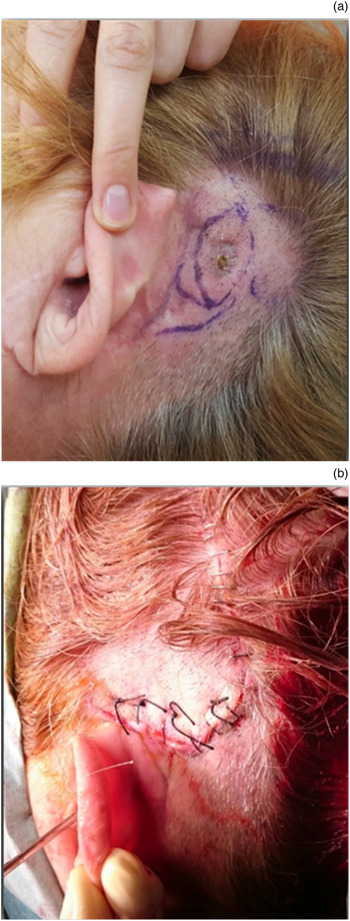
In the first patient, the Bonebridge had been implanted in the retro-auricular region using a classic pre-sigmoid approach. After oral antibiotic treatment, surgical debridement was performed, and a rotational skin flap was needed to close the defect (Figure 1). Finally, the same Bonebridge device was implanted at the level of the middle fossa on the squamous portion of the temporal bone. In the other three patients, after unsuccessful oral and intravenous antibiotic treatment, surgical revision and mechanical removal of an evident biofilm were performed. Despite that, the implant was later removed. A new device was implanted in a more posterior region, far from the ischaemic area, and a rotational skin flap was performed to cover the defect.
Images of patient one, showing: (a) Bonebridge implant and device extrusion, and (b) a rotational skin flap. The Bonebridge will be implanted in the middle fossa.

Discussion
Surgery for cochlear implants and bone conduction devices is considered safe and reliable. Skin necrosis, infection, dehiscence and device extrusion are the most common complications, occurring in 1.7–10 per cent of cases.Reference Kempf, Johann and Lenarz15,Reference Olsen, Larsen, Wanscher, Faber and Jeppesen16
The Bonebridge system is the only active prosthesis amongst the transcutaneous devices; it also has the lowest weight and a lower external profile, a characteristic that reduces the chance of injury to the skin.Reference Zernotti and Sarasty1 The system imparts fewer complications than with percutaneous bone conduction implants, where the trauma related to skin penetration can predispose to cutaneous infections.
Skin flap necrosis is one possible major complication of this surgery. It can be caused by infection, haematoma and the shape of the flap. The technique for skin incision is a predisposing factor for necrosis. Smaller incisions with smaller skin flaps are used to reduce vascular compromise and minimise the risk of flap necrosis.Reference David, Ramsden, Gordon, James and Papsin17 Another important factor is flap thickness. Various authors recommend flaps of 6–7 mm thickness.Reference Parkins, Metzinger, Marks and Lyons18 We recommend performing two flaps: a superficial flap that includes the skin and subcutaneous tissue, and a deeper fascio-muscular flap, to reduce the risk of device extrusion.
Infections or post-implantation hypersensitivity to silicone could be another cause of flap necrosis. If patients show no response to antibiotic treatment and wound cultures are negative for bacterial growth, skin patch testing to the silicone components of the implants could be performed to demonstrate sensitivity.Reference Loochtan, Yang, Mantravadi and Marzo19
Despite efforts to prevent and improve the management of these complications, post-operative wound infection and skin dehiscence is a dreaded complication. Depending on the severity of the infection, and despite rigorous medical and surgical efforts to eradicate the infection, it can still lead to device removal. Several studies have demonstrated that Pseudomonas aeruginosa and Staphylococcus aureus are common and virulent bacteria usually related to the severity of the infection, requiring intensive medical and surgical treatment.Reference Germiller, El-Kashlan and Shah20,Reference Hopfenspirger, Levine and Rimell21
As other authors have suggested,Reference Olsen, Larsen, Wanscher, Faber and Jeppesen16 and based on the clinical examination findings, oral or intravenous antibiotic treatment may be initially used. Surgical revision is often performed in the case of skin necrosis and infection, to close the defect and rule out the presence of a biofilm. This last finding represents a challenge for the surgeon. Despite the mechanical removal of the biofilm and local antibiotics, the preservation of the implant is extremely difficult, and a new device is often needed.
In our series, there is one case of a transcutaneous bone conduction device and three cases of cochlear implant exposure. With respect to the first case, in our department, it represents the only complication observed after implantation of 46 Bonebridge devices. Moreover, we consider the Bonebridge system to be the first option in patients with bilateral mixed or conductive hearing losses, and bone conduction thresholds better than 45 dB.
Three different surgical approaches have been described in the literature: the pre-sigmoid, retro-sigmoid and middle fossa approaches. The pre-sigmoid approach is the preferred technique if the anatomy is normal on the pre-operative computed tomography scan. In the presence of anatomical variants, such as a low middle fossa dura plate or anterior protruding sigmoid sinus, or in cases of radical cavities, pre-sigmoid placement of the implant is not possible. In these cases, we can choose a retro-sigmoid or middle fossa approach. In our hospital, we began using the Bonebridge system in 2012, and we have now implanted a total of 46 patients. In a recently published study,Reference Carnevale, Tomás-Barberán, Til-Pérez and Sarría-Echegaray22 we described our favourite technique of a middle fossa approach, considering it a safe and excellent option when the pre-sigmoid technique is not reliable. In the case of previous cervicofacial surgical procedures such as rhytidectomy or parotidectomy, where post-auricular vascularisation can be compromised, we think that the middle fossa approach has to be considered the best option to avoid a large post-auricular incision in the conflictive area.
The skin overlying the mastoid is highly vascularised. It depends essentially on the posterior auricular artery, a collateral branch of the external carotid artery that provides a reliable blood supply to the post-auricular area. The angiosome supplied by the posterior auricular artery extends approximately 7 cm posterior to the external auditory canal meatus, 4.8 cm superoposterior to the root of the helix and 3.7 cm posterior to the mastoid process.Reference Krespi, Ries, Shugar and Sisson23 In addition, the superior auricular artery, a branch of the superficial temporal artery, contributes in a minor way to the blood supply of the post-auricular area. After its origin from the external carotid artery just superior to the occipital artery, the posterior auricular artery runs toward the stylomastoid foramen, where it is anatomically close to the principal trunk of the facial nerve.Reference Liu, Wang, Benet, Meybodi, Tabani and Ei-Sayed24
In parotid gland surgery, the posterior auricular artery can be coagulated to control the bleeding during the identification and dissection of the facial nerve trunk at the stylomastoid foramen. This could explain the greater risk of post-auricular skin necrosis observed in our two patients with previous parotidectomy. Another location at risk for posterior auricular artery damage is just inside the posterior cervical skin incision; this is typical of rhytidectomy, performed in several cases of parotidectomy for aesthetic purposes. In this region, coagulation with bipolar forceps where the sternocleidomastoid muscle inserts at the mastoid tip may damage post-auricular vascularisation.
Previous rhytidectomy was a possible cause of the delayed Bonebridge extrusion in patient one, associated with the local vascularisation injury. In the case described, a pre-sigmoid approach was used. After successful antibiotic treatment, surgical debridement and rotational skin flap to close the defect were performed. The same device was implanted at the level of the middle fossa, in the squamous portion of temporal bone.
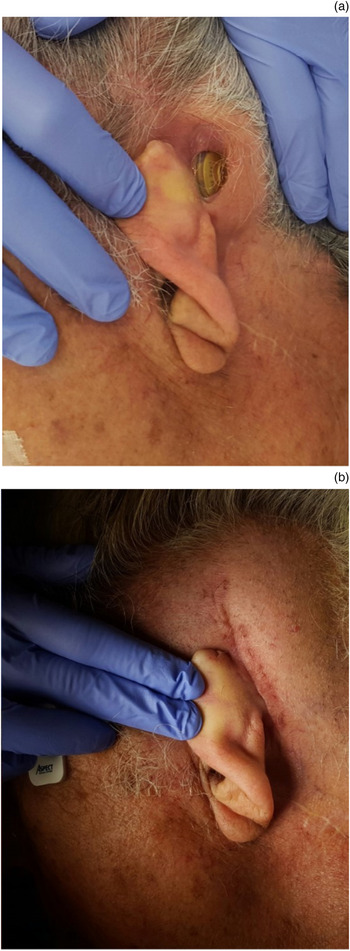
Regarding the other three cases (patients two, three and four), cochlear implant exposure was observed in patient two, who previously underwent two aesthetic facelifts, and in patients three and four, who had previously undergone parotidectomy (Figure 2). In all these cases, a compromised vascularisation of the post-auricular region related to the previous surgery could be easily hypothesised. A rotational or advancement skin flap was used in all cases to cover the defect, and a new device was implanted as posteriorly as possible to avoid the conflictive area. No skin dehiscence or implant exposure were observed during the follow up.
Patient three received a cochlear implant and had previously undergone parotidectomy. Image (a) shows device exposure. (b) After surgical debridement and creation of a rotational flap, the device is moved to a more posterior area.

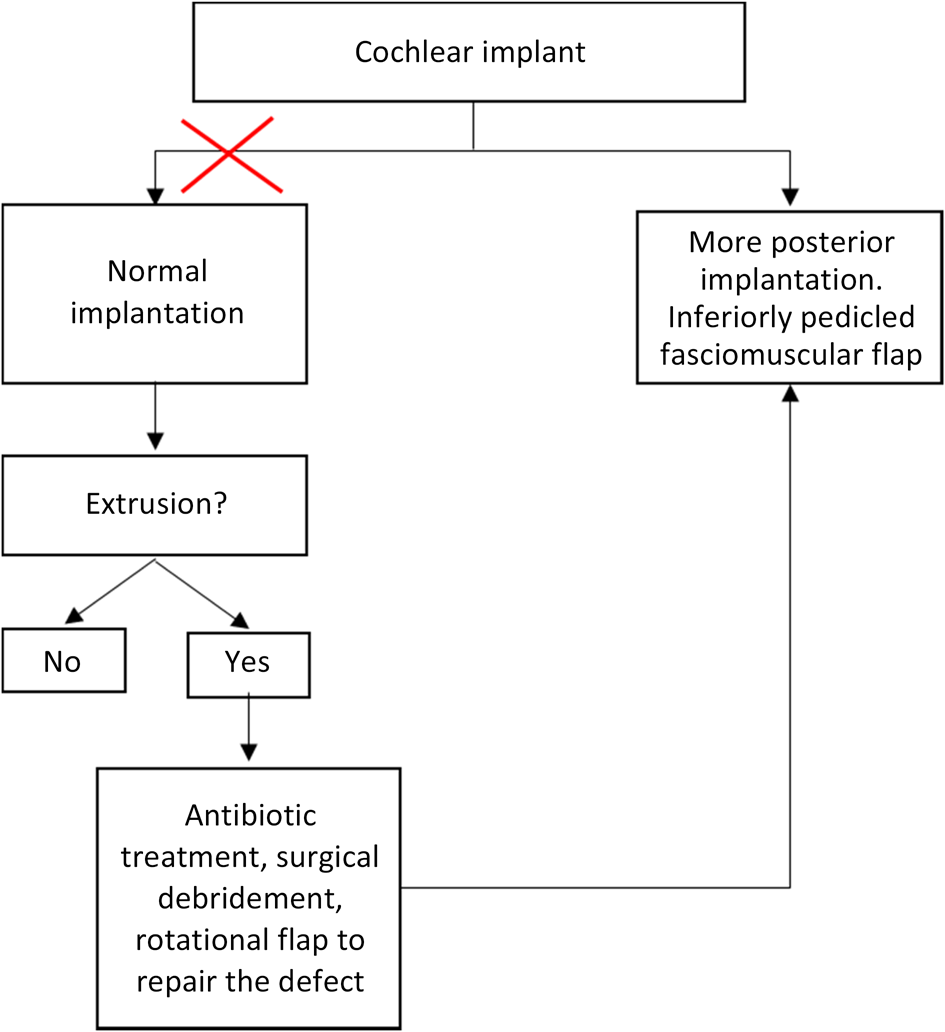
In order to avoid implant extrusion, the authors suggest that an inferiorly based fascio-muscular flap (not an anteriorly based flap as usually performed) may be the best option, depending on the temporal superficial artery and occipital arteries, as theoretically these vessels have been preserved during the previous cervicofacial surgery.
• Medical and surgical management of implantable hearing device extrusion is challenging for ENT surgeons
• As prior cervicofacial surgery may affect post-auricular region vascularisation, it presents a risk for skin dehiscence and device extrusion and infection
• Regarding bone conduction implants, transcutaneous devices are preferred to percutaneous devices
• The Bonebridge is likely the best option in a middle fossa approach
• Regarding cochlear implants, an inferiorly based fascio-muscular flap, depending on occipital and temporal arteries, is likely the best option to cover the implant
• Placing the implant in a more posterior area, far from the conflictive region, may help avoid complications
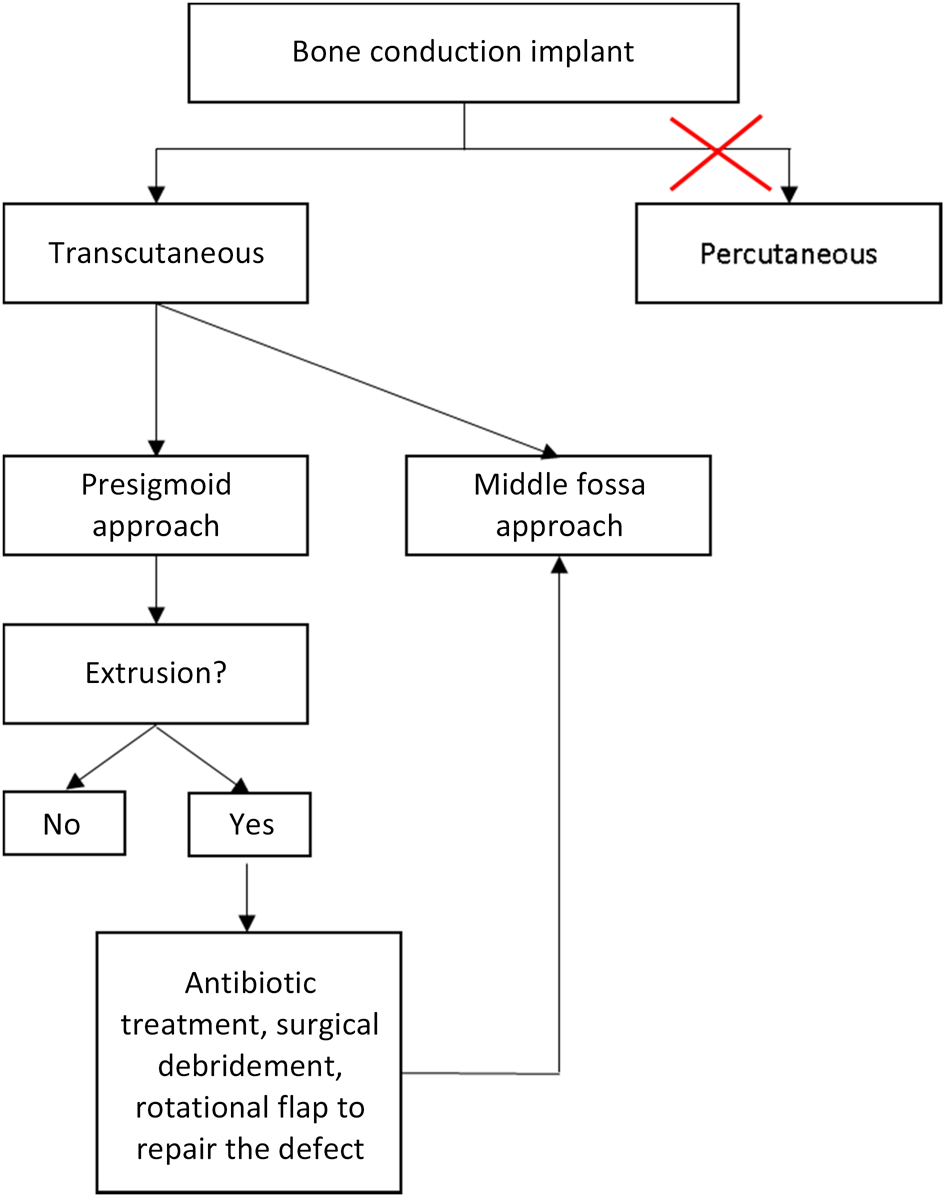
Our proposed algorithms to manage challenging cases such as those described here are shown in Figures 3 and 4.
Algorithm proposed for the prevention and management of bone conduction implant extrusion in cases of previous face and neck surgery.

Algorithm for the prevention and management of cochlear implant extrusion in cases of previous face and neck surgery.

Conclusion
Previous cervicofacial surgical procedures, such as aesthetic facelift and parotidectomy, and other treatments that may compromise vascularisation of the post-auricular region, have to be taken into account when a bone conduction device or cochlear implant surgery is being considered, to avoid complications.
Different techniques can be used to reduce the risk of implant exposure. In the case of previous face and neck surgery, the authors suggest that a transcutaneous system is safer than a percutaneous device, and the middle fossa approach has to be considered the first choice. For cochlear implants, after creating the superficial flap and inferiorly based fascio-muscular flap (described above), the surgeon needs to place the implant as posteriorly as possible, far from the ischaemic area, to avoid the risk of skin necrosis.
Competing interests
None declared