1. INTRODUCTION
The expression of future temporal reference has spilled much ink in studies of Canadian varieties of French. Beginning in the 1980s, studies of Laurentian varieties of French began to show that the constraints influencing choice between the future variants differed considerably from what had been prescribed by traditional grammarians over the past centuries.Footnote 2 For some researchers, these results brought into question the accuracy of grammarians’ descriptions. Nonetheless, studies of Acadian French revealed a linguistic system different from the Laurentian one. While the Laurentian French future temporal reference system was at odds with what early and contemporary grammarians had been prescribing for the future variants, the Acadian French future temporal reference system accurately reflected the descriptions of many grammarians. These findings thus contributed to the debate surrounding the development of constraints and the accuracy of grammarians’ descriptions in relation to the spoken language. The present results shed light on this debate by bringing evidence from one of the most linguistically conservative varieties of Acadian French, that spoken in the Baie Sainte-Marie (BSM) region of the Canadian province of Nova Scotia.
All contemporary varieties of French use two main ways of expressing future temporal reference: the inflected future (a synthetic variant) in (1), and the periphrastic future (an analytic form composed of the auxiliary aller ‘to go’ followed by an infinitive) in (2).
(1) Je reviendrai demain.
‘I’ll come back tomorrow.’
(Patrick, GC-18)Footnote 3
(2) Et là après je vas rouvrir ma own petite besogne dans Meteghan.Footnote 4
‘And then I’m going to open my own little business in Meteghan.’
(Véronique, M-296)
A third variant, the futurate present in (3), involves present tense conjugation of the main verb, but with future temporal reference.
(3) Je braquons back dans le mois de [. . .] mai.
‘We start again in the month of [. . .] May.’
(Sam, GC-36)
The futurate present has often been excluded from studies (e.g. King and Nadasdi, Reference King and Nadasdi2003; Blondeau, Reference Blondeau2006; Grimm, Reference Grimm2010a; Grimm and Nadasdi, Reference Grimm and Nadasdi2011; Wagner and Sankoff, Reference Wagner and Sankoff2011) since its rate of occurrence is considerably less than the two main variants in most varieties of French.Footnote 5 Moreover, it is often difficult to determine whether a token expresses habituality or if it has future or present temporal reference unless there is some overt temporal indication, either by means of an adverbial or by inferences from the context. Much of the discussion surrounding the two main variants (inflected future and periphrastic future) is devoted to describing the constraints that govern their use. Early grammarians (Maupas, Reference Maupas1607; Antonini, Reference Antonini1753) often described the variation as influenced by temporal distance (i.e. proximate vs. distant outcomes) with the periphrastic future denoting proximate eventualities, that is, actions anticipated to occur shortly following the moment of speech. This association has given rise to its label of futur proche (Antonini, Reference Antonini1753).
Recent studies of Laurentian varieties (Deshaies and Laforge, Reference Deshaies and Laforge1981; Emirkanian and Sankoff, Reference Emirkanian, Sankoff, Lemieux and Cedergren1985; Poplack and Turpin, Reference Poplack and Turpin1999; Poplack and Dion, Reference Poplack and Dion2009) have presented a linguistic system different from these earlier descriptions. These studies found that the future variants in Laurentian French are constrained by a factor group absent from grammarian commentary, sentential polarity, a linguistic factor that exerts a far stronger effect on variant choice than temporal distance. In these varieties, negative contexts favour the inflected future while affirmative contexts favour the periphrastic future. In contrast, a study of Acadian French spoken in the two Canadian provinces of Newfoundland and Labrador and Prince Edward Island (King and Nadasdi, Reference King and Nadasdi2003) shows that the Acadian future temporal reference system differs from the Laurentian one substantially; not only is the polarity constraint, so widespread in the Laurentian varieties, absent in the Acadian communities, but the temporal distance constraint in the Acadian studies is in line with grammarians’ descriptions.
The present study contributes to the aforementioned studies by presenting the results of a variationist analysis of the future variable in one of the most linguistically conservative varieties of Acadian French, BSM Acadian French. Numerous studies (Gesner, Reference Gesner1979; Flikeid, Reference Flikeid, Mougeon and Beniak1994; King, Reference King2013) have shown that a number of linguistic features which have been lost in other varieties of French persist in this variety. For example, the passé simple remains productive (Gesner, Reference Gesner1979; Comeau, King and Butler, Reference Comeau, King and Butler2012) as does the imperfect subjunctive (Comeau, Reference Comeau2011). The investigation of the future variable in a conservative variety of Acadian French allows us to peer into earlier stages of the language, as other variables have shown. Acadian French is primarily spoken in Canada's Atlantic Provinces (New Brunswick, Newfoundland and Labrador, Nova Scotia, and Prince Edward Island) by descendants of settlers originating mainly in the centre-west of France in the 17th century and which constitutes a separate French settlement from that along the St. Lawrence Valley. Many Acadian communities have been relatively isolated from other varieties of French (including Laurentian French), which may have created the ideal context for conservative linguistic features to persist. The data for the present study come from the Butler Grosses Coques Sociolinguistic Corpus and the Corpus acadien de la Nouvelle-Écosse, both collected in the 1990s in the BSM region of Nova Scotia.
The major results of this study are twofold: a) the pattern observed for BSM confirms King and Nadasdi's (Reference King and Nadasdi2003) results showing that varieties of Acadian French are distinct from Laurentian varieties for this variable, in terms of both rates of the variants and the conditioning factors; b) the results for BSM differ from those of Prince Edward Island and Newfoundland and Labrador as reported by King and Nadasdi (Reference King and Nadasdi2003). Taken within the context of the conservative nature of the BSM variety, the differences observed in Acadian French shed light on the grammaticalization path taken by the variants, particularly the periphrastic future.
The article is organized as follows. First, the theoretical frameworks, grammaticalization theory and variation theory, are described. Then, a historical overview of the development of the main variants of the expression of future temporal reference is presented followed by a review of the major findings in recent studies of this variable in spoken varieties of French. The speech community is then described. The variable context is defined and the potential conditioning factors are outlined. The remainder of the article presents the results and a comparison with other varieties of French and Acadian French to contextualize the present study within the literature on future temporal reference in French.
2. THEORETICAL BACKGROUND
2.1 Grammaticalization and linguistic variation
A plethora of studies have used both grammaticalization theory and variation theory (e.g. Schwenter and Torres Cacoullos, Reference Schwenter and Torres Cacoullos2008; Torres Cacoullos and Walker, Reference Torres Cacoullos and Walker2009; Poplack, Reference Poplack, Narrog and Heine2011; Torres Cacoullos, Reference Torres Cacoullos and Díaz-Campos2011). While variation theory focuses on understanding the mechanisms of language variation and change, grammaticalization research (Hopper, Reference Hopper, Traugott and Heine1991; Bybee, Perkins and Pagliuca, Reference Bybee, Perkins and Pagliuca1994) centres on the change of lexical items into constructions expressing grammatical functions in addition to ‘the movement of already-grammatical forms into other areas of the grammar, such as syntactic forms into morphology or discourse markers’ (Walker, Reference Walker2010: 106). The combination of variation and grammaticalization theories has been facilitated by a number of shared assumptions (Poplack, Reference Poplack, Narrog and Heine2011). For instance, variationist studies implicitly assume a form-function asymmetry (i.e. different linguistic forms can be used to express a similar function) (Labov, Reference Labov1969, Reference Labov1972). While forms may have additional grammatical functions not shared among competing forms, these differences between forms are neutralized in the shared context. In variationist studies, the shared grammatical context is referred to as the variable context and the competing forms are referred to as variants. While grammaticalization studies often focus on the trajectory of a single form, some studies have noted the presence of competing forms, referred to as layering in the grammaticalization literature (Hopper, Reference Hopper, Traugott and Heine1991). Another common feature of both approaches is that the object of study is actual language in use rather than constructed or hypothetical examples. These, and other shared assumptions, have enabled scholars to integrate the two.
The methodological tools made available by variation theory allow for the empirical testing of a number of principles and hypotheses of grammaticalization theory (e.g. phonetic erosion, retention, semantic bleaching, unidirectionality, etc.). For instance, some variationist studies have evaluated the grammaticalization principle of retention, which predicts that ‘specific semantic nuances of the source construction can be retained in certain contexts long after grammaticization has begun’ (Bybee, Perkins and Pagliuca, Reference Bybee, Perkins and Pagliuca1994: 16). Thus, as forms grammaticalize into their new functions, they can nevertheless retain vestiges of their earlier source meanings. Torres Cacoullos and Walker (Reference Torres Cacoullos and Walker2009) found that a version of the principle holds true in the grammaticalization of the main English future forms (going to and will). We might expect going to to be used more frequently with proximate events since it was originally used to mark present temporal spatial movement. In a study of 18th-century English, Roy (Reference Roy2007) reports that temporal distance does condition the future variable with proximate events favouring going to, a finding that supports the grammaticalization principle of retention. However, this effect disappears in the 20th century (Roy, Reference Roy2007; Torres Cacoullos and Walker, Reference Torres Cacoullos and Walker2009). Despite the apparent loss of this constraint in later stages of grammaticalization, Torres Cacoullos and Walker (Reference Torres Cacoullos and Walker2009) show that the future forms, including going to, still occupy particular niches which can be traced back to their source meanings. As such, they argue for an expanded definition of retention in that it can involve ‘collocations following from source-construction meanings rather than source-construction meanings per se’ (Torres Cacoullos and Walker, Reference Torres Cacoullos and Walker2009: 325). In consequence, retention of earlier source meanings may be stronger in the earlier stages of grammaticalization (e.g. proximity in 18th-century English), but we may still find evidence of retention of source functions in later stages (e.g. collocations in 20th-century English).
Another principle considered by variationist studies is that of universal pathways of grammaticalization. The result of a number of typological studies of grammaticalization has given rise to a prediction that ‘there will be some cross-linguistically similar paths for the development of grammatical meaning’ (Bybee, Perkins, and Pagliuca, Reference Bybee, Perkins and Pagliuca1994: 14). That is, the grammaticalization of a particular feature will develop along similar processes across languages regardless of whether the languages share a common origin. However, variationist work has provided mixed results with regard to this principle. For instance, Schwenter and Torres Cacoullos (Reference Schwenter and Torres Cacoullos2008) advance a grammaticalization path approach to circumscribing the variable context in the case of variation between Spanish preterit and present perfect forms based on the cross-linguistic grammaticalization path from perfect to perfective. Schwenter and Torres Cacoullos (Reference Schwenter and Torres Cacoullos2008: 11) circumscribe the variable context ‘broadly, to include the stages, or array of meanings, traversed along the grammaticalization path’ since to circumscribe the variable context based on a single function (e.g. only perfect or only perfective) would not provide an accurate picture of the range of functions occupied by the forms as they grammaticalize. However, Poplack's (Reference Poplack, Narrog and Heine2011) comparison of the expression of future temporal reference in Romance languages (French, Portuguese, and Spanish) shows that different constraints influence choice of the periphrastic future across the languages, despite the fact that these languages are related. Based on these results, Poplack (Reference Poplack, Narrog and Heine2011: 222) questions the validity of the principle of grammaticalization pathways due to the fact that the paths ‘by which go-verbs grammaticalize into future markers are not parallel, even in closely related languages’. Despite the number of studies which suggest universal pathways of grammaticalization (e.g. Heine, Claudi and Hünnemeyer, Reference Heine, Claudi and Hünnemeyer1991; Bybee, Perkins and Pagliuca, Reference Bybee, Perkins and Pagliuca1994), Poplack's results point to the need for further empirical research into the validity of this principle.
This article contributes to the line of research which integrates theories of grammaticalization and variation. The results presented in Section 5 provide evidence in support of the grammaticalization principle of retention. Unlike other varieties of French (including Laurentian and other Acadian varieties), BSM Acadian French retains functions of the earliest stages of grammaticalization of the periphrastic future. With regard to the proposal of universal grammaticalization paths, the results suggest that even different varieties of the same language may be at different stages of the shared grammaticalization path.
2.2 The history of the main future temporal reference variants in French
Historically, there have been various forms to express future temporal reference in French, some of which persist into modern varieties. These include devoir ‘to require’ (Féraud, Reference Féraud1768; cited by Gougenheim, Reference Gougenheim1971: 67) in (4) and vouloir ‘to want’ (Bauche, Reference Bauche1928: 120) in (5).Footnote 6
(4) Il doit partir demain.
‘He will leave tomorrow.’
(5) Le train veut partir à 8 heures.
‘The train will leave at 8 o’clock.’
While such variants have historically been used, most varieties of spoken French today, including the BSM variety, make use of two main variants to express future temporal reference, the inflected future and the periphrastic future.Footnote 7 A third variant, the futurate present, did occur in the data, but due to its low rate of occurrence (8%, N = 58) it was excluded from the analyses. Thus, the focus of this study is the alternation between the inflected and periphrastic futures.
The French inflected future is descended from a Vulgar Latin periphrastic construction involving the modal auxiliary habere ‘to have’ which followed an infinitive verb. The transition from Vulgar Latin to Old French involved, in part, the reanalysis of reduced reflexes of the habere auxiliary as a suffix, shown in (6) for chanter ‘to sing’ (Fleischman, Reference Fleischman1982).
(6)


The inflected future occurs in some of the earliest available documents for Old French, such as Les Serments de Strasbourg (Gasté, Reference Gasté1888) from 842 C.E. in (7).
(7) Et ab Ludher nul plaid nunquam prindrai
‘And I won't take any accommodation with Lothair.’
(Les Serments de Strasbourg, p. 10, translation and emphasis mine)
Thus, French, from its early beginnings, made use of a synthetic form to express futurity.Footnote 8
The other main future variant in Modern French, the periphrastic future in (8), originated as a verb of spatial movement with the verb aller ‘to go’ followed by the infinitive verb (Gougenheim, Reference Gougenheim1971; Fleischman, Reference Fleischman1982).
(8) Quant l’empereur va quérir son neveu
‘When the emperor goes out to search for his nephew’
(La chanson de Roland, p. 221, emphasis added)
While this variant did not originally function to mark futurity, it eventually grammaticalized as a future marker due to its co-occurrence with temporal adverbs as argued by Fleischman (Reference Fleischman1982: 84) who situates the inception of this reanalysis to the Middle French period noting that it was ‘initially accompanied by a point-of-time adverb which by itself carried the meaning of (generally proximal) futurity’. The association between adverbials and the verb of movement eventually led to the transmission of futurity from the adverbial to the periphrastic construction, thus resulting in the development of a new variant to express futurity, the periphrastic future. By the 17th century, the periphrastic future appeared without temporal adverbials and expressed futurity as in (9).
(9) Nous allons régaler, mon Père, votre abord.
‘Father, we’ll celebrate your arrival.’
(Molière, Le Tartuffe; cited by Fleischman, Reference Fleischman1982: 84)
While each future variant has been assigned a range of functions, most grammarians since the 16th century associate the periphrastic future with proximate future events. Maupas (Reference Maupas1607: 187) is one of the first grammarians to note this association in stating that aller ‘to go’ followed by an infinitive verb is used ‘quand l’effet futur eſt prochain. Que ie vay avoir, que tu vas avoir’.Footnote 9 Nearly a century and a half later, Antonini (Reference Antonini1753: 327‒328) labels the periphrastic future as a futur prochain ‘near future’ in stating that ‘Un Futur prochain, que les Grecs appellent Paulo-poſt futur, s’exprime en François par le moyen du verbe je vais joint à l’infinitif. Ainſi pour marquer qu’on reviendra bientôt, on dit, je vais revenir.’Footnote 10 While grammarians have attributed numerous other functions to the future variants including modal (e.g. epistemic) and aspectual (e.g. habitual) distinctions, they most widely associated the periphrastic future with proximate events or states. Poplack and Dion (Reference Poplack and Dion2009) confirm this pattern in their analysis of grammarians’ commentary from 1530‒1999.Footnote 11 While a wide variety of functions are attributed to the three variants (the periphrastic future, the inflected future and the futurate present), they report that 59% of grammarians agree that the periphrastic future denotes proximate temporal events, the highest rate of agreement by grammarians for all variants and their putative functions. The association between the periphrastic future and proximity is maintained in even modern-day grammars: Grevisse and Goosse (Reference Grevisse and Goosse2011 §820: 1092) comment on this association in stating that the periphrastic future is ‘un futur vu du présent, souvent un futur proche’.Footnote 12 Thus, throughout its long history, the periphrastic future has to a large extent been associated by grammarians with proximity to the moment of speech.
While the proximity effect has long been associated with the periphrastic future, its grammaticalization into a future tense marker involved earlier stages where it had other functions. Following the actuation of the change (i.e. the transmission of futurity from the adverbials to the periphrastic construction), there is considerable debate as to whether the periphrastic future functioned as a tense marker or as an aspectual marker. Fleischman (Reference Fleischman1982: 83) cites both Gougenheim (Reference Gougenheim1966) and Flydal (Reference Flydal1943) who argue that the periphrastic construction has two values: one tense-related (proximity) and the other aspectual (proximal posteriority or imminence), the latter an earlier stage in the grammaticalization path of the periphrastic construction as a future marker. Flydal (Reference Flydal1943: 39‒40) argues that the change from imminence to futurity took place in the 16th century, suggesting that the imminence value was a precursor to the futurity (proximity) one (an idea frequently reported in the literature on the grammaticalisation of go-futures). Heine, Claudi and Hünnemeyer (Reference Heine, Claudi and Hünnemeyer1991: 174) argue that the imminence function ‘may be a developmental stage to (simple) future for all movement-verb derived future’. However, this interpretation of all movement futures remains contested in the literature. For instance, Bybee, Perkins, and Pagliuca (Reference Bybee, Perkins and Pagliuca1994) found that most imminent readings are typically found with futures derived from come, not go, but still state that they would not ‘be surprised to find cases of ‘go’-derived immediate futures, but rather [. . .] the special meaning of ‘come’ futures gives rise to the immediateness meaning, while other sources do not do so as readily’. (ibid.: 272). Nevertheless, the earlier functions may have been neutralized along the grammaticalization path in many languages. The grammaticalization of English future forms (will and going to) referred to in Section 2.1 is a case in point. Roy's (Reference Roy2007) diachronic study shows that, while the proximity effect is found with respect to the go-future in 18th-century English, this factor group no longer exerts an influence in 20th-century English. Torres Cacoullos and Walker (Reference Torres Cacoullos and Walker2009) confirm Roy's (Reference Roy2007) findings that the future variants in 20th century English no longer retain source meanings. However, they do show that the forms are used in particular collocations, which they attribute to the distribution patterns of the variants in earlier stages of the language (Torres Cacoullos and Walker, Reference Torres Cacoullos and Walker2009: 347). Thus, in varieties where the go-future is less grammaticalized than in other varieties, as is the case with the BSM variety, it may well retain vestiges of its earlier (source) functions, while in other varieties further along the grammaticalization path, these earlier functions may have become neutralized.
2.3 Future temporal reference in Canadian varieties of French
Variation between the two main future forms persists in all spoken Canadian varieties of French, albeit at different rates. In Laurentian varieties, the low rate of the inflected future has been taken as evidence of a change involving its gradual replacement by the periphrastic future. In an early study of this variable in the variety spoken in Montreal, Emirkanian and Sankoff (Reference Emirkanian, Sankoff, Lemieux and Cedergren1985) report that the inflected future only occurs at a rate of 21%. In a later study of Montreal French, Zimmer (Reference Zimmer1994) reports the rate to be 17%. Poplack and Turpin (Reference Poplack and Turpin1999) also find that the rate of the inflected future in Ottawa-Hull French is rather low (20%).Footnote 13 With regard to varieties of French spoken in Ontario, Grimm and Nadasdi (Reference Grimm and Nadasdi2011) report the lowest overall rate of the inflected future (11%) for the communities of Cornwall, Hawkesbury, North Bay and Pembroke, citing possible contact with English as a factor influencing its decline.Footnote 14 Further evidence of a change in progress is found in studies conducted within the apparent time construct whereby age is shown to have a statistically significant effect on the choice of the future variants. Zimmer (Reference Zimmer1994) finds that it is older consultants (in particular, older women) who use the inflected future at greater rates than younger consultants, thereby suggesting a change in progress. Poplack and Turpin (Reference Poplack and Turpin1999) find that older speakers (55+) favour use of the inflected future, while the younger speakers (15‒34) favour use of the periphrastic future, thus once again suggesting the gradual replacement of the inflected future by the periphrastic future. Nevertheless, there are some exceptions to this trend. Blondeau (Reference Blondeau2006) and Wagner and Sankoff (Reference Wagner and Sankoff2011) both analyse individual speakers’ linguistic behaviour in real-time in the Montreal corpora: the 1971 Sankoff-Cedergren corpus of Montreal French (Sankoff and Cedergren, Reference Sankoff and Cedergren1972), the 1984 corpus (Thibault and Vincent, Reference Thibault and Vincent1990), and the 1995 corpus (Vincent, Laforest and Martel, Reference Vincent, Laforest and Martel1995). Both studies note that some individuals’ behaviour runs counter to the community pattern. That is, some speakers actually increased their use of the inflected future as they aged, despite the decline of the inflected variant in the community. The authors argue that the increase of the inflected future highlights its formal stylistic value. In Wagner and Sankoff's study, the consultants who increased their use of the inflected future did so after having entered the workforce, which the authors interpret as the result of their participating in a linguistic marketplace where formal linguistic variants have greater value. They also determined that the inflected future was used at higher rates by consultants belonging to the higher socioprofessional classes, another finding which lends support to the interpretation of the inflected form as a formal stylistic variant in Laurentian French. Despite the increased preference for the inflected future observed in Montreal French among some speakers, most apparent-time accounts of the future variable in Laurentian French report that the rate of frequency of the periphrastic future increases over time, which suggests that it has become the default variant to mark futurity in these varieties.
Studies of varieties of Acadian French report higher rates of the inflected future than in Laurentian varieties. In one of the first quantitative studies of the future in Acadian French, Chevalier (Reference Chevalier, Dubois and Boudreau1996) reports that, in New Brunswick varieties, the inflected future ranges from 7.9% to 37.1% across communities.Footnote 15 King and Nadasdi (Reference King and Nadasdi2003), a later study which employs a methodology comparable to the later Laurentian studies, report that Acadian varieties spoken in Newfoundland and Labrador and Prince Edward Island use the inflected future substantially more than in Laurentian studies, at an overall rate of 53%. Consequently, the hypothesis that the inflected future is undergoing a gradual decline, as suggested by studies of Laurentian varieties, does not accurately describe all varieties of French spoken in Canada, at least not the Acadian varieties.
Beyond the overall rates of the variants, a detailed statistical analysis of the variable linguistic system provides a better basis for comparison between Acadian and Laurentian varieties. Studies of Laurentian French report the overwhelming effect of a constraint absent from grammarians’ commentary, that of polarity. Deshaies and Laforge (Reference Deshaies and Laforge1981) conducted the first quantitative analyses of the future variable in Canada and observed that polarity is a highly influential constraint with respect to variant choice: the inflected future occurs almost exclusively in negative contexts (at a rate of 96.9%), while the periphrastic future occurs categorically in affirmative contexts (at a rate of 99.5%) in Quebec City French. Subsequent studies of Laurentian varieties likewise note the strong effect of this constraint (e.g. Emirkanian and Sankoff, Reference Emirkanian, Sankoff, Lemieux and Cedergren1985; Zimmer, Reference Zimmer1994; Poplack and Turpin, Reference Poplack and Turpin1999; Blondeau, Reference Blondeau2006; Poplack and Dion, Reference Poplack and Dion2009; Grimm, Reference Grimm2010a; Grimm and Nadasdi, Reference Grimm and Nadasdi2011; and Wagner and Sankoff, Reference Wagner and Sankoff2011). While most studies report the overwhelming effect of polarity, some studies also note the (minimal) effect of temporal distance (Poplack and Turpin, Reference Poplack and Turpin1999). In contrast with the Laurentian studies, King and Nadasdi (Reference King and Nadasdi2003) show that polarity has no bearing on the variable use of the future variants in Acadian French. Instead, temporal distance is a far greater predictor of variant choice: the closer the anticipated eventuality is to the moment of speech, the more likely the periphrastic future will be used; the further the eventuality is anticipated to occur from the moment of speech, the more likely the inflected future will be used. The expression of future temporal reference in Acadian French is thus clearly distinct from Laurentian varieties.
The overwhelming effect of polarity in Laurentian varieties has led some researchers to question whether early grammarians’ observations had been accurate in describing the variation between the future forms (Poplack and Turpin, Reference Poplack and Turpin1999; Poplack and Dion, Reference Poplack and Dion2009). While it is possible that early grammarians failed to notice the polarity constraint, another possibility is that the polarity constraint is a later innovation in some varieties. In addition, the dialectal differences between Acadian and Laurentian varieties may be due, in part, to the different point of origin of settlers.Footnote 16 The precise role of the polarity constraint has likewise been the subject of debate. Deshaies and Laforge (Reference Deshaies and Laforge1981) propose that the inflected future is associated with negative contexts since both are hypothetical in nature. Laurendeau (Reference Laurendeau2000) proposes that the association between negative contexts and the inflected future is one based on non assertion. However, Poplack and Dion (Reference Poplack and Dion2009: 575) note that Laurendeau's explanation does not account for contexts of non assertion which show no use of the inflected future or why the periphrastic future is largely excluded from negative contexts. While an analysis of the origins of the polarity constraint is beyond the scope of this paper, the fact that conservative varieties of Acadian French, such as the BSM variety, show no effect of the polarity constraint suggests that it was not present in earlier stages of the language, or at least not in all varieties.
3. BAIE SAINTE-MARIE ACADIAN FRENCH
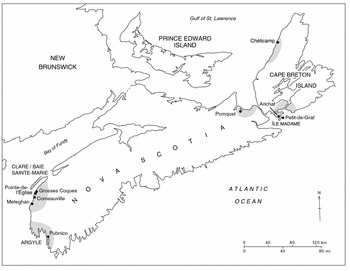
The present data come from two sociolinguistic corpora, the Butler Grosses Coques Sociolinguistic Corpus and the Corpus acadien de la Nouvelle-Écosse. Both corpora comprise recorded interviews from the BSM region, shown in Map 1.
Acadian regions of Nova Scotia.

Baie Sainte-Marie, or the Municipality of Clare, is located on the southwest shores of Nova Scotia and is one of the five main Acadian dialect regions of the province shown in grey. At the time of data collection for these two corpora (early 1990s), the BSM population was majority native-French speaking (71%, pop. 9,655, Statistics Canada, 1991a), while native French speakers made up only 4% of the province's total population (pop. 899,950, Statistics Canada, 1991b).Footnote 17 Therefore, French is the majority language at the local level, but a minority language at the provincial level.
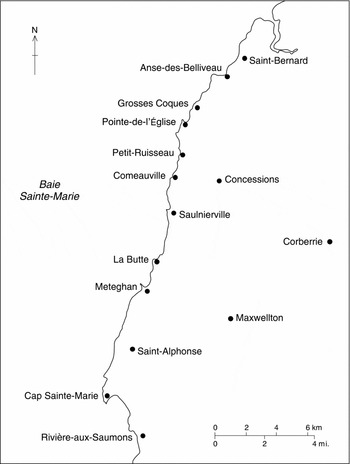
The Butler Grosses Coques Sociolinguistic Corpus was collected in 1990 under the direction of Gary R. Butler. The data are drawn from sociolinguistic interviews conducted by community residents in the village of Grosses Coques, shown in Map 2.
The Baie Sainte-Marie region.

The corpus is composed of interviews with 31 consultants of both sexes and from a wide age range. While no strict sociolinguistic questionnaire was followed, the interviews are focused on the telling of narratives (e.g. personal experience, community narratives, local legends). Some interviews also include conversational data in individual and group settings.
The Corpus acadien de la Nouvelle-Écosse comprises interviews recorded in the five main Acadian regions of Nova Scotia (Argyle, BSM, Chéticamp, Pomquet and Île Madame) and collected under the direction of Karin Flikeid in the mid-1990s. The interviews were conducted by community residents and are similar in nature to the Grosses Coques ones (i.e. narratives are an important component of the interview), but a sociolinguistic questionnaire was sometimes used to elicit conversational and narrative data. While the corpus includes data from other Acadian regions, only those from BSM were retained in this analysis. The BSM data come from consultants born and living in the village of Meteghan, at some remove from Grosses Coques (see Map 2). Data from 11 consultants were retained in the Meteghan sample.
Previous studies of the BSM variety have largely focused on its conservative nature, most certainly in comparison with other varieties of French, but across the Acadian diaspora as well. They often include descriptions of linguistic features lost in most other varieties of French (Acadian or otherwise). For instance, Flikeid (Reference Flikeid, Mougeon and Beniak1994) notes that the southwestern varieties of Nova Scotia French (the BSM and Argyle varieties) retain more conservative features than do varieties spoken in the eastern regions of the province (Chéticamp, Pomquet and Île Madame). She draws this conclusion based on higher rates of point as a negator versus standard pas and higher proportions of first person plural je . . . –ons and third person plural ils . . . –ont (Flikeid, Reference Flikeid, Mougeon and Beniak1994). The conservative nature of this variety is also exemplified by Gesner (Reference Gesner1979) as well as in Comeau, King and Butler's (Reference Comeau, King and Butler2012) study of past temporal reference in which the simple past is shown to be productive, despite being widely regarded as obsolete in most varieties of spoken French. The conservative nature of the BSM variety may result from the fact that the initial settlers of this community (post-Grand Dérangement) were largely composed of settlers who had previously established a settlement at nearby Port-Royal. In contrast, other communities (e.g. Chéticamp, Pomquet, etc.) which show fewer conservative features underwent dialect-mixing unlike the southwest Nova Scotia communities (Flikeid, Reference Flikeid, Mougeon and Beniak1994). Thus, the lack of dialect mixing may have allowed certain conservative features to persist in the southwest Nova Scotia Acadian varieties.
4. THE ENVELOPE OF VARIATION AND POTENTIAL CONDITIONING FACTORS
4.1 Circumscribing the variable context
Earlier studies (Deshaies and Laforge, Reference Deshaies and Laforge1981; Emirkanian and Sankoff, Reference Emirkanian, Sankoff, Lemieux and Cedergren1985; Zimmer, Reference Zimmer1994; Chevalier, Reference Chevalier, Dubois and Boudreau1996) examined variation between the future forms whether they expressed future temporal reference or not. However, more recent studies (King and Nadasdi, Reference King and Nadasdi2003; Grimm, Reference Grimm2010a; Wagner and Sankoff, Reference Wagner and Sankoff2011) adopted the methodology developed by Poplack and Turpin (Reference Poplack and Turpin1999) wherein they refined the variable context by excluding tokens that do not refer to a future outcome. Consequently, in the present study, tokens of the inflected future and the periphrastic future were retained based on whether they unambiguously express future temporal reference.
A number of tokens of the variants were excluded since they do not conform to the envelope of variation:
- habituals, since they do not express a future temporal reference;
(10) Des temps là, j’allons dîner là.
‘Sometimes, we’ll go eat dinner there.’
(Marie, GC-6)
- tokens in which aller is used as a verb of movement (literally ‘to go’) since these are ambiguous between present temporal reference and future temporal reference;
(11) Je vas aller le fermer.
‘I’m going to go close it.’
(Michelle, GC-29)
- reported speech of others;
(12) Elle a dit : « Oh, je vas me larguer su le couch. »
‘She said “Oh, I’m going to lie down on the couch.”’
(Marie, GC-6)
- fixed expressions (e.g. leave-taking expressions);
(13) Bien, tu reviendras, Patrick!
‘Well, come again, Patrick!’
(Evelyn, GC-18)
- tokens with hesitations or false starts;
(14) Parce que [. . .] ils allont patiner de, de quoi/
‘Because [. . .] they will go skating some-, something/’
(Evelyn, GC-13)
A total of 682 tokens of the future temporal reference variable were retained for analysis.
4.2 Potential linguistic factors
A number of potential linguistic factors were operationalized into testable factor groups to determine whether they condition the variable. They were chosen based on the literature on the future temporal reference variable.
4.2.1 Temporal distance
Historically, early grammarians largely accounted for the variable use of the periphrastic future and the inflected future based on temporal distance (Maupas, Reference Maupas1607; Antonini, Reference Antonini1753). However, studies of Laurentian varieties which include this factor group find that it exerts a minor effect (Poplack and Turpin, Reference Poplack and Turpin1999) or none at all (Grimm, Reference Grimm2010a). In contrast, studies of Acadian French (King and Nadasdi, Reference King and Nadasdi2003) have found that this factor group is the best predictor of variant choice.
In order to determine whether temporal distance influences variant choice, each token was coded based on whether the anticipated event was expected to occur within the hour (15), within the day (16), within the week (17), longer than a week (18), and longer than a year (19).
(15) Well, je vas changer la tape de bord.
‘Well, I’m going to change the tape to the other side.’
(Carole, GC-6)
(16) Je vas jouer ça de soir voir quoi ce-que c’est.
‘I’ll play that tonight to see what it is.’ [referring to playing a cassette]
(Carole, GC-23)
(17) À la fin de la semaine, je pourrai mettre mes pipes là.
‘At the end of the week, I’ll be able to put my pipes there.’
(Éric, GC-23)
(18) So mais que ç’arrive à New Year’s, j’aurons des tickets.
‘So when New Year's comes, we’ll have tickets.’
(Francis, M-341)
(19) J’allons rester là quatre, cinq ans puis là j’allons venir back par icitte.
‘We’re going to stay there four, five years and then we’re going to come back here.’
(Carole, GC-23)
The fine-grained temporal divisions established for this factor group were based on King and Nadasdi's breakdown to allow for a comparison of the BSM results with their results. Based on their findings and on early grammarians’ descriptions of the periphrastic future as le futur proche, we would expect that proximate events (i.e. those within the hour following the moment of speech) to favour use of the periphrastic variant.
4.2.2 Adverbial specification
The presence of particular temporal adverbials has also been shown to condition variability between the future forms. For instance, Poplack and Turpin (Reference Poplack and Turpin1999: 152) argue that the association between the futurate present and the presence of specific adverbials helps disambiguate tokens of the futurate present from habitual readings. They also find that non-specific time adverbials favour the inflected future, whereas the absence of adverbials favours the periphrastic future, which they interpret as the default option. They argue that the association of the inflected future with non-specific adverbials highlights the ‘avoidance of this eventuality’ which relates to the hypothetical nature of this variant (Poplack and Turpin, Reference Poplack and Turpin1999: 152). Other studies, which do not include the futurate present, report different findings. For example, Grimm and Nadasdi (Reference Grimm and Nadasdi2011) report that adverbial specification plays no role in conditioning variation in the 1978 Ontario French corpus (Mougeon and Beniak, Reference Mougeon and Beniak1991). However, Grimm (Reference Grimm2010b) reports that adverbial specification does condition variant choice in Hawkesbury (one of the Ontario French communities in the 2005 Ontario French corpus) where the periphrastic future is favoured in the presence of specific and non-specific adverbial specification. King and Nadasdi (Reference King and Nadasdi2003) find that this factor group plays no role in constraining the variable in their data.
Despite the fact that the futurate present tokens were not included in the analysis of the BSM data, each token was coded as to whether there is a specific time adverbial (20), a non-specific time adverbial (21), or no adverbials present (22).
(20) Elle va en avoir un autre à Noël.
‘She's going to have another one at Christmas.’
(Francis, M-341)
(21) Je ferai ça bientôt.
‘I’ll do that later on.’
(Tina, M-295)
(22) Quoi ce-que toi tu vas t’habiller dedans?
‘What are you going to dress up in?’ [for Hallowe’en]
(Anique, M-341)
Since previous studies show mixed results for this factor group, it is unclear how adverbial specification might influence variant choice in BSM Acadian French.
4.2.3 Certainty
Another linguistic factor that has been associated with the future variants is certainty. Poplack and Turpin (Reference Poplack and Turpin1999: 152), following the work of Vet (Reference Vet1993), operationalized this constraint as imminence, that is, ‘a state at which the eventuality is impending’. In light of the fact that temporal distinctions are already assumed in the factor group temporal distance, King and Nadasdi (Reference King and Nadasdi2003) chose to operationalize this constraint based on how certain a speaker is that a given event will take place. Though Poplack and Turpin (Reference Poplack and Turpin1999) did not find imminence to constrain use of the inflected or periphrastic futures (it did, however, constrain use of the futurate present), King and Nadasdi (Reference King and Nadasdi2003) found that an eventuality deemed more likely to occur favours the periphrastic future. However, determining the speaker's degree of certainty presents a methodological problem as this type of information must be gathered from contextual or linguistic evidence, if present. To code for this factor group, I adopted King and Nadasdi's (Reference King and Nadasdi2003) procedure whereby in cases in which the addition of sans aucun doute ‘without any doubt’ to the token rendered it more certain, the token was coded as uncertain. If the event was no more certain with the addition of sans aucun doute, it was coded as certain. This criterion proved useful in instances where the clause in which the token occurred offered no information on the certainty of the outcome, such as when the clause was lacking an adverbial expression like pour sûr ‘for sure’ for certain outcomes and peut-être ‘maybe’ for uncertain outcomes. Examples illustrating the likelihood of an event's realization which was deemed certain is shown in (23), while an event deemed uncertain is shown in (24).
(23) Il va avoir deux ans dans mars.
‘It’ll be two years in March.’ [since the speaker's wife's death]
(Hilaire, GC-35)
(24) Puis c’est supposé qu’elle va avoir un autre présentation à Noël.
‘And supposedly she’ll have another show at Christmas.’
(Francis, M-341)
If BSM Acadian French patterns like other Acadian varieties, we should find that certain events favour the periphrastic future.
4.2.4 Polarity
One of the most widely discussed linguistic constraints on the future variable in studies of Laurentian French is polarity. While early grammarians and commentators do not mention this constraint, sociolinguistic research on Laurentian varieties of French reports a very strong relationship between the inflected future and negative contexts (e.g. Emirkanian and Sankoff, Reference Emirkanian, Sankoff, Lemieux and Cedergren1985; Poplack and Turpin, Reference Poplack and Turpin1999; Grimm and Nadasdi, Reference Grimm and Nadasdi2011). Despite the overwhelming effect in Laurentian French, studies of Acadian French (King and Nadasdi, Reference King and Nadasdi2003) find a lack of effect for this factor group. Here, I included polarity as a potential factor group. Each token was coded as either affirmative (25) or negative (26) polarity.
(25) J’irai dans l’après-midi avec toi.
‘I’ll go in the afternoon with you.’
(Anique, M-341)
(26) Je vas bout point rester par icitte.
‘I probably won't stay around here.’
(Trina, M-295)
If BSM Acadian French patterns like other Acadian varieties, we would expect that polarity does not influence the future temporal reference variable.
5. RESULTS
5.1 Quantitative results
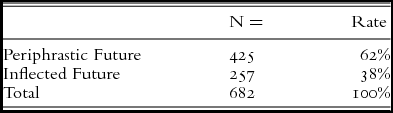
Quantitative analyses were conducted with the statistical program Goldvarb X (Sankoff, Tagliamonte and Smith, Reference Sankoff, Tagliamonte and Smith2005). The overall distribution of the variants for the BSM data is shown in Table 1.
Overall distribution of variants in Baie Sainte-Marie Acadian French.
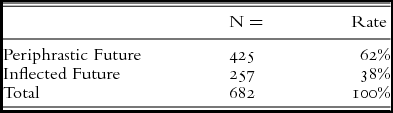
In BSM Acadian French, the rate of the periphrastic future is higher than the inflected future and follows a pattern akin to what has been reported for other Acadian varieties. King and Nadasdi (Reference King and Nadasdi2003) report that the periphrastic future is used at an overall rate of 47%.Footnote 18 In contrast, studies of Laurentian varieties report that the periphrastic future is used at rates ranging from 73% in the Ottawa-Hull region (Poplack and Turpin, Reference Poplack and Turpin1999) to 89% in the Ontario French communities of Cornwall, Hawkesbury, North Bay and Pembroke (Grimm and Nadasdi, Reference Grimm and Nadasdi2011).
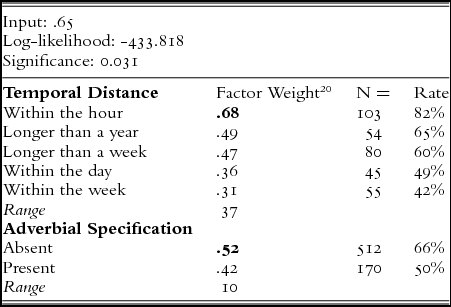
Perhaps more revealing than the overall rates are the results of the multivariate analyses. Table 2 shows the results of the effects of factors on the selection of the periphrastic future.
Multivariate analysis of factors which condition the periphrastic future in Baie Sainte-Marie Acadian French.
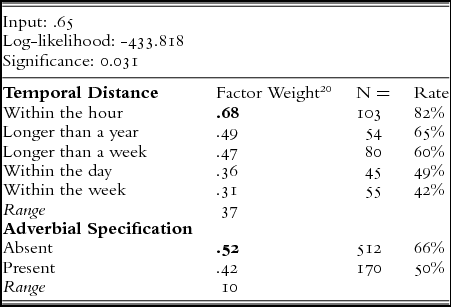
Not selected as significant: Certainty, Polarity.
The factor group exerting the strongest influence on variant choice is temporal distance, with a range of 37, followed by adverbial specification, which exerts a smaller effect based on the smaller range of 10. Within the factor group temporal distance, events anticipated to occur within the hour strongly favour the periphrastic future with a factor weight of 0.68. Events anticipated to occur in more than a week and in more than a year have a neutral effect since the factor weight hovers around the 0.5 mark. Events anticipated to occur within the day and within the week favour the inflected future.Footnote 19
Adverbial specification, which exerts a smaller effect than temporal distance, was also statistically significant. The data was collapsed into presence versus absence of adverbials. The small range of 10 suggests that the effect is minimal. As Poplack and Turpin (Reference Poplack and Turpin1999) found for Ottawa-Hull French, the absence of adverbials favour the periphrastic future in BSM French as well. However, the addition of data for the third variant, the futurate present, would likely elucidate the precise role of this factor group.
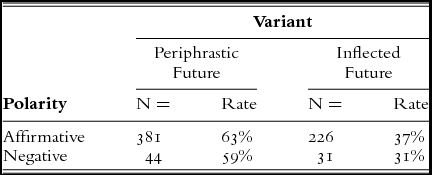
Table 2 also shows that two factors, certainty and polarity, were not retained as statistically significant predictors of variant choice. Unlike all of the Laurentian varieties studied to date, the future temporal reference variable in BSM Acadian French is not conditioned by sentential polarity. Table 3 shows the distribution of the variants in terms of polarity.
The Baie Sainte-Marie variants organized by sentential polarity.
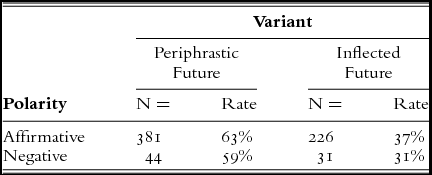
The variants appear at approximately the same rates as they do in the overall data set regardless of the sentential polarity.
5.2 Comparison across Acadian communities
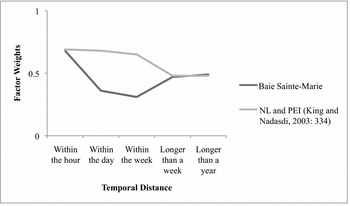
The results presented in Section 5.1 show that, while the BSM variety patterns similarly to other Acadian varieties, there are nevertheless notable differences. The strongest predictor of variant choice, temporal distance, is also the strongest factor group in King and Nadasdi's (Reference King and Nadasdi2003) study of Acadian French spoken in Newfoundland and Labrador and in Prince Edward Island. In both King and Nadasdi's study and the present study, the strongest favouring effect for the periphrastic future is events anticipated to occur within the hour following the moment of speech. That this result is shared across three Acadian communities provides strong evidence that the future variants do express fine-grained temporal distinctions in Acadian French. There are nevertheless differences between the two studies. While King and Nadasdi report a linear correlation between temporal distance and use of the periphrastic future (i.e. the further removed from the speech time, the lower the favouring effect of the periphrastic future), such a correlation is not observed in the BSM data. Figure 1 compares the present study with King and Nadasdi (Reference King and Nadasdi2003).
Temporal distance in Acadian French.

In both BSM and in the Newfoundland and Labrador and Prince Edward Island communities, the periphrastic future is favoured with events anticipated to occur within the hour from the moment of speech. However, the Acadian communities differ for the remaining time periods up to a week following the moment of speech. In BSM, the inflected future is favoured with events anticipated to occur within the day and within the week following the moment of speech, while the inverse was found in the other Acadian communities. At one week following the moment of speech, the effect of this factor group becomes neutral for both BSM and for the other Acadian communities as shown by the factor weights which hover around the 0.5 mark (i.e. a neutral effect). A closer examination of these data (i.e. the data for more than a week following the moment of speech) revealed no discernible pattern.
With regard to the BSM tokens for the within the hour factor, a closer examination shows that most of these are, in fact, imminent (i.e. occurring within a minute of the moment of speech). The within the hour data were recoded as either imminent (i.e. within a minute), as shown in (27), which involves the speaker changing the interview cassette to the other side, or non-imminent (i.e. in more than a minute, but within the hour), as shown in (28), which involves a meal which has been cooking for a while, but is not quite ready at the moment of speech.
(27) Là, j’allons dévirer la tape de bord.
‘OK, we’re going to turn the cassette to the other side.’
(Michelle, GC-29)
(28) Mais ça seye cuit assez pour toi, je le mangerons.
‘When it's cooked enough for you, we’ll eat it.’
(Nicole, GC-18)
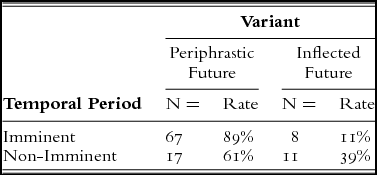
Table 4 presents the rates of variants for the within the hour tokens organised by imminence.
The Baie Sainte-Marie within the hour tokens organized by imminence.
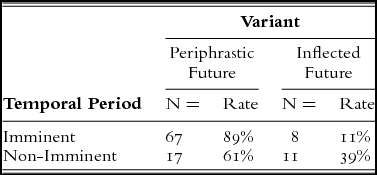
The periphrastic future clearly has a stronghold in the imminent context, accounting for 89% of all imminent tokens, which is a statistically significant difference (χ2 (df = 1) = 11.1; p = 0.001). It is only with non-imminent events that the inflected future gains some ground, increasing from 11% of imminent events to 39% of non-imminent events. This finding suggests that the BSM periphrastic future does not function primarily as a proximate marker of future eventualities (i.e. a futur proche) as in other varieties of Acadian French, but rather marks imminence.
Based on this finding, we might ask why the BSM data pattern on imminence rather than general proximity, as was found in King and Nadasdi's study. As noted in Section 2.2, the periphrastic future originated as a construction expressing spatial movement prior to its grammaticalization as a future marker. However, following the initial stages of grammaticalization, it came to be used with a range of functions. Two functions which have been argued to be associated with go-futures are imminence and proximity (Flydal, Reference Flydal1943; Heine, Claudi and Hünnemeyer, Reference Heine, Claudi and Hünnemeyer1991), with the former preceding the latter in terms of stages of grammaticalization. In Acadian French, where the inflected future still holds considerable ground in the expression of future temporal reference, it may be that the periphrastic future is less grammaticalized than in varieties (e.g. Laurentian French) in which the inflected future has nearly been ousted by the periphrastic future. In addition, if imminence is indeed an earlier stage along the path of grammaticalization (before proximity and before becoming a generalised future marker), then BSM Acadian French is even more conservative than the varieties studied by King and Nadasdi. It may be that in Prince Edward Island and in Newfoundland and Labrador, the periphrastic future is also favoured in imminent contexts. However, in those communities the periphrastic future continues to be favoured with events anticipated to occur within the day and within the week, suggesting it functions as a marker of proximity rather than uniquely imminence. The fact that BSM is conservative (even in comparison with other varieties of Acadian French) with regard to the future temporal reference variable is in line with other studies (Gesner, Reference Gesner1979; Comeau, Reference Comeau2011; Comeau, King and Butler, Reference Comeau, King and Butler2012) which report the highly conservative nature of this variety.
5.3 Comparison across varieties of French
Let us consider the varieties spoken in France as well. Roberts (Reference Roberts2010), using data from the Beeching corpus for Brittany, Lot, Minervois and Paris, shows that temporal distance is not a statistically significant factor group constraining variant choice, while polarity is the most significant factor group, as observed in Laurentian French. This finding lends support to the notion that the polarity constraint, while absent from European grammarians, may have originated in France prior to the settlement of New France. Roberts likewise found that temporal distance did not condition the variable. Thus, if temporal distance ever did condition the future variable in European French, it may have been neutralized in contemporary varieties.
Roberts (Reference Roberts2012) further examined this variable in Martinique French and found that temporal distance is the only significant linguistic factor group governing use of the variants and polarity is not a significant factor group; a surprising result in that it reveals a system quite similar to the one found in Acadian French. This finding opens new questions as to the origins of temporal distance and polarity as the two main factor groups for this variable in contemporary spoken French.
Thus far, there have only been studies of the future temporal reference system in Acadian varieties which have had limited contact with outside varieties of French (i.e. the varieties studied by King and Nadasdi and the BSM variety).Footnote 21 We could ask whether we might find the polarity effect in other Acadian communities. While some conservative linguistic features of BSM Acadian French are found in other Acadian communities, they have not persisted everywhere across the Acadian diaspora. For instance, the traditional first person plural je . . . –ons conjugation has been lost in northeast New Brunswick (Beaulieu and Cichocki, Reference Beaulieu and Cichocki2008). Thus, exposure to normative French or contact with external varieties of French may create the impetus to lose some traditional features (je . . . –ons) in favour of variants found in other varieties of French (or at greater rates in other varieties). Therefore, it may also be the case that the polarity constraint is found in varieties of Acadian French which have had considerable contact with external varieties of French. While there remains to be comparable studies of this variable for the Acadian French spoken in New Brunswick, Chevalier's (Reference Chevalier, Dubois and Boudreau1996) study of the future forms suggests that some varieties of New Brunswick Acadian French may show use of the polarity constraint. If this is the case, the contrasting results within the Acadian diaspora might reveal important consequences of contact with external varieties of French. While such contact may lead varieties to lose traditional features, they may also gain some, including constraints of external varieties. While an analysis of the origins of the polarity constraint is beyond the scope of this paper, this is certainly an area which merits further research: what can account for the fact that the polarity constraint is operative in some varieties (e.g. Laurentian and European), but not in others (e.g. Acadian and Martinique)? Was the polarity constraint operative in pre-settlement varieties of Laurentian and Acadian French? Are there linguistic explanations to account for the polarity constraint? Future research may offer answers to these questions and provide an account which better explains its role in constraining future temporal reference.
6. DISCUSSION
Upon initial inspection, the future temporal reference variable may not seem to be a particularly interesting variable considering that the same variants are used across all varieties of spoken French studied to date. However, a fine-grained analysis of the constraints governing the use of the variants reveals striking differences with regard to the underlying grammatical systems across varieties of French. While some researchers have suggested the eventual decline of the inflected future in spoken French, the Acadian data provide a sharp contrast to this interpretation since rates of the inflected future are generally higher than in Laurentian varieties.
Beyond rates of the variants, the multivariate analyses revealed an underlying system distinct from other varieties of French. While the polarity constraint persists in many spoken varieties of French (Laurentian and European), the BSM results confirmed King and Nadasdi's findings that conservative varieties of Acadian French show a clear lack of the polarity constraint. In addition, the factor group which best predicts variant choice in BSM, like in other Acadian varieties, is temporal distance. The temporal distance result mirrors closely how early and contemporary grammarians characterized use of the variants. While a highly unlikely scenario is that Acadians overtly learned this constraint, this finding is best interpreted in that early grammarians identified an actual, spoken-language constraint. While grammarians continue to argue that the use of the variants is based on temporal distance, even in varieties that have lost this constraint, varieties of Acadian French robustly retain this constraint.
The results of the comparative analysis also shed light on the process of grammaticalization and of the particular paths of variants. While King and Nadasdi (Reference King and Nadasdi2003) report that the periphrastic future is associated with a proximity reading, the periphrastic future in BSM appears not to denote general proximity, but rather imminence. The literature on the grammaticalization of go-futures predicts that, as these constructions undergo grammaticalization, an initial stage of imminence will be followed by a proximity function. Thus, the fact that BSM Acadian French makes use of the periphrastic future to express imminence suggests that this variety is even more conservative than other varieties of Acadian French, which is in line with other studies that have shown that the BSM variety is highly conservative. The results likewise show that, as forms grammaticalize, they may retain vestiges of their earlier functions related to earlier stages of grammaticalization (e.g. imminence in BSM Acadian French) or they may completely neutralize these functions in later stages (e.g. temporal distance in some varieties of Laurentian French).
The study of the expression of future temporal reference also sheds light on the history of this variable in the French language more generally. Acadian French allows us to peer into earlier stages of the language since changes which have taken place in other varieties have not taken place in Acadian French (and may never do so). Comparisons across French varieties (i.e. Acadian, Laurentian, European, Martinique, etc.) allow us to better understand broader issues involving language change, language contact and the effects of isolation from external varieties.