Introduction
Worldwide, unintended pregnancies represent an estimated two-fifths of all pregnancies annually. In 2014, 85 million pregnancies, out of the 213 million recorded globally, were experienced by women with a desire to avoid childbearing. Of these, half ended in induced abortion (Sedgh et al., Reference Sedgh, Singh and Hussain2014). The rate of unintended pregnancies is substantially higher in developing regions of the world (Bearak et al., Reference Bearak, Popinchalk, Alkema and Sedgh2014). In many developing countries, due to legislative, social and cultural barriers, women resort to abortions clandestinely and unsafely (Bearak et al., Reference Bearak, Popinchalk, Alkema and Sedgh2014). When this occurs, potentially fatal complications may ensue. The degree to which abortion complications contribute to maternal mortality varies across regions: although it accounted for 8% of maternal mortality internationally (Say et al., Reference Say, Chou, Gemmill, Tunçalp, Moller and Daniels2014), one study from East Africa suggested that it accounted for 18% of maternal deaths in that region (WHO, 2008; Shah & Ahman, Reference Shah and Ahman2010; Åhman & Shah, Reference Åhman and Shah2011).
Post-abortion care (PAC) is a service package that integrates treatment for abortion complications, including evacuating the uterus of retained products of conception, family planning (FP) counselling and, if desired, access to contraceptive methods (Turner & Corbett, Reference Turner and Corbett2003). Integrating voluntary family planning (FP) services with emergency treatment is critical to the effectiveness of PAC: PAC clients are sexually active and do not use, or ineffectively use, contraception. They are no longer pregnant and often wish to avoid childbearing. They are unlikely to return to the facility for a follow-up visit, are at risk of repeat abortion, and, according to global recommendations, should delay pregnancy for at least 6 months (Conde-Agudelo et al., Reference Conde-Agudelo, Rosas-Bermudez and Kafury-Goeta2006; International Federation of Gynecology and Obstetrics et al., 2009). Moreover, they are eligible to receive a variety of contraceptive methods and are present in facilities that usually offer them (Bednarek et al., Reference Bednarek, Creinin, Reeves, Cwiak, Espey and Jensen2011; Barros Pereira et al., Reference Barros Pereira, Carvalho and Graca2015).
Operational research has identified effective ways to promote contraceptive uptake during PAC (Huntington & Piet-Pelon, Reference Huntington and Piet-Pelon1999; Savelieva et al., Reference Savelieva, Pile, Sacci and Loganathan2003; USAID, 2011; Tripney et al., Reference Tripney, Kwan and Bird2013). Nevertheless, weaknesses in PAC programmes in low- and middle-income countries continue to impede contraceptive uptake (Shah et al., Reference Shah, Santhya and Cleland2015; Huber, Reference Huber2019). Using data from Demographic and Health Survey (DHS) calendar data for India, Zavier and Padmadas (Reference Zavier and Padmadas2012) found that 30% of women used any method after abortion. Whereas results of special projects demonstrate promise, the multitude of interventions packaged in their approaches may impede their diffusion and effectiveness in ‘real world’ settings (Banerjee et al., Reference Banerjee, Gulati, Andersen, Acre, Warvadekar and Navin2015). Adding to this challenge, few studies have sought to understand PAC clients’ fertility preferences and contraceptive decision-making (McDougall et al., Reference McDougall, Fetters, Clark and Rathavy2009; McCarraher et al., Reference McCarraher, Chen-Mok, Oronoz, Brito-Anderson, Grey, Tucker and Bailey2010; Pearson et al., Reference Pearson, Kanti, Andersen, Moreau, Surkan and Decker2017).
The purpose of this paper was to address this knowledge gap. The study drew upon findings from mixed-method research on post-abortion FP in public sector facilities of Tanzania. Its objectives were to: (1) delineate the characteristics of PAC clients and their demand for FP, (2) explain the factors that influence their fertility desires and contraceptive decision-making and (3) identify programmatic elements that public sector PAC in Tanzania does and does not adequately address.
Methods
Setting, participants and data collection
The study took place between April and July 2016 in public sector facilities in Mwanza, Geita and Zanzibar regions of Tanzania. Mwanza and Geita both border Lake Victoria in mainland Tanzania, and Zanzibar comprises of Unguja and Pemba Islands, located off the coast of the mainland in the Indian Ocean. The purpose of the study was to inform the design and evaluation of efforts to strengthen the quality and utilization of post-abortion FP. These efforts were led by the Ministries of Health of mainland Tanzania and Zanzibar, respectively, in collaboration with the Post-abortion Care Family Planning Project that is led by EngenderHealth – an international sexual and reproductive health non-governmental organization. For the data presented in this paper, study participants included PAC clients. Data collection comprised of a quantitative client exit interview and qualitative in-depth interviews (IDIs), administered following participants’ discharge from PAC. The selection of sites was based on 2015–16 data on PAC service utilization in these regions. Facilities that had recorded treating at least four PAC clients per month during this period were considered eligible for the study. In the end, the study recruited PAC clients at two regional referral hospitals, eight district hospitals and seven health centres in Mwanza and Geita, and one regional referral hospital, three district hospitals and four health centres in Zanzibar. During this time, cross-sectional data were obtained on these facilities’ preparedness to offer PAC, including post-abortion FP, which revealed that all facilities had adequate stock of short-acting contraceptive methods (SAMs) and in 23 of these facilities, SAMs were kept in PAC provision settings. Ninteeen of the sites had adequate stock of long-acting reversible contraceptive methods (LARCs) and in six of them, LARCs were kept in PAC provision settings. No facility reported a stock-out of SAMs or LARCs in the previous three months.
Sampling
The number of clients recruited at each facility was determined based on calculations of the sample size required to evaluate differences in PAC contraceptive uptake before and after the above-described quality improvement intervention that was to be carried out in study facilities by the Ministries of Health of mainland Tanzania and Zanzibar in collaboration with EngenderHealth (Baynes et al., Reference Baynes, Yegon, Lusiola, Kahando, Ngadaya and Kahwa2019b). While in the care of a facility, a staff member caring for clients assessed them to determine if their physical and emotional state was suitable for research participation. Those deemed eligible were then asked if they would like to participate in the study. Women who agreed were interviewed within 30 minutes of their discharge from care. Interviews were carried out in a private location in, or adjacent to, the facility. In the end, 228 PAC clients in seventeen sites in Mwanza and Geita and 184 in eight sites in Zanzibar – a total of 412 women – were enrolled in exit interviews. Thirty-three of these participants participated in qualitative IDIs. Interviewers that conducted the exit interview sampled roughly one in every fifteen PAC clients for enrolment in IDIs. During enrolment, interviewers ensured that equal numbers of women aged 18–29 years and 30 years and above, and at regional hospitals and lower-level facilities, participated in IDIs.
Study instruments and analysis
The exit interview addressed clients’ socio-demographic characteristics; family planning use and fertility intentions; recognition of complications and care seeking; recall of counselling; post-abortion contraceptive use; and satisfaction with PAC. During data collection, data collectors recorded participants’ responses to survey questions on tablet software and transferred them to a private server, where study staff accessed the data for real-time review of data quality. After data collection, study staff cleaned and migrated data into Stata 14 software for analysis.
The IDI followed an open-ended guide that emphasized clients’ recognition of complications and care seeking, experiences receiving PAC, current pregnancy intentions and post-abortion contraceptive decision-making. Data collectors digitally recorded the IDIs and transcribed them into Swahili. A field supervisor reviewed the digital recordings and transcripts, and those deemed of sufficient quality were translated into English, and entered into QSR Nvivo-Pro for analysis. Three IDIs could not be used for analysis because of difficulty interpreting audio-recordings, and the authors carried out analysis of 30 of the 33 IDI transcripts obtained during data collection.
To address the first study objective, quantitative data from the exit interview were analysed employing basic univariate analysis to delineate the socio-demographic profile of PAC clients, features of their care seeking and treatment experiences, their childbearing preferences and uptake of contraception. Further analysis of the data on participants’ pregnancy interventions and contraceptive uptake during PAC was carried out in order to obtain the proportion of demand for contraception that was satisfied clients’ encounter with staff at the facility. To understand the influences on post-abortion contraceptive use, a dummy variable was derived as the outcome variable of modern contraceptive uptake, and Fisher’s exact tests conducted to detect associations between independent variables drawn from other surveys and the study outcome. Variables that demonstrated a significant relationship with the outcome (α=0.05, 95% confidence interval (CI)) were analysed in multivariate tests, which employed robust standard errors to account for clustering by facility. In multivariate tests, an additive procedure was used to minimize the number of variables, avoid collinearity and maximize the accuracy of the model.
To analyse the IDIs, social ecological theory was employed (Stokols, Reference Stokols1992), which conjectures that individuals are nested within multiple contextual domains, which influence them, their preferences and behaviours at different levels. The cognitive social model of fertility was drawn upon (Bachrach & Morgan, Reference Bachrach and Morgan2013), which explains (un)met need for contraception, i.e. the prevalence of non-use of contraception among women reporting a desire to space or limit future pregnancy (Bradley & Casterline Reference Bradley and Casterline2014), as the result of distinct cognitive and social processes. During analysis, ‘framework analysis’ (Srivastava & Thomson, Reference Srivastava and Thomson2009) was used to identify analytical categories based on what clients reported about their post-abortion childbearing preferences, prior experiences and feelings about contraception, and contraceptive decision-making in the context of PAC. A codebook was then developed and a more in-depth analysis of the data conducted, with research assistants being trained to code data using QSR-Nvivo software. After coding was completed, inter-rater reliability assessments were carried out, which found that the level of agreement in use of all codes was high, 93%. After this, coded segments of data were re-arranged, again, to display and validate the coherency of the understanding of PAC clients’ childbearing preferences and contraceptive behaviours based on the data.
Results
Quantitative findings
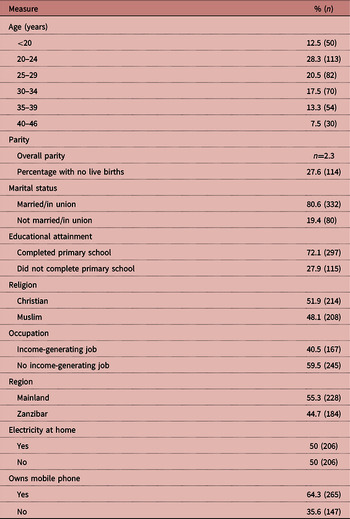
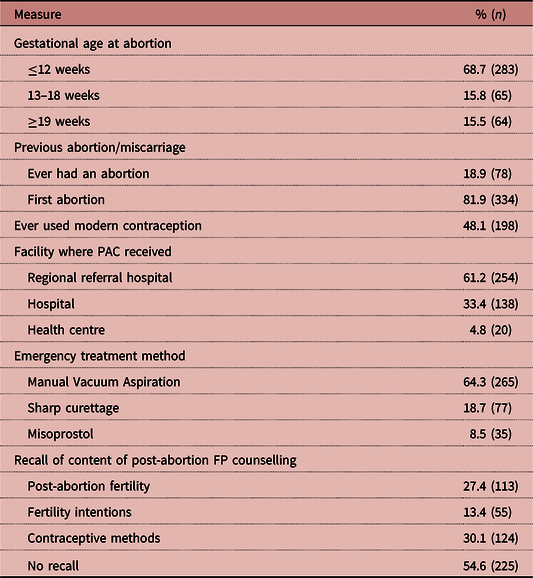
A total of 412 women participated in the exit interview following their receipt of PAC. The distributions of the sample women by socio-demographic characteristics and their reproductive health, care seeking and PAC service characteristics are shown in Tables 1 and 2.
Socio-demographic characteristics of study participants, N=412

Reproductive health, care seeking and PAC service use characteristics, N=412

Patterns of post-abortion fertility desires and contraceptive use
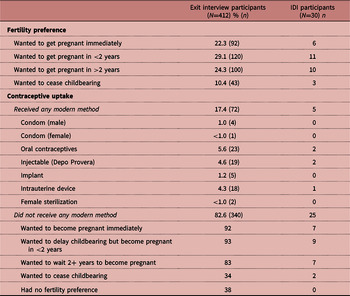
Table 3 presents the findings from survey questions on participants’ childbearing intentions and acceptance of modern contraception during PAC. One-hundred and twenty-four (30.1%) recalled receiving counselling on post-abortion FP and contraceptive methods; 63.8% (n=263) of those who participated in the survey reported a desire to space or limit childbearing. Of the other 36.2% (n=149), 61.7% (n=92) reported that they wanted to become pregnant immediately and 38.3% (n=57) maintained they had no desire for contraception. Of those who desired to delay childbearing for less than 2 years (n=120) and more than 2 years (n=100), 22.5% (n=27) and 17% (n=17), respectively, received a modern contraceptive. Among those who desired to cease childbearing completely (n=43), 20.9% (n=9) received a modern method. Of the 149 participants who reported no demand for FP after PAC, 12.8% (n=19) received a modern method. Altogether, the unmet need for contraception among survey participants who desired to delay or cease childbearing after PAC was 79.8% (n=210).
Post-abortion fertility preferences and contraceptive uptake, N=412

Determinants of post-abortion contraceptive use
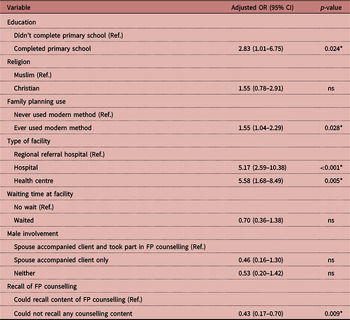
Table 4 shows the results of the multivariate analysis for associations between post-abortion FP uptake and the selected variables. Educational attainment, prior FP use, type of facility utilized, and recall of FP counselling were significantly associated with post-abortion FP uptake. The odds of accepting a modern FP method after receiving treatment for complications arising from abortion were greater among women who completed primary school (OR=2.83, p=0.024), had ever used modern contraception (OR=2.15, p=0.028) and received PAC in a district hospital (OR=5.17, p<0.001) or health centre (OR=5.58, p=0.01) relative to regional referral hospitals. However the odds of accepting a modern FP method after receiving treatment for abortion complications were less among women who could not recall any content from the FP counselling received (OR=0.41, p=0.009).
Key determinants associated with post-abortion contraceptive uptake (multivariate)

* Significant as p<0.05; ns, not significant.
Qualitative findings
The qualitative analysis revealed different layers of contextual influences that shaped women’s fertility desires and contraceptive behaviour after PAC: individual (PAC client), spousal/partner-related, health service-related and societal.
Individual influences
Pregnancy intentions
Family composition (number, age and sex of living children), as well as the wish to space births, shaped participants’ attitudes and desires about childbearing after PAC.
I would like to have four children because I believe I can manage to raise them. I had a miscarriage for this pregnancy but I love giving birth, but in a plan. I have two children, one is 8 years old and second one is 4 years old. After this, I need two, a boy and a girl. I think I should rest for one year. (Age 26, Geita Hospital, Geita)
Participants frequently expressed concerns about their health after PAC, and feeling exhaustion from consecutive childbearing and managing a large family.
I need to rest first, at least after two or three years, because when I delivered my last born who is one year and ten months, I conceived when he was four months… the pregnancy I told you before… and now I came with this one that I aborted again. (Age 25, Mnazi Moja, Zanzibar)
Several IDI participants demonstrated fatalistic beliefs about childbearing. According to one participant:
…that is why I told you that [having children] is God’s plan. You can plan but it wouldn’t materialize. (Age 28, Chake Chake Hospital, Zanzibar)
However, other participants (multigravida women, who were generally older) frequently maintained that they could manage their fertility themselves. One reported:
I don’t want more children, I will go back home and live healthily. I will come back for the service according to the directives…I need to have permanent contraception. (Age 36, Nansio Hospital, Mwanza)
Contraceptive use
Women reported fears about side-effects of post-abortion contraception. These were most prevalent among younger participants, who expressed worries about the fertility consequences of FP use after abortion. One participant reported:
…[contraceptives] are harmful. Trying [them] is not good, as I have been bleeding already. I want to be free, I want to have babies. (Age 21, Wete Hospital, Zanzibar)
Among women who had used FP in the past, negative experiences with contraception seemed to condition their decision against accepting post-abortion contraception.
I used pills after my first child, but I was having a lot of vaginal discharge. I went to the clinic where they advised me to stop because I [was] breastfeeding. Then I stopped. After stopping, I got pregnant with my third baby. So, after having the third born, I decided to change to injection. However, I was not having my menstrual period due to the injection and I had abdominal pain. I went to the hospital and they advised me to change methods. My friend advised me to use calendar [method]. The calendar was a challenge, and I found myself pregnant. (Age 28, Mnazi Moja Hospital, Zanzibar)
Other clients described how knowledge about methods helped them to act on their childbearing desires and accept a method from their PAC provider. According to one woman:
Because I am expecting to get another pregnancy in one year to come, I didn’t want to use a long term method. I chose Depo Provera injection because it matches with my timing. I could not opt for a long-term method like loops, which, I am told, protect against pregnancy for at least three years. That would have been inconvenient to me. (Age 32, Nyamagana Hospital, Mwanza)
One older woman expanded on why she chose a long-acting method:
Those are quite good to use because you are safer, happier, no concern about using FP all the time as you will rest for ten years if you have used those long term methods that last for ten years. Long term are very good for now because I can rest now until I am near menopause; or if you are 24–25 years you can rest until you are 35 years, give your body enough time to recover before having another baby. (Age 38, Nansio Hospital, Mwanza)
Frequently, participants who had used SAMs expressed an underlying desire for a long-acting method.
On long term ones, I have never used them. I would like to start. Before, I was trying to plan to use the calendar [method] and pills for a gap of 3 years, 2.5 years. Do you see that? If I really do my best it is three years. (Age 34, Nyamagana Hospital, Mwanza)
Spousal/partner influences
Pregnancy intentions
For many participants, expressing a fertility preference required consultation with their husbands.
I will speak to my husband; he is the one with all the decisions. Even when difficult things happen, he is the one who is the first to know. If you don’t share with him, then things go bad to the point of being unbearable. (Age 29, Geita Hospital, Geita)
Participants varied in terms of their attitudes concerning spousal communication about FP. Women who expressed confidence tended to be older, have more than two children and desire to cease childbearing. According to one participant who already has six children:
I need to have permanent contraception. There is … my husband, my family, but they cannot decide for me. (Age 39, Nansio Hospital, Mwanza)
Some participants felt pressure to conceive, especially after abortion, in order to avoid marital strife.
I wanted to rest but if you do not know that you can carry children again then you have problems at the house, your husband might have children with [another woman]. [My son] is not even a year and I aborted again. (Age 24, Chake Chake Hospital, Zanzibar)
Unmarried participants emphasized the pressure they feel to avoid pregnancy out of wedlock. One respondent reported:
Many people advised me, your child is just 1 year old so it is better you abort. I told them I could not do such a thing because I might even lose my life. That is when they told me, [that I had] to leave this house. And so I decided to share it with the man who impregnated me, I told him what my sister said, that I have to leave the house. The man ran away from me when I was three month pregnant. (Age 20, Sekou Toure Hospital, Mwanza)
Contraceptive use
Women’s contraceptive use after abortion, in most cases, was predicated upon concurrence with a spouse or partner.
They told me about FP, I told them that my husband is not around. I talk[ed] to my husband today about when he is coming back. He asked me if my condition is bad. I told him I am ok, he should not come today. So I will come back with my husband. (Age 29, Mnazi Moja)
Women who rely on traditional methods reported their spouses’ lack of cooperation:
Yes… I mixed [the calendar method] up, but is because my husband is a watchman at night. Most of the time [he] is not at home at night; only one day is [he] at home, Saturday. When he is around there is a big misunderstanding if you tell him today is a dangerous day he tells you I will ejaculate outside, but then he doesn’t do it. I found myself conceiving in such scenarios. (Age 27, Geita Hospital, Geita)
Women commonly reported that contraceptive use begets discord with their spouse.
I have used other methods but they are harmful to me. I started using the injection for a year. I was bleeding much like a woman in labour. This brought misunderstanding with my husband. Tablets did not disturb me, but I have stopped because this brought again misunderstanding with my husband. Then I became pregnant with this [pregnancy]. (Age 34, Nansio Hospital, Mwanza)
Women without spouses or partners feared the long-term effect of contraceptive use on future fertility.
It is said that you cannot get any children once you have used those, or you can give birth to an unhealthy child or they can be harmful to your body. I will start to use [contraception] after I have had my children… not for now. (PAC client, age 20, Sekou Toure Hospital, Mwanza)
Health service-related influences
Pregnancy intentions
Although participants acknowledged that they should delay childbearing for 6 months after abortion, none could accurately report when their fertility would resume.
[The providers] told me within six months if I conceive, I will get miscarriage. In the coming six month I better use FP otherwise if I conceive it will abort again. I have understood them Inshallah, but I have never used FP. (Age 31, Mnazi Moja Hospital, Zanzibar)
Participants’ recollection of counselling suggests that PAC providers were remiss in explaining post-abortion fertility with clients, facilitating discussion on clients’ preferences about the timing of future childbearing, and providing contraception-related decision support accordingly.
Contraceptive use
Frequently, clients desired to learn more about FP methods than what providers emphasized during PAC. According to one client:
…there was nothing on [FP methods]. I have used pills and injection. I got problems and I wish to know what more methods I should use now. (Age 28, Nyamagana Hospital, Mwanza)
On occasion, providers denied FP services to clients because clients’ partners were not on-hand.
I wished [health care providers] advised me about injection and pills and which is best. But, they told me if your husband was here we could give you one right here, but because he is not around they told me to wait, that I should not start taking FP drugs now. (Age 23, Wete Hospital, Zanzibar)
In other instances, clients described that, even after they had asked for a method, information was not forthcoming on methods of choice. One client explained:
I wish to know if you are supposed to be investigated before getting the injection. I also wish to know how to take those pills…They did not [give me information]. They told me at any government hospital I can get [contraception], even in Bwelo, where I am come from. (Age 25, Mnazi Moja, Zanzibar)
On occasion, clients described constraints to method choice:
I have been told to take an option, tablets. She has instructed me very well, I understood that tablets would be suitable for me. (Age 34, Nyamagana Hospital, Mwanza)
Societal influences
Pregnancy intentions
Participants’ narratives reflected the enduring influence of traditional religion on their attitudes about fertility, even in the context of PAC. One participant stated:
I would have even 100 [more children], if God gives me, let him give me. (Age 24, Chake Chake Hospital, Zanzibar)
Gender norms in the context of marriage affected women’s sense of autonomy over their future fertility. One participant commented:
When I was young, I planned to have six kids, but now I have six so I don’t know how it will be. As long as I have a husband, I don’t know how many children I will get. (Age 36, Mnazi Moja Hospital, Zanzibar)
Contraceptive use
Peer influences shaped women’s attitudes toward contraception. These, at times, encouraged women to choose and receive a method.
I heard about FP for child spacing. I heard people use implants, some injections, some calendar. I would love the one without any problem. If I use implants and it causes some problems, I will just go and remove it, and try another method. Others say it has no problems; even my sister is using it without any problem. (Age 24, Mnazi Moja, Unguja/Zanzibar)
On other occasions, rumours perpetuated misconceptions about side-effects. One participant remarked:
When you hear what people say about them, I mean people who have used them. They say that they are not good… Implants, people say, get lost in the body meaning that when you want to remove it is not in the area where it was inserted. (Age 24, Nyamagana Hospital, Mwanza)
According to another participant:
I don’t want [contraception]. Only God plans for kids. [Your spouse] can ejaculate inside you and you don’t conceive, and sometimes [he] tries only one time and she conceives. We don’t have a choice. (Age 35, Wete Hospital, Pemba/Zanzibar)
Discussion
This analysis in Tanzania demonstrates that women’s desire to space or limit childbearing immediately after receipt of post-abortion care poorly predicts whether they receive a contraceptive method at that same time. Of the 263 women in the study sample that expressed a desire for spacing or limiting, only 53 (20.2%) were discharged from PAC with modern contraception, while 210 (79.8%) were discharged with an unmet need. The qualitative findings help explain this, elucidating factors influencing women at multiple levels. These factors overlap, at times reinforcing each other, while at other time contradicting each other, fomenting a complex context in which women formulate and act upon fertility intentions.
Women in this study based their childbearing preferences on perceptions of the ideal family size and their health risk. Their reported sense of agency to assert pregnancy intentions, however, varied considerably. A study from Kenya reported associations between self-efficacy and other factors related to women’s autonomy and contraceptive use (Wegs et al., Reference Wegs, Creanga, Galavotti and Wamalwa2016). As highlighted in the literature on gender and contraception use in traditional societies, the broader social dimensions of pregnancy loss in this study population elevate pressures on women to demonstrate fecundity, subservience to their spouses’ sexual and childbearing demands, and allegiance to the pronatalist interpretations of religion – a reflection of their ability to be a good wife (Adongo et al., Reference Adongo, Phillips, Kajihara, Fayorsey, Debpuur and Binka1997). This study found exceptions to this, mostly among women who were older and at advanced stages of parity, who were confident that they had conformed to childbearing expectations. Unmarried study women reported facing contradictory pressures: first to resort to unsafe abortion to avert the social impropriety of pregnancy out of wedlock, and second, to forego contraceptive uptake during PAC based on the misconception that it would harm their chances of becoming pregnant in the future. The confluence of individual perceptions of risk and stigma rendered women doubly vulnerable – first to the abortion complications that made PAC necessary in the first place, and repeat abortion that could give rise to such complications in the future.
Although study PAC clients were aware that they should use FP, counselling fell short of imparting an accurate understanding of when this should start. Indeed, only a quarter of exit interview participants recalled any discussion of post-abortion fertility, and none could correctly recall when they would resume fecundity after PAC. After abortion, fertility can resume within 7–10 days and, furthermore, research has indicated that delaying the next pregnancy for at least 6 months after abortion reduces the incidence of pre-term delivery, low birth weight, premature rupture of membranes and maternal anaemia. It follows that PAC providers should particularly stress the timing of clients’ return to fertility during counselling. Although previous studies have demonstrated that effective counselling can increase post-abortion contraceptive uptake (Huber et al., Reference Huber, Curtis, Irani, Pappa and Arrington2016), evidence on the outcomes of emphasizing fertility intentions during family planning counselling is inconclusive (Henning et al., Reference Henning, Burgess, Jones and Norman2017).
The study findings suggest that women in Ghana perceive pregnancy as a matter of contingency. While they reported post-abortion fertility preferences, their narratives conveyed how they were affected by overlapping and exogenous factors, which were identified as spousal, health service and societal contexts. The interplay between them shapes women’s attitudes towards childbearing and how they assert them in their personal, familial, care-seeking and social spheres (Rusibamayila et al., Reference Rusibamayila, Phillips, Kalollela, Jackson and Baynes2017). The various and, at times, incongruous contextual influences on fertility intentions, observed among the PAC clients in this study, appears in the wider literature on FP in sub-Saharan Africa (Johnson-Hanks, Reference Johnson-Hanks2004). This suggests the relevance of structural interventions (i.e. interventions that empower women in negotiations about household decision-making, sexual relations, contraceptive use, control over economic assets, and autonomy in health care seeking) to elevate women’s ability to adopt fertility preferences that withstand shifts between the contexts of spousal, social and health-service-related relationships (Wegs et al., Reference Wegs, Creanga, Galavotti and Wamalwa2016).
Post-abortion care provides a setting where women present with evident needs to regulate their fertility and where there are health care workers trained and equipped to help them. The counselling requirements for addressing these needs are well documented in clinical and reproductive health literature, as are post-abortion contraceptive eligibility criteria (Johnson et al., Reference Johnson, Ndhlovu, Farr and Chipato2002; Turner & Corbett, Reference Turner and Corbett2003; Huber et al., Reference Huber, Curtis, Irani, Pappa and Arrington2016). Yet, in this research, as in others’, women’s needs for information and services were found to be mostly unfulfilled (Curtis et al., Reference Curtis, Huber and Moss2005). The quantitative analysis demonstrated that higher education attainment, prior experience with contraceptive methods and utilization of lower-level facilities for PAC were associated with higher odds of contraceptive uptake during PAC. Nevertheless, PAC provision, particularly counselling, requires strengthening so that clients can assert their desires and make fully informed, voluntary decisions consistent with them, regardless of education, experience with contraception, and where they access care. Although addressing this may require insights from providers on supply-side factors that influence post-abortion FP, voices of clients offer critical insights. Higher uptake of post-abortion contraception among clients at primary- and intermediate-level facilities has been observed in studies carried out in other countries in sub-Saharan Africa (Alemayehu et al., Reference Alemayehu, Otsea, Gebremikael, Dagnew, Healy and Benson2009). According to investigations into this finding in Tanzania, health centres and dispensaries, relative to hospitals, receive fewer clients, which gives providers more time to counsel women on fertility awareness and contraceptive methods, and such lower level facilities, because they are smaller, rarely require complex internal referrals for women who desire contraceptive during their PAC visit (Baynes et al., Reference Baynes, Kahwa, Lusiola, Mwanga, Bantambya, Ngosso and Hiza2019a).
Post-abortion care clients harbour conflicted stances towards contraception (Aniteye & Mayhew, Reference Aniteye and Mayhew2011; Evens et al., Reference Evens, Otieno-Masaba, Eichleay, Mcarraher, Hainsworth and Lane2014). Women who recognize the need to space births may elect to do so, but mostly via traditional methods, fearing harmful consequences from using modern contraception after abortion complications. At times, these misconceptions are rooted in lived experiences with side-effects, while at others in rumours or myths. Yet, clients also reported difficulty with natural fertility regulation, owing to a lack of knowledge on the technique and lack of autonomy over the timing of sexual intercourse. Nevertheless, women who had ever effectively practised fertility regulation were more likely to resume use after abortion.
Contraceptive decision-making after PAC, however, takes place in the wider and fluid context of women’s familial, social and societal relationships. The findings of this study illuminate how imbalances in negotiating power between women and their sexual partners not only shape women’s childbearing intentions and FP practices, but moreover permeate the culture of service delivery and client interactions with PAC providers (Blanc, Reference Blanc2001; Rasch & Lyaruu, Reference Rasch and Lyaruu2005; Nanda et al., Reference Nanda, Schuler and Lenzi2013). Women’s concerns over spousal discord shape whether they request contraception after PAC (Schuler et al., Reference Schuler, Rottach and Mukiri2011). Furthermore, providers occasionally reinforce this concern by requiring spousal concurrence before they will provide an FP method to clients seen for PAC (Stanback & Twum-Baah, Reference Stanback and Twum-Baah2001). Study participants also acknowledged the influence of societal factors that encourage contraceptive use, despite spousal concerns. While this did not emerge in this study, others have documented that women implement their preferences by taking up a method they can use clandestinely (Castle et al., Reference Castle, Konaté, Ulin and Martin1999; Rusibamayila et al., Reference Rusibamayila, Phillips, Kalollela, Jackson and Baynes2017).
The study had certain limitations. Even though some participants in the client exit interview reported that they had had an induced abortion, all IDI participants reported having experienced spontaneous abortion. Second, even though study participants were interviewed almost immediately following their discharge from care, issues such as residual pain, discomfort and stress might have inhibited their ability to recall aspects of their PAC experience. In addition, the data used for this analysis did not feature health workers who delivered PAC and was not linked to information on the individual skill-set of the PAC providers who treated clients enrolled in the study. Furthermore, the documentation of method availability was cross-sectional, based on direct observations during data collection at each facility, and reports on stock-outs in the period prior to this were anecdotal, based on recall of a group of PAC providers at each enrolled facility. Lastly, the study did not employ national probability sampling and, therefore, its findings cannot be generalized to the entire country.
In conclusion, this study has elucidated the multilevel factors that influence women’s pregnancy intentions and contraceptive decision-making after treatment for abortion complications, and explained how PAC services address women’s FP needs in Tanzania. Furthermore, it identified programmatic elements that local health systems in the study settings should emphasize to strengthen PAC. These include expanding contraceptive method availability in facilities offering PAC, strengthened counselling on the timing of post-abortion fertility and family planning options, emphasizing women’s childbearing desires and eligibility for a variety of voluntary contraceptive methods. Efforts to strengthen PAC should also focus on ways to help clients continually access contraceptive supplies, the provision of written instructions and strategies to empower women in the household, community and clinical contexts, where contraceptive behaviours take shape. Authorities should consider ways to address these priorities and prevent situations in which women who desire FP fail to receive it in treatment settings where methods are available. Health system functionaries and collaborators should blend service communication interventions that encourage timely access of PAC, including voluntary uptake of post-abortion contraception, with structural interventions that empower women to assert fertility intentions in a context of restrictive social, gender and religious norms (USAID, 2019).
This study has illuminated organizational influences on women’s ability to realize their childbearing preferences after abortion. Whereas social context underlies a great deal of PAC clients’ vulnerability, the client–provider interaction offers an opportunity to clarify women’s desires, address their concerns and educate them on FP options. Post-abortion care providers require tools and a facilitative environment that enhances their ability to do this, including, if the client so desires, engaging spouses in counselling. Given the relevance of clients’ social and household context, efforts to improve access to post-abortion contraception should strengthen linkages between facility- and community-level actors that can offer additional counselling, spousal outreach, referral and, where permitted, provision of methods to clients at home. If managers, providers and partners of local health systems adopt a multifaceted strategy to support demand for, and improve access to, post-abortion FP, together they will make progress for women who experience abortion complications in Tanzania and similar settings.
Acknowledgments
The data from this study are not publically available due to IRB restrictions and regulations of the Government of Tanzania. This material is available from the corresponding author upon reasonable request.
Funding
This work was supported by the United States Agency for International Development (USAID) under Cooperative Agreement AID-OAA-00050.
Conflicts of Interest
No potential conflicts of interest are reported by the authors.
Ethical Approval
The Tanzanian National Institute of Medical Research and the US-based Western Institutional Review Board approved the study protocol.