1. Introduction
Multilateral trade rules contain a number of provisions granting Special and Differential Treatment (SDT) to developing countries. According to the Preamble of the Marakesh Agreement establishing the WTO, one of the stated objectives of SDT is to ‘ensure that developing countries, and especially the least-developed among them, secure a share in the growth of world trade commensurate with their needs’. Similarly, the 2001 declaration from the WTO Ministerial Conference launching the Doha Round of trade negotiations states that a fundamental objective of the negotiations is to improve the trading prospects of developing countries and that ‘special and differential treatment for developing countries shall be an integral part of all elements of the negotiations’. STD provisions are thus intended to encourage the integration of developing countries in the world economy and to improve their trading prospects.
Yet, these provisions have been criticized for being at odds with their stated objectives. The main argument behind such criticisms is that SDT violates the principle of reciprocityFootnote 1 – which requires countries to exchange mutual trade concessions – and, in doing so, discourages developing countries from liberalizing (Roessler, Reference Roessler and Krueger1998).Footnote 2 Bagwell and Staiger (Reference Bagwell, Staiger, Feenstra and Taylor2014) argue that SDT provisions for developing countries not only hinder their trade liberalization prospects, but are also unhelpful in expanding their exports: even if developing countries are allowed to ‘free ride’ on the reciprocal liberalization efforts of others, unless they reduce their own tariffs, terms of trade changes may leave their export volumes unaffected.
If we interpret SDT provisions as a license not to engage in reciprocal liberalization, we should then conclude that they do not encourage developing countries to liberalize, do not allow them to benefit from liberalization by other countries, and ultimately do not give them their ‘commensurate share in the growth of world trade’. So, what is their rationale, if any?
In this paper, we argue that WTO rules on DDT can be reconciled with the principle of reciprocity and with their stated objectives. We build on the idea that governments may enter trade agreements in order to enhance the credibility of their own domestic policies (e.g. Staiger and Tabellini, Reference Staiger and Tabellini1987; Matsuyama, Reference Matsuyama1990; Maggi and Rodríguez-Clare, Reference Maggi and Rodríguez-Clare1998). We describe a simple model of bilateral trade between a small developing country and a large trading partner, based on earlier work (Conconi and Perroni, Reference Conconi and Perroni2012). The small country suffers from a domestic commitment problem in trade policy: investors incur some costs that can no longer be recouped (i.e. costs that are irreversible or ‘sunk’) to build capacity in the import-competing sector; as a result, they put pressure on the government to enact and maintain protectionist policies; if the government cannot credibly pre-commit to trade policy choices before investment decisions, the small country can be trapped in a vicious circle of inefficient protection and inefficient investment allocation.Footnote 3
The small country may in principle overcome this commitment problem on its own. However, a reciprocal trade agreement, in which the large country lowers its tariffs conditionally on the small country doing the same, creates a ‘carrot and stick’ mechanisms that reinforces the credibility of government policies in the small country, helping to support its liberalization efforts. By contrast, unilateral concessions by the large country may actually hinder such efforts. The desire to achieve domestic policy credibility can thus explain why many developing countries have joined the WTO and entered reciprocal trade agreements with large developed countries.Footnote 4
We then show that, even if the two countries enter a reciprocal trade agreement, the small country may need to delay the implementation of its trade liberalization commitments. The reason for this concession is simple: when capacity in the import-competing sector can only be reduced gradually, the commitment problem of the small country may prevent it from immediately lowering its tariffs to their long-run level. In this case, a reciprocal trade agreement may require a transition phase, during which the small country reduces its tariff gradually, while the large country already liberalizes.
Our analysis suggests that SDT may be interpreted as part of an intertemporal carrot-and-stick mechanism that promotes liberalization by developing countries. In line with this interpretation, Michalopoulos (Reference Michalopoulos2000) argues that ‘the fundamental justification for the extension of additional time to implement agreed measures relates to weaknesses in the institutional capacity of developing and least developed countries. It is assumed that, given additional time, developing and least developed countries will strengthen their institutions in ways that would enable them to implement the agreements.’
The key insights from our discussion are can be summarized as follows: conditional reciprocity need not imply simultaneity in trade concessions; requiring simultaneity may indeed be counterproductive, as this can undermine one of the key benefits developing countries may receive from entering trade agreements; however, even if developing countries are allowed to delay their liberalization process, conditional reciprocity needs to be present in the background. In other words, SDT rules can be fully in line with the principle of reciprocity, rather than representing an exception to it.
The remainder of the paper is organized as follows. Section 2 discusses the related literature. Section 3 provides a brief history of SDT rules. Section 4 presents the main features of our model. Section 5 shows that conditionality can help a developing country achieve trade liberalization. Section 6 shows that, in the presence of capacity constraints, the developing country may best be helped by conditional (but asynchronous) trade concessions. Section 7 concludes, discussing the implications of our analysis for the ongoing debate on SDT rules in the WTO.
2. Related literature
We build on the idea that developing countries may enter trade agreements in order to enhance the credibility of their own domestic policies. While the traditional theories of trade agreements focus an international source of inefficiency in trade policy (i.e. the temptation of countries to act in a non-cooperative manner to improve their terms of trade), recent studies have emphasized a domestic source of inefficiency: when setting trade policy, a government may be unable to make credible commitments to the private sector; if this is the case, countries may have commitment motives to join trade agreements, if these help to reduce (or even eliminate) governments discretionary power in setting tariffs (e.g. Staiger and Tabellini, Reference Staiger and Tabellini1987; Matsuyama, Reference Matsuyama1990; Maggi and Rodríguez-Clare, Reference Maggi and Rodríguez-Clare1998, Reference Maggi and Rodríguez-Clare2007).
Domestic commitment problems are particularly severe in developing countries.Footnote 5 The desire to achieve domestic policy credibility is the reason why many developing countries have joined the WTO and entered reciprocal trade agreements with large developed countries. For example, it has been argued that Mexico's negotiators were mostly driven to join NAFTA by the desire to ‘tie their own hands’ and boost the credibility of domestic reforms, rather than by market access considerations (Whalley, Reference Whalley and Frankel1998). This idea has been formalized by Maggi and Rodríguez-Clare (Reference Maggi and Rodríguez-Clare1998), who show that a time-inconsistency problem in trade policy may arise in a small economy when capital is fixed in the short run but mobile in the long run. They suggest that entering into binding trade agreements can be a solution to this problem.Footnote 6 This argument, however, fails to account for the fact that international agreements are not just like binding contracts: absent a supranational authority with autonomous powers of enforcement, a country's international commitments are not directly binding on that country, but rather they must be sustainable in light of the dynamic incentives that the country faces vis-à-vis its trading partners as well as its domestic agents. These dynamic incentives, and the effect that SDT provisions have on them, are the central focus of our analysis.
Reciprocity and conditionality are central to theoretical studies on trade agreements (Bagwell and Staiger, Reference Bagwell and Staiger1999, Reference Bagwell, Staiger, Feenstra and Taylor2014). Bagwell and Staiger (Reference Bagwell, Staiger, Feenstra and Taylor2014) point out that developing countries can only benefit from trade agreements if they do not simply ‘free ride’ on reciprocal most-favored-nation (MFN) concessions between developed countries, but liberalize in turn. Their theoretical argument is driven by terms of trade effects. Our paper shows that a similar argument can be made when developing countries cannot affect their terms of trade, but suffer from a policy commitment problem.
The importance of reciprocity has also been emphasized in empirical studies. Subramanian and Wei (Reference Subramanian and Wei2007) examine the impact of GATT/WTO membership on trade flows. They show that industrial countries, which participated actively in reciprocal trade negotiations, have witnessed a larger increase in trade than developing countries, which had few obligations to reduce their own trade barriers. Moreover, post-Uruguay Round developing country members, which face comparatively more stringent accession requirements, are systematically more open than old developing country members. Similarly, Tang and Wei (Reference Tang and Wei2009) find that countries that became WTO members have generally grown faster, but that these growth effects can only be observed in those countries that underwent rigorous accession procedures.
3. Evolution of SDT rules in the GATT/WTO
As mentioned earlier, current SDT provisions consist mainly of longer implementation periods and the generalized system of preferences (GSP). Both are temporary in nature: implementation periods are transitory by definition,Footnote 7 while GSP preferences are lost upon ‘graduation’, i.e. when a beneficiary country is deemed by the granting country to have attained a sufficient level of progress. Also, there is a strong emphasis on meeting the special needs of the LDCs, which are granted even longer implementation periods and more favorable GSP preferences.
The interpretation of SDT provisions has evolved significantly over time (e.g. Whalley, 1999; Michalopoulos, Reference Michalopoulos2000). Until the early 1980s,Footnote 8 these provisions were primarily meant to meet the special problems of development faced by developing countries, according them special rights to nurture infant industries and to obtain preferential access to developed countries' markets. The principle of non-reciprocity for developing countries (Article XXXVI of the GATT) indicated recognition of unequal playing fields between developed and developing countries. Preferential treatment took many forms: better market access for exports by developing countries in accordance with GSP, so that they could boost economic development through exports; a lesser level of obligations for developing countries which provided them with the necessary flexibility to pursue policies for industrialization and economic development; and no requirement for developing countries to sign and adhere to all the agreements in GATT.
In the early 1980s, the situation changed rather dramatically. There was a broad consensus that the past approach to SDT had been disappointing in that it had provided little incentive for developing countries to participate more fully in the multilateral trading system (Whalley, 1999). There was also a growing disenchantment with a development strategy based on import substitution and the protection of infant industries (Kreuger, 1997; Bora et al., 2000). As pointed out by Baldwin (Reference Baldwin2012), part of this disenchantment was due to the internationalization of supply chains, which made many developing countries realize that maintaining protection was increasingly costly. In previous decades, when most production was bundled and trade involved goods manufactured in one nation being sold in another, allowing poor nations to keep high tariffs, while rich nations liberalized, was seen by developing countries as a way to foster their infant industries. By contrast, in a world of international supply chains that rely crucially on imported intermediates, ‘protection doesn't protect industry, it destroys it’, as implied by the well-know rate of effective protection argument.
During the first six rounds of GATT negotiations, developing countries were not expected to make significant tariff commitments. This changed drastically with the Uruguay Round of trade negotiations (1986–1994), at which ‘developing countries took on unprecedented obligations not only to reduce trade barriers, but to implement significant reforms both on trade procedures (e.g., import licensing procedures, customs valuation) and on many areas of regulation that establish the basic business environment in the domestic economy’ (Finger and Schuler, Reference Finger and Schuler2000). Developing countries were required to make efforts to liberalize their economies and could not opt out of parts of the agreements, which were all bundled together as the Single Undertaking. However, they were granted longer periods to meet their commitments.Footnote 9
4. Domestic commitment and trade preferences
In a recent paper (Conconi and Perroni, Reference Conconi and Perroni2012), we examine how the relationship with a large trading partner can affect a small country's ability to overcome a commitment problem in trade liberalization. The question we address is the following: should developing countries be granted broader market access by developed countries unconditionally or only conditionally on them undertaking policies to liberalize their own economies? Should conditionality take the form of an asynchronous exchange of concessions, with the large country liberalizing before the small country does?
To address these questions, we develop a simple trade model between two countries, a home country and a foreign country (represented by a ‘*’), each producing an exportable good and an import-competing good. The home country is assumed to be small, i.e. unable to affect its terms of trade through its own trade policies, while the foreign country is assumed to be large. Thus, the terms of trade facing the small country are determined by domestic prices in the economy of the large country.
In this section, we provide a brief description of our model and a summary of the main results in Conconi and Perroni (Reference Conconi and Perroni2012). In the following section, we show that the presence of capacity constraints may require the large country to offer trade concessions first, conditional on the small country liberalizing at the end of a transition period.
4.1 The small country's commitment problem
Two goods, x and y, are produced and traded, with x being exported and y being imported by the home country (the reverse being the case for the large country). Countries levy ad valorem import tariffs, t and t*, which drive a wedge between prices in the exporting and importing countries. The domestic prices of importables in the home and foreign countries are thus
 $p_y = p_y^* (1 + t)$
and
 $p_x^* = p_x(1 + t^*)$
, respectively. As the domestic country is small, it faces a constant ratio px
*/py
* (assumed to be unity).
Production of the export good in the home country uses labor and exhibits constant-returns-to-scale. The import-competing good is produced using capital alone. In turn, capital (capacity) is produced using labor and a specific factor present in fixed supply (e.g. land), which implies an increasing marginal cost in terms of labor inputs. In the benchmark version of the model, capital is assumed to fully depreciate at the end of each period. In Section 5, we show that relaxing this assumption can help us to reconcile the observed features of SDT provisions with their stated goals.
At any given period, a certain amount of labor must be devoted to generate capital to be employed in the production of import-competing goods in subsequent periods. We assume that investors in the home country are individually small and forward-looking, i.e. they make their choices on the basis of expected prices. Once investment decisions have been made, the ex-post domestic supply of importables is fixed. This implies that any divergence between expected prices and realized prices will give rise to positive or negative quasi-rents accruing to domestic investors, which are equal to the difference between the actual and the expected value of the investment:
 $$(\,p - p_E )S(\,p_E ).$$
Quasi-rents represent the gap between the actual value of import-competing supply (which is fixed ex-post) and the value that was anticipated by investors. In an intertemporal equilibrium where all policies (and therefore prices) are fully anticipated, quasi-rents are always zero. However, off the equilibrium path, unanticipated policy changes can generate positive or negative quasi-rents.
In this setting, aggregate welfare is given by:
 $$\int\limits_0^{\,p_E } {S(z)dz + (\,p - p_E )S(\,p_E ) + } \int\limits_p^\infty {D(z)dz + t(1 + t^* )(D(\,p) - S(\,p_E )) \equiv W.} $$
The first two terms capture producer surplus associated with the installed capacity and with the quasi-rents obtained if realized prices diverge from expected ones. The last two terms represent, respectively, consumer surplus and tariff revenues.
We assume that, after investment has taken place, investors successfully manage to form a lobby – solving the free-riding problem described by Olson (Reference Olson1965) – whose objective is to affect trade policies so as to maximize quasi-rents. Consistent with the political contributions model developed by Grossman and Helpman (Reference Grossman and Helpman1994), we assume that the incumbent policymaker is semi-benevolent, i.e. his objective function is a weighted sum of aggregate welfare and lobbies' surplus:
 $${\rm \Pi} \equiv W + \lambda (\,p - p_E )S(\,p_E ),$$
where λ > 0 is an additional weight that the policymaker attaches to quasi-rents.
Suppose that the small country is facing a given import tariff by the large country, t*. The unilaterally optimal import tariff for the policymaker in the small country is that which maximizes (3), given t*. If the policymaker could commit to a tariff level before capacity is installed, p could not depart from p E , and there would be no quasi-rents to lobby for. Unilateral liberalization (t=0) would then maximize the small country's welfare, as well as the objective of the policymaker for any level of t*, independently of whether or not the policymaker is benevolent (i.e. independently of the value of λ).
If the policymaker can commit to trade policy choices before capacity is installed, realized prices and expected prices will always coincide, and quasi-rents can never arise; in this case, it is easy to show that free trade is the optimal trade policy choice, which maximizes aggregate welfare.
If instead the policymaker cannot commit to trade policy choices before capacity is installed, realized prices can differ from expected prices and out-of-equilibrium quasi-rents can arise. In the absence of commitment, trade policy choices will have to be made after private investment choices are made. The equilibrium trade policy is the outcome of a positive feedback mechanism: the presence of installed import-competing capacity drives the ex-post optimal tariff above zero; in turn, the expectation of above-zero tariffs encourages the formation of import-competing capacity. Although investors are fully forward-looking and quasi-rents vanish in equilibrium, when investment precedes policy choices, the potential for quasi-rents to arise off the equilibrium path, because of the lobbying pressure associated with them, produces policies that are ex-ante suboptimal.
Given that quasi-rents are zero in equilibrium, the policymaker in the small country will always be strictly worse off in an equilibrium with positive tariffs than under unilateral liberalization; however, the inability to pre-commit may prevent the policymaker from achieving unilateral trade liberalization. That is, trade liberalization in the small country is optimal from a long-run perspective, but not credible in the short run – a time-consistency problem that traps the small country in a vicious circle of inefficient protection and inefficient investment allocation.
Notice that, in our setup, lobbying owes its very existence to the inability of policymakers to credibly pre-commit to trade policy before investment decisions are made. Although investors are fully forward-looking and quasi-rents vanish in equilibrium, when investment precedes policy choices, the potential for quasi-rents to arise off the equilibrium path, because of the lobbying pressure associated with them, produces policies that are ex-ante suboptimal. Policy commitment, on the other hand, fully removes the potential for quasi-rents and thus any effect of lobbying on trade policy.Footnote 10 This is different from, but related to, the mechanism described Maggi and Rodríguez-Clare (Reference Maggi and Rodríguez-Clare1998), in which lobbying comes from owners of factors that are inter-sectorally mobile in the long run, but immobile in the short run. Both mechanisms result in ex-post, short-term frictions to trade liberalization.Footnote 11
4.2 The impact of trade concessions by the large country
In this section, we summarize the main findings of Conconi and Perroni (Reference Conconi and Perroni2012), in which we examine the small country's ability to sustain free trade through a reputational mechanism.
The literature on policy credibility has appealed to the well-known idea that repeated interaction with the private sector creates incentives to maintain ‘reputation’ and can therefore help overcome credibility problems, or at least mitigate them. As described in Stokey (Reference Stokey1989), when the interaction between each government and its domestic investors is repeated indefinitely, time-consistency policy problems can be solved by punishment strategies that involve a permanent reversion by the private sector to the expectation of future inefficient policies. The idea is simply that, if reneging on a policy promise entails a permanent loss of credibility, the prospect of future losses can be sufficient to prevent a forward-looking government from going back on its promises. In our model, along the equilibrium path in which the small country's government keeps its tariff at zero, investors anticipate that free trade will be sustained, so they install little capacity and do not lobby the government for protection. Any deviation from this path would result in investors losing credibility in the government's free trade stance, increasing installed capacity, and lobbying for higher tariffs so as to maximize their quasi-rents.Footnote 12
We consider three alternative scenarios. The first is one in which the small country's government must sustain free trade on its own, i.e. without relying on trade concessions by the large trading partner. In a scenario where the small country faces a fixed large-country tariff
 $\bar t^* $
, free trade may be sustainable by the small country in a reputation equilibrium where a deviation from t
L
=0 in any given period results in investors indefinitely reverting to the expectation of a tariff t
PF
=t
 $(\bar t^* )$
.
Along an equilibrium path where t=0, investors anticipate zero tariffs and the equilibrium payoff is thus Π (0,
 $\bar t^* $
, 0,
 $\bar t^* $
), with the last two arguments representing the tariff levels anticipated by investors. If the small country deviates to a tariff t
D
>0, the deviation is not anticipated by investors, and the deviation payoff is Π (t
D
,
 $\bar t^* $
, 0,
 $\bar t^* $
). Free trade is then sustainable as long as the one-shot gain that the small country would experience from deviating from free trade in a given period does not exceed the permanent reduction in the future discounted payoff (the present value of an indefinite payoff reduction from the bilateral free-trade payoff to the high-tariff payoff) that would ensue:
 $${\rm \Pi} (t_D, \bar t^*, 0,\bar t^* ) - {\rm \Pi} (0,\bar t^*, 0,\bar t^* ) \le \displaystyle{\delta \over {1 - \delta}} ({\rm \Pi} (0,\bar t^*, 0,\bar t^* ) - {\rm \Pi} (t_{PF}, \bar t^*, t_{PF}, \bar t^* )),$$
where t
D
≡ t (
 $\bar t^* $
, S(p
L
)), is the optimal deviation from free trade, t
PF
≡ t(
 $\bar t^* $
, S(p
PF
)) is the tariff in a no-reputation, perfect-foresight protection equilibrium, with p
L
=1+t* and p
PF
=(1+ t
PF
)(1+ t*), and δ < 1 is a discount factor. In this case, trade liberalization can be achieved exclusively through domestic incentives: if reneging on a policy promise – even only once – entails a permanent loss of credibility, the prospect of future losses can be sufficient to prevent a forward-looking government from going back on its promises.
The second scenario we consider is one in which the small country's liberalization is accompanied by the large country unconditionally reducing its tariff to
 $\underline{t}^* \lt \bar t^* $
. In this case, the incentive constraint for the small country's government to be able to sustain free trade is:
 $${\rm \Pi} (t_D, \underline{t}^*,0,\underline{t}^*) - {\rm \Pi} (0,\underline{t}^*,0,\underline{t}^*) \le \displaystyle{\delta \over {1 - \delta}} ({\rm \Pi} (0,\underline{t}^*,0,\underline{t}^*) - {\rm \Pi} (t_{PF}, \underline{t}^*, t_{PF}, \underline{t}^*)).$$
We show that such unconditional liberalization has an ambiguous effect on the ability of the small country's government to sustain free trade. Formally, the critical discount factor for which (4) is met with equality might be higher or lower than the critical discount factor that solves (5) with equality. The intuition for this ambiguity is that, when foreign tariffs are lower, less capacity is installed in the small country's import-competing sector; this reduces lobbying pressure by investors – leading to a reduction in the gains from defecting from free trade – but also reduces the Nash reversion tariff and hence the adverse consequences of a loss of reputation – leading to a reduction in the long-run cost of defections. The overall impact on defection incentives is therefore ambiguous. Thus, if the government is unable to credibly pre-commit before investment decisions are made, ‘trade policy leadership’ by the large country (Coates and Ludema, Reference Coates and Ludema2001) may be of no help to the small country in its effort to sustain low tariffs.
Finally, we contrast the implications of unconditional concessions with those of a reciprocal trade agreement in which the large country's tariff reduction from
 $\bar t^* $
to
 $\underline{t}^*$
is conditional on the small country reducing its own tariffs from t
PF
= t(
 $\bar t^* $
) to t
L
= 0. In this third scenario, free trade is sustainable for the small country as long as:
 $${\rm \Pi} (t_D, \underline{t}^*,0,\underline{t}^*) - {\rm \Pi} (0,\underline{t}^*,0,\underline{t}^*) \le \displaystyle{\delta \over {1 - \delta}} ({\rm \Pi} (0,\underline{t}^*,0,\underline{t}^*) - {\rm \Pi} (t_{PF}, \bar t^*, t_{PF}, \bar t^* )).$$
When compared to a situation in which the large country does not intervene or in which it unilaterally liberalizes, such an agreement always makes it easier for the small country to overcome its commitment problem. Formally, the critical discount factor that solves equation (6) with equality is always lower than the corresponding critical discount factor for equations (4) and (5). The reason behind this result is that conditional tariff concessions by the large country provides both a ‘carrot’ and a ‘stick’: it reduces the gains from defecting from free trade, without reducing the severity of the punishment.
Thus, the need to overcome a policy credibility problem can be an important driver for smaller developing countries in entering into trade agreements with larger countries; yet, in order to fulfill this role, such agreements should involve reciprocity – i.e. the fact that small countries face a policy commitment problem does not, it itself, recommend that reciprocity should be dispensed with. Nevertheless, as we show in the next section, reciprocity might need to take a different form – specifically, it might need to be delayed.
5. Conditionality and transitional SDT provisions
We now come to the heart of our discussion, namely the question of how we SDT provisions can be reconciled with reciprocity. As some of their critics have pointed out, the structure of SDT rules seems at odds with the notion of reciprocity and with our previous conclusion that conditional reciprocity is the best mechanism for bolstering liberalization efforts by small developing countries. However, reading SDT provisions as necessarily involving a relaxation of conditionality can be misleading: simultaneous bilateral liberalization need not imply conditionality and, conversely, conditionality may be present even when trade concessions do not take place simultaneously.
When the small country faces a policy commitment problem such as the one we have have described in the previous sections, and if capacity in the import-competing sector depreciates in a single period, transition to a long-run trade liberalization agreement can take place in a single step, during which both countries reduce their tariffs. If instead import-competing capacity can only be reduced gradually, the developing countries may not be able to immediately lower tariffs to their long-run level.Footnote 13 As the following discussion shows, a reciprocal trade agreement may then require asynchronous exchange of concessions.
Consider a situation in which (6) is met with equality, implying that free trade can ‘just be sustained’ by the small country when the large country offers reciprocal trade concessions.
Let us denote with
 $S_L \equiv S(1 + \underline{t}^*)$
the equilibrium capacity of the small country's import-competing sector in the long-run trade deal (t
L
= 0,
 $\underline{t}^*$
). If, starting from a higher level, capacity can immediately be adjusted downwards, it would be possible at any point in time to ‘jump’ to tariffs (
 $0,\underline{t}^*)$
. If, however, capacity cannot be instantaneously adjusted to its long-run equilibrium level, the small country may not be able to sustain free trade instantaneously.
To develop our argument, we shall assume that there is an upper bound on capital depreciation and denote with φ ∈ (0, 1) the rate at which capacity in the import-competing sector can be reduced from one period to the next. Then, if S(j) is capacity at period j and N(j) is the level of new capacity investment at j, the level of capacity at j+1 is S(j+1)=(S(j) + N(j)) (1 − φ).
To focus on the small country's transition incentives, we shall assume that the large country sets the same tariff
 $\underline{t}^*$
in the transition phase as in the long-run agreement, implying
 $p_T = (1 + t_T )(1 + \underline{t}^*)$
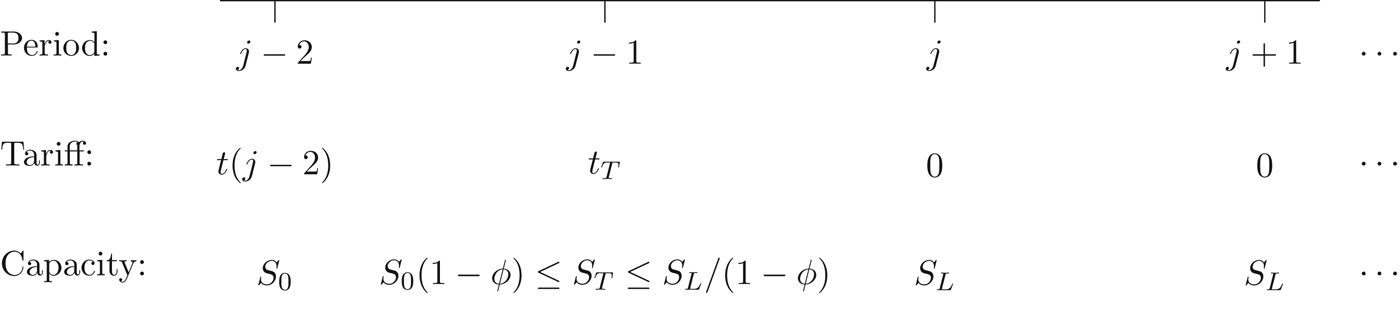
. For simplicity, consider the scenario depicted in Figure 1, where it is conceivable to reach the long-run agreement
 $(0,\underline{t}^*)$
in two periods, at j, but it is not possible to do so in one period. This happens if, starting from a certain level of installed capacity, S
0, at j−2 (inherited from earlier periods) the rate of depreciation is such that:
 $$\displaystyle{{S_L} \over {(1 - \phi )^2}} \ge S_0 \ge \displaystyle{{S_L} \over {1 - \phi}}. $$
Transitional and Long-run Tariffs and Capacity

Notice that the long-run agreement (t
L
=0,
 $\underline{t}^*$
) can only be achieved at period j if the capacity for period j−1, planned at j−2 on the basis of the tariffs expected at j−1, does not exceed S
L
/(1 − φ). This implies that convergence to the long-run agreement at j is only possible for sufficiently low transitional tariffs at j − 1. An overall self-enforcing trade liberalization path for the small country will require the small country's transitional and long-run tariffs to be sustainable, given its deviation incentives and the punishment that accompanies deviations.
We can show that, given the cooperative tariff of the large country, the small country may need to liberalize gradually, setting a tariff t
T
in period j − 1 that exceeds its long-term tariff t
L
= 0. Notice that, under the assumption of Nash-reversion punishment strategies, the punishment that the small country faces for defecting from t
T
during the transition is the same as that faced from defecting from t
L
= 0 in the long run: a deviation from t
T
at at j − 1, is followed by a reversion to tariffs (t
N
,tN
*) from j onwards rather than tariffs (
 $0,\,\bar t^* $
), where
 $t_N^* = \bar t^* $
, and t
N
= t(
 $\bar t^* $
); the same punishment applies if the small country deviates from the long-run tariff t
L
= 0 from j onwards. In contrast, transitional deviation incentives differ from long-run deviation incentives, since the small country's import-competing capacity is larger at j−1 than at j, so that its investors can earn larger quasi-rents. In turn, this implies that the small country faces a stronger temptation to deviate from the agreement.
Let us then examine the transitional deviation incentives of the small country. The capacity at j−1 installed at j−2 on the basis of the tariffs expected at j−2 can be determined as follows. We can identify a function,
 $\tilde S(\,p_T )$
, relating transitional capacity to the transitional gross-of-tariff price of importables, p
T
=(1+ t
T
)
 $(1 + \underline{t}^*)$
, where
 $\tilde S\prime (.) \gt 0$
.Footnote
14
This represents the optimal level of capacity when there is positive investment at j−2. When the depreciated initial capacity exceeds planned capacity
 $\tilde S(\,p_T )$
, the size of the import-competing sector will be S
0 (1−φ). Hence:
 $$S_T (t_T, \underline{t}^*) \equiv \max {\rm \;} \{ S_0 (1 - \phi ),\tilde S(\,p_T )\} \gt S_L. $$
The transitional deviation gain for the small country can be written as:
 $$\eqalign{{\rm \Delta} _T (t_T, t^*,S_0 ) \equiv & \int\limits_{\,p_D}^{\,p_T} D(z)dz + (1 + t^*)(t_D (D(\,p_D ) - S(\,p_E )) - t_T (D(\,p_T ) - S(\,p_E )))\hskip-10pt \cr& + (1 + \lambda )(\,p_D - p_T )S(\,p_E )} $$
where
 $p_E = (1 + t_T )(1 + \underline{t}^*)$
is the expected price of importables in the transition agreement and
 $p_D = (1 + t_D )(1 + \underline{t}^*)$
is the price when the small country optimally deviates from the transition agreement.
Looking at (9), it can be easily verified that ∂Δ T /∂S T >0. Thus, during the transition (at j − 1), the small country faces a stronger temptation to increase its tariff above the agreed-upon level in comparison with the long run (from j onwards). This, however, does not imply that transitional tariffs in the small country must be higher than long-run tariffs. In order to characterize the set of sustainable transitional tariff combinations, we need to consider both unilateral policy deviation incentives and investment incentives in the small country's import-competing sector. Specifically, given a ‘just sustainable’ long-term tariff t L = 0, the sustainable transitional tariff t T is identified by the following conditions:
-
1. transitional deviation gains do not exceed long-run deviation gains:
(10) $${\rm \Delta} _T (t_T, \underline{t}^*,S_0 ) \le {\rm \Delta} _L (0,\underline{t}^*,S_L ),$$
-
2. given expected tariffs
$(t_T, \underline{t}^*)$
, capacity at j−1 does not exceed S
L
/(1−φ):
(11)
$$S_T (t_T, \underline{t}^*) \le S_L /(1 - \phi ).$$


To obtain a more precise characterization, we employ a differential approach, which we develop as follows. Consider scenarios where capacity depreciates just fast enough that a two-period transition is feasible, i.e. where no investment in capacity takes place during the transition and S
0 (1 − φ)2=S
L
. In such borderline scenario, if we make the initial capacity level S
0 progressively closer to the long-run level S
L
, the sustainable transitional tariff will approach t
L
=0. Notice that in this limit scenario, a fast transition to t
L
=0 from j onwards is only possible if
 $S_T (t_T, \underline{t}^*) \equiv \max {\rm \;} \{ S_0 (1 - \phi ),\tilde S(\,p_T )\} = S_0 (1 - \phi )$
, i.e. if given the tariffs prevailing in the transition, import-competing are in a situation in which they would like to reduce capacity.
Let:
 $$\left( {\displaystyle{{dt_T} \over {dS_0}}} \right)_{S_0 = S_L} \equiv \theta. $$
Notice that θ captures the marginal differences between transitional and long-run tariffs for the small country, in the neighborhood of a limit scenario with S 0=S L : if θ > 0, we have t T > 0, i.e. transitional tariffs in the small country are higher than its long-run tariffs.
Then, for S 0 approaching S L and φ=1− (S 0 /S L )1/2, the developing country can reduce its tariff to t L = 0 from j onwards, passing through a single transitional period in which t = t T , if there exists a θ that satisfies the following system of linear inequalities:
 $$\displaystyle{{\partial \Delta _T} \over {\partial t}}\theta + \displaystyle{{\partial \Delta _T} \over {\partial S}} \le 0,$$
 $$\theta \tilde S{\rm \prime} (p) - 1 \le 0.$$
Condition (13) must be met in order for punishment to deter defections during the transition phase; condition (14) must be met for capacity to depreciate to its long-run level.
It can be shown that a fast transition to a low-tariff regime may require the small country to adopt transitional tariffs that are higher than its long-run tariffs. To see this, notice that, when S
0 (1− φ)2=S
L
, a fast transition to t
L
=0 from period j onwards requires the import-competing capacity at j − 1 not to exceed the depreciated initial capacity,
 $S_T (t_T, \underline{t} ^* ) = S_0 (1 - \phi )$
. In this regime, the size of the
 ${y}$
sector does not depend on t
T
and an increase in the small country's transitional tariff has the following effect on its deviation incentives:Footnote
15
 $$\displaystyle{{\partial \Delta _T} \over {\partial t_T}} = (1 + t^*)^2 (t_D D{\rm \prime} (\,p_D ) - t_T D{\rm \prime} (\,p_T )) \lt 0.$$
Starting from S 0=S L , an increase in capacity has the following effect on deviation incentives:
 $$\displaystyle{{\partial \Delta _T} \over {\partial S}} = \lambda (1 + t^*)(t_D - t_T ) \gt 0.$$
Condition (14) requires that capacity investment must not be too responsive to prices. Plugging (15) and (16) into condition (13), it is straightforward to verify that a fast transition to the long-run agreement (t
L
=0,
 $\underline{t}^*$
) requires θ >0. This implies that, in this limit case scenario, the small country can only move to low tariffs t
L
=0 at period j by going through a transitional period (j − 1), in which it adopts higher tariffs, t
T
>0.
It follows that, if capacity in the small country's import-competing sector cannot immediately adjust to its long-run level, a reciprocal trade agreement may require an asynchronous exchange of concessions, with the large country liberalizing before the small country does. Such pattern, however, is the result of a reciprocal trade agreement in which conditionality – the threat of a long-run reversion to
 $\bar t^* $
by the large country if the small country fails to complete its transition to liberalization – allows the small country to overcome its commitment problem. Thus, reciprocity – the conditional exchange of trade concessions – is essential to induce liberalization by the small country. Notice, however, that conditionality may not be apparent when the exchange of concessions is not simultaneous, even if it is present in an intertemporal sense. This might explain why previous studies have criticized SDT provisions as being at odds with the principle of reciprocity (Roessler, Reference Roessler and Krueger1998; Bagwell and Staiger, 2011).
It can also be shown that a fast transition to liberalization by the small country may additionally require that the transitional tariff by the large country,
 $t_T^* $
, is lower than its long-run tariff,
 $\underline{t}^*$
, a feature that is consistent with temporary GSP concessions. Specifically, let us denote with
 $\underline{t} _T (\underline{t}^*)$
the minimum transitional tariff that the small country can sustain if the large country adopts a transitional tariff equal to its long-run tariff, i.e.
 $t_T^* = \underline{t}^*$
. If
 $\tilde S(\underline{t} _T (\underline{t}^*),\underline{t}^*)(1 - \phi ) \gt S_L $
, achieving a fast transition to the long-run agreement
 $(t_L = 0,\underline{t}^*)$
will require
 $t_T^* \lt \underline{t}^*$
.Footnote
16
The intuition for this result is that a lower tariff by the large country helps to contain capacity investment in the small country's import-competing sector, reducing its deviation incentives in the transition period.
Then, consistent with the structure of SDT provisions in the WTO, there will be a transition phase, in which the large country liberalizes before the small country does – and where indeed the large country liberalizes preferentially vis-à-vis the small country. Notice that this sequence of events does not result from unilateral tariff reductions by the large country inducing liberalization in the small country, as in the mode of ‘trade policy leadership’ of Coates and Ludema (Reference Coates and Ludema2001); it is instead part of a trade deal, in which liberalization in the small country is sustained by the large country's threat of retaliation.
The intuition for this result is that, since the ability of the small country to lower its tariffs depends on the level of installed import-competing capacity, it may be impossible to sustain lower tariffs until its capacity has depreciated sufficiently. During a transition phase – when installed capacity is still large – the developing country faces a stronger temptation to increase its tariff above the agreed-upon level in comparison with the long run . An immediate reduction in tariffs by its large partner may ease the transition, by encouraging trade and preventing the build up of new import-competing capacity in the small country. In other words, higher tariffs in the small country may be required in the transition phase, even if the large country already liberalizes during the transition. Such a pattern, however, need not imply lack of conditionality; on the contrary, conditional reciprocity is needed to support the small country's liberalization efforts.
6. Conclusion
In this paper, we have shown that SDT under existing WTO rules can be interpreted as a mechanism that enables a large developed country to help a small developing country to overcome domestic commitment problems in trade liberalization. To formalize this argument, we have described a model of trade relations between a small developing country and a large developed country, where the small country's government faces a time inconsistency problem in tariff choices. This problem arises because investors, after having installed sunk capacity in the import-competing sector, put pressure on the government to raise tariffs so as to increase their quasi-rents. In this setting, free trade is optimal in the long run , but it is not credible in the short run, i.e. if the government cannot commit to tariff choices before investment decisions are made.
While previous studies have assumed that international agreements are automatically binding, as if a simple signature allowed policymakers to ‘tie their own hands’, our analysis focuses on the dynamic incentives that the small country continuously faces when trying to sustain free trade, and the effect that a trade policy relationship with the large country has on these incentives. If the developing country can only gradually reduce capacity in the import-competing sector, trade concessions along the path to trade liberalization may be reciprocal but asynchronous: the large country will liberalize first, expecting the small country to do the same after a transition period. In each period, trade liberalization in the small country is sustained by the threat of future punishment by the large country.
Although conditionality could be present only implicitly, certain explicit legal provisions provide strong support for our interpretation of SDT rules as part of a carrot-and-stick mechanism to foster trade liberalization in developing countries. Our analysis thus reconciles observed SDT provisions with their objectives as stated in the WTO agreements, by showing that temporary SDT can help developing countries to overcome their institutional problems and encourage them to liberalize their economies. Temporary preferences can indeed produce a ratchet effect on liberalization incentives, so that they are no longer required once the initial institutional hurdles have been overcome. Moreover, contrary to the view held by some in the policy debate, SDT rules can be consistent with reciprocity and conditionality.
Our results have implications for the ongoing debate on the design of SDT rules in the WTO. The Doha Declaration states that WTO agreements should afford the opportunity for developing countries to undertake ‘less than full reciprocity in reduction commitments’. This statement could be read to mean that developing countries, or at least the smaller ones, do not need to undertake substantial trade liberalization commitments, and they should be allowed to have a ‘free ride’ on the negotiations. Our analysis suggests that this may hinder the ability of developing countries to overcome their policy credibility problems, reducing the value of trade agreements to them. It may instead be in the best interest of these countries to interpret the statement as implying that they are expected to pursue trade reforms, but may be accorded longer transition periods to implement them.
One of the complaints about the current system is the fact that most SDT provisions are not legally binding, either because they are not explicitly included in the WTO agreements or because they are simply expressed as ‘best endeavor’ clauses. For this reason, the Trade and Development Committee has been mandated to consider the legal and practical implications of turning them into mandatory obligations. This argument fails to recognize that international agreements must be self-enforcing. Explicitly including SDT provisions in the WTO agreements would not by itself affect their enforceability, which depends on governments' dynamic incentives to comply with their commitments.
We have focused on the small country's motives and incentives to achieve and sustain trade liberalization (vis-à-vis a large country and domestic investors), abstracting from the large country's motives and incentives; but the active engagement of the large country in this process is also crucial for its viability. In this respect, it has been pointed out that developing countries are rarely challenged by larger countries as respondents in WTO litigation (Bown and Hoekman, Reference Bown and Hoekman2008), suggesting that large countries may face weak incentives to carry out the punishments that are legally available to them under dispute settlement rules, and that therefore strengthening such incentives under WTO rules may be important.