Introduction
A major threat to the western rangelands is invasion by exotic weeds. Overgrazing, drought (Brooks and Pyke Reference Brooks and Pyke2001; O’Connor Reference O’Connor1991; Pyke Reference Pyke1999), wildfire (Young and Evans Reference Young and Evans1978), and disturbance for energy development opened the landscape for further spread of invasive exotic species (Copeland et al. Reference Copeland, Pocewicz and Kiesecker2011). Cheatgrass (Bromus tectorum L.) is one of the highly invasive species in the United States (Knapp Reference Knapp1996; Mack Reference Mack2011; Menalled et al. Reference Menalled, Mangold and Davis2008). It is the dominant species on about 20 million hectares in the western United States (Bradley and Mustard Reference Bradley and Mustard2005). Abundant soil seed reserve (Young et al. Reference Young, Evans and Eckert1969), early germination pattern (Menalled et al. Reference Menalled, Mangold and Davis2008; Young et al. Reference Young, Evans and Eckert1969), better uptake of soil moisture (Knapp Reference Knapp1996) and nitrogen (Blank and Morgan Reference Blank and Morgan2011; Lowe et al. Reference Lowe, Lauenroth and Burke2003), promotion of grass-fire cycle, and tolerance to fire regimes (Belnap and Phillips Reference Belnap and Phillips2001; Bolton et al. Reference Bolton, Smith and Link1993; Brandt and Rickard Reference Brandt and Rickard1994; Brooks et al. Reference Brooks, D’Antonio, Richardson, Grace, Keeley, Ditomaso, Hobbs, Pellant and Pyke2004; Hulbert Reference Hulbert1955; Stewart and Hull Reference Stewart and Hull1949; Young et al. Reference Young, Evans, Eckert and Kay1987) contribute to competitive advantage and dominance of B. tectorum over native vegetation. Bromus tectorum–dominated areas can be restored by establishing and maintaining stands of robust perennial forage species (Asay et al. Reference Asay, Horton, Jensen and Palazzo2001; Cronin and Williams Reference Cronin and Williams1966; Thompson et al. Reference Thompson, Roundy, McArthur, Jessop, Waldron and Davis2006; Whitson and Koch Reference Whitson and Koch1998). Forage kochia [Bassia prostrata (L.) A. J. Scott] is a promising forage species for restoring annual weed–infested areas.
Management Implications
Previous reports suggest that forage kochia (Bassia prostrata) can compete with annual weeds. However, there are no reports comparing competitive ability of forage kochia with other potential perennial native or nonnative species. Our study investigated whether forage kochia could compete with Bromus tectorum (cheatgrass), an invasive annual weed, better than potential perennial grasses such as Agropyron cristatum (crested wheatgrass; nonnative) and Elymus lanceolatus (thickspike wheatgrass; native). Although forage kochia seedlings moderately competed with B. tectorum, perennial grass seedlings reduced B. tectorum growth more than forage kochia at the seedling stage. There is a concern that forage kochia may compete with native perennials. To address this, we also conducted a greenhouse experiment and observed that forage kochia has little to no effect on the growth of native perennial grass seedlings. On the contrary, native grass seedlings negatively influenced the growth of forage kochia seedlings. This is important, because it shows that forage kochia seedlings compete with B. tectorum, but not with native grass seedlings. Forage kochia has been considered a potentially important forage and reclamation species, and our study shows the potential for future field-based research to more fully explore forage kochia and its competitive ability against B. tectorum and its compatibility with native perennials.
Forage kochia is a desirable perennial species for greenstripping (Clements et al. Reference Clements, Gray and Young1997; Harrison et al. Reference Harrison, Waldron, Jensen, Page, Monaco, Horton and Palazzo2002; Monsen Reference Monsen1994; Pellant Reference Pellant1990), reclamation of drastically disturbed areas, and forage production during fall and winter seasons in the semiarid rangelands (Harrison et al. Reference Harrison, Chatterton, Waldron, Davenport, Palazzo, Horton and Asay2000, Reference Harrison, Waldron, Jensen, Page, Monaco, Horton and Palazzo2002; Keller and Bleak Reference Keller and Bleak1974; McArthur et al. Reference McArthur, Guinta and Plummer1974; Sullivan et al. Reference Sullivan, Anderson and Fugal2013). It is a drought- and salt-tolerant species (Keller and Bleak Reference Keller and Bleak1974; Stevens et al. Reference Stevens, Jorgensen, McArthur and Davis1985) that can compete with annual exotic weeds such as halogeton [Halogeton glomeratus (M. Bieb.) C. A. Mey.] (Stevens and McArthur Reference Stevens and McArthur1990), B. tectorum (McArthur et al. Reference McArthur, Blauer and Stevens1990; Monsen and Turnipseed Reference Monsen and Turnipseed1990), and saltwort (Salsola kali L.) (Koch and Asay Reference Koch and Asay2001). Generally, it can be seeded either in late fall, winter, or early spring. Forage kochia emerges in the early spring and competes with invasive weeds such as B. tectorum for soil moisture (Monaco Reference Monaco2004).
In spite of the benefits of forage kochia, there is a concern that it may outcompete native plants and spread into native rangelands, perhaps because nonnative plants establish and spread in new areas by acquiring resources faster than native plants (Levine et al. Reference Levine, Vila, D’Antonio, Dukes, Grigulis and Lavorel2003; Rees et al. Reference Rees, Condit, Crawley, Pacala and Tilman2001). Forage kochia spreads in most unseeded areas adjacent to seeded areas (Blauer et al. Reference Blauer, McArthur, Stevens and Nelson1993; Gray and Muir Reference Gray and Muir2013; Harrison et al. Reference Harrison, Chatterton, Waldron, Davenport, Palazzo, Horton and Asay2000). However, many researchers have suggested forage kochia is not invasive in perennial plant communities (Harrison et al. Reference Harrison, Chatterton, Waldron, Davenport, Palazzo, Horton and Asay2000, Reference Harrison, Waldron, Jensen, Page, Monaco, Horton and Palazzo2002; Monaco et al. Reference Monaco, Waldron, Newhall and Horton2003; Pendleton et al. Reference Pendleton, Frischknecht and McArthur1992; Waldron et al. Reference Waldron, Eun, ZoBell and Olson2010). Nevertheless, there is limited information available on its competitiveness with native species (Harrison et al. Reference Harrison, Chatterton, Waldron, Davenport, Palazzo, Horton and Asay2000; Monaco et al. Reference Monaco, Waldron, Newhall and Horton2003). Further investigations of potential interactions of forage kochia with native perennial grasses will augment the existing literature and help land managers decide whether to use it for reclamation or as a forage species. Therefore, the specific objectives of this study were: (1) to compare the effect of forage kochia versus perennial cool-season grasses on B. tectorum seedling growth and (2) to evaluate the effect of forage kochia on native perennial cool-season grasses during the seedling stage.
Materials and Methods
Greenhouse experiments were conducted at the Laramie Research and Extension Center greenhouse complex, Laramie, WY, from January 2014 to February 2015. The air temperature was maintained at approximately 24 C during daytime and 18 C during nighttime. There was no supplemental lighting.
Bromus tectorum Study
The target-neighbor design (Gibson et al. Reference Gibson, Connolly, Hartnett and Weidenhamer1999; Goldberg and Fleetwood Reference Goldberg and Fleetwood1987) was used to determine competitive ability of neighbor species against a target species. In this study, the target species was B. tectorum and neighbor species included ‘Immigrant’ forage kochia (nonnative perennial subshrub), ‘Critana’ thickspike wheatgrass [Elymus lanceolatus (Scribn. & J. G. Sm.) Gould; native perennial grass], and ‘Hycrest’ crested wheatgrass [Agropyron cristatum (L.) Gaertner × A. desertorum (Fisch. Ex Link) Schultes; nonnative perennial grass].
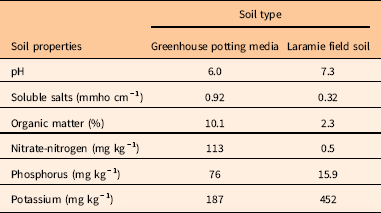
Bromus tectorum and three neighbor species were sown into black plastic propagation trays (53-cm length by 28-cm width by 5-cm height) with drainage holes on January 11, 2014. Before seeding, trays were filled to within 2.5 cm of the rim with the greenhouse potting media (mixture of one part sand and two parts media containing peat moss, vermiculite, and rice hulls). Seedlings were transplanted into 1.5-L pots (15-cm deep) at 2 wk after seeding. Each neighbor species was transplanted in increasing densities (0, 1, 2, 3, 4, or 5 seedlings pot−1) equidistant around 1 target seedling planted in the center of the pot. Before transplanting, pots were filled with greenhouse potting media (Table 1). During the first week of transplanting, dead seedlings were replaced by new seedlings of the same age. Eighteen treatments (3 neighbor species by 6 densities), each replicated six times, were arranged in a completely randomized design (CRD). Pots were given approximately 150 ml water on alternate days, but no fertilizer was applied. The pots were rearranged biweekly to minimize microenvironmental effects in the greenhouse. Tiller number and height of B. tectorum plants were measured at 2 wk after transplanting and before harvesting. Grass shoots with at least 3 leaves were counted as tillers. The plant height was taken from the soil surface to the extended tip of the longest live grass leaf. The difference between initial values (2wk after transplanting) and final values (before harvesting) for tiller number and plant height were response variables. Aboveground plant parts were harvested on March 23, 2014, oven-dried for 48 h at 60 C, and weighed to determine B. tectorum dry biomass.
Properties of potting media used in greenhouse experiments.

The same design and methods were used for the repeated study conducted during fall 2014; however, Laramie field soil (fine-loamy, mixed, Borollic Haplargids; Table 1) was used instead of greenhouse potting media. All species were seeded on September 28, 2014, and transplanted into 1.5-L pots at 2 wk after seeding. Aboveground shoots were harvested on January 13, 2015.
Statistical analyses were conducted separately for each study using SAS software (SAS institute 2014). For testing the relationships between B. tectorum growth parameters and neighbor density within each neighbor species, regression analysis (r2) was determined using PROC REG, and linear-regression models were fit based on residual plots (scatter plot of residuals vs. neighbor density variable). An analysis of covariance (ANCOVA) was used to compare slopes of three regression lines using PROC GLM.
Native Grass Study
Four native perennial grasses: ‘Anatone’ bluebunch wheatgrass [Pseudoroegneria spicata (Pursh) Á. Löve], ‘Magnar’ basin wildrye [Leymus cinereus (Scribn. & Merr.) Á. Löve], ‘Critana’ E. lanceolatus, and ‘Rosana’ western wheatgrass [Pascopyrum smithii (Rydb.) Á. Löve] were used to study their interaction with Immigrant forage kochia. In this study, treatments consisted of forage kochia grown alone, each of four native grasses grown alone, and one individual of each native species grown with one individual forage kochia seedling. Treatments were arranged in a CRD with five replicates. All treatments were established by sowing seeds in respective pots on June 13, 2014, and seedlings in individual pots were thinned to the desired number of plants for each treatment on June 28, 2014. Pot arrangement, watering, and fertilization were done following the same procedures described earlier. Plant height, number of branches (forage kochia), and tiller number (grass) were measured after thinning (June 28, 2014) and before harvesting. Plant height was measured from the pot soil surface to the top of forage kochia main stem or the extended tip of longest live grass leaf. A tiller was a grass shoot with at least 3 leaves. The differences between initial (after thinning) and final data (before harvesting) were considered as response variables for respective parameters. No mortality was observed during the study period. Aboveground biomass was harvested on October 28, 2014, oven-dried for 48 h at 60 C, and weighed to determine dry biomass. The study was repeated using the same design. Planting was done on November 1, 2014, and thinning occurred on November 15, 2014. Laramie field soil was used instead of greenhouse potting media in the second study period (Table 1). The study was harvested on February 16, 2015.
Statistical analyses were conducted separately for each study using PROC GLM in SAS software (SAS institute 2014). Forage kochia plant characteristics and aboveground biomass data were subjected to statistical analysis using a CRD. A two-group t test (α=0.05) was conducted for comparison within each native species when grown with and without the forage kochia companion.
Results and Discussion
Bromus tectorum Study
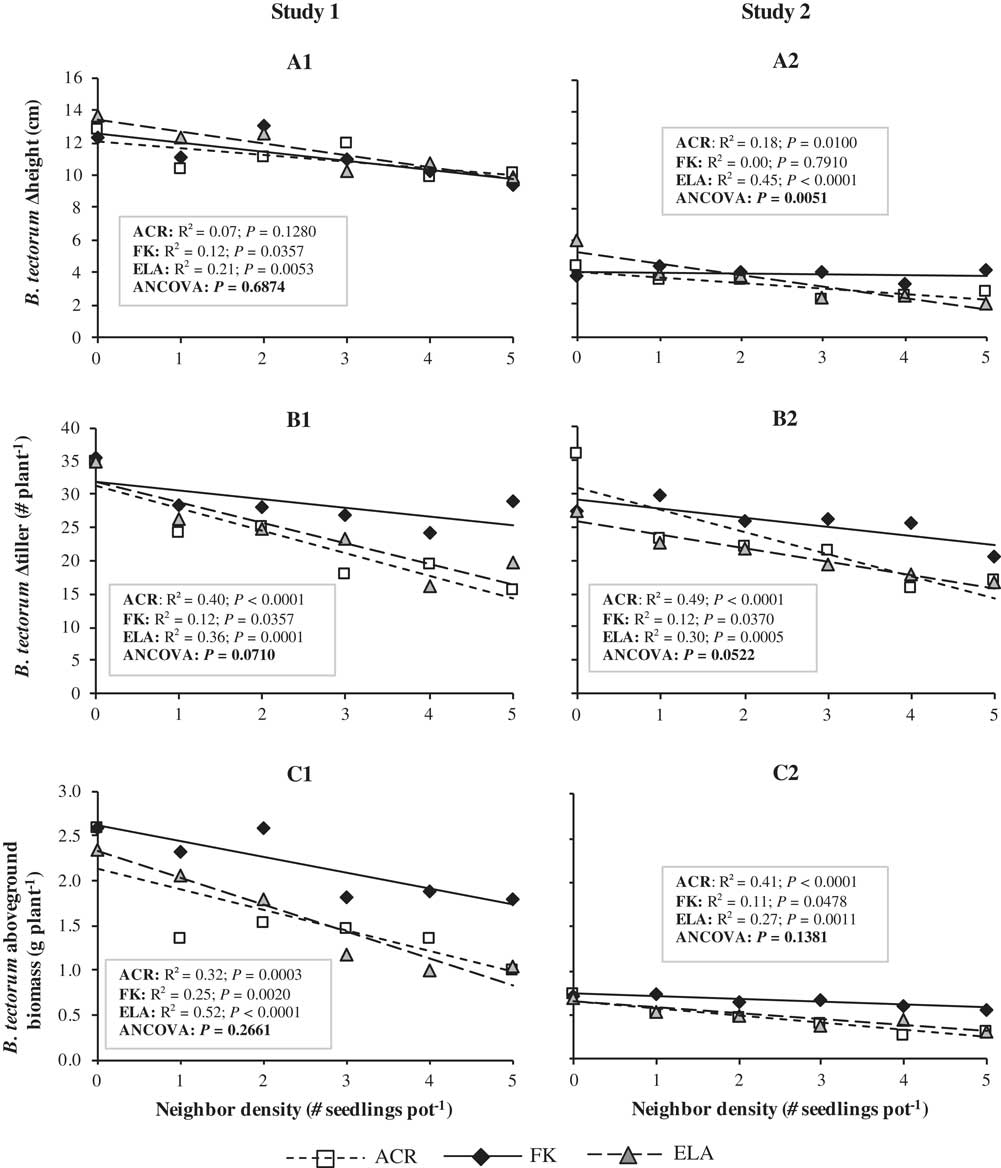
Results from Study 1 showed that change in height of B. tectorum (Δheight) was significantly influenced by different neighbor densities of forage kochia and E. lanceolatus, but not by neighbor densities of A. cristatum (Figure 1A1). However, ANCOVA analysis showed that the slopes of three regression lines were not significantly different (P>0.05), and there were no differences in B. tectorum Δheight among these three neighbor species. In Study 2, B. tectorum Δheight was reduced by increasing density of A. cristatum and E. lanceolatus, but not forage kochia Figure 1A2). The slopes differed (P<0.05) across three regression lines. Agropyron cristatum and E. lanceolatus appeared more effective in reducing B. tectorum height than forage kochia. Linear regression analyses showed that increase in B. tectorum tiller number (Δtiller) was negatively related to neighbor density of all neighbor species (Figure 1B1 and B2). However, the slopes of three regression lines were not significantly different (P>0.05) in Study 1, but were different (P=0.05) across three regression lines in Study 2. The change in B. tectorum tiller number was lower when grown with each perennial grass than when grown with forage kochia. In both studies, regression analyses showed that the effect of neighbor density on B. tectorum shoot biomass was significant for all neighbor species (Figure 1C1 and C2). These three slopes were not different (P>0.05), and pairwise comparisons among neighbor species showed that forage kochia was not as effective in reducing B. tectorum shoot biomass as the two grasses.
Regression analyses to determine the effects of neighbor species and neighbor densities on growth parameters of Bromus tectorum (change in height [Δheight], change in tiller number [Δtiller], and aboveground biomass) in two greenhouse studies. ACR, Agropyron cristatum; FK, forage kochia; ELA, Elymus lanceolatus. ANCOVA P-values (for equality of slopes) are also included.

These two greenhouse experiments used different potting media (potting soil in Study 1 and field soil in Study 2). Any differences in plant growth responses between these two studies may be attributed to differences in soil characteristics of these potting media, especially nitrogen availability (Table 1). Overall, the results from the two greenhouse experiments indicate that increasing density of each neighbor species (up to 5 seedlings pot−1) around a B. tectorum seedling reduced B. tectorum seedling growth. However, no mortality of B. tectorum seedlings was observed in any case during this period (8 wk in Study 1 and 13 wk in Study 2) under regular watering conditions. Bromus tectorum has relatively rapid shoot and root growth with many fine rootlets that give it a competitive advantage over slow-growing seedlings of perennial plants (Aguirre and Johnson Reference Aguirre and Johnson1991; Cline et al. Reference Cline, Uresk and Rickard1977; Evans Reference Evans1961; Harris Reference Harris1977). The greater neighbor density likely resulted in more rapid depletion of water and nutrients from the soil compared with when B. tectorum was grown alone. The results of this study indicate that these neighbor species in their initial growth stages slightly reduced B. tectorum seedling growth in the greenhouse. However, established or mature stands of these perennial species may have long-term or even greater ability to suppress B. tectorum seedling growth in field conditions (Reference Buman, Monsen and AbernethyBuman et al. 1998; Humphrey and Schupp Reference Humphrey and Schupp2004; McGlone et al. Reference McGlone, Sieg and Kolb2011). Davies and Johnson (Reference Davies and Johnson2017) reported that established perennial vegetation was effective in limiting reinvasion by exotic annual grasses.
Forage kochia has been considered a candidate for competing with aggressive exotic weeds such as B. tectorum (McArthur et al. Reference McArthur, Blauer and Stevens1990; Monaco Reference Monaco2004; Monaco et al. Reference Monaco, Waldron, Newhall and Horton2003; Stevens et al. Reference Stevens, Jorgensen, McArthur and Davis1985; Young and Clements Reference Young and Clements2004). Forage kochia seedlings can form a small rosette of leaves and accelerate root growth by preferentially partitioning energy into the root system (Harrison et al. Reference Harrison, Chatterton, Waldron, Davenport, Palazzo, Horton and Asay2000), thereby being able to survive in stressful environmental conditions such as weed competition or water stress. The results from the greenhouse studies indicate that presence of forage kochia, even in its seedling stage, tends to negatively affect B. tectorum seedling growth. However, the effect of forage kochia seedlings on B. tectorum was less than that of E. lanceolatus and A. cristatum, likely due to greater interference of the fibrous root system of neighbor grass species compared with the single taproot of forage kochia seedlings. Moreover, relatively small forage kochia seedlings were more likely to be influenced by the shading effect of lateral tillers of B. tectorum (Evans Reference Evans1961). Davies and Johnson (Reference Davies and Johnson2017) also reported that established A. cristatum limited exotic annual grasses more than forage kochia. Previous studies also found that native or nonnative perennial cool-season grasses were effective for B. tectorum control (Davies and Johnson Reference Davies and Johnson2017; Rose et al. Reference Rose, Hild, Whitson, Koch and Tassell2001; Whitson and Koch Reference Whitson and Koch1998). In field conditions near Riverside, WY, Whitson and Koch (Reference Whitson and Koch1998) found that E. lanceolatus was not as effective for B. tectorum control as Hycrest A. cristatum. While aggressive A. cristatum was shown to be strongly competitive against B. tectorum, it also has the tendency to reduce native plant diversity and form monotypic stands (Asay et al. Reference Asay, Horton, Jensen and Palazzo2001; Henderson and Naeth Reference Henderson and Naeth2005; Hull and Klomp Reference Hull and Klomp1967; Nafus et al. Reference Nafus, Svejcar, Ganskopp and Davies2015). In the present greenhouse studies, the overall effects of E. lanceolatus and A. cristatum on B. tectorum seedling growth did not seem to differ from each other.
Native Grass Study
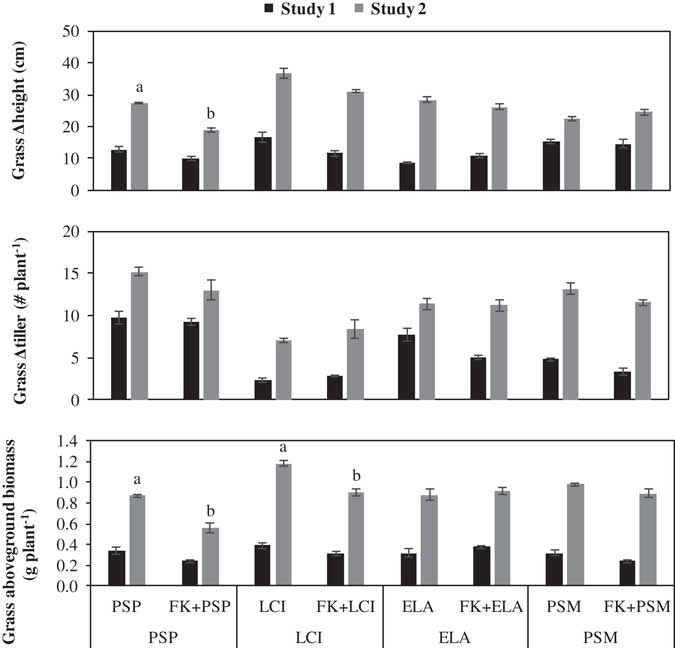
There were no significant (P>0.05) effects of a forage kochia seedling on the growth parameters (change in height, tiller, shoot biomass) of any native species in Study 1 (Figure 2). In Study 2, change in grass height and biomass of P. spicata and only biomass of L. cinereus were reduced when grown with forage kochia, but forage kochia seedlings did not influence the tiller number of any grasses. Overall results indicate that forage kochia seedlings did not interfere with seedling growth of these native perennial grasses during the study period (12 wk in Study 1 and 16 wk in Study 2). Previous reports also support that forage kochia can be sown in a mixture with perennials (Stevens et al. Reference Stevens, Jorgensen, McArthur and Davis1985; Stevens and McArthur Reference Stevens and McArthur1990) and does not preclude reestablishment of native perennials in rangelands (Clements et al. Reference Clements, Gray and Young1997; Harrison et al. Reference Harrison, Chatterton, Waldron, Davenport, Palazzo, Horton and Asay2000). Likewise, forage kochia stands do not appear to reduce the density of established perennial species (Stevens et al. Reference Stevens, Jorgensen, McArthur and Davis1985) and do not demonstrate an invasive nature in perennial plant communities (Harrison et al. Reference Harrison, Chatterton, Waldron, Davenport, Palazzo, Horton and Asay2000, Reference Harrison, Waldron, Jensen, Page, Monaco, Horton and Palazzo2002; Monaco et al. Reference Monaco, Waldron, Newhall and Horton2003; Pendleton et al. Reference Pendleton, Frischknecht and McArthur1992; Waldron et al. Reference Waldron, Eun, ZoBell and Olson2010).
Effects of forage kochia companion on growth parameters of grasses (change in height [Δheight], change in tiller number [Δtiller], and aboveground biomass) in two greenhouse studies. For each native grass species within a study, means (±SEs) with different letters are significantly different (P<0.05). PSP, Pseudoroegneria spicata; LCI, Leymus cinereus; FK, forage kochia; ELA, Elymus lanceolatus; PSM, Pascopyrum smithii.

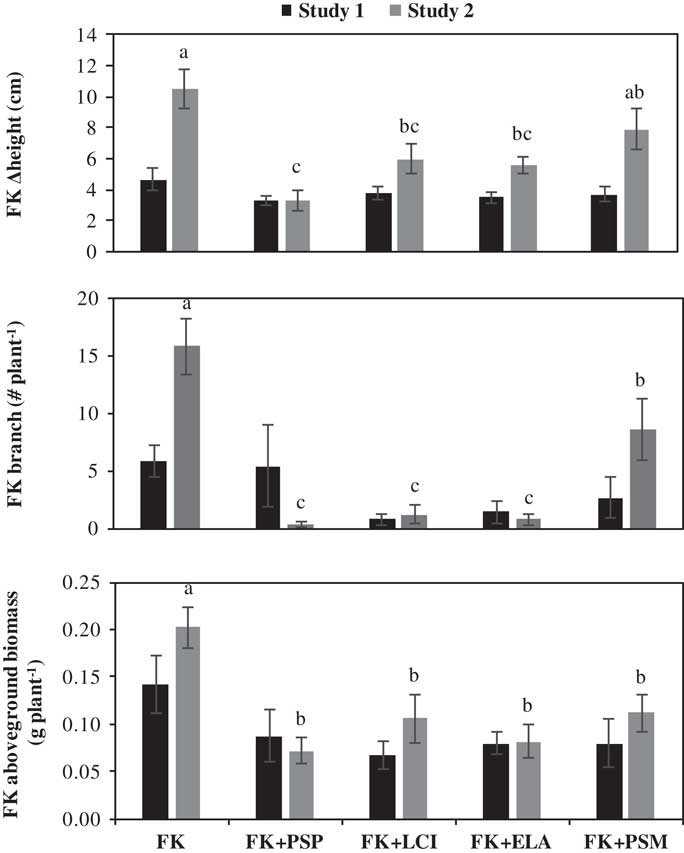
In Study 1, there were no significant differences in forage kochia change in plant height, branching, and shoot biomass when forage kochia was grown with and without a native perennial grass companion (Figure 3). In Study 2, change in height of forage kochia was significantly lower when grown with each native grass seedling, except P. smithii, and the effects of E. lanceolatus, L. cinereus, and P. spicata on forage kochia height were similar. There was a significant effect of native grass on forage kochia branching. Branching was greatest when forage kochia was grown alone, followed by when it was grown with P. smithii. The other three native grasses drastically reduced the branching of forage kochia. Similarly, forage kochia shoot biomass was also significantly lower when grown with each native grass seedling than when grown alone. All native grasses were similar in reducing forage kochia shoot biomass.
Effects of native grass companion on growth parameters of forage kochia (change in height [Δheight], branching, and aboveground biomass) in two greenhouse studies. Means (±SEs) with different letters within a study are significantly different (P<0.05). PSP, Pseudoroegneria spicata; LCI, Leymus cinereus; FK, forage kochia; ELA, Elymus lanceolatus; PSM, Pascopyrum smithii.

The results from this study indicate that these native grasses negatively affect forage kochia branching and shoot biomass. In general, perennial grasses develop a fibrous root system that is likely able to occupy more soil volume and thus acquire more moisture and nutrients within the pot environments compared with the single slender taproot system of forage kochia in its early growth stage. In the present studies, competition for light was unlikely because of the relatively small seedling size. Although the mechanism of competition was not directly examined, seedlings within each pot were likely competing for nutrients, because the pots were not fertilized during the experiment and watering may have leached existing nutrients from the soil. In a study by Aerts et al. (Reference Aerts, Boot and van der Aart1991), a major proportion of biomass of a perennial grass, moorgrass [Molinia caerulea (L.) Moench], was allocated to its roots, and this extensive root system gave it a competitive advantage over two evergreen shrubs [Calluna vulgaris (L.) Hull and Erica tetralix L.]. According to Li et al. (Reference Li, Sun, Zhang, Guo, Bao, Smith and Smith2006), the extent of root distribution and density of a species influence the ability of other species to take up resources from the soil. Rate of nutrient uptake of a plant can influence its competitive ability in different soil environments (Casper and Jackson Reference Casper and Jackson1997). However, root growth and comparative ability of roots to take up soil moisture or nutrients were not studied in the current experiments. Overall, forage kochia did not appear to compete with native grasses at the seedling stage.
Forage kochia has been considered a potential perennial species to control B. tectorum in semiarid rangelands. The greenhouse studies showed that the seedlings of forage kochia and cool-season grasses have a negative impact on B. tectorum growth parameters, and the presence of high densities of these species increases the negative impact on B. tectorum. The native grass E. lanceolatus in its seedling stage also showed promise for reducing B. tectorum seedling growth. Reduction of forage kochia growth in the presence of native perennial grasses indicates that forage kochia seedlings are unlikely to limit the growth of native seedlings. Although these studies used two types of potting media (greenhouse potting mixture and actual field soil), detailed field experiments should be conducted to better elucidate the effectiveness of forage kochia and E. lanceolatus or other desirable perennial species in annual weed–dominated areas.
Acknowledgments
The project was funded by the University of Wyoming Energy Graduate Assistantships grant program. No conflicts of interest have been declared.