1. Introduction
On 24 May 2017, the Taiwanese Constitutional Court (hereafter, “the Court”) handed down Judicial Yuan Interpretation No. 748, which stated that the prohibition on same-sex marriage in Taiwan’s Civil Code was unconstitutional. The Court ordered the Legislative Yuan, the unicameral legislature of Taiwan, to amend the law within two years. Regardless of a significant backslide in the Taiwanese 2018 referendum,Footnote 1 the Legislative Yuan followed the Court’s order in 2019 and legalized gay marriage. This change in the law made Taiwan the first state to legalize same-sex marriage in Asia. Many legal scholars consider this same-sex marriage ruling a progressive decision,Footnote 2 in which the Court undertook a counter-majoritarian task of protecting a minority group.Footnote 3 While we agree with the Court’s role in promoting marriage equality, we contend that most legal scholars commenting on the case have overlooked an important question in this process: why did the Court suddenly have so much authority to rule on this case?
Taiwanese lesbian, gay, bisexual, and transgendered (LGBT)-rights activists had been pushing for progressive same-sex marriage legislation in the Legislative Yuan for more than a decade. From 2006 to 2016, same-sex marriage advocacy groups proposed at least seven same-sex marriage Bills to the Legislative Yuan, but the unicameral body exhibited little enthusiasm for this legislative agenda.Footnote 4 It is also noteworthy that before the Court granted a petition for judicial review of the same-sex marriage issue, gay-rights activists had finally made progress in the Legislative Yuan: legislators had formed a bipartisan, multiparty coalition and had introduced to the Legislative Yuan a draft of a same-sex marriage Bill that had already gone through a first reading. Because the legislature was considering a same-sex marriage Bill, the Court was initially hesitant to grant judicial review for this case. The hesitation stemmed from the timing and the possible inappropriateness of the Court’s insertion of itself in judicial policy-making. Grand Justice Tang Te-chung, in expressing a procedural concern regarding whether or not the Court should hear the case, made a revealing statement:
The Legislative Yuan, as the institution responsible for crafting laws, has the authority and the responsibility to settle political controversy in society. We obviously cannot determine whether or not the legislative branch has malfunctioned before it has made a legislative decision. Thus, is it appropriate at this point for the Court to step in and impose judicial policy-making on the process?Footnote 5
Justice Tang’s concern rested on the basic logic of the separation of powers in a democracy. In a democracy, legislatures possess more legitimacy than courts regarding the duty of drafting and enacting laws—and, of course, many people would argue that legislatures, alone, can legitimately exercise this power. The justification for this view is that popularly elected officials, not selectively appointed ones, represent the majority will when it comes to crafting policy and resolving social controversies. Judicial policy-making, if it occurs at all, should be rare, and when it does happen, it often invites the criticism of “a counter-majoritarian force.”Footnote 6 Indeed, when the Court handed down the same-sex marriage ruling in 2017, it triggered a great backlash in society. Many people argued that unelected judges ought not to make decisions touching on important matters and that, instead, some form of representative or direct democracy ought to be the means of resolving these matters.Footnote 7 A consequence of this dissatisfaction was a 2018 national referendum on same-sex marriage, the wording of which was shaped by both conservative and pro-“gay rights” social groups. A majority of referendum voters sided with the conservative groups. Given that most Taiwanese prized referendums over judicial decisions for settling controversies, the activist role that the Court played in the same-sex marriage Bill has given rise to puzzlement about the separation of powers. Why did the Court have and use so much power in rendering a decision in this case? And why did the legislature sidestep its role as a law-maker?
Perhaps even more puzzling, at the time, was the fact that Taiwan was under a unified government in which the Democratic Progressive Party (DPP), as the ruling party, dominated both the executive and legislative branches. Relying on its political advantage at the time, the DPP could have passed and implemented the same-sex marriage Bill, but did not; rather, the ruling party chose to hold off on the Bill and leave the decision-making to the judiciary. Given this backdrop, the question as to why the legislature avoided the issue is even more puzzling.
In this paper, we tackle the above questions. We explain the political foundations of Taiwan’s progressive judiciary by exploring, in detail, the case of the first gay-marriage legislation in Asia. We argue that the Court’s role in this case permitted both the legislature and the executive to engage in position avoidance through deliberate deferral to the Court. The political divisiveness of the same-sex marriage policy made it a tough issue across Taiwan’s two major political parties: the DPP and the more conservative Kuomintang (KMT). The diverse public opinion on the same-sex marriage issue pushed elected politicians to avoid taking a firm position on the matter. In this way, they essentially delegated the decision-making to the third branch of government, the judiciary, in a move that constituted a successful effort to dodge the political cost of taking sides on a hugely controversial policy.Footnote 8
In the following sections, we first introduce the political foundations of Taiwan’s judicial policy-making. We then present a political position-avoidance framework for analyzing the interaction between the legislature and the Court. This framework rests on previous studies that examined legislative position-taking and judicial review. We apply the position-avoidance framework to Taiwanese same-sex marriage cases. The empirical section of this paper presents evidence that public opinion in Taiwan regarding same-sex marriage exhibited significant diversity, which explains the prevaricating attitudes of Taiwanese legislators. We have found that the divided public opinion prompted Taiwanese legislators to engage in position avoidance. This avoidance manifested itself in ambiguous language, inconsistent policy positions, and abstentions from roll-call voting. As the same-sex marriage policy grew more and more heated, a greater and greater number of legislators constantly changed their policy positions and engaged in equivocal language when addressing this issue in public. When the legislature voted on the same-sex marriage Bill, a nontrivial percentage of abstentions were counted. Overall, these facts suggest that legislative position avoidance was in play during the same-sex marriage debate, which had split public opinion and which, as we will show, indirectly promoted judicial policy-making.
2. Position avoidance, legislative deferral, and empowered courts
Previous research can help us answer the central question guiding this study: why did the Taiwanese legislature put off the same-sex marriage Bill in 2016 and then, in 2019, defer to the Court’s ruling on the matter? To answer this question, we should first address a pair of intertwined issues: (1) how legislatures and courts differ from each other; and (2) how an empowered court can benefit a legislature.
In a democratic society, elected legislators are constrained by electoral pressure and are expected to produce policy responsiveness. Otherwise, they are subject to electoral sanction. By contrast, appointed judges are not directly accountable to the public. This gives judges the freedom to make policy without facing the threat of electoral sanction. As such, elected leaders sometimes delegate decision-making authority to judicial institutions.Footnote 9
Studies have found that elected officials can benefit, in various ways, from their empowerment of courts. One of the benefits is that an activist court can help the officials enforce a regime. As Whittington contends, an enhanced judicial authority can help supervise and correct political actors who might otherwise fail to adhere to a politically preferred constitutional vision.Footnote 10 In American history, an example of this view can be found in how Madison sought a stronger national government in the 1780s. The fragmentation of the young American political system had provided ample opportunities for electoral minorities to exercise, in Madison’s eyes, a troubling degree of political power. To build a stronger national government capable of disciplining local political actors, Madison chose to support judicial activism. Thus, today, the US Supreme Court can review the constitutionality of state statutes and can, in this way, be a mechanism by which the federal government supervises state governments.Footnote 11
Elected officials can benefit from strong courts in another important way: the courts can sometimes help a nation overcome political gridlock. In the US, which has a very strong national legislature with an independent executive, leaders might be constrained by the demands of maintaining both a national coalition and a legislative process. Elected officials’ deference to activist judiciaries can cut through these constraints, thus helping realize controversial policy goals that cannot advance through open legislative and electoral politics.Footnote 12 According to Graber: “[t]he Supreme Court has proven receptive to these invitations, particularly when the justices share the values of the elite or presidential wing of the dominant national coalition.”Footnote 13 When a pressing but highly intractable issue arises with no clear legislative majority to favour one or another outcome, the court-empowering option can be quite attractive.
Perhaps the greatest benefit that elected officials can derive from an empowered court is the avoidance of blame. Of course, when a clear position on an issue can strengthen elected officials’ chance of winning another term, they make that position known, signalling to their constituency that it and they hold similar views.Footnote 14 But because electoral victory is the chief goal of elected officials, avoidance of blame is particularly notable when they are facing a politically divisive issue.Footnote 15 Thomas argues that legislators, in order to avoid blame, avoid taking a position (1) when they are uncertain about which one would give them a desired election payoff; and (2) when they believe that revealing a position would negatively affect their election results.Footnote 16
Jones states that diverse constituencies, by virtue of their ability to maximize electoral losses, can prompt legislators to engage in position and blame avoidance.Footnote 17 The same pattern also characterizes legislators who seek election to an office representing a constituency different from the one they currently represent. In these cases, being ambiguous is the best strategy by which legislators can reduce their risk of offending current and future constituencies.Footnote 18
A historical example of position avoidance and blame avoidance can be found in 1850s America: both Whigs and Democrats were aware that the slavery issue threatened to tear apart their national coalitions, so the two parties preferred to orient politics around less politically controversial issues, such as tariffs and banking.Footnote 19 The US Supreme Court decision of Roe v. Wade (1973) offers us another instance in which a legislature engaged in position avoidance and blame avoidance by deferring to a judicial branch: the legislators could not bring themselves to resolve a divisive issue (i.e. abortion) within the party system and preferred that the issue remain tied up in the court system so that they might avoid having to take a potentially unpopular side. Lovell details a situation in which anti-union decisions handed down by the Supreme Court during the 1930s were consequences of legislative compromises that facilitated judicial policy-making in the guise of statutory interpretation.Footnote 20 And Frymer describes how legislative choices and political fragmentation help explain the judicial decisions that desegregated labour unions in America:Footnote 21 during the 1950s and 1960s, liberals eager to avoid the task of mediating tensions between White workers and the civil-rights movement dodged the responsibility by delegating it to the federal courts.
Historical examples of this type of blame avoidance can also be found in non-democratic settings, where authoritarian leaders prefer to stay away from controversial issues that might either give shape to a resilient opposition or split the ruling coalition. To implement some unpopular policies, leaders constantly rely on court rulings. For example, Moustafa shows that the Egyptian Supreme Constitutional Court helped the Mubarak regime gradually liberalize the economy by ruling on cases that overturned Nasser-era socialist-oriented policies.Footnote 22 By delegating the cases to the Constitutional Court, the Mubarak regime could implement its policy goals without facing opposition. The leaders could simply claim they were following the court’s rulings.
It is worth noting that, in some situations, position-taking is unavoidable. For example, it is difficult to mask one’s position on a single roll-call vote. In a roll-call vote in the US, members of Congress can choose only to support or to oppose a certain motion. Although roll-call votes create little leeway for ambiguity, a “no” vote may allow slightly more future obfuscation than a “yes” vote.
Lovell advanced the idea of “legislative deferral,”Footnote 23 which is key to our current analysis of Taiwan’s gay-marriage reform. According to Lovell, legislative deferral occurs when legislators who are caught between powerful constituencies with irreconcilable demands avoid the political costs of making decisions by covertly empowering the courts. Lovell goes on to argue that legislative deferral involves two major factors. The first is deep division among legislators regarding how to resolve policy controversies. When there is a lack of consensus over the direction of policy, legislators may try to accommodate one another’s conflicting preferences, resulting in compromises that obscure the language in legislation. The obscured language, in turn, causes legislative deferral by leaving room for judicial resolution.
The second major factor associated with legislative deferral is the presence of numerous legislators who feel pressure to enact a Bill quickly even if the end result sacrifices certain policy goals. The legislators conclude that the enactment of compromised legislation is more desirable than a drawn-out, possibly harmful legislative battle based on an unflinching commitment to policy goals. In the case of the Wagner Act, as Lovell notes, members of the US Congress, facing both the Great Depression and an increasingly strident labour movement, felt pressure to pass a new law that would address these matters, yet wound up passing a law that was broadly interpretable by US courts.
In sum, a political environment promoting judicial policy-making is an environment in which legislatures are highly divided and are facing pressure to take a stand on a given political issue. In this type of environment, legislators would prefer to avoid the unwanted political consequences of choosing sides, and there are few better ways to achieve this goal than to delegate a decision-making role to courts.
For two reasons, Taiwan’s same-sex marriage decision reflects the “non-majoritarian difficulty” argument put forward by Graber.Footnote 24 First, in 2016, the same-sex marriage decision created divisions within each of the two major political parties. No majority consensus had formed at that time, rendering the legislators unable to settle this issue. Second, the divisive nature of same-sex marriage not only prevented the Legislative Yuan from forming a consensus about it, but also convinced the Legislative Yuan to steer clear of any substantive discussion of same-sex marriage. We describe this phenomenon as legislators’ “blame avoidance.” For many years, social groups worked with pro-LGBT legislators to propose several different drafts of a same-sex marriage Bill, yet the drafts ended up going nowhere. It was clear, thus, that the Legislative Yuan wanted to keep this issue off its agenda.
In this paper, we examine how empowered courts, position avoidance, and legislative deferral gave rise to judicial policy-making that shaped Taiwan’s marriage-equality decision. We propose that divided public opinion on same-sex marriage policy led Taiwanese legislators to hold off on policy-making. We further propose that this legislative inaction indirectly promoted judicial policy-making. In the following section, first, we briefly review the history of same-sex marriage policy in Taiwan, with a focus on how the issue evolved over several years from a low profile to a lightning rod of heated debate. Second, using self-collected data on Taiwanese legislators’ attitudes and two nationwide surveys on public attitudes, we show how the heterogeneity of the Taiwanese constituency on same-sex marriage issues contributed to legislators’ avoidance of position-taking.
3. The history of same-sex marriage activism in Taiwan
The legal mobilization of same-sex marriage in Taiwan stretches back more than a decade. A small group of legislators from the DPP had been advocating gay rights in the 2000s, yet the same-sex marriage issue at the time never transitioned into a major political platform for the party. Pro-gay activists plugged away, however, working with a handful of DPP legislators to push marriage-equality legislation. The activists employed various strategies: lobbying legislators, petitioning for judicial review, and demanding a referendum. Among these strategies, the mobilization of the Legislative Yuan dominated. Before passing the same-sex marriage Bill in 2019, the Legislative Yuan received several drafts for public hearings but not one draft ever made it to a vote. Clearly, the same-sex marriage issue in Taiwan was a tough one for the major political parties to handle.
Let us examine the legislative history of this issue a little more closely. The first of three major attempts to attract legislators to the cause took place in 2006, when DPP legislator Hsiao Bi-khim formed a coalition with 38 other legislators from both the KMT and the DPP. Collectively, they proposed the first same-sex marriage Bill, which quickly encountered a strong backlash from other members of the legislature. The Bill never made it to its first hearing.Footnote 25
The second attempt at a marriage-equality Bill occurred in 2013. A pro-LGBT social group, the Taiwan Alliance to Promote Civil Partnership Rights, worked with DPP legislators Cheng Li-chun and Yu Mei-nu to propose another marriage-equality Bill. This time, the Judiciary and Organic Laws Committee of the Legislative Yuan accepted the draft and finished the first public hearing of it. However, as had its predecessor, the new Bill faced strong opposition. The draft went nowhere. Moreover, in the same year, the conservative camp formed two social groups—the Coalition for the Happiness of our Next Generation and the Family Guardian Coalition—to express their firm opposition to the same-sex marriage Bill. They organized press conferences, anti-gay petitions, and demonstrations to protest marriage equality.Footnote 26 The rise of this conservative movement imposed significant countervailing pressures on legislators who had been supporting the same-sex marriage Bill.
The third attempt at a marriage-equality Bill took place in 2016.Footnote 27 At that time, Taiwanese society was discussing the suicide of Jacques Picoux, who had been a French-language lecturer at National Taiwan University and who had taken his own life after his partner’s death. Picoux’s suicide helped create public sympathy for the gay-rights agenda, which took aim at the failure of Taiwanese law to protect long-term gay partners. In 2016, approximately 20,000 people took to the streets to demand the legalization of same-sex marriage.Footnote 28 These pressures pushed the KMT, the DPP, and a small third party (the New Power Party) to propose several drafts of a marriage-equality Bill for consideration by the Legislative Yuan.
However, this time, both sides—the pro-gay and anti-gay camps—had vigorously mobilized people to advocate their respective positions. Tensions flared in Taiwanese society when the Legislative Yuan was reviewing this draft. On one occasion, the anti-gay camp mobilized its supporters to surround the Legislative Yuan building on the day the draft was reviewed. On other occasions, they showed up at the offices of legislators to issue demands.Footnote 29 Similarly, the social groups advocating marriage equality mobilized supporters, who publicly demonstrated. It is not hard to imagine just how intense the pressure was on legislators. At the end of 2016, the Legislative Yuan postponed all proposed drafts of the marriage-equality Bill, preferring instead to create two more public hearings on this issue with a promise of reviewing the policy at a later time. Perhaps not surprisingly, no schedule for addressing the Bill’s future ever took shape.Footnote 30
After several failed attempts in the legislature, the same-sex marriage policy finally made great progress via the judiciary. Pro-gay social groups had been adopting strategies that would simultaneously mobilize not only the legislature, but the courts as well. In 2017, the Constitutional Court handed down the J.Y. 748 ruling, which held that the prohibition on same-sex marriage in the Civil Code is unconstitutional. The Court ordered the legislature to amend the pertinent laws within two years. However, the same-sex marriage case faced a major backslide the following year when, in a 2018 referendum, Taiwanese voters disagreed with the Court’s ruling—the majority voted not to amend the existing Civil Code.Footnote 31 In 2019, the legislature finally passed a marriage-equality Bill proposed by the executive branch. Marriage equality would likely have been unsuccessful had the DPP been a minority party in the legislature.
Overall, Taiwanese social groups advocating marriage equality made several attempts to enact same-sex marriage Bills over the years, yet these efforts met with little legislative success and eventually generated significant tension throughout society. We should keep in mind the fact that marriage equality was not a heated public issue until 2016. For example, when social groups advocating marriage equality worked with DPP legislators before 2016 to submit the first and second proposals of the Bill to the Legislative Yuan, the efforts failed to attract widespread public attention. However, the aforementioned suicide of Jacques Picoux in 2016 changed the social atmosphere. More and more social groups and legislators advocated a mobilization of legal resources to secure gay rights. In response, conservative forces opposing marriage equality grew more and more contrarian. The result was an increasingly strident division across society. In the next section, we argue that marriage equality was a heated intra-party, as well as cross-party, issue and that this complex divisiveness erected enormous obstacles to the formulation, by legislators, of a clear policy direction, resulting ultimately in the judicial policy-making of 2017.
4. Same-sex marriage as a cross-party issue
4.1 Position-taking in the same-sex marriage debate
It is not uncommon to see judicial policy-making take place regarding controversial issues. This tendency rests on two major factors. First, and as we have already established, legislators fear that a clear policy position may incur an unsustainable political cost and will deny them the chance to shift political blame to others (e.g. judges). Second, and something that we have not yet discussed, is that courts give activists a chance to achieve a more extreme policy outcome than would be possible through the legislative process. After all, legislatures are places where conflicting interests are accommodated through compromise. Movement activists, who are generally less willing than others to tolerate political compromise, would thus prefer to settle issues in the judicial arena.Footnote 32 In the following sections, we use public-opinion data from 1990 to 2017 and self-collected data on the attitudes of legislators in the Ninth Legislative Yuan (a session extending from late 2016 to early 2020) to show how the diversity of public attitudes on the issue of same-sex marriage influenced legislators’ behaviours.
4.2 The public level
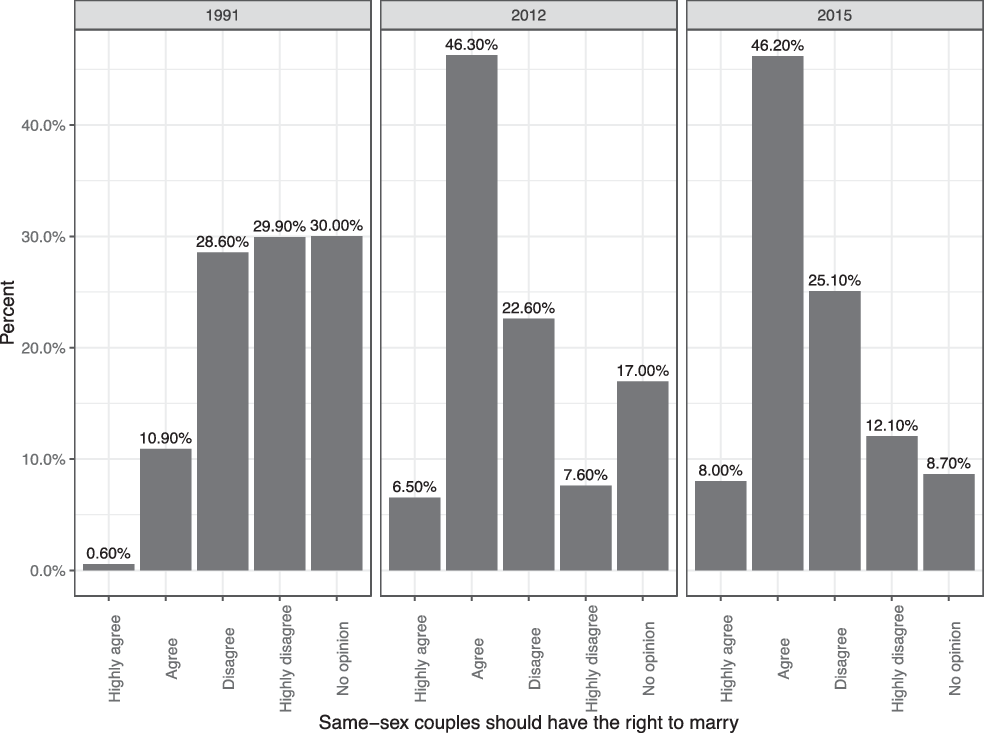
To examine the changes in Taiwanese public attitudes toward same-sex marriage, we have used data from the Taiwan Social Change Survey (TSCS) hosted by the National Science Council. This database tracks the long-term trends of social changes in Taiwanese society on various topics. In terms of the same-sex marriage topic, the TSCS tracked relevant public attitudes in the years 1991, 2012, and 2015. We can see that from 1991 to 2015, public attitudes shifted from a conservative leaning to a more liberal one. Overall, an increasing percentage of Taiwanese considered themselves to be gay-rights supporters.
A survey question asked whether respondents agreed or disagreed with the statement “Same-sex couples should have the right to marry.”Footnote 33 Figure 1 shows that, in 1991, only 11.5% of respondents responded affirmatively to the question (0.6% of respondents answered “Highly Agree” and 10.9% answered “Agree”), whereas 58.5% of respondents tended to oppose same-sex marriage (28.6% answered “Disagree” and 29.9% answered “Highly Disagree”). However, almost two decades later, public opinion on this issue had changed significantly. By 2012, the number of people who supported same-sex marriage had increased from 11.5% to 52.8% (6.5% answered “Highly Agree” and 46.3% answered “Agree”). And the percentage of people against same-sex marriage had dropped from 58.8% to 30.2% (22.6% answered “Disagree” and 7.6% answered “Highly Disagree”).
Taiwanese public opinion on same-sex marriage in 1991, 2012, and 2015.

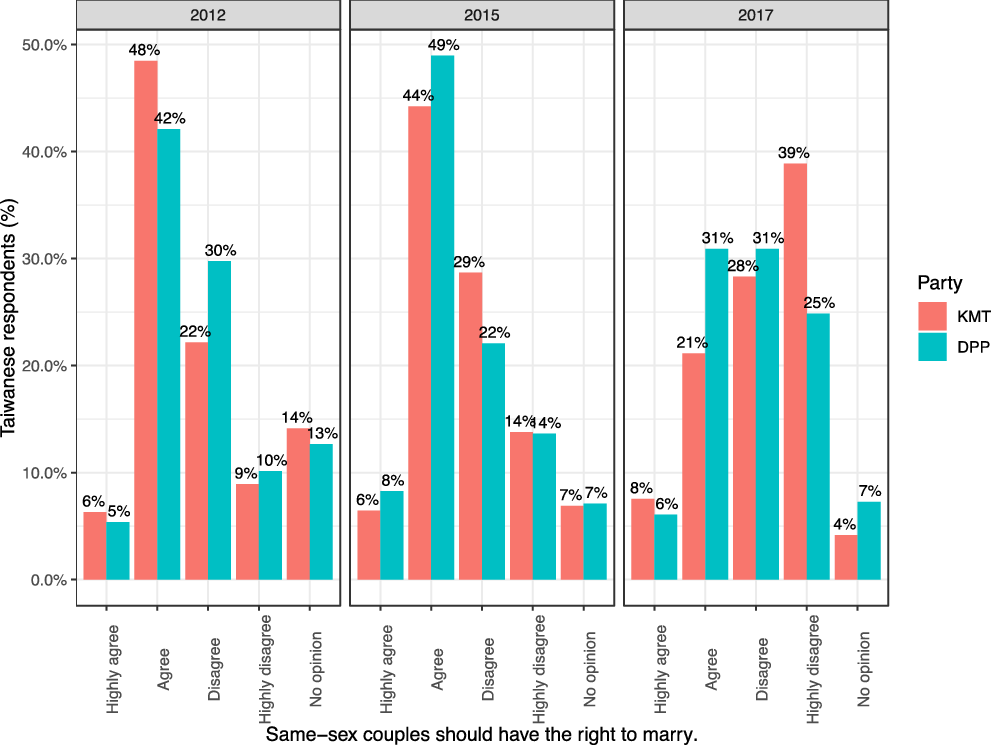
If we take a close look at who supported or opposed same-sex marriage, we can see that the controversy surrounding this policy created intra-party division, as well as cross-party division. The two major parties had to contend with diverse constituencies on this issue. To show just how split public opinion was on the issue of same-sex marriage within parties, we took the TSCS surveys from 2012 and 2015 and combined them with 2017 data from Taiwan’s Election and Democratization Study (TEDS).Footnote 34 Hence, we can visualize the distribution of these public attitudes in terms of respondents’ political affiliation. As we can see from Figure 2, the KMT and the DPP were similar to each other regarding the distribution of party-affiliated attitudes toward same-sex marriage policy.Footnote 35 In 2012, a good swath of Taiwanese society across party lines supported same-sex marriage,Footnote 36 with the surprising finding that more KMT adherents than DPP adherents expressed a willingness to embrace same-sex marriage.
Taiwanese public opinion on same-sex marriage across party affiliation.

We paid special attention to similarities between same-sex marriage attitudes in 2015 and those in 2017. The first time point, 2015, pre-dated the Constitutional Court’s same-sex marriage ruling of 2017. In 2015, roughly half of both KMT supporters and DPP supporters favoured same-sex marriage. More specifically, about 50%Footnote 37 of KMT supporters and about 57%Footnote 38 of DPP supporters favoured same-sex marriage in 2015. The second time point, 2017, was after the Court had handed down its same-sex marriage ruling, with both KMT and DPP voters expressing less support for same-sex marriage than they had two years earlier, suggesting a slight backslide. KMT voters’ support of same-sex marriage decreased by a whopping 21 percentage points between 2015 and 2017 while DPP voters’ support decreased by an equally impressive 20 percentage points.
The parallelism that characterized changes in KMT and DPP voters’ views on same-sex marriage policy suggests that the policy had significant intra-party dynamics. These dynamics, in turn, complicated the efforts of KMT and DPP legislators to reach a consensus on policy direction, thus weakening the chance that the Legislative Yuan might enact substantial progressive legislation on the matter.
As studies on American politics show, elected officials in the US Congress frequently measure the views of constituents before taking a policy position—the aim being to maximize re-election prospects.Footnote 39 Position-taking involves risks, and legislators know this. Thus, to minimize their electoral losses, many legislators avoid taking a firmly articulated stance when it might result in negative political fall-out.Footnote 40 In this vein, it is not hard to understand why the same-sex marriage Bill in Taiwan suffered from an observable absence of enthusiasm among legislators in 2016. If each of Taiwan’s two main political parties had enjoyed a base of supporters whose opinions on same-sex marriage had been homogeneous, legislators could have easily and safely taken a firm position on the matter. However, as we know, the respective voter bases of the KMT and the DPP were internally fractured when it came to the same-sex marriage issue. In addition to this complication, the very act of position-taking on same-sex marriage is so dichotomized that legislators cannot easily wax rhetorical in ways that create pleasant ambiguity or that point to an appealing middle ground on the political spectrum. Especially with regard to roll-call voting in Taiwan’s legislature, its elected officials faced an uncompromising binary choice: vote for or against the Bill. Therefore, given each party’s divided opinions on same-sex marriage policy, legislators had every reason to engage in position avoidance, including no action at all, so as to reduce potential electoral penalties.
4.3 The elite level
In this section, we examine how, in Taiwan, political elites’ attitudes toward the issue of same-sex marriage have changed in accordance with changing public opinion. As shown in the last section, each of Taiwan’s two major parties has been host to diverse, seemingly irreconcilable views on this issue. Thus, we expect that some legislators—if under the belief that a straightforward position would negatively affect their election results—either adopted a noticeably ambiguous position or engaged in position avoidance.
4.4 Data and coding
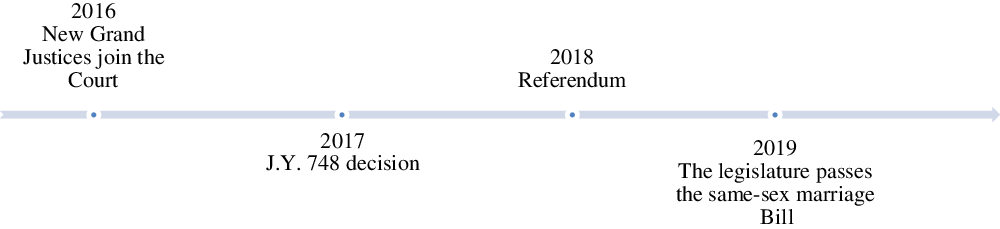
To track the changes in Taiwanese legislators’ attitudes toward same-sex marriage policy, we have collected data on our own. Specifically, we have coded legislators’ attitudes on the basis of two sources of information: their public statements in newspapers and their voting patterns in the legislature. We have observed legislators’ attitudes at four different time points: in 2016, 2017, 2018, and 2019. Moreover, we have chosen these four periods insofar as they represent four critical junctures in the development of the same-sex marriage issue in Taiwan: in 2016, a newly packed Constitutional Court was formed after the retirement of sitting Grand Justices.Footnote 41 The ruling party, the DPP, appointed seven new liberal Grand Justices to the seats, bringing a new political landscape to the Court. In 2017, the Court handed down the J.Y. 748 decision, followed, in 2018, by a multi-question referendum in nationwide local elections. In the referendum, both conservative groups and pro-gay social groups posed questions related to same-sex marriage. In May 2019, the Legislative Yuan passed the same-sex marriage Bill. Figure 3 outlines these four periods.Footnote 42
Data-collection timeline.

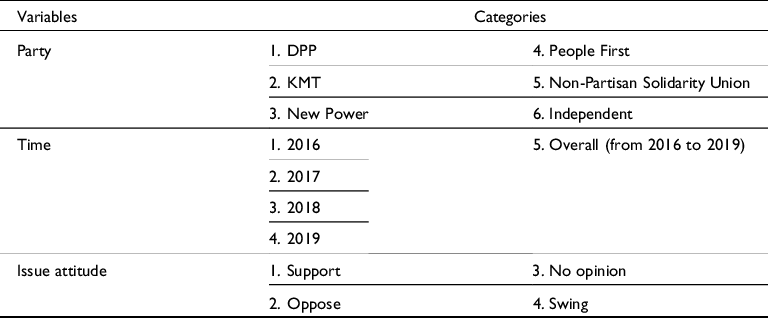
Our data collection covers the legislators serving in the Ninth Legislative Yuan. It was they who helped draft Taiwan’s same-sex marriage Bill. We coded the legislators’ attitudes for four categories: support, oppose, no opinion, and swing. We based the coding on legislative rhetoric, legislators’ interactions with social groups, and legislators’ voting behaviours. First, if we observed that a legislator had attended a pro-“marriage equality” event or had expressed support for an LGBT group publicly during one of the four periods, we coded the legislator’s attitude as “support” for that period. For example, one DPP legislator, Lin Shu-fen, publicly expressed her support for same-sex marriage in 2016, and a New Power Party legislator, Huang Kuo-chang, signed a memo in support of marriage equality in the same year. Their attitudes are both coded as “support” for that period.
In contrast, if we observed that a legislator had participated in an anti-LGBT event or expressed anti-“marriage equality” sentiments, we coded the legislator’s attitude as “oppose.” For example, one KMT legislator, Chien Tung-ming, signed a memo critical of marriage equality, and another KMT legislator, Fai Hung-tai, publicly expressed his advocacy for the aforementioned conservative organization Family Guardian Coalition. In both cases, we coded the two legislators’ attitudes as “oppose” for the relevant period.
If a legislator had attended events in both the “support” and “oppose” camps and exhibited an inconsistent attitude during one period, we coded the attitude as “swing” for the relevant period. And if a legislator had refused to commit to a clear position and had not cast a vote on the marriage-equality Bill during one period, we coded the legislator’s attitude as “no opinion” for the relevant period. Table 1 summarizes our key variables.
Main variables

Having identified the attitudes of legislators broken down on an annual basis across 2016, 2017, 2018, and 2019, we created an overall evaluation of the attitudes covering the four years as a single block of time. In the last part of this section, we qualitatively describe these overall changes. For instance, from 2016 to 2018, the party whip of the DPP, legislator Ker Chien-ming, was firmly against the marriage-equality Bill, yet in 2019, he cast his vote in favour of same-sex marriage. For his case, we assigned the following label to his overall attitude: from “oppose” to “support.”
4.5 Legislators’ attitudes
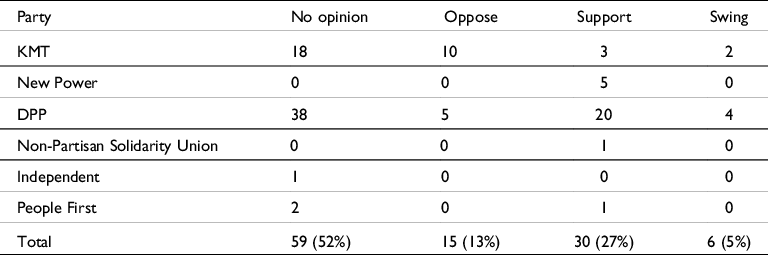
After collecting data on—and identifying—legislators’ attitudes for these four periods, we had to deal with the major question of how legislators’ attitudes had evolved from 2016 to 2019, the period in which the Constitutional Court issued its same-sex marriage ruling. First of all, when we look at the legislators’ attitudes around 2016 (see Table 2),Footnote 43 we can see a clear pattern wherein a majority of the legislators were avoiding taking a position: more than half of the legislators, when asked, chose not to reveal their positions on marriage equality or expressed inconsistent attitudes. Even though the DPP was the dominant party in 2016 and had more supporters of LGBT rights than the KMT had, a good number of DPP legislators fell under the “no opinion” category, refusing to take sides.
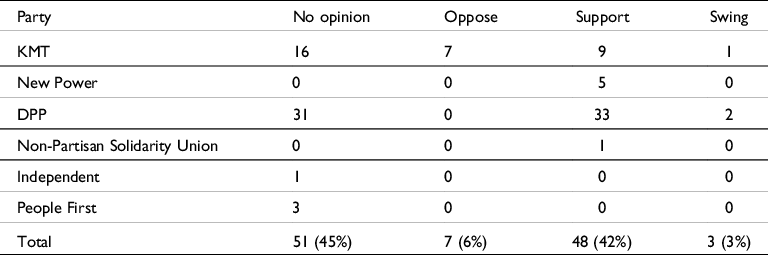
In 2017, the Constitutional Court handed down its same-sex marriage ruling. We can see that a majority in the legislature still tended to avoid staking out a clear policy direction (see Table 3), but no DPP legislator fell under the “Oppose” category, suggesting that the DPP had been unifying its members’ policy positions on this matter.
Legislators’ attitudes toward same-sex marriage in 2016

Legislators’ attitudes toward same-sex marriage in 2017

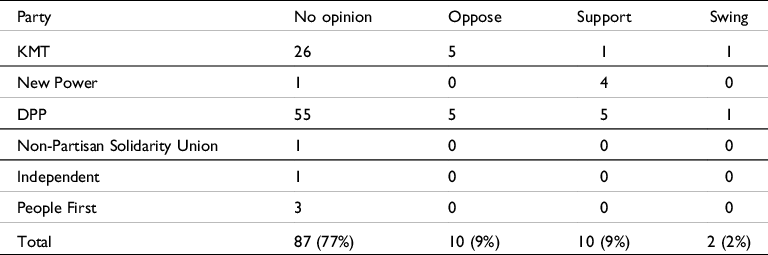
However, most striking was the year 2018—that is, the year after the Court had ruled in favour of same-sex marriage. In 2018, there was a huge decrease in the “Support” category of both parties (see Table 4). Clearly, KMT legislators opposed the marriage-equality Bill, but also, and somewhat surprisingly, a good number of DPP legislators had changed their attitudes and had joined the “Oppose” camp. It is possible that the same-sex marriage ruling had upset the public, and that legislators had found it necessary either to change their policy positions or at least to distance themselves from their previously vocal support of marriage equality.
Legislators’ attitudes toward same-sex marriage in 2018

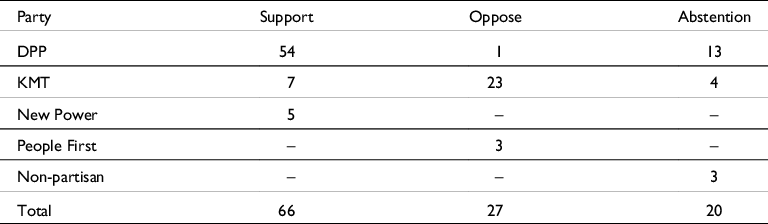
Finally, in 2019, legislators voted on the same-sex marriage Bill. The Bill was approved in a 67:27 vote, with 20 legislators abstaining. We present the 2019 legislature’s voting results in Table 5, which shows that most of the DPP legislators voted “yes” and most of the KMT legislators voted “no.” This voting pattern reflects the fact that, in the months preceding the vote, the two parties had been gradually unifying their respective policy positions and enforcing party discipline. In the next section, we further explore the voting patterns of both district legislators and legislators-at-large.
Legislators’ attitudes toward same-sex marriage on 2019’s roll-call vote

5. A comparison between district legislators and legislators-at-large
The Taiwanese Legislative Yuan is a unicameral legislature with 113 seats. Among the 113 seats, 79 are geographically based district seats and 34 are party-based seats. We refer to the former as “district legislators” and the latter as “legislators-at-large.” Currently, Taiwan uses a mixed-member majoritarian (MMM) system. Under the MMM system, voters make two choices on one ballot: one for a preferred district candidate and one for a preferred party. Voters’ first choice translates into a vote for a candidate who, if victorious, occupies a district seat and, thus, becomes a district legislator. In other words, district legislators are elected through a single-member district system in which candidates need to win a plurality of the popular vote in their respective districts. By contrast, voters’ second choice (for a preferred party) obviously is not a direct vote for a candidate, but a very indirect vote for the “legislators-at-large”: voters choose these legislators-at-large on the basis of proportional representation, which itself rests on citizen-voters’ second choice—their vote for their favourite political party.
These two types of elected officials represent voters differently. District legislators tend to have a local orientation, whereas legislators-at-large are expected to exhibit a broad orientation that reflects the needs of large districts. Moreover, electoral rules fundamentally shape the political landscape. As suggested by Duverger’s Law, single-member district systems (i.e. winner-takes-all electoral systems) are conducive to a two-party set-up. Wherever a winner-takes-all system is in place, the two parties’ respective policy positions tend to converge on median voters’ policy positions.Footnote 44 However, proportional-representation systems generate new small parties that reflect a range of citizens’ beliefs.Footnote 45 In Taiwan, given that the country has two electoral systems (i.e. a winner-takes-all system for the selection of district legislators and a proportional-representation system for the selection of legislators-at-large), legislators’ voting patterns might vary according to which of the two electoral systems was responsible for putting the legislators in office. Thus, in what follows, we provide a comparison between the policy positions of district legislators and the policy positions of legislators-at-large regarding same-sex marriage.
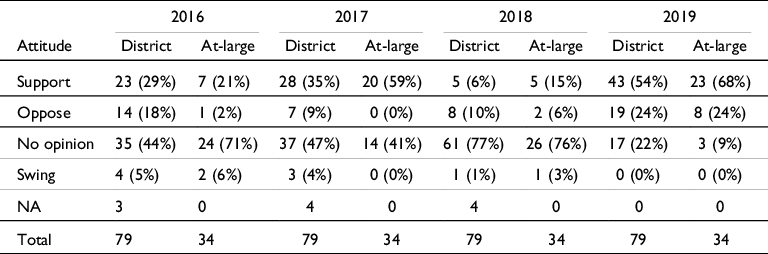
In Table 6, we present the percentages of district legislators and the percentages of legislators-at-large who exhibited one of the four previously discussed attitudes toward same-sex marriage in each of the four years from 2016 to 2019. We must first keep in mind that, at any given time, the total number of district legislators (79) is more than twice as great as the total number of legislators-at-large (34). Consequently, we provide both the percentages and the total numbers so that a complete comparison is possible. Regarding the specific numbers from 2016, we can see that district legislators (29%) were more likely than legislators-at-large (21%) to support gay marriage. However, in 2017, the Court handed down Interpretation 748, and legislators-at-large that year exhibited much more support for same-sex marriage (59%) than they had done the previous year, suggesting that they were not firmly bound to geographically based public opinion. Even more interesting is that in 2018, well after the same-sex marriage decision, both district legislators (77%) and legislators-at-large (76%) exhibited a high number of “no opinion” attitudes. This finding suggests that electoral pressure, both “for” and “against” same-sex marriage, was so intense that legislators felt compelled to avoid running counter to public opinion. In this regard, the two types of legislators exhibited a quite similar attitude, despite the vastly different selection mechanisms responsible for the legislators’ assumption of political office. Finally, in 2019, the year of the roll-call vote, we can plainly observe that an absolute majority of legislators-at-large (68%) supported same-sex marriage, as did district legislators (54%), though a significant percentage of the latter either opposed it (24%) or refrained from voicing a firm opinion on the matter (22%).
A comparison between district legislators and legislators-at-large

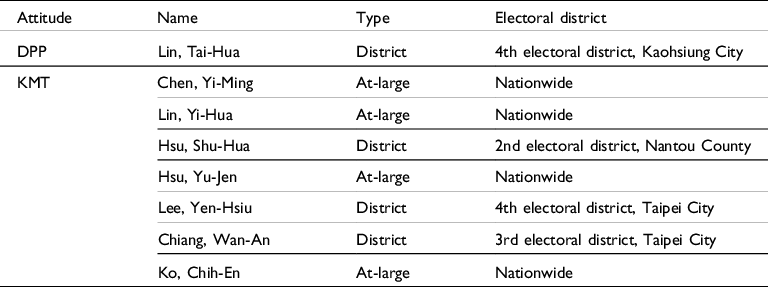
We can now take a close look at the non-compliant DPP and KMT legislators in the 2019 roll-call vote (see Table 7). Before the day of the vote, the DPP party whip asked DPP legislators to vote “yes;” likewise, the KMT party whip asked fellow party members to vote “no.” It is noteworthy that even though party leaders asked their members to align their policy position with that of the party leadership, one DPP legislator voted “no” and seven KMT legislators voted “yes.” In other words, they chose not to comply with their leaders’ urgings. The one DPP legislator who voted “no” was Lin Tai-Hua, a legislator representing a rural area (Renwu, Niaosong, Daliao, and Linyuan Districts) in the Kaohsiung City. In her case, the strong geographically based public opinion, which leaned toward a conservative rejection of same-sex marriage, pushed her to contravene party dictates. She was re-elected to the tenth term Legislative Yuan in 2020. Apparently, thus, her noncompliance brought her more benefit than harm.
Non-compliant legislators in the 2019 roll-call vote

The seven non-compliant KMT legislators consisted of three district legislators (Lee Yen-Hsiu, Chiang Wan-An, and Hsu Shu-Hua) and four legislators-at-large (Chen Yi-Ming, Lin Yi-Hua, Ko Chih-En, and Hsu Yu-Jen). Of the three district legislators, Lee and Chiang represented urban districts in Taipei, suggesting that their support for same-sex marriage was linked to geographically based public opinion: residents of densely urban areas tend to be quite liberal-minded about such matters as same-sex marriage. Representing a district in Nantou County, district legislator Hsu Shu-Hua is an “outlier” whose noncompliance with her party leadership is not easily explainable. Finally, the remaining four non-compliant legislators, being legislators-at-large, may be less bound to mainstream public opinion than district legislators are because voters do not directly elect them to office. Let us not forget that, despite both parties’ mobilization of their members, a good number of legislators (20 out of 113) chose to abstain from voting, suggesting that they tended to refrain from articulating a clear position on this issue.
5.1 Changes in legislators’ attitudes over time
In addition to examining legislators’ attitudes for each of the above-mentioned periods, we provide an overall evaluation of how legislators’ attitudes changed longitudinally. We place legislators’ behavioural patterns into four categories: (1) Still Support, (2) Still Oppose, (3) Take No Position, and (4) Swing.
Our definitions of the “Still Support” and “Still Oppose” categories are quite straightforward. Each one simply means that the legislators remained firmly for or against marriage equality between 2016 and 2019. Regarding the “Still Support” category, a good number of DPP legislators strongly supported marriage equality during this four-year stretch. Legislator Yu Mei-Nu is an example of this type of officeholder. A member of the DPP, she was the primary advocate of the marriage-equality Bill in 2016. Although her party faced substantial criticism for the Bill and the 2018 referendum defeat, Yu’s support for LGBT groups remained unchanged.
As for the “Still Oppose” category, most of the legislators who stood strongly against same-sex marriage throughout this extended period were KMT members. For example, KMT legislators Lai Shih-Bao and Fai Hung-Tai were the primary leaders of the groups that blocked the various drafts of the marriage-equality Bill submitted by pro-gay social groups. Even after the Constitutional Court rendered its decision on the matter, Lai criticized the Court, accusing it of having become a political tool for the DPP, and questioned the legitimacy of judicial policy-making in general.
Members of the “Swing” category, by our definition, are legislators who, between 2016 and 2019, held inconsistent policy positions on the same-sex marriage issue. Some of these individuals shifted from “Support” to “Oppose” while others went in the opposite direction. And some legislators simply transitioned to or from the “Take No Position” category. Located in this category is KMT legislator Huang Chao-Shun, who shifted from “Support” to “Oppose.” In 2014, when social groups advocating same-sex marriage held Pride Parade in Taipei and called for legislators to sign a statement in support of marriage equality, Huang responded positively.Footnote 46 What is more, the next year, Huang changed her Facebook profile photo to Pride Rainbow colours, signalling to the public her support for LGBT groups.Footnote 47 However, in 2018, right after that year’s referendum, Huang drastically changed her policy position and started to make public statements opposing marriage equality. She criticized the Executive Yuan for having proposed a draft of the marriage-equality Bill even though the referendum had signalled that the public was not ready for this step. Also, during a news conference held by a conservative group, she openly stated her belief that marriage should only be between a man and a woman.Footnote 48 KMT legislator Chen Shei-Saint exemplifies the shift from “Support” to “Take No Position.” Chen had publicly expressed his support for social groups advocating marriage equality; however, when he started to campaign for mayor of Taoyuan, he refused to reveal his policy position on same-sex marriage. Eventually, in 2019, he voted “no” on the same-sex marriage Bill.
The examples of legislators Huang and Chen are essentially cases of strategic ambiguity. The actions of these individuals, moreover, raise the critical question of when Taiwanese legislators began to change their public positions on marriage equality. Regarding Huang and Chen, they demonstrated their support for marriage equality before 2016, yet after the Court’s same-sex marriage ruling in 2017, the issue grew more heated, creating a critical point in time when the legislators started to shift their positions, usually under the tangible pressure of conservative constituents.
Another form of attitudinal shift involves a transition from “Take No Position” to “Support.” Chiang Wan-An (KMT), Lee Yen-Hsiu (KMT), and a few other young KMT legislators exhibited this changing attitudinal pattern. Given that the KMT’s policy approach to the marriage-equality issue had been relatively conservative over the years, Chiang, Lee, and the others usually refrained from making public statements that contradicted their party’s position; however, as the main constituents of these young KMT legislators were themselves young, they were, by virtue of their age, likely to support marriage equality. Thus, we can see why the resulting political pressure might have prompted Chiang, Lee, and their peers to vote “yes” on the same-sex marriage Bill of 2019.
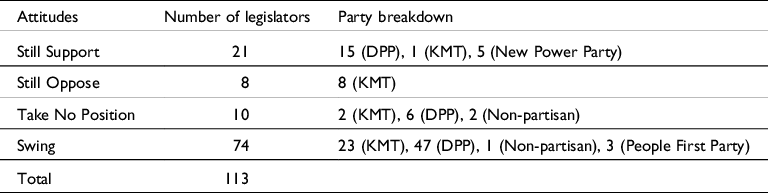
Overall, we have found that from 2016 to 2019, most of Taiwan’s national legislators fell under the “Swing” category; that is, they exhibited inconsistent policy positions with respect to marriage equality. Only a small percentage of legislators remained firmly for or against the progressive agenda. As Table 8 shows, during this 2016–19 period, only 21 members of the legislature remained supportive of the same-sex marriage Bill, and 15 of them were members of the DPP. Only eight members remained firmly opposed to the same-sex marriage Bill throughout the period, and they were all members of the KMT party. Again during this period, ten members consistently refused to take a position. And of particular note is the fact that 74 of the overall 113 legislators exhibited inconsistent attitudes, strongly suggesting that most of the Ninth Legislative Yuan’s elected officials were acting equivocally when dealing with the same-sex marriage policy.
The marriage-equality attitudes of the members of the Ninth Legislative Yuan from 2016 to 2019

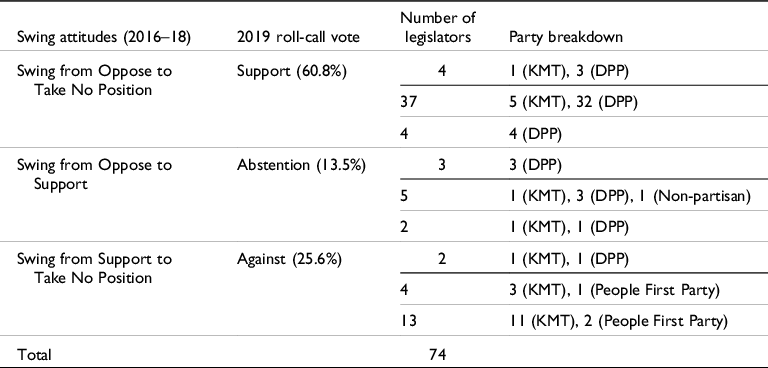
If we take a close look at the “Swing” category (see Table 9), we find that, of the legislators who exhibited inconsistent attitudes during this period, 60.8% voted “yes” for the same-sex marriage Bill in the 2019 roll-call vote; 13.5% chose to abstain, refusing to take a position; and 25.6% voted against the Bill.
The “swing” attitudes of the Ninth Legislative Yuan’s elected officials from 2016 to 2019

Three additional points merit our attention. First, of the legislators who shifted from either the “Oppose” stance or the “Take No Position” stance to the “Support” stance, most were DPP legislators, suggesting that the DPP has been trying to unify its position on the same-sex marriage issue before the 2019 roll-call vote. Second, we observed a similar pattern amongst KMT legislators, though in a different direction. Of all the legislators who shifted to the “Oppose” stance, most were KMT members, suggesting that the party was similarly trying to unify its position on this issue—in the KMT’s case, by pressuring its legislators to vote against the same-sex marriage Bill. Third, even though same-sex marriage was a heated issue and all political parties were aware that the public was attentively awaiting a resolution arising from the debates, at the 2019 Legislative Yuan roll-call vote on same-sex marriage, a sizable minority of legislators (13.5%) abstained from voting. These abstentions suggest that, even given the political parties’ apparent attempt to steer their respective officials to a particular vote, the fear of taking an unpopular stance on same-sex marriage was so intense that one in ten legislators preferred position avoidance. The resulting abstentions are even more impressive when we consider the informal, indirect, behind-closed-door punishments that the legislators might have suffered from their party leadership for having strayed from the party line (i.e. KMT opposition to the Bill, DPP support for the Bill).
5.2 Legislative rhetoric: ambiguity, deferral, and hostility
Upon taking a closer look at the Legislative Yuan’s rhetoric on marriage equality, we have identified three major patterns regarding how legislators engaged in position avoidance and how they used Taiwan’s Constitutional Court to further their political agendas.
First, legislators started to adopt ambiguous language when they were responding publicly to questions on same-sex marriage policy. The ambiguity took various forms: politicians tried to “nuance” their position; to bury it in a convoluted, drawn-out answer; or to dodge questions entirely. For example, DPP legislator Hsu Chih-Chieh, once supportive of marriage equality, started to behave equivocally after sensing just how controversial the issue had become among Taiwanese, many of whom were part of a conservative pushback against the progressive agenda. In 2016, when asked in public if he still supported same-sex marriage, he buried his answer at the end of an extended, nuanced statement that played to both sides of the issue: “I agree that we should create laws to protect the rights of gay couples, such as property rights and inheritance rights, yet these protections should not include marriage.”Footnote 49 When asked the question again shortly before the Legislative Yuan’s vote on the same-sex marriage Bill in 2019, he straight-out dodged the question, asserting that because same-sex marriage “is a very complicated issue, we are still in the process of studying it.”Footnote 50 He later chose to abstain from the roll-call vote in 2019.
A second major pattern characterizing legislators’ position avoidance rested on their invocation of the rule of law. They essentially argued that their policy positions were simply in keeping with statutory requirements. For instance, after the DPP unified its position on same-sex marriage in 2019, the party leader of the DPP, Ker Chien-Ming, stated in public that “although I personally oppose same-sex marriage, we still must contend with the Constitution. We must bow to it. No politicians, including the president, should stand on the opposite side of the law. This [compliance with the Court’s ruling] is what we must deal with.”Footnote 51
A third pattern was entrenchment by legislators in their ideological commitments. Because the process of judicial review can require politicians of any country to accept a particular policy, whether they like it or not, they can use court rulings as cover for rhetorical bombast; in other words, politicians might harden their position because they know full well that the courts have already decided the issue under discussion. For example, in the US, legislators in several state governments passed “symbolic” laws to regulate abortion after the Supreme Court’s Roe v. Wade decision (1973), protecting a woman’s right to have an abortion. These legislators, who supported the laws in the knowledge that the court system would quickly strike them down, could in turn publicly blame the courts for non-enactment of the laws and could avoid possible negative fall-out from the laws had they actually been enacted and enforced. In the context of the Taiwanese same-sex marriage Bill, a small group of deeply entrenched conservative legislators demonstrated this pattern. For instance, KMT legislator Lai Shyh-Bao criticized the Constitutional Court’s ruling by framing it as a political tool for the ruling party (the DPP) and belittled the legitimacy of the Court: “Are Grand Justices that important? The current Grand Justices have become the political handmaidens of President Tsai Ing-wen …. The Court issued this decision to help her honor her campaign promises.”Footnote 52
6. Conclusion
Many scholars of judicial systems seek to understand the concept of judicial independence and the relationship between judicial review and judicial activism. Most of this research has looked at the topic in relation to social reform. Our current study contributes to these discussions by explaining the political components of an activist judiciary as they concern Taiwan’s same-sex marriage Bill. We have argued that the risk of position-taking on a tough issue (marriage equality) compelled political elites (members of the Legislative Yuan) to engage in position avoidance and to embrace the political value in deferring to the Court’s ruling that protected gay marriage.
Using original data on legislators’ position-taking and the data from two surveys on public attitudes, we have argued that the divisive nature of the same-sex marriage issue in Taiwanese society not only ruled out the possibility that the Ninth Legislative Yuan would form a working consensus on the issue, but also drove members of the body to engage in position avoidance. The avoidance manifested itself in the form of ambiguous language, inconsistent policy positions, and voting abstentions. We have uncovered ample evidence of intra-party divisions over the marriage-equality issue: no consensus emerged in either the KMT or the DPP. As the debate over same-sex marriage policy intensified, a growing percentage of legislators changed their policy positions and used equivocal language when addressing the issue in public. Furthermore, a nontrivial percentage of abstentions characterized the voting on the same-sex marriage Bill in 2019. Overall, this evidence suggests that split public opinion on same-sex marriage mirrored and perhaps influenced intra-party splits in the KMT and the DPP, stoked the reluctance of legislators to legislate, and hardened their reliance on judicial policy-making as a means of position avoidance.
The threat of electoral sanction constrains not only legislators, but presidents as well. Even though Taiwanese society now regards same-sex marriage legislation as one of President Tsai’s most important political achievements, we contend that she has been less progressive than is commonly perceived. When, in 2015, Tsai first ran for re-election, she included marriage equality in her campaign platform, but it was never a focus, whether on the campaign trail or during her first term. Same-sex marriage, we should keep in mind, was not a heated issue at that time; politicians felt little pressure to include marriage equality in their manifestos.
After Tsai became president, same-sex marriage was a political thorn in her side: the public expected politicians to honour their promises, yet Tsai faced a deeply divided constituency. Thus, not surprisingly, Tsai made ambiguous statements about marriage equality during her first term. In 2017 at a public symposium, when asked whether or not she supported a modification of the Civil Code to protect same-sex couples, she provided an indirect answer: “[t]his is a generational issue. People hold different values and ideologies. It’s very difficult to form a consensus. In fact, a highly respected elderly peer of mine opposes it [same-sex marriage legislation].”Footnote 53 News media later found out that the senior to whom Tsai was referring was a prestigious priest, Kao Chun-min, from a Presbyterian church in Tainan. Kao was not only an influential activist among Christians, but also a well-respected activist among DPP supporters. He had served as a national policy adviser for the first DPP president, Chen Shui-bian. However, Kao was known for his opposition to same-sex marriage. It is not hard to imagine that Kao’s attitude toward same-sex marriage caused Tsai to hesitate before publicly supporting it.
However, when Tsai began to campaign for her second-term election, she faced a nontrivial threat. We propose that Tsai’s support for LGBT rights helped, rather than hurt, her election. Initially, Tsai had a difficult time campaigning for her second term. The public’s satisfaction with Tsai’s performance was low. Tsai was the first Taiwanese presidential incumbent to face an internal challenger in a party’s nominating process. In the past, the expectation was that presidential incumbents would campaign for their second term with the full support of their party. Yet during the DPP’s primary election, Tsai faced a strong DPP challenger, Lai Ching-te, who garnered substantial support within the party. Fears ran high that Tsai would lose the party nomination to Lai. Indeed, the electoral threat forced Tsai to seek additional support outside her existing constituencies—she needed a new political platform and a new mobilization strategy. Supporting same-sex marriage might be a risky move, but it could help Tsai attract additional support from minority groups and build a refreshing political image. By successfully pushing the Legislative Yuan to pass the same-sex marriage Bill in May 2019, Tsai won the DPP’s presidential nomination in June 2019 and the following presidential election. The high degree of recognition she received from international media and domestic social groups endowed Tsai with a significant amount of credit for her commitment to her campaign promises, which paved the way to her second presidency.
Another example of the reservations exhibited by both Tsai and the DPP regarding same-sex marriage occurred in 2019, when the Legislative Yuan, despite the Court’s groundbreaking decision on same-sex marriage, refused to grant same-sex marriage via a change to the existing Civil Code; instead, the Legislative Yuan made a new law—the Act for the Implementation of J.Y. Interpretation No. 748. This move signalled that Tsai and the DPP were still concerned with conservative public opinion.Footnote 54
Overall, our study has several implications for comparative research on courts and for targeted research on Taiwanese politics. Four implications, in particular, merit our attention here: legislative deferral, symbolic extremism, social reform through litigation, and Taiwan’s Constitutional Court as an instrument of position avoidance. First, when legislative deferral happens, elected officials take no action, often with the full knowledge that the judiciary will handle the matter. Taiwan’s handling of the marriage-equality issue depended on legislative deferral, which raises rather obvious accountability issues: when it occurs, citizens usually cannot strongly influence the institution that is “unnaturally” assuming responsibility for policy outcomes. For policy-making in democracies, legislatures are clearly more legitimate than high courts, most of which are composed of justices who do not have to face election.
A second implication of our study concerns symbolic extremism. Blaming a court for policy outcomes may encourage some politicians to adopt extreme policy positions as a symbolic gesture in the knowledge that the court system would strike down any laws resulting from the positions. The high visibility of judicial review also gives politicians a golden opportunity to publicize their positions by attacking the judiciary for unpopular, even if constitutionally sound, rulings. This political manoeuvring not only weakens the legitimacy of courts, but warps the behaviour of legislators as well.
The issue of litigation-based social reform leads us to a third important implication of our research. We have shown that, particularly when a society faces controversial political issues, litigation can be an effective way to implement social reforms and related policies. Studies on compliance with judicial decisions suggest that judicial policy-making might encounter executive resistance and implementation difficulties.Footnote 55 However, in the case of Taiwan, deep divisions in public opinion about same-sex marriage created, in legislators, a fear that any firmly held policy position would jeopardize their near-term electoral prospects. In this general scenario, social-movement activists might regard the third branch of government as a good alternative to the other two branches. We must bear in mind, though, that the executive and legislative branches should enforce judicial rulings and should strengthen them with related laws and policies.
Finally, our study suggests that a revised evaluation of the Taiwanese Constitutional Court is in order. After the Court ruled on the same-sex marriage issue, many legal scholars spoke highly of the institution and described it as a fount of progress. However, if we look at the political considerations behind this ruling, we find that this judicial policy-making was much less a challenge to the legislative or executive branches than a resolution to a heated issue that the legislative branch was unwilling or unable to settle. In this case, the judicial policy-making of the Constitutional Court was neither an act of judicial activism nor an affront to the legislature, but a mechanism of position avoidance widely, even if surreptitiously, embraced by many in Taiwan’s Legislative Yuan.
Overall, it is worth noting that the Court’s involvement in the political controversy comes at a price. After the same-sex marriage ruling, the Court unavoidably received increasing public criticism regarding its legitimacy of policy-making. Those political pressures rendered that the Court avoided sensitive political cases—the Court “decided not to decide.”Footnote 56 In 2018, the Taiwanese Constitutional Court dismissed at least two politically sensitive cases.Footnote 57 To this date, the Court’s hesitation of involving political issues remains. In 2020, the Constitutional Court dismissed a KMT legislators’ petition challenging the amendment to the Irrigation Act (a Bill to nationalize irrigation groups). The reform of irrigation groups is politically sensitive because KMT used to rely on irrigation groups as one of its mobilization networks. Those dismissals are examples of the Court’s hesitation of stepping into controversial policies. In our views, when the Court takes the blame for policy-making, it also comes with the price of hurting its legitimacy, which might push the Court to be cautious when granting future petitions for judicial reviews.
Acknowledgements
The first draft of this paper was presented at a CGOTS panel at the APSA 2019 Annual Meeting. We thank Wei-Ting Yen and the conference participants for helpful discussion. We also thank Ming-Sung Kuo, Hui-Wen Chen, Yu-Cheng Wang, the editor, and two anonymous reviewers for helpful comments.