INTRODUCTION
Gastrointestinal (GI) nematode infections are prevalent throughout human and livestock populations worldwide, particularly in developing countries. Although infections are not directly fatal, the morbidity arising from these chronic infections in humans surpasses that caused by malaria, measles or car accidents (Chan, 1997; Horton, 2003). Moreover, infections are believed to affect the growth (Stephensen, 1999) and cognitive ability (Nokes et al. 1992) of affected children. In livestock, they cause diseases that result in economic losses to farming communities worldwide (Waller, 2003), but especially among small-holder farmers in the tropics where nematode infections of small ruminants constitute the most important health-related impediment to productivity (Perry et al. 2002).
A range of different control strategies is available for GI nematode infections including the use of anthelmintics, grazing management and improvements in sanitation, but these control methods are associated with many problems, the most important being the rapid development and spread of resistance to the currently available chemotherapeutic anthelmintic drugs (Kaminsky, 2003; Kaplan, 2004). The selection pressure for the onset of resistance in nematodes stems primarily from the repeated, intensive use of the three main drug classes (the benzimidazoles, the imidazothiazoles, and the macrocyclic lactones) (Jackson and Coop, 2000; Wolstenholme et al. 2004), often combined with suboptimal dosages, but without involving non-chemotherapeutic practices, such as grazing management. Since each class of drugs has a specific mechanism of action (Martin, Robertson and Bjorn, 1997), resistance to one drug within each class automatically leads to resistance to all other drugs with the same mechanism of action (Michel, 1985). Anthelmintic resistance is not yet common amongst GI nematodes of humans, but already there are some indications that previously effective anthelmintics are losing efficacy (De Clercq et al. 1997; Reynoldson et al. 1997; Albonico et al. 2003). Resistance is now a major threat to sheep and goat farming in the Southern hemisphere, with multiple drug-resistant parasites present (Varady et al. 1993; Mwamachi et al. 1995; van Wyk, Malan and Randles, 1997; Waruiru, Ngotho and Mukiri, 1998). New synthetic anthelmintic drugs or vaccines are unlikely to be available in the near future, so alternative strategies for the control of these parasite infections are urgently required.
One potential alternative control strategy may be the use of natural plant products, such as the cysteine proteinases from the latex or fruit of plants, of which papaya (Carica papaya; Berger and Asenjo, 1940), pineapple (Ananas comosus; Berger and Asenjo, 1939) and fig (Ficus species; Robbins, 1930) are good examples. These plants have been used as traditional treatments against GI nematode infections by some indigenous peoples for centuries. The latex from papaya and fig has been shown to reduce the worm burden of mice infected with Heligmosomoides polygyrus (Satrija et al. 1995), pigs infected with Ascaris suum (Satrija et al. 1994) and humans infected with several GI nematodes (Hansson et al. 1986). Although early work with A. suum demonstrated that fig latex digested the nematode (Robbins, 1930; Hansson et al. 1986), this mechanism of action was not studied in detail until recently. Our earlier study (Stepek et al. 2005) confirmed that the anthelmintic mechanism of action of plant cysteine proteinases was indeed digestion of the cuticle of H. polygyrus. Although the plant proteinases may have a detrimental effect against H. polygyrus, a nematode that lives in the anterior of the small intestine, it is not known whether nematodes that live in the posterior of the gastrointestinal tract are also susceptible, or whether the plant proteinases fail to survive passage through the gastrointestinal tract of mammals, which is a hostile environment for proteins. It was therefore of interest to determine whether plant-derived cysteine proteinases would also damage nematodes that live in the large intestine. In this paper, we have assessed the efficacy of the crude and purified cysteine proteinases from papaya (Carica papaya), fig (Ficus carica and Ficus benjamina), pineapple (Ananas comosus) and kiwi fruit (Actinidia chinensis) in vitro against the murine GI nematode, Trichuris muris, which is found in the caecum, and which is closely related to T. vulpis and T. ovis of domestic livestock and T. trichiura of humans. We also investigated the anthelmintic properties of papaya latex, which is known to be a rich source of four cysteine proteinases, against T. muris in vivo.
MATERIALS AND METHODS
Materials
Fresh latex was collected from the cut stems and unripe fruit of the fig plants Ficus carica (variety Brown Turkey) and Ficus benjamina (University of Sheffield Experimental Gardens) and stored frozen. Upon thawing, 1 mM EDTA was added in a volume equivalent to the weight of latex. This latex/EDTA mixture was thoroughly vortexed and then centrifuged before collecting and storing the supernatant frozen. Protein fractions containing fruit bromelain [identifier C01.028 in the Merops peptidase database (http://merops.sanger.ac.uk)] and actinidain (C01.007) were obtained by acetone precipitation of pulverized pineapple fruits and kiwi fruits, respectively. Papain (C01.001), chymopapain (C01.002), ficin (C01.006), stem bromelain (C01.005), Carica papaya latex, L-trans-epoxysuccinyl-leucylamido(4-guanidino)butane (E-64) and L-cysteine base were purchased from Sigma Chemical Company, UK. The stem bromelain preparation may also contain small quantities of ananain (C01.026) and comosain (C01.027) (Rowan, Buttle and Barrett, 1990). The substrates benzoyl-arginyl-p-nitroanilide (Bz-Arg-pNA), benzyloxycarbonyl-phenylalanyl-arginyl-p-nitroanilide (Z-Phe-Arg-pNA) and benzyloxycarbonyl-arginyl-arginyl-p-nitroanilide (Z-Arg-Arg-pNA) were purchased from Bachem UK Ltd.
Enzymes
The enzymes used throughout the in vitro study were purified cysteine proteinases that occur naturally in fruits and latices of a number of plants: papain and chymopapain from the latex of the papaya plant (Carica papaya; Zucker et al. 1985), ficin from the latex of the fig plant (Ficus carica; Kramer and Whitaker, 1964), stem bromelain from the stem of the pineapple plant (Ananas comosus; Rowan et al. 1990), fruit bromelain in protein precipitate from pineapple fruit (Ananas comosus; Rowan et al. 1990), and actinidain in protein precipitate from kiwi fruit (Actinidia chinensis; Sugiyama et al. 1997). In addition, total ‘crude’ latex was used from C. papaya, F. carica and F. benjamina. C. papaya latex was used for the in vivo experiments.
Active-site titration of cysteine proteinases
In order to standardize all enzyme preparations, the operational molar concentration of active cysteine proteinase was determined by active-site titration with L-trans-epoxysuccinyl-leucylamido(4-guanidino)butane (E-64), as described previously (Stepek et al. 2005).
Animals
For the in vitro experiments, female BKW mice were purchased from Charles River UK Ltd at 6 weeks of age and infected at 7 weeks of age, and male C57BL/6 mice were purchased from Charles River UK Ltd at 5 weeks of age and infected at 6 weeks of age. For the in vivo experiments, male C57BL/6 mice were obtained from Charles River UK Ltd at 5 weeks of age and infected at 6 weeks of age. The animals were provided with food and water ad libitum. All animal procedures were carried out under UK Home Office licence numbers 40/2621 and 40/2242, and under the regulations of the Animals (Scientific Procedures) Act 1986.
Parasites
BKW mice were immunosuppressed by exposure to 450 rad. gamma-irradiation (137Caesium source) (Soltys, Goyal and Wakelin, 1999) for 30 sec immediately prior to oral infection with a suspension of 400 T. muris embryonated eggs (Sobreda strain; isolated from mice in Portugal by J. Behnke) in 0·2 ml of distilled water. Then 0·1 ml of hydrocortisone acetate at 1·25 mg/ml was injected subcutaneously on days 4, 7, 11 and 14 post-infection (p.i.) for continual immunosuppression (Lee and Wakelin, 1982). From 35 days p.i., mature male and female worms were available for use in vitro. The mice were killed by exposure to CO2, and the caecum was removed and opened with fine forceps. This was placed into a Petri dish containing pre-warmed (37 °C) Hanks' Balanced Salt Solution (HBSS) for approximately 1–2 h to allow the worms to detach. The adult male and female worms were identified by observation under the microscope, separated and washed in pre-warmed (37 °C) HBSS before use.
For provision of immature (L2 and L4) worms, C57BL/6 mice were immunosuppressed by exposure to 450 rad. gamma-irradiation (137Caesium source) (Soltys, Goyal and Wakelin, 1999) for 30 sec immediately prior to oral infection with a suspension of 400 T. muris embryonated eggs (Sobreda strain) in 0·2 ml of distilled water. For continual immunosuppression (Lee and Wakelin, 1982), 0·1 ml of dexaforte at a 1 in 100 dilution was injected subcutaneously on days 7, 10, 12, 14 and 17 post-infection (p.i.). On days 10–13 p.i., L2 of T. muris were present for in vitro use, and on days 26–28 p.i., L4 of T. muris were available for use in vitro (Fahmy, 1954; Panesar, 1989). For provision of immature (L3) worms, 100 embryonated eggs of the Sobreda strain of T. muris were administered orally in 0·2 ml of distilled water to C57BL/6 mice, without immunosuppressive therapy. On day 20 p.i., L3 of T. muris were present for in vitro use (Fahmy, 1954; Panesar, 1989). The mice were killed by exposure to CO2, and the caecum and large intestine were removed and opened with fine forceps. They were placed into a Petri dish containing pre-warmed (37 °C) HBSS and, for retrieval of the L2 and L3 only, the mucosa was scraped off using a clean microscope slide. The worms detached during a 1–2 h incubation at 37 °C. The L2, L3 and L4 were identified by observation under the microscope and washed in pre-warmed (37 °C) HBSS before use.
Effects of enzymes on adult worm survival
The effects of the cysteine proteinases on the motility of the adult male and female worms were determined following the method described previously by Stepek et al. (2005) for Heligmosomoides polygyrus, using the following concentrations of active enzymes: 0–100 μM (25 μM increments) papain, 0–200 μM (50 μM increments) chymopapain, 0–200 μM (50 μM increments) crude papaya latex proteinase, 0–300 μM (50 μM increments) F. carica latex proteinase, 0–500 μM (100 μM increments) F. benjamina latex proteinase, 0–50 μM (10 μM increments) ficin, 0–150 μM (50 μM increments) stem bromelain, 0–200 μM (100 μM increments) fruit bromelain and 0–300 μM (100 μM increments) actinidain. At the same time, adult male and female worms were incubated with either 200 μM crude papaya latex or 150 μM stem bromelain after inhibition of the cysteine proteinases in both preparations by the addition of 3 mM E-64. These enzymes were prepared in HBSS with 16 mM L-cysteine, and the motility of the worms was recorded every 15 min for 2 h using a motility scale from 0–5, where 5 was the most active (Stepek et al. 2005).
In separate experiments, 1 male and 1 female worm were removed from plates containing either 25 μM papain, 200 μM chymopapain, 200 μM crude papaya latex proteinase, 300 μMF. carica latex proteinase, 500 μMF. benjamina latex proteinase, 30 μM ficin, 150 μM stem bromelain, 100 μM fruit bromelain, 200 μM actinidain, or HBSS with and without 16 mM L-cysteine, every 30 min for 2 h, and fixed in 2·5% glutaraldehyde in 0·1 M phosphate buffer, pH 7·2 for 1 h. These worms were then prepared for scanning electron microscopy (SEM), as previously described (Stepek et al. 2005).
Effects of enzymes on the motility of the immature stages of Trichuris muris
The effects of the cysteine proteinases on the motility of the L2 to L4 stages were determined following the method described for the adult worms, using the following concentrations of active enzymes: 100 μM papain, 200 μM–300 μM crude papaya latex proteinase, 30 μM ficin, 200 μM–300 μM stem bromelain and 300 μM actinidain. These enzymes were prepared in HBSS with 16 mM L-cysteine, and the motility of the L3 and L4 was recorded every 15 min for 2 h using a motility scale from 0–5, where 5 was the most active. The effects of these enzymes on the L2 stage were additionally determined by observation of the cuticle using a high-power microscope.
Effect of papaya latex treatment on Trichuris muris mature and immature worm infections
Fifty or 100 embryonated eggs of the Sobreda strain of T. muris were administered orally in 0·2 ml of distilled water to groups of 6 C57BL/6 mice, without immunosuppressive therapy. Low doses were given to these mice, compared to the mice used for examining the effect of papaya latex on the immature parasite stages (see below), because only low parasite burdens survive to patency without immunosuppressive therapy, larger worm burdens being rapidly rejected from the murine host (Behnke and Wakelin, 1973). Faecal egg counts, using McMaster flotation chambers and 40% saturated zinc sulphate, were carried out on days 42, 44, 46 and 48 p.i., prior to enzyme treatment, and also on days 49, 51, 53 and 55 p.i. post-treatment, and the results were expressed as eggs per gram of faeces (EPG). Crude papaya latex (3·13 g) was dispersed in 5 ml of sterile distilled water, prior to filtration. 0·2 ml of the papaya latex preparation (containing 337 nmol of active enzyme) or 0·2 ml of sterile distilled water, as control, was administered daily via the oral route on days 48–54 p.i. The mice were killed on day 55 p.i. by exposure to CO2, and the caecum and large intestine were removed and stored at 4 °C. They were placed into a scored glass Petri dish containing HBSS, one at a time, and opened with fine forceps. The adult male and female worms were identified by observation under the microscope, collected in a universal and counted to determine the worm burdens.
In a separate experiment to assess the in vivo efficacy of papaya latex against earlier developmental stages of the parasite (the L2 stage, which are almost entirely within the mucosa, unlike adults that extend the posterior section of the body into the gut lumen), 200 embryonated eggs of the Sobreda strain of T. muris were administered orally in 0·2 ml of distilled water to groups of 6 C57BL/6 mice, without immunosuppressive therapy. Crude papaya latex (2·5 g) was dispersed in 4 ml of sterile distilled water, prior to filtration and 0·2 ml of the papaya latex preparation (containing 617 nmol of active enzyme) or 0·2 ml of sterile distilled water was orally administered daily on days 11–17 p.i. The mice were killed by exposure to CO2 and autopsied on day 21 p.i., and the caecum and large intestine were removed. The mucosa was scraped off using a clean microscope slide and the numbers of worms present were recorded.
Statistics
All the in vitro motility experiments were analysed using repeated measures ANOVA (rmANOVA) in SPSS (version 9.0). For analysis of changes in motility with time, we fitted time as the within-subject factor. Enzyme (where several extracts were being compared) and cysteine (presence/absence) were fitted as between-subject factors, as relevant, and the concentration of latex or enzyme as a covariate, in full factorial models that incorporated all possible interactions. When the data did not meet the requirements of sphericity (Mauchley's Test of Sphericity), we used the Huynh-Feldt adjustment to the degrees of freedom to interpret significance on the side of caution. The linear and curvilinear lines illustrated on the figures were fitted using polynomial regression in Microsoft Excel.
Faecal egg counts, assessed as part of the in vivo experiments, were analysed by rmANOVAs in SPSS on log10 (EPG+25) transformed data, with time after infection as the within-subject factor, and treatment (papaya latex or water) and intensity of infection (dose level of eggs administered) as the between-subject factors. Worm burdens were analysed by 2-way ANOVAs or the non-parametric Mann-Whitney U-test and whilst, for the former, we explored models based on transformed data and with negative binomial error structures, the best fit for the adult worm data was a model based on the raw worm counts. All parametric models were assessed for goodness of fit by R2, and residuals were checked for normal or negative binomial distribution, as relevant. The final statistical models fitted to the data are explained more comprehensively in the Results section.
RESULTS
Incubation of worms with different enzyme preparations in vitro
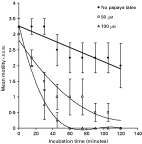
It was apparent from the motility assays that as time progressed, movement of the worms became slower, even in the Hanks' saline control incubations, but loss of motility was not as rapid for these worms as compared to the worms incubated in the presence of enzymes (Fig. 1 shows papaya latex as an example). Only the worms in the kiwi fruit extract preparation showed no significant difference from those in the Hanks' solution (data not shown). All the other cysteine proteinase preparations caused a rapid detrimental effect on T. muris adult worms. These worms clearly demonstrated signs of damage to the cuticle from 30–45 min, which was associated with a reduction in motility as the damage quickly progressed (as observed under the light microscope), eventually leading to the worms releasing their internal structures. As shown previously (Stepek et al. 2005) with the adult worms of another rodent gastrointestinal nematode, Heligmosomoides polygyrus, this effect was solely due to the cysteine proteinases present, because the nematocidal effect was completely abolished by pre-incubation of the enzyme preparations with E-64 (Table 1). Table 1 summarizes the LD50 values for the plant cysteine proteinases after a 90 min incubation with Trichuris muris adult male and female worms, and the time at which cuticle damage was first observed.

Fig. 1. Loss of motility of Trichuris muris adult worms during incubation in vitro with varying concentrations of papaya latex. Either linear or curvilinear lines were fitted to the data in Microsoft Excel. Overall loss of motility with time was significant (rmANOVA, with time as the within-subject factor and concentration of papaya latex as a covariate; main effect of time, F4·7,84·8=12·5, P<0·001). There was also a significant interaction between time and the concentration of papaya latex (F1,18=19·7, P<0·001).
Table 1. LD50 values for plant cysteine proteinases, derived from dose-response relationships, after a 90 min incubation with Trichuris muris adult worms in vitro, and the length of time for these enzyme preparations to damage the nematode cuticle (The enzymes were incubated with the worms in Hanks' solution in the presence of 16 mM L-cysteine at 37 °C for 2 h.)

This detrimental effect of plant cysteine proteinases observed with the adult worms of T. muris was also observed with the L3 and L4 stages of this nematode, with papain, papaya latex, stem bromelain and ficin causing a significant decrease in worm movement (data not shown). The L3 and L4 incubated with these effective enzyme preparations demonstrated progressive damage to the cuticle from 30 min, which coincided with the decline in movement. After a 2 h incubation at 37 °C, in the presence of these plant cysteine proteinases, cuticular damage to the surface of the L2 stage was evident, resulting eventually in the larvae releasing their internal structures (results not shown), in a similar way to that observed for the adult worms.
SEM of worms incubated with plant cysteine proteinases
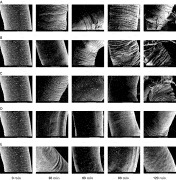
The cuticle of T. muris was observed, using SEM, at equivalent points along the body of adult male and female worms over a 2 h time-course. Fig. 2 shows that the damage to the cuticle of T. muris adult worms was consistent with the effects observed by light microscopy during the worm motility assays. Fig. 2D and E illustrate the lack of cuticle disruption following incubation in the kiwi fruit extract (containing active actinidain) and in Hanks' saline with cysteine. However, as is evident from Fig. 2A–C, papaya latex, fig latex and pineapple fruit extract (containing active cysteine proteinases) caused progressive damage to the cuticle, beginning with the appearance of transverse wrinkles, followed by blistering and, finally, less localized cuticle digestion with expulsion of the worm intestine and other internal structures from points along the worm surface. Although these enzymes displayed a similar effect with T. muris to that previously documented with H. polygyrus (Stepek et al. 2005), the damage took slightly longer to occur.

Fig. 2. Scanning electron micrographs of Trichuris muris adult worms exposed to a variety of natural plant cysteine proteinases in vitro in Hanks' solution containing 16 mM cysteine base at 37 °C. Clear evidence of damage to the cuticle can be seen from 60 min in 200 μMCarica papaya latex (A), 300 μMFicus carica latex (B), and 100 μM fruit bromelain (C). Note the transverse wrinkling by 30 min leading to signs of cuticle digestion by 120 min. In contrast, worms incubated in either 200 μM actinidain (D) or HBSS and 16 mM L-cysteine alone (E) showed little sign of cuticular damage, even after a 120 min incubation. Scale bars=100 μm.
In vivo anthelmintic efficacy of plant cysteine proteinases against mature Trichuris muris worms
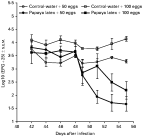
In view of the potent anthelmintic effect in vitro of the cysteine proteinases from papaya, pineapple and fig described above, a representative enzyme preparation, papaya latex, was tested in vivo against T. muris. Figs 3 and 4 summarize data clearly showing that the papaya latex cysteine proteinases possessed potent anthelmintic activity against T. muris adult worms, in mice infected initially with either 50 or 100 eggs of T. muris. As can be seen (Fig. 3), faecal egg counts in the water-treated groups remained steady, whilst those in the latex-treated animals fell sharply soon after treatment began, with this divergence in faecal egg counts between treatment groups being significant (2-way interaction between time and treatment, F4·7, 84·5=16·4, P<0·001). There was also a highly significant overall difference between treatment groups (main effect of treatment, F1,18=20·3, P<0·001). The anthelmintic efficacy of papaya latex was similar in percentage terms (91·5% and 97·8% reduction for groups infected with 50 and 100 eggs, respectively, by day 55 p.i.) for both intensities of infection (2-way interaction between treatment and intensity of infection, P=NS). No other interactions in the statistical model were significant, but there was a significant overall effect of time (main effect of time, F4·7,84·5=19·9, P<0·001) and an expected main effect of intensity of infection, with the mice exposed to the heavier inoculum passing more eggs in their faeces (main effect of intensity of infection, F1,18=9·3, P=0·007). This reduction in egg output was due to the reduction in the number of worms present and was consistent with the reduction in worm numbers (see below).

Fig. 3. The faecal egg output of mice infected with Trichuris muris and treated with 0·2 ml of filtered crude papaya latex in sterile distilled water. Mice were infected with either 50 or 100 eggs and were then treated for 7 days from day 48 p.i. Faecal egg counts were performed on days 42, 44, 46, 48, 49, 51, 53 and 55 p.i. For statistical analysis and interpretation of the data, see the main text.

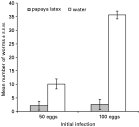
Fig. 4. The worm burden of mice infected with Trichuris muris and treated with 0·2 ml of filtered crude papaya latex in sterile distilled water. Mice were infected with either 50 or 100 eggs and were then treated for 7 days from day 48 p.i. The worm burdens were determined on day 55 p.i. For statistical analysis and interpretation of the data, see the main text.
As with the faecal egg counts, the reduction in worm burdens at day 55 p.i. was significant (2-way ANOVA with treatment and intensity of infection as factors on worm burdens; model R2=91·6%; main effect of treatment, F1,18=138, P<0·001) (Fig. 4), but the efficacy varied depending on the intensity of infection (78·4% and 92·7% reduction for mice infected with 50 and 100 eggs, respectively), being more effective in the mice carrying the heavier worm burdens (2-way interaction between treatment and intensity of infection, F1,18=51·5, P<0·001). As expected, mice exposed to the higher inoculum carried heavier worm burdens (main effect of intensity of infection, F1,18=55·1, P<0·001).
In vivo effect of papaya latex on immature Trichuris muris worms
When mice infected with 200 eggs were treated with papaya latex earlier during the infection (for 7 days from day 11 p.i.), there was no significant difference in parasite burdens when the number of worms was assessed on day 21 p.i. (mean worm recovery for the control group=63·0±28·0 and for the treated group=92·7±15·8, n=6 for both groups; Mann-Whitney U-test, z=−1·28, P=NS). Therefore, papaya latex does not appear to possess the same in vivo anthelmintic activity against the L2 stage of T. muris as it does against the adult worms of this nematode.
DISCUSSION
This study has demonstrated conclusively that the anthelmintic efficacy of various plant cysteine proteinases observed in our previous study with Heligmosomoides polygyrus (Stepek et al. 2005) is not species-specific, as these enzymes are comparably effective against the adult worms of Trichuris muris, a parasite that occupies the large intestine, predominantly living in the mouse caecum. Adult worms of this species were affected during in vitro incubation in the presence of most of the plant cysteine proteinases tested. When a representative source of the enzymes, papaya latex, was administered in vivo, it proved effective at reducing both faecal egg output within a day or two of commencement of treatment, and worm burdens at autopsy several days later. Thus, sufficient quantities of proteinase must survive passage through most of the murine intestinal tract to provide anthelmintic activity in the caecum. In this context, additional experiments showed that relatively high enzyme activity persisted in the large intestine for at least 2 h after treatment, and intensified with time from administration (Stepek et al. unpublished observations). Our current observations indicate that the mechanism of action of the anthelmintic plant cysteine proteinases is similar, if not identical, for both T. muris and H. polygyrus, namely digestion of the cuticle, leading to the death of the nematode. This cuticular damage correlated with loss of motility of the parasites, indicating that damage to the cuticle is the crucial mode of action of these proteinases.
The only plant cysteine proteinase examined which showed no detrimental effect on T. muris adult worms was actinidain from kiwi fruit juice, which, in our earlier study, also had no effect against H. polygyrus adult worms (Stepek et al. 2005). This suggests a common molecular target in the cuticles of these two nematode species, which is resistant to hydrolysis by actinidain but susceptible to the action of the other proteinases. It is worth noting that actinidain is very similar in substrate specificity and structure to many other members of the papain family (Varughese et al. 1992), making the clear distinction in anthelmintic efficacy truly remarkable. The arrangement of the amino acids in the hydrophobic binding site is not identical for both enzymes however, suggesting that discrimination between possible substrate structures is feasible (Baker, 1980; Brocklehurst, Baines and Malthouse, 1981; Salih et al. 1987; Kowlessur et al. 1989). The target proteins in the cuticle for the efficacious cysteine proteinases still remain unknown.
The previously available in vivo data indicate that the enzymes in the crude latex of papaya and fig are efficacious in reducing the worm burdens and egg outputs of mice infected with H. polygyrus (Satrija et al. 1995), pigs infected with Ascaris suum (Satrija et al. 1994), and humans infected with Ascaris, Trichuris or Ancylostoma/Necator (Hansson et al. 1986). Our more recent study confirmed the in vivo anthelmintic efficacy of papaya latex in mice infected with H. polygyrus, but additionally showed that it is entirely dependent on the catalytic activity of the cysteine proteinases present (Stepek et al. manuscript in preparation). In the current study, we have established that papaya latex also has efficacy against T. muris in vivo, irrespective of the level of the initial infection and despite the localization of this parasite in the caecum, indicating that these enzymes remain active during passage through almost the entire gastrointestinal tract. Because the activity of the cysteine proteinases is pH-sensitive, the enzymes may become temporarily inactive when passing through parts of the gastrointestinal tract, such as the stomach (with a pH as low as 2). This may explain our findings of a lack of in vivo efficacy against a nematode residing in the stomach (Stepek et al. manuscript in preparation). Another concern was the enzymes' ability to survive the digestive activity of the intestinal enzymes during passage through the entire mammalian intestine. However, the potent in vivo efficacy of papaya latex against T. muris adult worms, which was clearly demonstrated in our experiments, indicates that despite the potential hazards of low pH and hostile intestinal proteinases, sufficient activity was retained to damage and expel worms from the large intestine and, as stated above, the persistence of enzyme activity in the large intestine for more than 2 h would aid in this expulsion of worms from the posterior region of the intestinal tract.
Although papaya latex was shown to greatly reduce the worm burden and egg output of mice infected with T. muris adult worms, this treatment did not appear to have any effect on the worm burden of mice infected with the immature worms (L2) of this species. This may indicate that papaya latex cannot penetrate the mucosa of the GI tract, where the immature T. muris worms are found. The immature stages of T. muris live in mucosal tunnels within the enterocytes, and in the early stages of development, probably do not expose much, if any, of their cuticle to the intestinal lumen (Lee and Wright, 1978). As this study has demonstrated, the L2 stage of T. muris (and also the L3 and L4 stages) readily succumbs to the detrimental effect of plant cysteine proteinases in vitro, indicating that their surface is susceptible to attack by cysteine proteinases. The failure of papaya latex to reduce worm burdens in vivo at this early stage of infection is therefore most likely attributable to the lack of contact between the latex and the surface of these juvenile worms during its passage down the intestinal lumen. If this proves to be the case, it suggests that plant-derived cysteine proteinases will be ineffective against nematodes that live in the mucosal tissues, and hence activity may be entirely confined to lumen-dwelling stages and species of nematodes.
The experiments reported in this paper clearly add weight to the concept that plant cysteine proteinases are viable potential candidates for an alternative method of control urgently needed for GI nematode infections of humans and livestock. Not only are they effective against worms that inhabit the small intestine, sufficient activity is retained by papaya latex to make a marked, significant impact on T. muris worm burdens in the large intestine. It remains to be determined if their use is practicable in ‘the field’, and whether these laboratory assessments can be utilized to develop a formulation that will show comparable efficacy in monogastric as well as ruminant hosts naturally exposed to nematode challenge.
The authors acknowledge the Leverhulme Trust (F/00114/P) for a research grant held by J.M.B., D.J.B. and I.R.D. We thank Steve Ellin and the late Ken Cartmell (Tapton Experimental Gardens, University of Sheffield) for their help in the maintenance of the fig trees and in the collection of the latex. Finally, we are sincerely grateful to Simon Clifford and Tim Smith for excellent technical assistance in parasite maintenance and electron microscopy.