INTRODUCTION
Psychiatric intensive care units (PICUs) typically contain patients who are difficult to manage on open wards. In the United Kingdom, these units are more likely to use antipsychotic drugs and to use medications for rapid tranquilisation than open wards (Brown & Bass, Reference Brown and Bass2004). Antipsychotic medication carries a risk of significant dose related side effects, affecting both the mental and physical health of patients. High dose prescriptions of antipsychotics are regarded as a clinical necessity by some psychiatrists and can be the result of polypharmacy (i.e. the concurrent use of two or more antipsychotics) (Paton et al. Reference Paton, Barnes, Cavanagh, Taylor and Lelliott2008). These prescriptions persist in clinical practice despite the lack of convincing evidence for their use and it may be that, as one recent editorial proposed, ‘the concept that more antipsychotic(s) must always be or might be, ‘better’ is virtually groundless’ (Taylor, Reference Taylor2010). This practice therefore remains a concern for psychiatrists and their patients alike. Evidence based prescribing may provide a partial solution to this clinical dilemma. The Royal College of Psychiatrists (RCPsych) has produced a series of consensus statements on the use of high dose antipsychotics. These have consistently recommended observation of the British National Formulary (BNF) dose limits where possible, recording the reasons for use of high or combination dosages, reviewing the use of ‘as required’ or pro re nata (PRN) prescriptions and conducting clinical audit of prescribing (Royal College of Psychiatrists, 1993, 1997, 2006). Clinical audit has been used to review prescribing practice in a PICU (Cornwall et al. Reference Cornwall, Hassanyeh and Horn1996) and was used for a major review of antipsychotic prescribing in the United Kingdom, the Prescribing Observatory for Mental Health-UK (Royal College of Psychiatrists, 2009). We completed a clinical audit to evaluate anti-psychotic prescribing practice on the Hollywell Unit, a 4-bed PICU at Hillcrest Hospital, Redditch, Worcestershire, United Kingdom.
METHOD
A clinical audit of the patient case notes and prescription charts of those discharged from Hillcrest PICU who had been prescribed one or more antipsychotic medication. We derived audit standards from a limited number of the simply measurable recommendations from the RCPsych 2006 consensus statement and used these to examine how many patients received high doses of antipsychotics, calculated as the total percentage of the British National Formulary (BNF) limit (recommendations 1 and 2) and the extent to which this was due to single or combination therapy and/or the use of PRN medication (recommendations 8 and 9). Where a combination was used we examined whether the reason for using this was recorded in the medical notes (recommendation 6). Patients not subject to a full multidisciplinary review (those admitted for the provision of a temporary place of safety or those discharged within three days) were excluded from audit. Data was collected and analysed in MS Excel. The first audit sample was patients discharged between February and October 2005. The second was patients discharged from February to October 2006.
RESULTS
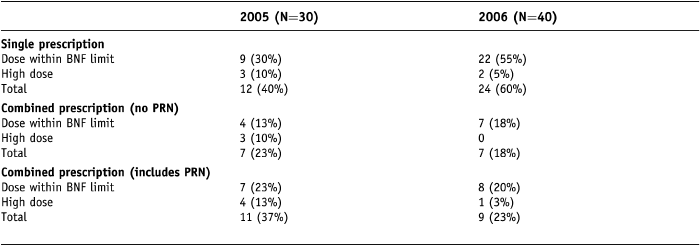
30 patients from 2005 were reviewed, 40 from 2006. Full details of the antipsychotic prescribing in each sample are shown in Table 1. The number of patients receiving a single antipsychotic (dose within BNF limits) increased from 9 (30%) in 2005 to 22 (55%) in 2006 and the number of patients prescribed a high dose (all prescription types) declined: 10 (33%) in 2005 vs. 3 (8%) in 2006. There was little difference in the overall numbers prescribed antipsychotic combinations excluding a PRN, 7 (23%) in 2005 vs. 7 (18%) in 2006 but the number of high dose combination prescriptions including a PRN declined from 4 (13%) in 2005 to 1 (3%) in 2006.
Antipsychotic prescriptions (RCPsych recommendations 1, 2, 8, 9)
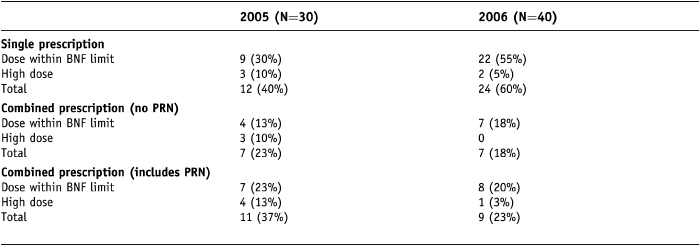
At re-audit in 2006 there was a total of 3 high dose prescriptions (1 combination and 2 single antipsychotics), compared to 10 in 2005. There was a slight reduction in the overall number of patients prescribed a PRN antipsychotic in combination: 9 in 2006 vs. 11 at 2005. PRN antipsychotic medication for the management of disturbed behaviour is a common cause of high dose prescribing and is reportedly ‘custom and practice’ in some inpatient settings (Paton et al. Reference Paton, Barnes, Cavanagh, Taylor and Lelliott2008). Within the high dose prescription groups, only 1 patient was prescribed a high dose combination including a PRN in 2006, compared to 4 in 2005.
Approximately half the prescriptions for combination antipsychotics in each sample were prescribed for the control of disturbed behaviour. Recording of the rationale for the use of combination antipsychotic therapy improved; only 1 (6%) of cases had this missing in 2006, compared to 8 (44%) in 2005. More patients were prescribed a combination as a result of a poor response to monotherapy: 3 (19%) in 2006 vs. 0 (0%) in 2005 (Table 2).
Reasons for the prescription of combined antipsychotics

DISCUSSION
A number of limitations apply to this audit. Firstly, it measured prescribed not administered medication and we cannot be certain that all patients received the prescribed doses. Secondly, we did not systematically evaluate the clinical presentation, demographic profile or length of stay of the cases in each audit sample. Any or all of these could have influenced prescribing practice. We do not believe however that there was any marked difference in these factors, either between the two audit samples or between the latter and patients in other English PICUs. Finally, the audit was a retrospective review of medical and prescription records, records which may have inaccuracies and/or omissions.
Despite these limitations our results suggest that at the time of the second audit the anti-psychotic prescribing on Hollywell had become more consistent with the RCPsych consensus statements. We achieved this through adopting a more evidence based approach to prescribing, increasing the frequency of multidisciplinary review and through continued education and training on the ward. The number of high dose prescriptions declined and the number of patients receiving a single antipsychotic almost doubled. This was achieved with a simultaneous 33% increase in the number of patients treated on the unit. In our 2006 sample, the rate of single antipsychotic prescription was 60%, compared to 40% in 2005. The latter is equivalent to that reported by POMH-UK which reported single antipsychotic prescribing rates of 60% in low/medium secure units and 57–60% in open ward/PICUs respectively (Paton et al. Reference Paton, Barnes, Cavanagh, Taylor and Lelliott2008; Royal College of Psychiatrists, 2009). An earlier comparable clinical audit of a London PICU describes a single antipsychotic prescribing rate of 24.7% (Hillam & Evans, Reference Hillam and Evans1996). The improvement in 2006 was therefore particularly encouraging as evidence suggests patients prescribed combined anti-psychotics are 20 times more likely to be prescribed a high dose (Paton et al. Reference Paton, Barnes, Cavanagh, Taylor and Lelliott2008).
Regular and frequent review of treatment plans may contribute to the safe and appropriate use of antipsychotic medication (Cornwall et al. Reference Cornwall, Hassanyeh and Horn1996; Royal College of Psychiatrists, 2006; Paton et al. Reference Paton, Barnes, Cavanagh, Taylor and Lelliott2008) and our audit provides some evidence that this can be done in a PICU environment. Antipsychotic medication carries a risk of significant dose related side effects and these may increase the risk of non-adherence to treatment. Psychiatrists therefore need to keep accurate records of the reasons for their decision to prescribe high dose/combination antipsychotics, especially where patients are compulsorily treated (Langan & Shajahan, Reference Langan and Shajahan2010). Implementing this principle, we were able to reduce the number of times where the reason for the use of combined antipsychotics was unclear or not recorded in the notes from 8 occurrences in 2005 to 1 in 2006.
CONCLUSION
Our audit results suggest that some of the recommendations of the 2006 RCPsych consensus statement can be followed on a PICU. The audit illustrates the potential for individual variation in prescribing practice in the PICU environment and how the consensus statement can be used to both benchmark and promote evidence based prescribing practice as has been advocated by numerous previous authors, (Jones et al, Reference Jones, Jones and Lucey1998; Royal College of Psychiatrists, 1993, 1997, 2006, 2009; Paton et al. Reference Paton, Barnes, Cavanagh, Taylor and Lelliott2008; Taylor, Reference Taylor2010; Langan & Shajahan, Reference Langan and Shajahan2010). We recommend continuous cycles of clinical audit as a method of sustaining continuous improvement in practice and hope this audit illustrates what can be achieved by PICUs who want to optimise their prescribing of high dose antipsychotics.