Introduction
New Zealand has a growing population of older adults living with dementia. By 2026, it is estimated that over 78,000 New Zealanders will have dementia (New Zealand (NZ) Ministry of Health, Reference McPherson, Kayes, Moloczij and Cummins2013). Recognising the importance of optimising independence, wellbeing and safety of those living with dementia, the NZ Ministry of Health has developed a national framework for dementia care to guide the dementia care pathways of health and social support organisations. This framework is underpinned by the principles of following a person-centred and people-directed approach, providing accessible, proactive and integrated services that are flexible to meet a variety of needs and developing the highest possible standard of care (NZ Ministry of Health, Reference McPherson, Kayes, Moloczij and Cummins2013: 5).
While this framework provides guidance for all levels of the workforce, the reality in New Zealand is that the workforce most involved in providing dementia care are the support workers (formal/paid care-givers) (New Zealand (NZ) Labour et al., 2010). This workforce is critical in supporting people with dementia, particularly in terms of accessing health and social services, and facilitating engagement in clinical and support interventions to maximise wellbeing. Essentially, the New Zealand national framework for dementia care aims to ensure that people and their families/whānau are living well (NZ Ministry of Health, 2010; NZ Human Rights Commission, 2012; McPherson et al., Reference McPherson, Kayes, Moloczij and Cummins2013; NZ Ministry of Health, 2013).
A particular concern is the predicted reduction of support workers in aged care that, in parallel with the growth in the number of older adults living with dementia, means that the demand for care of older people with dementia is expected to exceed supply (Badkar, Reference Badkar2009; Health Work Force New Zealand, 2011; NZ Human Rights Commission, 2012). Reasons for reducing numbers of support workers are multiple and complex; one key factor being the ageing of the workforce itself (Badkar, Reference Badkar2009; Fujisawa and Colombo, Reference Fujisawa and Colombo2009; NZ Labour et al., 2010). Therefore, optimising recruitment and retention within this workforce is vital (Ashley et al., Reference Ashley, Butler and Fishwick2010).
Factors impacting on recruitment and retention include inadequate pay and training, lack of benefits, limited opportunity for advancement, inconsistent hours, and poor working conditions (Ashley et al., Reference Ashley, Butler and Fishwick2010), work overload (Brannon et al., Reference Brannon, Barry, Kemper, Schreiner and Vasey2007) and a lack of respect (Stacey, Reference Stacey2005). Similar factors have been found in a New Zealand context (Roud et al., Reference Roud, Keeling and Sainsbury2006; Jorgensen et al., Reference Jorgensen, Parsons, Reid, Weidenbohm, Parsons and Jacobs2009; King et al., Reference King, Parsons and Robinson2012). Furthermore, females far outnumber males in this workforce (McPherson et al., Reference McPherson, Kayes, Moloczij and Cummins2013) and as the educational level of women increases, they will be less likely to apply for low-paid jobs such as support work, further reducing the numbers coming into the sector (Hensen and Yeabsley, Reference Hensen and Yeabsley2013).
Further impacting recruitment and retention is a general perception that support workers are an unskilled workforce, and thus do not receive adequate or appropriate recognition for the important work they do, which is reflected in their low levels of remuneration (NZ Labour et al., 2010). This perception is conceivably a misconception. For example, in their ethnographic exploration of emotional labour experienced by support workers, Bailey et al. (Reference Bailey, Scales, Lloyd, Schneider and Jones2015) described how support workers developed a level of detachment that enabled them to engage with their work just enough so that required tasks could be achieved with dignity and respect. This suggests a level of skill and sensitivity that the authors argued goes beyond the ‘unskilled’ nature of the work for which these workers are remunerated or recognised.
Lack of recognition for the important and skilled work that support workers undertake was strongly identified as a source of stress in two New Zealand-based qualitative studies. In one of these studies, Czuba (Reference Czuba2015) interviewed ten support workers employed in long-term residential care roles, and they reported a lack of feeling valued as a source of stress in the work they undertook that, in turn, impacted on workers’ capacity to provide high-quality care. This was reflected by the findings of an interview study by George et al. (Reference George, Hale and Angelo2017), in which support workers also highlighted a lack of recognition as stressful. It is this sense of feeling undervalued and unrecognised that forms the focus of this paper.
A lack of recognition of the important contribution of support workers in dementia care is certainly not confined to New Zealand, and is prevalent worldwide. Across various cultural contexts, both the attitudes of society at large and management within the health-care workforce have been identified as contributing to support workers feeling disempowered and undervalued (Ashley et al., Reference Ashley, Butler and Fishwick2010; Elwér et al., Reference Elwér, Aléx and Hammarström2010; Butler et al., Reference Butler, Brennan-Ing, Wardamasky and Ashley2014; Gjødsbøl et al., Reference Gjødsbøl, Koch and Svendsen2017; Kadri et al., Reference Kadri, Rapaport, Livingston, Cooper, Robertson and Higgs2018). Feeling valued and recognised is a concept described by Dutton et al. (Reference Dutton, Debebe and Wrzesniewski2012) as ‘felt worth’. Felt worth is potentially a key factor to retention and recruitment of this workforce.
In a study of hospital cleaners, Dutton et al. (Reference Dutton, Debebe and Wrzesniewski2012) introduced the notion of felt worth, which they argue is a fundamental gauge of social inclusion and respect from others. These authors focused their study on the critical activities carried out by people playing support roles in organisations. For example, they described hospital cleaning as work that is hidden yet valuable; ‘a base of activity upon which much else must rest’ (Perry, Reference Perry1978: 6). The hospital cleaners in the study by Dutton et al. (Reference Dutton, Debebe and Wrzesniewski2012: 17) ‘played a vital role of caring for place, which enabled caring for people’. Drawing on this analogy, the work of support workers is vital for quality care, as it provides the basis or foundations for all other care, and thus the concept of felt worth could be extended to support workers to enable valued recognition.
Felt worth is described by Dutton et al. as
individuals’ sense of importance accorded to them by others … Felt worth captures an individual's cognitions and feelings about the level of regard that others accord him or her as opposed to a more internally-held belief about one's own worth (self-esteem). (Dutton et al., Reference Dutton, Debebe and Wrzesniewski2012: 4)
Felt worth develops as a result of the constructed meaning of the work (i.e. whether the work is valued or not by others), how the worker themselves consider and connect to their work, and the influence others have on this understanding in terms of holding specific opinions about the status of the work. Therefore, felt worth is socially derived and constituted from understandings and interactions between a person and those to whom they are connected. In the case of the support worker, this could mean their clients and clients’ families, management, co-workers and the public in general.
As felt worth is socially derived and constituted from understandings, how people perceive felt worth can thus be influenced by the language and terminology used. For example, the terminology relating to dementia has morphed somewhat over the years. In 1998, Kitwood proposed that the term ‘patient-centred care’ be replaced with ‘person-centred care’ in recognition of the holistic approach to care and understanding that is required for people living with dementia, suggesting that ‘patient’ was too symbolic of the medicalisation of health care (Kitwood, Reference Kitwood1998). This change in terminology enhanced the value of the person with dementia, but did nothing to add value to that of the work of the support worker in providing such person-centred care. It was Kadri et al. (Reference Kadri, Rapaport, Livingston, Cooper, Robertson and Higgs2018) who, on analysing interviews of 25 paid care staff working in dementia care, extended the argument of person-centred care to the enhancement of the personhood of paid staff. Acknowledging the personhood of paid care staff would endorse the felt worth of care work.
Felt worth is also socially constructed from the interactions between a person and those to whom they are connected. Nolan et al. (Reference Nolan, Ryan, Enderby and Reid2002) proposed that a more appropriate model for dementia care than either patient-centred or person-centred care would be that of ‘relationship-centred care’. Relationship-centred care recognises that in dementia, care is shared and symbiotic between all involved; the person living with dementia, their family and the staff, conferring importance of all, including the support worker. In the United Kingdom, Nolan and colleagues developed the Senses Framework as a guide to how these relationships can be positively developed and sustained. This framework described six ‘senses’ that need to be experienced and nourished by all three groups to enable quality care: a sense of security, continuity, belonging, purpose, achievement and significance (Nolan et al., Reference Nolan, Davies and Grant2001; Ryan et al., Reference Ryan, Nolan, Reid and Enderby2008). Thus, the concept of felt worth is fully embedded in this framework.
Therefore, enabling felt worth or feeling valued is arguably a key factor underpinning retention, recruitment and quality practice of support workers. Focusing on the notion of felt worth, our study explored how support workers working with older adults with dementia in New Zealand can be valued for the important work they do and how this knowledge can be used to support them to provide quality care. In considering felt worth, we wished to construct inductively how support workers perceived (a) themselves in their work and (b) how they thought others regarded and interacted with them in their work.
Methodology
Study design
Our study sought the perceptions and opinions of participants; we drew on qualitative descriptive methodology to obtain suitable data. Specifically, face-to-face interviews were undertaken. Although focus groups may have generated discussion or debate (Nyumba et al., Reference Nyumba, Wilson, Derrick and Mukherjee2018), we decided a more in-depth personal exploration was required given that potential participants may feel vulnerable or disempowered (Jorgensen et al., Reference Jorgensen, Parsons, Reid, Weidenbohm, Parsons and Jacobs2009) as well as being geographically dispersed. The University of Otago Humans Ethics Committee (number 16/029) approved this study and all participants provided signed informed consent.
Stakeholder consultation
As a research team interested in those who support older adults, we initiated our programme of research by consulting with stakeholders. We held two symposia (in 2013 and 2015) inviting carers, support workers and organisations in elder care. At these symposia members of the research team presented the findings of their completed care-giver-related research, following which there were discussion panels with attendees, asking them what they thought to be the most important research questions to explore next. Consensus following these meetings was that the team should embark on a programme of research to explore ‘How we can value those supporting older adults’. These stakeholders then became an informal advisory group, advising on aspects of research, such as question development or review of findings and data analysis. This informal advisory group was primarily comprised of staff and people who attended the local Alzheimer's Society and Carers Group, with consultation happening as required during the research process at their meetings. We also undertook individual consultation with managers from local organisations providing care for older adults who had attended our symposia. A third symposium was held in 2018 at which findings from the current study were presented and discussed.
Recruitment and participant inclusion
Participants were adult (18 years and older) support workers working in residential care homes or community-based private homes and caring for older adults with dementia. We purposively sampled for a broad range of opinions; participants were recruited from both home-based and residential aged care and from both the South and North Islands of New Zealand. In New Zealand, older people with dementia may live in their private home or in a retirement village, rest home, hospital or respite facility. Those living in their private home may receive support from a paid support worker. Older adults requiring care are assessed, by the Needs Assessment and Service Coordination Organisation, as to level and type of care the person is eligible for, including whether they are eligible for admission into a residential care facility or for home-based care (NZ Ministry of Health, 2019).
In New Zealand, there are approximately 16,000 support staff working in private home-based care and around 22,000 support workers working in aged residential care facilities. Demographically, the majority of support workers (56%) are of New Zealand European descent (Māori and Pacific Island descent each constitute 10%, Chinese represent 17% and Indian represent 6%) (NZ Human Rights Commission, 2012; New Zealand (NZ) Immigration, 2019).
Participants were ineligible if they could not be interviewed in English. We adopted a broad recruitment strategy and recruited nationally via public advertising, social media, meetings and newsletters of elder-care organisations and other professional networks (Alzheimer's Society, Age Concern, Carers New Zealand) and via appropriate worker unions and organisations employing support workers for older adults. The advertising information requested those interested in participating to contact the researchers directly. Detailed study information sheets were then provided to those who expressed interest.
Data collection
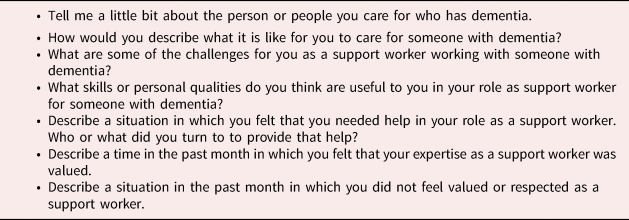
Data were collected using semi-structured interviews in two New Zealand cities, Dunedin and Auckland. Three interviewers from a range of health professional backgrounds were involved in data collection; all three had qualitative interview experience. We interviewed for data saturation, postulating that we would require approximately 20 participants. Interviews took place at venues convenient for participants using the interview guide shown in Table 1. The interview guide was developed based on prior research and expertise of the research team, and as a result of community stakeholder consultation. Interviews were audio-recorded and transcribed verbatim by a professional transcription service.
Interview guide

Data analysis
We used the General Inductive Approach (Thomas, Reference Thomas2006) to data analysis. This approach is guided deductively by the research objectives and inductively by analysis of the raw data; the research objectives focusing or providing a specific lens to the thematic analysis, in this case, guided by our understandings of felt worth. A model is then developed from key themes to address the research objective. Two researchers (YB, MLJ) read, line by line, all transcripts and identified segments of text relevant to the research questions and provided these segments with a preliminary code. Preliminary codes from all transcripts were then discussed numerous times between three team members (YB, MLJ, LAH) until consensus was reached on a coding schedule. The latter was then applied across all transcripts and quotes illustrating these identified codes, ensuring that codes were unique and did not overlap. A subset of transcripts was reviewed by other members of the research team, who then met with the primary coders to discuss discrepancies.
On further examination and discussion, the identified codes were collapsed into categories and sub-categories and then further reduced to themes and sub-themes. Transcripts were then re-read to ensure the emerging themes and sub-themes truly reflected the data within. Guided by the paradigm approach described by Corbin and Strauss (Reference Corbin and Strauss2008), we then developed a model of how support workers consider they can be valued in the work they do. In this paradigm approach, the emerging themes and sub-themes are reorganised or arranged by categorising them under predefined linking categories which help create a framework that explains the phenomenon. The ‘phenomenon’ is the key or central idea to be conceptualised, in this case, ‘felt worth of support workers (and how thus can support workers be valued)’. The predefined categories are: what are the events or incidents (‘causal conditions’) that give rise to the phenomenon within a given ‘context’. What are the broader, more general circumstances that may influence the phenomenon (the ‘intervening conditions’)? ‘Strategies’ are actions that are taken to influence the phenomenon as it exists within the actual or perceived context or set of conditions. Finally, the ‘consequences’ are the outcomes of these actions (Corbin and Strauss, Reference Corbin and Strauss2008).
We used two strategies to ensure the trustworthiness of our analysis: (a) our findings were endorsed via a formal presentation to participants and stakeholders, and (b) they resonated with a support worker not involved as a participant.
Results
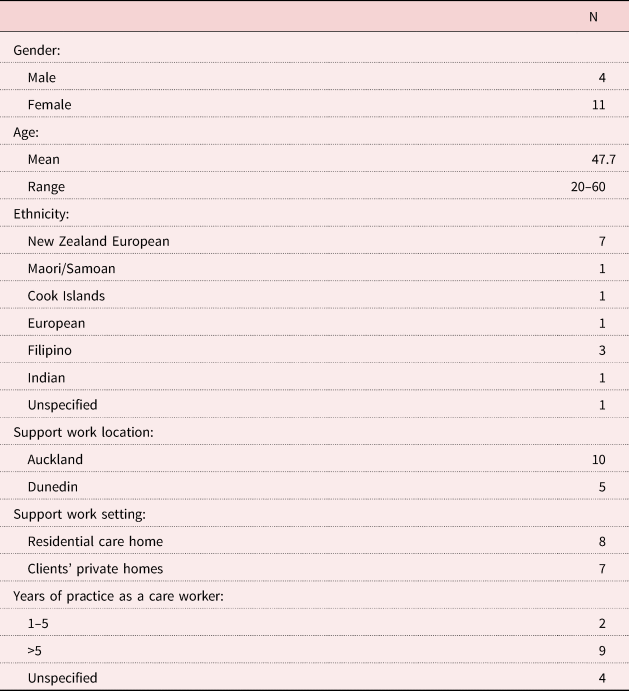
We recruited and interviewed 15 participants (four males, 11 females). Seven participants were working in home-based settings and eight were based in residential facilities. Table 2 shows the demographic details of our participants. Although we postulated that a sample of 20 participants would be sufficient to reach data saturation, recruitment difficulties resulted in only 15 participants. The majority of our participants were recruited via organisations with whom we had been able to establish face-to-face contact.
Participant demographic data

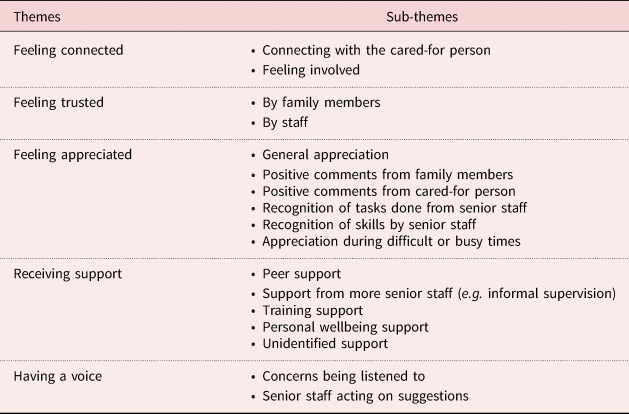
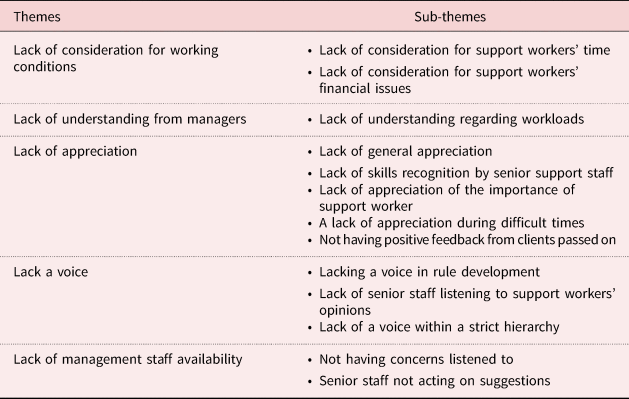
Tables 3 and 4 detail the themes and sub-themes of what interviewed support workers considered were enablers and barriers to feeling valued.
Themes and sub-themes of feeling valued

Themes and sub-themes of barriers to feeling valued

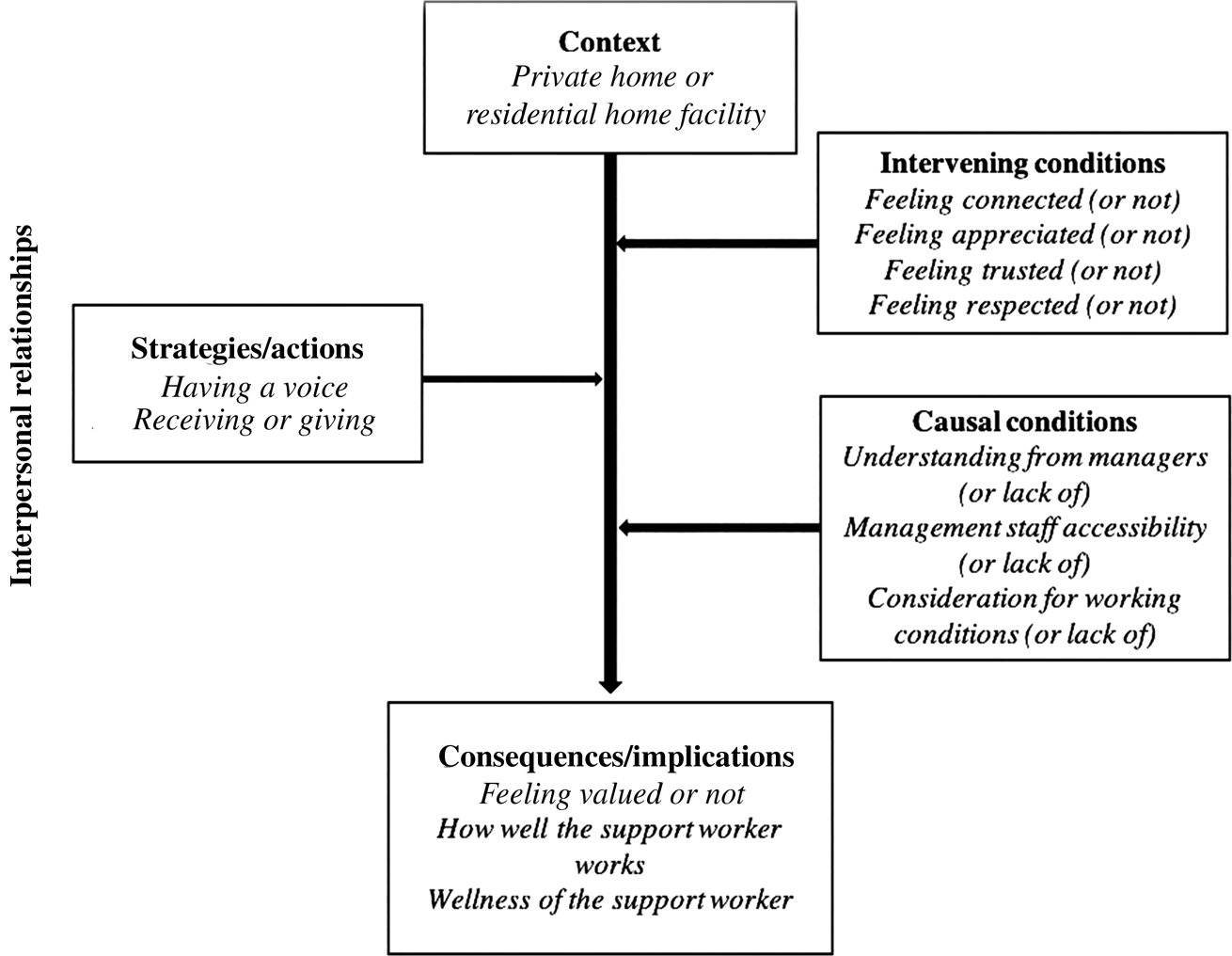
Figure 1 represents the conceptual model we developed by categorising these themes and sub-themes by the predefined categories of the paradigm model. In the resulting model, it can be seen that support workers’ felt worth depended largely on the context in which the care-giving took place (home-based or residential facility). In turn, context-dependent causal conditions (lack of consideration for working conditions; lack of understanding from managers; lack of management staff availability); actions or strategies (having a voice, receiving or giving support) and intervening conditions (feeling connected, feeling appreciated, feeling trusted or not feeling trusted) occurred. These conditions led to whether the support worker felt valued or not. Perceptions of feeling valued then had implications for how well the support worker carried out their duties, in addition to influencing their perceived wellbeing.
Conceptual theoretical framework of support workers’ felt worth.

The context of the care-giving refers to whether the support workers primarily carried out their work in clients’ private homes or in residential care homes. Our findings suggest the differences between these two distinct working environments influence how the causal conditions, the intervening conditions, and actions or strategies taken impact on feeling valued or not. That said, regardless of the specific working environment, feeling valued was underpinned by the central theme of interpersonal relationships. As an illustrative example, the quality and quantity of interactions between support workers and those in their immediate working environment were influenced by the context. Support workers working within clients’ homes would routinely have less interaction with other support staff compared to support workers in residential homes, but arguably had greater opportunities to develop trusting relationships with clients and their family by spending significant amounts of time in each client's private home.
The influence of the context on these causal conditions was also modified by the use of certain strategies developed to enable feeling valued. Such strategies can be separated in terms of being developed by the individual support worker themselves (e.g. informal support groups/networks) or by their employers (i.e. organisational strategies such as formalised supervision or support). Intervening conditions included the appreciation or recognition (or lack thereof) of the wide variety of attributes and skills that support workers believed they possessed, further influencing the feeling of value.
Below we use data from four participants (two working in aged care facilities and two who worked for agencies that provide home-based care) to elucidate this framework. Participants’ actual words are quoted (Shepard et al., Reference Shepard, Jensen, Schmoll, Hack and Gwyer1993); names are pseudonyms.
Private home-based support workers: Hazel and Helen
Hazel and Helen were both private home-based support workers. Both had worked in the aged care sector for between five and ten years, working approximately 20 hours per week. During the course of the day they travelled from one home to the next. The itinerant nature of the work means they had limited formal contact with fellow workers and employers, resulting in a daily experience that Hazel described as ‘isolated’.
To support them in such an isolated work context, they had both found informal peer support to be a valuable strategy (receiving support):
It's [peer support] really helpful … another person and I were working with a client and she passed away while we were showering her … it wasn't horrible, which some people might think it was … because it wasn't painful, and we had been happy and she had been happy and she just slipped away … and so you know, we talk about that, that it was almost a privilege to be there when that happened. (Hazel)
I usually sit down with a coffee and one of the others that I work with in particular, and she was the other one that helped out [client's wife]. And, we just sit there and … talk. (Helen)
The organisation Hazel worked for had strategies to support staff (receiving support), but Hazel considered them ineffective. For example, one such strategy was for Hazel to phone the on-call support line:
Nowadays in that situation, they've got an on-call line, I don't know how helpful that would be … because if I rung the on-call number, I'm talking to someone in Wellington or Auckland or something … I'm more likely to go home and tell my family … you don't tell the name of the people [clients] but you have to talk to somebody … We can ring our co-ordinator … but it kind of depends on how busy they are. (Hazel)
This latter strategy, ringing her co-ordinator (receiving support), could facilitate her perception of feeling valued or not, depending on who was the co-ordinator for that day and whether this person was respectful of her or not (lack of respect). Hazel explains:
If I ring up and have a problem, I always hope it's her [a specific nurse] because she treats you with such respect like you've got some clues … whereas some of the others are just quite snappy with you like you're silly you know.
Not receiving support could easily decrease her perception of feeling valued, especially when there was a lack of understanding from managers:
The person I had spoken to earlier who had asked me to go to that client as a fill in was really rude to me and said … ‘why can't you squeeze these people in, we're desperate’ and I said ‘well where's the time, I've got other people to go to, what time can I fit this person in, do you have my schedule in front of you?’ … I'm sure she was stressed but we're out there doing the job on a cold rainy night and somebody on the phone in Auckland who doesn't understand what the weather's like down here is saying well you've got to fit somebody else in and treating me like I was lazy. (Hazel)
Another organisational strategy to foster connections were meetings. However, these appeared to be held infrequently. When the meetings did take place, participants reported that they often felt that their voice was not being heard (not having a voice):
In this organisation, they have meetings every now and then but it's not the same, the people who run the organisation come in and do the talking and they say ‘is [sic] there any questions?’ But it's not the same. (Hazel)
Lack of management staff availability led further to feelings of isolation and devaluing. Helen stated:
I think our employers need to be … more readily available. I know they are busy and we are not the only carers or support workers that they have on their books … But sometimes I get the feeling that you are just a bit of a nuisance … You have to make contact with them if you want support … It doesn't seem to occur to them to pick up the phone, ring you and say, ‘how are you going?’
Another experience that was adding to participants not feeling valued was when they experienced a lack of a voice within an organisation, as epitomised by a story told by Helen:
I have had that feeling [of not feeling valued] from my own employers … I rang in this day to report to them that it was my opinion that this … lady was, that her state of mind had changed … and I told them what she was doing which she had not been doing before … and the woman on the other end said, ‘oh you just do this and you just do that you see’, I said, ‘I am not ringing in to ask you how to deal with it, I know how to deal with it. I am ringing to report that in my opinion her mental state has changed again.’ ‘Oh’ they said, and hung up … But that is alright. There is more than one in the office in which I rang and … I just probably struck the wrong person when I rang.
Feeling appreciated did, however, make one feel valued, and for Hazel this appreciation came mostly from her clients: ‘I feel valued a lot by the people that I work for … I get lots of nice things said from them … yeah so I feel really valued by them lots of times’ (Hazel). However, not all families were appreciative. Helen explained: ‘You do [feel valued] for some families, definitely. Others … you are just there as a stop gap until something major happens.’
Along with feeling appreciated, feeling trusted speaks to the perception of being valued. Helen spoke of when a client's wife left her husband in Helen's care: ‘I know that I was definitely valued by [name] and the first time she did it I couldn't believe it, was when she left [client] in my care in the evening when she went out.’
Residential home-based support workers: Rachel and Richard
Rachel and Richard also worked in aged care facilities. Both had worked in aged care for between five and ten years and worked approximately 24 hours per week. In contrast to Hazel and Helen, Rachel and Richard were not isolated in the work that they did. In their jobs they experienced continuous contact with multiple clients, intermittent contact with clients’ families, and they worked within a support team and directly with senior staff.
Within this context, although not essentially lonely, peer support (receiving support) was still required, as Richard explained: ‘We talk to each other in the morning first thing. It's more like we're not … staff members … we go out as well, we have a meal or something. We go to each other's house, it's more like friends’ (Richard). Rachel also spoke of peer support, but this time in the form of a debriefing process (receiving support):
You might go and talk to another staff member that is the debriefing thing again. I actually think debriefing is actually quite important when you are looking after dementia residents, because sometimes I know when staff debrief with me, I will say to them, ‘why didn't you do such and such?’ and they will say, ‘I have never actually thought about that’ … Sometimes it is good to download with somebody and, and then you feel a little bit supported by talking to somebody as well. It is not all about finding a solution, sometimes it is just to feel supported, [someone saying] … ‘That is no good. Is there anything I can do to help you? Go and have a cup of tea and I will keep an eye on them for a little while’ … or something like that.
Such informal support situations may also facilitate care-givers’ learning, in terms of sharing strategies to deal with specific problems: ‘[Name] told me to try this, so I am going to try this to see if it works’ (Rachel).
Richard told how he received support from his organisation in the form of formal training:
They're supporting me with the different [training] … every month or so we get an email or something like there's a study, anybody want to join in or anybody wants to go for it we are there. And they do support you financially as well … They give us time for the studies. (Richard)
It seemed that when working in residential care, it was easier for the organisation to value staff with collective gestures. For example, Rachel described feeling appreciated:
When we have had a day when you have had a lot less staff on that you would normally have and everybody had to do more of a workload and they might say, thank you to everybody and then next day they might buy a cake or something like that.
Another example was provided by Richard:
Small things … very small things. Sometimes just coming in the morning and [senior staff] saying OK right, we heard you that you done this so [claps his hands], so just a clap in the morning … That makes your day. Simple. For me it's brilliant. Nothing about the money, because this job is not about the money … really just coming in and appreciating … It works awesome for me. (Richard)
However, while working with others could lead to feeling connected, it could also lead to some workers not feeling valued or respected (lack of respect): ‘If that person goes and tries and maybe they can get some of the job done, it makes you feel like you're not doing your job and a comment that might be said to you, is, well so and so managed to do it, I can't understand why you can't do it’ (Rachel).
Lack of management staff accessibility appeared less of an issue in a residential context. However, the availability of management staff did not always lead to feeling valued, particularly if they did not listen (lacking a voice). Rachel explains:
I have bluntly said to my manager at times … ‘If I want anything done I need to tell somebody else to come to you to ask you to do it so that it gets done’, and it made her sit up and listen to me, because she said, ‘I don't mean to be like that’ and I said, ‘well I asked you that same question a month ago and you told me, no, and somebody else has come and asked you and you said yes’.
Having a voice and having ideas listened to by management appeared to be powerful in enabling support workers to feel valued. For example, upon being asked what made him feel valued at work, Richard responded: ‘When it is in a meeting … and we explain our ideas or share our ideas.’
Even a small token of feeling of appreciated went a long way towards feeling valued: ‘I probably do [feel valued] because I pushed my manager to give me my appraisal last Friday. And I actually said to her in my appraisal, “I don't feel appreciated for what I do” and she told me that she does appreciate what I do.’ Rachel went on to say: ‘Sometimes you do think you are appreciated, other times you just feel like you are a paid slave.’
Rachel was quite pessimistic about how valued residential-based support workers really are by people in general for the work they do:
The work isn't actually valued for the effort you put into it … It is considered woman's work, woman care for children, woman can care for old people, it makes you feel like the old people aren't valued because the money isn't put into the sector either and it makes you think, I hope to god I never have to go into a rest home or a hospital. (Rachel)
As with the home-based support workers, most families appeared to appreciate the workers’ efforts (feeling appreciated), as Richard said: ‘They say “Hi”, and they know you by your name. That's a good thing.’
Discussion
In exploring and understanding the felt worth of support workers, we developed a conceptual model describing how support workers working in dementia care could be valued for their work. Our data revealed several factors, dictated by the context of the work environment that influenced support workers’ felt worth, including the extent to which they felt appreciated and trusted by the clients, the clients’ families, management and co-workers.
Support workers’ perceptions of feeling valued appeared to be influenced by the context within which they worked, which was seemingly linked to the quality and quantity of interpersonal contact they had during work. High-quality interpersonal relationships have been shown to be important to feeling valued, particularly via the cultivation of supportive friendships within an organisation (Tse and Dasborough, Reference Tse and Dasborough2008). Such relationships have been shown to increase employees’ feelings of psychological safety in the workplace, which is also likely to lead to an increased sense of feeling valued (Carmelli et al., Reference Carmelli, Brueller and Dutton2009). In our study, support workers based in residential homes reported fewer experiences of isolation because they were constantly surrounded by co-workers. However, whether this translated into increased levels of feeling valued is debatable, because there were arguably increased opportunities for feeling devalued or underappreciated by senior co-workers if their skills and attributes were not recognised. Indeed Nolan and colleagues’ Senses Framework for quality dementia care specifically details the sense of security for staff as being ‘to feel free from physical threat, rebuke or censure; to have secure conditions of employment; and to have the emotional demands of work recognized and to work within a supportive but challenging culture’ (Ryan et al., Reference Ryan, Nolan, Reid and Enderby2008: 80). Thus, even if care-givers work in a co-working environment, there is still the opportunity for them to feel insecure and devalued if they lack a voice or are underappreciated. Meanwhile, home-based support workers had less contact with co-workers and often reported feeling distant from their employers and peers, which has been shown to decrease perceived respect and organisational identification in workers who lack immediate interpersonal relationships with their colleagues (Bartel et al., Reference Bartel, Wrzesniewski and Wiesenfeld2012). This potentially undermines the sense of belonging, or the capacity ‘to feel part of a team with a recognized and valued contribution, to belong to a peer group, a community of gerontological practitioners’ (Ryan et al., Reference Ryan, Nolan, Reid and Enderby2008: 80).
There were, however, possibly more opportunities in home-based care for building trust between our participants and their clients and their clients’ families as a result of working within the clients’ private homes. Our home-based participants frequently reported their clients made them feel more valued than the organisation for which they worked. Previous work exploring the nature of the relationship between home-based support workers and family care-givers reports a reciprocal empathy and recognition of the value that each provides for the care of the client, but that boundaries created by scope of practice and organisational processes can cause interfering tensions (Sims-Gould et al., Reference Sims-Gould, Byrne, Tong and Martin-Matthews2015). Support workers in the study by Sims-Gould et al. (Reference Sims-Gould, Byrne, Tong and Martin-Matthews2015) described how, in working in the client's home, family members can both help and hinder their work, as well as both appreciate and disrespect the work they do. Perhaps in the home-based setting, as opposed to residential facility, felt worth is more mediated by the interpersonal relationships with family than with co-workers or managers. That said, in the Czuba (Reference Czuba2015) study, support workers expressed frustration at not being valued by both employees and families. This created a sense of emotional conflict in which the support worker felt they did their best, considered themselves committed to their work, yet were undervalued for what they did; as one worker cites, ‘the most frustrating thing for me is that you never get thanked for the hard work you put in’ (Czuba, Reference Czuba2015: 80).
Whilst the context in our study set the initial conditions for support workers’ felt worth, felt worth was influenced by other factors, as illustrated in our conceptual model. Clearly, felt worth was strongly underpinned by the worthiness support workers themselves applied to their role, translating into the skills they subsequently developed. It was apparent that support workers’ deep understanding of individual clients enabled them to employ appropriate idiosyncratic strategies to encourage clients in undertaking specific behaviours (e.g. hygiene-related behaviours). These individualised skilful strategies are akin to what Bailey et al. (Reference Bailey, Scales, Lloyd, Schneider and Jones2015) termed skills of emotional labour: skilfully manipulating conditions to achieve desirable behaviours. Our participants were enabling person-centred care, a care model that encompasses health, individual psychology and the environment (Kitwood, Reference Kitwood1998). Support workers in a previous qualitative study described how obtaining and utilising such knowledge represents a special skill set (George et al., Reference George, Hale and Angelo2017), a special skill set that should not be underappreciated, particularly as a high staff turnover would likely result in decreased individualised knowledge of clients (Ashley et al., Reference Ashley, Butler and Fishwick2010).
Felt worth is also derived from the perceptions and interactions of others. Employers’ recognition of the specialised skill set that support workers bring to the role is thus important, underappreciation of which devalues the support worker. For example, in the current study, Helen described a time when she phoned her agency to describe a change in her client's state and was cut off. Such a change may well have required immediate action, but it was Helen's impression that her individualised client knowledge was largely dismissed. In the Senses Framework, this speaks to the sense of significance: ‘To feel that gerontological practice is valued and important, that your work and efforts “matter”’ (Ryan et al., Reference Ryan, Nolan, Reid and Enderby2008: 80).
The concept of felt worth from ‘others’ can extend beyond aged care organisations and employers, to society in general. Indeed, one of our participants suggested an underlying reason for why support workers were undervalued: ‘I think for all of us to feel a bit more valued it will have to come from people … I get older clients that say “us oldies are … a burden to our families, a burden to society”’. Kadri et al. (Reference Kadri, Rapaport, Livingston, Cooper, Robertson and Higgs2018) refer to the culture of creating a sense of staff personhood. These authors reported that employers do not identify support workers as persons in their own right and proposed that support workers’ sense of personhood be valued and the work they do – ‘the moral work of caring’ that occurs within formal care work – be acknowledged more fully (Kadri et al., Reference Kadri, Rapaport, Livingston, Cooper, Robertson and Higgs2018: 15). Undervaluing staff personhood in dementia care may stem from a general devaluing of older adults living with dementia. As Edvardsson et al. (Reference Edvardsson, Winblad and Sandman2008: 362) stated, ‘with a belief that there is nothing left of the person there is also a risk that the life of the individual … is seen as meaningless, which makes care and the role of the carer meaningless’. Therefore, if people living with dementia are undervalued by society, perhaps it is unsurprising that their support workers feel the same.
As the client, their families, their home environments and society in general are not easily modifiable, we suggest it is an employer's responsibility to cultivate a working culture in which an employee is valued by all. Employers are in a strong position to facilitate support worker felt worth, by taking an employee's perspective, encouraging initiative, supporting a sense of choice at work, and being responsive to employees’ feelings, questions and ideas. It is clear that interpersonal environments that make individuals feel listened to and ultimately valued can have a large positive influence on all aspects of their working lives and beyond (Tse and Dasborough, Reference Tse and Dasborough2008). A clear and practical example of the importance of interpersonal relationships in the support context was the role of debriefing, offering support workers the opportunity to discuss issues or to generally ‘download’ after a working day, both formally and informally. For example, the act of having a coffee with peers, or a supervisor phoning a care-giver to ask about how their day went, were identified as positively influencing support workers’ perceptions of feeling valued in the workplace. The survey of 460 health support workers by Berta et al. (Reference Berta, Laporte, Perreira, Ginsburg, Dass, Deber, Baumann, Cranley, Bourgeault, Lum, Gamble, Pilkington, Haroun and Neves2018) found that quality of work life, perceptions of supervisor support and perceptions of workplace safety can influence these workers’ work attitudes and work outcomes. These are factors that are easily modified, with potentially moderate changes achieving large positive gains.
The importance of interpersonal relationships to positive working experiences can be seen elsewhere in the literature. For example, within self-determination theory, Deci and Ryan (Reference Deci and Ryan2008) describe how the social context has a large influence on employees’ motivation for work and various other outcomes. Specifically, Deci and Ryan state that an individual's working environment can support or thwart their three basic psychological needs of autonomy (feeling like they are the origins of their own actions), competence (feeling that they are capable of the work they are assigned to) and relatedness (feelings of mutual connectedness with people in the immediate environment). There is robust evidence showing that if these psychological needs are met, there is an increased likelihood not only of high-quality motivation for work (i.e. the individual feeling like they want to work rather than having to work), but also employee optimal functioning (Lynch et al., Reference Lynch, Plant and Ryan2005), psychological wellbeing, job satisfaction (Van den Broeck et al., Reference Van den Broeck, Vansteenkiste, De Witte, Soenens and Lens2010) and life satisfaction (Deci and Ryan, Reference Deci and Ryan2008; Van den Broeck et al., Reference Van den Broeck, Vansteenkiste, De Witte, Soenens and Lens2010). Conversely, a lack of psychological need satisfaction has been shown to be associated with decreased motivation and burnout at work (Gagné and Deci, Reference Gagné and Deci2005; Van den Broeck et al., Reference Van den Broeck, Vansteenkiste, De Witte, Houdmont and Leka2008). The psychological need for relatedness is particularly pertinent here, because this is reliant on mutual connectedness and respect – a theme that consistently emerged as facilitating support workers to feel valued.
Strengths and limitations
Strengths of this study included the richness of the data obtained and the geographical and contextual spread of participants. The sample was also demographically similar to that of previously published New Zealand studies (Jorgensen et al., Reference Jorgensen, Parsons, Reid, Weidenbohm, Parsons and Jacobs2009; King et al., Reference King, Parsons and Robinson2012; Czuba, Reference Czuba2015) and that which is published on New Zealand Government websites (NZ Human Rights Commission, 2012; NZ Immigration, 2019). However, participant recruitment was challenging and protracted. One possible reason for this is that support workers wishing to participate may have had difficulty in finding the time to be interviewed. In fact, time pressure was an issue brought up by several participants. Moreover, we experienced difficulties in recruiting via employer organisations. Although this may appear to be an obvious lucrative source of recruitment, organisations may not distribute information about the study or support workers may feel vulnerable if they agree to participate (Lee, Reference Lee2005; Czuba, Reference Czuba2015; George et al., Reference George, Hale and Angelo2017). We tried to mitigate for this by having a wide-reaching recruitment strategy (e.g. via public media and appropriate worker unions) and we requested that those interested in participating contact the researchers directly. Our most effective recruitment occurred when we were able to have face-to-face contact time with potential participants or organisations for which they worked. A further limitation of this study is the possibility of an inherent sampling bias, in that participants who responded to the recruitment call may have been those who felt undervalued in the first place. It must also be noted that we interviewed two types of support worker within a small sample size, reducing the transferability of our findings. The small sample size also meant we were unable to explore ethnicity or gender variations of felt worth.
Implications
Education and training for managers in terms of supporting employee's need satisfaction would have positive consequences for support workers feeling valued on multiple levels. For example, listening to their perspective (i.e. ‘giving them a voice’) would directly address one of the main devaluing themes to emerge from the current study, whilst simultaneously addressing their psychological needs of relatedness (by being listened to) and autonomy (by allowing them to have a say in work practices).
Further suggestions for increasing support workers’ felt worth arise directly from our participants’ suggestions regarding the enablers and barriers to feeling valued. For example, we recommend that ways be found to increase the awareness amongst employers, co-workers and clients (and clients’ families) of the skills and attributes that support workers bring to their job. Similarly, opportunities could be maximised for support workers to feel appreciated or recognised for these skills, attributes and the work that they do. Participants in the current study suggested that even small gestures such as verbal acknowledgements from clients’ families and employers went a long way towards making them feel valued. Specifically in the realm of community-based care-giving, there clearly needs to be an increased understanding and appreciation of support workers’ time.
The distance between community-based care-givers and their employers (often operating in different cities) means that strategies are required to maximise employer availability and meaningful communication, as opposed to a disconnected and unsympathetic voice on the phone. Perhaps in this sense, localised managers or team leaders are needed rather than using a centralised system of communication. Modern telecommunication (e.g. video conferencing calls) is another possibility that allows for face-to-face communication between employers and employees, particularly with the rise in popularity of smartphones.
Indeed, a vital aspect of feeling valued was the opportunity for support, not only by employers but also amongst peers. Therefore, employees should perhaps be routinely offered the opportunity to ‘download’ after the events of the day or week, particularly for those community-based care-givers who spend the majority of their working days being ‘isolated’.
In line with participants’ comments regarding having a voice in organisational policies, it is suggested that employees should perhaps be consulted when it comes to making any such changes, so that employers can understand what works for the support workers. Aside from employer availability, encouraging localised social networks amongst support workers in the same geographical area (or even online communities) may prove fruitful in reducing the feelings of isolation that were reported in this study.
Theoretical recommendations aside, how then do organisations in dementia care pragmatically enhance the felt worth of their support workers? Careerforce is the New Zealand Industry Training Organisation for, amongst others, the aged care sector, providing qualifications appropriate for support workers through to management (Careerforce, 2018), including a New Zealand Diploma in Business (Level 6) Leadership and Management. Two competencies of the latter qualification are ‘Motivating and developing self and others to improving employee engagement and productivity’ and ‘Managing and leading people to enable them to achieve personal and organisational goals’. Whether this qualification then translates into enhancing support worker felt worth is debatable. Within all aged sector Careerforce qualifications, a focus on person-centred care is prominent. Perhaps such qualifications at a managerial level should expand to embrace Nolan and colleagues’ relationship-centred philosophy and Senses Framework or the contention of Kadri et al. (Reference Kadri, Rapaport, Livingston, Cooper, Robertson and Higgs2018) that ‘person-centred care’ should embrace support workers to improve overall care.
Conclusion
This study established that the quality of the interpersonal relationships experienced by support workers significantly influenced their perceptions of feeling valued. For the support worker, such influential relationships exist with their management, their clients and their families, and with other support workers and health-care professionals. Moreover, feeling valued was strongly influenced by the context of the work setting. Nolan et al. (Reference Nolan, Ryan, Enderby and Reid2002) recognised the importance of interpersonal relationships when they promoted the concept of relationship-centred care, arguing for an inclusive, all-encompassing view of dementia care. To borrow from Nolan and colleagues’ Senses Framework, the senses of security, belonging and significance appear most pertinent to our findings. Strategies are required that strengthen relationships, and enable support workers to feel secure in their work, and to have a sense of belonging and feel significance in the skilled work they do.
Financial support
This work was supported by a grant awarded by Brain Research New Zealand (BRNZ). BRNZ did not play any role in the design, execution, analysis or interpretation of any data, nor in the writing of this manuscript.
Ethical standards
The University of Otago Humans Ethics Committee (number 16/029) approved this study.