This study examines the role of language system in language use in relation to the communicative context, using a cross-linguistic comparison between English Australian versus Turkish-speaking healthy older adults. The study builds upon an earlier neurolinguistic study on English-speaking patients with dementia of the Alzheimer type (DAT), which demonstrated the vulnerability of particular language use forms to dementia (March, Wales, & Pattison, Reference March, Wales and Pattison2006) and showed that this vulnerability was partly contributed by cognitive difficulties (March, Pattison, & Wales, Reference March, Pattison and Wales2009). The current study compares English and Turkish as two distinct language systems and examines if and how these systems affect the way speakers utilize language at discourse production level. In particular, using a theoretical linguistic framework, it focuses on the use of deixis, which is a linguistic tool that handles context-dependent language.
During discourse production, psychological and/or physical properties of a given communicative context are shared between the speakers. American sociolinguist Susan Ervin-Tripp argues that context “permeates language, that contextual assumptions affect how we understand language, and that contexts of speech have to be better understood to develop theories of language” (Ervin-Tripp, Reference Ervin-Tripp, Slobin, Gerhardt, Kyratzis and Guo1996, p. 21). Speakers in real-life situations regularly utilize the knowledge from both linguistic and nonlinguistic surroundings to access the intended message in a given sentence (e.g., in “She was here,” the words she and here gain their meaning from the immediate context of the conversation, using the shared knowledge available to the speakers; Jarvella & Klein, Reference Jarvella and Klein1982). In this sense, reference is central to the production of discourse, because of the “relation that holds between expressions and entities, properties or situations in the outside world” (Lyons, Reference Lyons1981, p. 168). Deixis is argued to be the main source of reference in language, handling the orientational features of language (Lyons, Reference Lyons1968), and it is the most obvious tool to investigate how language is used in relation to context.
The term deixis was used first by Greek grammarians and discussed in the oldest documents on Indo-European languages (Bühler, Reference Bühler, Jarvella and Klein1982). Its study gained wider recognition in the past century through German linguist Karl Bühler's 1934 seminal work, Sprachtheorie (Language Theory; Jarvella & Klein, Reference Jarvella and Klein1982), expanded by British linguist John Lyons and American linguist Charles Fillmore. Theoretically, deixis is said to be located where semantics meets pragmatics (Levinson, Reference Levinson1983) and serves to determine “the structure and interpretation of utterances in relation to the time and place of their occurrence, the identity of the speaker and addressee, and objects and events in the actual situation of utterance” (Lyons, Reference Lyons1981, p. 170). In addition to these time, person, and place aspects of deixis, various signs and forms have also been argued to carry deictic roles, such as mood, word-order variation, and sentence accent (Fillmore, Reference Fillmore1997; Segal, Reference Segal, Duchan, Bruder and Hewitt1995, p. 10), although not all of these forms have been integrated into central theories of deixis (Fuchs, Reference Fuchs1993).
Bühler (Reference Bühler, Jarvella and Klein1982) argues in his 1934 work that a vital relationship exists among the speaker, the hearer (addressee), and the world, forming a deictic field of language—the zeigfeld. The deictic field holds a zero point, the origo, which is centered at the speaker and encompasses the three orientational axes: here, now, and I (Bühler, Reference Bühler, Jarvella and Klein1982). As the basic deictic elements of the zeropoint, these axes function as markers of place, time, and individual. Deictic context then operates “as an integral part of the context of utterance,” which is spatiotemporal and whose zero point is the here and now of the speaker (Lyons, Reference Lyons1995, p. 304). For effective deictic use, both speakers have to rely on the communicative context. Without appropriate reference to the speaker's spatial or temporal orientation, the meaning of deictic utterances remains vague for the hearer. To illustrate, the sentence “He is there” provides no information about the referred person and the referred place. The hearer in the communicative context can, however, successfully comprehend the intended meaning for he and there, as long as she or he refers to the speaker's orientation within the context, and in the here and now.
In brief, deixis provides speakers with a framework for using and interpreting language and its context, without having to name the entity “referred,” and in this sense, deictic words can functionally replace nouns in discourse. According to linguistic theories of deixis, the two basic types of deixis, among others, are person and spatial deixis (Fillmore, Reference Fillmore, Jarvella and Klein1982, Reference Fillmore1997; Lyons, Reference Lyons1968, Reference Lyons1977, Reference Lyons1995). Person deixis involves reference to personal aspects of the communicative context, primarily through the use of personal pronouns (e.g., “She is painting already”). Spatial deixis in turn handles reference to spatial/place aspects of the context mainly via demonstratives such as here and that (e.g., “Jenny put that over there”).
Because of deixis’ intrinsic role in communication, the analysis of deixis in discourse production provides an invaluable tool to examine discourse processing in relation to communicative context. In neurodegenerative disorders such as DAT, which presents itself with naming and semantic changes early in the course of the disease (Cummings & Benson, Reference Cummings, Benson, Ardila and Ostrosky-Solis1989; Martin & Fedio, Reference Martin and Fedio1983; Zakzanis, Leach, & Kaplan, Reference Zakzanis, Leach and Kaplan1999), the study of deixis is particularly relevant and can provide insights into the impact of semantic changes on discourse production. How do speakers utilize their communicative context, given difficulties in naming and retrieving from semantic networks? What role does deixis play, given that it can functionally replace nouns in communication? Our previous work on language use in Anglo Australian DAT patients revealed changes in deictic use (March et al., Reference March, Wales and Pattison2006). The pattern was a trend toward higher use of spatial deixis but a lower person deictic use, compared to the healthy older adult group. Noting that the evaluation of discourse under a single-task condition can limit the generalizability of findings (Davis, O'Neill-Pirozzi, & Coon, Reference Davis, O'Neill-Pirozzi and Coon1997; Smith, Murdoch, & Chenery, Reference Smith, Chenery and Murdoch1989), the study design included four discourse task conditions: two character-based tasks (single vs. cartoon picture formats) and two route-description tasks (shared vs. unshared formats). The findings regarding deictic use were not uniform across these four discourse tasks. The nature and degree of deictic changes were determined by the parameters of context (shared vs. unshared) and task properties (character based vs. route description).
What remains to be examined is whether our findings in English speakers can similarly apply to speakers of other languages, given that deixis is closely linked to the language system in use as much as being intrinsically context dependent (Fillmore, Reference Fillmore1997). In other words, the lexical and grammatical elements of a language determine the avenues available to speakers for deictic use. In order to establish whether the findings are generalizable across languages, cross-linguistic research in healthy adults can provide a baseline to understand the role of language system in deictics without the added effect of brain insult. Further, cross-linguistic approaches to discourse processing can provide insights into whether brain–language relationships across languages are uniform. Such research has been well documented in the field of aphasiology (Menn, Reference Menn and Berndt2001). Evidence to date indicates that the presentation of aphasia can vary across languages as a factor of inflectional language systems (Bates, Friederici, & Wulfeck, Reference Bates, Friederici and Wulfeck1987; Menn, Reference Menn and Berndt2001; Slobin, Reference Slobin1991). For instance, language breakdown patterns in nonagglutinative, morphologically clear-cut English language differ from those in inflectional languages such as Finnish and Polish (Menn & Obler, 1990, cited in Slobin, Reference Slobin1991), and Turkish (Slobin, Reference Slobin1991), or even relatively less-inflected languages such as German and Italian (Bates et al., Reference Bates, Friederici and Wulfeck1987). Slobin (Reference Slobin1991) demonstrated that, in Turkish-speaking nonfluent Broca's aphasia patients, speech was not telegraphic, and there were fewer than expected grammatical errors. He attributed this finding to the highly “agglutinative inflectional” nature of the Turkish language, also pointing out that the speech of Turkish 2-year-olds was not telegraphic, unlike their English counterparts. Research also provides evidence on the role of language structure (i.e., phonological, morphological, and syntactic) in language acquisition (Berman, Reference Berman, Fletcher and Garman1986; Macken, Reference Macken, Fletcher and Garman1986; Slobin, Reference Slobin and Slobin1985).
A cross-linguistic approach is pertinent to the study of deictic use, because the syntactic and lexical properties of a language system play a central role in deictic use (Fillmore, Reference Fillmore, Jarvella and Klein1982), with evidence from deictic investigations in a variety of language systems (e.g., see Jarvella & Klein, Reference Jarvella and Klein1982; Weissenborn & Klein, Reference Weissenborn and Klein1982). To what extent is the expression of brain impairment determined by the language system in use? In what way does the brain pathology interact with a given language system and result in particular discourse changes?
Against this background, with the aim of examining the role of language systems in discourse processing, this project undertakes detailed studies of deictic and noun use in two typologically different languages, English and Turkish, which respectively belong to Germanic and Altaic language groups (Lewis, Reference Lewis1967). The distinct grammatical and lexical systems of these languages provide an excellent platform to explore the theoretical distinctions regarding deixis and to assess the interplay between the uses of nouns and deixis in discourse production. The properties of English and Turkish are reviewed briefly below, emphasizing those aspects relevant to person and spatial deixis.
ENGLISH VERSUS TURKISH: TWO CONTRASTING LANGUAGE SYSTEMS
English and Turkish languages differ both syntactically and lexically. The English language has a “relatively impoverished morphology” (De Villiers & De Villiers, Reference De Villiers, De Villiers and Slobin1985, p. 29). In contrast, Turkish is “an agglutinative language par excellence” (van Schaaik, Reference van Schaaik1996, p. 13) with a less clear-cut morphology (Sebuktekin, Reference Sebuktekin1970; Underhill, Reference Underhill, Slobin and Zimmer1986). In other words, although inflections exist in English nouns and verbs (Slobin, Reference Slobin and Slobin1985), the Turkish language is an exclusively suffixing language (Underhill, Reference Underhill, Slobin and Zimmer1986), “with as many as fourteen suffixes and postclitics” in a single word (Sebuktekin, Reference Sebuktekin1970, p. 18). A further syntactic difference involves the word order, with the subject–verb–object order in English and subject–object–verb order in Turkish (Lewis, Reference Lewis1967). The word order and associated sentence meaning in Turkish is relatively more flexible and highly driven by pragmatic concerns (Erguvanli, 1979, cited in Aksu-Koc & Slobin, Reference Aksu-Koc, Slobin and Slobin1985; Erku, Reference Erku1984; Kuruoglu, Reference Kuruoglu, Slobin and Zimmer1986).
With regard to person deixis, a particular distinction between the English and Turkish languages involves the personal pronominal systems that differ in terms of variety, specificity, content, and representation. A main difference involves the way gender information is dealt with by the third person pronouns. Whereas the English third person singular pronouns, “he, she, it” and variations thereof (e.g., possessive forms such as her), distinguish between gender as well as nonliving objects, the Turkish language is devoid of gender as a grammatical category (Braun, Reference Braun and Koenig1998; Lewis, Reference Lewis1967). The Turkish third person pronoun is represented by a single word “o,” which covers the three English third person singular pronouns as well as handling the distal demonstrative pronoun “that.” Therefore, the deictic use of “o” relies solely on the use of contextual information, without any attached gender meaning. Although the Turkish language remains functional without an elaborate pronoun system, the use of third person pronouns can create a degree of ambiguity for its speakers, requiring other communicative mechanisms. For instance, in English, the use of “she” can be sufficient, provided that there is only one female in a given communicative context (“She is waiting”). In contrast, in Turkish, the pronoun “o” is ambiguous on its own and needs to be accompanied by a pointing gesture, if not replaced by noun use (e.g., “The girl is waiting”).
A similarly important distinction pertains to lexical tools available for spatial deixis, which is mainly handled by demonstratives (Fillmore, Reference Fillmore, Jarvella and Klein1982). The English and Turkish languages have syntactically and lexically different demonstrative systems. Languages and cultures can vary greatly in the way they conceptualize space with distinct cognitive, linguistic, and pragmatic constraints on descriptions of space (Levinson, Reference Levinson, Gumperz and Levinson1996). Whereas the English language has a two-way distance contrast system: proximal versus distal (e.g., this, that; here, there), the Turkish system is three way: proximal, medial, and distal (e.g., demonstrative pronouns: bu, şu, and o). The Turkish medial pronoun şu refers to an object that is a little further away from the speaker (Lewis, Reference Lewis1967). Language acquisition research (Kuntay & Ozyurek, Reference Kuntay and Ozyurek2006) indicates Turkish children acquire the use of şu at a later age than bu and o, taking at least 6 years to develop. Kuntay and Ozyurek highlight that bu and o mainly involve distance contrasts (proximal vs. distal), whereas şu refers to neutral distance and requires the joint attention of speakers. This ability to encode attentional processes develops in bits and pieces past the age of 6, contributing to the later acquisition of the use of şu in children. It is further noted that adults use more demonstrative pronouns than children in conversational language, and Kuntay and Ozyurek highlight that a prolonged developmental process is required for the relative mastery in the use of şu in Turkish.
In addition to differences in distance contrast systems, English and Turkish languages differ greatly with regard to the range of lexical forms available to express demonstratives. Fillmore (Reference Fillmore, Jarvella and Klein1982) describes four types of demonstrative adverbs: locative (e.g., here, there); directional (e.g., hence, thence); goal based (e.g., hither, thither); and manner based (soo in Japanese, meaning “in this way”). Whereas the locative adverb is commonly employed in spoken English, the directional and goal-based adverbs are largely confined to written and archaic forms of English (e.g., hither–goal; thence– directional). Further, the English language does not have specific linguistic forms that represent the manner and sentential demonstrative forms. Rather, meaning is expressed through an adverbial phrase such as in this way (e.g., the Turkish word böyle, meaning like this, similar to koo in Japanese; Fillmore, Reference Fillmore, Jarvella and Klein1982). In contrast, all adverbial forms are commonly used in Turkish spoken language, as follows:
It should be noted that like this cannot be classified as a manner demonstrative in English (Fillmore, Reference Fillmore, Jarvella and Klein1982), because it consists of two separate words. Rather, this would be coded as a demonstrative pronoun form. Overall, the lexical and syntactic distinctions between English and Turkish pronominal as well as demonstrative systems provide an excellent platform to examine how two distinct language systems influence the use of person and spatial deixis, and whether deictic use is linked to the use of nouns in discourse production.
HYPOTHESES
This cross-linguistic study compared noun use, spatial deictic use, and person deictic use in healthy older adults from Turkish-speaking (Istanbul, Turkey) and English-speaking backgrounds (Melbourne, Australia) across four discourse tasks. The partially distinct demonstrative and pronoun systems across two languages are noted above, with a wider range of demonstratives but a particularly restricted third person pronoun in the Turkish language. It was predicted that the Turkish-speaking older adults would utilize more spatial deixis and fewer person deixis compared to English speakers. Further, it was expected that the findings would vary across the four discourse tasks, since the task properties and demands would create variable constraints on the way language is used. Given that deictic words can functionally replace nouns in discourse (e.g., “He is walking” instead of “Peter is walking”), noun use was also examined as a variable, and it was predicted that higher deictic use would be associated with lower noun use in general. We note that other nonlinguistic mechanisms such as gestures also play a central role in the use of deixis, although such mechanisms were not examined in this study; analyses were undertaken at the word-use level.
METHOD
Participants
Participants were 26 Anglo Australian and 26 Turkish healthy older adults, over the age of 64 years and from lower education backgrounds. A sample size of 26 is appropriate for two group comparisons, with a statistical power of 0.80 (alpha level of 0.05 and a large effect size of 0.40). The project was approved by the Human Research Ethics Committee of the University of Melbourne. Australian participants were recruited from volunteers residing in inner-north Melbourne (three senior citizens clubs and three low-level care/retirement villages). Turkish participants were recruited from an inner-city retirement village in Istanbul. All participants were approached and assessed by the first author, and participants were assessed in quiet office spaces, without the presence of a third party. Main selection criteria were being currently free of psychiatric medication, having no history of neurological illness, and having fewer than 12 years of schooling (not commencing tertiary education). The Mini Mental State Examination (MMSE; Folstein, Folstein, & McHugh, Reference Folstein, Folstein and McHugh1975) was administered to all volunteers, and a cutoff score of 25 was used for screening possible dementia.
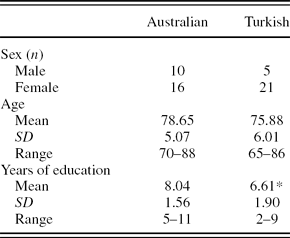
A t-test analyses on demographic variables (Table 1) revealed that the Turkish participants had significantly lower years of schooling than did the Australian group, t (50) = 2.95, p < .01, a finding that was consistent with population characteristics. Whereas education until the age of 15 has been compulsory in Australia since 1872, in Turkey, the upper age limit of 11 (Grade 5) was the norm up until the early 1990s. With regard to sex, both language groups comprised proportionately more women than men, with a slightly higher proportion of women in the Turkish group (approximately 1:4 men to women in the Turkish group and 2:3 men to women in the Australian group). Finally, the groups did not differ with regard to age, t (50) = 1.80, p = .08. We note that the two groups performed similarly on the MMSE, t (50) = –1.37, p > .05, range = 25–30 (see Table 2), with no suspected dementia and broadly comparable levels of general cognitive functioning.
Demographic variables (age, sex, and years of education) and MMSE performance by group

Note: n = 26 in each group. MMSE, Mini Mental State Examination.
*p < .05.
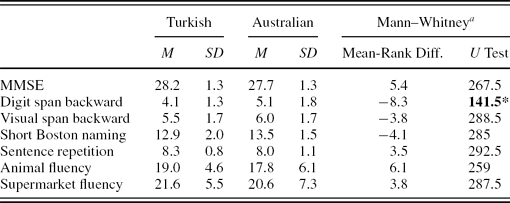
Neuropsychological test performance in Turkish and Australian older adults: Descriptive statistics and Mann–Whitney U test summary statistics
Note: n = 26 for each group. MMSE, Mini Mental State Examination.
aMean-rank difference = (Turkish) – (Australian).
*p < .05.
Instruments and procedure
Participants completed four discourse tasks and a set of neuropsychological tests in a predetermined order: the MMSE, the short-form Boston Naming Test (BNT), the digit span measure, the cookie-theft picture task, the Sentence Repetition Test, the Map Task 1, the visual memory span measure, the cartoon picture task, semantic verbal fluency tasks, and the Map Task 2. Discourse output was audiorecorded.
The short form of the original BNT (Kaplan, Goodglass, & Weintraub, Reference Kaplan, Goodglass and Weintraub1983) contained 15 of the original test items and was derived to obtain a version that is culturally and linguistically appropriate for Turkish speakers. The items (see Appendix A) were selected on the basis of a pilot study undertaken in Turkish speakers in Istanbul (Oktem-Tanor, personal communication, July 1998). A parallel psychometric study in an Anglo Australian sample showed the comparability of the short form to existing 15-item versions, revealing a moderate correlation with the full BNT (r = .66, p < .001; March, Worrall, & Hickson, Reference March, Worrall and Hickson2000).
The digit span and visual memory span measures were from the Wechsler Memory Scale—Revised form (Wechsler, Reference Wechsler1987), and only the backward span scores were utilized. Semantic verbal fluency measures included generation of words within a minute, first from the animal category (“tell me as many animal names as you can think of until I tell you to stop”) and then from the supermarket category (“tell me as many items sold in a supermarket as you can think of until I tell you to stop”). Finally, the Sentence Repetition Test involved repetition of nine orally presented sentences of varying syntactic complexity and number of propositions (see Appendix A). The syntactic structure of sentences was based on the structure of an experimental sentence comprehension task (maximum = 9; Waters, Caplan, & Rochon, Reference Waters, Caplan and Rochon1995).
Discourse tasks
Three pictorial stimuli were used to elicit four discourse samples: a single picture stimulus, the cookie-theft picture task; a cartoon picture (10 sequential pictures) task; and a map task to elicit route description. Two of the picture stimuli were based on events surrounding characters. The first task was static and more structured, and the latter included sequential pictures, requiring a higher level of processing (Davis et al., Reference Davis, O'Neill-Pirozzi and Coon1997). The map task was based on a simple visual plan to elicit route description and was administered under two context conditions: shared versus unshared. The character-based tasks were selected to facilitate the use of person deixis, whereas the map tasks were chosen to facilitate the use of spatial deixis. Given the discourse variable of interest was intrinsically dependent on context, multiple discourse tasks were selected to manipulate the complexity and the nature of information across the pictures (Chapman, Highley, & Thompson, Reference Chapman, Highley and Thompson1998; Davis et al., Reference Davis, O'Neill-Pirozzi and Coon1997; Smith, Chenery, & Murdoch, Reference Smith, Murdoch and Chenery1989). The tasks are described briefly as follows (for a detailed description and discussion of discourse tasks, see March et al., Reference March, Wales and Pattison2006, pp. 318–320).
1. The cookie-theft picture: Single picture. The cookie-theft picture from the Boston Diagnostic Aphasia Examination (Goodglass & Kaplan, Reference Goodglass and Kaplan1983) is a spontaneous language production task that provides a structured context involving easy to identify events and characters. It is a single-picture format, with a mother and two children (a girl and a boy). The participant is instructed to “describe what is happening in the picture.”
2. The cartoon picture task: Narrative description of sequential pictures. The cartoon picture task consists of 10 sequential pictures from the Peanuts series, with no voice bubbles (plate 40, April 26, 1970; Schulz, Reference Schulz1976). Three characters in the cartoon (a girl, a dog, and a bird) perform a number of actions and shift through various contexts across the pictures. (The cartoon first depicts three characters walking in three separate picture frames. When it starts raining, each character opens an umbrella. As it stops raining, the characters close their umbrella, except the “bird,” who continues to hold her umbrella as she stands under a downpipe oblivious to the weather change.) The cartoon is distinct from the static cookie-theft picture, with repetitious characters and actions across the pictures, and requires the participant to link the pictures thematically. As the characters shift across cartoon sequences, the task facilitates the use of personal pronouns and provides a context to distinguish the uses of person deixis versus anaphora. The participant is instructed to “describe what is happening in the pictures and what the story is, starting from the first picture.” It is noted that the English speakers in general chose the pronoun “he” to refer to the dog and the pronouns “he” or “it” to refer to the bird.
3. Map Tasks 1 and 2: Route description in shared versus unshared contexts. The map task is based on a colored road layout to elicit route description (see black-and-white copy, March et al., Reference March, Wales and Pattison2006). The plan is used twice to create (a) shared context, Task 1: speakers share the context, because the plan is visually available to the participant and the examiner; (b) unshared context, Task 2: only the participant has visual access to the plan and describes the route “over the phone.” The map is not seen by the examiner, who is unable to identify the source of spatial referents, thus rendering the use of spatial deixis inappropriate. Map Task 1 (shared context) aims to facilitate the use of spatial deixis, whereas Map Task 2 assesses inappropriate deictic use. In both tasks, the participant is asked to explain “how to get from the orange house to the blue house” (for detailed procedure and examples, see March et al., Reference March, Wales and Pattison2006, p. 337).
Discourse analytic methods: Language use variables
Discourse samples were audiotaped, transcribed, and verified by a second person for accuracy. Discourse variables were coded and analyzed by the first author. The language use variables, that is, noun/nominal phrases, person deixis, and spatial deixis, were obtained as follows:
1. For each language, nominals versus spatial and personal deictics were coded as categories. Initially, specific linguistic forms were coded (e.g., person deixis accusative form him; spatial deixis demonstrative locative form here). Counts were obtained for each form.
2. The specific linguistic forms were then combined, revealing the sum of form counts, under each language use category: nouns, spatial deixis, and person deixis.
a. Person deictic category involved personal pronouns (Lyons, Reference Lyons1995), which were initially coded by case markers (i.e., nominative, accusative, genitive, dative, or reflexive) and then combined into one variable.
b. Specific linguistic forms were compiled to form the spatial deixis category. The linguistic forms were based on the framework by Fillmore (Reference Fillmore, Jarvella and Klein1982, pp. 47–48), defining demonstratives according to their syntactic functions: existential deixis, demonstrative locative deixis, demonstrative pronoun deixis, demonstrative determiner deixis, demonstrative directional deixis, demonstrative goal adverb deixis, demonstrative manner deixis, and demonstrative sentential deixis. Nouns with determiners (e.g., “this woman”) were coded as nouns and determiners separately (i.e., noun–woman; this–demonstrative determiner/spatial deixis).
3. The sum of linguistic forms under each language use category was adjusted for text length using the “clause method” (Trask, Reference Trask1999). That is, the total of clauses was treated as the divider of language use variables, with every unit with a verb being considered a clause.
We note that, although a single examiner (first author) undertook the discourse analysis, interrater reliability was also examined as part of the study (see March et al., Reference March, Wales and Pattison2006) and revealed well-matched codings for nouns, spatial deixis, person deixis, and anaphora. However, occasional ambiguity was noted with regard to spatial deixis versus anaphora (with the second rater coding “That is a plate” as anaphora). As a result, we expanded the instructions for the coding system, integrating that coding of anaphora requires the presence of an antecedent in the text, with a pronoun/demonstrative referencing to an earlier referential element (e.g., “The girl is walking by herself”). It was also explicitly stated that the instructions should be accompanied by the writings of Lyons and Fillmore.
RESULTS
Analyses were conducted to assess (a) whether the Turkish and Australian groups differed on neuropsychology (NP) measures; (b) whether Turkish versus English speakers differed in the uses of nouns, spatial deixis, and person deixis across discourse tasks; and (c) whether spatial and person deictic uses were correlated with noun use. Missing data analyses revealed that the data set was complete. Stem-and-leaf plots and skewness/kurtosis values revealed normal distributions in neuropsychological test scores but skewed language use variables, which warranted the use of nonparametric statistical methods.
Were the Turkish and Australian English speakers comparable on neuropsychology measures?
Mann–Whitney U tests were conducted to assess the comparability of the two linguistic groups with regard to level of general cognitive functioning, working memory, and language measures (Table 2). Overall, the two groups were found to be equivalent with regard to level of cognitive functioning, with similar performances on all measures except the Digit Span Backward. The Digit Span Backward performance difference was considered to partially reflect different cognitive strategies in chunking, hence a cultural bias in daily strategies. Such evidence has been reported elsewhere with regard to Spanish- versus English-speaking American older adults and DAT patients (Arguelles, Loewenstein, & Arguelles, Reference Arguelles, Loewenstein and Arguelles2001; Loewenstein, Arguelles, Arguelles, & Linn-Fuentes, Reference Loewenstein, Arguelles, Arguelles and Linn-Fuentes1994). The Spanish speakers use a two-digit chunking strategy in daily life (e.g., reciting telephone numbers) as opposed to English speakers, and this strategy is a potential disadvantage in a task that requires repetition of single digits. Similarly, the Turkish (from Turkey) employ chunking of two or more digits in daily life, for instance, in reciting telephone numbers (e.g., 491-75-20), whereas the Australians in general use single-digit coding (e.g., 4-9-1-7-5-2-0). A further possible factor could be the relatively lower education level in the Turkish group.
Do the Turkish and Australian older adults differ in terms of language use rates?
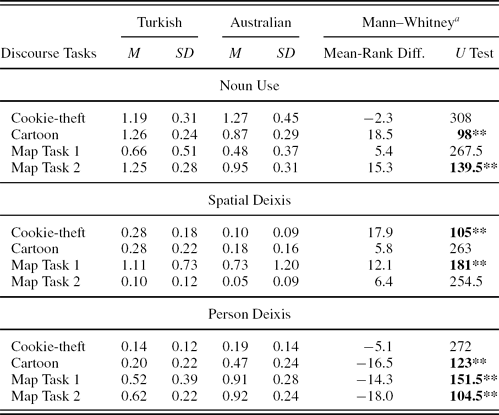
Nonparametric Mann–Whitney U tests (see Table 3) on language use variables revealed a number of significant group differences, which varied across the four discourse tasks. Analyses revealed that, in the cartoon picture task and Map Task 2, the Turkish group used significantly more nouns than did the Australian group, with no significant group differences found in the cookie-theft picture task and Map Task 1. Further, the Australian older adults employed more person deixis than the Turkish group in all tasks except the cookie-theft picture task. Finally, the Turkish group employed more spatial deixis in the cookie-theft picture task and Map Task 1.
Language use variables in Turkish and Australian older adults: Descriptive statistics and Mann–Whitney U test summary statistics
Note: Language use rates refer to the number of occurrences divided by the number of clauses. n = 26 for each group.
aMean-rank difference = (Turkish) – (Australian).
**p < .01.
Spatial deixis: Group differences
Spatial deictic use was further examined to ascertain whether the richer demonstrative system played a role in the higher deictic use by the Turkish group. To examine the nature of linguistic elements in use, the eight linguistic forms (demonstratives: existential, locative, pronoun, determiner, directional, goal adverb, manner, and sentential; Fillmore, Reference Fillmore, Jarvella and Klein1982) that formed the spatial deixis variable were examined separately in all four discourse tasks. It was noted that both groups had produced at least one word under four of the eight linguistic forms: existential, demonstrative locative, demonstrative pronoun, and demonstrative determiner. In addition, the Turkish group also produced words under the following forms: demonstrative directional, demonstrative goal adverb, demonstrative manner, and demonstrative sentential forms, under which the Australian group failed to produce any words at all.
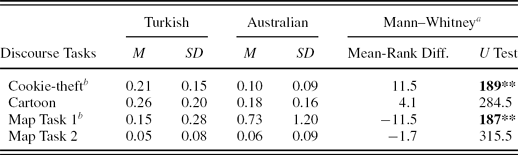
The subsequent question was whether the spatial deixis difference between groups was guided by the richness of the Turkish demonstrative system. To test this hypothesis, a new text-length adjusted spatial deixis variable (referred to as new spatial deixis) was formed by excluding the linguistic forms used by the Turkish speakers only, and this variable comprised the forms in common between the two language speakers (i.e., existential, demonstrative locative, demonstrative pronoun, and demonstrative determiner). Mann–Whitney U tests (Table 4; cf. Table 3) revealed that, after excluding Turkish specific forms from the original deixis variable, the group difference patterns did not alter except for Map Task 1. In Map Task 1, the group difference changed in the opposite direction, with the Turkish speakers using fewer new spatial deictic words (compare to more original spatial deixis in Table 3). The means and standard deviations illustrate a sharp drop in Turkish spatial deictic rates (compare Tables 3 and 4) in this task and indicate that the task had particularly facilitated the use of Turkish-specific linguistic forms, possibly via its spatial and shared-context emphasis.
New spatial deixis: Descriptive statistics and Mann–Whitney U test summary statistics
Note: The new spatial deixis variable comprises linguistic elements used by both groups. Spatial deixis rates refer to the number of occurrences divided by the number of clauses. n = 26 for each group.
aMean-rank difference = (Turkish) – (Australian).
bThe discourse task revealed significant group difference in the original spatial deixis.
**p < .01.
Overall, additional analyses demonstrated that the group differences in the original spatial deixis variable were guided by both lexical and contextual factors. In Map Task 1, the role of linguistic elements was prominent, since exclusion of nonshared linguistic forms altered the direction of the original variable group difference (Table 4). Given that this task facilitated deixis-based spatial language use (see descriptive statistics Table 3), the higher use of spatial deixis in the Turkish group was noted to be due to the wider range of demonstratives in Turkish (e.g., directional and manner demonstratives).
The cookie-theft picture task was further analyzed to assess the use of specific linguistic elements. The analyses revealed that the Turkish group used more determiners (e.g., this girl) than the Australians (U = 132.5, p < .001), whereas the rates for demonstrative pronouns (e.g., this is good) and existential deixis (e.g., there is a cup) were similar across the groups. That is, the task facilitated the use of deictic determiners for Turkish speakers, who showed a tendency to qualify the nouns through the spatial context (e.g., this woman is wiping the dishes).
Relationships between noun use and deictic variables
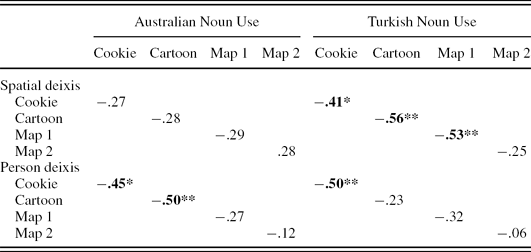
The questions were whether noun use was associated with deictic use in either language group and whether the patterns were similar across the groups. Spearman rho rank-order correlation coefficients were obtained to examine the relationship between language use variables in each language group (see Table 5). No significant correlations were found between spatial and person deixis rates (not reported in Table 5). In the Australian group, noun use and spatial deixis variables were not correlated, whereas inverse correlations were noted in the Turkish group across all discourse tasks except Map Task 2. It is noted that in Map Task 2, hardly any spatial deixis was used by either group, because the unshared context situation restricted its use; therefore, the lack of a significant relation in either group was considered highly plausible. In contrast, the Australian group displayed a significant negative correlation between person deixis and noun use in the cookie-theft and cartoon picture tasks, whereas in the Turkish group, the significant finding was restricted to the cookie-theft task. The lack of any significant correlations in the two map tasks was considered plausible, because the tasks were not character based, therefore restricting the use of person deixis to first and second person pronouns, which did not necessarily substitute for nouns in the picture.
Language use relationships in discourse tasks
Note: n = 26 for each group.
*p < .05. **p < .01.
Noun use and spatial deixis relationships
The patterns for spatial deixis–noun relationships differed across the two groups, with an inverse relationship found only in the Turkish group (Table 5). This finding was not unexpected, since the Turkish speakers used significantly more spatial deixis than the Australians did (Table 3). After excluding the Turkish-specific linguistic elements from the original spatial deixis variable, a reduction in the effect size of cookie-theft group differences was noted (compare the mean-rank differences in Tables 3 and 4). As a result, we also examined the correlation between noun use and the new spatial deixis variable and found that the correlation was no longer significant (r = –.16, p > .10). That is, the significant finding between noun use and the original spatial deixis in this task was determined by the Turkish-specific linguistic elements. In addition, in spite of no significant group differences between noun use and (original) spatial deixis in the cartoon picture task, the Turkish group analyses revealed a moderate significant inverse relationship between noun use and (original) spatial deixis in this task. These findings overall suggest that the significant noun and spatial deictic use relationship in the Turkish group was associated with the availability of a wider range of demonstratives in Turkish and that the nouns and spatial deixis replaced each other in language use. This finding contrasted with the Australian group findings, with no significant noun–spatial deixis relationships found in character-based tasks, and indicate that these two language use forms did not carry an interchangeable role in discourse.
The Map Task 1 facilitates spatial deictic use with its unstructured nature. That is, unlike in the Map Task 2, the context is shared between the speaker and the examiner, and the speaker can explain the route in any way, such as utilizing minimal language combined with gesture. This task revealed a higher spatial deictic use compared to other tasks, with both subject groups producing at least three times more spatial deixis in this task and the Turkish group utilizing more spatial deixis than did the Australian group (Table 3). The correlations revealed again an insignificant relationship between noun use–spatial deixis in the Australian group, a finding that was considered unusual (Table 5), since the task, compared to other tasks, had still facilitated a high use in Australians (see Table 3, means). To elucidate the role of linguistic elements, the correlation analysis was repeated using the new spatial deixis variable (i.e., using shared linguistic forms in the two groups). The noted correlation in the Turkish group was no longer significant (r = .23, p > .10), indicating that the Turkish-specific linguistic forms had guided the relationship between noun use and the original spatial deixis.
Overall, the noun use–spatial deixis patterns across the shared-context task conditions were consistent, with significant relationships noted in the Turkish-speaking group only, and indicating distinct discourse processes across the two groups. That is, in the Turkish group, spatial deixis replaced nouns when the context of communication was shared, partly owing to the availability of a wider range of demonstratives in the Turkish language.
Noun use and person deixis relationships in character-based tasks
In both character-based tasks, the finding of a significant noun use–person deixis relationship was plausible, since both tasks facilitated third-party reference. Noun use in the cookie-theft picture task was negatively correlated with person deixis in the Australian group, whereas it had negative correlations with both spatial and person deixis in the Turkish group (Table 5). The significant person deixis finding in both groups indicated similar discourse processes, determined by the pictorial content (see cookie-theft, Tables 3 and 5).
In contrast, the patterns differed in the cartoon picture task, with the Turkish group using half as many person deictic words as compared to the English group, and more nouns (Table 3). Noting that the task involved repetition of characters across pictures, the lower person deictic use by Turkish speakers potentially played a function to reduce the ambiguity associated with pronoun use (i.e., due to lack of gender information in Turkish third person pronouns). In contrast, in the cookie-theft picture task, noun use and person deixis rates were similar in the two groups, and this finding was feasible because the static nature of the picture partly controlled the ambiguity associated with third person pronouns. Although the cartoon picture facilitated the shifting of reference among the three characters, the static nature of the cookie-theft picture resulted in speakers focusing on one aspect of the picture (e.g., the mother washing the dishes) and shifting to the other aspect (e.g., the boy and the girl stealing the cookies), without necessarily referring back to the first aspect. Overall, there was a clear discourse task effect with regard to person deictic use as well as its relation with noun use, distinguishing the Turkish and Australian groups.
DISCUSSION
In summary, this project revealed that the Turkish versus Australian healthy older adults differed with regard to the use of nouns, spatial deixis, and person deixis, and that the differences varied across discourse tasks under study. Group differences in noun use were noted in the cartoon picture task and in Map Task 2, with a higher use in the Turkish group. Further, deictic use patterns varied according to type. Whereas the Turkish group in general used more spatial deixis (cookie-theft picture task and Map Task 1), the Australian group used more person deixis (cartoon picture task, Map Task 1, and Map Task 2).
Analyzing the specific linguistic forms under the spatial deixis variable revealed that the higher spatial deictic use by Turkish speakers was partially determined by the wider range of demonstratives in the Turkish language structure. This effect was particularly prominent in the shared route description task (i.e., Map Task 1), which facilitated space/place-based language use. In contrast, the gender-free third person pronoun system in Turkish restricted the use of person deixis in the cartoon picture task. The cartoon task involved sequential, repetitious characters across thematically linked pictures and rendered reference to characters via third person pronouns highly ambiguous for Turkish speakers.
Deixis and noun use correlations revealed partially distinct patterns in the Australian and Turkish groups. Under the three shared-context conditions (cookie-theft task, cartoon task, and Map Task 1), noun use and spatial deixis was inversely correlated in the Turkish group, whereas no significant correlations were found in the Australian group. In contrast, noun use and person deixis were inversely correlated in the Australian group (i.e., cookie-theft and cartoon tasks), whereas the Turkish group displayed a significant finding only in the cookie-theft picture task. Overall, the processes associated with person versus spatial deixis types were broadly distinct across the two language groups, providing empirical evidence on the theoretical distinction of deictic types.
Finally, the analyses illustrated an interaction between the language system and the communicative context that determined how language was used. Overall, the properties and demands of the tasks (i.e., communicative context) played a central role in how language was used and determined the nature and degree of language use relationships in each group. There was a clear discourse task effect on language use patterns, the nature of which varied between the language groups under study.
Conclusions
To conclude, the language use patterns across English- versus Turkish-speaking older adults indicated partially distinct language use processes, determined by linguistic factors, including a nonelaborate third person pronoun system versus a richer demonstrative system in the Turkish language compared to the English language. The language systems clearly influenced to what extent the two language groups utilized person versus spatial deixis and whether and in what way these forms were linked to noun use in return. The Turkish speakers made higher use of the shared communicative context, since the language had available tools to express intended meanings and avoided person deixis when the context created ambiguity for the speakers. In other words, when the linguistic tools available for a deictic type were richer, the speakers of that language showed a higher preference to use that particular deictic form, and they did so interchangeably with nouns within the bounds of contextual factors. The findings depended on the discourse task under study that created specific demands on the communicative context.
The findings provide empirical evidence for linguistic theories that attest deixis as a language use form that is determined by the context and the language system, and they specifically confirm Fillmore's (Reference Fillmore, Jarvella and Klein1982) theoretical position that the communicative context and the grammatical and lexical elements available to a language are central aspects—in other words, determinants of deictic use. The findings further provide empirical evidence on the theoretical distinction of deictic types (Fillmore, Reference Fillmore, Jarvella and Klein1982, Reference Fillmore1997; Lyons, Reference Lyons1968, Reference Lyons1977, Reference Lyons1995), demonstrating that the uses of spatial versus person deixis display disparate patterns even within a single language system, therefore warranting such distinction in clinical discourse research.
The study indicated that when deixis was used, this use was not necessarily associated with a reduced noun use in language output; in other words, it is not always used as a means to replace nouns in language. Our findings showed that if the language system was lexically impoverished in supporting a deictic type, the linguistic elements available for that deictic type created ambiguity, and in turn the use of deixis was poorly linked to the use of nouns, not being necessarily used instead of a noun. However, the relationship between noun and deictic use became robust when a language system and structure supported a given deictic type (e.g., the availability of three separate third person pronouns in English vs. a restricted single pronoun in Turkish). Overall, the findings contribute to the existing theory base in that the extent to which the use of a given deictic type replaces nouns is determined by how well the language system supports that particular deictic type.
Furthermore, the study illustrates that the use of multiple tasks is a methodological necessity in the study of discourse and language processing, which is intrinsically context dependent and not essentially generalizable. Most clinical discourse research has involved the use of single tasks, for example, in DAT (e.g., see Giles, Patterson, & Hodges, Reference Giles, Patterson and Hodges1996; Nicholas, Obler, Albert, & Helm-Estabrooks, Reference Nicholas, Obler, Albert and Helm-Estabrooks1985; Tomoeda & Bayles, Reference Tomoeda and Bayles1993). The use of multiple discourse tasks enables experimental manipulation of discourse production through variations in and across task conditions (Cherney & Canter, Reference Cherney, Canter and Lemme1992; Davis et al., Reference Davis, O'Neill-Pirozzi and Coon1997; Ehrlich, Reference Ehrlich, Bloom, Obler, DeSanti and Ehrlich1994; Shadden, Burnette, Eikenberry, & DiBrezzo, Reference Shadden, Burnette, Eikenberry, DiBrezzo and Prescott1991), the parameters of which can affect the outcome and nature of the discourse produced (Chapman et al., Reference Chapman, Highley and Thompson1998; Davis et al., Reference Davis, O'Neill-Pirozzi and Coon1997; Smith, Chenery, et al., Reference Smith, Chenery and Murdoch1989). An underlying discourse difficulty may not necessarily be detected, unless the tasks under study are carefully selected and designed. For instance, Ulatowska et al. (1988, p. 129) state that “more structured linguistic tasks that force the subject to respond in a particular manner may also reveal subtle deficits not apparent in spontaneous discourse. Spontaneous language tasks, although more naturalistic, may serve to mask a patient's deficits by allowing the patient the opportunity to select what he or she will say.”
The evidence from this project provides further insights into our earlier work on language use in English-speaking DAT patients (March et al., Reference March, Wales and Pattison2006), who displayed a tendency to overuse spatial deixis, including inappropriate use and an underuse of person deixis. We demonstrated that the spatial deictic use was less preferred by English-speaking healthy older adults in relation to the restricted demonstrative system, whereas person deixis carried an interchangeable role with nouns in discourse production. Hence, this evidence from the cross-linguistic study suggests that the DAT patients in our earlier neurolinguistic study displayed a shift to a more ambiguous form of deixis, that is, spatial deixis, with the English language having a relatively limited demonstrative system. Following from this, it can be hypothesized that the effect of DAT on Turkish speakers would be expected to be a shift to a more ambiguous form of deictic use, that is, person deixis, with the Turkish language having a limited third person pronominal system. Although this hypothesis remains to be tested, overall, the converging evidence highlights an increased vulnerability of the discourse abilities in dementia, when the abilities in question are poorly supported by the lexical and syntactic properties of a given language system.
Subsequently, cross-linguistic studies are needed to examine whether discourse disintegrates at similar patterns across languages as a result of neurological and neurodegenerative insult to the brain. In neurolinguistic research within a single language system such as English, the assumption is that the brain insult accounts for the changes noted in language/discourse abilities. Our findings, in support of Slobin's (Reference Slobin1991) work with Turkish aphasia patients, indicate that the brain insult interacts with the language system to result in specific language/discourse changes that may not necessarily be generalizable to speakers of other languages. In other words, it is misleading to assume that a neurodegenerative process such as DAT results in similar discourse changes across languages.
A relevant variable for future studies of DAT is the perspective-taking ability, since being able to orient oneself according to the other speaker is key to the appropriate use of deixis (Forrester, Reference Forrester1996). It has been reported that DAT patients display reduced perspective taking in discourse (Kempler & Zelinski, Reference Kempler, Zelinski, Huppert, Brayne and O'Connor1994; Ripich, Carpenter, & Ziol, Reference Ripich, Carpenter and Ziol2000), and it remains to be examined whether and to what extent this difficulty can explain the deictic use changes and any inappropriate use of communicative context.
The current cross-linguistic project, along with the neurolinguistic study on DAT (March et al., Reference March, Wales and Pattison2006), has significant implications for neuroimaging studies that examine linguistic elements such as pronouns. The project demonstrates that the discourse task under study and the associated communicative context place constraints on language output and determine how discourse is produced. A selected discourse task for language production may not necessarily elicit the target linguistic variables under study; in other words, it may not be sensitive enough. Hence, it is crucial to incorporate carefully selected multiple discourse tasks and adopt an experimental neuroimaging design. In addition, the language system plays a significant role in the use of language, and cross-linguistic studies are paramount to examine how the language systems determine the relationships among language elements, brain structures, and function. Further, the potential cognitive demands of language and discourse tasks in use should be accounted for, since both verbal and visual working memory capacity can play a role in processing of pictorial stimuli and can contribute to how language is used (see March et al., Reference March, Pattison and Wales2009). Finally, such language research should draw on theoretical linguistic knowledge, since, for instance, not all personal pronouns are deictic in function but can instead carry anaphoric functions. The deictic versus anaphoric uses are well described by linguists (Bühler, Reference Bühler, Jarvella and Klein1982; Lyons, Reference Lyons1977) and carry distinct functions in language despite often sharing linguistic elements such as pronouns and demonstratives. Therefore, a pronoun can have partially disparate brain correlates depending on whether it has been used as deixis or anaphora. Such distinctions are not necessarily drawn in clinical discourse research, with the pronoun use being employed as an umbrella term (e.g., see Nieuwland, Petersson, & Van Berkum, Reference Nieuwland, Petersson and Van Berkum2007).
One limitation of this study has been the lack of young adult language samples, which would have informed whether the cross-linguistic patterns noted between English and Turkish speakers were specific to discourse in older age. Further, although examining discourse production in relation to communicative context, a further limitation of this project is the lack of visual recording to enable the study of gestures in relation to deictic use. Evidence from speech and gesture research illustrates that discourse comprehension and production are both enhanced by gesture (Holler & Wilkin, Reference Holler and Wilkin2009; Kelly, Ozyurek, & Maris, Reference Kelly, Ozyurek and Maris2010), and the study of gesture in relation to deictic use is particularly relevant to examine whether and how deictic use is supported by gestures. Further, longitudinal case studies of neurodegenerative patients through examination of discourse–gesture patterns would reveal whether gesture becomes more enhanced with disease progression or if it becomes less efficient in supporting discourse.
Overall, this study has provided empirical evidence for theoretical descriptions of deixis, demonstrating a clear role of the language system and the communicative context in the way speakers use context-dependent language. The cross-linguistic evidence sheds insight into the earlier study on language use changes in DAT, with the converging evidence suggesting that the linguistic elements poorly supported by a given language system are more prone to the effects of neurodegenerative disease. As discussed above, the findings have implications for clinical discourse and linguistic neuroimaging studies, particularly when linguistic elements such as pronouns and demonstratives are under study, with a need to draw on theoretical linguistics.
APPENDIX A
Language tests
Short BNT (in order of difficulty)
Pencil, Flower, Saw, Mushroom, Camel, Volcano, Snail, Harmonica, Cactus, Hammock, Funnel, Accordion, Compass, Tongs, Palette
Sentence Repetition Test
The car hit the child.
The teacher was called.
The dog chased the cat and the mouse.
The purse was stolen by a woman.
It was the garden that the dog entered.
The man invited his friend to his house.
The woman caught the child that fed the lion.
The student watched the film and ate the ice cream.
The postman that the child knew found the book.