Introduction
In the autumn of 1937, Fan Majun was one of thousands who fled the Japanese invasion of Shanghai.
Arriving at the Bund, it was already 7.30 in the morning. There were many people from my home, and their faces all wore a worried expression. After half an hour we climbed aboard the boat, which was extremely dirty, but it was the only one available. More and more refugees boarded until it was full, but it still didn't set off. The sun was high in the sky, and we hadn't eaten a thing since dawn . . . The crying of children and the complaints of adults were enough to drive one mad. It was like being in prison, and I felt I just could not bear it. At last, the boat set off and when I looked at the clock on the customs house it was already ten.Footnote 1
Throughout the twentieth century, the chaos and trauma associated with Fan's refugee experience was repeated across the world as populations were displaced by some of the most devastating wars the world has ever seen. However, focusing on the undoubted terrible human cost of forced migration leaves several questions unexplored. Just how did Fan Majun get on the boat in the first place? Where was he going? What would he do when he got there? Answering these highlights the extent and efficacy of the socio-political network required to move millions of people during a time of crisis in China, and illustrates the role and limitations of the Nationalist Government. Moreover, it draws attention to the importance of an interlinked network of urban institutions, which by 1937 stretched across China and beyond.
Fan Majun was just one of millions who became refugees during the Anti-Japanese War of Resistance, which is normally seen as lasting from 1937 to 1945.Footnote 2 A month after the Marco Polo Bridge Incident in July 1937 marked the outbreak of the Japanese invasion of north China, a force landed in Shanghai, and fierce fighting raged in the Chinese areas of the city for three months. Then, at the end of October, the Japanese finally broke through the Chinese line and advanced west across the Lower Yangtze Delta towards the capital Nanjing, which was captured in December. During the battle for Shanghai, the city was heavily bombed, although for political reasons, the International Settlement remained largely immune from the violence. Instead, from mid-August hundreds of thousands of refugees flooded into the foreign administered enclaves, placing a huge burden on local authorities, and beginning an exodus of people from Shanghai to cities across China. Even before the fighting began, 50,000 people were estimated to have left Zhabei in the north of the city, and in total, over 1 million people living in Shanghai were displaced by the war. By December 1937, 375,000 of these had been evacuated to their homes.Footnote 3 This was part of a wider exodus from the region, with estimates putting the number forced out of Jiangsu Province at 12,502,633, or 34.28 per cent of its population.Footnote 4 While problems with wartime record keeping make these figures unreliable, the exodus was part of a national movement of people that has recently been estimated at between 65 and 90 million over the course of the war.Footnote 5 Understanding how this movement in the early months of the invasion was managed reveals much about the importance of the co-operation between political and social organizations in managing this crisis. This allows reconstruction of a history that goes beyond the trauma and chaos caused by the Japanese invasion, and illustrates how societies actually deal with catastrophe, a narrative that is still not fully developed in France, where more research has been conducted on war and occupation than in East Asia.Footnote 6
To rescue this story of management from the more powerful ones of violence and trauma associated with the refugee experience, I describe the movement of three different migrant communities from Shanghai to their homes in the closing months of 1937. These were Hunan Province in central China, Wuxi City just 100 miles west of Shanghai and Guangdong Province in the south of the country. In tracing the movements of these communities, I first highlight the importance of central government in creating a bureaucratic structure which provided a space for local officials to work closely with a wide range of societal organizations in providing refugee relief. Secondly, I show how these organizations were based predominantly in cities, and how their co-operation in a time of crisis illustrates the extensive urban linkages that had formed across China in the early twentieth century. Central to this network were tongxianghui (native place societies), guild-like organizations acting as trans-local entities integrating migrant communities into cities across the country, while maintaining emotional and physical connections back to their homes. Focusing on the role these organizations played in the refugee movement illustrates the complicated and dynamic nature of modern urban identity in China, as migration created new communities in fast-developing polycentric metropolitan spaces. Finally, underlying socio-political connections is the physical infrastructure along which refugees travelled, which included temporary shelters such as factories, schools and temples, as well as the railways, roads and waterways.
Concentrating on connections between cities goes beyond studies of refugees in individual metropolises, such as Shanghai, where authors have been largely critical of relief efforts.Footnote 7 Elsewhere, scholars have focused on the Nationalist Government's organization of refugees in the temporary capitals of Wuhan in 1938 and Chongqing until the end of the war.Footnote 8 In doing so, they underestimate the extent to which the central state took responsibility for management of refugees in the first few weeks of the war, or, if it could not, created a national system within which social organizations worked effectively. There can be no doubt that charities and native place associations were often forced to fend largely for themselves, and indeed some did so very effectively, but others lacked sufficient resources and worked closely with government officials or relied on state funds.Footnote 9 Indeed, in moving people from one city to another, organizations were taking them out of a specific metropolitan jurisdiction, and so had to rely on the provincial or central government to co-ordinate activities. Refugee management during the invasion should therefore be seen as part of a gradual process of slow but incremental state penetration into various areas of social life that began in the late Qing and was to find its apotheosis after 1949.
Despite this, the Nationalist Government did not have the capability to control metropolitan social organizations, and so had to make do with co-ordination. Like prostitutes in Suzhou, whose struggles with the state are described by Peter Carroll elsewhere in this issue, refugees moved in a fluid environment in which they interacted with both political and social institutions. These included a variety of charities, but also tongxianghui, which by 1937 had developed into a national network of urban-based organizations that could be mobilized in times of crisis. Understanding their trans-local nature reveals just how interconnected the modern urban system in China had become. Tongxianghui have a long history of representing migrant communities in cities across the country, acting as kin-like organizations tying residents of the same city or province together, and in twentieth-century Shanghai, increasingly serving to connect them with the nation as a whole.Footnote 10 Despite their ability to embody multiple meanings, there is still some debate as to how far tongxianghui were both modern and specifically urban institutions.Footnote 11 By analysing how three native place organizations co-operated with both the state and a variety of other actors in a national emergency, I argue that not only were they modern and urban, but that their trans-local nature made them part of an emerging urban system that existed on a national, and to some extent a global, scale. In short, they were extensions of the social networks that were so vital to effective governance in Shanghai itself.Footnote 12 As the other authors in this issue have argued, links between a variety of social and political organizations were crucial to the construction of urban modernity, whether that be systems of running water in Tianjin or People's Square in Shanghai. By exploring how such networks operated between as well as within cities, I emphasize the extent of interconnectedness within the urban system, and in doing so draw attention to how urban spaces in China should be studied in relation to each other, rather than as just single bounded entities. If the modern city is increasingly a place in which everyday life is bound up with networks that stretch from the local to the global, then a major national crisis is the perfect lens through which to study it.Footnote 13 So devastating was the Japanese invasion of China in 1937 that migrant communities in Shanghai and the organizations that represented them were forced to reach outside the city for help. This reveals both the co-ordinating role of the central state, and the extent to which cities in China, as elsewhere, were enmeshed in a web of connections that helped to define their nature.
The Hunan Native Place Society: working with the government
The experience of the Hunan Tongxianghui in Shanghai illuminates how the system established by the central government in Nanjing provided an over-arching co-ordinating structure for refugee relief. The relative poverty of the native place society, which was founded in 1923 with just 425 members, meant it explicitly relied on government support, as it was unable to raise enough money from business and private donors, unlike more prosperous migrant communities.Footnote 14
In response to the Japanese invasion of China, the Nationalist Government established the Feichang shiqi nanmin jiuji weiyuanhui (Emergency Refugee Relief Commission) in September 1937. Its headquarters were in Nanjing with branches at the provincial, municipal and county levels of government across China. The magnitude of the task at hand meant that officials from across the state bureaucracy, including the Executive Yuan, finance, transport, social affairs and railway departments were appointed to the commission, and at the provincial and municipal levels, governors and city heads were directed to liaise with police and charities to organize relief efforts. Local officials were also charged with several major responsibilities including shelter and transport of refugees, provision of food, clothes and other necessities, as well as their protection. Refugees could be put to work if deemed capable or granted military service if they so wished. At this early stage of the war, there was little funding allocated for refugee relief from Nanjing, and it was up to provinces and cities to find money from their own budgets.Footnote 15 It is true that the central government very much delegated the work of managing refugees to lower echelons of the bureaucracy, and it was local officials who had to deal with the situation on the ground, but this framework was to coalesce in a dense network of official contacts connecting people and places across China.
Indeed, the establishment of a centralized bureaucracy for refugee management was a new development, since in 1932 when the Japanese fire-bombed Shanghai there is no evidence that such an organization existed. Instead, the municipal government formed the Shanghai zhanqu nanmin linshi jiujihui (Shanghai War Area Temporary Refugee Relief Committee), which worked closely with native place societies to house and repatriate refugees, while charities such as the Red Swastika Society were also heavily involved in relief efforts both in Shanghai and elsewhere. Local governments in many cities across the Lower Yangtze Delta co-operated with charities in refugee shelter and shipment, but did so unsupervised by officials in Nanjing.Footnote 16 This makes the actions of the Nationalist Government in 1937 the first time that the central state took an active part in refugee management since the fall of the Qing Dynasty, although China had a long tradition of official activity during natural disasters, such as the great famine between 1876 and 1879.Footnote 17 In 1938, the Emergency Relief Commission was replaced with the Development and Relief Commission, which set up sub-stations across China to house and register refugees.Footnote 18 This new system, as well as the ravages of war, combined to shut out societal organizations from much of refugee relief in Guomindang-controlled China, but communications between the Hunan Tongxianghui and various organs of the government show social and political organizations working closely together.
Being a small organization with limited funds, the Hunan Tongxianghui was unable to establish refugee shelters of its own in Shanghai, but it registered people from Hunan dispersed in the various centres across the city, and helped to organize their return home. Between 18 August and the beginning of October, 1,252 people were able to leave Shanghai by themselves, while a further 1,701 were recorded as being repatriated by the society between 11 September and 5 October.Footnote 19 The situation is confused by a report from 19 September, which recorded 1,000 people as having been returned to their homes leaving 1,167 awaiting transport in Shanghai. In addition to this, there were also nearly 4,000 refugees who had registered, but were staying with friends and family.Footnote 20 Despite this confusion, the Hunan Tongxianghui worked closely with other organizations. At the outbreak of the war, it joined other native place societies, including some from Guangdong, Sichuan, Hebei, Ningbo and Changzhou to form the Shanghaishi ge luhu tongxiangtuanti lianhe banshichu (Shanghai City United Office for Native Place Associations), which facilitated repatriation of refugees.Footnote 21 Although there is little evidence that this organization had any real power, it does show that tongxianghui were able to cross community boundaries, and co-operate in refugee relief.
A far more important link was with the Shanghai municipal authorities, which also formed a point of contact to officials elsewhere in China. Within the International Settlement itself, refugees from Hunan were placed in camps managed by the Shanghai cishan tuanti lianhe jiuzai hui (Shanghai Federation of Charities Disaster Relief Committee). Initially established to raise funds for refugees in north China, it was the longest running of the three organizations that co-ordinated aid in the city, and was the most closely connected to the government in Nanjing, from which it received 20,000 yuan in donations.Footnote 22 This organization was also the medium through which the Emergency Relief Commission dealt with tongxianghui in facilitating movement of refugees around China. One of the most important tasks of native place associations was the arrangement of free travel for those who had lost their homes and incomes, and in Nanjing, the Executive Yuan ensured that officials in the ministries of Finance, Railways and Transport were aware of the need for this. In the case of those from Hunan, the Shanghai–Nanjing and Shanghai–Hangzhou railways as well as the river from Nanjing to Wuhan were the primary transit routes, and it was the task of the native place association to work with relevant authorities and charities in each city along the way.Footnote 23 The Hunan Tongxianghui first received notice of the guidelines on 9 September in an order from the Shanghai Bureau of Social Affairs, which was sent out to the Relief Committees in Shanghai as well as the tongxianghui itself.Footnote 24 Following this, the native place association petitioned the relevant departments, which copied their replies to the Shanghai Federation of Charities.Footnote 25 The Ministry of Transport arranged for free transfer of refugees with the Minying Steamer Company, while the Railway Ministry simply asked that a list of refugees passing through each city should be given to the local railway station and government departments in accordance with central guidelines.Footnote 26 Members of the Hunan Tongxianghui were clearly concerned about what would happen to refugees after they left Shanghai, and telegrams were sent to the Hunan Provincial Government to ask for its help in ensuring that local officials in Nanjing, Jiangsu and Hubei would co-operate in refugee return.Footnote 27 Refugees returning home through Zhejiang Province to the south of Jiangsu were also cared for by local officials, since the Hangzhou Municipal Government promised the Hunan Tongxianghui that both the Zhejiang Railways and Roads ministries would grant free transport.Footnote 28 The ability of the tongxianghui to mobilize successfully the support of such a dense network of officials in different cities throughout east and central China speaks volumes as to the extent of the co-operation between it and the government, not to mention the efficacy of the framework established by the Emergency Refugee Relief Commission.
This is not to say that the trip from Shanghai to Hunan was an easy one. Refugees travelled west by boat or rail to Suzhou or Jiaxing, before moving on to the capital Nanjing, where they caught the steamer up the Yangtze River to Wuhan, and then continued south into Hunan Province. It was estimated that the total cost of returning 6,000 people would be 7,000 yuan, and the money was provided by the Hunan Provincial Government and the Hunan Flood Relief Committee.Footnote 29 Advice given out by the tongxianghui alluded to the threat of enemy attack, warning mothers to keep their children quiet, men not to smoke and all not to eat more than their ration. In an appeal to both community and national spirit that was repeated by other organizations, refugees were reminded that ‘there were many soldiers from Hunan fighting the enemy on the frontline who did not have even a cup of water every day’.Footnote 30 Little information exists on what happened to refugees once they returned home, but the provincial government registered them and enlisted those eligible for military service. It also distributed money and entrusted officials in counties across the province with the task of establishing refugee centres.Footnote 31
The narrative I have given of refugee movement from Shanghai to Hunan remains one largely devoid of human sentiment. Of course, many refugees were in a pitiful state, and tragically Hunan itself suffered massively from depopulation in 1938 as the Japanese advanced westwards.Footnote 32 The dry nature of official correspondence gives only glimpses of their emotions, but clearly demonstrates how effective the national system of refugee management was in those first few weeks of the war. The Hunan Tongxianghui, which had few resources, relied heavily on this to transport members of the migrant community in Shanghai safely home.
The Wuxi Native Place Society: working with charities
The Wuxi community in Shanghai was larger and had access to more resources than the Hunan community, while returning refugees was a relatively simple affair as the county of Wuxi was just 100 miles west on the railway line to Nanjing. In these circumstances, the Wuxi Tongxianghui did not need the help of the central state, although it worked within its framework for refugee management. During the Japanese invasion, it liaised with the Red Swastika Society, the charitable arm of the Society of the Way, a Buddhist sect of dubious legality. It had overcome this connection to grow into a national relief organization with branches across the country and was active in Jiangsu Province during the floods of 1931, as well as the bombing of Shanghai in 1932.Footnote 33 Throughout the Anti-Japanese War of Resistance, the Red Swastika Society not only helped with the shelter and transport of refugees in cities across Jiangsu, but also sent teams out to bury bodies during the early months of 1938, most notably in Nanjing.Footnote 34 Exploring how the Wuxi Tongxianghui worked closely with this charity, and how the Red Swastika Society also took an active part in the processing of refugees back in Wuxi City, illustrates how connections between urban social institutions spread beyond Shanghai, tying multiple cities into a national network. Moreover, the voices of relief workers allude to the trans-localism of urban identity, since the threat of invasion made people think of the safety that they believed could be found in their native place.
The Wuxi Tongxianghui was founded in 1924, and had over 6,000 members including some notable entrepreneurs, such as its executive director Rong Zongjing, who together with his brother Rong Desheng had built their fortunes in cotton and flour milling, and were the richest industrialists in China.Footnote 35 It had long represented the Wuxi community in Shanghai, and organized previous relief efforts in the war of 1924–25, when it helped refugees flee a besieged Wuxi, while during the bombing of Shanghai in 1932 it also worked closely with the Red Swastika Society. Indeed, the tongxianghui very much saw refugee relief as its duty, as an editorial on its activities in 1937 noted.
Since the government was concerned with military matters, it did not take responsibility for refugee relief and resettlement. Moreover, it had no power to deal with this. In these chaotic times, the relief of refugees who have suffered from the loss of their homes should rely on social organizations and philanthropic individuals.Footnote 36
The themes of chaos and victimization at the hands of the Japanese help to glorify the society's role, and also excuse the apparent lack of action on the part of the national government. However, the writer was not critical of this, but instead recognized the duty of the society to support the Wuxi migrant community in Shanghai.
The society certainly responded quickly to the outbreak of war. On 15 August, it rented a building as a temporary headquarters in the International Settlement, since its old base on Qipu Road was in the centre of the battlefield. A Relief Council was established and divided into sections responsible for refugee shelter, food, first aid, burial services and repatriation.Footnote 37 Funding for all this activity came from the organization's extensive links to the Shanghai business community and over 16,000 yuan was collected between August and November. Donations attest to the coherence of the migrant community, as many were small individual gifts, although some were from organizations such as the Shanghai Ironworkers Trade Association which gave 1,000 yuan.Footnote 38 This money took the place of government funds and allowed the society to set up refugee shelters. These were managed jointly with the Jiangyin Native Place Society, and while there is no more information on the nature of that co-operation, Jiangyin was only a few miles north of Wuxi and there had long been a close relationship between the two communities. Five shelters were provided with a combined capacity of 5,000 refugees. Like many others in Shanghai, they were meant as short-term dwellings while travel was arranged, something that was recognized by the workers, who were eager to help their fellow migrants return home.Footnote 39 This work began on 16 August and until the end of that month 500–1,000 people were arriving daily from across the city. The flood dwindled to a trickle, and at the end of September responsibility for housing the few refugees who remained in the metropolis was handed over to the Shanghai Federation of Charities. In total, some 26,000 men, women and children passed through the shelters, which given that there were an estimated 100,000 people from Wuxi living in Shanghai is a not insignificant number.Footnote 40 The reports of workers in the refugee centres starkly capture the sense of dislocation that displacement produced, while also drawing attention to how the crisis heightened people's perception of links back to their native places. For example, one aid worker noted the relief that many felt on arriving safely at a shelter.
When the first day of work started on 16 August, those fellow migrants fleeing the battlefield flooded into our shelters . . . Their worried expressions immediately displayed a small amount of relief, since they knew that not only had they reached shelter, but they would soon be going back to their native place – Wuxi.Footnote 41
Having been instrumental in providing shelter for refugees in Shanghai, the Wuxi Tongxianghui then arranged transport out of the city. The society acquired passes for 60 small private boat operators, which together shipped nearly 20,000 refugees, most of them in batches of 30 to 50 people.Footnote 42 It was in this work that the Red Swastika Society emerged as a partner, since it helped to arrange and man the convoys. Three members of the Wuxi Tongxianghui were sent from Shanghai to Wuxi to organize hiring of boats. They met with representatives of the Red Swastika Society and began the return trip to Shanghai by steamer, towing seven boats behind them under threat from enemy bombers. On 25 August, they arrived safely in Shanghai, but loading of refugees was delayed by 24 hours as the steamer company tried to increase the price of tickets. The local government settled the dispute, and so the following morning 1,588 refugees were loaded on to a convoy that had grown to 13 boats. It passed several army checkpoints before arriving in Wuxi, where the refugees were processed and sent to various shelters in the city.Footnote 43 A second convoy composed of 14 boats with 1,850 refugees set off from Shanghai on 29 August, and this trip was also without incident. As before, the experience was an uncomfortable one, since as well as army checkpoints and the threat from Japanese planes, Suzhou Creek itself carried tragic evidence of the fighting. ‘On this trip, both ways, we saw not less than twenty corpses floating in Suzhou Creek. There is no-one to drag them out for burial. In the sunshine, the bodies all turned red, and the flies gathered.’Footnote 44 These convoys were but one way to leave Shanghai in the autumn of 1937. The railway was certainly still in operation in mid-August, as thousands of Chinese gathered at the North Station, anxious to get on a train bound for Nanjing, while even to the end of October, the Wuxi Branch of the Red Swastika Society reported people arriving daily by train.Footnote 45 Moreover, the multiple organizations involved in the return of refugees meant that members of the Wuxi community were just as likely to find themselves among the 35,000 refugees that the Shanghai Municipal Relief Committee helped to get to Hangzhou, Ningbo, Wuxi and Xuzhou.Footnote 46
The exodus from Shanghai to multiple places across China meant that many people merely passed through Wuxi on their way home, and the city stood out as a transport hub in refugee shipment, a rather tragic counterpart to its pre-war role as a regional market centre. According to the Emergency Relief Commission's guidelines, it was the responsibility of the Wuxi municipal authorities to shelter refugees. Despite this, there is no evidence that officials took an active part in refugee relief, although local government departments were reorganized to handle military affairs such as air defence, conscription and provision of food to troops.Footnote 47 A preoccupation with military matters is understandable since Wuxi was regularly bombed from early October, and finally occupied at the end of November. In such circumstances, the Red Swastika Society took control of much of the task of processing refugees. Total numbers passing through the city are hard to gauge, with the society claiming that 30,384 people entered its shelters between 17 August and 30 September, 27,982 of whom were sent home.Footnote 48 The Chinese Foreign Relief Association of Wuxi, about which I have been able to find no information beyond its existence, estimated that 32,346 people had been sent by the Wuxi and Jiangyin Tongxianghui to the city between the middle of August and the middle of October, 3,831 of whom remained in long-term shelter in Wuxi.Footnote 49 Given the constant stream of refugees these figures are likely to be an underestimate.
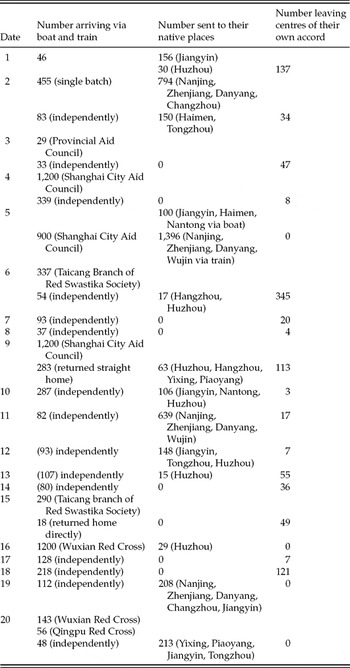
Table 1 is a daily record of the activities of the Wuxi Branch of the Red Swastika Society during the first three weeks of October, when by all accounts the exodus from Shanghai had peaked. It draws attention to how Wuxi City was but one node in a massive urban network. Not only were the Wuxi Native Place Society and the Red Swastika Society just two of several organizations involved in refugee relief, but the city itself was a transit point for many anxious to get to their homes further inland. Those leaving independently were most likely Wuxi County residents returning to the countryside and able to arrange their own transport, while others were shipped to a multitude of cities. Many of these, such as Danyang and Zhenjiang, were located further inland towards Nanjing, but other places, such as Nantong, required a trip across the Yangtze. Either way, shipment made use of ports and railway stations that were key sites in the national urban system, while large buildings in Wuxi City itself, including at least two temples and a cocoon selling business were temporarily converted into refugee shelters.Footnote 50
Number of refugees passing through Wuxi City, October 1937

Source: ‘Shijie hongshizihui Wuxi fenhui jiuji gongzuo jianbao shi yue’ (Simple Report of the Relief Work of the Wuxi Branch of the International Red Swastika Society (October)), in Shijie hongshizihui Changtai banchu he Changzhou, Suzhou, Wuxi fenhui jiuji gongzuo baogao (The Relief Work Report of the Branch Offices of the Changzhou, Suzhou and Wuxi International Swastika Society and the Changzhou/Taicang Headquarters) (Shanghai Municipal Archives Q120-4-422), 56–69.
Tracing the movement of refugees from Shanghai to Wuxi highlights not so much the inefficiency of the central state, but the fact that it was not always required for successful refugee management. Instead, tongxianghui and charities drew together the resources and people of Shanghai and Wuxi to channel thousands of displaced people out of the danger-zone.
The Guangdong Native Place Society: worldwide networks
The Guangdong community in Shanghai was one of the richest in the city, but was affected by the Japanese invasion in the same way as everyone else. While the route home to Hong Kong and Guangzhou was by sea rather than land, the tongxianghui found itself at the centre of a network of political and social links that extended around the world, and made appeals for help to other migrant communities that illustrate the recognition of multiple national and trans-local sentiments in urban identity formation.
The invasion of Shanghai forced some Guangdong migrants to shelter in the gardens of their tongxianghui's headquarters, where its personnel were joined by 10 cadets, who tried to comfort them through the rainy night.Footnote 51 One young man described the situation in terms that repeat the discourse of refugee trauma, while also revealing how in this time of crisis people from Guangdong, like their countrymen from Wuxi, turned to an organization they believed best represented both their interests in Shanghai and links to their native place.
How many could such a small garden hold? There were people standing next to the toilets and still they kept coming . . . Even the pavement next to the street was full of people, and everywhere wailing could be heard. Fortunately, just at that moment pastor Huang arrived and spoke to the masses of refugees, asking them to be patient and telling them that housing would be found. If it couldn't be found today, then they would be able to spend the night here and that no matter what happened it wouldn't be a problem. At this, the refugees calmed down.Footnote 52
Responding to the crisis, the native place society established the Guangdong tongxianghui jiuji nanming weiyuanhui (Guangdong Native Place Society Council for Refugee Relief). Two weeks later 21,818 people were living in four shelters, all within the International Settlement.Footnote 53 This brought the society into contact with the relief apparatus of Shanghai. For example, Guangdong refugees made up the vast majority of those in the Qingjing Temple shelter, which was managed by the Shanghai Federation of Charities. Having so many refugees from different places created problems in the camp, but it was not possible to separate the groups, so the Young Men's Christian Association (YMCA) was called in to calm things down. Indeed, in December 1937, after the majority of refugees had been successfully returned home, the tongxianghui passed responsibility for those remaining in Shanghai to the YMCA, although members of the Guangdong community remained in the city for several years.Footnote 54 In addition to arranging housing for refugees, the tongxianghui ensured they were fed and clothed, although their large number was a strain on resources. At first they only ate two meals of zhou (a kind of rice porridge) a day, but by the end of October those who had not returned home were enjoying two daily meals of rice, while clothes and blankets were also distributed.Footnote 55
Such support required funds. The sum of 20,000 yuan was raised from members of the tongxianghui itself, and this was supplemented by donations from businesses back in Hong Kong and Guangzhou as well as people from south-east China who had migrated abroad.Footnote 56 Individual companies were not contacted directly. Instead, telegrams were sent out to the Guangdong Provincial Government, and the Hong Kong and Guangzhou municipal governments, and these were passed on to local chambers of commerce, hospitals and businesses. The language of these telegrams invokes a personal connection between the afflicted refugees in Shanghai and organizations across the world from which donations were solicited. They began:
Since the outbreak of the war in Shanghai, my fellow migrants in the battle zone, who have met with disaster, number not less than several tens of thousands of people. They have no food or clothes and no homes to return to. Observing this terrible situation, this society established the Guangdong Native Place Society Refugee Relief Council to provide shelter, support and other relief.Footnote 57
Following this appeal to sentiment, a request was made for donations to be entrusted to a variety of banks and other organizations, which included the Guangdong Bank, East Asian Bank, the Yongan Company and the Xinxin Company.Footnote 58 This extensive network of commercial contacts meant that banks were the primary vehicles of transferring money, rather than the state, as was the case with the Hunan Native Place Society, and money was wired to the Shanghai Branch of the Guangdong Bank for the tongxianghui to use as it saw fit.Footnote 59
Donations were not just sought from Guangdong and Hong Kong, but also from communities living outside China. A telegram to the Guangdong Guild in Singapore was copied to the Sin Chew Daily, a Malaysian newspaper, and asked all countrymen to pay attention to the refugees’ plight in Shanghai, before stating that it was everyone's duty to help others from their native place. A separate telegram to San Francisco appealed to all countrymen in America, but also stressed the importance of native place sentiment in asking for money.Footnote 60 The mixing of discourses illustrates the multiple identities that ran through international networks, as appealing to national sentiment provoked feelings of patriotism, while native place attachment is a more community- and often urban-oriented connection. This suggests that groups of migrants in Shanghai, Singapore and San Francisco may have felt themselves to be both Chinese and from Guangdong, as well as identifying with the cities to which they had migrated. The allusion to such multiple identities in telegrams sent from one migrant community to another also illustrates that people living in Shanghai were aware of their own complicated trans-local identity, and hoped that communities in similar situations elsewhere would empathize with them during this time of crisis.
Having successfully organized the shelter and support of refugees, the Guangdong Tongxianghui was then involved in their return. In total, some 10,000 people were taken by boat to Hong Kong, Guangzhou and Macao in 16 groups, although detailed information only exists for the first 8. The first group of refugees left Shanghai on 29 August on a boat owned by the British company Butterfield and Swire, each person paying 5 yuan a ticket. The International Committee for the Repatriation of Refugees then stepped in to liaise between the shipping companies and other organizations, and negotiated fares of 8 yuan for deck passengers between Shanghai and ports in Guangdong. For those shipments throughout September for which data exists, the International Committee paid 3 yuan per ticket and the Guangdong Tongxianghui or private donor the rest.Footnote 61 Similarly to the Hunan and Wuxi cases, the Guangdong Native Place Society needed to liaise with Shanghai authorities, international organizations and private companies to get the refugees out of the city. Such co-operation also extended to processing of refugees after they had returned to Guangdong, where evidence supports the existence of an effective national framework for their management. The Guangdong Provincial Government, the Guangzhou Municipal Government and two hospitals were informed when each batch of refugees was sent out from Shanghai and arrangements were made for their reception.Footnote 62 The Guangdong Branch of the Emergency Relief Committee set up six refugee centres, and as in Hunan people were divided by gender, age and occupation. As in Hunan, officials arranged for all refugees to return to their homes, and were even able to give a small donation to those wishing to continue their profession. Once more, the actual process of sending refugees home was delegated to the county governments, while transport by both road and ship was to be provided free of charge, as mandated by officials in Nanjing.Footnote 63
The story of Guangdong refugees, like those from other parts of China, does not end in 1937. Nearly five years later, after the outbreak of the Asia-Pacific War the tongxianghui also worked with national and municipal authorities, as well as the Japanese army in returning some of those refugees still in Shanghai. Despite the establishment of successive collaborationist governments in Nanjing, not to mention Japanese control of the region, tongxianghui retained their ability to operate as nodes in complicated urban socio-political networks. Although many people had left Shanghai at the beginning of the war, several thousand remained in camps in the foreign concessions until the Japanese occupation of the International Settlement in 1941 led to a renewed exodus. In fact, the total number of refugees in shelters dropped from 12,000 to just over 2,000 between January and October 1942.Footnote 64 Those from Guangdong were naturally represented by their tongxianghui. It wrote to Wen Zongyao, who was the head of the Judicial Yuan and from Taishan in Guangdong, asking him to put its case to the National Relief Council of Wang Jingwei's Reorganized Government. There were 3,000 refugees in Japanese- and Chinese-run camps who were about to be evicted, as well as a further 1,000 living in Shanghai. The cost of their return was estimated at 600,000 yuan, although if Japanese army boats could be used, it would be about half that. Although the tongxianghui had successfully solicited some money from people in Shanghai, it urgently required 100,000 yuan.Footnote 65 Some days later, the Relief Council agreed to provide the money, and in a repetition of the pre-war government's actions delegated management of refugees to the municipal-level Special Government in Shanghai.Footnote 66 Having secured the funds, it took over a month for any refugees to find a berth. Only four ships a month ran between Shanghai and Guangdong, and the majority of tickets were bought by the Japanese army. After repeated requests, the tongxianghui had only secured 200 tickets, and so it asked the mayor of Shanghai for help in hiring its own boat.Footnote 67 Not even the Guangdong Tongxianghui had such power, and although by the end of May 500 people had been shipped back to Guangdong, negotiations were still continuing with the Japanese army and the shipping company to return the remainder.Footnote 68
The Guangdong case provides yet further evidence of urban-based networks of businesses, charities and various levels of the state bureaucracy co-operating to get people home, while exploring how this network changed under Japanese occupation illustrates how different circumstances could alter its dynamic. The outbreak of the Asia-Pacific war had cut off links to funds provided by migrant communities in such cities as San Fransisco and Singapore, so the tongxianghui used its connections in Wang Jingwei's government to ask for money. Despite a shift from relying on social to political organizations, the tongxianghui was still key to the whole operation, standing as a node in a physical, bureaucratic and sentimental network that in 1937 stretched to south-east Asia and across the Pacific.
Conclusion
In the first decades of the twentieth century, China was emerging as an industrial urban society. This was one in which the increasingly diverse linkages that joined cities together were becoming more important. They brought a wide variety of political and social organizations together in networks that not only served individual cities, but also linked them together in a modern urban system. This meant that on the eve of the Japanese invasion, a host of institutions were well placed to meet the crisis of refugee movement. Such a crisis was also a test of the state apparatus, one to which it stood up remarkably well by creating a structure within which local officials, charities and private institutions were able to work successfully together. To fault officials in Nanjing for not being always directly involved in refugee relief is to miss the point. After all, these were exceptional circumstances in which the government itself was in many senses a refugee, fleeing first to Wuhan and then Chongqing. The changes to Chinese society brought about by rapid urbanization also led to the emergence of complex new identity formations. On the one hand, these were confined to individual cities, which both acquired and remade their own identities. On the other, they were trans-local, as institutions and people increasingly played out the drama of their lives in more than one location. This meant that in Shanghai, during times of conflict different communities worked together, but this co-operation also extended to other places in China and beyond. Cities stand out as important nodes in these networks, which themselves were crucial to identity formation in Chinese society and existed on a variety of different levels, incorporating both state and society actors. Moreover, as the continuing importance of the Guangdong Tongxianghui to refugee relief after the outbreak of the Asia-Pacific War illustrates, connections between them were often robust enough to survive crises. Although native place societies were formally disbanded after 1951, and the central state increasingly controlled migration through tight imposition of the household registration system, the return of millions of people to their homes after the end of the war, and later movement throughout the Maoist period suggests that links between cities continued to remain an important part of modern urban identity.