Introduction
Dementia with its associated social and economic factors is a growing problem worldwide (Prince et al., Reference Prince, Comas-Herrera, Knapp and Guerchet2016). There are over 386,000 people with dementia living in care homes in England and 38,000 in Scotland (ENRICH, 2015). Banerjee (Reference Banerjee2009) recommended training staff to provide better care for people with dementia presenting with behavioral and psychological symptoms rather than antipsychotic medication. However, low numbers of care staff and poor organizational systems in care homes hamper the implementation of systematic guidelines in routine practice. In psychosocial interventions studies, researchers include staff training to facilitate these interventions in care settings (Fossey and James, Reference Fossey and James2008; Teri et al., Reference Teri2009; Goyder et al., Reference Goyder, Orrell, Wenborn and Spector2012). These studies have shown improvements in residents’ quality of life, as well as reductions in problematic behavior. However, we need staff and residents to provide feedback and recommendations to develop and implement programs in care homes. Robinson et al. (Reference Robinson, Newton and Dawson2010) suggest that researchers and clinicians should involve the public to develop healthcare research which can identify potential barriers and facilitators to the successful implementation of interventions.
The data presented in this paper were collected as part of a series of previously published investigations of Psychomotor DANCe Therapy INtervention (DANCIN) in care homes. Based on the Medical Research Council (MRC) guidelines for developing complex interventions (Craig et al., Reference Craig, Dieppe, Macyntyre, Michie, Nazareth and Petticrew2008), this program of work consisted of a systematic review of dancing as a psychosocial intervention in dementia care settings (Guzmán-García et al., Reference Guzmán-García, Hughes, James and Rochester2012a), a grounded theory pilot study (Guzmán-García et al., Reference Guzmán-García, Mukaetova-Ladinska and James2012b), and a multiple-baseline single-case study looking at the individual effect of DANCIN on behavior and mood variables in ten residents with mild to moderate levels of dementia (Guzmán et al., Reference Guzmán, Freeston, Hughes, Rochester and James2016c).
The aim of this study was to conduct a process evaluation to understand the attitudes and beliefs of participants towards DANCIN, and how to improve the approach in dementia care settings. It provides evidence concerning whether training staff in the use of this dancing therapy approach might be possible in order to conduct a larger scale study. It is crucial to develop strategies that not only focus on training staff, but on measures to safeguard the sustainability of interventions too (Boersma et al., Reference Boersma, van Weert, Lakerveld and Dröes2015).
Methods
The study was approved by the Research and Development Department, Newcastle, Tyne and Wear National Health Service (NHS) Trust, and by the Integrated Research Application System (IRAS) Ethics Committee (Reference Number 09/H090674) in Newcastle upon Tyne, England, United Kingdom. A necessary amendment was notified and approved (24642/108056/1/483) on account of some dancers becoming observers because of health deterioration not attributable to DANCIN.
Intervention
The DANCIN model under evaluation was designed and based on the Psychomotor Therapy model which has been reported in detail in previous publication (Guzmán et al., Reference Guzmán, Freeston, Hughes, Rochester and James2016c). In summary, Psychomotor Therapy involves three domains: (i) motor (balance, fast/slow interpersonal coordination, hand-grip, gesture, and facial expression), (ii) emotional-affective (feeling expression, verbal, and non-verbal communication), and (iii) cognitive (planning movement in space), with the aim of using movement activities and paying attention to bodily experiences (Wallon, Reference Wallon1932; Dröes, Reference Dröes, Miesen and Jones1997; Calmels, Reference Calmels2003; Probst et al., Reference Probst, Knapen, Poot and Vancampfort2010). The approach is complemented by hand to hand touch, relaxation, and breathing techniques (Camacho and Paolillo, Reference Camacho and Paolillo2004). Additionally, arm-chair exercises to warm-up and cool down, and four simplified Danzón Latin Ballroom choreographies were practised for staff to perform with residents at each week of the study.
Delivery
DANCIN sessions were arranged twice-weekly for 30 minutes between 14:00 and 15:30 pm with the aim to deliver a total of 24 sessions in each care home. The intervention was led by the first author (Clinical Psychologist with background in Psychomotor Therapy) with staff invited to participate as facilitators. DANCIN staff training was delivered for a small group of 3–5 staff members, including activity coordinators at each setting in a 2-hour session. Staff willing to facilitate the session did not require professional dance experience, but a rhythmic response to music was required. DANCIN staff training involved using a theoretical and practical presentation, comprising eight units: (1) the Psychomotor Therapy principles, (2) information on the effects of dancing in dementia based on the findings of the systematic review (Guzmán-García et al., Reference Guzmán-García, Hughes, James and Rochester2012a), (3) effect of antipsychotic medication on dementia, (4) music and rhythmicity, (5) DANCIN session structure, (6) safety considerations while dancing, (7) performing techniques and movement adaptations, and (8) modeling how to feedback the emotions and feelings with participants after each session. During the session, staff asked residents with previous dancing experience to help and lead at certain points of the songs. After each DANCIN session, staff was encouraged to sit down and ask residents to share thoughts after taking part in DANCIN. For example, people's reactions and opinions, verbal and non-verbal, were discussed within the dance group. Experiences from residents and staff are acknowledged and validated by the dance group, including the observers who were taking part by chair-based adaptation moves.
Data collection and instruments
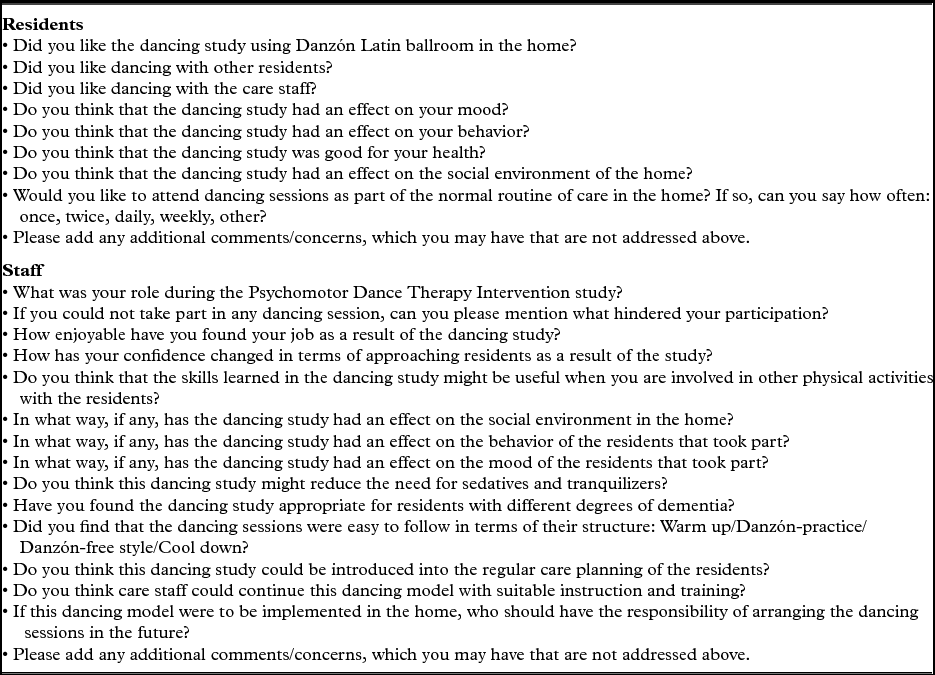
The questionnaires were informed by questions used in semi-structured interviews in a previous qualitative grounded theory study of DANCIN (Guzmán-García et al., Reference Guzmán-García, Mukaetova-Ladinska and James2012b), recommendations for developing questionnaires (Oppenheim, Reference Oppenheim1992), and a questionnaire used with staff caring for older people with dementia (Palo-Bengtsson and Ekman, Reference Palo-Bengtsson and Ekman1997).
To simplify the process for participants with dementia and to facilitate a higher response rate, the scaling of the residents’ questionnaire consisted of simple yes/no responses. The questionnaires for care home staff consisted of Likert-type scaling responses, such as worse, slightly worse, no change, slightly better, a lot better.
Frequency of DANCIN sessions was once, twice a week, or daily. Residents’ questions comprised areas evaluating views and beliefs on the overall experience, impact on mood, behavior, health, and social environment. Staff questionnaires addressed job satisfaction, confidence in approaching residents, transferable skills, effects on the social environment, mood, behavior, and reducing medication in participants. Residents and staff questionnaires provided open space for additional comments and recommendations concerning the DANCIN sessions or any other issue not addressed in the questionnaire. Verbatim comments given by residents were noted down by the external researcher, and written comments by staff were collected for analysis.
See Table 1 for questionnaires examples.
Summary of participant's questionnaires

Following the 12-week DANCIN intervention, an external researcher (second author: physiotherapist and public involvement in research specialist) administered questionnaires to residents and available staff in each of the three care homes to obtain feedback. The questionnaires were returned in a sealed envelope. Emphasis on independent status, confidential and anonymity management of data was given. Residents were permitted to receive assistance in reading the questions from the external researcher. Photos of DANCIN sessions captured by each care home were shown to residents as a mnemonic aid for participation in the evaluation. The external researcher collected notes of comments given by the residents and ticked the responses accordingly.
Sampling and recruitment
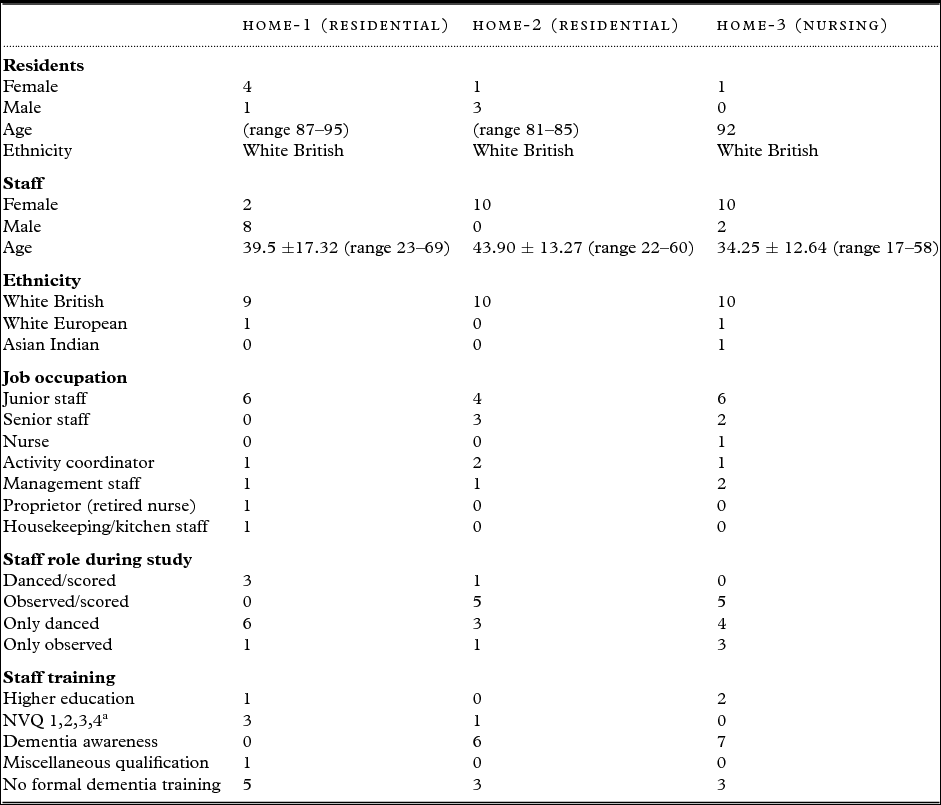
A total of ten residents (six women and four men) were enrolled in the study as dancers. Five were from Home-1 (residential), four from Home-2 (residential), and one from Home-3 (nursing). As Homes 2 and 3 were interlinked, five residents joined together in the nursing home. Thirty-two staff members across the three care homes (22 female and ten male) took part in this study: four danced and scored the monitoring behavior/mood diaries during the multiple-baseline single-case study (for previous study details, see Guzmán et al. (Reference Guzmán, Freeston, Hughes, Rochester and James2016c)). Ten observed and scored monitoring behavior/mood diaries, 13 only danced, and five only observed. Participants’ demographic information is summarized in Table 2.
Residents and staff demographics who evaluated DANCIN

The number or participants responding to the questionnaires is represented in Arabic numbers. Staff working at Home-1 mean: 5.56 years ± 7.75 (range 7 months–25 years). Staff working at Home-2 mean: 4.89 years ± 4.10 (range 8 months–13 years). Staff working at Home-3 mean: of 5.51 years ± 4.93 (range 3 months–15 years).
aUK work related National Vocational Qualification in Health and Social Care.
Data analysis
There is a call for rigorous methods to address the active content of interventions with precision and specificity (Des Jarlais et al., Reference Des Jarlais, Lyles and Crepaz2004). Hence, we applied the Behavior Change Techniques Taxonomy Version 1 (BCTTv1) to inform the process evaluation in this study for future implementation of DANCIN in care homes. BCTTv1 provides a method to specify, interpret, and implement the “active ingredients” of interventions to change behaviors. It is a structured taxonomy of 93 distinct BCTs with labels, definitions, and examples (Michie et al., Reference Michie2013).
Questionnaire responses, written, and verbatim comments were mapped to the BCTTv1. The selected labels were influenced by the Scottish Intercollegiate Guidelines Network, Information for Patients, Carers and Members of the Public (SIGN, 2011). This is a Scottish Health Improvement document that helps to identify concerns and develop guidelines for treatment and care of patients. Individual scores for each question were entered onto an Excel Spreadsheet. A percentage of scores was derived from each care home and used for the total response to each item.
Results
The external researcher collected questionnaires from ten residents located as follows: Home-1 (n = 5); Home-2 (n = 4), and Home-3 (n = 1). A total of 32 questionnaires from staff members were collected; 27 had an active role during the multiple-baseline single-case study, for example, by completing the monitoring diaries of behavior and mood outcomes. Three family members from participating residents (Home-1) wanted to provide feedback and returned questionnaires to external researcher. No relatives at Homes 2 and 3 were available on the day that the researcher conducted the evaluation.
Relatives rated the residents’ mood, behavior, and social environment as “a lot better” during the DANCIN study. These family members were reluctant to see a reduction in sedative medication. Two relatives rated DANCIN as appropriate for all stages of dementia. One relative stated that it would be moderately difficult for people with severe dementia. Family members evaluated the DANCIN model as easy to facilitate by staff and supported the idea of including dance sessions since some of the residents were regular dancers in their youth.
Labels associated with behavior change
Data will be integrated below under four BCTTv1 headings. The analysis will focus on residents first and staff responses second.
Social support (emotional)
Residents
Ten residents provided feedback and liked DANCIN sessions. One resident, who only attended 50% of the sessions, showed some frustration owing to breathing difficulties and commented that despite not being able to dance and, therefore, only observe, he would recommend DANCIN to other residents. Residents felt that the sessions brought a positive effect to their mood, behavior, and social interaction with other residents and staff. Four residents did not recall that the intervention study aimed to change problematic behaviors (e.g. insomnia). Verbatim responses from residents were as follows:
‘Yes, remember heel, toe, kick, breathing in/out and wiggle fingers, always enjoyed dancing’.
‘Got easier each week, cool down was relaxing’.
‘Pleased it (DANCIN) was something I could take part in despite my poor eyesight’.
‘Couldn't say, don't feel my behaviour a problem. Would get thrown out if it was’.
‘[. . .] teaches you how to be sociable or nice to people, makes you more confident’.
‘Improves your attitude towards life, lifting up depression’.
Staff
There were mixed responses with regards to mood in the context of social and emotional support, with 78% of staff thinking that residents’ mood improved and 22% thinking there was no change. Similarly, 75% of staff provided a positive answer about the effect on behavior and 25% stated that residents’ problematic behavior had not changed. Comments included:
‘Residents much calmer, like with (resident's name), who was less agitated on dancing days; the residents were a lot more relaxed’.
‘During (DANCIN) study, residents seem to be in a better mood’.
Concerning staff thoughts about whether DANCIN was socially supportive for residents, 84% staff responded that it was easy to follow for people with mild to moderate dementia and 16% thought it was not easy for residents. Staff suggested having DANCIN session extended to 45 minutes and adding other musical genres like music from 1940s to 1970s.
Some further comments were noted by staff:
‘Residents with differing degrees of dementia all loved to take part or sit and watch the dancing’.
‘Everything was well-structured and the residents were shaped to the session without any problem’.
‘Most definitely, Danzón and adding other type of music in Free Style’.
One staff member highlighted the good effects for a particular resident who was not a participant of this study, but who interacted in the DANCIN sessions:
‘A lady with severe dementia really enjoyed it and did sleep all night once we introduced the dancing in the care home. She doesn't talk anymore, but now she likes to say ‘Thank you’ or ‘I'm grateful’, she smiles and definitely sleeps better’.
Focus on past success and verbal persuasion to boost self-efficacy
Residents
Participants’ previous dancing experience varied from “none,” “occasional” to “regular.” The external researcher noted that participants reminisced about dancing in the past and that DANCIN boosted their strengths rather than deficits. Residents’ verbatim comments were reported:
‘I never thought of that, I think is good for my health, I liked to watch it’.
‘I didn't know we could do things like this (DANCIN) here’.
‘Not difficult, once you got into it. Helped by rhythm of music’.
Staff
Overall, 44% of staff thought that job satisfaction had not changed, while 56% recorded better job satisfaction during the DANCIN program. Noted comments by staff:
‘It feels good to see residents happier after taking part’.
‘Not much change, however it was nice to see residents enjoying themselves; it was also nice to see staff enjoying themselves’.
Concerning whether the DANCIN sessions contributed to feelings of greater confidence (self-efficacy) in the context with dealing with residents in a physical manner (e.g. personal hygiene), 72% care staff reported no change and 28% said they had much better confidence.
‘It gives benefit to residents, to do arm movements and breathing exercises in the morning’.
‘I am able to carry on the dance sessions’.
Restructuring the social environment
Residents
All ten residents said it was a positive “social” activity. Noted comments read as follows:
‘Yes, encourages residents to come together’.
‘Everybody enjoyed it. Though it reflected well on care home, as everyone joined’.
Staff
We found that 66% of staff believed that the social environment noticeably improved during and following DANCIN, while 34% said that the social environment had not changed.
‘Mr S increased his energy level, in some ways after dancing sessions, residents were happier’.
‘It was good for the residents to keep active in any way possible and it does get them together and interacting’.
There were mixed responses about whether DANCIN would be sustainable as a matter of day-to-day practice within the social environment: 34% staff did not believe it, 66% reported that DANCIN strategies (e.g. having a little dance in the corridor to reduce anxiety) could be used in a transferable manner while working with residents.
Staff comments written down were:
‘I could see dancing for newer staff, for getting involved [. . .] to know their clients more’.
‘Residents were able to follow with the help of staff’.
It is important to mention that some staff mentioned some factors that hindered staff from joining DANCIN, such as completing care home's paper work or covering for absent staff, feelings of embarrassment, being unwell themselves, or lacking time for these activities with residents.
Habit formation
Residents
In terms of frequency to implement DANCIN on regular basis, all residents wanted to dance as part of their care plan. No further recommendations were given on preferred time or duration for DANCIN sessions. Verbatim and written comments by participants stated:
‘Twice a week is fine, I would be happy to dance seven days a week! I enjoyed it 100%’.
‘Dance every day! and add other music’.
Staff
In terms of preferred frequency of sessions, 78% staff mentioned twice a week, 19% staff responded daily, and 3% respondents left the question blank. As for DANCIN being introduced as a regular part of the residents’ care plans, 86% of staff thought it would be quite possible, 13% said that it would be complicated, and 1% said it was not feasible at all. Written comments were as follow:
‘I was impressed with the dancing sessions in the home, but there is often a problem of how often it could be arranged’.
‘For people that enjoy the activity, watching or taking part it is a good way to keep active’.
Staff beliefs on receiving training to sustain DANCIN in the care homes were generally positive: 78% indicated “quite a lot of interest,” 22% were “not enthusiastic” about further training. The questionnaire asked an open question about whose responsibility it would be to organize the sessions in the future and about the frequency of DANCIN sessions if they were to continue: 16% responses were blank, and 47% of staff mentioned the activity coordinator as the person to organize the DANCIN sessions, while 25% suggested the manager and 12% said the activity coordinator helped by a senior staff carer or family member.
‘Once a day by activities coordinator with the help of a member of the staff or family member’.
‘The residents have learnt a routine for the dancing, routine is important’.
Concerning staff attitudes about whether the approach was a potential method for helping to reduce antipsychotic medication to treat behavior and mood disturbance, we found that 44% of staff were against reducing medication and 41% of staff were in favor of reducing intake, while 15% of staff did not know what medication the residents were on:
‘I don't really know if the residents taking part are on those medications’.
‘Sometimes if they (residents) attended the dancing affected their mood, more positive [. . .] they were able to sleep better because they (residents) were tired, so yes’.
Discussion
This study reported the attitudes and beliefs of residents, staff, and relatives of a Psychomotor DANCe Therapy INtervention (DANCIN). In keeping with our earlier research (Guzmán-García et al., Reference Guzmán-García, Mukaetova-Ladinska and James2012b), the majority of staff found the model to have beneficial effects on the social environment, mood, and behavior of participants with dementia. There were a number of “softer” positive benefits from the intervention. For instance, the DANCIN sessions were a useful way to generate good conversations among visitors to the homes. For family members, DANCIN was redolent of the ballroom dancing their parents once enjoyed. New staff were helped to develop the confidence required to approach residents in a more physical way, for example to provide assistance around personal hygiene. Performing DANCIN with residents allowed social touch and reduced isolation and was appreciated by staff as a dance program, which was easy to facilitate. Minor modifications of the sessions have been suggested (see social support (emotional) and habit formation labels).
Our findings suggest that staff, usually a senior member of the care team and the activity coordinator, require support from management to continue DANCIN sessions as part of their working shifts. This is relevant to current English and Scottish National Dementia Strategies around staff training programs, as activity coordinators are usually volunteers not formally included on the Dementia Workforce Development Plan. Staff require extrinsic motivators to support them if they are to pursue DANCIN. Participants’ responses in this study suggest it is important to extend the content of staff training on side-effects of antipsychotic medication. Understanding how psychosocial interventions like DANCIN can improve behavior and mood may obviate the need for antipsychotic medication.
In our previous study (Guzmán-García et al., Reference Guzmán-García, Mukaetova-Ladinska and James2012b), staff shortages and high workload were mentioned as possible obstacles to long-term adherence. In the present study, staff were prepared to allocate time for DANCIN because of its perceived benefits for the residents. Worries seen in our previous study regarding the fear of becoming emotionally attached to residents through DANCIN were not mentioned in this process evaluation study. Beliefs were mixed among the staff concerning whether or not the intervention was suitable for all stages of dementia. Some staff had more involvement in the DANCIN program than others, either as participants or as observers, which is likely to have affected their appreciation of the possible benefits of this study. Participants’ views on DANCIN were similar to previous studies using dance in dementia care. Palo-Bengtsson et al. (Reference Palo-Bengtsson, Winblad and Ekman1998) found that staff could see the therapeutic benefits, while also being aware of the extra work created for them. Other studies have also demonstrated the positive attitudes created by dance interventions when participants dancing skills are displayed (Palo-Bengtsson and Ekman, Reference Palo-Bengtsson and Ekman1997; Coaten, Reference Coaten2001; Duignan et al., Reference Duignan, Hedley and Milverton2009; Ravelin et al., Reference Ravelin, Isola and Kylmä2013).
Strengths and limitations
While this study represents attitudes within care homes and contributes to the field of psychosocial interventions in dementia, it was only conducted in a small region of North East England. We ensured that questionnaires for residents with mild or moderate dementia were easy to understand. We are aware that staff sometimes helped residents to respond to the questionnaire, so there might be some bias in their responses. Staff were aware of subsequent deteriorations in the health of some of their residents (not attributable to the study), which may then have colored their judgments about the possible benefits of DANCIN. Using the external researcher to gather the current data is a strength of the study. Although it was not always clear how much involvement the staff interviewed had with the intervention, respondents nevertheless knew about the study in the care home.
Methodological challenges and organization culture
Home-1(residential) and Home-3 (nursing) intended to keep DANCIN regardless of staff shortages. In contrast, staff at Home-2 (residential) did not wish to continue and were reluctant to fill in the process evaluation questionnaires. This attitude was caused by time pressures owing to staff shortage and manager turnover. The differences in motivation are likely to have a strong impact on results. Before starting this sort of research, it is also important to establish with all staff, including managers, that the DANCIN activity is not only for entertainment, and to emphasize the therapeutic objectives, which in this evaluation were found to be decreased in anxiety and boosting of self-efficacy in both residents and staff, as well as creating a positive social environment. Behavior change research suggests that habit-formation activities are needed to sustain behavior (Lally and Gardner, Reference Lally and Gardner2013). Our findings suggest that the sustainability of this intervention depends on team work with activity coordinators, nurses, and care assistants working together.
It was useful to have designated key staff members to organize the DANCIN sessions. During our research, Home-2 and Home-3 were going through management turnovers, which was a challenge for the operation of the study. To ensure research rigour, staff required monthly external supervision so that the DANCIN model was consistently delivered. Previous research has shown that training staff has failed in the longer term (Moniz-Cook, Reference Moniz-Cook1998; Shah and De, Reference Shah and De1998), suggesting that models for better supervision in the form of an “interactive staff training approach” are required (Gentry et al., Reference Gentry, Iceton and Milne2001). Strategies on how to provide feedback (Milne et al., Reference Milne, James, Keegan and Dudley2002; James et al., Reference James, Milne, Marie-Blackburn and Armstrong2007) can be adapted and organized in the context of staff training while facilitating DANCIN.
Conclusion and clinical implications for dementia care
Our approach to DANCIN is following the MRC model to inform complex interventions (Craig et al., Reference Craig, Dieppe, Macyntyre, Michie, Nazareth and Petticrew2008). This process evaluation extends the findings from previously published investigations of DANCIN in care homes, by reporting the views and experiences of key stakeholder groups.
Residents and staff have helped in improving the content of this intervention and emphasized the positive effects on behavior, mood, and social environment. Residents with mild to moderate dementia are keen to receive this intervention as part of their routine care, and it would appear that care home staff are happy to receive additional training to support such approaches. We have shown that family members who provided feedback, supported the idea of including DANCIN in their relatives’ care plans.
A future phase II feasibility study is warranted. However, successful implementation of DANCIN would require strong leadership from a dedicated therapist trained in Psychomotor Dance Therapy, together with a systematic supervision plan to foster effective team working between care home staff as part of their normal shift working patterns. Four labels of the BCTTv1 (Social support (emotional); Focus on past success and verbal persuasion to boost self-efficacy; Restructuring the social environment; Habit formation) are worthy of further exploration within the context of future experimental studies to promote long-term ongoing active participation in Psychomotor Dance Therapy. A preliminary manual has subsequently been produced with some modification of the content of the sessions (available from first author).
Conflict of interest
None.
Description of author's roles
This study was undertaken by Dr Azucena Guzmán in partial fulfilment of the requirements for her PhD. Dr Lisa Robinson collected research data and provided input to the paper; Professor Ian A. James, Professor Lynn Rochester, and Professor Julian C. Hughes provided expert advice and supervision on the research, practical support with delivering, and training on the Psychomotor DANCIN and commented on drafts of the paper, including the final draft.
Acknowledgments
We are very grateful to the residents, staff, and relatives for their considerable time and commitment with this process evaluation. Thank you to Alan Duncan for supporting Azucena during her PhD.