Introduction
Otoacoustic emissions (OAEs) are sounds that arise in the ear canal when the tympanum receives vibrations transmitted backwards through the middle ear from the cochlea. These vibrations occur as a byproduct of a unique and vulnerable cochlear mechanism which has become known as the cochlear amplifier. This mechanism greatly contributes to hearing sensitivity and discrimination ability.Reference Kemp1 Spontaneous OAEs are a kind of OAE which is recordable in the ear canal without external stimulation. Since attention was drawn to this phenomenon by Kemp, many studies have focused on the role of spontaneous OAEs in tinnitus.Reference Kemp2–Reference Penner5 However, spontaneous OAEs are seldom the cause of tinnitus.Reference Penner5, Reference Eggermont6
Some have suggested that the active processes of the cochlea may be involved in tinnitus generation.Reference Norton, Schmidt and Stover4, Reference Jastreboff7 In the present study, we investigated whether the clinical and audiological characteristics of normal-hearing tinnitus patients with spontaneous OAEs differed from those of similar patients without spontaneous OAEs. We also conducted a literature survey to study the role of spontaneous OAEs in tinnitus generation.
Materials and methods
Sixty-one tinnitus patients with normal hearing sensitivity were recruited over a 2.5-year period. All patients had pure tone hearing thresholds within 20 dB HL for all frequencies (125 to approximately 8000 Hz). Thirty-two patients with spontaneous OAEs, the study group, were compared with 29 patients without spontaneous OAEs, the control group, by retrospective chart review.
The study was approved by the institutional review board of Seoul St Mary's Hospital.
To facilitate clinical comparison, patients were asked to complete a questionnaire evaluating the nature, duration and location of their tinnitus, along with any changes, and also whether the patient experienced hyperacusis and prolonged worsening of their tinnitus after exposure to a relatively short period of moderate or loud sound (the ‘kindling effect’).Reference Jastreboff and Hazell8 Both groups were also asked to use visual analogue scales (VASs) to indicate their awareness of their tinnitus, its loudness and its effect on their quality of life. In addition, all patients were requested to complete a tinnitus handicap inventory.
To enable audiological comparison, the results of pure tone audiometry (PTA) and tinnitogram analyses were examined. We also compared measures of transient evoked OAEs and distortion product OAEs with the presence or number of peaks of spontaneous OAEs.
Data analysis was performed with the Statistical Package for the Social Sciences version 15.0 software program. A p value of less than 0.05 was deemed statistically significant.
Results
Demographic and clinical characteristics
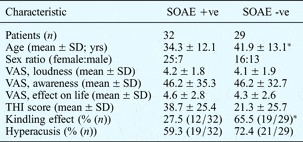
The mean patient age was 34.3 years in the study group and 41.9 years in the control group; this difference was statistically significant. The proportion of females in the study group (25/32) was higher than that in the control group (13/29), although this difference was not statistically significant. No statistically significant differences in tinnitus VAS or tinnitus handicap inventory score were found between the two groups, although the mean tinnitus handicap inventory score of the study group was considerably higher than that of the control group (38.7 vs 21.3, respectively). The proportion of patients reporting the kindling effect was significantly higher in the control group compared with the study group; however, the proportion of patients reporting hyperacusis did not differ between the groups (Table I).
Tinnitus patients: demographic and clinical characteristics

*p < 0.05. SOAE +ve = spontaneous otoacoustic emissions (OAEs) present; SOAE -ve = spontaneous OAEs absent; yrs = years; VAS = visual analogue scale score; SD = standard deviation; THI = tinnitus handicap inventory
The location, subjective pitch and nature of tinnitus (including changes over time) did not differ between the two groups (data not shown).
Spontaneous otoacoustic emissions
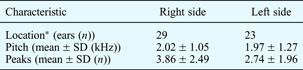
In the study group, spontaneous OAEs were noted on the right side only in nine patients, on the left side only in three, and bilaterally in 20. In total, 112 spontaneous OAE peaks were recorded on the right side, with a mean value of 3.86 peaks per ear. On the left side, 63 OAE peaks were recorded, giving a mean value of 2.74 peaks per ear. The mean frequency of spontaneous OAEs was 2.02 kHz on the right side and 1.97 kHz on the left (Table II). Of the 18 study group patients assessed by tinnitogram, only two (11.1 per cent) had a tinnitus frequency similar to their spontaneous OAE frequency.
Spontaneous OAE characteristics
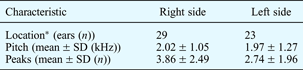
*Spontaneous otoacoustic emissions (OAEs) were recorded in 20 patients bilaterally, in 9 patients unilaterally on the right and in 3 patients unilaterally on the left. SD = standard deviation
Audiological characteristics
Eighteen study group patients and 14 control group patients were assessed by tinnitogram. Loudness matching showed significantly lower tinnitus amplitude in the study group compared with the control group (16.1 vs 35.6 dB HL, respectively). The mean tinnitus frequency was 6.0 kHz in the study group and 4.8 kHz in the control group, but this difference was not statistically significant (Table III).
Tinnitogram and TEOAE results

*p < 0.05. SOAE +ve = spontaneous otoacoustic emissions (OAEs) present; SOAE -ve = spontaneous OAEs absent; pts = patients; SD = standard deviation; min = minimal; TEOAE = transient evoked OAEs; R = right ear; L = left ear
Transient evoked OAE responses and reproducibility were significantly greater in the study group than in the control group (Table III).
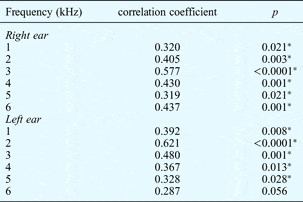
Mean values for distortion product OAE (DPOAE) responses at all frequencies were higher in the study group than in the control group (data not shown), and the number of peaks of spontaneous OAE and DPOAE responses were well correlated between ears, except at 6 kHz on the left side (Table IV).
Correlation between SOAE peak number and DPOAE response, by frequency

*p < 0.05. SOAE = spontaneous otoacoustic emission (OAE); DPOAE = distortion product OAE
Discussion
Spontaneous OAEs are sound signals emanating from the inner ear in the absence of external stimulation, and are known to often be present in normal-hearing ears. The incidence of spontaneous OAEs is approximately 30–40 per cent in normal-hearing adults, and markedly decreases with hearing loss greater than 20 dBHL.Reference Norton, Schmidt and Stover4, Reference Kuroda9 The level and frequencies of spontaneous OAEs decrease with age, and they are more frequent in females and in the right ear.Reference Kuroda9
In our study, the mean age of the study group was significantly younger than that of the control group. In addition, the proportion of females was higher in the study group, although this difference was not statistically significant. These results are congruent with previously reported patterns of spontaneous OAEs with regard to age and gender.
The kindling effect has previously been described by Jastreboff and Hazell as prolonged worsening of tinnitus after noise exposure.Reference Jastreboff and Hazell8 In our study, the kindling effect was more frequent in the control group than the study group. The mechanism of enhancement of tinnitus by sound exposure may be either peripheral or central. The increase in cochlear amplification after sound exposure can be thought of as a peripheral mechanism, suggesting that the kindling effect would be more frequent in tinnitus patients with spontaneous OAEs. However, our study showed a significantly higher prevalence of the kindling effect in the control group (i.e. patients without spontaneous OAEs), suggesting other possible mechanisms for this effect. Other, more generally accepted central mechanisms have been cited to explain this phenomenon.Reference Jastreboff and Hazell8, Reference Moller10 For example, particular nuclei within the central nervous system may become sensitised, for hitherto unknown reasons. Repeated overstimulation of the auditory system, when in a sensitised state, may lead to permanent resetting of central auditory filters.Reference Jastreboff and Hazell8, Reference Moller10 These may then overreact to very low levels of external sound, resulting in the kindling effect.
A central mechanism may not completely explain our results. However, peripheral pathology, in the form of hyperfunction of the outer hair cells, is thought to contribute more to tinnitus generation than central pathology in patients with spontaneous OAEs, and this may explain the lower prevalence of the kindling effect in patients with tinnitus and spontaneous OAEs. Although the exact mechanism and significance of the kindling effect in tinnitus patients are not yet established, tinnitus patients who experience the kindling effect have a lower probability of success of tinnitus re-training therapy. This suggests that patients with tinnitus and normal hearing who have spontaneous OAEs may be more responsive to tinnitus re-training therapy, due to their lower prevalence of the kindling effect. Further studies are necessary to verify this suggestion and to investigate the possible mechanism.
The mean tinnitus handicap inventory score of the study group was higher than that of the control group, although the difference was not statistically significant. Considering that the mean tinnitus loudness of the study group (as assessed by tinnitogram) was significantly lower that that of the control group, the high mean tinnitus handicap inventory score of the study group was notable. Therefore, despite the lesser magnitude of tinnitus in the study group compared with the control group, our findings suggest that tinnitus patients with spontaneous OAEs may be more in need of aggressive tinnitus treatment.
In our study, of the 18 study group patients assessed by tinnitogram, only two had a tinnitus frequency similar to their spontaneous OAE frequency. This finding is congruent with other reports. Generally, in approximately 6–12 per cent of normal-hearing persons, spontaneous OAEs are considered at least partially responsible for tinnitus.Reference Eggermont6, Reference Penner11 However, in most cases there is no direct relationship between the spontaneous OAE sound and tinnitus. It has been suggested that spontaneous OAEs and tinnitus may be related in a more complex way.Reference Norton, Schmidt and Stover4, Reference Jastreboff7 Dysfunction or hyperfunction of the outer hair cells is a well known proposed mechanism of tinnitus signal generation, as demonstrated by Jastreboff's neurophysiological model of tinnitus.Reference Norton, Schmidt and Stover4, Reference Eggermont6, Reference Jastreboff7, Reference Paglialonga, DelBo, Ravazzani and Tognola12, Reference Granjeiro, Kehrle, Bezerra, Almeida, Sampaio and Oliveira13 If spontaneous OAEs are regarded as a reflection of cochlear function, then tinnitus patients presenting with spontaneous OAEs would be expected to show distinct features, compared with those without spontaneous OAEs. In the present study, analysis of the audiological characteristics of spontaneous OAEs showed that transient evoked (TEOAE) responses and reproducibility were greater in the study group compared with the control group, and that distortion product OAE (DPOAE) responses were also greater at almost all frequencies. Our findings are similar to many other published results showing increased DPOAE and TEOAE responses in patients with spontaneous OAEs.Reference Kuroda9, Reference Kuroda, Fukuda, Chida, Kashiwamura, Matsumura and Ohwatari14–Reference Kulawiec and Orlando16 It may be thought that spontaneous OAE amplitudes were just added to TEOAE and DPOAE responses. Interestingly, we also found that DPOAE responses were increased even at frequencies remote from spontaneous OAE frequencies. With this in mind, the presence of spontaneous OAEs and of increased TEOAE and DPOAE responses may be the result of hyperactive outer hair cell function, not only at specific frequency regions but throughout all frequency regions of the outer hair cell. This phenomenon has also been suggested by other authors.Reference Kuroda, Fukuda, Chida, Kashiwamura, Matsumura and Ohwatari14 Therefore, spontaneous OAEs could be regarded as an indicator of hyperactive outer hair cell function.
The exact mechanism of spontaneous OAE generation remains unknown. The commonly accepted mechanism of multiple reflections involves two sub-processes: reflection of the forward-travelling wave, and reflection of the backward-travelling (retrograde) wave by the stapes.Reference de Boer and Nuttall17 In the cochlea, most energy travels apically and is absorbed, but any energy that escapes basally to reach the base can be partially reflected back, forming a new forward-travelling wave. This can re-stimulate the outer hair cell mechanism. Under conditions of high amplification, endless recirculation of the travelling wave leads to sustained oscillation inside the cochlea and to spontaneous OAEs of one or more pure tones into the ear canal.Reference Kemp1 In short, to sustain oscillation of the basal membrane, the cochlea needs strong amplification by outer hair cells with coexisting irregularities. Thus, spontaneous OAEs would be more frequent in a cochlea with strong outer hair cell function.
• Spontaneous otoacoustic emissions (OAEs) occur as byproducts of a unique and vulnerable cochlear amplifier; they are rarely responsible for the perceived tinnitus sound
• This study investigated the clinical and audiological characteristics of normal-hearing tinnitus patients with spontaneous OAEs
• These patients had different clinical and audiological characteristics, compared with controls without spontaneous OAEs; outer hair cell hyperfunction may contribute to these differences
• Normal-hearing tinnitus patients with spontaneous OAEs have more severe symptoms and a lower prevalence of the kindling effect; early, aggressive treatment is thus necessary
In summary, even though evidence is lacking for spontaneous OAEs as a form of tinnitus-related sound, hyperactive outer hair cell function could be related to tinnitus sound generation in some tinnitus patients, as well as to the generation of spontaneous OAEs. In the present study, we regarded spontaneous OAEs as an indicator of hyperactive outer hair cell function. We therefore used the presence of spontaneous OAEs to separate out tinnitus patients who we considered to have hyperactive outer hair cell function, and we found that this study group had several distinct features, as described above.
Our tinnitus patients with recordable spontaneous OAEs had significantly higher tinnitus handicap inventory scores. Therefore, we suggest that such patients need more aggressive treatment. Tinnitus treatment with aspirin and intravenous or intratympanic lidocaine injection has previously been reported.Reference Jastreboff7, Reference Penner18, Reference Kalcioglu, Bayindir, Erdem and Ozturan19 Aspirin carries some risk of inducing new tinnitus and hearing loss in some patients, and the effect of aspirin on tinnitus has only been described in one case.Reference Penner18 Several studies have reported that intravenous lidocaine injection partly relieves tinnitus; however, lidocaine has a brief duration of effect, lasting just a few hours.Reference Kalcioglu, Bayindir, Erdem and Ozturan19 Tinnitus re-training therapy would be a good alternative treatment in tinnitus patients with spontaneous OAEs, as they show relatively high tinnitus handicap inventory scores, despite a lower magnitude of tinnitus sound, and also have a low prevalence of the kindling effect. Moreover, tinnitus re-training therapy could very safely be applied to all different types of tinnitus patients.
Conclusion
Normal-hearing tinnitus patients with spontaneous OAEs differ both clinically and audiologically, compared with normal-hearing tinnitus patients without spontaneous OAEs. Outer hair cell hyperfunction may contribute to the differences between these two groups. Symptom severity should be thoroughly evaluated in normal-hearing tinnitus patients with spontaneous OAEs, and more aggressive, appropriate treatment should be considered from the outset.
Further studies are required to investigate the therapeutic efficacy of different types of treatment modalities in normal-hearing tinnitus patients with and without spontaneous OAEs.