Introduction
Care home staff often follow rigorous routines from day to night, usually spending more time engaged in personal care tasks than promoting activity and stimulation (Froggatt and Parker, Reference Froggatt, Parker, Hughes, Lloyd-Williams and Sachs2010). In the UK, the English and Scottish Dementia Strategies outline the need to train staff and improve the quality of care in care homes (Department of Health, 2009; Scotland's National Dementia Strategy 2013–2016). Forty-six million people live with dementia worldwide, bringing an estimate economic impact of US $818 billion (Prince et al., Reference Prince, Wimo, Guerchet, Ali, Wu and Prina2015). There are over 386,000 people with dementia living in care homes in England and 38,000 in Scotland (ENRICH, 2015). Psychosocial interventions have shown to improve well-being in care homes, through theatre activities (van Haeften-van Dijk et al., Reference van Haeften-van Dijk, van Weert and Dröes2014); cognition with Cognitive Stimulation Therapy (Spector et al., Reference Spector2003); and to reduce agitation with Music Therapy (Sung et al., Reference Sung, Lee, Li and Watson2012). A recent systematic review of non-pharmacological interventions to reduce agitation in dementia (Livingston et al., Reference Livingston2014) showed that Music Therapy was effective; however, there was no mention of Dance Therapies, neither within the context of art/exercise-based activities nor in “body oriented” Psychological Therapies (Loew et al., Reference Loew, Tritt, Lahmann and Röhricht2006; Kelly, Reference Kelly2014).
Theoretical background
Dance research with healthy older adults has been shown to be effective in improving social activity and physical health (Bertram and Stickley, Reference Bertram and Stickley2007; Silva Lima and Pedreira Vieira, Reference Silva Lima and Pedreira Vieira2007) and well-being (Keogh et al., Reference Keogh, Kilding, Pidgeon, Ashley and Gillis2012). Dance is multi-dimensional: music, body movement, sensory, and social elements are involved, whilst the interaction between the brain and behavior suggests the possibility of increasing human brain plasticity (Karpati et al., Reference Karpati, Giacosa, Foster, Penhune and Hyde2015). The current study applies Psychomotor Therapy, widely practiced in the Netherlands to improve the health of older people (Dröes, Reference Dröes, Miesen and Jones1997), and a core approach for improving residential dementia care in Objective 5, Measure No. 17 of the French “Plan Alzheimer's” (2008–2012). Previous sport-based psychomotor interventions in dementia (Hopman-Rock et al., Reference Hopman-Rock, Staats, Tak and Dröes1999) found beneficial effect on cognition (N=134, p < 0.05 compared to control group) and increased positive group behavior. Psychomotor Dance Therapy using African rhythms in healthy older women (Tupinier, Reference Tupinier2009) described anecdotal improvements in quality of life, interaction, restlessness, and agitation. A previous study using motion capture and ground reaction force recordings to analyze a 30-minute Danzón lesson with elements from Psychomotor Dance Therapy found significant reductions in variability of sway normalized by body height on healthy non-dancer older adults (Guzmán-García et al., Reference Guzmán-García, Johannsen and Wing2011). This suggested that learning Danzón at a beginner's level was beneficial for balance, despite the increased cognitive load in the early stages of skill acquisition.
Most geriatric healthcare interventions are complex interventions due to the highly heterogeneous population (Faes et al., Reference Faes, Reelick, Esselink and Olde Rikkert2010). We followed the Medical Research Council (MRC) Framework (Craig et al., Reference Craig, Dieppe, Macintyre, Michie, Nazareth and Petticrew2008) to inform the development of this Psychomotor DANCe Therapy INtervention (DANCIN) in care homes. The current study is the continuation of MRC-Phase I: development, point 2 to 4 of the CReDECI checklist (Möhler et al., Reference Möhler, Köpke and Meyer2015). First, we conducted a systematic literature review of dancing in dementia in care settings (Guzmán-García et al., Reference Guzmán-García, Hughes, James and Rochester2012a). We found potential benefits, including a decrease in behaviors, improvements in mood, and increase in physical activity. The review highlighted three small randomized control trials using: Dance Therapy (Rösler et al., Reference Rösler2002) and Dance Movement Therapy (Hokkanen et al., Reference Hokkanen, Rantala, Remes, Härkönen, Viramo and Winblad2003; Hokkanen et al., Reference Hokkanen, Rantala, Remes, Härkönen, Viramo and Winblad2008). These studies showed small significant changes in visuospatial skills and mobility, but no investigation of behavioral or emotional measures were undertaken. Most studies found in the review had weak methodology with limited discussion on the processes of impact on behavior and psychological symptoms.
Second, DANCIN was then investigated using a qualitative testing through grounded theory methodology after a six-week pilot sessions (Guzmán-García et al., Reference Guzmán-García, Mukaetova-Ladinska and James2012b). Two theoretical models from staff and residents showed that residents living with dementia enjoyed the twice-weekly sessions. Both staff and residents mentioned that DANCIN was targeting mainly their behavior and mood. For example: “. . .I just can say that if you are feeling miserable and you dance, it cheers you up. . .”; “I would not worry as long as I am enjoying myself, get on well with other dancers and don't whinge” (p. 8, Guzmán-García et al., Reference Guzmán-García, Mukaetova-Ladinska and James2012b). The development and evaluation of DANCIN follows the MRC-Framework (Craig et al., Reference Craig, Dieppe, Macintyre, Michie, Nazareth and Petticrew2008). According to this, the present study is part of the first phase of the framework: development of a complex intervention. Hence, it aims at investigating the effect of DANCIN on the behavior and mood at the individual level of nursing home residents by applying a single-case study design.Owing to the aims, Single-Case Research (SCR) methodology was employed. Such a design provides an estimate of the personal variability of the effect, which cannot be distinguished from the data in a conventional parallel group trial. It might imply a small sample as found in previous dementia Dance Therapies studies; however, SCR will provide a robust methodology to chart complex changes occurring within individuals over time (Blampied, Reference Blampied1999; Blampied, 2013) or when asking if an intervention is more effective than the current “baseline” or “treatment-as-usual condition” (Kratochwill et al., Reference Kratochwill2010) and can be helpful during the development of an intervention (Vernooij-Dassen and Moniz-Cook, Reference Vernooj-Dassen and Moniz-Cook2014). Previous SCR in dementia has shown significant benefits in terms of decreasing behaviors which were challenging at meal times and during self-care tasks (Moniz-Cook et al., Reference Moniz-Cook, Stokes and Agar2003); and reducing agitation using aromatherapy with massage (Brooker et al., Reference Brooker, Snape, Johnson, Ward and Payne1997).
Methods
Design
We conducted a multiple-baseline single-case study with three phases A-B-C. Phase A comprised a staggered baseline of varied length (from 3–6 weeks). A larger number of baselines strengthen the design when variables are likely to fluctuate greatly (Barlow et al., Reference Barlow, Nock and Hersen2009). We predicted that the pattern of fluctuating behavior and mood in dementia would require a minimum of three weeks observation for sufficient comparisons (Ottenbacher, Reference Ottenbacher1997) and a maximum of six weeks of intervention. This variation was observed in the qualitative pilot study (Guzmán-García et al., Reference Guzmán-García, Mukaetova-Ladinska and James2012b).
Phase B was the 12-weeks DANCIN and Phase C comprised naturalistic follow-up observation (12-weeks). We surmised that the emergent patterns of behavior would require at least as long a period of follow-up as the intervention itself to allow sufficient and realistic comparisons to be made.
Randomization and ethics
The study was approved by the Research and Development Newcastle-upon-Tyne and Wear National Health System (NHS) Trust department and with the Integrated Research Application System (IRAS) Ethics Committee (Reference Number 09/H090674) in Newcastle upon Tyne, England, United Kingdom. A necessary amendment was notified and approved by the Ethics department: (24642/108056/1/483) owing to some participants becoming observers. An external researcher to this study randomized the participants to baselines. As the initial sample was of eleven residents, a random number generator on Statistical Package for the Social Sciences (SPSS, version 17) was used to generate number sequences which were then used to allocate three blocks of three participants and one block of the two participants to one of the four baselines. In the three care settings, three residents were assigned to six-weeks (42 days observations), three residents to five-weeks (35 days observations), three residents to four-weeks (28 days observations), and one resident to three-weeks baselines (21 days observations). Participants started baseline measures at different times and the intervention began at the same time in all care homes.
Settings and participants
Care homes were selected in accordance with the Transparent Reporting of Evaluations with Non-randomized Designs (TREND) guideline for reporting of non-randomized group trials (Des Jarlais et al., Reference Des Jarlais, Lyles and Crepaz2004). First, a list of potential homes was provided by member of a specialist Challenging Behavior Team, working in the North East of England. Eight private residential and nursing care homes were identified. (In the UK, a residential care home usually provides care to people with dementia that do not require specialized 24/7 nursing care. A nursing home provides specialized medical service.) Once settings were identified, participants were approached by the manager and senior care during conversations at the care home. A DANCIN taster invitation was given to those homes expressing an interest in participating. Inclusion criteria for settings were as follows: (i) care/nursing homes with no regular dancing activity or exercise to music during the study period; (ii) a spacious well-ventilated room to both perform the dance and accommodate a group of ten people (e.g. dining room); (iii) staff available to commit to the requirements of the study. The inclusion criteria for participants were as follows: (i) a formal diagnosis dementia of any type, in mild to moderate stages confirmed from care/nursing home medical notes or previous assessment such as the Mini-Mental State Examination (MMSE) ≥12 (Folstein et al., Reference Folstein, Folstein and McHugh1975); (ii) ability to give consent to take part in the study; (iii) ability to walk independently; and (iv) low risk of falls according to the Tinetti Balance Tool (Tinetti et al., Reference Tinetti, Williams and Mayewski1986) cut-off value of gait and balance overall score of 18 points.
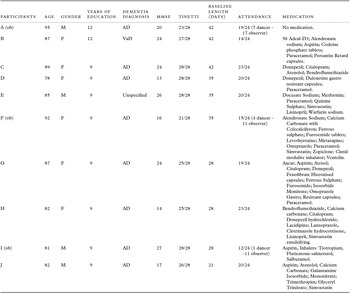
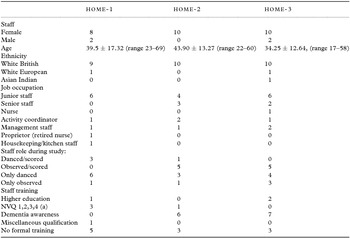
Two residential care homes and one nursing home met inclusion criteria and 18 residents indicated interest; only twelve fulfilled all the criteria for recruitment. One resident died prior to the starting of the study, one participant withdrew consent following recruitment. A total of ten residents (six women, four men) commenced the study. Five were from Care Home-1 (residential); four from Home-2 (residential); and one from Home-3 (nursing). Homes 2 and 3 were inter-linked, then, five residents joined together in this nursing care setting. Thirty two staff members across the three homes (22 female; 10 male) took part in this study, four danced and scored; ten observed and scored; thirteen only danced and five only observed. Residents and staff demographic information are summarized in Tables 1 and 2, respectively.
Residents’ demographics

Notes: Observer-participant (ob); Gender: F (female) M (male); Dementia type: Alzheimer's disease (AD); Vascular disease Dementia (VaD); Age: mean 84.40 ± 7.12; Years of education: mean 9.60 ± 1.265; Mini-Mental State Examination (MMSE) mean 20.50 ± 5.169; Tinnetti Gait mean: 11.70 ± 0.483; Tinetti Balance mean: 14.50 ± 1.900; Tinetti Overall mean: 26.40 ± 2.271.
Staff's demographics

Notes: Staff working at Home-1 had a mean of 5.56 years ± 7.75 (range 7 months to 25 years). Staff working at Home-2 had a mean of 4.89 years ± 4.10 (range 8 months to 13 years). Staff working at Home-3 had a mean of 5.51 years ± 4.93 (range 3 months to 15 years).
(a) A United Kingdom work related National Vocational Qualification in Health and Social Care.
Intervention
Content
The intervention was designed based on the Psychomotor Therapy framework and Danzón Latin Ballroom was selected as the core dance rhythm. Danzón originated from the English Contra Dance, it is performed at a slow-to-moderate speed with small steps in which the feet slide or drag and stop on each beat along with gentle hip and body movements. These movements contrast with tango or foxtrot, which involve stylized walking with strong lifted marked steps between beats (Flores y Escalante, Reference Flores y Escalante2006).
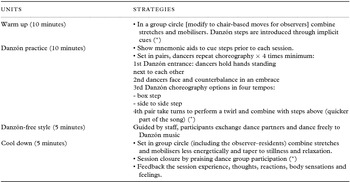
Psychomotor Therapy approach involves three dimensions: (i) motor (balance, fast/slow inter-personal coordination, hand-grip, gesture, and facial expression); (ii) emotional-affective (feeling expression, verbal, and non-verbal communication); and (iii) cognitive (attention and planning movement in space), with the aim of using movement activities and paying attention to bodily experiences (Wallon, Reference Wallon1932; Dröes, Reference Dröes, Miesen and Jones1997; Calmels, Reference Calmels2003; Probst et al., Reference Probst, Knapen, Poot and Vancampfort2010). The approach is usually complemented by hand by hand touch, relaxation, and breathing techniques (Camacho and Paolillo, Reference Camacho and Paolillo2004). Additionally, arm-chair exercises to warm up and cool down, and four simplified Danzón Latin Ballroom choreographies were practiced for staff to repeat with residents at each week of the study. Table 3 shows key components of the DANCIN session.
Key features of Psychomotor DANCe Therapy Intervention (DANCIN) session

(*) Stop by relaxing and breathing in/out in between dance movements, clapping for motivation, and cue for upright posture. Session 1 should be flexible as dance group needs to get comfortable with each other, session's fluidity, and structure shapes towards session 3 (second week). More details upon request to the authors.
Delivery
DANCIN sessions were arranged twice-weekly for 30 minutes between 14:00 and 15:30 pm with the aim to deliver a total of 24 sessions in each setting. The intervention was led by the first author (Clinical Psychologist with background in Psychomotor Therapy) with staff invited to participate as facilitators. DANCIN staff training was delivered for a small group of 3–5 staff members, including activity coordinators at each setting in a two-hour session. Staff willing to facilitate the session did not require professional dance experience, but a rhythmic response to music was required. DANCIN staff training involved using a theoretical and practical presentation, comprising eight units: (i) the Psychomotor Therapy principles; (ii) information on the effects of dancing in dementia based on the findings of the systematic review (Guzmán-García et al., Reference Guzmán-García, Hughes, James and Rochester2012a); (iii) outline of the side-effects of antipsychotic medication on dementia; (iv) music and rhythmicity; (v) DANCIN session structure; (vi) safety considerations whilst dancing; (vii) performing techniques and movement adaptations; and (viii) modeling how to feedback the experience after each session.
Staff were encouraged to sit after each DANCIN session and ask residents to share their thoughts and feelings after taking part in DANCIN. For example, take note of reactions and opinions, verbal and non-verbal, were discussed within the dance group. DANCIN qualitative findings showed that some residents might start reminiscing about their youth linked to the experience of dance; some residents might recognize the “stiffness” of their bodies and the need for exercising. Staff were encouraged to ask residents with previous dancing experience to help and lead at certain points of the session. Experiences from residents and staff are acknowledged and validated by the dance group, including the observers were taking part by chair-based adaptation moves.
Material
Laptop for power point presentation and back up storage of Danzón Music, music recorder with speakers, two video cameras and tripods, two manuals with photographic material of the choreographies as mnemonic aid to cue participants.
Activities to increase adherence
A certificate of achievement was given to the ten residents that completed the study, to staff that facilitated the dance sessions and to staff that supported with the behavior/mood data diaries.
Measures
Home managers were sent an invitation letter and given time to consider participation. Managers approached staff before the researcher; similarly, residents were approached by the staff to assess their willingness to participate. Participants were interviewed using the Mental Capacity Act 2005 (sections 30–34), which covers England and Wales and Consent Pathway framework that protects the rights of people who may not be able to provide informed consent. Potential residents and staff participants had the opportunity to read an information leaflet, then, researcher (first author) sought consent. Once consent was given, screening measures were administered by the first author at the settings.
Screening measures
The MMSE (Folstein et al., Reference Folstein, Folstein and McHugh1975) was used to confirm levels of cognitive impairment. The Tinetti Balance Assessment Tool-Frail Adult version (Tinetti et al., Reference Tinetti, Williams and Mayewski1986) to assess mobility. This latter version contains gait and balance sections such that combined scores provide a risk of falls assessment.
Outcome measure
The DMAS-17 (Sunderland et al., Reference Sunderland, Alterman, Yount, James and Hill1988) was selected as it contains items related to mood and behavior relevant to the aim of this study. The DMAS-17 has a 6-point scale: 0=none, 2=occasionally, 4=frequently, 6=severe. It takes 15 minutes to complete and utilize language accessible to staff when describing resident's behavior.
Single items from DMAS-17 were selected by senior staff in each care setting for each participant and investigated as outcomes. The DMAS-17 items include: self-directed motor activity; sleep (insomnia or daytime drowsiness); appetite (increase or decrease); psychosomatic complaints; energy; irritability; physical agitation; anxiety; depressed appearance; awareness of emotional state; emotional responsiveness; sense of enjoyment; self-esteem; guilt-feelings; hopelessness/helplessness; suicidal ideation; and speech. The scale has high inter-rater reliability and it is validated against the Geriatric Depression Scale (GDS) and Hamilton Depression Scale (Sunderland and Minichiello, Reference Sunderland and Minichiello1996).
Then, an interview was conducted with the senior care staff member familiar with the needs of individual residents. The purpose of the initial interview was to generate bespoke target items from the DMAS-17 for daily measurement. For each participant, a minimum of two items were chosen where it was identified that they would generally occur three or more times per week. Selection of targets was based on the following: (i) items important to the resident or to people close to the resident; (ii) actions that might be dangerous or distressing to the person or others; (iii) behaviors that interfered with the resident's functioning. Selected DMAS-17 items were discussed with participants as a reminder of their goals during DANCIN.
The outcome measure was the individualized behavior and mood monitoring diaries scored by care staff during Phase A and B. Diaries were collected daily and kept by the researcher to avoid staff looking at previous scoring trends. Sessions were led and video-recorded to ensure fidelity of the intervention. Two staff members were required to facilitate DANCIN for a group of six residents (including non-dancing observers). During the 12-week follow-up, Phase C, in order to minimize the burden on staff, data were collected by weekly phone calls. Settings were allowed to pursue whatever activity suited them during the follow-up period. For the purposes of comparison, it was preferred if homes did not dance. See Figure S1 of study protocol published as supplementary material online attached to the electronic version of this paper at http://journals.cambridge.org/ipg.
Individual target behaviors
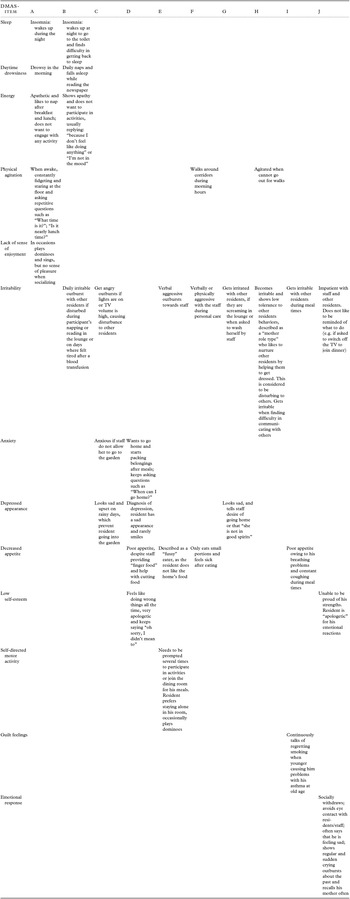
The individual target behaviors selected for each participant from DMAS-17 are described in Table 4.
Individual target behaviors

Notes: Letters of the alphabet represent the participants with behavior/mood item described.
Statistical analysis
Participants’ behavioral scores were plotted for each bespoke DMAS-17 item. This visual analysis considered level, trend line, and variability differences between phases A-B-C (baseline, intervention, and follow-up effects). A statistical analysis of the trends between Phase A and B was undertaken using PAND. PAND has been developed in the field of special education (Parker et al., 2007), self-practice in Cognitive Behavioral Therapy (Davis, Reference Davis2008) and social skills in autistic children (Schneider et al., Reference Schneider, Goldstein and Parker2008).
PAND examines the number of observations from baseline overlapping with observations in the intervention (Parker and Hagan-Burke, Reference Parker and Hagan-Burke2007a; Parker and Hagan-Burke, Reference Parker and Hagan-Burke2007b; Parker et al., Reference Parker, Hagan-Burke and Vannest2007). The objective is that the lowest data cluster (0 = none) of the outcome measure is scored in Phase B.
A six step approach was applied:
-
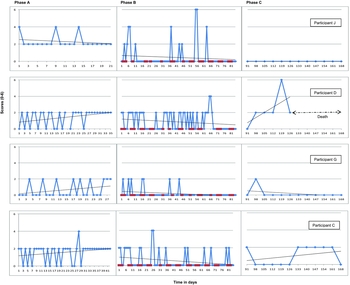
• Step 1: using the data from Participant J with 21 days baseline (see Figure 1, low self-esteem) as an example, it can be seen that still data clusters (scores of 2 and 4) between the Phase A (baseline) and Phase B (intervention) are not “widely separated” and overlap is apparent. Overlapping data points are defined as the “minimum number that would have to be swapped across phases for complete score separation” (Parker et al., Reference Parker, Hagan-Burke and Vannest2007, p. 197). As there is no score in Phase A below 2, all the remaining scores in Phase B are non-overlapping. In this example, “2” is the non-overlapping cut-off value.
-
• Step 2: create spreadsheet to calculate PAND. To assess the number of overlapping data clusters (scores) for each participant, all observations were labeled in a spreadsheet (Microsoft Excel) as to whether they originated in Phase A or Phase B, and then were sorted into descending order of magnitude (i.e. higher: 6, 4, 2 and lower: 0). See Table S1, published as supplementary material online attached to the electronic version of this paper at http://journals.cambridge.org/ipg to follow this self-esteem example. This followed the observed downward trend where low self-esteem ratings appeared to be higher in the baseline phase and decreased during the intervention phase although the highest cluster for low self-esteem was observed during the intervention phase (day 56).
-
• Step 3: obtain data from figure to calculate PAND. Once data had been sorted, data clusters would have to be swapped across phases to allow for a complete separation of scores. There were eleven observations scored during Phase B intervention (6, 6, 4, 4, 4, 4, 2, 2, 2, 2, 2) overlapping with Phase A (baseline). In Table S1 (scores in italics and bold), the example given with participant J's self-esteem ratings illustrates where a line is drawn in order to allow complete separation of phases A and B, scores that were not “0” in Phase B (intervention). See Figure 1 and Table S2, published as supplementary material online attached to the electronic version of this paper at http://journals.cambridge.org/ipg to follow this self-esteem example. PAND equals the remaining data (higher scores in Phase A & lower scores in Phase B) divided by the total data observations N: 21 + 73 = 94/105 = 90 % where 50% is chance level (meaning that only 40% of self-esteem data in self-esteem overlap). Parker et al. (Reference Parker, Vannest and Davis2011) recommends rescaling PAND by the formula ((non-overlap/0.5) – 1) to facilitate a comparison with more familiar indicators.
-
• Step 4: calculate Phi (bona fide effect size) and confidence intervals (CIs). A further method of assessing significance of overlap is by using Pearson's Phi coefficient. To do this one must “balance the table” with the higher/lower values. Parker et al. (2007) recommends doing to provide a robust approach for small differences by equating the overlap diagonals: 0 + 11 = 11/2 = 5.5 (lower scores in Phase A and higher scores in Phase B). Then, a 2 x 2 table with the higher and lower scores of Phase A and B, respectively, for each behavioral/mood item was constructed using SPSS Version 17. These tables were generated to establish PAND and to provide a “bona fide” ES for scores across Phases A versus B, which were entered into an online resource (Pezzullo, Reference Pezzullo2010 http://statpages.org/ctab2x2.html) to calculate Phi and its CIs. See Table S2, published as supplementary material online attached to the electronic version of this paper at http://journals.cambridge.org/ipg to follow example.
-
• Step 5: interpret Effect Size (ES-magnitude of change). A major challenge in SCR is the need for interpretational guidelines for ES. Previous authors have warned on differences in ES magnitudes according to study design, client, and type of intervention (Rosnow and Rosenthal, Reference Rosnow and Rosenthal1989). In contrast to the interpretation of p-value significance, there is a “lack of ES guidelines” in SCR (Parker and Brossart, Reference Parker and Brossart2003) and the usual ES (small, medium, large) indicators developed by Cohen (Reference Cohen1988) for common statistics do not apply and do not fit SCR data as the ES are larger. The most appropriate ways of classifying ES are derived from a sample of published SCR studies based on N=200 phase comparisons (Parker et al., Reference Parker, Vannest and Davis2011) to benchmark the magnitude of change for PAND and Phi in each participant. See supplementary Table S3, example published as supplementary material online attached to the electronic version of this paper at http://journals.cambridge.org/ipg). An empirically derived criteria based on actual SCR was applied. It is ultimately an arbitrary set of cases selected by Parker and colleagues and it is likely to be biased towards larger effects because studies showing effects detectable by visual analysis are more likely to be published. Most published and unpublished SCR studies do not use statistics; smaller effects not clear through visual analysis are less likely to be published. The 95% CIs obtained for the Phi scores based on N=69 sample (Parker et al., 2007b) were as follows: 10th percentile (-0.02<. 22<. 44); 25th percentile (0.26< 0.51< 0.68); at 50th percentile (0.47< 0.68< 0.82); at 75th percentile (0.71< 0.86< 0.94); and at 90th percentile (0.79< 0.94< 0.99). This was considered a better alternative to inappropriate use of Cohen's conventional ES for SCR.
-
• Step 6: to obtain a summary of the intervention effectiveness, we completed two meta-analysis to aggregate the ES of treatment across all the participants, one for mood and one for behavior. Parker and Vannest (Reference Parker and Vannest2012) and Burns (Reference Burns2012) suggest conducting meta-analysis to provide an overall summary of the effect of the intervention in SCR. We aggregated the DMAS-17 for each participant with the most severe items from both the categories of mood and behavior at Phase A. It was meant by “severe”, those items that scored the highest data clusters at baseline. Then the ES derived from each participant's individualized items were combined and computed using the WINPEPI programme COMPARE2.EXE (Abramson, 2011a; Abramson, 2011b), a procedure for comparison of two independent groups or samples (http://www.brixtonhealth.com/pepi4windows.html) by entering the Phi coefficients obtained for the mood and behavior related items.
Self-esteem and depressed appearance results.

Results
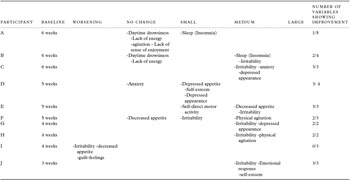
No differences were found with care homes cognitive assessment notes and the applied MMSE for this study. The average number of DANCIN sessions completed was 20 in each setting. Three out of ten participants attended between 50%–70%, and seven out of ten attended 71%–100% of the sessions. During Phase B, three participants (A, F, I), who were initially dancers, became physically unwell owing to some comorbid conditions, e.g. cancer, breathing difficulties, and decided to participate by observing. Based on the protocol of a previous pilot study (Guzmán-García et al., Reference Guzmán-García, Mukaetova-Ladinska and James2012b), a decision was taken to consider them as “observers” and analyze the effect of DANCIN on their selected individualized items. In Phase C (follow-up), data collection was interrupted in three participants (A, D, E) owing to health events. Findings show a positive trend, with decreasing difficult behaviors and increasing positive mood. Participants showed more fluctuations in Phase A and less in Phase B. Results based on the statistical analysis of the DMAS-17 scores, indicated a small to medium improvement in 21 out of 32 mood/behavior items; eight items showed no change and three items in one case showed adverse effects. Table 5 shows participants’ results.
Participants’ PAND results

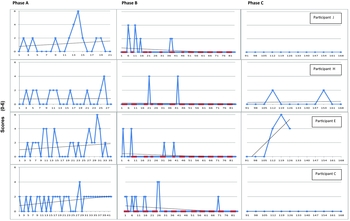
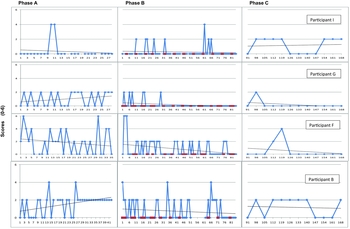
During non-DANCIN days, staff observed and assessed residents’ mood and behavior according to the residents’ daily events; including difficult life-events, such as grief and attendance at a fellow resident's funeral. See Figure 1, Participant C: Phase B days 5–8 and 26–27 data clusters. Related individual mood variables, which were aggregated using WINPEPI, gave an average effect of DANCIN across all participants regardless of their observer/dancer role. Results showed an overall average Phi of 0.24 (95% CI = 0.17–0.30), indicating a statistically significant intervention effect that is considered to be small in magnitude compared to published SCR research. See Table S4, example published as supplementary material online attached to the electronic version of this paper at http://journals.cambridge.org/ipg. The related behavioral items were aggregated using WINPEPI, and the weighted average PAND was 0.28 (95% CI = 0.23–0.34) indicating a statistically significant small to medium magnitude intervention effect. See Table S5, published as supplementary material online attached to the electronic version of this paper at http://journals.cambridge.org/ipg. Figure 1 shows some examples at different baselines to illustrate the individual self-esteem and depressed appearance trend. Figure 2 displays individual examples of the irritability item. See Figure S2 for additional results of individualized items, published as supplementary material online attached to the electronic version of this paper at http://journals.cambridge.org/ipg for other measured items. No falls were reported during the study and participants remained stable on their medication, except for participant D whose psychiatrist prescribed Haloperidol owing to aggressive behavior following an Urinary Tract Infection (UTI) during Phase B at day 65. This person died during Phase C.
Irritability results.

Irritability results continued.

Discussion
This study is part of a series of investigations examining the development of a Psychomotor DANCIN. A small to medium change was seen in both behavioral and mood items, such as energy levels to socialize, increase in appetite, decrease in irritability and depressed appearance. Some of the male participants (A, E, J) with a tendency to be irritable, apathetic, and socially withdrawn, showed enhanced energy levels and decreased irritability. This might be because care homes had activities such as art-and-craft or bingo which were not as appealing to men as to women. Male residents may have found DANCIN more engaging, and felt valuable as dance partners being preferred by female participants compared to female to female dyads. In line with a study of 13,715 people between 13 and 86 years (Lovatt, Reference Lovatt2011), dance confidence in men is linked with self-esteem based on the individual's perception of the opinions and perceptions of other people. Self-esteem was measured in a female participant D and male participant J, who showed a positive change. The impact of the Danzón Latin ballroom music used in DANCIN seems to trigger positive emotion, which has been described as “Happy music” in the grounded theory study (Guzmán-García et al., Reference Guzmán-García, Mukaetova-Ladinska and James2012b).
This study showed that residents with either sensory deficits such as auditory difficulties (Participant F), or no previous dancing experience (C, J) could be included in DANCIN to prevent isolation. Participants, whose mobility was compromised by comorbid illnesses such as cancer or pain, wanted to take part by observing and chair-moves were adapted. The two observers in this study gained small to medium improvements with respect to behavior and mood items. Calvo-Merino et al., (Reference Calvo-Merino, Jola, Glaser and Haggard2008) research on dance observation has demonstrated the emotional benefits in observers without cognitive impairment. This study is consistent with the previous grounded theory model (Guzmán-García et al., Reference Guzmán-García, Mukaetova-Ladinska and James2012b) where both residents with dementia and staff recognized a benefit for residents observing the session. It is also similar to a previous Finish Dance study with dementia participants who reported a positive impact while observing a dance session (Ravelin et al., 2013). However, our study found one observer, with regular dance experience in his youth, (participant I) showing negative effects. Participant I displayed an increase in irritability, low self-esteem, and spoke of guilty feelings concerning being a smoker in his youth. Of note, this participant only attended 50% of DANCIN sessions, owing to breathing difficulties.
Strengths and limitations
The strength of the study lays in its innovative nature. Using the multiple-baseline single-case method allowed participants to be their own control to reach about the likely effects of DANCIN between Phase A and B. We have been able to show the specific ways in which the intervention was beneficial or not for each person. The strength of the study lays in its innovative nature. We have been able to show the specific ways in which the intervention was beneficial or not for each person. Our research has also shown that it is possible to engage with care settings with no previous dance exercise and encourage this type of body oriented Psychological Therapy to potentially treat residents’ behavior and mood. A spin-off from the research was the effect on training care staff in the use of a psychosocial treatment. Involving service-users on this MRC-Phase I appears to have made staff reflect on residents’ mood and behavior, and how DANCIN can enrich the care home social environment. Regarding limitations, it may be a concern that the first author led the DANCIN sessions. However, it is important to recognize that this was a real-world study, with limited resources, and therefore some of the biases could not be controlled for due to funding limitations. In the follow-up study, we will ensure that the first author is not involved in data collection. Precaution was taken to minimize bias when trained staff had to complete the behavior diaries and had to additionally dance when no other staff member was available.
Another limitation was the lack of measures of inter-rater reliability in connection with the daily data collection. James et al. (Reference James, McClintock, Reichelt and Ellingford2007) found that staff are not always reliable informants, and further training on the use of scoring sheets would have improved reliability. To ensure consistent DMAS-17 scoring, staff were trained and a consensus in each care home was carried out on how to rate the items according to their observations. Overall, it was preferred to have realistic observations of “day to day actions” from a senior care staff member familiar with participants’ behavior. Ten senior staff members provided scores only, whilst eighteen scored and danced. This might have biased the scoring in favor of being overly positive. To compensate for this possible bias, an external researcher conducted an evaluation after Phase B was completed with additional comments for further DANCIN development. These quantitative findings will be published elsewhere.
Implications for future research in dementia clinical practice
This study has helped to build up evidence regarding the development of DANCIN as a therapy for those with cognitive impairment and physical frailty. A preliminary manual and poster with the main features of the session were developed at the end of the study. This manual will be applied in future studies and used to implement a consistent programme of DANCIN. The study findings allow us to estimate effect-sizes (small to moderate magnitude of change), enabling us to establish the numbers of participants required in controlled and randomized controlled trials. The work has also been useful in identifying outcome measures to understand the impact of the intervention on resident and staff well-being. As part of such future investigations, we intend to examine the training and supervising of staff with the aim of implementing the DANCIN sessions as part of their standard therapeutic input. Future outcomes will be chosen and analyzed in line with Psychological Processes and Behavior Change Techniques Frameworks (Michie et al., Reference Michie2013).
Conclusion
This study supports the growing evidence of body oriented Psychological Therapies in mild and moderate stages of dementia. DANCIN sessions were able to adapt to loss of mobility during the course of the study through chair-based participation and observation. Data suggest that the intervention can be used to decrease irritability or depression, increase self-esteem, important factors for positive mood in dementia. Overall, this intervention showed reduction in terms of social isolation in residents previously described as socially withdrawn. The study demonstrates both an innovative single-case methodology and form of analyses (e.g. PAND). Whilst this study was conducted in a particular region of England, it involved two care homes and one nursing home, strengthening its validity. Hence, the effects of DANCIN were not limited to a particular care home environment or specific dance group, but were unique to the individuals.
Conflict of interest
None.
Description of author's roles
This study was undertaken by Azucena Guzmán in partial fulfillment of the requirements for her PhD. Professor Julian Hughes, Professor Lynn Rochester, and Professor Ian James provided expert advice and supervision of the research, practical support during the delivery of the dance oriented therapy. Professor Mark Freeston provided expert advice on the measurement, statistical analysis, and presentation of the single-case methodology. All of the authors contributed to the design of the project and to the writing of the paper, on which Azucena Guzmán took the lead.
Acknowledgments
We thank the residents, staff, managers, and relatives who took part in this study and devoted time and energy to this study design. Special thank you to Professor Richard Parker for advice on PAND methodology. We thank to Dr David Lee for randomization and Challenging Behavior Team at Castleside Newcastle-upon-Tyne for recruitment assistance. We are also grateful to Professor Martin Orrell for advice on early draft. A preliminary abstract outlining a brief description of the methodology and outcomes was published on the conference proceedings of the 15th International Congress of the International Psychogeriatric Association in The Haghe, Netherlands (2011). Dissemination of preliminary findings of one case study began via an unpublished oral presentation at the Annual World Conference of Psychomotor Therapy in Paris, France (2011).
Supplementary data
To view supplementary material for this article, please visit http://dx.doi.org/10.1017/S104161021600051X