And where is all [Solomon's] rich knowledge? Where are the mysteries, and where are the books? For there remain only the Proverbs, Wisdom, Ecclesiastes, and the Song of Songs.
Hippolytus
A widespread early Christian tradition regarded Solomon as the great exorcist and magician of antiquity, the forerunner of the exorcistic activity of Jesus, and the genius of later Christian magic and divination.1
See Pablo A. Torijano, Solomon, The Esoteric King: From King To Magus, Development Of A Tradition (JSJS 73; Leiden: Brill, 2002) 106–28, 192–230; Dennis C. Duling, “The Legend of Solomon the Magician in Antiquity: Problems and Perspectives,” Proceedings: Eastern Great Lakes Biblical Society 4 (Westerville, Ohio: EGLBS, 1984) 1–23; Duling, “The Eleazar Miracle and Solomon's Magical Wisdom in Flavius Josephus's Antiquitates Judaicae 8.42–49,” HTR 78 (1985) 1–25; Duling, “Solomon, Exorcism, and the Son of David,” HTR 68 (1975) 235–52; C. C. McCown, “The Christian Tradition as to the Magical Wisdom of Solomon,” Journal of the Palestine Oriental Society 2 (1922) 1–8. As Torijano notes, even Josephus, who can usually be relied upon to demythologize the Bible for his pagan audience, embraces the magical portrait of Solomon, so robust was the tradition (Solomon, 96).
Torijano, Solomon, 225–30.
On Eccl 3:2–3 in the Sepher ha-Razim (The Book of the Mysteries), see Torijano, Solomon, 204; and Michael A. Morgan, Sepher ha-Razim (SBLTT 25; Chico, Calif.: Scholars Press, 1983) 17–18.
This study will consider evidence of a “magical”4
By this I mean an approach which recognizes in the Song indications of Solomon's identity as magician and exorcist. As we shall see, it is not the case that the Testament's author read the Song as a magical or exorcistic text per se, as for example Pseudo-Philo's Biblical Antiquities 60 (see section III below).
In his recent study, Torijano reserves the term “magician” for a stage of the tradition historically subsequent to the Testament, referring to the Testament's Solomon as “exorcist” and “astrologer.” For Torijano (Solomon, 194), the defining characteristic of the magical portrait of Solomon is his active manipulation of the environment, as opposed to passive control of demons. While Torijano's scheme is in some ways helpful, it is conventional to refer to the Testament's Solomon as “magician,” and to the Testament as a “magical” text. Used in a broad sense, the terms “magic” and “magician” encompass not only exorcism, but also other techniques and concerns of the Testament. Even the Testament's exorcisms should not be thought of as mere exorcisms, since Solomon actively presses demons into building of the temple (cf. 1 Kgs 9:15, where Solomon impresses human and not demonic laborers), thus doing more than merely “subduing or expelling them” (Torijano, Solomon, 194). Without attempting to obliterate the legitimate diachronic distinctions which Torijano labors to elucidate, I shall use the term “magician” in a broad sense to refer to the Testament's Solomon.
For a recent introduction to the Testament, see Todd E. Klutz, Rewriting the Testament of Solomon: Tradition, Conflict and Identity in a Late Antique Pseudepigraphon (Library of Second Temple Studies 53; London: T&T Clark, 2003) 1–37. Other recent contributions on the Testament include Sarah I. Johnston, “The Testament of Solomon from Late Antiquity to the Renaissance,” in The Metamorphosis of Magic from Late Antiquity to the Early Modern Period (ed. Jan N. Bremmer and Jan R. Veenstra; Groningen Studies in Cultural Change 1; Leuven: Peeters, 2002) 35–49; Philip S. Alexander, “Contextualizing the Demonology of the Testament of Solomon,” in Die Dämonen. die Dämonologie der israelitisch-jüdischen und frühchristlichen Literatur im Kontext ihrer Umwelt = Demons: The Demonology of Israelite-Jewish and Early Christian Literature in Context of Their Environment (ed. Armin Lange, Hermann Lichtenberger, and K. F. Diethard Römheld; Tübingen: Mohr Siebeck, 2003) 613–35; Peter Busch, Das Testament Salomos. Die älteste christliche Dämonologie, kommentiert und in deutscher Erstübersetzung (Texte und Untersuchungen zur Geschichte der altchristlichen Literatur 153; Berlin: Gruyter, 2006). These items were not available to me during my research for this study.
Our investigation will be guided by four questions or concerns. First, in general, how does the Testament approach the biblical data pertaining to Solomon, including the Song? Second, within its general orientation toward the biblical Solomon, what are the distinctive characteristics of the Song that would bear on its use in a later magical reading? Third, we shall turn to the texts themselves to consider the evidence for six proposed instances of intertextuality. Fourth, we shall attempt to situate the Testament's hermeneutical habitude within the broad context of ancient biblical interpretation.
The prospect of a magical reading of the Song in the Testament is promising even before we compare the evidence of the two texts. Not only did readers in the Solomon magus tradition consider Solomon's magical identity central to their reconstruction of Solomon's history, it was the basis of his continuing significance in Christian thought and practice. In addition, they regarded Solomon as the indisputable author of the Song.6
As for the ancient acceptance of Solomonic authorship, Roland E. Murphy notes that the superscription of the Song probably alludes to the “songs” of 1 Kgs 5:9–14 (The Song of Songs: A Commentary on the Book of Canticles or the Song of Songs [Hermeneia; Minneapolis, Minn.: Fortress, 1990] 3). See also Duling, “Solomon, Exorcism,” 237. The statement of Hippolytus, cited by Anastasios Sinaites (Patrologia Graeca 89:592; the text is the epigraph of this study), is as clear a statement as possible from antiquity that Solomon was the author of the Song. Unless proven otherwise, we must assume that the author of the Testament accepted Solomonic authorship.
The Testament's Appropriation of the Old Testament as a Biographical Source for Solomon
Dennis C. Duling observes that the “fountainhead” of the traditions about Solomon the magician is the Hebrew Bible itself, most importantly the description of Solomon's wisdom in 1 Kgs 5:9–14 (4:29–34):7
Duling, “Solomon, Exorcism,” 237. See also Paul Perdrizet, “

,” Revue des Études Grecques 16 (1903) 45 n.1. McCown noted that the most magically suggestive elements of the passage must be dated to the latest redactional stratum of 1 Kings (“Christian Tradition,” 2). Even so, they predate the earliest translation into Greek. The Solomon magus tradition begins where the Hebrew Bible leaves off, and is not a product of the LXX translation alone.
While emphasizing the centrality of 1 Kings 5 in his translation and notes, Duling, recognizes only a limited use of the Song in the Testament (OTP 1:935–87). In the relatively short period of time during which the Testament has been widely available (since McCown's critical edition appeared in 1922 [The Testament of Solomon: Edited from Manuscripts at Mount Athos, Bologna, Holkham Hall, Jerusalem, London, Milan, Paris and Vienna (Leipzig: J. C. Hinrichs, 1922)]), it has tended to attract the attention of New Testament specialists (such as Duling) for its relevance to the Gospels, while reflection on the Testament is virtually absent from the Song of Songs literature—even though the early history of interpretation of the Song is a perennial point of interest.
God gave Solomon very great wisdom, discernment, and breadth of understanding as vast as the sand on the seashore, so that Solomon's wisdom surpassed the wisdom of all the people of the east, and all the wisdom of Egypt. He was wiser than anyone else, wiser than Ethan the Ezrahite, and Heman, Calcol, and Darda, children of Mahol; his fame spread throughout all the surrounding nations. He composed three thousand proverbs, and his songs numbered a thousand and five. He would speak of trees, from the cedar that is in the Lebanon to the hyssop that grows in the wall; he would speak of animals, and birds, and reptiles, and fish. People came from all the nations to hear the wisdom of Solomon; they came from all the kings of the earth who had heard of his wisdom.
The post-Enlightenment reader is tempted to see Solomon as a natural historian devoted to science for its own sake—the kind of gentleman who might go around giving Latin names to things.8
The “translation” of this passage into post-Enlightenment terms is commonplace among modern commentators. Torijano uses words such as “encyclopedic” and “scientific” to describe Solomon's knowledge (Solomon, 13, 29–33). Simon J. DeVries characterizes Solomon's wisdom here as “essentially intellectual,” and “cleverness”; what Gerhard von Rad termed a “Solomonic humanism” (1 Kings [2d ed.; Word Biblical Commentary 12; Nashville, Tenn.: Thomas Nelson, 2003] 74–76). DeVries observes that much of the modern discussion has focused on the relation between the “intellectual” wisdom of 1 Kings 5 and the “pragmatic” wisdom of 1 Kings 3. For the reader in the Solomon magus tradition, no such tension existed—magical skill was eminently both intellectual and practical. Walter Brueggemann presents an alternate (post)modern view by postulating a dual tradition of “clan” and “urbane” wisdom) Solomon: Israel's Ironic Icon of Human Achievement [Columbia, S.C.: University of South Carolina Press, 2005] 107–10).
Torijano finds the magical potential of the passage in the LXX wording, suggesting that the magical identity of Solomon is a function of the Hellenistic context (Solomon, 29–33). The elements of the text which elevate Solomon to the status of Hellenistic king are, according to Torijano, post-deuteronomistic (Solomon, 13). Others have seen more potential in the MT itself. Duling infers from other Hebrew Bible occurrences of their names that Ethan, Heman, Kalcol, and Darda were “ecstatic Temple musicians believed to have been contemporaneous with David and Solomon” (“Legend of Solomon,” 11–13). On the magical significance of the beasts and birds, see Duling, “Legend of Solomon,” 15, and see the Testament's own impressive menagerie. Duling identifies three ancient texts that read 1 Kgs 5:9–14 as magical: Wis 7:15–21, Tg. Esth. II, and Josephus, Ant. 8.42–29 (“Solomon, Exorcism,” 238, “Legend of Solomon,” 9–10).
Ann Jeffers discusses the word

(“wise man”) as a magical term in the Hebrew Bible (Magic and Divination in Ancient Palestine and Syria [Studies in the History and Culture of the Ancient Near East (SHCANE) 8; Leiden: Brill, 1996] 40–41). The “wise man” of the Hebrew Bible cannot be fully accounted for solely in terms of philosophical or proverbial wisdom—while Solomon was not a full-blown Hellenistic magus, neither was he a Hellenistic philosopher. If there is anything to be learned from a detached reading of texts in the magical tradition, it is that readers of every age—including our own—must be wary of using the Solomon texts as a mirror in which to view someone who conforms to their own standards of superlative achievement.
Traditional Jewish and Christian interpretation has shown a preference for locating the “narrative” of the Song toward the beginning of Solomon's life, that is, before his liaison with foreign women and their gods.10
The impulse to find a narrative in the Song is as ancient as the oldest allegorical interpretations (Murphy, Song of Songs, 18, 28–31; Tremper Longman III, Song of Songs [New International Commentary on the Old Testament (NICOT); Grand Rapids, Mich.: Eerdmans, 2001] 22–25. Brian McNeil argues for a very early (second century) Christian allegorical reading (“Aviricius and the Song of Songs,” VC 31 [1977] 23–34). In modern interpretation, several so-called dramatic models of the Song have been proposed. While not committed to any one of these modern strategies, the Testament's biographical appropriation of the Song implies that Solomon is a character in its story, loosely speaking.
Louis Ginzberg, The Legends of the Jews (Philadelphia: Jewish Publication Society, 1909–1938) 6:301–2.
McCown wrote: “Both the Song of Songs and the Testament of Solomon are more easily understood, however, if we may suppose that there was current a legend or cycle of legends describing Solomon's love affairs. One may be justified in supposing that some of the unintelligible allusions in the Song of Songs would be explained if we had these legends before us and that others may possibly be due to the excision or modification of allusions which were unacceptable to a rigid monotheism. If this may seem to be going too far, it at least is within the range of probability that the Testament reflects an interpretation of the Song of Solomon which took it to describe his

and regarded the maiden whose ravishing beauty is so sensuously described as the cause of his downfall. Such a conception of the book was naturally repressed by the constituted authorities and could be preserved only in books like the Testament, which never received ecclesiastical approval but circulated among the less instructed along by and forbidden paths” (“Solomon and the Shulamite,” JPOS 1 [1921] 121). Some recent interpreters have essentially rediscovered the “negative” reading of the Song by approaching it as a recapitulation of the Eden story. See Brueggemann, Solomon, 211–14.
The key passage in recovering this alternative reading is T. Sol. 26:1–8, which describes how Solomon's love for a “Shummanite” (

) woman leads him to sacrifice locusts to the Jebusite gods Raphan and Molech. The discussion of the biblical background of the Shummanite's identity is complicated by the spelling of her appellation, which does not correspond perfectly to any biblical name. McCown reasoned that while the names of three biblical figures are close, only two of these persons are connected with the life of Solomon: Abishag the Shunammite
13
. Several variant spellings are attested in the LXX. See Rahlfs's apparatus at 3 Kgdms 1:3, 15; 2:17, 21, 22.

. For variants, see Rahlfs's apparatus at Song 7:1. Some of the variants suggest a connection between the two figures was perceived by readers of the LXX (particularly in Vaticanus). As for the MT, Marvin H. Pope discusses the spelling of “Shulamite” and concludes that the Song itself cannot have Abishag in view (Song of Songs [AB 7C; Garden City, N.Y.: Doubleday, 1977] 598–99). Pope's conclusion must not prevent us from attempting to connect the Testament's Shummanite to a biblical figure.
The third is Elisha's friend the Shunamite (2 Kgs 4:36). F. C. Conybeare apparently favored the Shulamite thesis (“The Testament of Solomon,” JQR 11 (1898) 45 n.1). His text (based on MS P) read

, while McCown read (MS H)

(Testament, 73*). Complicating the identification of the Testament's Shummanite is the possibility that the Song's Shulamite and Abishag are meant to be identical. Some (e.g., Pope, Song of Songs, 598–99) have argued strenuously against this. Others (e.g., Torijano, Solomon, 23) keep the possibility alive. The crux is whether the Testament's author would have perceived this identity. If there is any coherence to the Testament's biography of Solomon, then there is no place for Abishag after the completion of the temple, which is precisely where the Testament places the Shummanite. Therefore, in the mind of the Testament's author, Abishag and the Song's Shulamite were two persons. If this is to be disproven, it must be from the Testament's own internal logic, rather than from the intrinsic possibilities of the biblical text. Raymond Jacques Tournay suggested that Abishag and the Song's Shulamite were one and the same (Quand Dieu parle aux hommes le langue de l'amour. études sur le Cantique des cantiques [Cahiers de la Revue biblique 21; Paris: J. Gabalda, 1982] 74–75). Unfortunately, this requires an emendation of the MT which (right or wrong) is so brilliant that it is unsafe to assume that the author of the Testament was aware of it.
McCown, “Solomon and the Shulamite,” 120.
Ibid., 119.
For example, David's retinue included an Ammonite and a Hittite (2 Sam 23:37, 39). Saul's most notorious henchman was the impious Doeg the Edomite (1 Sam 22:18; superscription of Psalm 52).
In presenting his English translation several decades later, Duling did not categorically rule out the “Abishag thesis.” See OTP, 1:986, n.26a.
Despite the problem of McCown's argument, his Shulamite thesis probably correctly identifies the biblical background to the figure of the Shummanite in T. Sol. 26, as the following factors suggest. In 1 Kings, Abishag drops out of the story after Solomon's struggle with Adonijah son of Haggith (she is last mentioned in 1 Kgs 2:22), whereas the seductress of the Testament appears only later in Solomon's life, after the temple has been built. The “Abishag thesis” fails because it requires the author of the Testament to have depended on the story of 1 Kings, but not to have appreciated the simple fact that Abishag is already old news when the Testament's Solomon first meets his Shummanite. Also, while T. Sol. 26:1 reports that Solomon encountered the Shummanite while traveling to the kingdom of the Jebusites, 1 Kgs 1:3 is clear that Abishag was found within the borders of Israel. Finally, the “Abishag thesis” does not explain why the Testament would refer to a “Shummanite” by this epithet instead of by her known name. The Song's Shulamite is never named; so it makes sense to refer to her in this way in a later retelling in the Testament. Of the possible biblical figures, the Song's Shulamite emerges as the most likely referent of T. Sol. 26. Unfortunately, it seems that all arguments for the Shulamite thesis must rely on the evidence that rules out Abishag, rather than on positive evidence. In one regard, I have attempted to go beyond what McCown offered by presenting an appreciation of the basic story line of Solomon's life in 1 Kings, an argument which assumes only what is already demonstrable in the Testament.
This conclusion is significant because it allows us to locate the story of the Song within the Testament's biographical reconstruction. Specifically, it indicates what might be called a negative reading of the Song
20The reading should be considered “negative” only in the sense that the Song ends badly, not that the Testament's author shows any suspicion of the Song as a faithful autobiographical record.
E.g., the crucifixion and virgin birth of Jesus (T. Sol. 15:10). These obviously Christian details do not mean that the Testament does not otherwise stand within the stream of prior Jewish interpretive traditions of the Hebrew Bible.

).
22McCown, “Solomon and the Shulamite,” 116. These two traditions appear to have reconverged by the late sixteenth century, when Peter Binsfeld matched one of seven arch-demons with each of the traditional seven deadly sins—in this scheme, Asmodeus was the demon of lust (Tractatus de confessionibus maleficorum et sagarum, an, et quanta fides ijs adhibenda sit [Trier: H. Bock, 1571]). The Talmud's Asmodeus is more likely to have been associated with drunkenness (b. Giṭ. 68a, see Dictionary of Deities and Demons in the Bible [ed. Karel van der Toorn, Bob Becking, and Pieter W. van der Horst; Grand Rapids, Mich.: Eerdmans, 1999] 107).
Christian Solomonic iconography often shows him as a mounted warrior spearing a naked woman or lilith (Perdrizet, “

,” 50; Duling, “Legend of Solomon,” 7). Any reader for whom this was the stock image of Solomon could hardly have approached the female figures of the Song without a certain amount of prejudice or trepidation.
McCown, “Solomon and the Shulamite,” 119.
The A Priori Significance of the “Song” as a Magical Genre
In addition to its perceived biographical relevance to Solomon, the genre and title of the Song would themselves have prompted the Testament's magical reading, since readers in the Solomon magus tradition regarded Solomon's songs as magical or exorcistic texts. Duling has argued that the understanding of 1,005 songs of Solomon (1 Kgs 5:12 [4:32]) as magical incantations is attested in several ancient sources.24
Duling, “Legend of Solomon,” 14–15, and n.9 above.
See also Duling, “Solomon, Exorcism,” 240; “Legend of Solomon,” 14; Torijano, Solomon, 41, 109–11. Presumably, Solomon's knowledge came from David, just as later texts are framed as Solomon's instruction of his son Rehoboam (Torijano, Solomon, 210–15). The Sepher ha-Razim traces the tradition of esoteric knowledge from Noah to Solomon (Morgan, Sepher ha-Razim, 19). As Morgan notes, the text elevates the status of Solomon by anachronistically placing him after the sages and prophets (Sepher ha-Razim, 19 n.9).
Tony W. Cartledge describes David as a “musical therapist” and his song as “the first spiritual” (1 & 2 Samuel [Smyth & Helwys Bible Commentary; Macon, Ga.: Smyth & Helwys, 2001] 209). This colorful characterization demonstrates the degree to which every interpreter, whether a modern academic or ancient magician, relies on contemporary models of reality to make sense of the text.
See Perdrizet, “

,” 52. Perdrizet notes that this tradition survives in the Tale of the Fisherman and the Genie (the third night's entertainment), where the genie reports that he was imprisoned by Solomon, who sent “his minister, Asaf son of Barkhiyá” to seize him (The Arabian Nights' Entertainment, Or The Book of the Thousand Nights and One Night: A Plain and Literal Translation of the Arabian Nights Entertainments [trans. Richard F. Burton; New York: Heritage, 1962] 51).
Several sources indicate that ancient interpreters perceived the large number of musical compositions reported in 1 Kgs 5:12 to have gone missing.
27Duling argues that the account of exorcism in Josephus (Ant. 8.2.5) implicitly advances the notion that Solomon wrote books of incantations. Josephus refers to

a term more magically suggestive than the LXX's

(3 Kgdms 5:12; see “Solomon, Exorcism,” 241; “Eleazar Miracle,” passim). McCown reckoned that “Solomonic” books were known to Josephus, and to others as late as the sixth century (McCown, “Christian Tradition,” 3, 19). On Qur'an 2:95, McCown wrote: “This official condemnation of Solomonic magical writings proves their existence among the Arabs of Mohammed's time and also probably in the time of the commentators who record the tradition, and makes their use among Jews in the East more than likely” (McCown, “Christian Tradition,” 8). On the search for Solomonic literature in antiquity, see David J. Halperin, “The Book of Remedies, the Canonization of the Solomonic Writings, and the Riddle of Pseudo-Eusebius,” Jewish Quarterly Review 72 (1982) 269–92.
y. Ber. 10a and y. Pesaḥ. 56a (see McCown, “Christian Tradition,” 6, 13–14). Hippolytus was also aware of this explanation as an exegesis of Prov 25:1:


(“In the days of Hezekiah, some things from the books were chosen, and others were overlooked”; PG 89:592).
McCown, “Christian Tradition,” 13–14. The relevant text of T. Sol. 13:2 in Recension C is:

[sic]


(“[A]fter you die, you shall make for Hezekiah another testament, one for the world, and this one [i.e., the Testament of Solomon] will be hidden and will not be shown to the common people and the simple-minded, lest the treasure be forsaken to the general public.” McCown, Testament, 86*).

, a superlative genitive, was taken by Hippolytus to signify it was the song par excellence, a digest or sampler of Solomon's 5,000 songs (1,005 in MT). Hippolytus was a champion of the allegorical reading of the Song and was not interested in recovering Solomon's lost magical wisdom from it—clearly, he regarded the censorship of Hezekiah as beneficial to the faithful.
30


(“Out of these [the 5,000 books of Solomon], then, the wise friends of Hezekiah [see Prov 25:1] took those portions which bore upon the edification of the Church. And the books of Solomon on the “Parables” and “Songs,” in which he wrote of the physiology of plants, and all kinds of animals belonging to the dry land, and the air, and the sea, and of the cures of disease, Hezekiah did away with, because the people looked to these for the remedies for their diseases, and neglected to seek their healing from God.” PG 89:592–93; Ante-Nicene Fathers 5:176).

(gnosis) and

(“mysteries”) as opposed to the perhaps more orthodox

(i.e., philosophical “wisdom”).
31Josephus (Ant. 8:45–46) speaks of Solomon's

(“art” or “skill”).
“Magic” in the Song of Songs
A. The seal upon the heart and the binding of Ornias: Song 8:6–7 and T. Sol. 1–2
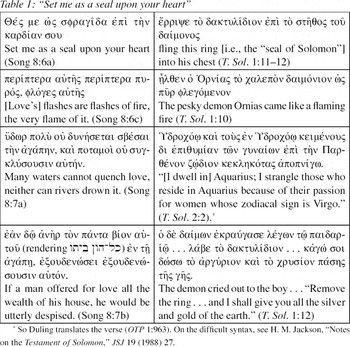
Besides the appearance of the Song's Shulamite in T. Sol. 26, the most striking indication that the author of the Testament drew on the Song for raw magical material involves, on the one hand, the Song's most memorable passage (“Set me as a seal upon your heart”; Song 8:6–7), and on the other hand, the story which introduces Solomon's principle exorcistic technique in the Testament (T. Sol. 1–2).32
See Longman (Song of Songs, 209) on the attention that this verse has attracted. See also Torijano, Solomon, 57.
The key to Solomon's control over demons, both in the Testament and in the broader Solomon magus tradition, is a seal-ring he received from Michael the archangel (T. Sol. 1:6). The so-called “seal of Solomon” became the chief icon of Solomon magus and inspired countless amulets and tales, and was apparently being shown to pilgrims in Jerusalem as late as the fourth century.33
As Duling observes, the ring or “seal of Solomon” is also called the “seal of God,” both in the Testament and on amulets (“Solomon, Exorcism,” 247). On the amulets, see McCown, “Christian Tradition,” 6; and Perdrizet, “

,” passim. McCown regards the story in Josephus's Ant. 8:44 as the foundation of the Christian tradition (“Christian Tradition,” 3–4). See also Duling, “Eleazar Miracle,” passim. On the pilgrimage of Egeria (Aetheria) to see the ring, see Duling, “Legend of Solomon,” 6; Torijano, Solomon, 85 n.69; Itinera Hierosolymitana Saeculi IIII-VIII (ed. Paul Geyer; Corpus scriptorum ecclesiasticorum latinorum [CSEL] 39; 1898; reprinted New York: Johnson, 1964) 88 (incorrectly cited by Torijano as page 21). The pilgrim was previously identified in 1884 as St. Silvia of Aquitania by the discoverer of the Itinerarum, J. F. Gamurrini. Many of the amulets depict Solomon on horseback, an image which is the likely background of the traditional picture of St. George. Muslim versions of the seal of Solomon, in conformity with the prohibition of human forms, were geometric, and gave rise to the pentalpha or pentagram, which was a popular magical sigillum throughout the Middle Ages, and is popularly known today as an occult device (see Duling, “Legend of Solomon,” 3; Perdrizet, “

,” 56).
E.g., Longman, Song of Songs, 209–10; Othmar Keel, The Song of Songs: A Continental Commentary (Minneapolis: Fortress, 1994) 71–73 (with illustrations); Dianne Bergant, The Song of Songs (Berit Olam; Collegeville, Minn.: Liturgical Press, 2001) 97; John G. Snaith, The Song of Songs (New Century Bible [NCB]; Grand Rapids, Mich.: Eerdmans, 1993) 120. Pope offers “signet-ring” in his translation, but with ancient Near Eastern parallels in mind (Song of Songs, 666–67).
In T. Sol. 1:1–13, Solomon gives his ring to a boy tormented by the vampire demon Ornias, with instructions to bind the demon by throwing the ring at the demon's chest, where it is apparently affixed.35
The story is in T. Sol. 1:1–13. The text is obscure regarding how the ring is attached to the demon. I describe the process as affixation because the demon subsequently pleads for the ring to be removed: “take the ring from off me” (

[T. Sol. 1:12, see also 3:3, 9:3]). Elsewhere (e.g., T. Sol. 7:8), the procedure is described by the verb

(“to place a seal upon”).
The relationship between the two texts is subtle and complicated by the fact that they interact in different ways at each point of contact. For instance, both Love and Ornias are said to be as flaming fire, suggesting that an extended comparison might succeed.36
T. Sol. 20:17 suggests that Ornias's flaming appearance is a result of having fallen from heaven like lightning. I consider this an etiology that is subsequent to the literary connection, which remains the more primitive explanation of Ornias's flaming appearance.

Perhaps the most puzzling aspect of the relationship I am proposing is that the Testament appears to identify the Song's positive personification of Love with Solomon's demonic antagonist. I have already noted that the Testament's unconventional, “negative” reading of the Song (i.e., as something other than a celebration of love), in part, frees him to subvert the poem's love themes; even so, the proposed transformation is bizarre enough to call for an additional demonstration of its plausibility. Such confirmation may come from the external attestation of a second exorcistic text, clearly dependent on the Testament, called “Another [Prayer] of Saint Athanasius the Great of Alexandria.”
37In A. Delatte, Anecdota Atheniensia (Bibliotèque de la Faculté de Philosophie et Lettres de l'Université de Liège 36; Liège, 1927) 230–38.

).
38Delatte, Anecdota Atheniensia, 233; Torijano, Solomon, 67.

) women, thus rather opposing than personifying love (T. Sol. 2:3).
39Torijano notes the addition of the term to the Testament's story, but does not offer an explanation (Solomon, 68).
The intertextual relationship I have proposed is one way of accounting for the otherwise (bedeviling!) epithet: Athanasius calls Ornias the “love-demon” because he perceives the resonance between the Testament and Song 8:6–7, and understands the Song as a cryptic demonological text. As he rehearses his outline of the Testament in his prayer, he inserts what is in effect an interpretive “footnote,” one of the sort that naturally accompanies the retelling of a story. Whether Athanasius originated the gloss or passed down traditional information without being aware of its derivation, it is likely that the term was a part of Athanasius's interpreter's library and that the proposed connection to the Song is the correct derivation of “

.”
As for the name “Ornias,” it appears in the Lucianic recension of the LXX as the transliteration of the name Adonijah, as misspelled or misread in the Hebrew Vorlage.40
This would have been the result if the Hebrew letter resh (

) were substituted for daleth (

), as in

. See the BHS apparatus at 1 Kgs 1:5. See Torijano, Solomon, 133 n.16.
Kugel's observation is appropriate: “Most of narrative expansions found in rabbinic midrash and other early texts have as their point of departure some peculiarity in the biblical text itself” (In Potiphar's House: The Interpretive Life of Biblical Texts [San Francisco: Harper, 1990] 247).
The relationship I have outlined does not explain the source of every detail of the Ornias story, nor does it help us to identify which aspects of the Ornias story are the Testament's own creative contribution, as opposed to the products of prior traditions. However, the model has the advantage of accounting for almost all of the topoi in Song 8:6–7, supporting the claim that the Song is one of several sources for the Testament, and has been freely adapted to serve the author's portrayal of Solomon as magician. For the author of the Testament, the unhappy ending of the Song casts a shadow over the rest of the poem, inviting him to use it as a source of flair and authenticity in the Testament's demonology.
The explicit mention of a “seal” in Song 8:6 is the catchword that initially brings the two texts into contact.42
Generally, the idea of the “catchword” is that ancient redaction and exegesis did not require thorough, point-by-point justifications of every move and intertextual connection. Rather, interpreters looked in texts for a critical mass to get the exegetical ball rolling, and they were attentive to irregularities and details of the text which are often passed over in modern critical study. The slightest clue could trigger substantial interpretive inferences.
See n. 3 above.
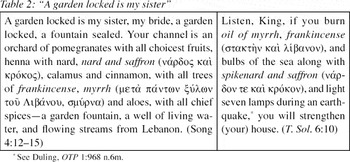
B. The spice garden: Song 4:12–15 and T. Sol. 6:10–11
Song of Songs 4:12–15 describes the bride as “a locked garden” containing fruits and spices. The characteristically modern tack is to treat this as essentially an economic text, a list of the exotic luxury goods available in cosmopolitan Israel. Several commentators have used this insight to locate the Song's author at a particular level of Israelite society, sometimes with a view to questions of authorship and date.44
For example, Murphy, Song of Songs, 161; Duane Garrett and Paul R. House, Song of Songs, Lamentations (Word Biblical Commentary 23B; Nashville: Thomas Nelson, 2004) 197–98; Longman, Song of Songs, 156–57; Jill M. Munro, Spikenard and Saffron: A Study in the Poetic Language of the Song of Songs (JSOTSup 203; Sheffield: Sheffield Academic Press, 1995) 50–51. Longman notes that the garden passage has often figured prominently in the defense of Solomonic authorship (Song of Songs, 3).
A reader in the Solomon magus tradition would almost certainly have seen an entirely different significance. Here was a magician's garden, complete with all the plants needed for casting spells against demons—a veritable witch's brew. Duling reasons similarly when discussing the late ancient magical understanding of 1 Kgs 5:27 (5:13), another ostensibly nonmagical text: “[N]o ancient herbalist would have failed to note that precisely these two things, cedar and hyssop, were bound together by a scarlet thread and used as a sprinkler of blood in the magical rites which acknowledge the healing of skin disease.”45
I.e., in Lev 14:1–9; Duling, “Legend of Solomon,” 15. The title of Jill Munro's study of the imagery in the Song of Songs draws attention to the “Spikenard and Saffron” of Song 4:13. For Munro, the spices represent the threshold between the sumptuous world of the court and the world of nature (Spikenard and Saffron, 49). Although she does not discuss the magical context of the phrase “spikenard and saffron” in T. Sol. 6:10, she does refer to some of the ritual uses of spices (Spikenard and Saffron, 48), including the burning of incense in Tob 8:2–3. Readers of the Testament will be aware that it is the fish liver, and not the incense in which it is burned, that is the active ingredient in the exorcistic recipe (see T. Sol. 5:9).

The point is not that the original meaning of the Song was to present a magical recipe, nor that the Testament's author was ignorant of these magical ingredients apart from Song 4:12–15.
46Even in the original setting, items in this list had ritual uses, if not strictly magical ones. See Keel, Song of Songs, 180. Readers of the Gospels will recall the gifts of the wise men to the infant Jesus (Matt 2:11). These “children of the East” were magi, not Hellenistic philosophers or astronomers, and it is possible that their interest in Jesus represents for Matthew an extension in history of the admiration of Solomon himself by earlier Mesopotamians. In this case, the gifts they brought Jesus were gifts for “Solomon” (see Matt 12:42): the gold because he was to be a great king (see 1 Kgs 10:14), and the frankincense and myrrh because he was to be a practitioner of pharmacopoeia in what was by then the tradition of Solomon magus.

), does not appear at all in the Song, and its presence must be explained by other means.
47Conybeare (“Testament,” 22 n.5) thought the bulbs might be debris that washed up on the beach.

) stands out because it occurs in the Bible only in Song 4:14. If it does not have a biblical background, the Testament's author either has chanced upon this pair in combination with the other common ingredients or has derived it from another unknown source. If the Testament's list has a biblical background, it must be in Song 4:14. We already have sufficient grounds to believe that our author was reading and “quoting” the Song, so it is likely that the distinctive phrase “nard and saffron” functions as a virtual Solomonic signature
48Similarly, Torijano considers the allusions to Proverbs 1–9 in Wisdom 1–6 to function as a “token of Solomonic authorship” (Solomon, 90).
The author of the lists of spices in 1 En. 29:2; 30:3; and 32:1 appears also to have been inspired by the Song, but without the intention of suggesting a magical recipe.
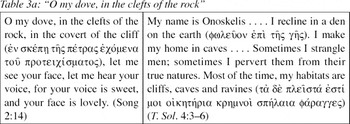
C. The beautiful lover who dwells in the cliffs: Song 2:14 and T. Sol. 4
Song of Songs 2:14 describes the female lover as a dove living in the cliffs. A number of recent commentators have noted that this image connotes the inaccessibility of the lover and the intense longing of the beloved.50
Murphy, Song of Songs, 141; Garrett, Song of Songs, 160; Longman, Song of Songs, 122–23; Keel, Song of Songs, 105–6; Bergant, The Song of Songs, 30; Snaith, The Song of Songs, 40.
Munro, Spikenard and Saffron, 90–91.
To the magical imagination of the Testament's author, the image of the cliff-dweller may have suggested a connection to demonology. In T. Sol. 4:1, Solomon demands that Beelzeboul bring him a female demon. Having been bound to obey, Beelzeboul summons the beautiful Onoskelis (“ass-legs”), who like the dove of the Song, dwells in “cliffs, caves and ravines” (T. Sol. 4:6).

In addition, a second image connects Onoskelis and the “dove”: Onoskelis travels by the full moon (T. Sol. 4:9), and the Song characterizes the “dove” as the one who “looks forth like the dawn, fair as the moon, bright as the sun” (Song 6:9–10).52
It might seem this line arbitrarily focuses attention on just two details of the Testament's presentation of Onoskelis, while ignoring those elements which have no relation to my proposed intertext in the Song. In defense of the claim that the moon motif is an essential aspect of the portrait of Onoskelis, I can point not only to the background in Hellenistic demonology (see below), but also to another Christian magical text, which identifies her as “Onoskelis, the one who goes through the lunar star” (

). This occurs in “Another prayer. Of Gregory the Theologian (i.e., Nazianzus)” (

), Delatte, Anecdota Atheniensia, 244.

Onoskelis has a fairly well-documented background in Hellenistic demonology.
53See Duling's notes on T. Sol. 4 in OTP 1:964–65. McCown (Testament, 67) identified Enepsigos as Hecate.

who inhabit not the desert, but an island, and who retreat into the ocean. Unlike the figure of the Testament, Lucian's “ass-legs” are not cliff-dwellers, but “women of the sea” (

). However, Michael Psellus (1017–ca. 1078) relates that these creatures, which change forms, are called “ass-legs” when they leave the sea to dwell in dry places.
54G. Gaulmin, Michaelis Pselli de operatione daemonum dialogus (Paris, 1688) 122–25; translation in David R. West, Some Cults of Greek Goddesses and Female Daemons of Oriental Origin (Alter Orient und Altes Testament [AOAT] 233; Kevelaer: Butzon und Berker; Neukirchen-Vluyn: Neukirchener Verlag, 1995) 314–15. Psellus's authorship is questionable.
West, Cults of Greek Goddesses, 201–3, 297–301. On the identification of Hecate and the moon, see 201–3. In explaining the cross-cultural interconnectedness (“mythological transference”) of the ancient female demon cults and stories, the scope of West's work is much more ambitious than the present discussion. For a thumbnail sketch, his tables correlating demons and major themes between Semitic and Greek cultures are useful (318–23).
On the one hand, this portrait of the pagan Onoskelis seems to discourage the appeal to the Song's dove imagery which I have suggested. The two parallels I have proposed—the habitat and the association with the moon—can be accounted for as belonging to the Greek demon Empousa, obviating the need for a biblical background. However, upon closer examination, the specific reference to the dwelling of the Testament's Onoskelis in cliffs and ravines appears not to be a part of the Greek background, but rather to have been derived from the description of the Song's dove.
What I am suggesting is that as he read the Song, the Testament's author was struck by the image of the female figure associated with the moon (

) in Song 6:9–10. Immediately, this suggested a connection to Empousa and Hecate, whom the author knew as Onoskelis. In effect, Song 6:9–10 proved that the historical Solomon magus knew of Onoskelis, the famous figure of Hellenistic demonology, and so she was incorporated in a prominent role in the Testament's biographical presentation. Second, Song 6:9 suggested to our ancient author that Solomon spoke of Onoskelis as a “dove.” This opened up the connection to Song 2:14, which describes the dove's dwelling in the cliffs, a fact which resonated with the desert dwelling of Empousa and the Greek Onoskelis. On the basis of Song 2:14, the Testament's author was able to describe Onoskelis's dwelling (with a greater degree of specificity than the Hellenistic traditions supported) as being in cliffs, caves and ravines. This allows us to explain why the Testament locates Onoskelis in an environment which is almost, but not quite appropriate to a wild ass, and which has no exact parallel in pagan sources.
56See Job 39:6: “Who let the wild donkey (LXX

) go free? Who untied his ropes? I gave him the wasteland (

; LXX

) as his home, the salt flats as his habitat.” Unlike the dove's habitat, these are wide-open spaces.
As in the case of Ornias and the seal upon the heart, the most troubling implication of the parallel I have proposed is that it correlates the Song's positive image of the dove with the decidedly perilous figure of Onoskelis, a fair seducer who strangles men and leads them astray. Once again, this transformation of the Song is characteristic of how the Testament appropriates its imagery. Anticipating the impending disaster of Solomon's apostasy for the sake of his lover, the Testament subverts the Song's idealization of human love by associating the respective habitats of the object of Solomon's infatuation and of Onoskelis. The Testament literally demonizes the Song's dove.
D. Commanding the wind: Song 4:16 and T. Sol. 7:1–8; 22:9–24:5
In Song 4:16, the beloved calls on the wind to blow upon the garden of his lover. Since Franz Delitzsch suggested that the simultaneous confluence of north and south winds was conducive to gardening, geographical explanations of the verse have been popular.57
Franz Delitzsch, Commentary on the Song of Songs and Ecclesiastes [Keil and Delitzsch Commentary on the Old Testament; Grand Rapids, Mich.: Eerdmans, 1950] 87. See also Pope, who notes that the rabbis related this verse to the north and south walls of the temple, employing a sort of sacred geography (Song of Songs, 498–99).
See Murphy, Song of Songs, 157; Keel, Song of Songs, 181; Bergant, Song of Songs, 57. Longman perceives a symbolical meaning of the line (the woman is opening herself completely to the man), but the symbolism works at the level of the merism (north and south winds as a totality), rather than as allegory (i.e., north wind symbolizing one thing and south another) (Song of Songs, 158).
Garrett recognizes the “magical” quality of sexuality, but he does not do what the Testament's author does, namely, correlate this verse with Solomon's magical career (Song of Songs, 201–2).
Obviously, this generalization must not be taken as an absolute statement. Pliny, for example, is able to produce a number of naturalistic if scientifically unverifiable explanations for the cause of the wind. To his credit, after a survey of these theories, he (correctly) concludes that “it is clear that [the winds] have a law of nature, which is not unknown, though not yet fully known” (“palam est illos quoque legem naturae habere non ignotam etiamsi nondum percognitam”; Nat. 2.44–50) According to the authors of the Enochic apocalypses, the winds were controlled by personal entities who proceed from heavenly gates, but apparently under divine administration (see 1 En. 18:1–5; 34:2–3; 36:1–4; 41:3–4; 60:12; 69:22; 76:1–14).
Solomon binds two such demons in the Testament.61
How would this motif have figured in the broader Christian worldview of the Testament's author? It is noteworthy that the Gospels present Jesus as the master of the winds (on the Testament and Gospel backgrounds, see Duling, OTP 1:949, and Torijano, Solomon, 111–19). The question is whether or not Jesus' control of the winds was connected (in the text itself or in later interpretation) to his well-known mastery of demons, as is the case with the Testament's Solomon. Traditionally, the calming of the storm in Mark 4:35–41 (and parallels) has been taken as a proof of Jesus' divine nature, his status as the pre-existent second person of the Trinity, who by virtue of his role in creation could command the winds to be still. This venerable interpretation goes back as far as the fourth century, and was held by Chrysostom (“[W]hile the sleep and the outward appearance showed man, the sea and the calm declared him God.” PG 57:351–52; Nicene and Post-Nicene Fathers [NPNF] 10:190), Peter Chrysologus (fifth century; “[T]hose who were sailing knew, believed, and confessed him to be the author of all things” [“navigantes ipsum esse omnium sentiunt, credunt, fatentur auctorem”] CCSL 24:117), Basil (“by these [expressions of authority] we may recognize our Master and Maker,” NPNF2 8:14–15), and Ephraem Syrus (“The ship bare his manhood, but the power of His Godhead bare the ship and all that was therein…. He like the Architect of creation, made the waters solid and joined them together and laid them under his feet,” NPNF2 13:328. See also C. McCarthy, Saint Ephrem's Commentary on Tatian's Diatessaron: An English Translation of Chester Beatty Syriac MS 709 [Journal of Semitic Studies Supplement 2; Oxford: Oxford University Press for the University of Manchester, 1993] 127). With a different set of presuppositions, it would not have been difficult to read this story as a manifestation not of Jesus' creative power, but of his great (Solomonic) wisdom. The following three considerations support this notion: First, the calming of the storm is followed immediately by the story of the Gerasene demoniac (in all three Synoptics), which for the Testament's author would have been a clear instance of Solomonic typology. Second, the reaction of Jesus' companions to his calming of the storm (“Who then is this, that he commands even the winds and the waters, and they obey him?” Luke 8:25 and parallels) is remarkably similar to the reaction of the crowds to Jesus' exorcistic power in Luke 4:36 (“What is this word? For with authority and power he commands [

] the unclean spirits, and they come out!” Also Mark 1:27). For a reader in the magical tradition, the answer to the question “Who is this?” would have been: “This is the one greater than Solomon.” Third, no reader in the ancient magical tradition would have failed to notice the personification of the winds and storm. He commands or rebukes them; they obey him. For the ancient reader, “they” were the personal (demonic) entities who caused the winds to blow, and not a mere literary device. An Arabian legend has Solomon confining a genie to the Sea of Galilee (Burton, Arabian Nights, 91). If the Arabian legend is based on the miracle of Jesus, as it may well be, then it attests an “exorcistic” reading of the story in Luke 8:22–25. If, on the other hand, the Arabian legend has a folkloric background prior to the Gospel story, then perhaps the disciples themselves, who grew up on the shores of the lake, understood Jesus to have rebuked the spirit with which they would have no doubt been familiar as native Galileans. Every reader of the Gospels is aware that Jesus is the “one greater than Solomon” (Matt 12:42, Luke 11:41). For those for whom Solomon is understood on the model of the wise philosopher, the likeness will be found in the wise sayings and judgments of Jesus. For those who understood Solomon as magician and exorcist, Jesus' Solomonic identity would have included the full complement of Solomonic attributes, both wisdom and power. These two are explicitly linked in Matt 13:54, where an astounded crowd asks: “Where did this man get this wisdom and these deeds of power?” For a contemporary magical interpretation of Mark 4:35–41 (and parallels) and a list of ancient parallels, see Morton Smith, Jesus the Magician (San Francisco: Harper & Row, 1978) 119 and 199–200.
In the well-known story of the Fisherman and the Genie in the Arabian Nights, the genie in the brass bottle is put there and sealed by Solomon (Burton, Arabian Nights, 51–52).
The tendency of modern readers is to view such an expansion as contrary to the concerns of sincere historical writing. However, we should be careful in judging the motivations of ancient interpreters by the canons of modern historiography. Rather than being anti-historical, this expansion is actually motivated by a concern for “historicity” of a sort. The Testament's author, believing his own Solomon magus to be the historical Solomon, was merely trying to account for all the pertinent data, which included a speech Solomon addressed to the winds. If we apply modern standards to the Testament, the verdict is that the author has been hasty in the introduction of a story which was not properly documented. However, from an ancient point of view, the modern or “orthodox” Solomon would be the product of an equally serious historiographical sin: namely, the failure to pursue a maximal interpretation of all of the (sacred) text's details and interpretive opportunities. Ancient interpreters sometimes “connected the dots” where modern readers do not perceive the need for heroic efforts, but they did so more out of reverence than carelessness.
The Song's specification of north and south is itself magically evocative. The demons of the four cardinal directions figure prominently in the later medieval Solomon magus tradition, particularly in the Hygromanteia and the Sefer ha-Razim, where they are invoked by name.63
Torijano, Solomon, 213–14. On the Hygromanteia, see Torijano, Solomon, 151–61 (text and translation, 231–309).
McCown says these are “nomina duo celeberrimarum literarum Ephesiarum” (Testament, 29*). McCown notes a number of variants of the name in the apparatus. I am proceeding on the assumption that the correct name is Lix Tetrax, on the basis of external attestation, such as in Clement's Stromata, etc.
Any discussion of the meaning of this name must begin with Clement of Alexandria, who (quoting Androcydes the Pythagorean) explains that the meaning of the rare term “

is the earth, according to the ancient naming, and

is the year, with regard to the [four] seasons [

].”
65
(Clement Alex. Strom. 5:7; GCS 15:356). One MS (L) has

, which is reflected in the text in PG 9:72.
Readers of G. W. H. Lampe's Patristic Greek Lexicon (Oxford: Clarendon Press, 1961–1968), for instance, do not have the benefit of the quotation's context, so it appears that

simply means earth.

is anything but

(“earth”). Clement is discussing the arcane, “symbolic” use of language among the Egyptians, mystics and philosophers. In the two “definitions” which precede those of

and

, Androcydes says that the word

(“shadowless”) denotes the darkness, which casts no shadow, while

(“shadowy”) denotes the light, since its rays are its shadow. In other words, the gist of the passage is that in esoteric contexts, words have ironical or paradoxical meanings—thus, it is unlikely that the plain meaning of

is “earth,” and of

, the four seasons. What corresponds to “earth” as “shadowless” corresponds to darkness? What are the paradoxical twins of

and

? Admittedly, this involves a sort of Humpty Dumpty logic, but to propose that the answer to the question was obvious would be a disservice to the cleverness of the ancient imagination. At the very least, the name seems to point to some sort of cosmological quaternity, and given the fact that there is a limited number of these, we should at least consider the possibility that instead of denoting the earth and its four seasons (the oblique, symbolic usage, according to Androcydes), the name Lix Tetrax might refer in its plain sense to the sky and its four winds. Such a meaning would be not only satisfactorily ironic, but also consistent with the Testament's presentation of Lix Tetrax as a wind demon, the one who causes whirlwinds which confuse the orderly action of the four winds.
67In the context of T. Sol. 7:5, the

(literally “turnings”) are dust storms and whirlwinds.
E. Male “breasts” in Song 1:2 and T. Sol. 9:4
The Septuagint text of the Song consistently revocalizes the Hebrew word

(“your love”) to read

(

, “your breasts”).
68Murphy, Song of Songs, 9 n.36. This occurs at Song 1:2, 1:4, 4:10 (twice), and 7:13 (7:12).

(breast, pl.

) is not uncommon in the LXX, but it invariably refers to the breasts of female humans and animals, and never to a male's chest.
In New Testament literature,

occurs twice in the Gospels, where it refers in its normal sense to female breasts (Luke 11:27; 23:29). In Rev 1:13, the term refers to the “chest” of Jesus, around which he wears a belt. David E. Aune notes that this vision draws on the imagery of the priestly vestments, and that we should expect the belt to be worn around the waist.
69David E. Aune, Revelation (Word Biblical Commentary 52; Dallas: Word, 1997–1998) 94. Johannes P. Louw and Eugene A. Nida (Greek-English Lexicon of the New Testament: Based on Semantic Domains [New York: United Bible Societies, 1988] 1:99) also note the ungainliness of

for the male breast, suggesting that in some target languages,

should be rendered as “chest.” Recent English translations have taken this advice, avoiding the awkwardness of the AV, which has Jesus “girt about the paps with a golden girdle.”

in biblical Greek is meant to identify Jesus with the beloved of the Song of Songs by referring to what may have been a well-known locus difficilis in the LXX.
In T. Sol. 9:4, Solomon encounters a headless male demon. Solomon asks him how he sees, and he replies that he sees through his breasts (

)—a third instance of male breasts. While the headless demon is known in the broader context of the Greek magical papyri, his sight through his breasts does not seem to have been derived from this tradition, even though the question of how he did see without a head was apparently of interest. In the magical papyrus P.Lond. 46, the headless demon sees not through his breasts, but through his feet.
70Papyri graecae magicae [PGM] 5.145, translated by D. E. Aune in The Greek Magical Papyri in Translation, Including the Demotic Spells (ed. Hans Dieter Betz; 2d ed.; Chicago: University of Chicago Press, 1992) 103. The text is the “Stele of Jeu the hieroglyphist in his letter,” in P.Lond. 46. See also McCown, Testament, 67 n.5. With this text in mind, he identified the headless demon as a universal folkloric figure.
F. The solitaire gem: Song 4:9 and T. Sol. 1:6 (also 10:5–10)
In light of the Testament's description of the seal-ring of Solomon as consisting of a precious engraved stone (

; T. Sol. 1:6), it is tempting to imagine readers in the magical tradition interpreting Song 4:9 as the description of one of the talismans which were so familiar to their religion: “You have ravished my heart (

), my sister, my bride, you have ravished my heart with one of your eyes, with one ornament of your neck (

).” It is possible that this verse suggested some kind of “magical” function, even in its original setting: the eye of the woman is said to have a power that is like that of an amulet worn around the neck, and any reader in the magical tradition would likely have appreciated a reading that emphasized this point.
71See Murphy, Song of Songs, 156, 160. Elsewhere, I have argued that the Talmud (b. Git. 67b) derives the term “kordiakos,” denoting a form of demon possession, from the LXX text of Song 4:9 (“The Derivation of ‘Kordiakos’: A New Proposal,” forthcoming in Journal for the Study of Judaism in the Persian, Hellenistic, and Roman Periods [JSJ] 38 [2007]). See also Prov 17:8.
According to the Sepher ha-Razim, Noah inscribed esoteric information on a sapphire, which was transmitted to later generations. See Morgan, Sepher ha-Razim, 17; Torijano, Solomon, 202.
The Testament's Hermeneutical Method
What can we say about the Testament's hermeneutical method, on the basis of these proposed parallels to the Song? The relationship between the two texts is complex and does not lend itself to a simple, aphoristic description of the Testament's hermeneutical scheme. In general, the Testament uses the Song “compositionally,” rather than “expositionally”—in other words, the Testament partly derives its shape from assumptions about the Song, more than it attempts systematically or explicitly to exegete the Song.73
On this distinction, see Devorah Dimant, “Use and Interpretation of Mikra in the Apocrypha and Pseudepigrapha,” in Mikra: Text, Translation, Reading and Interpretation of the Hebrew Bible in Ancient Judaism and Early Christianity (ed. Martin Jan Mulder; Philadelphia: Fortress, 1988) 382.
McCown described the Testament as “a combination of folktales and a magician's vade-mecum” (Testament, 1), then derided the book's lack of “plot or progress of thought” (Testament, 3–4), and judged the Testament's use of sources “inconsistent and ill-digested” (Testament, 88). Recently, Torijano has sought a greater degree of order and consistency in the Testament, and has found it to be organized in all recensions by the exorcistic formula “Who are you?” (Solomon, 55–65). Even so, Torijano's detailed outline as much reveals formal diversity and complexity as it imposes structural order on the Testament (Solomon, 60–64).
In the selection of interpretive topoi from the Song, the Testament appears to share some of the characteristics of “midrashic”75
In using the term “midrashic,” I mean to suggest a characteristic exegetical method and not a particular literary form.
For example, the prominence of Asmodeus. See Duling, OTP 1:948 n.80.
Modern scholars speak of the “interpreted Bible” of ancient exegetes to describe the unwritten traditions that accompanied the text—perhaps we could also speak of a “highlighted Bible” to describe how difficulties of the text predicted interpretive effort. If ancient readers had been equipped with yellow highlighter pens, they would have marked in their Bibles all of the lexical and syntactic abnormalities, as well as the phrases that were susceptible to enhanced interpretation in their own context (in this case, the “magical” context). As we examine the Testament's use of the Song, we see that as its author appropriates passages of the Song for his own peculiar use, he gravitates toward passages which are both inherently distinctive and magically suggestive.
In its basic outline of Solomon's life, the Testament can be described as a narrative expansion of 1 Kings—it claims to retell the story of his construction of the temple, with many added details, but without ever challenging the veracity of the biblical account. Kugel defines narrative expansion as:
one of the most characteristic features of ancient biblical scholarship: the writer, in going over the contents of a particular story, would insert all manner of “extras” not explicitly stated in the text itself—additional actions performed by the person or persons in the biblical narrative, or words spoken by them. Now such narrative expansions are, by definition, exegetical because they are ultimately based on something that is in the text—the unusual word or turn of phrase … or simply some problem in the plot that required resolution.78
Kugel, In Potiphar's House, 3–5; Kugel's emphasis.
As for the Testament's use of the Song, the exegetical method is analogous to a feature of rabbinical exegesis which Kugel calls “back-referencing,” defined as “the practice of reading verses from such books as the Psalms, Proverbs, Job, the Song of Songs and Ecclesiastes as if they referred to people or events set forth in the historical narratives of the Hebrew Bible, and in particular the Pentateuch.”79
Ibid., 271, see also 173, 261.
I have already noted that little work has been done by modern scholars on the back-referencing of Solomonic wisdom literature in the magical tradition. Interestingly, the Talmud, which is not magical per se, attests a number of magical readings of Solomon's canonical compositions (b. Giṭ. 67b–68b). The otherwise enigmatic phrase

(Eccl 2:8) is understood in the Babylonian tradition to refer to the male and female demons who helped in the construction of the temple (b. Giṭ. 68a).
80See Søren Giversen, “Solomon und die Dämonen,” in Essays on the Nag Hammadi Texts in Honor of Alexander Böhlig (ed. Martin Krause; Nag Hammadi Studies [NHS] 3; Leiden: Brill, 1972) 17–18.
In one important regard, McCown's understanding of the Testament's orientation toward the Song must be modified. He suggested that what I have called the negative reading of the Song in the Testament was advanced by “those who opposed [the Song's] admission into the Canon of the Hebrew Scriptures.”81
McCown, “Solomon and the Shulamite,” 120.
Todd E. Klutz has described how the modern students of the Testament, from McCown onward, have been suspicious of its magical worldview and have not given it a fair reading. Such prejudice not only hinders any attempt to understand the Testament on its own terms, it may also prevent a fair appraisal of the prominence of magic in the biblical world. Klutz notes that “scholarly references to ‘magic’ and the ‘the magical world view’ have normally been accompanied by either explicit or implicit denigration of the mental capacities of people who traffick [sic] in such stuff” (“The Archer and the Cross: Chorographic Astrology and Literary Design in the Testament of Solomon,” in Magic in the Biblical World: From the Rod of Aaron to the Ring of Solomon [ed. Todd E. Klutz; JSNTSup 245; London: T&T Clark, 2003] 5, 222–25).
Conclusion: Testament of Solomon and Pre-Allegorical Interpretation of the Song
Any biographer of Solomon must deal with his dual status as divinely elected temple builder and eventual apostate.83
Brueggemann has referred to Solomon as “Israel's Ironic Icon of Human Achievement.” See also his presentation of the “irony” of Solomon (Solomon, xi–xiii). See Torijano, Solomon, 2, 225, for a discussion of how the Solomonic tradition grappled with the multiple facets of the character.
See McCown, “Solomon and the Shulamite,” 120–21.
In contrast, the Testament presents an alternative, pre-critical, pre-orthodox, Christian reading of the Song as the narration of Solomon's demise. Not only does the Testament, true to its interpretive grid, find magic in the Song, it does not hesitate to associate the Song's love themes with the more sinister figures of Solomonic demonology. In this view, as the Song develops its meditation on love, it brings into focus the forces which in the Testament lead to Solomon's demise, and so the Testament never loses sight of the Song's narrative ending—Solomon's sacrifice of five locusts on the altar of pagan idols for the sake of the Song's lover.
To the extent that this study has succeeded in demonstrating the use of Song in the Testament, the discussion of the use of the Hebrew Bible in the pseudepigrapha (and possibly the New Testament) should be attentive to the biographical relevance of Solomonic hagiographa for ancient interpreters, as it has always been with respect to the narrative materials. In addition, the findings of this study represent the addition of a short but distinct chapter to the history of the interpretation of the Song, one which falls in the largely unknown interim between the original setting of the love poetry (as reconstructed in modern exegesis) and the onset of a millennium and a half of a virtually monolithic allegorical consensus.