Introduction
In the past few years, an increasing number of studies has recognized demoralization as a relevant clinical dimension to assess and treat in cancer patients (Clarke & Kissane, Reference Clarke and Kissane2002; Fang et al., Reference Fang, Chang and Chen2014; Kissane et al., Reference Kissane, Clarke and Street2001).
Demoralization is defined as an existential distress syndrome that can arise from upsetting events or situations, such as the experience of chronic and progressive medical diseases that represents a threat to the patient's integrity and life (Clarke & Kissane, Reference Clarke and Kissane2002; Kissane et al., Reference Kissane, Clarke and Street2001; Vehling & Philipp, Reference Vehling and Philipp2018). Demoralization arises from a persistent incapacity of coping, feelings of helplessness and hopelessness, loss of meaning and purpose, and impaired self-esteem (Clarke & Kissane, Reference Clarke and Kissane2002; Norris et al., Reference Norris, Pratt-Chapman and Noblick2011; Robinson et al., Reference Robinson, Kissane and Brooker2015). All these phenomena should persist for more than two weeks and a major depressive or other psychiatric episode should not be present as the primary condition (Kissane et al., Reference Kissane, Clarke and Street2001).
Although mild demoralization may not be pathological and the syndrome is not included in the Diagnostic and Statistical Manual of Mental Disorders, cancer and its effects, as traumatic stressors, can affect patients’ lives and psychological well-being. It could provoke high emotional suffering and clinically relevant demoralization, which is significantly associated with potentiated risk for suicidal ideation (Grassi et al., Reference Grassi, Costantini and Kissane2017; Robinson et al., Reference Robinson, Kissane and Brooker2015; Vehling et al., Reference Vehling, Kissane and Lo2017).
Demoralization can be distinguished from depression: in major depression, the source of distress is within oneself and is characterized by feelings of guilt, anhedonia, and no motivation. In contrast, demoralized patients give an external attribution to their distress, feel inability to cope instead of guilt, and do not experience anhedonia, but uncertainty about the direction of their actions; their motivation is, in fact, intact (de Figueiredo, Reference de Figueiredo1993). Therefore, in demoralized patients, the ability to experience pleasure can be retained and drop in mood and loss of interest are not necessarily present (Vehling et al., Reference Vehling, Kissane and Lo2017). Numerous studies showed in a percentage of cancer patients moderate or severe demoralization in absence of depression (Grassi et al., Reference Grassi, Costantini and Kissane2017; Mehnert et al., Reference Mehnert, Vehling and Höcker2011; Vehling et al., Reference Vehling, Kissane and Lo2017). These evidences support the relevance of assessing demoralization as an autonomous clinical dimension.
Clinically relevant demoralization can affect cancer patients in all the disease stages, with an overall prevalence rate of 13–18% (Robinson et al., Reference Robinson, Kissane and Brooker2015). It can rise to 52.5% in advanced cancer patients, probably from their more severe clinical condition (Julião et al., Reference Julião, Nunes and Barbosa2016). The literature shows that demoralization is generally associated with impaired physical symptoms (Vehling & Mehnert, Reference Vehling and Mehnert2014), diminished quality of life, depression, anxiety, feelings of solitude, and reduced social functioning (Robinson et al., Reference Robinson, Kissane and Brooker2015). Additionally, demoralized patients can present with suicidal ideation and desire to die (Fang et al., Reference Fang, Chang and Chen2014; Robinson et al., Reference Robinson, Kissane and Brooker2016). The previously mentioned associations can be also observed in the advanced phase of illness (Julião et al., Reference Julião, Nunes and Barbosa2016; Mehnert et al., Reference Mehnert, Vehling and Höcker2011; Rudilla et al., Reference Rudilla, Galiana and Oliver2016; Vehling & Mehnert, Reference Vehling and Mehnert2014).
The distinctive characteristics of demoralization and their effect on the individual and on his or her adjustment to illness suggest the importance of adequate assessments and effective treatments (Kissane et al., Reference Kissane, Clarke and Street2001). The therapeutic intervention to treat demoralization should focus on restoring hope and exploring the meaning of personal relevant themes linked to the current situation, such as life and death, supporting the feeling of uncertainty to meet patient's unfulfilled needs, and promote realistic goals achievement (Breitbart et al., Reference Breitbart, Rosenfeld and Gibson2010; Clarke & Kissane, Reference Clarke and Kissane2002; Dufault & Martocchio, Reference Dufault and Martocchio1985; Nunn, Reference Nunn1996; Thomas et al., Reference Thomas, Meier and Irwin2014).
Considering its negative effct on patients’ quality of life, the purpose of the present study was to assess the prevalence of demoralization in a population of end-of-life cancer patients (i.e., patients with a life expectancy of less than four months and a Karnofsky performance status [KPS] ≤50) (Karnofsky, Reference Karnofsky and MacLeod1949).
In fact, in previous research focusing on the concept of dignity in end-of-life cancer patients, we found that this specific sample has distinctive characteristics (Bovero et al., Reference Bovero, Sedghi and Botto2018a). To assess demoralization, we used the Demoralization Scale (DS) (Kissane et al., Reference Kissane, Wein and Love2004a), a valid and reliable instrument that has been translated and validated in several countries (Costantini et al., Reference Costantini, Picardi and Brunetti2013; Deng et al., Reference Deng, Pang and He2017; Grassi et al., Reference Grassi, Costantini and Kissane2017; Mehnert et al., Reference Mehnert, Vehling and Höcker2011; Mullane et al., Reference Mullane, Dooley and Tiernan2009; Rudilla et al., Reference Rudilla, Galiana and Oliver2016). In these studies, different factor structures emerged according to the specificities of the various samples: advanced cancer patients (Kissane et al., Reference Kissane, Wein and Love2004a; Mehnert et al., Reference Mehnert, Vehling and Höcker2011; Mullane et al., Reference Mullane, Dooley and Tiernan2009), cancer and noncancer advanced patients receiving palliative care (Rudilla et al., Reference Rudilla, Galiana and Oliver2016), inpatients recruited from a specialist tertiary level cancer hospital (Deng et al., Reference Deng, Pang and He2017), and cancer patients at mixed stages (Costantini et al., Reference Costantini, Picardi and Brunetti2013; Grassi et al., Reference Grassi, Costantini and Kissane2017). Therefore, in the present study, in addition to exploring the prevalence of demoralization in end-of-life cancer patients and its associations with a set of psychosocial variables, we explored the latent dimensions of demoralization emerging in end-of-life cancer patients.
Methods
Study design and participants
Participants were recruited from October 2016 to February 2018 at “Città della Salute e della Scienza” Hospital of Turin. Inclusion criteria were: diagnosis of cancer, being hospitalized, and meeting the criteria to access palliative care. These last, stated in Piedmont Regional Legislative Decree no. 45/2002 and in the National Law on Palliative Care and Pain Treatment (no. 38/2010) are the following: presence of an advanced disease stage in its terminal phase, for which there are no possible or appropriate curative treatments and with unfavorable/poor prognosis, an estimated life expectancy less than four months, and KPS ≤50. Exclusion criteria were not speaking Italian fluently, diagnosis for any severe psychiatric disorder, and having obtained a score ≤19 at the Mini Mental State Examination (Folstein et al., Reference Folstein, Folstein and McHugh1975), which implies not being able to provide valid informed consent and answers. There were 291 possible candidates: 26 did not meet the inclusion criteria (14 obtained a score ≤19 on the Mini Mental State Examination, five were not able to speak Italian fluently, and seven had a KPS ≥50), 25 refused to participate in the study because of severe distress resulting from the disease, and five passed away before the interview. The final sample included 235 end-of-life cancer patients. They were assisted by a multidisciplinary team composed of physicians, nurses, and psychologists trained in palliative care. All of them received psychological support and palliative care aimed at managing their symptoms and well-being, without any ongoing curative treatments, or palliative chemoradiotherapy.
A palliative physician gathered, for each patient, the sociodemographic and clinical data. He also estimated patients’ life expectancy, based on the “surprise question” (Moss et al., Reference Moss, Lunney and Culp2010), the Palliative Prognostic Score (Maltoni et al., Reference Maltoni, Nanni and Pirovano1999), and his clinical experience. Then, participants were interviewed at their bedside during the first meeting with the psychologists. On this occasion, the established set of rating scales was administered and patients’ awareness of diagnosis and prognosis was evaluated.
Measures
The Italian validated versions of the following instruments were used.
The Demoralization Scale-Italian version (DS-IT) (Costantini et al., Reference Costantini, Picardi and Brunetti2013) is a self-report scale assessing demoralization, composed of 24 items on a 5-point Likert scale (0 = never, 4 = always). For the study, the following cutoff scores were used: 0–25th percentile, low demoralization; 25th–75th percentile, medium demoralization; and >75th percentile, high demoralization (Robinson et al., Reference Robinson, Kissane and Brooker2016).
The Hospital Anxiety and Depression Scale-Italian Version (HADS-IT) (Costantini et al., Reference Costantini, Musso and Viterbori1999) is a 14-item self-report scale that consists of two seven-item subscales related, respectively, to depressive and anxious symptomatology. The items are on a 4-point Likert scale, ranging from 0 to 3, rating the issue described in the item. Scores ≥8 on each subscale indicate clinically relevant symptomatology.
The Patient Dignity Inventory-Italian version (Bovero et al., Reference Bovero, Sedghi and Botto2018a) is a 25-item self-report that follows the Dignity Model (Chochinov, Reference Chochinov2002). The items are on a 5-point Likert scale (1, not a problem; 5, an overwhelming problem). This version, validated for end-of-life patients, consists of five subscales (Psychological Distress, Social Support, Physical Symptoms and Dependency, Existential Distress, Loss of Purpose and Meaning).
The Functional Assessment of Chronic Illness Therapy – Spiritual Well-Being (FACIT-Sp-12) measures spirituality in cancer patients. It contains 12 items underlying the traditional religiousness dimension (Faith) and the spiritual one (Meaning/Peace) (Peterman et al., Reference Peterman, Fitchett and Brady2002). The wording of the items does not assume a belief in God, so it can be completed comfortably by both atheists and agnostics. The items are on a 5-point Likert scale, ranging from 0 (not at all) to 4 (very much).
The Edmonton Symptom Assessment System-Italian Version (Moro et al., Reference Moro, Brunelli and Miccinesi2006) assess nine common symptoms experienced by cancer patients: pain, tiredness, nausea, depression, anxiety, drowsiness, appetite, well-being, and shortness of breath. In addition, patients can eventually report other symptoms. The symptoms severity is rated on an 11-point Likert scale, ranging from 0 (no symptom) to 10 (worst possible symptom).
The visual analog scale (VAS) for pain (Scott & Huskisson, Reference Scott and Huskisson1976) explores patient's subjective pain perception. The patient indicates the intensity of his or her current pain with a cross on a horizontal line of 10 cm with specifications on each end (“no pain” on the left; “intolerable pain” on the right). The score is the distance between the left end of the line and the patient's cross.
Statistical analysis
To identify demoralization latent dimensions, the DS-IT factor structure was explored through principal component analysis (PCA) with oblique rotation and Kaiser normalization, on its 24 items. Sampling adequacy and assumption of sphericity were tested by calculating the Kaiser-Meyer-Olkin measure and the Bartlett test. The optimum number of factors was determined through Guttman-Kaiser criterion (eigenvalue of ≥1.00 as the cutoff point) and the scree plot visual examination.
To analyze the demoralization prevalence, the sample was divided into three subsets (low, medium, high demoralization), depending on the obtained DS-IT total score and Robinson et al. percentiles (Reference Robinson, Kissane and Brooker2016). Sociodemographic, medical, and psychological variables were analyzed with respect to the three groups, through multivariate analyses of variance and chi-square test. Descriptive statistics included frequencies, M, and SD. All the tests were two-sided and all the tests assumptions were verified. p values < 0.05 were considered statistically significant. In analyses of variance, post hoc analyses with Bonferroni correction were performed. Statistical analysis was executed using the software SPSS Statistics, version 24.0 (IBM Corp. Armonk, NY).
Results
Participants’ sociodemographic and medical characteristics
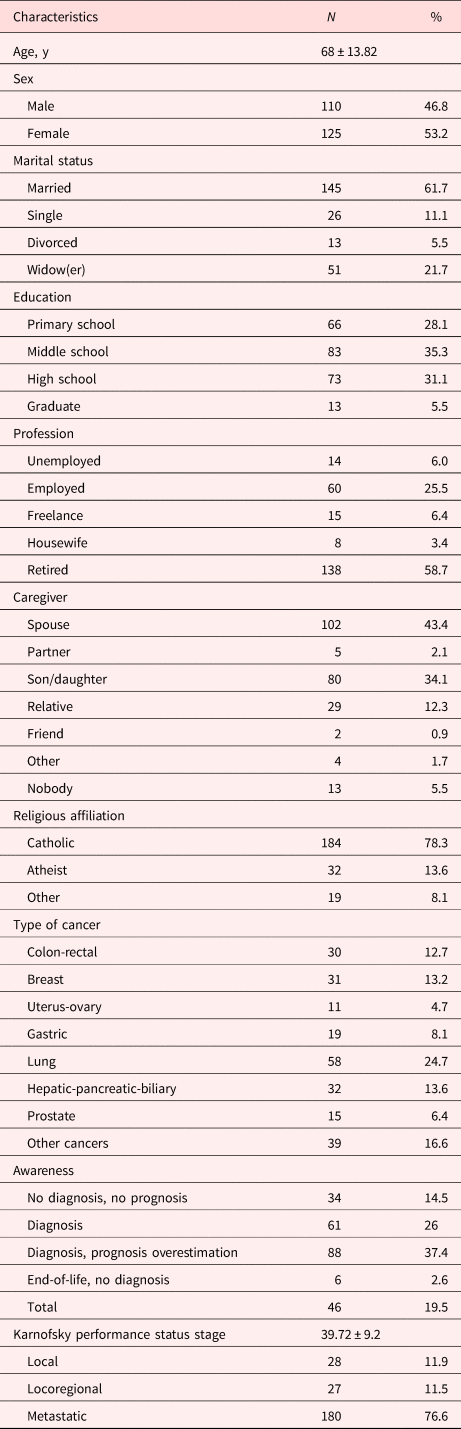
The final sample consisted of 235 patients. The average age was 68 years (range 30–91); 53.2% of participants were female and the majority of the sample was married. Only 5.5% were graduated and nearly 60% of the sample was retired. Almost 80% of patients were Catholics. Spouses and sons/daughters were the most frequent caregivers.
The KPS average score was 39.72 and the most frequent types of cancer were lung, hepatic-pancreatic-biliary, colorectal, and breast. In three-quarters of cases, the cancer stage was metastatic. According to the Palliative Prognostic Score, patients were classified in three groups on the basis of the risk of death: A, 54 (23.0%); B, 138 (58.7%); and C, 43 (18.3%), with C being representative of the highest risk. Most patients were not aware of their disease prognosis or overestimated it (63.8%, n = 150). The average expectancy of life was about 27 days, ranging from <24 hours to 120 days (Table 1).
Sociodemographic and clinical characteristics of the sample (N = 235)

Demoralization prevalence and latent dimensions
The sample's average demoralization total score was 35.04 (SD ± 15.01; SE = 0.98). Sixty-four participants (27.2%) had low demoralization, 118 (50.2%) had medium demoralization, and 53 (22.6%) had high demoralization.
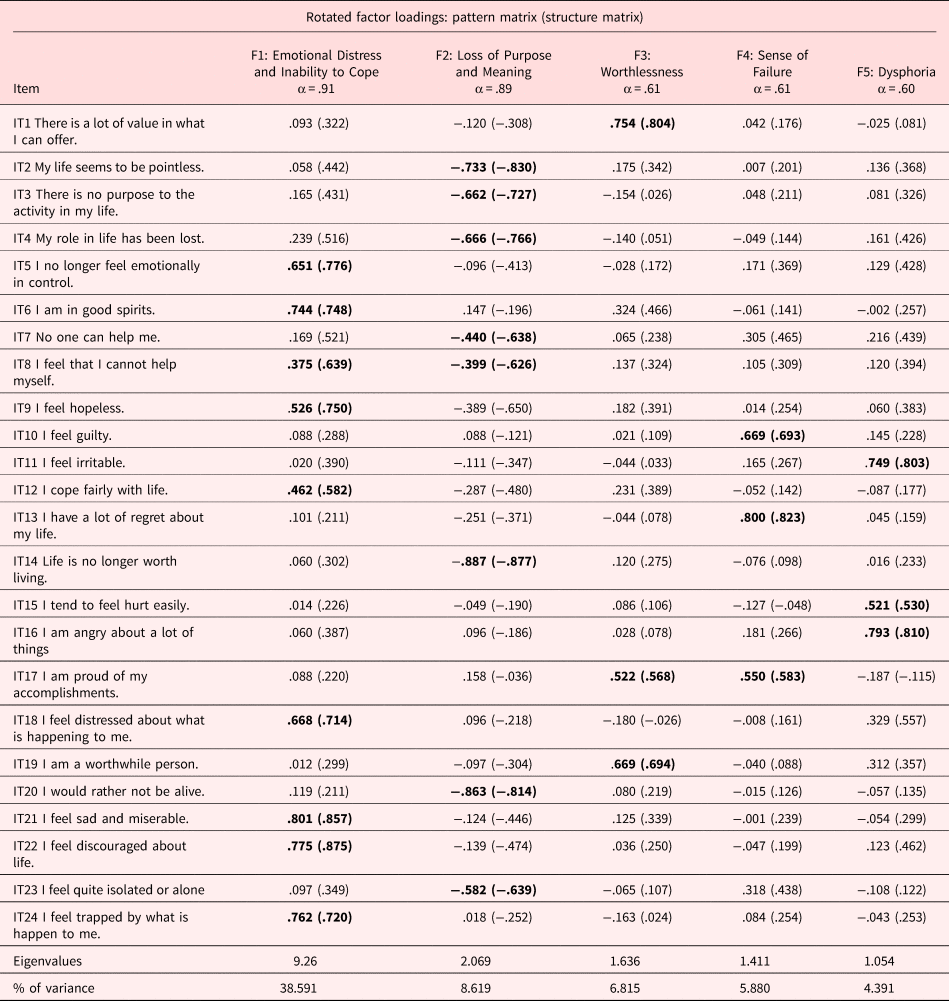
Regarding the factor analysis, the Kaiser-Meyer-Olkin measure of 0.90 verified the sampling adequacy for the analysis and the Bartlett test of sphericity chi-square (276 = 3,165.01, p < 0.001) indicated that the correlations between the items were sufficiently large for PCA. The optimum number of factors comprehended five components that together accounted for 64.30% of the variance. Table 2 shows the factor loading after the rotation and the emerged factors that represent the demoralization latent dimensions. Component 1 (items 5, 6, 8, 9, 12, 18, 21, 22, 24) was labeled “Emotional Distress and Inability to Cope”; component 2 (items 2, 3, 4, 7, 14, 20, 23) represents the loss of purpose and meaning; component 3 (items 1 and 19) refers to worthlessness; component 4 (items 10, 13, 17) corresponds to sense of failure; component 5 (items 11, 15, 16) was labeled “Dysphoria.”
Summary of the exploratory factor analysis: PCA, oblique-rotated, five-component solution (N = 235)

Factor loadings >.40 appear in bold type.
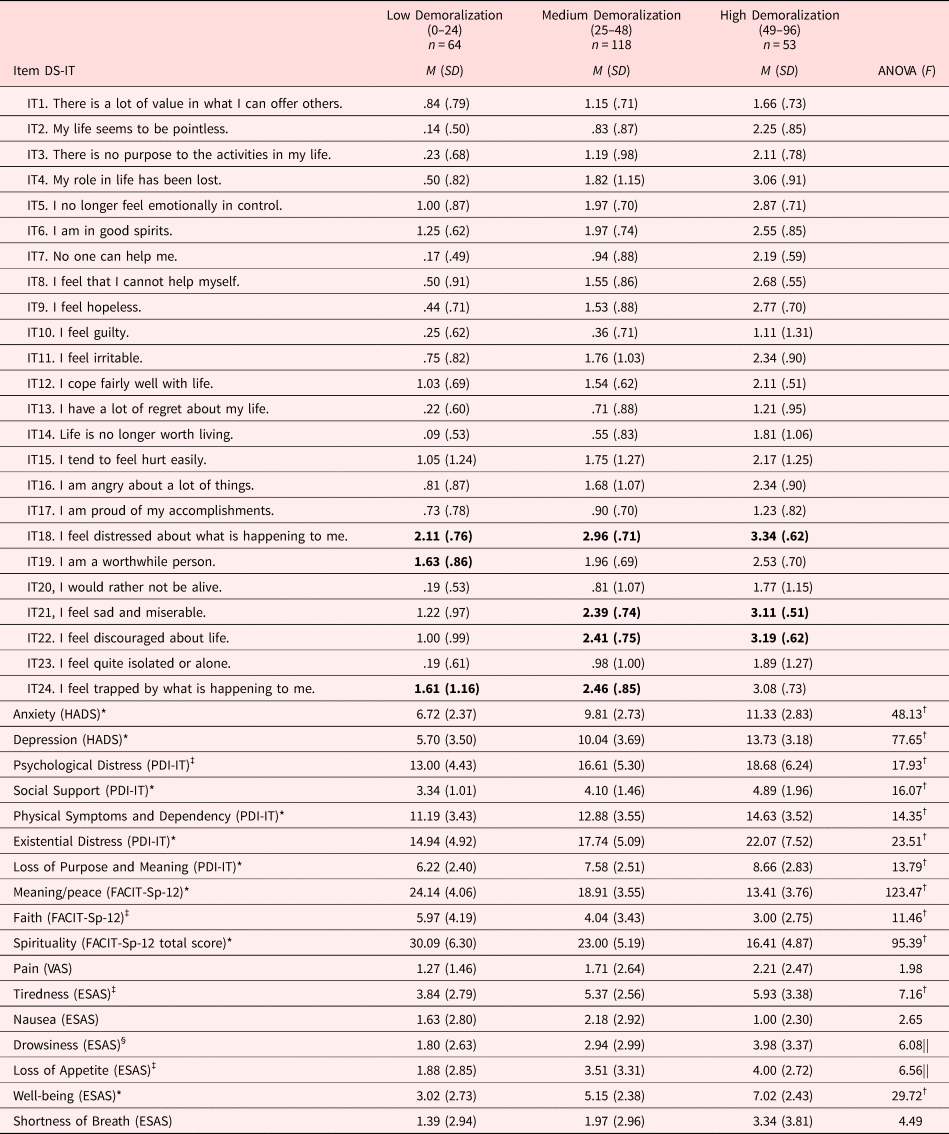
The average scores on the emerged five factors were, respectively, 18.8 ± 6.8 (range 0–36) for “Emotional Distress and Inability to Cope”; 7.4 ± 6.0 (range 0–24) for “Loss of Purpose and Meaning”; 3.2 ± 1.3 (range 0–8) for “Worthlessness”; 2.1 ± 1.9 (range 0–12) for “Sense of Failure”; 4.9 ± 2.6 (range 0–12) for “Dysphoria.” In “Low,” “Medium,” and “High” demoralization groups, the items of the DS-IT with the highest mean scores were 18, 19, 21, 22, and 24. They all belong to factor 1: “Emotional Distress and Inability to Cope” Likert point 4, corresponding to the “always” answer, was not the highly frequent for any items, but 18, 21, and 24 were the items with the highest frequencies of answers “often.” “Never” was the most frequent answer given to items 2, 3, 4, 7, 10, 14, 15, 20, and 23 (Table 3).
Levels of demoralization in the sample and their associations with the other continuous variables
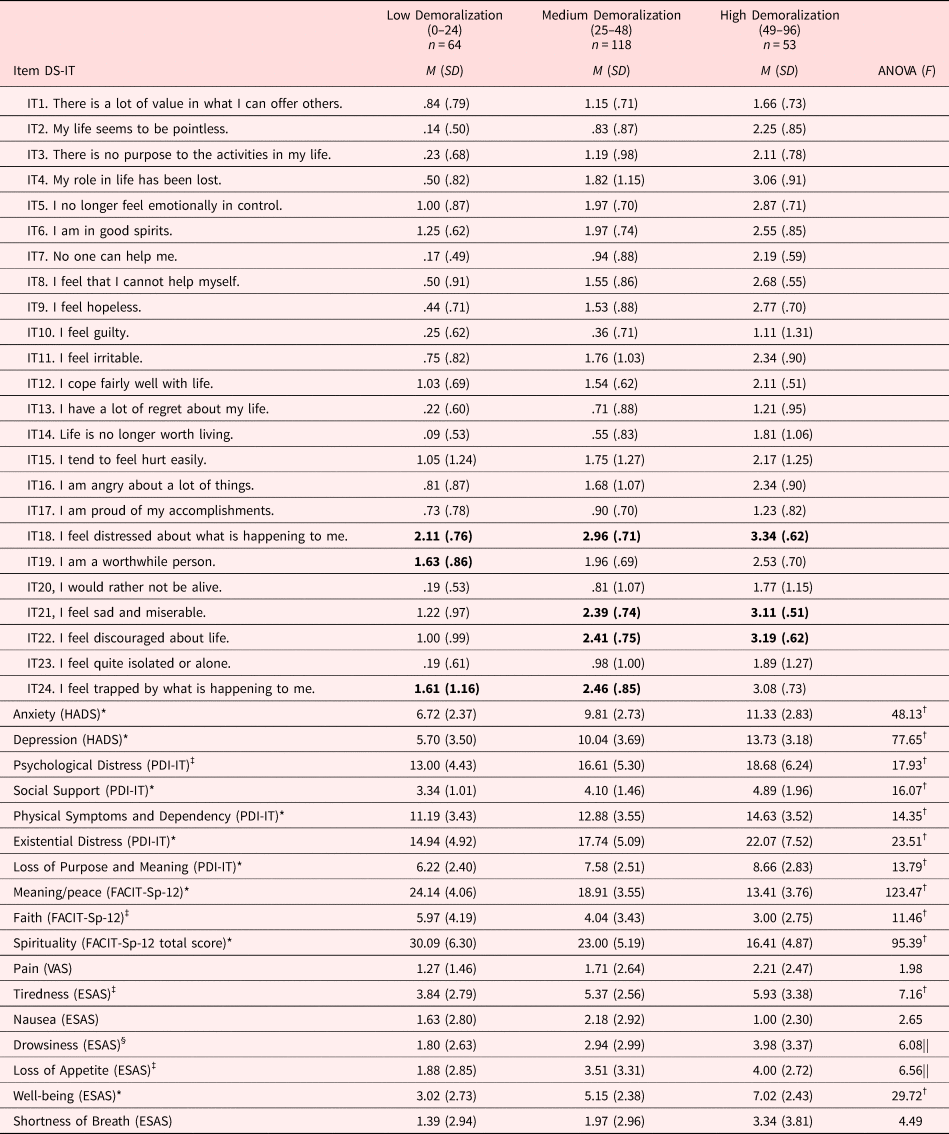
M in bold type are the highest in low, medium, and high demoralization.
DS-IT, Demoralization Scale-Italian version; ESAS, Edmonton Symptom Assessment System-Italian Version; FACIT-Sp-12, Functional Assessment of Chronic Illness Therapy – Spiritual Well-Being; HADS, Hospital Anxiety and Depression Scale; PDI-IDT, Patient Dignity Inventory-Italian version; VAS, visual analog scale.
* Significant difference among all three groups.
† p < .01.
‡ Significant difference between low and medium and between low and high demoralization.
§ Significant difference between low and high demoralization.
|| p < 0.05.
Associations between demoralization and the medical, sociodemographic, and psychological variables
Using Pillai's trace, we found a significant association between the demoralization severity and the scores of the other continuous variables, V = 0.67, F(28,000) = 5.66, p < 0.001.
Specifically, separate univariate analysis of variance evidenced that the group means of almost all the variables consistently increased, passing from low to high demoralization, and decreased for both the FACIT-Sp-12 subscales and the FACIT-Sp-12 total score. There was no significant between-group difference respect to VAS and Edmonton Symptom Assessment System-Italian Version-Nausea, Well-being, and Shortness of Breath. None of the sociodemographic and medical variables were significantly associated with demoralization (Table 3).
To compare demoralization and depression, DS scores and “Depressive symptomatology” HADS subscale were analyzed. Participants were divided into three groups according to 33th and 66th percentiles to identify, in our sample, the group of patients with the lowest level of depressive symptomatology (scores ≤8), the group with moderate levels (scores 9–12) and the group with the highest level (scores ≥13). Thirty-five patients with high demoralization presented also high levels of depression, and only two patients showed high demoralization with a low level of depressive symptomatology (Table 4).
Contingency table between Demoralization and Depressive Symptomatology
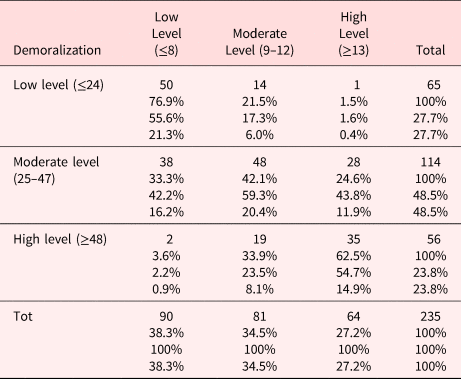
For each cell, the first value is the absolute frequency, the second value is the row percentage, the third value is the column percentage, and the fourth value is the total percentage.
Discussion
The present study aimed to investigate the prevalence of demoralization in end-of-life cancer patients and its associations with a set of medical and psychosocial variables. In addition, following the results of a previous research, which showed that end-of-life cancer patients show distinctive characteristics (Bovero et al., Reference Bovero, Sedghi and Botto2018a), we explored the demoralization latent dimensions emerging in this distinct population.
Previous DS validations were performed in patients in an advanced illness stage (Kissane et al., Reference Kissane, Wein and Love2004a; Mehnert et al., Reference Mehnert, Vehling and Höcker2011; Mullane et al., Reference Mullane, Dooley and Tiernan2009); with a KPS ≥80 (Grassi et al., Reference Grassi, Costantini and Kissane2017) or >50 (Costantini et al., Reference Costantini, Picardi and Brunetti2013); with mixed tumor stages (Deng et al., Reference Deng, Pang and He2017); and cancer/noncancer patients receiving palliative care (Rudilla et al., Reference Rudilla, Galiana and Oliver2016), but no studies focused specifically on end-of-life patients. The results of the present PCA, performed on cancer patients with an average life expectancy of 27 days and a KPS average value of 39.72, suggest a new DS structure, that might represent the most salient demoralization aspects in this specific population. The PCA highlighted a factor structure at five factors (i.e., Emotional Distress and Inability to Cope, Loss of Purpose and Meaning, Worthlessness, Sense of Failure and Dysphoria) which showed two main differences compared with the previous validations (Costantini et al., Reference Costantini, Picardi and Brunetti2013; Grassi et al., Reference Grassi, Costantini and Kissane2017; Kissane et al., Reference Kissane, Wein and Love2004a; Mehnert et al., Reference Mehnert, Vehling and Höcker2011; Mullane et al., Reference Mullane, Dooley and Tiernan2009; Rudilla et al., Reference Rudilla, Galiana and Oliver2016). First, “Emotional Distress and Inability to Cope” clusters items belonging to “Helplessness” (items 5, 8, 9), “Disheartenment” (items 6, 18, 21, 22, 24), and “Sense of Failure” (item 12) dimensions of the original DS. Second, “Worthlessness” encompasses two items of “Sense of Failure” original factor (items 1 and 19). “Loss of Purpose and Meaning,” “Dysphoria,” and “Sense of Failure” factors were similar to the ones reported by the previously mentioned other validations. The emerged factors could represent the dimensional nature of cancer patients’ demoralization at the end of life. Based on the clinical practice and on Clarke and Kissane's evidence (Reference Clarke and Kissane2002), it can be speculated that the demoralization course might begin with inability to cope with the situation, followed by emotional distress, which might then evolve into dysphoria. Later, this psychological distress could lead to experience a sense of failure, which could pave the way to a condition of adverted loss of worth. Finally, all of these elements could generate a more spiritual and existential crisis characterized by all those feelings which represent the loss of purpose and meaning. It might be the final step of a process, originating from the confrontation with an impairing medical condition as well as the increasing severity of the dying patients’ medical status. These speculations should be verified through tailored longitudinal researches, which might reveal precious indications for the healthcare professionals on how to assist demoralized dying patients (Clarke & Kissane, Reference Clarke and Kissane2002).
With respect to sample's demoralization prevalence, DS-IT mean score was higher than the ones reported in previous validations. Also, the percentage of patients with high demoralization (23.8%) was higher than the one reported in other studies with advanced cancer patients, in Ireland (14%), Germany (15.7%), and Italy (17%). These results could be explained by considering the differences among countries with regard to cancer- and death-related cultural aspects and by the fact that our sample consisted of patients at the end of life. In fact, physical discomfort, loss of functioning, and an increased dependency on others seem to be key factors for eliciting demoralization in dying cancer patients (Lichtenthal et al., Reference Lichtenthal, Nilsson and Zhang2009). The data could highlight that end-of-life patients might have higher levels of demoralization than patients at previous illness stages. In this regard, there is no evidence in literature that indicates a direct association between demoralization and the illness stage. In particular, cancer patients can manifest existential distress in each disease stage, because existential stressors can be present throughout the illness course (Vehling et al., Reference Vehling, Lehmann and Oechsle2012). However, patients who are closer to death are often confronted with limited lifetime, growing physical constraints, and increasing existential distress (Clarke et al., Reference Clarke, Kissane and Trauer2005), and this could increase demoralization and reduce existential well-being (Bovero et al., Reference Bovero, Sedghi and Opezzo2018b; Lichtenthal et al., Reference Lichtenthal, Nilsson and Zhang2009). These suppositions are not in contrast with the fact that our research did not evidence a significant relationship between demoralization, KPS, disease stage, and pain. Indeed, such associations were not significant, probably because of our sample's homogeneous nature: all the patients had a very low KPS score, 76.6% of them had a metastatic stage, and VAS scores were low for almost all the patients, indicating an overall condition of controlled pain. Nevertheless, the comparison between the demoralization prevalence in our sample with those of other studies suggest an association between demoralization and patients’ clinical condition. Further studies specifically targeting this topic could provide evidences about this interesting relationship.
Data on prevalence also showed that “Emotional Distress and Inability to Cope” is the most salient demoralization aspect for end-of-life patients. In fact, the scores obtained by participants at the items of this factor are the highest among all the DS items. So, the emotional and existential dimensions of distress could be clinically crucial for end-of-life patients. In this regard, the key characteristics of demoralization in our sample were the self-perception of being incapable to face a progressive illness, a sense of discouragement, and feeling worthwhile, trapped, and sad. Finally, we can support that low self-esteem, poor social connection, and a general sense of vulnerability could be specific predictors for demoralization in end-of-life patients. Terminal cancer patients show a weakened sense of connection to others because physical disability progressively limits their capacity to engage in valued social and community activities, have less access to and ability to make use of supportive relationships, and a reduced sense of purpose in life, as rooted in the experience of meaningful relationships.
Furthermore, only 19.5% of patients are totally aware of their medical condition, and most of the sample overestimated the prognosis. Awareness level likely could affect the psychological attitude toward the illness, acting on person's capacity of acceptance, planning, active coping, and use of emotional support. These data might suggest that, for terminal patients, not being informed on end-of-life issues and some aspects of the relationship with healthcare providers, as feelings of not having control, not being involved in decision making, and not being seen as a human being, could lead to an increased existential distress. Therefore, clinicians should attempt to establish close rapport with patient and ensure an emphatic and attentive approach.
Regarding the comparison between demoralization and depression, data confirm previous evidence supporting the notion that demoralization is a different construct with respect to depression (Costantini et al., Reference Costantini, Picardi and Brunetti2013; Grassi et al., Reference Grassi, Costantini and Kissane2017; Kissane et al., Reference Kissane, Grabsch and Love2004b; Lee et al., Reference Lee, Fang and Yang2012; Mehnert et al., Reference Mehnert, Vehling and Höcker2011). At the same time, only two patients showed low depressive symptomatology and high demoralization. These data are lower than that reported by Kissane et al. (Reference Kissane, Wein and Love2004a) (i.e., 7–14%) and the percentage of patients with high demoralization and high depression is high. These data are probably the result of patients’ critical clinical status, which can lead to a major overlap between these conditions. Perhaps unrecognized and poorly treated depression in the previous illness stages might increase anhedonic states, lower morale, and elicit helplessness and hopelessness, which can ultimately favor demoralization.
About relationships with the other variables, the positive association between “Physical Symptoms and Dependency” Patient Dignity Inventory-Italian version factor, and demoralization indicates the link among dignity, demoralization, and physical problems shown by Vehling and Menhert (Reference Vehling and Mehnert2014). In fact, at the end of life, the constant presence of physical symptoms can compromise a patient's sense of dignity, leading to feelings of dependency or being a burden to others (Bovero et al., Reference Bovero, Sedghi and Opezzo2018b; Chochinov, Reference Chochinov2002), which may heighten existential distress and demoralization.
Moreover, the relationship between demoralization, dignity-related loss of purpose and meaning, and existential distress as well as the dimensions of spiritual well-being may underline the protective function of the latter on demoralization against the existential concerns. This result also supports the usefulness of considering the spiritual well-being when assessing patients’ quality of life (Bovero et al., Reference Bovero, Leombruni and Miniotti2016). Without also knowing a patient's level of faith, peace, and meaning, the healthcare provider might miscalculate the burden of the illness for the patient.
The considerable number of patients in this sample suffering from demoralization strengthen the need for psychological interventions to reduce the existential distress at the end of life, focusing on finding meaning and detecting spiritual concerns. Individual or group interventions applied to dying cancer patients (Breitbart et al., Reference Breitbart, Rosenfeld and Gibson2010), have shown great success in impacting patients’ existential well-being and other psychological issues, such as demoralization, elevating a positive growth, tapping inner peace, and strengthening religious coping style.
This study has limitations. First, the study is cross-sectional, measuring variables in a single cohort time, and essentially descriptive. This method does not allow to assess if terminally ill patients experienced changes in the demoralization dimensions while approaching death. Future studies should conduct longitudinal assessment of demoralization, but the difficulties in recruiting and of losing patients over time will continue to be a challenge for end-of-life research.
When patients could not autonomously fill in the rating scales, they were helped to complete them by the psychologist. Of course, it would have been better if the patients had completed the tools by themselves, but this limitation is strictly connected to the sample's clinical condition.
The strength of this research is that it represents the first Italian study that assesses the prevalence of demoralization and the specific DS factor structure in end-of-life cancer patients with a life expectancy of few weeks. A larger population would reinforce the results achieved in this study, and future research could explore the associations between demoralization and quality of life in these patients. Moreover, this study should be replicated with the DS-II.
Our findings also suggest that, in this illness phase, there is a strong overlap between depression and demoralization. Thus, attention should be paid to this vulnerable population. Finally, the DS-IT can help to assess the demoralization level in patients nearing death, with few weeks of life remaining, contributing to identify their existential suffering and promoting clinical approaches to optimize their quality of life.
Author ORCIDs
Andrea Bovero, 0000-0001-5728-9907
Acknowledgments
In memory of our friend and colleague Dr Rossana Peraglie.