Introduction
According to the theory of Panspermia formulated more than a century ago by Richter (Reference Richter1865) and Arrhenius (Reference Arrhenius1903), biological material can be transported from one planet to another. Recently, Panspermia has been revisited assuming meteorites or spacecraft as possible carriers for the exchange of life forms (reviewed in Mileikowsky et al. Reference Mileikowsky, Cucinotta, Wilson, Gladman, Horneck, Lindegren, Melosh, Rickman, Valtonen and Zheng2000; Clark Reference Clark2001; Horneck et al. Reference Horneck, Mileikowsky, Melosh, Wilson, Cucinotta, Gladman, Horneck and Baumstark-Khan2002; Nicholson et al. Reference Nicholson, Schuerger and Setlow2005). During such a hypothetical interplanetary transfer, the organisms would have to cope with the following three major impacts: (1) the escape process from the planet of origin, e.g. via impact-induced ejection of rocks or a rocket launch; (2) the long-term journey in space; and (3) the capture by another planet, entry and landing. Although it will be difficult to prove that resistant organisms could survive this cascade of strenuous attacks, the likelihood of those different steps can be assessed from measurements and calculations (reviewed in Horneck Reference Horneck1995).
For this and other astrobiological studies the European Space Agency (ESA) has developed a multi-user exposure facility with the acronym EXPOSE (Schulte et al. Reference Schulte, Baglioni and Demets2001). Attached to the outside of the International Space Station (ISS), EXPOSE provides a platform for long-term investigations under the conditions of outer space (space vacuum, the full spectrum of solar extraterrestrial electromagnetic radiation, cosmic radiation and temperature fluctuations) (Rabbow et al. Reference Rabbow, Rettberg, Panitz, Drescher, Horneck and Reitz2005, Reference Rabbow2009, Reference Rabbow2012, Reference Rabbow2014). So far, two EXPOSE mission have been performed by ESA: EXPOSE-E (exposure facility attached to the balcony of the European module Columbus of the ISS) that was attached to the external balcony of the European module Columbus from February 2008 to September 2009 (Rabbow et al. Reference Rabbow2012) and EXPOSE-R (exposure facility attached to the URM-D of the Zvezda Module of the ISS) that was placed outside of the Russian Zvezda module of the ISS for nearly 2 years, from March 2009 to January 2011 (Rabbow et al. Reference Rabbow2014).
A consortium of scientists has been formed to study the ‘Responses of the Organisms to the Space Environment consortium’ (ROSE) using this facility (Horneck et al. Reference Horneck1999). Together with five other experiments of the ROSE consortium, the experiment ‘Spores in artificial meteorites’ (SPORES) was accommodated in EXPOSE-R (Panitz et al. Reference Panitz, Horneck, Rabbow, Rettberg, Moeller, Cadet, Douki and Reitz2014). Its objective was to study responses of bacterial, fungal and fern spores to selected parameters of the space environment. In this paper, we report the results dealing with the survival of fungal spores under space vacuum, solar ultraviolet (UV) radiation, cosmic radiation and temperature fluctuations that have been tested in the space flight experiment SPORES. A mission ground reference (MGR) was performed in parallel to the space experiment as well as experiment verification tests (EVTs) and an experiment sequence test (EST) prior to the space mission (Rabbow et al. Reference Rabbow2014).
Materials and methods
Organism and culture conditions
Trichoderma spp. are free-living and fast-growing fungi that are common in soil- and root-ecosystems (Harman et al. Reference Harman, Howell, Viterbo, Chet and Lorito2004). Cultures of Trichoderma longibrachiatum (Rifai Reference Rifai1969) (DSM No. 16517) were grown at 24°C on potato dextrose agar (PDA, Sigma-Aldrich, Germany) covered with cellophane. After 1 week, the cellophane, carrying the culture, was transferred into a new empty culture plate and dried at room temperature for 1–3 days. The conidiospores (in the following called ‘spores’) (size: 4 μm × 2.5 μm) were harvested from the cellophane and stored in dry condition.
Sample preparation
Dried fungal spores (approx. 9 × 10⁶) were taken up by a Pasteur pipette and transferred into small bags (5 mm × 5 mm) of bioFOLIE (IN VITRO Systems & Services, Germany) and sealed by welding. BioFOLIE is a space proved foil which is permeable for gases and transparent for UV radiation of wavelengths λ > 190 nm. The number of spores was determined by the use of a Neubauer counting chamber.
Flight protocol
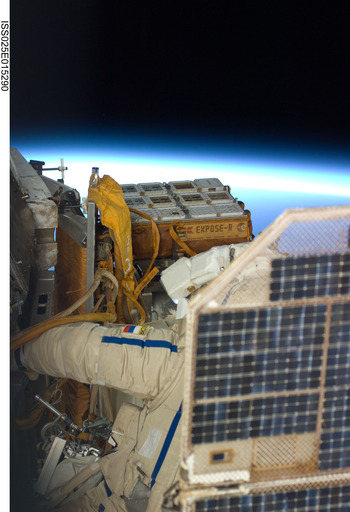
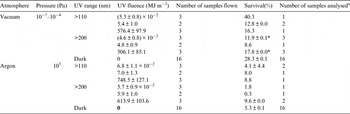
For the flight experiment, the samples were accommodated in two types of sample trays of the EXPOSE-R facility (Fig. 1) (for details see Rabbow et al. Reference Rabbow2014). One tray was vented to space conditions (vacuum at an approximate pressure of 10−7–10−4 Pa) and one tray was filled with argon atmosphere at a pressure of 105 Pa, to provide an inert atmosphere. An optical filter system on top of the trays provided insolation with a cut-off at λ = 200 nm (quartz) or λ = 110 nm (MgF2); neutral density filters of quartz or MgF2 (with 100, 1 and 0.01% transmission) were used to vary the UV radiation fluence at the sample site by up to four orders of magnitude. A second set of samples was located beneath the irradiated samples; they served as ‘dark’ samples, thereby receiving – apart from insolation – the same environmental conditions as the irradiated ones. Table 1 gives an overview of the exposure conditions and number of samples used in the space flight experiment. The number of samples was limited due the experimental setup and available space in the EXPOSE-R facility.
EXPOSE-R facility mounted by the astronaut during extravehicular activity (EVA) onto the external platform of the Zvezda module of the ISS (credit NASA).

Space experiment data: Experimental parameters of spores of T. longibrachiatum of the SPORES experiment on board of EXPOSE-R, fluences and spectral ranges of solar electromagnetic radiation at the samples sites and survival of the fungal spores. Data of UV-irradiated samples significantly different from those of the dark samples are marked (*).

a Only those insolated samples were analysed that were found on their original position after the mission (see text for further explanation).
The fully loaded EXPOSE-R facility was launched to the ISS on November 28, 2008 with a Russian Progress spacecraft and mounted on an external platform (URM-D) of the Zvezda module of the ISS on March 10, 2009. On the following day, the valves were opened to evacuate the vented trays. The environmental data (temperature, UV radiation and cosmic radiation) registered by sensors of the EXPOSE-R facility, were regularly transmitted to the ground station at the Deutsches Zentrum für Luft- und Raumfahrt (DLR). Temperature ranged from −24.6 to +49.5°C. Owing to computer failure some data were lost, so that the total UV fluence was calculated from ISS orbit parameters (Rabbow et al. Reference Rabbow2014). The cosmic ray dose ranged from 225 to 320 mGy, depending on the position of the samples in the trays (Berger et al. Reference Berger, Hajek, Bilski and Reitz2014). After 682 days of exposure to space conditions, the EXPOSE-R facility was removed on January 21, 2011 and transported to the inside of the ISS. EXPOSE-R was brought back to the Earth on March 9, 2011 with the last Discovery (STS-133) Shuttle mission and further transported to the DLR. It was then disintegrated under an argon atmosphere and the samples were transferred to our laboratory for analysis.
Mission Ground Reference
The MGR of EXPOSE-R had a sample setup and a filter arrangement that was identical to that of the flight experiment. During this experiment, the environmental data of the flight experiment were mimicked in the Planetary and Space Simulation facilities (PSIs) at the DLR. The PSIs offer the possibility to expose samples that are integrated into space hardware to defined and controlled simulated space conditions, like ultra-high vacuum, high and low temperature and extraterrestrial UV spectrum (λ > 200 nm) were produced by a solar simulator (Rabbow et al. Reference Rabbow2009). These facilities were used for the MGR experiment as well as for the EVTs and the EST. EVTs and EST were performed in preparation of the flight experiment in order to estimate the tolerances of spores of different strains to the simulated parameters of space and to select the most promising strains and the optimal exposure conditions for the space mission. Each test lasted between 1 and 2 months.
Tests of viability
After exposure, the sample bags were cut open and the spores were released in 5% Tween80 solution (Sigma-Aldrich, Germany) to counteract the cluster formation of the strongly hydrophobic spores. Viability of spores was analysed by two methods: (i) ethidium bromide staining (Strauss Reference Strauss1991) and (ii) test of germination capability on the PDA medium. Ethidium bromide is a Live/Dead staining agent. In dead spores the envelope of the spores is permeable for the dye, which intercalates with the DNA of the spores and results in a red fluorescence. The number of dead spores N D was counted using a fluorescence microscope (Axioplan, Zeiss, excitation filter BP 546/12 and emission filter LP 590), and the total number of spores N 0 was determined with brightfield microscopy (100 × magnifications). The surviving fraction (%) was calculated using the following equation:
 $$S = 100 - \left( {\displaystyle{{N_D} \over {N_0}} \times 100} \right)$$
With N D is the number of dead spores and N 0 is the total number of spores. For each test run, approximately 300 spores were counted.
For germination tests, the protocol according to Dose et al. (Reference Dose, Bieger-Dose, Dillmann, Gill, Kerz, Klein and Stridde1996) was used. The spore suspension in 5% Tween80 was diluted in distilled water to reach a final concentration of 100 or 50 spores ml−1. Approximately 200 μl of the dilution were plated on the PDA medium (a total of 15 parallel plates) and incubated at 24°C. The number of germinated spores was counted after 30 h. The surviving fraction (%) was determined by calculating
 $$S = \displaystyle{{N_G} \over {N_0}} \times 100$$
with N G is the number of germinated spores and N 0 is the total number of spores.
In the final evaluation, survival was determined from germination tests. The data from ethidium bromide staining were just taken as additional support of the germination data. There were no significant differences between the survival data from both tests.
Statistical analysis
The results of the spore survivability were compared statistically using the Mann–Whitney U-test (Pruscha Reference Pruscha2006). A critical value of α = 5% was used. Owing to the minimal requirements of the test (n = 3) the calculations could be applied only to part of the results.
Results
Survival of the spores in the EVTs/EST
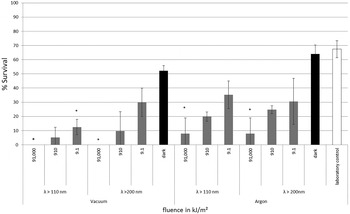
Five EVTs and one EST were performed in the PSIs before the space mission, in order to determine the responses of spores of T. longibrachiatum to the envisaged space conditions (Rabbow et al. Reference Rabbow2014). Each of those tests lasted for about 1 to 2 months. The results of EVT 5, which lasted from July 14 to August 23, 2006, are shown exemplarily in Fig. 2.
EVT 5 data: Survival of spores of T. longibrachiatum after exposure to UV irradiation (λ > 110 nm and λ > 200 nm) and with different neutral filter combinations (100%T: 9.1 × 10⁴ kJ m−2, 1%T: 9.1 × 10² kJ m−2; 0.01%T: 9.1 kJ m−2) in combination with vacuum at a pressure of 1.1 × 10⁻⁴ Pa or argon at a pressure of 105 Pa. Samples inside the trays were first irradiated by use of a solar simulator (λ > 200 nm) up to a fluence of 9.1 × 10⁴ kJ m−2, then transported into a vacuum chamber and additionally irradiated with vacuum UV radiation (V-UV) using a set of eight inserted deuterium lamps up to a fluence of 83 kJ m−2; the latter corresponds to the fraction of V-UV to be added to simulate the whole solar extraterrestrial electromagnetic spectrum. Depending on the kind of window on top of the samples (MgF2 or quartz), V-UV reached the samples or not. Survival data of UV-irradiated samples significantly different from those of the dark samples are marked (*).

After storage in argon at 105 Pa for 39 days, the survival rate of spores of T. longibrachiatum argon (dark samples) was more than 60% and did not significantly differ from that of the laboratory control. The laboratory control samples were treated identically to the experiment samples, except the exposure to vacuum/argon and UV radiation. They had also been sealed in bags and shipped to the DLR in Cologne where they were stored during the experiment under ambient conditions (Fig. 2). A significant lower survival rate of 52% was obtained for the dark samples kept for the same period under vacuum (1.1 × 10⁻⁴ Pa) (Fig. 2).
A clear decrease of spore survival was detected in UV-irradiated samples, in those irradiated under vacuum as well as those under argon conditions. This decrease was fluence dependent. The survival of samples that had received the highest UV fluence (9.1 × 10⁴ kJ m−2) was significantly lower than that of the dark sample. For the vacuum-treated samples, even UV (λ > 110 nm) at the lowest fluence (9.1 kJ m−2) resulted in significantly lower survival compared with the dark samples. If the samples were irradiated in vacuum with a fluence of 9.1 × 10⁴ kJ m−2, no survivor was detected, regardless of the spectral range applied. It should be noted that the BioFOLIE cut-off any UV at wavelengths is lower than 190 nm. In most cases, the survival fraction was slightly higher (but not significant) for spores irradiated in argon than those irradiated under vacuum (Fig. 2).
Survival of the spores in the space flight experiment
The space mission of EXPOSE-R lasted for nearly 2 years (682 days exposure to selected parameters of outer space). This led to a strong inactivation of the spores, even of those that were not exposed to solar UV radiation: only (28.3 ± 0.1) % of the dark samples in space vacuum survived the space travel (Table 1). An even higher inactivation was found in the dark samples that were kept in argon: several samples did not survive at all; the mean value of all 16 dark argon samples (including those with zero survival) resulted in a survival rate of (5.3 ± 0.1) % (Table 1).
During the disassembly of the EXPOSE-R facility, it was found that several sample bags had moved away from their original position. This was not a problem for the dark samples; however, several samples in the top layer (insolated samples) were moved to different positions beneath other filter combinations than originally planned. All those samples that had moved to other places were discarded in the evaluation of the survival of insolated samples. The result was that in several cases only 1 sample per filter combination could be analysed. There was a large scattering between the survival data of the different insolated samples (Table 1) and no trend of survival with UV fluence was found, neither for λ > 110 nm nor for λ > 200 nm, and neither in vacuum nor in argon samples. Only the survival data of the UV-irradiated samples (λ > 200 nm at 4.6 × 10⁻² MJ m−2 and at 506.1 MJ m−2) under vacuum differed significantly from the dark samples. The mean survival value, averaged over all UV-exposed flight samples, was (11.9 ± 8.9)% and was not significantly different from that of the dark samples (16.8 ± 14.0)%.
Survival of the spores in the MGR
Owing to a delay in the data transmission from the EXPOSE-R flight mission (Rabbow et al. Reference Rabbow2014), the MGR started about 9 months after the start of the flight experiment – although the samples were prepared and accommodated in the trays in parallel to those of the flight. The MGR lasted for nearly 2 years, from December 16, 2009 to October 17, 2011. Before the start of the MGR, the loaded trays were stored at the DLR in the dark at ambient temperature.
As in the flight experiment, the dark samples of the MGR, whether kept under vacuum of 1.7 × 10⁻³ Pa or in an argon atmosphere, showed a relatively low survival rate: (17.0 ± 0.1)% for the vacuum samples and (29.6 ± 0.2)% for the argon samples.
The UV (λ > 200 nm)-irradiated sample bags that were located beneath 100% T filters while kept in vacuum – they had obtained the full irradiance of 9.04 × 10⁵ kJ m−2 – had converted from transparent to a brownish colour. Very little survival, if any, was detected in spores from those heavily UV-irradiated bags. A slightly higher survival rate (9% or less) was found for the vacuum spores that received lower UV fluences; however, again no trend was found with the variation of the UV fluence by two or four orders of magnitude. No significant difference was detected compared with the flight samples, except for the dark samples. Survival of the UV-irradiated argon spores varied between 4.7 and 18.3%, also with no trend of survival with fluence.
Parallel to the flight experiment and the MGR, laboratory samples were prepared and shipped to the DLR, were they were stored at ambient temperature. The survival of those laboratory controls, determined after the termination of the MGR, was (44.2 ± 0.0) %. Similar survival values were obtained from samples kept in our laboratory in Freising. Only spores that were stored in cuvettes for the same period of time, showed a higher survival of 80.8%.
Discussion
The EXPOSE-R mission exposed biological samples to the outer space environment of low-Earth orbit for nearly 2 years; this is the second longest exposure of resistant species to space – after the nearly 6-year lasting Long Duration Exposure Facility mission (Horneck et al. Reference Horneck, Bücker and Reitz1994). During such long-lasting missions, sojourn time in space may become a critical parameter, in addition to those that are characteristic of outer space, namely space vacuum, solar extraterrestrial UV radiation, cosmic ionizing radiation and extreme temperature fluctuations.
In order to estimate the level of damage to the potential microbial space travellers, space parameters have been mimicked before the space mission during the EVTs and the EST; however, due to certain constraints, those tests lasted for 1 to 2 months only. Among several fungal and fern spores tested, spores of T. longibrachiatum excelled by their high resistance to desiccation, even under vacuum (Fig. 2). Fungal spores accumulate high concentrations of osmoregulators, e.g. trehalose and glycerin that protect the cells against desiccation (Heckly Reference Heckly, Crowe and Clegg1978; Thevelein Reference Thevelein1984; Smith Reference Smith and Jennings1993; Sterflinger Reference Sterflinger1998; Jennings & Lysek Reference Jennings and Lysek1999). Their high resistance to vacuum demonstrated during the EVTs and EST led us to the decision, to use spores of this strain for the EXPOSE-R flight experiment. This judgment was further supported by the reported high survival of fungal spores, also Trichoderma spp., after storage for over 4 years at room temperature (Antheunisse et al. Reference Antheunisse, De Bruin-Tol and Van Der Pol-Van Soest1981).
The choice to use fungal spores in our space experiment was further backed up by previous results from space exposure experiments with fungi. Ascospores of the fungi of Xanthoria elegans and Rhizocarpon geographicum were exposed to outer space conditions including the full spectrum of solar extraterrestrial UV radiation at λ > 110 nm for 10 days on board of the Biopan facility of ESA (de la Torre et al. Reference de la Torre2010. The spores showed a high rate of germination: (75 ± 20) and (81 ± 29)%, respectively. In dark flight samples, the germination rate was 91% and higher. Dose et al. (Reference Dose, Bieger-Dose, Dillmann, Gill, Kerz, Klein, Meinert, Nawroth, Risi and Stridde1995, Reference Dose, Bieger-Dose, Dillmann, Gill, Kerz, Klein and Stridde1996) found a survival rate of 30% for conidiospores of Aspergillus niger after exposure to space vacuum for about 7 months during the European Retrievable Carrier (EURECA) mission of ESA. This inactivation was correlated with a partial fragmentation of the DNA of the spores. However, spores of A. niger kept in an argon atmosphere during that space experiment had a further reduced survival rate of 10%. These data are well in agreement with our results. The authors assumed the accumulation of, as yet unknown, toxic compounds in the closed argon containers that may have caused that effect.
Solar UV radiation has been found to be the most deleterious factor of space when tested with dried preparations of viruses, bacterial or fungal spores (reviewed in Horneck Reference Horneck1998). UV radiation can generate lesions in the DNA directly, but UV radiation is also indirectly responsible for single- and double-strand breaks in DNA by generating reactive oxygen species. The effects of solar UV radiation on microbial life and evolution have been reviewed extensively (e.g. Cadet et al. Reference Cadet, Anselmino, Douki and Voituriez1992; Horneck & Brack Reference Horneck, Brack and Bonting1992; Nicholson et al. Reference Nicholson, Schuerger and Setlow2005). Our results confirm the high damaging effect of UVC, tested in the UV range λ > 200 nm, on fungal spores. In the EURECA experiment, Dose et al. (Reference Dose, Bieger-Dose, Dillmann, Gill, Kerz, Klein and Stridde1996) reported the induction of DNA double-strand breaks and DNA–protein crosslinking in spores of Aspergillus ochraceus that were exposed solar extraterrestrial UV irradiation at wavelengths (λ > 170 nm) and fluences up to 4 × 10⁸ J m−2, which were comparable with those received by the SPORES samples (Table 1).
The exposure of spores of T. longibrachiatum to solar extraterrestrial UV radiation did not result in any dose–response correlation (Table 1): The survival of the irradiated samples was reduced to a certain level, compared with the dark samples – only for the vacuum-exposed samples– irrespective of the applied fluence. The reason for this lack in dose-dependence may be found in the arrangement of the spores in the bags: they stick naturally together in clusters. Therefore, the outer layers of those clusters shielded the inner spore part from solar irradiation. A similar non-dose-dependence was observed for the viability of the Antarctic black fungi Cryomyces antaracticus and Cryomaces menteri that were exposed to outer space conditions during the 1.5 years lasting EXPOSE-E mission: no significant difference in survival (~10%) was observed between that of space dark samples and space UV (λ > 110 nm)-irradiated samples at fluences of 6 × 10⁵ J m−2 (Onofri et al. Reference Onofri2012).
Although spores of the fungus T. longibrachiatum are distinguished by a long shelf-life (Antheunisse et al. Reference Antheunisse, De Bruin-Tol and Van Der Pol-Van Soest1981) and have demonstrated high resistance to desiccation and space vacuum during the laboratory EVTs and EST, only few per cent were able to withstand the long-term attack of outer space conditions during the 2-years lasting EXPOSE-R mission. These results throw some light on the discussion of lithopanspermia: exposure time seems to be one of the limiting factors for estimating the likelihood of interplanetary transfer of life; only very few species may cope with a long-term journey in space, even if they have demonstrated a high resistance to desiccation and UV irradiation in laboratory tests.
Conclusions and outlook
Our results obtained with the EXPOSE-R mission on board of the ISS have shown the usefulness and limits of a Space Station for astrobiology research. The EXPOSE facilities allow long-term passive exposure of samples to selected space parameters with continuous monitoring of the environmental conditions during the mission, in particular cosmic radiation, solar electromagnetic radiation, temperature and residual pressure. However, the samples need to be retrieved for biological analyses in the laboratory. Hence, only one data point is obtained at the end of the mission. A great advantage would be the provision of a continuous on-line monitoring of the samples and their reactions during the missions. First steps in this direction have been achieved by Nicholson et al. (Reference Nicholson2011) during the Organism/Organic Exposure to Orbital Stresses (O/OREOS, a nano-satellite mission of PDA: potato dextrose agar) mission of National Aeronautics and Space Administration (NASA). Using 10 cm cube-format payloads aboard a 5.5 kg free-flying nano-satellite they obtained telemetered spaceflight science data on bacterial growth kinetics and metabolic activity.
In the EXPOSE facilities on board of the ISS, the total influx of solar radiation was determined by the orbit of the ISS, the orientation of the platform towards the Sun, and the shading by ISS components, caused, e.g. by the solar panels. To determine the kinetics of photochemical and photobiological processes, predefined UV radiation fluences need to be obtained. This could be achieved by the provision of a sun-pointing device, as already realized during the EURECA mission (Horneck et al. Reference Horneck, Eschweiler, Reitz, Wehner, Willimek and Strauch1995). In order to avoid overheating of the samples in this case, active cooling and a shutter or lid to control the insolation would be required.
Acknowledgements
The authors thank the European Space Agency (ESA) for the flight opportunity and would like to acknowledge the support of ESA and of the MUSC team. This work was conducted as part of the SPORES experiment on EXPOSE-R, and the results will be included in the PhD thesis of Katja Neuberger. This study was supported by grant IB 3020 (Forschung unter Weltraumbedingungen –Biowissenschaften und Medizin) of the Bundesministerium für Wirtschaft und Technologie (BMWi) to K.N. We thank Professor Bertold Hock for valuable comments on the manuscript. We are deeply grateful to him for his advice and initiative during the planning of the SPORES proposal.
Author disclosure statement
No competing financial interests exist.