


INTRODUCTION
Mammalian biostratigraphy focuses on correlating and sequencing geological deposits based on the fossil mammal assemblages contained within them. Mammals are good biostratigraphic indicators due to their rapid morphological evolution and turnover (Schreve, Reference Schreve1997). Quaternary climate fluctuation has resulted in major shifts in the biogeography of many mammal species, resulting in discernible patterns of presence and absence in the fossil record of certain regions (Schreve, Reference Schreve1997). Currant and Jacobi (Reference Currant and Jacobi1997, Reference Currant and Jacobi2001, Reference Currant, Jacobi, Tuffreau and Roebroeks2002) outlined a mammalian biostratigraphic framework for the late Pleistocene in the British Isles that described five mammal assemblage-zones (MAZ; distinctive fossil mammal bone assemblages), including the Banwell Bone Cave (BBC) MAZ. Named after the type-site, BBC in Banwell, Somerset (Figure 1), the BBC MAZ is characterized by a low diversity fauna that consists primarily of tundra species. Reindeer (Rangifer tarandus) and bison (Bison priscus) dominate the fauna, with mountain hare (Lepus timidus), wolf (Canis lupus), wolverine (Gulo gulo), and brown bear (Ursus arctos) being consistently present (Currant and Jacobi, Reference Currant and Jacobi2001). Horse (Equus ferus) and traces of human presence are notably absent from this MAZ. The small mammal fauna from the BBC MAZ is restricted to a single species, the northern vole (Microtus oeconomus; Currant and Jacobi Reference Currant, Jacobi, Ashton, Lewis and Stringer2011), which today inhabits a broad range of habitats including tundra, mixed forest, taiga, and forest steppe biomes.
(color online) Sites in the British Isles containing a Banwell Bone Cave mammal assemblage-zone fauna. Red star = Banwell Bone Cave; 1 Stump Cross Cave; 2 Windy Knoll Cave; 3 Steetley Wood Cave; 4 Ash Tree Cave; 5 The Arch (aka Lion's Mouth); 6 Tattershall Castle; 7 Cassington; 8 Bosco's Den; 9 Port Eynon Point Cave; 10 Pen Park Quarry; 11 Kew Bridge Station; 12 Willment's Pit, Isleworth; 13 Windsor; 14 Limekiln Hill Quarry; 15 Brean Down; 16 Bleadon Quarry; 17 Picken's Hole; 18 Hyena Den; 19 Tornewton Cave.

The BBC MAZ is known from locations widespread throughout England and Wales (Figure 1). Currant and Jacobi (Reference Currant and Jacobi2001, p. 1710) argued that the BBC MAZ is “clearly the vertebrate assemblage of a cold environment” and postulated that it correlated closely with the early part of the last cold stage, marine oxygen isotope stage (MIS) 4. However, in subsequent publications Gilmour et al. (Reference Gilmour, Currant, Jacobi and Stringer2007) and Currant and Jacobi (Reference Currant, Jacobi, Ashton, Lewis and Stringer2011) questioned this correlation and suggested that the BBC MAZ might actually relate to interstadial MIS 5a (the Brimpton interstadial dating to approximately 86–72 ka; Bryant et al., Reference Bryant, Holyoak and Moseley1983). Although typically characteristic of a fauna indicating cold tundra environments, many of the sites that contain the BBC MAZ also contain associated environmental proxies that indicate temperate climates, more characteristic of interstadial conditions. At Willment's Pit, Isleworth, Greater London, fossil Coleoptera provide evidence of interstadial climatic conditions (Coope and Angus, Reference Coope and Angus1975), while pollen and plant macrosfossils indicate vegetation dominated by herbaceous species typical of grasslands that occur in treeless landscapes (Kerney et al., Reference Kerney, Gibbard, Hall and Robinson1982). At Cassington in Oxfordshire, Coleoptera and pollen provide evidence of an interstadial open tundra environment, with vegetation dominated by Arctic steppe/tundra herbaceous species (Maddy et al., Reference Maddy, Lewis, Scaife, Bowen, Coope, Green and Hardaker1998). Amino acid racemization dating has tentatively correlated these deposits with MIS 5c and MIS 5a, respectively (Penkman et al., Reference Penkman, Preece, Bridgland, Keen, Meijer and Parfitt2011, 2013). Further, TIMS dating of stalagmite flowstone enclosing the BBC MAZ at Stump Cross Caverns in North Yorkshire, gave a date of 73.86 + 1.20/-1.19 ka, supporting an interstadial MIS 5a correlation for this assemblage (Gilmour et al., Reference Gilmour, Currant, Jacobi and Stringer2007).
Evidence from raised beaches, which indicate higher sea levels, suggest Britain was not joined to continental Europe for most of MIS 5 (Keen Reference Keen and Preece1995). Gilmour et al. (Reference Gilmour, Currant, Jacobi and Stringer2007) and Currant and Jacobi (Reference Currant, Jacobi, Ashton, Lewis and Stringer2011) argue that the temperate faunal species typical of interglacial conditions survived in Island Britain up until MIS 5c, then during cold MIS 5b Britain became temporarily reconnected to the continent and a major faunal change occurred, with the loss of most temperate mammal species and the gain of species typical of arctic conditions (arctic fox, Vulpes lagopus; wolverine, Gulo gulo; and reindeer, Rangifer tarandus). With the onset of MIS 5a, they argue that the new fauna became trapped in Britain by the higher sea levels and the return of Britain to being an island. The presence of a faunal assemblage typical of cold conditions, alongside palaeoclimate indicators of interstadial conditions, a restricted range of species and the absence of woolly mammoth (Mammuthus primigenius), wild horse (Equus ferus), woolly rhinoceros (Coelodonta antiquitatis), hominin remains, and archaeology, which are present in MIS 5a on the European continent, are all suggested to be evidence of Britain being an island isolated from the continent at this time (Currant and Jacobi Reference Currant, Jacobi, Ashton, Lewis and Stringer2011).
The possibility that the BBC MAZ represent fauna typical of cold environments living in temperate conditions has implications both for the technique of mammalian biostratigraphy and for our understanding of the Quaternary history of the British Isles. Thus, further investigation is required to confirm whether the BBC MAZ relates to cold or temperate environmental conditions. Here we undertake stable isotope analysis of bison and reindeer bone and teeth from BBC in order to establish the environmental context in which these animals lived.
Background to stable isotopes
Palaeoclimatic and palaeoenvironmental data can be obtained from fossil tooth enamel and bone through stable isotope analyses. The measured isotopic signals are underpinned by dietary specialisation, animal behaviour, and environmental conditions. This approach has enabled the reconstruction of late Pleistocene palaeoenvironmental conditions at a range of archaeological and palaeontological sites (e.g., Sponheimer and Lee Thorpe, Reference Sponheimer and Lee-Thorp2003; Hedges et al., Reference Hedges, Stevens, Kock and Leng2005, Stevens and Hedges, Reference Stevens and Hedges2004; Drucker et al., Reference Drucker, Bridault, Hobson, Szuma and Bocherens2008, Reference Drucker, Bridault, Cupillard, Hujic and Bocherens2011; Stevens et al., Reference Stevens, Jacobi, Street, Germonpré, Conard, Münzel and Hedges2008, Reference Stevens, Hermoso-Buxán, Marín-Arroyo, González-Morales and Straus2014; Szpak et al., Reference Szpak, Gröcke, Debruyne, MacPhee, Guthrie, Froese, Zazula, Patterson and Poinar2010; Reade et al., Reference Reade, O'Connell, Barker and Stevens2016, Reference Reade, Tripp, Charlton, Grimm, Sayle, Fensome, Higham, Barnes and Stevens2020a; Fabre et al., Reference Fabre, Lécuyer, Brugal, Amiot, Fourel and Martineau2011; Jones et al., Reference Jones, Richards, Straus, Reade, Altuna, Mariezkurrena and Marín-Arroyo2018, Reference Jones, Richards, Reade, de Quirós and Marín-Arroyo2019; Britton et al., Reference Britton, Pederzani, Kindler, Roebroeks, Gaudzinski-Windheuser, Richards and Tütken2019).
Skeletal carbon is acquired through the animal's diet and in herbivores is ingested directly from plant tissue (Gannes et al., Reference Gannes, Del Rio and Koch1998). Within the context of late Pleistocene Europe, where plants used the C3 photosynthetic pathway and C4 and CAM plants were most likely absent (Wißing et al., Reference Wißing, Rougier, Crevecoeur, Germonpré, Naito, Semal and Bocherens2016), plant δ13C would have been influenced by a variety of climatic/environmental variables such as temperature, precipitation, relative humidity, atmospheric carbon dioxide concentrations, and the canopy effect (Heaton, Reference Heaton1999; Kohn, Reference Kohn2010). Thus, faunal δ13C reflects underlying environmental conditions, mediated by species-specific dietary behaviours, such as grazing versus browsing (Heaton, Reference Heaton1999). Bone collagen δ13C signatures primarily reflect dietary protein whereas enamel carbonate δ13C reflects the whole diet (Ambrose and Norr, Reference Ambrose, Norr, Lambert and Grupe1993). Relative to the plants consumed, herbivore bone collagen δ13C (δ13Ccoll) are approximately + 5‰ enriched and enamel carbonate δ13C (δ13Cenamel) are approximately + 14‰ enriched (Lee Thorpe et al., Reference Lee-Thorp, Sealy and van der Merwe1989; Cerling and Harris, Reference Cerling and Harris1999). Nutritional stress has also been suggested to influence animal δ13C values but the evidence for this is equivocal (Doi et al., Reference Doi, Akamatsu and González2017).
Herbivore nitrogen is acquired from the plants in the animal's diet (Gannes et al., Reference Gannes, Del Rio and Koch1998). Globally, plant δ15N has been shown to increase with decreasing mean annual precipitation, with plants growing in arid locations having higher δ15N values than those growing in wetter locations (Austin and Vitousek, Reference Austin and Vitousek1998; Handley et al., Reference Handley, Austin, Stewart, Robinson, Scrimgeour, Raven, Heaton and Schmidt1999; Amundson et al., Reference Amundson, Austin, Schuur, Yoo, Matzek, Kendall, Uebersax, Brenner and Baisden2003; Szpak, Reference Szpak2014). Furthermore, plant δ15N values have been shown to be positively correlated with local temperatures, with plants growing in cooler ecosystems have lower δ15N values than those growing in warmer ecosystems (Martinelli et al., Reference Martinelli, Piccolo, Townsend, Vitousek, Cuevas, McDowell, Robertson, Santos and Treseder1999; Amundson et al., Reference Amundson, Austin, Schuur, Yoo, Matzek, Kendall, Uebersax, Brenner and Baisden2003; Pardo et al., Reference Pardo, Templer, Goodale, Duke, Groffman, Adams and Boeckx2006; Szpak Reference Szpak2014). However, at mean annual temperatures of <−0.5°C the relationship between temperature and plant δ15N deteriorates (Craine et al., Reference Craine, Elmore, Aidar, Bustamante, Dawson, Hobbie and Kahmen2009). The relationships between plant δ15N and climatic variables are thought to be linked to mycorrhizal associations, N availability, and greater relative importance of fractionating losses of N in hot, dry ecosystems compared to cold, wet ecosystems (Craine et al., Reference Craine, Brookshire, Cramer, Hasselquist, Koba, Marin-Spiotta and Wang2015). As for carbon, the δ15N signatures of the vegetation are passed on to the herbivore consumers and are recorded in their body tissues. Thus herbivore δ15N reflect the underlying environmental conditions. Relative to the plants consumed, herbivore bone δ15N are typically + 3 to 5‰ enriched (Bocherens and Drucker, Reference Bocherens and Drucker2003). Nutritional stress can also affect animal δ15N, but the direction and magnitude of these effects depends on whether the animal is undergoing protein catabolism when they are starving or relying more heavily on fat reserves or other processes that conserve protein during fasting (Hobson et al., Reference Hobson, Alisauskas and Clark1993; Polischuk et al., Reference Polischuk, Hobson and Ramsay2001; Cherel et al., Reference Cherel, Hobson, Baiileul and Groscolas2005; Fuller et al., Reference Fuller, Fuller, Sage, Harris, O'Connell and Hedges2005; Mekota et al., Reference Mekota, Grupe, Ufer and Cuntz2006; Lohuis et al., Reference Lohuis, Harlow and Beck2007; Newsome et al., Reference Newsome, Clementz and Koch2010; Bowes et al., Reference Bowes, Lafferty and Thorp2014; Gomez-Campos et al., Reference Gomez-Campos, Borrell and Aguilar2011; Aguilar et al., Reference Aguilar, Giménez, Gómez–Campos, Cardona and Borrell2014; Fleming et al., Reference Fleming, Kellar, Allen and Kurle2018).
Oxygen isotopes in mammal tooth enamel is linked to prevailing climatic and environmental conditions in the vicinity of the animal's habitat during the period of tooth formation (for review, see Pederzani and Britton [Reference Pederzani and Britton2019]). For most species, drinking water is typically the largest source of O to the δ18O signature, but water contained in the diet and respiration also contribute (Longinelli Reference Longinelli1984; Luz et al., Reference Luz, Kolodny and Horowitz1984; Luz and Kolodny, Reference Luz and Kolodny1985; Bryant et al., Reference Bryant and Froelich1995). The relative contribution that each of these pools makes to an animal's body water depends on the physiological and behavioural characteristics of the species (Kohn, Reference Kohn1996; Kohn et al., Reference Kohn, Schoeninger and Valley1996; Podlesak et al., Reference Podlesak, Torregrossa, Ehleringer, Dearing, Passey and Cerling2008; Pederzani and Britton, Reference Pederzani and Britton2019). For bison and reindeer (obligate drinkers and the species of focus in this study) empirical relationships between skeletal δ18O and the δ18Oprecip have been demonstrated (Longinelli et al., Reference Longinelli, Iacumin, Davanzo and Nikolaev2003; Hoppe, Reference Hoppe2006), which, in turn, displays a strong relationship to surface air temperatures in mid and high latitude environments (Rozanski, Reference Rozanski, Araguás-Araguás, Conginatini, Swart, Lohmann, Mckenzie and Savin1993). Here we measure δ18O in tooth enamel carbonate. In medium-large sized mammals tooth formation typically lasts several months to a few years, thus a sample of enamel can provide information at either an annual or subannual resolution (Fricke et al., Reference Fricke and D'Neil1996).
METHODS
Ten bison and 11 reindeer bones along with eight bison and 10 reindeer teeth were sampled for isotope analysis. All specimens came from the 2007 excavations at BBC led by Roger Jacobi and Andy Currant as part of the Ancient Human Occupation of Britain (AHOB) project (Ashton et al., Reference Ashton, Lewis and Stringer2011). As the excavation was limited in size, the recovered faunal assemblage was relatively small and it was not possible to select a single skeletal element to ensure any individual was only sampled once. However, the assemblage is thought to be a result of postdepositional mass movement, as the bones were completely mixed, directly articulating elements were absent, and parts of the same animal did not occur even vaguely together within the sediments (Currant and Jacobi, Reference Currant, Jacobi, Ashton, Lewis and Stringer2011). Details of skeletal elements sampled are given in Supplementary Files 1 and 2. The reindeer teeth sampled include six teeth found in situ in their mandibular bones (three left mandibles, two teeth per mandible), thus a minimum of three individuals are represented.
Collagen extraction and analysis
Collagen was extracted from the bison and reindeer bone samples using a modified Longin (Reference Longin1971) method. Chunks of bone were cut using a dental drill with a small cutting wheel attachment. Each sample was cleaned by abrasion with aluminium oxide prior to collagen extraction. Bones were demineralised in 0.5M hydrochloric acid at 4°C until they had completely decalcified. Samples were then rinsed three times with deionized water and gelatinised in a pH3 aqueous solution for 48 hours at 75°C. The filtered supernatant containing the soluble collagen was then collected, frozen, and lyophilized. The collagen was weighed into tin capsules for δ13C and δ15N analysis. Analysis was performed at the Godwin Laboratory, Department of Earth Sciences, University of Cambridge, using a Costech automated elemental analyser coupled to a Finnigan MAT253 isotope ratio mass spectrometer. Samples were analysed in duplicate, with carbon and nitrogen results being reported using the delta scale in units of “per mil” (‰) relative to internationally accepted standards, VPDB and AIR respectively (Hoefs, Reference Hoefs2009). Based on replicate analyses of international and laboratory standards, precision is better than ± 0.2‰ for both δ13C and δ15N.
Enamel carbonate preparation and analysis
The tooth surfaces were cleaned with a brush and then lightly abraded using a tungsten drill bit. The enamel surface of each tooth was abraded from the apex to the cervix of the crown with a diamond-incrusted drill bit and the removed powder sample collected for analysis. Enamel powder samples were prepared according to Balasse et al., (Reference Balasse, Ambrose, Smith and Price2002). Samples were treated with 2–3% NaOCl for 24 hours (0.1ml/mg sample) then repeatedly rinsed with distilled water. Next, 0.1 M acetic acid (0.1ml/mg sample) was added to the enamel powder and left for 4 hours. Samples were then thoroughly rinsed, frozen, and lyophilized. δ18O and δ13C analysis was performed at the Godwin Laboratory, Department of Earth Sciences, University of Cambridge. Samples were reacted with 100% orthophosphoric acid for 10 minutes at 90°C in individual vessels in an automated cryogenic distillation system (PRISM), interfaced with a Finnigan MAT 253 isotope ratio mass spectrometer. Results are reported with reference to the international standard VPDB calibrated through the NBS19 standard (Coplen, Reference Coplen1995) and the precision is better than ±0.10‰ for both δ18O and δ13C.
RESULTS
Collagen carbon and nitrogen
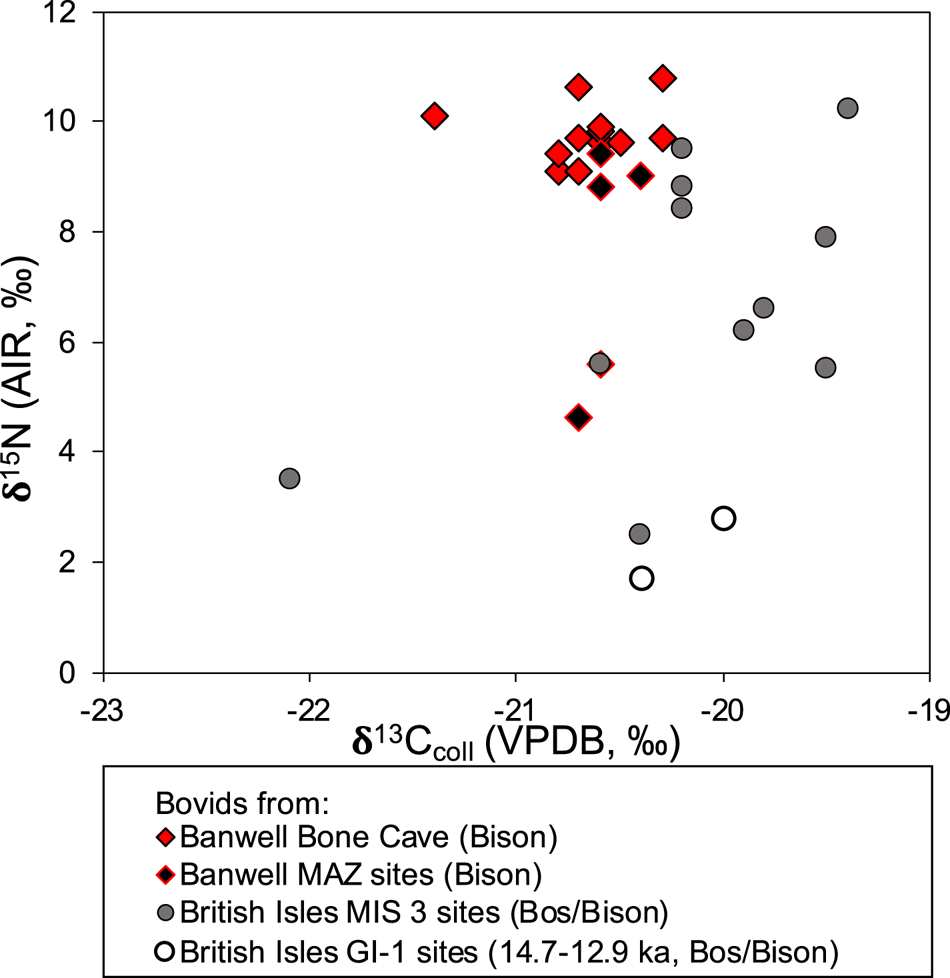
Collagen was successfully extracted from all bones and had C/N atomic ratios between 2.9 and 3.6, which indicates good collagen preservation (DeNiro, Reference DeNiro1985). The δ13Ccoll and δ15N values of bison and reindeer are listed in Supplementary File 1 and shown in Figure 2. Additional published bison δ13Ccoll and δ15N data from two specimens from BBC were added to the dataset (Higham et al., Reference Higham, Jacobi and Bronk Ramsey2006). Bison δ13Ccoll values range from −21.4 to −20.3‰ with a mean of −20.7 ± 0.3 ‰ and δ15N values range from 9.1 to 10.8‰ with a mean of 9.8 ± 0.5 ‰. Reindeer δ13Ccoll values are higher than those of the bison, ranging from −19.9 to −19.6‰ with a mean of −19.8 ± 0.1 ‰, whereas reindeer δ15N values are generally lower and more variable than those of the bison, ranging from 5.8 to 9.2‰ with a mean of 7.4 ± 1.3 ‰. Mann-Whitney U tests show there is a significant difference between bison and reindeer δ15N (W = 128, P < 0.001) and δ13Ccoll (W = 0, P < 0.001).
(color online) Banwell Bone Cave bison and reindeer bone collagen δ13C and δ15N results.

Tooth carbonate carbon and oxygen
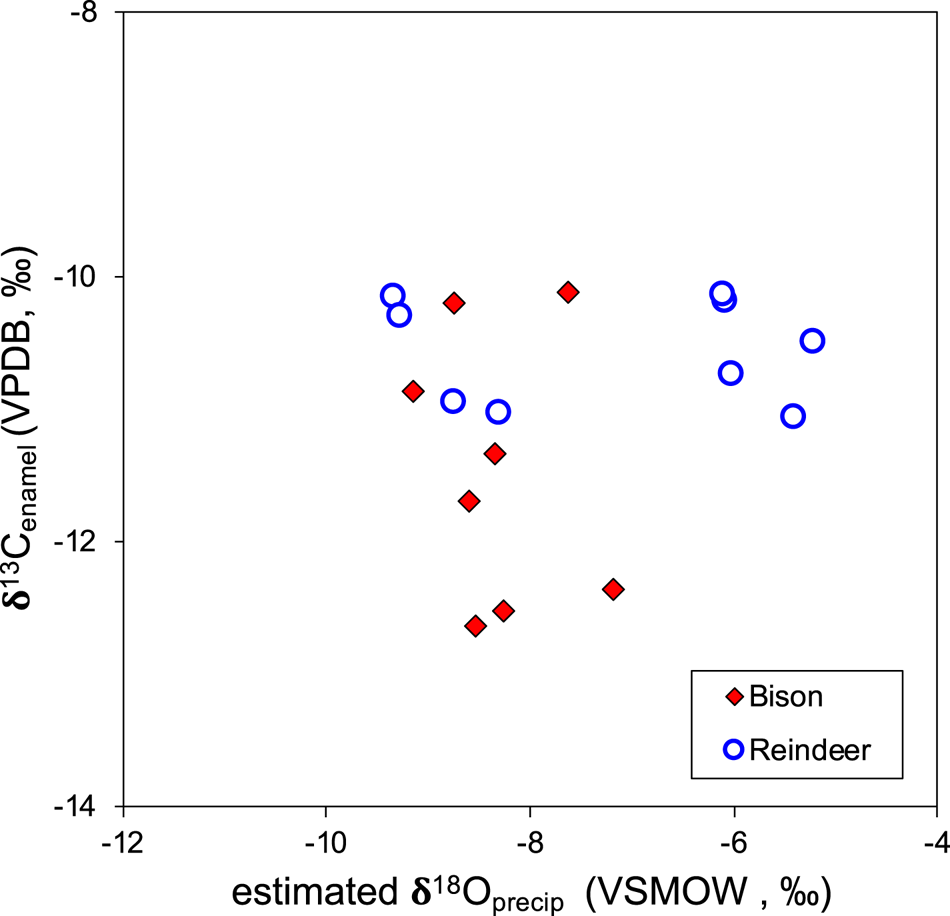
Tooth δ13Cenamel and δ18Oenamel results are listed in Supplementary File 2. Mean bison δ13Cenamel is −11.5 ± 1.0 ‰, with individual values ranging from −10.1 to −12.6 ‰. As with the δ13Ccoll results, reindeer mean δ13Cenamel is greater than that of the bison, being −10.5 ± 0.4 ‰. However, unlike the collagen, there is some overlap in reindeer and bison δ13Cenamel values (Figure 3). Less variability is seen in reindeer δ13Cenamel (ranging from −10.1 to −11.0 ‰) than in that of the bison. δ18O values range from −7.0 to −5.7 ‰ for bison (mean = −6.5 ± 0.4 ‰) and −8.2 to −5.0 ‰ for reindeer (mean = −6.6 ± 1.3 ‰). Mann-Whitney U tests show there is no significant difference between bison and reindeer δ13Cenamel (W = 25, P > 0.05) or δ18O (W = 40, P > 0.05).
(color online) Bison and reindeer calculated drinking water δ18O values plotted against enamel δ13C (see supplementary file 3 for enamel δ18O values).

Data conversions
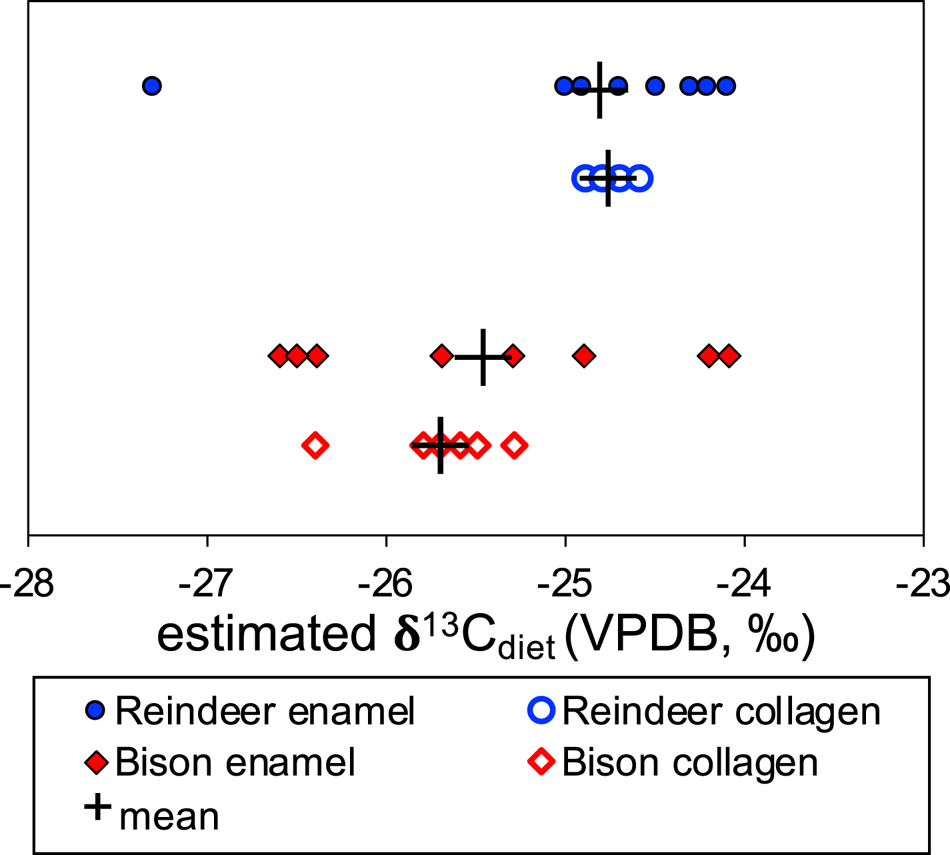
To facilitate direct comparison, δ13Ccoll and δ13Cenamel were converted to δ13Cdiet by assuming a diet to collagen offset of + 5‰, and diet to carbonate offset of + 14‰ following Lee Thorp et al. (Reference Lee-Thorp, Sealy and van der Merwe1989) and Cerling and Harris (1999; Figure 4, Supplementary File 3). No significant difference was seen between estimated δ13Cdiet values reconstructed from tooth enamel and bone collagen for either bison (Mann-Whitney U test, W = 44, P > 0.05) or reindeer (Mann-Whitney U test, W = 46, P > 0.05).
(color online) Calculated carbon isotope values of the diet consumed by Banwell Bone Cave bison and reindeer.

To facilitate palaeo-drinking water estimates, we first converted δ18Oenamel results from the V-PDB to the V-SMOW scale following (Coplen, Reference Coplen2011):

To estimate drinking water δ18O for bison, we invert the empirically derived relationship between tooth enamel carbonate δ18O (δ18Ocarb) and local environmental water (δ18Oenvi) given in Hoppe (Reference Hoppe2006) using the method recommended by Pryor et al. (Reference Pryor, Stevens, O'Connell and Lister2014):

For reindeer, we use a modified version of the relationship between skeletal phosphate δ18O (δ18Ophos) and local environmental water (δ18Oenvi) presented in Longinelli et al. (Reference Longinelli, Iacumin, Davanzo and Nikolaev2003). Longinelli et al.'s dataset includes both tooth and bone samples and we note the relationship between δ18Ophos and δ18Oenvi differs between the two sample types. In our study we have analysed only tooth enamel, so we derive a relationship between δ18Ophos and δ18Oenvi based only on the tooth enamel data reported in Longinelli et al. (Reference Longinelli, Iacumin, Davanzo and Nikolaev2003). Using inverted least-square regression (Pryor et al., Reference Pryor, Stevens, O'Connell and Lister2014) the relationship between δ18Oenvi and δ18Ophos is given by:

As this equation was derived for δ18Ophos, and we analysed the carbonate phase of enamel a conversion between the two bioapatite structures is required. δ18Ocarb covaries strongly with δ18Ophos and we estimate δ18Ophos for our results following Zazzo et al. (Reference Zazzo, Lécuyer, Sheppard, Grandjean and Mariotti2004, Equation 2):

The calculated palaeo-δ18Oenvi values are assumed to provide a satisfactory approximation of local palaeo-precipitation δ18O (δ18Oprecip). Assuming the empirical relationship that exists in the modern environment between δ18Oprecip and mean annual air temperature (e.g., Rozanski et al, Reference Rozanski, Araguás-Araguás, Conginatini, Swart, Lohmann, Mckenzie and Savin1993) is applicable to the past, palaeo-δ18Oprecip can be used to estimate palaeo-air temperature. However, this observed relationship is geographically variable. Here, we use the relationship derived from European data originating at sites below 500 m of altitude by Pryor et al. (Reference Pryor, Stevens, O'Connell and Lister2014):

Each data conversion has an associated uncertainty. We use the error propagation tool presented in Pryor et al. (Reference Pryor, Stevens, O'Connell and Lister2014) to calculate the compound uncertainty associated with our palaeo-δ18Oprecip and palaeotemperature estimates.
DISCUSSION
Carbon
The bone collagen and tooth enamel δ13C values confirm a C3 plant-based diet, typical of the steppe-tundra grasslands of the late Pleistocene. The significantly higher reindeer δ13Ccoll relative to bison δ13Ccoll (Figure 2) follows a pattern often observed in late Pleistocene contexts, where reindeer have higher δ13Ccoll than other contemporary herbivores including bovids, equids and other cervids such as red deer (e.g., Fizet et al., Reference Fizet, Mariotti and Bocherens1995; Drucker et al., Reference Drucker, Bocherens, Bridault and Billiou2003; Stevens et al., Reference Stevens, O'Connell, Hedges and Street2009). This has been attributed to their consumption of lichens, which exhibit higher δ13C values than sympatric C3 vascular plants (Park and Epstein, Reference Park and Epstein1960; Maguas and Brugnoli, Reference Maguas and Brugnoli1996; Drucker et al., Reference Drucker, Bocherens, Pike-Tay and Mariotti2001). The overlap of bison and reindeer δ13Cenamel values potentially indicates ecological niche overlap and suggests a lichen component in the bovid diet, which is not obvious from the δ13Ccoll values. Lichens are a rich source of carbohydrate and poor source of protein. As δ13Cenamel reflect whole diet δ13C (Ambrose and Norr, Reference Ambrose, Norr, Lambert and Grupe1993; Tieszen and Fagre, Reference Tieszen, Fagre, Lambert and Grupe1993) low lichen consumption is more likely to be visible in δ13Cenamel than in δ13Ccoll, which primarily reflect dietary protein δ13C (Krueger and Sullivan, Reference Krueger, Sullivan, Turnland and Johnson1984). Overlap between bovid and reindeer dietary niche and potential lichen consumption by bovids has previously been suggested in other late Pleistocene contexts (Julien et al., Reference Julien, Bocherens, Burke, Drucker, Patou-Mathis, Krotova and Péan2012; Bocherens et al., Reference Bocherens, Drucker, Germonpré, Lázničková-Galetová, Naito, Wissing, Brůžek and Oliva2015; Reade et al., Reference Reade, Tripp, Charlton, Grimm, Leesch, Müller and Sayle2020b), and has been observed also in some modern bison populations (Larter and Gates, Reference Larter and Gates1991). Overlapping reindeer and bison δ13Cenamel values could also be produced by species-specific differences in tooth growth and enamel mineralisation rates. A full year of tooth growth is represented in the majority of analysed bison teeth, such that the derived dietary signal will represent an average spanning this time period. In comparison, the majority of the analysed reindeer teeth formed between late spring and autumn, and thus represent a dietary signature biased toward the summer months (see Supplementary File 2). In modern reindeer populations, lichen is less heavily relied upon in summer compared to in the winter (Holleman et al., Reference Holleman, Luick and White1979). Together tooth and bone δ13C data suggest the BBC MAZ was deposited at a time when steppe-tundra grasslands likely covered the local landscape.
Nitrogen
Both the reindeer and bison δ15N values are high for herbivore species. Notably the reindeer δ15N values are higher than all published late Pleistocene reindeer δ15N values from the UK (Figure 5, Supplementary File 4). Comparatively high reindeer δ15N values are relatively rare in late Pleistocene Europe but are found in reindeer from southwest France during MIS 3 (Figure 5; Bocherens et al., Reference Bocherens, Drucker and Madelaine2014). From the 97 late Pleistocene European bison we found in the published literature, only two examples have δ15N values comparative to those observed at BBC (Figure 6, Supplementary File 5). One is from southwest France (Les Pradelles/Marillac, δ15N = 9.3‰; Fizet et al., Reference Fizet, Mariotti and Bocherens1995) and another from Crimea, (Emine-Bair-Khosar, δ15N = 9.1‰; Gąsiorowski et al., Reference Gąsiorowski, Hercman, Ridush and Stefaniak2014); both date to MIS 3. Thus, the range in bison δ15N observed in the BBC material is extremely rare for late Pleistocene Europe.
(color online) Bone collagen δ13C and δ15N of late Pleistocene reindeer from the UK and southwest France. Additional data not produced for this publication has been collated from the published literature (full details are given in Supplementary file 4).

(color online) Bone collagen δ13C and δ15N of late Pleistocene Bovids from the UK and southwest France. Additional data not produced for this publication has been collated from the published literature (for full details see Supplementary file 5).

Two possible explanations exist for such high herbivore δ15N values. First, elevated δ15N can be produced by nutritional stress. However, for such high bone collagen δ15N to be solely indicative of nutritional stress long periods of fasting/starvation for both reindeer and bison would be required. Given the abundance of the bison and reindeer remains at BBC and at other site containing the BBC MAZ, it seems that the environment was suitable for long-term coexistence of the two species and does not suggest the environment was so nutritionally poor as to result in significant periods of starvation. Furthermore, where comparable reindeer δ15N values are seen in southwest France during MIS 3 (Bocherens et al., Reference Bocherens, Drucker and Madelaine2014), reindeer were also extremely abundant, often being the dominant fauna in zooarchaeological assemblages (Mellars, Reference Mellars2004). Such abundance is unlikely in an environment in which animals are starving.
The alternative and most parsimonious explanation is that the elevated reindeer and bison δ15N values are linked to environmental conditions. Plant to herbivore δ15N fractionation has been shown to be constant (Männel et al., Reference Männel, Auerswald and Schnyder2007; Bocherens et al., Reference Bocherens, Drucker and Madelaine2014; Kuitems et al., Reference Kuitems, van Kolfschoten and van der Plicht2015), and relationships between herbivore δ15N and temperature and/or aridity have been shown to be driven by the δ15N of the plants the animals consume (Murphy and Bowman, Reference Murphy and Bowman2006; Hartman, Reference Hartman2011). Today, high plant δ15N are linked to low precipitation (aridity) and higher temperatures. However, in southwest France, the high MIS 3 reindeer δ15N values were found alongside elevated δ15N values in contemporary herbivores and carnivores and were interpreted as being indicative of an environment for which no modern analogue is known. The contemporary palaeoclimate proxies indicted relatively low temperatures, thus the elevated δ15N values were ascribed to aridity (Fizet et al., Reference Fizet, Mariotti and Bocherens1995; Richards et al., Reference Richards, Taylor, Steele, McPherron, Soressi, Jaubert, Orschiedt, Mallye, Rendu and Hublin2008; Bocherens et al., Reference Bocherens, Drucker and Madelaine2014). Similarly, the beetle, pollen, and plant macrofossil data from BBC MAZ sites, along with the bison and reindeer oxygen isotope data (see below) do not indicate very high temperatures (Coope and Angus, Reference Coope and Angus1975; Coope et al., Reference Coope, Gibbard, Hall, Preece, Robinson and Sutcliffe1997; Maddy et al., Reference Maddy, Lewis, Scaife, Bowen, Coope, Green and Hardaker1998). Thus, the BBC reindeer and bison δ15N likely also indicate arid conditions. The rarity of comparable bison δ15N values from late Pleistocene Europe support the notion that the BBC MAZ was deposited under non-analogue environmental conditions.
Oxygen
Mean δ18Oenamel values are similar for both species (−6.5 ± 0.4 ‰ for bison and −6.5 ± 1.3 ‰ for reindeer). As with the δ13Cenamel and δ15Ncoll, reindeer δ18Oenamel is more variable than that of bison, ranging from −8.2 to −5.0‰, compared to −7.0 to −5.7‰. The higher variability in the reindeer δ18Oenamel is likely attributable to the different time periods each tooth represents, with the bison δ18Oenamel values relating to approximately a full annual cycle, and the reindeer δ18Oenamel signatures being biased toward the summer months (Supplementary File 2).
Using the discussed data conversions, we estimate a mean palaeo-δ18Oprecip of −8.3 ± 1.3‰ from the bison data and −7.0 ± 1.6‰ from the reindeer data. For individual samples, palaeo-δ18Oprecip estimates range from −9.1 to −7.1‰ for bison and −9.3 to −4.6‰ for reindeer, with associated uncertainties between 2.4 and 2.8‰ (Supplementary File 2). For comparison, modern mean annual δ18Oprecip in the UK ranges from approximately −8.5 to −6.5 ‰ (IAEA GNIP) (The International Atomic Energy Agency (IAEA)/World Meteorological Orgnaisation (WMO), 2020). Estimated palaeo-δ18Oprecip therefore indicates similar climatic conditions to the present day, i.e., temperate conditions, assuming that δ18Oprecip can be treated as a function of temperature. The palaeo-δ18Oprecip estimates made from the reindeer data include values higher than might be expected, and if taken at face value could indicate a climate far warmer than present. However, this conjecture should be treated cautiously. As the majority of our reindeer samples are believed to have formed only over the summer months, the occurrence of higher palaeo-δ18Oprecip estimates are not actually surprising. In fact, an estimated mean δ18Oprecip of −4.6‰ is not that dissimilar to modern mean monthly maximum values for the UK of approximately −4.5 to −2.0‰ (IAEA, GNIP) (The International Atomic Energy Agency (IAEA)/World Meteorological Orgnaisation (WMO), 2020). Regardless, the δ18Oenamel results only show evidence of δ18Oprecip values associated with temperate environments, and we find no indication of colder conditions.
Using species mean palaeo-δ18Oprecip estimates we derive palaeotemperature estimates of 10.3 ± 2.5°C from the bison data and 12.8 ± 3.1°C from the reindeer data. These temperatures are comparable to the recent (1981–2010) 30-yr mean annual air temperature for southwest England of 10.5°C (https://www.metoffice.gov.uk/). Similarities are also apparent between our palaeotemperature estimates and others from late Pleistocene interglacial deposits. Coleoptera-based estimates from lithofacies B at Cassington, which contained a bison-reindeer fauna attributed to the BBC MAZ and has been dated to interstadial MIS 5a, range from 17–18°C for the warmest month to −4–4 °C for the coldest month (Maddy, Reference Maddy, Lewis, Scaife, Bowen, Coope, Green and Hardaker1998; Penkman, Reference Penkman, Preece, Bridgland, Keen, Meijer and Parfitt2011, Reference Penkman, Preece, Bridgland, Keen, Meijer, Parfitt, White and Collins2013). Comparatively, Coleoptera-based temperature estimates from lithofacies D at the site, correlated to stadial MIS 4, range from 7–11°C for the warmest month to −30 to −10°C for the coldest month (Maddy, Reference Maddy, Lewis, Scaife, Bowen, Coope, Green and Hardaker1998). Likewise, molluscs from the organic silts at Willment's Pit, Isleworth, which also contains mammalian fauna assigned to the BBC MAZ and tentatively correlated to interstadial MIS 5c, suggest mean July temperature of no lower than 15°C (Kerney, Reference Kerney, Gibbard, Hall and Robinson1982; Penkman Reference Penkman, Preece, Bridgland, Keen, Meijer and Parfitt2011, Reference Penkman, Preece, Bridgland, Keen, Meijer, Parfitt, White and Collins2013). Based on these independent data, our palaeotemperature estimates clearly fall within the expected range of a late Pleistocene interstadial climate, and outside of the range expected of a late Pleistocene stadial climate.
CONCLUSION
The results of the stable isotope analyses conducted in this study confirm that the BBC faunal assemblage relates to a temperate rather than cold environment. Our study is the first to derive palaeoclimate information directly from the fauna itself, providing evidence that the bison-reindeer fauna, typically thought of as a cold climate assemblage, existed under temperate climate conditions at BBC. Our results support the correlation of the BBC MAZ to interstadial MIS 5a rather than to the succeeding stadial of MIS 4.
The δ13C values of bison and reindeer fauna indicate C3 plant-based diets, typical of the steppe-tundra grasslands of the late Pleistocene. Lichen appears to have been important for reindeer and potentially also a component of the bison diet, thus indicating some possible ecological niche overlap. The δ15N values of both bison and reindeer are unusually high and likely represent arid conditions within a temperate environment. Mean palaeotemperature estimates derived from bison and reindeer tooth enamel δ18O indicate that temperate conditions similar to the present day prevailed during the deposition of the fauna at BBC.
Confirmation that fauna from the BBC lived in conditions consistent with the temperate interstadial MIS 5a rather than the succeeding cool stadial MIS 4, lends support to the hypothesis that the BBC MAZ represents an island fauna and that a mismatch between British and other European mammal faunas existed during MIS 5 (Gilmour et al., Reference Gilmour, Currant, Jacobi and Stringer2007). Finally, this study provides a cautionary tale for the use of particular species as climatic indicators. The presence or absence of geographical barriers may substantially influence the species composition of a faunal assemblage to the extent that species may have existed in environments beyond their current environmental limits, or in environments for which there are no modern analogues.
ACKNOWLEDGMENTS
RS and HR are funded by an ERC consolidator grant to RS (ERC-CG-617777: UP-North). We thank Delfin Weis and Elizabeth Rutherford for assistance with sample preparation and James Rolfe for assistance with analysis. We are grateful to Delphine Fremondeau for assistance with ZooMS analysis. Rebecca Kearney is thanked for assistance with formatting. We are very grateful to Andy Currant and the late Roger Jacobi for providing newly excavated material for analysis and for encouraging us to undertake research on the late Pleistocene fauna of the British Isles. The excavations at Banwell Bone Cave were conducted as part of the Ancient Human Occupation of Britain (AHOB) Project funded by the Leverhulme Trust. We thank two anonymous reviewers for their suggestions which helped improved this manuscript.
SUPPLEMENTARY MATERIAL
The supplementary material for this article can be found at https://doi.org/10.1017/qua.2020.104