The Japanese surrender to Allied forces on August 15, 1945 was celebrated throughout Korea as the moment of the nation's release from three and a half decades of Japanese colonial rule. However, dreams of Korean self-determination would be premature. Soviet forces occupied the northern part of Korea, while the United States occupied the south, where it established the US Army Military Government in Korea (USAMGIK). Thus, Korea became a proxy battlefield for the struggles of the two world hegemons, and the period 1945–1948 became the prelude to a Korean national tragedy—the division of Korea into North and South.Footnote 1
Music played a significant role in attempts to shape the new political order during the pivotal years of 1945–1948. Korean patriotic songs proliferated, as if to emphasize Koreans' united voices and hopes for independence. Yet the Korean musical scene also rapidly came to reflect competing ideologies: democracy and capitalism versus communism. Pro-communist Koreans prioritized music with clear political messages that reflected proletarian struggles. Pro-capitalist Koreans eschewed the politicization of music, elevating artistry and the pursuit of music for music's sake.Footnote 2
The USAMGIK, which lasted until 1948, and the formal establishment of the Republic of Korea in the south emerged as a main instigator of this ideological divide, and Ely Haimowitz—the American pianist who served as the USAMGIK's chief music advisor—emerged as the driving force of USAMGIK's music policy. Haimowitz concentrated the USAMGIK's efforts in disseminating Western orchestral musicFootnote 3 in Korea, and in doing so, he showed significant sensitivity to Korea's colonial experience. Western art music gained status in much of the colonial world as a genre associated with social prestige and “highbrow” culture.Footnote 4 Under Japanese colonial rule (1910–1945), however, Korean access to Western orchestral music was limited.Footnote 5 To emphasize the image of the USAMGIK not as an occupying force but a liberation army, Haimowitz devised and implemented policies to help Koreans restore their ethnic pride. Haimowitz believed that expressing friendly gesture and respect towards Koreans was USAMGIK's best propaganda strategy. Thus, he not only introduced European orchestral music to the Korean audiences but also encouraged Korean musicians to compose Western-style orchestral music. Many Korean musicians gratefully accepted USAMGIK's help, and the dissemination of various styles of Western musicFootnote 6 became a tactic for winning Koreans' trust.
By focusing on Western orchestral music's unique role in forging US hegemony over South Korea, this article traces the activities of Ely Haimowitz and the musical entanglements between Haimowitz and Korean musicians under the USAMGIK. During the Cold War, Western orchestral music was a symbol of modern cultural achievement and reinforced ideological positions both in Western and Eastern blocs. As Danielle Fosler-Lussier details in Music in America's Cold War Diplomacy, the US government supported international tours of US symphony orchestras and created music educational programs to spread American democracy abroad.Footnote 7 The Soviet Union also devised musical exchange programs and international music competitions, including symphonic performances, to promote socialist ideology.Footnote 8 The use of orchestral music in Cold War cultural politics was not limited to these two super powers. Elaine Kelly's article “Performing Diplomatic Relations” explores orchestral music in East Germany's efforts to build ties with the Middle East during the Cold War.Footnote 9 In “The Orquesta Sinfónica Nacional de Cuba and Its Role in the Cuban Revolution's Cultural Project,” Marysol Quevedo addresses the strategic use of orchestral music in Cuba's Cold War music diplomacy in close connection with its post-revolutionary nation-building project. By expanding from Europe to a non-Western country, Cuba, Quevedo complicates the scholarly conversation on orchestral music in Cold War politics.Footnote 10
The main contribution of the above-mentioned studies is to extend our understanding of orchestral music as a political tool during the Cold War. Delving into the relevant government agencies and their policies, such scholarship reveals the musical repertoire deployed in music diplomacy and elucidates the ways in which musicians, as cultural ambassadors or propagandists, were involved in Cold War politics. While emphasizing authorities and top-down state policies as main actors in Cold War music diplomacy, however, this kind of research often overlooks dynamic interactions among policy makers, musicians, and recipients of music.
This article concentrates less on examining a government that devises music policies as a seamless whole and instead places a greater emphasis on exploring the complex relationships among individuals who were involved in music diplomacy. The key intervention of my research here is to draw our attention to music diplomacy not only as a tactic of power but also as a way to open up new musical encounters among people from different cultures. The relationship between Ely Haimowitz and Korean musicians influenced both the perspectives of Korean musicians and that of Haimowitz's. More to the point, the personal interactions and friendship that Korean musicians shared with Haimowitz were not any less important as the top-down music policy of the USAMGIK in creating a pro-American network in what would become the South Korean music scene. The US-Soviet rivalry initiated the USAMGIK's music policy that resulted in the widespread of Western orchestral music in southern Korea. However, it was Korean musicians' personal interactions with Haimowitz that provided a key leverage point in the success of the USAMGIK's music diplomacy.
To better understand the contextual details of the musical entanglements between Haimowitz and Korean musicians, this article draws upon historical records both from the United States and Korea. Haimowitz and the Korean musicians who worked with him have passed away, but thanks to the generosity of the Haimovitz family, I was able to gain access to Haimowitz's private archival collection, including his correspondence with, and memoranda for, the USAMGIK; private letters, diaries, and photographs; and printed music and concert programs. Scholars have fruitfully illuminated how non-Western musical collections, as selected and curated by Westerners, have served colonial legacies by concealing indigenous voices and enshrining collectors' biases.Footnote 11 Like the Western curators of non-Western music, the documents written by Haimowitz reveal that his knowledge and understanding of Koreans and their culture were not always accurate, and there were multiple biases on his part. However, what makes Haimowitz's private collection different from the non-Western musical collections by Westerners is that the focus of the Haimowitz collection is not so much Korean music as his life under the USAMGIK. Thus, Haimowitz's private collection tells us a great deal about his relationships with Korean musicians and their music, revealing Haimowitz not only as a cool-headed US military officer but as an individual musician who shared interests with Korean musicians, suffered ethical dilemmas, and often supported Korean voices against the USAMGIK.
This article begins with a brief description of Ely Haimowitz and the Music Section of the USAMGIK Department of Education, where he served as chief advisor. I then elucidate the role of Western orchestral music in the USAMGIK's music policy, as well as the musical entanglements among Haimowitz and Korean musicians. Throughout, the article emphasizes that Korea's colonial experience and Korean musicians' relationship with Haimowitz were the key factors in building a pro-American orientation during the crucial, transitional period between the colonial and Cold War eras. Western orchestral music, as a symbol of modernity, fulfilled Korean musicians' long-standing desire to emerge on the international stage, while it helped the USAMGIK effectively counter Soviet music policy that stressed the importance of indigenous Korean music. Furthermore, filtered and mediated by the United States, Western orchestral music has also fashioned South Korea's post–World War II cultural identity.
Ely Haimowitz and the Music Section of the USAMGIK Department of Education
On November 26, 1945, the USAMGIK established the Office of Special Subjects—Music (known informally as the Music Section) under the Department of Education. Formally, the USAMGIK Office of Research was in charge of surveying the cultural and educational landscape in southern Korea.Footnote 12 However, American officials were not well equipped to understand Korean culture from an insider's point of view. Hence, in December 1945 the Department of Education organized a music advisory committee composed of Korean musicians. Committee members worked with the Department of Education to draw up music curricula for elementary and secondary schools as well as colleges. It also provided crucial insights into public opinion concerning the USAMGIK's music policy.Footnote 13
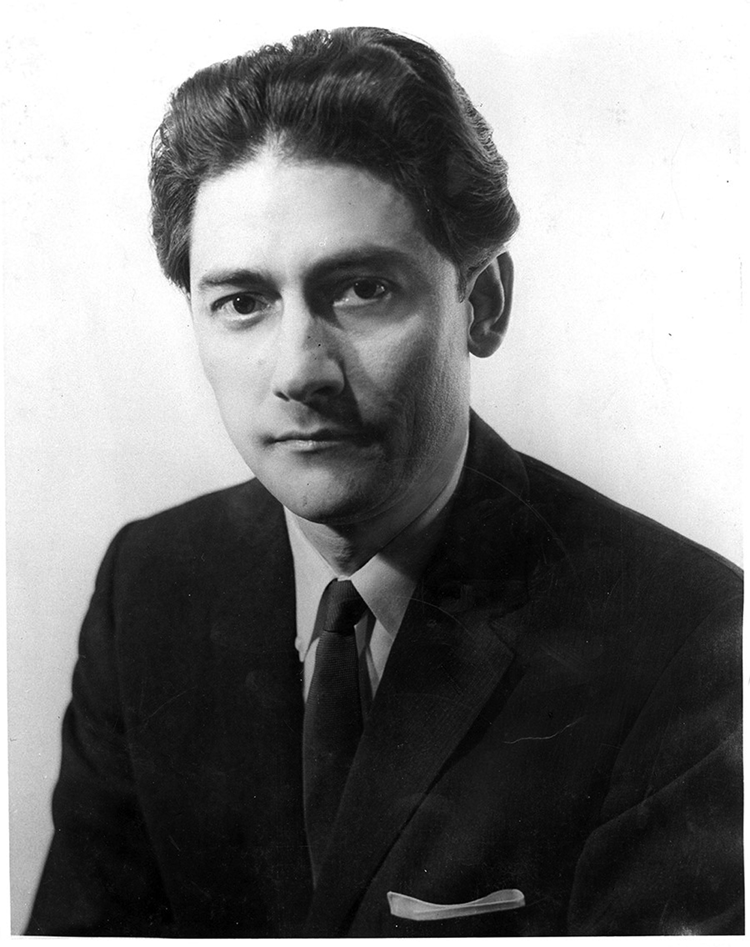
Lieutenant Maurice E. Faulkner served briefly as chief advisor to the Music Section, followed by Ely Haimowitz (1920–2010), who was appointed in March 1946 (Figure 1).Footnote 14 In July 1947, Haimowitz was transferred and became the chief of Cultural Affairs in the Office of Civil Information; however, his duties remained the same as they had been while serving in the Department of Education. Prior to his Army service, Haimowitz had begun to train as a concert pianist. After graduating with a Bachelor of Music from Rollins College, Florida, in 1941, Haimowitz received a full fellowship to the Juilliard Graduate School in New York City, where he majored in piano. His studies were cut short, however, by the United States' entry into World War II. On May 16, 1942, Haimowitz was drafted into the US Army and forced to take leave from Julliard. By October 1942 he had been diverted to officer training, and in February 1943 he graduated the Quartermaster School in Camp Lee, Virginia. Haimowitz served with the Army Air Forces as Quartermaster Supply Officer until 1945, at which point he was sent to Korea as a Military Government Officer.Footnote 15
Ely Haimowitz in his youth. Photo courtesy of Valerie Haimowitz.

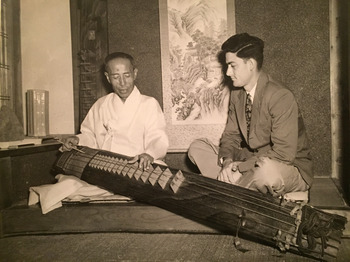
Although the Music Section belonged to the Department of Education, Haimowitz's role was by no means limited to music education. Using the resources of USAMGIK, he aimed to rebuild music for the general public, as well as in the nation's schools.Footnote 16 In order to better understand various cultural currents in Korea, Haimowitz worked closely with Korean musicians. Indeed, throughout his incumbency in USAMGIK, Haimowitz took interest in Korean traditional music, studying its history and even learning to play the kŏmungo (a zither-type string instrument) under the tutelage of former court musician Ham Hwa-jin (Figure 2).Footnote 17 Haimowitz also helped Korean musicians hold the first ever nongak, or farmers' music festival, in 1946.Footnote 18 Haimowitz's primary focus, however, was on fostering Western music and stimulating the growth of new Korean music modeled on Western musical forms—particularly Western art music, which was well suited for the pro-US liberal camp.Footnote 19
Haimowitz learning to play a Korean traditional string instrument, kŏmungo, from the former court musician Ham Hwa-jin in Korea under the USAMGIK. Photo courtesy of Valerie Haimowitz.

The USAMGIK's support for Western music predated Haimowitz's tenure. Most notably, on January 20, 1946, the Music Section created the Koryŏ Symphony Association (hereafter, KSA), which organized all interested Korean musical groups in support of the Koryŏ Symphony Orchestra (hereafter, KSO). Organized just several months prior, in September 1945, the KSO was the first Western-style orchestra founded in post-colonial Korea, and it was made up entirely of pro-capitalist Korean musicians.Footnote 20 The orchestra performed at the ceremony welcoming American soldiers to Korea on October 20, 1945, and it received the USAMGIK's full support from late 1945 until the end of the transitional period (1945–1948).Footnote 21
Noted Korean composer and tenor Hyŏn Che-myŏng was elected Chairman of the KSA. The Executive Board included Korea's revered conductor Yim Wŏn-sik and the nation's well-known music historian Yi Hye-ku.Footnote 22 Other members of the association included sopranos Kim Cha-kyŏng and Chŏng Hun-mo, composers Yi Hŭng-ryŏl and Na Un-yŏng, violinist Ch'ae Tong-sŏn, and many others who would later be remembered as leading composers and performers of Western art music in Korea.Footnote 23 Under Haimowitz's direction, the Music Section continued its strong support for the KSO, for instance, by forming an endowment for the orchestra and hosting concert series featuring the orchestra and its performers.Footnote 24 However, Haimowitz's efforts also extended to personal support for members of the KSA and the KSO—most notably, by making it possible for the conductor Yim Wŏn-sik and pianist Yun Ki-sŏn to study music in the United States. To facilitate this possibility, Haimowitz wrote personally to Rosina Lhévinne, the pianist who had been Haimowitz's own instructor at Juilliard, asking her to secure permission for Yim and Yun to enter Juilliard. In one letter to Lhévinne, Haimowitz emphasized the troubling nature of Japanese colonial rule:
I am writing this letter to you also in a semi-official capacity. . . . Forty years of Japanese domination has done few Korean artists any good. Indeed, only the very best Korean students in any field were ever allowed to go to Japan to study, and even in the University here, the student enrollment was approximately eighty percent Japanese. So, you see, it was difficult for the good talent to have a chance. Perhaps you are surprised to learn that there is music over here, halfway around the world: for the Korean musicians are a very musical group of people who love Western music. . . . He [Yun Ki-sŏn] got his training only in Japan, and needs badly the kind of finishing which only a good Western school can give. I think that with one or two years of study with you he might be ready for a career. Possibly I overestimate his abilities, but the only way to find out would be to give him a chance.Footnote 25
Not only does Haimowitz emphasize the difficulty receiving adequate training under Japanese colonial rule, he proceeds under the assumption that Korean musicians could never receive the level of education in Japan that they could in the United States. Haimowitz's tenor seemed to persuade Lhévinne. In 1948, with financial support from Haimowitz and the USAMGIK, Yim and Yun left to study at Juilliard. On their way to the United States that June, Yim and Yun visited Honolulu, where, with the aid of the USAMGIK, they performed with the Honolulu Symphony Orchestra. In the United States, Haimowitz connected Yim and Yun with American avant-garde composer George Antheil. He also provided an introduction to Richard Lert, the American conductor and founder of the Music Academy of the West in Santa Barbara, California, and before continuing on to Juilliard, Yim and Yun attended this prestigious summer institute.Footnote 26
At Juilliard Yun Ki-sŏn studied under Lhévinne. After graduation he became a faculty member of the University of Hartford, Connecticut, where he worked until his return to South Korea in 1968.Footnote 27 Yim Wŏn-sik attended the summer educational program at Tanglewood in 1949 and then returned to Korea, where he achieved prominence as both a conductor and music educator. Not surprisingly, Yim chiefly contributed to Korea's Western art music scene, conducting major symphony orchestras, including the orchestra of the Korean Broadcasting System. In 1953, in the midst of the Korean War, Yim established the Seoul Arts High School, the first high school–level institute for the teaching of Western art music in Korean history.Footnote 28
Haimowitz's efforts to promote Western art music in southern Korea, as well as his dedicated support for individuals such as Yun and Yim, won him great admiration in the nation's art community. For instance, in November 1947 a number of prominent musicians, including soprano Kim Cha-kyŏng, tenor Yi In-sŏn, pianist Yun Ki-sŏn, and violinist Mun Hak-chun, held a concert at Paichai Music Hall to commemorate Haimowitz's contributions to the Korean musical world and express their gratitude to him. The concert program described Haimowitz as “a great figure, with a deep understanding of the arts, who made great efforts for the development of the Korean music scene.”Footnote 29
In a letter to Haimowitz dated November 29, 1947, tenor Yi In-sŏn wrote, “We appreciate your kind help for our work in opera, which is one of the most important forms of entertainment for liberated Korea. We are sure that your honorable name will be remembered forever in Korea's history of opera.”Footnote 30 On December 5, 1947, Kim Kyu-sik, chairman of the Interim Legislative Assembly of South Korea, presented Haimowitz with a letter of appreciation on behalf of South Korea's citizens. This letter described Haimowitz “a true friend of Koreans.”Footnote 31 Similarly, Pak Yong-ku, one of the most influential music critics of the period, praised Haimowitz as “a great supporter of Korean musicians.”Footnote 32 And notably, several decades after returning home from the United States and establishing himself as one of South Korea's most prominent musical figures, Yim still spoke of Haimowitz as a major influence on his musical career. In an interview with the music magazine Kaeksŏk (Auditorium) in 1995, Yim said, “whenever I look back at the 80 years of my life as a musician, I always recall a person I really appreciate. He is Ely Haimowitz.”Footnote 33
Western Orchestral Music for Korea's Ethnic Pride
In order to understand the widespread affection and admiration for Haimowitz—a US military officer serving under the USAMGIK—it is crucial to understand the context. Resentment of American oversight expanded rapidly during the transitional period, fueled in no small part by near-daily incidents of racist harassment and violence that American soldiers perpetrated against Koreans.Footnote 34 A letter from the military governor, John R. Hodge, to US soldiers stationed in Korea indicates that the USAMGIK viewed such incidents as not simply an operational concern but a strategic one. Writing to the troops, Hodge decried the crimes that soldiers had committed against Koreans, emphasizing that the USAGMIK should promote an image of the United States as a “utopia” and that US soldiers should function as “apostles of freedom and democracy.”Footnote 35
Ironically, however, Hodge himself also helped to kindle anger against the USAMGIK. Unaware of the deeply rooted anti-Japanese sentiment in Korea, Hodge maintained Japanese administrative officials to manage the USAMGIK. This fact raised a violent storm of protest. Yet, even after this significant blunder, Hodge continued to rely for advice and assistance on wealthy, conservative Korean landlords and businessmen, some of whom had been Japanese collaborators. To make matters worse, Hodge's excessive fear of a communist seizure of southern Korea led him to tolerate violent, extremist attacks on pro-communist Koreans and Soviet diplomats. As a result, in 1948, the South Korean Labor Party led an armed uprising in the Jeju province against Korean extremists and the USAMGIK.Footnote 36
Meanwhile, in terms of cultural policy, the USAMGIK lagged behind the Soviet Union. While culture played a central role in Soviet occupation policy from the start, the USAMGIK did not begin to utilize cultural propaganda in earnest until mid-1947.Footnote 37 Haimowitz was often frustrated by USAMGIK's general policy because by not using cultural diplomacy, the USAMGIK was disadvantaging themselves compared to the Soviet occupation forces.Footnote 38 During the Soviet-US trusteeship, most influential Korean composers, such as Kim Sun-nam and An Ki-yŏng, favored communism over capitalism. Some, like composer Yi Kŏn-u and tenor Pak Ŭn-yong, actively devoted themselves to communist party activities.Footnote 39 The Soviets helped to generate some of this support by placing special emphasis on the preservation and promotion of native Korean culture. On the surface the USAMGIK also claimed to support traditional Korean arts and culture.Footnote 40 In reality, however, US officials took a cavalier approach to the repatriation of Korean cultural artifacts that had been looted and seized by the Japanese. Worse yet, US soldiers destroyed important sites and artifacts—for instance, by driving trucks and jeeps directly onto historic palace grounds. The soldiers understood nothing of the cultural importance of these palaces or the monuments situated on palace grounds, and they paid little attention to their impact on sites that held enormous meaning for many Koreans.Footnote 41
Between the USAMGIK's ongoing offensive behaviors and mounting Korean dissatisfaction, it is remarkable that so many Korean musicians consistently voiced positive opinions about Haimowitz. It should be pointed out that Haimowitz's relationships were mainly forged with musicians who, as a part of an elite minority, had been trained in Western art music, particularly those who had learned English.Footnote 42 Korean musicologists have reasonably assumed that it was in the mid-to-late nineteenth century that Korea (Joseon Dynasty) encountered Western music for the first time. As the Kingdom of Choson (Korea) and the United States engaged in their first official diplomatic interaction in 1882, American Christian missionaries introduced American hymns to Koreans. The first Western notation published in Korea was a hymnbook entitled Ch'anyangga (Hymns) that an American missionary, Horace G. Underwood, published in 1894. At the churches and private schools that they established, American missionaries also taught Koreans how to play the organ, sing using Western vocal methods, and read European music notation. Although only a small number of Koreans attended these kinds of schools and churches, most of the Korean musicians who worked closely with Haimowitz were those who learned Western music and English from the institutes founded by American missionaries.Footnote 43
It was during the Japanese colonial period (1910–1945) that Koreans became more familiar with Western art music. Beginning in the early 1920s, major European performers such as violinist Jascha Heifetz and pianist Arthur Rubinstein toured Korea. Admittedly, their audiences were largely comprised of Japanese residents, since few Koreans could afford the high-priced tickets. As a result, many Korean intellectuals and musicians nurtured a strong desire to listen to and perform “highbrow” Western orchestral music, but for most that desire remained unfulfilled.Footnote 44 Hence, Western orchestral music came to function as a symbol of social prestige in the colonial period, but it also served to stoke Korean pride and resentment against the Japanese. It is no coincidence that the first Western-style orchestra in Korea, established in 1928, was organized by students at Keijō Imperial University. At the time, Keijō Imperial was considered the most prestigious university in the nation, and its students were drawn from the elites of the social elite. At the same time, Japanese members of the orchestra outnumbered Korean ones, illustrating the hierarchical relationships that made so many Koreans chafe under Japanese colonial rule.Footnote 45
To appreciate the complexity of Korea's relationship to Western music, it is important to keep in mind that Korea had never been colonized by a European nation. Accordingly, as compared to Asian countries that had been colonized by Western powers, Koreans were relatively less hostile to Western culture. Indeed, musicians who had received training in Western music during the colonial period tended to view Western art music as culturally “advanced,” and Western orchestral music, in particular, was a musical genre that many Korean musicians were eager to embrace. Thus, ultimately, Korean musicians were able to reconcile their postcolonial nation-building projects with Western musical traditions.Footnote 46 As a result, somewhat ironically, Haimowitz's background in Western art music became his great asset in building rapport with Korean musicians.
In an interview with a USAMGIK official, the director of the KSA, Tokko Sŏn, said that the cultural and racial pride of Korea:
had always been suppressed by the Japanese, who did not allow the Koreans any freedom at all in cultural pursuits. Western music had always been appreciated by Koreans, but [after the end of Japanese rule] it was necessary to familiarize them with it anew, and on a scale that would allow them to take pride in their own knowledge of the Western music. Thus, the organizations' aim was to promote Western music in Korea, and to contribute to the musical advancement of the “Korean Renaissance.”Footnote 47
There had been a few attempts during the colonial period to organize Western-style orchestras comprised entirely of Korean musicians—for instance, Chungang Aguhoe (the Central Association for Music and Friendship), the first professional Western-style orchestra, founded in 1929, and Chosŏn Kwanhyŏnaktan (the Joseon Symphony Orchestra), established in 1940. These orchestras performed pieces from the Western art musical canon, such as Franz Schubert's Three Marches Militaires, “Minuets” from Mozart's Don Giovanni, Rossini's “William Tell Overture,” Beethoven's Egmont overture, and Schubert's Symphony no. 8. However, as discussed above, under Japanese rule Korean orchestras could not set to work in real earnest, and the outbreak of the Pacific War (1941–1945) froze nearly all orchestral activity.Footnote 48
It was in this historical context that the members of the KSA welcomed the USAMGIK. The USAMGIK helped Korean musicians fulfill a long-frustrated desire to organize their own Western-style orchestra and, thereby, helping Koreans restore their ethnic pride which Japanese colonialism had damaged. Of course, many pro-communist musicians firmly rejected the “elitist” and “Western-centric” views put forward by members of the KSA.Footnote 49 Nonetheless, the KSO gained great popularity in the American zone.Footnote 50 Due to the support it received from the USAMGIK, the KSO was the only orchestra able to hold regular concerts in southern Korea.Footnote 51
Orchestral Music as a Political Tool
Haimowitz spared no pains to help the orchestra, and the KSO held dozens of concerts during the US military government period.Footnote 52 The orchestra's repertoire mainly comprised highlights of European art music, such as Camille Saint-Saëns's Violin Concerto, no. 3; Tchaikovsky's Symphony no. 5; Edvard Grieg's “Op. 23” from Peer Gynt; Beethoven's Symphony no. 5; Johann Strauss's “Blue Danube Waltz,” and Louis-Hector Berlioz's “Marche Hongroise” from the Damnation of Faust.Footnote 53 In 1947 the Kyunghyang Daily described this repertoire as “dignified and magnificent music” and the KSO as “the most prestigious musical organization in Korea.”Footnote 54
The KSO also introduced American music to Korean audiences. In order to purchase new instruments for the orchestra, Haimowitz raised money from Americans who had attended its concerts. Then he organized a US-Korea goodwill concert meant to highlight the generosity of the orchestra's American patrons and promote the image of the United States as a helper for Koreans. The KSO premiered American composer Douglas Moore's “Village Music,” an orchestral suite drawing on American folk traditions, at this concert.Footnote 55 Due to Haimowitz's efforts, the USAMGIK came to realize that music could be a significant political tool.
Notably, under Haimowitz's guidance, the KSO also performed Russian music at times when cooperation with the Soviets was needed. For instance, on June 6, 1947, Haimowitz and the orchestra held a concert to celebrate the new meetings of the Soviet-US joint commission.Footnote 56 This was a politically sensitive moment. In May, the Soviet Union and United States had agreed to resume the meetings after a long hiatus following a rupture in negotiations. Haimowitz made sure to invite Soviet officials to the concert. There, before a largely Soviet audience, Haimowitz himself performed as piano soloist in the Korean premiere of Russian composer Sergei Rachmaninoff's Piano Concerto no. 2. The orchestra also performed Tchaikovsky's Symphony no. 6, the Pathétique Symphony. Korean newspapers reported that the Soviet officials in attendance greatly enjoyed themselves.Footnote 57 In an interview with a Korean journalist, Nicholai Georgiyevich Lebedev, general of the Soviet Civil Administration in northern Korea, said:
The concert today was very enjoyable! I felt like I attended a concert not in an Asian country but in a European country. Working in perfect harmony, the conductor and the orchestra members performed very well, especially Tchaikovsky's “Pathétique” Symphony. I believe that Korean musicians have great potential to appear on the international stage in the future.Footnote 58
The KSO's performance of Russian music, with a prominent US military officer as soloist, was doubtlessly seen as a friendly gesture to Soviet officials. Given that the great Russian composer Rachmaninoff migrated to the United States and died there, this choice of music would have also paradoxically highlighted American democracy.Footnote 59
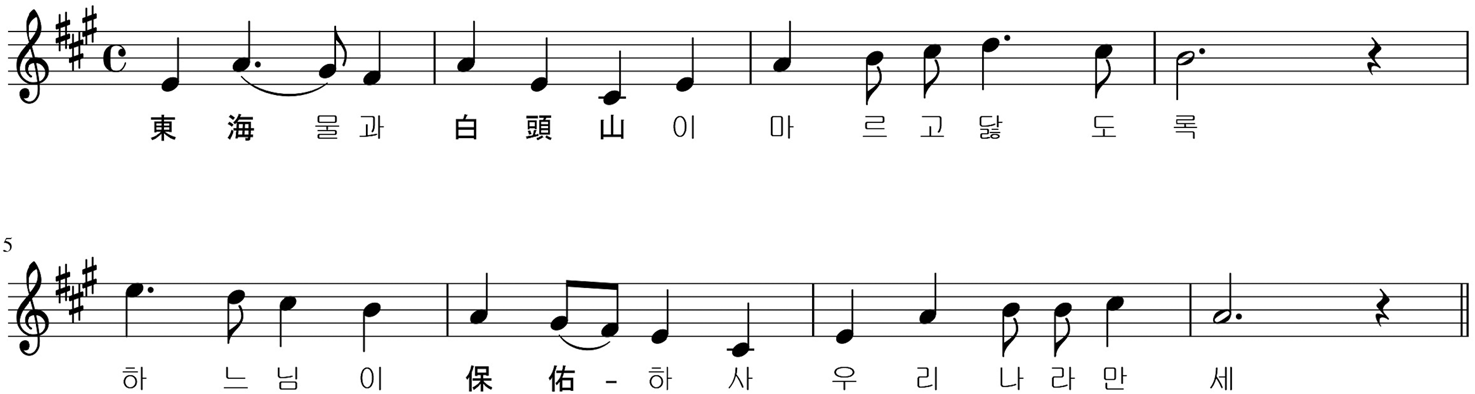
“Aegukka” (Korean national anthem), measures 1–8. Music by An Ik-t'ae and lyrics by unknown. Chosŏn Kungmin Ŭmak Yŏn'guhoe [Association for research on Joseon national music], (Haebangginyŏm) Aegukkajip [Collection of patriotic songs in commemoration of national independence] (Hansŏng: Chosŏn Kukmin Ŭmak Yŏn'guhoe, 1946), 17. Quoted in No. 0085K01120, Ehwa Music Database, www.Emusicdb.info.

Far more importantly than promoting these excursions into American and Russian art music, Haimowitz encouraged the KSO to perform music written by Korean composers in Western styles, particularly at national events. For instance, at the USAMGIK-supported celebration of the first anniversary of Korean independence from Japan, the KSO played the Korean national anthem, composed by An Ik-t'ae (Example 1).Footnote 60 At the second national anniversary of Korea's independence, held August 19–20, 1947, the orchestra performed Yi Hŭng-lyŏl's “Haebang Kinyŏmga” (Song of Liberation), a celebration of Korea's independence from Japanese colonial rule, and Kim Sŏng-t'ae's “Kkum Sok ŭi Ch’ŏnyŏ” (Girl in a Dream),” an aria from his opera Ch'un Hyang.Footnote 61 The story of Kim's opera is based on one of the most famous Korean classical novels, Ch'un Hyang Chŏn, a love story about crossing class barriers during the Joseon Dynasty.Footnote 62 Written in the Korean language and based on Korean cultural material, both songs emphasized Korean identity.
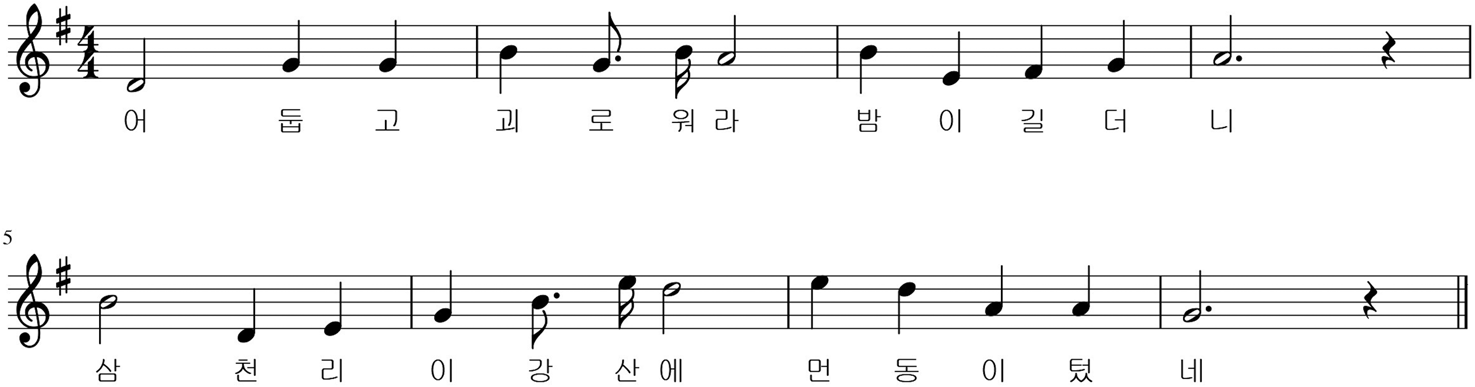
No recordings or sheet music from these songs have yet been rediscovered. However, given that Korean composers of the period often celebrated Korean independence using a Western-inspired type of march called haebanggayo (independence song), it is likely that Yi's “Haebang Kinyŏmga” (Song of Liberation) was written in that form. “Tongnip Haengjin'gok” (Independence March), written by Kim Sŏng-t'ae in 1945 (Example 2), is one of the most famous haebanggayos and exemplifies the genre's characteristic style. The Koryŏ Symphony Orchestra performed this piece at the first national middle school music festival, hosted by USAMGIK on May 10 and 11, 1947 at Geunjeongjeon Hall in Gyeongbokgung Palace, Seoul.Footnote 63
“Toknip Haengjin'gok” (“Independence March”), measures 1–8. After a long, dark night full of distress, the sun has risen over the whole land of Korea (lyric translation). Music by Kim Sŏng-t'ae and lyrics by Pak T'ae-won. Tongnip Haengjin'gok [March of Independence] (Seoul: Kukjeŭmakmunhwasa, 1945). Quoted in No. 0840K11644, Ehwa Music Database, www.Emusicdb.info.

In addition to haebanggayos, many other types of Western-influenced musical work gained recognition in the American zone. (By contrast, in the Soviet zone, Western music was sidelined by a socialist focus on Korean indigenous music.) Notably, for instance, both Yi and Kim, who had been trained in Western art music institutes in Japan, gained fame by producing numerous songs in a form called kagok. Footnote 64 Kagok emerged in Korea in the 1920s as a secular song form in which the melody is based on Western major/minor scales and the chord progression is based on functional harmony. Although kagok was modeled on the characteristics of German Lied and influenced by North American Protestant hymnody, the lyrics invariably reflect Korean people's lives and patriotism. Kagok has been associated with elite concert-going audiences, but many kagok pieces, including Yi's “Paugogae” (Rocky Hill) and Kim's “Tongsimch'o” (Yearning Leaves), are beloved by people throughout South Korea to this day.Footnote 65
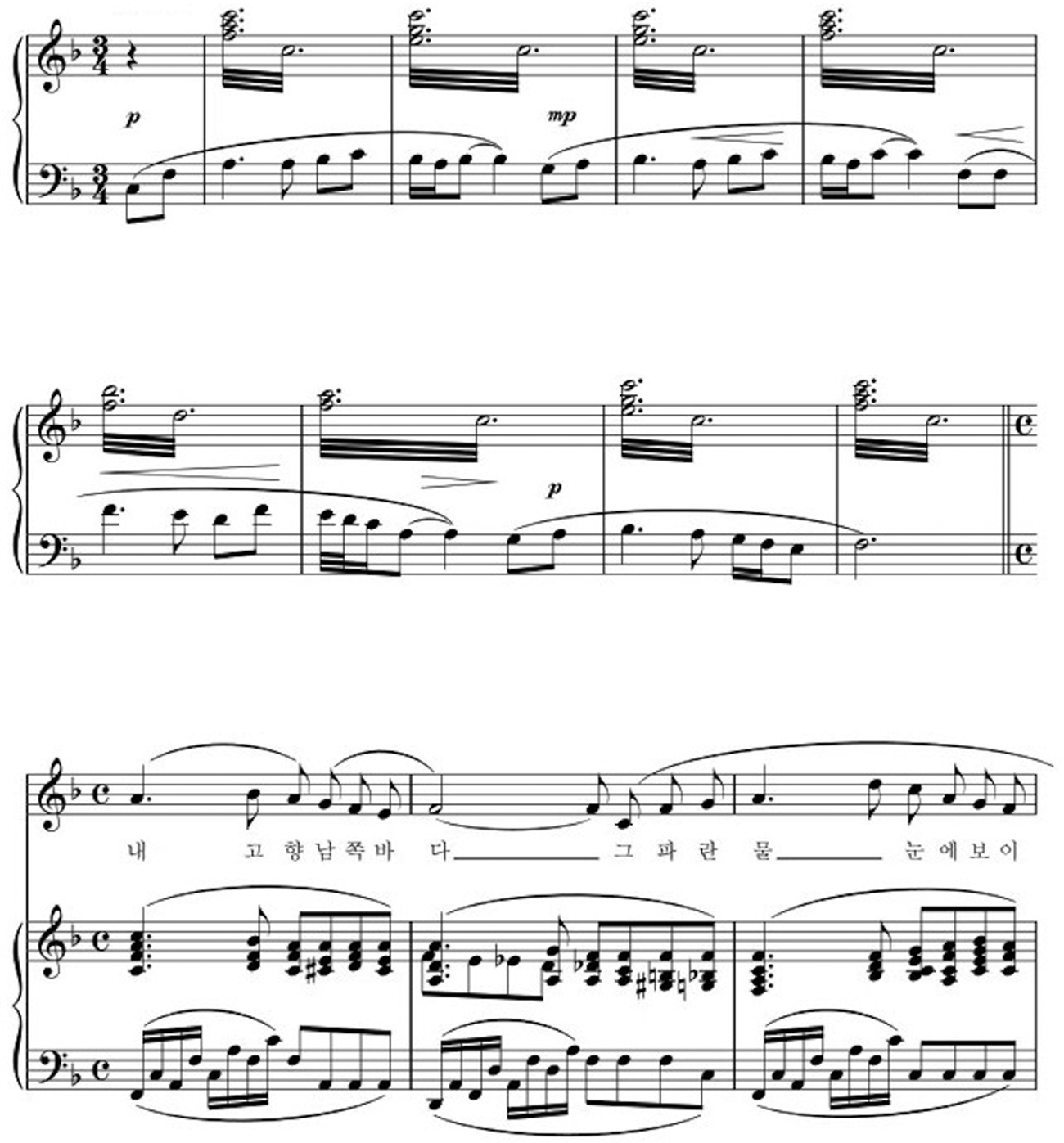
Kim Tong-chin, “Kagop'a” (“I Wish I Had Returned Home”), measures 1–11. Music by Kim Tong-chin and Lyrics by Yi Ŭn-sang. Kang-Yŏm Yi, ed., Han'gukkagok Paekkokjip [Selection of 100 Korean lyric songs] (Seoul: Kungminŭmak Yŏn'guhoe, 1976), 19.
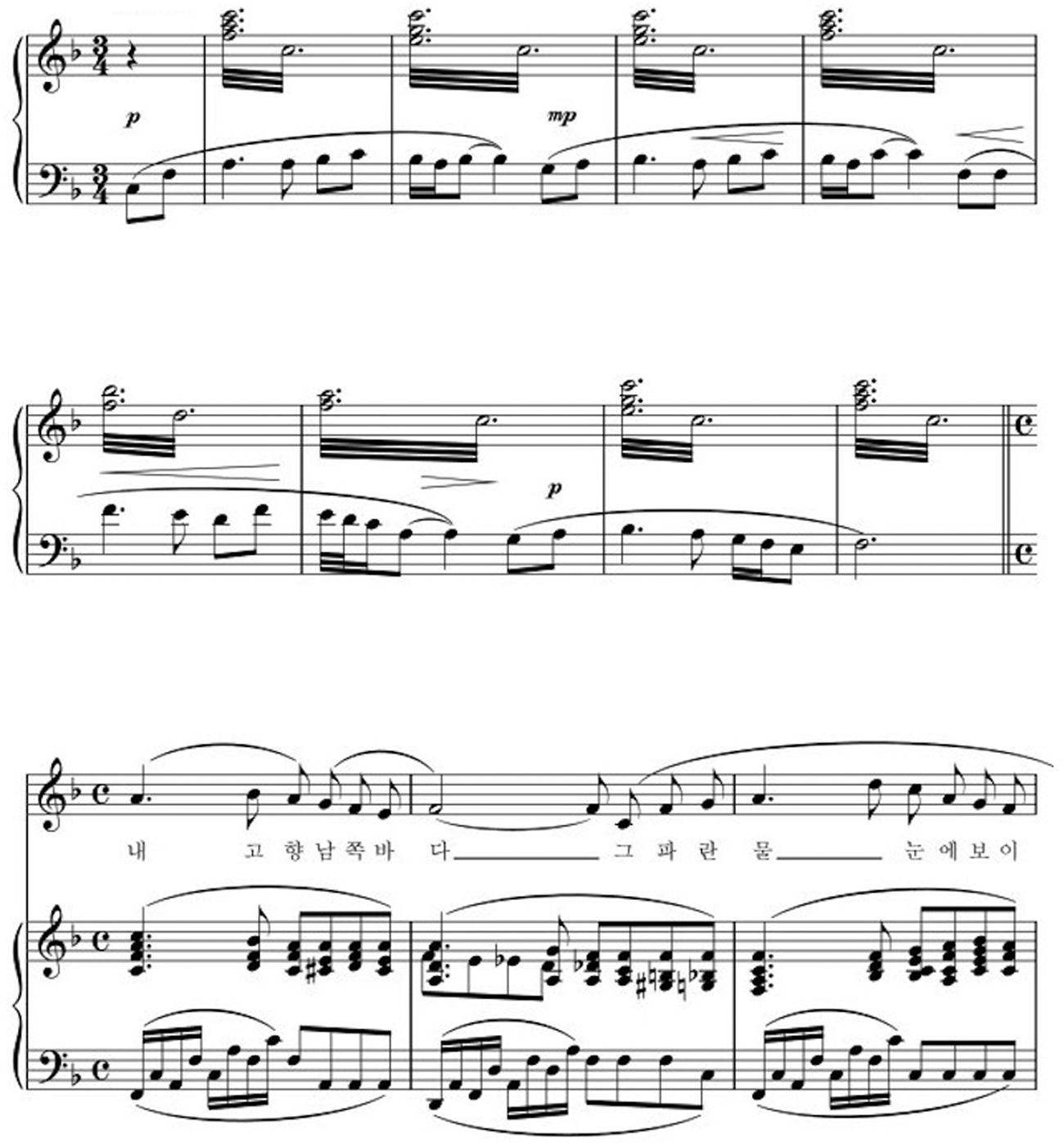
By contrast, the Soviet officials who governed in the north rejected kagok. Kim Tong-chin, who remained in northern Korea during the Soviet-US trusteeship but defected to South Korea in 1950, is considered one of the greatest kagok composers. In an oral history with Chŏn Chŏng-im, Kim reported:
At the time [during the Soviet occupation of North Korea], there were many Soviet artists in Pyongyang. The Soviet artists asked [North] Korean musicians to perform their country's modern music. I performed the music of Beethoven and Schubert for them. But they did not like it. They asked for modern music with an emphasis on the indigenous sound of Korea. I introduced them to old Korean traditional instrumental music, which supposedly emerged more than 1,000 years ago. They did not like this music because it was “just old traditional music.” They wanted to hear music that originated in Korean traditional music but developed in a modern Korean way. So I performed my kagok, “Kagop'a” (I Wish I Had Returned Home) [Example 3]. They rejected it by saying that “Kagop'a” was written in a Western style. They kept asking me to “perform your country's indigenous music.”Footnote 66
The lyrics of Kim Tong-chin's “Kagop'a” describes the sadness of Koreans who left their homes under Japanese colonial rule in order to participate in the Korean independence movement abroad. “Kagop'a” enjoyed great popularity among Koreans during the colonial period. In recent years, Korean critics have praised the song as an ideal exemplar of the kagok, due to its great artistry and use of through-composed form; indeed, “Kagop'a” is often described as having opened a new, modern chapter in the Korean art song.Footnote 67 In the 1940s, however, Soviet officials in northern Korea treated kagok as no more than Western-style music and ignored it. Kim Tong-chin's “Kagop'a” was even banned in North Korea.Footnote 68
In contrast to the Soviets, Haimowitz and the Music Section respected the kagok and haebanggayo and promoted them as high art. For example, at the middle school music festival hosted by the USAMGIK in 1947, the repertoire performed by the KSO included a number of kagoks and haebanggayos, including Yim Wŏn-sik's “Chayuchosŏn” (Freedom, Korea) and “Yŏntae ŭi Charang” (Pride of Solidarity); Pak T'ae-chun's “Chŏnwŏn ŭi P'yŏngwŏn” (Peace of the Idyll); and Kim Sŏng-t'ae's “Tongnip Haengjinkok” (Independence March; see Example 2).Footnote 69
Haimowitz was well aware of the value of this type of Western-style music written by Koreans. In a USAMGIK internal memorandum, he wrote:
It has been my sincere belief that we Americans should have tried to build up everything Korean; that is the best way of gaining the public confidence of the Koreans, who have come to think that we Americans think of them as just another group of, say, “Oriental negroes,” as one Korean put it to me. I feel that we should help make them [Koreans] known to the world because the Koreans are dependent upon us, for one reason, and of course, the most important reason now, is the fact that it is good OCI [The Office of Civil Information] material. . . . The Koreans are a very sensitive people, but also a very proud people; anything which we would so show them that we consider them to be our equals would have an infinitely wholesome reaction.Footnote 70
As this paragraph reveals, from an American perspective, Western-style music written by Koreans made for good propaganda material. Similarly, by supporting the KSO, Korea's own Western-style orchestra, Haimowitz and the Music Section satisfied Korean musicians' long-standing desire to develop the performance of socially prestigious Western art music and emerge on the international stage. Through such efforts, moreover, the USAGMIK effectively countered Soviet music policy, which overwhelmingly emphasized the importance of indigenous Korean music.
Haimowitz's Support for Korean Musicians Beyond His Call of Duty
During the post–World War II era, non-Western countries actively used Western art music in their nation-building projects. While Western art music widely functioned as a symbol of modernity, each country adopted and developed Western art music in different ways according to their positions in the emerging new world order, shaping new cultural identities in the Cold War context. In East Asia, under strong Soviet influence, the People's Republic of China and North Korea combined European orchestral music with their own folk music traditions, emphasizing their pro-communist stance. By contrast, both South Korea and Japan made great efforts to preserve their traditional music in its original state, while promoting Western art music without fundamental changes in its styles and forms.Footnote 71 Japan and South Korea shared many aspects of the musical reformation under the US occupation. However, the motivations behind the musical changes that took place in these two countries were completely different from each other.
During the colonial era, the empire of Japan successfully escaped colonization from the West. Japan modernized quickly through Westernization and colonized other Asian countries. Although it modeled its imperial expansion after the West, Japan ironically attempted to justify its own violence of colonialism in Asia by insisting that its new order would make Asia free from Western power. As World War II ended with Japan's defeat and the US occupation of Japan (1945–1952), however, many Japanese started to bring into question the domination of Western culture in Japan. Thus, the Japanese government revisited its own music traditions and their values.Footnote 72 By contrast, in South Korea, both Western art music and Korean traditional music helped to restore the people's ethnic pride damaged by Japanese colonial rule. As I have shown earlier in this article, South Koreans actively accepted Western art music disseminated by the USAMGIK as a symbol of modernity that would enhance Korea's international reputation. In the meantime, Korean traditional music was highly valued as a national heritage that had remained “intact” despite Japanese colonialism. It was during the USAMGIK period that those concepts and beliefs were forged and solidified in southern Korea with the US intervention. In these crucial years from 1945 to 1948, the efforts of Haimowitz as a central figure in the USAMGIK's music policy were not limited to fostering the performance of orchestral music—he passionately formed rapport with Korean musicians.
Haimowitz was not a high-ranking member of USAMGIK, but he was perhaps the only US military officer who maintained regular, sustained, official contact with Korean musicians and other prominent members of the Korean arts world.Footnote 73 Unlike many US military officers, who harbored strong racial and cultural biases against Koreans, Haimowitz consistently demonstrated a positive and respectful attitude. This goodwill enabled Haimowitz to maintain friendly relationships with many Korean musicians, and he rose high in their estimation. One notable exception was his strained relationship with Hyŏn Che-myŏng (1902–1960), the musician who led the KSO foundation and served as inaugural chair of the KSA. Haimowitz was extraordinarily open in his criticism of Hyŏn. However, even this hostility appears to reflect a certain political acumen on Haimowitz's part.
As a musician and historical figure, Hyŏn has long provoked mixed feelings among Koreans. He is considered one of the great pioneers of Western music in Korea; however, his pro-Japanese activities have left an indelible stain on his reputation. In 1937, Hyŏn joined the Chosŏn Munyehoe (The Art and Literature Association of Joseon), a pro-Japanese literary organization supported by the Education and Management Bureau of the Japanese Government General of Korea. An active participant in Taehwasuk, an organization established by the Japanese colonial administration to “rehabilitate” Korean independence fighters, Hyŏn also took the lead in composing and disseminating Japanese military songs during World War II.Footnote 74
Haimowitz was well aware of the strong animosity many Koreans felt for pro-Japanese collaborators. Upon the nation's liberation from Japanese colonial rule, ousting pro-Japanese collaborators from power came to be seen as an urgent task. Despite vociferous complaint and opposition, however, the USAMGIK maintained pro-Japanese collaborators in office in order to consolidate its control over southern Korea. Ever since then, from a Korean perspective, the continued empowerment of the “betrayers of the nation” has remained a serious problem with which to be reckoned.Footnote 75 As scholars have pointed out, the South Korean government has often emphasized and exploited the dichotomy between Korea as “pure victim” and Japan as “absolute plunderer,” an ideological trope mobilized to resurrect feelings of nationalism that emerged after Korea's liberation from Japan and strengthen national unity in moments of crisis.Footnote 76 As a prominent collaborator, Hyŏn has been at the center of controversy from the transitional period to the present day. It was in this context that Haimowitz denounced Hyŏn.
Faulkner, the first chief of the Music Section, was not inclined to make an issue of Hyŏn's pro-Japanese past when the musician was elected to serve as inaugural chairman of the KSA in January 1946. Unlike his predecessor, Haimowitz was very sensitive to anti-collaborator sentiment, and he did not hesitate to express his negative feelings toward Hyŏn. When the New York Times ran an article describing Hyŏn as a great figure who laid the foundations for the development of Korean music in the post-colonial period, Haimowitz wrote an angry complaint to the editor.Footnote 77 In his letter to the editor, Haimowitz clearly demonstrated his empathy with Korean anger toward former collaborators:
The impression is given that Mr. Rody Hyŏn [Hyŏn Che-myŏng] has been instrumental “in reorganizing the musical life of a nation of 30,000,000 people.” As one who has worked directly during this time with the many fine Korean musicians and music educators in South Korea who resent such an assertion, I can assure you that such is not the case. In your article, the work of the Department of Education is not mentioned. Actually, it was this department in Military Government that began the task of rehabilitating music in Korea, and that has, to date, with the cooperation of these musicians and teachers, shown a commendable record of accomplishments both in the public schools of Korea and also in music outside the schools. . . . Needless to say, Mr. Hyun has not been at all associated with the Music Section, Department of Education, during this occupation.Footnote 78
Of course, Haimowitz's letter was not entirely accurate, and it reveals multiple biases on his part. To begin with, Haimowitz strongly denies Hyŏn's contribution to the Korean musical world, insisting that Hyŏn had never been associated with the Music Section. Yet Hyŏn was the inaugural chair of the KSA convened by the Music Section. Moreover, the letter greatly overestimates the USAMGIK's role in rebuilding Korean musical life, and greatly underestimates the role of Korean musicians. The USAMGIK was hardly the sole organizational actor supporting the renewal of musical life in Korea. Korean musicians had formed a number of organizations to support this task, including many that specialized in Western music, such as Chosŏn Ŭmakka Hyŏphoe (The Musicians' Association of Joseon), Taehan Yŏnjuga Hyŏphoe (Korean Music Performers' Association), and Chŏn'guk Ŭmakmunhwa Hyŏphoe (The National Society of Music and Culture).Footnote 79 Indeed, the KSO itself was formed by Korean musicians on September 15, 1945, just days after the USAMGIK itself was initiated, and the orchestra was formed with the express purpose of cultivating Korean musical life.Footnote 80 As a memorandum of USAMGIK reveals, the USAMGIK did not begin to offer its support to the KSO until after December 14, 1945, when Faulkner first heard the orchestra play.Footnote 81 Thus, it was disingenuous of Haimowitz to describe Korean musicians as mere collaborators of USAMGIK and to ignore Hyŏn's contributions to the Korean musical world.
Yet Haimowitz's denial of Hyŏn's contributions was rooted in his distaste for Hyŏn's pro-Japanese activities during the colonial period, and this opinion, at least, was acceptable to nationalist Korean musicians. Haimowitz's letter to the editor of the New York Times continued:
Mr. Hyŏn is well known among Korean patriots as an ardent pro-Japanese collaborator and opportunist who entertained Japanese troops extensively. This is commonly referred to among informed Koreans. . . . One incident may serve to illustrate: at a music contest sponsored by the Japanese in the summer of 1945, a young Korean violinist Li Tong Hi played a series of variations on the melody “Home Sweet Home.” Though his playing was not the best, he managed to receive a passing score; but one of the judges, a Japanese, Mr. Oba Yunosuke, objected because his technique was poor, and complained that he should not have received the passing score. At this juncture, another judge, Mr. Rody Hyŏn, pointed out that it was not a question of whether or not his playing was good or bad, but that he had played “enemy” music. For this he [Hyŏn] was applauded by the Japanese, who, of course, immediately ruled the boy out.Footnote 82
In his rhetoric and actions, Haimowitz appears to have adopted the position of an ally to pro-US Korean musicians, taking their animosities as his own. Haimowitz's anger toward Japanese collaborators impressed Pak Yong-ku, one of the most influential Korean music critics specializing in Western music at the time. In an oral history, Pak recalled that Haimowitz first alerted him to the New York Times feature on Hyŏn. One day, Haimowitz visited Pak, decrying the New York Times article as “distorted.”Footnote 83 Pak himself had openly criticized Korean musicians such as Hyŏn who oppressed other Koreans under Japanese colonial rule. Hence, Haimowitz's denunciation of Hyŏn was bound to make a favorable impression on Pak.Footnote 84 When asked what he thought of Haimowitz, Pak answered:
It might have been a part of USAMGIK's cultural policy. On the other hand, however, I believe that he [Haimowitz] tried his best to do what he was supposed to do in a country liberated from colonial rule, with a sense of duty, beyond his own benefit as well as ideology. . . . I thought he was a really good guy!Footnote 85
As this anecdote reveals, Haimowitz's strong support for anti-Japanese sentiment was strategically important and allowed him to win the trust of many Koreans. Nonetheless, it would be rash to conclude that Haimowitz's positions on the matter were strictly calculating. In addition to supporting anti-Japanese sentiment, Haimowitz took a stand against American soldiers' racism toward Koreans. Haimowitz sent a report about American biases against Koreans to the military governor, John Hodge. In it, Haimowitz described occasions where he observed US military police swearing about, and at, Koreans. He also noted that Korean dancers who hosted a dinner and performed for American officers were not permitted to eat with them. Haimowitz added:
Was it fine to treat the two dancers in this stand-offish, snobbish manner such as southerners would treat a guest Negro chorus in a small, white high school in the deep south? I was completely ashamed of the manner in which they were treated.Footnote 86
Clearly, Haimowitz was disillusioned enough with American racism against Koreans to write a somewhat provocative report to his commander. In my interview with Haimowitz's daughter, Valerie Haimowitz, she said “my father identified himself a Jew but he was not religious and rather scorned organized religion. I'm sure he was strongly against racism of any kind.” His Jewish identity would be a reason why, despite being white, Haimowitz was so sensitive to American racism in Korea.Footnote 87 It is unclear whether Hodge ever responded to Haimowitz's report. Given Haimowitz's low rank in the USAMGIK and Hodge's insensitive approach to cultural policy, Haimowitz's letter was likely ignored.
There are additional clues that Haimowitz's support for Korean musicians went beyond his call of duty as a US military officer. Haimowitz not only voiced anti-Japanese and anti-racist sentiments in solidarity with the Koreans he admired, but he also advocated on behalf of pro-communist Korean musicians—even as the USAMGIK was arresting pro-communist Koreans. The former Korean court musician Ham Hwa-chin was one of those arrested by the USAMGIK. Haimowitz appealed to the military government to release him, emphasizing Ham's importance as an authority on Korean traditional music.Footnote 88
Haimowitz also had a close relationship with the pro-communist Kim Sun-nam. As one of the most talented Korean composers of the period, Kim wrote many musical works in Western styles. However, the USAMGIK issued an arrest warrant for him based on the fact that Kim had composed several pro-communist songs, such as “Inmin Hangjaengga” (Song for the Korean Proletarian Uprising) and “Namjosŏn Hyŏngjeyŏ Itjimara” (South Korean Brothers, Don't Forget). After the warrant was issued, Haimowitz harbored Kim in his car to help him avoid arrest, and he endeavored to help Kim move somewhere where he could continue his career. Haimowitz got Kim a scholarship to the Music Academy of the West in Santa Barbara—the same institution to which he had recommended Yim and Yun in 1946—but due to the outstanding arrest warrant, Kim could not travel to the United States.
Even after Haimowitz returned to the United States in 1948, he continued to support Kim. Haimowitz showed Kim's manuscripts to the American composer Aaron Copland, and Copland offered Kim a scholarship to the Tanglewood Music Festival in Massachusetts. Kim did not accept the offer and eventually moved to North Korea. In an oral history, Pak Yong-ku emphasizes how it was thanks to Haimowitz that Kim was able to continue his musical career despite defecting to North Korea. From North Korea, Kim went to Moscow and studied with the Soviet Armenian composer Aram Khachaturian for two years. He returned to North Korea, where he lived until his death several decades later.Footnote 89
It hardly needs to be stated that Haimowitz's advocacy on behalf of pro-communist musicians did not align with USAMGIK policy. Indeed, following his return to the United States, intelligence agents investigated Haimowitz for his continued support of pro-communist Korean musicians such as Kim.Footnote 90 What made Haimowitz even take the risk of supporting these musicians, contrary to USAMGIK policy and against the harrowing backdrop of the mounting Cold War? To answer this question, we need to pay attention to Haimowitz as an individual and as a musician. Although we tend to fix historical figures with stereotyped images according to their national identity and political allegiances, Haimowitz can be reduced neither to the image of a cold-hearted US military officer mindlessly upholding US policy nor to the image of a selfless humanitarian. As Pak has recalled, when Haimowitz first came to southern Korea, he was just a twenty-five-year-old American and promising musician whose career as a concert pianist had been compulsorily interrupted. Likewise, the Korean musicians who extended their trust to Haimowitz cannot be reduced to passive recipients or victims of USAMGIK propaganda. Although they hailed from different ethnic and cultural backgrounds, the Korean musicians were contemporaries of Haimowitz who shared much in common with him as musicians including their shared difficulties pursuing musical careers during the war and in the period of turmoil that followed. Thus, a strong bond of sympathy developed between Haimowitz and many Korean musicians.Footnote 91 While it is true that Haimowitz advocated for Korean musicians as a part of the USAMGIK's cultural strategy, he also shared heartfelt friendships with Korean musicians, and he suffered ethical dilemmas in working with them. This was the complex figure who, at times, spoke up for Koreans against USAMGIK policy.Footnote 92
Conclusion
Due to their experience under Japanese colonial rule, Korean nationalists were relatively open to Western music, and many welcomed the USAMGIK's music policy under Haimowitz's tenure. At the same time, the racist and violent behavior of certain USAMGIK employees and soldiers roused Koreans' antipathy and even contempt. In this context, Haimowitz's explicitly anti-racist and anti-Japanese stances, as well as his support for certain pro-communist musicians, may well have helped to cover the USAMGIK's grave faults, appeasing pro-capitalist Korean musicians and encouraging them to continue supporting the American presence. What emerged was no mere top-down reformation of Korean music by the USAMGIK; rather, it was the complicated entanglements between Haimowitz and Korean musicians that accelerated the spread of Western-style orchestral music in the American zone during the transition from colonial to Cold War eras.
Scholars have pointed out the strong influence of Korea's experience under Japanese rule and memories of the colonial past on the formation of postcolonial Korean cultural identities.Footnote 93 Even during the Japanese colonial period, however, Japan was not the only agent that shaped musical lives in Korea. As Hyun Kyong Hannah Chang demonstrates, from the late nineteenth to the early twentieth century, Japan's rivalry with the United States for East Asia stimulated the flow of American missionaries into Korea, resulting in new cultural practices of American hymn-singing.Footnote 94 Complicating the picture yet more, tensions between the United States and Soviet Union emerged as another significant variable affecting musical developments in southern Korea under the USAMGIK. It was in this context that the USAMGIK strategically selected, circulated, and fostered Western orchestral music, utilizing these repertoires as an ideological tool.
In many respects, Western orchestral music was ideally suited to the USAMGIK's purposes, given that it was associated with social prestige and national pride in southern Korea but rejected in the Soviet zone. Thus, the USAMGIK used Western orchestral music, despite its European origins, to propagate US democracy. Filtered and mediated by the United States, Western orchestral music was widely circulated and appropriated in Korea under the USAMGIK. In this Cold War context, Western orchestral music has fashioned a South Korean cultural identity that emphasized its alliance with the United States. Although South Korea is geographically located and culturally imagined as non-Western, Western music became an essential part of constructing South Korea's national identity. US Cold War music diplomacy reconfigured the imagined cultural geography of South Korea.
In this turbulent period of Korean history, American pianist Ely Haimowitz represented nearly the sole point of contact between the American officers of the USAMGIK and the Korean musical community. As this article has examined, the pro-American stance that many Korean musicians nurtured was greatly informed by their relationships with Haimowitz. The complex and contradictory entanglements among Korean musicians, Haimowitz, and other US military personnel reveal that music diplomacy cannot be explained solely by a unidirectional action from a country to its target country. Even when they serve their country's interests, those involved in the political activities are still individual human beings who do not always follow orders exactly or conform to the ideologies of the organization that they present; rather, individuals live together with their own feelings and emotions. Haimowitz's biases and inner ethical conflicts largely influenced his political performances under the USAMGIK. We can best understand these actions by examining him as an individual first, not as a vessel for USAMGIK's music policy. As scholars, we need to pay more attention to musical and human encounters that music diplomacy creates. Unless we have a more nuanced understanding of the role of individuals and human interactions in music diplomacy, we miss the contextual details of music circulation and reception motivated by political actions.