Introduction
According to Erik Erikson's (1950/Reference Erikson1963: 267) theory of psychosocial development, generativity ‘is primarily the concern in establishing and guiding the next generation’. Recent formulations emphasise generativity as an integration of two orientations toward the next generation, which extends the influence of oneself (agency), and through this, nurtures and gets close to young people (communion). Originally conceived as a midlife developmental task, generativity is becoming more relevant in later life as people have tended to delay procreation and live longer (United Nations 2005). Nowadays, it is common to find that people of late-middle age or even at the beginning of old age have dependent children. For those with grown-up children, older people can be a valuable resource for home-making and taking care of grandchildren. Thus active concern for one's offspring is very much part of later life. On top of these intra-familial contributions, older people often provide help to unrelated others in the form of voluntary work (Snyder and Clary Reference Snyder, Clary, de St Aubin, McAdams and Kim2003) and produce items of lasting value (e.g. maintaining or repairing traditional art, writing memoirs or autobiography). These activities can be conceived as stimulated by an older person's motivation to invest in the welfare of their offspring and in society at large before they become incapacitated or pass away. Indeed, older people report as many, if not more, daily activities that nurture the next generation as midlife adults (McAdams, de St Aubin and Logan Reference McAdams, de St Aubin and Logan1993; Sheldon and Kasser Reference Sheldon and Kasser2001). It has been shown that from the older persons' perspective, still being able to contribute is associated with a positive quality of life (Cheng, Chan and Phillips Reference Cheng, Chan and Phillips2004).
‘Generativity’ began as a psychological construct, a state in an epigenetic sequence of psychosocial maturation. This paper argues, however, that its manifestation is constrained by the social and cultural environment that provides norms for and opportunities to be generative (McAdams and de St Aubin Reference McAdams and de St Aubin1992). In this connection, it should be noted that the technological and social forces that drive population ageing have also widened the distance between successive generations. As Kai Erikson (Reference Erikson, de St Aubin, McAdams and Kim2004: 53) put it, ‘the pace of technological change and the growth of human knowledge are now climbing so sharp an incline almost everywhere in the world that the skills and outlooks of the present generation may be of limited value for the worlds their children will soon occupy’. In a similar vein, McAdams, Hart and Maruna (Reference McAdams, Hart, Maruna, McAdams and de St Aubin1998) asserted that ‘generativity mismatch’ occurs when social changes in modern societies are so fast that the older generation's experiences and abilities to offer guidance fail to match the demands of the younger generation for new knowledge. The debilitating power of social and technological transformations on the generative realisation of the older generation was vividly captured by Cattell (Reference Cattell1994) from her study of Kenyan grandmothers:
Advising—in the sense of imparting knowledge and providing moral and social guidance—has been a pre-eminent duty of older Samia. But now ‘it isn't easy to advise’, because young people want the knowledge of schools and books, which grandmothers lack. Hardly any women over the age of 50 had any formal schooling; they cannot read or write, some do not even count in the modern styles. Often older women do not know what younger women want to know. For instance, preventing pregnancy is a topic of great interest to most young people. When grandmothers were young, a bride was expected to be a virgin … it would be a rare grandmother who possesses this knowledge (1994: 169–70).
The situation in Hong Kong is very similar. Hong Kong's population has grown substantially since World War II and the communist takeover of China in 1949. During this turbulent period, and because of Hong Kong's colonial history, there was little opportunity for the current cohort of older people to receive more than rudimentary education when they were young. Many as adults struggled for food, shelter and to maintain a family, and for periods had several jobs, usually as semi-skilled or skilled workers. The 2001 population census showed that 42.4 per cent of those aged 65 or more years had received no formal education, and another 39.2 per cent had received only primary education (Census and Statistics Department 2002). Compulsory education for nine years began in 1971, so receiving secondary education and even some tertiary education is now the norm in Hong Kong.
The rapid development of Hong Kong from a fishing port into one of the major financial centres in Asia, along with the educational gap between the generations, presents an interesting opportunity for the study of the forms of generativity in a changing society. Traditionally, older people had high status in the family, and under the Confucian code of conduct children were bound to serve and respect their parents. When, however, a household's production and income are no longer tied to cultivable land that is passed from one generation to another, older people lose status, and traditional values are under constant pressure – they either transform or are put aside (Aboderin Reference Aboderin2004; Cheng and Chan Reference Cheng and Chan2006). Conceivably also, the growing opportunities for formal education depreciate the perceived value of older people's accumulated knowledge, and their reputation for practical wisdom is undermined. A widening gap between older and younger generations seems to be universal in rapidly developing societies.
This generation gap raises an important issue. How do older people realise generative drive when their expertise and knowledge, and the values and norms that they espouse, are no longer deemed desirable or relevant by the younger generation? Although elders are by tradition highly regarded in Chinese communities, these values have been gradually eroded (Cheng and Chan Reference Cheng and Chan2006), which probably means that inter-generational disputes occur more frequently. A related question is therefore whether older people's efforts to establish and support the next generation are appreciated, disregarded or even treated with contempt, and what effects such reactions have on their generative development. In approaching these questions, we agree with de St Aubin (Reference de St Aubin, de St Aubin, McAdams and Kim2004: 66) that, ‘a top-down approach to cross-cultural work would ultimately fail to capture the specific generativity dynamics unique to a particular culture. Starting with an established model a priori and trying to fit it to different cultures limits our ability to advance generativity theory’. For this first exploratory study of generativity in Hong Kong, we decided to use a qualitative method that focuses on the expressions and their meanings of those who are experiencing social and familial change; in other words, the study is an investigation using ‘bottom-up’ processes.
Methods
Participants and organisation of the focus groups
We chose the focus group as the mode of data collection because local evidence had shown that it enables older people to talk openly and energetically (Cheng, Chan and Phillips Reference Cheng, Chan and Phillips2004). Moreover, the multiple points of view that are expressed, and their interactive discussion, facilitate collaborative and consensual interpretations (Wilkinson Reference Wilkinson and Smith2003). The participants were recruited from social centres for older persons run by non-governmental organisations. Approximately one-third were men.
To ensure that the expressions for analysis were not biased by age, socio-economic group (SEG) or level of social participation, we constituted eight focus groups that were stratified by these characteristics. Thus, two focus groups were composed of people aged 60–74 years (the ‘young-old’) and of lower SEGs, two of people aged 75 or more years (the ‘old-old’) of lower SEGs, two of ‘young-old’ middle class people, and lastly two of ‘old-old’ middle class people. ‘Middle class’ participants were defined as having some secondary education, a household income of at least HK$ 15,000 (equivalent to US$ 1,900) or more per month, and living in private housing. ‘Lower class’ was defined as not meeting any of these criteria. For each age-SEG combination, one focus group was composed of those who participated in social-centre activities frequently, and the other of those who rarely attended. The two groups are distinguished as socially ‘active’ and ‘inactive’. We aimed to recruit 12 participants for each focus group.
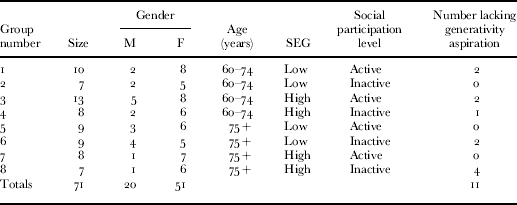
There are over 350 social centres for older people in Hong Kong. Ten were randomly selected from a full list and approached in sequence one by one. The manager of each centre was asked to co-operate by identifying willing participants who met the selection criteria. The first five centres approached were able to provide the expected number of participants for each focus group (although some did not turn up for the focus group meeting). In one group, a participant brought along a friend who also met the inclusion criteria; this group had 13 members. Altogether, 51 women and 20 men participated.Footnote 1Table 1 details the characteristics of the groups and participants. The sampling strategy achieved the desired diversity in the sample (Cheng, Chan and Phillips Reference Cheng, Chan and Phillips2004; Stein and Mankowksi Reference Stein and Mankowski2004).
Characteristics of the focus group participants
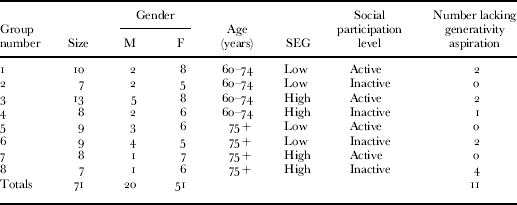
Note: SEG=socio-economic group.
Each focus group meeting was conducted in Cantonese, led by an experienced moderator, and divided into four sections. In the first section, to orient the discussion towards the overall topic of generativity, the participants were asked to give their thoughts about the younger generation and society. Next, they were asked to talk about what they wanted to do for the younger generation and society. Following this, they were asked to give examples of their attempts: (a) to nurture the younger generation, (b) to contribute to society, and (c) to leave a legacy. Finally, they were asked to describe their feelings about the reactions of their family members and others to their generative actions. Because clear differences were not found between the comments made by men and women, by middle and lower class participants, and by active and inactive members (e.g. the inactive participants were not more likely to see generativity as irrelevant to them), the findings for the sample as a whole are reported.
Data analysis
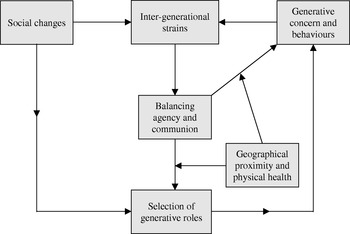
The grounded theory approach and its constant comparative method were adopted (Strauss and Corbin Reference Strauss and Corbin1998). The focus group transcripts were open-coded by the second author line-by-line, which identified 115 emerging concepts; ambiguities were resolved by consultation with the first author. The axial coding was initially conducted independently by all three authors, after which mutual agreement was reached through discussion. Related concepts were then grouped into broader but still homogeneous categories with closely inter-related items. The third stage of analysis comprised selective coding, in which the inter-relationships of the higher-order categories were refined and elaborated. One of the identified core categories was ‘balancing agency and communion’. Around this theme, a theory of the dynamics of generativity realisation was developed with special reference to a society in which older persons did not benefit as much as younger generations from social development. In accordance with the principle that new theories or hypotheses should represent ‘the voices of many’ (Strauss and Corbin Reference Strauss and Corbin1998: 145), only those categories that emerged in at least four of the focus groups were included in the elaboration of the theory. It is summarised schematically in Figure 1. The theory reveals the tension between older persons and their children as a result of the former's need to fulfil their concern for the next generation in the context of social changes which undermine the status of older persons and limit the kinds of generative roles that they can comfortably play. This leads to a reconsideration of the balance between agency and communion in the pursuit of generativity, involving oftentimes an orientation toward the pursuit of communion over agentic expressions in later life, along with modified views of one's responsibilities toward the next generation so as to preserve the generative self. These tendencies are further modified by one's physical condition and the geographical distance from a child's home. These ideas will be considered in depth in the following section.
Manifestations of generativity in a context of social changes.

Two caveats need to be borne in mind. First, not all participants saw a continuing need to care for the next generation. In fact, consistent with Erikson's (1950/Reference Erikson1963) postulate that generativity is evident mainly in midlife, some participants did not believe that caring for the next generation was essential or urgent because their grown-up children were old enough to take care of themselves (see Table 1). Some justified this view by referring to their own experience; they reasoned that because as young adults they had not received help from their parents, their own children would cope well without their care. Others believed that generativity would have been more feasible when they were younger and more capable (Fleeson Reference Fleeson and Rossi2001; Stewart and Vandewater Reference Stewart, Vandewater, McAdams and de St Aubin1998), and some were content with the contributions that they had already made to their offspring and to society. The following theoretical propositions are therefore based on the views of the majority of the participants who were committed to the welfare of the younger generation.
Secondly, although it has been argued that many older people freed from family responsibilities realise their generativity in the civic domain (Keyes and Ryff Reference Keyes, Ryff, McAdams and de St Aubin1998; Rossi Reference Rossi and Rossi2001), our participants devoted their concerns almost entirely to their own offspring. This might reflect the familism espoused in Confucian societies (Yang Reference Yang, Sinha and Kao1988). Additionally, their lack of confidence in influencing their own offspring (see below) might have discouraged them from trying to make a difference in civic affairs. For instance, although voluntary work is a common expression of generativity in western countries (Snyder and Clary Reference Snyder, Clary, de St Aubin, McAdams and Kim2003), most participants said they were not sure how they could become a volunteer or what they could do. This echoed the finding of a recent representative survey of Hong Kong's older population that only five per cent had participated in voluntary work during the previous 12 months (Hong Kong SAR Government, Health, Welfare and Food Bureau, unpublished data). As a result, unless otherwise stated the term ‘younger generation’ refers hereafter to the participants' offspring.
Results
Social change
Social change was one of the most prominent themes to emerge from the focus group discussions, and was characterised mainly by the contrasts in the lifestyles and educational attainment of successive generations. The impact of rapid technological advances was mentioned by seven of the eight focus groups as a distal causal factor, so that the knowledge and experiences of older people were considered obsolete, especially when the impact of societal changes penetrated every aspect of domestic life. Many said that their lack of education and illiteracy made it difficult to keep pace with changes in information technology and to realise their generative intent, as younger people are much more educated nowadays. As a result, their role as keepers of traditional wisdom was diminished, which undermined the significance of their concern for the younger generations. Some even internalised a sense of inferiority when comparing their educational attainment to that of their offspring. One participant from Group 3 put it in these terms:
In the past, we played marbles on the streets; our grandchildren now use computers. No way can we be compared to them. I have to ask them to teach me; we cannot teach them anything. When they ask you about computer knowledge, you are just speechless; we cannot teach. Time leaps; we are not able to teach. Knowledge progresses very fast, our knowledge is just not working [useful].
Generative concern
Interestingly, their helplessness in the face of technological advances went hand-in-hand with a sense of urgency in teaching and guiding the younger generation. Some expressed worries about the negative influences that social changes had on younger people, and thought that guidance was indispensable for their positive development. It was this sense of urgency in ‘saving’ the younger ones and how little they felt that they could contribute that best demonstrated their generative concern and dilemma. One woman in Group 4 said, ‘nowadays, the technology is advanced, everything changes very rapidly. If we do not teach now, many [bad] things may be implanted in their mind’. We will return to the issue of generative concern when we come to the participants' views about what can and should be passed on to the next generation, and consider how they had realistically adapted their understanding of generativity, given the constraints. Several examples of generative behaviours will be mentioned in the following sections.
Inter-generational strain
Many of the elders' generative efforts were met with disapproval. Their sense of inefficacy and inferiority was reinforced every day by their offspring's reactions. Many participants lamented the lack of appreciation of their generative efforts, even in areas about which they were supposedly experts. One woman in Group 5 recalled that when she advised her daughter-in-law how to prepare a more appetising dish by slicing the ingredients, she dismissed the suggestion and said that it would make no difference at all. Another woman in Group 5 said, paraphrasing her granddaughter's ‘standard script’, ‘If I tell her to do something different, she says, “Stop talking, granny. It is fine, I know it”. If you say a few words more, she says, “You're nagging”’. A third woman said, ‘The younger ones can earn money; so they think they don't need your advice. [If you give advice] they lose their temper’. A man in Group 5 echoed these remarks, when recounting what happened when his sons caught colds during the SARS outbreak and he expressed concern. He ended up being scolded by his son for ‘meddling in my affairs’. He said to his son, ‘I feel so upset. Parents are supposed to be concerned about you [children], not to hate you. Why did you speak [to me] like that? I am very unhappy’. During the focus group he added, ‘what else can I do for the next generation?’
Balancing agency and communion
This was identified as the core category of the participants' expressions. Coincidentally, it echoes well what theorists regard as the integration in generativity of two fundamental social motives, ‘agency’ and ‘communion’ (McAdams Reference McAdams1985; Peterson and Stewart Reference Peterson and Stewart1996). In other words, it concerns how to make a difference (i.e. agency) while maintaining good relationships with offspring (i.e. communion). This core category was abstracted from 40 lower-order categories, among which the most prominent themes were a desire to be respected, a sense of low efficacy in influencing or helping younger people, and uncertainty about ways to maintain good communication and to get along well with younger generations. As the label (‘balancing’) suggests, this category describes a dynamic state of affairs, in which the desire to make a difference in the lives of younger family members is constantly evaluated against the need to maintain a sense of harmony and togetherness. Hence it was important for our participants that their attempts to guide and establish their children and grandchildren are also approved and welcomed by them. This illustrates how generativity is manifested differently in old age and in midlife, when the status and authority differential between ‘parent’ and ‘child’ are markedly different. In a Chinese society, such a differential is clearly tied to the decline in the status of older persons as a result of changing filial attitudes. The result, as we heard often from the participants, is a calculated trade-off between agency and communion in the context of changing intergenerational relationships, and the adoption of behaviour that maintains a certain level of impact while preventing relationship strain.
Although respect for elders is traditionally valued, older people often have to adjust their expectations to reality (Cheng and Chan Reference Cheng and Chan2006); that is, to change their behaviour to avoid conflict with family members. This is particularly important in a collectivistic society that places great value on harmony in personal relationships (Markus and Kitayama Reference Markus and Kitayama1991). Cognisant of the fact that their generative efforts were not necessarily valued, many participants described how they tactfully exercised their generative intent to get along well with the next generation. Although they liked to offer advice and help, they felt that they needed to do it in a way that would not be seen as interfering with their children's decisions. Respecting the autonomy and privacy of the younger generation, and waiting for invitations to help, were the most frequently mentioned strategies. If no invitation was forthcoming, some said that they would rather remain ‘silent’ to avoid conflict. They felt that these strategies not only promoted positive relationships with their offspring, but also positioned themselves well for their generative roles. An exchange among three participants (P) in Group 7 lucidly captured this tactic:
P1: So when he [son] needs you, you have to be ready; when he does not need you, you better be smart. … If he needs you to take care of him, needs your help, then you should. If he does not need you, you better not interfere, even pretend to be invisible. … So no matter if we are getting along with [them], you have to act depending on the situation.
P2: In a word, being sensible.
P1: You have to evaluate the situation.
P3: Right: if he or she isn't happy, you should never ask him or her so many questions.
Role identification
Given the strong desire to maintain harmony, roles that aroused conflict were discarded while those that were less controversial were retained. There must be a certain level of competency in performing the remaining roles, otherwise there would be no sense of generative accomplishment. Thus, most participants saw their roles as primarily to provide practical assistance in household chores and baby-sitting, which freed their children for work. Although they did obtain satisfaction from such routine tasks, a sense of their significance was accentuated when they were called upon to help, usually when their children encountered unexpected difficulties (e.g. sickness) or even a crisis (e.g. unemployment). These situations were, however, infrequent. For the most part, the participants had to accept, if reluctantly, the limited roles that they could play day to day, or else conflicts arose. These limited roles might then curtail as circumstances changed, as when grandchildren became older or when the older person's health deteriorated. Two participants in Group 1 described the dilemma well:
P1: In my mind, I want to help, but I really don't know what I can do. … Like I started to baby-sit my grandchildren when they were small; three of them, going to school, picking them up from school, cooking for them. Now they have grown up, and no longer need my assistance.
P2: Most of the time I help with household chores. I don't know what else I can do, now that the grandchildren are in primary school.
Sometimes such limited roles become important buffers in crisis situations. A woman from Group 7 gave a vivid example:
My daughter-in-law was in labour prematurely and there were birth complications. [I] had to be highly aware [of her needs]. I was not living with her. Although she had a [Filipino] domestic helper, I still think there are differences between foreigners and the Chinese. Then I went [to her home] on my own initiative and took care [of my grandson]. … He is a teenager now but my daughter-in-law still appreciates [my assistance]. She says to me, ‘without you, the baby would not have made it’. It was I who worked so hard to take care [of him] until he had grown up. … It is not [that I looked for] credit; it was my responsibility.
Physical proximity and health as contextual factors
Two objective conditions were delineated as either promoting or inhibiting generativity, namely proximity and health. Geographical distance between the older person and their children was considered a major determinant of whether they could exercise generativity. The participants who lived with their children were more confident about being able to help, whereas those living apart saw relatively few opportunities, especially when foreign domestic helpers had been hired to perform household and childcare tasks (this is common in Hong Kong). This issue was further compounded by health problems, which limited the ability to travel. Indeed, a decline in physical health was nominated by many participants as the reason why they felt powerless to care for the younger generation. For instance, physical decline might mean that they lacked the energy required to take care of grandchildren as they once did. Worse, they might come to a point when they were themselves physically dependent, and so needed to be taken care of rather than able to take care of others. These compounding difficulties were succinctly summarised by a woman in Group 5:
Frankly speaking, if they [the children] move out, certainly you do not have to be responsible for housekeeping. I am so old now that I even need someone to help me with housekeeping. How can I help them?
When the older person did not live with children, extra efforts were made to deliver care, though not necessarily every day, as was done by two Group 4 participants:
P1: Although we do not live together, I would cook soup and take it to them (the children). … They have to work. … We know how to cook healthier dishes.
P2: I would buy the ingredients and put them in a bag to be given to the Filipino maids to cook. … The maids have no such knowledge.
The uncertainty of physical deterioration can weigh heavily in an older person's calculation of his or her commitment to the generative role, and in the consideration given to communion versus agency. The participants were aware that one becomes more dependent on children as one's health deteriorates. As a woman from Group 7 said:
I remember that my son asked me about four years ago, ‘Mom, if I have my own children, would you help to baby-sit?’ I replied, ‘No way, I won't baby-sit. Don't depend on me, better you do not have a child [if you can't handle it yourself].’ I just couldn't make a promise, because you do not know what your physical condition will turn out to be after a year. … I wanted to help from the bottom of my heart, but I just couldn't say it out loud.
The adjustment of generative concerns
We now return to the issue of generative concern, by focusing on how the subjective concern is shaped by social conditions and inter-generational relations. An interesting finding was that the participants rationalised a moderated version of generativity. Recognising that their experience and resources had little bearing on the needs of the younger generation, some resorted to a more ‘passive’ way of showing concern, one that they felt they could exert. Some participants argued that striving to be ‘less of a burden’ to their children manifested generativity. This involves taking good care of themselves (e.g. staying healthy) and minimising their expectations of their children, e.g. in terms of providing financial help (see Cheng and Chan Reference Cheng and Chan2006). By minimising their demands, their children could concentrate on making a living and raising the grandchildren. Although this theme was mentioned in several of the focus groups, it was clearly more salient for those with health problems, which provided further evidence that physical decline diminished the agentic expression of generativity. Under such circumstances, being considerate and making few demands was the most constructive expression of the generative self available to an older person, and led to stronger bonding with their children. Three of the oldest participants in Group 6 articulated this rationalisation:
R1: Yes, yes, staying healthy would make me feel relieved.
R2: The younger ones have to concentrate on studying or making money.
R1: [We should] keep healthy. They [children and grandchildren] go to work, or study; [they] don't have to worry about me. I'm alone at home. … They call me once in a while, and check to see if I'm ‘still here’.
R2: When the grandchildren ask, ‘how are you?’, I say ‘okay’. He or she might then say, ‘be careful’. … In fact, I pretend to be okay even though I'm not (laughs).
R3: It's most important that I keep healthy. While I'm healthy, I'm helping the younger ones.
What to pass on
Creating legacies in order to leave behind a better world and to transcend mortality are a central aspect of the theory of generativity. Theorists have argued that legacies can be created by the production of ideas and tangible objects (as through writing or the creative arts) and by passing on moral codes and customs (Erikson Reference Erikson1982; Kotre Reference Kotre1984; McAdams Reference McAdams1985). All the focus group participants spoke only of the latter, however, and there were no mentions of creativity, despite explicit prompts. For the great majority of older people in Hong Kong today – the cohort that survived World War II, acquired little education and few skills, and spent their entire working lives in low-paid, unskilled or semi-skilled jobs – the creative forms of generativity are outside their experience.
In contrast, nurturing the moral awareness and behavioural codes of the younger generation, and bringing the participants' role to bear and making a lasting contribution, were shared themes across the focus groups. These enthusiasms in part reflected concerns about the bad influences in contemporary society on young people. The participants represented a cohort of older people that had endured wars, famine, very hard working lives, and poor living conditions. Many had migrated from China during the 1950s, and subsequently had lived and raised children in squatter settlements in very deprived conditions. Others had been prisoners of war during World War II. They contrasted their survival through such harsh conditions in relatively good shape with young people's reactions to today's problems. To the participants, younger people took too much for granted, and failed to treasure what they already had.
The participants believed that the role of helping to shape their grandchildren's characters was significant and even critically important, not least because in Hong Kong middle-aged parents have long working hours, and can spend little time in parenting. Furthermore, as their sons and daughters had raised relatively few children, they tended either to spoil them or to pressure them to succeed.Footnote 2 Hence the participants saw a genuine need to fill this role and to help their children in the parenting role, although they also recognised their own limitations. The conviction that the role is very important was expressed well by a woman in Group 4, who said, ‘If I can shape my children towards contributing to the society, and my grandchildren are behaving well, studying hard, and staying away from unlawful stuff, that will give me satisfaction and I can leave this world any time without regret’.
A common way of influencing the younger generation was for the older people to describe their past hardships. Two extracts from men in Groups 2 and 7 exemplified this practice:
I tell them [my hardships] on and off … so that they understand how blessed they are nowadays. … [One story I tell …] It was such a bad drought at that time. I had to fetch water by using my foot to press. … I don't know how to describe it; I gestured to show my grandchildren. … Suddenly I fell and hurt myself. … I retold this story just yesterday.
In the past, we would do anything just to support the family. Nowadays young people cannot tolerate difficulties, and complain of being underpaid and ill-treated. I told him [my son] that he had to learn to adapt in new environments; it's the same everywhere. At first he did not like to hear this … but then after some time, he told me, when having tea together, that he had started to adjust. Seeing that he has matured, I feel I don't have to worry anymore.
By teaching the younger generations moral and behavioural codes, the focus group participants felt that they could make a difference and this was a source of satisfaction. As a woman in Group 3 said, ‘I do not have money to leave behind, but I present myself as a model of diligence, honesty and punctuality to the young ones’.
Discussion
Although the challenge of realising generativity in a changing world has been alluded to by some authors (Erikson Reference Erikson, de St Aubin, McAdams and Kim2004; McAdams, Hart and Maruna Reference McAdams, Hart, Maruna, McAdams and de St Aubin1998), there have been no empirical studies of its adjusted forms. The focus in previous studies on generativity in midlife has been accompanied, moreover, by neglect of its manifestations in later life. This study has begun to address the gap in our knowledge of how older people realise their generative concerns, especially in the societal context of widening gaps in knowledge, skills and needs between today's older and younger generations.
The focus group participants were clearly aware of the impact of social changes on their relationships with their offspring. They recognised that the knowledge and wisdom they had accumulated over a lifetime had little use for the younger generations, who are better educated and have new ways of acquiring knowledge and making decisions. They were conscious that their opinions and affection were often minimised, brushed aside, or even brutally criticised. The recurrent rejection by their children and even grandchildren thwarted their generative strivings. Although previous studies have suggested that generative actions bear little relationship to psychological wellbeing (Grossbaum and Bates Reference Grossbaum and Bates2002; McAdams, de St Aubin and Logan Reference McAdams, de St Aubin and Logan1993), it is possible that the relationship is mediated by the level of expressed appreciation by the younger generation. Such inferences must be qualified, however, by the fact that they are based on the expressed views of only the older participants, and were not cross-checked with their younger family members. It is possible that the latter's accounts are quite different and lead to different interpretations. Nevertheless, at least from the point of view of the elders, a reciprocal relationship between action and feedback is apparent, by which certain kinds of action may be diminished in the long run by negative feedback. Such interesting inter-personal dynamics in generativity require further research.
Despite the challenges, the participants repeatedly found ways to preserve their generative self (Brandtstädter and Greve Reference Brandtstädter and Greve1994). In a way, they selectively devoted their energies to domains in which they were most likely to succeed (Baltes and Baltes Reference Baltes, Baltes, Baltes and Baltes1990), and they accentuated the significance of their continuing roles, such as helping with household chores and inculcating moral principles and behavioural codes. Although social changes have eroded older people's generative capacity, they also provide grounds for asserting the significance of their continuing generative roles. For instance, the free flow of unsupervised materials on the Internet, the lack of moral socialisation of young children, and the inability of their sons and daughters to attend to their parental duties, provide grounds for the belief that the ways in which older people help care for and nurture grandchildren are important.
Another interesting tactic by which the participants preserved the generative self was to redefine the nature of generative success. Rather than being dependent on actions that had direct effects, some elders believed that taking good care of themselves and lessening the burdens they created, so as to free the children's energy to pursue their own goals, showed consideration and was a mark of generative success. The generativity literature has not recognised this strategy and rationalisation, but both are consistent with theories of optimal adjustments in old age – that to preserve the sense of self in the face of dwindling personal resources, modifying one's aspirations is often more realistic and effective than modifying the environment (Brandtstädter and Greve Reference Brandtstädter and Greve1994; Heckhausen and Schulz Reference Heckhausen and Schulz1995). More research is needed to understand how older people make compromises in their generative ambitions, yet stabilise their generative self.
The findings reveal the interesting dynamics between agency and communion (McAdams Reference McAdams1985; Peterson and Stewart Reference Peterson and Stewart1996), and how the pendulum swings toward communion when the agentic self is diminished. This corroborates earlier findings that, as people get older, they are less likely to represent themselves as agentic (Diehl, Owen and Youngblade Reference Diehl, Owen and Youngblade2004). In the present study, the elders' attempts to influence the next generation were clearly moderated by the degree to which their actions were favourably received; they withheld courses of action that led to conflict, and they waited for invitations to help. In other words, intimacy and harmony with the next generation were not to be sacrificed for the sake of agency. Indeed, research has shown that generativity is primarily driven by a ‘communion’ orientation, and agency comes into the picture only when it is congruent with communion (Mansfield and McAdams Reference Mansfield and McAdams1996). There appear to be marked cross-cultural similarities in how generativity is expressed in later life. Nonetheless, the extent to which a culture – and specifically its relative encouragement of independent as against interdependent self-constructions (Markus and Kitayama Reference Markus and Kitayama1991) – moderates the communion orientation in generativity is an interesting topic for future research.
The findings have also suggested that health plays a role in generative capacity (Stewart and Vandewater Reference Stewart, Vandewater, McAdams and de St Aubin1998). While this is unsurprising, the relationship might be more complex than has been shown. For example, whereas the ability to carry out household duties and to baby-sit might be limited by deteriorating health, sharing one's life history and moral principles is surely less affected. Because a serious health decline is associated with a person becoming dependent on others, especially their children, a strong agentic expression of generative behaviours, which are potentially conflict-arousing, might adversely affect the bonding between generations that is vital to sustain care-giving (Cicirelli Reference Cicirelli1992). This might be another reason why the informants were so eager to avoid conflicts notwithstanding their concern for the younger generations. Much research is needed to understand the complex interplay among older people's health, their need for both harmony and generativity, and their children's filial behaviours.
Although the generalisability of the findings of this small, gender-biased sample is limited, the study has richly illustrated how older people modify their generative desires and expression in the context of social changes that render their knowledge and skills outdated. By concentrating their energies on a few selected important roles, and by tactfully avoiding potential conflicts, the informants realised their agentic success in generativity and maintained strong bonds with their offspring. This does not imply, however, that we should celebrate older people's ability to adapt to a diminished generative capacity. Many who are relatively healthy can continue to make valuable contributions to society, whether through childcare, moral education, social support, or even formal employment. It appears from the findings of this study that generativity is best realised in a framework of inter-generational solidarity, in which younger people value the company and wisdom of older people as much as older people value others. Combating age stereotypes and raising the image of older people in society will also help. Promoting inter-generational solidarity and the positive image of older people are key qualities for the generative success of older people.
Acknowledgements
The preparation of this manuscript was supported in part by a Hong Kong City University Strategic Grant (Number 7001652). The authors thank all the focus group participants for their essential contributions to the study, and Kenneth Heller for his helpful comments on an earlier version of the manuscript.