Dietary intake is a relevant topic in nutritional epidemiology, encompassing studies that aim the monitoring or surveillance of population-level dietary patterns as well as those that examine associations between diet and specific outcomes(Reference Willett1). Assessing dietary intake enables the diagnosis of population nutritional status, guiding food and health policies and predicting trends(Reference Willett1–Reference Thompson, Subar, Coulston, Boushey, Ferruzzi and Delahanty3). Additionally, the associations identified between usual dietary intake and health outcomes enable the establishment of causal hypotheses over time(Reference Satija, Yu and Willett4,Reference Shim, Oh and Kim5) .
The usual dietary intake may be traditionally estimated by different dietary assessment methods. The FFQ is widely used in epidemiological studies to estimate the usual food intake along weeks, months or years(Reference Willett1). The average dietary intake of the 24-h dietary recall (24HR) and the dietary record (DR), applied over several days, are used to estimate the usual intake(Reference Ishihara6). Statistical methods have been developed to estimate usual intake from as few as two 24HR, combining repeated recalls with techniques that correct for within-individual random error(Reference Carroll, Midthune and Subar7,Reference Kirkpatrick, Guenther and Subar8) , which may still be improved using web-based self-administered 24HR, specially in large-scale epidemiological studies(Reference Hercberg, Castetbon and Czernichow9–Reference Lapointe, Laramée and Belanger-Gravel12). Furthermore, the Diet History Questionnaire (DHQ) comprises an interview on usual food intake that records typical intake for each meal, including time, place, type, amount and preparation/brand of food, supplemented by FFQ, a 3-day DR and questions about preferences and aversions(Reference Lee, Niemmen, Lee and Niemmen13–Reference Burke16).
Some authors have proposed the usual dietary recall (UDR) as an alternative for estimating the usual food intake(Reference Vaisbich, Satiro and Roz17,Reference Leme, Fisberg and Thompson18) . The UDR involves reporting what is usually consumed by identifying the number and types of meals (e.g. breakfast, lunch and dinner), the foods and preparations included in each meal and the frequency of eating between meals(Reference Vieira, Lima and Petilik19). The method is similar to the 24HR, with the distinction that it focuses on what is consumed on a typical day rather than during the previous 24-h, especially when the latter does not accurately represent usual food intake(Reference Bricarello and Castro20). Additionally, it is hypothesised that the UDR may have originated from the DHQ due to similarity with the interview component of this dietary assessment method(Reference Fagúndez, Torres and Sánchez15,Reference Burke16) .
The advantages of the UDR include its open format, like the 24HR and DR methods, allowing greater flexibility in recording foods or meals(Reference Ortega, Pérez-Rodrigo and López-Sobaler21–Reference Nascimento, Barbosa and Sichieri23). Moreover, the UDR is considered less influenced by daily variations in food intake because it focuses on frequently consumed foods(Reference Fisberg, Marchioni and Colucci24) as well as the FFQ and the DHQ, especially among low-income, rural or older populations whose diets tend to be more monotonous(Reference Conceição, Morais and Souza22,Reference Fernandes, Duarte and Pessoa25–Reference Ramalho and Henriques27) . Compared with FFQ and DHQ, the UDR has the advantage of being faster and easier to apply(Reference Dias and Bonatto28–Reference Batista30). It is also widely applied in both research and clinical practice for several reasons: it provides a reliable alternative to the 24HR when the intake of the previous day is not representative,(Reference Prado, Botero and Guerra29,Reference Gaspar, Chiba and Gomes31–Reference Siqueira, Alves and Figueiroa33) and it improves adherence, since it requires only a single administration, unlike the 24HR or DR, which involve repeated assessments across several days(Reference Montenegro, Schneider and Trindade34). Furthermore, the UDR may be a more useful tool than FFQ to estimate the usual intake since the latter may not accurately represent absolute usual consumption because it excludes certain items consumed by individuals since it is limited to pre-established foods and portion sizes(Reference Walton35).
While the 24HR, DR, FFQ and DHQ are validated and have a well-established methodology in the literature(Reference Ortega, Pérez-Rodrigo and López-Sobaler21,Reference Cade, Thompson and Burley36–Reference Castell, Serra-Majem and Ribas-Barba38) , little is known about the characteristics, application and viability of the UDR. References to the UDR in literature reviews, publications by government agencies or guidelines from international nutrition societies were also not found(Reference Henríquez-Sánchez, Sánchez-Villegas and Doreste-Alonso39–45).
Commonly, researchers develop and use alternative methods that are feasible and capable of providing reasonable data on food and nutrient intake, even when there are methods with well-recognised performance for dietary assessment(Reference Kirkpatrick, Vanderlee and Raffoul46). As nutritional epidemiology advances, specialists have expressed concerns regarding the lack of rigor in reporting these alternative methods, as well as their validity and usability(Reference Cade, Warthon-Medina and Albar47). A scoping review is needed to identify ways of applying the UDR and to evaluate its validity in order to determine whether it can be an accurate alternative to other dietary assessment methods.
Thus, this scoping review aims to examine the available scientific evidence on the usual dietary recall, identifying the instrument’s application method, the characteristics of the populations in which it has been used, the objectives of dietary assessment, the psychometric properties that have been tested and the instrument’s limitations.
Methods
This scoping review was guided by the Preferred Reporting Items for Systematic Reviews and Meta-Analyses extension for Scoping Reviews (Reference Tricco, Lillie and Zarin48). The research question was formulated using the Population, Concept, and Context methodology(Reference Peters, Godfrey and Khalil49). Community-dwelling or institutionalised populations or individuals were evaluated in this review. The concept examined was the use of the usual dietary recall as a tool to evaluate food consumption within the context of national and international scientific research in the field of nutritional epidemiology. The review protocol has been registered on the Open Science Framework platform (https://osf.io/3sfxu).
Databases and search strategy
Searches were conducted in February 2024 across the following platforms: Excerpta Medica Database, Publisher Medline, Cochrane Controlled Register of Trials, Latin American and Caribbean Health Sciences Literature, Periodicals of the Coordination for the Improvement of Higher Education Personnel (CAPES Periodicals) and Google Scholar (with the first ten pages of results considered).
The search strategy involved combining the term ‘usual dietary recall’ with its synonyms using the Boolean operator ‘OR,’ and the full strategy can be consulted in the review protocol (https://osf.io/3sfxu). In general, the search terms, informed by the research question and including free text terms and subject headings, were ‘usual dietary recall’, ‘habitual dietary recall’, ‘habitual intake recall’, ‘recall of habitual intake’, ‘recall of habitual consumption’, ‘recall of usual consumption’, ‘usual food recall’, ‘habitual food recall’, ‘recall of habitual diet’, ‘habitual recall’, ‘recall of habitual food intake’, ‘recall of usual food intake’ and ‘diet surveys’. The strategy was replicated in Portuguese and Spanish in the Latin American and Caribbean Health Sciences Literature, CAPES Periodicals and Google Scholar databases, in addition to the English search. Studies published in Portuguese, English and Spanish were included. The search strategies are available in the Supplementary Material.
Study selection and eligibility criteria
Studies that used the UDR in populations of any age group or health condition were included. In addition, original articles with experimental or observational designs, as well as literature reviews, theses and dissertations, were considered.
Protocols, editorials, comments, conference abstracts, book chapters and studies that mentioned the term ‘Usual Dietary Recall’ but presented the application methodology as another dietary assessment method (such as FFQ, DR, 24HR or DHQ) were excluded. Authors whose complete publications were not found were contacted by email to obtain the full paper. Articles were excluded when it was not possible to access the full publication online, through the university’s library or even after contacting the authors.
Data extraction and analysis
Initially, studies retrieved from search platforms were allocated on a single basis, to exclude duplicates through the EndNote 7x software®. The database was then implemented in Rayyan®, a web application developed for the selection process of the systematic review (identification, screening, eligibility and inclusion)(Reference Ouzzani, Hammady and Fedorowicz50). Four trained independent reviewers (SEOV, DPSF, LFFA and JSC) evaluated the titles (Phase 1), abstracts (Phase 2) and full texts (Phase 3). Discrepancies were resolved by consensus among the reviewers or by a fifth reviewer (AQR). After completing the selection process, the reviewers manually searched for eligible references in the manuscripts’ bibliographies. This phase was referred to as the complementary search.
For data extraction and critical analysis, the review team summarised: characteristics of the study (location, year of publication and design); the population studied (age group, sample size and health condition); name of the instrument as presented by the authors; application method; recall period; use of photographs/utensils; use of combined dietary assessment methods; objective of dietary assessment (quantitative and/or qualitative); objective of the study (monitoring/surveillance or diet–outcome relationship); references used for describing the UDR, psychometric properties and limitations pointed by authors. The data extraction form was prepared and tested for this purpose using an Excel Microsoft Office® spreadsheet.
Results
The search strategy applied to the electronic databases retrieved 596 publications. After removing duplicates and reviewing titles and abstracts (Phase 1 and Phase 2), 170 publications were selected for full-text screening (Phase 3). Most of the publications were excluded in Phase 3 because they did not use the UDR. The complementary search identified twenty-two additional publications. In total, 116 publications were included(Reference Bricarello and Castro20,Reference Conceição, Morais and Souza22,Reference Fernandes, Duarte and Pessoa25–Reference Montenegro, Schneider and Trindade34,Reference Aguirre, Vitolo and Puccini51–Reference Dos Santos, D’avila and Alves154) (Figure 1).
Flowchart of study selection and inclusion process.

Characteristics of included studies
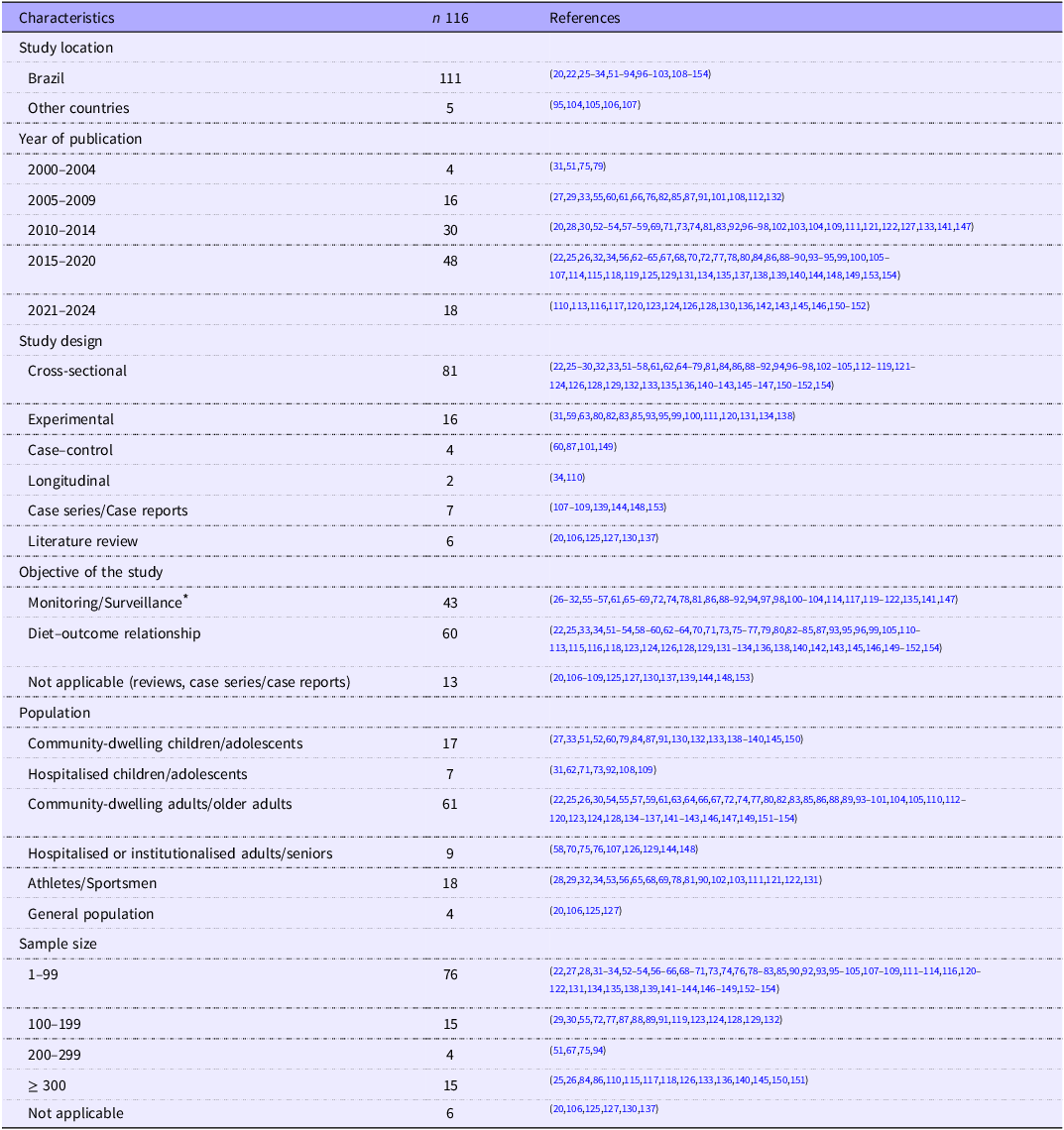
Most of the included studies were conducted in Brazil, representing all geographical regions: North (n 3; 2·7 %), Northeast (n 16; 14·4 %), South (n 18; 16·2 %), Southeast (n 67; 60·4 %) and Midwest (n 7; 6·3 %) (data not shown in the table). Five studies were conducted in the United Arab Emirates(Reference Sadiya, Abusnana and Abdi95), India(Reference Samaddar, Khullar and Bakshi104), Mexico(Reference Mondragon105) and the USA(Reference Marshall106,Reference Kaliszewski and Parker107) . The publication years of the studies ranged from 2000 to 2024, with the majority published between 2015 and 2020 (n 48; 41·4 %). The study designs were categorised as cross-sectional (n 81; 69·8 %), experimental (n 16; 13·8 %), case–control (n 4; 3·4 %), longitudinal (n 2, 1·7 %), case series or case reports (n 7, 6·0 %) and literature review (n 6, 5·2 %). Studies’ objective was classified mostly as diet–outcome relationship (n 60, 52·0 %), and 43 (37·0 %) as monitoring/surveillance (Table 1).
Characterisation of the studies included in the scoping review (n 116)

* Among the forty-three studies, thirty-seven used non-probabilistic samples.
The UDR was used in different groups, especially among community-dwelling adults/older adults (n 61; 52·6 %), community-dwelling children/adolescents (n 17, 14·7 %) and athletes/sportsmen (n 18; 15·5 %). The sample sizes were also diverse, with the smallest being one individual in case reports(Reference Lamonica, Frangella and Pessina108,Reference Maciel, Maciel and Cavalcante109) , and the largest comprising 796 community-dwelling older adults in a population-based study(Reference Fernandes, Juvanhol and Lozano110) (Table 1).
Characteristics of the usual dietary recall
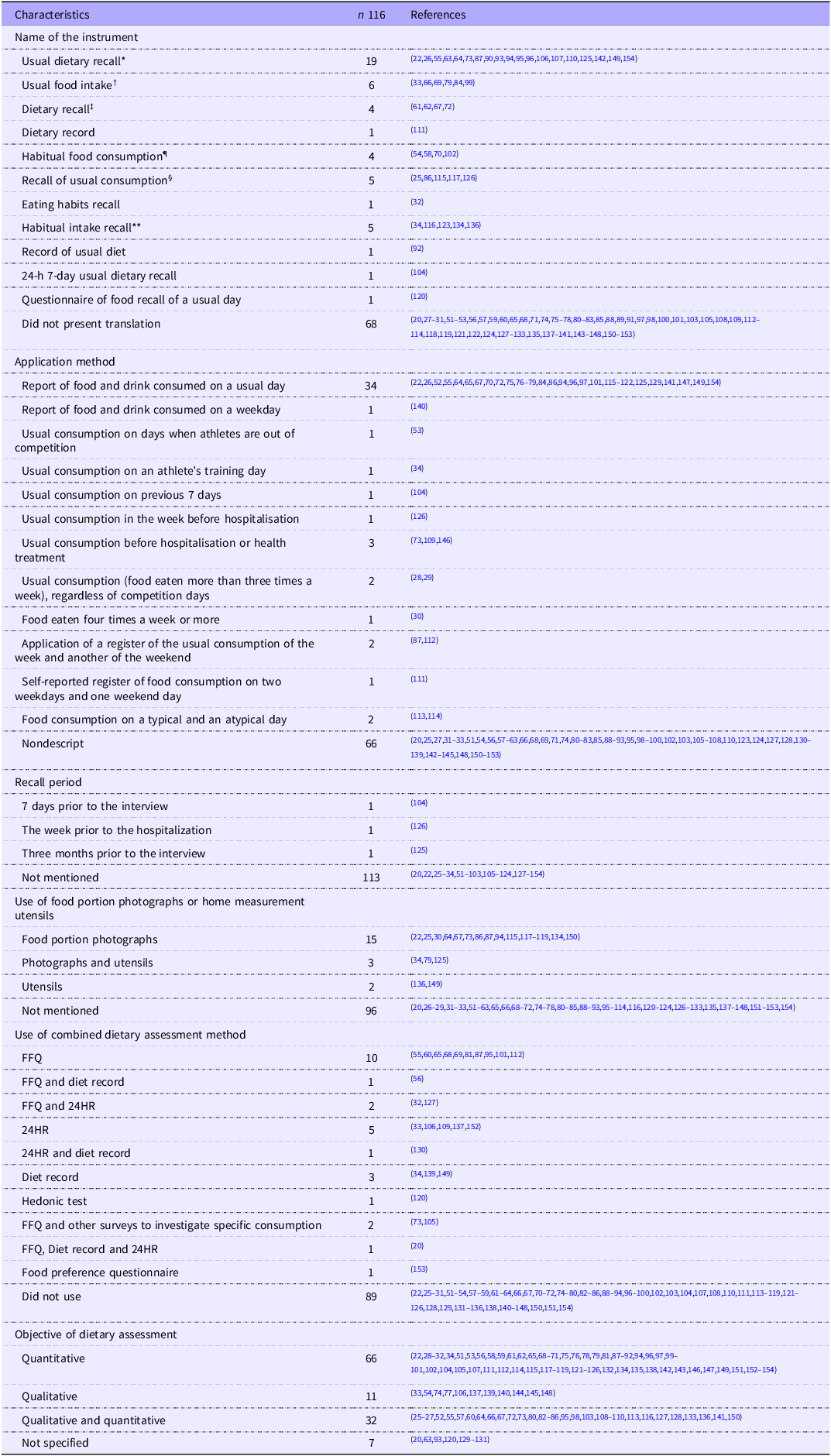
Variations in the nomenclature of the instrument used were detected, with the most common being ‘Usual Dietary Recall’ (n 19; 16·4 %). More than half of the authors did not provide an English translation for the nomenclature of the dietary assessment method of usual food intake (n 68; 58·6 %) (Table 2).
Characteristics of the instruments, application methodologies and objectives of dietary assessment in the included studies (n 116)

24HR, 24-hour dietary recall. *Variations: Usual Recall Diet; Usual Diet Recall; Dietary Recall; Dietary Recall Usual; Usual Food Recall; Usual Recall; Usual Recall Method; Usual One-Day Recall. †Variations: Habitual Remembership; Usual Intake Reminder; Ordinary Intake Reminder; ‡Variations: Usual Daily Food Intake; Usual Dietary Intake; Usual Daily Diet; ¶Variations: Habitual Food Day, Usual Food Day, Food Day Recall; Usual Food Record; §Variations: Recall of Habitual Consumption; **Variations: Usual Intake Recall; Habitual Dietary Recall.
Most publications did not provide a detailed description of the UDR application method. Among those that did (n 34; 29·3 %), the most common method involved reporting the foods and drinks usually consumed at meals on a typical day. Some studies investigated food consumption on weekdays and weekends or on typical and atypical days(Reference Novaes, Franceschini and Priore87,Reference Medeiros111–Reference Pinto and Rodrigues114) . In three publications (2·6 %), the authors defined that only foods consumed more than three or four times a week would be considered habitual and should therefore be included in the UDR(Reference Dias and Bonatto28–Reference Batista30) (Table 2). Some studies reported collecting more detailed information, including the mode and ingredients of food preparation, type of food, trademarks(Reference Conceição, Morais and Souza22,Reference Fernandes, Duarte and Pessoa25,Reference Fernandes, Duarte and Pessoa26,Reference Conceição, Fonseca and Morais64,Reference Fernandes, Lopes and Souza67,Reference Rodrigues, Fernandes and Souza94) and food preferences and aversions(Reference Leandro-Merhi, Garcia and Tafner75,Reference Araújo, Braga and Tavares153) (data not shown).
Eleven publications (9·5 %) used the multiple pass technique to systematise the application of UDR(Reference Conceição, Morais and Souza22,Reference Fernandes, Duarte and Pessoa25,Reference Conceição, Fonseca and Morais64,Reference Fernandes, Lopes and Souza67,Reference Nascimento-Souza, Paiva and Pérez-Jiménez86,Reference Rodrigues, Fernandes and Souza94,Reference Nascimento-Souza115–Reference Fernandes, Cândido and Rocha119) (data not shown). Eleven publications (9·5 %) inquired about the use of supplements among athletes or physical activity practitioners, but not necessarily collected by the UDR(Reference Montenegro, Schneider and Trindade34,Reference Barboza, Silva and Rêgo53,Reference Mallmann and Alves78,Reference Oliveira and Faicari89,Reference Zimberg, Cavalieri and Camargo103,Reference Medeiros111,Reference Alvarez, Von Atzingen and Sarni120–Reference Gotine124) (data not shown).
The majority of publications did not specify the recall period that interviewees should report when estimating usual food intake (n 113, 97·4 %). On the other hand, only three studies considered the recall period to be 3 months, 1 week or 7 days prior to a specific event, such as an interview or a hospitalisation(Reference Samaddar, Khullar and Bakshi104,Reference Valença125,Reference Leandro-Merhi, Aquino and Bertelli126) . Twenty publications (17·2 %) employed food portion photographs and/or household measurement utensils during the application of the UDR to help the participant inform the amount of food and drinks consumed more accurately (Table 2).
Twenty-seven publications (23·3 %) supplemented the data obtained from the UDR with other dietary assessment methods, although not all presented the results. The most used complementary method was the FFQ (n 16; 13·8 %), which was used to capture the frequency of consumption of foods of interest to the researcher, thereby adding specific information to the evaluation of food consumption. Additionally, nine studies (n 7·8 %) used the 24HR as a complementary survey (Table 2).
Sixty-six studies (56·9 %) estimated food consumption quantitatively by comparing the average intake of macronutrients and micronutrients with the values recommended by official dietary guidelines. Eleven studies (9·5 %) estimated food consumption qualitatively, with a focus on the frequency of food groups or meal distribution. Additionally, thirty-two studies (27·6 %) estimated the food consumption quantitatively and qualitatively. Seven publications did not specify the estimation of food intake but reported that it was assessed to monitor possible changes in habits during an intervention(Reference Bricarello and Castro20,Reference Chaves, Rezende-Neto and Nogueira63,Reference Rezende-Neto, Santos and Silva93,Reference Alvarez, Von Atzingen and Sarni120,Reference Klossniak, Matos and Vaz129–Reference Neto, Silva Santos and Aragão-Santos131) (Table 2).
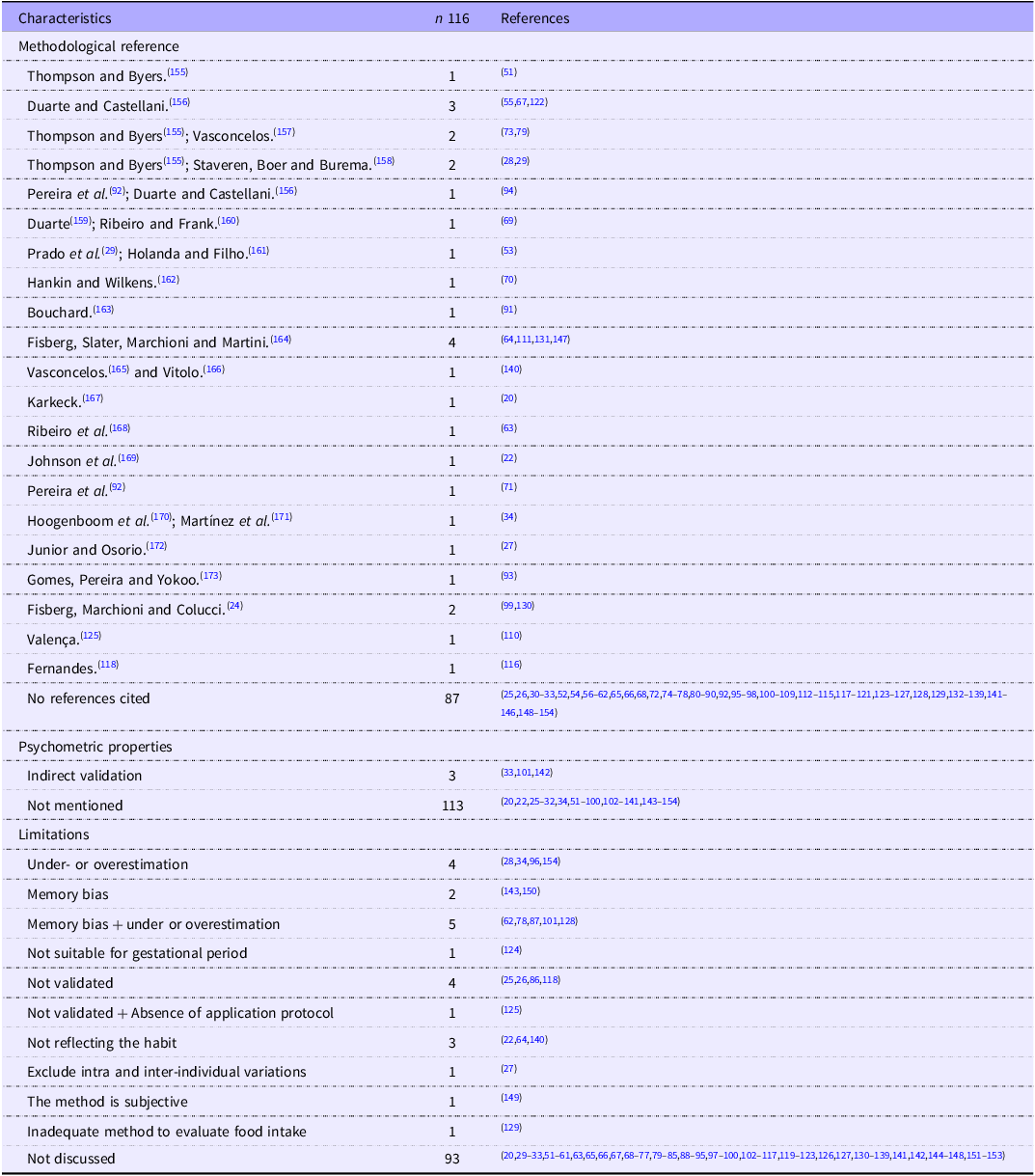
Of the 116 publications included, only 29 (25·0 %) referenced the adopted methodology for applying the UDR. Between those references, 18 (15·5 %) were articles or book chapters that discuss the use of various available methods to assess food consumption, highlighting their advantages and limitations, but not mentioning the UDR(Reference Fisberg, Marchioni and Colucci24,Reference Cade, Warthon-Medina and Albar47,Reference Thompson and Byers155–Reference Karkeck167) . Thompson and Byers(Reference Thompson and Byers155) and Duarte and Castellani(Reference Duarte and Castellani156) were the most cited authors (n 9; 7·8 %). All the references cited were screened individually to identify the origin of the instrument. Five references (4·3 %) used to report the UDR refer to studies that used other dietary assessment methods to assess food consumption, for example, the FFQ(Reference Ribeiro, Sávio and Rodrigues168), 24HR(Reference Johnson, Knight and Edwards169–Reference Gomes, Pereira and Yokoo173) and a general questionnaire on eating habits(Reference Gomes, Pereira and Yokoo173). Four references cited by authors in their methodology section are original studies that used the UDR and were also included in this scoping review(Reference Prado, Botero and Guerra29,Reference Pereira, Forte and Simon92,Reference Fernandes118,Reference Valença125) (Table 3).
Methodological references, psychometric properties and limitations of the usual dietary recall in the studies included (n 116)

None of the studies reported prior testing of the UDR’s psychometric properties (Table 3). However, one study compared energy and vitamin C intake assessed by the FFQ and the UDR(Reference Zanatta, Souza and Oliveira101). Siqueira, Alves and Figueiroa(Reference Siqueira, Alves and Figueiroa33) compared the UDR report with the 24HR to determine whether the foods consumed in the previous 24 h could be considered typical. Moreover, Lima et al. (Reference Lima, Junges Filho and Pontes142) compared thiamine intake, assessed by the UDR and serum lactate levels.
Most studies did not report limitations of the UDR (n 93, 80·2 %). The main limitations identified were errors due to under- or overestimation of the report (n 9; 7·8 %), followed by memory bias (n 7; 6·0 %) and the fact that the instrument had not been validated (n 5; 4·3 %). Dadalt et al. (Reference Dadalt, Nakazora and Batista66) noted that the use of the UDR method posed a limitation, but they did not provide a reason. Similarly, two other studies reported limitations related to the assessment of food consumption without specifying their nature(Reference Morais, Alves and Augusto84,Reference Rodrigues, Fernandes and Souza94) (Table 3).
Discussion
This scoping review identified 116 publications, most conducted in Brazil between 2015 and 2020, that employed the UDR to assess usual food intake across diverse populations and health conditions in both small- and large-scale studies. The application method was similar to that of the 24HR, but with the consumption report referring to what is consumed on a typical day rather than the last 24 h. The review pointed out the absence of psychometric properties for the UDR. Authors also reported underestimation or overestimation of dietary intake and memory bias as important UDR limitations. No standardised bibliographic reference for the UDR was identified. Substantial heterogeneity in its application was observed, including variations in instrument nomenclature, administration methods, recall periods and portion size estimation approaches.
One of the most important psychometric properties is validity, which indicates whether an instrument measures what it is intended to measure(Reference Salvador, Palma and Puchal174). Validation studies are essential to identify potential biases and errors during data collection, including inter- and intra-individual variability, seasonal effects and information bias(Reference Nelson, Margetts and Nelson175). Indirect validation typically compares dietary intake estimates from an analysed instrument with those obtained from another dietary assessment tool that is more accurate and subject to different sources of systematic error(Reference Willett1). Validation may also include comparison with recovery biomarkers, such as 24-h urinary nitrogen for protein intake and 24-h urinary potassium and Na for potassium and Na intake. Correlation between dietary intake and recovery biomarkers provides strong evidence of validity because systematic errors in dietary assessment methods are independent of biomarker error(Reference Willett1,Reference Freedman, Commins and Moler176,Reference Freedman, Commins and Moler177) . Despite the widespread use of the UDR to assess usual intake, especially in Brazil, no studies have reported or cited evidence of its psychometric properties. Therefore, validation and reproducibility studies for this instrument are urgently needed.
Although not a specific indirect validation method, a study conducted with thirty-two individuals with obesity(Reference Zanatta, Souza and Oliveira101) reported correlations between energy, but not vitamin C intake, comparing data of the UDR and a FFQ using no statistical adjustments to the consumption data. Also, Siqueira, Alves and Figueiroa(Reference Siqueira, Alves and Figueiroa33) mentioned that they found similarities between some dietary habits identified by both UDR and 24HR. Similarly, Lima et al. (Reference Lima, Junges Filho and Pontes142) observed a strong negative correlation between thiamine intake, assessed by the UDR and lactate levels, an indirect indicator of thiamine deficiency, among fifteen adult patients in an emergency setting. Although these preliminary results suggest potential validity, evidence remains insufficient to confirm the UDR as a reliable measure of usual intake.
Underestimation or overestimation of intake and memory bias, reported in the identified studies, is inherent not only in the UDR but also in all retrospective methods (such as FFQ, 24HR, and DHQ). The discrepancy between reported and real consumption (measured by direct methods, such as food weighing) can be as high as 50 %(Reference Nelson, Bingham, Margetts and Nelson178). While it is impossible to eliminate these limitations, they can be mitigated using food portion photographs, home measurement models and interviewer training(Reference Nelson, Bingham, Margetts and Nelson178). However, only twenty publications (17 %) employed these resources to facilitate the estimation of food portions(Reference Conceição, Morais and Souza22,Reference Fernandes, Duarte and Pessoa25,Reference Batista30,Reference Montenegro, Schneider and Trindade34,Reference Conceição, Fonseca and Morais64,Reference Fernandes, Lopes and Souza67,Reference Galati, Resende and Salomao73,Reference Medeiros, Speridião and Sdepanian79,Reference Nascimento-Souza, Paiva and Pérez-Jiménez86,Reference Novaes, Franceschini and Priore87,Reference Rodrigues, Fernandes and Souza94,Reference Nascimento-Souza115,Reference Nascimento-Souza, Paiva and Silva117–Reference Fernandes, Cândido and Rocha119,Reference Valença125,Reference Ribeiro134,Reference Pacheco136,Reference Godoy, Cunha and Furtado149,Reference Guimarães, Cardoso and Souza150) . Eleven studies (10 %) mentioned training interviewers(Reference Batista112,Reference Pipolo, Silva and Brandão113,Reference Nascimento-Souza115,Reference Cerqueira122,Reference Leandro-Merhi, Aquino and Bertelli126,Reference Freitas, Macedo and Lessa128,Reference Neto, Silva Santos and Aragão-Santos131,Reference Sá133,Reference Martins138,Reference Lobo140,Reference Dos Santos, D’avila and Alves154) .
A critical limitation of the UDR is the absence of a consolidated recall period in which individuals are asked to recall their consumption. This period should be clearly defined by the researchers to ensure that the influence of diet on the outcome of interest is assessed according to the duration of exposure(Reference Dwyer, Costello, Merkel, Coulston, Boushey, Ferruzzi and Delahanty179), as well as to clarify the definition of what considered ‘usual’ for the researcher or the interviewee, as the term may be applied to different time intervals. Furthermore, the reference recall period affects the accuracy of consumption reports, as it may be influenced by factors such as food seasonality, changes in the individual’s life stage (e.g. age, health condition, routine or changes in eating behaviour) and the time elapsed between past and current consumption, which increases memory biases(Reference Nelson, Margetts and Nelson175,180) .
Despite these limitations, UDR has been used as a tool for estimating usual intake in diet-outcome studies or monitoring/surveillance studies. In diet–outcome studies, assessing usual intake allows for the development of causal hypotheses over time, in contrast to evaluations based solely on current consumption(Reference Willett1,Reference Shim, Oh and Kim5) . In fact, most of our identified studies were conducted within the context of diet-outcome objective. In contrast, monitoring/surveillance studies may assess measures of actual intake to provide precise estimates of group-level central tendencies(Reference Willett1,Reference Kac, Sichieri and Gigante181) . Although a considerable number of the identified studies are classified as monitoring/surveillance (n 43; 37 %), the use of non-probabilistic samples in these studies compromises conclusions regarding the applicability of the UDR in this context.
Although the UDR has been applied across diverse population groups, discussion of its performance has been limited to specific ethnic groups, pregnant women, and hospitalised or community-dwelling adults and older adults. The open format of the UDR provides flexibility to capture foods or meals specific to certain ethnic groups(Reference Ortega, Pérez-Rodrigo and López-Sobaler21–Reference Nascimento, Barbosa and Sichieri23). It also enables assessment of usual intake prior to recent events such as disease diagnosis(Reference Brasil, De Souza and Estevam146), hospitalisation(Reference Caselli, Lomazi and Montenegro62,Reference Maciel, Maciel and Cavalcante109) or pregnancy(Reference Gotine, Filgueiras and Ribeiro123). Furthermore, the method may be particularly suitable for older adults, who often recall habitual intake more accurately than recent consumption because of memory limitations(Reference Fernandes, Duarte and Pessoa25,Reference Fernandes, Duarte and Pessoa26,Reference Nascimento-Souza, Paiva and Pérez-Jiménez86) . Notably, most studies identified did not report psychometric properties, limitations or methodological reference for the UDR according to population groups. In this context, validation studies are needed to address these gaps.
This review has some limitations. First, it excluded certain grey literature studies (e.g. government reports, congress abstracts) and included only manuscripts in Portuguese, Spanish and English. However, the broad search criteria yielded a satisfactory number of articles, theses and dissertations for an initial review. Second, only five studies were conducted outside Brazil, which reduces the possibility of discussing the applicability of the UDR in other countries. Nevertheless, these studies suggest that the instrument might be recognised in other countries. Finally, insufficient details on application methods, references, psychometric properties and limitations of the UDR constrained the analysis of its use.
Despite these limitations, this scoping review contributed to evidence of the wide use of the UDR, specially across Brazil, a large country with a diverse culture and distinct dietary patterns across its territories(Reference Fisberg, Marchioni and Colucci24), which may justify the possibility of expanding its use to assess food consumption of different population groups in other countries. Furthermore, we believe that, with appropriate validation and development of a standardised protocol for applying the UDR, this instrument has the potential to substantially contribute to nutritional epidemiology research by enabling assessment of usual dietary intake across diverse populations.
A protocol would address the lack of standardisation in UDR use, establish a consolidated reference for its implementation, support validation studies and define the appropriate recall period. First, the instrument should be clearly designated as the UDR to prevent misinterpretation and ensure clarity in its application. Second, the most used approach – an interview in which respondents report their usual food intake on a typical day – should be enhanced to collect more detailed information, including food preparation methods and ingredients, food types, brand names and individual preferences or aversions, as reported in some studies and recommended by the FAO(44). Third, the application should follow the Multiple Pass Method, which was used in some identified studies. This technique engages respondents and improves recall by revisiting meals multiple times, thereby reducing underreporting and minimising interviewer bias through standardised, sequenced questioning(Reference Tucker182–Reference Steinfeldt, Anand and Murayi185). Fourth, the recall period should be disclosed in the protocol to allow for an accurate assessment of the reported data. Finally, questions about dietary supplement use should be incorporated, as noted in several studies, given the increasing prevalence of supplement consumption, the risk of underestimating nutrient intake when supplements are excluded and the need to identify intakes exceeding safe limits(Reference Thompson, Subar, Coulston, Boushey, Ferruzzi and Delahanty3,Reference Larson-Meyer, Woolf and Burke186) .
Conclusion
Researchers have recently applied the UDR across diverse population groups. The application method was similar to that of the 24HR, but with the consumption report referring to what is consumed on a typical day rather than the last 24 h. Important limitations were identified in the publications, such as the absence of psychometric properties and standardised recall period, suggesting the need to validate the instrument to allow study reproducibility and obtain accurate measurements. In addition, the development of a protocol for the application of the UDR is recommended to ensure standardised replication of the method.
Acknowledgements
We are grateful to the Brazilian Center for Evidence-informed Healthcare: a Joanna Briggs Institute Centre of Excellence (JBI-Brazil) for examining the protocol at the Regular Scientific Meeting. We extend our thanks also to Evandro Ribeiro, Librarian of the Federal University of Viçosa, for his support in developing the search strategy and specifying the search sources. We thank all the researchers and students of the Study and Practice Group on Aging, Nutrition and Health of the Department of Nutrition and Health of the Federal University of Viçosa (GREENS/UFV) who were involved in the development of this scoping review.
This work was supported by the Coordination for the Improvement of Higher Education Personnel (CAPES) (SEOV, DPSF, PHRFA and JSC received financial support through scholarship). This work was also supported by the Carlos Chagas Filho Foundation for Research Support in the State of Rio de Janeiro (FAPERJ) (LFFA, grant number SEI-260003/019668/2022). This work was also supported by the Minas Gerais State Research Support Foundation (FAPEMIG – APQ 01267-24). CAPES, FAPERJ and FAPEMIG had no role in the design, analysis or writing of this article.
SEOV, DPS, LFFA and JSC were responsible for the selection process, data extraction and manuscript writing. PHRF and AQR guided and planned the study alongside the full team of co-authors. CAS and JFN reviewed the manuscript, with all authors providing critical feedback during its development. All authors have read and approved the final manuscript.
There are no conflicts of interest.