Book Review Editor's Note: This year marks the twenty-fifth anniversary of Rediscovering the Religious Factor in American Politics, one of the most important volumes in the quantitative study of religion and politics in America. The timing of Rediscovering was instrumental in helping guide the newly forming subfield and bringing together a collection of scholars who would define religion and politics research. Sadly we lost one of these scholars recently—Ted G. Jelen. Ted's passing makes it all the more essential to celebrate these milestones. To mark this anniversary, I have asked the editors of Rediscovering, David Leege and Lyman “Bud” Kellstedt, to reflect on the writing and impact of the volume. Two reviews of the reflective reviews of the book follow their remarks. In this collection, read the stories of how the subfield developed from those who were involved and consider where the our research is and should be heading. – Andrew R. Lewis
HISTORY OF THE BOOK
On November 14, 1957, organized crime families held a meeting in Apalachin, NY to iron out disputes over racket ownership, territories, and leadership. The meeting followed a decade of criminal careers cut short by violent struggles. They shared common goals but sought more “diplomatic” solutions to their conflicts.
In early 1991, in a far more benign way, a group of young to mid-career political scientists, eager to integrate religious explanations into the interpretation of American political behavior, felt the need for a summit to assess the utility of current measures, their shortcomings, and potential improvements. They brought to the table knowledge from American religious history, from the sociology and psychology of religion, as well as from analysis of national datasets and from specialized samples from a variety of sources. The latter included studies of Catholic parish life, Southern Baptist clergy, political party donors, and religious activists.
The most important of the national surveys were time-series datasets—the American National Election Studies (ANES) and the General Social Survey (GSS). Years prior Leege had been involved in helping solidify these large national surveys for social science research. In 1976, while a program director at the National Science Foundation, Leege explored the history of “national research centers” in the biological and physical sciences. Noting the characteristics of such centers—stable multi-year funding, broadened input from and accountability to scholarly users, a budget that included funding for measurement development and testing, and readily available archived data—he encouraged Warren Miller to recreate the biennial Michigan Election Studies as just such a national resource. Once funded, Miller and Leege negotiated an appropriate structure and the first board of overseers. Sociologists quickly followed suit, creating the “General Social Survey” from the National Opinion Research Center's time-series datasets.
ANES and GSS already had a few primitive measures of religion begging to be assessed and expanded. So did the commercial Gallup Polls which, by then, were archived at the Roper Center. Many scholars were making substantive claims from these religious measures but there was little agreement about what each religious item measured. It was particularly difficult to publish articles in leading professional journals when reviewers in the field shared so little common ground.
In late 1988, Leege submitted an overture for the 1989 Pilot Study that would assess existing measures of religion and experiment side-by-side with new ones. The ANES Board of Overseers responded by creating a four-person Working Group on Religious Measures chaired by him, and including Kellstedt, who had worked extensively on the properties of existing ANES measures of religion, Kenneth Wald, a comparativist/Americanist who was deeply concerned about the atheoretical and hyper-empirical nature of extant research on religion and politics, and Wade Clark Roof, who had spearheaded similar efforts within the sociology of religion. The group recommended a battery of measures along several dimensions of religion, including affiliation, beliefs, and practices. Many of the measures were included in both the 1989 Pilot Study and the 1990 Biennial Election Study, and formed the basis for the results interpreted in the Rediscovering book.
Study group members prepared reports for professional conferences during the next 2 years but there still was only moderate consensus among scholars in the field. An “Apalachin” summit was proposed to include active scholars in religion and politics; Leege raised money from the Religion Division of the Lilly Endowment to fund the endeavor. The conference took place in early 1991. The result was the publishing of Rediscovering in Reference Leege and Kellstedt1993 by M. E. Sharpe. The book was not designed around central theories and concepts but rather attempted to examine the new measures from the Pilot Study and the 1990 ANES. Further, while sample sizes in the survey datasets were sufficient for racial, gender, regional, denominational, and religious traditions, as well as partisan and ideological comparisons, the sizes of Latino subgroups were insufficient to include them in most of the analyses (however, see pages 165 and 281 for exceptions). Today, of course, they are among the most important groups to examine (Espinosa Reference Espinosa2008). Two smaller religious groups were also left unexamined—Jews and Mormons. Recent scholarship has given these groups close scrutiny (for Mormons, see: Perry and Cronin Reference Perry and Cronin2012; Campbell, Green, and Monson Reference Campbell, Green and Monson2014). After searching for years for measures conceptually equivalent for Jews to the belief and behavior measures for Christians, Kenneth Wald argues that the central concern unifying Jewish political behavior is the desire for cultural acceptance and political enfranchisement equaling that of other religious groups. Jews stray from the liberalism of Democrats only when they feel its candidates further Christian or other identity-group advantage, and Jews enhance their Democratic loyalty when Republicans further a Christian nation notion. Thus, different dimensions of religious intensity are less important than social distance items and group or candidate imagery (Wald Reference Wald2015).
The disciplinary reception of Rediscovering was positive. Immediately scholars were able to integrate appropriate religious measures into their models, and, as a result, generated much richer findings about the sources of behavior and attitudes. For example, in the work of Miller and Shanks, based on ANES data, the classical contrasts between interests and valence issues generated new understanding, particularly about the religious reinforcements of cultural predispositions (Miller and Shanks Reference Miller and Shanks1996). In other research, based on a specialized dataset, Verba, Schlozman, and Brady incorporated well-informed religious variables into their path-breaking books; they were able to show, for example, that reinforcing measures of religiosity intensified political participation (Verba, Schlozman, and Brady Reference Verba, Schlozman and Brady1995). Using ANES data, Layman reexamined Carmines and Stimson's theories (Reference Carmines and Stimson1989) of issue histories and partisan coalitional change by introducing a variety of religious measures to the models (Layman Reference Layman2001). In addition, textbooks in electoral politics incorporated religious variables into their tables (Abramson, Aldrich, and Rohde Reference Abramson, Aldrich and Rohde1994; Flanigan and Zingale Reference Flanigan and Zingale1994). Sociologists did similar things with the religious measures on GSS and expanded these or newer measures into cross-national studies of values (Steensland et al. Reference Steensland, Park, Regnerus, Robinson, Wilcox and Woodberry2000). Because not everyone wanted to plow through Rediscovering, Leege wrote a two-part summary on the properties of the measures that was published in the newsletter of the American Political Science Association (APSA) section on voting, elections, and public opinion; two decades later he still receives requests for this out-of-print guide.
CONTRIBUTIONS
There are several enduring contributions of Rediscovering the Religious Factor to the field of religion and politics. One stands out: the widespread use of the concept religious tradition to capture the broad religious communities of the American public, reducing the staggering complexity of American denominations to theologically, socially, and politically meaningful aggregations. Most operationalizations of the concept follow the detailed coding scheme used in the 1989 Pilot Study, in ANES surveys since, or in later modifications (Green et al. Reference Green, Guth, Smidt and Kellstedt1996, 188–189; Steensland et al. Reference Steensland, Park, Regnerus, Robinson, Wilcox and Woodberry2000; Smidt, Kellstedt, and Guth Reference Smidt, Kellstedt, Guth, Guth, Kellstedt and Smidt2009, 29–31). Even critics of the scheme find it necessary to use in their research. Although unrecognized in Rediscovering, this concept links contemporary religious alignments with the ethno-cultural or ethno-religious theories of religion and political behavior, where unique combinations of religious faith and ethnicity produce distinct electoral alignments. Quantitative historians, sociologists, and political scientists had utilized this model either explicitly or implicitly (Lazarsfeld, Berelson, and Gaudet Reference Lazarsfeld, Berelson and Gaudet1944; Berelson, Lazarsfeld, and McPhee Reference Berelson, Lazarsfeld and McPhee1954; Campbell et al. Reference Campbell, Converse, Miller and Stokes1960; Kleppner Reference Kleppner1979).
Despite its ubiquitous use, there are practical problems with employing measures of religious tradition. Interviewers need to be trained to do appropriate probes when faced with ambiguous responses. In addition, assignments to traditions are not always easy. For example, the growing number of non-denominational Protestants are difficult to assign, as are respondents who name a denominational family split between traditions (Baptist, Presbyterian, or Lutheran, for example) but cannot name the specific denomination. The recent Baylor University surveys may be helpful, asking respondents to name their local church so researchers can check with the church and ideally assign individuals to the proper tradition. In addition, it would be helpful to examinations of ethno-religious models if surveys included a question about the ethnic and racial makeup of congregations. This would allow scholars to compare homogeneous church contexts with those that are more heterogeneous. Finally, the increasing numbers of “unaffiliated” respondents have also encouraged scholars to explore the substantial religious and political differences within this growing “tradition” (Kellstedt and Guth Reference Kellstedt and Guth2011; Campbell et al. Reference Campbell, Layman, Green and Sumaktoyo2018). Despite these caveats, the emphasis on religious tradition has produced consistent findings linking religion to political behavior. White evangelical Protestants, and their Mormon “allies,” sometimes joined by Latino Protestants, occupy the conservative end of the political spectrum, while Jews, Latino Catholics, and Black Protestants, and their religiously dissimilar “secular” allies occupy the liberal flank. In the middle are white mainline Protestants (the historic leader of the Republican coalition) and Anglo Catholics (the former linchpin of the Democratic alignment).
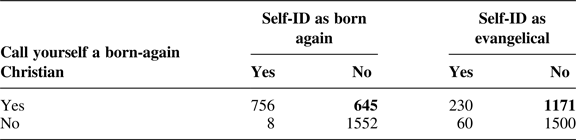
Detailed affiliation probes are uncommon in many political surveys because of time constraints and questionnaire space. Instead, Protestant respondents who identify as born again are placed in an “evangelical” traditions with the non-born again assigned to the “mainline.” This strategy usually “works,” in terms of finding predictable political differences, but almost always understates differences between these traditions (compared with the more time consuming “specific affiliation” route). Yet a careful reading of the “born again” chapter in Rediscovering might give researchers pause before they adopt this common practice. The chapter raises conceptual questions: is “born again” an identification; is it a status obtained through a lifetime of nurturing in a church or has it resulted from a profession of faith in Christ; or is it an experience that took place at a specific moment of time or a gradual experience that occurred over time? The chapter showed that Republican party identification increased over the following categories: non-born again, born again, and nurtured by the church, a gradual temporal experience, a profession of faith; and a sudden, specific moment of time experience (Rediscovering, 211). Obviously, “born-again” is not a singular concept, and yet no one has followed up these findings. In addition, many different wordings have been used in born-again questions by both academic and commercial pollsters measuring different aspects of the born-again phenomenon. Exit polls, for example, divide Protestants into evangelical and mainline categories based on a born-again, evangelical question. In contrast, in the 2016 ANES survey, “Christians” were asked, “Would you call yourself a born-again Christian, that is, have you personally had a conversion experience related to Jesus Christ?” (Note that the item asks about both an identification and an experience.) In the same 2016 survey, ANES also asked: “Which of the following terms describe your religious beliefs?” “Born again” and “evangelical” were included as options. Below is a cross-tabulation of the first question with the born again and evangelical identities, asked of Christians only. Sizable numbers (in bold in the table) who call themselves born- again Christians did not feel comfortable using the terms “born again” or “evangelical” to describe their religious beliefs. In the same survey, in data not shown, with both a born-again item (the left-hand column in Table 1) and detailed religious affiliation measures, we find that affiliation evangelicals who call themselves born again gave Trump 85% of their votes compared with 66% of their non-born again fellow evangelicals. Among mainliners by affiliation, the smaller born-again group gave Trump 72% of their votes, while the non-born again supported him at 53%. In contrast, the exit polls showed an 81% vote for Trump among white evangelicals (although the evangelical category included an undisclosed number of Roman Catholics and Mormons). These findings suggest caution in using the combination of “Protestant” and a conceptually ambiguous “born-again” measure to determine membership in religious traditions.
Born-Again Measures in the 2016 American National Election Studya

a Cell entries are numbers of respondents.
Rediscovering demonstrated the importance of religious traditions, but it also showed that other religious variables modified the bivariate relationships between traditions and political behavior—including beliefs and practices, the salience of religion, the born-again phenomenon, and religious media effects. Implicit in these analyses was a second theory of the ties between “religion” and politics, a restructuring model. It was only briefly mentioned in Rediscovering (195), but it suggested that changes in American religion were taking place within denominations and religious traditions along “liberal/conservative” lines (for the idea itself, see: Wuthnow Reference Wuthnow1988). This theory suggested a way to examine the impact of religion on political behavior by examining beliefs and behaviors within traditions.
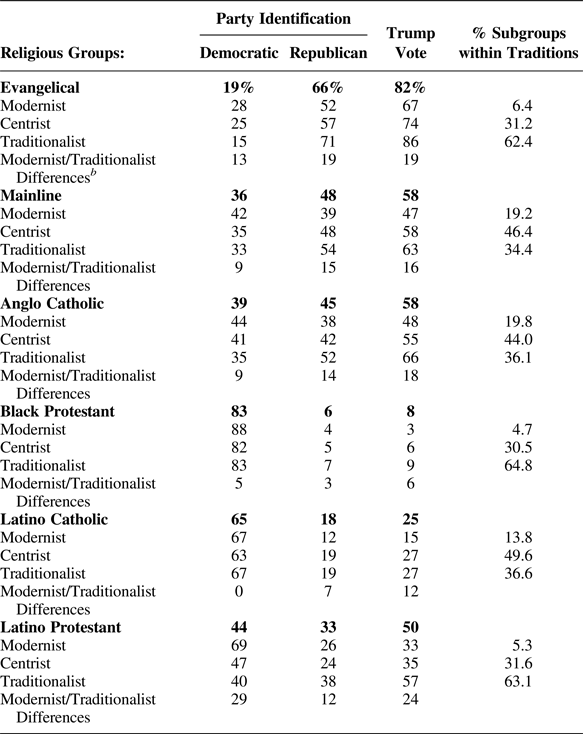
Extensive efforts to examine the ties between religion and politics began soon after the publishing of Rediscovering. These endeavors have resulted in scores of articles, book chapters and convention papers over the past 25 years. (see, for example: Layman Reference Layman2001; Green et al. Reference Green, Guth, Smidt and Kellstedt1996; Green et al. Reference Green, Kellstedt, Smidt, Guth and Campbell2007; Guth, Kellstedt, and Smidt Reference Guth, Kellstedt and Smidt2009). These studies have used different measures of beliefs and practices (and at times added the salience of religion and religious identifications), based on availability in surveys, dividing respondents within traditions into “traditionalists,” “centrists,” and “modernists” with striking results when related to party identification, vote choice, and issue positions. Table 2 shows the impact of religious traditions and a traditionalist/modernist measure using the large sample from the recent 2016 Cooperative Congressional Election Study (CCES). As one can see, the results work best within the large white traditions (evangelical and mainline Protestantism and Roman Catholicism) suggesting the power of restructuring theory. However, for Black Protestants and Latino Catholics, the old ethno-religious theory still holds as the divisions within do not seem to matter much politically. Very similar findings from presidential elections going back to 1988 have been produced using a variety of religious measures (Kellstedt et al. Reference Kellstedt, Smidt, Green, Guth and Campbell2007). Still, efforts should be made to develop belief and practice measures for specific religious traditions that would likely result in even more robust findings in links to political behavior variables.
Political Perspectives by Religious Groupsa

a Source: 2016 Cooperative Congressional Election Study.
b The modernism/traditionalism measure is a factor score based on church attendance, prayer, and the importance of religion to the respondent. Factor loadings are above 0.8 with an average correlation of 0.57 for the whole sample with subgroup average correlations as follows: white evangelicals 0.49; white mainline 0.52; white Catholics 0.56; Black Protestants 0.43; Latino Catholics 0.50; and Latino Protestants 0.51.
ALTERNATIVE APPROACHES TO MEASURING RELIGION
Some scholars have taken seriously the suggestion to develop specific measures for specific traditions. For example, efforts have been made to expand the belief and practice items in ANES surveys (Mockabee, Wald, and Leege Reference Mockabee, Wald and Leege2007). Some had found the original measures very powerful for understanding the dominant (Reformed) Protestant ethic in the United States but predicted less well to the politics of the sacramental traditions such as Roman Catholics, Episcopalians, Lutherans, and Orthodox. Normative beliefs and practices differ in various religious traditions, as argued over a decade earlier in the Rediscovering volume (see Chapter 2). However, the addition of new religious measures in the 2008 ANES survey was not continued in 2012 and 2016. In a different direction, studies based on GSS data and specialized studies of Catholics suggest there may be more payoff in “images of God” measures. Respondents who perceive God as strict, judgmental, law-giving, and order-maintaining are more likely to be conservative and Republican, while those who conceive of God as maternal, nurturant, loving, and forgiving are more liberal and Democratic. Those who embrace both sets of images sometimes embrace ideologically inconsistent and issue-specific politics (Leege Reference Leege1988; Greeley Reference Greeley1989).
Still, others have argued that religion is a primary factor in foundational values and cultural conflict (conflict over the social order—“the way it's supposed to be”). This is measured in clusters of religious beliefs, the role of government, and feelings toward “others” which typically cohere, e.g., religion and racial attitudes, fear of or hospitality toward foreigners, and gender-related change. Further, this cultural conflict ought to be integrated into general theories of American political behavior (Leege et al. Reference Leege, Wald, Krueger and Mueller2002). Finally, others emphasize the social nature of the local church and show that community network and identity effect is a very powerful source of political values and behavior (Converse Reference Converse, Campbell, Converse, Miller and Stokes1966; Huckfeldt and Sprague Reference Huckfeldt and Sprague1995; Djupe and Gilbert Reference Djupe and Gilbert2009). For them, general sampling and atomistic designs are insufficient but should expand to the study of conversation partners.
Other promising belief concepts like individualism/communitarianism, produced robust findings in Rediscovering (227), but have been largely ignored since. Civic gospel measures also appear worthy of attention (for a “Christian nationalism” measure that seems closely analogous to the civic gospel, see: McDaniel, Nooruddin, and Shortle Reference McDaniel, Nooruddin and Faith Shortle2011). In addition, promising work by Toft, Philpott, and Shah develops the concept “political theology” in their work on international politics that could point to promising empirical indicators linking religion to political behavior (Toft, Philpott, and Shah Reference Toft, Philpott and Samuel Shah2011). The concepts discussed in this paragraph and their operational indicators are in latent or early stages of development but should warrant significant scholarly attention.
New measures or sample designs are more likely to emerge from “experimental” efforts by political scientists or by religious survey organizations like Pew and the Public Religion Research Institute (PRRI), which run numerous national surveys each year (and may be receptive to suggestions from academics). One such effort by Pew developed a religious movement or identification measure that asked respondents whether their church should defend traditional beliefs and practices or adapt to or adopt modern beliefs and practices. This question could possibly replace a whole series of religious identification items (e.g., evangelical, fundamentalist, and liberal) that take up survey time and have not produced consistent findings. This measure is appropriate for respondents regardless of religious affiliation, while more traditional identification items tend to be “tradition specific.”
The possibilities for religion and politics scholarship are far more promising than was the case when Rediscovering was published. There are academic surveys available for scholars that did not exist before (examples include surveys from Baylor University and CCES). In addition, Pew and PRRI run surveys on a regular basis that are available for secondary analysis. These additions allow scholars to examine the ties between religion and politics for groups like Muslims, Buddhists, and Hindus (see the Association of Religion Data Archives for access to many of these surveys). And a large number of respondents gives researchers the opportunity to explore political similarities and differences among “unaffiliated” groups (atheists, agnostics, “nothing in particular”) and to examine a “spiritual but not religious” category.
To conclude, the Rediscovering volume opened the door for efforts to examine the links between religion and political behavior. There is little question that the religious factor in American politics has been rediscovered. The book still has value for suggesting areas for future research. It is up to the current and future generations of scholars to build on its strengths and to overcome its shortcomings.