INTRODUCTION
Radiocarbon (14C) dating plays a fundamental role in archaeological investigations (Bayliss Reference Bayliss2009 and references therein), but its application is not always straightforward, involving assumptions that have proved to not always be correct. Besides the correction of factors involved in the concept of a 14C age per se (e.g., the Libby half-life), it has been pointed out that understanding the origin of carbon in a sample is key to the correct interpretation of 14C chronologies. Among other factors, this is hindered by the existence of the so-called reservoir effects (Stuiver and Polach Reference Stuiver and Polach1977), of which archaeology has mainly suffered from the marine reservoir effect (MRE), primarily due to the importance of marine-brackish material for radiocarbon dating, such as mollusk shells, which are abundant in many archaeological sites.
Water displaced from the surface ocean undergoes 14C decay without replenishment. Considering the deep ocean residence times of the order of thousands of years (e.g., Sigman and Boyle Reference Sigman and Boyle2000), these water masses can “age” significantly when compared to the coeval atmosphere, a phenomenon known as the MRE. This is not to say, however, that the MRE is absent at the ocean surface. Surface water contains both old carbon, derived from its interaction with deeper layers, and newly acquired carbon from the atmosphere. A practical implication of the MRE is that marine materials yield overestimated 14C ages. The anomalies can reach thousands of years and the 14C ages obtained from these samples are termed apparent ages (Mangerud Reference Mangerud1972). For the present study, the relevant MRE offsets are R and ΔR, as first defined by Stuiver et al. (Reference Stuiver, Pearson and Braziunas1986) and summarized in Alves et al. (Reference Alves, Macario, Ascough and Bronk Ramsey2018). Briefly, the former represents the difference in 14C age between the ocean and the atmosphere at a given time, while the latter is the 14C age offset between the local and the global ocean. Unfortunately, the process of MRE quantification inherits complications of the 14C dating analyses and common issues (e.g., post-depositional effects) are directly implicated in the calculation of such variables. Some of these complications, and the accessory techniques used to overcome them, are discussed in the next paragraphs for carbonate, charcoal and bone samples.
A sample is considered to be contaminated whenever, after deposition, processes other than radioactive decay change its carbon isotopic ratio; any carbon that was not initially part of the sample matrix is defined as a contaminant (Gillespie Reference Gillespie1984; Taylor Reference Taylor1987). Isolating the pristine sample has been a challenge since the early developments of the radiocarbon dating technique (Libby Reference Libby1954). In the case of mollusk shells, diagenesis may lead to carbonate dissolution, accompanied by recrystallization and the substitution of the original crystal structure, possibly affecting even the most interior layers of a sample (Taylor Reference Taylor1987). Such reactions, known as neomorphisms, take place in the presence of water via mechanisms of dissolution and precipitation (Tucker and Wright Reference Tucker and Wright1990), showing their strong dependence upon the deposition environmental conditions (Douka et al. Reference Douka, Hedges and Higham2010, and references therein). The less soluble/more stable calcium carbonate (CaCO3) polymorph low-magnesium calcite (LMC, 0-4% MgCO3) is preferentially crystallized after the dissolution of the metastable polymorphs high-magnesium calcite (HMC, >4% MgCO3) and aragonite (Reid and Macintyre Reference Reid and Macintyre1998, and references therein). Nevertheless, although unusual, isomineralogic diagenetic changes (aragonite to aragonite recrystallization) are also possible (see e.g., Enmar et al. Reference Enmar, Stein, Bar-Matthews, Sass, Katz and Lazar2000; Webb et al. Reference Webb, Price, Nothdurft, Deer and Rintoul2007). Aragonite is the principal mineral component of shell carbonates in most species (Taylor Reference Taylor1987; Douka et al. Reference Douka, Hedges and Higham2010). Therefore, the presence of calcite in such shells is an indicator of contamination by recrystallization. Although the secondary phase may be contemporary with the original shell carbonate or even derived from its dissolution-recrystallization process, in which cases it would not represent a contaminant for the 14C dating of the material, there is always the possibility of material of younger/older age in the immediate environment influencing the isotopic composition of the secondary phase (Taylor Reference Taylor1987; Douka et al. Reference Douka, Hedges and Higham2010). A powdery or “chalky” appearance can be associated with recrystallization in regions where the rate of aragonite dissolution is higher than that of calcite precipitation (Aitken 1990; McGregor and Gagan Reference McGregor and Gagan2003) and procedures such as staining methods (e.g., Feigl Reference Feigl1958; Friedman Reference Friedman1959) and X-ray diffraction (XRD) (see e.g., Als-Nielsen and McMorrow Reference Als-Nielsen and McMorrow2011) can be used to detect secondary calcite (e.g., Chappell and Polach Reference Chappell and Polach1972; Sepulcre et al. Reference Sepulcre, Durand and Bard2009; Douka et al. Reference Douka, Hedges and Higham2010).
Charcoal samples may also yield apparent ages. This is because 14C dating determines the time elapsed since the cessation of carbon exchanges between sample and environment. Therefore, the association of this event with the context to be dated must be careful (see Waterbolk Reference Waterbolk1971). In archaeology, charcoal remains collected from hearths are often radiocarbon dated to establish a chronology for domestic and ceremonial activities. Although this approach assumes that the burning happened immediately or shortly after wood formation, this is not always the case and ages may be largely overestimated if charcoal is derived from the heartwood of long-lived species (e.g., oak) or if the death of the tree significantly pre-dates its use as fuel. In both cases, this inbuilt age is a consequence of the so-called old-wood effect and leads to uncertainties of up to hundreds of years (McFadgen Reference McFadgen1982; Schiffer Reference Schiffer1986; Gavin Reference Gavin2001). Since the old-wood effect does not affect structures such as bark, twigs, and seeds, the 14C dating of these materials is usually preferred (e.g., Albero et al. Reference Albero, Angiolini and Piana1986; Anderson Reference Anderson1991; Erlandson et al. Reference Erlandson, Kennett, Ingram, Guthrie, Morris, Tveskov, West and Walker1996; Facorellis Reference Facorellis1998; Rieth et al. Reference Rieth, Hunt, Lipo and Wilmshurst2011; Wilmshurst et al. Reference Wilmshurst, Hunt, Lipo and Anderson2011; Deforce et al. Reference Deforce, Boeren, Adriaenssens, Bastiaens, De Keersmaeker, Haneca, Tys and Vandekerkhove2013). One way of identifying short-lived plant species or structures in the charcoal assemblage is the use of anthracological analyses (e.g., Vernet Reference Vernet1999; Scheel-Ybert Reference Scheel-Ybert2001; Ludemann et al. Reference Ludemann, Michiels and Nölken2004; Emery-Barbier and Thiébault Reference Emery-Barbier2005; Byrne et al. Reference Byrne, Dotte-Sarout and Winton2013; Moskal-del Hoyo Reference Moskal-del Hoyo2013; Euba et al. Reference Euba, Allué and Burjachs2016; Macario et al. Reference Macario, Scheel-Ybert, Ribeiro-Pinto, Pereira, Amaral and Alves2021). By comparing the wood anatomic features preserved in charcoal with a reference collection and the specialized literature (e.g., Metcalfe and Chalk Reference Metcalfe and Chalk1950; Scheel-Ybert 2016 Reference Scheel-Ybert and Smith2020), it is possible to taxonomically classify charcoal fragments and thus avoid the old-wood effect.
Finally, the radiocarbon dating of bone samples also needs to be performed with caution. The recognition that, owing to a mixed marine/terrestrial diet, materials traditionally considered as terrestrial, such as human bone, could also be affected by the MRE is important for the establishment of accurate chronologies for archaeological sites. This type of sample yields a partially marine 14C age, which depends on the proportion of marine-derived carbon in the material, that must be calibrated with mixed marine/atmospheric calibration curves and the appropriate MRE correction (see e.g., Beavan and Sparks Reference Beavan and Sparks1998; Arneborg et al. Reference Arneborg, Heinemeier, Lynnerup, Nielsen, Rud and Sveinbjornsdottir1999; Beavan-Athfield et al. Reference Beavan-Athfield, McFadgen and Sparks2001; Naito et al. Reference Naito, Chikaraishi, Ohkouchi, Mukai, Shibata, Honch, Dodo, Ishida, Amano, Ono and Yoneda2010; Commendador Reference Commendador2014; Ervynck Reference Ervynck2014; Cook et al. Reference Cook, Ascough, Bonsall, Hamilton, Russell, Sayle, Scott and Bownes2015). For human bones, stable isotope analyses can provide an estimation of the relative contribution of marine resources to diet. Stable carbon isotope measurements can be used for diet analyses and allow for the quantification of the relative contribution of different food classes from the same (e.g., C3 vs. C4 plants) or distinct (e.g., marine vs. terrestrial species) environments (e.g., Van de Merwe Reference Van de Merwe1982; Chisholm et al. Reference Chisholm, Nelson and Schwarcz1982; Schwarcz et al. Reference Schwarcz, Melbye, Katzenberg and Knyf1985; Walker and DeNiro Reference Walker and DeNiro1986; Ambrose Reference Ambrose1986). However, complications in dietary estimations may arise from the fact that diet-to-tissue isotopic fractionation and the relative contribution of carbon isotopes from different food sources will depend on the nature of the diet (Webb et al. Reference Webb, Lewis, Shain, Kastrisianaki-Guyton, Honch, Stewart, Miller, Tarlton and Evershed2017; Jim et al. Reference Jim, Jones, Ambrose and Evershed2006). Stable isotopes of nitrogen are passed along food webs with relatively well-established fractionations, e.g., 3–6‰ (Schoeninger et al. Reference Schoeninger, DeNiro and Tauber1983; O’Connell et al. Reference O’Connell, Kneale, Tasevska and Kuhnle2012) and can differentiate between herbivores (low trophic position) and carnivores (high trophic position) or between marine and terrestrial food webs (e.g., Schoeninger et al. Reference Schoeninger, DeNiro and Tauber1983; Schoeninger and DeNiro Reference Schoeninger and DeNiro1984; Walker and DeNiro Reference Walker and DeNiro1986). Nevertheless, there are environmental and physiological factors influencing nitrogen isotope ratios which limit dietary interpretations based on these values only (see e.g., Hedges and Reynard Reference Hedges and Reynard2007).
The presence of marine and terrestrial material in close stratigraphic association at coastal archaeological sites along the Brazilian shoreline makes it possible to derive marine reservoir corrections for the region. In order to yield meaningful MRE quantifications, stratigraphic pairing must be a reliable indicator of contemporaneity. Moreover, the validity of such an approach relies on the consideration of possible obstacles such as the old-wood effect and the recrystallization issues discussed above. Here, by analyzing lagoonal-brackish (shell) and terrestrial (charcoal) materials from the archaeological context of a Southern Brazilian shell mound, we describe what we consider to be the best practices for overcoming these issues.
MATERIALS AND METHODS
The Cabeçuda Shell Mound
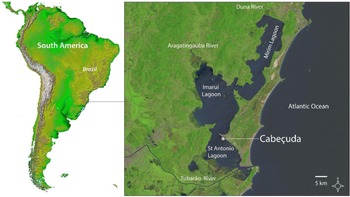
The Brazilian coastline is well known for bearing a great number of archaeological shell mounds. Sambaqui (Tamba = shell, ki = heap) is a word of Tupi etymology used to designate this type of site, usually found near large bodies of water (e.g., Gaspar et al. Reference Gaspar, DeBlasis, Fish, Fish, Silverman and Isbell2008). The prehistoric groups who built coastal sambaquis are depicted as fishers and gardeners that occupied and harvested the rich terrestrial, estuarine and marine environments of the Brazilian littoral (Lima Reference Lima2000; Wagner et al. Reference Wagner, Hilbert, Bandeira, Tenório and Okumura2011; Scheel-Ybert and Boyadjian Reference Scheel-Ybert and Boyadjian2020; Toso et al. Reference Toso, Hallingstad, McGrath, Fossile, Conlan, Ferreira, da Rocha Bandeira, Giannini, Gilson, de Melo Reis Bueno and Bastos2021). The sambaquis were monumental funerary constructions where extremely elaborate rituals and feastings took place (DeBlasis et al. Reference DeBlasis, Kneip, Scheel-Ybert, Giannini and Gaspar2007; Villagran and Giannini Reference Villagran and Giannini2014; Kneip et al. Reference Kneip, Farias and DeBlasis2018; Scheel-Ybert et al. Reference Scheel-Ybert, Rodrigues-Carvalho, DeBlasis, Gaspar and Klokler2020). In this context, the Sambaqui de Cabeçuda, in Southern Brazil, stands out as an important coastal site, due to its key location in the landscape, monumentality associated with the funerary ritual, and the long duration of its occupation (Figure 1). It was the first sambaqui of large dimensions to be systematically investigated and its abundance and diversity of archaeological remains place it in a special position in Brazilian archaeology (Klokler Reference Klokler2014; Scheel-Ybert et al. Reference Scheel-Ybert, Rodrigues-Carvalho, DeBlasis, Gaspar and Klokler2020).
Laguna Lagoonal System (LLS) in southern Brazil and the location of Cabeçuda. Satellite imagery from USGS (Earth Explorer) and NASA (Shuttle Radar Topography Mission).

Cabeçuda is situated in the state of Santa Catarina, between the Santo Antônio dos Anjos and the Imaruí lagoons (UTM 22J 712601-6852170 SAD69), in a region of high sambaqui density (Rodrigues-Carvalho and Mendonça de Souza Reference Rodrigues-Carvalho and Mendonça de Souza1998; DeBlasis et al. Reference DeBlasis, Kneip, Scheel-Ybert, Giannini and Gaspar2007; Klokler Reference Klokler2014; Kneip et al. Reference Kneip, Farias and DeBlasis2018). Together with the Mirim lagoon, these two lagoons form the Laguna Lagoonal System (LLS) that covers an area of 180 km2. The lagoons are connected by narrow channels and receive a significant amount of their inflow from the three main rivers in the region: the Tubarão, the D’Una and the Aratingaúba rivers (Giannini Reference Giannini2002). The former discharges in the Santo Antônio dos Anjos lagoon while the Imaruí and Mirim lagoons receive freshwater from the others (Fonseca and Netto Reference Fonseca and Netto2006) (Figure 1). Kjerfve (Reference Kjerfve and Kjerfve1994) classifies this system as a choked lagoon, connected to the sea by a single entrance channel that contributes to the greater salinity of the Santo Antônio dos Anjos lagoon when compared to the other two. In fact, the north portion of this lagoon complex presents salinity < 0.5 during the entire year, while the middle lagoon has a salinity of 0.5–5, mostly influenced by rainfall patterns (Barletta et al. Reference Barletta, Lima, Dantas, Oliveira, Neto, Fernandes, Farias, Filho, Costa, Finkl and Makowski2017, and references therein). In the past, the higher salinity of the Santo Antônio lagoon may have also been influenced by a lagoonal inlet, which is presently almost closed, in the southern portion of the LLS (Giannini Reference Giannini1993; Tanaka et al. Reference Tanaka, Giannini, Fornari, Nascimento, Sawakuchi, Rodrigues, Menezes, DeBlasis and Porsani2009; Giannini et al. Reference Giannini, Villagran, Fornari, Nascimento, Menezes and Tanaka2010; Fornari et al. Reference Fornari, Giannini and Junior2012). The mean depth of the system is approximately 2 m, meaning that wind can significantly influence circulation. Much of the tidal influence is filtered out by the narrow channel that connects the ocean and the Santo Antônio dos Anjos lagoon (Fonseca and Netto Reference Fonseca and Netto2006). There is geological evidence that the LLS was formed by the submersion of incised valleys parallel to the coast during early to mid-Holocene, under a sea-level higher than that of the present day (Giannini Reference Giannini2002; Giannini et al. Reference Giannini, Sawakuchi, Martinho and Tatumi2007, Reference Giannini, Villagran, Fornari, Nascimento, Menezes and Tanaka2010; Amaral et al. Reference Amaral, Fonseca Giannini, Sylvestre and Ruiz Pessenda2012). This happened due to post-glacial sea-level rise (Angulo et al. Reference Angulo, Giannini, Suguio and Pessenda1999, Reference Angulo, Lessa and de Souza2006); at the time, the LLS was connected with a wide bay to the southwest, where oceanic circulation was more direct. At about 6 ka cal BP, due to the formation and progressive widening of a sand barrier, this paleobay to southwest gradually changed to its present configuration of coastal lagoons (the Santa Marta, Camacho and Garopaba do Sul lagoons) (Tanaka et al. Reference Tanaka, Giannini, Fornari, Nascimento, Sawakuchi, Rodrigues, Menezes, DeBlasis and Porsani2009; Giannini et al Reference Giannini, Villagran, Fornari, Nascimento, Menezes and Tanaka2010; Amaral et al. Reference Amaral, Fonseca Giannini, Sylvestre and Ruiz Pessenda2012; Fornari et al. Reference Fornari, Giannini and Junior2012). Since then, the entry of sea water has been restricted to two inlets, the intermittent one in Camacho, about 18 km southwest of Cabeçuda, and the permanent one in Entrada da Barra, 7 km southeast and in the southern portion of Santo Antônio dos Anjos lagoon.
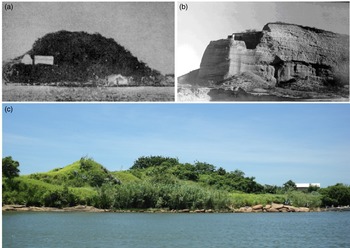
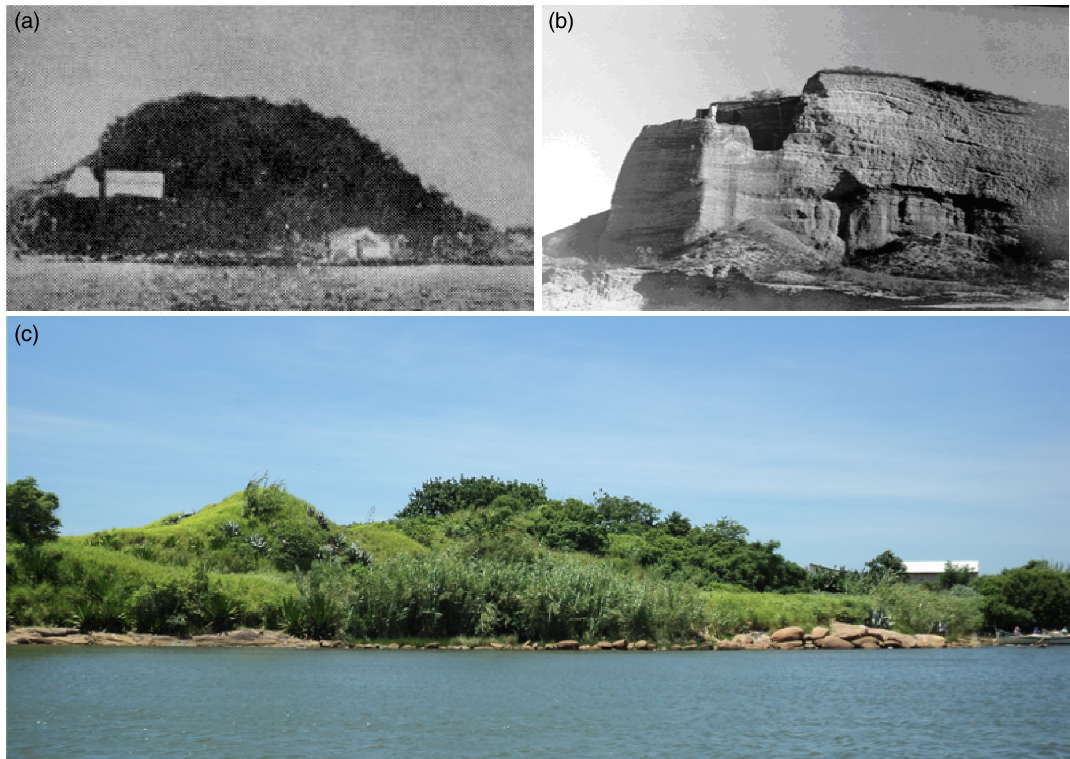
The Sambaqui de Cabeçuda rests partly on sandy sediments of an eolian paleodune (belonging to generation G2 described in Giannini et al. (Reference Giannini, Sawakuchi, Martinho and Tatumi2007), dominant previous or contemporaneous to the Holocene maximum flooding) whose reddish-brown color is due to the presence of post-depositional silty clay, and partly on a pink granite of the Precambrian basement (Guerra Reference Guerra1950, Giannini et al. Reference Giannini, Sawakuchi, Martinho and Tatumi2007). In its original size, Cabeçuda was estimated to have been 22 m in height, 400 m in diameter and 53,000 m3 in volume (Rohr Reference Rohr1961; Mendonça de Souza 1995; Klokler Reference Klokler2014). Currently, due to urban expansion and historical exploitation for lime production, less than 25% of the original site volume is preserved (Klokler Reference Klokler2014; Scheel-Ybert et al. Reference Scheel-Ybert, Rodrigues-Carvalho, DeBlasis, Gaspar and Klokler2020, and references therein) (Figure 2). Nevertheless, Cabeçuda remains a key site for the reconstruction of the paleoenvironment and the understanding of the social dynamics of sambaqui builders in southern Brazil. Excavations in this site resumed recently and several field campaigns took place from 2010 to 2017. The site presents a complex stratigraphy, showing an alternation of light-colored shellfish-rich layers and dark organic layers. In the former, fish bones and charcoal were found scattered. In the latter, compact sandy sediments predominated over shellfish remains, burials were present, and fish bones, charcoal, and lithic artefacts were abundant. These layers were less thick and covered by the shellfish layers. High concentrations of fish bones found in funerary contexts suggest the presence of offerings, while large charcoal deposits associated with the burials indicate the importance of fire in the funerary ritual (Scheel-Ybert et al. Reference Scheel-Ybert, Rodrigues-Carvalho, DeBlasis, Gaspar and Klokler2020).
Cabeçuda in 1928 (a), at the time of the first excavation in 1950 (b), and at the time of the second excavation in 2012 (c) (Photos: S. Fróes de Abreu, L. Castro Faria, R. Scheel-Ybert, respectively).
The Sample Set
Samples used in the present study, including shell, charcoal and bone were directly associated with five different burials recovered in the 2010–2012 excavations (see Supplementary Material for a description of the burials). The contemporaneity of the samples is a fundamental requirement for the derivation of ΔR values. The specimens used in this research are coeval samples, retrieved from the same archaeological contexts. The samples were taken from burial features, consisting of bones from the burial itself along with associated samples of shell and charcoal which are related to the funerary ritual (Scheel-Ybert et al. Reference Scheel-Ybert, Rodrigues-Carvalho, DeBlasis, Gaspar and Klokler2020). Three different contexts were analyzed. Two of them are situated in locus 1, in the northwestern part of the site: burials E1, E3, and E5 come from the same funerary area, where a horizontal excavation of 20 m2 was performed by decapage, and are most likely contemporaneous by a few days, years or decades (although burial E5 is necessarily younger than burial E1, for it was deposited just above it); burials P6 and P7 come from different archaeological layers from the profile beneath this funerary area. Burial P7, stratigraphically lower, is situated ca. 40 cm below burial P6; this one is situated ca. 1.30 m below the excavation area where the other burials were found. The later context refers to burial P13, which comes from locus 2, presently situated in the middle part of the site, ca. 25 m apart from locus 1. This burial is situated at around the same height as burials P6 and P7. However, their contemporaneity cannot be inferred stratigraphically alone, because different areas of the site were established at the same time; the building of the site did not happen linearly, but according to several events carried out in distinct places (Scheel-Ybert et al. Reference Scheel-Ybert, Rodrigues-Carvalho, DeBlasis, Gaspar and Klokler2020).
Analyses
Anthracological and Malacological Analyses
Charcoal samples were subjected to anthracological investigations to rule out the old-wood effect. These analyses were performed at the Archaeobotany and Landscape Laboratory of the National Museum of Brazil – Universidade Federal do Rio de Janeiro (LAP-MN/UFRJ). Samples were manually broken, exposing the three fundamental wood sections (transversal, tangential longitudinal, and tangential radial), and examined under a reflected light brightfield/darkfield microscope. Anatomical structures were then exhaustively compared to a well-identified comparative collection (charcoal collection from Museu Nacional, UFRJ; Scheel-Ybert et al. Reference Scheel-Ybert2016), allowing taxonomic identification. Additionally, descriptions and photographs from the specialized literature (e.g., Metcalfe and Chalk Reference Metcalfe and Chalk1950; Detienne and Jacquet Reference Detienne and Jacquet1983) were consulted to support the identifications. A large set of charcoal samples was analyzed and structures such as barks and twigs were selected to avoid the old-wood effect. In the absence of those, charcoal pieces derived from branches of restinga taxa (Myrtaceae, Sapotaceae, Leguminosae, Sapidaceae, and Rutaceae), which are not usually composed of long-lived species, were selected.
The restinga vegetation is a mosaic of plant associations with diverse physiognomies typical to sandy beach and foredune ridges. It consists of an extremely dynamic ecosystem which is (and has been) in constant change and remodeling due to eolian and marine processes, including sea-level variations (see Scheel-Ybert and Boyadjean Reference Scheel-Ybert and Boyadjian2020, and references therein). Therefore, the restinga flora is mainly composed by pioneer and early secondary species, which usually have a short life spam. Typically, pioneer species do not exceed ten years of age and early secondary species, 10–25 years (Budowski Reference Budowski1965).
The archaeological shells obtained for the present study were identified to species level with the support of the specialized literature (e.g., de Souza et al. Reference de Souza, Lima and da Silva2011) and a reference collection. Shells of the suspension-feeder bivalve Anomalocardia flexuosa (Linnaeus 1767) were selected. This organism tolerates large variations in salinity (> 17) and is geographically widespread (Abbott Reference Abbott1974; Leonel et al. Reference Leonel, Magalhães and Lunetta1983; Monti et al. Reference Monti, Frenkiel and Moueza1991; Rios Reference Rios1994; Rodrigues et al. Reference Rodrigues, Borges-Azevedo, Costa and Henry-Silva2013), typically inhabiting environments protected from the wave action, such as mangroves, estuaries, muddy beaches, and intertidal zones (Boehs and Magalhães Reference Boehs2004; de Souza et al. Reference de Souza, Lima and da Silva2011). This means that these shells were most probably collected from the lagoons adjacent to Cabeçuda.
X-Ray Diffraction
In order to assess the potential for shell recrystallization, the archaeological shells were analyzed using X-ray Diffraction (XRD) at the Laboratory of the Universidade Federal Fluminense (LDRX-UFF). Samples were homogenized with a mortar and pestle, and the fine powder was analyzed in a Bruker AXS D8 Advance (Cu Kα radiation, 40 kV, 40 mA) diffractometer. The machine was operated in a Bragg–Brentano θ/θ configuration with the diffraction patterns being collected in a flat geometry with steps of 0.02 degrees and accumulation time of 2.0 s per step using a PSD detector (Bruker AXS LynexEye model). Data were refined following the Rietveld method and using the GSAS-II software (Toby and Von Dreele Reference Toby and Von Dreele2013).
Stable Isotopes Analyses
Bone collagen δ13C and δ15N analyses were performed on five human individuals for dietary reconstructions and for assessing the relative contribution of marine carbon in bone collagen. Samples were analyzed at the Oxford Radiocarbon Accelerator Unit (ORAU, University of Oxford, UK) following the collagen extraction protocol proposed by Brock et al. (Reference Brock, Higham, Ditchfield and Ramsey2010). Stable isotope analyses were performed with an aliquot of the gas used for 14C dating. Collagen samples (2–5 mg) were analyzed using a continuous flow isotope ratio mass spectrometer composed of a combustion elemental analyzer (Carlo-Erba NA 2000) and a gas source isotope ratio mass spectrometer (IRMS; Sercon 20/20). Through the combustion of collagen, nitrogen (N2) and carbon dioxide (CO2) were liberated. After the removal of water via the use of a chemical trap, these two gases were separated in a GC column packed with Carbosieve TM (Supelco G60/80 mesh; Bellefonte, Pennsylvania, USA) packing medium. During the process, helium (He) was used as a carrier gas and N2 and CO2 were sequentially analyzed on the IRMS for each sample. The calculations of δ13C and δ15N were performed relative to the results of an alanine standard and isotopic ratios are reported as delta per mil relative to the V-PDB and AIR international standards for carbon and nitrogen respectively (Coplen Reference Coplen1994). Details of this process can be found in Brock et al. (Reference Brock, Higham, Ditchfield and Ramsey2010).
Eighteen well-preserved shells were prepared for carbonate δ13C and δ18O analyses. The last visible growth bands of the shells, comprising several annual growth increments and thus reflecting several seasons, were sampled, homogenized using a mortar and pestle and the carbonate sample analyzed at the Stable Isotope Facility of the University of California, Davis (SIF UCDavis) using a GasBench II system interfaced to a Delta V Plus IRMS (Thermo Scientific, Bremen, Germany). Approximately 0.3 mg of powdered sample was placed into vials and loaded into an autosampler rack (at 70ºC). Next, the capped vials were flushed/filled with helium using a CTC PAL autosampler device. Several drops of phosphoric acid (H3PO4) (103%) were then manually injected into each vial with the aid of a syringe to release CO2. The vials were returned to the autosampler rack to equilibrate for 24 hr at 30°C. A Thermo Fisher Scientific Gas-Bench II device connected to a Thermo Fisher Scientific Delta V Plus gas-isotope ratio mass spectrometer was used to analyze the sample CO2. Provisional δ values for the sample peak were acquired through the measurement of a pure CO2 reference gas. These values were then corrected for changes in linearity and instrumental drift in order to yield accurate δ13C and δ18O for reference materials. The data were calibrated on the V-PDB scale using NBS 18 (–5.01‰, –23.01‰, for δ13C and δ18O respectively), NBS 19 (1.95‰, –2.20‰), and LSVEC (–46.60‰, –26.70‰).
Radiocarbon Dating
Carbonate: At the Radiocarbon Laboratory of the Universidade Federal Fluminense (LAC-UFF), carbonate pre-treatment follows the standard protocols for the preparation of inorganic samples (Oliveira et al. Reference Oliveira, Macario, Carvalho, Moreira, Alves, Chanca and Diaz2021). The remains of organic tissues were removed manually with scalpels and washing with MilliQ water was not necessary. For each shell, the last visible growth band, comprising several growth increments and thus reflecting several seasons, was sampled (∼40 mg) and etched overnight with 0.8 mL of hydrochloric acid (HCl) 0.5M at 90ºC to remove the external layer (∼50% of the sample). After the chemical pre-treatment, vials containing the samples were sealed with rubber septa and evacuated (<10 mTorr) in a vacuum line. Finally, 1mL of H3PO4 (85%) was inserted into each vial with the help of a syringe. The samples were left to react overnight at room temperature and the acid hydrolysis of CaCO3 generated CO2. The CO2 obtained in the previous step was inserted into the vacuum line for purification. This process started with the use of a cryogenic trap of ethanol and dry ice (–78°C) to freeze the water present in the sample. CO2 was then frozen with liquid nitrogen (–196°C) whilst other gases were discarded by pumping. Next, CO2 was transferred to a previously prepared graphitization tube, which consists of a small tube containing iron (Fe) inside a larger tube containing zinc (Zn) and titanium hydride (TiH2). The graphitization tube was sealed with a torch and taken to the oven (7 hr at 550ºC) for the reduction of CO2 to graphite (Xu et al. Reference Xu, Trumbore, Zheng, Southon, McDuffee, Luttgen and Liu2007; Macario et al. Reference Macario, Oliveira, Carvalho, Santos and Xu2015a, Reference Macario, Tenório, Alves, Oliveira, Chanca, Netto, Carvalho, Souza, Aguilera and Guimarães2017). The mixture of graphite and Fe, formed inside the inner reaction tube, was pressed in small aluminium cathodes. At the LAC-UFF, samples are measured in a 250 kV Single Stage Accelerator Mass Spectrometry (SSAMS) system produced by the National Electrostatics Corporation (NEC). This compact AMS, dedicated to the measurement of carbon isotopes, is the same system used at the Australian National University (ANU) 14C Laboratory (Fallon et al. Reference Fallon, Fifield and Chappell2010), where some of the samples (graphite) were sent for measurement.
Bone: Bone samples were subjected to two different treatments at the ORAU. Samples coded AF underwent an acid-base-acid (ABA) treatment with 0.5M HCl (∼4 rinses for over 18 hr), 0.1M sodium hydroxide (NaOH) (30 min) and 0.5M HCl (1 hr). Rinses with MilliQ water were performed between each step. The ABA treatment was followed by the gelatinization of collagen using pH 3 solution at 75ºC for 20 hr (Longin Reference Longin1971) and ultrafiltration (Brown et al. Reference Brown, Nelson, Vogel and Southon1988). Details of these steps can be found in Brock et al. (Reference Brock, Higham, Ditchfield and Ramsey2010). The sample coded AG underwent the AF treatment without the ultrafiltration step in order to increase the collagen yield. Nevertheless, since this parameter is an indicator of the bone suitability for dating (and indeed of its preservation state), the AG pretreatment is only recommended in some special cases (see Brock et al. Reference Brock, Higham, Ditchfield and Ramsey2010). In both cases (AF and AG), the collagen samples were weighed into clean tin capsules. The tins containing purified collagen were taken to a collection system where they were combusted in an elemental analyzer (e.g., a Carlo-ERBA NA 2000). Hydrogen gas was added to the sample CO2 and the mixture was collected and transferred to a specially designed rig containing Fe catalyst (Bronk Ramsey and Hedges Reference Bronk Ramsey and Hedges1997). The rig valve was then closed, and the reactor taken to the oven (6 hr at 560ºC). The final pressure in the reactors was measured to check for the completeness of the reaction. After that, the mixture of graphite and Fe was finally pressed in an aluminium cathode and taken to the ion source of a 2 MV accelerator system, produced by High Voltage Engineering Europa (HVEE), for measurement.
Charcoal: At the LAC-UFF, charcoal samples underwent an ABA treatment (Oliveira et al. Reference Oliveira, Macario, Carvalho, Moreira, Alves, Chanca and Diaz2021). This consisted of a wash with HCl 1.0M (2 hr at 90ºC), a wash with NaOH 1.0M (1 hr at 90ºC) and a second wash with HCl 1.0M (2 hr at 90ºC), performed in this order. In each step, the washes were repeated until the solution became clear and, after the final wash of each step, samples were rinsed with MilliQ water. The ABA treatment was carried out in order to remove contaminants such as carbonates and organic acids. The second acid step is necessary for the removal of atmospheric CO2 contamination that may be introduced during the base step (Goh and Molloy Reference Goh and Molloy1972). After the chemical treatment, samples were dried and placed into previously prepared combustion tubes that were later evacuated and taken to a muffle furnace (3 hr at 900ºC). During this combustion step, the samples were converted to CO2. Graphitization happened in the same way as for the shell samples.
MRE Determination
In order to ensure sample contemporaneity and take into account the overall variability in ΔR, Russell et al. (Reference Russell, Cook, Ascough, Scott and Dugmore2011) propose a multipair approach. Following their method, several marine and terrestrial samples are selected for the ΔR calculation and every possible pairing is used. In the present study, for the calculation of ΔR values we have used the OxCal v4.2.4 calibration software (Bronk Ramsey Reference Bronk Ramsey2009), which has been shown to yield results equivalent to those obtained by the use of the multipair approach (Macario et al. Reference Macario, Souza, Aguilera, Carvalho, Oliveira, Alves, Chanca, Silva, Douka and Decco2015b). Charcoal ages were calibrated with the SHCal20 curve (Hogg et al. Reference Hogg, Heaton, Hua, Palmer, Turney, Southon, Bayliss, Blackwell, Boswijk, Ramsey and Pearson2020) and shell ages were calibrated with the Marine20 curve (Heaton et al. Reference Heaton, Köhler, Butzin, Bard, Reimer, Austin, Ramsey, Grootes, Hughen, Kromer and Reimer2020). By including the terrestrial and marine ages of each group of samples in the same phase and leaving ΔR undetermined (within the interval from –600 to 600 14C years), it was possible to evaluate the magnitude of the offset that would result in coeval samples (Bronk Ramsey Reference Bronk Ramsey2013). The following models were employed in the present study (the codes can be found in the Supplementary Material):
-
Model 1: Considering that the burials can be from different time periods but the samples associated with a single burial are coeval, this model assumes an independent ΔR value for each burial (phase) (see Macario et al. Reference Macario, Souza, Aguilera, Carvalho, Oliveira, Alves, Chanca, Silva, Douka and Decco2015b).
-
Model 2: This follows the same premises of the first model but assuming a ΔR value that is roughly time-independent during the occupational period of the site, similar to the method employed by Macario et al. (Reference Macario, Alves, Chanca, Oliveira, Carvalho, Souza, Aguilera, Tenório, Rapagnã and Douka2016).
-
Model 3: This approach considers all samples as part of the same occupational period (a single phase for all samples), which enhances the statistics of the model (Macario et al. Reference Macario, Souza, Aguilera, Carvalho, Oliveira, Alves, Chanca, Silva, Douka and Decco2015b).
-
Model 4: This is a single phase model for the derivation of a R value, similar to the one used by Milheira et al. (Reference Milheira, Macario, Chanca and Alves2017) for the study of the earthen mounds in Southern Brazil, for the whole set of samples.
Modeling Human Diet at Cabeçuda
The relative contribution of different food sources to human diet at Cabeçuda was calculated using a Bayesian mixing model in FRUITS 2.1.1 (Fernandes et al. Reference Fernandes, Millard, Brabec, Nadeau and Grootes2014). In order to simplify the model, only the most important components of the diet (i.e., fish, terrestrial mammals and C3 plants), based on the archaeological evidence, were included in the model input. The δ13C and δ15N values of 17 fish specimens from Southern Brazil, reported in Colonese et al. (Reference Colonese, Collins, Lucquin, Eustace, Hancock, Ponzoni, Mora, Smith, DeBlasis and Figuti2014), were averaged to yield –11.4 ± 1.4‰ and +13.5 ± 2.0‰, respectively. These samples consisted of archaeological and modern marine-brackish species from the Santa Catarina coast. Colonese et al. (Reference Colonese, Collins, Lucquin, Eustace, Hancock, Ponzoni, Mora, Smith, DeBlasis and Figuti2014) also report isotopic data for 14 archaeological samples of herbivorous and omnivorous specimens from the Southeastern Atlantic Forest of Brazil. The average δ13C and δ15N values of these terrestrial animals are –22 ± 1.2‰ and +8.4 ± 1.7‰, respectively. Finally, the plant isotopic data used in the model were obtained from Galetti et al. (Reference Galetti, Rodarte, Neves, Moreira and Costa-Pereira2016), who analyzed 48 samples [modern fruits (n = 30); roots (n = 5) and palm-heart (n = 13)] from the Southeastern Atlantic Forest, obtaining average δ13C and δ15N values of –29.2 ± 3.0‰ and +1.1 ± 2.0‰, respectively. Modern plant samples had their δ13C values corrected for the Suess Effect using a value of +2‰ (Hellevang and Aagaard Reference Hellevang and Aagaard2015).
The isotopic values of the food sources refer to the bulk of each food source and offsets need to be applied for the derivation of the isotopic signature of their macronutrient fractions (protein, carbohydrate, and lipids). Following Fernandes et al. (Reference Fernandes, Grootes, Nadeau and Nehlich2015) and Fernandes (Reference Fernandes2016), the offsets employed in the model were –2‰ (Δ13Cprotein−collagen), –8‰ (Δ13Clipids−collagen) and +2‰ (Δ15Nprotein−collagen) for terrestrial mammals, –1‰ (Δ13Cprotein−collagen), –7‰ (Δ13Clipids−collagen) and +2‰ (Δ15Nprotein−collagen) for fish and –2‰ (Δ13Cbulk−protein) and +0.5‰ (Δ13Cbulk−lipids), and δ15Nprotein = δ15Nbulk for plants. An uncertainty of 1‰ was applied to all of these offsets. While the nitrogen content of collagen is assumed to be exclusively derived from proteins, carbon can be obtained from carbohydrates or lipids via the de novo synthesis of non-essential amino acids (Jim et al. Reference Jim, Jones, Ambrose and Evershed2006; Fernandes et al. Reference Fernandes, Nadeau and Grootes2012; Webb et al. Reference Webb, Lewis, Shain, Kastrisianaki-Guyton, Honch, Stewart, Miller, Tarlton and Evershed2017). Hence, we have assumed that protein and energy (representing lipids and carbohydrates) contribute with 74 ± 4% and 26 ± 4% of carbon to bulk collagen, respectively (Fernandes et al. Reference Fernandes, Nadeau and Grootes2012). The Bayesian analysis of the isotopic data of the individuals of Cabeçuda (Fernandes Reference Fernandes2016) was performed with a model using δ13C and δ15N diet-to-collagen offsets of +5 ± 0.5‰ (Fernandes et al. Reference Fernandes, Nadeau and Grootes2012). The model assumed a range of protein intake of >5% and <45% of the total calories (Fernandes et al. Reference Fernandes, Millard, Brabec, Nadeau and Grootes2014).
RESULTS AND DISCUSSION
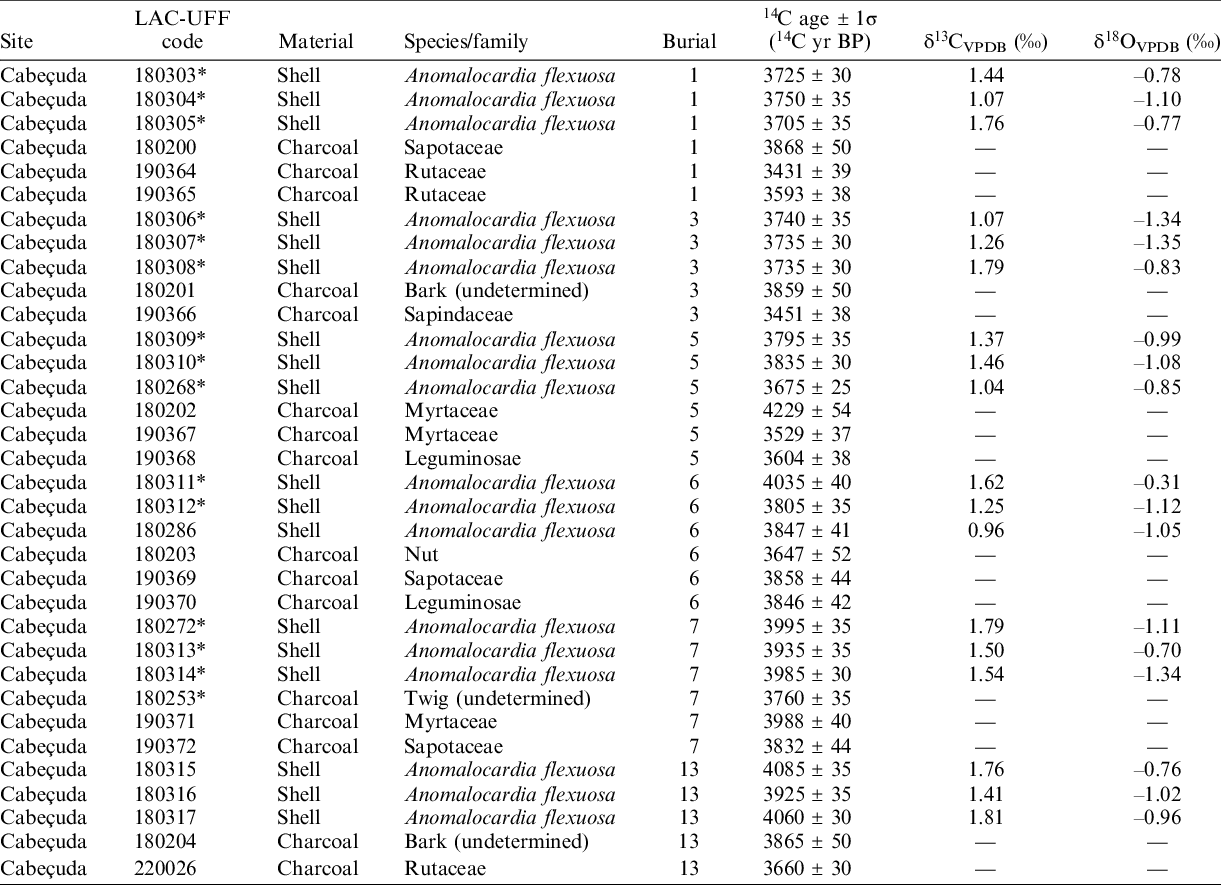
Table 1 presents the results of the analyses of the charcoal and shell samples collected at Cabeçuda.
Anthracological and isotopic results, including 14C-AMS, for archaeological samples from the shell mound Sambaqui de Cabeçuda. The uncertainties for the δ13C and δ18O values are 0.10 and 0.20‰, respectively.

* These samples were measured at the ANU 14C Laboratory.
The XRD results for the shells are presented in the Supplementary Material. Although the results show the presence of an amorphous phase that may contain organic carbon, this would not be converted to CO2 during the acid hydrolysis of the sample and thus does not constitute contamination. Indeed, the XRD results point to a crystalline structure that is primarily aragonite, which means that aragonite to calcite recrystallization is not an issue for the archaeological shells used in this study. Similar conclusions were obtained by Colonese et al. (Reference Colonese, Collins, Lucquin, Eustace, Hancock, Ponzoni, Mora, Smith, DeBlasis and Figuti2014) on shells from this site. In any case, the etching procedure performed for the shells has been shown to be a valid method to eliminate any possible secondary calcite (e.g., Macario et al. Reference Macario, Tenório, Alves, Oliveira, Chanca, Netto, Carvalho, Souza, Aguilera and Guimarães2017).
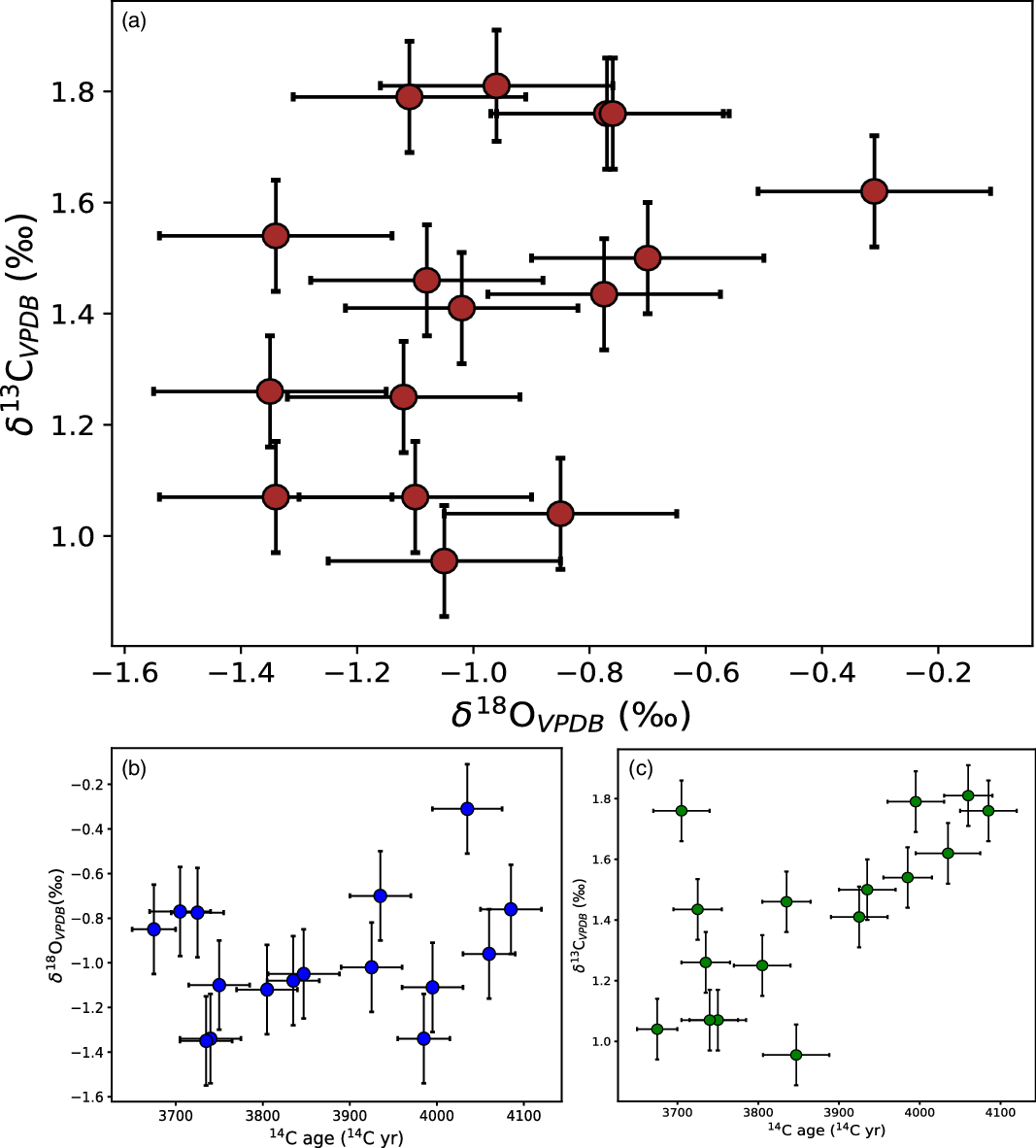
The δ13C and δ18O values for the Cabeçuda shells are in the range from +0.96 to +1.81‰ and from –1.35 to –0.31‰, respectively. These values are within the range found by Casati (Reference Casati2019) for several Anomalocardia shells from Cabeçuda and nearby sites. They are also broadly consistent with the modeled present-day values for the South Atlantic ocean (see Gruber et al. Reference Gruber, Keeling, Bacastow, Guenther, Lueker, Wahlen, Meijer, Mook and Stocker1999; LeGrande and Schmidt Reference LeGrande and Schmidt2006; Tagliabue and Bopp Reference Tagliabue and Bopp2008) and these two variables show no correlation in the set of samples analyzed in the present study (Figure 3a). The negative δ18O signal points to the influence of higher temperatures or freshwater input by the regional rivers. In this context, the positive δ13C values could be a result of enhanced primary production through upwelling as proposed by recent studies, and in such case would also reflect inputs from oceanic waters (e.g., Toniolo et al. Reference Toniolo, Giannini, Angulo, de Souza, Pessenda and Spotorno-Oliveira2020). Figure 3b shows that the δ18O values remain broadly constant. The δ13C values, on the other hand, seem to decrease with time (Figure 3c). This is also consistent with data presented by Casati (Reference Casati2019) and may be due to a lower marine influence in this period, possibly related to decreasing sea-level. According to Casati (Reference Casati2019), other possible influencing factors for this trend include the progressive closure of the connections between the lagoon and the sea due to siltation (Giannini et al. Reference Giannini, Villagran, Fornari, Nascimento, Menezes and Tanaka2010), increasing rainfall leading to enhanced fluvial input in the region (e.g., Cruz et al. Reference Cruz, Burns, Jercinovic, Karmann, Sharp and Vuille2007; Bernal et al. Reference Bernal, Cruz, Stríkis, Wang, Deininger and Catunda2016) and the progradation of the Tubarão river delta increasing its influence in the lagoon (Nascimento Reference Nascimento2010). It is here assumed that molluscs were collected from areas surrounding the site, and thus their δ13C and δ18O values would reflect local environmental conditions. However, given the volume and the long-term use of the site such an assumption may be arguable. Previous studies have shown that shellfish exploitation by coastal foragers may occur at several distances from the depositional sites (Andrus and Thompson Reference Andrus and Thompson2012). Therefore, collections in areas exposed to distinct degrees of freshwater and sea water circulation could explain some of the variability observed in shell δ13C and δ18O values, but further studies are required to validate this hypothesis. Moreover, it is important to notice that in Figure 3 the radiocarbon ages are not calibrated.
(a) Stable isotopes (δ18O and δ13C) results for the archaeological shells. (b) δ18O and (c) δ13C results versus time for the archaeological shells.

Deriving a ΔR Value for the Sambaqui de Cabeçuda
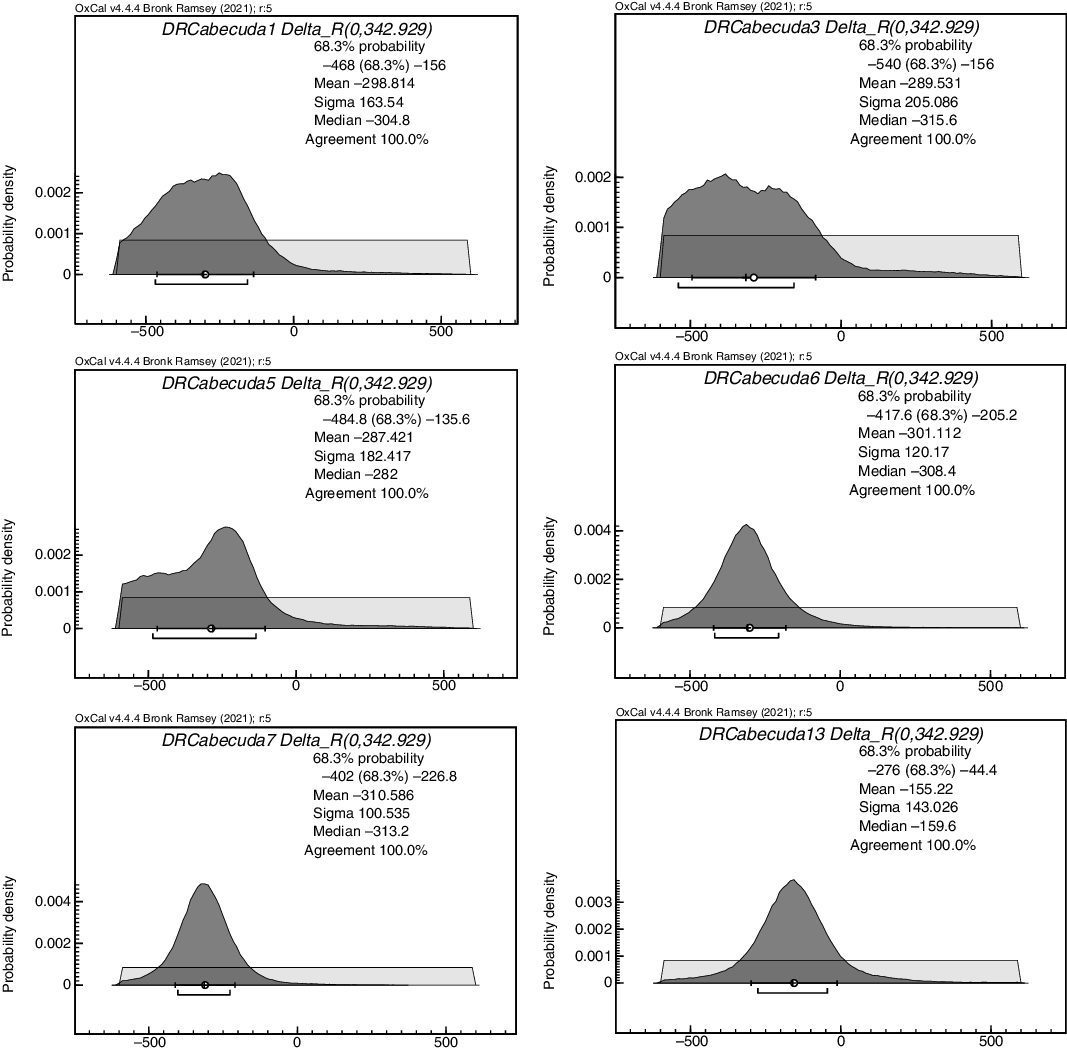
Highly negative ΔR values were obtained for Cabeçuda. Model 1 yields ΔR values that range from –316 ± 205 to –160 ± 143 14C yr (Figure 4). However, although this model is ideal for assessing temporal variations, our small sample set is a drawback. Due to the limited number of samples in each phase, any outlier can lead to inaccurate results for the ΔR. For example, outlier analysis included in model 1 (Bronk Ramsey Reference Bronk Ramsey2009) revealed that sample 180202 is an outlier at 41% probability (see Supplementary Material). In order to bypass this obstacle and given that the results of model 1 do not hint at a considerable temporal variation of ΔR, model 2 employs separate phases but all the dates are used to achieve a common ΔR for the site.
Individual ΔR values obtained for each Cabeçuda burial studied (model 1).

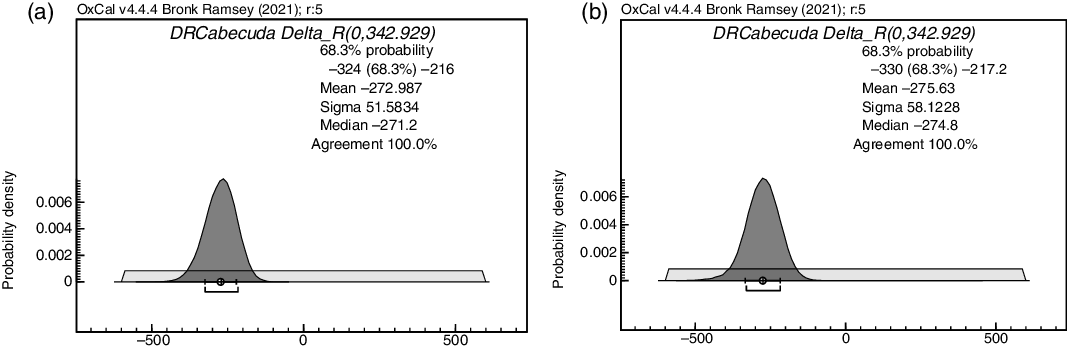
The approach of model 2 yielded a ΔR of –271 ± 52 14C yr (Figure 5a). By having a closer look at this model (see Supplementary Material), it is possible to note that burial 5 is problematic, with the charcoal (sample 180202), which is identified as an outlier (58%), being older than the shells. A possible reason for this inconsistency is the remobilization of the charcoal fragment, meaning that it would not be originally associated with the burial. This means that more charcoal samples derived from this burial need to be measured for this research. Finally, model 3 maximizes the statistics of the ΔR derivation by considering the whole set of dates within a single phase. By employing this model, a ΔR value of –275 ± 58 14C yr was derived for the site (Figure 5b).
A common ΔR value obtained for all the Cabeçuda burials studied using a model with (a) different phases (model 2) and (b) a single phase (model 3) for the Cabeçuda burials.

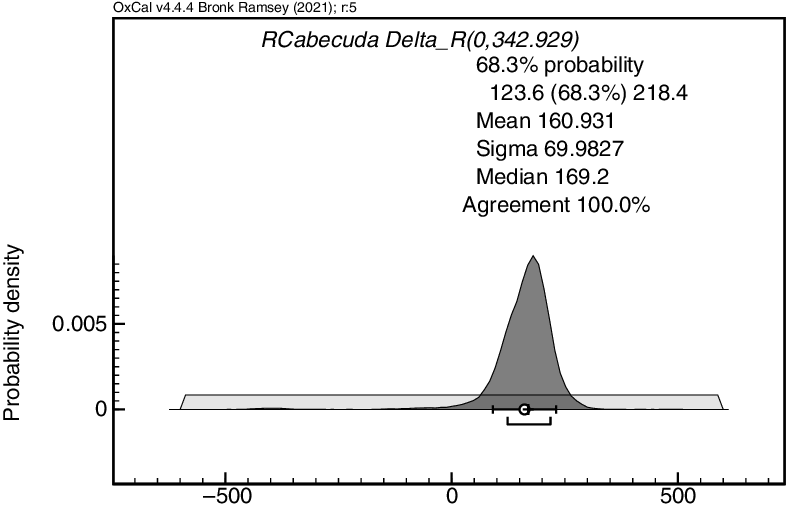
Model 3 assumes that all samples are coeval, but the outlier model shows that sample 180202 is remarkably older (see Supplementary Material). Moreover, samples 190364 and 190371 are also identified as outliers at different probabilities. If the charcoal dates were reliable, the highly negative ΔR results obtained in the present study would indicate that aquatic samples from the LLS could be accurately calibrated by the use of the SHCal20 atmospheric curve and the R offset (instead of Marine20 and ΔR). Model 4 yields the value of R = 169 ± 70 14C yr (Figure 6). A drawback of this approach is that marine 14C ages calibrated with atmospheric curves yield calibrated age distributions that present the oscillations characteristic of the atmospheric reservoir.
Single R value obtained considering a single phase for the Cabeçuda burials (model 4).

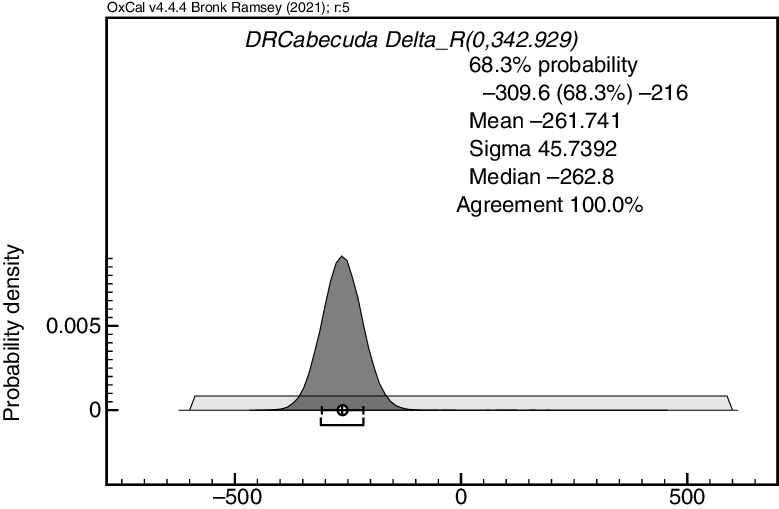
The ΔR values derived in the present study are very negative and some probability distributions in Figure 4 are truncated even within the –600 to 600 14C yr range used in the model. The samples identified as outliers in model 3 (180202, 190364, and 190371) are charcoal pieces associated with burials 1, 5, and 7, and could have been remobilized. Therefore, it is important to acknowledge the possibility of these samples being unsuitable for MRE determinations (i.e., not coeval). Taking this into consideration and excluding these samples from the third model presented here, a ΔR of –263 ± 46 14C yr is obtained (Figure 7). This is the most reliable of all the approaches so far presented. Despite the very low chances in the restinga environment, charcoal samples 180202, 190364, and 190371 could possibly be affected by the old-wood effect. Therefore, given that the shells do not present recrystallization, by excluding these samples from the ΔR determination the chances of remobilization or an old-wood effect affecting the result were also further minimized. The ΔR value of –263 ± 46 14C yr is therefore the one to be used for Cabeçuda until more samples are measured for the improvement of the statistics.
Single ΔR value obtained considering a single phase for the Cabeçuda burials. Outliers (samples 180202, 190364, and 190371) were excluded from this analysis.

These results are highly negative, similarly to what is observed in the present day ΔR values of –114 ± 25 and –244 ± 53 14C yr derived for the coast of Santa Catarina (Alves et al. Reference Alves, Macario, Spotorno-Oliveira, Oliveira, Muniz and Fallon2020). In Southern Brazil, only two other archaeological sites were studied for MRE quantification: the earthen mound complex in Patos Lagoon (R = 63 ± 53 14C yr; Milheira et al. Reference Milheira, Macario, Chanca and Alves2017) and the Sambaqui de Jabuticabeira (ΔR = –205 ± 80 14C yr), both showing results consistent with our findings for Cabeçuda. The latter value was re-calculated using Marine20 and the same approach in model 2 from the data presented in Eastoe et al. (Reference Eastoe, Fish, Fish, Gaspar and Long2002). To understand our results, it is important to consider the environmental setting of the LLS. This lagoonal system was formed when the post-glacial rise in sea-level drowned pre-existing incised valleys during the Mid Holocene (Amaral et al. Reference Amaral, Fonseca Giannini, Sylvestre and Ruiz Pessenda2012), and since then, it presents an increasingly restricted connection to the sea, which enhances the effect of terrestrial carbon input by the discharge of major rivers in this reservoir. This phenomenon is even more significant when one considers that the seawater entering the lagoon may be influenced by the plume of the La Plata River (Toniolo et al. Reference Toniolo, Giannini, Angulo, de Souza, Pessenda and Spotorno-Oliveira2020), which is the second largest river in South America (e.g., Piola et al. Reference Piola, Campos, Möller, Charo and Martinez2000, Reference Piola, Matano, Palma, Möller and Campos2005; Piola and Romero Reference Piola and Romero2004; Pimenta et al. Reference Pimenta, Campos, Miller and Piola2005). In addition, the shallow depths of the lagoons suggest that these are well-mixed reservoirs that could be in isotopic equilibrium with atmospheric CO2. Although Colonese et al. (Reference Colonese, Netto, Francisco, Deblasis, Villagran, Ponzoni, Hancock, Hausmann, Farias and Prendergast2017), who analyzed stable isotopes of carbon and oxygen in archaeological samples from Cabeçuda, report a higher marine influence in the system at 3 ka cal BP when compared to the present-day conditions, the ΔR value derived here shows continental influence. The analyses of samples from different archaeological layers at Cabeçuda would allow for the assessment of the MRE temporal variation but, unfortunately, this was not possible due to the poor preservation of the site. Since the Brazilian sambaquis are often found near coastal lagoons due to the productivity of these environments, negative ΔR values are not uncommon (Macario et al. Reference Macario, Alves, Belém, Aguilera, Bertucci, Tenório, Oliveira, Chanca, Carvalho and Souza2018) and the same approach may suit other settlements.
Diet Assessment and Chronology in the Sambaqui de Cabeçuda
Table 2 presents the results for the bone samples. With the exception of burial 7, collagen was extracted from all human bones. The collagen C:N atomic weight ratios were within the interval (2.9–3.5) characteristic of intact collagen (van Klinken Reference van Klinken1999). The radiocarbon ages of these samples fall within the range 4000–3500 yr BP, in agreement with previous results for other samples derived from the same excavation. The mean δ13C and δ15N values for the five individuals were –10.6 ± 1.4‰ and +18.4 ± 0.5‰ respectively, indicating diets with high intake of marine proteins.
Results for the bone samples analyzed in the present study.

According to the model parameters and assumptions, marine fish and C3 plants were the main sources of dietary calories to humans of Cabeçuda (see Supplementary Material), which is in agreement with zooarchaeological data obtained from the sambaqui deposit (Klokler Reference Klokler2016). The model outputs indicate that for all humans most of the carbon atoms in collagen derived from fish, with relative contributions ranging from 74 ± 4% (burial 13) to 82 ± 4% (burial 3).
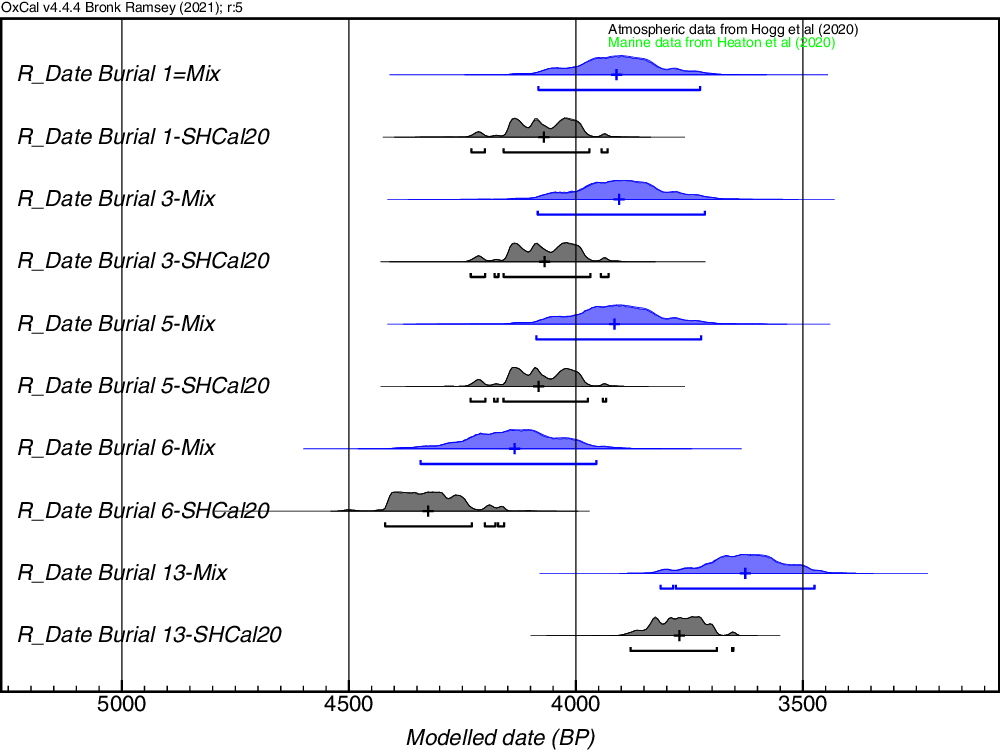
A highly marine diet bears important consequences to the calibration of radiocarbon ages obtained from human remains (see Pezo-Lanfranco et al. Reference Pezo-Lanfranco, Eggers, Petronilho, Toso, da Rocha Bandeira, Von Tersch, dos Santos, Ramos da Costa, Meyer and Colonese2018; Fossile et al. Reference Fossile, Ferreira, da Rocha Bandeira, Figuti, Dias-da-Silva, Hausmann, Robson, Orton and Colonese2019; Toso et al. Reference Toso, Hallingstad, McGrath, Fossile, Conlan, Ferreira, da Rocha Bandeira, Giannini, Gilson, de Melo Reis Bueno and Bastos2021). In the specific case of Cabeçuda, the ΔR value calculated in this work can be applied for correcting the 14C ages obtained from the individuals. Based on the contributions of each of the most significant food sources to the diet of the Cabeçuda builders, as estimated by Bayesian modeling in the previous section, the bone samples analyzed in this paper were calibrated with mixed calibration curves (using the respective percentual contribution of marine carbon to collagen carbon) and the ΔR derived here (–263 ± 46 14C yr) (Figure 8).
Comparison between the calibration of the ages obtained from the humans of Cabeçuda using a SHCal20/Marine20 mixed curve (purple) and only the SHCal20 curve (black).

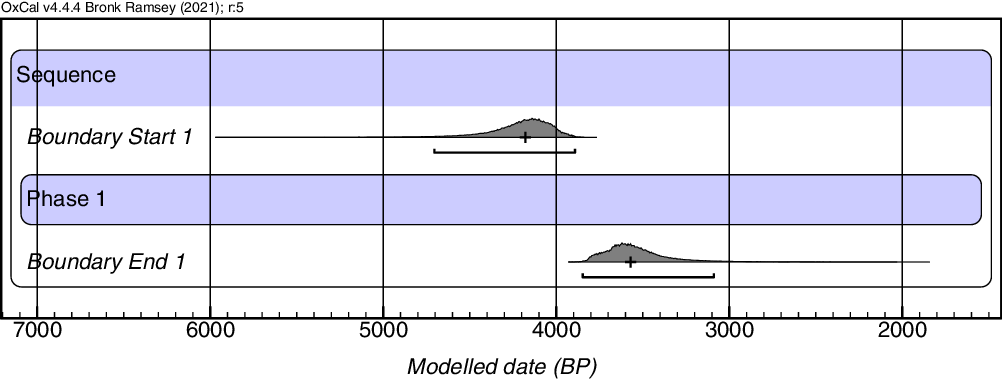
Using a phase model for the Cabeçuda bones it is possible to estimate a period between approximately 4200 and 3600 cal BP (Figure 9) within the occupation. However, it is important to emphasize that this is not representative for the whole site since Cabeçuda is much larger than the studied burials.
Boundaries of a phase model for the Cabeçuda bones.

CONCLUSIONS
The Sambaqui de Cabeçuda is an impressive Brazilian coastal shell mound, which holds important paleoenvironmental and archaeological information. Here, we employed an interdisciplinary approach involving stable isotopes, carbonate geochemistry, radiocarbon dates on shell, bone and charcoal remains from the site, as well as Bayesian models to derive (1) an accurate MRE offset for the region, (2) the age of human burials, and (3) the diet of the inhumated individuals. Our model outputs reveal that the local MRE was highly negative (–263 ± 46 14C yr) and this must be considered when calibrating local conventional radiocarbon dates derived from marine organisms (e.g., shells, fish) and human remains (collagen, apatite) whose dietary proteins were dominated by marine resources. This was the case for all the human individuals analyzed in this study. Stable isotope and Bayesian Isotope Mixing Models pointed to dietary regimes with high intakes of marine proteins. By quantifying the MRE, a correction factor for the radiocarbon dates (ΔR) enabled us to accurately model their ages between ca. 4200 and 3600 cal BP. Based on our results, we argue that the following steps should be taken for reliable MRE studies to be performed in Brazilian shell mounds:
-
1. Stratigraphic control: MRE studies rest on the assumption of contemporaneity between terrestrial and marine materials. Previous studies have outlined measures to guarantee that the samples are coeval and thus ensure the suitability of archaeological contexts for MRE calculation. Whenever possible, archaeologists sampling for this purpose should follow these guidelines.
-
2. Post-depositional effects and inbuilt ages must be taken into account: Each type of material introduce biases in radiocarbon dating. These should be anticipated by the researcher and analyzed beforehand with the aim of minimizing any interferences in the accuracy of the derived MRE offset.
-
3. Multiple possibilities of Bayesian modeling: For the derivation of MRE offsets, different Bayesian models should be tested. This will allow for the identification of the most accurate priors to be used with the set of 14C dates under analysis. In the present study, we have employed four different models and discussed their results alongside their advantages and limitations.
-
4. Human diet should be assessed prior to radiocarbon dating bones: Human bone is often radiocarbon dated to derive direct and secure ages of burial events. However, human bones can be also affected by the MRE in populations with dietary regimes based on marine organisms. It is of paramount importance to evaluate individual diets using stable isotopes prior radiocarbon dating.
Supplementary material
To view supplementary material for this article, please visit https://doi.org/10.1017/RDC.2022.75
ACKNOWLEDGMENTS
We are grateful for the PhD Scholarship awarded to E. Q. Alves (CNPq 203494/2014-8) and for the research fellowships awarded to K. D. Macario (CNPq 307771/2017-2 and 317397/2021-4; FAPERJ E-26/600 110.138/2014, E26/203.019/2016 and E26/202.615/2019; INCT-FNA 464898/2014-5), which were important for the completion of this work. This work was partially funded by the ERC Consolidator project TRADITION, which has received funding from the European Research Council (ERC) under the European Union’s Horizon 2020 research and innovation programme under grant agreement No 817911. This work contributes to the “María de Maeztu” Programme for Units of Excellence of the Spanish Ministry of Science and Innovation (CEX2019-000940-M). We are also grateful for the valuable input of Dr Guillaume Soulet, Dr Quan Hua, Dr Renan Pereira Cardoso, Dr Ingrid Chanca and an anonymous reviewer. All necessary permits were obtained for this study, which complied with the regulations of the Brazilian National Historic and Artistic Heritage Institute – IPHAN 01500.005246/2015-94.