INTRODUCTION
The genus Pionosyllis (Syllidae: Eusyllinae) was erected by Malmgren (Reference Malmgren1867) for a new species from Spitzbergen, Pionosyllis compacta. Malmgren's diagnosis for this genus (‘Proboscis exserta solo dente-valido conico armata, pone marginem papillis mollibus c.10 coronata. Setae compositae subfalcate articulo terminale elongato lineare apice bidentato. Segmenta media et posteriora fasciculis setarum capillarum longissimarum deciduarum praedita, praeter setas falcatas. Cetera ur in genere Syllide’) is imprecise, and can also include many other subsequently described species, differing from this diagnosis in one or a few characters. Pionosyllis is currently a heterogeneous genus containing about 71 species, most of them not well characterized. In fact it has been used as a ‘dumping ground’, in which species whose diagnoses did not agree with any other genus of Eusyllinae Malaquin, 1895 have been included (San Martín, Reference San Martín1984, 1990, 2003).
Like the type species, many subsequently discovered species of Pionosyllis were either incompletely described or poorly known, pointing to the necessity of a generic revision and the redescription of these doubtful species. There have been some previous attempts to partially revise Pionosyllis, as well as to transfer some species to other genera (Jiménez et al., Reference Jiménez, San Martín and López1994, Reference Jiménez, San Martín and López1995), and particularly Opisthodonta and Paraehlersia (San Martín & Hutchings, Reference San Martín and Hutchings2006). In this paper we use a cladistic approach as a basis to propose a new Linnean classification for the Pionosyllis complex, including some closely related species such as Paraehlersia ferrugina (Langerhans, Reference Langerhans1881), Nudisyllis tinihekea Knox & Cameron, Reference Knox and Cameron1970, and Dioplosyllis tridentata Kudenov & Harris, Reference Kudenov and Harris1995. Paraehlersia ferrugina has been included in Syllis (or in Typosyllis) but also shares peculiar features with Pionosyllis (e.g. epigamc reproduction), so that it was moved from the Syllinae to Eusyllinae (Núñez & San Martín, Reference Núñez and San Martín1996), and later included in a new genus (San Martín, Reference San Martín, Ramos, Alba, Bellés, Gosólbez, Guerra, Macpherson, Martin, Serrano and Templado2003). In turn, Nudisyllis has been recently discussed and emended (San Martín & Hutchings, Reference San Martín and Hutchings2006).
In this paper, we redescribe the available types and/or additional specimens of several poorly known species of Pionosyllis. Using this information, we analyse the phylogenetic relationships among all known species, including some ones belonging to closely related genera, we also redefine Pionosyllis, transferring some of them either to previously described genera or the new genera. In addition to the phylogenetic analysis, the description of new taxa and the Linnean classification, keys to identify the species of each genus are provided.
MATERIALS AND METHODS
Material
All material examined was ethanol-preserved on permanent microscope slides, which origin is detailed for each species. In addition, numerous specimens were examined during the projects ‘Fauna Ibérica’ (San Martín, Reference San Martín, Ramos, Alba, Bellés, Gosólbez, Guerra, Macpherson, Martin, Serrano and Templado2003) and ‘Syllidae from Australia. Eusyllinae’ (San Martín & Hutchings, Reference San Martín and Hutchings2006) as well as during a stay in the Hamburgische Zoologische Museum (Hamburg, Germany). Specimens were examined using a stereomicroscope and a compound microscope with differential contrast optics (Nomarski). Drawings were made by means of a drawing tube. Body width measurements were made at proventricular level, excluding parapodia or cirri; body length measurements excluded antennae, palps and anal cirri. Whenever possible, measurements were made from the largest anterior available fragment; otherwise, previously reported information on size was used. Most of the specimens of the type series of several species were very fragile and delicate or showed a poor condition because of their age and mode of preservation. Therefore, some descriptions may be incomplete, lacking information on the pygidium, simple chaetae, or other relevant characters. The mode of reproduction is unfortunately unknown in several species too.
The following abbreviations are used in the text: JK (Jacknife support); SMNH (Swedish Museum of Natural History); USNM (United States National Museum of Natural History); BMNH (British Museum, Natural History Museum); MNHN (Muséum National d'Histoire Naturelle, Paris); ZMUC (Zoological Museum, University of Copenhagen); ZMH (Zoologisches Museum Hamburg); MNHUB (Museum für Naturkunde der Humboldt-Universität zu Berlin), AM (The Australian Museum), IMEO (Institute of Marine Ecology, Osaka), NSMNH (National Science Museum (Natural History), Tokyo, Japan), MNCNM (Museo Nacional de Ciencias Naturales de Madrid, Spain). Also material loaned by the firm IDENTICHAET was included in the account of Pionosyllis enigmatica.
Phylogenetic methodology
As the polarity of most characters was unknown, the method used for rooting the cladograms and polarity determination was the ‘outgroup comparison’ (Kitching et al., Reference Kitching, Forey, Humphries and Williams1998). The parsimony analysis was performed using PAUP, Version 4.0b10 (Swofford, Reference Swofford2002) and PAUPRat ‘Paup*implementation of the parsimony ratchet’ (Nixon, Reference Nixon1999), beta-version 1 (Sikes & Lewis, Reference Sikes and Lewis2001). The Parsimony Rachet is a search strategy that is surprisingly efficient at finding shortest trees for data sets too large for traditional heuristic search methods (Sikes & Lewis, Reference Sikes and Lewis2001). Each ratchet-analysis was run for 3000 replicates with refault settings. Replicates were later condensed and filtered in PAUP to obtain the shortest trees. Clade support was assessed using Jacknife. Jacknife was calculated with 1000 replicates, heuristic searches, tree bisection and reconnection (TBR), 3 random addition sequences, and maxtrees set to 300.
Unknown characters states were coded as a ‘?’ and not applicable characters as ‘-’. Autapomorphies and invariant characters were excluded. Some characters were binary and others multistate; all of them were considered unordered, and always of equal weight. All characters used were morphological or reproductive.
TERMINAL TAXA
Outgroups
The family Syllidae is a member of the order Phyllodocida (Fauchald, Reference Fauchald1977; Glasby, Reference Glasby1993; Rouse & Fauchald, Reference Rouse and Fauchald1997; Nygren, Reference Nygren1999; Rouse & Pleijel, Reference Rouse and Pleijel2001; Nygren & Sundberg, Reference Nygren and Sundberg2003). Accordingly, several species phylogenetically close to the Syllidae have been selected as outgroups: Nereis pelagica Linnaeus, 1761 (family Nereididae), Ophiodromus flexuosus (delle Chiaje, 1825) (family Hesionidae), Synelmis sp. (family Pilargidae), Chrysopetalum maculata Aguado, Capa & San Martín, Reference Aguado, Capa and San Martín2003 (family Chrysopetalidae), and Pisione longispinulata Aguado & San Martín, Reference Aguado and San Martín2004 (family Pisionidae). Neither, the Nautiliniellidae Miura & Laubier, 1990, nor the Sphaerodoridae Malmgren, Reference Malmgren1867, has been included, as further studies are required to elucidate their phylogenetic relationships within the Phyllodocida (Glasby, Reference Glasby1993; Pleijel & Dahlgren, Reference Pleijel and Dahlgren1998; Rouse & Pleijel, Reference Rouse and Pleijel2001).
The possible relationships between the subfamilies of Syllidae were assessed by including in the analysis some representative species: four species of Autolytinae Langerhans, Reference Langerhans1879, four Exogoninae Langerhans, Reference Langerhans1879, and three Syllinae Grube, 1850. General information on the families and information of the other species used as outgroups were obtained from the literature (mainly Pleijel, 1998; Rouse & Pleijel, Reference Rouse and Pleijel2001).
Ingroups
The ingroup includes all valid species of Pionosyllis sensu lato, as well as all other taxa traditionally included among the Syllidae, in order to be ‘a priori’ considered monophyletic.
Since Pionosyllis compacta Malmgren, Reference Malmgren1867, many other species have been included in Pionosyllis. Hartman's catalogue (1959) records 26 species within Pionosyllis, as well as 10 more further transferred to Parapionosyllis Fauvel, Reference Fauvel1923, Eusyllis Malmgren, Reference Malmgren1867, Syllis Lamarck, 1818 and Typosyllis Langerhans, Reference Langerhans1879. Hartman (Reference Hartman1965) added five more species, together with another one synonymized with Typosyllis. Fauchald (Reference Fauchald1977) considered 31 species among Pionosyllis. Many species described since then are junior synonyms of other Pionosyllis species or belong to other genera (see list below). On the other hand, some species described within other genera should be assigned to Pionosyllis (e.g. the examination of the type material of the ‘hesionid’ Hesiosyllis enigmatica Wesenberg-Lund, Reference Wesenberg-Lund1950 revealed that it belongs to Pionosyllis sensu lato).
The following list summarizes all described species of the genus and their current status, including the 41 considered Pionosyllis sensu lato, and thus included in the cladistic analysis (marked with an asterisk).
*Pionosyllis aciculata San Martín, Reference San Martín1990. Transferred to Synmerosyllis gen. nov.
Pionosyllis aciculigrossa San Martín, Reference San Martín1990. Transferred to Typosyllis (Licher, Reference Licher1999).
*Pionosyllis ancori San Martín & Hutchings, Reference San Martín and Hutchings2006. Transferred to Brevicirrosyllis gen. nov.
*Pionosyllis anophthalma Capaccioni & San Martín, Reference Capaccioni and San Martín1989. Transferred to Perkinsyllis gen. nov.
Pionosyllis anops Hartman, Reference Hartman1953. Junior synonym of Eusyllis maxima (Monro, Reference Monro1930) (Jiménez et al., Reference Jiménez, San Martín and López1995).
*Pionosyllis articulata Kudenov & Harris, Reference Kudenov and Harris1995. Transferred by Aguado & San Martín, Reference Aguado and San2006 to Paraehlersia.
*Pionosyllis augeneri Hartmann-Schröder, Reference Hartmann-Schröder1979. Transferred to Perkinsyllis gen. nov.
Pionosyllis comosa Gravier, Reference Gravier1906. Junior synonym of Pionosyllis kerguelensis (McIntosh, Reference McIntosh1885) (see below).
*Pionosyllis compacta Malmgren, Reference Malmgren1867. The type species of Pionosyllis.
Pionosyllis confusa Hartmann-Schröder, Reference Hartmann-Schröder1960. Junior synonym of Pionosyllis pulligera Krohn, Reference Krohn1852 (see below). Transferred to Nudisyllis.
*Pionosyllis corallicola Ding & Westheide, Reference Ding and Westheide1997. Transferred to Westheidesyllis gen. nov.
Pionosyllis decorus Annenkova, 1934. Transferred to Syllis (Uschakov & Wu, Reference Uschakov and Wu1960), and considered as a junior synonym of Typosyllis adamanteus (Treadwell, 1914) by Imajima & Hartman (Reference Imajima and Hartman1964).
*Pionosyllis dionisi Núñez & San Martín Reference Núñez and San Martín1991. Considered as incertae sedis, possibly belonging to Paraehlersia.
*Pionosyllis divaricata (Keferstein, Reference Keferstein1862). Transferred to Nudisyllis.
*Pionosyllis ehlersiaeformis Augener, Reference Augener1913. Transferred to Paraehlersia (San Martín & Hutchings, Reference San Martín and Hutchings2006).
Pionosyllis elephantensis Hartmann-Schröder & Rosenfeldt, Reference Hartmann-Schröder and Rosenfeldt1992. Junior synonym of Pionosyllis dionisi (Núñez & San Martín, Reference Núñez and San Martín1991) (see below).
Pionosyllis elongata Johnson, 1901. Transferred to Syllis by Moore (Reference Moore1909) and to Typosyllis by Hartman (Reference Hartman1948).
*Pionosyllis enigmatica (Wesenberg-Lund, Reference Wesenberg-Lund1950).
Pionosyllis epipharynx Hartman, Reference Hartman1953. Transferred to Eusyllis and considered as a junior synonym of Eusyllis maxima (Monro, Reference Monro1930) by Jiménez et al. (Reference Jiménez, San Martín and López1995).
*Pionosyllis fusigera Augener, Reference Augener1913. Transferred to Basidiosyllis gen. nov.
*Pionosyllis gesae Perkins, Reference Perkins1981. Transferred to Westheidesyllis gen. nov.
*Pionosyllis gigantea Moore, Reference Moore1908.
*Pionosyllis gorringensis Hartmann-Schröder, Reference Hartmann-Schröder1977. Transferred to Brevicirrosyllis gen. nov.
*Pionosyllis hartmannschroederae San Martín & Hutchings, Reference San Martín and Hutchings2006. Transferred to Perkinsyllis gen. nov.
*Pionosyllis heterocirrata (Hartmann-Schröder, Reference Hartmann-Schröder1959). Transferred to Westheidesyllis gen. nov.
*Pionosyllis homocirrata (Hartmann-Schröder, Reference Hartmann-Schröder1958). Transferred to Perkinsyllis gen. nov.
*Pionosyllis kalimna San Martín & Hutchings, Reference San Martín and Hutchings2006. Transferred to Basidiosyllis gen. nov.
*Pionosyllis kerguelensis (McIntosh, Reference McIntosh1885). Originally Eusyllis kerguelensis, the species was transferred to Pionosyllis by San Martín & Parapar (Reference San Martín and Parapar1997).
*Pionosyllis koolalya San Martín & Hutchings, Reference San Martín and Hutchings2006. Transferred to Perkinsyllis gen. nov.
*Pionosyllis lamelligera Saint-Joseph, Reference de Saint-Joseph1886. Transferred to Synmerosyllis gen. nov.
*Pionosyllis longisetosa Hartmann-Schröder, Reference Hartmann-Schröder1965. Transferred to Perkinsyllis gen. nov.
*Pionosyllis longocirrata Saint-Joseph, Reference de Saint-Joseph1886. Transferred to Opisthodonta Langerhans, Reference Langerhans1879.
*Pionosyllis luquei San Martín, Reference San Martín1990. Transferred to Opisthodonta.
*Pionosyllis magnidens Day, Reference Day1953. Transferred to Nudisyllis.
*Pionosyllis magnifica Moore, Reference Moore1906.
Pionosyllis malmgreni McIntosh, 1869. Non-identifiable; types apparently lost. Nomen nudum.
Pionosyllis manca Treadwell, 1931. Possibly and Exogoninae according to Hartman (Reference Hartman1959) closer to Parapionosyllis longicirrata (Webster & Benedict, 1884) according to Perkins (Reference Perkins1981).
*Pionosyllis mariae San Martín & Hutchings, Reference San Martín and Hutchings2006. Transferred to Brevicirrosyllis gen. nov.
*Pionosyllis marquesensis Monro, Reference Monro1939. Likely belonging to another subfamily, closer to Pionosyllis procera and related species described as Typosyllis.
*Pionosyllis mayteae San Martín & Hutchings, Reference San Martín and Hutchings2006. Transferred to Brevicirrosyllis gen. nov.
Pionosyllis maxima Monro, Reference Monro1930. Transferred to Eusyllis by Jiménez et al. (Reference Jiménez, San Martín and López1995).
*Pionosyllis melaenonephra Haswell, Reference Haswell1920. Transferred to Opisthodonta by San Martín & Hutchings (Reference San Martín and Hutchings2006).
Pionosyllis micropharyngea Hartmann-Schröder, Reference Hartmann-Schröder1974. Junior synonym of Pionosyllis procera.
Pionosyllis morenoae San Martín, Reference San Martín1984. Junior synonym of Pionosyllis longocirrata Saint Joseph, Reference de Saint-Joseph1886.
Pionosyllis neapolitana Goodrich, 1930. An Exogoninae, transferred to Grubeosyllis Verrill, 1900 by Jiménez et al. (Reference Jiménez, San Martín and López1994), and to Salvatoria McIntosh, Reference McIntosh1885 by San Martín (Reference San Martín, Ramos, Alba, Bellés, Gosólbez, Guerra, Macpherson, Martin, Serrano and Templado2003).
Pionosyllis nutrix Monro, Reference Monro1936. An Exogoninae, transferred to Grubeosyllis Verrill, 1900 by Jiménez et al. (Reference Jiménez, San Martín and López1994).
Pionosyllis oculata Hartmann-Schröder, Reference Hartmann-Schröder1960. Junior synonym of Brania arminii Langerhans, Reference Langerhans1881 (Núñez et al., Reference Núñez, San Martín and Brito1992).
*Pionosyllis petalecirrus Averincev, Reference Averincev1982.
Pionosyllis pierantoni Cognetti, Reference Cognetti1957. Junior synonym of Pionosyllis weismanni Langerhans, Reference Langerhans1879, according to Ben-Eliahu (Reference Ben-Eliahu1977).
*Pionosyllis procera Hartman, Reference Hartman1965. See Pionosyllis marquesensis.
Pionosyllis prope-weismanni Dauvin & Lee, 1983. Junior synonym of Palposyllis prosostoma Hartmann-Schröder, Reference Hartmann-Schröder1977, after examination of the holotype and paratypes (MNHN POLY 1296–1298).
*Pionosyllis pulligera (Krohn, Reference Krohn1852). Transferred to Nudisyllis.
Pionosyllis riojai San Martín, Reference San Martín1990. Transferred to Typosyllis by Licher (Reference Licher1999).
*Pionosyllis rousei San Martín & Hutchings, Reference San Martín and Hutchings2006. Transferred to Opisthodonta.
*Pionosyllis samsonensis Hartmann-Schröder, 1980. Junior synonym of Nudisyllis tinihekea Knox & Cameron, Reference Knox and Cameron1970 according to San Martín & Hutchings (Reference San Martín and Hutchings2006).
Pionosyllis serrata Southern, Reference Southern1914. Junior synonym of Pionosyllis pulligera according to San Martín (Reference San Martín, Ramos, Alba, Bellés, Gosólbez, Guerra, Macpherson, Martin, Serrano and Templado2003).
*Pionosyllis serrata non Southern (Hartmann-Schröder, Reference Hartmann-Schröder1984). Described as Eusyllis serrata by Hartmann-Schröder, Reference Hartmann-Schröder1984; transferred to Pionosyllis by San Martín & Hutchings, Reference San Martín and Hutchings2006; transferred to Perkinsyllis gen. nov.
*Pionosyllis serratisetosa López, San Martín & Jiménez, Reference López, San Martín and Jiménez1997. Transferred to Opisthodonta.
*Pionosyllis spinisetosa San Martín, Reference San Martín1990. Transferred to Perkinsyllis gen. nov.
*Pionosyllis stylifera Ehlers, Reference Ehlers1913.
Pionosyllis subterranea Hartmann-Schröder, Reference Hartmann-Schröder1956. Junior synonym of Pionosyllis neapolitana Goodrich, 1900 according to Jiménez et al. (Reference Jiménez, San Martín and López1994).
Pionosyllis suchumica Czerniavsky, Reference Czerniavsky1881. Types unknown; non-identifiable from the original description (Czerniavsky, Reference Czerniavsky1881). Nomen nudum.
*Pionosyllis templadoi San Martín, 1991. Transferred to Opisthodonta.
Pionosyllis typica Moore, Reference Moore1909. Transferred to Typosyllis by Licher (Reference Licher1999).
*Pionosyllis uraga Imajima, Reference Imajima1966. Transferred to Opisthodonta.
*Pionosyllis weismanni Langerhans, Reference Langerhans1879. Transferred to Brevicirrosyllis gen. nov.
Pionosyllis weissmannioides Augener, Reference Augener1913. Transferred to Paraehlersia by San Martín & Hutchings (Reference San Martín and Hutchings2006).
Pionosyllis yambaensis Hartmann-Schröder, Reference Hartmann-Schröder1990. An Exogoninae, according to San Martín (Reference San Martín2005).
*Pionosyllis yolandae San Martín & Hutchings, Reference San Martín and Hutchings2006. Transferred to Synmerosyllis gen. nov.
Two new species which are herein described, Basidiosyllis victoriae sp. nov. and Opisthodonta russelli sp. nov. are also included in the analysis (namely sp. A and sp. B).
Description of characters
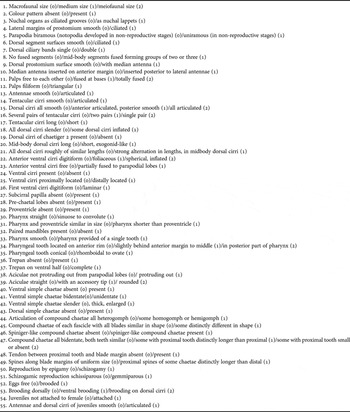
Some characters used in the phylogenetic analysis have already been scored in previous studies of the relationships among Phyllodocida (Glasby, Reference Glasby1993; Pleijel & Dahlgren, Reference Pleijel and Dahlgren1998), some there are more specific of Syllidae (Licher, Reference Licher1999; Nygren, Reference Nygren1999, Reference Nygren2004; Nygren & Sundberg, Reference Nygren and Sundberg2003), and remaining ones are based on our personal observations on the target complex (Table 1).
List of characters and states.

(1) BODY SIZE
The species of this group ranged from very long, massive, large species (i.e. more than 30 mm long), with numerous segments, to small, slender species (few mm long). Usually, small size is connected with an interstitial mode of life, considered as derived in the polychaetes (Laubier Reference Laubier1967; Westheide Reference Westheide1971, Reference Westheide1987, Reference Westheide, Higgings and Thiel1988). We consider in the analysis three categories.
Large species distinctly longer than 10 mm. Incomplete specimens are included when their width is over about 0.3 mm and appeared to be long enough if complete. Medium size species are 5–10 mm long. Small species shorter than 5 mm long or with very slender, filiform body.
(2) NUCHAL ORGANS
Two ciliated grooves between the prostomium and the peristomium (0) (see San Martín, Reference San Martín, Ramos, Alba, Bellés, Gosólbez, Guerra, Macpherson, Martin, Serrano and Templado2003: figures 47B, 55A, 81B, 85B, 161B; San Martín & Hutchings, Reference San Martín and Hutchings2006: figures 10A, 12E, 16A, 19E, 27D, 41B, 42E, 69C), or two nuchal lappets as in Autolytinae or in Amblyosyllis (1) (see San Martín, Reference San Martín, Ramos, Alba, Bellés, Gosólbez, Guerra, Macpherson, Martin, Serrano and Templado2003: figures 40A, 262C, 270D, 270E, 279A, 279B; San Martín & Hutchings, Reference San Martín and Hutchings2006: figures 1A, 2A–C, 5A, 3A, 4A, 4B).
(3) LATERAL SIDES OF PROSTOMIUM CILIATED
Prostomium smooth (0), or with cilia on both lateral margins (1) (see San Martín, Reference San Martín, Ramos, Alba, Bellés, Gosólbez, Guerra, Macpherson, Martin, Serrano and Templado2003: figures 32A, 47A, 47B; San Martín & Hutchings, Reference San Martín and Hutchings2006: figure 17A).
(4) PARAPODIA WITH NOTOPODIUM IN NON-REPRODUCTIVE STAGES (BIRAMOUS PARAPODIA)
Parapodia always biramous (0), notopodium both in reproductive and non-reproductive stages (all outgroups). Parapodia uniramous, lacking notopodia (1), except on some segments in the reproductive stages (all Syllidae).
(5–6) CILIARY BANDS
Except O. flexuosus, the outroup species lack ciliary bands on segments (0). Some syllids have ciliary bands, either on lateral sides of each segment (see Ding & Westheide, Reference Ding and Westheide1997: figure 6D,E; San Martín & Hutchings, Reference San Martín and Hutchings2006: figure 59A); as a single complete band on each segment (see San Martín, Reference San Martín, Ramos, Alba, Bellés, Gosólbez, Guerra, Macpherson, Martin, Serrano and Templado2003: figure 47A,B; San Martín & Hutchings, Reference San Martín and Hutchings2006: figures 12D, 19E, 19F), or as two complete bands on some segments (San Martín, Reference San Martín, Ramos, Alba, Bellés, Gosólbez, Guerra, Macpherson, Martin, Serrano and Templado2003: figure 20A,B; San Martín & Hutchings, Reference San Martín and Hutchings2006: figures 36B, 43F, 45B, 48A, 48B, 57A, 69A, 69B, 69D, 76A, 76B). Two characters are considered: dorsal surfaces smooth (0), or ciliated (1), and dorsal ciliary bands single (0) or double (1).
(7) FUSION OF SEGMENTS
In a few species, groups of 2–3 midbody and posteriormost chaetigers fuse, forming single segments (1) (San Martín & Hutchings, Reference San Martín and Hutchings2006: figure 78A).
(8–9) MEDIAN ANTENNA
Nereidids and pisionids lack a median antenna while most syllids have a median antenna, which can be inserted along the anterior prostomial margin (0) (see San Martín & Hutchings, Reference San Martín and Hutchings2006: figures 9A, 60A, 78A), or in the middle of prostomium (1), behind the lateral antennae (see San Martín & Hutchings, Reference San Martín and Hutchings2006: figures 17A, 18A, 27C, 46E, 47A, 59A, 63A, 69C).
(10–11) PALPS
Palps can be free from each other (0) (see San Martín & Hutchings, Reference San Martín and Hutchings2006: figures 16A, 17A, 42E, 78A, 78B), fused at their bases (1) (see San Martín & Hutchings, Reference San Martín and Hutchings2006: figures 47A, 57A, 59A, 63A, 66A), or fused along their entire length (2). The degree of fusion is sometimes difficult to elucidate, because the palps, although physically separate, lie very close to each other, appearing basally fused. Some juvenile exogonids still attached to the females showed completely separated palps whereas they are completely fused in adults (see San Martín, Reference San Martín, Ramos, Alba, Bellés, Gosólbez, Guerra, Macpherson, Martin, Serrano and Templado2003: figure 1F; 2005: figure 94D). This ontological criterion (for adults) has been taken into account to assign the states.
Syllids palps are triangular to quadrangular, distally rounded, and relatively thick (0) while they are more or less filiform in the outgroups (1).
(12–14) ARTICULATION OF APPENDAGES
The antennae can be smooth (0) (see San Martín & Hutchings, Reference San Martín and Hutchings2006: figures 37A, 40A, 59A), or articulated (1) (see San Martín & Hutchings, Reference San Martín and Hutchings2006: figures 43E, 44A, 47A), as well as the tentacular cirri: smooth (0), and articulated (1).
Dorsal cirri can be: all smooth (0); articulated anteriorly and smooth from midbody (1) (see San Martín & Hutchings, Reference San Martín and Hutchings2006: figures 44A, 47A); and all articulated (2). All appendages are smooth in the outgroups.
(15–16) TENTACULAR CIRRI
There are several pairs (0), two pairs (1), single pair (2) of tentacular cirri, which can be longer than body width (0), or shorter than body width (1).
(17–20) DORSAL CIRRI
All mid-body dorsal cirri can be slender, similar in shape to remaind ones (0), enlarged, inflated (1) and alternating with ones not so inflated (see San Martín & Hutchings, Reference San Martín and Hutchings2006: figures 60A–D, 65A).
The dorsal cirri of chaetiger 2 can be present (0), or absent (1); the absence of dorsal cirri on several species of the genus Exogone Ørsted, 1845 and Sphaerosyllis Claparède, 1863 (subfamily Exogoninae) is considered by San Martín (Reference San Martín1991a) as a neotenic character, related to an interstitial life-style.
Mid-body dorsal cirri can be much shorter than antennae, tentacular cirri or anteriormost dorsal cirri, similar in shape to those of the Exogoninae (see San Martín, Reference San Martín, Ramos, Alba, Bellés, Gosólbez, Guerra, Macpherson, Martin, Serrano and Templado2003: figure 24A,B; San Martín & Hutchings, Reference San Martín and Hutchings2006: figures 56A–D, 73A–C, 73A, 73B) (1), or similar in length and shape to the anterior ones (0).
There may be strong alternation of long and short midbody dorsal cirri (1) (see San Martín & Hutchings, Reference San Martín and Hutchings2006: figure 59A), or a slight or null alternation (0).
(21–25) VENTRAL CIRRI
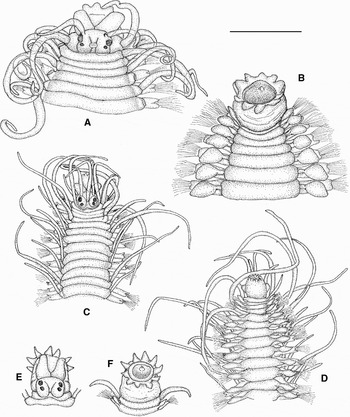
Ventral cirri may be digitiform (0), the anteriormost being either foliaceous, sometimes ending acutely (1) (figures 16B, 17C; see San Martín & Hutchings, Reference San Martín and Hutchings2006: figures 38E, 41 C, 41D), or spherical, inflated (2) (Figures 9B, 11B, 12A, 15C; see San Martín & Hutchings, Reference San Martín and Hutchings2006: figure 66C,D,F); and also partially fused to parapodial lobes (1), or free (0). Ventral cirri may be absent (1), or present (0).
Originate proximally on the parapodial lobes (0) or distally (1) (see San Martín & Hutchings, Reference San Martín and Hutchings2006: figures 18D, 59C).
Ventral cirri of chaetiger 1 may be similar to the others (0), or laminar, enlarged and ventrally directed (1) (see San Martín, Reference San Martín, Ramos, Alba, Bellés, Gosólbez, Guerra, Macpherson, Martin, Serrano and Templado2003: figures 30B, 31B; San Martín & Hutchings, Reference San Martín and Hutchings2006: figure 78B).
(26) SUBCIRRAL PAPILLA
The presence of digitiform papillae under the dorsal cirri (1) of anterior segments, that are, perhaps, gills (according to Laubier, Reference Laubier1968), was first reported in Paraehlersia ferrugina (see San Martín, Reference San Martín, Ramos, Alba, Bellés, Gosólbez, Guerra, Macpherson, Martin, Serrano and Templado2003: figures 19B, 20C,D). Subsequently, we have also observed subcirral papillae in Pionosyllis articulata, Paraehlersia ehlersiaeformis and P. weissmanniodes (see San Martín & Hutchings, Reference San Martín and Hutchings2006: figures 43F, 44B, 45B,C, 47B, 48B,C).
(27) PRECHAETAL LOBES
The parapodia may be simple (0), or with a distinct prechaetal lobe (1) (Figures 9D–F, 12A–D, 17D; see San Martín & Hutchings, Reference San Martín and Hutchings2006: figures 65B, 66C–E), like some outgroups (Ophiodromus flexuosus and Pisione longispinulata).
(28–36) DIGESTIVE TRACT
The presence of a muscular proventricle adjacent to the pharynx is a distinct autapomorphy of the family Syllidae (Glasby, Reference Glasby1993), coded as (1) in the analysis.
The pharynx may be straight (0), or coiled and convoluted (1); longer than or similar to proventricle (0), or shorter (1) (Figure 12A; see San Martín, Reference San Martín, Ramos, Alba, Bellés, Gosólbez, Guerra, Macpherson, Martin, Serrano and Templado2003: figures 32A, 34A; San Martín & Hutchings, Reference San Martín and Hutchings2006: figure 17A). The pharynx may be smooth (0), or bears some kind of armature, composed of one or several teeth (1). The middorsal tooth may be on the anterior rim (0), slightly back from the anterior rim to the mid-pharynx (1) (see San Martín & Hutchings, Reference San Martín and Hutchings2006: figure 74A), or clearly posterior (2) (see San Martín & Hutchings, Reference San Martín and Hutchings2006: figures 37A, 38A, 40A, 65A). The pharyngeal tooth may be conical (0), or elongated to rhomboidal or ovate (1) (see San Martín, Reference San Martín, Ramos, Alba, Bellés, Gosólbez, Guerra, Macpherson, Martin, Serrano and Templado2003: figures 78A, 80A, 82A, 84A, 87A, 87B, 116F, 117A, 119A; San Martín & Hutchings, Reference San Martín and Hutchings2006: figure 17A).
The trepan may be absent (0), or present in the pharynx opening (1) (see San Martín, Reference San Martín, Ramos, Alba, Bellés, Gosólbez, Guerra, Macpherson, Martin, Serrano and Templado2003: figures 53C, 55C; San Martín & Hutchings, Reference San Martín and Hutchings2006: figures 10C, 11F, 13F, 15C, 16B). It may be incomplete (0), or complete crown of teeth (1) (see San Martín, Reference San Martín, Ramos, Alba, Bellés, Gosólbez, Guerra, Macpherson, Martin, Serrano and Templado2003: figures 170E, 173B).
(37–38) ACICULAE
The distal end of the aciculae may be: straight (0) (see San Martín & Hutchings, Reference San Martín and Hutchings2006: figures 66D, 67L), with a slender, acuminate, more or less oblique tip (1) (San Martín & Hutchings, Reference San Martín and Hutchings2006: figures 44L, 65F), or rounded (2) (San Martín, Reference San Martín, Ramos, Alba, Bellés, Gosólbez, Guerra, Macpherson, Martin, Serrano and Templado2003: figure 186F, San Martín & Hutchings, Reference San Martín and Hutchings2006: figures 57J, 63O, 68J).
The aciculae may be protuding (1) (Figures 9D–F, 14F–H), or completely embedded in the parapodial lobes (0).
(39–41) VENTRAL SIMPLE CHAETAE
Ventral simple chaetae may be absent (0), or present (1). If so, it may be bidentate (0) (Figure 13D), or unidentate (1); slender (0), or distinctly large, similar to or thicker than largest shafts of compound chaetae (1) (see San Martín, Reference San Martín, Ramos, Alba, Bellés, Gosólbez, Guerra, Macpherson, Martin, Serrano and Templado2003: figures 24G, 25D; San Martín & Hutchings, Reference San Martín and Hutchings2006: figures 56L, 70J, 72C, 73I).
(42) DORSAL SIMPLE CHAETAE
Dorsal simple chaetae may be absent (0), or present (1).
(43–48) COMPOUND CHAETAE
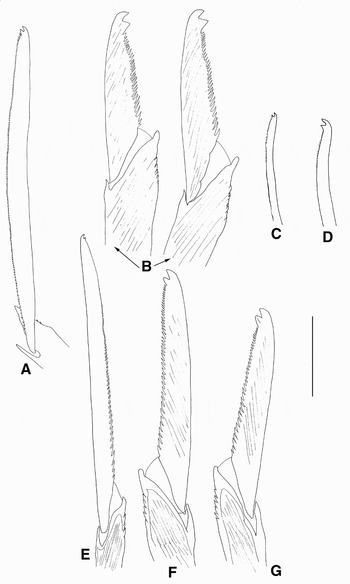
The compound chaetae may be heterogomph (0) or with homogomph or hemigomph articulation (1) (see San Martín & Hutchings, Reference San Martín and Hutchings2006: figures 56E–H, 70D,E, 72A). All blades similar in shape (0), or with a few being distinctly different (1). All blades similar in size (0), or with a few being longer, slender, the ‘spiniger-like’ blades (1) (Figures 10A, 12B, 13A, 16A; San Martín & Hutchings, Reference San Martín and Hutchings2006: figures 44I,F, 47E,H, 62F, 63F,D, 67D,G, 68H,K).
Blades may be bidentate, with both teeth similar in size and shape (0) (Figures 10, 13), with the proximal tooth longer and thicker than distal one (1) (Figures 16D, 17F), or with the proximal tooth small or absent (2) (Figure 13B,D).
Blades with more or less distally directed teeth (0), or with the proximal tooth strongly curved and bearing a tendon that contacts the blade's margin (1) (see San Martín & Hutchings, Reference San Martín and Hutchings2006: figures 74C,D, 79A–F).
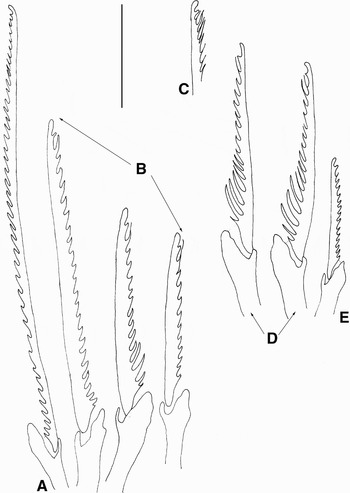
Blades with short, uniform spines (0) (figures 10A–C, E–F, 14A–D), or with some blades bearing very long, upwardly directed spines (1) (Figures 18B–D; see San Martín & Hutchings, Reference San Martín and Hutchings2006: figures 63G, 75F,G, 77A–D).
(49–54) REPRODUCTION AND DEVELOPMENT
The typical reproductive mode of Pionosyllis is epigamic (0) or direct (e.g. the type species and others), but also schizogamic reproduction (1), typical of the subfamily Syllinae may occur, as in P. procera and P. marquesensis (San Martín & Estapé, Reference San Martín and Estapé1993 and our own observations). These species are apparently members of Syllinae. Schizogamic reproduction may be scissiparous (0), or gemmiparous (1).
Brooding of eggs has been reported in some species described as Pionosyllis (see Pierantoni, Reference Pierantoni1905) as well as in the members of the subfamily Exogoninae (see San Martín, Reference San Martín2005). Four states are defined: no brooding (0), dorsal brooding by means of capillary notochaetae (1), ventral brooding with eggs attached to nephridial openings (2), and brooding on dorsal cirri (3). The juveniles may remain attached to females (1), or they are released after the development of embryos (0) (see San Martín, Reference San Martín2005).
Juveniles and small specimens may have all the appendages articulated (1), or smooth (0), progressively developing articulations on anteriormost appendages (antennae, tentacular cirri and most anterior dorsal cirri) or may remain smooth.
RESULTS AND DISCUSSION
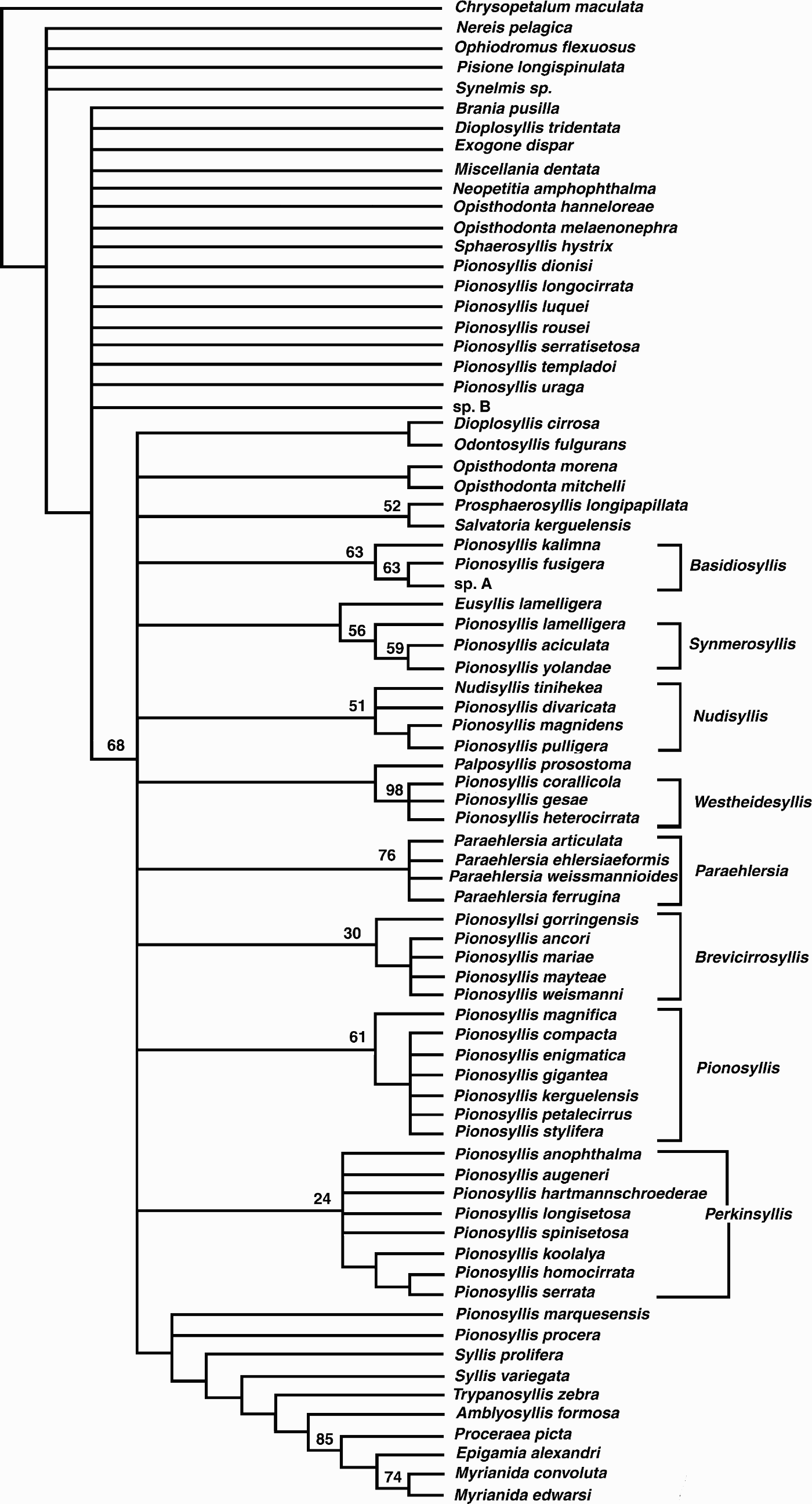
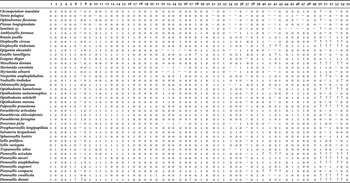
The analysis of the data matrix with the 55 characters and the 76 taxa (Table 2) yielded a strict consensus of 1200 equally parsimonious trees (Figure 1), with a length of 314 steps, a consistency index of 0.204, a homoplasy index of 0.796, a retention index of 0.558, and a rescaled consistency index of 0.114. The traditional Pionosyllis genus results from a paraphyletic group with uncertain relationships among the different clades (Figures 1–3). The strict consensus (Figure 1) shows several constant monophyletic clades formed by Pionosyllis (sensu lato) species. Consequently, new genera are proposed for the corresponding clades and Pionosyllis has been redefined. Moreover several species have been transferred to Nudisyllis and Paraehlersia, and eight species of Pionosyllis (sensu lato) were not placed consistently in any clade, so that their relationships with another Syllidae remain unresolved.
Strict consensus tree of 1200 equally parsimonious trees (length = 314 steps). Bold numbers: the Jacknife support values for each node.

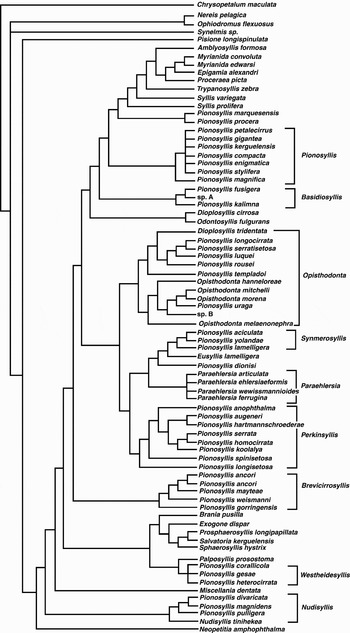
First tree

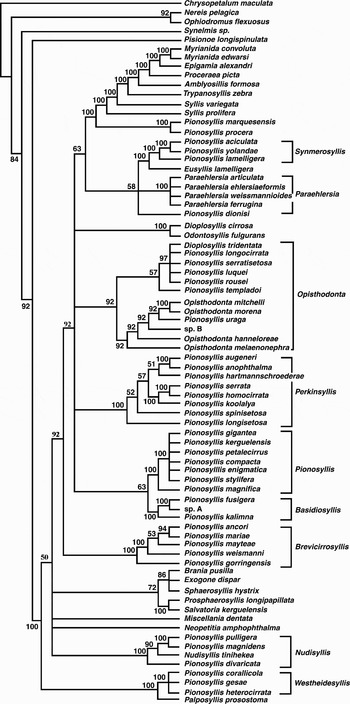
50% majority rule tree. Bold numbers: frequency values for each node.

Character matrix.

Consensus (Figure 1), first equally parsimonious tree (Figure 2) and 50% majority rule (Figure 3) show clearly that Pionosyllis, as usually recognized, is paraphyletic. In order to keep Pionosyllis monophyletic, members of Dioplosyllis, Odontosyllis, Opisthodonta, and some Exogoninae and Syllinae should be included.
The Syllidae are a monophyletic group (Figure 1) characterized by two clear apomorphies, the presence of proventricle, character 29, and the uniramous parapodia, character 5, more closely related to Pisione, Synelmis, Ophiodromus, and Nereis, than to Chrysopetalum.
As a result, the whole family is represented as a large polytomy of terminal taxa with one monophyletic clade, the relationships between the classical subfamilies requiring further detailed study. The ingroup also presents a high number of uncertainties, most of them related to reproduction, unknown in many species. Most species of Pionosyllis (sensu lato) do not group in minor clades, but with Opisthodonta (or even within it), both in the first (Figure 2) and semistrict (Figure 3) trees. Thus, we tentatively propose them as belonging to Opisthodonta. Pionosyllis dionisi, in turn, seems uncertainly related to Paraehlersia and Synmerosyllis (Figures 2 & 3).
The following clades represent the genera into which we propose to divide Pionosyllis (sensu lato), and the genera Nudisyllis and Paraehlersia. The apomorphies of the proposed or emended genera are given. The clade comprising P. kalimna and Pionosyllis sp. A constitutes Basidiosyllis gen. nov. (66 JK); the clade comprising P. lamelligera and P. yolandae constitutes Synmerosyllis gen. nov. (73 JK); the clade comprising Nudisyllis tinihekea and P. pulligera constitutes Nudisyllis (66 JK); the clade comprising P. corallicola and P. heterocirrata constitutes Westheidesyllis gen nov. (98 JK); the clade containing P. gorringensis and P. weissmani is named Brevicirrosyllis gen nov. The clade comprising P. magnifica and P. stylifera maintains the original name Pionosyllis (60 JK); the clade comprising P. anophthalma and P. serrata comprises Perkinsyllis gen nov. Thus Pionosyllis is a strictly monophyletic genus which comprises only seven known species; all other species previously described under this genus clearly do not belong to it.
Finally, the last clade comprises the species P. marquesensis and P. procera, species belonging to Syllinae, Amblyosyllis and species belonging to Autolytinae. These two species of Pionosyllis (sensu lato) share two apomorphies with the Syllinae, namely anterior appendages (antennae, tentacular and anterior dorsal cirri) articulated (characters 13–15) and reproduction by schizogamy (character 50), although these characters' states showed reversions within the clades and homoplasies with other groups of Pionosyllis (sensu lato). Since they form a clade in both the first tree and the semistrict consensus, they probably constitute a new genus, which will be discussed in relation to the Syllinae in further studies. Some species considered by Licher (Reference Licher1999) as ‘Typosyllis’ incertae sedis appear to be related to these two species, and all of them would need a more detailed study beyond the scope of this paper, as well as the relationships among other taxa not belonging to Pionosyllis (sensu lato).
All clades have a JK value higher than 50, except Brevicirrosyllis (30) and Perkinsyllis (24) (Figure 1). However, they are defined by clear apomorphies. Based on this and on the fact that they can be assigned neither to Pionosyllis sensu stricto nor to any other genus, they receive a generic status.
The genus Opisthodonta comprises only two species in the strict consensus (Figure 1). However, it is a well defined monophyletic group both in the semistrict consensus (Figure 3) and the first tree (Figure 2), with a JK value of 92. Several Pionosyllis (sensu lato) and Dioplosyllis tridentata form another clade in both cladograms that form a larger monophyletic group together with Opisthodonta. These three clades do not appear on the strict consensus, so that they did not receive a new single generic name. Instead to avoid making a taxonomic decision, leaving this cluster as incertae sedis, we have decided to redescribe Opisthodonta to include all related Pionosyllis (sensu lato) species plus Dioplosyllis tridentata. However, this group needs a more detailed study.
The parsimony analysis including as many problematic taxa as possible, shows the species formerly described as Pionosyllis (sensu lato) are not a natural group. Although the resulting tree cannot be considered perfect, it gives rise to more consistent relationships, allowing us to propose new genera and to revise the existing genera as well as postulate several hypotheses to be tested in future works; that it will depend on the increase of knowledge on Pionosyllis and related genera.
TYPE SPECIES
Pionosyllis fusigera Augener, Reference Augener1913, by present designation.
DIAGNOSIS
Body slender, small, of medium to meiofaunal size. Without ciliary bands. Segments fused on one species. Prostomium provided with four eyes, three antennae and two palps. Median antenna inserted on anterior margin of prostomium. Palps fused at their bases, triangular. Nuchal organs as two ciliated grooves. Two pairs of tentacular cirri. Antennae, tentacular cirri and dorsal cirri similar in shape, smooth, club-shaped, slender at base and wider distally; some dorsal cirri inflated. Subcirral papilla absent. Compound chaetae heterogomph, provided with falcigerous bidentate blades, with both teeth similar in size or slightly different; spines on margin short. Acicula tips acuminate or tricuspidate. Parapodia with prechaetal lobes short, small. Pharynx and proventricle of similar size, short. Pharyngeal tooth located in mid-pharynx. Reproduction unknown.
APOMORPHIES
Clade supported by one autapomorphy; the dorsal cirri are inflated in some segments (character 18, state 1). Another apomorphy is the presence of pre-chaetal lobes (character 28, state 1). This state of the latter character is shared with the following taxa: Ophiodromus flexuosus, Pisione longispinulata, Amblyosyllis sp., Pionosyllis marquesensis, Pionosyllis procera and genus Pionosyllis. The presence of a pharyngeal tooth in the posterior part of the pharynx (character 34, state 2) might also be an apomorphy, but it is uncertain in Pionosyllis sp. A; this character state is shared with Salvatoria kerguelensis, Prosphaerosyllis longipapillata, and the clade in the consensus tree including Opisthodonta hanneloreae and Pionosyllis sp. B.
ETYMOLOGY
From the Greek basidios meaning club, in reference to the club-shaped dorsal cirri and antennae.
KEY TO SPECIES
1. Long, inflated dorsal cirri distally button-shapedBasidiosyllis fusigera.
Long, inflated dorsal cirri distally rounded, without a button2
2. Acicula tip tricuspidate. Proximal tooth of blades of compound chaetae somewhat longer than distal tooth. Colour pattern transverse black bands. Segments of midbody fused, forming groups of 2–3 segments Basidiosyllis victoriae, sp. nov.
Acicula tip acuminate. Both teeth of blades of compound chaetae similar in size. Red to orange spots on dorsum. Segments not fusedBasidiosyllis kalimna
Pionosyllis fusigera Augener, Reference Augener1913: 227, pl. 3, figure 34 and text, figure 32a–c.
Basidiosyllis fusigera San Martín & Hutchings, Reference San Martín and Hutchings2006: 330, figure 60A–I.
MATERIAL EXAMINED
Western Australia, Sharks Bay, Surf Point, Outer Bar, 1–3.5 m, 16/6/1905 (ZMH V-7951, 1 syntype).
TYPE LOCALITY
Sharks Bay, Western Australia.
DISTRIBUTION
Western Australia.
HABITAT
1–3.5 m depth.
Pionosyllis kalimna San Martin & Hutchings, 2006:335, figure 65A–K.
TYPE LOCALITY
Bundegi Reef, Western Australia.
DISTRIBUTION
Only known from type locality.
HABITAT
Rocky rubble, sediment and brown algae with epiphytes, 2 m depth.
MATERIAL EXAMINED
Six Men's Bay, Barbados (west coast), on Montastrea annularis, 10 m depth, María Victoria Díaz coll., 22 May 1990, holotype (MNCNM 16.01/6062).
DESCRIPTION
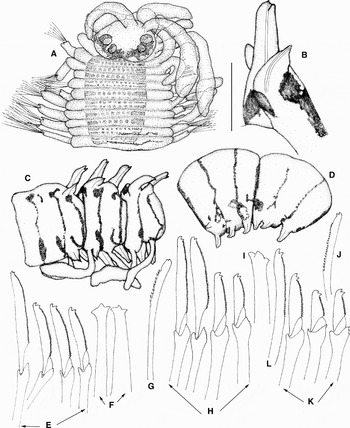
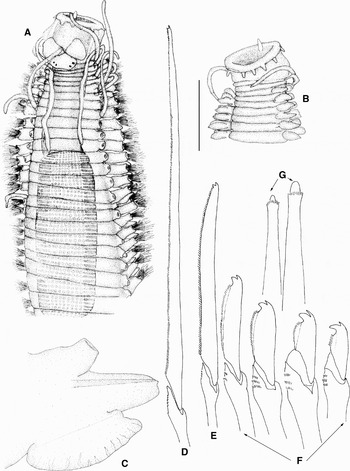
Pre-epitoke specimen, with well developed notopodia from chaetiger 14, long, with notoaciculae, without natatory chaetae. Body short, slender, 2.3 mm long, 0.3 mm wide, for 32 chaetigers. Dorsum with a transverse, irregular black band across each segment beginning on chaetiger 9 (Figure 4A); bands more marked from chaetiger 11 (Figure 4C,D); posterior part of prostomium with curved dorsal band of dark pigment (Figure 4A), and ventral part with slight black pigmentation. Intersegmental furrows well defined onwards chaetiger 10; from chaetiger 11, only one intersegmental furrow visible every two or three chaetigers (Figure 4C,D). Prostomium ovate, wider than long, with rounded corners; four large lensed eyes in open trapezoidal arrangement, anterior pair larger. Palps short, ventrally folded, fused at bases, with dorsal furrow; antennae thick, elongate, club-shaped, slender basally and wide distally, originating on anterior margin of prostomium, median antenna shorter and thinner than lateral antennae (left antenna detaching). Peristomium dorsally reduced, covered by prostomium; dorsal tentacular cirri similar to lateral antennae, ventral tentacular cirri about 1/3 of length of dorsal tentacular cirri (both only present on right side) (Figure 4A). Dorsal cirri missing in many parapodia; alternating long, slightly shorter than body width, club shaped cirri, and shorter, less so inflated dorsal cirri (Figure 4C). Ventral cirri short, ovate. Parapodia slender, elongate, with dorsal, anterior short papilla (Figure 4B). Compound chaetae hemigomph; shafts smooth on distal part near hinge; blades bidentate, with proximal tooth longer than distal tooth; blades quite short, with straight spines on margin (Figure 4E,H,K). Anterior parapodia each with 8–15 compound chaetae (Figure 4E), diminishing to about seven in posterior chaetigers; blades of anterior chaetigers 21 µm long dorsally, 10 µm ventrally, blades of midbody parapodia 22 µm dorsally, 13 µm ventrally (Figure 4H), and blades of posterior chaetigers 16 µm dorsally, 10 µm ventrally (Figure 4K). Solitary dorsal simple chaetae (Figure 4G,J) from chaetiger 14, bidentate, with proximal tooth more prominent than distal one, provided with short, straight subdistal spines on margin. Solitary ventral simple chaetae (Figure 4L) on far posterior chaetigers, bidentate, both teeth similar, with short spines on margin. Anterior parapodia each with two aciculae (Figure 4F), only one from chaetiger 13, with tricuspidate tip (Figure 4I). Pharynx apparently short, everted and ventrally folded, pharyngeal tooth not seen. Proventricle extending through 9 segments, barrel shaped, with about 23 muscle cell rows.
Basidiosyllis victoriae, sp. nov. (A) Anterior end, dorsal view; (B) midbody parapodium, dorsal view (chaetae not drawn); (C) segments 11–12, 13–14, and 15–17, dorsal view (chaetae not drawn); (D) chaetigers 18–20 and 21–23, lateral view (chaetae not drawn); (E) compound chaetae, anterior parapodium; (F) aciculae, anterior parapodium; (G) dorsal simple chaeta, midbody parapodium; (H) compound chaetae, midbody parapodium; (I) acicula, posterior parapodium; (J) dorsal simple chaeta, posterior parapodium; (K) compound chaetae, posterior parapodium; (L) ventral simple chaeta. Scale: (A) 0.18 mm; (B) 90 µm; (C,D) 0.24 mm; (E–L) 20 µm.

ETYMOLOGY
The species is named after Dr María Victoria Díaz Castañeda, Mexican polychaetologist, who kindly provided us with the specimen.
TYPE LOCALITY
Six Men's Bay, Barbados Islands.
DISTRIBUTION
Barbados Islands.
HABITAT
In the coral Montastrea annularis; 10 m depth.
TYPE SPECIES
Pionosyllis weismanni Langerhans, Reference Langerhans1879, by present designation.
DIAGNOSIS
Body of macrofaunal to medium size, some species filiform. Without ciliary bands. Segments not fused. Prostomium with two pairs of eyes and two anterior eyespots or without eyes, bearing three antennae and two palps; median antenna inserted near posterior margin of prostomium. Palps fused at their bases, with a dorsal furrow, divergent, triangular in shape. Peristomium with two pairs of tentacular cirri. Antennae, tentacular cirri and dorsal cirri of first chaetiger long, smooth to rugose or pseudoarticulated when very long; remaining dorsal cirri short, exogonid-like, somewhat longer than parapodial lobes. Parapodia without prechaetal lobes. Subcirral papilla absent. Ventral cirri inserted at bases of parapodial lobes, not modified. Compound chaetae heterogomph or hemigomph bidentate falcigers, with moderately long or short bidentate blades; spines on margin short. Dorsal and ventral simple chaetae on posterior parapodia. Ventral simple chaetae enlarged, usually with proximal tooth longer than distal tooth, and provided with a hood. Tips of aciculae acuminate. Pharynx and proventricle similar in length; pharyngeal tooth located on anterior rim. Reproduction by epigamy.
APOMORPHIES
Clade supported by one clear apomorphy: ventral simple chaetae thick and enlarged (character 42, state 1).
ETYMOLOGY
The name of the genus refers to the short dorsal cirri of members of this genus.
KEY TO SPECIES
1. Ventral simple chaetae of similar width to shafts of compound chaetae, with both teeth similar in size, without hood. Compound chaetae heterogomphBrevicirrosyllis gorringensis.
Ventral simple chaetae very large, with proximal tooth longer than distal tooth, provided with a hood. Compound chaetae hemigomph2
2. Dorsal cirri with fibrillar inclusions3
Dorsal cirri without fibrillar inclusions4
3. Dorsal cirri on chaetiger 2 present … Brevicirrosyllis weismanni
Dorsal cirri on chaetiger 2 absent … Brevicirrosyllis mariae
4. Dorsal simple chaeta truncate … Brevicirrosyllis mayteae
Dorsal simple chaeta pin-shaped … Brevicirrosyllis ancori
Pionosyllis ancori San Martín & Hutchings, Reference San Martín and Hutchings2006: 324, figure 56A–M.
TYPE LOCALITY
Yonge Reef, Great Barrier Reef, Queensland, Australia.
DISTRIBUTION
Australia (Queensland, Western Australia, New South Wales).
HABITAT
In encrusting algae, 30 m depth.
Pionosyllis gorringensis Hartmann-Schröder, Reference Hartmann-Schröder1977: 86, figures 36–40.
MATERIAL EXAMINED
Holotype ZMUH (P-13681) and (P-13682) (3 paratypes).
REMARKS
This species is poorly known, only known after its original description.
TYPE LOCALITY
Gorringe Bank (east Atlantic).
DISTRIBUTION
Known only from the type locality.
HABITAT
Dredges; 72 m depth.
Pionosyllis mariae San Martín & Hutchings, Reference San Martín and Hutchings2006: 340, figures 46D–F, 70A–J, 71A–F, 72A–C.
TYPE LOCALITY
Yonge Reef, Great Barrier Reef, Queensland, Australia.
DISTRIBUTION
Australia (Queensland and New South Wales).
HABITAT
In encrusting communities and in sand, 9–244 m depth.
Pionosyllis mayteae San Martín & Hutchings, Reference San Martín and Hutchings2006: 344, figure 73A–K.
TYPE LOCALITY
Yonge Reef, Great Barrier Reef, Queensland, Australia.
DISTRIBUTION
Australia (Queensland).
HABITAT
In encrusting communities, 30 m depth.
Pionosyllis weismanni Langerhans, Reference Langerhans1879: 546, pl. 32, figure 11.- Banse, Reference Banse1959: 431, figure 4.- (?) Ben-Eliahu, Reference Ben-Eliahu1977: 50, figure 20.- Hartmann-Schröder, Reference Hartmann-Schröder1977: 85, figure 27–35.- Uebelacker, Reference Uebelacker, Uebelacker and Johnson1984: 67, figure 60. San Martín, Reference San Martín, Ramos, Alba, Bellés, Gosólbez, Guerra, Macpherson, Martin, Serrano and Templado2003: 71, figures 24, 25.
Pionosyllis weissmanni Langerhans, Reference Langerhans1879 [sic].- Campoy, Reference Campoy1982: 337, pl. 27 a–i.-Núñez & San Martín, Reference Núñez and San Martín1996: 209, figure 4f–j.
Pionosyllis pierantoni Cognetti, Reference Cognetti1957: 42–43, figure 8.
REMARKS
This species seems to be very variable (see Ben-Eliahu, Reference Ben-Eliahu1977); it could constitute a complex of species.
TYPE LOCALITY
Madeira (Portugal).
DISTRIBUTION
North-eastern Atlantic, from British Isles to Cape Verde Islands (López & San Martín, Reference López and San Martín1994). Mediterranean Sea. Red Sea. Gulf of México. Cuba.
HABITAT
Calcareous concretions, inside corals, algae, and sand; from intertidal to about 200 m depth.
Nudisyllis Knox & Cameron, Reference Knox and Cameron1970: 77, emended by San Martín & Hutchings, Reference San Martín and Hutchings2006.
TYPE SPECIES
Nudisyllis tinihekea Knox & Cameron, Reference Knox and Cameron1970, by monotypy.
DIAGNOSIS
Body small, fragile, of meiofaunal size. Segments not fused. Prostomium proportionally large, with four eyes and sometimes a pair of anterior eyespots; three antennae, and two palps. Palps separate, free from each other, but close at their bases, triangular to distally rounded in shape. Median antenna inserted on middle of prostomium or on line with lateral antennae. Nuchal organs as two ciliated grooves; cilia extending to laterals of prostomium. Two pairs of tentacular cirri. Dorsal cirri on all chaetigers, long, cylindrical, smooth or slightly rugose. Subcirral papilla absent. Ventral cirri not modified. Compound chaetae with both unidentate and bidentate blades on same parapodium, or all indistinctly bidentate, with unidentate appearance; bidentate blades having proximal tooth very small, similar to a spine; spines on margin short. Tips of aciculae tricuspidate or lancet-shaped. Pharynx small, shorter than proventricle; pharyngeal tooth located near anterior rim, elongated to ovate. Reproduction by epigamy, probably with dorsal incubation of eggs, verified on two species; care of juveniles on dorsal cirri, verified in one species.
APOMORPHIES
Clade supported by three apomorphies: pharynx shorter than proventricle (character 31, state 1), state change is shared with Odontosyllis fulgurans and Neopetitia amphophthalma; pharyngeal tooth elongated, rhomboidal to ovate (character 35, state 1), state change is a parallelism with Salvatoria kerguelensis and Prosphaerosyllis longipapillata; some compound chaetae with proximal tooth small or absent (character 47, state 2), shared with most of the Exogoninae species studied (except Exogone dispar), Palposyllis prosostoma, Westheidesyllis gen. nov., Miscellania dentata and Pionosyllis stylifera. Egg brooding (character 52, state 1) and juveniles attached to female body (character 54, state 1) might be apomorphies of the clade, although the first one is uncertain in Pionosyllis divaricata and Pionosyllis magnidens, and the second one in these two species and in Nudisyllis tinihekea. State change in character 52 is convergent with the examined Exogoninae and Perkinsyllis gen. nov. and that in character 54 is shared with Sphaerosyllis hystrix, Exogone dispar and Brania pusilla. The presence of cilia on lateral margins of prostomium (character 4, state 1) is uncertain in P. magnidens and P. divaricata; if present in these two species it might also be an apomorphy of the clade, shared with Odontosyllis fulgurans, Eusyllis lamelligera and Westheidesyllis gen. nov.
KEY TO SPECIES
1. Parapodia each with compound chaetae provided with bidentate blades dorsally and unidentate blades ventrally 2
All blades of compound chaetae indistinctly bidentate, proximal tooth reduced to a small spine3
2. Strong dorsoventral gradation of blade-length of compound chaetae on each parapodium. Dorsal compound chaetae with long, bidentate blades, provided with a few distinct spines basally, ventral compound chaetae with short, smooth, unidentate blades. Pharyngeal tooth less than one third of length of pharynx Nudisyllis pulligera
Dorsoventral gradation of blade-length not so strong, all blades on each parapodium similar in length, dorsal blades bidentate and provided with moderate spines, ventral blades unidentate, with short spines on margin. Pharyngeal tooth very long, approximately half length the pharynx Nudisyllis magnidens
3. Parapodia each with 2–3 dorsal tufts of long, distinct ciliaNudisyllis tinihekea
Parapodia without tufts of cilia … … Nudisyllis divaricata
Syllis divaricata Keferstein, Reference Keferstein1862: 111, Taf. 9, figures 45–47.
Pionosyllis divaricata Fauvel, Reference Fauvel1923: 287, figure 109 f–i.- Cognetti, Reference Cognetti1957: 39–40.- San Martín, Reference San Martín1990: 591, figure 1; 2003: 85, figure 34.
Non Pionosyllis divaricata Haswell, Reference Haswell1920: 104, pl. 13, figures 2–3.
TYPE LOCALITY
Saint Vaast la Houge, France.
DISTRIBUTION
North-east Atlantic, Mediterranean, Madeira, Cape Verde Islands, Cuba.
HABITAT
Algae, Posidonia oceanica and Thalassia testudinum beds, at few metres depth.
Pionosyllis magnidens Day, Reference Day1953: 416, text-figure 3a–c; 1967: 263, figure 12.8.a–c.
Pionosyllis cf. magnidens Hartmann-Schröder, Reference Hartmann-Schröder1974: 125, Taf. 9–10, figures 82–88.
MATERIAL EXAMINED
Lamberts Bay (shore), Station 204, (BMNH, 1961.16.14/15), Holotype.
DESCRIPTION
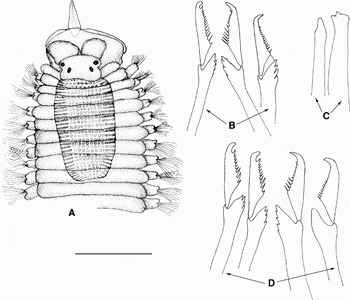
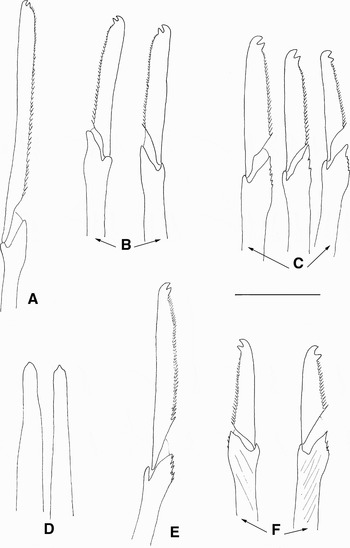
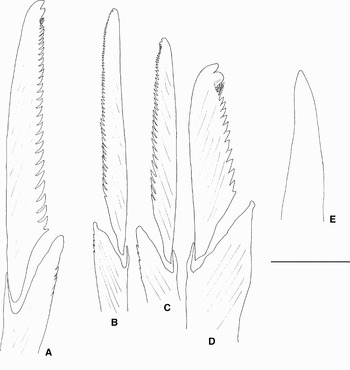
Holotype lacking antennae and cirri (Figure 5A), broken, consisting of one anterior part of 13 chaetigers (1.25 mm long), a midbody part of 19 chaetigers, and a posterior part of 15 chaetigers. Prostomium rectangular, with lateral constrictions; two pairs of large eyes in open trapezoidal arrangement. Palps separate, divergent (Figure 5A). Anterior parapodia each with about 20 compound chaetae, midbody parapodia each with about 10–12 chaetae. Compound chaetae provided with bidentate blades dorsally and unidentate blades ventrally, with shorter spines on margin and more distinctly unidentate more ventrally (Figure 5B,D). Slight dorsoventral gradation in length of blades, blades of compound chaetae about 21 µm long above, 16 µm long below on midbody parapodia; blades of dorsalmost compound chaetae bidentate, remaining blades on each fascicle unidentate; bidentate compound chaetae arranged by couples, two couples on anterior parapodia, a single couple on remaining parapodia; unidentate blades with strongly hooked tips. Pharynx very short, everted in holotype, with very long, dagger-shaped pharyngeal tooth, apparently without soft papillae on anterior rim. Proventricle longer than pharynx, extending through about 9 segments, with about 30 muscle cell rows.
Nudisyllis magnidens (Day, Reference Day1953) comb. nov. (A) Anterior end with everted pharynx, dorsal view; (B) compound chaetae, anterior chaetiger; (C) aciculae, midbody parapodium; (D) compound chaetae, midbody parapodium (BMNH 1961.16.14/15). Scale: (A) 0.5 mm; (B–D) 20 µm.

REMARKS
Day (Reference Day1953) described and figured this species as having palps fused at bases, while the species has free palps and bidentate compound chaetae (Hartmann-Schröder, Reference Hartmann-Schröder1974), which have been observed in the holotype.
TYPE LOCALITY
Lamberts Bay, South Africa.
DISTRIBUTION
Southern Africa.
HABITAT
In sand on rocks, algae, coralline algae, intertidal and subtidal.
Syllis pulligera Krohn, Reference Krohn1852: 251, figures 1–3.
Pionosyllis pulligera Fauvel, Reference Fauvel1923: 286, figure 109 k–o.- Cognetti, Reference Cognetti1957: 38.- Hartmann-Schröder, Reference Hartmann-Schröder1971: 154.- San Martín, Reference San Martín, Ramos, Alba, Bellés, Gosólbez, Guerra, Macpherson, Martin, Serrano and Templado2003: 82, figures 32, 33.
Pionosyllis serrata Southern, Reference Southern1914: 23, Pls. 3–4, figure 5A–E.- Fauvel, Reference Fauvel1923: 286, figure 109a–e.- Hartmann-Schröder, Reference Hartmann-Schröder1971: 153.- Campoy, Reference Campoy1982: 342.- San Martín, Reference San Martín1984: 111, Lám. 19.
Pionosyllis confusa Hartmann-Schröder, Reference Hartmann-Schröder1960: 92, Taf. 10–11, figures 80–82.
MATERIAL EXAMINED
Many specimens from the Iberian Peninsula, Balearic Islands and Cape Verde Islands. Specimens identified as P. pulligera from ZMUH (P-14689; V-7948), and from MNHN (A 76), unknown data, collector and identifier. Four paratypes of P. confusa (ZMUH, P-14688), Sarso (Red Sea), Gerlach coll.
REMARKS
The specimens from NMHN are in poor condition, but a few dorsal compound chaetae on some parapodia have bidentate blades like other studied specimens which were recorded as Pionosyllis pulligera. These bidentate blades may be difficult to see (likely being overlooked by several authors) or have fallen off in P. pulligera, while they are clearly visible in P. serrata. Thus, we believe that the specimens with clearly visible bidentate blades were reported as P. serrata while the remaining ones were reported as P. pulligera.
Pionosyllis confusa was described as having the pharyngeal tooth in the middle of the pharynx. However, the paratypes have the pharyngeal tooth on the anterior margin and the compound chaetae are identical to those of P. serrata. Besides it has not been possible to observe the holotype; we believe that the original description of the pharyngeal tooth may likely be a misinterpretation. Pierantoni (Reference Pierantoni1905) reported brooding of eggs and development of juveniles on dorsal cirri.
TYPE LOCALITY
Bay of Villafranca, near Nice (France, Mediterranean Sea).
DISTRIBUTION
North-east Atlantic, from the North Sea to Cape Verde Islands. Mediterranean, Black Sea. Red Sea.
HABITAT
Among algae; interstitial in sand. Intertidal and subtidal.
Nudisyllis tinihekea Knox & Cameron, Reference Knox and Cameron1970: 77, figures 6–9.- San Martín & Hutchings, Reference San Martín and Hutchings2006: 281, figure 17A–F.
Pionosyllis pulligera (non Krohn) Augener, Reference Augener1913: 221, Taf. 2, figure 8, text-figure 29.
Pionosyllis samsonensis Hartmann-Schröder, Reference Hartmann-Schröder1980b: 52, Abb. 39–43; Reference Hartmann-Schröder1981: 32; Reference Hartmann-Schröder1982: 65. Reference Hartmann-Schröder1983: 130; Reference Hartmann-Schröder1984: 20; Reference Hartmann-Schröder1985: 69; Reference Hartmann-Schröder1986: 41; Reference Hartmann-Schröder1987: 38; Reference Hartmann-Schröder1991: 35.
MATERIAL EXAMINED
ZMUH (P-17098) (3 specimens), Port Samson, Australia. Australia: see San Martín & Hutchings, Reference San Martín and Hutchings2006.
REMARKS
This species is very similar to other members of the genus. However, it is characterized by having tufts of long, distinct cilia on the parapodia and on the dorsal surface of the body, but not forming rows. The compound chaetae are indistinctly bidentate, the aciculae have lancet-shaped, nearly tricuspidate tips, and dorsal and ventral simple chaetae are unidentate and distally somewhat hooked. Augener (Reference Augener1913) reported dorsal brooding of eggs.
TYPE LOCALITY
Boat Harbour, Snares Islands, New Zealand.
DISTRIBUTION
Australia and New Zealand.
HABITAT
Coarse sand, algae, seagrass, sand with debris. Eulittoral.
TYPE SPECIES
Opisthodonta morena Langerhans, Reference Langerhans1879. Designated by Hartman, Reference Hartman1959.
DIAGNOSIS
Body long, with numerous segments, stout, dorsally convex, of macrofaunal size. Segments not fused. Without ciliary bands. Prostomium provided with two pairs of eyes, sometimes two anterior eyespots, three antennae and two palps. Median antenna inserted on the middle of prostomium or slightly in front of level of anterior eyes. Palps free to each other. Peristomium small, partially covered by prostomium and first chaetiger, with two pairs of tentacular cirri. Dorsal cirri on all chaetigers, cylindrical, long to very long, smooth or slightly rugose. Parapodia slender, elongate; ventral cirri of some species, at least on anterior parapodia, ovate, foliaceous almost completely fused with parapodial lobe, usually provided with hyaline inclusions, perhaps glands. Remaining ventral cirri neither foliaceous nor fused to parapodial lobes, inserted at the bases of parapodia. Chaetal bundles formed of numerous compound chaetae, including falcigers provided with long, thick proximal tooth and short distal tooth and a few chaetae with long, slender, spiniger-like blades; some species with a tendon contacting proximal tooth and blade edge. Dorsal simple chaetae apparently lacking; ventral simple chaeta usually also lacking. Aciculae tips button-shaped, with a crown of spines, acuminate or tricuspidate. Pharynx and proventricle similar in length, usually long. Pharynx with a crown of soft papillae on anterior rim and a single middorsal tooth, placed anteriorly, on anterior third or even in middle part of pharynx.
REMARKS
Opisthodonta differs from Pionosyllis in having separated palps and in the arrangement of the compound chaetae. Pionosyllis species always have the pharyngeal tooth on the anterior pharyngeal margin. Opisthodonta is usually composed of O. morena, O. mitchelli, and O. pterochaeta, but three other species should be incorporated into the genus: a new species mainly differing in the position of the pharyngeal tooth and details of the compound chaetae, and two species in Pionosyllis. Pionosyllis uraga has the pharyngeal tooth on the anterior rim of the pharynx and P. melaenonephra has it slightly behind the rim, on the anterior half of the pharynx. We placed them in Opisthodonta since they have foliaceous anterior ventral cirri fused with the parapodial lobes, and the compound chaetae are clearly of the Opisthodonta type. On the other hand, Opisthodonta pterochaeta Southern, Reference Southern1914 and O. curticirris (Hartmann-Schröder, Reference Hartmann-Schröder1983) should be transferred to other genera (see San Martín, Reference San Martín, Ramos, Alba, Bellés, Gosólbez, Guerra, Macpherson, Martin, Serrano and Templado2003; San Martín & Hutchings, Reference San Martín and Hutchings2006), and the species with a tendon connecting the proximal tooth and blade edge are herein provisionally included in Opisthodonta. It is possible that all these species form a separate group, but most of them are incompletely known as they are rare and have extremely fragile bodies, allowing only to collect fragments. In fact, many specimens of this group have been published without species names, and probably belong to undescribed species. For example, Pionosyllis sp. from Spanish Mediterranean (Campoy, Reference Campoy1982), Pionosyllis sp. C from the Gulf of México (Uebelacker, Reference Uebelacker, Uebelacker and Johnson1984), Eusyllis sp. from Australia in Hartmann-Schröder (Reference Hartmann-Schröder1984), and Pionosyllis divaricata non Keferstein, from Australia (Haswell, Reference Haswell1920).
KEY TO SPECIES
1. Some blades of compound chaetae with a tendon connecting proximal tooth with blade edge2
Blades without such tendon7
2. Pharyngeal tooth located near anterior margin of pharynx3
Pharyngeal tooth located near middle of pharynx5
3. Blades of compound chaetae from midbody with distal tooth indistinct or non-existentOpisthodonta longocirrata
Blades with distal tooth4
4. Dorsalmost blades basally narrow and distally wideOpisthodonta serratisetosa
Blades of compound chaetae wider basally than distallyOpisthodonta tridentata
5. Dorsal cirri shorter than body width. Distal tooth of blades of compound chaetae slightly shorter than proximal toothOpisthodonta luquei
Dorsal cirri longer than body width6
6. Distal tooth minute and proximal tooth distinctly elongated. Falcigers elongatedOpisthodonta templadoi
Distal and proximal tooth similar in size. Falcigers short and wideOpisthodonta rousei
7. Pharyngeal tooth anteriorly located … Opisthodonta uraga
Pharyngeal tooth located distinctly back from anterior margin8
8. Falcigers provided with a translucent hood (in fact, several rows of spines) on marginO. russelli
Falcigers with a single row of spines on margin9
9. Antennae and anterior cirri rugose to pseudoarticulated. Dorsum of anterior segments with transverse dark rows. With ventral simple chaetaOpisthodonta melaenonephra
All appendages smooth. Dorsum not pigmented. Without ventral simple chaeta 10
10. Spiniger-like chaetae very long and slender, more than three times longer than falcigersOpisthodonta hanneloreae
Spiniger-like chaetae with shorter bladesOpisthodonta morena and O. mitchelli
Pionosyllis longocirrata Saint-Joseph, Reference de Saint-Joseph1886: 160, pl. 8, figures 24–29.- Fauvel, Reference Fauvel1923: 288, figure 110 h–l.- Cognetti, Reference Cognetti1957: 40.- Day, Reference Day1967: 264, figure 12.8.l–m.
Pionosyllis morenoae San Martín, Reference San Martín1984: 109–111, figure 18.- Núñez & San Martín, Reference Núñez and San Martín1996: 211, figure 4 N–Q.
MATERIAL EXAMINED
MHNP (A-422): numerous specimens; (A-76), 33 specimens (as P. divaricata).
REMARKS
Pionosyllis morenoae was described as having elongate blades with a curved proximal tooth contacting the distal part of blades, and becoming indistinct or absent on compound chaetae from midbody to posterior end (San Martín, Reference San Martín1984). These chaetal types are identical to those of the southern African Pionosyllis longocirrata Saint-Joseph, 1886 reported in Day (Reference Day1967). However, these chaetae are quite different to those described by Saint-Joseph (Reference de Saint-Joseph1886). The MHNP specimens examined agree with P. morenoae (San Martín, Reference San Martín1984). We assume that Saint-Joseph and subsequent authors were not able to observe the delicate details of the distal blade end and considered this material to be conspecific (taking into account that the types are most likely lost).
TYPE LOCALITY
Dinard, France.
DISTRIBUTION
Eastern Atlantic, from English Channel to southern Africa. Western Mediterranean.
HABITAT
Among Laminaria and shells, harbours, Posidonia oceanica beds and leaves, rocks and algae from sublittoral to coraligenous bottoms, calcareous coralline algae, inside sponges, from 0 to 100 m depth.
Opisthodonta hanneloreae San Martín & Hutchings, Reference San Martín and Hutchings2006: 302, figure 37A–G.
TYPE LOCALITY
Wallabi group of Islands, Western Australia.
HABITAT
Dead corals and shell debris, in shallow water.
DISTRIBUTION
Western Australia.
Pionosyllis luquei San Martín, Reference San Martín1990: 598–601, figures 6&7.- Góngora-Garza & de León-González, Reference Góngora-Garza and de León González1993: 20–22, figure 2.
TYPE LOCALITY
Isle of Pines, Cuba.
DISTRIBUTION
South Cuba, María-Madre Island, Nayarit (Pacific coast of México).
HABITAT
Inside coralline rocks; 1 m depth.
Pionosyllis melaenonephra Haswell, Reference Haswell1920: 103, pl. 12, figures 11–16, pl. 13, figure 1.
Opisthodonta melaenonephra San Martín & Hutchings, Reference San Martín and Hutchings2006: 303, figures 38A–G, 39A–O.
MATERIAL EXAMINED
Holotype (AM 494). Australia: see San Martín & Hutchings, Reference San Martín and Hutchings2006.
TYPE LOCALITY
Port Jackson, Sydney, Australia.
DISTRIBUTION
South-western Australia.
HABITAT
Among roots of oarweeds.
Opisthodonta mitchelli Kudenov & Harris, Reference Kudenov and Harris1995: 51, figure 1.18.- Capa et al., Reference Capa, San Martín and López2001: 622.
TYPE LOCALITY
Off Point Arguello, Santa María Basin, California.
MATERIAL EXAMINED
Coiba National Park, Panamanian Pacific: 119 specimens (see Capa et al., Reference Capa, San Martín and López2001).
DISTRIBUTION
California, Panamá.
HABITAT
Soft bottoms and rocky substrata, in depths of 72–111 m (Kudenov & Harris, Reference Kudenov and Harris1995). Inside dead corals at low depth.
Opisthodonta morena Langerhans, Reference Langerhans1879: 547, figure 12.- Pérès, Reference Pérès1954: 107, figures 3–6.- Laubier, Reference Laubier1966: 249.- Storch, Reference Storch1966: 173, pl.1, figure 2.- Hartmann-Schröder, Reference Hartmann-Schröder1971: 100, figures 1–3.- Campoy, Reference Campoy1982: 307.- San Martín, Reference San Martín, Ramos, Alba, Bellés, Gosólbez, Guerra, Macpherson, Martin, Serrano and Templado2003: 54, figures 15&16. San Martín & Hutchings, Reference San Martín and Hutchings2006: 306, figures 40A–F, 41A,F, 42A–B.
HABITAT
Occurring interstitially in coarse and coral sand, seagrasses, mud, from intertidal to depths greater than 240 m (San Martín & Hutchings, Reference San Martín and Hutchings2006).
DISTRIBUTION
Western Atlantic, Mediterranean, Red Sea, Australia (New South Wales, Western Australia).
Pionosyllis rousei San Martin & Hutchings, 2006:345, figure 74A–F.
TYPE LOCALITY
Elisabeth and Middleton Reefs, Australia.
DISTRIBUTION
Only known from the type locality.
HABITAT
Substrate unknown, 244 m depth.
Pionosyllis cf. uraga Day, Reference Day1973: 33, figure 4 k–m.
Pionosyllis uraga Perkins, Reference Perkins1981: 1108 non Pionosyllis uraga Imajima, Reference Imajima1966.
Pionosyllis sp. Gardiner, Reference Gardiner1976: 137.
MATERIAL EXAMINED
Morrocoy National Park (Venezuela), David Bone leg., Holotype (MNCNM 16.01/6063) and 6 paratypes (MNCNM 16.01/6064, 6065, 6066, 6067, 6068 and 6069), Thalassia testudinum beds, 0.5 m depth.
DESCRIPTION
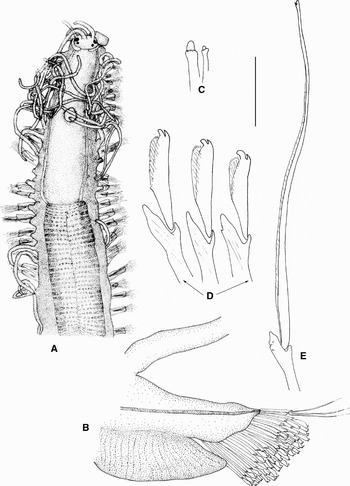
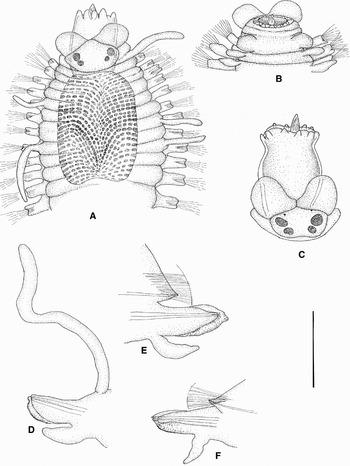
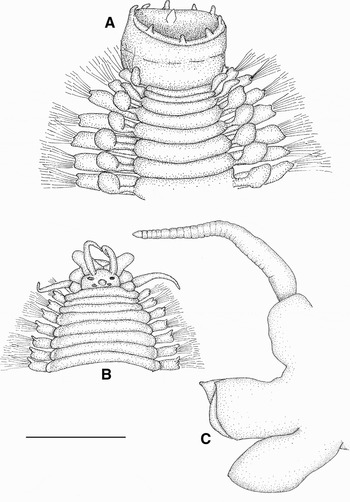
Body long, thick, strongly convex dorsally, without colour markings, very fragile; only anterior fragments, 5.4 mm long, 0.3 wide, for 34 chaetigers (holotype). Prostomium ovate, with two pairs of eyes in open trapezoidal arrangement and two small anterior eyespots; median antenna originating just in front of anterior eyes, cylindrical, longer than prostomium and palps together, lateral antennae shorter than median one, originating on anterior margin of prostomium; palps long and large, broad, folded downwards, separated for their entire length. Two kidney-shaped nuchal organs posterolateral to prostomium (Figure 6A). Two pairs of long tentacular cirri. Antennae, tentacular cirri and dorsal cirri long, cylindrical to thread-like. Dorsal cirri with distinct cirrophores, alternating in length on anterior segments, long cirri much longer than body width, usually coiled and sometimes forming a tangle; short cirri as long as or shorter than body width; several specimens with dorsal cirri shorter than those described above. Parapodia elongate, subtrapezoidal; ventral cirri foliaceous, ovate, fused to parapodial lobe except distally, with dark inclusions (Figure 6B). Compound chaetae similar throughout body, heterogomph, with nearly smooth shafts. Parapodia each including 3–5 compound chaetae with long, spiniger-like blades, tips indistinctly bifid (Figure 6E), and more than 30 falcigers with short distal tooth and long, broad, somewhat curved proximal tooth (Figure 6D); blades of both falcigers and spiniger-like chaetae provided with a translucent hood, slightly spinose on margin, forming a ‘breast’ more distinct ventrally and posteriorly. Anterior parapodia with more compound chaetae than midbody parapodia. Slight gradation on length of falcigers on each fascicle, 30 µm in length dorsally, 20 µm in length ventrally, on midbody parapodia. Simple chaetae not seen. Parapodia each with 2–3 aciculae, ending in small button (Figure 6C). Pharynx long and wide, with crown of 10 soft papillae with cilia on anterior rim; pharyngeal tooth rounded, slightly acute anteriorly, located just in middle of pharynx (Figure 6A). Proventricle somewhat shorter than pharynx, extending through about 11 chaetigers, with about 28 muscle cell rows.
Opisthodonta russelli sp. nov. (A) Anterior dorsal view, paratype; (B) anterior parapodium, lateral view; (C) aciculae; (D) falcigers; (E) spiniger-like compound chaetae. Scale: (A) 0.77 mm; (B) 0.15 mm; (C–E) 20 µm.

ETYMOLOGY
The species is dedicated to Dr David E. Russell, who allowed us to describe this species as a new.
REMARKS
This species closely ressembles Opisthodonta uraga. However, all reports of the species consistenly highlighted the pharyngeal tooth located in the middle of pharynx, while O. uraga has a smaller pharyngeal tooth located anteriorly. Furthermore, O. russelli and O. uraga differ in details of the blades of the compound chaetae that the peculiar translucent hoods are more developed in the former than in the later.
DISTRIBUTION
Atlantic coasts of North and South America, from North Carolina to Venezuela.
HABITAT
Thalassia testudinum beds. Coarse to fine or very fine sand, silty sand, from 0.5 m to 189 m depth.
Pionosyllis sp. Baratech & San Martín, Reference Baratech and San Martín1987: 44, figures 4–5.
Pionosyllis serratisetosa López et al., Reference López, San Martín and Jiménez1997: 293–296, figure 1. San Martín, Reference San Martín, Ramos, Alba, Bellés, Gosólbez, Guerra, Macpherson, Martin, Serrano and Templado2003: 89. figures 37&38.
TYPE LOCALITY
Chafarinas Islands (Spain), Alborán Sea (western Mediterranean).
DISTRIBUTION
Only known from the type locality and Alborán Sea.
HABITAT
Among algae, inside block of the coral Cladocora caespitosa; 6–20 m depth.
Pionosyllis templadoi San Martín, Reference San Martín1991b: 17–20, figures 1&2.
TYPE LOCALITY
Isle of Pines and Archipelago of Canarreos, south-west Cuba.
DISTRIBUTION
Only known from the type locality.
HABITAT
Among Halimeda sp., 3 m depth.
Dioplosyllis tridentata Kudenov & Harris, Reference Kudenov and Harris1995: 38, figure 1.12.
REMARKS
Kudenov & Harris (Reference Kudenov and Harris1995) described this species as having a single middorsal tooth, but the crown of papillae and the semi-circle of small teeth on the pharynx opening, characteristic of the genus Dioplosyllis (see Gidholm, Reference Gidholm1962) were absent; thus all characters agree with the diagnosis of Opisthodonta.
TYPE LOCALITY
Off Purísima Point, California.
DISTRIBUTION
Only known from the type locality.
HABITAT
Rocky substrata.
Pionosyllis uraga Imajima, Reference Imajima1966: 114–115, text-figure 37.
Non Pionosyllis uraga Perkins, Reference Perkins1981: 1108.
MATERIAL EXAMINED
Uraga Strait of Tokyo Bay, (NSMNH) holotype. Wakasa Bay (Japan), (IMEO) W-90-42-25, 2 specimens, 126 m depth, sand, 35°57′27″N 135°56′17″E; W-700, 1 specimen, 125 m depth, sand, 36°45′ N 135°5′E; W-541, 1 specimen, 75 m depth, sand, 36°45′135°5′E (Minako Hanaoka leg.).
DESCRIPTION
Only anterior fragments, most dorsal cirri lacking. Body long, stout, with convex dorsum, without colour markings; longest anterior fragment examined from Wakasa Bay, 2.56 mm long, 0.78 mm wide for 26 chaetigers. Prostomium (Figure 7A) ovate to pentagonal, with two small eyes in open trapezoidal arrangement. Dorsal cirri cylindrical, long, slender, smooth, with distinct short cirrophore, alternating dorsal cirri longer than body width and shorter than body width (Figure 7A). Parapodia slender, elongate. Ventral cirri ovate, foliaceous, fused to parapodial lobe on nearly all their length; irregular inclusions inside ventral cirri, perhaps glands (Figure 7B,C). Compound chaetae bundles very dense, composed of numerous chaetae with long, indistinctly bifid spiniger-like blades, and falcigers with proximal tooth longer and thicker than distal tooth, more strongly marked ventrally and posteriorly (Figure 7D). Anterior parapodia each with about 7 spiniger-like compound chaetae and about 60 falcigers; midbody parapodia each with about 3–5 spiniger-like chaetae and about 19 falcigers. Falcigers provided with a short, small, translucent, indistinct hood with short, fine, straight spines on margin. Two aciculae on each parapodium, with blunt tip and crown of subdistal, minute spines (Figure 7E). Pharynx long, surrounded by crown of soft papillae on anterior rim; pharyngeal tooth small, located on anterior margin (Figure 7A,B). Proventricle similar in length to pharynx, with about 40 muscle cell rows.
Opisthodonta uraga (Imajima, Reference Imajima1966) comb. nov. (A) Anterior end, dorsal view; (B) anterior end with everted pharynx, ventral view (chaetae not drawn); (C) anterior parapodium, posterior view (dorsal cirrus and chaetae not drawn); (D) spiniger-like compound chaetae of anterior parapodium; (E) spiniger-like from midbody; (F) compound chaetae, midbody parapodium; (G) aciculae. Scale: (A, B) 0.77 mm; (C) 0.15 mm; (D,E) 20 µm.

TYPE LOCALITY
Uraga Strait, Tokyo Bay, Japan.
DISTRIBUTION
Japan. The report of Banse & Hobson (Reference Banse and Hobson1974) of this species for British Columbia and Washington is probably correct.
HABITAT
Sand; from 40 to 150 m depth.
Paraehlersia San Martín, Reference San Martín, Ramos, Alba, Bellés, Gosólbez, Guerra, Macpherson, Martin, Serrano and Templado2003: 61.
TYPE SPECIES
Ehlersia ferrugina Langerhans, Reference Langerhans1881, designated by San Martín (Reference San Martín, Ramos, Alba, Bellés, Gosólbez, Guerra, Macpherson, Martin, Serrano and Templado2003).
DIAGNOSIS
Body long, stout, with numerous segments, of medium to macrofaunal size, dorsally convex. Segments not fused. Double dorsal row of cilia on dorsum of most segments. Prostomium provided with four eyes and a pair of anterior eyespots, three antennae and two palps. Median antenna inserted in the middle of prostomium. Palps fused at bases, with a dorsal furrow, triangular in shape. Nuchal organs as two ciliated grooves. Two pairs of tentacular cirri. Antennae, tentacular cirri and anterior dorsal cirri of adults articulated to irregularly articulated depending upon size, remaining dorsal cirri smooth. Parapodia without prechaetal lobes; most species with digitiform, retractile papilla between parapodial lobes and dorsal cirri of anterior parapodia. Compound chaetae heterogomph, including one or more chaetae with spiniger-like blades and several bidentate falcigerous blades, anteriorly with both teeth similar, posteriorly with proximal tooth longer and more robust than distal tooth; spines on margin of blades short to moderate. Aciculae acuminate. Pharynx and proventricle of similar size. Pharyngeal tooth anteriorly located. Reproduction by epigamy.
APOMORPHIES
Clade supported by a very clear apomorphy, the presence of a subcirral papillae (character 27, state 1). Four other apomorphies can be considered. The dorsal surface of segments is ciliated (character 6, state 1); this state change is shared with Ophiodromus flexuosus and is a homoplasy with most examined Autolytinae (except Proceraea picta), Odontosyllis fulgurans, Dioplosyllis cirrosa, Westheidesyllis gen. nov., Eusyllis lamelligera and Perkinsyllis gen. nov. The dorsal ciliary bands are double (character 7, state 1), a convergence with Epigamia alexandri and all the species of Perkinsyllis gen. nov. except Pionosyllis longisetosa. The antennae are articulated (character 13, state 1), a homoplasy with the examined Syllinae, Eusyllis lamelligera, Opisthodonta melanonaephra and Pionosyllis dionisi, and so are the tentacular cirri (character 14, state 1), a character state shared with the same taxa plus Ophiodromus flexuosus. The dorsal cirri are articulated in anterior segments and smooth in posterior ones (character 15, state 1), a homoplasy with Amblyosyllis sp., Pionosyllis marquesensis, Pionosyllis procera, Eusyllis lamelligera, Westheidesyllis gen nov., Opisthodonta melanonaephra and Pionosyllis dionisi. Finally, the spiniger-like chaetae (character 46, state 1) is a homoplasy with Exogone dispar, Pionosyllis anophthalma, Pionosyllis augeneri, Pionosyllis longisetosa, Pionosyllis spinisetosa, Pionosyllis hartmannschroederae, Pionosyllis dionisi, the examined species of Opisthodonta.
REMARKS
Ehlersia Quatrefages, 1866 is a synonymy of Syllis Lamarck, 1818 (see San Martín, Reference San Martín, Ramos, Alba, Bellés, Gosólbez, Guerra, Macpherson, Martin, Serrano and Templado2003); the type species of Ehlersia is Syllis sexoculata, a species not related to Ehlersia ferrugina, as Ehlersia could not be used, and San Martín (Reference San Martín, Ramos, Alba, Bellés, Gosólbez, Guerra, Macpherson, Martin, Serrano and Templado2003) proposed Paraehlersia as the new generic name.
Pionosyllis dionisi is included in Paraehlersia since the antennae, tentacular and anterior cirri are articulated, and it has spiniger-like compound chaetae. However, its position in the consensus is isolated, and it does not show clear relationships with any other clade. Examination under SEM (San Martín, Reference San Martín, Ramos, Alba, Bellés, Gosólbez, Guerra, Macpherson, Martin, Serrano and Templado2003) revealed neither subcirral papillae nor ciliary bands, but a more detailed examination seems to be necessary.
KEY TO SPECIES
1. Blades of falcigerous chaetae with both teeth similar in size.Paraehlersia (?) dionisi
Blades of falcigerous chaetae (from midbody) with proximal tooth distinctly longer than distal one. Anterior parapodia each with subcirral, retractile papilla2
2. Ventral simple chaetae enlarged, with proximal tooth much longer than distal tooth and long subdistal spines. Falcigerous chaetae with blades provided with moderately long, distal spines on marginParaehlersia weissmannioides
Ventral simple chaetae not enlarged, without long distal spines. Blades of compound chaetae with short spines on margin3
3. Small size (6 mm long); only most anterior dorsal cirri articulatedParaehlersia articulata
Large size (up to 10 mm); large specimens with articulated dorsal cirri on about first anterior third of body. 4
4. Blades of compound chaetae of most posterior parapodia enlargedParaehlersia ehlersiaeformis
Blades not enlargedParaehlersia ferrugina
Pionosyllis articulata Kudenov & Harris, Reference Kudenov and Harris1995: 55, figure 20. Capa et al., 201: 622.
Paraehlersia articulata Aguado & San Martin, 2006: 6.
REMARKS
This species is very similar to P. ferrugina. Specimens from Coiba Island are smaller than the Mediterranean species, and are provided with ciliary bands and subcirral papilla on each anterior parapodia. Nevertheless the antennae, tentacular cirri, and anteriormost dorsal cirri are weakly articulated, while the cirri of P. ferrugina have with more distinct articles.
TYPE LOCALITY
Santa María Basin (California), USA.
DISTRIBUTION
Southern to central California. Recently, we have examined specimens of this species collected in Coiba Island (Pacific, Panamá). Ehlersia sp. (Westheide, Reference Westheide1974) from the Galápagos Islands probably belongs to this species.
HABITAT
Soft bottoms and rocky substrata, in depths of 60–205 m (Kudenov & Harris, Reference Kudenov and Harris1995). Inside dead corals.
Pionosyllis dionisi Núñez & San Martín, Reference Núñez and San Martín1991: 236, figure 1.- Parapar et al., Reference Parapar, San Martín, Urgorri and Besteiro1993: 372, figure 5. San Martín, Reference San Martín, Ramos, Alba, Bellés, Gosólbez, Guerra, Macpherson, Martin, Serrano and Templado2003: 67, figures 22&23.
Pionosyllis elephantensis Hartmann-Schröder & Rosenfeldt, Reference Hartmann-Schröder and Rosenfeldt1992: 98–99, figures 28–33.
MATERIAL EXAMINED
Several specimens from the Canary Islands and Western Mediterranean. The paratype of P. elephantensis (ZMH P-20750) has been examined for comparison.
TYPE LOCALITY
Candelaria, Tenerife (Canary Islands, Spain).
DISTRIBUTION
Canary Islands, Ceuta (Spain); Elephant Island (South Shetlands, Antarctica).
HABITAT
Biocenosis of Dendrophyllia ramea, coarse sand, silt with stones; 43.5–466 m.
Pionosyllis ehlersiaeformis Augener, Reference Augener1913: 225, figures 31&32.
Paraehlersia ehlersiaeformis San Martín & Hutchings, Reference San Martín and Hutchings2006: 309, figures 43D–F, 44A–K, 45A–F, 46A–C.
MATERIAL EXAMINED
Australia. See San Martín & Hutchings, Reference San Martín and Hutchings2006. ZMH, V 8786 (1 specimen).
REMARKS
A redescription of this species is provided in San Martín & Hutchings (Reference San Martín and Hutchings2006). One specimen in ZMH V 7950 belongs to another species, similar to Perkinsyllis augeneri.
TYPE LOCALITY
Sharks Bay, Western Australia.
DISTRIBUTION
Australia: Western Australia, South Australia, New South Wales. The reports from south-west Africa and Cape Agulhas (South Africa) (Day, Reference Day1953, Reference Day1967) are doubtful.
HABITAT
Pelagic and interstitial in the surf area. Abundant on algae, coralline concretions and seagrasses. Intertidal up to 100 m depth.
Ehlersia ferrugina Langerhans, Reference Langerhans1881: 104, figure 10.- Laubier, Reference Laubier1968: 85.- San Martín, Reference San Martín1984: 306, figures 73&74.
Syllis (Ehlersia) ferrugina Fauvel, Reference Fauvel1923: 269, figure 100 k–u.-Núñez & San Martín, Reference Núñez and San Martín1996: 207–208.
Paraehlersia ferrugina San Martín, Reference San Martín, Ramos, Alba, Bellés, Gosólbez, Guerra, Macpherson, Martin, Serrano and Templado2003: 61, figures 19–21.
TYPE LOCALITY
Puerto de la Orotava (=Puerto de la Cruz), Tenerife Island, Canary Islands, Spain.
DISTRIBUTION
Apparently cosmopolitan in tropical and temperate waters; however, this taxon could be a complex of species.
HABITAT
Very common on algae, Posidonia oceanica and Cymodocea nodosa beds, coraligenous concretions, sand; intertidal to about 100 m depth.
Pionosyllis weissmannioides Augener, Reference Augener1913: 223, figure 30.
Paraehlersia weissmannioides San Martín & Hutchings, Reference San Martín and Hutchings2006: figures 47A–I, 48A–F, 43A–C, 49D–F.
MATERIAL EXAMINED
Sharks Bay, Useless Inlet, Australia, 7 m depth (Holotype, ZMH V-7949). Australia: See San Martín & Hutchings, Reference San Martín and Hutchings2006.
REMARKS
A redescription of this species is provided in San Martín & Hutchings (Reference San Martín and Hutchings2006).
TYPE LOCALITY
Sharks Bay, Useless Inlet, Western Australia.
DISTRIBUTION
Australia: Western Australia, New South Wales.
HABITAT
On sand and shelly grit, shallow waters up to 15 m depth.
TYPE SPECIES
Pionosyllis longisetosa Hartmann-Schröder, Reference Hartmann-Schröder1965 by present designation.
DIAGNOSIS
Body long and slender, of medium to meiofaunal size. Segments not fused. Anterior segments with a single dorsal row of cilia, double after proventricular segments. Prostomium with four eyes and two anterior eyespots or without eyes, with three antennae and two palps. Nuchal organs as two ciliated grooves. Median antenna inserted on middle of prostomium or on posterior margin. Palps fused at bases, with a dorsal furrow, triangular in shape. Two pairs of tentacular cirri. Antennae, tentacular and dorsal cirri long to very long, slender, thread-like, all similar, sometimes coiled over dorsum. Subcirral papilla absent. Two kinds of heterogomph compound chaetae, one provided with slender and spiniger-like, sometimes with very long blades, the other with shorter, elongate falcigers provided with long, fine, distally dressed spines on margin; some species having short spiniger-like blades or lacking. Dorsal and ventral simple chaetae on posterior parapodia. Aciculae distally expanded, bilobed. Parapodia without prechaetal lobes, or with very small ones. Pharynx and proventricle similar in size, or pharynx longer than proventricle. Pharyngeal tooth anteriorly located. Reproduction unknown on most species; however, one specimen of P. hartmannschroederae nom. nov., examined by G.S.M. at the Australian Museum, had attached eggs, ventrally brooded, and is proved a similar reproduction in P. augeneri; perhaps all species of Perkinsyllis brood eggs.
APOMORPHIES
Clade supported by one clear autapomorphy, the presence of some chaetae bearing proximal spines distinctly longer than distal ones (character 49, state 1). Some other apomorphies for the clade might be considered. The dorsal surface is ciliated (character 6, state 1). The state change, which is uncertain for Pionosyllis homocirrata and Pionosyllis spinisetosa, is shared with Ophiodromus flexuosus and a homoplasy with most examined Autolytinae (except Proceraea picta), Odontosyllis fulgurans, Dioplosyllis cirrosa, Westheidesyllis gen nov., Eusyllis lamelligera and Paraehlersia. The aciculae have rounded tips (character 39, state 2), a state change shared with Exogone dispar, Brania pusilla, and Westheidesyllis gen. nov. Details on reproduction are only known from Pionosyllis augeneri and Pionosyllis hartmannschroederae, in which the eggs are brooded (character 52, state 1) attached to the ventral surface of the body (character 53, state 1). If they proved to be present in the remainder of the species within the clade, they could be considered also apomorphies of the genus; change in character 52 would be a homoplasy with Nudisyllis tinihekea, Pionosyllis pulligera and all the studied Exogoninae species, and change in character 53 would be shared with Sphaerosyllis hystrix, Exogone dispar and Brania pusilla.
ETYMOLOGY
The genus is named in honour of Dr Thomas H. Perkins, for his important contributions to the knowledge of the family Syllidae and other polychaetes.
KEY TO SPECIES
1. Small (up to 1.6 mm long). Dorsal cirri absent on chaetiger 2Perkinsyllis homocirrata
Body of mid-size to macrofaunal. Dorsal cirri present on chaetiger 22
2. Anteriormost parapodia with compound chaetae similar, provided with short blades3
Anteriormost parapodia with compound chaetae provided with blades of different sizes, some of them spiniger-like chaetae4
3. Anteriormost parapodia with compound chaetae provided with distinctly large, broad shafts, and blades with coarse spines on marginPerkinsyllis serrata
Anteriormost parapodia without distinctly enlarged shafts on compound chaetae; spines of blades thinPerkinsyllis koolalya
4. Blades of compound chaetae of anteriormost parapodia with coarse spines on margin5
Blades of compound chaetae similar throughout, with fine spines on margin6
5. Blades of anteriormost compound chaetae all similar, with elongated blades, with dorsoventral gradation. Spiniger-like chaetae from midbody apparently unidentatePerkinsyllis augeneri
Compound chaetae including bidentate spiniger-like chaetae from anteriormost segments. Perkinsyllis longisetosa
6. Falcigers of midbody provided with a double curvature7
Blades of compound chaetae with ‘normal’ curvaturePerkinsyllis spinisetosa
7. Dorsal simple chaetae unidentate, with coarse spines on marginPerkinsyllis hartmannschroederae nom. nov.
4. Dorsal simple chaetae bidentate, with thin spines on marginPerkinsyllis anophthalma
Pionosyllis anophthalma Capaccioni & San Martín, Reference Capaccioni and San Martín1989: 41–47, figures 1–3. San Martín, Reference San Martín, Ramos, Alba, Bellés, Gosólbez, Guerra, Macpherson, Martin, Serrano and Templado2003: 76, figures 28&29.
TYPE LOCALITY
Alfaque Inlet, delta of Ebro River, Mediterranean, Spain.
DISTRIBUTION
Only known from the type locality.
HABITAT
Fine sand.
Pionosyllis augeneri Hartmann-Schröder, Reference Hartmann-Schröder1979: 98, figure 119.- San Martín & Hutchings, Reference San Martín and Hutchings2006: 326, figures 57A–J, 58A–F.
(?)Pionosyllis augeneri Hartmann-Schröder, Reference Hartmann-Schröder1980a: 393, figures 10–15.
MATERIAL EXAMINED
ZMUH P-16796 (16 specimens). Australia: See San Martín & Hutchings, Reference San Martín and Hutchings2006.
TYPE LOCALITY
Broome (Australia).
DISTRIBUTION
North-western Australia. Caribbean Sea (?).
HABITAT
Coarse sand and silt. Sediments on mangrove forests.
REMARKS
This species has been re-described by San Martín & Hutchings (Reference San Martín and Hutchings2006). The record of the West Indies could be another species, since there are significant differences in the simple chaetae.
Typosyllis (Langerhansia) longisetosa Hartmann-Schröder, Reference Hartmann-Schröder1990: 49–50, figures 9–12.
Pionosyllis hartmannschroederae San Martín & Hutchings, Reference San Martín and Hutchings2006:330, figure 61A–F.
TYPE LOCALITY
Brisbane (Queensland, Australia).
DISTRIBUTION
Australia (Queensland, Western Australia).
HABITAT
Sandflats in mangroves, dead corals, fine sediment, sediments trapped in algae; intertidal and shallow waters.
Eusyllis homocirrata Hartmann-Schröder, Reference Hartmann-Schröder1958: 235, pl. 38, figures 8–11.-Westheide, Reference Westheide1974: 71, figure 32.
Pionosyllis homocirrata Ding & Westheide, Reference Ding and Westheide1997: 284, figure 5.-Núñez et al., Reference Núñez, Riera, Brito and Pascual2001: 62, figure 1.
TYPE LOCALITY
Bimini Islands.
DISTRIBUTION
Circumtropical: Bimini Islands, Galápagos Islands, India, South China, Cuba, Bahamas, Angola, Canary Islands.
HABITAT
Interstitial on exposed intertidal tropical and subtropical beaches.
Pionosyllis longisetosa Hartmann-Schröder, Reference Hartmann-Schröder1965: 118, figures 80–83.
MATERIAL EXAMINED
Holotype, ZMUH P-14692 and paratype, P-14685.
ADDITIONS TO THE DESCRIPTION
Both specimens incomplete. Anteriormost parapodia with elongated, spiniger-like compound chaetae, with bidentate blades, about 120 µm and coarse serration on margin (Figure 8A), remaining chaetae similar, but shorter, with small proximal tooth, and a distinctly long distal spine (Figure 8B), with dorsoventral gradation in length, 81 µm above, 45 µm below. From midbody backwards, few spiniger-like chaetae on each parapodium but having very long blades (more than 200 µm long), bidentate, with long, fine distal spines (Figure 8C); falcigers with bidentate blades, provided with long, coarse basal spines distally dressed, and 1–2 distal spines long and fine (Figure 8D); shorter blades with short, coarse spines (Figure 8E), and dorsoventral gradation in length, 57 µm above, 32 µm below.
Perkinsyllis longisetosa (Hartmann-Schröder, Reference Hartmann-Schröder1965) comb. nov. (HZMP-1996). (A) Spiniger-like compound chaeta, anterior parapodium; (B) compound chaetae, anterior parapodium; (C) distal end of spiniger-like compound chaeta, midbody parapodium; (D) compound chaetae, midbody parapodium; (E) ventralmost compound chaeta, midbody parapodium. Scale: 20 µm.

REMARKS
The blades of compound chaetae appear to have an indistinct second row of spines, which are difficult to observe and could be an artefact.
TYPE LOCALITY
Quedal (Chile).
DISTRIBUTION
From Punta Lavapié to Quedal (Chile).
ECOLOGY
Fine sand with detritus, silt, algae. 20 m to 260 m depth.
Eusyllis serrata Hartmann-Schröder, Reference Hartmann-Schröder1984: 18, figures 23–26.
Pionosyllis serrata San Martín & Hutchings, Reference San Martín and Hutchings2006: 346, figures 72D–F, 75A–N, 76A–F, 77A–F.
MATERIAL EXAMINED
Australia: See San Martín & Hutchings, Reference San Martín and Hutchings2006.
REMARKS
This species is re-described in San Martín & Hutchings (Reference San Martín and Hutchings2006).
TYPE LOCALITY
Goode Beach, Frenchman Bay, Albany (Western Australia).
DISTRIBUTION
Australia (Western Australia, New South Wales).
HABITAT
Posidonia, sand, 1.5–30 m depth.
Pionosyllis sp. A Uebelacker Reference Uebelacker, Uebelacker and Johnson1984: 72–73, figure 66.
Pionosyllis spinisetosa San Martín, Reference San Martín1990: 592, figures 2&3.- Núñez & San Martín, Reference Núñez and San Martín1996: 209, figure 4a–e.
TYPE LOCALITY
Gulf of México, 29°54′ 58.6″N 86° 4′ 58.5″W.
DISTRIBUTION
Gulf of México, Cuba, Canary Islands, Cape Verde Islands.
HABITAT
Sand and mud, inside sponges on Rhizopora mangle roots, green algae; intertidal to 37 m depth.
Pionosyllis Malmgren, Reference Malmgren1867: 158.
Hesiosyllis Wesenberg-Lund, Reference Wesenberg-Lund1950: 14.
TYPE SPECIES
Pionosyllis compacta Malmgren, Reference Malmgren1867 by monotypy.
DIAGNOSIS
Body long to moderately long, stout, of macrofaunal size, dorsally strongly convex. Apparently without ciliary bands. Segments not fused. Prostomium provided with four eyes, sometimes also a pair of eyespots, with three antennae and two palps; sometimes two peristomial cheeks or lobes on large specimens. Median antenna inserted in the middle of prostomium. Palps fused at bases, with a dorsal furrow, triangular in shape. Nuchal organs as ciliated grooves. Two pairs of tentacular cirri. Antennae, tentacular cirri and dorsal cirri smooth, sometimes rugose, long, filiform, similar throughout or alternating slightly in length. Subcirral papilla absent. Ventral cirri not fused to parapodial lobes, proximally inserted; those of anteriormost parapodia inflated, more or less spherical. Heterogomph compound chaetae with bidentate falcigerous blades, the two teeth similar in size; some dorsal anterior falcigers somewhat longer than the remaining in some species; other species with some unidentate blades. Dorsal and ventral simple chaeta on some posterior parapodia, bidentate, with both teeth similar; one species with filiform, unidentate dorsal simple chaeta; spines on margin of blades short to moderate. Aciculae straight, pointed, acute, usually protruding from parapodial lobes. Parapodia with prechaetal lobes. Pharynx and proventricle similar in size. Pharyngeal tooth anteriorly located. Reproduction by epigamy.
APOMORPHIES
Clade supported by one autapomorphy: spherical, inflated ventral cirri on anterior segments (character 22, state 2). Other apomorphies of the clade are the presence of a prechaetal lobe (character 28, state 1), a state change shared with Ophiodromus flexuosus, Pisione longispinulata, Pionosyllis marquesensis, Pionosyllis procera, Amblyosyllis sp. and Basidiosyllis gen. nov.; and the aciculae protruding from the parapodial lobe (character 38, state 1), a state change which is a convergence with Syllis variegata, Trypanosyllis zebra, Amblyosyllis sp., Paraehlersia articulata, Pionosyllis yolandae, Pionosyllis aciculata and Palposyllis prosostoma.
REMARKS
Some of these species are morphologically similar to Syllis corruscans Haswell, Reference Haswell1886, but this species reproduces by schizogamy (Haswell Reference Haswell1920; personal observation) and most likely belongs to the Syllinae. All species of Pionosyllis sensu stricto inhabit muddy sediments in cold waters, polar and subpolar seas or deep bottoms (more than 100 m).
KEY TO SPECIES
1. Ventral cirri of chaetiger 1 laminarP. compacta
Ventral cirri of chaetiger 1 not laminar2
2. Compound chaetae all with bidentate blades3
Some blades unidentateP. stylifera
3. Blades of posterior compound chaetae with both teeth rounded, convergentP. gigantea
Blades of posterior compound chaetae with both teeth acute, divergent4
4. Blades of the compound chaetae all short, bidentate … 5
Blades of the compound chaetae with dorsoventral gradation6
5. Blades of compound chaetae with short spines on marginP. magnifica
Blades of compound chaetae with moderately long spines on marginP. petalecirrus
6. Some posterior compound chaetae (the most ventral ones) with short blades, with proximal tooth far from the distal one, near the middle of the bladeP. kerguelensis
All posterior compound chaetae with similar, moderately long bladesP. enigmatica
Pionosyllis compacta Malmgren, Reference Malmgren1867: 40, figure 48.- Pettibone, Reference Pettibone1954 (in part): 262, figure 28j.- Hartmann-Schröder, Reference Hartmann-Schröder1971: 153 (key), 154.- Uschakov, Reference Uschakov1955: 166, figure 54i–j.
Not Pionosyllis compacta Langerhans, Reference Langerhans1879: 545, figure 10a–e (=Pionosyllis lamelligera Saint-Joseph, 1886, see Núñez & Talavera, Reference Núñez and Talavera1995: 517).
MATERIAL EXAMINED
Arctic Ocean: Spitzbergen, 80°N 13°E, 1 June 1861, coll. Malmgren (syntypes, SMNH 2443). Off Point Barrow, Alaska, 15 miles from shore, 145 m depth, 6 September 1949 (1 ant. end, USNM 21955). All the syntypes are broken, fragmented and in poor condition. A lectotype has been designated and isolated in a vial. The remaining specimens (paralectotypes) are conspecific with the lectotype.
DESCRIPTION
Body moderately long, slender, fragile, with well defined segments (Figure 9A), white to yellowish in alcohol. Body subcylindrical, ventrally flattened, dorsally convex, 8–10 mm long (according to Malmgren, Reference Malmgren1867), 0.8–1 mm wide. Lectotype an anterior fragment 0.8 mm wide and 2.5 mm long for 20 chaetigers. Prostomium (Figure 9A,C) subpentagonal, twice wider than long, with rounded posterior margin; four large lensed eyes in trapezoidal arrangement and usually two anterior eyespots; anterior eyes somewhat larger than posterior ones. Antennae, tentacular cirri and dorsal cirri similar in shape, smooth, without articulations, thick, distally blunt (Figure 9A,D); antennae and tentacular cirri as long as body width or shorter, most lacking on examined specimens; antennae and dorsal tentacular cirri somewhat longer than dorsal cirri, according to Malmgren (Reference Malmgren1867: figure 48). Palps somewhat longer than prostomium, broad, fused at their bases, with a dorsal furrow, widely separated on distal end (Figure 9A–C). Peristomial ring shorter than the following segments, dorsally covered by first segment (Figure 9A). Dorsal cirri alternating, long ones somewhat longer than body width, shorter ones as long as half body width. Ventral cirri of first chaetiger enlarged, stout, foliaceous, rounded (Figure 9B); remaining ventral cirri conical, shorter than parapodia, thickened at their bases and distally pointed (Figure 9D–F). Parapodia each provided with two lobes; prechaetal lobe conical, postchaetal lobe foliaceous and larger than prechaetal one; prechaetal lobe less prominent in posterior chaetigers (Figure 9D–F). Compound chaetae heterogomph falcigers; shafts on anterior chaetigers provided with inconspicuous subdistal spines or smooth, those on midbody and posterior chaetigers with short subdistal serrations; blades bidentate, distal tooth hooked, less curved on anterior compound chaetae than on posterior ones, proximal tooth similar in size to distal one; parapodia each with 1–2 dorsal compound chaetae provided with elongate, slender blades, distally bidentate, longer on anterior and midbody parapodia, about 70 µm in length (Figure 10A), posteriorly shorter, about 41 µm in length, and provided with larger distal teeth (Figure 10E); remaining chaetae on each fascicle, heterogomph falcigers (Figure 10C,F) with strongly bidentate tipped blades, about 47 anteriorly and 15 posteriorly, very similar in length (33 µm anteriorly, 20 µm posteriorly); blades of anterior compound chaetae with close distal teeth (Figure 10A,B); all blades provided with fine, short, distally directed spines on edge. Epitokous forms with bundles of capillary notochaetae and notoaciculae first occurring on chaetigers 12–15 (Figure 9E,F). Dorsal and ventral simple chaetae not seen. Anterior parapodia each with 3 aciculae, straight, pointed distally, provided with a small mucro at the tip, protruding from anterior lobe; mid-posterior parapodia each with 2 similar aciculae (Figure 10D). Pharynx wide, usually everted on preserved specimens, extending through about 3–4 chaetigers when retracted, with a distal crown of 10 soft small lobes; pharyngeal tooth conical to oval, with rounded base, located anteriorly (Figure 9A–C). Proventricle somewhat longer and wider than pharynx, barrel-shaped, extending through about 10 chaetigers, with approximately 28 muscle cell rows (Figure 9A).
Pionosyllis compacta Malmgren, Reference Malmgren1867. (A) Anterior end, dorsal view, lectotype (SMNH 2443); (B) anterior end, ventral view, paralectotype (SMNH 2443); (C) prostomium and pharynx, dorsal view (USNM 21955); (D) anterior parapodium, long dorsal cirri, anterior view (SMNH 2443); (E) midbody parapodium, anterior view (SMNH 2443); (F) posterior parapodium, anterior view (SMNH 2443) (neurochaetae and dorsal cirri, not drawn in E, F). Scale: (A,F) 0.14 mm; (B,C) 0.26 mm; (D,E) 0.13 mm.

Pionosyllis compacta Malmgren, Reference Malmgren1867. (A) Dorsalmost compound chaeta with elongate blade, anterior parapodium; (B) falcigers, anterior parapodium; (C) falcigers, midbody parapodium; (D) aciculae, midbody parapodium; (E) dorsalmost compound chaeta with elongate blade, posterior parapodium; (F) falcigers, posterior parapodium (A-F: SMNH 2443). Scale: 20 µm.

REMARKS
Langerhans (Reference Langerhans1879; figure 10a–e) reported this species from Madeira but having chaetae very different from those of the types, thus we assume that he likely found another species. Uschakov (Reference Uschakov1955) reported this species from the Bering Sea, listed the characters in a key, and noted that it had ‘anterior part of body bearing dorsally narrow dark transverse striations’; Malmgren also described a similar colour pattern in his original description, but this colour pattern is no longer visible. One of the two specimens from Point Barrow (Alaska) (Pettibone, Reference Pettibone1954) perfectly fits Malmgren's description, but the other one belongs to Nudisyllis.
TYPE LOCALITY
Spitzbergen.
DISTRIBUTION
Arctic (Spitzbergen, Alaska), Bering Sea (Bering Island, Bering Strait).
HABITAT
In low water to 145 m depth.
Hesiosyllis enigmatica Wesenberg-Lund, Reference Wesenberg-Lund1950: 14, pl. 3 figure 16, pl. 4 figure 17.- Fauchald Reference Fauchald1977: 73 (key), 76, 84.
Pionosyllis enigmatica San Martín, Reference San Martín, Ramos, Alba, Bellés, Gosólbez, Guerra, Macpherson, Martin, Serrano and Templado2003: 73, figures 26&27.
MATERIAL EXAMINED
North-eastern Atlantic: east of Iceland, 65°00′N 11°16′W, 584 m, 20 May 1896, ‘Ingolf’ Station 59 (holotype of Hesiosyllis enigmatica: 1 ant. end, female + 2 middle fragments in alcohol; 2 slides in gum chloral: 10th right + 11th left parapodia, ZMUC-POL-16); off western Sweden: Björns Rev, Koster Fjord, 90–130 m, 6 December 1985, coll. F. Pleijel (1 ant. end + 2 fragments, as Pionosyllis sp., det. FP; ZMUC-POL-17; 3 ant. ends, as Pionosyllis sp., det. FP; IDENTICHAET); North Sea: Helgoland, (1 ant. end as Pionosyllis compacta, det. Augener Reference Augener1924, ZMH V-9771). Bank of Galicia (north-western Spain) (3 anterior fragments), among Madrepora oculata, 760–769 m depth (Fauna Ibérica II Cruise).
DESCRIPTION
Body long, massive, opaque, fragile, without colour markings (preserved specimens), dorsally convex, flattened ventrally, with well defined segments (Figure 11A–D); holotype 6.5 mm long, 2 mm wide for 21 chaetigers, 2 fragments not included; largest examined specimen (ZMH V-9771) 31 mm long, 1.5 mm wide for 90 chaetigers. Prostomium squared to round, somewhat wider than long; a median dorsal cleft dividing prostomium into lobe or cheek on each side; four lensed eyes in trapezoidal arrangement, anterior pair slightly larger than posterior pair (Figure 11A,C,E). Antennae, tentacular and dorsal cirri similar in shape along the whole body, long, slender, thin, smooth (Figures 11A,C,D, 12C,D). Median antenna originating between posterior pair of eyes, twice as long as lateral ones; lateral antennae originating in front of anterior pair of eyes, somewhat longer than prostomium and palps together (Figure 11A,C). Palps long, broad, divergent, basally fused, with a median dorsal furrow, slightly longer than prostomium. Peristomium short, partially covered by the dorsal lobes of prostomium and first chaetiger; dorsal tentacular cirri similar in length to median antenna, about 2–3 times longer than ventral ones. Dorsal cirri alternating long and short, long cirri about 3 times longer than body width, shorter cirri as long as body width (Figure 11A,C,D); ventral cirri somewhat shorter than parapodial lobes, thick and rounded anteriorly (Figures 11B,D, 12A) and ovate, pointed posteriorly (Figure 12C,D). Parapodia provided with prechaetal and postchaetal lobes; prechaetal lobe conical, distally pointed, postchaetal lobe rounded and shorter than prechaetal one (Figures 11A,C, 12A–D). Compound chaetae numerous, 40–50 on each anterior parapodium, progressively decreasing to about 5 posteriorly; all heterogomph falcigers, dorsalmost one provided with long, slender, minutely bidentate blade with numerous fine, short spines on edge (Figures 12B, 13A,E); shafts provided with short subdistal spines. Blades of remaining chaetae more strongly bidentate, all similar in shape, with coarse, distally directed, uniform spines on edge, distal tooth hooked, proximal tooth similar in shape and size to distal one (Figures 13B,F,G, 14A–E), except for dorsalmost blades on midposterior chaetigers, with proximal tooth smaller than distal one (Figure 13E). Slight dorsoventral and anteroposterior gradation in length of blades, articles progressively becoming shorter and slightly wider posteriorly; dorsalmost blades of compound chaetae in holotype about 140 µm long, ventralmost ones about 114 µm long on anterior parapodia; blades about 128 µm long dorsally, 74 µm ventrally on posterior parapodia (chaetiger 59, ZMH V:9771). Simple chaetae only found on last chaetiger of one specimen (ZMH V-9771); solitary dorsal simple chaeta slender, bidentate, with faint spines on margin (Figure 13C); solitary ventral simple chaeta somewhat thicker than dorsal one, bidentate, slightly curved, with faint serration distally (Figure 13D). Anterior parapodia each with 5–8 straight, thick, distally pointed aciculae (Figure 14F); number of aciculae per parapodium decreasing progressively posteriorly (Figure 13G), posterior parapodia each with 1–2 aciculae of same type as anterior ones (Figure 14H). Pharynx wide, usually everted on examined specimens, extending through 8 chaetigers, provided with 10 large, triangular, soft lobes surrounding opening (Figure 11A–F); pharyngeal tooth relatively small, anteriorly located. Proventricle barrel shaped, also extending through 8 chaetigers, but about 1/3 longer than pharynx, with about 35 muscle cell rows. One of the specimens is a pre-epigamic female bearing eggs, with small notoaciculae and short notochaetae (Figure 12C).
Pionosyllis enigmatica (Wesenberg-Lund, Reference Wesenberg-Lund1950). (A) Anterior end, dorsal view; (B) anterior end, ventral view (A,B: holotype ZMUC-POL-16); (C) anterior end, dorsal view; (D) anterior end, ventral view (C,D: ZMUC-POL-17); (E) prostomium and everted pharynx; (F) everted pharynx, ventral view (E,F: IDENTICHAET). Scale: 0.56 mm.

Pionosyllis enigmatica (Wesenberg-Lund, Reference Wesenberg-Lund1950). (A) Anterior parapodium (ZMUC-POL-16) (dorsal cirrus and neurochaetae not drawn); (B) midbody parapodium, anterior view (dorsal cirrus not drawn); (C) midbody parapodium, posterior view, mature female (showing incipient notochaetae, neurochaetae not drawn) (B,C: IDENTICHAET); (D) posterior parapodium, anterior view (neurochaetae not drawn) (ZMH V-9771). Scale: (A) 0.13 mm; (B) 0.26 mm; (C) 0.14 mm; (D) 0.12 mm.

Pionosyllis enigmatica (Wesenberg-Lund, Reference Wesenberg-Lund1950). (A) Dorsalmost compound, elongate chaeta, posterior parapodium; (B) compound falcigers, posterior parapodium; (C) dorsal simple chaeta; (D) ventral simple chaeta (A–D: ZMH V-9771); (E) dorsalmost compound elongate chaeta, anterior parapodium; (F) dorsalmost compound falciger, same parapodium; (G) ventralmost compound falciger, same parapodium (E-G: IDENTICHAET). Scale: (A,B,E,F,G) 12 µm; (C,D) 20 µm.

Pionosyllis enigmatica (Wesenberg-Lund, Reference Wesenberg-Lund1950). (A–C) Dorsal, median and ventral falcigers, anterior parapodium (ZMUC-POL-16); (D,E) dorsal and ventral falcigers, posterior parapodium (IDENTICHAET); (F) anterior aciculae; (G) midbody aciculae (IDENTICHAET); (H) posterior aciculae (ZMH V-9771). Scale: (A–E) 12 µm; (F,H) 48 µm; (G) 37 µm.

REMARKS
Wesenberg-Lund (Reference Wesenberg-Lund1950) erected Hesiosyllis assuming the existence of five antennae, two of which fell off; however, the holotype now only has two lateral antennae and the base of the median one (Figure 7A). The specimen probably never had five antennae, as shown in Wesenberg-Lund (Reference Wesenberg-Lund1950: figure 18), but only four, the right antenna being doubled at its base, certainly an anomaly. Currently, only the lateralmost right lateral antennae is present, there is no evidence of the presence of a second antennae in the left side while the right side clearly shows the attachment of the missing antenna arising from the same ceratophore as the existing one. The median antenna is also missing. Furthermore, the two chitinous jaws found in addition to the single anterior tooth were absent either in the holotype or in any other specimen, likely being misinterpretation of folds on the pharynx wall.
Hesiosyllis was placed, with some reservations, within Syllidae (Wesenberg-Lund, Reference Wesenberg-Lund1950), then transferred to the Hesionidae (Fauchald, Reference Fauchald1977), but it is, in fact, clearly a synonymy of Pionosyllis (Drs M.E. Petersen, T.H. Perkins and P.R. Garwood, personal communication).
According to Petersen (personal communication) the ventral cirri of chaetigers 1–3 are noticeably smaller than the following ones, with those from chaetiger back having a slitlike pocket on the anteroventral side (Figure 8A,B), which is not visible on ventral cirri 1–3. These special ventral cirri might be related to reproductive, tube-building or some other function, but additional observations of specimens of both sexes and living material are required to assess the function of these structures (Petersen, personal communication).
TYPE LOCALITY
East of Iceland: 65°00′N 11°16′W (Station 59 ‘Ingolf’ expedition), 584 m.
DISTRIBUTION
East of Iceland, west coast of Sweden, North Sea. North-western Spain.
HABITAT
Ooze, mud; 90–584 m. On corals Madrepora oculata; 760–769 m depth.
Pionosyllis gigantea Moore, Reference Moore1908: 325, figures a–c; 1909: 326; Reference Moore1923: 256.- Hartman, Reference Hartman1969: 445, figures 1–3.- Banse & Hobson, Reference Banse and Hobson1974: 60 (key), figure 15f.
MATERIAL EXAMINED
North-eastern Pacific: vicinity of Naha Bay, Behm Canal, south-eastern Alaska, 75–245 m, gravel and sponges, coll. ‘Albatross’ dredgings, Station 4228, 1903 (holotype, USNM 5532); west of Gabriola, B.C., sponge bed, 6 July 1917 (1 spec., USNM 35633); Clallam Bay, Strait of Juan de Fuca, Washington, 193 m, gravel, 30 June 1938 (1 spec., USNM 33151); off the coast of southern California, coll. ‘Albatross’ dredgings, 1904 (2 spec., USNM 17363).
DESCRIPTION
Body long, thick, massive, dorsally curved, ventrally flattened, with well defined intersegmental furrows (Figure 15A,B), without colour markings (preserved specimens). The type is a poorly preserved, broken specimen, without antennae, tentacular or dorsal cirri, 11 mm long, 2.5 mm wide (anterior part with 33 chaetigers) plus a broken piece of 7 chaetigers, 4 mm long (40 segments, 16 mm long, 4 mm wide according to Moore, Reference Moore1908). Remaining specimens (non-type series) are also incomplete and fragmented. Prostomium subpentagonal, wider anteriorly and partially covered by first chaetiger; four lensed eyes in trapezoidal to square arrangement, anterior eyes slightly larger than posterior ones; antennae and tentacular cirri smooth; lateral antennae originating on anterior margin of prostomium, in front of anterior eyes, slightly longer than prostomium and palps together (Figure 15B); median antenna originating between posterior pair of eyes and ‘about 31/2 times…the length of the prostomium and palpi’ (Moore, Reference Moore1908); median antenna detached in all examined specimens; palps longer than prostomium, broad, large, divergent, fused at their bases and with a dorsal furrow (Figure 15B). Peristomium very short, almost completely hidden by first chaetiger (Figure 15B); tentacular cirri very similar in shape to antennae, ‘the dorsal about 5 times the length of the head and the ventral only about twice that length’ (Moore, Reference Moore1908); tentacular cirri detached or broken in all specimens. Dorsal cirri long, thin, slender, tapering towards the tip; anterior ones rugose to weakly wrinkled on distal part (Figure 15C), midbody and posterior dorsal cirri smooth, without articulations; dorsal cirri alternating long and short (Moore, Reference Moore1908). Ventral cirri of chaetigers 1 and 2 slender, those from chaetiger 3 similar in length but thicker, enlarged, ending bluntly on anterior parapodia (Figure 15A,C); from chaetiger 3 posteriorly becoming gradually smaller, thickened at base and distally pointed. Prechaetal parapodial lobes with a distal, rounded papilla dorsally (Figure 15B,C); anterior parapodia truncated distally, becoming tapered posteriorly. Compound chaetae heterogomph falcigers, with shafts slightly serrated subdistally (Figure 16A–D). Anterior parapodia with about 40–50 compound chaetae, decreasing in number to 16–18 posteriorly; blades of compound chaetae of anterior parapodia all similar in shape, bidentate, with distal tooth somewhat hooked and proximal tooth similar, with coarse and short spines, except distally, short and distally directed (Figure 16A); blades about 190 µm long dorsally, 100 µm long ventrally. Shape of the blades progressively changing posteriorly; posterior parapodia each with three different kinds of chaetae, dorsalmost one provided with elongate, slender blade with small, indistinct teeth (Figure 16B), some other dorsal chaetae with blade similar but shorter and wider, and provided with two short, rounded teeth (Figure 16C); remaining chaetae becoming shorter and much wider in ventral part of fascicle, with blunt, rounded teeth, and long and fine distal spines on cutting edge, making a tuft (Figure 16D). Blades of posterior chaetigers with sinuose furrow, apparently complete, on proximal tooth (Figure 16D), more marked in ventral part of fascicle. Blades of posterior chaetigers about 150 µm long dorsally, 60 µm ventrally. Anterior parapodia each with 5–6 aciculae, slightly curved at their end with an acute tip (Figure 16E); posterior parapodia each with 3 aciculae similar in shape to anterior ones. Simple chaetae not seen. Pharynx wide, massive, short, with a crown of ten short papillae surrounding opening; pharyngeal tooth rhomboidal, relatively small, anteriorly located (Figure 15A); inner surface of pharynx dark red, with a chitinous layer. Pharynx and proventricle not visible through body wall.
Pionosyllis gigantea Moore, Reference Moore1908. (A) Anterior end, ventral view with everted pharynx (USNM 33151); (B) anterior end, dorsal view (USNM 17363); (C) anterior parapodium (USNM 17363). Scale: (A) 0.56 mm; (B) 1.13 mm; (C) 0.26 mm.

Pionosyllis gigantea Moore, Reference Moore1908. (A) Compound chaetae, anterior parapodium; (B–D) dorsalmost, dorsal and ventral compound chaetae, posterior parapodium; (E) acicula (A–E: USNM 17363). Scale: 14 µm.

REMARKS
The posterior median cleft, forming two prostomial lobes, originally described (Moore, Reference Moore1908) have not been seen due to the poor condition of the specimens. Pionosyllis gigantea is characterized by its relatively large size (about 16 mm long), and the compound chaetae having blades with short, coarse, distally directed spines ending in tufts. It closely resembles P. enigmatica and P. kerguelensis, but differs mainly in the shape of compound chaetae. The furrow on the proximal tooth of blades of compound chaetae is only visible in several posteriormost chaetae, which were not described by Moore (Reference Moore1908) and Hartman (Reference Hartman1969).
TYPE LOCALITY
North-eastern Pacific: vicinity of Naha Bay, Behm Canal, south-eastern Alaska, 75–245 m.
DISTRIBUTION
South-eastern Alaska, western Canada, southern California.
HABITAT
Mud, volcanic sand, gravel, rocks and sponges; 75–398 m depth.
Eusyllis kerguelensis McIntosh, Reference McIntosh1885: 191, pl. 29, figure 4, pl. 33 figure 3, pl. 15a figure 13.- Ehlers, Reference Ehlers1897: 42; Reference Ehlers1913: 473.- Augener, Reference Augener1924: 376; Reference Augener1927: 152.- Monro, Reference Monro1930: 94, figure 30a–c; 1936: 130.- Knox, Reference Knox1951: 73; Reference Knox1960: 105.- Knox & Cameron, Reference Knox and Cameron1998: 49, figures 99–100.- Hartman, Reference Hartman1953: 20; Reference Hartman1964: 81, pl. 25 figures 2–3.- Wesenberg-Lund, Reference Wesenberg-Lund1961: 59, figure 19.- Hartmann-Schröder, Reference Hartmann-Schröder1965: 115, figures 74–75; 1986: 77.- Averincev, Reference Averincev1982: 19, pl. II, figures 1–2.- Hartmann-Schröder & Rosenfeldt, Reference Hartmann-Schröder and Rosenfeldt1988: 39, figure 16; 1990: 97; 1992: 98.
Pionosyllis comosa Gravier, Reference Gravier1906: 288.- Ehlers, Reference Ehlers1913: 473, pl.32 figures 1–4.- Benham, Reference Benham1927: 60.- Monro, Reference Monro1930: 92; Reference Monro1936: 128, figure 20.- Hartman, Reference Hartman1953: 23; Reference Hartman1964: 85, pl. 26 figures 7–8; Reference Hartman1967: 58.
Pionosyllis cosma [sic] Knox, Reference Knox1960: 106.- Knox & Cameron Reference Knox and Cameron1998: 51.
Pionosyllis kerguelensis San Martín & Parapar, Reference San Martín and Parapar1997: 291. San Martín & Hutchings, Reference San Martín and Hutchings2006: 337, figure 66A–F, 67A–L.
MATERIAL EXAMINED
Kerguelen: Station 149H, off Christmas Harbour, 200 m, coll. HMS ‘Challenger’, presented McIntosh (syntype of Eusyllis kerguelensis, BMNH 1885.12.1.142: 1 ant. end + 2 median parts); Falkland Islands (=Malvinas), Swedish Antarctic Expedition 1901–1903: 52°11′S 60°26′W, Port Albemarle, 40 m, sand with algae, 8 September 1902 (2 spec. of Pionosyllis comosa SMNH 3332, 3728); 53°45′S 61°10′W, Burwood Bank, 137–150 m, shell fragments and stones, 12 September 1902 (1 spec. of P. comosa SMNH 3660). Coast of northern Argentina: 37°15′S 56°8′W, 100 m, sand and gravel, 23 December 1901, Swedish Antarctic Expedition 1901–1903 (1 spec. of P. comosa SMNH 3826). South Georgia: 54°24′S 36°22′W, South Fjord in front of the Nordenskjöld glacier, 210 m, blue-grey mud with a few small stones, 29 May 1902, Swedish Antarctic Expedition 1901–1903 (1 spec., lot identified as Pionosyllis epipharynx SMNH 3033). Antarctic Expedition Charcot: 1910 (P. comosa MNHN A-76), 1906 (P. comosa). Crozert Island: Station 12, DC 12 (P. comosa MNHN A-921). Syntypes of P. comosa, MNHN 285, 286. South Shetland Islands, ‘Spanish cruise Bentart 94’, coll. ‘Hespérides’: Station 52, mixed sediment, 62°43′S 60°27′W, 84 m, 1 spec.; Station 71, rocks, 62°43′S 60°26′W, 50 m, 1 spec.; Station 77, mud and organic rests, 62°40′S 60°40′W, 130 m, 1 spec.; Station 92, rock and gravel, 62°40′S 60° 41′W, 34 m, 1 spec. Tasman, Station 2EBS, 42°17.99′S–170°00.00′E, 958 m depth, 1 spec. (SMF 13225).
REMARKS
Pionosyllis kerguelensis was originally included in Eusyllis without any reference to the incomplete crown of denticles on the edge of pharynx that characterize this genus. According McIntosh (Reference McIntosh1885), the pharynx has two crowns of papillae, in agreement with the examined specimen of the type series (besides its poor condition) and lacks pharyngeal denticles. Specimens from SMNH, identified as P. comosa, also appear to have two crowns of papillae.
Hartman (Reference Hartman1964) reported P. comosa as having chaetae with short, distally entire blades using Gravier's (1906) drawings, who described the species as having bidentate blades. This discrepancy is probably due to a mistake.
TYPE LOCALITY
Kerguelen Island, 200 m depth.
DISTRIBUTION
Coast of north Argentina, Antarctic and subantarctic seas: Kerguelen Island, South Georgia, Falkland Islands (=Malvinas), Magellan area, Davis Sea, Palmer Archipelago, Drake Passage, South Orkney Island, Antarctic Peninsula, South Shetland, Australia, New Zealand, Crozet Island.
HABITAT
Fine grey sandy mud, volcanic mud, hard bottom, sand and shells; intertidal to 2916 m (Ehlers, Reference Ehlers1913).
Pionosyllis magnifica Moore, Reference Moore1906: 223, pl. 10, figures 9–11; 1908: 325.- Hartman, Reference Hartman1969: 447, figures 1–3.- Kudenov & Harris, Reference Kudenov and Harris1995: 54, fig. 19.- López et al., Reference López, Britayev, Martín and San Martín2001: 400, figures 1–3.
Eusyllis magnifica Pettibone, Reference Pettibone1954: 261.
MATERIAL EXAMINED
Bering Sea, ‘Adler’ cruise 18; 150 m depth; 2 specimens (V.N. Goriachev leg.). Southern coast of Kamchatka peninsula, point Lopatka; 6–8 m depth, 1 specimen (A.A. Adrianov leg.).
TYPE LOCALITY
Admiral Inlet (Port Townsend, Washington), USA.
DISTRIBUTION
North Pacific from Alaska and north Japan to California.
HABITAT
Mud, pebbles–mud, sand and shells; in branchial chambers of giant crabs (López et al., Reference López, Britayev, Martín and San Martín2001); intertidal to 150 m depth.
Pionosyllis petalecirrus Averincev, Reference Averincev1982: 19, figures 3–6.
TYPE LOCALITY
Davis Sea, Antarctica.
DISTRIBUTION
Only known from the type locality.
HABITAT
Shallow water.
Pionosyllis stylifera Ehlers, Reference Ehlers1913: 474, pl. 31, figures 6–10.- Monro, Reference Monro1939: 111, figure 6.- Hartman, Reference Hartman1964: 88, pl. 27, figures 8&9.- Hartmann-Schröder & Rosenfeldt, Reference Hartmann-Schröder and Rosenfeldt1990: 97; Reference Hartmann-Schröder and Rosenfeldt1992: 98.- Knox & Cameron, Reference Knox and Cameron1998: 53.
MATERIAL EXAMINED
Kaiser Wilhelm II Land (Antarctica), Winterstation, syntypes (several specimens and fragments in dry condition), 31 July 1902; 22–24 November 1902; 11 November 1902, Ehlers coll., 385 m depth, Deutsche Südpolar Expedition 1901–1903; MNHUB (5808). Kaiser Wilhelm II Land (Antarctica), 1908, 385 m depth, 7 anterior, 2 posterior and 1 midbody fragments, ZMUH (PE-379; PE-380).
DESCRIPTION
Body long, thick, without colour markings, opaque, up to 15 mm long, 1 mm wide for about 60 chaetigers. Prostomium trapezoidal to pentagonal; four large eyes laterally placed on anterior half of prostomium, anterior pair slightly larger than posterior one. Palps broad, folded downwards, fused on their basal third, with a well defined furrow. Median antenna long and thick, cylindrical, originating between anterior pair of eyes; lateral antennae about 1/3 length of median one, similar in shape but slender, originating in front of anterior eyes. Peristomium dorsally reduced, covered by first chaetiger (Figure 17A). Buccal opening protected by 3–4 ventral lobes of peristomium (Figure 17B). Dorsal tentacular cirri long, similar in length to median antenna; ventral tentacular cirri somewhat shorter than half length of dorsal ones. Dorsal cirri of first chaetiger very long, reaching to chaetiger 8. Dorsal cirri of remaining anterior segments alternating in length, long ones slightly longer than body width, short ones shorter than half length of long cirri (Figure 17A), all thick at their bases, cylindrical, acute on distal end (Figure 17D); dorsal cirri of median and posterior segments all relatively short. Antennae, tentacular cirri and long dorsal cirri rough, giving a pseudoarticulated appearance, but not forming true articles; remaining dorsal cirri smooth or slightly rough. Intersegmental furrows well marked (Figure 17A). Parapodia relatively short and broad, with anterior and posterior parapodial lobes, posterior one longer than anterior lobe; ventral cirri short and broad, ovate (Figure 17D). Anterior parapodia each with about 13–18 compound chaetae, diminishing to 8–9 on posterior parapodia. Arrangement of compound chaetae inverse to that of most species of Syllidae, dorsal compound chaetae with shorter blades and ventral compound chaetae with longer blades (Figure 17D). Compound chaetae of most anterior parapodia each with bidentate blades provided with long distal tooth and short proximal tooth, distal tooth proportionally longer and more hooked ventrally (Figure 17E). On subsequent anterior chaetigers, dorsal compound chaetae with distal tooth rounded and proximal tooth fine and similar in length to distal tooth, also similar to spines of margin of blade; ventral compound chaetae with blades similar to dorsal chaetae of most anterior parapodia (Figure 17G). Compound chaetae of remaining parapodia with fairly wide blades, with distal tooth rounded and somewhat hooked, and with minute, nearly indistinct proximal tooth, with numerous short spines on margin (Figure 17I); blades of dorsal chaetae about 13–14 µm in length and those of ventral ones about 27 µm in length. Shafts of compound chaetae provided distally with numerous, short spines. Solitary dorsal simple chaeta from about chaetiger 18, slender, bayonet-shaped, ending in fine, unidentate tip (Figure 17H). Ventral simple chaetae not seen. Aciculae straight (Figure 17F), with tapering tip, 2 in each anterior parapodium, solitary in remaining parapodia. Pharynx and proventricle not clearly visible through body wall; pharynx extending through 5 segments, opening surrounded by a crown of 10 soft papillae; pharyngeal tooth large, located nearly on anterior margin of pharynx (Figure 17C). Proventricle rectangular, through about 4 segments, with about 7 muscle cell rows.
Pionosyllis stylifera (Ehlers, Reference Ehlers1913). (A) Anterior end, dorsal view (lacking lateral antennae, right dorsal tentacular cirrus and dorsal cirrus of first right parapodium); (B) anterior end, ventral view; (C) anterior end of pharynx; (D) midbody parapodium, anterior view; (E) dorsal, medium and ventral compound chaetae, anterior parapodium (1st parapodium); (F) acicula; (G) dorsal and ventral compound chaetae, anterior parapodium (5th chaetiger); (H) dorsal simple chaeta, medium parapodium (39th chaetiger); (I) dorsal, medium and ventral compound chaetae, posterior parapodium. Scale: (A,B) 0.14 mm; (C) 0.26 mm; (D) 0.13 mm; (E–I) 20 µm.

TYPE LOCALITY
McMurdo Sound, Antarctica.
DISTRIBUTION
New Zealand, subantarctic islands, Antarctic seas.
HABITAT
Muddy sand, with or without stones, fine sand, fouling; also hard bottoms and algae; from 4–500 m depth.
TYPE SPECIES
Pionosyllis lamelligera Saint-Joseph, 1886, by present designation.
DIAGNOSIS
Body long and slender with numerous segments, of medium size. Segments of midbody fused, forming single segments from groups of 2–3 chaetigers. Ciliary bands absent, sometimes rows of cilia on the parapodia. Prostomium provided with four eyes, sometimes also a pair of anterior eyespots, with three antennae and two palps. Median antenna inserted anteriorly, slightly back to the lateral antennae. Palps free to each other, divergent. Nuchal organs as two ciliated grooves. Two pairs of tentacular cirri. Antennae, tentacular cirri and dorsal cirri of chaetiger 1 long, weakly articulated; dorsal cirri of remaining chaetigers much shorter, smooth. Subcirral papilla absent. Ventral cirri inserted basally on parapodial lobes; ventral cirri of first chaetiger enlarged, foliaceous, laminar. Compound chaetae heterogomph falcigers with blades short to moderately long, bidentate; spines on margin short. Dorsal and ventral simple chaetae present on posterior parapodia. Tips of aciculae trifid. Parapodia without prechaetal lobes. Pharynx longer than proventricle. Pharyngeal tooth anteriorly located. Reproduction by epigamy (only demonstrated in the type species).
APOMORPHIES
Clade supported by one apomorphy: fused segments (character 8, state 1), state change is shared with Basidiosyllis sp. A. Palps free from each other (character 10) could be a reversal.
ETYMOLOGY
From Greek, Syn, fused, and Mero, parts, in reference to the fusing of two to three segments on midbody.
KEY TO SPECIES
1. Posterior acicula neither enlarged nor protruding from parapodial lobes. Posterior compound chaetae including falcigers with moderately long, slender blades and falcigers with short blades, with proximal tooth longer than distal toothSynmerosyllis lamelligera
Posterior acicula enlarged, protruding from parapodial lobes. Blades of the compound chaetae similar all along the body2
2. Blades of compound chaetae with dorsoventral gradation in sizeSynmerosyllis aciculata
Some compound chaetae with relatively elongated spiniger-like bladesSynmerosyllis yolandae.
Pionosyllis aciculata San Martín, Reference San Martín1990: 601, figures 8&9.
TYPE LOCALITY
Cayo Matías (Archipiélago de los Canarreos), southern Cuba.
DISTRIBUTION
Only reported from the type locality.
HABITAT
Algae, inside dead coral; 1–3 m depth.
Pionosyllis lamelligera Saint-Joseph, 1886: 163, pl. 8, figures 30–38.-Fauvel, Reference Fauvel1923: 288, figure 110a–g.- Cognetti, Reference Cognetti1957: 4142, figure 7.- Hartmann-Schröder, Reference Hartmann-Schröder1971: 154; Reference Hartmann-Schröder1996: 161.- Campoy, Reference Campoy1982: 340.- San Martín, Reference San Martín1984: 105, pls. 16, 17; 2003: 79, figures 30&31.
MATERIAL EXAMINED
MNHN A-76, 2 specimens; MNHN A-422, 3 specimens; MNHN A-371, 1 specimen belonging in fact to Eusyllis lamelligera; MNHN A-492, 1 specimen. Numerous specimens from all around the Iberian Peninsula.
TYPE LOCALITY
Roches-Bonnes (Dinard), France.
DISTRIBUTION
Atlantic coasts of Europe, from France to Cape Verde Islands, Mediterranean, Cuba.
HABITAT
Algae, kelps, among ascidians, Posidonia oceanica beds, calcareous concretions; intertidal to 40 m depth.
Pionosyllis yolandae San Martín & Hutchings, Reference San Martín and Hutchings2006: 348, figures 42C–F, 49A–C, 78A–J.
TYPE LOCALITY
Burrill Rocks, New South Wales (Australia).
DISTRIBUTION
Australia (New South Wales, Western Australia).
HABITAT
On gorgonaceans, ascidians, sponges and in sand, 14–244 m depth.
TYPE SPECIES
Eusyllis heterocirrata Hartmann-Schröder, Reference Hartmann-Schröder1959 by present designation.
DIAGNOSIS
Body small and slender, of meiofaunal size, with dorsolateral and ventrolateral rows of cilia. Segments not fused. Prostomium with eyes or without them, with three antennae and two palps. Median antenna inserted on posterior margin of prostomium. Palps fused at their bases, with a dorsal furrow, divergent, triangular in shape. Nuchal organs as two ciliated grooves. Two pairs of tentacular cirri. Antennae, tentacular cirri and dorsal cirri long, smooth, cylindrical; short, exogonid-like, small dorsal cirri present on some parapodia of midbody. Dorsal cirri absent on chaetiger 2. Subcirral papilla absent. Ventral cirri distally inserted on parapodial lobes. Compound chaetae homogomph, with bifid articulation, provided with short falcigers, slightly bidentate, with small proximal tooth; spines of blades short to moderate. Dorsal simple chaetae on posterior parapodia; apparently without ventral simple chaetae. Tips of aciculae distally rounded or laterally expanded. Parapodia with small prechaetal lobes. Pharynx longer than proventricle or similar in size. Pharyngeal tooth anteriorly located. Reproduction unknown.
APOMORPHIES
Clade supported by two apomorphies. The first one, the strong alternation in length of midbody dorsal cirri (character 21, state 1), is exclusive of the genus. The second one, the presence of some hemigomph or homogomph chaetae (character 44, state 1) is shared with Nereis pelagica, and with the species of Brevicirrosyllis, except B. gorringensis. Some other possible apomorphies can be considered. The ciliated lateral margins of prostomium (character 4, state 1), are shared with Nudisyllis tinihekea, Pionosyllis pulligera, Odontosyllis fulgurans and Eusyllis lamelligera. The ventral cirri originate distally on the parapodial lobes (character 25, state 1), and this state change is shared with Neopetitia amphophthalma and Dioplosyllis cirrosa. Finally, the aciculae have rounded tips (character 39, state 2), as in Exogone dispar, Brania pusilla and Perkinsyllis gen. nov.
ETYMOLOGY
The genus is named in honour of Dr Wilfried Westheide, who has made very important contributions to the knowledge of the family Syllidae and other interstitial polychaetes.
REMARKS
Eusyllis spirocirrata Hartmann-Schröder, Reference Hartmann-Schröder1959, clearly belongs to this genus. The holotype and paratype have been re-examined (HZMUH P-14587, P-14588), the later is a posterior part, probably of the former. The types are very small and covered with small crystals, so they are difficult to study. However, the species agrees quite well with W. heterocirrata, but is much smaller (juvenile specimen?) and has long spiralled cirri. As this difference is likely a fixation artefact, this species was not included in the analysis, as it was considered a synonymy of W. heterocirrata.
KEY TO SPECIES
1. Without eyes (anterior eyespots present). Proventricle through about 1–2 segments, with 14 rows of muscle cellsWestheidesyllis corallicola
With two pairs of large eyes and a pair of anterior eyespots. Proventricle through about 3–4 segments2
2. Blades of compound chaetae with similar, relatively coarse spines on margin. Ciliation of body not easily visibleWestheidesyllis heterocirrata
Blades of compound chaetae of anterior and midbody parapodia with long, fine spines on margin. Ciliation very marked on prostomium and ciliary bands on each segmentWestheidesyllis gesae
Pionosyllis corallicola Ding & Westheide, Reference Ding and Westheide1997: 285, figure 6a–j.
Pionosyllis corallicola San Martín & Hutchings, Reference San Martín and Hutchings2006: 328, figure 59A–E.
TYPE LOCALITY
Hainan Island, South China Sea.
DISTRIBUTION
Hainan. Western Australia.
HABITAT
Intertidal and subtidal coral sand.
Pionosyllis gesae Perkins, Reference Perkins1981: 1105, figure 10a–k.- Uebelacker, Reference Uebelacker, Uebelacker and Johnson1984: 30.69, figure 30.64.
TYPE LOCALITY
Hutchinson Island (Florida, USA).
DISTRIBUTION
Florida, Gulf of México, Cuba, Cape Verde Islands.
HABITAT
Interstitial on coarse and medium sand; algae.
Eusyllis heterocirrata Hartmann-Schröder, Reference Hartmann-Schröder1959: 118, figures 64–66.
Pionosyllis heterocirrata Hartmann-Schröder, Reference Hartmann-Schröder1992: 224–226, figures 11–15.
? Eusyllis spirocirrata Hartmann-Schröder, Reference Hartmann-Schröder1959: 121, figures 67–69.
TYPE LOCALITY
Pacific coast of El Salvador.
DISTRIBUTION
Circumtropical: Pacific Ocean (El Salvador), central Atlantic (Ascension Island), Indian Ocean (Tanzania, southern Africa).
HABITAT
Sediments in mangrove forests, fine to coarse sand, green algae.
ACKNOWLEDGEMENTS
We express our gratitude to all the museums and people that have lent us the material: Dr L. Sandberg, Swedish Museum of Natural History (Stockholm, Sweden); Dr K. Fauchald and Mrs L.A. Ward, United States National Museum of Natural History, Smithsonian Institution, (Washington, USA); Mr A. Muir and Ms M. Lowe, The Natural History Museum (London, United Kingdom); Dr J-C. Dauvin, Muséum National d'Histoire Naturelle (Paris, France); Dr M.E. Petersen and Dr D Eibye-Jacobsen, Zoologisk Museum (Copenhagen, Denmark); Dr G. Hartwich, Museum of Natural History, Humboldt zu Universität, (Berlin, Germany); Drs G. Hartmann-Schröder, G. Schulze and A. Brandt, Zoologisches Museum der Universität (Hamburg, Germany); Dr P. Garwood, IDENTICHAET (Newcastle upon Tyne, United Kingdom); Drs P. Hutchings and P. Berents, and Ms A. Murray, The Australian Museum (Sydney, Australia), Dr M. Imajima, National Science Museum (Natural History) (Tokyo, Japan), Dr Minako Hanaoka, Marine Ecological Institute Co. Ltd., (Osaka, Japan), Dr J. Bailey-Brock, University of Hawaii, USA, and Dr F. Pleijel, Tjärno Marine Biological Laboratory, Stömstad (Sweden). Dr P.R. Garwood, Dr M.E. Petersen and Dr T.H. Perkins (Florida Department of Natural Resources, Florida, USA) began the study of Hesiosyllis enigmatica and allowed us to include it in our revision. They also carefully revised parts of the manuscript and gave us very useful advice and suggestions. Furthermore, Dr Perkins revised the whole manuscript and helped us with written English style. Anna Murray also did a careful revision of the whole manuscript, helping us with the English style. The comments of Dr Jorge Núñez (Universidad de La Laguna, Tenerife, Spain) greatly improved the quality of the paper. Dr D.E. Russell began the description of a new species of Opisthodonta and allowed us to describe it herein. Dr F. Licher, Universität Osnabrück (Germany) kindly helped us with some questions. Dr D. Bone, Universidad Simón Bolívar, (Caracas, Venezuela) provided us with the specimens used as types of Opisthodonta russelli. Dr T. Britayev and A.N. Svertzov, Institute of Ecology and Evolution, Russian Academy of Sciences, provided us with specimens of P. magnifica. We wish to express also our deep gratitude to Drs Á. Delgado Buscalioni, J.L. Sanz and especially F. Ortega (Section of Palaeontology of our University), for their great help with the phylogenetic methodology and to Dr Arne Nygren, Göteborgs Universitet, for his invaluable help with the use of the PAUPRat program. This paper has been partially supported by several projects: ‘Fauna Ibérica IV’ (PB95-0235) of the CICYT (Comisión Interministerial de Ciencia y Tecnología), ‘Australian Eusyllinae’ (supported by an Australian Museum Visiting Research Fellowship), ‘Eusyllinae (Syllidae) de Australia’ of the Spanish Ministerio de Educación, Cultura y Deporte. (Programa de Movilidad ‘Salvador de Madariaga’, ref. PR2002-207), Project of Spanish Ministerio de Ciencia y Tecnología BOS2003-01322, European Commission's Research Infrastructure Action via the SYNTHESYS Project, and ‘Taxonomía y Sistemática de la Familia Syllidae (Polychaeta)’, financed by ‘Ministerio de Educación y Ciencia’ of the Spanish Government, project number CGL2005-02442.
The comments and suggestions of two anonymous referees greatly improved the quality of the paper.