


Introduction
Globally, the escalating substance use and overdose crisis has emerged as a major public health emergency (Zhu et al., Reference Zhu, Kwon, Lai, Park, Barnes and Chapman2025). In Canada, and particularly in British Columbia (BC), the impact has been drastic (Government of Canada, 2025). Since the declaration of the public health emergency in BC in 2016 due to the toxic drug crisis (Ministry of Health, 2016), the province has consistently reported among the highest rates of overdose deaths in the country and internationally. In 2023 alone, more than 2,500 deaths were attributed to unregulated drug toxicity in BC, highlighting the urgent need for comprehensive and responsive strategies to address not only substance use itself but also its related health consequences (BC Coroners, 2026).
While much attention has been paid to substance use disorders (SUDs) and overdose fatalities, less is known about the mental health conditions directly induced by substance use, despite their critical role in shaping the clinical trajectory and treatment needs of affected individuals. These conditions can exacerbate the severity of SUDs, complicate recovery, increase healthcare utilization and contribute to poor health outcomes (Baldacchino and Sharma, Reference Baldacchino, Sharma, El-guebaly, Carrà, Galanter and Baldacchino2021). Moreover, the bidirectional relationship between mental health and substance use underscores the importance of addressing both simultaneously (Torrens et al., Reference Torrens, Gilchrist and Domingo-salvany2011). Early recognition and understanding of these conditions can support more effective service planning, prevention from progression to more severe and chronic disorders and integrated care delivery (Baldaçara et al., Reference Baldaçara, Ramos and Castaldelli-maia2023).
Substance-induced mental disorders (SIMD) represent a significant but an underexamined dimension of the broader mental health and substance use landscape (Fiorentini et al., Reference Fiorentini, Cantù, Crisanti, Cereda, Oldani and Brambilla2021). Although SIMDs are often described as arising from the physiological effects of psychoactive substances, causal mechanisms in psychiatry are multifactorial and probabilistic rather than deterministic (Kendler et al., Reference Kendler, Zachar and Craver2011). Substance use may precipitate or exacerbate symptoms in individuals with underlying vulnerability, and diagnostic boundaries may be fluid, with some episodes later understood as manifestations of an underlying primary disorder (Bramness et al., Reference Bramness, Hjorthøj, Niemelä, Taipale and Rognli2024). The Diagnostic and Statistical Manual of Mental Disorders, Fifth Edition (DSM-5) classifies SIMD under substance-related and addictive disorders, and recognizes several subtypes, including substance-induced psychotic, bipolar, depressive, anxiety (including post-traumatic stress disorder [PTSD]), obsessive-compulsive, sleep, sexual dysfunction, delirium and neurocognitive disorders (American Psychiatric Association, 2022). Unlike primary mental disorders, which are usually ruled out when attributable to substance or medications, SIMD can occur after a brief or first-time exposure to a substance, and they may or may not co-occur with a diagnosed SUD (Kaplan et al., Reference Kaplan, Kurtz and Serafini2018).
Although research into co-occurring mental and SUDs has been conducted in prior decades (Koegl and Rush, Reference Koegl and Rush2012), an up-to-date epidemiological examination of the DSM category SIMD specifically is lacking. This gap in research is particularly important given the shifting patterns of drug use, changes in the toxic drug supply and the evolving landscape of mental health service provision in Canada. Identifying the prevalence, incidence and risk factors associated with SIMD is essential for informing targeted interventions, policy development and resource allocation.
In this study, we aim to address this gap by examining SIMDs in British Columbia, Canada, over a two-year period from January 2022 to December 2023, using administrative health data. Specifically, our objectives are to (1) estimate the incidence and prevalence of SIMD in the population of BC and (2) describe and evaluate socio-demographic and geographic patterns of SIMD.
The aim is to deepen understanding of SIMD as a consequence of substance use and to contribute to the evidence base necessary for designing responsive mental health and addiction services in the context of Canada’s drug crisis, and to inform policy and service planning in other jurisdictions facing similar challenges worldwide.
Methods
Study design and data sources
This retrospective, population-based study used linked administrative health data from Population Data BC (PopData BC) to estimate the incidence and prevalence of SIMD in BC. The observation period spanned from 1 January 2022, to 31 December 2023. Data sources accessed through PopData BC included the Medical Services Plan (MSP) database for physician billing records, the Discharge Abstract Database (DAD) for hospitalizations and the National Ambulatory Care Reporting System (NACRS) for emergency department visits. These clinical datasets were supplemented with a Consolidation File containing registry, demographic and area-based information (Population Data BC, 2024) within a health system that is primarily publicly funded and covers core hospital and physician services under the provincial plan. Detailed information on data sources is provided in the Supplementary Material (Appendix Table 1).
Study cohort
The cohort included individuals aged 12 years and older who were registered with the provincial health insurance program, had a valid personal health number and had at least one record in MSP, DAD or NACRS. Only records with a valid PopData BC unique identifier (PopData_ID) were retained to enable linkage. Records were excluded if the PopData_ID was missing, if the individual was under 12 or over 105 years of age, or if the record represented an isolated case of SUD that did not meet criteria for SIMD.
Definitions and measures
Substance classification
The study focused on psychiatric disorders induced by psychoactive and potentially addictive substances: cannabis, alcohol, tobacco, sedative/hypnotic agents, cocaine and other stimulants, hallucinogens and opioids. Records involving mixed, unspecified or unknown substances were grouped as ‘mixed/unknown/unspecified’. Psychotropic medications used to treat neuropsychiatric conditions (e.g., antidepressants and antipsychotics) were excluded, as the focus was on substances with higher potential for misuse or dependence.
SIMD definition
SIMD cases were identified using a systematic algorithm based on diagnostic codes and the timing of health encounters. Because no published algorithm exists specifically for SIMD, we developed one tailored to this study. Its structure was informed by methodologies used in previous research on substance-induced psychosis (Kendler et al., Reference Kendler, Ohlsson, Sundquist and Sundquist2019; Myran et al., Reference Myran, Harrison, Pugliese, Solmi, Anderson, Fiedorowicz, Perlman, Webber, Finkelstein and Tanuseputro2023; Leonhardt et al., Reference Leonhardt, Bramness, Rognli and Lien2024), while adapting the criteria to capture a broader range of substance-related psychiatric presentations.
A case met SIMD criteria if either: (1) a single relevant SIMD ICD-9 or ICD-10 code was recorded (e.g., F115 for Mental and behavioural disorders due to use of opioids, psychotic disorder), or (2) a psychiatric diagnosis occurred within six months following a substance-related event, including acute intoxication (intentional or unintentional poisoning), withdrawal or a SUD diagnosis. The full list of ICD-9 and ICD-10 codes is provided in Supplementary Appendix Table 2.
To confirm SIMD, the diagnosis had to appear in one of the three diagnostic fields in MSP and NACRS or the first five out of 25 fields in DAD. This strategy was used to improve sensitivity by capturing SIMD documented as secondary or tertiary diagnoses during acute presentations (e.g., overdose or suicide attempts).
Psychiatric conditions included in this analysis were consistent with DSM-5-TR classifications and comprised psychotic disorders, bipolar disorders, depressive disorders, anxiety disorders, obsessive-compulsive disorder (OCD), PTSD, sleep disorders, sexual dysfunction, delirium and neurocognitive disorders. For descriptive purposes, bipolar and depressive disorders were grouped as mood disorders; anxiety, PTSD and OCD as anxiety disorders; and delirium and neurocognitive disorders as neurocognitive disorders.
Incident cases were identified using a fixed two-year lookback period preceding the month of diagnosis. An individual was classified as incident if no record of the same SIMD or mental disorder was observed in the prior two years. Prevalent cases included individuals who met the SIMD definition at any point during the study period (1 January 2022–31 December 2023), either in a given month or year. If an individual had multiple qualifying encounters within a month or year, they were only counted once per period. Additionally, individuals with multiple types of SIMD diagnoses were counted as a single prevalent case for the purposes of prevalence estimation. Additional information about the case identification algorithm and a flow diagram is provided in the Supplementary Material (Appendix Figure 1).
Prevalence was calculated as monthly point prevalence, annual period prevalence and cumulative two-year prevalence. Mid-year population sizes used to calculate prevalence and incidence rates or individuals aged 12 and older. The average number of visits per case was calculated by dividing the total number of visits made by prevalent cases in a given month by the number of prevalent cases identified during that same month. While some of these encounters may have been unrelated to SIMD, the frequency of visits can reflect the overall health service involvement.
Geo-socio-demographic and clinical variables
A range of geo-socio-demographic and clinical variables were examined in relation to SIMD, including age group (18–24, 25–34, 35–44, 45–54, 55–64 and 65+), sex (male, female, unspecified), health authority (HA) and area-level neighbourhood income quintiles after tax. Geographic classification into urban and rural areas was based on the Community Health Service Area urban/rural classification system, which categorizes regions in BC according to their level of urbanization. Area-level variables are originally derived by Statistics Canada, which links individual health records to equity stratifier measures using residential postal codes, and were accessed through PopData BC’s Consolidation File.
Clinical variables included the class of substance associated with the disorder, the specific type of mental disorder (according to DSM-5-TR), whether the individual had any concurrent SUD diagnosis regardless of class of substance (yes/no), and involuntary mental health admission ‘Involuntary admission refers to psychiatric admission and treatment authorized under the British Columbia Mental Health Act following formal legal certification, indicating that an individual met statutory criteria for involuntary admission at the time of hospitalization. [Guide to the Mental Health Act (2005), 2005 ed. Victoria: British Columbia Ministry of Health.]’ due to serious impairment or risk to self or others (yes/no; hospitalizations only), as an indicator of illness severity and acuity. Mortality status during the study period (yes/no) was also recorded. SUD was defined by ICD codes indicating harmful use, dependence or withdrawal. Acute intoxication was not considered a SUD diagnosis. Supplementary Appendix Table 2 lists all ICD codes used.
Statistical analysis
Data linkage, cleaning and cohort construction were conducted in SAS (Statistical Analysis System). Statistical analyses were performed in both R (version 4.5.1) and SAS.
Descriptive statistics were generated to estimate the prevalence and incidence of SIMD during the 2022–2023 study periods. Monthly and annual counts and rates were calculated and visualized to describe temporal patterns. Rates were adjusted for population growth using BC Stats estimates for individuals aged 12 years and older (4,775,510 in 2022 and 4,946,316 in 2023) (BC Stats, 2024). Confidence intervals (95%) for prevalence and incidence rates were obtained from binomial models using Wilson score intervals.
All incidence and prevalence rates are reported per 10,000 population, except monthly substance-specific incidence, which is reported per 100,000. For incidence rates, prevalent cases from the preceding period were subtracted from the denominator to approximate the population at risk. Sex-specific rates used sex-stratified population estimates, and HA-specific rates used population denominators for each authority’s catchment area.
Separate descriptive analyses were conducted for incident and prevalent cases. These were stratified by age group, sex, socioeconomic status, urban/rural residence, HA, mortality within the study period, involuntary admission, concurrent SUD, specific psychiatric diagnosis and class of substance associated with the diagnosis. Results were summarized as counts and percentages. For age, as a continuous variable, the mean, minimum, maximum and standard deviation were reported.
Subgroup patterns were further examined by substance class. Within each subgroup, we estimated the percentage distribution of socio-demographic, service-related and geographic factors. Because multiple substances could be associated with a single diagnosis and individuals could receive more than one SIMD diagnosis (e.g., alcohol-induced delirium and cocaine-induced anxiety), counts and percentages for substance class and diagnosis type are not mutually exclusive.
An exploratory regression analysis was conducted to examine multiple factors associated with SIMD incidence. A comparison cohort was constructed including all BC residents registered under the provincial health insurance plan (MSP) for at least one day between 1 January 2022 and 31 December 2023. Because individuals in this cohort did not necessarily have healthcare encounters during the study period, covariates were limited to demographic, geographic and registry-based variables obtained from the Consolidation File. Details of the model specification are provided in the Supplementary Material.
Results
Incidence and prevalence
During the 2022–2023 study period, a total of 37,474 incident cases of SIMD were identified (17,936 in 2022 and 19,539 in 2023). The annual incidence rate was 37.56 per 10,000 in 2022 and 39.92 per 10,000 in 2023. The cumulative two-year incidence rate was 77.51 per 10,000.
The total number of prevalent cases was 83,307 (52,003 in 2022 and 55,953 in 2023). The annual prevalence rate was 108.90 per 10,000 in 2022 and 113.12 per 10,000 in 2023, corresponding to a cumulative two-year prevalence rate of 171.38 per 10,000. Confidence intervals (95%) are provided in the Supplementary Material (Appendix Table 4).
Roughly 60% of incident cases and 30% of prevalent cases were identified using the first SIMD definition. First definition relies on a single ICD code denoting a mental disorder due to substance use, whereas the second definition employs a combination of two ICD codes in temporal sequence. Definition-specific rates and counts, along with monthly trends, are provided in the Supplementary Material (Appendix Table 5 and Appendix Figure 2).
Monthly incidence and prevalence trends followed a similar pattern over the two years. Both showed fluctuations over time, beginning with a small spike in early 2022, a dip in mid-2022, and a steady increase into 2023, peaking in May 2023 at 3.52 incident cases per 10,000 and 32.83 prevalent cases per 10,000. Figures 1 and 2 illustrate these monthly trends.
Monthly trends of substance-induced mental disorders prevalence rates and counts.

Figure 1 Long description
Monthly Prevalence of Substance-Induced Mental Disorders in British Columbia (Jan 2022–Dec 2023). Rate graph. X-axis label: Month. X-axis span: Jan-2022 to Dec-2023. Y-axis label: Rate (per 10,000). Y-axis range: 29.11 to 34.07, with labeled ticks at 29.11, 30.10, 31.09, 32.09, 33.08, 34.07. A single line with point markers shows a rise from Jan-2022 to a higher point around Mar-2022, followed by a drop around Apr-2022. The line fluctuates through mid and late 2022 around the 31.09 to 32.09 region, with a lower point around Jan-2023 near the 30.10 tick. From early 2023 the line rises and reaches its highest point around May-2023, between the 33.08 and 34.07 ticks. After May-2023, the line drops around Jul-2023, then fluctuates through late 2023 mostly between the 32.09 and 33.08 ticks, ending at Dec-2023 near the 32.09 tick. Count graph. X-axis label: Month. X-axis span: Jan-2022 to Dec-2023. Y-axis label: Count. Y-axis range: 13,622 to 17,162, with labeled ticks at 13,622, 14,330, 15,038, 15,746, 16,454, 17,162. A single line with point markers shows an increase from Jan-2022 to a higher point around Mar-2022 near the 15,746 tick, followed by a drop around Apr-2022 near the 15,038 tick. The line fluctuates through mid and late 2022 around the 15,038 to 15,746 region, with a lower point around Jan-2023 near the 14,330 tick. From early 2023 the line rises and reaches its highest point around May-2023, between the 16,454 and 17,162 ticks. After May-2023, the line drops around Jul-2023, then fluctuates through late 2023 mostly between the 16,454 and 17,162 ticks, ending at Dec-2023 near the 16,454 tick. Relationship between the two graphs. Both lines show a rise in early 2022, a dip in mid 2022, a lower point around Jan-2023, a peak around May-2023 and fluctuations through late 2023 with the final month lower than the May-2023 peak.
Monthly trends of substance-induced mental disorders incidence rates and counts.

On average, each individual diagnosed with SIMD made between three and four healthcare visits per month across emergency departments, hospitals or outpatient clinics. The average monthly number of visits remained relatively stable over the two-year study period, ranging from 3.23 to 3.56 per case (Supplementary Appendix Table 3).
Rates by sex
Supplementary Appendix Figure 3 illustrates the trends in the incidence and prevalence of SIMDs by sex. Across the study period, the gap between males and females remained relatively constant for both incidence and prevalence, with similar overall patterns observed in each group. The only notable divergence occurred towards the end of 2023, when incidence rates among females declined slightly while rates among males remained stable.
Rates by class of substance
The substance-specific incidence rates of SIMDs are presented in Supplementary Appendix Figure 4. Overall, trends by substance class closely followed the general pattern, with no major deviations observed. A sharp decline in the incidence of alcohol-induced disorders occurred in March 2022, and a modest rise in both alcohol- and opioid-induced disorders around March 2023. In addition, cannabis-related and mixed/unknown/unspecified substance-related disorders showed small increases during April and May 2023.
Rates by HA
When stratified by HA and adjusted for population size, the highest incidence and prevalence rates were observed in the Northern HA, with 109.54 per 10,000 and 225.55 per 10,000, respectively. The second-highest rates occurred in Vancouver Island HA, followed by Interior HA, Fraser HA and Vancouver Coastal HA. Figure 3 presents these HA-specific rates on a provincial map.
Map distribution of incidence and prevalence rates of substance-induced mental disorders in British Columbia health authorities.

Descriptive statistics
The mean age of cases was 43 years in both incident and prevalent populations. The standard deviation was 17.45 among incident cases and 16.48 among prevalent cases. In the prevalent population, the largest proportion of cases fell within the 35–44 age group, whereas in the incident population, the 25–34 age group comprised a slightly higher proportion.
Across both populations, males accounted for the majority: 62.24% of incident cases and 58.81% of prevalent cases. Thirty per cent of individuals in both populations were from the lowest income quintile. Mortality within the study period was higher in the incident cohort (6.06%) compared to the prevalent cohort (1.73%). A detailed breakdown of socio-demographic, clinical and geographic characteristics for both incident and prevalent cases is presented in Table 1.
Descriptive characteristics of incident and prevalent cases of substance-induced mental disorders

Table 1 Long description
Descriptive characteristics are reported for people with substance-induced mental disorders, comparing prevalent cases with incident cases using mean age and counts with percentages. Mean age is similar in both groups, about 43 years. Most cases fall between ages 25 and 54, with males comprising a larger share than females in both groups (about 59 percent prevalent and 62 percent incident). Death during the period is uncommon among prevalent cases (under 2 percent) but higher among incident cases (about 6 percent). By region, Fraser has the largest share (about 31 to 32 percent), followed by Vancouver Coastal and Vancouver Island; most people live in medium or large urban areas (about 74 percent prevalent and 69 percent incident). Lower-income neighbourhoods account for the largest share (about 31 percent in the lowest quintile for both), and most records are marked missing or not applicable for involuntary treatment, though incident cases show higher recorded involuntary treatment than prevalent cases. Outpatient service is most common (about 83 percent prevalent and 73 percent incident), with incident cases more often involving hospital care than prevalent cases. Mixed or unspecified substances are most frequent (about 57 percent in both), alcohol is next (about 28 percent), and opioids are around 12 percent; anxiety is the most common psychiatric diagnosis among prevalent cases, while psychosis is most common among incident cases. Some categories can overlap, so percentages within sections may add to more than 100 percent.
SUD, substance use disorder.
a Categories are not mutually exclusive; therefore, totals may exceed 100%.
Incident cases stratified by substance class
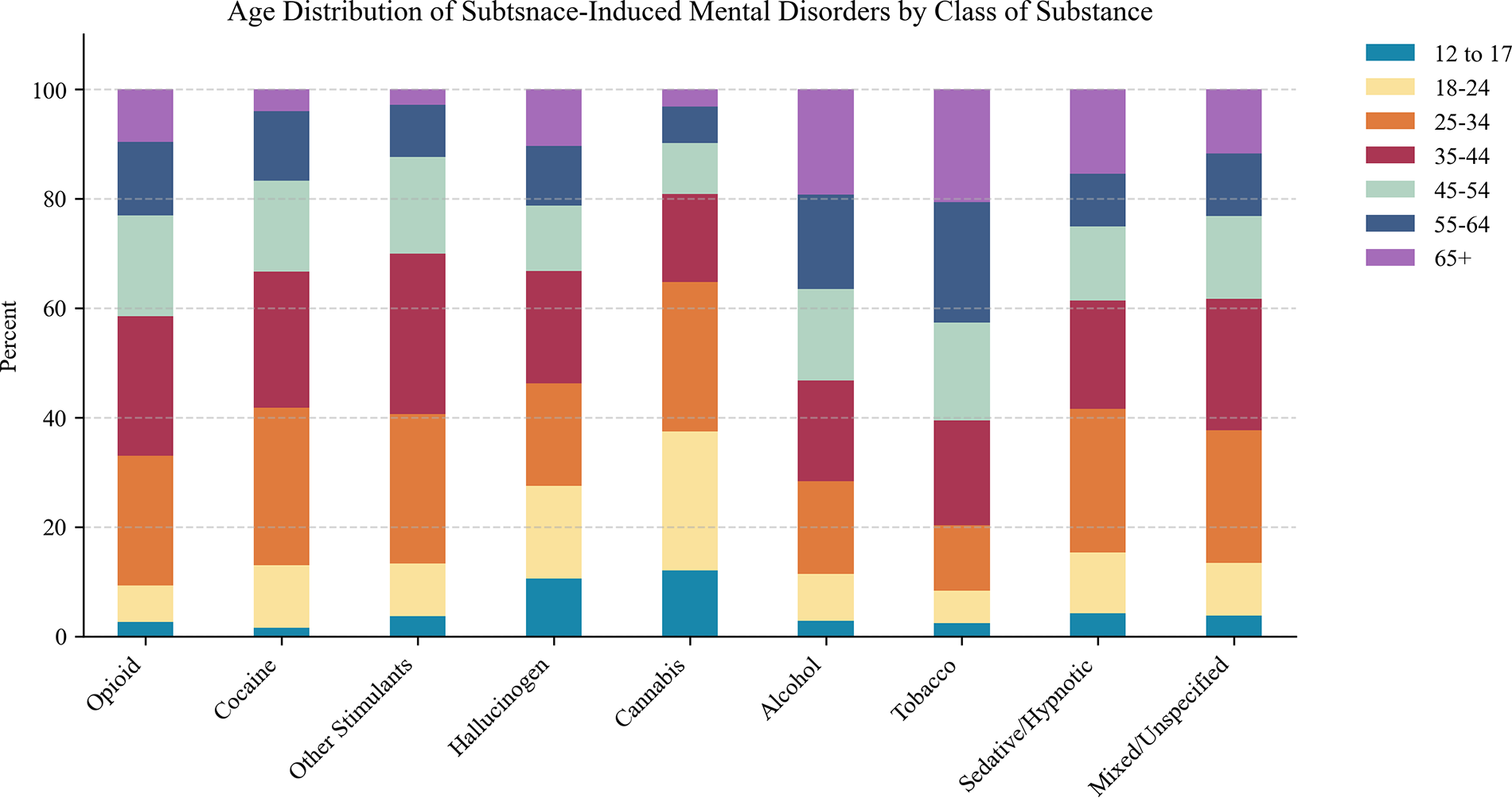
Table 2 summarizes the characteristics of incident SIMD cases by substance class. Narrative summaries for each class are provided in the Supplementary Material. Demographic, clinical and health service-use profiles varied markedly across substances. As shown in Figure 4, cannabis- and hallucinogen-related disorders tended to affect younger populations, with cannabis in particular showing the highest proportion of individuals under 18 (12.06%). Alcohol- and tobacco-related disorders were concentrated among older adults, with alcohol cases predominantly in those aged 65 and older. Sex distribution was male-dominated in all groups, though tobacco-related cases had the highest proportion of female patients, suggesting a more balanced gender profile in that subgroup.
Socio-demographic and clinical characteristics of incident and prevalent cases of substance-induced mental disorders, stratified by substance class

Table 2 Long description
Substance-class groups are compared on age, age bands, sex, care setting, diagnosis categories, concurrent substance use disorder, and involuntary treatment, with percentages calculated within each substance class. Mixed/unspecified has the largest count, followed by alcohol and then opioid and cannabis. Mean age is youngest for cannabis and oldest for tobacco, with alcohol also older than most other classes. Across age bands, cannabis and hallucinogen groups skew younger, while alcohol and tobacco include larger shares of older adults. Males are the majority in every class, though tobacco and sedative/hypnotics have relatively higher female shares than other classes. Clinic encounters are common across classes and are especially high for tobacco and mixed/unspecified, while emergency department use is highest for other stimulants and opioid and lowest for tobacco and alcohol. Psychosis is most frequent in mixed/unspecified and other stimulants, while anxiety disorders are highest in tobacco and alcohol; unspecified diagnoses are also common, particularly in opioid, cocaine, and other stimulants. Concurrent substance use disorder is highest for sedative/hypnotics and lowest for tobacco. Involuntary treatment is most often recorded as yes for cannabis and other stimulants, but missing data are substantial for most classes, especially tobacco and mixed/unspecified, so comparisons should be interpreted cautiously.
ED: emergency department; SUD: substance use disorder.
a Values represent column percentages within each substance class. Percentages are calculated using the total number of individuals classified in each substance-specific SIMD category as the denominator. Totals (n) for each substance class are provided in the column headers.
b Categories are not mutually exclusive; therefore, totals may exceed 100%.
Age group distribution of substance-induced mental disorders incidence across substance classes.

Figure 4 Long description
Stacked bar graph titled ′Age Distribution of Substance-Induced Mental Disorders by Class of Substance′. The graph features vertical bars for each substance class: Opioid, Cocaine, Other Stimulants, Hallucinogen, Cannabis, Alcohol, Tobacco, Sedative or Hypnotics, Mixed or Unspecified. The y-axis represents percent, ranging from 0 to 100. The legend indicates age groups: 12 to 17, 18 to 24, 25 to 34, 35 to 44, 45 to 54, 55 to 64 and 65 plus. Each bar is divided into segments corresponding to these age groups. Cannabis and hallucinogens show higher proportions in younger age groups, particularly 18 to 24. Alcohol and tobacco have larger segments in older age groups, especially 55 to 64 and 65 plus. The legend colors map to the age group segments in the bars, highlighting age distribution trends across substances.
Patterns of healthcare utilization also differed. Hospital admissions were most frequent for stimulant-related disorders (cocaine and other stimulants), which also had the highest rates of involuntary admission, exceeding 50% for other stimulants. In contrast, tobacco and mixed/unspecified cases were more often managed in outpatient settings and had the lowest rates of involuntary hospitalization.
Across substances, unspecified mental disorders were the most common diagnosis, however, distinctions were observed in the second most common diagnoses: anxiety disorders were prominent in tobacco and alcohol cases; psychotic disorders were dominant in stimulant-related and mixed/unspecified cases (over half of patients); mood disorders were more frequent in cannabis- and sedative/hypnotic-related cases; and neurocognitive disorders were more common among alcohol and sedative users. Concurrent SUD was widespread but ranged in magnitude, from 42% in sedative/hypnotic and 34% in opioid cases to 10% in tobacco, 18% in hallucinogen and 17% in mixed/unspecified groups.
Exploratory regression analysis
The odds ratios (ORs) and 95% confidence intervals from the multivariable regression analysis are presented in the Supplementary Material (Appendix Table 6). Compared with the middle-aged population, individuals under 25 and those over 45 had lower odds of SIMD. Female sex was also associated with lower odds of SIMD (OR = 0.63). Relative to Vancouver Coastal Health, an urban HA that hosts several of the province’s largest tertiary care and specialized mental health services, other HAs generally had higher odds of incident SIMD, with particularly elevated odds observed in Vancouver Island and Northern Health (ORs = 1.49 and 1.78, respectively). Compared with residents of large and medium urban areas, those living in small urban, rural and remote regions had progressively higher odds of SIMD incidence. In terms of socioeconomic status, individuals in lower and lowest income groups had approximately 3.5-fold and 2-fold higher odds of SIMD, respectively, compared to top earners.
Discussion
This study represents the first population-level investigation of the epidemiology of substance-induced mental disorders using administrative health data. The primary aim was to estimate the incidence and prevalence of these conditions by analysing emergency department, hospital and outpatient records in BC between 2022 and 2023. Over this two-year period, we found prevalence and incidence rates of 172 and 78 per 10,000 population, respectively.
Prior Canadian and international research has examined co-occurring disorders rather than SIMDs. For example, Rush et al. (Reference Rush, Urbanoski, Bassani, Castel, Wild, Strike, Kimberley and Somers2008), Young et al. (Reference Young, Tanner, Crocker, Sharpe, Lu and Kurdyak2024) and Khan (Reference Khan2017) used cycles of the Canadian Community Health Survey (CCHS) to estimate the prevalence of concurrent or dual diagnoses. Our findings are not directly comparable, as our case definition was more specific and required psychiatric diagnoses to occur subsequent to substance exposure. A closer parallel is the study by Rognli et al. (Reference Rognli, Taipale, Hjorthøj, Mittendorfer-rutz, Bramness, Heiberg and Niemelä2023), which reported incidence rates of substance-induced psychoses (SIP) in Denmark, Norway, and Sweden ranging from 9.3 to 14.1 per 100,000, nearly three times higher than the annual incidence observed in our study. Their narrower focus on psychotic disorders, a subset of our broader case definition, reflects that these discrepancies may arise from more inclusive diagnostic practices, different substance use patterns or more responsive health systems in Scandinavia that facilitate earlier recognition of SIP cases that may remain undetected in Canada (Gedeon et al., Reference Gedeon, Sandell, Birkemose, Kakko, Rúnarsdóttir, Simojoki, Clausen, Nyberg, Littlewood and Alho2019).
Both the prevalence and incidence of SIMD were higher in males than in females, with male-to-female ratios of 1.4 and 1.6, respectively. These findings are consistent with the 2012 CCHS data and align with broader evidence showing that SUDs are more common in males, with rates of alcohol and drug use disorders nearly twice as high compared with females across studies (Merikangas and McClair, Reference Merikangas and McClair2012). At the same time, women often experience more severe medical, psychiatric and functional consequences of SUDs, pointing to important sex- and gender-related differences in risk and outcomes (McHugh et al., Reference McHugh, Votaw, Sugarman and Greenfield2017). While the 2012 CCHS reported the highest prevalence of concurrent disorders among youth aged 15–24, adults accounted for the majority of SIMD cases in our study. This shift may partly reflect the ageing of earlier cohorts across the decade between the two analyses.
Temporal patterns showed that both incidence and prevalence followed similar trajectories, with peaks observed during the first half of 2023 and were fairly consistent across classes of substance. Several factors may help explain this increase, including heightened availability of potent substances, changes in clinical practices that facilitated greater recognition of SIMD and policy shifts that reduced stigma and encouraged service use. For example, the decriminalization pilot implemented in BC on 31 January 2023, may have encouraged more people who use drugs to seek care without fear of criminal prosecution (Ali et al., Reference Ali, Russell, Torres-salbach, Lo, Bonn, Bardwell, Budau, Hyshka and Rehm2025). National drug enforcement data also point to a changing substance use landscape: in 2023, cocaine trafficking was the leading drug-related offence in Canada, with an 11.7% increase from the previous year, followed by methamphetamines and opioids other than heroin. Although cannabis is legal, enforcement remains active, with importation and exportation violations in 2023 accounting for nearly two-thirds of Cannabis Act offences since 2019 (Statistics Canada, 2024). These patterns suggest a convergence of policy, clinical and supply-side dynamics that may have contributed to the observed rise in SIMD; however, these explanations remain speculative and warrant future investigation.
Regional variation was observed, with Northern and Vancouver Island Health Authorities recording the highest incidence and prevalence of SIMD. This pattern mirrors findings from the BC Coroners Service, which reported that Northern Health experienced the highest rate of toxic drug deaths during the same period, at 70.9 per 100,000 population. The convergence of high SIMD rates and toxic drug mortality underscores the disproportionate burden borne by regions with more remote and rural populations, where access to health services is often limited. Consistent with this, our exploratory regression analysis also revealed a clear “social gradient” across age, sex, rurality and neighbourhood income levels. These findings suggest that geographic, social and structural factors may contribute to increased vulnerability. Such disparities indicate that prevention and treatment resources are not evenly distributed relative to need, and that service access may be constrained in more remote areas. Addressing these inequities will require closer examination of how health system capacity and geographic context shape patterns of SIMD and substance-related harms.
Our study also demonstrates that SIMD does not always co-occur with SUD. Only about one-third of prevalent cases and 18% of incident cases were diagnosed with a concurrent SUD. Findings imply that acute or even first-time exposures to psychoactive substances, as well as chronic use, may trigger psychiatric syndromes. Still, our methodology may underestimate true comorbidity, since we considered only the first qualifying SIMD record per person, meaning prior or subsequent SUD diagnoses may not have been captured. Another key observation was that nearly half of cases were attributed to unspecified, unknown or mixed substances, likely reflecting either underreporting by patients, diagnostic uncertainty by providers or limitations in toxicological confirmation.
When stratified by substance class, both regulated substances, such as tobacco, cannabis and alcohol, and unregulated substances, including opioids and stimulants, were implicated in SIMD. The psychiatric conditions most frequently associated with these disorders were anxiety and psychosis. These findings align with evidence from a recent review on substance-induced psychosis, which reported that psychoactive substances, particularly when used in potent forms, can substantially increase the risk of both onset and chronic progression of psychotic disorders (Fiorentini et al., Reference Fiorentini, Cantù, Crisanti, Cereda, Oldani and Brambilla2021). Clinically, this is significant because it highlights diagnostic domains that clinicians should pay close attention to when assessing individuals with suspected substance-related mental health presentations.
Nevertheless, caution is warranted in interpretation. Administrative data lack the granularity to unequivocally establish causality or temporal sequence, making it difficult to determine whether psychiatric conditions were directly induced by substances or whether they predated and possibly contributed to substance use. Although our algorithm was designed to preserve a temporal ordering between substance-related events and subsequent psychiatric diagnoses, the retrospective nature of the study and the limitations inherent in administrative data constrain causal interpretation. These limitations may reduce our ability to distinguish pre-existing psychiatric conditions from those that are truly substance-induced. In particular, psychiatric diagnoses recorded shortly after a substance-related event may represent pre-existing but previously undiagnosed or undocumented disorders. Moreover, socioeconomic adversity, trauma and genetic predisposition are well-established risk factors for both substance use and psychiatric disorders, further complicating causal inference.
Several limitations of this study should be acknowledged. First, the reliance on administrative data required the exclusion of records with missing identifiers, which likely represent highly marginalized groups such as people experiencing homelessness or individuals without health coverage. Our analysis also did not capture individuals who accessed care outside the provincial insurance system (e.g., community-based services, private clinics, shelters) or those who never engaged with formal healthcare. Consequently, the true burden of SIMD may have been underestimated. Second, misclassification remains a concern, as diagnostic coding accuracy varies across providers and facilities. Third, the absence of individual-level socio-demographic variables, such as race/ethnicity, Indigenous identity, immigration status, sexual orientation and personal income, limited our ability to examine health inequities. Although neighbourhood-level income quintiles and urban/rural classifications provided partial context, these proxies do not capture the complexity of individual-level social determinants. It is also important to note that the data reflect the population of BC and may not be generalizable to other provinces or countries, as trends are shaped by local policies, health system structures and substance use contexts. Also, we deliberately restricted the timeline to minimize overlap with COVID-19 pandemic and potential influence of pandemic measures on the estimates, and we acknowledge that this decision tightens the observation period. Finally, missing data for certain covariates, particularly geographic variables, were handled by creating a separate “missing” category, which may have reduced interpretability.
Despite limitations, this study provides, to our knowledge, the first population-based evidence on the epidemiology of SIMD during a period of escalating toxic drug deaths. By leveraging large-scale, linked administrative data and applying diagnostic criteria aligned with DSM-5 and ICD-9/10, we generated contemporary, population-based estimates that capture both incidence and prevalence. Our case identification algorithm was designed to maximize inclusivity while maintaining specificity, thereby reducing misclassification. Stratification by sex, age, geography and substance class enabled us to identify key disparities and highlight populations at elevated risk. Reporting geo-socio-demographic characteristics for both incident and prevalent populations, as well as for individual substance classes, further provides actionable insights to guide targeted interventions by health providers and policy makers. Importantly, the estimates generated here establish a baseline that can be used in future investigations to enable longitudinal comparisons and evaluate time trends in SIMD across changing policy, clinical and substance use contexts.
The findings demonstrate a substantial and heterogeneous burden, with marked regional disparities and a significant proportion of cases occurring outside the context of diagnosed SUD. These results underscore the urgent need for integrated psychiatric and substance use care, regionally tailored service planning and sustained monitoring of these conditions within the ongoing overdose emergency. As many countries are implementing or considering similar drug policy and harm-reduction initiatives, comparative research across jurisdictions will be essential to clarify which patterns are context-specific versus generalizable, inform international guidelines for integrated care and support coordinated global efforts to reduce morbidity and relieve pressure on health systems.
Conclusion
This study provides timely, population-based estimates of substance-induced mental disorders in BC. The findings revealed substantial burden, demographic and geographic distributions and distinct patterns across substance classes. This underscores the need for heightened clinical awareness, targeted prevention strategies and regionally tailored service planning. Continued surveillance, coupled with research on social determinants and evolving drug supply dynamics, will be essential to address these under-recognized yet pressing mental health conditions.
Supplementary material
The supplementary material for this article can be found at https://doi.org/10.1017/S2045796026100869.
Availability of data and materials
Data for this study were accessed through Population Data BC following a thorough review and approval process by the relevant data stewards. Access to data provided by the Data Stewards is subject to approval but can be requested for research projects through the Data Stewards or their designated service providers. The following data sets were used in this study: National Ambulatory Care Reporting System, Medical Services Plan (MSP) Payment Information File, Discharge Abstract Database (Hospital Separations), Consolidation File (MSP Registration & Premium Billing). You can find further information regarding these data sets by visiting the PopData project webpage at: https://my.popdata.bc.ca/project_listings/24-042. All inferences, opinions and conclusions drawn in this publication are those of the authors and do not reflect the opinions or policies of the Data Steward(s).
Acknowledgements
The use of Generative AI in this manuscript was limited to the use of ChatGPT for checking sentences and paragraphs for correctness, coherence and clarity.
Author contributions
M.M.: Conceptualization, methodology, investigation, data curation, writing – original draft, visualization, project administration. C.G.S.: Methodology, writing – review & editing. R.K.: Writing – review & editing. A.K.: Writing – review & editing. J.H.P.: Methodology, writing – review & editing, supervision. All authors have read and approved the final version of the manuscript.
Financial support
This research received no specific grant from any funding agency, commercial or not-for-profit sectors.
Competing interests
Dr. Christian G. Schütz holds a partner academic appointment with the University of British Columbia (UBC), supported by funding from the Provincial Health Services Authority (PHSA). He also works as a psychiatrist and clinician scientist at PHSA. Additionally, Dr. Schütz serves on the advisory board of Clearmind, a startup focused on medication development. Other authors declare that they have no competing interests, relevant financial interests, personal relationships or affiliations that could have influenced the research presented in this paper.
Ethical standards
Ethics approval was obtained from the University of British Columbia Behavioural Research Ethics Board (UBC BREB H24-00203).




 Open access

