Introduction
Prior research has demonstrated positive associations between neighbourhood poverty and cumulative biological risk (CBR) (Diez Roux & Mair, Reference Diez Roux and Mair2010; Schulz et al., Reference Schulz, Mentz, Lachance, Johnson, Gaines and Israel2012). CBR has been conceptualized as indicative of the effects of stress on biological functioning (McEwen, Reference McEwen2008), and has been linked with increased risk of morbidity and mortality (Seeman et al., Reference Seeman, Crimmins, Huang, Singer, Bucur and Gruenewald2004a; Juster et al., Reference Juster, McEwen and Lupien2010). These adverse effects of stress on health occur through multiple pathways and may accumulate over time, contributing to racial, ethnic and socioeconomic inequities in health (House, Reference House2002; Diez Roux & Mair, Reference Diez Roux and Mair2010; Phelan et al., Reference Phelan, Link and Tehranifar2010). These effects appear to occur through contextual, behavioural and physiological mechanisms (House, Reference House2002; Phelan et al., Reference Phelan, Link and Tehranifar2010), including: effects of local environmental conditions (e.g. food access) on health-related behaviours (e.g. diet, physical activity) (Morland et al., Reference Morland, Wing and Diez-Roux2002; Larson & Story, Reference Larson and Story2009; Zenk et al., Reference Zenk, Schulz, Kannan, Lachance, Mentz and Ridella2009; Izumi et al., Reference Izumi, Zenk, Schulz, Mentz and Wilson2011) and biological indicators of health (e.g. body fat, blood pressure) (Dengel et al., Reference Dengel, Hearst, Harmon, Forsyth and Lytle2009); environmental conditions that are conducive to stress, with links to health outcomes through physiologic responses to stress (Selye, Reference Selye1982; Lazarus & Folkman, Reference Lazarus and Folkman1984); and physical exposures that may be inimical to health (e.g. air pollutants) (Brochu et al., Reference Brochu, Yanosky, Paciorek, Schwartz, Chen, Herrick and Suh2011).
One pathway through which neighbourhood poverty may contribute to adverse health outcomes is by reducing potential protective effects of positive social relationships, although evidence is mixed (Diez Roux & Mair, Reference Diez Roux and Mair2010). Prior studies have suggested that supportive social relationships may be health protective (Thoits, Reference Thoits2011; Uchino et al., Reference Uchino, Bowen, Carlisle and Birmingham2012), and that such positive social relationships may be eroded under conditions of poverty (Franzini et al., Reference Franzini, Caughy, Spears and Esquer2005). Commonly conceptualized at the individual level, social relationships are theorized to promote health through behavioural (e.g. health-promoting behaviours) (Umberson et al., Reference Umberson, Crosnoe and Reczek2010), psychosocial (e.g. symbolic meaning, norms, social support) (Umberson et al., Reference Umberson, Crosnoe and Reczek2010; Thoits, Reference Thoits2011) and physiological pathways (e.g. reduced cardiovascular reactivity) (Glynn et al., Reference Glynn, Christenfeld and Gerin1999). In addition to their individual-level effects, social relationships may also be conceptualized collectively as social characteristics within a locality (Macintyre et al., Reference Macintyre, Ellaway and Cummins2002). To date, few studies have examined associations between neighbourhood poverty, social relationships and physical health, and the majority of these have used self-reported indicators of health (Diez Roux & Mair, Reference Diez Roux and Mair2010).
This paper examines whether social relationships are protective against the adverse effects of neighbourhood poverty on cumulative biological risk – a clinical and anthropometric indicator of biological risk – and the extent to which social relationships may mediate associations between neighbourhood poverty and CBR.
Background
Neighbourhood socioeconomic position and health
A robust body of evidence links neighbourhood socioeconomic position (SEP) with health (Pickett & Pearl, Reference Pickett and Pearl2001; Borrell et al., Reference Borrell, Diez Roux, Rose, Catellier and Clark2004; Cox et al., Reference Cox, Boyle, Davey, Feng and Morris2007; Winkleby et al., Reference Winkleby, Sundquist and Cubbin2007; Mair et al., Reference Mair, Diez Roux and Galea2008; Diez Roux & Mair, Reference Diez Roux and Mair2010). This study is grounded in theoretical frameworks and empirical evidence linking neighbourhood socioeconomic characteristics to health through effects on neighbourhood physical and social characteristics (Schulz et al., Reference Schulz, Kannan, Dvonch, Israel, Allen and James2005a). Studies of neighbourhood social environments to date have been largely guided by social disorganization theory (Shaw & McKay, Reference Shaw and McKay1969). This theory suggests that neighbourhood conditions that are conducive to economic and social stress (e.g., neighbourhood poverty) may contribute to neighbourhood disorder as social relationships among residents weaken (Shaw & McKay, Reference Shaw and McKay1969). That is, under conditions of economic and social stress, neighbourhood residents encounter conflicting values and tensions (Shaw & McKay, Reference Shaw and McKay1969), and those tensions may have negative implications for collective social relationships within the neighbourhood. To the extent that these social relationships are health protective, their erosion may have adverse health implications (Shaw & McKay, Reference Shaw and McKay1969). Social disorganization theory has been critiqued for its limited attention to structural forces that shape neighbourhood social relationships and norms (Ralph, Reference Ralph2014). The purpose of this paper is to attempt to partially address this critique through explicit attention to structural socioeconomic inequities in health outcomes, and the potential role of social characteristics in mediating these associations.
The following section provides a review of the literature on associations between neighbourhood SEP, health and four indicators of social relationships: social support, neighbourhood satisfaction, social cohesion and neighbourhood participation. Because social relationships can be conceptualized at both the individual and neighbourhood level, this section closes with a brief review of methodological approaches to disentangling these effects.
Social support is conceptualized as access to relationships that provide emotional, instrumental, appraisal and informational support (Uchino, Reference Uchino2009; Umberson & Montez, Reference Umberson and Montez2010; Thoits, Reference Thoits2011). While substantial evidence links social support, assessed at the individual level, to multiple indicators of health (Seeman et al., Reference Seeman, Glei, Goldman, Weinstein, Singer and Lin2004b; Uchino, Reference Uchino2006, Reference Uchino2009; Thoits, Reference Thoits2011), some studies suggest that individuals who are experiencing an adverse health outcome may leverage support to cope with their health concerns (Uchino, Reference Uchino2006; Sampson et al., Reference Sampson, Parker, Cheezum, Lewis, O’Toole and Patton2013). Additionally, the evidence linking social support to neighbourhood SEP is mixed. Individual-level social support has been found to partially mediate an inverse association between neighbourhood poverty and depressive symptoms (Kim, Reference Kim2010). As a between-neighbourhood phenomenon, neighbourhood-level social support mediated the association between neighbourhood poverty, neighbourhood disorder and self-rated health (Franzini et al., Reference Franzini, Caughy, Spears and Esquer2005). Kim (Reference Kim2010) posited that residents of high-poverty neighbourhoods may build relationships with neighbours to cope with neighbourhood stressors.
A second indicator of social relationships is neighbourhood satisfaction, conceptualized as residents’ satisfaction with the neighbourhood. Hipp (Reference Hipp2009) reported positive associations between individual reports of neighbourhood satisfaction and neighbourhood educational attainment, but not neighbourhood household income. Kruger and colleagues (2007) reported an inverse association between neighbourhood satisfaction and depressive symptoms. In a more specific test of mediation, Weden and colleagues (2008) reported that neighbourhood satisfaction mediated associations between a composite measure of neighbourhood disadvantage and self-rated health.
Social cohesion indicates the functional aspects of community such as shared sense of membership, influence, social integration and mutual emotional connections among neighbourhood residents (Chavis et al., Reference Chavis, Hogge, McMillan and Wandersman1986; Parker et al., Reference Parker, Lichtenstein, Schulz, Israel, Schork, Steinman and James2001). Prior studies have reported that elements of social cohesion are positively correlated with neighbourhood SEP (Franzini et al., Reference Franzini, Caughy, Spears and Esquer2005), self-rated physical and mental health (Echeverria et al., Reference Echeverria, Diez-Roux, Shea, Borrell and Jackson2008; Elliott et al., Reference Elliott, Gale, Parsons and Kuh2014), and inversely associated with incidence of myocardial infarction (Kim et al., Reference Kim, Hawes and Smith2014). In a multilevel analysis, Rios and colleagues (2012) found that trust and shared values among neighbours, and dependability of neighbours, assessed at the neighbourhood level, partially mediated associations between neighbourhood SEP and self-rated health and psychological distress.
Neighbourhood participation, measured by participation in informal or formal neighbourhood organizations and activities, may be indicative of social integration, with social ties developing through such participation (Thoits, Reference Thoits2011). Following a different interpretation of social disorganization theory (Shaw & McKay, Reference Shaw and McKay1969), others have conceptualized neighbourhood participation as an indicator of conflicting social values, as those who participate more actively may do so in order to address conditions in their neighbourhoods with which they are dissatisfied (Sampson et al., Reference Sampson, Raudenbush and Earls1997; Swaroop & Morenoff, Reference Swaroop and Morenoff2006). Perhaps reflecting these different mechanisms, Swaroop and Morenoff (Reference Swaroop and Morenoff2006) reported that with the exception of neighbourhoods with the highest levels of poverty, neighbourhood participation was higher in low-SEP neighbourhoods, where residents may organize to address community needs. Neighbourhood participation is positively associated with well-being (Dupere & Perkins, Reference Dupere and Perkins2007) and inversely associated with rise in cortisol levels (an indicator of physiologic response to chronic stress) after waking (Karb et al., Reference Karb, Elliott, Dowd and Morenoff2012). Daniel and colleagues (Reference Daniel, Moore and Kestens2008) suggested that problem-solving behaviours intending to exercise control over one’s environment, such as neighbourhood participation, may mediate or moderate associations between neighbourhood poverty and cardiometabolic disease.
Multilevel models are useful for disentangling individual-level effects from neighbourhood-level effects on health. While multilevel mediation models have gained increasing attention in recent years, potential confounding is possible when within-group effects differ from between-group effects (Raudenbush & Bryk, Reference Raudenbush and Bryk2002). This challenge is generally addressed through the use of multilevel models that account for individual-level characteristics while examining the independent contributions of variance in aggregated characteristics across neighbourhoods (Ellaway & Macintyre, Reference Ellaway and Macintyre2000; Subramanian et al., Reference Subramanian, Lochner and Kawachi2003; Franzini et al., Reference Franzini, Caughy, Spears and Esquer2005). Some studies of the association of neighbourhood SEP, social relations and health have engaged multilevel models to disentangle individual from neighbourhood-level effects. The analyses presented below employ a multilevel modeling approach.
Research questions and hypotheses
The research questions that have guided this analysis build on, and extend, this body of research to cumulative biological risk (CBR) – a robust indicator of health (Seeman et al., Reference Seeman, Epel, Gruenewald, Karlamangla and McEwen2010; King et al., Reference King, Morenoff and House2011). This study focuses on three main questions: 1) are individual- and neighbourhood-level social relationships inversely associated with CBR; 2) are social relationships protective against CBR; and 3) are associations between neighbourhood poverty and CBR mediated through corrosive effects of neighbourhood poverty on social relationships? This study is guided by the following hypotheses, based on the literature reviewed above: social relationships, as individual- and neighbourhood-level characteristics, are associated with lower levels of CBR; and social relations, assessed at the individual and neighbourhood levels, mediate the inimical association of neighbourhood poverty and CBR.
Methods
Data
Data for this study were drawn from the Healthy Environments Partnership (HEP) 2002–2003 Community Survey (Schulz et al., Reference Schulz, Kannan, Dvonch, Israel, Allen and James2005a) and 2000 Census US data. The HEP Community Survey was collected as part of a community-based participatory research study in Detroit, Michigan, USA (Schulz et al., Reference Schulz, Kannan, Dvonch, Israel, Allen and James2005a).
The HEP Community Survey was conducted with a stratified two-stage probability sample of occupied housing units, designed for 1000 completed interviews with adults age ≥25 years across three areas of Detroit (Schulz et al., Reference Schulz, Kannan, Dvonch, Israel, Allen and James2005a). The survey sample was designed to achieve adequate variation in SEP within each of the three predominant racial/ethnic groups in Detroit: non-Latino Black (NLB), Latino and non-Latino White (NLW). Interviews were completed with 75% of households in which an eligible respondent was identified (919/1220) and 90% of households in which an eligible respondent was contacted (919/1027) (Schulz et al., Reference Schulz, Kannan, Dvonch, Israel, Allen and James2005a). The final sample consisted of 919 respondents nested within 146 blocks and 69 census block groups. Sample weights were created to account for differential selection and response rates and to match the sample to Census 2000 population distributions of the racial/ethnic groups across SEP in the study communities (Schulz et al., Reference Schulz, Zenk, Kannan, Israel, Koch and Stokes2005b).
Clinical and anthropometric measures taken at the time of the survey and used in this analysis included: resting blood pressure, measured three times by phlebotomists using a portable cuff device (Omron model HEM 711AC) that passed Association for the Advancement of Medical Instrumentation standards (Yarows & Brook, Reference Yarows and Brook2000), from which the mean of the second and third measurements was derived (LeBrón et al., Reference LeBrón, Schulz, Mentz and White-Perkins2015, Reference LeBrón, Schulz, Mentz, Reyes, Gamboa and Israel2018); waist circumference (cm); height (cm); and weight (pounds) using a calibrated scale. Glucose, albumin, total cholesterol and high (HDL) and low (LDL) density lipid levels were derived from fasting blood samples.
Measures
Dependent variable
The dependent variable – cumulative biological risk (CBR) – is an individual-level measure adapted from similar measures to assess cumulative physiological tolls on biological systems (Seeman et al., Reference Seeman, Epel, Gruenewald, Karlamangla and McEwen2010; King et al., Reference King, Morenoff and House2011). It included indicators of cardiovascular and metabolic dimensions of biological risk and self-reported use of medication for hypertension, diabetes and hypercholesterolaemia. A CBR index was calculated as the sum of the following indicators: SBP≥140 mmHg; DBP≥90 mmHg; waist circumference≥102 cm (males) or ≥88 cm (females); glucose≥110; triglycerides≥150; total cholesterol>240 or total cholesterol≤240 and LDL≥ 130; and HDL<40 (males) or <50 (females). Building on previous studies (Geronimus et al., Reference Geronimus, Hicken, Keene and Bound2006), the index includes points for individuals whose: SBP and DBP were below the high blood pressure criteria and who were taking hypertension medication; glucose levels were below the high-risk criteria and were taking medication; and lipid levels were within the normal range and were taking dyslipidaemia medication. The mean for this index was 2.63 (SE=0.07, min=0, max=7).
Independent variables
Independent variables included self-report measures of social relationships derived from survey data examined at the individual level and aggregated to the block group level as a characteristic of the neighbourhood. Social support was a seven-item mean scale, including dimensions of emotional (e.g. someone to confide in, to trust to help solve problems, who makes you feel loved and cared for) and instrumental (e.g. help around the house, if sick, if couldn’t use car, or if needed to borrow money) support. Response options ranged from never (1) to always (5) (Cronbach’s alpha=0.72). Neighbourhood satisfaction was a single item assessing the extent to which participants agreed with the statement: I would move out of this neighbourhood if I could. Response categories ranged from strongly agree (1) to strongly disagree (5). Social cohesion was a six-item mean scale measuring membership, influence, integration and emotional connection to the community (Chavis et al., Reference Chavis, Hogge, McMillan and Wandersman1986; Parker et al., Reference Parker, Lichtenstein, Schulz, Israel, Schork, Steinman and James2001). Example items include: people in this neighbourhood share the same values, and I feel at home in this neighbourhood. Response options ranged from strongly agree (1) to strongly disagree (5), reverse coded so that a high score indicates high social cohesion (Cronbach’s alpha=0.78). Neighbourhood participation assessed participation in organized neighbourhood activities such as: (1) attending block clubs, neighbourhood association or police meetings; (2) participation in a neighbourhood cleanup or beautification project, crime watch or other neighbourhood activity; and (3) serving on a committee, organizing meetings or serving in a position of leadership for any local organization (e.g. block club, church, school or other organization). This variable was dichotomized into participation in at least one of these three domains (1) and no participation (0).
Neighbourhood poverty, assessed at the Census block group level, was the percentage of households below the poverty line, derived from 2000 Census data. This measure was constructed in quintiles, with 1=<21.9%; 2=≥21.9%<28.3%; 3=≥28.3%<32.5%; 4=≥32.5%<42.0%; and 5=≥42.0% (referent) to allow for non-linear associations. Neighbourhood-level control variables included percentage NLB and percentage Latino.
Covariates
Control variables included individual demographic characteristics and health-related behaviours. Demographic variables included: age (years); sex (1=female); self-reported race/ethnicity categorized as NLB, NLW and Latino; education (1=≥12 years); length of neighbourhood residence; and a dichotomous indicator of household poverty, calculated using the poverty-to-income ratio for 2000 US poverty thresholds (1=≤poverty) (US Census Bureau, 2011). Length of neighbourhood residence was assessed by participant reports of the number of months or years they had lived in their neighbourhood.
Four indicators of health-related behaviours were included as controls to assess the extent to which social relationships are associated with CBR through pathways that are distinct from behaviours. Metabolic minutes was a continuous measure of physical activity using the 2005 International Physical Activity Questionnaire (IPAQ Research Committee, 2005). Dietary practices was a continuous measure assessed using the Healthy Eating Index (HEI) – a composite measure of daily servings of food groups and nutrients (Kennedy et al., Reference Kennedy, Ohls, Carlson and Fleming1995). Smoking was assessed through items asking about current and former tobacco, cigar and tobacco pipe use (Gentry et al., Reference Gentry, Kalsbeek, Hogelin, Jones, Gaines and Forman1985; Frazier et al., Reference Frazier, Franks and Sanderson1992), coded as a categorical variable (current=0, former=1, never=2). An analysis of descriptive statistics indicated a modest though statistically significant correlation between physical activity and dietary practices (r=0.08; p=0.01). Because these are control variables, rather than independent variables, both were retained in the models as covariates. Alcohol use was assessed as self-reported frequency and amount of alcohol use (Block et al., Reference Block, Coyle, Hartman and Scoppa1994). Due to its skewed distribution (with more than half of participants reporting no alcohol consumption), alcohol use was dichotomized (1=any drinks/month, 0=none).
Statistical analysis
Hierarchical linear models were used to test these research questions regarding the effects of social indicators on CBR and their potential mediation of the association of CBR and neighbourhood poverty. Potential confounding in multilevel mediation effects estimates can arise when within-group effects differ from between-group effects when conducting these tests. The appropriate methodological approach to test unbiased mediation effects is to disentangle the individual effects from the characteristics of the neighbourhood (Ellaway & Macintyre, Reference Ellaway and Macintyre2000; Subramanian et al., Reference Subramanian, Lochner and Kawachi2003). To use this approach, consistent with the structure of the data, two-level hierarchical regression models were used for a continuous outcome, using HLM 7.0 (Scientific Software International, Lincolnwood, IL, 2006). At the upper level of multilevel models, standard error estimates are more robust for a larger number of groups (e.g. block groups) regardless of the group size (e.g. number of individuals in a block group) (Maas & Hox, Reference Maas and Hox2005). There were 919 survey participants nested within 69 block groups, with an average of thirteen individuals per block group.
To test the cross-sectional mediation (MacKinnon & Fairchild, Reference MacKinnon and Fairchild2009) of social relationships on the association of poverty and CBR, this study followed recommendations by Zhang and Preacher (Reference Zhang and Preacher2009) for an unbiased approach for testing mediation when using multilevel data. Specifically, the following model was used, using social support (SS) as an example:
 $${\rm Level}\,1\,\left( {{\rm individual}} \right)\,\colon\,{\rm CBR}{\equals}\beta _{0} {\plus}\beta _{1} \left( {{\rm SS}{\minus}{\rm Mean }\left( {{\rm SS}} \right)} \right){\plus}\,\ldots\,$$
 $${\rm Level}\,2\,\left( {{\rm neighbourhood}} \right)\,\colon\,\gamma _{0} {\equals}\delta _{0} {\plus}\delta _{1}^{'} {\times}{\rm poverty}{\plus}\delta _{2}^{'} {\times}{\rm Mean} ({\rm SS})\,\ldots\,$$
In this model, the individual-level measure was grand mean centred and its aggregate at the block group level was included at the neighbourhood level. The mediation test statistics proposed by Freedman and Schatzkin (Reference Freedman and Schatzkin1992) suggested using the difference in the point estimates in models with and without the mediator, standardized by the joint variance. Using model (1) as an example, it can be written as:
 $$t_{{N{\minus}2}} {\equals}{{\delta _{1} {\minus}\delta _{1} {\rm '}} \over {\sqrt {\sigma _{{\delta _{1} }}^{2} {\plus}\sigma _{{\delta _{1} ^{{\rm '}} }}^{2} {\minus}2\sigma _{{\delta _{1} }} \sigma _{{\delta _{1} {\rm '}}} \sqrt {1{\minus\rho _}} } }}$$
where
 $\delta _{1} $
and
 $\delta _{{1 }}^{'} $
are the parameters testing for the poverty effect when social support is excluded and included from the model respectively, and ρ refers to the correlation between the independent variable (poverty) and the mediator (SS).
The individual-level parameter represents the expected effect of a difference in CBR between two participants in the same neighbourhood who differ by one unit in the social relationship indicator. The neighbourhood-level parameter indicates the expected effect of a one-unit difference in neighbourhood-level social relations for two residents with the same individual-level social relationship indicator who live in neighbourhoods with different neighbourhood mean levels of the social relationship indicator on CBR (within-neighbourhood effect). The difference between these two parameters (i.e. individual and neighbourhood) is the between-neighbourhood effect, which indicates the effect of different neighbourhood mean levels of social relations on CBR. Models assessing this research question also included neighbourhood poverty and neighbourhood level and individual demographic controls.
Although the proportion of missing data (6%) was low, multiple imputation procedures derived from Bayesian models (Barnard et al., Reference Barnard, Rubin and Schenker2001) were used to impute missing values using the %IMPUTE routine (IVEware, Ann Arbor MI) in SAS 9.1 (SAS Institute Inc., Cary NC). Multiple imputations allowed the complete case approach to be used and thus obtain robust standard error estimates (Rubin, Reference Rubin1996). In sensitivity analyses, participants who were taking medication for hypertension, diabetes or cholesterol at the time of the assessment were excluded from the high-risk CBR sub-categories.
Results
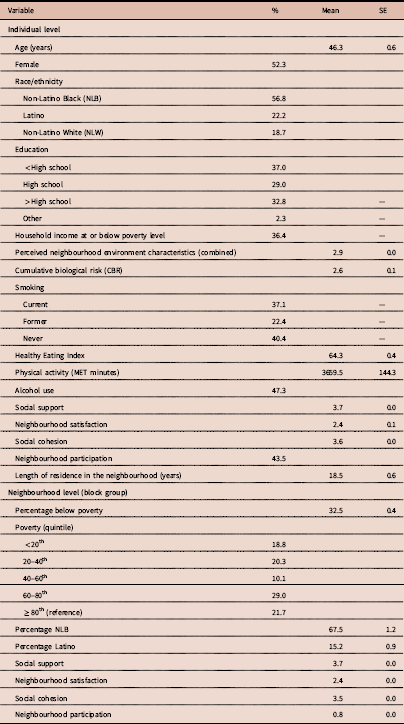
Table 1 shows descriptive statistics for the individual and block group variables. Slightly more than half of the participants were female; about one-fifth identified as Latino or NLW, with the majority of participants identifying as NLB. Approximately one-third of participants had less than a high school education and nearly 40% reported household incomes at or below the federal poverty level. This reflects the sampling design, intending to sample housing units across SEP for the three largest racial/ethnic groups in Detroit. Sampling design weights, described in the Methods section, adjust this distribution to reflect the distribution of Detroit residents by household and Census tract poverty level in Detroit at the time the survey was conducted. At the block group level, on average about one-third of households had incomes at or below the poverty level, reflecting the distribution of households below the poverty line, and about two-thirds of households were NLB.
Descriptive statistics of study sample for individual- and neighbourhood-level variables (N=919), Detroit, US, 2002–2003

Weighted means and standard error are reported for individual-level variables; unweighted means and standard deviations are reported for neighbourhood-level variables.
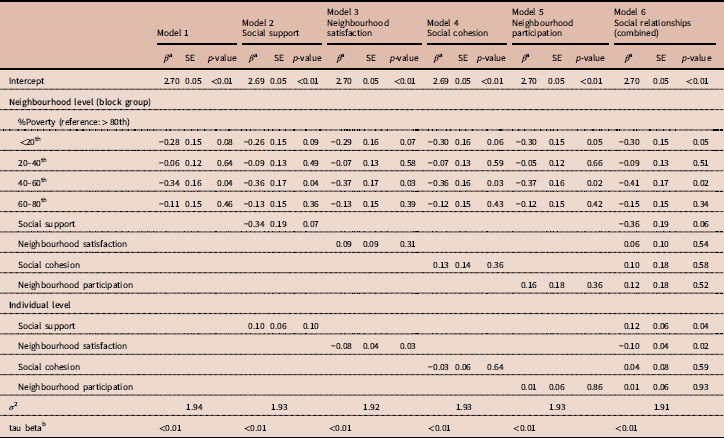
Table 2 shows results from multilevel regression analyses testing associations between neighbourhood poverty, social relationships and CBR. Model 1 indicates positive associations between neighbourhood poverty and CBR, accounting for individual-level controls (Schulz et al., Reference Schulz, Mentz, Lachance, Zenk, Johnson, Stokes and Mandell2013). Models 2–5 each add one measure of social relationships (social support, neighbourhood satisfaction, social cohesion and neighbourhood participation) and Model 6 includes all four social relationship measures.
Cumulative biological risk regressed on neighbourhood poverty and social relationships
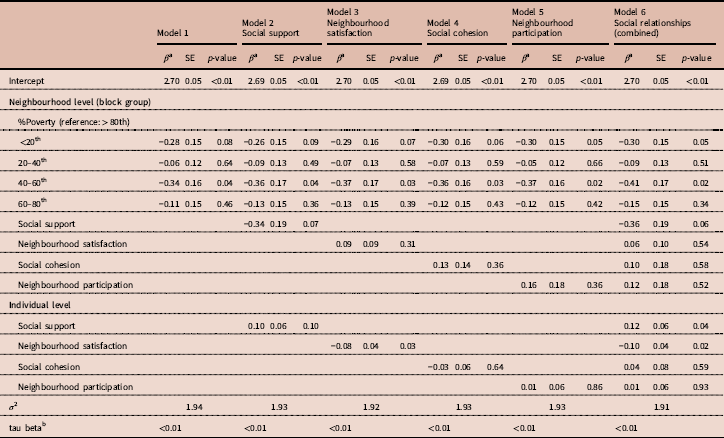
a Neighbourhood-level controls include percentage NLB and Latino residents. Individual-level controls include: age, sex, educational attainment, race/ethnicity, household poverty level, physical activity, Healthy Eating Index, alcohol use, smoking and length of neighbourhood residence.
b tau beta indicates the Kendall correlation rank coefficient.
As indicated in Models 2–5, when included individually in models, patterns suggest a trend towards a positive association between social support and CBR at the individual level (β=0.10, SE=0.06, p=0.095) and a negative association at the neighbourhood level (β=−0.34, SE=0.19, p=0.07; Model 2). Individual-level neighbourhood satisfaction was inversely associated with CBR (β=−0.08, SE=0.04, p=0.03), with no significant association at the neighbourhood level (β=0.09, SE=0.09, p=0.31; Model 3). Social cohesion (Model 4) and neighbourhood participation (Model 5) were not significantly associated with CBR at either the individual or neighbourhood levels. When all four social relationship indicators were included together (Model 6) similar patterns were identified. Individual-level social support was positively associated with CBR (β=0.12, SE=0.06, p=0.04), while neighbourhood-level social support showed an inverse association (β=−0.36, SE=0.19, p=0.06), though this latter association was only marginally significant. In this same model, individual-level neighbourhood satisfaction was inversely associated with CBR (β=−0.10, SE=0.04, p=0.02), while there was no difference in CBR by neighbourhood-level neighbourhood satisfaction (β=0.06, SE=0.10, p=0.54). Results suggest no association of social cohesion (individual: β=0.04, SE=0.08, p=0.59; neighbourhood: β=0.10, SE=0.18, p=0.58) or neighbourhood participation (individual: β=0.01, SE=0.06, p=0.93; neighbourhood: β=0.12, SE=0.18, p=0.52) with CBR.
As shown in Table 3, between-neighbourhood effect estimates based on Model 6 of Table 2 suggest that residents of neighbourhoods with higher mean social support had marginally significantly lower CBR than residents of neighbourhoods with lower mean social support (β=−0.24, SE=0.15, p=0.06), accounting for individual and neighbourhood controls and other social relationship indicators. Thus, as advanced by Raudenbusch (Raudenbush & Bryk, Reference Raudenbush and Bryk2002), while individual-level social support was positively associated with CBR, neighbourhood-level social support trended towards an inverse or protective effect. Across neighbourhoods, there was no difference in the association of neighbourhood satisfaction (β=−0.04, SE=0.13, p=0.38), social cohesion (β=0.14, SE=0.08, p=0.95) or neighbourhood participation (β=0.12, SE=0.15, p=0.78) with CBR.
Tests of individual- and neighbourhood-level associations of social relationships and cumulative biological risk

a Coefficients based upon tests generated from Table 2, Model 6 (Raudenbush & Bryk, Reference Raudenbush and Bryk2002).
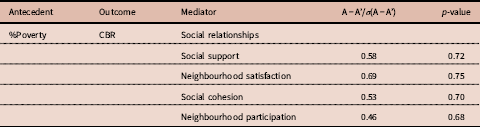
Table 4 shows results from tests of the hypothesis that associations between neighbourhood poverty and CBR are mediated by social relationships. Results provide no support for the hypothesis that any of the four indicators of social relationships examined significantly mediate associations between neighbourhood poverty and CBR.
Tests of mediation of associations between neighbourhood poverty and cumulative biological risk by indicator of social relationshipsFootnote a

a Tests were conducted using Freeman and Schatzkin tests for mediation, difference in association between the antecedent and outcome without the mediator in the model (A) and with the mediator included in the model (A’): A−A’/σ(A−A’).
Finally, in sensitivity analyses, participants who were taking medication for conditions encompassed in this measure were removed from the high-risk CBR sub-categories. Results did not indicate substantial differences in the associations between neighbourhood poverty, social relations and CBR when removing participants who were taking medication at the time of the assessment (data not shown).
Discussion
There are three key findings from the research reported here. First, the results indicate that social support is associated with cumulative biological risk: on average, individuals reporting higher levels of social support had higher CBR, whereas when comparing two individuals differing in individual-level social support living in the same neighbourhood, neighbourhood-level social support was inversely, though marginally, significantly associated with CBR. This pattern held after accounting for neighbourhood poverty, other indicators of social relationships, health-related behaviours and demographic characteristics. Second, on average, individuals reporting higher levels of self-reported neighbourhood satisfaction had lower CBR after accounting for neighbourhood poverty and neighbourhood and individual characteristics. There was no association between neighbourhood-level neighbourhood satisfaction and CBR. The results presented here do not provide evidence that social cohesion or neighbourhood participation – assessed as individual and within-neighbourhood characteristics – were associated with CBR. Third, when comparing two individuals with similar individual-level social support, residents of neighbourhoods with higher average social support had lower CBR than residents of neighbourhoods with lower average social support. Results do not indicate support for a between-neighbourhood association of neighbourhood satisfaction, social cohesion and neighbourhood participation and CBR. Results indicate no evidence that any of the four indicators of social relationships mediated associations between neighbourhood poverty and CBR. Rather, associations between neighbourhood poverty and CBR remained robust after accounting for all four measures of social relationships. The results reported above lend little support to social disorganization theory – specifically that associations between neighbourhood poverty and health may be mediated by effects of neighbourhood poverty on social relationships. Results are consistent with conceptual frameworks suggesting that health is influenced by a complex interplay of individual and neighbourhood characteristics. Each of these findings is discussed in greater detail below.
Are individual- and neighbourhood-level social relationships protective of health?
Results reported here indicate modest and mixed support for the hypothesis that social relationships are protective of health. Individual-level social support was positively associated with CBR, contrary to the hypothesized direction of effect. This finding joins a small literature with similar findings. For example, Cousson-Gélie and colleagues (Reference Cousson-Gélie, Bruchon-Schweitzer, Dilhuydy and Jutand2007) reported a positive association of social support and breast cancer mortality. A larger literature suggests that greater social support may be associated with favourable self-reported health and clinically assessed indicators of reduced cardiovascular risk (Seeman et al., Reference Seeman, Glei, Goldman, Weinstein, Singer and Lin2004b; Uchino, Reference Uchino2006, Reference Uchino2009; Umberson & Montez, Reference Umberson and Montez2010), and that neighbourhood SEP and social support are linked to health (Franzini et al., Reference Franzini, Caughy, Spears and Esquer2005; Kim, Reference Kim2010). The latter studies used self-reported health indicators and are thus vulnerable to same-source bias, whereas the present study was strengthened by the use of clinical and anthropometric health indicators (Duncan & Raudenbush, Reference Duncan and Raudenbush1999). For example, Kim (Reference Kim2010) and Franzini and colleagues (2005) found that greater social support was associated with fewer depressive symptoms and more favourable self-rated health, respectively, accounting for neighbourhood SEP. Residents with less-favourable health may seek and mobilize greater social support and build relationships with neighbours in order to cope with health concerns (Uchino, Reference Uchino2006; Sampson et al., Reference Sampson, Parker, Cheezum, Lewis, O’Toole and Patton2013), which could help to explain the positive association of social support and CBR reported here. Additionally, under conditions of chronic stress, the physiologic effects of social support on CBR may manifest over time, whereas associations of social support with depressive symptoms may be more immediate (Umberson & Montez, Reference Umberson and Montez2010). The review of the literature described above – regarding associations of social support, neighbourhood SEP and health – identified one study by Kim (Reference Kim2010) that incorporated cross-sectional and three-year follow-up measures of health, and no studies that explicitly examined these associations over time. A cross-sectional association of social support and health may reflect those with poorer health mobilizing greater social support (Uchino, Reference Uchino2006), which would then suggest a positive association of social support and health in cross-sectional analyses. This cross-sectional analysis is not able to disentangle the extent to which associations reflect garnering of socially supportive relations as health concerns have emerged or the health implications of social resources over the life course.
Neighbourhood-level social support was inversely associated with CBR. Holding individual-level social support constant, an individual living in a neighbourhood with higher neighbourhood social support would experience reduced CBR compared with an individual in a neighbourhood with lower mean neighbourhood social support. Findings presented here extend and strengthen those previously reported through the use of an objective measure of CBR derived from clinical and anthropometric data, reducing the risk of single-source bias (Podsakoff & Organ, Reference Podsakoff and Organ1986). In addition, the use of multilevel models allows us to disentangle individual- from neighbourhood-level effects, in this case suggesting differing patterns and potential pathways at individual and neighbourhood levels.
The association of neighbourhood satisfaction with CBR was contingent upon whether it was assessed as an individual or neighbourhood characteristic. While there was no association of neighbourhood-level neighbourhood satisfaction with CBR, residents reporting higher individual-level neighbourhood satisfaction had lower CBR than residents reporting lower neighbourhood satisfaction – an association that operated independent of neighbourhood poverty and health-related behaviours. This inverse association of individual-level neighbourhood satisfaction and CBR resonates with the literature indicating an association of greater neighbourhood satisfaction with better self-rated mental and overall health (Kruger et al., Reference Kruger, Reischl and Gee2007; Weden et al., Reference Weden, Carpiano and Robert2008). The results reported here extend previously reported associations of neighbourhood satisfaction to indicators of cardiovascular risk. Different individual- and neighbourhood-level associations of neighbourhood satisfaction with CBR suggest a need to examine the aspects of neighbourhood satisfaction (e.g. quality of life, social ties to neighbours) that may shape health differently across contexts. This is, based on the review of literature described above, the first attempt to test such an association as a neighbourhood-level characteristic. Previous reports of associations between neighbourhood satisfaction and depressive symptoms were modelled at the individual level (Kruger et al., Reference Kruger, Reischl and Gee2007).
The divergent individual-level associations of social support and neighbourhood satisfaction with CBR reported here may reflect different aspects of relationships assessed by these measures. The indicator of social support assessed supportive relationships on which participants perceived they could draw – relationships that were not bound by a particular geographic area. In contrast, neighbourhood satisfaction assessed residents’ satisfaction with their specific residential neighbourhood. Additionally, assessments of neighbourhood satisfaction could be informed by social, physical and economic aspects of participants’ neighbourhood, including, but not limited to, social relationships with neighbours. These contrasting associations of individual-level social support and neighbourhood satisfaction with CBR suggest a need to disentangle dimensions of social relationships that shape health, and for studies that evaluate these associations with clinical and anthropometric measures of health.
Results do not provide support for the hypothesis of an inverse association between social cohesion and CBR, contrary to cross-sectional studies involving self-reported indicators of health (Rios et al., Reference Rios, Aiken and Zautra2012; Elliott et al., Reference Elliott, Gale, Parsons and Kuh2014) and one longitudinal study of the incidence of cardiovascular events (Kim et al., Reference Kim, Hawes and Smith2014). The implications of social cohesion for CBR may unfold over a longer period than that for self-reported health indicators. Additionally, the results presented here differ from associations previously reported with neighbourhood participation and mental health, suggesting that the associations are sensitive to health indicators, and as reported by Dupere and Perkins (2007), to neighbourhood social and physical conditions. Differences in independent (e.g. typologies with multiple components) and dependent measures used across these studies (e.g. mental health, self-reported health) may contribute to these differences.
Are social relationships as between-neighbourhood characteristics protective of health?
Results indicate limited support that social relationships, as between-neighbourhood characteristics, are protective against CBR. Patterns across neighbourhoods indicate a marginally significant inverse association between neighbourhood-level social support and CBR. This finding is consistent with the hypothesis that neighbourhood-level social support may be health protective, and is consistent with results reported by Franzini and colleagues (2005) indicating a positive association between neighbourhood-level social support and self-rated health. Results did not support the hypothesis of a between-neighbourhood association of neighbourhood satisfaction, social cohesion and neighbourhood participation with CBR, accounting for neighbourhood poverty, and other individual and neighbourhood factors.
Do neighbourhood social relationships mediate associations between neighbourhood poverty and CBR?
Based on tests of mediation, the null hypothesis that social relationships do not mediate associations between neighbourhood poverty and CBR cannot be ruled out. Results suggest that associations between neighbourhood poverty and CBR operate through pathways that are independent from the effects of social relationships. Previously reported findings suggest that perceived and observed neighbourhood conditions mediate associations between neighbourhood poverty and CBR (Schulz et al., Reference Schulz, Mentz, Lachance, Zenk, Johnson, Stokes and Mandell2013), suggesting that these pathways are distinct from the effects of social relationships.
The finding of no mediating role of these four indicators of social relations on the association of neighbourhood poverty and CBR contributes to a modest literature, some of which suggests a mediation effect. These differences may reflect differences across studies in terms of indicators of neighbourhood SEP (i.e. individual vs composite indicator) and health (i.e. self-rated vs clinically and anthropometrically assessed). Additionally, several previous studies involved older, more economically advantaged residents and neighbourhoods, and larger geographic regions (e.g. national samples, states metropolitan areas). In this Detroit-based sample, the lowest quintile of neighbourhood poverty was <21.9%, reflecting a high percentage of households below the poverty line.
These findings of no mediation effect of social relations on the association of neighbourhood poverty and CBR, alongside a persistent association of neighbourhood poverty and CBR, are not consistent with social disorganization theory (Shaw & McKay, Reference Shaw and McKay1969). In post hoc analyses, neighbourhood poverty was not significantly associated with any of the social relationship indicators, suggesting that adverse health implications of neighbourhood poverty were independent of effects on social relationships. Accordingly, interventions to promote and protect social relations may not alter associations of neighbourhood poverty and CBR, particularly in areas where poverty is fairly highly concentrated such as the neighbourhoods included in this study. Based on the findings reported here, interventions to improve neighbourhood economic conditions may promote health, including, for example, policies to lift communities out of poverty, programmes to mitigate the adverse health implications of poverty and interventions and policies that improve neighbourhood physical contexts, particularly in neighbourhoods characterized by high levels of poverty (Stock et al., Reference Stock, Corlyon, Serrano and Gieve2014).
Study limitations and strengths
This study has several limitations. The use of cross-sectional data precludes the establishment of causal associations (MacKinnon & Fairchild, Reference MacKinnon and Fairchild2009). Additionally, the study sample was drawn from low-to-moderate income, predominantly Latino and NLB communities in Detroit, and is not representative of the US as a whole. Future research, with samples with larger income gradients and other geographic areas, may yield stronger associations between neighbourhood SEP, social relationships and health. Furthermore, tests of neighbourhood social relationships were limited to four indicators, and do not reflect the entire set of social relationships that might be examined. The indicator of neighbourhood participation used in this study best assesses any neighbourhood participation on the part of the study participant. It does not capture other characteristics of neighbourhood participation such as frequency, type of participation, motivations for participation or household-level neighbourhood participation. Moreover, the neighbourhood-level measure of social relationships consisted of the mean of each indicator of social relationships reported by individual participants in the same neighbourhood. Thus, it does not reflect an independent indicator of social relationships in the neighbourhood as a whole. Further, a small subset of block groups had low within-group sample sizes. However, the strength of upper-level estimates in multilevel models is contingent upon the larger sample size of neighbourhoods rather than the number of individuals within each neighbourhood (Maas & Hox, Reference Maas and Hox2005). In this dataset, the 69 block groups had an average of thirteen individual indicators. The large number of block groups lends strength to these findings. Finally, while the study controlled for length of residence, it did not disentangle life course implications of length of neighbourhood residence for the associations reported here. Future studies that are adequately powered with a large enough sample size are warranted that examine variations in these associations by age and other social statuses, such as gender.
Despite these limitations, this study extends the literature in several important ways. It contributes to the literature that conceptualizes social relationships as characteristics of individual residents and neighbourhood contexts, and tests their role in associations between neighbourhood poverty and health. The use of multiple indicators of social relationships facilitates an examination of the aspects of social relationships that may shape health differently. The health indicator, cumulative biological risk (Seeman et al., Reference Seeman, Epel, Gruenewald, Karlamangla and McEwen2010; King et al., Reference King, Morenoff and House2011) is a robust and objective measure of health, and extends previous studies that have relied upon self-reported health outcomes.
Conclusions
Results reported here indicate limited evidence for associations between social relationships and CBR. Contrary to hypotheses, individual-level social support was positively associated with CBR, while neighbourhood-level social support operated in the hypothesized direction. This may reflect a pattern in which individuals with higher CBR experience greater social support due to health challenges and that as a neighbourhood characteristic, social support is health protective. Associations between individual-level neighbourhood satisfaction and CBR were in the hypothesized direction, with individuals reporting higher levels of satisfaction with their neighbourhoods having lower CBR. The findings reported here are consistent with the idea that social support as a neighbourhood characteristic, and neighbourhood satisfaction among residents within neighbourhoods, are health protective. Findings suggest that associations of social support and neighbourhood satisfaction with CBR operate independently of, and do not mediate, associations of neighbourhood poverty and health-related behaviours – factors previously demonstrated to be associated with CBR (Schulz et al., Reference Schulz, Mentz, Lachance, Johnson, Gaines and Israel2012, Reference Schulz, Mentz, Lachance, Zenk, Johnson, Stokes and Mandell2013). These findings are consistent with the idea that neighbourhood poverty is associated with CBR through pathways other than the indicators of social relationships tested here. As such, interventions to strengthen socially supportive relationships may complement policies to promote health, but should not be considered an alternative to interventions designed to directly address neighbourhood poverty and its effects on cardiovascular risk.
Acknowledgments
The Healthy Environments Partnership (HEP) (www.hepdetroit.org) is a community-based participatory research partnership affiliated with the Detroit Community-Academic Urban Research Center (www.detroiturc.org). We thank the members of the HEP Steering Committee for their contributions to the work presented here, including representatives from Chandler Park Conservancy, Detroit Health Department, Detroit Hispanic Development Corporation, Detroit Institute for Population Health, Eastside Community Network, Friends of Parkside, Henry Ford Health System, the University of Michigan School of Public Health and community members at large. We thank the HEP Community Survey participants for their participation in the study.
Ethical Approval
Data collection procedures accorded with ethical standards for the treatment of human subjects and with the Helsinki Declaration. The University of Michigan Institutional Review Board approved this study in January 2001.
Conflicts of Interest
The authors have no conflicts of interest to declare.
Funding
The study and analysis were supported by the National Institute of Environmental Health Sciences (NIEHS) (R01ES10936, R01ES014234); National Institute of Minority Health and Health Disparities (NIMHD) (P60 MD002249, R24MD001619); the University of Michigan Center for Research on Ethnicity, Culture, and Health; and the University of Michigan National Center for Institutional Diversity. The results presented here are solely the responsibility of the authors and do not necessarily represent the views of these supporting institutions.