INTRODUCTION
Radiation dermatitis is a common toxicity experienced by patients receiving radiotherapy. It may result in a significant impact on quality of life and can subsequently impact on treatment compliance and results. While the effects will settle once treatment is complete, early symptoms may develop after only 2–3 weeks of treatment and may deteriorate. Despite recent advances in radiotherapy planning, such as intensity modulation, up to 90% of patients will experience a dose dependant skin reaction.Reference Salvo, Barnes and Van Draanen1 There is no clear consensus on how to treat or prevent this reaction. A survey on practice in the United KingdomReference Harris, Probst and Beardmore2 revealed a range of skin care regimes in use. Although not evidence based, for example, avoidance of metallic-based topical agents is advised by many radiation oncology centres.Reference Harper, Franklin, Jenrette and Aguero3
The goal of management skin care therapy is to provide moisture, aid healing, prevent infection and decrease patient discomfort. Current management strategies are mostly focused on prevention and a variety of studies have been carried out to examine the effect of different creams.Reference Hemati, Asnaashari and Sarvizadeh4–Reference Thornton Sann, Tutrone and Weinberg6 However, a variety in methods, subjective scoring systems and small sample size make it difficult to draw conclusions about the best therapies. As a result, many treatment decisions are based upon clinical experience, expert opinion, safety profile, cost and access.Reference McQuestion7
The use of topical therapy appears to be one of the most controversial areas. There appear to be two different causes of apprehension regarding the application of cream during radiotherapy treatment:
∙ Metallic elements contained within the cream may cause a dose enhancement owing to increased photon interaction probability, namely the mass energy absorption coefficient, μ en/ρ. This may increase dose to the skin and therefore, increase the skin reactions experienced by patients. Burch et al.Reference Burch, Parker, Vann and Arazie8 measured surface dose after exposure to a variety of skin care products and found no difference between metallic and non-metallic deodorants. No assessment with metallic-based creams could be found.
∙ A bolus effect may be caused by a layer of cream on the surface of the skin. This concern has probably lead to the widely adopted policy that applying cream should be avoided in the 4 hours before a radiotherapy session, without any evidence to support it.Reference Bieck and Phillips9 A recent study using MOSFET detectors and Monte Carlo techniques has shown that a typical application of cream provides no significant bolus effect to increase skin doseReference Morley, Cashell, Sperduti, McQuestion and Chow10. This work does not address this further, but solely compares samples of cream that contain metal against a control that does not.
Silver sulfadiazine cream (SSDC) typically contains 1% (10 mg/g) of silver sulfadiazine. It has been used extensively for the treatment of burns for many years although its efficacy has been questioned in a Cochrane review.Reference Wasiak, Cleland and Campbell11 Radiotherapists are often reluctant to use SSDC while patients are receiving radiotherapy. We were able to find guidance recommending that SSDC is not used during treatment to treat radiation dermatitis in both a systematic reviewReference Salvo, Barnes and Van Draanen1 and a website designed for guiding physicians treatment decisions.12 However, McQuestion states that the cream can be used owing to its ability to reach high concentration in an effected area and provide local antimicrobial action.Reference McQuestion7 One small study (n=102) does suggest a benefit from using the cream during adjuvant radiotherapy following mastectomy for breast cancer. In this study radiation dermatitis was reduced when compared with general skin care alone. A blinded observer assessed the severity of dermatitis weekly during patient’s treatment and graded it from 0 to 4 according to the Radiation Therapy Oncology Group criteria. The intervention group had a lower score for skin injury compared with control (5·49±1·02 versus 7·21±1·76, p<0·001). Two patients in the control group discontinued the radiotherapy course because of severe skin injuries. A multivariate analysis found that the use of SSDC was significantly associated with a decreased skin injury (p<0·001).Reference Hemati, Asnaashari and Sarvizadeh4 On the basis of this study, it received a weak recommendation for use during breast radiotherapy by the MASCC Skin Toxicity Study Group.Reference Wong, Bensadoun and Boers-Doets13
Zinc oxide cream (ZOC) is available as an over the counter treatment for minor skin burns. The cream contains a water-repellent base (consisting of oils and waxes); protective and emollient agents (including zinc oxide (ZnO)), antibacterial and antifungal agents and a weak anaesthetic.14 We have experience of radiographers and physicians recommending that patients do not use this cream during treatment because of the metallic content. However, no data or guidance could be found on why this is the case. Owing to its relatively high concentration of Zinc we chose to investigate the dose effect of this cream also.
Only one previous study could be foundReference Burch, Parker, Vann and Arazie8 in the literature that attempted to measure the dosimetric effects of metallic elements present in products applied to the skin. No creams with metallic ingredients were included in the study, but several deodorants and talcum powder (containing aluminium/zirconium and magnesium, respectively) were tested using a PTW Markus chamber placed below a <0·1 mm layer of polyethylene with the product deposited above. The maximum increase in surface dose for any of these products was 2·4% of the dose at the depth of maximum dose in a 5×5 cm2 6 MV beam at a source-to-surface distance (SSD) of 100 cm. A noted limitation of the study was that the thickness of product was not determined, but a ‘normal application’ was applied. Controlling thickness becomes more important when performing measurements close to a phantom surface owing to the very steep dose gradient in the build-up region.
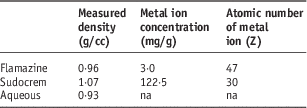
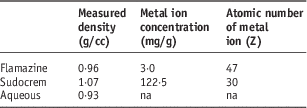
The brands of SSDC and ZOC used in this study were Flamazine® and Sudocrem®, respectively.Table 1 shows the key physical properties of each of these creams. It is noted that the metal ion concentration in SSDC is very low, particularly when compared with ZOC. The atomic number of the respective ions, however, is similar and an increase in total μ en/ρ will likely result but the magnitude of the effect needs to be quantified.
Comparison of physical properties of Flamazine, Sudocrem and aqueous cream
This study aimed to measure any increase in dose close to the surface of SSDC and ZOC compared with aqueous cream (AQC). The rationale that creams containing metal ions should not be used by patients during radiotherapy was investigated. SSDC was investigated as its use appears controversial yet there may be clinical benefit in the treatment of radiodermatitis. ZnO also has the properties required in a topical therapy and was felt to provide an interesting comparator owing to its relatively higher metallic concentration.
METHODS
Two tests were devised to demonstrate the potential effect of metallic elements in creams on the radiation dose distribution. In both tests, AQC (Aqueous cream BP; Pinewood Laboratories Ltd, Ballymacarby, Co. Tipperary, Ireland) was used as a control. The cream was chosen as it contains no metal ions and is frequently used by patients during their radiation treatment.
The first test was used to provide a measurement of the creams’ radiodensity. Universal containers (20 mL) were filled with each cream and then submerged in a water filled phantom. Each cream was scanned using a Philips Brilliance Big Bore computed tomography scanner (Phillips Health care, DA Best, Netherlands). A region of interest was drawn on the central slice in the centre of the cream and the mean Hounsfield unit (HU) was converted to relative electron density (RED) using the previously commissioned HU-to-density table. Figure 1 shows the universal container within the water phantom before scanning.
Universal container containing Sudocrem in water phantom.

The second test was to measure the relative change in dose in well-controlled conditions; for this we created a sachet of each cream. Each sachet was made from poly pocket plastic wallets and contained 26 g of cream with a thickness of ~3 mm. Each sachet was exposed, in a RW3 solid water phantom (PTW, Freiburg), to 100 monitor units of radiation. This was delivered with 100 kV photons (using a Gulmay D3300, Gulmay Ltd, Byfleet, Surrey Elekta Kungstensgaten, Stockholm, Sweeden) with a 5 cm diameter applicator and 6 MV photons with a 10×10 cm field (using an Elekta Precise linear accelerator). The exposure was performed three times for each cream and the dose was measured at effectively 60 μm from the cream surface using a PTW 23342 soft X-ray ion chamber (PTW, Freiberg, Germany). This detector has a plane-parallel design and thin entrance window. Relative doses were measured at effective depths of 9 mm for 100 kV and 5 cm for 6 MV. These positions on the percentage depth dose curves were ~80 and 86%, respectively.
For the 100 kV set up, as pictured in Figures 2 and 3, the ion chamber was placed face down above the cream sachets with the phantom surface at 30 SSD. This negates the need to precisely control the thickness of cream and allows better comparison against the AQC control. There is much less dependence on thickness when measuring differences in backscattered dose in this fashion, compared with measuring dose below the cream as the fall-off with depth is quite steep for 100 kV X-rays. However, while using the phantom in the 6 MV, 95 SSD set up, the creams were placed below the ion chamber as the effect of ±1 mm uncertainty in thickness would have negligible impact beyond the depth of maximum dose (15 mm).
Cream sachet placed below ion chamber in RW3 solid water phantom.
RW3 phantom set up for 100 kV exposure.
RESULTS
Figure 4 shows all three creams as scanned in the water phantom. The HU measured were: AQC, −69HU; SSDC, 17HU and ZOC, 662HU. Using our scanner’s commissioned HU-to-density table, these were converted to RED of 0·95, 1·04 and 1·40, respectively (where water is 1). AQC and SSDC therefore have RED very similar to water, and hence soft tissue, while the RED for ZOC appeared closer to that of bony tissue.
Computed tomography image showing radiodensity of all three creams in single scan.
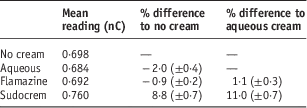
For the phantom exposures, the results for 100 kV are shown in Table 2. An increase in μ en/ρ owing to the metallic elements would be manifested as an increase in backscattered dose. There was only a small difference between SSDC and AQC (1·1%) but ZOC yielded a much larger increase (11·0%).
Results from 100 kV exposures
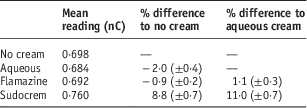
Dose differences are presented relative to no cream present, and relative to aqueous cream.
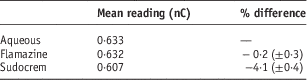
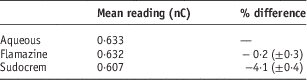
Similarly, with 6MV photons (see Table 3), very similar doses were measured with both AQC and SSDC (a difference of −0·2%) but with ZOC a difference of −4·1% was recorded. Reduced dose measured below the creams would infer a larger value of μ en/ρ within the cream itself.
Results from 6 MV exposures
DISCUSSION
These experiments have tested the relative effects on radiation dose distribution close to the interface of cream and phantom material of SSDC and ZOC relative to a control (AQC) for 100 kV and 6 MV photons. The results show that SSDC behaves in a similar fashion to AQC and by inference to any water-based cream. SSDC (at 1% w/w concentration) could be applied as frequently as AQCs, which currently are used more commonly during radiotherapy treatment. However, the effects seen with ZOC suggest that at a thickness many then times that of a normal application, an increase in photon interaction within the cream, especially for 100 kV radiation mean that further, more representative investigations are required.
The RED measurements give us another, perhaps more striking result. The values for SSDC and ACQ are similar to water, while the value for ZOC was closer to bone. Both SSDC and ZOC contain metals with atomic numbers much higher than water, however, the metal ion concentration in ZOC is 40 times higher than in SSDC, which is in agreement with the finding that μ en/ρ would appear to be larger based on measurements in both 100 kV and 6 MV photon beams.
Clearly, as this is not an in vivo system the conclusions that can be drawn are limited. Cream distribution within the skin, the thickness of the cream in and on top of the skin and the half-life of the products should ideally all be modelled to have certainty in the effects on the dose distribution. Further work is necessary to assess SSDC before clinical conclusions can be drawn. However, the results suggest that with SSDC further patient trials would be safe. Furthermore, this system could be used to assess the suitability of other creams that contain metal where there is doubt over there suitability during radiation treatment. For example, recent work has focused on Mometastone, a steroid cream formulated with aluminium and titanium. This appears to improve radiation dermatitis compared with emollient creams in breast cancer.Reference Ulff, Maroti, Serup and Falkmer15 Its suitability in patients receiving higher doses of radiotherapy to the skin surface, such as those seen while treating cancers of the head and neck, for example, have not been evaluated.
The current study does not address the effect of the creams in electron beams and as this method is used to treat many skin malignancies data obtained here could be useful. If the radiation dose is increased at the skin surface then a further study may even be performed to investigate their use in improving response to the treatment of superficial malignancies.
Further work should also involve using a Monte Carlo-based physics code to model the effect the different products have on dose distribution in therapeutic electron and photon beams, and more accurately represent a typical application of cream to the skin. Ascertaining the depth at which a cream is absorbed and knowledge of all the elemental constituents and abundances will be required to perform accurate simulations, but they could prove very useful owing to the difficulties in measuring these effects reliably with ionisation chambers or any detector close to the surface. Difficulties arise when secondary charged particle equilibrium is not established and there is contamination of electrons in an MV photon beam, for example.
CONCLUSION
The concentration of silver in Flamazine® (as an example of any SSDC) is not large enough to perturb dose any differently to AQC. Other work has shown there is minimal bolus effect from the creams.Reference Morley, Cashell, Sperduti, McQuestion and Chow10 We believe it would be safe to use during radiotherapy. However, an improved study combining Monte Carlo simulations and further measurements should be carried out for other creams containing metallic elements, such as Zinc, in order for conclusive results more representative of a patient treatment scenario to be found. Our methodology provides a simple and effective strategy to assess other creams.
Acknowledgements
None.